Tag: Green

  • Green skills, graduate competencies, and championing subject diversity – it’s time to join up some agendas 

    Green skills, graduate competencies, and championing subject diversity – it’s time to join up some agendas 

    Author:
    Rebecca Collins and Santiago Poeira Ribeiro

    Published:

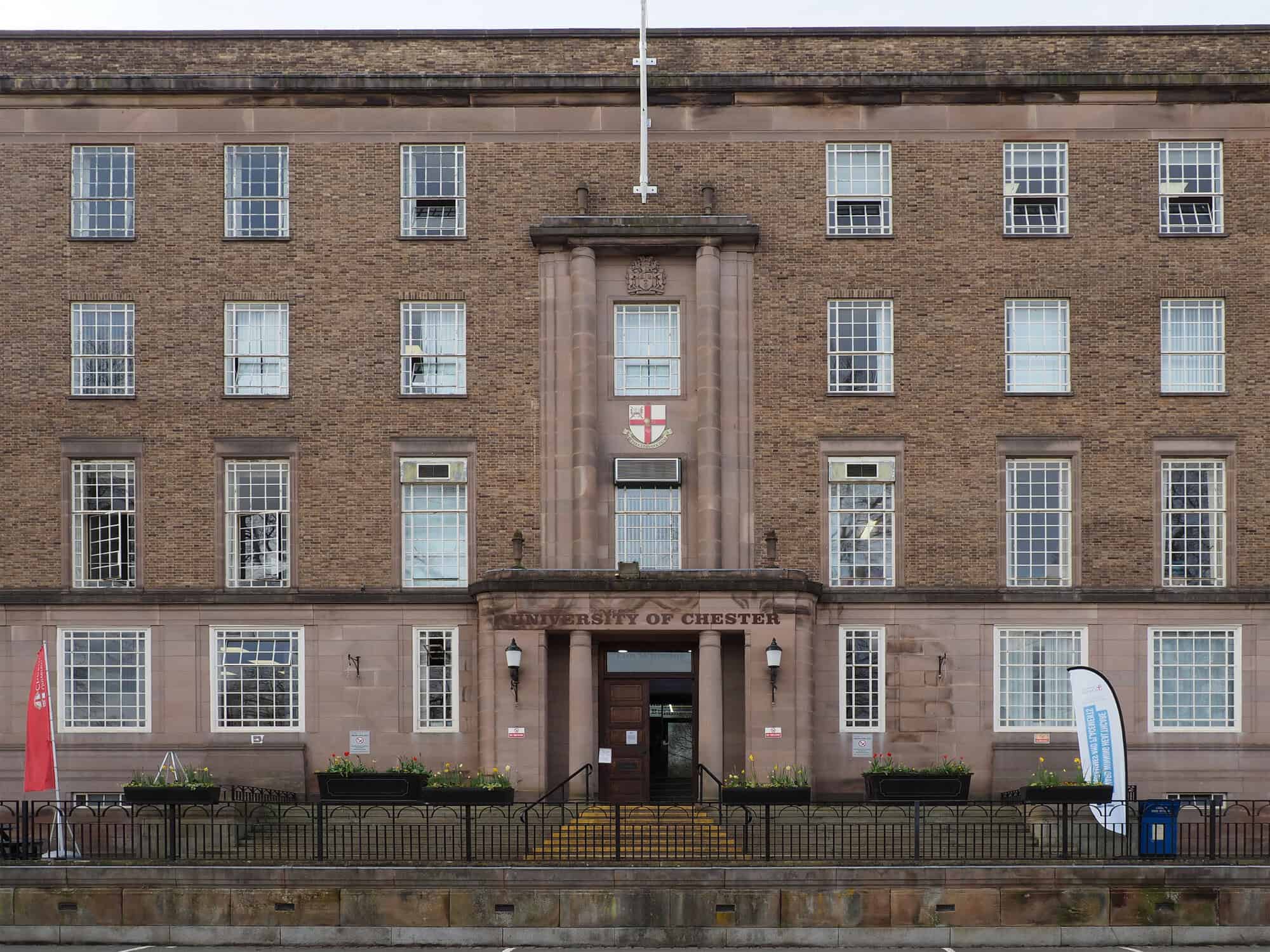
    This HEPI blog was kindly authored by Rebecca Collins, Director, Sustainability and Environment Research and Knowledge Exchange Institute, University of Chester and Santiago Poeira Ribeiro, student in Natural Sciences (Physics), University of Chester. 

    UK universities are currently grappling with a perfect storm of disruptors: financial challenges, ambivalence from national policymakers, and, increasingly, from prospective students as they question what a university education really offers them. At the same time, the employment landscape is weathering its own storms, including those driven by accelerating technological change (particularly AI), concerns about skills deficits, geopolitical turbulence, and equivocation about whether or not this net zero business is here to stay.  UK Government response to these challenges has most recently taken the form of Skills England’s analysis of the skills requirement across ten priority sectors and the promise of a new industrial strategy from 2026-27 that connects these requirements to reforms of the higher education system.  

    It is in this context that a strangely paradoxical scenario is playing out.  On the one hand are claims that the UK does not have the necessary skills for a ‘green transition’ to net zero – what are increasingly being described as ‘green skills’.  (Notwithstanding the current national political ambivalence about net zero, most sectors of the UK economy have long since recognised the necessary direction of travel and know they need an appropriately knowledgeable and skilled workforce to accelerate action.) On the other is a higher education sector beset by the contraction or closure of subject areas perceived by some political and industrial leaders as insufficiently relevant to our collective economic future, ‘green’ or otherwise. However, for many years now, UK higher education has cultivated students’ green skills through its commitment to education for sustainable development (EfSD), widely recognised as essential knowledge for graduates entering the workforce. Indeed, climate literacy training is now often embedded in university curricula, as well as becoming increasingly normalised as a core, if not mandatory, training requirement across a range of industry sectors. Whilst what EfSD looks like at different universities varies, the majority of institutions demonstrate some degree of engagement with this agenda across all subject areas, with some making it a flagship institutional policy.   

    UK higher education thus seems to be quite good already at cultivating green skills for graduates, and across a wide range of subject areas. How, then, does this map onto the very varied definitions of green skills that have emerged from different sectors? The proliferation of reports concerned with this topic has not (yet) resulted in a clear, unified definition. Rather, this tends to be determined by who is doing the defining. Considering the different definitions and concepts prioritised by different institutions, we propose that these intersecting concerns can ultimately be distilled into three main types of green skill: 

    1. Technical skills: particularly those needed to accelerate decarbonisation; concentration of this need in industries such as manufacturing, transportation, utilities and infrastructure.  
    1. Green-enabling skills: otherwise known as soft or transferable skills, including systems thinking, communication, collaboration, critical thinking, adaptability. 
    1. Values-based skills: such as environmental awareness, climate justice, democratic engagement, cultural sensitivity. 

    Whilst definition 1 skews towards STEM subjects (as well as forms of technical expertise developed through other forms of learning, such as apprenticeships or vocational training), definitions 2 and 3 are within the purview of many other subjects commonly studied at undergraduate level, particularly within the arts, humanities and social sciences.   

    It is a timely moment to be reflecting on the relationship between how skills deficit narratives are framed by some corners of industry and government, and how universities position their offer in response. It feels like every academic in UK higher education has a story about recent, current or imminent institution-wide curriculum transformation. Whilst the rationales presented for these varies, one of the stronger narratives concerns ensuring students develop competencies that are fit for the future, respond directly to regional, national or global skills needs, and give students the vocabulary to articulate how the former meets the latter. As such, curriculum transformation presents an opportunity to think about how universities frame their offer, not just to prospective students but equally to the sectors those students might move into as skilled graduates.   

    Further, whilst driven by a range of factors, curriculum transformation presents the opportunity to articulate the role of all subjects studied in higher education, and all types of higher education providers, to contribute to the skills needed for an economy resilient to the socio-political shocks that will inevitably be invoked by environmental crises. There is a role for university leaders to be much bolder in articulating the value of all subjects – STEM and the arts, humanities, social sciences, and everything in between – and the green skills they cultivate. Now is the moment to consider how the promise of higher education might speak to or work with other agendas concerned with ensuring environmentally and socially sustainable and inclusive economies, regionally, nationally and globally. University leaders have a central role to play in advocating for a national higher education system where diversity – of student, skill and subject area – is not just celebrated as a buzzword but is demonstrated to be an essential part of a thriving, resilient and sustainable society.  

    Source link

  • More Campuses Earn “Green Light” Free Speech Ratings From FIRE

    More Campuses Earn “Green Light” Free Speech Ratings From FIRE

    The number of colleges and universities with written policies that do not seriously threaten student expression are on the rise this year, according to the Foundation for Individual Rights and Expression’s 19th annual “Spotlight on Speech Codes” report, published Tuesday.

    Since 2006, FIRE has grouped hundreds of public and private higher education institutions into three overall categories based on their campus speech policies: green, yellow and red lights. This year, 73 of the 490 (14.9 percent) colleges and universities surveyed received a green light ranking—meaning their policies don’t threaten free expression—compared to 63 last year. It’s the highest share since 2012, when just 3.6 percent of institutions earned green-light ratings. 

    For the first time in 19 years, the number of green-light colleges outnumbered those in the red-light category (14.7 percent), reserved for institutions with policies that “clearly and substantially restrict free speech,” according to the report. Last year, 20 percent of institutions received a red-light rating.

    Although political and institutional responses to campus protests related to the Israel-Hamas war reignited debate over free expression last year, the report attributed the decrease in red-light ratings to colleges and universities revising their policies related to harassment, hate speech and bias-reporting systems. Specifically, the report said that while bias-reporting systems have become popular over the past decade, they “have invited students to report protected speech simply because it offends them,” turned academic institutions into “referees of political and academic speech,” and created a “chilling effect on campus expression.”

    Lawsuits, free speech advocacy—from students, alumni and groups like FIRE—and lawmaker scrutiny have all spurred changes in recent years.

    “Over a dozen institutions have either substantially revised or eliminated entirely their bias reporting systems,” the report said. “Others have significantly reduced the prominence of their bias reporting teams, either by reducing the number of places on their website the team is mentioned or by requiring students enter their credentials to access the policy information.”

    FIRE rated the majority of institutions—337, or 68.8 percent—as yellow, meaning they “maintain policies that impose vague regulations on expression.” And eight colleges—including Baylor University, Brigham Young University and Hillsdale College—received a warning rating for “clearly and consistently stat[ing] that they hold a certain set of values above a commitment to freedom of speech.”

    Over all, private colleges have more restrictive policies than public colleges. Just 10.6 percent of public colleges earned red lights compared to 28 percent of private colleges—and only 7.1 percent of private colleges earned a green-light rating, compared to 17 percent of public ones.

    Source link

  • Labor, Coalition and Green education policies compared – Campus Review

    Labor, Coalition and Green education policies compared – Campus Review

    Australians go to the polls this Saturday to choose the next government. The Australian Labor Party, the Liberal-National Coalition and the Australian Greens have a variety of different policies for education in the funding, content and management spaces.

    Please login below to view content or subscribe now.

    Membership Login

    Source link

  • Coventry given green light to open campus in GIFT City

    Coventry given green light to open campus in GIFT City

    The institution revealed its ambition to open the campus in December, when it launched an Indian hub in New Delhi to support the institute’s admissions, recruitment, and partnerships in the region.

    Approval for the £1 billion expenditure on the campus was announced at the London Stock Exchange on April 9 at the 13th UK-India Economic and Financial Dialogue (EFD).

    GIFT City (Gujarat International Finance Tec-City) is a business district in the Indian state of Gujarat.

    “We are delighted that approval has been given to commence the set-up process for Coventry University GIFT City and know that many students will benefit from the high-quality education we can offer over the years to come,” said John Latham CBE, vice-chancellor of Coventry University and Group.

    Competition among international universities has risen significantly in the region, with more UK universities keen on expanding into GIFT City. In January, The University of Surrey unveiled plans to open a campus in the city, as did Queen’s University Belfast.

    We… know that many students will benefit from the high-quality education we can offer over the years to come
    John Latham, Coventry University

    Coventry’s new India campus is offering postgraduate programs such as international business management and business and finance. The university plans to add further courses in the near future.

    Alison Barrett, director of India at the British Council said: “It emphasises our shared commitment to the internationalisation of education, as highlighted in the National Education Policy 2020. Thousands of students will benefit from the high-quality education that the university can offer in the years to come.”

    The campus building is set open its doors this month.

    Source link

  • Georgia Southern and East Georgia State merger gets green light from system board

    Georgia Southern and East Georgia State merger gets green light from system board

    Dive Brief:

    • Georgia Southern University is poised to absorb East Georgia State College after the University System of Georgia governing board approved a merger plan Tuesday. 
    • The board’s vote follows USG Chancellor Sonny Perdue’s recommendation for the consolidation last week. Tuesday’s action marks “the first step in a careful process that will take more than a year,” the system said. 
    • The new institution will retain the “identity” of East Georgia State, which has struggled with enrollment declines in recent years. At the same time, it will become part of Georgia Southern and will be led by the latter’s president, Kyle Marrero, according to the announcement. The consolidation requires the approval of the institutions’ accreditor. 

    Dive Insight:

    Perdue trumpeted the consolidation of Georgia Southern and East Georgia State as a way to invest in key higher education functions — especially student success and degree accessby saving on administrative costs and reducing academic program overlap.

    “By using public resources as efficiently as possible, we’re making sure every dollar saved is reinvested into those programs that truly empower our students, support our faculty and strengthen our communities for a brighter future,” Perdue said in Tuesday’s announcement.  

    Georgia state Rep. Butch Parrish — who represents Swainsboro, which is home to East Georgia State and 40 miles from Georgia Southern praised the plan. 

    “It’s essential that as the system streamlines and operates more efficiently, we safeguard access to higher education in the local area and keep the EGSC spirit going,” Parrish said in a statement. 

    Now that the board has greenlit the merger, the institutions plan on quickly forming an implementation team with representatives from both colleges to work out details, the system said. That team will also prepare and submit the required paperwork for approval by their accreditor,  the Southern Association of Colleges and Schools Commission on Colleges.

    USG and the institutions plan on holding campus and community listening sessions to seek input on the new institution’s design, with the first one slated for Wednesday on East Georgia State’s campus.  

    Of the two, Georgia Southern is by far the larger institution. As of fall 2023, the university enrolled 26,041 students to East Georgia State’s 1,756, according to federal data. Georgia Southern’s enrollment has been relatively stable, declining 1.4% between 2018 and 2023, while East Georgia State’s fell by 40.3%. 

    The larger university also has a much deeper catalog of programs compared to East Georgia State, which according to its website offers six associate and three bachelor’s degree programs. 

    The planned consolidation is the latest move in an effort going back nearly 15 years to pare down Georgia’s state university system. So far, USG has undertaken 13 consolidations. From these, it has saved $30 million in administrative expenses that it said it has reinvested into student services and faculty and staff hires

    Once the Georgia Southern and East Georgia State combination completes, USG will have 25 institutions, the system said.

    Source link

  • Could Trump’s tariffs end up spurring green innovation?

    Could Trump’s tariffs end up spurring green innovation?

    U.S. President Donald Trump has never been a champion of the environment. From gutting climate policies to rolling back crucial environmental protections, the track record of the U.S. president speaks for itself. 

    But his announcement this month of steep tariffs on a sweeping range of foreign-made goods intended to boost U.S. production may also inadvertently fuel a global shift toward green innovation and a more sustainable future.

    During his first term, Trump pulled the United States out of the Paris Agreement, slashed pollution regulations and gave the fossil fuel industry a free pass. One of his most controversial moves was opening up the Arctic National Wildlife Refuge (ANWR) to drilling — a pristine, ecologically-sensitive area home to polar bears, caribou and Indigenous communities that depend on the land.

    Now, he’s back — and this time, his weapon of choice is tariffs. The Trump administration has imposed tariffs on all imports from China, Mexico and Canada, as well as on steel, aluminium and cars from around the world.

    By targeting key imports like clean energy components and critical minerals, Trump’s latest trade war threatens to derail climate progress, drive up costs for renewable energy and push the United States further into fossil fuel dependence. The damage is real and the consequences could be catastrophic.

    Tariffs could hamper climate change efforts.

    The implementation of broad tariffs is poised to significantly hinder efforts against climate change and weaken environmental legislation. Here’s how:​

    Disruption of clean energy supply chains: The tariffs, particularly those targeting imports from China like steel, aluminium and lithium directly affect the availability and cost of clean technology components. For instance, the United States imports a substantial amount of lithium batteries from China — $1.9 billion worth in December 2024 alone. Increased tariffs on these imports could raise costs for renewable energy projects and electric vehicles, slowing the transition to cleaner energy sources. ​

    The energy sector is already grappling with shortages of essential parts. New tariffs exacerbate this issue, making it more challenging to procure necessary components for renewable energy infrastructure. This could delay projects and increase reliance on fossil fuels, counteracting efforts to reduce greenhouse gas emissions. ​

    Strain on environmental initiatives: The stock market’s negative reaction to the tariff announcements, with the Dow Jones dropping nearly 1,700 points and erasing approximately $3.1 trillion in market value, indicates broader economic instability. Such financial turmoil can lead to reduced funding and support for environmental programs, as both public and private sectors may prioritize immediate economic concerns over long-term environmental goals. ​

    As Trump imposes tariffs, his administration is also rolling back environmental protections. His Environmental Protection Agency is now questioning a key 2009 ruling that classifies greenhouse gases like carbon dioxide as harmful to human health. If the courts overturn it, this could weaken U.S. climate laws and make it harder to fight climate change.

    Unintended consequences

    While Trump’s tariffs largely threaten climate progress in the United States, they could have unintended environmental benefits elsewhere.

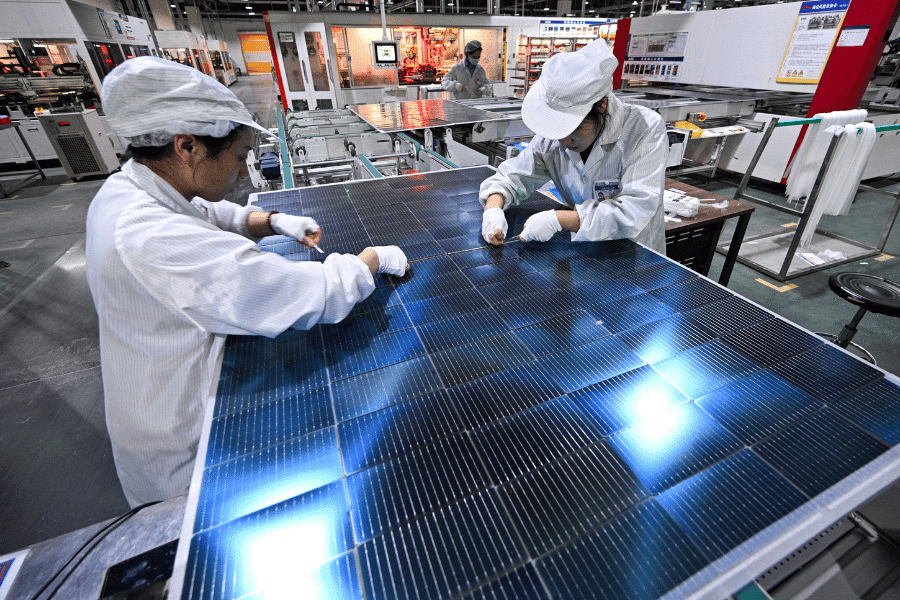
    Boosting green manufacturing in other countries: If U.S. tariffs make Chinese solar panels, batteries and EV components more expensive, other countries — especially in Europe, India and Latin America — may ramp up their own clean energy production. China itself may increase investment and focus on domestic EV adoption, hydrogen technology or battery recycling. 

    This could lead to a more diversified and resilient global supply chain for renewable technologies, while also strengthening domestic energy resilience by encouraging countries to develop and secure their own clean energy resources, reducing reliance on foreign imports.

    Strengthening regional trade alliances for green tech: With the imposing trade barriers, countries looking to avoid tariffs might strengthen regional partnerships, such as the EU-India green energy collaboration or China’s push to supply African and Latin American markets with solar and wind technology. This could decentralize the clean energy economy, reducing reliance on any single country.

    Reducing export-driven deforestation: If tariffs make U.S. imports of commodities like beef, palm oil and timber more expensive, countries that export these products (e.g., Brazil, Indonesia) may face declining demand. Less demand equals less incentive to clear forests for agriculture.

    On the other hand, the EU Deforestation Regulation (EUDR), adopted in June 2023, aims to block imports of commodities linked to deforestation unless they can be verified as deforestation-free. The EU is a huge consumer of these commodities. 

    With two major markets (U.S. and EU) becoming less profitable for deforestation-linked goods, exporters might change their practices to comply with stricter regulations. This could encourage more sustainable supply chains.

    However, this would depend on whether other countries, like China, pick up the slack and implement EUDR-like regulations.

    Backing off petroleum

    If trade wars escalate and tariffs disrupt global markets, long-term investments in fossil fuel projects could become riskier due to economic uncertainty. Tariffs on fossil fuel-related goods — like equipment, machinery or raw materials — can increase production costs for oil and gas companies. 

    As the cost of extraction, refining and transportation rises, companies could face shrinking profit margins, making fossil fuel investments less appealing. This, and shifting focus to clean energy, might push investors toward renewables, which are increasingly seen as more stable and future-proof.

    There’s a catch: These benefits depend on how other countries respond. If the U.S. tariffs cause economic slowdowns, some nations might double down on fossil fuels to stabilize their economies. So while tariffs could have some green silver linings, they’re more of a chaotic wildcard than a deliberate climate strategy.

    While the tariffs imposed by the Trump administration present significant challenges to global climate efforts, they also create opportunities for positive change. The disruptions in the clean energy supply chain, economic instability and rollbacks of environmental protections are certainly concerning. However, the unintended side effects of these actions might just catalyze a shift in global energy dynamics.

    In the long run, this “chaotic wildcard” could make fossil fuel investments riskier and accelerate the global pivot toward renewables. Countries and industries could be forced to innovate and adapt faster than expected. 

    While the path ahead may seem uncertain, there’s a silver lining: resilience, innovation and adaptability are key to overcoming these challenges. As the world adjusts to these new realities, the opportunity to cultivate a cleaner, more sustainable future is within reach — if leaders recognize this moment and take bold action to seize it. 

    So, while the road ahead may be bumpy, there is still reason to hope and act. 


    Questions to consider:

    1. How can governments turn the economic disruptions caused by tariffs into opportunities for advancing clean energy and climate goals?

    2. How can a decentralization of green energy technology be a good thing? 

    3. How can government intervention combined with market forces, like the rising cost of fossil fuels, accelerate the transition to renewable energy?


    Source link

  • Smart Campus Energy Management and Green Campuses

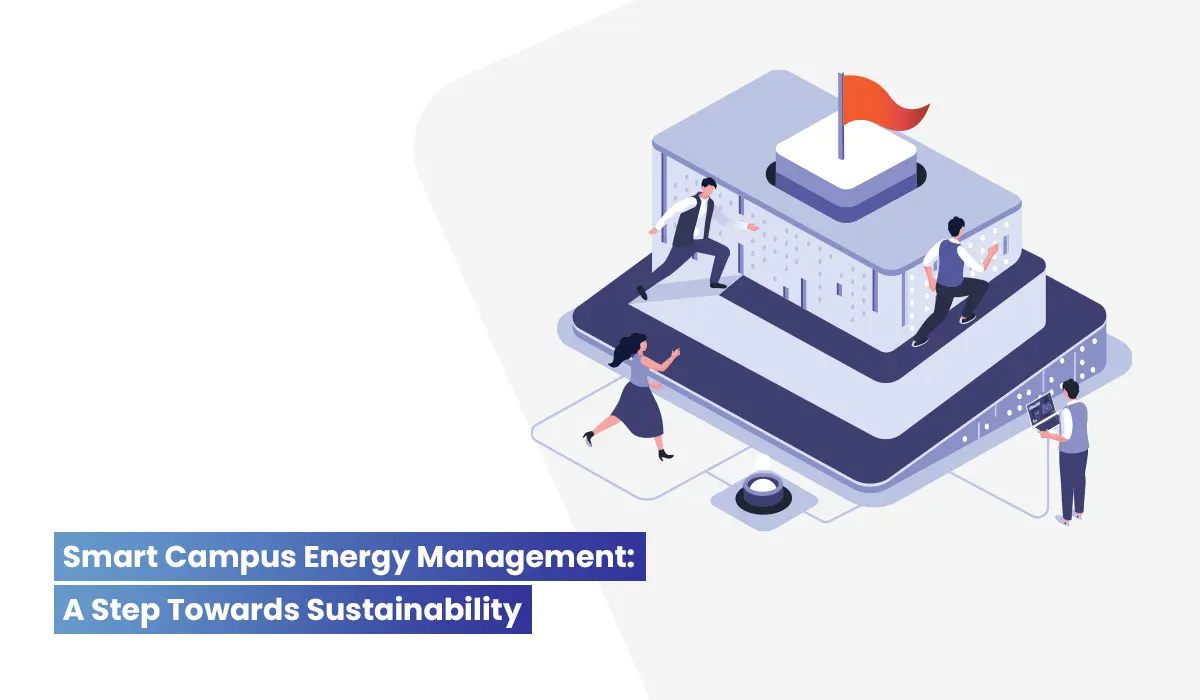
    Smart Campus Energy Management and Green Campuses

    Introduction: How Educational Technology Promotes Green Campuses

    Sustainability is now a requirement, not a slogan, especially concerning educational institutions given the tremendous environmental impact of paper-based systems! Textbooks and administrative paperwork from colleges and institutions contribute to worldwide paper consumption. Panic not, the good news is that technology and smart campus energy management is making a difference.

    Universities may encourage sustainability by using innovation that eliminates waste, conserves energy, and optimizes resources. With the correct tools, becoming green may become the norm. Creatrix Campus’s educational innovations in the form of smart campus energy management are turning campuses into eco-friendly centers while improving efficiency.


    Benefits of Educational Technologies for Eco-friendly Campus Management


    Paperless Classrooms and Administration

    Reducing paper waste is a simple but effective way for institutions to become green. Paperwork is massive in conventional classrooms and administrative systems due to the proliferation of various forms of paper-based documentation. However, campuses may reduce paper use, simplify operations, and save time by moving digital!

    Paperwork is a thing of the past with cloud-based tools for resource optimization that manage student work, grades, and attendance. With a few clicks, students may turn in their work online, instructors can digitally grade and comment, and attendance can be kept tabs. In addition to enhancing efficiency, all of this helps save environment. On top of that, everything is well-organized and simple to find, which simplifies administrative duties.


    Controlling Energy Consumption Using Intelligent Devices

    Energy regulation is crucial to a sustainable campus. Smart campus energy management have increased university energy efficiency. Smart meters, IoT devices, and cloud-based energy management software can analyze energy usage, identify inefficiencies, and reduce carbon footprint on campuses.

    According to a new study out of the National Renewable Energy Laboratory, campuses can save 30% on their energy bills by implementing smart campus energy management solutions. Colleges can significantly reduce their energy use by installing smart lighting, HVAC systems, and energy-efficient equipment.

    Additionally, facilities staff may reduce waste and promote eco-friendly practices across the board by making smarter decisions on energy usage based on data-driven insights. It’s about more than just cutting costs; it’s about making a better, more sustainable future for generations to come.


    Learn to Reduce Carbon Footprint Online

    More than just a convenient way to attend classes, online learning changes the atmosphere. Universities may substantially reduce travel by going digital, reducing traffic, carbon emissions, and cars on the road. Online education reduces carbon footprints by up to 90% compared to on-campus instruction, according to The Global e-Sustainability Initiative.

    But it’s not just about travel cuts!  Online learning minimizes the need for environmentally harmful paper books, handouts, and other materials! Students get to access course materials instantaneously from anywhere, saving resources and giving the planet a respite.

    Students can get degrees from home while protecting the environment—a win-win!


    Sustainable Resource Management

    Building a green campus requires efficient resource management. AI and IoT-powered smart campus energy management systems are changing how universities measure and optimize resource use. Educational institutions may now make smarter judgments about water, electricity, paper, and plastic to reduce waste and save money.

    Real-time data and predictive analytics helped institutions employing smart campus energy management systems cut energy use by 15% reports The International Energy Agency. It’s not just about turning off lights in empty classrooms—it’s about using energy-hungry equipment sparingly and conserving water in dorms and cafeterias.

    Cloud-based technologies and AI-powered analytics help colleges improve their sustainability initiatives and achieve lasting impact! Understanding how and when resources are used helps institutions reduce waste, save money, and promote sustainability.


    Environment Awareness

    Environmental knowledge is crucial to creating tomorrow’s leaders on campuses. Sustainability in the curriculum and green campus projects can teach students to be eco-friendly. This approach may even help students become environmental activists.

    According to a National Environmental Education Foundation research, 79% of students think their institutions should address sustainability, and 67% prefer to work for green companies. University environmental awareness programs teach lifelong habits and educate students to take responsibility for their ecological footprint.


    Remote Collaboration Encouragement

    Carbon footprint reduction doesn’t require face-to-face interaction. Virtual classrooms and cloud-based technology let students and teachers communicate anytime, anywhere, minimizing travel and meetings. Trust us, remote collaboration for group tasks or faculty discussions saves time, cuts travel emissions, and makes their workspace more flexible and sustainable.

    Remote work and collaboration tools reduce travel and their organization’s environmental effect, according to 60% of McKinsey respondents.  


    Data-driven Sustainability Planning

    Sustainability requires educated decisions, not just good intentions. Data helps higher eds design better, more customised sustainability plans. Leveraging AI and IoT for green campus operations aids to analyze real-time energy, waste, and resource allocation data to improve.

    According to a Gartner report, 70% of organizations utilizing data analytics have improved their sustainability initiatives, from waste reduction to energy optimization. Same with universities. Educational technologies let institutions track success, identify areas for development, and make long-term environmental decisions. Data-driven sustainability is a game-changer, not a buzzword.


    Conclusion

    University greening can jump forward with technology. Sustainable, eco-friendly education is possible through paperless classrooms in universities, smart campus energy management, and online learning. By using cloud-based tools for resource optimization, institutions lower their environmental footprint and inspire future leaders.

    Is your organization ready to impact? Greening your campus is easy with Creatrix Campus and its creative solutions. Connect with us.

    Source link

  • Despite being global leader, UK cannot afford to rest on its laurels in digital, AI and green skills

    Despite being global leader, UK cannot afford to rest on its laurels in digital, AI and green skills

    By Matteo Quacquarelli, Vice President of Strategy and Analytics at QS Quacquarelli Symonds.

    Across the globe, economies are grappling with skills and talent challenges. From talent saturation to workforce reskilling, each country is facing its own unique issues as it prepares for the evolution of the digital age.

    The QS World Future Skills Index, just launched, offers a detailed breakdown of the globe’s higher education systems, their links with industries and how countries are preparing for the next industrial evolution. Using exclusive QS data, it identifies where economies and countries need to align their higher education outcomes with the needs of industry in three key areas – green, AI and digital.

    The analysis delves into 81 economies and finds that UK higher education is currently one of the world’s best for cultivating students with the future skills business and industry are calling out for.

    It measures four indicators linked to skills like AI proficiency, digital literacy and environmental sustainability that will form the bedrock of the industries of tomorrow.

    Skills Fit measures how well countries are equipping graduates with the skills employers desire. In this, no country is currently better than the UK. Using data from both our own largest-of-its-kind QS Global Employer Survey and the World Bank Group, we identified that UK employers have the highest satisfaction rates with the skills graduates bring with them, anywhere in the world – but perhaps only for the time being.

    Additionally, the UK received top marks in the Academic Readiness dimension, measuring the preparedness of a country in regard to the future of work. The UK’s success in the QS World University Rankings by Subject allowed it to flourish here.

    However, the UK must not rest on its laurels. Higher education in other markets globally is innovating at a far more rapid rate than in the UK. The reputational strength of the UK – built on its history and tradition of delivering excellent teaching and learning – is unlikely to be the key driver of satisfaction going forward.

    The UK was slightly less successful than its closest rivals in the areas of Future of Work and Economic Transformation.

    Future of Work measures how well the job market is prepared to meet the growing demand for digital, AI and green skills, using 1Mentor data of over 280m job postings worldwide.

    Economic Transformation analyzes whether a country has the infrastructure, investment power, and talent available to transition to industries driven by AI, digital transformation, green technologies and high-skilled work. This indicator used data from the World Bank Group, UNESCO Institute for Statistics and the Education Policy Institute.

    This lower score is reflective of the slow-to-no economic growth seen in the UK over the past decade and the tightening of the public purse strings strangling investment in R&D and new business innovation (evidenced by decline not only in public but also private sector funding in the UK).

    The latest economic forecasts signal a further period of stagnation for the UK economy might be on the horizon.

    Just as the importance of investment in future skills cannot be understated, nor can the importance of higher education in AI breakthroughs and innovation.

    Funnelling research innovation down the value chain into industry has been the bedrock of economic innovation worldwide. Without Stanford University, there would be no Silicon Valley. In Germany, the universities of Stuttgart and Tübingen are key in the country’s Cyber Valley initiative. If Melbourne didn’t have its outstanding higher education institutions, the city would not hold the crown of tech capital of Australia.

    The QS Future World Skills Index highlights the example of South Korea, where there is a correlation between increasing numbers of young adults attaining tertiary education and GDP growth.

    The UK government’s new AI Opportunities Action Plan, announced earlier this week sets out a clear ambition strategy to maintain Britain’s position as one of the world’s AI superpowers and has been widely welcomed by industry.

    The prime minister says his government will make it easier for experts to come to the UK via its talent visas and for future leaders to learn here. Tens of thousands of additional AI professionals will be needed by 2030, he has said.

    The Government also wants to ‘increase its share of the world’s top 1,000 AI researchers’ and will launch an AI scholarship scheme to support 100 students to study in the UK.

    While the UK was also top in Europe for talent creation, with 46,000 students graduating from an AI-relevant higher education program ahead of Germany in terms of absolute numbers with 32,000, the UK is still behind Finland on a per capita basis. Without specific policy and commitment, the UK risks losing its leading position.

    The UK is missing ‘frontier conceptual, cutting-edge companies‘. DeepMind, the AI research laboratory, was one such company that was founded in the UK before being acquired by Google in 2014. But where was it established? The three co-founders meet while studying at University College London.

    The new AI Growth Zones the government has announced, with the first starting in Culham, will need to engage universities up and down the country. Higher education must also be closely involved in the Digital and Technology Sector Plan, which is set to be published in the coming months.

    The government has also previously pledged to become a green energy superpower. The QS Future World Skills Index suggests that both the UK’s job market and its higher education system is well set up to capitalise on that opportunity.

    To succeed, government policy, the needs of industry and higher education curricula must all align to create an environment where the country can succeed and be future-ready.

    Economies and higher education systems that invest in high-quality academic programmes in AI, digital and sustainability are setting themselves up for long-term success.

    For the full QS World Future Skills Index: https://www.qs.com/reports-whitepapers/world-future-skills-index

    The UK Spotlight is available here: https://www.qs.com/reports-whitepapers/uk-spotlight-qs-world-future-skills-index

    Source link