At a time when local schools are facing shrinking enrollment and talks of closure, Hawaiian immersion programs are bucking the trend.
Enrollment in schools that teach primarily in ʻōlelo Hawaiʻi — collectively known as Kaiapuni schools — has increased by 68% over the past decade, with the number of campuses run by the state education department growing from 14 to 26. But students tend to have fewer immersion options in middle and high school, and the pool of qualified teachers isn’t keeping up with families’ growing demand.
Recruiting qualified teachers is one of the largest barriers to expanding Kaiapuni programs, Office of Hawaiian Education Director Kau‘i Sang said in a recent education board meeting. The Department of Education needs to find a balance between adding more classrooms to meet families’ needs and hiring enough teachers to support existing Kaiapuni schools, she said.
DOE plans on opening two new Kaiapuni programs at Haleʻiwa Elementary on Oʻahu and Kalanianaʻole Elementary on the Big Island.
“We cannot open classrooms unless we have qualified staff,” Sang said.
Currently, DOE has three unfilled Kaiapuni teacher positions, Communications Director Nanea Ching said in an emailed statement. The department also employs 25 unlicensed Kaiapuni educators who still need to fulfill their teacher training requirements, she said.
But the number of additional teachers needed to fully staff Kaiapuni schools could be closer to 100, said Kananinohea Mākaʻimoku, an associate professor at the University of Hawaiʻi Hilo’s College of Hawaiian Language. Some Kaiapuni teachers are taking on larger-than-average class sizes because of staffing shortages, she said, meaning the annual vacancy rates underestimate the number of educators schools need.
DOE will need 165 more Kaiapuni teachers in the next decade to fully staff its classrooms and meet families’ growing demand, according to ʻAha Kauleo, an advisory group of Hawaiian language schools and organizations. The projection doesn’t account for a large group of teachers who are expected to retire in the coming years, Mākaʻimoku said.
Last year, UH Mānoa and Hilo produced a total of 12 licensed Kaiapuni teachers.
It’s difficult to find candidates who are both fluent in Hawaiian and interested in teaching, Mākaʻimoku said, especially because Hawaiian language speakers are in high demand in many careers. But a lack of teachers doesn’t mean schools should stop expanding Kaiapuni programs, she said, especially when the movement has so much family support and momentum.
‘No Option But To Leave Their Home District’
The Hawaiʻi Supreme Court has previously ruled that the education department has a constitutional duty to provide families with access to Hawaiian immersion education. Two lawsuits filed in August argued that DOE has fallen short of this responsibility by creating unique barriers for immersion families, such as waitlists for enrollment and limited immersion programs in some school districts.
One of the lawsuits was dropped over the summer, but the second remains active.
Currently, families are pushing for more immersion options in Pearl City, which has no middle or high school for Kaiapuni students. Children can attend the Kaiapuni program at Waiau Elementary until the sixth grade but then need to transfer to immersion programs in Kapolei or Honolulu for middle school or switch to an English-language program.
A petition to add Kaiapuni programs at Highlands Intermediate and Pearl City High School received more than 100 signatures over the past three weeks.
“Our keiki start their educational journey in Hawaiian immersion programs, but upon reaching intermediate and high school levels, they find themselves with no option but to leave their home district,” parent Chloe Puaʻena Vierra-Villanueva said in written testimony to the Board of Education.
The department is planning to add more grade levels to existing Kaiapuni schools next year and provide families with more information on how to enroll in immersion programs, Sang said. Her office also plans on tracking the number of open seats and waitlists across the state to determine which communities have the greatest demand for Kaiapuni classrooms.
Since 2020, the state has also offered a $8,000 salary bonus to Kaiapuni teachers to attract more people to classroom positions.
Kahea Faria, an assistant specialist at UH Mānoa’s College of Education and a Kaiapuni parent, said she would like to see more DOE campuses solely dedicated to serving immersion students across all grade levels. Creating environments where Hawaiian is the only spoken language is critical to students’ development, she said, and could possibly encourage more kids to pursue teaching careers in Kaiapuni schools.
“Right now, with a growing number of students, they have very limited opportunities to grow their language abilities,” Faria said.
The state also needs to look beyond Kaiapuni graduates to expand the potential pool of immersion teachers, Mākaʻimoku said. For example, she said, offering more Hawaiian language classes to families and community members could encourage more people to earn their Kaiapuni teaching credentials.
“That’s definitely a conversation that all communities in Hawaiʻi should have,” she said.
This story was originally published on Honolulu Civil Beat.
Did you use this article in your work?
We’d love to hear how The 74’s reporting is helping educators, researchers, and policymakers. Tell us how
As states continue to launch and expand private school choice programs, one of their biggest challenges is building online platforms that meet the overwhelming demand.
Tennessee families experienced a bottleneck earlier this year as they waited hours online to submit applications for the state’s new Education Freedom Scholarship program. In July, the state told 166 parents that they had received a scholarship, only to alert them a few days later that the notification was a mistake.
“It wasn’t the most ideal user experience,” said Heide Nesset, a senior fellow for the Beacon Center of Tennessee, a right-leaning think tank. But there was a “tight runway,” about three months, to get the program off the ground.
With state leaders hoping to serve up to 70,000 students next year, they’re now searching for a new vendor. Proposals are due Friday.
But the rough start in Tennessee wasn’t an anomaly. All states with education savings accounts have struggled to some extent with ensuring smooth transactions for families, whether that’s paying a school on time or ordering a homeschool curriculum. Some say the solution lies in picking more than one company to handle the increasing demand and improve customer service.
“If it’s one contract, I think the vendor is inherently trying to ensure that the state department has a really fantastic experience,” said Nesset, who is also the vice president of
implementation at the Yes. Every Kid. Foundation, a school choice advocacy organization. “If you have more than one [vendor], then they start competing, and families have the opportunity to make choices.”
Tennessee’s current vendor is Student First Technologies, which won a contract in 2023 to run a smaller ESA program in three counties. Earlier this year, the state expanded the contract with the Indiana-based company to manage the new statewide program, despite its problems in other states.
In West Virginia, where Student First still operates the Hope Scholarship program, an ESA, homeschool families complain that they can’t access the platform on their phones and that approvals and denials for purchases are inconsistent. Arkansas canceled its contract with Student First last fall after it failed to deliver a “fully operational” system on time. The company paid the state a $300,000 fine.
‘Get what they need’
Eighteen states now have at least one ESA program. With a new federal tax credit scholarship system beginning in 2027, the demand for organizations to manage them will surely grow. The trick is delivering a system that runs smoothly for families while ensuring that they’re using the money the way the state intended.
In a recent interview, Michael Horn, cofounder of the Clayton Christensen Institute, a think tank, talked with Jamie Rosenberg, the founder of ClassWallet. Still the biggest player in the market, the Florida-based company manages nine ESA programs.
Prior to platforms like his, states had two options, he explained. They either issued debit cards, which made it hard to ensure parents spent the money on allowable purchases, or expected them to pay up front and request reimbursement — a significant obstacle for families on a tight budget.
State policymakers and civil servants administering Education Savings Accounts have a potentially difficult logistical challenge on their hands.
They need to get hundreds of millions of dollars to tens of thousands families and ensure that money is spent in compliance with a… pic.twitter.com/IRRUfQZZpt
ESA vendors, he said, give families the “agency to get what they need but also the ease of knowing that what they’re doing and what they’re buying [complies with] program rules.”
Adding more than one vendor to the mix could make the companies work harder to reach lower-income and minority families who are less likely to use the programs, said Lisa Snell, a senior fellow at Stand Together Trust, which funds school choice initiatives.
“Family outreach and satisfaction become the goal rather than the government as the customer to one vendor,” she said.
Texas had the option to choose multiple vendors for its new ESA program, which launches next fall. The law allows the comptroller’s office to contract with up to five companies. But officials opted against it and awarded a two-year, $26 million contract to New York-based Odyssey, which currently runs programs in four other states.
Joe Connor, Odyssey’s CEO declined to comment on the state’s decision and referred The 74 to the state comptroller’s office. The office did not respond, but Amar Kumar, CEO of KaiPod Learning, a large national network of microschools, said the state likely felt multiple vendors would further complicate the process.
“There was this huge question of the complexity of doing that,” he said. “How do you tell families which portal to go to or how will they decide who manages which part of the program?”
‘Send a quarterly check’
The vendor platforms include built-in tools to prevent misuse. Student First Technologies has an AI feature, called QuinnIQ, that reviews each expense, “assigns a confidence score” and flags anything that’s new or that the state hasn’t approved in the past.
But Katie Switzer, a West Virginia parent using the state’s Hope Scholarship to homeschool her children, said it’s unreliable, sometimes approving purchases for some families and rejecting the same items for others. She thinks states should focus more on monitoring students’ academic progress than tracking every purchase.
“It’s stupid in my opinion to micromanage down to like the $20 workbook level,” she said. “Honestly, I think it would be more cost effective to send a quarterly check to families.”
That’s unlikely with such programs constantly under the microscope, and critics, especially in Arizona, pointing to high-end purchases, like diamonds and plane tickets, as examples of misuse. The state education department says it takes steps to prevent fraud and has referred cases to the attorney general’s office that have led to convictions.
West Virginia officials said they’re pleased with Student First’s progress since October, when parents complained that delayed orders caused students to fall behind on lessons. Orders are now “generally” processed within two business days, said Assistant Treasurer Carrie Hodousek, and the company has added and trained staff to prepare for peak order times.
Providers like Kaipod have their own concerns. School founders in the network have sometimes gone to the brink of eviction from their leased space because of late tuition payments, said CEO Kumar.
“There should be a predictable schedule, but sometimes it can take weeks extra to get paid,” he said. “If you’re running a small business and you owe rent, you owe payroll and your state payment is delayed, that creates a huge amount of stress for founders.”
For now, rebidding contracts for vendors is the strongest form of accountability, he said.
“They ought to not feel safe once they’ve won a contract,” he said.
Disclosure: Stand Together Trust provides financial support to The 74.
Did you use this article in your work?
We’d love to hear how The 74’s reporting is helping educators, researchers, and policymakers. Tell us how
Why Higher Ed Institutions Should Use Annual Reviews to Refocus Their Strategy
Organizational development principles teach us that long-term, sustainable change is achieved through making data-driven decisions, continuously learning and adjusting, and intentionally planning for growth. Which is why an annual review of your existing higher education programs and operations is an essential step in the process for building your institution’s success.
Skipping a review in the planning process puts your institution at risk of repeating mistakes and missing crucial opportunities due to an outdated approach.
In every area and at every level, institutions benefit from looking back at data from the previous year for clues into what adjustments are needed for improvement. From holding project retrospectives and conducting marketing audits to tracking enrollment trends and having individual performance check-ins, regular rituals that facilitate reflection on what’s working and what isn’t encourage continuous growth.
Similarly, creating an annual review process for your degree programs empowers your institution to assess its efficiency while using data-driven insights to build a strategic road map for the future.
Change starts from within. The best way to achieve growth is by being honest about where you are now and where you want to be. At Archer, we go through a robust discovery process with our partner institutions to understand the unique challenges and opportunities their online programs and the institutions themselves face in today’s dynamic higher ed landscape.
Common Pitfalls in Strategy Resets
Strategy resets often simply recycle old plans instead of applying lessons learned. Contrary to what you may think, plans built on evidence from the past are much easier to implement and keep on track than recycled plans. Here are three common pitfalls your institution should avoid when planning for the future.
Pitfall #1: Following Assumptions Over Evidence
When leaders fail to connect data and insights from past performance to future goals, important trends are missed and errors are doomed to be repeated. Analyzing available metrics and assessing risks ultimately leads to more intelligent plans that can increase enrollment and support positive student outcomes. Marrying your intuition and insights with data makes for a stronger strategy.
Pitfall #2: Allowing Siloed Departments to Slow Progress
Honest assessments across functional areas only happen when teams work together. Every corner of the university should be represented in the review process; marketing, information technology, enrollment, financial aid, the registrar, faculty, administration, and leadership all need to be aligned.
This is hard work, but you can start by finding ways to collaborate with a department that you work with regularly and then expand that collaboration to other departments. Look for more opportunities throughout the year for better cross-departmental communication and collaboration.
Pitfall #3: Limiting Plans to the Near Future Without Considering the Bigger Picture
Institutions should prevent letting their short-term tactics override their long-term goals. When you tie your institutional goals to your departmental goals, you create a natural flow of work and have an easier time communicating your successes up the chain of command. By regularly reviewing their goals and assessing if their work is on track or needs revisiting, teams are able to course-correct when necessary — before reaching the end of the year.
Using Postmortem Frameworks for Smarter Growth
Fortunately, there are plenty of techniques that can be used to create an effective review process. Postmortem meetings, data analysis, planning worksheets, and open communication can fuel an insightful retrospective.
When approached with the intent to learn from the past and find areas for improvement, a postmortem meeting offers a crucial opportunity for an organization to reflect on its progress. In postmortem meetings, individuals and teams consider how successful a project or period of time was and pinpoint what to change moving forward. Risk assessments are also particularly useful to help teams prepare for possible enrollment and market shifts in the future.
By harnessing the power of analytics reporting and postmortem agreements, teams can co-create realistic road maps that connect their vision with the institution’s operational capacity. Getting buy-in from all departments by engaging them in cooperative planning gives everyone the chance to discuss their team’s areas of strength and the areas where additional support may be needed.
Institutions that follow Archer’s Good, Better, Best framework are able to get a clear view of where they currently stand and what they should prioritize next to achieve consistent growth.
Key Takeaways
Avoid common strategy reset pitfalls by first taking account of where you are now and then determining where you want to be.
By leveraging data, collaboration, and iterative improvement strategies, institutions use proven organizational development techniques to stay competitive.
Postmortems, planning tools, and governance help leaders sustain their institution’s progress.
Let Archer Support Your Year-in-Review Process
Institutional growth requires a tailored approach, and the path looks different for every organization. At Archer Education, we understand that deep discovery, organizational development, sufficient investment, best-in-class technology, and a laser focus on the student experience are essential.
Are you ready to expand your institution’s online program offerings, elevate your student enrollments, future-proof your teams, or all of the above? Then allow the talented Archer team to support your institution by helping you establish a year-in-review process and uncover new possibilities for sustainable growth.
If you’d like to learn more, contact our team and explore our technology-enabled strategy marketing, enrollment, and retention services today.
New early-applicant data from the Common App found that applications from Black, low-income, first-generation and rural potential students are all up compared to this point last year. However, international applications dipped, and the most selective institutions are experiencing the smallest application growth compared to other types of institutions. Applicants are also increasingly choosing to submit standardized test scores.
The Common App report, released Thursday, is the first in a series of monthly research briefs on college applicant trends typically released between November and March. The November brief showed that applicants, and applications, rose over all compared to this time last year, with notable growth among particular groups.
For example, applications from those who identified as Black or African American increased 16 percent and multiracial applicants rose 11 percent compared to the same time last application season. The report also found that applicants who identified as first-generation grew by 12 percent, while low-income applicants, who qualified for a Common App fee waiver, increased at more than twice the rate of other applicants. Rural applicants grew by 15 percent compared to last year, while thosefrom metropolitan areas grew only 6 percent.
But the number of international students applying dropped 9 percent compared to this point last year, driven by a 14 percent drop in applicants from India, which has historically been the second-biggest source of international applicants on the Common App platformafter China. Applicants from Asia broadly and from Africa also dropped significantly, 9 percent and 18 percent respectively, with a whopping 43 percent decline in applicants from Ghana. These trends suggest theTrump administration’s policies, including international student visa delays and denials, may be deterring students.
At a time when highly selective institutions are under new political pressures, the report found that colleges and universities with admit rates of 25 percent or below had the slowest application growth, at 4 percent. Applications to other types of institutions grew at two or three times that rate.
The return of standardized test requirements at some institutions is also driving more applicants to submit test scores. Notably, applications reporting scores rose 11 percent compared to this time last year. However, students who identify as underrepresented minorities or first-generation or who qualify for a Common App waiver were less likely to share their scores.
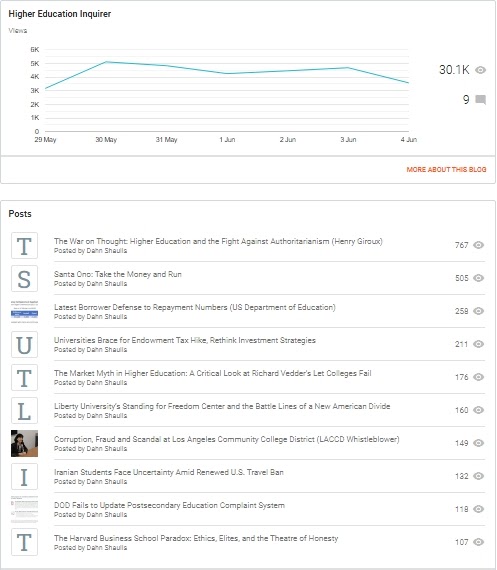
The Higher Education Inquirer’s viewership continues to grow. In the last week, we have had more than 30,000 views, and that’s without SEO help. Some of the content in HEI may be found elsewhere, but our in-depth historical and sociological analysis is rare for a blog or any other news source. HEI also relies on scholars and activists for our outstanding content. Thank you, Henry Giroux, Gary Roth, and Bryan Alexander for allowing us to post your work. And thanks to LACCD Whistleblower and Michael S. Hainline for your investigative exposes. If you missed any of their articles, please click on their links. FYI: The Higher Education Inquirer archive also includes more than 700 articles and videos. Please check them out and let us know what you think. We want to hear from all sides of the College Meltdown.
Washington, D.C.– CoSN today announced that the Mid-America Association for Computers in Education ( MACE) and the Nebraska Chapter of the Consortium for School Networking ( CoSNE) have been approved by the CoSN Board of Directors as official State Chapters. CoSN State Chapters play a crucial role in advancing the organization’s mission at the local level. These chapters provide a platform for education technology leaders to collaborate, share best practices and advocate for innovative solutions in their regions. Through networking events, professional development opportunities and policy influence, CoSN State Chapters empower members to drive impactful change in their school districts.
MACE is a nonprofit corporation dedicated to advancing educational technology by fostering collaboration, sharing best practices and supporting educators in the effective use of technology. The organization works to enhance education through responsible use of hardware and software, engage with industry partners to establish technical standards, and connect professionals in the field. CoSNE was established by the Nebraska Association of Technology Administrators ( NATA), along with a group of Nebraska K-12 chief technology officers, chief information officers and technology directors in smaller districts/regions — or not previously associated with NATA. CoSNE is advancing the focus on policy advocacy, professional development, and engagement with state and national entities to advance educational technology leadership and best practices for every K-12 technology leader across Nebraska.
More News from eSchool News
Simply put, AI can do a lot–it can personalize learning, help students expand on ideas for assignments, and reduce time spent on administrative tasks, freeing up educators to spend more time on instruction.
A recent survey found that 88 percent of U.S. parents believe AI is essential to their children’s education, but most aren’t even sure whether the technology is being used in their child’s classroom.
As AI becomes more widespread in education, more than half of high school students (56 percent) polled think it can go a long way in reducing math anxiety, a new global survey shows.
Teachers often seem to have eyes in the back of their heads. They respond to a murmured question in a class full of conversation. They can tell if someone’s skipping class a floor away by reading faces in the room.
While digital literacy has become an aspirational cornerstone of modern education, the exponential growth of data-driven decision-making across industries reveals critical gaps that demand a stronger focus on data literacy.
Teaching K-12 coding without computers may seem like a daunting task, but it can be a powerful way to introduce students to the fundamental concepts of computer science and problem-solving without the distraction of technology.
The most effective way for students to learn career-ready skills in fields such as advanced manufacturing and robotics is by applying these skills in the context of authentic projects and real-world scenarios.
In the Future of Jobs 2025 report, the World Economic Forum predicts that 60 percent of jobs will require upskilling or retraining, or they’ll be threatened. The skills we have today may not keep us secure for long.
Middle and high school counselors juggle overwhelming caseloads, expanded mental health duties, and additional administrative burdens–all of which limit their ability to provide individualized support for students.
When Adrienne Staten’s fellow teachers first started talking about using artificial intelligence tools in their classrooms, Staten was not on board.
This audio is auto-generated. Please let us know if you have feedback.
Full-time faculty salaries rose for the second year in a row, even after adjusting for inflation, according to preliminary compensation data from the American Association of University Professors.
Fall 2024 salaries rose an average of 3.8% year over year, though inflation brought that growth down to an increase of 0.9%, according to the study.
Even with two years of gains, faculty compensation has not fully recovered from the pandemic period, which brought a 7.5% effective drop in salaries from 2019 to 2022, AAUP said.
Faculty’s inflation-adjusted salaries are still climbing out of their pandemic dip
Year over year growth in nominal and real salaries from academic years 2017-18 to 2024-25.
During an era of constrained budgets for many institutions — with job and program cuts making headlines — institutions are under a countervailing pressure to invest in their people and infrastructure after years of belt-tightening. Some colleges have given employees raises even as they make budget cuts in other areas.
Preliminary data from AAUP’s latest faculty study shows salaries making some headway even in an era of slashed budgets. Fall’s salary increases for full-time faculty followed an inflation-adjusted 0.4% increase in 2023.
Those of course are averages, and figures varied across rank and job types. Associate professors’ salaries, for example, typically grew at a faster clip in the 2024-25 academic year than professors or assistant professors — while lecturers’ salaries rose faster than all of those positions, with growth over 6% at the doctoral and master’s level institutions, according to AAUP’s study.
The survey also found continued gender disparities for professor compensation, with men earning nearly $26,000 more than women at doctoral institutions and about $8,000 more at master’s institutions.
College and university presidents typically made around four times or more than the average faculty member across most institution types, according to the study.
Part-time faculty made an average of $4,093 per class section in the 2023-24 academic year. But their compensation “varied widely” depending on where they worked, AAUP said.
At private nonprofits, a part-time faculty member could make an average of $1,950 per section teaching at associate-granting institutions compared to $6,481 at bachelor’s-degree colleges.
Maximum payments could run into the tens of thousands of dollars across institution types. Meanwhile, some part-time faculty could earn as little as $700 per section teaching at a public university.
Just over one-third of colleges, 34.4%, made retirement plan contributions for at least some part-time faculty, and fewer than one-third, 32.5%, contributed to insurance premiums for at least some part-timers.
The AAUP analysis is based on surveys of more than 800 U.S. institutions, with data on roughly 370,000 full-time and 90,000 part-time faculty members.
CUPA-HR also found annual salary growth across much of the sector in the 2024-25 academic year.
After factoring in inflation of 2.7%, salaries went up 1.2% for administrators, 1% for professional staff, 1.1% for general staff and 0.5% for nontenure-track faculty, according to CUPA-HR. Real salaries for tenure-track faculty fell 0.1%.
As with AAUP, CUPA-HR noted that higher education salaries still fell short of pre-pandemic levels despite growth. The largest gaps are in salaries for tenure-track faculty — paid 10.2% less than in the pre-pandemic era after adjusting for inflation — and non-tenure-track teaching faculty, who are paid 7.6% less.
Jane CoomberSewell started her website in graduate school, now it’s time for a re-design
Meet Jane CoomberSewell, PhD in this featured interview. She’s been a business owner throughout graduate school. Jane recently completed her PhD in Media and Culture Studies, researching English entertainer Joyce Grenfell.
Jane’s website has always been helpful. Now as an independent researcher, her website has needed to change over time. That’s what this interview focuses on: how personal website can change over time to meet your needs.
I’m Jennifer van Alstyne. Welcome to The Social Academic blog, where I share articles and interviews on managing your online presence in Higher Education.
Whether you’re just creating your website, or need to re-design your outdated website, I hope this interview helps you. Jane and I talk about
Jennifer: Hello everyone. I am Jennifer van Alstyne. Welcome to the 1st featured interview of 2022. Today. I’m here with Dr. Jane CoomberSewell. We’re going to be talking about how a website can change over time.
Dr. Jane CoomberSewell created her website when she was in graduate school. And it’s been a journey to figure out exactly what belongs on the website, if the website is going to work long term. Now some changes are being planned, they’re ready to be made. So I thought this is a great subject to share with you.
Jane, it’s great to talk with you today. Would you mind introducing yourself?
Jane: I’m Jane. In the networking world in the United Kingdom, I’m now being referred to as Doctor Word Nerd. I run a business with my wife which has two parallel streams. Which is one of the reasons why the website is now websites. Joyce is an autism advocate and specialist.
Jane’s website was originally shared with Joyce. Now they will each have their own website.
Joyce’s one of the few people in the United Kingdom who is qualified to mentor autistic people who is herself autistic. While we’ve worked both work words, I am very much moving from
Proofreading
Editing
Student support
more and more into being a family and company historian and biographer. Because companies have life cycles and stories to tell just as much as individual’s do.
Jennifer: That’s right. And websites because they help us tell those stories to a wider number of people, it needs to be changed and updated with time as our needs change. And as the things that we want to share with those people change as well. So I’m really glad that we’re getting to talk today.
Can I ask, what was your graduate background and what did you do your PhD in?
Jane:So my, my PhD, it comes under media and cultural studies. But very broadly. It was a 4.5 year–cause I started off part-time and then went full time–adventure into the life of a lady called Joyce Grenfell who is a British entertainer. And really considering her as a sociopolitical commentator, hence the history side of it. And a feminist.
Was she a feminist? The answer being probably only with the small ‘f.’
But really looking at the power-knowledge dynamics that she explores in all her sketches which she wrote herself. Now I’m trying to turn that into a book for normal people.
Jennifer: You want to write a book about that for a general audience it sounds like?
Jane: Yeah. There’s 2 books at the moment. One is something that be useful to undergraduates, sort of a different spin on feminism. Feminism moves away a bit more from theory into lived feminism.
And then hopefully something very much more for the general readership.
I am the only person currently that has ever looked at Grenfell academically. There’s been journalistic approaches and there’s a very good biography by her goddaughter who is also a journalist. But that more general approach I think hasn’t been done yet.
Jennifer: Fascinating. Well, thanks for sharing that with me about your research.
Can I ask, is that something that shows up on your website?
Jane is working toward launching a new version of her personal website
Joyce: It is. I suppose there’s been 3, no 2.5 versions of the website so far. There was the one that we launched at the very beginning of my grad school days.
It was fine. Actually, when you look at my website or our websites, they don’t look very much different at all. The colors are the same. The logos haven’t changed.
We’ve updated the photos cause because you get fat, you get thin, you get fat, you get thin.
[The websites] They’ve become a lot more focused I think.
The 2nd version, which was launched about 18 months ago was about giving us a lot more on control our end. It’s when I started blogging.
I have a love-love-bit-of-hate relationship with blogging. In that I would love to spend more time doing it. And I think I could make it better work better than I am. But you just keep rethinking how you blog all the time.
I think that’s my big thing, not just with the blogging, but with websites is that it’s not something static. With the 1st version of the website, the major mistake we made was it was static. It didn’t change it. Didn’t have a blog element. And I may be looked at it once every couple of years. And I sent off a note to our web designer. She would charge me £15 to change 2 words on a page.
The way it is, or the way version 2.5 is that all the actual text and layout I can control myself. It’s only when we want to do more technically advanced things like changing pictures and adding new drop downs that I have to contact my designer for. And that’s the level I’m comfortable with.
Jennifer: And you like, you like being able to do some of those things.
Can I ask, did you work with a designer on version 1 of the website?
Jane: Yes and no. Accessibility was always important to us. I come from a disability services background. That’s what I did when I was a civil servant. For most of the times the civil service disparity employment advisor. I was always aware of making things accessible in terms of scaling font and it still looking good.
We had a young designer to do our logo for us. And I love our logo. Would I change it? Probably not. I might tweak it a little bit, but I don’t think I’d actually change it.
But all the text I’ve always written. Partly because I’m quite…Okay. Yeah, let’s be honest…quite arrogant about my use of English language.
Search engine optimization for academic websites
Jane: That has its downside. Because of course, search engine optimization (SEO) wise, I dislike…balancing got to get 5 versions of the keyword into the box pick-it-up vs. flow. I find that a tricky balance. And getting all your metatags right. I find all those things I find quite tricky. So sometimes I will get a bit of help on that side of it.
Jennifer: For some of our readers, they might not know what SEO is. SEO stands for search engine optimization. It’s something that people with websites do in order to help more visitors actually find their page. There are specific keywords or phrases that you might go search for on Google.
If those phrases or keywords match up with the phrases or keywords on Jane’s website, for instance, it will help you find her website.
Jane is saying that it’s difficult to balance the number of keywords she puts into the copy she writes for her website and actually writing it. I think that’s something that many people with websites struggle with.
If you’re brand new to websites, this is your very first website, you might not be doing so much SEO work as Jane is. But you do want to have keywords, like your name in there.
Being able to put your name on your website is so important for helping people find it.
Jennifer: Thanks, Jane. I appreciate you bringing that up.
Jane: I think there’s also something really important about keywords in that. Often the keywords we end up having to use to get found and not words we’re comfortable with.
My wife’s previous business was that she ran a telecoms billing platform. She wanted her website to say ‘value.’ Okay, but people don’t type into Google value. They type in ‘cheap.’ So she had to change this whole page…to ‘cheap’ to get her SEO to work, which is not the image she wanted to portray. But it’s what she needed to get people to then come and have that conversation with her.
Jennifer: Yeah. I think with academics in particular, keywords might even be a little bit easier than that because they’re looking for a really specific audience. So if your research is on a specific type of microbiology, for instance and you include that phrase in there, it’s pretty likely to, you know, show up in Google.
It’s definitely harder when you’re looking at a keyword that’s as general as ‘value’ or ‘cheap,’ because there’s only one word. It can make a really big difference in the types of visitors you get.
My recommendation for anyone reading is try to be really specific when you’re thinking about the keywords that are going on your website.
Remember, you’re looking for a specific audience. In this case, you may not be needing money that’s tied to that. Maybe you’re just looking for readers for your publication. So there’s lots of options for keywords.
Jane: Yeah. Yeah. That’s true. And it’s very industry specific. You really have to think through a strategy. Which is why it’s useful to use a designer sometimes.
It’s time to update an old or outdated personal website
Jennifer: Tell me more about what your old website was like. It sounds like you really didn’t like that you couldn’t do update yourself. And that you had to pay for updates. What else didn’t you like about it?
Jane: I think it was mainly just the staticness of it. It was very difficult and expensive to keep it current as you know. Obviously when you start a business, especially now, you can’t start a business without a website.
But in those first 2 years–I mean, I think businesses are always evolving and changing–but in those first 2 years, that’s probably when they move most.
Therefore, if you’ve constantly got to be sending information to somebody else to tweak your content…
The layout was very current, which meant of course, it very quickly became very dated because just like clothes, just like hairstyles–there’s style, and then there’s fashion.
Jennifer: Hm.
Jane: Because I don’t do the graphic aspect of it, I find it very difficult to pinpoint what that is. But it’s things like a Hermès scarf is always stylish. There are other things that are very fashionable for a very short period of time.
I think there are elements of website design, which I hope we’re getting now, which is much more about a classic style. While still being able to bolt on [things like] on Joyce’s site, she’s got the live transcription so that she can vlog rather than blog which connects in with the fact that she’s dyslexic. When she vlogs it will transcribe it live. Speaking as somebody who does audio transcription, it’s good. It’s still not as good as me sitting there and doing it for her will ever be, but it’s a lot quicker than me doing it. Cause it does it live.
Jennifer: So live transcription is one of the ways in which your separate websites revisioned the blog that you were, you were both working.
Jane: Yes.
Jennifer: So you still blog. And [Joyce] vlogs.
Jane: Yes. Well, she’s learning to vlog.
How you blog on your personal website may change
Jane: It’s one of those things like the blogging. I always feel that I’ve got more to learn and I could always do more of it.
And as a writer there’s a great discipline in blogging because it keeps you writing and it keeps the ideas flowing.
Jennifer: Right.
Jane: Often, I don’t know about you, but the ideas always come at the most inconvenient moment, you know? When you’re in the car I can’t really scribble an idea down. And then unless you have something like Otter AI on your phone so you can give yourself a quick note, the idea has gone.
Jennifer: I feel like I have a lot of blog ideas. I keep a list of them on my computer. And then I have time to write a lot of them. [Laughs]. That’s my problem.
Jane: When we first relaunched a new [website], we were religious. One of us blogged every single Monday. But we’ve been so busy. I’ve been so busy writing books. I haven’t had the emotional energy, I think, to blog as well.
Jennifer: That’s interesting. Can you tell me a little more about that? What do you mean by emotional energy to blog?
Jane: There are lots of different approaches to blogging, aren’t there? You can be your intellectual expert, or you can be a raconteur. Cause it’s all about engaging with your particular audience.
Because particularly when I’m doing the family biographies, people are telling me things. It’s not supposed to be a therapeutic thing, but often it becomes therapeutic. Often people will tell us things–cause Joyce does the interviewing and I do the writing–very personal and perhaps stuff they haven’t talked about for years.
So I want my blogs to be quite open to. And I often reflect on something that has happened during the week. If I have been very busy writing, I perhaps haven’t had time to process that myself.
I don’t feel I can blog about it until there’s a little bit of distance.
I think the last blog I did was about the phrase ‘self care.’ I really struggle with the phrase ‘self care.’ I think being middle-aged and British…And anything foregrounded with self gets linked just to words like ‘selfish,’ which is not how I feel about it but it’s kind of like a kick reaction. It took me ages to write that blog because I had to kind of balance it out.
And I think if you blog from the heart, which is what I try and do because I want our customers to know us because we feel very strongly that integrity is something that is impossible to attain, but must be your strongest goal. Sometimes those blogs take a lot of emotional energy.
When I used to copywrite blogs for another company, you know, I can churn out 500 words on why certain photocopiers are the best on the market. Really I can probably do that in about half an hour.
And the other thing I find quite time consuming when I’m blogging is sourcing the illustrations. Cause I always try and put in a couple of irrelevant illustrations.
And I think it was you or somebody in the same meeting we met at who told me about Unsplash.
Jennifer: Yeah!
Jane: And that has made that a lot easier, but actually again, we’re back to keywords. Finding the right keywords to get the image you want…
Jennifer: It can be difficult [chuckles].
Have a personal website you can control
Jane: It’s a constant learning thing, isn’t it? I think that’s that’s the biggest message is if you can always have an element of your website that you control. Even if it’s not the techie stuff. Because it’s an absolutely live document. You will never finish your website.
Jennifer: That’s right. That’s what I teach all of my [website design] clients. The process that I worked through with them, you know, we go through an intensive planning process for their websites to figure out what they actually need.
Then we sit down and we create the copy for the website or they do it on their own. Once that copy is placed, I actually teach them how to
update pages on our website
add new pages
navigate the backend so that they can find what they’re looking for
And they get a recording of that so that they can do it themselves afterwards.
I actually don’t do long-term management for websites that kind of nickel and diming that you were talking about changing two words for £15 pounds, I don’t do that. I want to help as many people as possible. That means that I can’t manage websites long-term.
I really need the academics that I work with to be able to do some of that work themselves. So I think that’s really important having some of that control yourself.
It sounds like it’s making a really big difference for you on your website.
Jane and Joyce used to share a website, now they’ll each have their own
Jane: I also find it much easier to help Joyce. So what we’ve done now is we’ve separated [our websites]. I’ve retained CoomberSewell.co.uk.
We’ve done little things so some of the pages mirror each other totally. And others, obviously her autism pages are a lot more detailed than mine. My pages is like a condensed version on autism, but it links to her website.
So silly things like I know for a fact at the moment because I’ve spent more time on her website than mine, her price list for proofreading as much more up to date than the one on my website, but I’m the one who does the proofreading!
In fact I’ve got a list of jobs to do at the weekend. And it’s this knowing that I was going to talk to you. That led to #6, being “Update price list.”
Do this when preparing to update your old or outdated personal website
Jennifer: It’s good to actually create a list like you’re doing right now. Like what are the things that I need to change on my website?
If you are approaching a website update project, I do recommend make a list of all the things that you
don’t like about your website
do like about your website
things that you need to change.
Then once you have that list, go ahead and schedule it in your agenda.
Maybe you don’t have time to accomplish all the things on your list right away, but if you space it out over time, you’re going to get those updates made.
You don’t want to wait 1-2 years between updates on your website. Things get outdated more quickly than you think.
Jane: And that is very, very true. I also think it’s good to have an honest friend. A really honest friend. I had a very amusing phone call today, a video call actually. My longest term friend, we’ve known each other since I was 5 months old, contacted me today on video call.
She’s just about to launch a professional photography website. The one thing that she’s not good at is photos of herself.
And whilst, perhaps that was a little over blunt, it did help her choose the pictures that she was going to choose. And acknowledge the fact that it’s only going to be a holding picture till she can get some new ones done.
Jennifer: Yeah. That’s important. And having that honesty and that rapport with you, it helped her move forward in her thinking of it.
Jane: I think particularly on the visual side. And on the text side, because I mean, as a proofreader, there’s one rule that I have. It’s just proofread to proofread thyself. Because it is almost impossible when you’ve written something and edited it and re-edited it…
I mean, you know, where I’ve been sort of trying to convert my, my thesis into a book, I am aghast at the mistakes have slipped through as I’ve put it to bed for 6 months and then come back to it.
Really, did I say that? Was I on said drugs at the time?
Jennifer: [Laughter]. And you’re a professional, you’re a proofreader.
Jane: It’s the hardest thing in the world to proofread your own work.
Jennifer: That’s so true.
Jane: So having a trusted friend who is good at being straight, but also kind is really, really important.
I think in business, we get very hooked up on should I be paying for this? Should I be paying for that? 99.9% of the time, I would say, Yes. But occasionally it’s okay, especially if it’s just a quick check to ask a friend for a favor because this guarantee there’s a bit of skills barter that can go on.
Jennifer: I think so. That I explain it to my clients is that your friend, they love you and they care about you. They’re actually going to be reading and examining your website with greater depth than your average visitor.
They’re going to stay on it longer.
They’re going to read into it more, try to understand it more so that they can talk with you about it. And that’s more than your average website visitor is doing.
If your friend is telling you that something’s
Confusing
Distracting
That it shouldn’t be there
well that’s something that you should listen to because other people aren’t even going to give you as much time or attention as a friend is. So it’s worth listening to what they have to say.
You don’t have to, you don’t have to respond to it. You know, you don’t have to do it, but getting that opinion is so helpful.
Do it while you remember (or write it down so you don’t forget)
Jane: And I think, I think also we’ve talked about planning and making sure we prioritize, but I think there’s also some times merit in striking while the iron is hot as well.
I mean a year ago you said to me, “Jane, you need to make more of the fact that your ‘bilingual.’” Do you remember this conversation? It was, it was a, it was a comment about my proofreading, the fact that I’m being of Canadian heritage, that I can proofread in
Canadian English
American English
English English
You said you need to make that much clearer on your website and you should blog about it. I still haven’t done it because I didn’t do it in that moment. And if I had done, it would have been very much more impactful.
I am going to get round to it. I am going to blog on it, but I don’t think it will be as good a blog as if I’d done it within 24 hours.
Jennifer: Oh, I don’t know that that’s the case. It’s possible that even that you’re thinking about it for the last year is going to add even just one sentence to that blog that is emotionally in a better space now than it would have been then.
So you never know that. I think it’s totally going to be awesome when you do it now.
Jane: Interestingly though, I have remembered to use the phrase when I’ve been talking to people.
Jennifer: Wonderful.
Jane: And I think I’ve pretty much got every American PhD student at my university now sending me their theses for proofreading.
Jennifer: I love that. I love that. I remember that conversation so well, and you were telling me about all the amazing things you were doing. And I was like, oh, I just read your website and it didn’t say that. Like, that was so awesome how you have a skill that really is going to help people that are English language speakers bet the proofreading that they need.
I also think that the way that you go about updating your website to meet your needs is so awesome. It sounds like version 1 and version 2 were both joint websites. And now version 2.5 is like separating that a little bit.
But what it does is it gives you each more space. So it’s like your website is growing. It’s like your needs are growing, your website’s growing and all of that copy, all of the things that you know, can be updated, hey–everything gets updated with time. That makes sense.
Jane: I think it also provides a lot of clarity. We were trying to be all things to all people. And although we work together and our sides of the business compliment each other. They’re not the same.
Joyce, certainly couldn’t do what I do. I know, I don’t have the patience, I think, to do what she does.
At the moment, they’re very similar. I’ve done a way updates, but I think over time as she grows the vlogging side of it…I’m teaching her how to edit. It’s going to be hysterical cause she’s even more of a Luddite than I am…And as I continue to blog, I think it will give me the room.
How Jane shared her thesis and publications on her personal website
Jane: One of the other things I did based off the conversation you had with me is that I changed one of the pages entirely. You said to me earlier, I’ve just remembered this, you know, is your thesis on your website?
Well, I took a sidebar. And that now has every journal article every, every time I’ve contributed to a podcast. It’s all on there. There’s a publication sidebar. So you don’t even have to go to a separate page for it.
If you’re interested in having me write a biography for you. You can get a sample of my writing by clicking on the sidebar. It was actually me being tight because I didn’t want to pay to have another page created. Actually it works really well.
Jennifer: Well I love that innovation can cause you to adapt. It sounds like you didn’t want to pay for another page so you needed to find another solution and that creative solution ended up working out for you.
That’s what websites are all about: experimenting to see what’s going to work well for you long term. And if it doesn’t, well, that’s something that needs to be changed.
I think that adapting with your website, making room for it to grow, it’s not going to happen all at once.
Jane: Right.
Your website will change, and that’s a good thing
Jennifer: You’ve had now 2.5 versions of this website, and you can still see it changing in the future. So for anyone who’s reading this interview, I definitely want to let you know that your website, it’s probably is going to grow or change over time.
Even if he just have a simple 1-page website that has your bio and a photo on it. Those elements are going to change. Your bio will be updated over time. Your photo. You’re going to want to change that over time so that it looks like you.
I think that being open to that is such a great quality to have when you’re building a website. And when you’re approaching a big update.
Jane, I just want to thank you so much for your candor in talking about how that website change has been for you.
What’s it like to work with multiple designers on your website over the years?
Jennifer: I want to ask a little bit more about what it’s like to work with someone since you worked with, it sounds like multiple designers on your website.
Jane: Two, yeah. So we had our original website designer. There were some design elements that came from other people, but as such, we had our original website designer and then we’ve got our current website designer.
And I think there’s something really important to say about I current website designer, not so much about his technical skills as a designer, although they’re very strong. It’s about personality matching. You know, particularly for, for joy as an autistic.
Choosing a website designer
Her technical skills are very different from mine. Actually, they’re great, but she worries about them. And so we needed a designer who got how you talk to this person on the spectrum. Because actually once you’ve met one person on the spectrum, you’ve met one person on spectrum.
A lot of the problems with our previous version is that I’m not convinced our previous designer was quite on particularly Joyce’s wavelength.
From that point of view, I would encourage people that if you feel like somebody is talking a load of jargon and your constantly running to catch up, they’re possibly not the right designer for you.
Jennifer: Oooh, that’s so important. So picking a designer is not just about budget. It’s not just about location or what their portfolio is. It’s also about how they get along with you and how well you communicate with each other.
Jane: I mean after all. I think we both know that you can go and buy a product. You could go buy website product. Most of my Canadian and American friends tend to use SquareSpace. If they’re building it from scratch and over here, it will be something like GoDaddy. But ultimately if you’re going to invest in that tailored service…People buy people. They don’t buy a product. They buy people. So get to know your designer.
I am fortunate in that our designer is the partner of a friend of ours. And he will come and train Joyce in exchange for a handmade pizza. But, from that point of view, it is worth spending the time not just getting quotes, not just finding out what particular language they’re skilled in, or design they’re skilled in…
You know, have a coffee with them if you can in these days of masks. Take your time. It might not be a big investments in dollars or pounds, but it’s a big investment in terms of your business. Or your future in terms of the academic reputation that you want.
So take your time. Yes, you can change later on. Because we’ve been talking about keeping the websites updated, constantly.
But actually, if you’re going to move that whole relationship to another designer, it is a bit of a hassle. You know, getting them to shift domain names from one host to another, it’s not a big job, but it is a hasley job. So take your time picking your person.
Jennifer: Oh, well, wonderful advice. You know, meeting someone in advance can make a whole difference in how you understand them. Seeing their facial expressions, seeing how they respond to questions or how they ask questions of you can make a big difference for people’s comfort levels.
Thank you so much for sharing that with me.
Jane’s new article on Sara Paretsky’s Guardian Angel
Jennifer: Speaking of academic reputation, you were telling me about a new article that you have out about your favorite lockdown read. Tell me a little bit more about that.
Jane: Oh, that was wonderful. I think that again is something I’ve learned about academia this year. I’ve written or half written or even sent off terribly intellectually worthy articles. And they tend to fall over.
I’m often always telling my students, don’t overcomplicate things. Go with your first instinct. Build on your first instinct. If you’ve made the right choices, it will flow.
I just happened to see this call for paper and I drafted out this article in about 40 minutes.
Jennifer: Pretty quickly.
Jane: It didn’t even have a single edit on it. Because it was passionate. I’m probably underselling my skills here because that’s what I do.
It’s a piece in the South Central Review. They did a lockdown special. I think they chose 25 articles in the end. They ask people to write on their favorite lockdown re-read. I chose a book by Sara Paretsky.
Jane: To be honest, I could have chosen any book by Sara Paretsky because I love them all. It was a joy to write, and I think that’s what comes through in the reading of it.
My major message from it was about independent researchers. I find Paretsky a very brave writer. She’s always gone with the flow and she’s changed publishers when she’s needed to. If she believes in something, she goes for it. Even if people tell her not to.
And I think to be an independent researcher, which is what I am, and to an extent what you are…
Jennifer: That’s right.
Jane: …is a brave place to be. And I think academia needs to take us a little bit more seriously. Because actually for us to stick our necks out with no institution backing us, with no access to other funding. You know, there used to be this attitude and I think there still is this attitude that if you’re not sponsored, you can’t be any good. But actually I think it’s the other way round. I think if, if you survive without an institution backing you or without permanent post, you are brave. You actually you’re showing your metal.
I was self-funded through my PhD. You don’t set out to spend £25,000+ unless you’re sure you can produce the goods or at least you’re brave enough to find out.
I think that was my big message in this article is academic world, you’ve really got to stop underestimating and putting barriers in the way of us independent researchers.
I’m doing a piece of research next week which I feel rushed on because it’s the last piece I was able to get ethical approval on before I finished my PhD.
I have more options in the arts than my wife does in the sciences because there are publications who will take me without being without ethical approval as long as I’ve gone through my own kind of ethical quality assurance.
But stop putting barriers in the way of us independents, because we’ve got plenty to say. Because we’re independent. Sometimes we can do things that you can’t.
Jennifer: I think that academia does need to listen up to independent researchers and where they’re at because so many PhD students that are graduating these days will end up as independent researchers in some way or another.
There are not enough teaching positions to go around at the university level. And the adjunctification of the university is prolific. And it’s and it’s not changing. It’s not going to go down. I mean, I hope it does, but that’s not what the trends are saying.
We do need to have more conversations like this. We do need to talk about things like open access and journals accepting independent researchers and appreciating the contributions that they make unfunded, frankly.
I’m so glad that this kind of lockdown reread inspired you to just kind of jump into a new article and get it out into the world.
Which book did you choose by the way?
Jane: I chose Guardian Angel (1992).As I say, I could have chosen any. There was another one I didn’t choose because I realized the specific remit was what’s your favorite re-read? I could have chosen one of the others.
But I realized it was my favorite purely because I’d won my copy in competition.
And bless her, Sara Paretsky had posted to me herself. And being daft enough bless her—sorry, Sara—to leave her home address on the envelope.
Which I promise you faithfully, Sara I’m not going to come and stalk you. But I do still have the old envelope and it is very carefully preserved.
Jennifer: That’s sweet. It meant a lot to you. And that’s why you felt so strongly about the book.
Well, the people who ran the organization or the competition for that book are like, “Yes! Our competition really inspired someone to love this book.”
Jane: I really hope. Yes, I really hope so.
Jennifer: Well, Jane, thank you so much for our conversation today. I have really loved talking with you about your website and how it’s changed throughout the years.
Is there anything else that you’d like to add before we wrap up?
Jane: No. I think I would just, just underline: your website is never finished and that’s okay.
Jennifer: Wonderful. Well, thank you so much for joining us today, Jane! We’ll see you again in 2022. Bye, bye.
Jane: Lovely. Thank you for inviting me, you take good care.
Having had a previous incarnation as a Civil Servant and public sector manager, Jane CoomberSewell(@JaneCoSe) is an independent researcher/biographer based in Kent, South East England. Jane completed her Doctorate in 2020, with a thesis re-examining the socio-political contributions of monologuist and entertainer Joyce Grenfell. Jane’s research interests include reception theory and female-led detective fiction.
Jane is an advocate for change in the way independent researchers are viewed by the establishment, believing that those who succeed in publication without the support of a University may be some of the strongest researchers in their field, certainly in terms of determination. When not working on one of the several biographies and other research projects she has under way at the moment, Jane can be found walking with her wife Joyce, an autism advocate or working in the garden to progress the couple’s drive for self-sufficiency. This may or may not include having lively conversations with her chickens about the history podcasts she plays to them.
With silver bells, and cockle shells…and pretty maids all in a row! Perhaps that is one way of looking at the wonderful record of professional learning that will come to reside in your online learning record of your Thinkspace blog.
Yes, it could be a beautiful garden, or it could be a collection of weeds with the occasional bright flower. So it is time for me to write a strong reminder of the importance of keeping a clear focus on your personal learning, which is more than just studying and writing assessments. Your learning is about lifting your knowledge to new levels and reaching out to your new professional community to discover the full dimensions that teacher librarianship can offer you.
But blogging first. What have you all been achieving so far in ETL401 with your blogging? There are many many posts written that wonderfully capture the measure of emerging engagement with ideas and interactions with your new knowledge spaces. The confidence that you bring to your writing, however, is not necessarily a natural process for all of you. Don’t let that be a concern. Focus rather on the importance of teacher librarianship. While I am on the topic, a special shoutout to your fellow student Fiona who wrote her first assessment about TLship entitled Would you like an adventure now, or should we have our tea first?
I was so taken by this blog post that I could ‘hear’ Fiona in my head – and contacted her to ask if she would record this blog post for me to share at the ASLA conference as part of my closing keynote. It was indeed the perfect wrap up for the whole conference closing. Thank you Fiona – I was proud of you, and the audience all agreed that her charm and confidence was very special indeed!
More importantly, you are all ready to be fully badged teacher librarians, but you must always and every day extend your knowledge – and blogging is one space where you can do this well, and push yourself to think and record your knowledge.
In particular you need to do this for your subjects and your course.
It really is not enough to just write a few posts, just so that you can write your final blog reflection for a subject. Of course you can ‘get away with it’. But learning is not about, ”getting away with something”. Learning, as you well know, is about pushing the boundaries to know more, to challenge ourselves and others around us. The thing is, for your final subject you are asked to review your learning through all your subjects, and being able to draw on your blog posts is a marvelous way to capture this. Don’t miss the opportunity to start now, get strong in blogging and learning habits, and have a good record as well as build your collaborative knowledge together.
As it happens, too many people have only written one, two or at most three posts.
Gasp!
BUT…………I can also see this much needed curiosity and reflection already happening in the posts that are being written in many other examples such as Tanya, Nicola (with clear use of ETL401 and ETL503 categories), Anastasia, Rebecca (also with good ETL401 and ETL503 categories), and of course Trish who likes to write reams, but whose blog template puzzles me! So if you are only doing one subject, there is still time for you to polish your blogging tools and get going!
Forgot to set up your categories? Just revisit the video we provided in the Introduction module Managing your subjects in Thinkspace.
It’s no surprise that those who write little on their blogs are those who write little or never on the forums. Please know that it is through engaging with the subject, the cognitive stress, pull, strain of the subject, that real learning actually happens. Study is not about content any more – it is all about professional development. A small tip as well. Look at the title of your blog. Does it say “just another CSU Thinkspace blog”, or have you changed the byline? Take a look at Deborah or Donna‘s blogs which all have something else. Donna’s A reflective journal of learning by an aspiring Teacher Librarian is particularly apt!
You set this up in your blog dashboard. Click on Settings > General. See the Tagline under the Site Title? Write yourself a nice tagline right there and you too can have something nicer than “just another CSU Thinkspace blog”.
For more quick tips on blogging, if you need them, take a few minutes to check up the many links provided on the landing page of Thinkspace to look at the many Tools and Resources provided their for you as your blogging habits improve. http://thinkspace.csu.edu.au/.
In addition, here is a very short video with a quick run through some basics for you, as a reminder, if you need it.
Finally, there are a few advanced learners amongst you, who are ready for a bigger challenge. So I wanted to share with you a blog post of one of our graduates who was a champion of both blogging and efficiencies in organisation for study. There was a day when many were asking just HOW to manage everything in a busy day of work, play, and study. Nadine of course was working full time, studying through several Masters degrees, and sharing and building connections all the while. Here was her post in response for the cry for help – which I now share with you. Being organised upfront saves time! Digital reading and studying – teachers are students too. If you are serious about getting organised, you will want to read this! This blog post was subsequently turned into a short contribution to inCite, for ALIA. Nadine is now working in China. Nadine has archived her Thinkspace blog, and continues to blog at https://informativeflights.wordpress.com/
Finally, let me leave you with a final word of encouragement. I received a phone call yesterday morning from a TL, whose first words to me started with “Judy, you won’t remember me, but…..” She graduated six years ago, and despite challenges, continued her study. She is now the keenest advocate and happiest TL in a low socioeconomic area school, ready to tell the world her story. The journey is not always easy. Some of you will find blogging easy. Some of you will not. I found it hard at first, but now it’s second nature.
Give it a go! Start writing, recording, reflecting, challenging, keeping pictures, taking videos, sharing memories…anything. Your students do. You can too.
It was a wonderful opportunity meeting up with current and past students at the recent ASLA conference in Canberra, as well as seeing Lori in person again after only interacting online. Those professional conversations we have at big TL gatherings are well worth it. Keep smiling! Here are my slides for my final presentation, which included the lovely contribution from our student.