Tag: Growth

  • Promoting and Sustaining a Growth Mindset in Online Classrooms – Faculty Focus

    Promoting and Sustaining a Growth Mindset in Online Classrooms – Faculty Focus

    Source link

  • Promoting and Sustaining a Growth Mindset in Online Classrooms – Faculty Focus

    Promoting and Sustaining a Growth Mindset in Online Classrooms – Faculty Focus

    Source link

  • Investigative Journalism Drives Unprecedented Growth

    Investigative Journalism Drives Unprecedented Growth

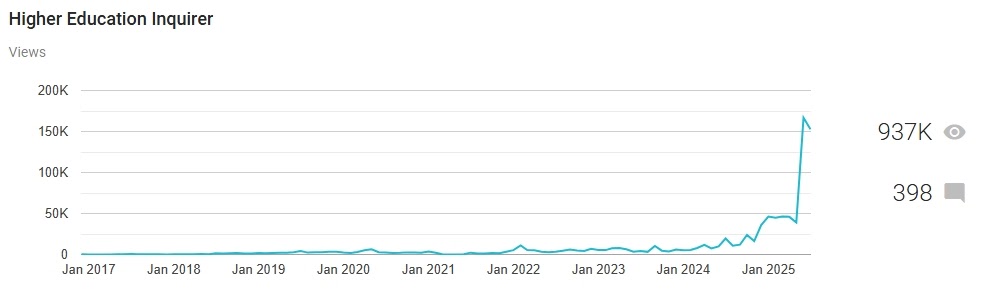
    The Higher Education Inquirer (HEI) is approaching a significant milestone: nearly one million total views expected by September 2025. This achievement underscores the growing demand for investigative journalism that holds higher education institutions accountable.

    HEI’s traffic growth has been steady for more than a year with an explosive rise over the last few months. In the first quarter of 2025, the site recorded about 132,000 views, showing increased interest. By June, monthly views passed 160,000. The highest single-day traffic came yesterday, July 21, 2025, with 10,391 views, breaking previous records. This peak coincided with the release of several articles on economic and social issues facing students, student loan debtors, and young workers.

    Key articles included Bryan Alexander’s examination of whether higher education still makes financial sense for students. Our staff contributed reports on young workers’ declining confidence in the job market and the expanding role of fintech companies like SoFi in student loans.

    HEI also covers broader social and political topics. An article on June 25 about Gaza’s humanitarian crisis and campus dissent drew hundreds of views, showing the publication’s interest in global issues related to academic freedom and student activism.

    One of the most significant examples of HEI’s investigative reporting has been its ongoing coverage of corruption and scandal in the Los Angeles Community College District (LACCD). In May and June 2025, HEI published detailed exposés documenting alleged fraud, retaliation against whistleblowers, grade manipulation, wage theft, and falsification of faculty credentials. These stories brought to light longstanding issues within LACCD, including actions by administrators such as Annie G. Reed, whose conduct has repeatedly raised serious concerns since at least 2016.

    The impact of HEI’s coverage extended beyond readership numbers. After critical articles published by allied independent media outlets were removed from online platforms, HEI stood firm in reporting these issues, highlighting the challenges faced by whistleblowers and the vital role of independent journalism in holding institutions accountable.

    In July 2025, HEI published an in-depth investigation revealing the Pentagon’s longstanding relationship with for-profit colleges, particularly through the Council of College and Military Educators (CCME). The investigation uncovered how these institutions have exploited military-connected students, veterans, and their families, benefiting from federal programs like the Post-9/11 GI Bill and Department of Defense Tuition Assistance. Despite multiple Freedom of Information Act (FOIA) requests, the Department of Defense has withheld critical documents, raising questions about transparency and accountability in military education partnerships.

    Additionally, HEI’s reporting on the exploitation of veterans under the guise of service highlighted how politicians, government agencies, and nonprofits have failed to protect those who have served. The investigation revealed that instead of supporting veterans, these entities have perpetuated systems that prioritize self-interest over the well-being of veterans, leading to wasted benefits and poor educational outcomes.

    Several factors explain HEI’s growth. The publication relies on original documents obtained through Freedom of Information Act requests, legal filings, and insider accounts to reveal facts often missed by mainstream media. This research appeals to readers seeking solid information.

    Contributions from scholars and activists like Bryan Alexander, Henry Giroux, David Halperin, and Michael Hainline add context that helps readers understand education trends and policies.

    HEI focuses on long-term issues such as adjunct faculty exploitation, college closures, student debt, and the privatization of public education, rather than fleeting news. This approach builds a loyal audience interested in ongoing analysis.

    The site offers free access without paywalls or advertising, encouraging sharing and reader interaction through comments, tips, and feedback. Its presence on social media and forums like Reddit helps reach more readers organically.

    Central to HEI’s mission is a commitment to transparency, accountability, and value in higher education. The publication seeks not only to reveal problems but also to hold institutions and policymakers responsible. HEI stresses that higher education must deliver real financial, social, and intellectual value and that openness is key to achieving this.

    The political and economic context has also contributed to HEI’s growth. Lasting effects of Trump-era policies—such as changes in Title IX enforcement, rollbacks of diversity efforts, and disputes over federal funding—have increased public interest. HEI’s clear, evidence-based coverage helps readers understand these complex changes.

    Public concerns about rising student debt, now over $1.7 trillion nationwide, and doubts about the value of college degrees have also driven readers to HEI. At the same time, debates around campus culture and diversity heighten demand for balanced reporting.

    As HEI nears its million-view goal, it plans to expand investigative work, grow its viewership base, and increase community engagement through interactive features and reader participation. The publication intends to continue monitoring higher education’s power structures and highlight factors affecting students, faculty, and institutions.

    In a time of declining trust in mainstream media and widespread misinformation, HEI’s growth shows a strong need for journalism that is thorough, honest, and focused on those involved in higher education.

    For readers seeking clear, direct insight on changes in colleges and universities, HEI offers an essential platform—living up to its motto, “Ahead of the Learned Herd.” Its rise marks a shift toward more accountable journalism in the field.

    Source link

  • Career Growth Series Cancellation Form

    Career Growth Series Cancellation Form

    Career Growth Series

    2025 Career Growth Series Cancellations

    Use this form to cancel your registration for one of more of the Career Growth Series virtual workshops.

    The post Career Growth Series Cancellation Form appeared first on CUPA-HR.

    Source link

  • NZ debuts growth plan as it eyes 35k more international students

    NZ debuts growth plan as it eyes 35k more international students

    • New Zealand relaxes some immigration rules – including upping the number of hours overseas students can work outside of their studies – in its bid to attract more international students
    • Immigration New Zealand unveils ambitious plan to tempt 35,000 more international students to the country by 2034
    • Government shines light on economic benefits of international education, but says it will keep an eye on education quality and the impact on local communities as the sector grows

    The New Zealand government has launched the International Education Going for Growth plan, as part of its broader strategy to increase international student enrolments from 83,700 in 2024 to 119,000 by 2034, and double the sector’s value from NZ$3.6 billion ( £1.60 billion) to NZ$7.2 billion (£3.20 billion). 

    On Monday, Immigration New Zealand announced changes to immigration rules to help the country “attract more international students, maintain high education standards, and manage immigration risks”.

    On November 3 this year, INZ will implement changes to increase the permitted work hours for eligible study visa holders from 20 to 25 hours per week, and extend in-study work rights to all tertiary students enrolled in approved exchange or study abroad programs, including those on one-semester courses.

    As per data published by INZ, currently 40,987 study visa holders have in-study work rights with 29,790 set to expire on or before March 31 2026, with the remaining 11,197 visas expected to lapse after that date.

    The new rules on work hours will apply only to students who have been granted a visa from November 3 onward, meaning those with existing visas limited to 20 hours per week will need to reapply to avail the increased allowance.

    On average in 2024, an international student spent NZ$45,000 across the year. That means… ultimately more jobs being created
    Erica Stanford, New Zealand education minister

    “This (increase in work hours) will apply to all new student visas granted from that date, even if the application was submitted earlier,” read a statement by INZ. 

    “If you already have a student visa with a 20-hour work limit and want to work up to 25 hours, you will need to apply for a variation of conditions or a new student visa. The relevant immigration fees will apply.”

    While international students in years 12 and 13 are eligible under the new rules, they will still be required to obtain both parental and school permission to work during the academic year, even with the increased limit of 25 hours per week. 

    Moreover, international graduates who do not qualify for post-study work rights may soon have access to a short-duration work visa of up to six months, giving them time to seek employment in their field under the Accredited Employer Work Visa pathway.

    The government is also investigating how to make it easier for students to apply for multi-year visas.

    “International education is one of our largest exports, injecting NZ$3.6 billion into our economy in 2024. It also provides opportunities for research, strengthening trade and people-to-people connections, which are important to drive investment, productivity and innovation in New Zealand,” read a statement by education minister, Erica Stanford. 

    “On average in 2024, an international student spent NZ$45,000 across the year. That means more visits to our cafes and restaurants, more people visiting our iconic attractions and ultimately more jobs being created.”

    As per data released by Education New Zealand, international enrolments are inching toward pre-Covid levels, with 2024 figures (83,425) now reaching 72% of the 2019 total of 115,705.

    According to ENZ chief executive Amanda Malu, while China and India remain New Zealand’s two largest international student markets, accounting for 34% and 14% of enrolments respectively, they are followed by Japan (9%), South Korea (4%), Thailand (3%), the United States (3%), Germany (3%), the Philippines (3%), and Sri Lanka (3%)

    It’s important to strike the right balance between increasing student numbers, maintaining the quality of education, and managing broader impacts on New Zealanders
    Erica Stanford, New Zealand education minister

    New Zealand wants to “supercharge” this rising momentum and position New Zealand as the destination of choice for international students, according to Stanford. 

    This includes increasing awareness of New Zealand as a study destination from 38% in 2024 to 44% by 2034, and raising the proportion of prospective students who rank the country among their top three study choices from 18% to 22% over the same period.

    “To achieve our ambitious target, we’re taking a considered and strategic approach. It’s important to strike the right balance between increasing student numbers, maintaining the quality of education, and managing broader impacts on New Zealanders. Our plan will deliver that,” stated Stanford. 

    Source link

  • Making things happen: Coventry University’s contribution to regional growth

    Making things happen: Coventry University’s contribution to regional growth

    • This blog is by Dr Clive Winters, Pro-Vice-Chancellor (Strategy and Governance) at Coventry University Group.
    • Today is Josh Freeman’s last day at HEPI. Josh has run the HEPI blog alongside his other duties for most of the past two years and has been a fabulous colleague. We will miss him and wish him all the best for the future and in his new role at the Office for Students.

    When levelling up was popular in political and media circles, it was a source of bemusement to some of us in Higher Education. After all, universities as anchor institutions have been helping level up our communities and delivering economic impact for decades, or even longer.

    Coventry University Group is now a global education provider, but its roots go back to 1843 when entrepreneurs and industrialists created Coventry School of Design to deliver a skilled workforce. Nearly two centuries later, we have never lost that core ethos of meeting local needs and we continue to work with businesses to provide job-ready graduates with the skills and creative thinking to improve their communities.

    Our emblem is a Phoenix, chosen because of the city’s long history of regeneration and rebirth – a story only possible through our ongoing commitment and agility to evolve with the city and deliver the skills and innovation ecosystem needed to raise and maintain aspirations, mobility and prosperity. We have always been of the city and for the city of Coventry and have transplanted our mission of creating better futures into more cities and regions with campuses in London, Scarborough and Poland.

    Education is based on place and each location is different, with social, economic and geographical factors driving local need and the gaps in skills, health and prosperity that we can help to fill. Our research and knowledge exchange activity complements our excellence in teaching to allow us to operate as a collaborative partner of choice, developing holistic solutions for local communities. We deliver technical, professional and vocational education and research that impacts on people and places. We co-create our courses with employers, our research is undertaken in collaboration and partnership, and knowledge exchange activity is designed with businesses not for them.

    When trying to capture this in an economic impact report on our activity in Coventry, we assumed the figures would be large, impressive and surprising to some but would not tell the full story of how we contribute to place and society. So, we asked the consulting team at Hatch to look at our wider impacts and not just add up the pounds.

    In simple economic terms, our main campus had a gross quantifiable economic footprint of 6,730 FTE jobs and £320m in Gross Value Added (GVA) in Coventry (2021/22). One in every 20 jobs in the city can be traced back to our presence. For every four direct on-campus jobs, a further three are supported across the city through the multiplier effects generated by the Group’s activity.

    But that doesn’t calculate the true extent to which we are woven into the economic and social fabric of Coventry, helping the city adapt and grow for 180 years. Our 5,000 health students on placements populate the teams in the wards and clinics of our local hospital, working alongside our alumni in the health and care sector in Coventry. The Research Centre for Care Excellence is a partnership with University Hospitals Coventry and Warwickshire (UHCW) empowering staff to develop ideas to make ‘patient first’ improvements. Patients feel the benefits, almost certainly without ever knowing the role we played. We are also working with UHCW and other NHS bodies to use our city centre estate to bring health services closer to patients and are the first university to be co-located in a Community Diagnostic Centre. Real people benefit from our work.

    Coventry was the home of bicycle design and manufacturing before becoming the UK’s motor city and is now vying to position itself at the forefront of the net zero transport revolution. Many of the brightest and best car designers and engineers in the UK have Coventry degrees, and we continue to meet the evolving needs of the city – upskilling 1,200 JLR staff though an electrification development programme and conducting 34 net zero collaborative research projects in just two years. We are moving the city forwards into a brighter, better future.

    The song We’ll Live and Die in These Towns seems an unusual choice for any place to have as an (unofficial) anthem, as it speaks of desperation and resignation to the fate of the working classes. But it has been embraced, not least by supporters of Coventry City, possibly because it somehow transmits a strong sense of identity based on where you are from, of place. Alongside the defiant chorus, the lyrics include the line, ‘nothing ever happened on its own’. People have to make things happen and Coventry is a city where we make things happen, but we don’t do that on our own. We do it with someone and for someone in collaboration and partnership as an anchor institution, that is the key to real economic impact.

    Source link

  • Career Growth Series – CUPA-HR

    Career Growth Series – CUPA-HR

    CUPA-HR’s Career Growth Series is a three-part professional development opportunity for higher ed HR professionals who want to explore how to grow, lead and thrive in their careers. These 90-minute virtual workshops will offer practical tools, peer insights and reflective space to support your growth.

    While you can register for only one or two of the workshops, together they form a cohesive journey — from identifying creative, self-directed development opportunities to evaluating leadership readiness and building the skills and strategies needed to step into and succeed in leadership roles.

    The Career Growth Series is a pilot program that is open to invited CUPA-HR members. Seats are limited to support interaction among participants. The workshops will be highly interactive, so come prepared to engage, reflect and share ideas. The sessions will not be recorded.

    New to CUPA-HR Virtual Events?


    Building the Blueprint for Your Professional Development Journey

    Wednesday, August 13 | 1:00-2:30 p.m. ET

    This workshop invites you to rethink professional development by exploring unconventional, self-directed strategies that align with your position and career aspirations. Through interactive activities and real-world examples, you’ll learn how to identify meaningful growth opportunities, build support for your development plan and articulate the value of your learning. Explore how curiosity, creativity and commitment can be key drivers for shaping a fulfilling professional journey in higher ed HR.

    Presenters

    Krista Vaught, Ed.D.
    Principal Advisor, Employee Experience and Learning and Development
    Frontier Design

    Natalie Trent
    Talent Management Manager
    Grand Valley State University

    The Zoom link will be shared with registrants via email the day before the event.


    Navigating Career Possibilities: Is Leadership Your Next Destination?

    Wednesday, August 20 | 2:00-3:30 p.m. ET

    This workshop will help you explore if leadership/management is the right next step in your career journey and will challenge the assumption that upward mobility is the only route to career fulfillment. Through self-assessment, peer dialogue and real-world insights, you’ll examine your motivations and strengths — and the realities of leadership roles. Leave with clarity on your path forward, whether it involves formal leadership or alternative growth opportunities in higher ed HR.

    Presenters

    Dawn Aziz, Ph.D.
    Director, Organization and Employee Development
    Wayne State University

    Kristen Finley
    Talent and Organizational Development Specialist
    Clemson University

    Elizabeth Oeltjenbruns
    Organization Development Consultant
    University of South Florida

    Krista Vaught, Ed.D.
    Principal Advisor, Employee Experience and Learning and Development
    Frontier Design

    The Zoom link will be shared with registrants via email the day before the event.


    From Aspiration to Action: Positioning Yourself for a Successful Transition Into Leadership

    Wednesday, August 27 | 2:00-3:30 p.m. ET

    This workshop is for higher ed HR professionals who are pursuing a leadership or managerial role or have recently transitioned into leadership/management. You’ll explore essential leadership competencies, reflect on your readiness, and learn strategies to build experience and credibility, even without a formal title. Through interactive discussions and real-world insights, you’ll gain tools to confidently navigate the shift from team member to a formal leadership role.

    Laura Boehme
    Vice President of People and Technology
    Central Oregon Community College

    Krista Vaught, Ed.D.
    Principal Advisor, Employee Experience and Learning and Development
    Frontier Design

    The Zoom link will be shared with registrants via email the day before the event.

    CORE
    Employee Development

    STRATEGIC LEADERSHIP
    Leading the Higher Ed Business Model

    ENGAGEMENT
    Self-Awareness and Accountability


    New to CUPA-HR Virtual Events?
    The CUPA-HR website requires you to create a free site account if you don’t already have one. After you’ve created a website account and established a login, you can then proceed to register for this event. If you have any questions while registering, please contact CUPA-HR toll free at 877-287-2474 or via e-mail at [email protected].

    Need to Cancel a Registration?
    Fill out the cancellation form.

    Source link

  • Civic engagement offers a firm foundation for universities contributing to regional economic growth agendas

    Civic engagement offers a firm foundation for universities contributing to regional economic growth agendas

    When searching for friendly support or warm words from politicians, the media, and the public, UK universities are increasingly being left empty-handed.

    Last year’s modest increase in tuition fees allowed universities a temporary reprieve after years of tightening financial constraints but came with a firm warning that standards must improve and was quickly wiped out by rises in National Insurance. Meanwhile, culture wars and negative perceptions on quality and graduate outcomes continue to dominate discourse around the sector, fuelling criticism of universities from all directions.

    Richard Jones, vice president for regional innovation and civic engagement at the University of Manchester posited last week that university leaders may be tempted to look for easy savings in their civic impact work – initiatives that engage with and benefit their local community but ultimately fall outside of a university’s traditional mission of teaching and research. But as he argues, this would be a profound mistake.

    The outlook in recent years for universities may have been challenging, but hope lies in Labour’s focus on place-based policy. Place has driven flagship funding decisions and policies including the Spending Review and the Industrial Strategy, with more money being devolved from Whitehall to the regions in pursuit of growth. New Mayoral Strategic Authorities have been empowered to take the reins on transport, investment, spatial planning and skills, with the promise of further autonomy as they mature. A new Green Book – government’s methodology for assessing public investments – is being updated and will broaden the criteria to look more favourably at investments outside London and the South East.

    Universities are perfectly placed to be the drivers of Labour’s regional growth ambitions. The priority sectors in last week’s Industrial Strategy – including advanced manufacturing, life sciences, and clean energy industries – are some of UK universities’ best strengths. Moreover, as anchor institutions located in the heart of communities, universities are physically well-placed to address causes of economic decline.

    Civic engagement for economic growth

    The civic university movement, which champions collaboration between universities and their localities, has an established framework for institutions looking to ramp up civic impact initiatives with their civic university agreements. More than 70 civic university agreements are already in place between universities and their local authorities, with universities in Manchester, Nottingham, Sheffield, Exeter, Derby and London, among others, providing a range of examples for institutions to learn from.

    A UPP Foundation series of roundtables held in four regions across England recently has also highlighted that the civic university movement remains active, with a wealth of civic activity taking place across the country. Universities are finding creative ways to engage with their local communities, with examples including offering to host events in university spaces, or running a café that demystifies the benefits of nuclear energy while providing employment and training for local people. For institutions nervous about signing up to lengthy and potentially costly partnerships, participants at the roundtables instead stressed that smaller gestures can be just as meaningful. Rather than draining resources, civic activity can in fact alleviate funding pressures when universities work together to learn from one another.

    Irrespective of geography, participants were united in their contention that universities should collaborate with their local partners to develop civic initiatives, working collaboratively to address the real day-to-day problems communities want help with, such as helping local businesses transition to net zero.

    Labour’s devolution agenda also offers an opportunity for universities to become visible bridges working across regions and political geographies. While mayoral devolution has been lauded in cohesive urban centres like Manchester and Birmingham, there are concerns the model will work less well in rural areas where proposed Mayoral Combined Authorities will intersect with traditional county borders. For such regions, universities can both serve as bolsters to wider regional identity and can benefit from the flexibility of their own geography that may span mayoral regions.

    The opportunities are there for universities to re-embed civic activity into their core work under Labour’s agenda – but it needs brave leadership to embrace them. In the face of tough financial decisions, university leaders must champion the benefits of civic activity. The late Bob Kerslake, chair of the UPP Foundation’s Civic University Commission 2018–19, deeply understood the potential and necessity for universities to be rooted in their local communities. For a higher education sector that has spent recent years on uncertain footing, tapping into Kerslake’s vision could provide a more certain path forward.

    The UPP Foundation’s full report UPP Foundation Spring 2025 Roundtables: The Role of Universities in Regional Placemaking explores the key themes of the roundtable discussions. You can download the report here.

    Source link

  • International students “crucial” for US growth, states new report

    International students “crucial” for US growth, states new report

    The study, published by the Institue of International Education (IIE), outlines the importance of expanding international study to the US over the next five years as American universities brace for an impending domestic “enrolment cliff”. 

    “Attracting global talent is crucial to driving the US economy and growth, and maintaining US leadership” IIE’s head of research, evaluation and learning Mirka Martel told The PIE News. 

    Martel, co-author of the Outlook 2030 Brief, highlighted the unique capacity of the US to host more international students, who currently make up just 6% of the overall student population.  

    In comparison, international students comprise a much larger proportion of the total student body in the UK (27%), Australia (31%) and Canada (38%). 

    Notably, 36 US states were identified by IIE with international student populations below the 6% line, with Massachusetts, New York and Washington DC the regions with the highest proportions of international students.  

    Meanwhile, US universities are facing a much reported on domestic enrolment cliff, with government figures showing undergraduate enrolment declining by more than two million between 2010 and 2022. 

    What’s more, projections indicate that the number of high school graduates will peak in 2025 and decline by 13% by 2041, with IIE warning that US colleges and universities will be left with “empty seats” if they do not focus on international enrolments.  

    Despite recent reports of declining student interest in the US driven by the Trump administration’s hostile policies, IIE’s Fall 2024 Snapshot predicted a 3% growth in international student levels in the 2024/15 academic year.  

    Martel said she expected this forecast to hold true, pointing to the “exciting” fall increase in undergraduate rates for the first time since Covid and the continuing increase in Optional Practical Training (OPT) stemming from rising graduate rates over the last three years. 

    Outside the US, the total number of globally mobile students has seen exponential growth in recent years, nearly doubling over the past decade to reach 6.9 mil in 2024.   

    With last year witnessing the largest growth since the pandemic, some expect global mobility to exceed 9 million by 2030, driven by the growth of youthful populations in South Asia and Sub-Saharan Africa.  

    This, the report says, will create “a steady pipeline of students seeking future academic study”, highlighting the case of Nigeria where the country’s universities can only admit one-third of the two million annual applicants due to capacity constraints.  

    Elsewhere in India, domestic institutions have significantly expanded their undergraduate studies, but “there remains a strong interest in pursuing graduate studies abroad,” according to IIE. 

    Attracting global talent is crucial to driving the US economy and growth

    Mirka Martel, IIE

    In 2023/24, the number of international students in the US reached a record level of 1.1 million, which was primarily driven by a surge in OPT rather than new enrolments.  

    IIE’s 2030 Outlook highlights the $50bn contribution of international students to the US in 2024, with California ($6.4bn), New York ($6.3bn) and Massachusetts ($3.9) reaping the highest economic benefits.  

    What’s more, last year international students created nearly 400,000 jobs in the US, with the report highlighting their role in driving innovation in key industries, as more than half of international students in the US graduate from STEM fields.  

    It points to Chamber of Commerce predictions of incoming labour market shortages across healthcare, computer and mathematical sciences, and business and financial operations, with international students with US training well-poised to fill the gaps.  

    Beyond the numbers, “[international students] are a political and economic asset for America,” states the report: broadening perspectives in the classroom and furthering business, cultural, economic and political ties after they return home.  

    Source link

  • Lifting as We Climb: A Reflection on Mentorship, Growth, and Leadership in Nursing Education – Faculty Focus

    Lifting as We Climb: A Reflection on Mentorship, Growth, and Leadership in Nursing Education – Faculty Focus

    Source link