Tag: Growth

  • Making things happen: Coventry University’s contribution to regional growth

    Making things happen: Coventry University’s contribution to regional growth

    • This blog is by Dr Clive Winters, Pro-Vice-Chancellor (Strategy and Governance) at Coventry University Group.
    • Today is Josh Freeman’s last day at HEPI. Josh has run the HEPI blog alongside his other duties for most of the past two years and has been a fabulous colleague. We will miss him and wish him all the best for the future and in his new role at the Office for Students.

    When levelling up was popular in political and media circles, it was a source of bemusement to some of us in Higher Education. After all, universities as anchor institutions have been helping level up our communities and delivering economic impact for decades, or even longer.

    Coventry University Group is now a global education provider, but its roots go back to 1843 when entrepreneurs and industrialists created Coventry School of Design to deliver a skilled workforce. Nearly two centuries later, we have never lost that core ethos of meeting local needs and we continue to work with businesses to provide job-ready graduates with the skills and creative thinking to improve their communities.

    Our emblem is a Phoenix, chosen because of the city’s long history of regeneration and rebirth – a story only possible through our ongoing commitment and agility to evolve with the city and deliver the skills and innovation ecosystem needed to raise and maintain aspirations, mobility and prosperity. We have always been of the city and for the city of Coventry and have transplanted our mission of creating better futures into more cities and regions with campuses in London, Scarborough and Poland.

    Education is based on place and each location is different, with social, economic and geographical factors driving local need and the gaps in skills, health and prosperity that we can help to fill. Our research and knowledge exchange activity complements our excellence in teaching to allow us to operate as a collaborative partner of choice, developing holistic solutions for local communities. We deliver technical, professional and vocational education and research that impacts on people and places. We co-create our courses with employers, our research is undertaken in collaboration and partnership, and knowledge exchange activity is designed with businesses not for them.

    When trying to capture this in an economic impact report on our activity in Coventry, we assumed the figures would be large, impressive and surprising to some but would not tell the full story of how we contribute to place and society. So, we asked the consulting team at Hatch to look at our wider impacts and not just add up the pounds.

    In simple economic terms, our main campus had a gross quantifiable economic footprint of 6,730 FTE jobs and £320m in Gross Value Added (GVA) in Coventry (2021/22). One in every 20 jobs in the city can be traced back to our presence. For every four direct on-campus jobs, a further three are supported across the city through the multiplier effects generated by the Group’s activity.

    But that doesn’t calculate the true extent to which we are woven into the economic and social fabric of Coventry, helping the city adapt and grow for 180 years. Our 5,000 health students on placements populate the teams in the wards and clinics of our local hospital, working alongside our alumni in the health and care sector in Coventry. The Research Centre for Care Excellence is a partnership with University Hospitals Coventry and Warwickshire (UHCW) empowering staff to develop ideas to make ‘patient first’ improvements. Patients feel the benefits, almost certainly without ever knowing the role we played. We are also working with UHCW and other NHS bodies to use our city centre estate to bring health services closer to patients and are the first university to be co-located in a Community Diagnostic Centre. Real people benefit from our work.

    Coventry was the home of bicycle design and manufacturing before becoming the UK’s motor city and is now vying to position itself at the forefront of the net zero transport revolution. Many of the brightest and best car designers and engineers in the UK have Coventry degrees, and we continue to meet the evolving needs of the city – upskilling 1,200 JLR staff though an electrification development programme and conducting 34 net zero collaborative research projects in just two years. We are moving the city forwards into a brighter, better future.

    The song We’ll Live and Die in These Towns seems an unusual choice for any place to have as an (unofficial) anthem, as it speaks of desperation and resignation to the fate of the working classes. But it has been embraced, not least by supporters of Coventry City, possibly because it somehow transmits a strong sense of identity based on where you are from, of place. Alongside the defiant chorus, the lyrics include the line, ‘nothing ever happened on its own’. People have to make things happen and Coventry is a city where we make things happen, but we don’t do that on our own. We do it with someone and for someone in collaboration and partnership as an anchor institution, that is the key to real economic impact.

    Source link

  • Career Growth Series – CUPA-HR

    Career Growth Series – CUPA-HR

    CUPA-HR’s Career Growth Series is a three-part professional development opportunity for higher ed HR professionals who want to explore how to grow, lead and thrive in their careers. These 90-minute virtual workshops will offer practical tools, peer insights and reflective space to support your growth.

    While you can register for only one or two of the workshops, together they form a cohesive journey — from identifying creative, self-directed development opportunities to evaluating leadership readiness and building the skills and strategies needed to step into and succeed in leadership roles.

    The Career Growth Series is a pilot program that is open to invited CUPA-HR members. Seats are limited to support interaction among participants. The workshops will be highly interactive, so come prepared to engage, reflect and share ideas. The sessions will not be recorded.

    New to CUPA-HR Virtual Events?


    Building the Blueprint for Your Professional Development Journey

    Wednesday, August 13 | 1:00-2:30 p.m. ET

    This workshop invites you to rethink professional development by exploring unconventional, self-directed strategies that align with your position and career aspirations. Through interactive activities and real-world examples, you’ll learn how to identify meaningful growth opportunities, build support for your development plan and articulate the value of your learning. Explore how curiosity, creativity and commitment can be key drivers for shaping a fulfilling professional journey in higher ed HR.

    Presenters

    Krista Vaught, Ed.D.
    Principal Advisor, Employee Experience and Learning and Development
    Frontier Design

    Natalie Trent
    Talent Management Manager
    Grand Valley State University

    The Zoom link will be shared with registrants via email the day before the event.


    Navigating Career Possibilities: Is Leadership Your Next Destination?

    Wednesday, August 20 | 2:00-3:30 p.m. ET

    This workshop will help you explore if leadership/management is the right next step in your career journey and will challenge the assumption that upward mobility is the only route to career fulfillment. Through self-assessment, peer dialogue and real-world insights, you’ll examine your motivations and strengths — and the realities of leadership roles. Leave with clarity on your path forward, whether it involves formal leadership or alternative growth opportunities in higher ed HR.

    Presenters

    Dawn Aziz, Ph.D.
    Director, Organization and Employee Development
    Wayne State University

    Kristen Finley
    Talent and Organizational Development Specialist
    Clemson University

    Elizabeth Oeltjenbruns
    Organization Development Consultant
    University of South Florida

    Krista Vaught, Ed.D.
    Principal Advisor, Employee Experience and Learning and Development
    Frontier Design

    The Zoom link will be shared with registrants via email the day before the event.


    From Aspiration to Action: Positioning Yourself for a Successful Transition Into Leadership

    Wednesday, August 27 | 2:00-3:30 p.m. ET

    This workshop is for higher ed HR professionals who are pursuing a leadership or managerial role or have recently transitioned into leadership/management. You’ll explore essential leadership competencies, reflect on your readiness, and learn strategies to build experience and credibility, even without a formal title. Through interactive discussions and real-world insights, you’ll gain tools to confidently navigate the shift from team member to a formal leadership role.

    Laura Boehme
    Vice President of People and Technology
    Central Oregon Community College

    Krista Vaught, Ed.D.
    Principal Advisor, Employee Experience and Learning and Development
    Frontier Design

    The Zoom link will be shared with registrants via email the day before the event.

    CORE
    Employee Development

    STRATEGIC LEADERSHIP
    Leading the Higher Ed Business Model

    ENGAGEMENT
    Self-Awareness and Accountability


    New to CUPA-HR Virtual Events?
    The CUPA-HR website requires you to create a free site account if you don’t already have one. After you’ve created a website account and established a login, you can then proceed to register for this event. If you have any questions while registering, please contact CUPA-HR toll free at 877-287-2474 or via e-mail at [email protected].

    Need to Cancel a Registration?
    Fill out the cancellation form.

    Source link

  • Civic engagement offers a firm foundation for universities contributing to regional economic growth agendas

    Civic engagement offers a firm foundation for universities contributing to regional economic growth agendas

    When searching for friendly support or warm words from politicians, the media, and the public, UK universities are increasingly being left empty-handed.

    Last year’s modest increase in tuition fees allowed universities a temporary reprieve after years of tightening financial constraints but came with a firm warning that standards must improve and was quickly wiped out by rises in National Insurance. Meanwhile, culture wars and negative perceptions on quality and graduate outcomes continue to dominate discourse around the sector, fuelling criticism of universities from all directions.

    Richard Jones, vice president for regional innovation and civic engagement at the University of Manchester posited last week that university leaders may be tempted to look for easy savings in their civic impact work – initiatives that engage with and benefit their local community but ultimately fall outside of a university’s traditional mission of teaching and research. But as he argues, this would be a profound mistake.

    The outlook in recent years for universities may have been challenging, but hope lies in Labour’s focus on place-based policy. Place has driven flagship funding decisions and policies including the Spending Review and the Industrial Strategy, with more money being devolved from Whitehall to the regions in pursuit of growth. New Mayoral Strategic Authorities have been empowered to take the reins on transport, investment, spatial planning and skills, with the promise of further autonomy as they mature. A new Green Book – government’s methodology for assessing public investments – is being updated and will broaden the criteria to look more favourably at investments outside London and the South East.

    Universities are perfectly placed to be the drivers of Labour’s regional growth ambitions. The priority sectors in last week’s Industrial Strategy – including advanced manufacturing, life sciences, and clean energy industries – are some of UK universities’ best strengths. Moreover, as anchor institutions located in the heart of communities, universities are physically well-placed to address causes of economic decline.

    Civic engagement for economic growth

    The civic university movement, which champions collaboration between universities and their localities, has an established framework for institutions looking to ramp up civic impact initiatives with their civic university agreements. More than 70 civic university agreements are already in place between universities and their local authorities, with universities in Manchester, Nottingham, Sheffield, Exeter, Derby and London, among others, providing a range of examples for institutions to learn from.

    A UPP Foundation series of roundtables held in four regions across England recently has also highlighted that the civic university movement remains active, with a wealth of civic activity taking place across the country. Universities are finding creative ways to engage with their local communities, with examples including offering to host events in university spaces, or running a café that demystifies the benefits of nuclear energy while providing employment and training for local people. For institutions nervous about signing up to lengthy and potentially costly partnerships, participants at the roundtables instead stressed that smaller gestures can be just as meaningful. Rather than draining resources, civic activity can in fact alleviate funding pressures when universities work together to learn from one another.

    Irrespective of geography, participants were united in their contention that universities should collaborate with their local partners to develop civic initiatives, working collaboratively to address the real day-to-day problems communities want help with, such as helping local businesses transition to net zero.

    Labour’s devolution agenda also offers an opportunity for universities to become visible bridges working across regions and political geographies. While mayoral devolution has been lauded in cohesive urban centres like Manchester and Birmingham, there are concerns the model will work less well in rural areas where proposed Mayoral Combined Authorities will intersect with traditional county borders. For such regions, universities can both serve as bolsters to wider regional identity and can benefit from the flexibility of their own geography that may span mayoral regions.

    The opportunities are there for universities to re-embed civic activity into their core work under Labour’s agenda – but it needs brave leadership to embrace them. In the face of tough financial decisions, university leaders must champion the benefits of civic activity. The late Bob Kerslake, chair of the UPP Foundation’s Civic University Commission 2018–19, deeply understood the potential and necessity for universities to be rooted in their local communities. For a higher education sector that has spent recent years on uncertain footing, tapping into Kerslake’s vision could provide a more certain path forward.

    The UPP Foundation’s full report UPP Foundation Spring 2025 Roundtables: The Role of Universities in Regional Placemaking explores the key themes of the roundtable discussions. You can download the report here.

    Source link

  • International students “crucial” for US growth, states new report

    International students “crucial” for US growth, states new report

    The study, published by the Institue of International Education (IIE), outlines the importance of expanding international study to the US over the next five years as American universities brace for an impending domestic “enrolment cliff”. 

    “Attracting global talent is crucial to driving the US economy and growth, and maintaining US leadership” IIE’s head of research, evaluation and learning Mirka Martel told The PIE News. 

    Martel, co-author of the Outlook 2030 Brief, highlighted the unique capacity of the US to host more international students, who currently make up just 6% of the overall student population.  

    In comparison, international students comprise a much larger proportion of the total student body in the UK (27%), Australia (31%) and Canada (38%). 

    Notably, 36 US states were identified by IIE with international student populations below the 6% line, with Massachusetts, New York and Washington DC the regions with the highest proportions of international students.  

    Meanwhile, US universities are facing a much reported on domestic enrolment cliff, with government figures showing undergraduate enrolment declining by more than two million between 2010 and 2022. 

    What’s more, projections indicate that the number of high school graduates will peak in 2025 and decline by 13% by 2041, with IIE warning that US colleges and universities will be left with “empty seats” if they do not focus on international enrolments.  

    Despite recent reports of declining student interest in the US driven by the Trump administration’s hostile policies, IIE’s Fall 2024 Snapshot predicted a 3% growth in international student levels in the 2024/15 academic year.  

    Martel said she expected this forecast to hold true, pointing to the “exciting” fall increase in undergraduate rates for the first time since Covid and the continuing increase in Optional Practical Training (OPT) stemming from rising graduate rates over the last three years. 

    Outside the US, the total number of globally mobile students has seen exponential growth in recent years, nearly doubling over the past decade to reach 6.9 mil in 2024.   

    With last year witnessing the largest growth since the pandemic, some expect global mobility to exceed 9 million by 2030, driven by the growth of youthful populations in South Asia and Sub-Saharan Africa.  

    This, the report says, will create “a steady pipeline of students seeking future academic study”, highlighting the case of Nigeria where the country’s universities can only admit one-third of the two million annual applicants due to capacity constraints.  

    Elsewhere in India, domestic institutions have significantly expanded their undergraduate studies, but “there remains a strong interest in pursuing graduate studies abroad,” according to IIE. 

    Attracting global talent is crucial to driving the US economy and growth

    Mirka Martel, IIE

    In 2023/24, the number of international students in the US reached a record level of 1.1 million, which was primarily driven by a surge in OPT rather than new enrolments.  

    IIE’s 2030 Outlook highlights the $50bn contribution of international students to the US in 2024, with California ($6.4bn), New York ($6.3bn) and Massachusetts ($3.9) reaping the highest economic benefits.  

    What’s more, last year international students created nearly 400,000 jobs in the US, with the report highlighting their role in driving innovation in key industries, as more than half of international students in the US graduate from STEM fields.  

    It points to Chamber of Commerce predictions of incoming labour market shortages across healthcare, computer and mathematical sciences, and business and financial operations, with international students with US training well-poised to fill the gaps.  

    Beyond the numbers, “[international students] are a political and economic asset for America,” states the report: broadening perspectives in the classroom and furthering business, cultural, economic and political ties after they return home.  

    Source link

  • Lifting as We Climb: A Reflection on Mentorship, Growth, and Leadership in Nursing Education – Faculty Focus

    Lifting as We Climb: A Reflection on Mentorship, Growth, and Leadership in Nursing Education – Faculty Focus

    Source link

  • Yara Shahidi On Learning, Growth, and Pursuing Passions

    Yara Shahidi On Learning, Growth, and Pursuing Passions

    Yara Shahidi | Photo by Paul Mardy

    Actor, producer, optimist, and agent for change Yara Shahidi, host of “The Optimist Project” on Sirius XM, shares insights from her Harvard journey, offering advice on navigating education, discovering passions, and continuing personal growth.


    You’ve been a strong advocate for education while also pursuing your degree at Harvard. What motivated you to prioritize higher education despite having so many career opportunities?

    Education has always been an integral part of my life — it was never really a question of if, but when and how. My parents instilled this idea that learning is a lifelong adventure, whether that’s in a classroom or out in the world. For college specifically, I saw it as an opportunity to explore my curiosities, grow a community, and continue to pour into my growth academically and mentally. In a world in which so much is demanded of us on a daily basis, college felt like one of the few spaces in life in which my primary job was to think and explore. From my Gen Eds about the evolution of morality and pharmaceutical pricing, to my courses on neo-colonialism and resistance movements, Harvard gave me the space to think critically, to interrogate my own beliefs, and grow.

    Many students feel pressure to choose the “right” college or career path. What advice would you give to those struggling with that decision?

    I understand that pressure. So many of us come from communities and families that have dealt with so many barriers to entry to higher education, and it feels as though we are receiving this education and degree for more than ourselves, but for everyone who has invested in us.  

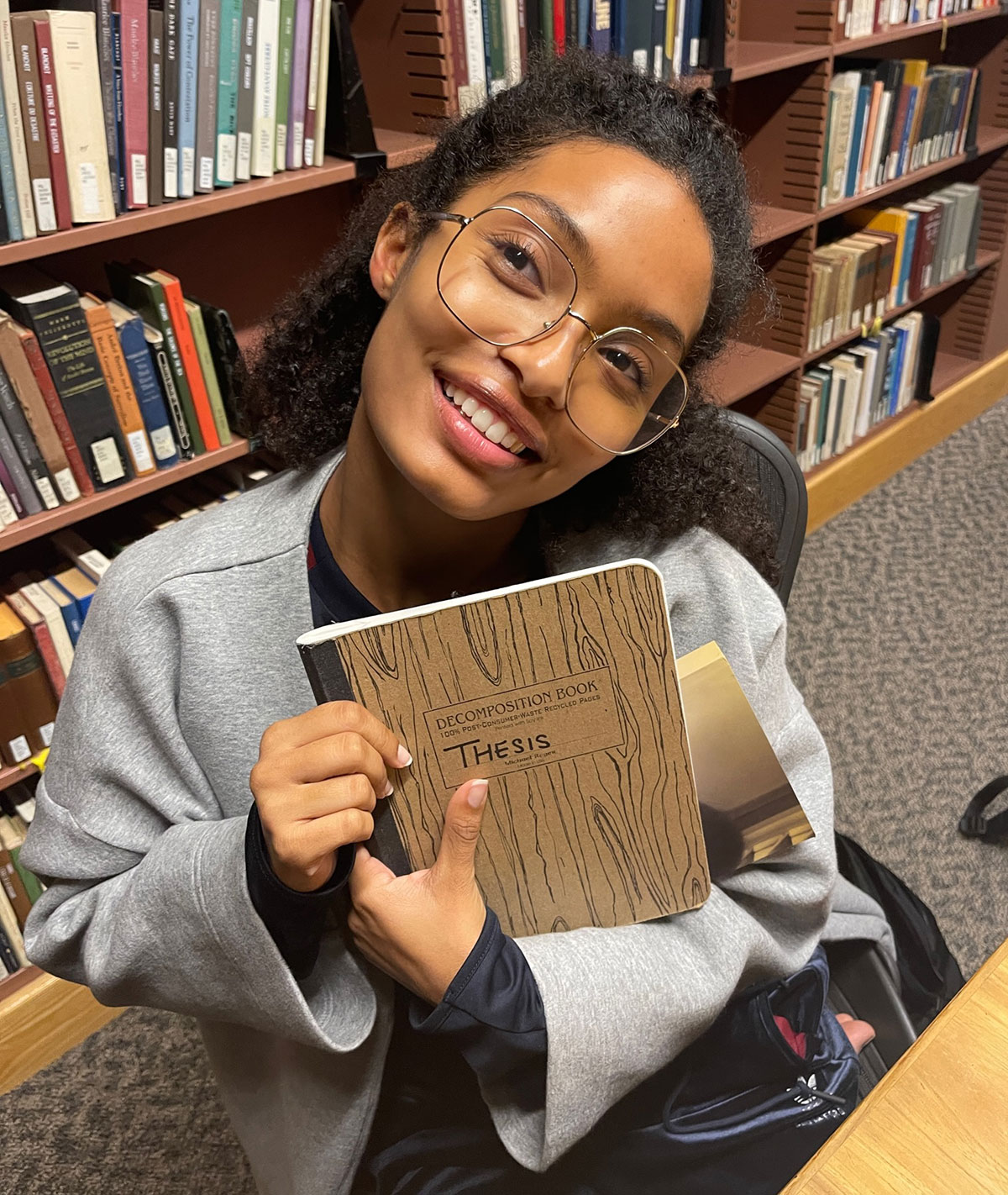
    Yara Shahidi in Harvard’s library (2021) | Photo courtesy of Yara Shahidi

    My favorite piece of advice from when I was trying to figure out my own path is when my mama told me that your degree is proof, to yourself and to the world, that you can start and complete a project. This isn’t to make light of the vastly different paths college offers to us, but to contextualize that the most valuable part of the learning experience is the life experience — learning how to listen to yourself, learning how to see things through, learning how to learn, and, when need be, learning how to pivot. In our family, we have focused on chasing our curiosities, with the belief that opportunities will blossom from the intersection of our identity and interests. 

    What are some lessons from your own education journey that you think every young person should hear?

    First: It’s OK not to have all the answers. We live in this era where everyone feels the expectation to have a five-year plan by the time they’re 17. I’m 25 and still don’t know what the next five years will hold for me. Some of the most interesting people I know have taken what many would consider unconventional paths. In fact, we are living in a time in which we are all realizing that to bring about a better world, we cannot rely on the status quo, and we will need to pursue unconventional paths. 

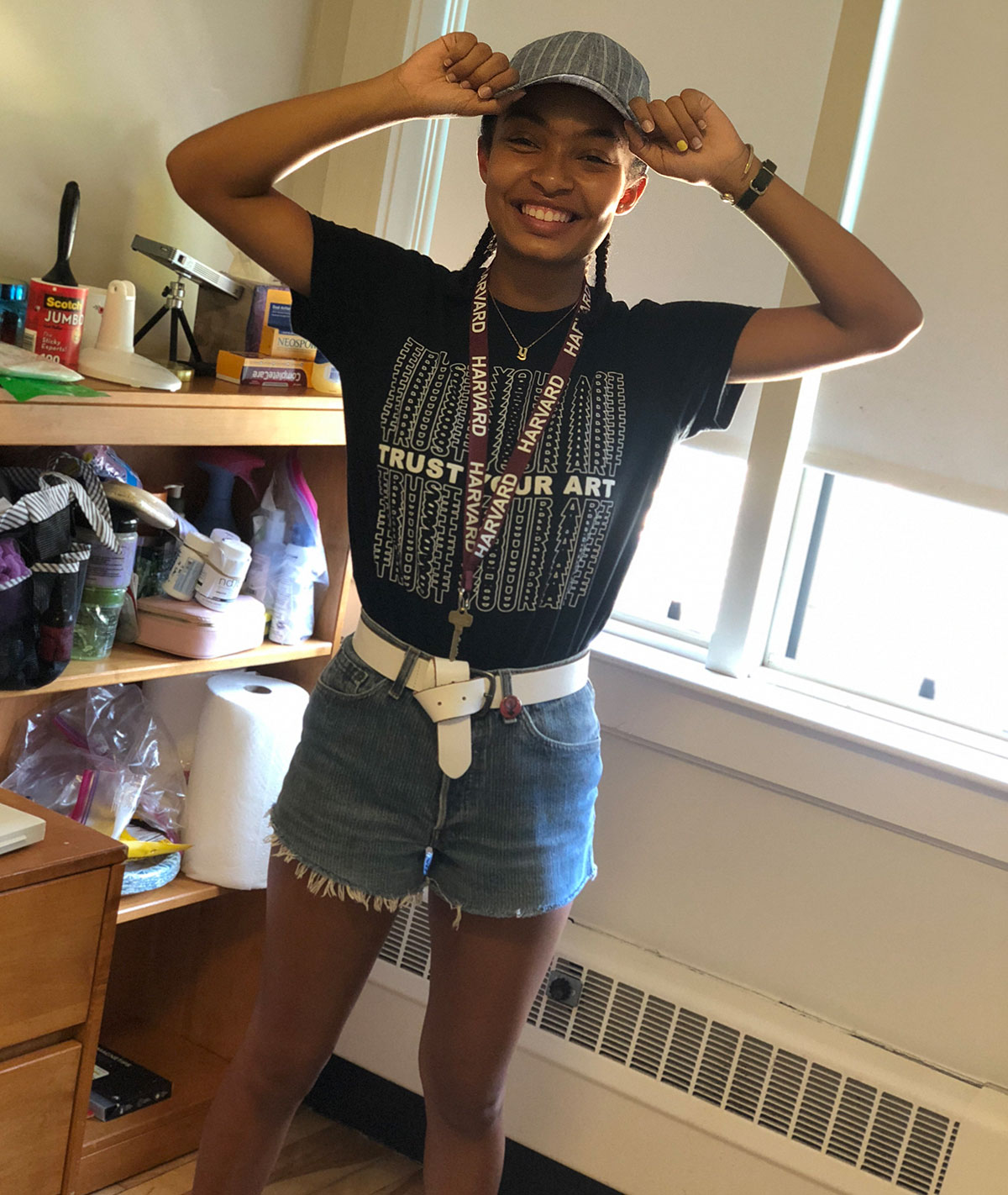
    Freshman year dorm room move-in (2018) | Photo by Afshin Shahidi

    Second: Let yourself be “bad” at things. I had to learn (and am still learning) that not every attempt of mine would be a surefire success, and that’s part of my growth process. With the very real pressure of having to be the best for doors to open, we can get consumed with looking polished and/or trying to find the “correct” way of moving. I’ve had to remind myself, we are not here to know; we are here to learn, and the best learning happens when we give ourselves permission to fumble through something new. 

    Lastly: Your education — whether it’s in school or out in the world — is for you. Honor your learning style, expand your worldview, and share your unique creativity and skills with the global community!

    You juggle so much — acting, activism, and academics. How has college helped you evolve as a person and as a leader?

    Being a student at Harvard reaffirmed the importance of being a student of life. My college experience was a practice in giving myself permission to grow. Separate from being a public figure because of my career, being a young adult in this day and age comes with some sort of public persona and a feeling of having to be certain to be taken seriously, which, in many ways, is the same as being static. Being in classrooms with people from so many different backgrounds forced me to challenge my own perspectives, deepen the reasoning for my beliefs, and grow curious about topics that had never been on my radar. Being able to balance maintaining a core set of values while engaging with new ideas has helped me maneuver my career, created a source of optimism as we look for brighter futures, and helped me in my evolution into the person I want to be. 

    Your generation is redefining success in so many ways. How do you think young people today can balance passion, purpose, and education?

    I think it’s incredible how we’re expanding the definition of success beyond traditional metrics. People want to do things that feel meaningful, and I think this generation has a beautiful sense of community where we are also invested in each other’s successes. Life seems like the group project we have to learn to love, and it’s up to us to figure out how we want to show up for the group. Our success seems to lie in embracing all of who we are, which allows us to contribute in a way that is unique to us. Allow yourself the freedom to explore different fields — be it arts, sciences, activism, or anything else that ignites your curiosity. Remember, it’s OK to have multiple passions and to pursue them in various capacities. Finding what fulfills us is the ultimate success. 


    Catch up on Yara’s podcast, “The Optimist Project,” on Sirius XM


    Source link

  • The End of Participation Growth

    The End of Participation Growth

    One of the things that I find extremely worrying about higher education policy these days is that we’ve simply stopped talking about increasing access to the system. Oh, sure, you will hear lots of talk about affordability, that is, making the system cheaper—and hence arguments about the correct level of tuition fees—but that’s not the same. Even to the extent that these things did meaningfully affect accessibility (and it’s not at all clear that they do), no one phrases their case in terms of access anymore. We don’t care about outcomes. And I do mean no one. Not students, not governments, not institutions. They care about money, cost, all sorts of things—but actual outcomes with respect to participation rates of low-income students? At best, they are a rhetorical excuse to mask regressive spending policies which benefit the rich.

    This is a problem because it now seems as though the process of widening access, a project which began after World War II and has been proceeding for seven decades. And yet, as some recently-released Statistics Canada data shows, participation rates are now actually in decline in Canada. And it’s mainly because growth at the bottom has stalled.

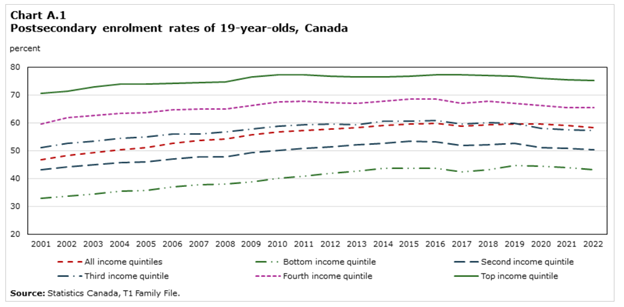
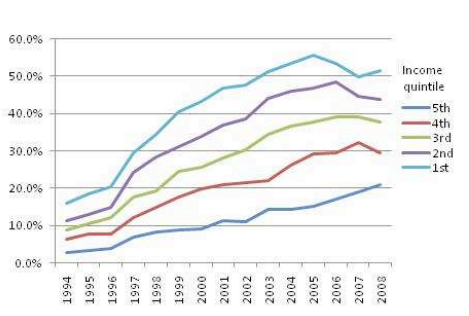
    Below is the chart StatsCan released last month. It shows the post-secondary enrolment rate for 19-year-olds, which I will henceforth refer to as the “part rate” or “participation rate,” both for the entire population (the dotted red line) and by income quintile.

    Now, the first thing you may notice is that there are some pretty big gaps between the participation rates of youth from rich and poor families; the top quintile does not quite attend at double the rate of the lowest quintile, but it’s close. And you might be tempted to say, “Hey, I’ve taken Econ 101—That must be because of tuition fees!” Except, no. These kinds of part-rate disparities are pretty common internationally, regardless of tuition fees. Here are postsecondary enrolment rates by income quintile from the United States, which, on the whole, has higher fees than Canada:

    And here’s a similar chart from Poland, which mostly offers education tuition-free:

    And here’s one from France, where public universities are tuition-free but students are increasingly heading to the fee-paying private sector:

    I could go on, country-by-country, but I will spare you and instead point you to this rather good paper doing a cross-national analysis across over 100 countries by OISE’s Elizabeth Buckner. Trust me, it’s the same story everywhere.

    But let me point out what I think are the two important points in that chart. The first is that the red dotted line, which represents the participation rate of all 19-year-olds, basically plateaued back in about 2014, the first year it broke the 59% and is currently headed downwards. This is a huge change from the previous period, 2000-2014, when overall participation rates rose from 46% to 59%. First growth, now stagnation.

    The second is that during the growth period, the biggest strides were being made at the bottom end of the income scale. The part rate gap between top and bottom quintiles fell from 38 percentage points in the early 2000s to about 32 percentage points in 2014, even as part rates for the wealthiest quintile increased. That is to say, more of our growth came from the bottom than from the top. That’s good! But the growth stopped across all income quintiles and went gently into reverse for the top four income quintiles.

    Now, you might think that it’s not a bad thing that participation rates peaked, that maybe we were in a situation where we were overproducing postsecondary graduates, etc. Who knows, it’s possible. I don’t know of any evidence that would suggest that 57-59% of the youth population is some kind of hard maximum, but if stipulating that such a maximum exists, then it might well be in this range.

    But since it’s quite clear that this overall plateauing of participation is happening entirely by way of freezing educational inequality at substantial levels, being OK with the present situation means being OK with major inequalities, and in any democracy which wishes to remain a democracy, that’s not really OK. It is true that, as I noted earlier, disparities are the global norm, but that doesn’t mean you don’t keep up the struggle against stasis. It might be the case that there is some kind of “natural barrier” to keep the country’s PSE part rate at 57-59%, but in what world does a “natural barrier” keep those rates at 75% for rich kids and 43% for poor kids?

    Increasing access overall and narrowing rich-poor access gaps is incredibly difficult. If it were as simple as making tuition free, we’d have it licked in no time, but countries with free tuition don’t have noticeably narrower part rate gaps than those that charge fees. Achieving these gaps requires a whole suite of policies to narrow educational achievement gaps as well as financial ones, to offer young people a variety of flexible program types rather than an inflexible academic monoculture and to ensure that advice and support exist for students not lucky enough to be able to access the kinds of cultural capital available to the top quintile.

    As I say, achieving success in this area is very difficult: solutions are neither easy nor quick. But what makes the problem even more intractable is ignoring it the way we are doing right now. Are we a country that actually cares about equal opportunity? Or is that just a myth to which we genuflect when we wish to pretend to be more socially progressive than Americans? I lean towards option #2 but would be overjoyed to be proven wrong.

    Source link

  • Westchester CC Sees 12-Point Growth in Graduation Rate

    Westchester CC Sees 12-Point Growth in Graduation Rate

    Providing students with wraparound support is one evidence-based practice that has demonstrated impact on student credit accumulation, persistence and graduation rates. In the mid-2000s, the City University of New York created a model of student support that has been duplicated at dozens of colleges to improve outcomes; now the State University of New York system hopes to build on this success on its own campuses.

    In 2018, Westchester Community College became the first SUNY campus to adopt CUNY’s initiative, which WCC calls Viking Resources for Obtaining Associate Degrees and Success (Viking ROADS). A March 2025 report from the nonprofit education-research group MDRC highlights the success of Viking ROADS during its initial three years: a 12-percentage-point increase in graduation rates among participants, despite headwinds from remote instruction during the COVID-19 pandemic.

    The background: CUNY created Accelerated Study in Associate Programs (ASAP) in 2007 as a comprehensive initiative to address barriers to student retention and completion.

    The core components of ASAP are personalized academic advising, specialized enrollment options and financial aid for course material and transportation costs for three years.

    Over the past decade, ASAP-inspired programs have been implemented at over a dozen institutions in seven states. WCC president Belinda Miles was a part of the ASAP replication initiative in Ohio in 2014, so when she began her role at WCC in 2015, “it wasn’t too long before I ran into ASAP,” she said.

    Arnold Ventures and MDRC, along with an anonymous donor to the WCC Foundation, provided financial support for the launch of Viking ROADS.

    In 2023, SUNY chancellor John B. King Jr. announced the system would implement ASAP at 25 of its 64 campuses starting in 2024. Now, results from a three-year MDRC evaluation of Westchester Community College’s program offer guiding principles to peer institutions scaling their own efforts.

    “We’re delighted to be that pivot campus and a leader amongst our peers,” Miles said.

    The study: MDRC’s study followed WCC staff and students from 2018 to 2021.

    Viking ROADS requires WCC students to be enrolled full-time in an eligible major, meet with a dedicated counselor and use college support services monthly, as well as be a New York resident, a first-time college student and only enrolled in one developmental education course.

    A majority of students involved in the Viking ROADS study were traditional college students, with about one in five identifying as a nontraditional student (defined as someone who is older than 24, works full-time, has children or does not have a high school diploma). One adaptation of ASAP that Viking ROADS staff implemented was to offer a transportation stipend, rather than a prepaid MetroCard; WCC is a commuter campus and students utilize both their own cars and public transport to reach campus, so having flexibility in how they addressed transportation barriers was key, Miles said.

    Over all, program participants were more likely to have higher enrollment rates over time and complete more credits, compared to their peers. By their fourth semester, 20 percent of program participants had earned degrees, compared with 13.3 percent of control group students. And by their sixth semester, 35 percent of program participants had completed an associate degree, compared to 23 percent of the control group.

    Researchers theorized this gap could be tied to the specialized course enrollment options and academic advising Viking ROADS participants receive, which could help students meet their course requirements and reduce their risk of earning excess credits that don’t support degree completion.

    “It’s critical that students begin with a person and a plan, or a plan and a person, [so] we can say, ‘Here’s the road map, here’s your guided pathway, here are the steps you take.’ But having a person that’s reliable is something that is critical for students, particularly first-generation students,” Miles said, because some learners may not have supporters at home who understand the bureaucracy of higher education.

    Program staff also reduce barriers to applying for graduation and making degrees official; among nonparticipants who earned 60 or more credits, only 69 percent earned a degree, compared to 83 percent of Viking ROADS students.

    “Despite the challenges that were posed by the COVID-19 pandemic, Viking ROADS still had large effects on three-year graduation rates, confirming the strength and adaptability of the ASAP model,” according to the report. “Viking ROADS not only helped students navigate the immediate disruptions that were caused by the pandemic but also supported their continued academic progress and degree attainment.”

    What’s next: In the same way Miles brought her work with ASAP to WCC, she and her staff plan to contribute to a community of practice for the other SUNY campuses joining these efforts.

    “I’m happy to share with colleagues what our story is and how we keep it going and how we keep expanding, albeit incrementally,” Miles said.

    Funding and providing resources for wraparound services can be a barrier to scaling initiatives, but reallocating and redesigning existing services to better address student needs is one way Miles said she is looking to expand student success efforts at WCC.

    Get more content like this directly to your inbox. Subscribe here.

    This article has been updated to reflect the correct name of Arnold Ventures.

    Source link

  • This week in 5 numbers: Another year of growth for faculty salaries

    This week in 5 numbers: Another year of growth for faculty salaries

    The amount in federal grants the Trump administration froze for Harvard University this week. The move came after the Ivy League institution refused to comply with federal officials’ demands to, among other things, eliminate diversity initiatives, curtail the power of some faculty and audit the viewpoints of students and employees.

    Source link

  • Try Reading Job Descriptions With a Growth Mindset (Opinion)

    Try Reading Job Descriptions With a Growth Mindset (Opinion)

    In a résumé workshop with a group of Ph.D. students, I shared a job description for a position for which they were qualified. The students had participated in an advanced pedagogy program at my university’s Center for Teaching and Learning, and the position was an instructional technologist at a small liberal arts college. Immediately, the students searched the job description for qualities and experiences they lacked and reasons why they were unqualified. Many were so turned off by the job title that they likely would not have continued reading had they come across this position on their own.

    Then I encouraged the students to approach the position description with a bias toward “I’m qualified.” In other words, instead of starting with the assumption that they were not qualified for the role, do the opposite. Once they changed their mindset and believed that they were qualified, they were able to see many connections between their skills and experiences and what they read in the job description.

    In my work as a graduate student career adviser, I have found that this tendency for Ph.D. students to approach descriptions for jobs outside their academic field from a deficit perspective is quite common. Graduate students who have trained for years with an eye toward an academic position in their field often see themselves as utterly unqualified when they begin to search for jobs in other sectors. This can even be the case for those who have spent considerable amounts of time on career exploration and self-reflection and feel committed to a career in a field other than academia. Once they get to the job search process, they get hung up on the job descriptions themselves.

    When I told another career adviser about my “bias toward ‘I’m qualified’” approach, she said that this reminded her of the growth mindset concept. Psychologist Carol Dweck came up with the concept of the growth mindset nearly 20 years ago, and it has since been applied to everything from business to professional sports to early childhood education. In short, a growth mindset is, to cite Dweck’s definition, “based on the belief that your basic qualities are things you can cultivate through your efforts, your strategies, and help from others.” In other words, you can change and improve many aspects of yourself through hard work and help from others. This is in contrast to a fixed mindset, which is the belief that your qualities are “carved in stone” and cannot be changed.

    This concept has many applications in work and life, and when we are stressed about a job search it is easy to let a fixed mindset take over. However, adopting a growth mindset in just one context—reading job descriptions—can help you be more positive and open-minded in your job search. Of course, not everyone can do every job, but a growth mindset will help you see and articulate both your qualifications and your potential in a new career field.

    Consider the following ways in which reading job descriptions with a growth mindset can create more opportunities in your career exploration and job search.

    • See and articulate your transferable skills and experiences.

    Talk to a career adviser for five minutes, and they are likely to discuss the importance of transferable skills. Yet it can be tough to conceive of your skills, know which skills are most important, see how they might come in handy in other contexts and then articulate those skills in a way that is appealing to other audiences. Here is an example from my own career about how reading a job description with a growth mindset helped me identify and articulate a skill set I didn’t know I had.

    Shortly after finishing my Ph.D., I came across a job posting for a school relations manager at a nonprofit organization, liaising between high school teachers and the organization. The job fit my interests, but at first glance it didn’t seem to match my skill set. In particular, the job description asked for relationship-building skills, which I had never thought about as a skill set, let alone one that I possessed. As I reflected on my experience throughout my time in graduate school, I thought about a short-term, part-time position I had meeting once a month with high school history teachers to help them design lesson plans. I enjoyed this work and was good at it and, though I had never thought about it before, realized that I could frame this experience as relationship building. In my application materials and job interviews, I emphasized this skill set and expressed confidence in continuing to grow in this area, and I got the job.

    • Open up new career fields.

    Several years ago, I worked with a Ph.D. student in art history who was interested in a career in user experience research. Although she was still two years away from graduation, she started looking at job descriptions to get a better sense of the responsibilities and qualifications for the kinds of roles she desired. In her research, she noticed that many positions asked for evidence of user experience projects, and some even asked for a portfolio. While some students would have seen this as an insurmountable barrier (a fixed mindset), she instead let her growth mindset kick in and got to work building her portfolio through project-based online courses, independent projects and on-campus jobs, and continued to network with practitioners in the field. Her hard work and help from others paid off, and she was able to move into the field after she graduated.

    • Compete for jobs for which you may be somewhat underqualified.

    Students often let the perception of being underqualified for a job prevent them from applying. This is a well-documented tendency among women and underrepresented groups, and, for graduate students, the impostor phenomenon often contributes to reduced confidence in relation to career possibilities. Most graduate students know about this tendency and the advice to apply if you meet 60 to 75 percent of the qualifications, Yet, many still have difficulty getting over the hump to apply when they don’t meet 100 percent of the qualifications in the job description. Or, if they do apply, they undersell their qualifications in their application materials.

    When you approach a position description for a job that interests you but feels like a reach, start with the job responsibilities and imagine yourself performing the tasks listed. If there are things on the list you haven’t done before, imagine how you could build on the skills and capacities you have in a new setting and then improve over time. Next, go through each qualification and look for some connection, however tenuous, to something you have done before and write it down. If you have trouble doing this on your own, work with a career adviser who can help. Usually this process helps you see capacities and qualifications you didn’t know you had and will give you confidence that you can grow into a role that feels like a stretch.

    • Apply for jobs for which you may feel overqualified.

    This next piece of advice addresses the other end of the spectrum—jobs for which you feel overqualified. Ph.D. students who are entering a field other than academia are making a career transition, which often requires spending some time in a role that might feel beneath your qualifications. This is especially true in certain industries like publishing, journalism, marketing and communications, and others. It can feel demoralizing for doctoral students to apply for jobs that only require a bachelor’s degree.

    In this case, use a growth mindset to imagine how you could advance within the organization or how this first position could be a stepping-stone to another opportunity in a couple of years. Keep in mind that people with advanced degrees tend to get promoted to a higher level and more quickly than those with just a bachelor’s. You won’t be stuck in this first role forever, and it will give you a chance to demonstrate your skills in your new field.

    Underlying these tips is a nudge to get online and read some job descriptions, even if you aren’t yet ready to apply. Just make sure that when you do, you suit up with your growth mindset first.

    Rachel Bernard is the GSAS Compass Consultant at Columbia University’s Graduate School of Arts and Sciences, where she focuses on career development for master’s and doctoral students. She is a member of the Graduate Career Consortium—an organization providing a national voice for graduate-level career and professional development leaders.

    Source link