Tag: hard

  • Is research culture really too hard to assess?

    Is research culture really too hard to assess?

    Assessing research culture has always been seen as difficult – some would say too difficult.

    Yet as REF 2029 pauses for reflection, the question of whether and how culture should be part of the exercise is unavoidable. How we answer this has the potential to shape not only the REF, but also the value we place on the people and practices that define research excellence.

    The push to assess research culture emerged from recognition that thriving, well-supported researchers are themselves important outcomes of the research system. The Stern Review highlighted that sustainable research excellence depends not just on research outputs but on developing the people who produce them. The Harnessing the Metric Tide report built on this understanding, recommending that future REF cycles should reward progress towards better research cultures.

    A significant proportion of what we have learnt about assessing research culture came from the People, Culture and Environment indicators project, run by Vitae and Technopolis, and Research England’s subsequent REF PCE pilot exercise. Together with the broader consultation as part of the Future Research Assessment Programme, this involved considerable sector engagement over multiple years.

    Indicators

    Nearly 1,600 people applied to participate in the PCE indicators co-development workshops. Over 500 participated across 137 institutions, with participants at all levels of career stage and roles. Representatives from ARMA, NADSN, UKRN, BFAN, ITSS, FLFDN and NCCPE helped facilitate the discussions and synthesise messages.

    The workshops confirmed what many suspected about assessing research culture. It’s genuinely difficult. Nearly every proposed indicator proved problematic. Participants raised concerns about gaming and burden. Policies could become tick-box exercises. Metrics might miss crucial context. But participants saw that clusters of indicators used together and contextualised could allow institutions to tell meaningful stories about their approach and avoid the potentially misleading pictures painted by isolated indicators.

    A recurring theme was the need to focus on mechanisms, processes and impacts, not on inputs. Signing up for things, collecting badges, and writing policies isn’t enough. We need to make sure that we are doing something meaningful behind these. This doesn’t mean we cannot evidence progress, rather that the evidence needs contextualising. The process of developing evidence against indicators would incentivise institutions to think more carefully about what they’re doing, why, and for whom.

    The crucial point that seems to have been lost is that REF PCE never set out to measure culture directly. Instead, it aimed to assess credible indicators of how institutions enable and support inclusive, sustainable, high-quality research.

    REF PCE was always intended to be an evolution, not a revolution. Culture has long been assessed in the REF, including through the 2021 Environment criteria of vitality and sustainability. The PCE framework aimed to build on this foundation, making assessment more systematic and comprehensive.

    Finance and diversity

    Two issues levelled at PCE have been the sector’s current financial climate and the difficulty of assessing culture fairly across institutional diversity. These are not new revelations. Both were anticipated and debated extensively in the PCE indicators project.

    Workshop participants stressed that the assessment must recognise that institutions operate with different resources and constraints, focusing on progress and commitment rather than absolute spending levels. There is no one-size-fits-all answer to what a good research culture looks like. Excellent research culture can look very different across the sector and even within institutions.

    This led to a key conclusion: fair assessment must recognise different starting points while maintaining meaningful standards. Institutions should demonstrate progress against a range of areas, with flexibility in how they approach challenges. Assessment needs to focus on ‘distance travelled’ rather than the destination reached.

    Research England developed the REF PCE pilot following these insights. This was deliberately experimental, testing more indicators than would ultimately be practical, as a unique opportunity to gather evidence about what works, what doesn’t, what is feasible, and equitable across the sector. Pilot panel members and institutions were co-designers, not assessors and assessees. The point was to develop evidence for a streamlined, proportionate, and robust approach to assessing culture.

    REF already recognises that publications and impact are important outputs of research. The PCE framework extended this logic: thriving, well-supported people working across all roles are themselves crucial outcomes that institutions should develop and celebrate.

    This matters because sustainable research excellence depends on the people who make it happen. Environments that support career development, recognise diverse contributions, and foster inclusion don’t just feel better to work in – they produce better research. The consultation revealed sophisticated understanding of this connection. Participants emphasised that research quality emerges from cultures that value integrity, collaboration, and support for all contributors.

    Inputs

    Some argue that culture is an input to the system that shouldn’t be assessed directly. Others suggest establishing baseline performance requirements as a condition for funding. However, workshop discussions revealed that setting universal standards low enough for all institutions to meet renders them meaningless as drivers of improvement. Baselines are important, but alone they are not sufficient. Research culture requires attention through assessment, incentivisation and reward that goes beyond minimum thresholds.

    Patrick Vallance and Research England now have unprecedented evidence about research culture assessment. Consultation has revealed sector priorities. The pilot has tested practical feasibility. The upcoming results, to be published in October, will show what approaches are viable and proportionate.

    Have we encountered difficulties? Yes. Do we have a perfect solution for assessing culture? No. But this REF is a huge first step toward better understanding and valuing of the cultures that underpin research in HE. We don’t need all the answers for 2029, but we shouldn’t discard the tangible progress made through national conversations and collaborations.

    This evidence base provides a foundation for informed decisions about whether and how to proceed. The question is whether policymakers will use it to build on promising foundations or retreat to assessment approaches that miss crucial dimensions of research excellence.

    The REF pause is a moment of choice. We can step back from culture as ‘too hard’, or build on the most substantial sector-wide collaboration ever undertaken on research environments. If we discard what we’ve built, we risk losing sight of the people and conditions that make UK research excellent.

    Source link

  • Moody’s: Trump’s tough international student policies could hit some colleges hard

    Moody’s: Trump’s tough international student policies could hit some colleges hard

    This audio is auto-generated. Please let us know if you have feedback.

    Dive Brief:

    • The Trump administration’s restrictive policies for international students present a financial risk for many U.S. colleges by potentially deterring them from enrolling, Moody’s analysts said in a recent report. 
    • Analysts pointed to visa disruptions, increased scrutiny of social media accounts, changes to deportation rules, and recent travel bans and restrictions to the U.S. from 19 countries. The Trump administration has also created confusion around visas for Chinese students, who account for nearly a quarter of international students.
    • While the impact on upcoming academic terms remains unclear, the changing policies are “diminishing the perception of the US as a prime destination for higher education,” the analysts said.

    Dive Insight:

    Colleges have been bracing for potential revenue and enrollment hits since the second Trump administration quickly struck an aggressive approach to immigration and international students. 

    When the administration moved to bar Harvard University from enrolling international students, the private institution sought and won a court order temporarily blocking the move the next day

    The ongoing legal spat underscores just how critical international enrollment is for the Ivy League university. In the 2024-25 academic year, Harvard’s roughly 6,800 foreign students made up 27.2% of the university’s total student body.  

    And just this week, George Washington University cited, among other federal moves, a slowdown in visa processing and President Donald Trump’s travel bans when explaining the need for painful budget measures, including possible layoffs. 

    International students make up over 20% of enrollment at 11% of the colleges rated by Moody’s. But that figure may understate the financial impact of lower international enrollment. 

    Foreign students typically pay full tuition and fees at colleges, noted Moody’s analysts Debra Roane, vice president and senior credit officer, and Emily Raimes, associate managing director. And they do so at a time when the ranks of traditional-age college students are projected to decline significantly in the coming years. 

    “Universities intending to fill the gap with more international students may fall short,” Roane and Raimes said in the report. 

    The analysts ran a stress test on colleges rated by Moody’s to look at the financial impact of international student enrollment declines. Given a 10% drop in international enrollment, 54 out 392 institutions would suffer a hit to a measure of their operating performance of at least half a percentage point. Seven of those colleges would see those margins decrease by two to eight percentage points. 

    With a 20% drop in international enrollment, 130 colleges would lose at least half a percentage point from their margins, and 18 among them would lose two to eight points. Those with already low margins could face “significant financial stress,” Roane and Raimes said. 

    The analysts noted, however, that highly selective colleges or those with considerable financial reserves might “better absorb the impacts by adjusting operations or increasing domestic enrollment.” Other prominent colleges might be able to mitigate international student declines through alternative revenue sources like fundraising and endowment spending.

    But others could have a much tougher time. Roane and Raimes pointed to specialty institutions, such as arts colleges — which are already facing a tough environment — whose student bodies can be over 30% international.

    Source link

  • Hard up for students, more colleges are offering college credit for life experience, or ‘prior learning’

    Hard up for students, more colleges are offering college credit for life experience, or ‘prior learning’

    PITTSBURGH — Stephen Wells was trained in the Air Force to work on F-16 fighter jets, including critical radar, navigation and weapons systems whose proper functioning meant life or death for pilots.

    Yet when he left the service and tried to apply that expertise toward an education at Pittsburgh’s Community College of Allegheny County, or CCAC, he was given just three credits toward a required class in physical education.

    Wells moved forward anyway, going on to get his bachelor’s and doctoral degrees. Now he’s CCAC’s provost and involved in a citywide project to help other people transform their military and work experience into academic credit.

    What’s happening in Pittsburgh is part of growing national momentum behind letting students — especially the increasing number who started but never completed a degree — cash in their life skills toward finally getting one, saving them time and money. 

    Colleges and universities have long purported to provide what’s known in higher education as credit for prior learning. But they have made the process so complex, slow and expensive that only about 1 in 10 students actually completes it

    Many students don’t even try, especially low-income learners who could benefit the most, according to a study by the Western Interstate Commission for Higher Education and the Council for Adult and Experiential Learning, or CAEL.

    “It drives me nuts” that this promise has historically proven so elusive, Wells said, in his college’s new Center for Education, Innovation & Training.

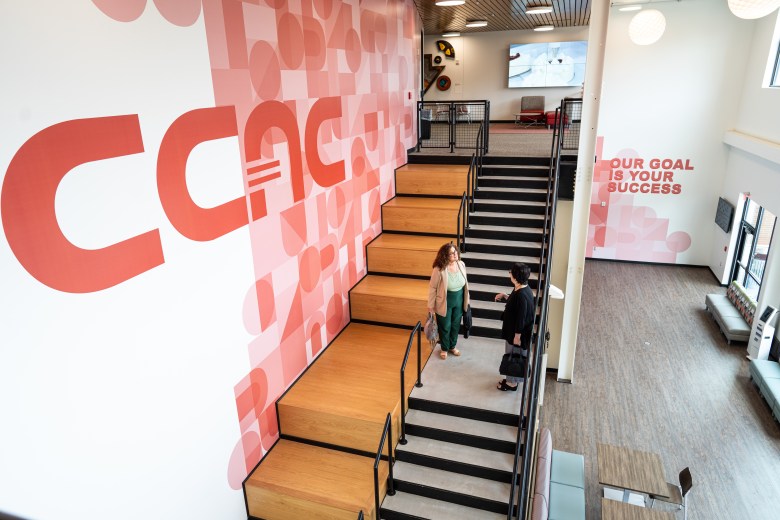
    Stephen Wells, provost at the Community College of Allegheny County in Pittsburgh. An Air Force veteran, Wells got only a handful of academic credits for his military experience. Now he’s part of an effort to expand that opportunity for other students. Credit: Nancy Andrews for The Hechinger Report

    That appears to be changing. Nearly half of institutions surveyed last year by the American Association of Collegiate Registrars and Admissions Officers, or AACRAO, said they have added more ways for students to receive these credits — electricians, for example, who can apply some of their training toward academic courses in electrical engineering, and daycare workers who can use their experience to earn degrees in teaching. 

    Related: Interested in innovations in higher education? Subscribe to our free biweekly higher education newsletter.

    The reason universities and colleges are doing this is simple: Nearly 38 million working-age Americans have spent some time in college but never finished, according to the National Student Clearinghouse Research Center. Getting at least some of them to come back has become essential to these higher education institutions at a time when changing demographics mean that the number of 18-year-old high school graduates is falling.

    “When higher education institutions are fat and happy, nobody looks for these things. Only when those traditional pipelines dry up do we start looking for other potential populations,” said Jeffrey Harmon, vice provost for strategic initiatives and institutional effectiveness at Thomas Edison State University in New Jersey, which has long given adult learners credit for the skills they bring.

    Being able to get credit for prior learning is a huge potential recruiting tool. Eighty-four percent of adults who are leaning toward going back to college say it would have “a strong influence” on their decision, according to research by CAEL, the Strada Education Foundation and Hanover Research. (Strada is among the funders of The Hechinger Report, which produced this story.)

    The Center for Education, Innovation & Training at the Community College of Allegheny County in Pittsburgh. The college is part of a citywide effort to give academic credit for older students’ life experiences. Credit: Nancy Andrews for The Hechinger Report

    When Melissa DiMatteo, 38, decided to get an associate degree at CCAC to go further in her job, she got six credits for her previous training in Microsoft Office and her work experience as everything from a receptionist to a supervisor. That spared her from having to take two required courses in computer information and technology and — since she’s going to school part time and taking one course per semester — saved her a year.

    “Taking those classes would have been a complete waste of my time,” DiMatteo said. “These are things that I do every day. I supervise other people and train them on how to do this work.”

    On average, students who get credit for prior learning save between $1,500 and $10,200 apiece and nearly seven months off the time it takes to earn a bachelor’s degree, the nonprofit advocacy group Higher Learning Advocates calculates. The likelihood that they will graduate is 17 percent higher, the organization finds.

    Related: The number of 18-year-olds is about to drop sharply, packing a wallop for colleges — and the economy 

    Justin Hand dropped out of college because of the cost, and became a largely self-taught information technology manager before he decided to go back and get an associate and then a bachelor’s degree so he could move up in his career.

    He got 15 credits — a full semester’s worth — through a program at the University of Memphis for which he wrote essays to prove he had already mastered software development, database management, computer networking and other skills.

    “These were all the things I do on a daily basis,” said Hand, of Memphis, who is 50 and married, with a teenage son. “And I didn’t want to have to prolong college any more than I needed to.”

    Meanwhile, employers and policymakers are pushing colleges to speed up the output of graduates with skills required in the workforce, including by giving more students credit for their prior learning. And online behemoths Western Governors University and Southern New Hampshire University, with which brick-and-mortar colleges compete, are way ahead of them in conferring credit for past experience.

    “They’ve mastered this and used it as a marketing tool,” said Kristen Vanselow, assistant vice president of innovative education and partnerships at Florida Gulf Coast University, which has expanded its awarding of credit for prior learning. “More traditional higher education institutions have been slower to adapt.”

    It’s also gotten easier to evaluate how skills that someone learns in life equate to academic courses or programs. This has traditionally required students to submit portfolios, take tests or write essays, as Hand did, and faculty to subjectively and individually assess them. 

    Related: As colleges lose enrollment, some turn to one market that’s growing: Hispanic students

    Now some institutions, states, systems and independent companies are standardizing this work or using artificial intelligence to do it. The growth of certifications from professional organizations such as Amazon Web Services and the Computing Technology Industry Association, or CompTIA, has helped, too.

    “You literally punch [an industry certification] into our database and it tells you what credit you can get,” said Philip Giarraffa, executive director of articulation and academic pathways at Miami Dade College. “When I started here, that could take anywhere from two weeks to three months.”

    Data provided by Miami Dade shows it has septupled the number of credits for prior learning awarded since 2020, from 1,197 then to 7,805 last year.

    “These are students that most likely would have looked elsewhere, whether to the [online] University of Phoenix or University of Maryland Global [Campus]” or other big competitors, Giarraffa said.

    Fifteen percent of undergraduates enrolled in higher education full time and 40 percent enrolled part time are 25 or older, federal data show — including people who delayed college to serve in the military, volunteer or do other work that could translate into academic credit. 

    “Nobody wants to sit in a class where they already have all this knowledge,” Giarraffa said. 

    At Thomas Edison, police academy graduates qualify for up to 30 credits toward associate degrees. Carpenters who have completed apprenticeships can get as many as 74 credits in subjects including math, management and safety training. Bachelor’s degrees are often a prerequisite for promotion for people in professions such as these, or who hope to start their own companies.

    Related: To fill ‘education deserts,’ more states want community colleges to offer bachelor’s degrees

    The University of Memphis works with FedEx, headquartered nearby, to give employees with supervisory training academic credit they can use toward a degree in organizational leadership, helping them move up in the company.

    The University of North Carolina System last year launched its Military Equivalency System, which lets active-duty and former military service members find out almost instantly, before applying for admission, if their training could be used for academic credit. That had previously required contacting admissions offices, registrars or department chairs. 

    Among the reasons for this reform was that so many of these prospective students — and the federal education benefits they get — were ending up at out-of-state universities, the UNC System’s strategic plan notes.

    “We’re trying to change that,” said Kathie Sidner, the system’s director of workforce and partnerships. It’s not only for the sake of enrollment and revenue, Sidner said. “From a workforce standpoint, these individuals have tremendous skill sets and we want to retain them as opposed to them moving somewhere else.”

    Related: A new way to help some college students: Zero percent, no-fee loans

    California’s community colleges are also expanding their credit for prior learning programs as part of a plan to increase the proportion of the population with educations beyond high school

    “How many people do you know who say, ‘College isn’t for me?’ ” asked Sam Lee, senior advisor to the system’s chancellor for credit for prior learning. “It makes a huge difference when you say to them that what they’ve been doing is equivalent to college coursework already.”

    In Pittsburgh, the Regional Upskilling Alliance — of which CCAC is a part — is connecting job centers, community groups, businesses and educational institutions to create comprehensive education and employment records so more workers can get credit for skills they already have.

    That can provide a big push, “especially if you’re talking about parents who think, ‘I’ll never be able to go to school,’ ” said Sabrina Saunders Mosby, president and CEO of the nonprofit Vibrant Pittsburgh, a coalition of business and civic leaders involved in the effort. 

    Pennsylvania is facing among the nation’s most severe declines in the number of 18-year-old high school graduates. 

    “Our members are companies that need talent,” Mosby said. 

    There’s one group that has historically pushed back against awarding credit for prior learning: university and college faculty concerned it might affect enrollment in their courses or unconvinced that training provided elsewhere is of comparable quality. Institutions have worried about the loss of revenue from awarding credits for which students would otherwise have had to pay.

    That also appears to be changing, as universities leverage credit for prior learning to recruit more students and keep them enrolled for longer, resulting in more revenue — not less. 

    “That monetary factor was something of a myth,” said Beth Doyle, chief of strategy at CAEL.

    Faculty have increasingly come around, too. That’s sometimes because they like having experienced students in their classrooms, Florida Gulf Coast’s Vanselow said. 

    Related: States want adults to return to college. Many roadblocks stand in the way 

    Still, while many recognize it as a recruiting incentive, most public universities and colleges have had to be ordered to confer more credits for prior learning by legislatures or governing boards. Private, nonprofit colleges remain stubbornly less likely to give it.

    More than two-thirds charge a fee for evaluating whether other kinds of learning can be transformed into academic credit, an expense that isn’t covered by financial aid. Roughly one in 12 charge the same as it would cost to take the course for which the credits are awarded. 

    Debra Roach, vice president for workforce development at the Community College of Allegheny County in Pittsburgh. The college is working on giving academic credit to students for their military, work and other life experience. Credit: Nancy Andrews for The Hechinger Report

    Seventy percent of institutions require that students apply for admission and be accepted before learning whether credits for prior learning will be awarded. Eighty-five percent limit how many credits for prior learning a student can receive.

    There are other confounding roadblocks and seemingly self-defeating policies. CCAC runs a noncredit program to train paramedics, for example, but won’t give people who complete it credits toward its for-credit nursing degree. Many leave and go across town to a private university that will. The college is working on fixing this, said Debra Roach, its vice president of workforce development.

    It’s important to see this from the students’ point of view, said Tracy Robinson, executive director of the University of Memphis Center for Regional Economic Enrichment.

    “Credit for prior learning is a way for us to say, ‘We want you back. We value what you’ve been doing since you’ve been gone,’ ” Robinson said. “And that is a total game changer.”

    Contact writer Jon Marcus at 212-678-7556, [email protected] or jpm.82 on Signal.

    This story about credit for prior learning was produced by The Hechinger Report, a nonprofit, independent news organization focused on inequality and innovation in education. Sign up for our higher education newsletter. Listen to our higher education podcast.

    The Hechinger Report provides in-depth, fact-based, unbiased reporting on education that is free to all readers. But that doesn’t mean it’s free to produce. Our work keeps educators and the public informed about pressing issues at schools and on campuses throughout the country. We tell the whole story, even when the details are inconvenient. Help us keep doing that.

    Join us today.

    Source link

  • Welfare reforms will hit disabled students hard

    Welfare reforms will hit disabled students hard

    As political funding decisions continue to pose threats to both the welfare of disabled people and the higher education sector as a whole, disabled students find themselves caught up in a crossfire of financial cuts.

    This was the subject of many coffee-break conversations at this year’s National Association of Disability Practitioners Conference, at which growing concerns around the financial viability of supporting disabled students effectively were shared by a number of specialist staff across the sector.

    As a practitioner, and as a disabled student myself, it’s hard to shake the feeling that current support mechanisms are stretched to their limits. Without urgent investment and reform, it’s disabled students who will continue to bear the brunt.

    Earlier in the year, Jim Dickinson flagged the potential fallout for disabled students arising from reforms to Personal Independence Payment (PIP) proposed in the government’s Pathways to Work Green Paper.

    With over 100 Labour MPs signing an amendment opposing the changes, if rumours about the government’s compromise are to be believed, new students will soon lose out on some of the support that many existing disabled students are entitled to.

    In the months since the reforms were first proposed, I’ve heard from a number of disabled students who shared serious concerns about what these cuts mean for their wellbeing, autonomy, and academic futures.

    “Without PIP, I would have to drop out.”

    That’s what Alex*, a disabled student at the University of Brighton, told me. Alex currently uses their PIP to cover a number of health related costs, from “feeding tube equipment that isn’t covered by the NHS, mobility equipment and repairs, and [support to cover] additional travel costs to get to [their] appointments.”

    Sadly, yet unsurprisingly, considerations of dropping-out of university are not uncommon. Recent data within the Advance HE Student Academic Experience Survey revealed that disabled students are almost twice as likely to have considered quitting, with 83 per cent of disabled students reporting challenges related to the cost-of-living.

    In my day-job, I often encounter the mistaken assumption that Disabled Students’ Allowance has the ability to fill all of the financial gaps that disabled students may face throughout their studies. DSA can act as a vital source of support for study-related costs, but it is not designed to replace social security.

    For many disabled students, Personal Independence Payment is a lifeline for maintaining independence whilst at university. But with persistent delays and restrictions on DSA support and the proposal to restrict PIP even further for young people, many students like Alex are at risk of starting their studies without access to either.

    “I can’t work alongside my course with my health issues…”

    In my own context, full-time students are expected to commit around 50 hours per week to their studies to meet the notional learning hours set by the SCQF. Yet, in the midst of the ongoing cost-of-living crisis, an estimated 68 per cent of undergraduates now work paid jobs alongside full-time study, exposing a continued disconnect between policy expectations and the lived reality of students today. A balancing act of work and study is unsustainable for many, and for disabled students, the pressures are even greater.

    Abi* reflected this in her conversation with me: “I can’t work alongside my course with my health issues […] as student finance is so little, I use my PIP to stay afloat every month,” she says. “I wouldn’t be able to have my car, with my carer driving me – which is the only way I can get out of the house.”

    At last check, Scope estimated that disabled households require an additional £1067 per month to meet basic living costs, as a result of the many financial barriers associated with existing as a disabled person in a society that is not constructed to compensate for a wide variety of access needs. Whilst PIP is not intended as an out-of-work benefit, many disabled students rely on it to fill the gaps left by inadequate financial support. Abi’s experience reflects the additional strain placed on disabled students by the “disability price tag”.

    Accessible accommodation is “more expensive than most private rentals…”

    Systemic barriers were emphasised by a number of the students I spoke with. For Daisy* securing accessible housing has been a particular challenge financially.

    Reflecting on her own living situation, she said: “I live in a very inaccessible city and can only live in university halls,” “it’s more expensive than most private rentals, but there’s no alternative.”

    Back in Brighton, Alex* shared similar concerns: “my only option is to live in university accommodation, which costs significantly more on average than most house shares in my city.”

    These accounts reflect a wider set of structural barriers that have a direct impact on the disabled student experience. Recent data from Disabled Students UK highlighted that affordable, accessible housing is often scarce, with 46 per cent of disabled students reporting that they’ve ended up paying more for housing that met their access needs.

    And housing can’t be considered in isolation – it’s tied to the broader context of inaccessible transport, barriers to timely healthcare, inadequate personal care support, and the high costs associated with assistive equipment.

    When these basic needs go unmet, it becomes significantly harder for disabled students to engage with university life: academically, socially, and beyond. Abi shared this concern, expressing fears that the removal of PIP would prevent her from having a wider student experience: “without my PIP, I wouldn’t be able to do anything extracurricular.”

    If disabled students can’t afford to live independently, how can they fully participate in university life, let alone thrive outside of it?

    “Why can’t they see how hard I’m trying to find work?”

    That’s the question Katie* posed to me when we spoke. Preparing to undertake a PhD in Newcastle, Katie found the transition from university into work daunting and unsupported. “There’s still an expectation that you get your degree, then get a job,” she said. “But there’s very little recognition of how much harder that is for disabled graduates.”

    A recent report from the Shaw Trust highlighted the persistence of the disability employment gap amongst graduates, emphasising that the gap is not about a lack of aspiration, it’s about structural and systemic barriers.

    Katie’s experience reflects a broader trend – while much of the discourse centres around “employability” and economic outcomes, little is said about the lack of disability-informed careers support or the inflexibility of most graduate job opportunities. “Trying to find ‘disability confident’ employers reduces the job pool even further,” she adds. “Half of the jobs which could be hybrid or online aren’t. And trying to find a flexible job that allows time for medical appointments? Nearly impossible.”

    But it isn’t just about work…

    These conversations emphasise access to equitable higher education risks being eroded by benefit restrictions, ongoing delays to DSA support, and widespread cuts to university funding.

    While higher education institutions have made important strides in recent years, through the development of Disabled Student Commitment, and an increased focus on compliance with the Equality Act, service cuts across the sector threaten to undermine that progress.

    According to our research at Disabled Students UK, only 38 per cent of disabled students currently feel that their support needs have been met by their institution. As public funding continues to shrink, many universities are being forced to reassess spending, with many opting to restructure services and streamline provision. But if disabled students are sidelined in these processes, the consequences will be stark.

    In a climate of compounding cuts, institutions must take care to ensure that the interests of disabled students are not excluded from decision-making or deprioritised in budget reviews. Otherwise, we risk further entrenching inequity within a sector that prides itself on widening participation.

    At the heart of all of this is one clear message – disabled students are not asking for luxury. They’re seeking the basic conditions needed to study, participate, and succeed. If we cannot meet even the baseline needs of disabled students, at both an institutional and state level, then we need to seriously question what kind of higher education system we are building, and who it’s truly for.

    Disabled Students UK’s Annual Disabled Student Survey, the largest survey into HE accessibility and the disabled student experience in the UK, is open for responses until the end of July.


    Source link

  • An early look at 2023–24 financial returns shows providers working hard to balance the books

    An early look at 2023–24 financial returns shows providers working hard to balance the books

    In most larger UK providers of higher education, the 2023–24 financial year ended on 31 July 2024.

    Five months and two weeks after this date (so, on or before 14 January 2025) providers are obliged to have published (and communicated to regulators) audited financial statements for that year.

    I’ve got a list of 160 large, well known, providers of higher education who should, by now, have made this disclosure – 43 of them are yet to do so. Of the 117 that have, just 15 (under 13 per cent) posted a deficit for that financial year (to be fair, this includes eight providers in Wales, where the deadline – for bilingual accounts – is the end of the month). This was as of the data of publication, there’s been a few more been discovered since then and I have added some to the charts below.

    If you’ve been aware of individual providers, mission groups, representative bodies, trade unions, regulators, and politicians coming together to make the case that the sector is severely underfunded this may surprise you. If you work in an institution that is curtailing courses, making staff redundant, and undergoing the latest in a long series of cost-cutting exercises, the knowledge that your university has posted a surplus may make you angry.

    But these results are not surprising, and a surplus should not make you angry (there are plenty of other reasons to be angry…) Understanding what an annual account is for, what a surplus is, why a university will pull out all of the stops to post a surplus, and what are the more alarming underpinning signals that we should be aware of will help you understand why we have what – on the face of it – feels like a counter-intuitive position in university finances.

    Why are so many results missing?

    There’s a range of reasons why a provider may submit accounts late – those who are yet to publish will already be deep in conversation with regulators about the issues that may have caused what is, technically, a breach of a regulatory condition. In England, this is registration condition E3. which is underpinned by the accounts direction.

    If you are expecting regulators to get busy issuing fines or sanctions for late submissions – you should pause. There’s a huge problem with public sector audit capacity in the UK – the big players have discrete teams that move on an annual cycle between higher education, NHS, and local government audit. You don’t need to have read too much into public finances to know that our councils are under serious pressure right now – and this pressure results in audit delays, hitting the same teams who will be acting as external university auditors.

    That’s one key source of delay. The other would be the complexities within university annual accounts, and university finances more generally, that offer any number of reasons why the audit signoff might happen later than hoped.

    To be clear, very few of these reasons are going to be cheerful ones. If a provider has yet to publish its accounts because they have not signed off their accounts, it is likely to be engaging with external auditors about the conditions under which they will sign off accounts.

    To give one example of what might happen – a university has an outstanding loan with a covenant attached to it based on financial performance (say, a certain level of growth each year). In 2023–24, it did not reach this target, so needs to renegotiate the covenant, which may make repayments harder (or spread out over a longer period). The auditor will need to wait until this is settled before it signs off the accounts – technically if you are in breach of covenant the whole debt is repayable immediately, something which would make you fail your going concern test.

    We’ve covered covenants on the site before – a lender of whatever sort will offer finance at an attractive rate provided certain conditions are met. These can include things like use of investment (did you actually build the new business school you borrowed money to build?), growth (in terms of finances or student numbers), ESG (are you doing good things as regards environment, society, and governance?) and good standing (are you in trouble with the regulator?) – but at a fundamental level will require a sense that your business is financially viable. If covenant conditions are breached lenders will be keen to help if they hear in advance, but your cost of borrowing (the interest rate charged, bluntly) will rise. And you will find it harder to raise finance in future.

    This is an environment where it is already hard to raise finance – and in establishing new borrowing, or new revolving credit (kind of like an overdraft facility) many universities will end up paying more than in previous years. This all needs to be shown in the accounts.

    Going concern

    When your auditor signs off your accounts, you would very much hope that it will agree that they represent a “going concern” – simply put, that in most plausible scenarios you will have enough money to cover your costs during the next 12 months. If your auditor disagrees that you are a going concern you are in serious trouble – all of the 117 sets of accounts I have read so far have been agreed on a going concern basis.

    This designation tells everyone from regulators to lenders to other stakeholders that your business is viable for the next year – and comes into force on the day your accounts are signed off by the university and external auditor. This is nearly always for a specific technical reason – additional information that is needed in order to make the determination. For some late publications, it is possible that the delay is a deliberate plan to make the designation last as far into the following financial years as possible. This year (2024–25) is even more bleak than last year – anything that keeps finance cheaper (or available!) for longer will be helpful.

    Breaking even and beyond

    So your provider had a surplus last year – that’s good right? It means it took in more money than it spent? Up to a point.

    In 2023–24 we got the very welcome news that Universities Superannuation Scheme (USS) has been revalued and contributions reduced for both members and employers. From the annual accounts perspective, this will have lowered staff costs (very often one of the most significant costs, if not the most significant cost, for most) in USS institutions. Conversely, the increase in Teachers Pension Scheme (TPS) contributions will have substantially raised costs in institutions required by law (yes, really!) to offer that scheme to staff.

    That’s some of the movement in staff costs. However, for USS, the value of future contributions to the current calculated scheme debt (which is shared among all active employers in the scheme) has also fallen. Indeed, as the scheme is currently in surplus, it shows as income rather than expenditure This is not money that the university actually has available to spend, but the drop shows out in staff costs – though most affected separate this out into a separate line it also shows up in the overall surplus or deficit (to be clear this is the accounting rules, there’s no subterfuge here: if you are interested in why I can only point you to BUFDG’s magisterial “Accounting for Pensions” guidelines).

    For this reason, many USS providers show a much healthier balance than accurately reflects a surplus they can actually spend or invest. This gives them the appearance of having performed as a group much better than TPS institutions, where the increase in contributions has made it more expensive to employ staff.

    Here I show the level of reported surplus(deficit) after tax, both with and without the USS valuation effect. Removing the impact of valuation puts 35 providers (including big names like Hull, Birmingham, and York) in deficit based on financial statements published so far.

    [Full screen]

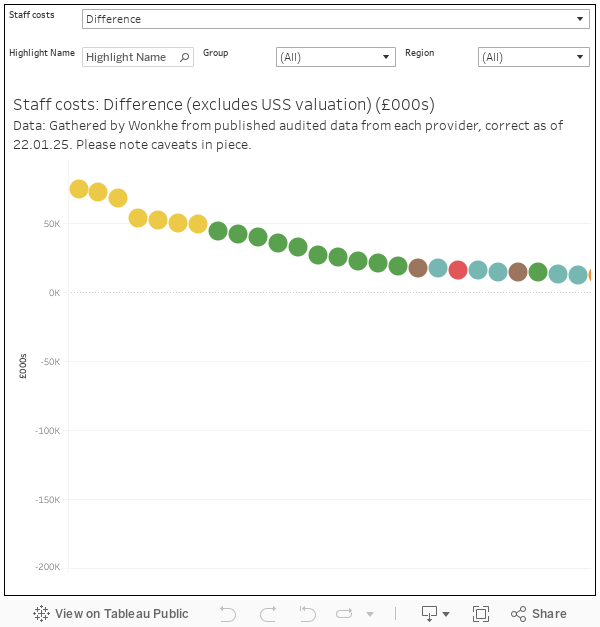
    And here I show underlying changes in staff costs (without the USS valuation effect). This is the raw spend on employing staff, including pay and pensions contributions. A drop could indicate that economies have been sought – employing fewer staff, employing different (cheaper) staff, or changes in terms and conditions. But it also indicates underlying changes in TPS contributions (up) or USS contributions (down) with respect to current employees on those schemes.

    [Full screen]

    Charts updated 11am 27 January to remove a handful of discrepancies.

    Fee income

    For most universities the main outgoing is staff costs, and the main source of income is tuition fees. Much has been made of the dwindling spending power of home undergraduate fees because of a failure to uprate with inflation, but this line in the accounts also includes unregulated fees – most notably international fees and postgraduate fees. The full name of the line in the accounts is “tuition fees and educational contracts”, so if your provider does a lot of bespoke work for employers this will also show up here.

    Both of these areas of provision have seen significant expansion in many providers over recent years – and the signs are that 2023–24 was another data point aligned with this trend for postgraduate provision. For this reason, the total amount of fee income has risen in a lot of cases, and when we get provider level UCAS data shortly it will make it clear that just how much of this is due to unregulated fees. International fees are another matter, and again we need the UCAS end of cycle data to unpick it, but it appears from visa applications and acceptances that from some countries (China, for example) demand has remained stable, while for others (Nigeria, India) demand has fallen.

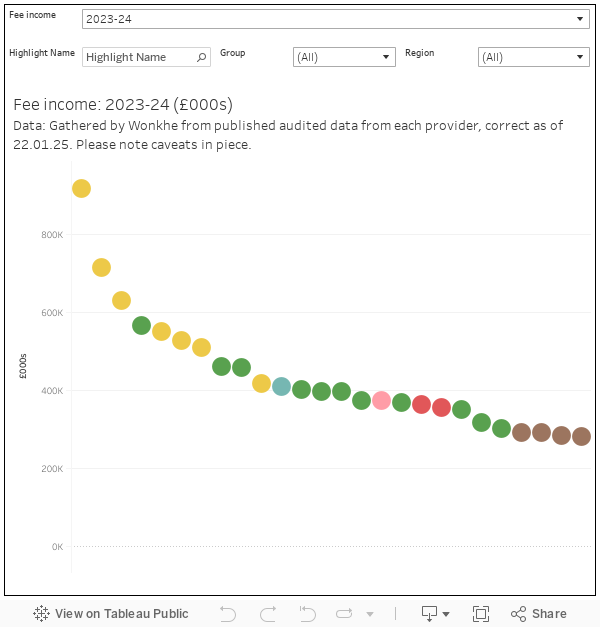
    Here I show fee income for the past two years, and the difference. This is total fee income, and does not discriminate between types of fees.

    [Full screen]

    One very important thing to bear in mind is that these are figures for the financial year, and represent fees relating to that year rather than the total amount of fees per student enrolled. For example, if a student started in January (an increasingly common start point for some courses at some institutions) you will only see the proportion of fees that had been paid by 31 July shown in the accounts. If you teach a lot of nursing students who start at non-traditional times of the year this will have a notable impact, as will a failure to recruit as many international students as you had hoped to do in January 2024 (though this will also show up in next year’s accounts).

    And it is also worth bearing in mind that income from fees paid with respect to students registered at the provider but studying somewhere else via an academic partnership, or involved in a franchise arrangement (something that has seen a lot of growth in some providers) shows up in this budget line.

    Other movements

    Quite a number of providers have drawn down investments or made use of unrestricted reserves. This is very much as you would expect, these are very much “rainy day” provisions and even if it is not actually raining now the storm clouds are gathering. Using money like this is a big step though – you can only spend it once, and the decision to spend it needs to link to plans not to need to spend it in the near future. So even if your balance looks healthy, a shift like this speaks eloquently of the kinds of cost-saving measures (up to and including course closures and staff redundancy) that you may currently see happening around you.

    Similarly, a provider may choose to sell assets – usually buildings – that it does not have an immediate or future use for. The costs of running and maintaining a building can quickly add up – a decision to sell releases the capital and can also cut running costs. Other providers choose to hang on to buildings (perhaps as assets that can be sold in future) but drastically cut maintenance and running costs for this reason. Again, you can (of course) only sell a building once, and a longer term maintenance pause can make it very expensive to put your estates back into use. I should note that the overall condition of university estates is not great and is declining (as you can read in the AUDE Estates Management Report) , precisely because providers have already started doing stuff like this. If the heating seems to be struggling, if the window doesn’t open, that’s why.

    In some cases we have seen decisions to pause capital programmes – not borrowing money and not building buildings as was previously planned. Here, the university makes an on-paper saving equivalent to the cost of finance if it was going to borrow money, or frees up reserves for other uses if it was using its own funds. Capital programmes don’t just include buildings – perhaps investment in software (the kind of big enterprise systems that make it possible to run your university) has been paused, and you are left struggling with outdated or unsuitable finance, admissions, or student record systems.

    Where we are talking about pausing building programmes it is important to remember that these exist to facilitate expansion or strategic plans for growth. The “shiny new building” is often perceived as a vice chancellor’s vanity project – in reality that new business school and the recruitment it makes possible may represent the university’s best hope of growing home fee income faster than inflation.

    What’s next?

    We see financial information substantially after the financial year ends – and for most larger providers this comes alongside the submission of an annual financial return to their regulator. We know for instance that the Office for Students is now looking at ways of getting in year data in areas where it has significant concerns, but financial data (by dint of it being checked carefully and audited) is generally historic in nature.

    For this reason what is happening on your campus right now is something that only your finance department has any hope of understanding, and there may be unexpected pressures currently driving strategy that are not shown (or even hinted at) in last years’ accounts. Your colleagues in finance and planning teams are working hard to forecast the end of year result, to calculate the KFIs (Key Financial Indicators) that others rely on, and to plan for the issues that could arise in the 2025 audit. The finance business partners or faculty accountants – or whatever name they have where you work – will be gathering information, exploring and explaining scenarios, and anticipating pressures that may require a change in financial strategy.

    The data I have presented here is drawn from published accounts – the data submitted to regulators that eventually ends up on HESA may be modified and resubmitted as understanding and situations change – for this reason come the early summer figures might look very different than what are presented here (I should also add I have transcribed these by hand – for which service you should absolutely buy me a pint) – so although I have done my best I may have made transcription errors which I will gladly and speedily correct.

    However scary your university accounts may be, I would caution that the next set (2024–25 financial year) will be even more scary. The point at which the home undergraduate fee increase in England kicks in for those eligible to charge it (2025–26) feels a long way off, and we have the rise in National Insurance Contributions (due April 2025) to contend with before then.

    There are a small but significant number of large providers looking at an unplanned deficit for 2024–25, as you might expect they will already be in contact with their regulator and their bank. Stay safe out there.

    If you are interested in institutional finances, I must insist that you read the superb BUFDG publication “Understanding University Finance” – it is both the most readable and the most comprehensive explanation of annual university accounts you will find.

    Source link

  • How to Equip Your Students With Essential Soft and Hard Skills Using Ed Tech

    How to Equip Your Students With Essential Soft and Hard Skills Using Ed Tech


    Today’s employers don’t just hire based on educational achievement. They’ve increasingly prioritized higher-order learning skills during the hiring process. To help students become job ready and land a role in the current workforce, professors need to empower learners with the necessary 21st-century skills, often called ‘soft skills.’

    This guide lays out key information on how to create opportunities for skill-based learning to help smoothen the transition from college to the workforce. It will also describe how to develop these skills in students while they’re still in the classroom. Most significantly, you’ll learn how educational technology can sharpen the essential soft skills students need beyond your course.  

    Below are 15 soft and hard skills that make up 21st-century learning.

    The 4 Cs of 21st-Century Learning

    The first four of these higher-order learning skills are widely considered the most vital 21st-century skills in the classroom for students to learn. Commonly known as the 4 Cs of 21st-century learning, they comprise:

    1. Critical thinking:

    Critical thinking is about problem-solving, and being able to bring a skeptical, discerning perspective to assertions of fact and opinion. Students are given opportunities to question and challenge the information presented to them. Troubleshooting and IT support are two hard skills that rely heavily on critical thinking as a foundation and are in-demand skills for the wide variety of technology-based careers in today’s job market.

    How Top Hat helps: Donna M. Smith, a math instructor, is a recipient of the Top Hat Black Educator Grant. A teacher of College Algebra at Sierra College, she has leveraged Top Hat to build a framework that helps students learn how to develop critical-thinking skills, and other soft skills like teamwork, adaptability and time management. She uses this framework to provide students with practice opportunities that demand specific actions from students, then gauges their higher-order learning using Top Hat’s range of assessment tools, spanning all six levels of Bloom’s Taxonomy. As a result, she reports, she’s found her students’ rate of success improved dramatically.

    In the same vein, 93 percent of students surveyed in a Top Hat research report said the variety of assessment types Top Hat offers help them learn how to develop critical-thinking skills.

    2. Creativity:

    This is the process of approaching problems from a variety of perspectives, including ones others might not notice. It helps develop trust in one’s own instincts and helps students seek out new solutions to old problems.

    3. Communication skills:

    This is the ability to convey thoughts and ideas clearly and effectively. In a 21st-century education, that includes being able to communicate well digitally, from texts, emails and social media, to podcasting and video conferencing.

    How Top Hat helps: Top Hat’s Discussion feature helps develop skill-building via collaboration in the classroom. While not all students are always on an equal playing field when it comes to comfort in group discussions, this Top Hat feature meets students where they are by allowing them to respond to comments and questions from any device. They can use simple text or incorporate images, sound bites and videos to propel the conversation forward. Teachers can even employ anonymity to make students comfortable engaging in sensitive topics. Teachers can use this Top Hat feature to drive up classroom participation significantly.

    4. Collaboration:

    This is the ability to work with others as a team to solve a problem or achieve a shared goal. It helps develop the abilities to share control, pitch solutions and discuss and decide with others the best course of action. It also helps students learn to effectively deal with others who may not agree with them, develop the critical abilities to resolve conflicts effectively and consider different viewpoints from their peers.

    Research shows that students who enter the workforce with knowledge and experience in the 4 Cs of 21st-century learning tend to be more adaptable and flexible in the constantly-shifting workplace environment. The 4 Cs of 21st-century learning, in turn, empower students to work better across cultures and are more prepared to take on leadership roles.

    Key Higher-Order Learning Skills

    Other important 21st-century skills in the classroom include:

    5. Problem-solving:

    This is the use of both conventional and innovative methods to solve different types of unfamiliar problems. It involves identifying and asking meaningful questions to clarify different viewpoints and arrive at more effective solutions.

    How Top Hat helps: The Top Hat Assignment feature enables teachers to provide students with interactive homework assignments that actively engage them in their own higher-order learning outside the classroom. A multimedia-friendly tool with 14 easy-to-use question types and automatic grading, this versatile feature keeps collaboration, communication and other essential skills front and center. It incorporates reading, answering questions and viewing media with worksheets, case studies and simulations to help students develop a deeper understanding of a problem and a multifaceted approach to its potential solutions. An added benefit for instructors is that it provides insights into students’ comprehension, participation and completion in real-time.

    6. Information literacy:

    This includes the ability to access, evaluate, utilize and manage information, critically and efficiently. It also involves the accurate and creative application of available information to the current problem or issue. It requires managing data flow from multiple sources, and the application of fundamental legal and ethical knowledge regarding access to and use of that information.

    7. Technology skills and digital literacy:

    Often abbreviated as ICT literacy (Information, Communication and Technology,) this is the collective set of abilities that allow students to effectively apply digital technologies to researching, evaluating, organizing and communicating information across digital channels. This may include using computers, mobile devices, social networks and other communication tools. Jobs in machine learning, product management and software development require understanding of technological platforms and apps. Individuals in these careers must be proficient in these skills in order to suceed.

    How Top Hat helps: Top Hat improves general literacy and digital literacy at the same time with Interactive Textbooks. Dynamic courseware incorporates text with high-quality images, videos and 3D simulations to captivate students’ interest and help them absorb and retain information better. They include case studies and customizable, interactive assessments, and students can access them anytime and from any device. Teachers can use Top Hat’s interactive textbooks in combination with physical textbooks, or on their own.

    Incorporating interactive textbooks and other digital technologies also helps students with skill-building and better prepare them to enter the 21st-century workforce by providing one-to-one computing, giving them the technology required to utilize their higher-order thinking skills in coursework.

    8. Media literacy:

    This includes the ability to analyze media and create media products. It involves understanding how, why and for what purpose various entities construct media messages, including what values and viewpoints they choose to include or exclude, and why. It also examines how people interpret messages differently and how that influences behaviors and beliefs. 

    9. Global awareness:

    This is the use of 21st-century skills to comprehend and address issues of global magnitude, and to collaborate with those from diverse backgrounds. It also involves taking an equitable or inclusive mindset when presenting new information. For example, educators might draw connections between cultural references in an English or cultural studies course. Teaching students the importance of global awareness also starts with reflecting on current and real-time events in your teaching, such as incorporating case studies on political or social uprisings.

    10. Self-direction:

    This is the ability to effectively set goals and manage time, as well as to work independently. It requires determining tangible and intangible criteria for success and balancing short-term tactical goals with long-term strategic ones. It also requires demonstrating initiative and commitment and working independently, including defining, prioritizing, monitoring and completing tasks without oversight, while reflecting on past experiences and learning from them.

    11. Social skills:

    This is the ability to effectively interact with others and work in diverse teams. Students recognize the appropriate times to listen or speak while remaining open-minded to diverse values and ideas. Students also learn how to conduct themselves professionally in a respectful manner, including when working with people from different backgrounds. Those looking to pursue careers in nursing or other areas of healthcare must be proficient in providing both emotional and physical care to patients. Common hard skills required for these careers include Basic Life Support (BLS), Patient Safety and Critical First Aid.

    12. Perseverance:

    This is the ability to persist in a determined effort in spite of obstacles and setbacks. It requires many of the other higher-order thinking skills, including problem-solving and self-direction, to employ effectively.

    How Top Hat helps: Top Hat’s 21st-century learning suite includes many tools that help educators make sure no student falls behind. Not least among them is learning insights. By tracking every interaction between a student and the software automatically, Top Hat enables you to see which students need additional help, in what area and when. Gauge attendance, progress, comprehension, participation—and act on these insights proactively in real-time.

    13. Literacy skills:

    Basic literacy skills include the abilities to create, comprehend, analyze, absorb, retain and recall written information. In the 21st-century workplace and modern economy, they especially apply to business, economic, financial, health and entrepreneurial interests.

    14. Civic literacy:

    Students become familiar with how civic decisions have local and global implications. This type of literacy involves effective participation in civic life by remaining informed and comprehending the processes of government. It also requires knowing how to exercise citizenship rights and obligations.

    15. Social responsibility:

    This encompasses everything from human rights, labor practices, the climate and the environment, fair operating practices, consumer issues and community involvement and development. It requires accountability, transparency, ethical behavior and respect for stakeholder interest, the rule of law, international norms of behavior and human rights.

    Why 21st-Century Skills Are Important

    Importance of Soft Skills for Students

    At its most basic level, teaching 21st-century skills, like critical thinking, provides a framework for higher-order learning. Beyond that, however, it also helps students develop the skills that ensure they will thrive when they leave the classroom and enter the workforce.

    Today’s workplaces are changing constantly, and the role of technology is ever-evolving and growing. That means that persistent, continual learning is essential to succeed and an emphasis on the importance of soft skills for students. Today’s graduates require not only the knowledge and skills for their chosen careers, but critical-thinking skills to navigate an always-changing landscape.

    Good for the World

    The greater community also benefits from new workers entering the workforce with a 21st-century education. The wellbeing of our broader society requires workers with competence and experience in:

    • Civic engagement
    • Critical thinking
    • Digital literacy
    • Effective communication
    • Global awareness

    Graduates equipped with these higher-order learning skills comprehend their role as good citizens and their connection to their neighbors and their shared environment. This way, they are more tolerant, they think more equitably and they aim to build a more diverse workforce. They are empowered to approach all they do in their work with a civic-minded focus.

    Conclusion

    As a 2017 research review in Nurse Education in Practice reported, “Technology has advanced in quantity and quality; recognized as a requirement of 21st-century learners.” Integrating curricula on critical thinking and other soft skills in your classroom will help your students enter the 21st-century workplace better equipped to meet the challenges facing future workers and leaders. As technology becomes an increasingly inseparable part of the working world, it’s becoming more evident that teachers who make effective use of it have an advantage in helping students prepare for life beyond the classroom.

    The developers and designers of Top Hat, including professional educators themselves, are singularly focused on employing the latest in 21st-century education technology to help educators empower students to achieve these aims.

    References

    Ross, D. (2017, April 24). Empowering Our Students with 21st-Century Skills for Today. Getting Smart. www.gettingsmart.com/2017/04/24/empowering-students-21st-century-skills/

    What is social responsibility? (n.d.). ASQ. asq.org/quality-resources/social-responsibility

    LinkedIn Jobs on the Rise 2022: The 25 U.S. roles that are growing in demand (2022, January 18). LinkedIn. https://www.linkedin.com/pulse/linkedin-jobs-rise-2022-25-us-roles-growing-demand-linkedin-news/


    Source link