Science found an exodus of Ph.D. holders from STEM and health roles at federal research agencies.
Andrii Rotkin/iStock/Getty Images Plus
The number of Ph.D. holders in STEM and health roles leaving 14 federal research agencies outnumbered hires 11 to 1 last year, according to a Science analysis of White House Office of Personnel Management (OPM) data. That has resulted in a net 4,224 fewer such Ph.D.s in those agencies, the journal reported this week.
Science also noted that reductions in force “accounted for relatively few departures.”
“At most agencies, the most common reasons for departures were retirements and quitting,” Science reported. “Although OPM classifies many of these as voluntary, outside forces including the fear of being fired, the lure of buyout offers, or a profound disagreement with Trump policies, likely influenced many decisions to leave.”
The National Institutes of Health saw the greatest increase in departures of STEM and health-relatedPh.D.s from 2024 to 2025, when President Trump retook the White House. In 2024,421 left the NIH; in 2025, more than 1,100 left. The agency also hired far fewer of those Ph.D.s last year than the year before. (Trump proposed cutting the NIH’s budget by roughly 40 percent this fiscal year, alongside massive cuts to other federal research agencies.)
The National Science Foundation lost a net 205 STEM and health-related Ph.D.s, equaling “40% of its total pre-Trump Ph.D. workforce of 517, by far the largest percentage at any agency,” Science reported. Nearly half of those who left the NSF last year were “rotators,” scholars on temporary leave from their universities, Science reported, noting that the agency erased 75 percent of those rotator positions last year.
Across all 14 agencies, the number of such Ph.D.s employed shrank17 percent on average from 2024 to last year.
In an email to Inside Higher Ed, Emily G. Hilliard, a spokesperson for the Health and Human Services Department, which includes the NIH, wrote that “under the Biden administration and throughout the pandemic, HHS ballooned into a bloated bureaucracy” that produced “no measurable improvements in public health.”
“The status quo was not working, and a major reset was overdue,” the spokesperson said. “HHS did just that, to streamline operations, reduce redundancies, and go back to pre-pandemic employment levels. It’s important to note many of these changes reflect voluntary departures through generous ‘Fork in the Road’ and early retirement offers, not a retreat from science.”
This audio is auto-generated. Please let us know if you have feedback.
Senators stressed the need for federal solutions to address a mental health crisis tied to social media and technology use among children and teens during a Thursday hearing held by the Senate Committee on Commerce, Science and Transportation.
Proposed solutions from senators and hearing witnesses spanned from completely ditching 1:1 devices and ed tech in schools to banning young children and teens from going on social media altogether.
The conversations in the Senate are developing with a sense of urgency as research continues to demonstrate the harmful social and emotional effects of social media use on youth and as more school districts and states seek to ban or limit cellphone use during the school day.
Additionally, the rapid spread of artificial intelligence tools could exacerbate these ongoing fears about technology’s impact on the youth mental health crisis, hearing witnesses said.
In the days leading up to the hearing, a coalition of education, library, and nonprofit leadership organizations sent a letter to Commerce, Science and Transportation Committee Chair Sen. Ted Cruz, R-Texas, and ranking member Sen. Maria Cantwell, D-Wash. The coalition stressed the importance of federal support for ed tech and connectivity in schools.
Some members of the coalition include AASA, The School Superintendents Association, The Consortium for School Networking and national teacher’s unions including the American Federation of Teachers and the National Education Association.
“It is essential to distinguish between largely unsupervised, entertainment-driven technology use at home and the intentional, monitored, and carefully curated use of technology in schools — where digital tools are employed to support learning and prepare students for future academic and workforce demands,” the coalition’s Jan. 13 letter said.
Senators also brought up various pending bills in Congress that would address their concerns with children and teens’ excessive use of social media and technology. At the same time, nearly 20 bills looking to take on similar concerns about youth safety online are gaining traction after the House Subcommittee on Commerce, Manufacturing and Trade advanced the package of legislation to the full Energy and Commerce Committee in December.
Cruz mentioned the Kids Off Social Media Act, a bipartisan bill he introduced last year that would prevent users under the age of 13 from accessing social media and prevent tech companies from using algorithms that feed addictive content to users under 17. Meanwhile, Cantwell highlighted other bipartisan Senate legislation such as an amendment to the Children and Teens’ Online Privacy Protection Act and the Kids Online Safety Act that she said would update privacy protections for children online and limit “exploitative designs” by tech companies.
Ed tech and the youth mental health crisis
In Cruz’s opening remarks, he praised the Federal Communications Commission’s decision in September to roll back the Biden administration’s expansion of the E-rate program to offer schools and libraries federal discounts to purchase Wi-Fi on school buses and internet hotspots.
That expansion of E-rate, Cruz said, gave students “unsupervised internet access” while also undermining parental rights. The goal of the E-rate expansion under the Biden administration, however, was to increase internet access to students from low-income families so they can complete their homework and not fall behind in their classes.
Under the Children’s Internet Protection Act, which was passed in 2000, schools and libraries receiving E-rate funds must block harmful content on their devices both on and off campus. Those requirements include denying access to content that is obscene, pornographic or otherwise harmful to students.
CIPA also “requires districts to adopt internet safety policies, monitor online activity, and educate students about appropriate online behavior,” the Jan. 13 coalition letter said. “These longstanding requirements demonstrate both the seriousness with which schools approach online safety and the robust legal architecture to protect students that is already in place.”
Cantwell pushed back on comments against the E-rate program.
“Congress is obligated to act,” Cantwell said, but rather than “focusing on threatening E-rate connectivity for schools, I think we should be passing meaningful protections for kids’ online privacy, regardless of whether they’re accessing the internet from home or school.”
Cruz also questioned during the hearing “whether assigning personal devices to children is actually improving academic outcomes or doing more harm than good.”
Two witnesses supported eliminating 1:1 devices in schools, which became widespread during the COVID-19 pandemic when districts had to operate classes remotely for many months. The witnesses, Emily Cherkin, founder of The Screentime Consultant, and Jared Cooney Horvath, director of education professional development company LME Global, called for a return to traditional analog learning for younger students followed by the integration of technology into academic instruction during later years once key skills are understood.
Despite a surge in ed tech over the past several years, Horvath said students’ proficiency in digital literacy has dropped between 2018 and 2023 as seen on the global assessment known as the International Computer and Information Literacy Study. “So clearly, the secret to learning how to use tech is to not use tech,” Horvath said.
Education organizations in the Jan. 13 letter denounced the idea of banning all technology in classrooms, however, saying that the government instead would better serve the public by adequately funding schools with professional development and technical support to ensure schools have the most effective safeguards and online filters on their devices.
Teacher preparation programs have long emphasized curriculum, instruction, and assessment. However, they often fall short in one critical area: social-emotional and mental health needs of students.
We work daily with students whose academic success is inseparable from their psychological well-being. Nonetheless, we witness new educators wishing they were trained in not just behavior management, but, nowadays, the non-academic needs of children. If preservice programs are going to meet the demands of today’s classrooms, they must include deeper coursework in counseling, psychology, and trauma-informed teaching practices.
Students today are carrying heavier emotional burdens than ever before. Anxiety, bullying, depression, grief, trauma exposure (including complex trauma), and chronic stress are unfortunately quite common. The fallout rarely appears in uniform, typical, or recognizable ways. Instead, it shows up as behaviors teachers must interpret and address (i.e., withdrawal, defiance, irritability, avoidance, conflict, aggression and violence, or inconsistent work).
Without formal training, it is easy to label these actions as simple “misbehaviors” instead of asking why. However, seasoned educators and mental health professionals know that behaviors (including misbehaviors) are a means of communication, and understanding the root cause of a student’s actions is essential to creating a supportive and effective classroom.
Oftentimes, adults fall into a pattern of describing misbehaviors by children as “manipulative” as opposed to a need not being met. As such, adults (including educators) need to shift their mindsets. This belief is supported by research. Jean Piaget reminds us that children’s cognitive and emotional regulation skills are still developing and naturally are imperfect. Lev Vygotsky reminds us that learning and behavior are shaped by the quality of a child’s social interactions, including with the adults (such as teachers) in their lives. Abraham Maslow’s hierarchy further reinforces that psychological safety and belonging must be met before meaningful learning or self-control can occur, and teachers need to initiate psychological safety.
Traditional classroom management training is often sparse in traditional preservice teacher training. It often emphasizes rules, procedures, and consequences. They absolutely matter, but the reality is far more nuanced. Behavior management and behavior recognition are not the same. A student who shuts down may be experiencing anxiety. A child who blurts out or becomes agitated may be reacting to trauma triggers in the environment. A student who frequently acts out may be seeking connection or stability in the only way they know how. Trauma-informed teaching (rooted in predictability, emotional safety, de-escalation, and relationship-building) is not just helpful, but is foundational in modern schools. Yet, many new teachers enter the profession with little to no formal preparation in these practices.
The teacher shortage only heightens this need. Potential educators are often intimidated not by teaching content, but by the emotional and behavioral demands that they feel unprepared to address. Meanwhile, experienced teachers often cite burnout stemming from managing complex behaviors without adequate support. Courses focused on child development, counseling skills, and trauma-informed pedagogy would significantly improve both teacher confidence and retention. It would also be beneficial if subject-area experts (such as the counseling or clinical psychology departments of the higher education institution) taught these courses.
Of note, we are not suggesting that teachers become counselors. School counselors, social workers, psychologists, and psychometrists play essential and irreplaceable roles. However, teachers are the first adults to observe subtle shifts in their students’ behaviors or emotional well-being. Oftentimes, traditional behavior management techniques and strategies can make matters worse in situations where trauma is the root cause of the behavior. When teachers are trained in the fundamentals of trauma-informed practice and creating emotionally safe learning environments, they can respond skillfully. They can collaborate with or refer students to clinical mental-health professionals for more intensive support.
Teacher preparation programs must evolve to reflect the emotional realities of today’s classrooms. Embedding several clinically grounded courses in counseling, psychology, and trauma-informed teaching (taught by certified and/or practicing mental-health professionals) would transform the way novice educators understand and support their students. This would also allow for more studies and research to take place on the effectiveness of various psychologically saturated teaching practices, accounting for the ever-changing psychosocial atmosphere. Students deserve teachers who can see beyond behaviors and understand the rationale beneath it. Being aware of behavior management techniques (which is often pretty minimal as teacher-prep programs stand now) is quite different than understanding behaviors. Teachers deserve to be equipped with both academic and emotional tools to help every learner thrive.
Latest posts by eSchool Media Contributors (see all)
This audio is auto-generated. Please let us know if you have feedback.
Dive Brief:
A federal judge on Friday ordered the permanent reinstatement of U.S. Department of Education mental health grants in 16 states, ruling that the April cancellation of the school-based and professional development funding was unlawful.
The order came a week after the Education Department awarded $208 million in new mental health grants under revised priorities set by the Trump administration that prohibit recipients from “promoting or endorsing gender ideology, political activism, racial stereotyping, or hostile environments for students of particular races.”
The original multi-year grant program first became available in 2018 to help schools address a worsening youth mental health crisis and increased school violence, including by supporting partnerships with colleges to expand the number of mental health providers available to students. Court records in the case, which was filed by the 16 states covered in the ruling, described how the funding brought more mental health professionals into schools and improved school climates.
The new grant priorities announced in July limited funding to hiring school psychologists rather than also funding school counselors and social workers, who often also provide student mental health supports.
U.S. District Judge Kymberly Evanson, in the Dec. 19 order inState of Washington v. U.S. Department of Education, took the Education Department to task for politicizing the grant program. “Nothing in the existing regulatory scheme comports with the Department’s view that multi-year grants may be discontinued whenever the political will to do so arises,” the ruling said.
The Education Department did not return a request for comment Monday.
The canceled grants caused “significant disruption” to the 16 plaintiff states, according to the judge. Nationally, the Education Department said the canceled grants totaled about $1 billion, according to court records.
Evanson found the Education Department had violated the Administrative Procedure Act multiple times through actions that “are arbitrary and capricious and contrary to law.”
Specifically, the judge ruled that the department’s discontinuation notices to grantees in the 16 states that sued were “arbitrary and capricious” because they did not explain the reason for the cancellations. “The Department makes no effort to analogize the discontinuation notices or the process by which the notices were issued to the cases they cite,” Evanson said.
The permanent injunction prevents the Education Department from issuing new priorities or irrelevant information to judge the mental health grant applications. Additionally, the court said it will oversee compliance with the order. In October, Evanson had issued an order granting the state’s motion for a preliminary injunction.
The mental health grant programs began in 2018, after the school shooting at Florida’s Marjory Stoneman Douglas High School, which killed 14 students and three staff members. The grants were continued and expanded over the years, including after the 2022 school shooting at Texas’ Robb Elementary School, where 19 students and two teachers were killed.
Washington Attorney General Nick Brown, who led the states’ lawsuit, said in a Dec. 20 statement the mental health grants helped schools hire 14,000 mental health professionals who provided mental and behavioral health services to nearly 775,000 K-12 students nationwide in the first year, helping to reduce wait times for students needing help.
“We’re facing a youth mental health crisis,” Brown said in response to the latest court order. “Making sure our kids have proper support should never be subject to political whim. This is why we stand firm against this administration’s utter disregard for the law.”
Massachusetts Attorney General Andrea Joy Campbell, in a Dec. 22 statement, said the ruling “ensures that our young people are not unlawfully denied resources, including mental health professionals in schools, to help them navigate a nationwide mental health epidemic.” Massachusetts was among the plaintiff states.
Kelly Vaillancourt Strobach, director of policy and advocacy for the National Association of School Psychologists, said that NASP is “pleased to see that the grantees in these plaintiff states will be able to continue their work next year.”
She added that grantees still have a lot of questions and that NASP “will be working with them to get answers to them in the new year about the future of their grant.”
Myrna Mandlawitz, policy and legislative consultant for the Council of Administrators of Special Education, said the ruling could bode well for other plaintiffs suing the administration over canceled grants. “You can’t enforce against a grantee criteria that they didn’t know about when they applied for and received the grant. That doesn’t even pass the laugh test if you ask me,” Mandlawitz said.
Joining Washington and Massachusetts in the lawsuit were the attorneys general of California, Colorado, Connecticut, Delaware, Illinois, Maine, Maryland, Michigan, New Mexico, New York, Nevada, Oregon, Rhode Island, and Wisconsin.
This audio is auto-generated. Please let us know if you have feedback.
Dive Brief:
A federal judge on Friday ordered the permanent reinstatement of U.S. Department of Education mental health grants in 16 states, ruling that the April cancellation of the school-based and professional development funding was unlawful.
The order came a week after the Education Department awarded $208 million in new mental health grants under revised priorities set by the Trump administration that prohibit recipients from “promoting or endorsing gender ideology, political activism, racial stereotyping, or hostile environments for students of particular races.”
The original multi-year grant program first became available in 2018 to help schools address a worsening youth mental health crisis and increased school violence. Court records in the case, which was filed by the 16 states covered in the ruling, described how the funding brought more mental health professionals into schools and improved school climates.
The new grant priorities announced in July limited funding to hiring school psychologists rather than also funding school counselors and social workers, who often also provide student mental health supports.
U.S. District Judge Kymberly Evanson, in the Dec. 19 order inState of Washington v. U.S. Department of Education, took the Education Department to task for politicizing the grant program. “Nothing in the existing regulatory scheme comports with the Department’s view that multi-year grants may be discontinued whenever the political will to do so arises,” the ruling said.
The Education Department did not return a request for comment Monday.
The canceled grants caused “significant disruption” to the 16 plaintiff states, according to the judge. Nationally, the Education Department said the canceled grants totaled about $1 billion, according to court records.
Evanson found the Education Department had violated the Administrative Procedure Act multiple times through actions that “are arbitrary and capricious and contrary to law.”
Specifically, the judge ruled that the department’s discontinuation notices to grantees in the 16 states that sued were “arbitrary and capricious” because they did not explain the reason for the cancellations. “The Department makes no effort to analogize the discontinuation notices or the process by which the notices were issued to the cases they cite,” Evanson said.
The permanent injunction prevents the Education Department from issuing new priorities or irrelevant information to judge the mental health grant applications. Additionally, the court said it will oversee compliance with the order. In October, Evanson had issued an order granting the state’s motion for a preliminary injunction.
The mental health grant programs began in 2018, after the school shooting at Florida’s Marjory Stoneman Douglas High School, which killed 14 students and three staff members. The grants were continued and expanded over the years, including after the 2022 school shooting at Texas’ Robb Elementary School, where 19 students and two teachers were killed.
Washington Attorney General Nick Brown, who led the states’ lawsuit, said in a Dec. 20 statement the mental health grants helped schools hire 14,000 mental health professionals who provided mental and behavioral health services to nearly 775,000 K-12 students nationwide in the first year, helping to reduce wait times for students needing help.
“We’re facing a youth mental health crisis,” Brown said in response to the latest court order. “Making sure our kids have proper support should never be subject to political whim. This is why we stand firm against this administration’s utter disregard for the law.”
Massachusetts Attorney General Andrea Joy Campbell, in a Dec. 22 statement, said the ruling “ensures that our young people are not unlawfully denied resources, including mental health professionals in schools, to help them navigate a nationwide mental health epidemic.” Massachusetts was among the plaintiff states.
Kelly Vaillancourt Strobach, director of policy and advocacy for the National Association of School Psychologists, said that NASP is “pleased to see that the grantees in these plaintiff states will be able to continue their work next year.”
She added that grantees still have a lot of questions and that NASP “will be working with them to get answers to them in the new year about the future of their grant.”
Myrna Mandlawitz, policy and legislative consultant for the Council of Administrators of Special Education, said the ruling could bode well for other plaintiffs suing the administration over canceled grants. “You can’t enforce against a grantee criteria that they didn’t know about when they applied for and received the grant. That doesn’t even pass the laugh test if you ask me,” Mandlawitz said.
Joining Washington and Massachusetts in the lawsuit were the attorneys general of California, Colorado, Connecticut, Delaware, Illinois, Maine, Maryland, Michigan, New Mexico, New York, Nevada, Oregon, Rhode Island, and Wisconsin.
The tragic shooting at Brown University in December 2025, which claimed two lives and left nine students wounded, is a stark reminder that even elite U.S. campuses are not immune to violence. For international students, understanding this incident requires placing it in the broader context of the United States’ history of social dangers, treatment of mental illness, and policies affecting foreigners.
The United States has historically had higher rates of violent crime, including gun-related incidents, than many other developed nations. While campus shootings remain statistically rare, they reflect deeper societal issues: widespread gun access, social inequality, and a culture that often prioritizes armed self-protection over preventative public safety measures. Universities, traditionally viewed as open spaces for learning and discussion, are increasingly sites of surveillance and armed response, reshaping the student experience.
Foreign students and immigrants may face additional vulnerabilities. Throughout U.S. history, immigrants have often been subject to discrimination, harassment, or violence based on nationality, race, or religion. Universities are not insulated from these pressures, and international students can be particularly susceptible to microaggressions, exclusion, or even targeted hostility. These risks were heightened under the Trump administration, when rhetoric and policies frequently cast foreigners as suspicious or undesirable. Visa restrictions, heightened scrutiny of foreign scholars, and public statements fostering distrust created an environment in which international students might feel unsafe or isolated.
Mental illness plays a critical role in understanding campus violence, but its treatment in the United States is inconsistent. While many universities provide counseling centers, therapy services, and crisis hotlines, the broader mental health system in the U.S. remains fragmented and under-resourced. Access often depends on insurance coverage, ability to pay, and proximity to care, leaving some individuals untreated or inadequately supported. Cultural stigmas and underdiagnosis can exacerbate the problem, particularly among minority and immigrant populations. International students, unfamiliar with local mental health norms or hesitant to seek care due to cost or cultural barriers, may be less likely to access help until crises arise.
U.S. universities deploy extensive surveillance systems, emergency protocols, and campus police to respond to threats. These measures aim to mitigate harm once an incident occurs but focus less on prevention of violence or addressing underlying causes, including untreated mental illness. Students are required to participate in drills and safety training, creating a reactive rather than preventative model.
Compared to other countries, the U.S. approach is distinct. Canadian universities emphasize mental health support and unarmed security. European campuses often maintain open environments with minimal surveillance and preventive intervention strategies. Many Asian universities operate in low-crime contexts with community-based safety measures rather than extensive surveillance. The U.S. approach emphasizes rapid law enforcement response and monitoring, reflecting a society with higher firearm prevalence and less coordinated mental health infrastructure.
The Brown University tragedy underscores a sobering reality for international students: while the U.S. offers world-class education, it is a nation with elevated risks of violent crime, inconsistent mental health care, and historical and ongoing challenges for foreigners. Awareness, preparedness, community engagement, and proactive mental health support are essential tools for international students navigating higher education in this environment.
Sources
The Guardian: Brown University shooting: police release more videos of person of interest as FBI offers reward
Reuters: Manhunt for Brown University shooter stretches into fourth day
Washington Post: Hunt for Brown University gunman starts anew as tension rises
AP News: Brown University shooting victims identified
People: Brown University shooting victim Kendall Turner
WUSF: Brown University shooting victims update
Wikipedia: 2025 Brown University shooting
Pew Research Center: International Students in the United States
Brookings Institution: Immigrant Vulnerability and Safety in the U.S.
National Alliance on Mental Illness: Mental Health in Higher Education
Journal of American College Health: Mental Health Services Utilization Among College Students
Officials also announced that the center will hone its primary focus to children’s health.
John Tlumacki/The Boston Globe/Getty Images
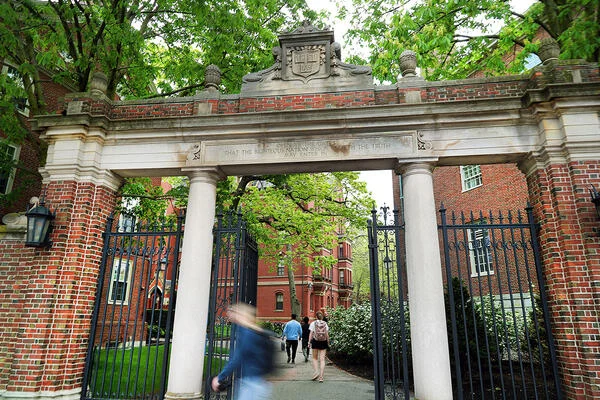
The director of Harvard University’s François-Xavier Bagnoud Center for Health and Human Rights will step down in January after seven years at the helm, dean of the Harvard T. H. Chan School of Public Health Andrea Baccarelli announced Tuesday. News of her departure follows months of criticism of the center’s Palestine Program for Health and Human Rights.
Mary Bassett’s last day as director will be Jan. 9, 2026, after which she will remain a professor of practice in the Social and Behavioral Sciences Department. Kari Nadeau, a professor of climate and population studies at Harvard, will serve as interim director. Bassett did not respond to a request for an interview Thursday. A Harvard spokesperson did not answer Inside Higher Ed’s questions about Bassett’s departure, including whether she was asked to step down, and instead pointed to Baccarelli’s message.
Baccarelli also announced that the center will shift its primary focus to children’s health.
“Over the past years, FXB has worked on a wide range of programs within the context of human rights, extending across varied projects, including those related to oppression, poverty, and stigma around the world,” he wrote. “We believe we can accomplish more, and have greater impact, if we go deeper in a primary area of focus.”
The center’s Palestine Program for Health and Human Rights drew increased scrutiny after Hamas’s Oct. 7, 2023, attack in Israel, including from former Harvard president Larry Summers and New York congresswoman Elise Stefanik. In previous years, the program partnered with Birzeit University in the West Bank, but Harvard declined to renew that partnership in the spring. In their April report on antisemitism on campus, Harvard officials detailed complaints from students about the program’s webinars, in which speakers allegedly “presented a demonizing view of Israel and Israelis.”
“One student told us that the FXB programming created the impression that ‘Israel exists solely to oppress Palestinians, and nothing else,’” the report stated.
This audio is auto-generated. Please let us know if you have feedback.
The U.S. Department of Education on Thursday announced new allocations for its mental health grants, which it revoked from over 200 original recipients earlier this year.
The new grants total more than $208 million, but are significantly less than the nearly $1 billion in funds pulled from school-based programs and providers earlier this year, according to court documents. The grants were rescinded because of their alleged use to fund diversity, equity and inclusion efforts in providing student mental healthcare services.
The discontinued mental health grants originated in fiscal years 2022, 2023 and 2024. Kelly Vaillancourt Strobach, director of policy and advocacy for the National Association of School Psychologists, told K-12 Dive this summer that the exact number is hard to quantify considering the grants spanned past and future years, including unspent funds.
The new awards will be divvied up among 65 recipients, half of which are rural. The recipients were selected under a new application process and are subject to new requirements. They’ll be required to limit funding to hiring school psychologists rather than also funding school counselors and social workers, who often also provide student mental health supports.
Districts and other recipients are also prohibited from “promoting or endorsing gender ideology, political activism, racial stereotyping, or hostile environments for students of particular races.”
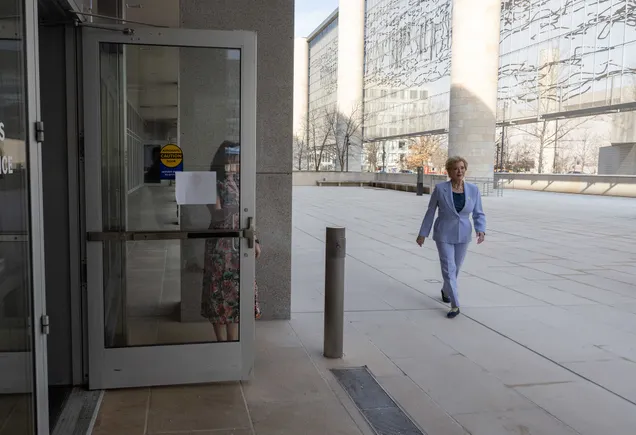
“Under the Biden Administration, it was more important to shape the racial and gender identities of mental health providers than it was to focus resources on high-quality, credentialed school psychologists who are best positioned to serve American students when they are at their most vulnerable,” said U.S. Secretary of Education Linda McMahon in a statement Thursday.
At least one rural school district had its funds revoked despite telling the department that it would reconfigure its priorities to fit the department’s requirements.
California’s McKinleyville School District, which serves Native American students and wanted to hire mental health providers to reflect its student body, had about $5.9 million in funding revoked, effectively ending the district’s grant awarded under the Biden administration.
The school district’s plans for those federal funds, the department said in a letter to the district, reflected “the prior Administration’s priorities and policy preferences and conflict with those of the current Administration.” Using the money in this way “no longer effectuates the best interest of the Federal Government,” the agency told McKinleyville USD in April.
That district and other entities sued the Trump administration over the withdrawal of the grants, saying such a move could only be made in cases where recipients didn’t meet their proposed benchmarks. A court temporarily paused the department’s decision in a separate lawsuit brought by 16 states.
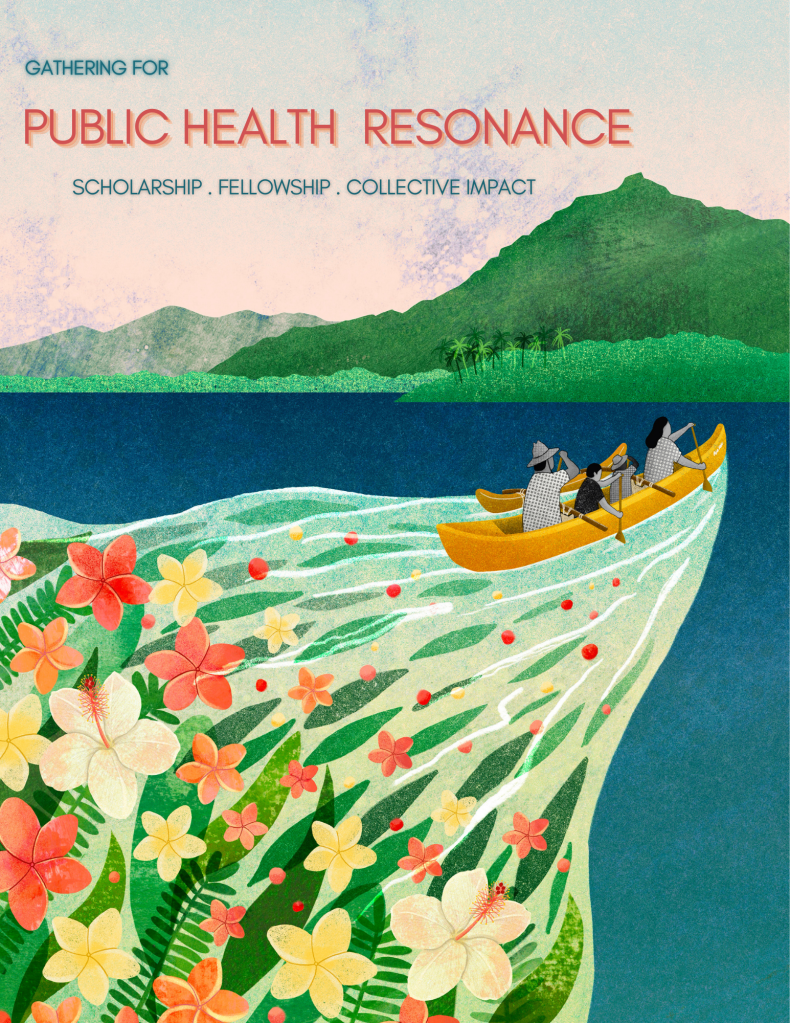
The Public Health Resonance Project at the University of Hawaiʻi at Mānoa collaborated with a talented artist to create illustrations to better share their research. Have you incorporated art into your research communications?
The Public Health Resonance Project at the University of Hawai‘i at Mānoa “amplifies unique attributes and deep connections across regionally and culturally relevant physical activities for health promotion and community wellness, locally and globally.”
Art and illustration can enhance how you share your research. Collaboration between the Public Health Resonance Project and a talented artist included feedback from the whole team to ensure the illustrations were culturally relevant to the research. “It was necessary.”
This episode features
Dr. Tetine Sentell, co-lead of the Project and Chin Sik & Hyun Sook Chung Endowed Chair in Public Health Studies at the University of Hawaiʻi Mānoa
Esme Yokooji, a graduate student in Public Health and social media coordinator for the Project
The episode on Art and Design to Share Your Research Story felt so special. It’s the 1st time these collaborators have all come together on video 🎧🎙️✨
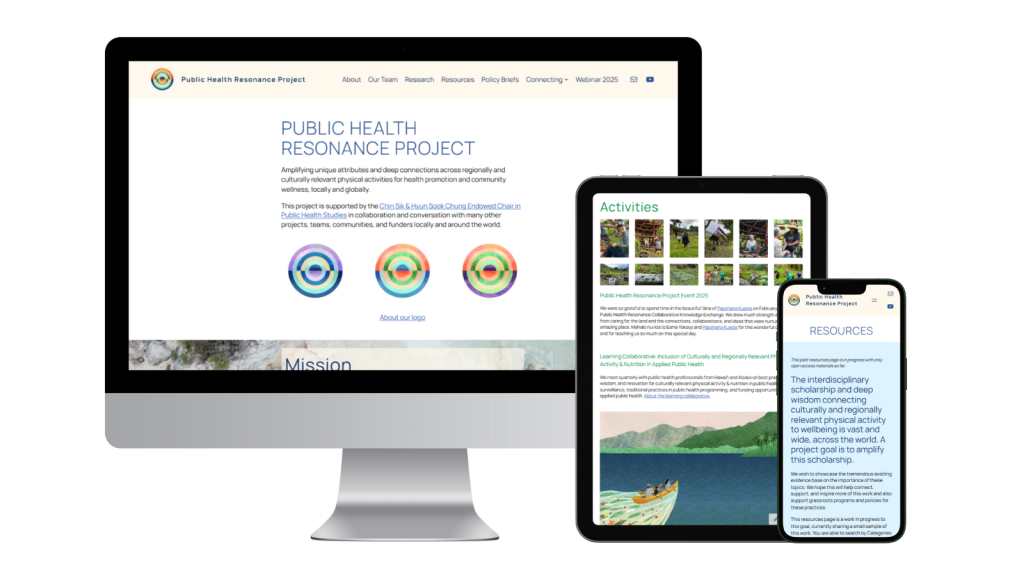
I love that I got to design their website and bring us together for this conversation. We talk about the research, art, and share 3 beautiful new illustrations with you.
There’s many ways to be more visual with your research such as data visualization, illustration, comics, science art, photography, video. I love that the PH Resonance Project found an artistic partner in Sunnu Rebecca Choi.
I hope this video inspires you. Save this post for later. You may not have 32m 5s to watch or listen today. But save it even if you just have a hint of ‘I want art for my research’ and you’re unsure how you’ll get there.
A dream I have is that more research groups, labs, and centers invest in collaborating with talented artists like Rebecca. These partnerships can help people around the world engage with (and share) research that’s meaningful to them. And also I love art.
Omg if this post (or the video) inspires you to reach out to an artist about working together? Please share it with me, I would love that! 🥹
Behind-the-scenes
Before we dive into the interview, I have a quick story to share with you about recording. Or, you can skip right to the interview.
My computer crashed right in the middle of our recording 💻😱
I’m freaking out. My desktop computer light is blinking red at me like a danger sign. When I try to cycle the computer on the fan goes crazy.
The podcast episode going live today? There was a moment there I thought it wasn’t gonna happen. When I finally made it back on, maybe 10 minutes later, I was delighted to find my guest happily chatting away. When I went back to watch the recording, they were so cute. “Oops! Looks like our host has dropped off,” and then right back to their conversation about art and research.
We were able to complete our recording. But this episode needed a bit more.
We had high resolution art to share. There was a story in there that needed attention to bring out 🎨✨️
And thank goodness I sought help. I soon learned my own audio/video? Parts of my solo video were unusable. Super lagged.
Luckily, I have a talented husband I’ve been teaming up with for his professor dad’s art focused YouTube channel. I love that Matthew can help.
The video is finally ready for you. Thank you!
Technical problems may happen 💯
Have you worried about something going wrong with your computer too? Things may go wrong with tech, but I hope it doesn’t for you! 🫶
Every time something goes wrong, I get anxious about my own unsurity of what comes next. People are often kind and understanding. When I’m the one experiencing technical issues, it feels like a huge deal and inconvenience to people. I have to remind myself: When I’m on the other side of that? I always understand. It’s super relatable. I can’t envision myself getting mad, angry, or hurt but someone else’s technical glitch. If your computer crashes in the middle of our meeting, I’ll totally get it too.
I wanted to share this story with you because for a moment there? It felt like this podcast episode may not happen. But it did. We made it happen. I’m so happy / relieved. I’m proud to share it with you 👋😄
The special 2024 logo was designed by Sunnu Rebecca Choi.
Tetine: Rebecca, we love you so much. I’m so excited to meet you in real life.
Rebecca: Thank you. I was really looking forward to meet you guys, all.
Tetine: You’re like our artistic hero, so it’s so fun to have an opportunity to do this. Thank you, Jennifer for making it happen.
Jennifer: Wait, Tetine. How did you first find Rebecca? How did you first connect?
Tetine: Oh yeah, so I have it in my slides.
Jennifer: Oh, you do? Okay. Show me your slides.
Yeah, yeah yeah! As a team, this is kind of our first time all meeting live and I’m so excited that we’re all here together. Tetine, why don’t you start us off. Would you please introduce yourself and tell people a little bit about your research?
Tetine: Sure. Aloha. I’m Tetine Sentell. I’m a Professor here at the University of Hawaiʻi at Mānoa in Public Health. I’m the department chair of public health and I am one of the co-founders of the Public Health Resonance Project, which is a really exciting, interdisciplinary, collaborative synthesis of literature, engagement with literature, dissemination of literature project we’ve been doing now for several years that this team has assembled as part of, and I’m just been so grateful to be part of that. And it’s really about sharing opportunities for strength-based public health promotion, especially around culturally and regionally relevant physical activity and how that’s meaningful to people as individuals, as families, as communities, and as collectives.
Jennifer: What are some examples of those culturally relevant activities? Just so people have an idea.
Tetine: So in Hawaiʻi, some examples would be hula, spearfishing, outrigger canoe paddling, for instance. And then of course, in many other places there are resonance and activities from culturally relevant dance, folk dances, regional relevant dances, practices in the water, practices in the land.
Jennifer: Esme, would you introduce yourself?
Esme: Sure. My name is Esme Yokooji. I’m a Master’s of Public Health student at UH Mānoa, and I am the graduate research assistant on this project. I’m in the NHIH or Native Hawaiian and Indigenous Health specialty at UH. And, in my free time, I am someone who participates in these activities. I do Okinawan dance. I like to volunteer in ʻĀina doing things like Kalo planting and just conservation and restoration work in our natural habitats here in Hawaiʻi. That’s what initially drew me to this project is just the real life connection and seeing how community engages with these things. So mahalo for having us.
Jennifer: Rebecca, you are coming here from London. This is fun. London, Hawaiʻi, and I’m in San Diego. Rebecca, tell me a little about your journey as an artist.
Rebecca: Hi, my name is Sunnu Rebecca Choi. I’m an illustrator and printmaker based in London, but I’m originally from South Korea, lived in Canada and United States and now ended up in London somehow. And then I used to be a fashion designer in New York and Toronto, but then I decided to change my career, become an illustrator. Right now I’m specializing in editorial illustration as well as children’s book illustration, mostly focusing editorial illustration wise, mostly focusing on medical scientific as well as psychologies. And I work with a lot of different university magazines as well.
Jennifer: Thank you. So everyone listening knows, I did design the website [for the Public Health Resonance Project]. I had so much fun doing this project because there are so many visual elements to all of those activities and to the people who are engaging with them. This is about people.
Tetine: I am so happy to be here because we’ve been working on this international, collaborative project for so many years, and one of the things we really wanted to do was make it so beautiful and really make it so it could be disseminated and shared in ways that inspire and engage and delight people. And so I developed this logo as we began consolidating and thinking about disseminating in collaboration with some partners, and in particular with my husband and all who helped build it. So thank you, Craig. It was a meaningful logo. We felt it was really important. I have this slide here to really show we were inspired by the Hawaiian colors and the deep ocean from the shore to the sunset, and really thinking about the levels of influence and the social ecological model, which is our theoretical influence in the background from a public health perspective and thinking about the ripple effects and the waves that grow and build and move across. And really thinking about the place to connect the project and the connections and the links, the ripples, the reflections.
We had this endowed chair and this opportunity, and so I was really reflecting and thinking about this and this absolutely beautiful art came in my alumni magazine. Can you see how beautiful that is? It’s so pretty. I even have the one I pulled out of my alumni magazine and it was Rebecca’s artwork and it was so beautiful and it really had the feeling of what we were thinking about of these reflections, of these perspectives. You can see it has a lot of depth and story to the artwork as well as just being so peaceful and beautiful and meaningful. And so that’s how I found the artwork and had no idea how to engage with artwork or what to do in this particular way if it was contractable through a university through our funds. But anyway, just cold emailed through the link in the website and she has a beautiful website if you’ve seen it. And through that started a conversation that has just been really so fruitful and so exciting and just I’m so honored to be part of this. And in collaboration also with Esme and others who’ve really helped support and build the artwork into spaces that we can use it for all the things we wanted to do.
Jennifer: That is amazing. I’m so happy that we had a chance to hear that kind of origin story because I feel like there’s so many possibilities that we just don’t know exist as researchers, as academics, even as artists. What can we do to better connect and help shape our ideas together? Rebecca, how did you feel when Tetine first reached out? Is this a kind of project that you’ve done in the past?
Rebecca: No, actually it was really interesting because I haven’t really worked with other universities before. So was it, what university?
Tetine: Middlebury.
Rebecca: Yeah, Middlebury Magazine. That was my first alumni magazine that I worked with, university. And then when Tetine emailed me I was like, “Oh, I actually didn’t know it was released already.” That’s how I knew that magazine has been issued. Yeah, so that was really interesting. And then since then I’ve been working with a lot of universities in United States, so that opened a new opportunity for me as well.
Jennifer: And so I’m curious Tetine, what about art helps bring the community together? Why invest in this kind of visual element?
Tetine: Of course, art inspires us, engages us, pulls us in, makes us think, is important to us as humans, as people in the world. But I also think in academia we do a lot of intricate, thoughtful, engaged practices and activities that often are not accessible because they’re deep inside words and publications, sometimes even behind paywalls. And I think there is a lot of intricacy and story in even peer-reviewed academic journal papers, much less the smaller summaries of them. View open access resources from the PH Resonance Project.
And so it just felt like this was such an opportunity relative to the work, work now, to disseminate and to share it, to think about how it’s helpful, how it’s good for mental health, how it’s engaging, how it’s good for physical health, how it’s good for strength. All that was sort of built in the background of how to share out, this was so important to disseminate in communities and to people. And then with that joy, right. This is a strength-based activity. It’s a thing that brings people together, makes them happy, makes them joyful, connect with each other. And I think that’s one of the things art can do. It felt like such a nice synergy and such an amazing opportunity to really tie all those things together.
Jennifer: You brought up joy, and that’s something that I really get not just from the beautiful illustrations that have been customized to represent different activities that the project is researching, but also in the new version of the logo, in the thoughtfulness of how it all comes together through, you have created brochures, event flyers, like physical things and materials to help people engage in person. And that artwork also creates that same warmth and feeling online. Rebecca, I’m curious about your process working on what feels like something really representative of community. What was that process like for creating the artwork for this project?
Rebecca: The process-wise, whenever I receive a brief, I start with the research. Understanding how each activity is carried out, what equipment is used, and learning about the cultural context, from coding to landscapes. And that process helped me make the imagery as accurate and respectful as possible. Also, every time I create the illustration, my goal was to highlight public health at the community level, showcasing people coming together, whether it’s a mother and a child, a family, or a wider community group. I wanted the artwork to capture the moment and that sense of connection and shared care. I believe illustration has the power to bring people closer and help them resonate more deeply with the subject matter. And I think that was my main goal in creating those illustrations. Usually, when I’m working on the brief, I come up with three different concepts or ideas for each illustration.
Whenever, if I’m working on the canoe activity, I come up with three different composition or concept or focusing on something different for each illustration for the client to choose from. And that’s how I start creating the art. And then once we decide which concept we are going to go with and then I go render the illustration, my rendering process is quite interesting because I’m a printmaker as well. I create all the textures using printmaking techniques, either monoprinting, etching, or any kind of things that I can get hands on and I scan them in. And then in terms of the final illustration, I use Procreate on iPad and then bring all the textures together on iPad. So it’s a mix of digital and analog process.
Tetine: That’s why it’s so tactile. It’s like you can really feel it even through the internet. It’s really beautiful that way.
Esme: I felt the same way though. When I first saw the illustrations, I was like, “Oh, it’s almost like it’s painted on washi paper.” Like watercolor on washi. It’s so beautiful.
Rebecca: I will sometimes use the watercolor and washi or, accurate. So in my studio I have bunch of papers with all different kinds of textures and colors, which I can just use on any kind of illustration.
Esme: That’s so cool.
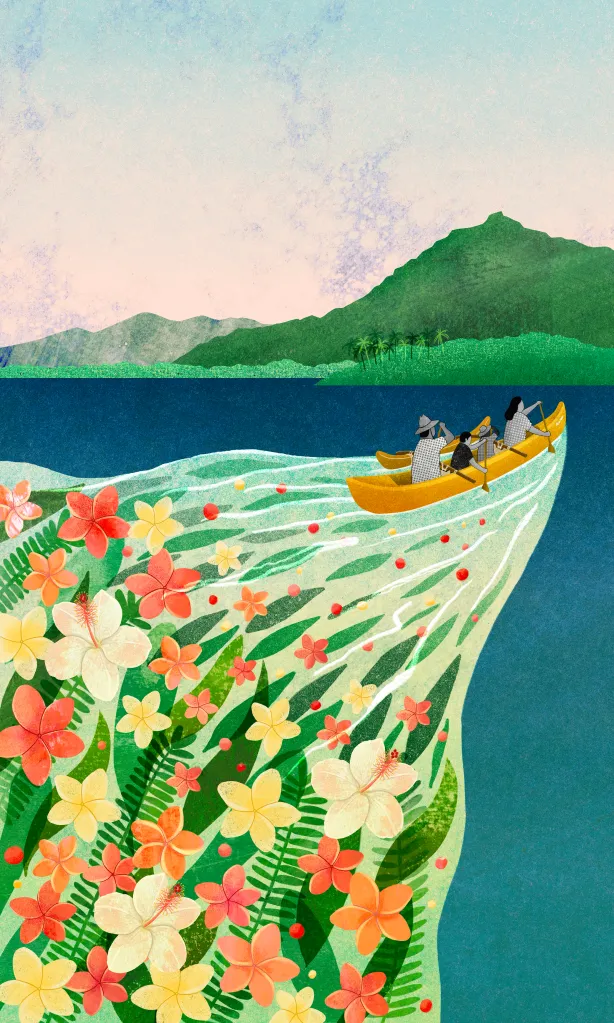
Tetine: It is. It’s so beautiful. I just love how it all works together and it really has such a feeling about it. Your work is so specifically you, but then you’re also using it so collaboratively to share other people’s vision, which is not an easy thing to do, I think as an artist, and I really appreciate the collaborativeness with which you’ve approached this, these. The first one as the initial one, as thinking about how to share and showcase what we were trying to do. And then very specifically in a regional context and an actual, it’s a specific way, it’s a specific bay you’re coming into and the landscape like you mentioned, and the practice and the movement and the arms, and then really thinking about who is in the canoe and what they’re wearing. And then as we have thought about it for the other resonating activities, to be willing and offer the opportunity for us to really be in collaborative conversation, even as the artwork is pretty far along to be like, “Oh no, we’ve gotten comments from our community members that this isn’t correct or we need to fix this.” I’m just so grateful for that.
Rebecca: Yeah, it was really, really interesting learning process for me as well because I knew about, briefly know about samba or Tongan, but I didn’t really specifically know about their clothing or how it works and how the body moves, things like that. So for me, it was a really, really good opportunity to learn about different activities as well.
Tetine: And I think that’s actually, exactly the project. In the sense that each one has not only resonance across, but these unique, very specific pieces of engagement, the land with the ocean with movements particular, with stories and songs and clothing from the community and care. And so the opportunity to showcase that and to showcase that very specifically about, in place for people doing it with each other as families and as communities, not specifically as, not as a show, but as a practice in community. And that has been really important. And as we share and tell the story of the artwork, that’s a really important piece of the, of our sharing of what you’ve been doing as well. Aloha.
Esme: I also want to say, Rebecca. I used to work in Heʻeia at the fish pond that kind of portrays that bay. And it was so funny because when we had the first kind of in-person activity, it actually took place in Heʻeia, but in the back of the valley. And it was so wonderful because when we showed the work to the people that are participating, they’re like, “Oh, that’s, Heʻeia, that’s here. They were able to instantly recognize from the art. And I think that, even people that weren’t affiliated with the project, were interested and curious. And I think the art was a big draw, seeing a place, recognizing it, feeling properly represented. So I just wanted to say thank you for that. That was so wonderful.
Rebecca: Yeah, also thank you for all the feedback that Tetine gives. Also, all our illustrations were reviewed by experts and that’s how we can actually get a correct imagery and then representative of the place as well.
Tetine: Yeah, and I’ll just say the funders of this, the endowed chair that I hold that has allowed this opportunity, it’s from a family enterprise and it’s all been in the background. I mentioned my husband helping with this. There’s a lot of family connections because Mele [Look], my beloved colleague who has done this project with me, certainly has helped connect to some of the cultural and regional experts, but in particular on the Heʻeia ridgeline, her husband Scott is a geologist, and he was like, “This ridge line is not correct. You have to go down. It happens like this, not like that.” And he drew a line for the ridge line so it was proper. That’s the level of detail and actually cultural consultation and regional consultation that’s been possible through this collaborative project.
Jennifer: It sounds like a lot of people were involved in the art making, and that’s something that’s probably really unexpected for folks who are listening to this. So it was the two of you as well as it sounds like experts?
Tetine: Yeah, yeah yeah. As Rebecca mentioned, we had the brief, we have a conversation, and then she would send three sort of options of things. And then those three options we would run by people who practice those activities, who work in the region, who engage in the practice. That certainly included my colleague Mele, who’s been part of this all along in every way, but also, exactly, people who paddle for the paddling one, people who participate in wild skating for the ones you’ll see in a minute we’ll talk about, and people who do samba, people who do Tongan dance. And so exactly this. So out of the three that we’ve chosen one to go with, and that one is really prioritized. Community, that it’s about being with family or being with others to do practices that bring people joy together, collaboratively in their real lives. That this is about, sometimes they are ceremonies at a wedding or at a party with a community, but they’re not about a show. They’re about a practice together in community.
And so that’s always been the background of the activities we’ve been showcasing. But then from those and from the one we’ve chosen, then she does a more developed artwork. And then from that more developed artwork, that’s where we really are like, okay, well this color or this clothes or this line or this is not how the arm would be, or this is not the exact proper direction of the canoe relative to the shoreline. That level of detail has been really important and part of the iterative conversation. And then we go back to consult and come back. So it’s a very iterative process.
Jennifer: When you started the project, did you know how long it would take to produce art using all of this feedback?
Tetine: For me, that is kind of how the process of most of the work that I do works, where there’s a lot of, we work a lot with community and in practice and public health is about that. I would say for me, not a surprise, but I did feel really bad for Rebecca. I felt it was a lot to ask the artist to engage in sort of the academic consultation process at that level of detail. But she was a really good sport about it.
Rebecca: It was very interesting because I also, I do longer projects or shorter projects. Usually the book projects are very long. Sometimes it lasts from three months minimum to one year or more than one year. But then editorial projects usually ends within two weeks. I think this project was in between, I guess.
Jennifer: I appreciate that. And for folks who are listening, if you’re considering working with an artist asking about their timeline, but also considering who you need to bring into the conversation for that art is helpful upfront so that you can talk about it together.
Tetine: Could I just add to that exact thing, which is that because of this project being so specific about culture and place and about those practices, it was vital and we couldn’t have done it otherwise. Because if the artwork for the practice doesn’t make sense to the people participating, we shouldn’t do that artwork at all, right? And so that was built into this. I could imagine other scenarios where you wouldn’t need quite such level of detail because maybe you’d be talking about just a feeling or something to connect with this, but this was so vital that we have that level of detail
Jennifer: Esme, as someone who is using the art to create flyers and other kinds of, I would say marketing materials, but is it marketing materials?
Esme: Well, I would say my background is also in organizing, and that was where I had most of my social media, video editing experiences actually in making, for lack of a better word, propaganda. But kind of trying to inculcate people and inform them, somewhat a combination of educational materials. And I think the goal of this project is, Tetine spoke on, is just to shine a light and a spotlight on these different activities, on these different researchers, on the work that they’re doing and its value. I think for me, what I’ve really enjoyed about being a part of this team is how much Tetine specifically stresses the importance of cultural competence and humility. And I think that understanding how specific everything is, understanding how tailored it is, really conceptualizing who our audience is, who’s going to be benefited by our materials, is something that’s really important to me, specifically being in Native Hawaiian and Indigenous Health. Because I think having more culturally tailored interventions or even having more culturally tailored messaging, having artwork that is accurate that people can recognize, that immediately draws them in I think is really valuable and important. It’s been truly really fun, honestly, to make materials and just experiment with the different kinds of things, whether it’s making a video intro or editing a logo for a flyer or collaborating on a poster or any manner of things. It’s been a joy.
Jennifer: Tetine, what would you like folks to know about, okay, there’s so many people out there who are like, “I do want a website. I do want to have beautiful artwork for my events. I do want these things, but I don’t know if it’s worth my time as the PI [Principal Investigator].” You are the decision maker here. And so I’m curious, what made you know that this was worth it for you in terms of your energy?
Tetine: Yeah, I mean, I think it is a conundrum of academic practice these days actually. This how we engage in the PR of the work we do in a sort of dissemination campaign. Generally, people do so much valuable work that they don’t [promote] because of their own demands of academia. They don’t have the time, capacity, support system to help be sharing that out. I guess I would advocate not for this to be something that individuals need to do only because it isn’t something an individual can do only. I was able to pull this together by the amazing collaboration, by being fortunate to have, hold this endowed chair and being senior enough in my own career that the publication process or grant making process was not the only thing I really needed to prioritize relative to my own goals of my academic, what I wanted to do with my career.
And so it has been actually a joy and an honor to be part of this collaboration, to keep building it, to keep growing it, to engage in sharing it out. Like as Esme is saying and dissemination materials might be one of the terms I might want to use for some of the things we’re doing to think about how we’re sharing out and why. What we want to do is think about how to build in the opportunity for innovative ways in which we showcase the work we do in academia and in art being one of the fundamental ways in which we can share out. And then the art being collateral, like Esme is mentioning and we’ve talked about. And that, Jennifer, is one of the great skills that you hold is how we share out the beautiful work that an artist achieves in collaboration with us, like Rebecca is doing. Then in YouTube and LinkedIn, or in community, and handouts and flyers. How do we do that? That’s certainly not something we learn in graduate school, but in the background is all this important work that deserves to be showcased.
Jennifer: Ah, wonderful. Are there slides that you did not share that you want to be sure to get into the video? Is there anything else that we should be sure to talk about today?
Esme: Only that I think from what I’ve experienced, because a lot of what I do specifically focuses on Indigenous Health and what did this Project was specifically trying to reach and elevate and focus on communities that have historically been marginalized, experienced disparity. But coming from the perspective of how is culture a source of strength, how is connectivity to land and to heritage a source of strength? And I think that using art is something that reinforces that message because a lot of times Indigenous Arts and Traditions, whether it’s storytelling or even hula, is considered an art form as well as a physical activity has been marginalized. So using art as a means to tell these stories and amplify these messages feels so right and is a source of resonance for me anyway. And engaging in this work.
Rebecca: So much of this project, the process was about discovery for me as well. Through this collaboration, I learned so much about the diverse cultural backgrounds behind each brief. And also me as a Korean Canadian based in London, I have so much different cultural diversity within me as well. So it was really valuable experience for me to work on those illustrations and artistically it also encouraged me to explore new colors and compositions that I never used before as well. So finding ways to express not just the activities itself, but the joy and vitality that shines through them while highlighting the connection between people, community and nature, was really, really enjoyable working on this brief.
Jennifer: Well, I’m very excited for the art to come. I’ve never had such beautiful art packaged, ready for me to consider for a website design. I felt really honored to be able to work with the thoughtfulness that I could tell everyone who was involved with this project put into the creation of these art pieces. And there’s new ones that I guess they’re maybe going to be premiered on this video if they’re not on the website first, and I’m very excited to share them with all of you. So Tetine, let’s do your slides.
Tetine: This was the beautiful artwork we talked about before that I was inspired by. And then this is exactly like, to showcase both the artwork itself and then the artwork, the initial one we’ve been talking about so much, the one, the paddling, the outrigger canoe paddling one, you can see the family, you can see Heʻeia in the background. And then you can also see how we used the artwork as a piece of the story we were telling, which was that we were doing various gatherings over the world, essentially, last year. And that we were thinking about, this was something, we had note cards, we had a poster, we had small business card size handouts to really share and tell the story about what we were doing. So the new artwork includes resonances specifically with this one. This is based in Hawaiʻi and our community here. And then we wanted to really think about how this resonated in other places.
So this is wild skating in Scandinavian lands. And we had feedback, for instance, specifically here in this one about the trees that actually from our Swedish colleagues said no one would ever go out without a helmet. And so we put a helmet on the child because we were like, that makes sense. That’s the cultural practice. Same with the backpack and the way she’s holding her poles. That the backpack, they were like, we’d never go out into the wilderness without some sort of backpack or something to be safe. So again, really thinking about how communities engage in these practices in real life versus what you might see on a tourist brochure. That was really important to us. Again, you can see the mom and her child. And then really, dance is a really important culturally and regionally relevant community, relevant practice, again, all over the world.
And so dance, a lot of the research is in dance specifically for so many different pieces of staving off dementia, Parkinson’s, community wellness, mental health. And so here we have our Tongan dance example we talked about earlier, and the samba dance example with input, in collaboration from colleagues from Tonga and Brazil, specifically talking about what this might look like in practice and what this might be like. And so for instance, in the samba one, at first we had these very elaborate headdresses and activities and our colleagues said, well, certainly we do that in Carnival and something, but that’s not what you would see in a community. That’s a special event for a different type of piece. And so if you want to think about how people would do these practices in real life, in community, it would be more casual like this. And same, we talked a lot about in the Tongan example about the clothes, what that might look like, how people would be engaged, what would be respectful, what would be expected, that this is a bit of a dressy event, but also a family event and what that might look like and how the arms are, the stories being told with the hands and the arms and the motions and what music would be relevant.
You can see in the background a lot of those conversations. The last thing I just wanted to highlight is, as we talked about earlier, we have different logos to go with each one. Because the resonance is across, and the first one really started with the Hawaiian sunset and colors. And then you can see these colors in the background are from some of these other places as well. So highlighting that resonance across that, we really want to think about the colors and the schemes, in terms of people’s communities and specific places. Which is to share, we really talked about this, and I know I think Jennifer, you have an example, but just how we’ve been able to engage in our own activities and practices using this artwork because of Esme’s skillset as well. And because of the capacities and the conversations, including with you, Jennifer, and the website. How to share out and showcase the conversations we’ve had with so many wonderful experts across the globe. And this really is just such a tremendously collaborative project. And so that’s really been a great joy of this project as well, is how to all the strengths and experiences and skillsets that people bring to the table together, really thinking about where we showcase that and how to do that in the most beautiful, respectful, exciting, engaging way possible.
Jennifer: Yay. Thank you so much for recording this with me. I feel like you were all so excited to talk that it really is going to make for an engaging episode for people, and I really hope that it inspires other folks to consider collaborating with an artist or even reaching out to Rebecca because you’re such a valuable resource for people. I love how much attention that you give to not just what needs to be communicated, but who it’s communicating with and who needs to be involved in the process. It’s just beautiful. Thank you all for being here today. Yeah. Anything else before we wrap up?
Tetine: No, but thank you, Jennifer. You’re a great visual communicator also, and I’m just really grateful for all the expertise you’ve brought to the story of the Public Health Resonance Project and the capacity to share it out as well. Those are skillsets I didn’t have and didn’t have access to either, and really have been grateful for that as well. Just thank you and again, for bringing us all together for this great opportunity. This is a great joy. It’s been a great joy to meet and a great joy to meet Rebecca, to have Esme here, who’s just been a joy as well. And Jennifer, thank you for all that you do for us as well. You also are a great joy!
A special thank you to my husband, Dr. Matthew M. Pincus, for his editing and storytelling support with this episode. If you need help with a video, reach out to him at [email protected]
This month in California state courts, the Social Media Victims Law Center and the Tech Justice Law Project brought lawsuits against the generative AI corporation OpenAI on behalf of seven individuals. Three of the plaintiffs allege that they suffered devastating mental health harms from using OpenAI’s flagship product, the large language model ChatGPT. Four of the plaintiffs died by suicide after interactions in which ChatGPT allegedly encouraged self-harm or delusions, in some instances acting as a “suicide coach.”
The details of these cases are very troubling. They raise questions about basic human qualities—our susceptibility to influence, our ability to project humanity on machines, and our deep need for love and companionship. But in a simpler way, they are heartbreaking.
In its final conversations this July with Zane Shamblin, a 23-year-old recent graduate of Texas A&M University, ChatGPT kept up its relatable tone to the end —mirroring Zane’s speech patterns, offering lyrical flourishes, and projecting a sense of eerie calm as it said goodbye. In a grim impersonation of a caring friend, the chatbot reportedly asked Zane what his last “unfulfilled dream” was and what his “haunting habit” would be after his passing.
In June, 17-year-old Amaurie Lacey, a football player and rising high school senior in Georgia, asked ChatGPT “how to hang myself” and how to tie a noose and received directions with little pushback, according to the legal organizations representing him in death. Like a siren luring a young man to his doom, ChatGPT deferentially replied to Amaurie’s question about how long someone could live without breathing, allegedly concluding its answer: “Let me know if you’re asking this for a specific situation—I’m here to help however I can.”
These accounts are chilling to me because I am a professor in the California State University system. Reading the details of these painful cases, I thought of my students—remarkably bright, warm, trusting and motivated young adults. Many San Francisco State University undergraduates are first-generation college attendees and they typically commute long distances, work and uphold caregiving responsibilities. They are resilient, but their mental health can be fragile.
Our students are also supposed to be budding users of ChatGPT. In February, our chancellor announced a new “AI-empowered university” initiative. As part of this program, Cal State is spending $17 million for OpenAI to provide “ChatGPT Edu” accounts to faculty, staff and the more than 460,000 students on our 23 campuses. This plan has been criticized for the pedagogical and labor concerns it poses, but to date there has been no conversation about other harms that ChatGPT Edu could cause at Cal State—California’s largest public university system.
It is time for us to have that conversation, partly because the product we’ve provided to our students has now been described in court as dangerous. ChatGPT Edu is ChatGPT 4o. It is only different insofar as it does not scrape user conversations to train its system. It is the same large language model that this month’s lawsuits accuse of causing delusional beliefs, hospitalizations, suicidal ideation, derailed careers and broken relationships. As the founding attorney of the Social Media Victims Law Center recently stated, “OpenAI designed GPT-4o to emotionally entangle users, regardless of age, gender, or background, and released it without the safeguards needed to protect them.”
This should be ringing alarm bells at Cal State, where we have a duty of care to protect students from foreseeable harms. In February, when the CSU’s “AI-empowered university” initiative was announced, few reports had suggested the possible mental health impacts of ChatGPT use. This is no longer true.
In June, a scathing investigation in The New York Times suggested the depth of “LLM psychosis” that people across the U.S. have encountered after their interactions with ChatGPT. Individuals have slipped into grandiose delusions, developed conspiratorial preoccupations, and, in at least twoseparate tragic cases, became homicidal as a result of these beliefs. While no one knows how many people are affected by LLM psychosis—it is poorly documented and difficult to measure—it should be clear by now that it is potentially very serious.
This issue is all the more concerning locally because the CSU system is inadequately capacitated to support struggling students. Like many other faculty, I have been trusted by students to hear stories of anxiety, depressive disorder, post-traumatic stress disorder, intimate partner abuse and suicidal ideation. Though our campus works very hard to assist students in distress, resources are thin.
Students at Cal State routinely wait weeks or months to receive appropriate assistance with mental health concerns. Indeed, a recently drafted state Senate bill emphasized that the system “is woefully understaffed with mental health counselors.” It is entirely predictable that in these circumstances, students will turn to the potentially dangerous “support” offered by ChatGPT.
In September, OpenAI described introducing guardrails to improve its responses to users who are experiencing very severe mental health problems. However, these safeguards have been critiqued as inadequate. Additionally, as OpenAI’s own reports show, these adjustments have only reduced problematic outputs, not eliminated them. As the lawsuits filed in California courts this month powerfully claim, ChatGPT is highly effective in reinforcing unhealthy cognitive states in at least some of its users. University administrators should not be reassured by OpenAI’s claim that “conversations that trigger safety concerns” among ChatGPT users ”are extremely rare”: Particularly at large institutions, it is highly likely that university-provided LLMs will be associated with student mental health concerns.
Cal State University partnered with OpenAI out of a desire to signal that our institution is forward-looking and open to innovation. In the same spirit, the CSU system should now close the book on ChatGPT—and give thanks that our students were not named in these cases. These tragic losses should mark the end of Cal State’s association with a flawed product. Going forward, our university must devote its resources to providing safer, more accountable and more human forms of care.
Martha Lincoln is an associate professor of cultural and medical anthropology at San Francisco State University.