
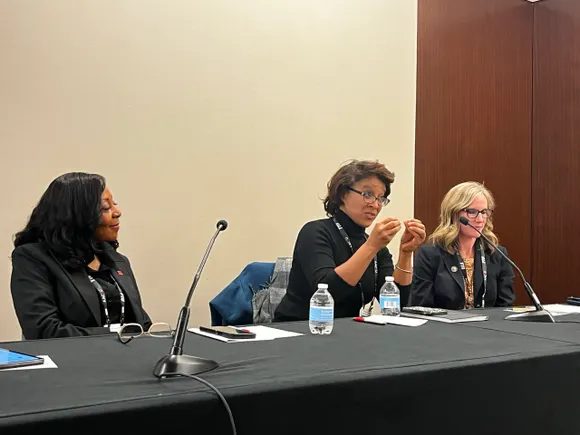
WASHINGTON — Leading a higher education institution is often associated with big picture ideas and high-level thinking. But jobs ranging from dean to president require hands-on management of a complex portfolio of tasks, and that portfolio has only grown in recent years.
“Leadership right now is not just demanding. It is cognitively and emotionally dense,” Francine Conway, chancellor of Rutgers University–New Brunswick, said Thursday at the American Association of Colleges and Universities′ annual conference in Washington, D.C. “The pace is relentless.”
During a standing-room-only panel, Conway and other senior college officials offered attendees practical solutions to solving some of the most prosaic day-to-day challenges that can slow leaders — and their institutions — down.
‘You will drive everyone good at their jobs away by micromanaging’
In most cases, one of the key benefits of a leadership position is having a support team. Conway said she actively seeks to empower her office mates to take on decision-making responsibilities, in part to keep her work high level.
“I say to my team, ‘If you can make a decision that does not substantively change the institution or alter our mission, you can go ahead and make that decision,’” she said.
But for some leaders, it can be hard to delegate appropriately, said Jennifer Malat, dean of the University of New Mexico’s arts and sciences college.
“A lot of us get into leadership roles because we were super overachievers who have a mindset that we must do everything ourselves,” Malat said. But you can’t succeed as a leader that way, both because there physically aren’t enough hours in the day and because “you will drive everyone good at their jobs away by micromanaging,” she added.
Mardell Wilson, provost at Creighton University, a private nonprofit in Nebraska, echoed that sentiment.
“You really aren’t as important as you think,” she laughed. While it’s easier to be confident in one’s own work, “you have to give someone else an opportunity.”
For Carmenita Higginbotham, delegating is especially essential. She helps lead two dramatically different Virginia Commonwealth University campuses in her roles as dean of the public institution’s main art school and as the special assistant to the provost for its arts school in Qatar.
“I don’t delegate tasks, I delegate outcomes and give them the bigger picture,” Higginbotham said, listing increases in student retention and post-graduate employment as examples.
Once leaders establish which outcomes are important, she advises them to let their teams work on them without seeking constant updates.
Instead, they should emphasize they are available for questions or broader conversations about the project, she said.
“Sometimes, if people are trying to impress you, they won’t come to you,” Higginbotham said, adding that’s an instinct she fights as well. Encouraging openness from team members can avoid issues down the line, she added.
Avoiding a Tetris calendar
College leaders are constantly fighting the most universal of constraints — time. While a full calendar can signal progress to some, panelists told attendees that the cognitive load of constant meetings often results in the sense that their job is getting in the way of their work.
Leadership right now is not just demanding. It is cognitively and emotionally dense.

Francine Conway
Chancellor of Rutgers University–New Brunswick
The wide-ranging responsibilities of college leaders can also result in rapid tonal shifts throughout the day. Conway gave the example of conducting standard employee check-ins after handling a missing student case.
To address the high potential for emotional whiplash, she creates 15-minute buffers between meetings on her calendar. And Conway said she is OK rescheduling meetings on days when she “needs more time to think and process” in order “to show up more fully.”
“If you don’t design your time, it will be designed for you,” she said.
That operating procedure runs counter to the stereotypical calendar of some college leaders, with back-to-back hourlong meetings.
“Not every meeting has to be an hour,” Conway said. “Or even 30 minutes.”
When Wilson first joined Creighton in 2020, employees constantly had scheduled meetings, she said.
Now, her office goes nearly meeting free in July, and she encourages her employees to do the same with their reports.
Academic offices are usually in a scheduling frenzy at the height of summer, with people taking vacations or attending higher ed conferences out of town, Wilson said. Making July a low-touch month allows leaders to reset for the coming academic year and reduces burnout.
“But it’s not just rest for you. You’re role modeling for your team, which is also really important,” she said.
Wilson also makes a point of telling people the best way to get on her schedule. Calling her assistant to coordinate a five-minute call, she said, allows her to address employee concerns more quickly than if someone sends a long email detailing the problem.
Managing one’s calendar also means leaving breathing room when possible, panelists said.
“I have blocks that are off limits. And I don’t mean time necessarily,” Higginbotham said. “I mean location. When my body is situated in a particular situation, that is off limits for work.”
In those cases, she won’t answer calls or respond to emails.
“It can’t always be a set time in the day, because we get pulled into so many different situations,” she said. She also said she strives not to think about work during off-limit blocks either but acknowledged it can be difficult.
Before and after vacations, college leaders should block off time to recalibrate, Malat said. That way, they can avoid work creeping into their last day of time off.
Sleeping, reading emails and knowing yourself
Leading a college campus has become a 24-hour job. But the work — and the person — will suffer if either gets in the way of sleep, Wilson told panel attendees.
“Sleep is one of the greatest assets you can have as a leader,” she said. She advised attendees to prioritize rest over jotting down ideas on a bedside notepad late into the evening.
“I can’t solve anything well at 2 a.m.,” she said, to knowing murmurs from the audience.
Smartphones make it tempting to check email immediately upon waking and stay plugged in throughout the day.
Malat instead encouraged attendees to turn off their phones’ email notifications. She also manages her emails by labeling them with one of three tags — “Reply,” “Revisit” and “Read” — drawing on a system developed by author Laura Mae Martin.
Emails marked “Reply” necessitate a direct response from her. “Revisit” emails will need action in the future, while “Read” indicates longer information, such as news articles and research, that requires time to process.
Cordoning off the messages that need direct attention with the “Reply” label, combined with a lack of constant inbox notifications, means it’s easier to get into a workflow state when addressing emails, Malat said.
“Even if you only have 20 minutes, you can get a lot done,” she said, “both because you’re not getting pinged and because you are not using your brain strength to look at all that mess and figure out what needs to be answered.”
Malat also uses an additional email label proposed by a colleague: “Meeting Prep.”
“When someone sends you an agenda, you sweep it in there,” she said. “When you’re sitting in the meeting, you know where it is, and you can pull it up right then.”
Sleep is one of the greatest assets you can have as a leader.
Mardell Wilson
Provost at Creighton University
Panelists further emphasized that college leaders need to be honest with themselves about how they best work and process information.
“One of the biggest mistakes leaders make is they try to replicate a leadership that they’ve seen in others” without taking their personality into account, Higginbotham said.
Introspection allows college officials to try different approaches, both professionally and personally, and see what fits.
Malat, for example, selects a week’s worth of outfits on Sunday night. She didn’t glamorize the process as some height of efficiency — “I hate doing this,” she said — but added that, for her, it’s “better than racing late to work because I changed my mind 20 times.”