Students often learn about entrepreneurship without a clear path to turn their ideas into a viable business. The University of Dayton’s capstone course gives them that path.
Launched in fall 2024, Flyer Nest guides students to develop scalable business ideas they can continue after graduation.
Housed in UD’s School of Business Administration, Flyer Nest is part of the university’s entrepreneurship program and teaches students not just how to launch companies but also how to design ventures that solve real problems and benefit their communities.
To date, Flyer Nest has served 12 teams totaling about 70 students, with each team developing a single business venture. Two teams have continued their ventures beyond the course, and six new teams began this semester.
Vince Lewis, associate vice president for entrepreneurial initiatives at UD, said all students in the capstone course end the semester not just with a classroom project but with a proposal they can submit for funding.
“There is a bigger learning outcome than just the start-up,” Lewis said. “Students gain better confidence in actually being able to execute an entrepreneurial venture.”
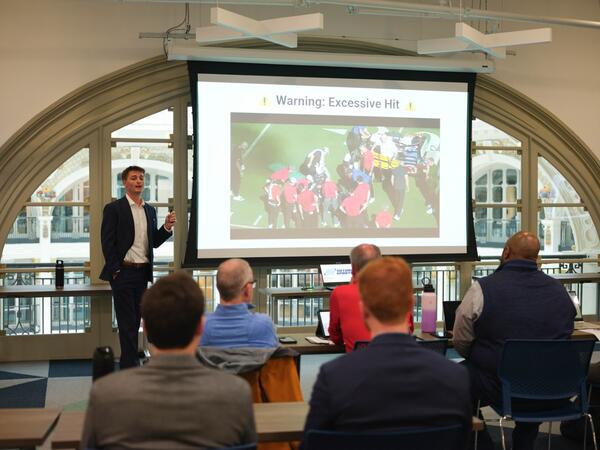
He added that two students from a continuing team raised about $400,000 to fund their venture aimed at improving helmet safety for football players.
“That’s a valuable, real-world opportunity,” Lewis said. “Students build a business case and then present it to business owners, investors and entrepreneurs at the end of the semester to get feedback.”
“It really does provide a win for students actively pursuing start-ups,” he added.
Lewis said students build their projects around technologies they find in a database of innovations available for licensing from research labs.
“Scientists and engineers develop [the technologies], but they aren’t focused on commercializing them,” said Lewis. He added that Flyer Nest teams work together to turn these technologies into solutions for real-world problems, from disease detection to health literacy for Black Americans.
Lewis said the team from Flyer Nest’s inaugural cohort focused on helmet safety secured $200,000 in state funding through TVSF, then secured the rest from new-venture competitions and grants.
The project leveraged the students’ football backgrounds and technology originally designed for hazmat suits to create a sensor embedded in helmet chin straps, he said.
“If you integrate Bluetooth and communications already being added into helmets, it can alert coaches or someone on the sideline that a chin strap isn’t tight, potentially preventing head injuries,” said Lewis.
He added that another team from the capstone course is using technology originally designed to detect fatigued pilots to assist truck drivers. The students are currently partnering with three local trucking companies interested in pursuing the venture with them.
What’s next: Lewis said next steps involve expanding Flyer Nest beyond business and entrepreneurship majors, particularly pulling students from engineering, design, communications and other disciplines.
He also said he wants to create a year-round venture studio where students can continue developing their ideas after the semester ends.
For other institutions interested in creating an experiential course like Flyer Nest, Lewis said it’s essential that they have strong institutional commitment and an engaged community partner embedded in the local entrepreneurial ecosystem.
“The community partners are what makes it work,” Lewis said. “Because they have this vast network of people they can bring in and integrate into the course to help us execute.”
Ultimately, Lewis said, running a capstone course like Flyer Nest requires dedication and a willingness to navigate the uncertainty that comes with real-world learning.
“It’s a significant lift in terms of effort, because there’s a little ambiguity when you’re going into it,” he said. “This experiential, real-world opportunity for students is a really big commitment.”
Get more content like this directly to your inbox. Subscribe here.
With rising food costs and uncertain federal food-assistance benefits wreaking havoc on families nationwide, Alicia Wright has found relief in an unlikely place: her community college’s food pantry.
Wright, a student at Roxbury Community College, said her campus food pantry has been lifesaving, especially as she juggles classes while raising her 6-year-old daughter, Olivia.
“I was like, ‘Oh snap—I don’t have to trek around Boston to find food from other local pantries,’” said Wright, a theater major who is scheduled to graduate in 2027. “Having it right there really changed the game for me.”
Wright is one of more than 1,500 students who have relied on the pantry, better known as the Rox Box, since its launch in October 2023, according to Nancy Santos, RCC’s Project Access director.
Roxbury Community College students shop for food and personal care essentials at the Rox Box.
Roxbury Community College
Designed to mirror a neighborhood grocery store, the pantry carries items such as food, diapers and personal care essentials and is funded entirely by the community.
“If I find myself going to class thinking about how I didn’t go grocery shopping this weekend, I know I can pick up something from the Rox Box,” Wright said, adding that students receive 30 points each month to redeem for items they need.
“That lets me be more present in class … [and] really does allow peace of mind,” Wright said.
Like Wright, nearly 60 percent of college students nationwide have experienced at least one form of basic needs insecurity in the past year, according to a recent Hope Center survey.
According to Swipe Out Hunger, a nonprofit dedicated to ending college student hunger, student visits to campus food pantries have increased by 30 to 50 percent over the past year across its more than 900 campus partners nationwide.
Origin story: The Rox Box started as an extension of Project Access, an initiative designed to address the nonacademic issues that can prevent degree completion at the Boston-area college.
Santos said the Rox Box has met a strong need, serving more than 300 students each month.
“It’s really taken off,” Santos said. “We see the athletes and everyone walking around with their little bags that say ‘Rox Box,’ and they’re proud that they’re going.”
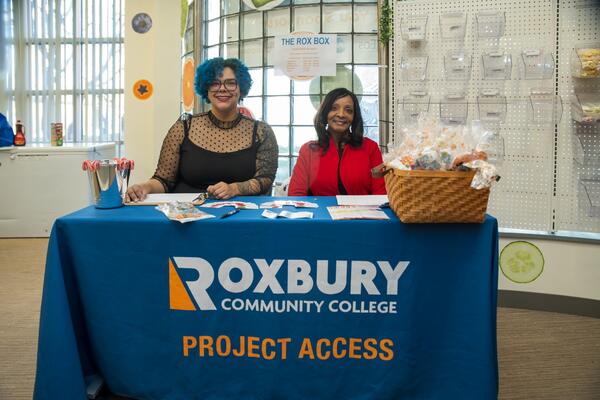
Roxbury Community College Project Access director Nancy Santos (right) sitting with a student worker at the Rox Box.
Roxbury Community College
She noted that demand continues to rise, with more than 1,700 visits from over 1,500 students between September and December 2025.
“We know the need is out there, because 1,700 visits on our campus is a large number when we only have 2,400 students enrolled,” Santos said, noting that RCC’s student body is predominantly Black, Latino and Pell Grant eligible.
Santos said she regularly surveys students who rely on the Rox Box and has found that nearly 40 percent worry their food won’t stretch until the next time they can afford to buy more, while nearly 30 percent have changed their eating habits to make the provisions last longer.
She underscored how the federal government shutdown last fall contributed to growing “uneasiness” and “insecurity” around RCC students’ food needs.
This comes as nearly 40 percent of public college students in Massachusetts experienced food insecurity last year.
“The numbers are alarming to us,” Santos said. “Our faculty have even shared that they can sometimes see students are distracted or they don’t come to school if they’re hungry … [and] it really does affect their grades.”
To ensure the Rox Box runs smoothly, Santos said, they hired a coordinator who is an RCC alum and had previously relied on the pantry.
“She started as a work-study, so she worked in the pantry with us, and when she graduated we hired her back,” Santos said. “In doing so, the students identify with her and they see there’s a path. They see where they are isn’t where they’ll always be.”
Santos said the pantry helps students feel supported and actively works to reduce the shame around needing help.
“I often say that the shame is not that you are food insecure, the shame is that [food insecurity] exists,” Santos said. “Don’t pretend it isn’t happening. Address it and embrace it and let’s figure out a way to wipe it out.”
What’s next: Santos said starting a campus food pantry is a “big undertaking” but worthwhile for other institutions looking to create their own.
“We are a small college, but we care for our students,” Santos said. “When students are fed and when they’re able to concentrate and really study, it helps them go across the finish line.”
Wright agreed, adding that actively listening to students’ needs and implementing those changes really fosters a sense of trust and community.
“We tell them our views and what we need and everything, and then we see things being done about it,” Wright said. “It really allows us to feel seen, heard and supported.”
Ultimately, Wright said, RCC really gets it right about seeing students “holistically.”
“We’re not just students—we’re entrepreneurs, we’re parents, we’re our parents’ caregivers,” Wright said. “A lot of us are already full-grown people who have lived life and know how to survive, [but] we just need a bit more support that shows [the college is] here for your success.”
Want to help students battling food insecurity? You can support The Rox Box here.
Get more content like this directly to your inbox. Subscribe here.
by Bruno V. Manno, The Hechinger Report November 10, 2025
This fall, some 19 million undergraduates returned to U.S. campuses with a long-held expectation: Graduate, land an entry-level job, climb the career ladder. That formula is breaking down.
Once reliable gateway jobs for college graduates in industries like finance, consulting and journalism have tightened requirements. Many entry-level job postings that previously provided initial working experience for college graduates now require two to three years of prior experience, while AI, a recent analysis concluded, “snaps up good entry-level tasks,” especially routine work like drafting memos, preparing spreadsheets and summarizing research.
Without these proving grounds, new hires lose chances to build skills by doing. And the demand for work experience that potential workers don’t have creates an experience gap for new job seekers. Once stepping-stones, entry-level positions increasingly resemble mid-career jobs.
No doubt AI is and will continue to reshape work in general and entry-level jobs in particular in expected and unexpected ways. But we are not doomed to what some call an “AI job apocalypse” or a “white-collar bloodbath” that leads to mass unemployment. There are practical solutions to the experience gap problem when it comes to education and training programs. These include earn-and-learn models and other innovative public and private employer partnerships that build into their approaches opportunities for young people to gain valuable work experience.
Related: Interested in innovations in higher education? Subscribe to our free biweekly higher education newsletter.
Before I describe these potential solutions, here is more information on how I see the problem.
The Federal Reserve Bank of New York reported that in March 2025, the unemployment rate for college graduates ages 22 to 27 was 5.7 percent, compared to an overall unemployment rate of 4.0 percent. Other than the temporary pandemic-related spike in 2021, that was the highest unemployment rate for new grads since 2014. More recently, the Fed’s August 2025 unemployment rate for recent college graduates was 1 percentage point higher than its overall unemployment rate of 4.3 percent.
The experience gap phenomenon is not limited to the tech sector. In 2019, 61 percent of AI-related job postings were in the information technology and computer science sector, with 39 percent in non-tech sectors, labor analytics from Lightcast show. By 2024, the majority (51 percent versus 49 percent) of AI-related job postings were outside the tech sector.
The cumulative effect of all this is apparent. The hollowing out of entry-level work stalls mobility across the labor market, leaving many college graduates stranded before their careers can even begin. Moreover, these changes cut to the core of higher education’s promise.
If graduates can’t secure meaningful jobs, confidence in higher ed falters — one reason why it should come as no surprise that 56 percent of Americans think earning a four-year degree is not worth the cost, a March 2023 Wall Street Journal-NORC poll found, compared with 42 percent who think it is, a new low in a poll first administered in 2013. Skepticism was predominant among those ages 18 to 34, and college degree holders were among those most skeptical.
The collapse of entry-level jobs isn’t just a cyclical downturn. It’s a structural shift. Left unchecked, this dynamic will deepen inequality, slow social mobility and further undermine faith in higher education.
As I’ve said, solutions exist. Here are five that I believe in:
Apprenticeships and other earn-and-learn models: Earn-and-learn apprenticeships are a promising, direct solution to the experience gap. They combine paid work with structured training and provide years of experience to college students in those jobs. Sectors from tech to health care are experimenting with this model, examples of which include registered apprenticeships, youth apprenticeships, pre-apprenticeships and apprenticeship degrees that allow individuals to pursue a degree while they work in an apprenticeship.
Skills-based hiring and alternative credentials: Initiatives such as skills-first hiring by major employers like IBM, Google and Apple aim to evaluate candidates based on their competencies rather than their degrees. Microcredentials, industry certificates and portfolios can serve as verifiable signals of skills gained through alternative training routes.
Stronger college and employer partnerships: Colleges can (and should) embed work-based learning into curricula through co-op programs, project-based courses and partnerships with local industries. Northeastern University and Drexel have long pioneered this model. And others, such as Western Governors University and Southern New Hampshire University, are using online learning to advance this approach. Scaling this solution could help close the experience gap.
Policy innovations: Governments can play a role by giving incentives to companies to create early career opportunities. Workforce Pell, recently enacted in President Trump’s One Big Beautiful Bill Act, expands financial aid to use for short-term training programs, opening new pathways for students who may not be pursuing traditional degrees. Tax credits for apprenticeship sponsors and funding for regional workforce hubs could further expand opportunities.
Reimagining internships: Expanding access to paid internships — especially for first-generation and low-income students — could democratize the attainment of experience. Philanthropies and local governments could underwrite stipends to ensure that opportunity isn’t reserved for the affluent who can afford unpaid internships or have social networks that connect them to these opportunities.
The challenge presented by this troubling experience gap is urgent. Today’s students deserve a college experience and a labor market in which education and effort still translate into opportunity.
Bruno V. Manno is a senior advisor at the Progressive Policy Institute, leading its What Works Lab, and is a former U.S. assistant secretary of education for policy.
This <a target=”_blank” href=”https://hechingerreport.org/opinion-too-many-college-graduates-are-stranded-before-their-careers-can-even-begin-we-cant-let-that-happen/”>article</a> first appeared on <a target=”_blank” href=”https://hechingerreport.org”>The Hechinger Report</a> and is republished here under a <a target=”_blank” href=”https://creativecommons.org/licenses/by-nc-nd/4.0/”>Creative Commons Attribution-NonCommercial-NoDerivatives 4.0 International License</a>.<img src=”https://i0.wp.com/hechingerreport.org/wp-content/uploads/2018/06/cropped-favicon.jpg?fit=150%2C150&ssl=1″ style=”width:1em;height:1em;margin-left:10px;”>
The pause to reflect on REF 2029 has reignited debate about what the exercise should encompass – and in particular whether and how research culture should be assessed.
Open research is a core component of a strong research culture. Now is the time to take stock of what has been achieved, and to consider how REF can promote the next stage of culture change around open research.
Open research can mean many things in different fields, as the UNESCO Recommendation on Open Science makes clear. Wherever it is practiced, open research shifts focus away from outputs and onto processes, with the understanding that if we make the processes around research excellent, then excellent outcomes will follow
Trust
Being open allows quality assurance processes to work, and therefore research to be trustworthy. Although not all aspects of research can be open (sensitive personal data, for example), an approach to learning about the world that is as open as possible differentiates academic research from almost all other routes to knowledge. Open research is not just a set of practices – it’s part of the culture we build around integrity, collaboration and accountability.
But doing research openly takes time, expertise, support and resources. As a result, researchers can feel vulnerable. They can worry that taking the time to focus on high-quality research processes might delay publication and risk them being scooped, or that including costs for open research in funding bids might make them less likely to be funded; they worry about jeopardising their careers. Unless all actors in the research ecosystem engage, then some researchers and some institutions will feel that they put themselves at a disadvantage.
Open research is, therefore, a collective action problem, requiring not only policy levers but a culture shift in how research is conducted and disseminated, which is where the REF comes in.
REF 2021
Of all the things that influence how research is done and managed in the UK HE sector, the REF is the one that perhaps attracts most attention, despite far fewer funds being guided by its outcome than are distributed to HEIs in other ways.
One of the reasons for this attention is that REF is one of the few mechanisms to address collective action problems and drive cultural change in the sector. It does this in two ways, by setting minimum standards for a submission, and by setting some defined assessment criteria beyond those minimum standards. Both mechanisms provide incentives for submitting institutions to behave in particular ways. It is not enough for institutions to simply say that they behave in this way – by making submissions open, the REF makes institutions accountable for their claims, in the same way as researchers are made accountable when they share their data, code and materials.
So, then, how has this worked in practice?
A review of the main panel reports from REF 2021 shows that evidence of open research was visible across all four main panels, but unevenly distributed. Panel A highlighted internationally significant leadership in Public Health, Health Services and Primary Care (UoA 2) and Psychology, Psychiatry and Neuroscience (UoA 4), while Panel B noted embedded practices in Chemistry (UoA 8) and urged Computer Science and Informatics (UoA 11) to make a wider shift towards open science through sharing data, software, and protocols. Panel C pointed to strong examples in Geography and Environment Studies (UoA 14), and in Archaeology (UoA 15), where collaboration, transparency, and reproducibility were particularly evident. By contrast, Panel D – and parts of Panel C – showed how definitions of open research can be more complex, because what constitutes ‘open research’ is perhaps much more nuanced and varied in these disciplines, and these disciplines did not always demonstrate how they were engaging with institutional priorities on open research and supporting a culture of research integrity. Overall, then, open research did not feature in the reports on most UoAs.
It is clear that in 2021 there was progress, in part guided by the inclusion in the REF guidance of a clear indicator. However, there is still a long way to go and it is clear open research was understood and evidenced in ways that could exclude some research fields, epistemologies and transparent research practices.
REF 2029
With REF 2029, the new People, Culture and Environment element has created a stronger incentive to drive culture change across the sector. Institutions are embracing the move beyond compliance, making openness and transparency a core part of everyday research practice. However, alignment between this sector move, REF policy and funder action remains essential to address this collective action problem and therefore ensure that this progress is maintained.
To step back now would not only risk slowing, or even undoing, progress, but would send confused signals that openness and transparency may be optional extras rather than essentials for a trusted research system. Embedding this move is not optional: a culture of openness is essential for the sustainability of UK research and development, for the quality of research processes, and for ensuring that outputs are not just excellent, but also trustworthy in a time of mass misinformation.
Openness, transparency and accountability are key attributes of research, and hallmarks of the culture that we want to see in the sector now and in the future. Critically, coordinated sector-wide, institutional and individual actions are all needed to embed more openness into everyday research practices. This is not just about compliance – it is about a genuine culture shift in how research is conducted, shared and preserved. It is about doing the right thing in the right way. If that is accepted, then we would challenge those advocating for reducing the importance of those practices in the REF: what is your alternative, and will it command public trust?
This article was supported by contributions from:
Michel Belyk (Edge Hill University), Nik Bessis (Edge Hill University), Cyclia Bolibaugh (University of York), Will Cawthorn (University of Edinburgh), Joe Corneli (Oxford Brookes University), Thomas Evans (University of Greenwich), Eleanora Gandolfi (University of Surrey), Jim Grange (Keele University), Corinne Jola (Abertay University), Hamid Khan (Imperial College, London), Gemma Learmonth (University of Stirling), Natasha Mauthner (Newcastle University), Charlotte Pennington (Aston University), Etienne Roesch (University of Reading), Daniela Schmidt (University of Bristol), Suzanne Stewart (University of Chester), Richard Thomas (University of Leicester), Steven Vidovic (University of Southampton), Eric White (Oxford Brookes University).
MOREHEAD, Ky. — The summer after ninth grade, Zoey Griffith found herself in an unfamiliar setting: a dorm on the Morehead State University campus.
There, she’d spend the months before her sophomore year taking classes in core subjects including math and biology and electives like oil painting.
For Griffith, it was an opportunity, but a scary one. “It was a big deal for me to live on campus at the age of 14,” she said. Morehead State is about an hour from her hometown of Maysville. “I was nervous, and I remember that I cried the first time that my dad left me on move-in day.”
Her mother became a parent as a teenager and urged her daughter to avoid the same experience. Griffith’s father works as a mechanic, and he frowns upon the idea of higher education, she said.
And so college back then seemed a distant and unlikely idea.
But Griffith’s stepsister had introduced her to a federal program called Upward Bound. It places high school students in college dorms during the summer, where they can take classes and participate in workshops on preparing for the SAT and financial literacy. During the school year, students get tutoring and work on what are called individual success plans.
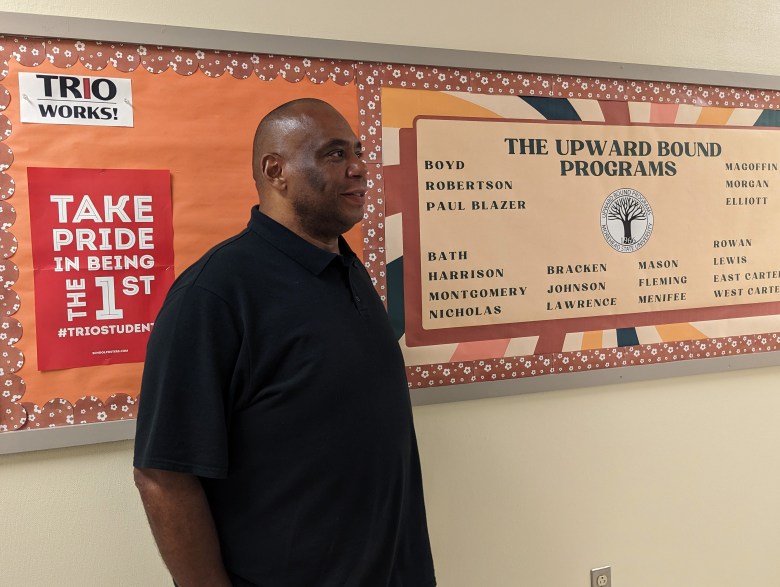
Upward Bound students test the robots they built in their robotics class – evaluating for programming and mechanical issues. Credit: Photo courtesy of the Upward Bound Programs
It’s part of a group of federal programs, known as TRIO, aimed at helping low-income and first-generation students earn a college degree, often becoming the first in their families to do so.
So, thanks to that advice from her stepsister, Kirsty Beckett, who’s now 27 and pursuing a doctorate in psychology, Griffith signed up and found herself in that summer program at Morehead State. Now, Griffith is enrolled at Maysville Community and Technical College, with plans to become an ultrasound technician.
Related: Interested in more news about colleges and universities? Subscribe to our free biweekly higher education newsletter.
TRIO, once a group of three programs — giving it a name that stuck — is now the umbrella over eight some dating back to 1965. Together, they serve roughly 870,000 students nationwide a year.
It has worked with millions of students and has bipartisan support in Congress. Some in this part of the Appalachian region of Kentucky, and across the country, worry about students who won’t get the same assistance if President Donald Trump ends federal spending on the program.
Students Zoey Griffith, left, and Aniyah Caldwell, right, say the Upward Bound program has been life-changing for them. Upward Bound is one of eight federal programs under the TRIO umbrella. Credit: Michael Vasquez for The Hechinger Report
A White House budget proposal would eliminate spending on TRIO. The document says “access to college is not the obstacle it was for students of limited means” and puts the onus on colleges to recruit and support students.
Advocates note that the programs, which cost roughly $1.2 billion each year, have a proven track record. Students in Upward Bound, for example, are more than twice as likely to earn a bachelor’s degree by age 24 than other students from some of the nation’s poorest households, according to the Council for Opportunity in Education. COE is a nonprofit that represents TRIO programs nationwide and advocates for expanded opportunities for first-generation, low-income students.
For the high school class of 2022, 74 percent of Upward Bound students enrolled immediately in college — compared with only 56 percent of high school graduates in the bottom income quartile.
Upward Bound is for high school students, like Griffith. Another TRIO program, Talent Search, helps middle and high school students, without the residential component. One called Student Support Services (SSS) provides tutoring, advising and other assistance to at-risk college students. Another program prepares students for graduate school and doctoral degrees, and yet another trains TRIO staff.
A 2019 study found that after four years of college, students in SSS were 48 percent more likely to complete an associate’s degree or certificate, or transfer to a four-year institution, than a comparable group of students with similar backgrounds and similar levels of high school achievement who were not in the program.
“TRIO has been around for 60 years,” said Kimberly Jones, the president of COE. “We’ve produced millions of college graduates. We know it works.”
Yet Education Secretary Linda McMahon and the White House refer to the programs as a “relic of the past.”
Jones countered that census data shows that “students from the poorest families still earn college degrees at rates far below that of students from the highest-income families,” demonstrating continued need for TRIO.
McMahon is challenging that and pushing for further study of those TRIO success rates. In 2020, the U.S. Government Accountability Office found that even though the Education Department collects data on TRIO participants, “the agency has gaps in its evidence on program effectiveness.” The GAO criticized the Education Department for having “outdated” studies on some TRIO programs, and no studies at all for others. Since then, the department has expanded its evaluations of TRIO.
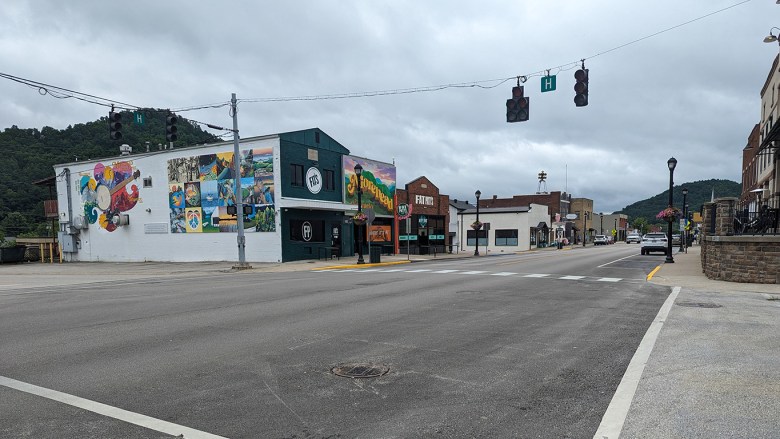
East Main Street in Morehead, Kentucky, just outside of Morehead State’s campus. Credit: Michael Vasquez for The Hechinger Report
During a Senate subcommittee hearing in June, McMahon acknowledged “there is some effectiveness of the programs, in many circumstances.”
Still, she said there is not enough research to justify TRIO’s total cost. “That’s a real drawback in these programs,” McMahon said.
Now, she is asking lawmakers to eliminate TRIO spending after this year and has already canceled some previously approved TRIO grants.
“What are we supposed to do, especially here in eastern Kentucky?” asked David Green, a former Upward Bound participant who is now marketing director for a pair of Kentucky hospitals.
Green lives in a region that has some of the nation’s highest rates of unemployment, cancer and opioid addiction. “I mean, these people have big hearts, they want to grow,” he added. Cutting these programs amounts to “stifling us even more than we’re already stifled.”
Green described his experience with TRIO at Morehead State in the mid-1980s as “one of the best things that ever happened to me.”
He grew up in a home without running water in Maysville, a city of about 8,000 people. It was on a TRIO trip to Washington, D.C., he recalled, that he stayed in a hotel for the first time. Green remembers bringing two suitcases so he could pack a pillow, sheets and comforter — unaware the hotel room would have its own.
He met students from other towns and with different backgrounds. Some became lifelong friends. Green learned table manners, the kind of thing often required in business settings. After college, he was so grateful for TRIO that he became one of its tutors, working with the next generation of students.
TRIO’s all-encompassing nature makes it unique among college access programs, said Tom Stritikus, the president of Occidental College, a private liberal arts college in Los Angeles. He was previously president of Fort Lewis College, a public liberal arts school in Colorado with a large Native American student population. At both institutions, Stritikus said, he witnessed the effectiveness of TRIO’s methods, which he described as a “soup to nuts” menu of services for at-risk students trying to be the first in their families to earn degrees.
After participating in the Upward Bound program, David Green has had a successful career, becoming a community leader in his hometown of Maysville, Kentucky. Credit: Michael Vasquez for The Hechinger Report
Jones, of the Council for Opportunity in Education, said she is cautiously optimistic that Congress will continue funding TRIO, despite the Trump administration’s request. The programs serve students in all 50 states. According to the COE, about 34 percent are white, 32 percent are Black, 23 percent are Hispanic, 5 percent are Asian, and 3 percent are Native American. TRIO’s guidelines require that a majority of participants come from families making less than 150 percent of the federal poverty level. For a family of four living in the contiguous United States, that’s a max of $48,225 a year.
In May, Rep. Mike Simpson, an Idaho Republican, called TRIO “one of the most effective programs in the federal government,” which, he said, is supported by “many, many members of Congress.”
In June, Sen. Shelley Moore Capito, a Republican from West Virginia and a former TRIO employee, spoke about its importance to her state. TRIO helps “a student that really needs the extra push, the camaraderie, the community,” she said. “I’ve gone to their graduations, and been their speaker, and it’s really quite delightful to see how far they’ve come, in a short period of time.”
TRIO survived, with its funding intact, when the Senate appropriations committee approved its budget last month. The House is expected to take up its version of the annual appropriations bill for education in early September. Both chambers ultimately have to agree on federal spending, a process that could drag on until December, leaving TRIO’s fate in Congress uncertain.
While lawmakers debate its future, the Trump administration could also delay or halt TRIO funding on its own. Earlier this year, the administration took the unprecedented step of unilaterally canceling about 20 previously approved new and continuing TRIO grants.
At Morehead State, leaders say the university — and the region it serves — need the boost it receives from TRIO: While roughly 38 percent of American adults have earned at least a bachelor’s degree, in Kentucky, that figure is only 16 percent. And, locally, it’s 7 percent, according to Summer Fawn Bryant, the director of TRIO’s Talent Search programs at the university.
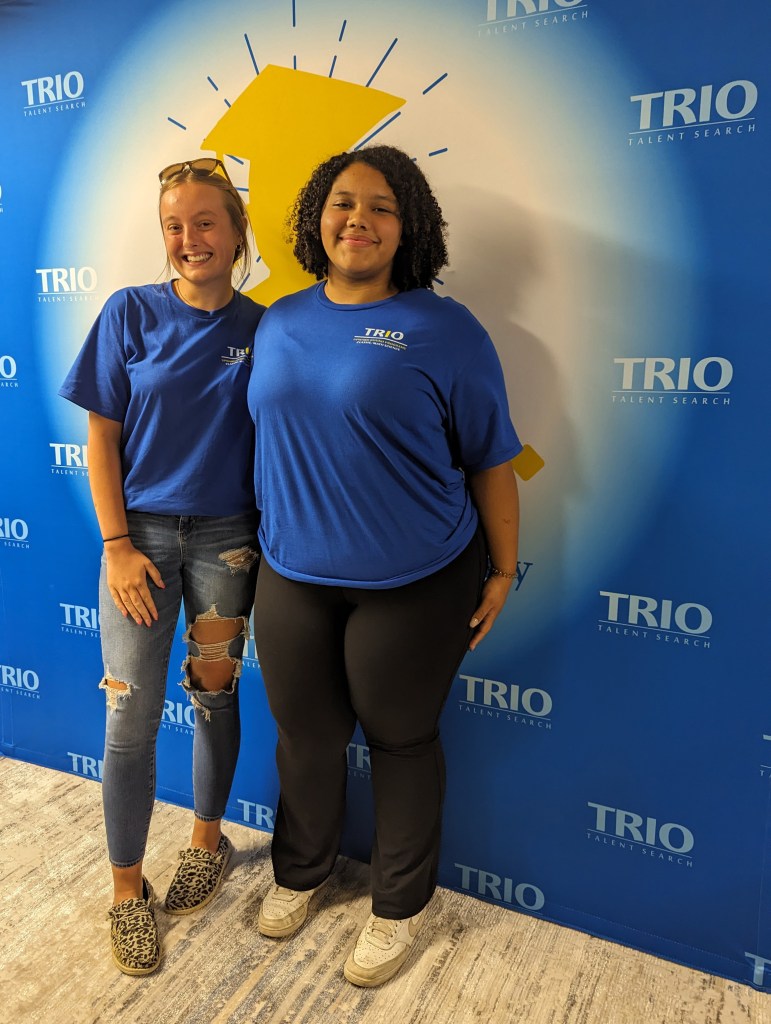
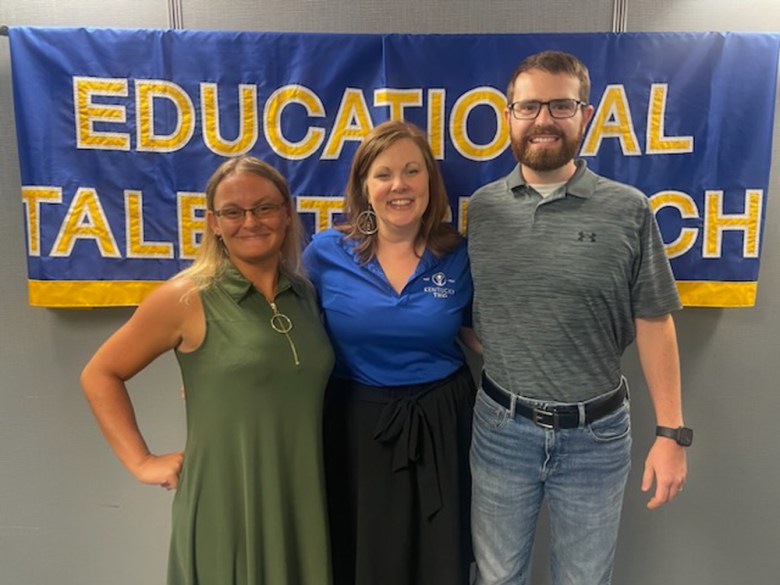
Summer Fawn Bryant, center, is director of TRIO’s Talent Search programs at Morehead State University in Kentucky. She stands with former TRIO students Alexandria Daniel, left, and Blake Thayer, right. Credit: Photo courtesy of Summer Fawn Bryant
TRIO works to counter the stigma of attending college that still exists in parts of eastern Kentucky, Bryant said. A student from a humble background who is considering college, she said, might be scolded with the phrase: Don’t get above your raisin’.
“A parent may say it,” Bryant said. “A teacher may say it.”
She added that she’s seen time and again how these programs can turn around the lives of young students facing adversity.
Students like Beth Cockrell, an Upward Bound alum from Pineville, Ky., who said her mom struggled with parenting. “Upward Bound stepped in as that kind of co-parent and helped me decide what my major was going to be.”
Cockrell went on to earn three degrees at Morehead State and has worked as a teacher for the past 19 years. She now works with students at her alma mater and teaches third grade at Conkwright Elementary School, about an hour away.
In a few years, 17-year-old Upward Bound student Isaac Bocook plans to join the teaching ranks too — as a middle school social studies teacher. Bocook said he was indecisive about what to study after high school, but he finally figured it out after attending a career fair at Morehead State’s historic Button Auditorium.
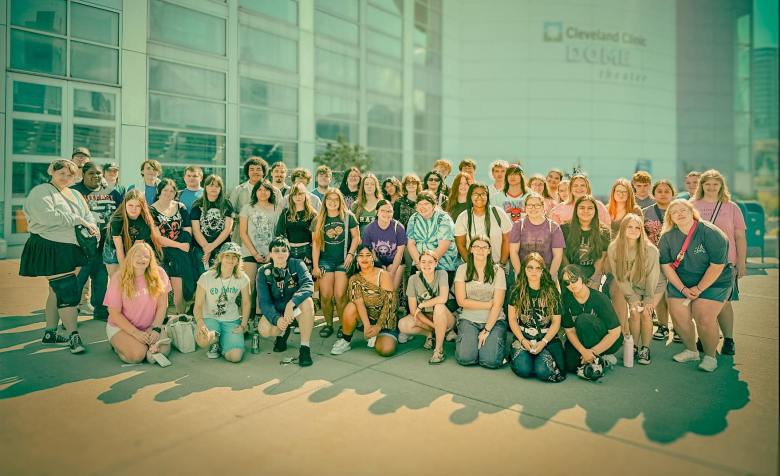
Upward Bound students visit the Great Lake Science Center in Cleveland for the end-of-summer educational trip. Credit: Photo courtesy of the Upward Bound Programs
Bocook lives in Lewis County, with just under 13,000 residents and a single public high school. At Morehead State’s TRIO program, Bocook met teenagers from across the entire region, which he said improved his social skills. TRIO also helped him with all kinds of paperwork on the pathway to adulthood. Filling out financial aid forms. Writing scholarship applications. Crafting a resume.
“I’m just truly grateful to have TRIO, as sort of like a hand to hold,” Bocook said.
His need for guidance is similar to what students at Morgan County High School in West Liberty, Kentucky, experience, said Lori Keeton, the school guidance counselor. The challenge facing these first-generation students, she said, is that “you just simply don’t know what you don’t know.”
As the sole counselor for 550 students, Keeton doesn’t have time to help each student navigate the complex college-application process and said she worries that some of her students will apply to fewer colleges, or no colleges at all, if TRIO disappears.
TRIO’s Talent Search program serves about 100 students at her high school, and roughly another dozen are part of Upward Bound. Each program has a dedicated counselor who visits regularly to guide and assist students.
Sherry Adkins, an eastern Kentucky native who attended TRIO more than 50 years ago and went on to become a registered nurse, said efforts to cut TRIO spending ignore the long-term benefits. “Do you want all of these people that are disadvantaged to continue like that? Where they’re taking money from society? Or do you want to help prepare us to become successful people who pay lots of taxes?”
As Washington considers TRIO’s future, program directors like Bryant, at Morehead State, press forward. She has preserved a text message a former student sent her two years ago to remind her of what’s at stake.
After finishing college, the student was attending a conference on child abuse when a presenter showed a slide that included the quote: “Every child who winds up doing well has had at least one stable and committed relationship with a supportive adult.”
“Forever thankful,” the student texted Bryant, “that you were that supportive adult for me.”
Contact editor Nirvi Shah at 212-678-3445, securely on Signal at NirviShah.14 or via email at [email protected].
The Hechinger Report provides in-depth, fact-based, unbiased reporting on education that is free to all readers. But that doesn’t mean it’s free to produce. Our work keeps educators and the public informed about pressing issues at schools and on campuses throughout the country. We tell the whole story, even when the details are inconvenient. Help us keep doing that.
Kurt Micklo lost interest in academics after he failed to make the basketball team as a sophomore at Chapin High School. Soon after, he fathered a son and began to work full time, which put him further behind in his studies.
A counselor finally advised him during his junior year that he should withdraw and try to earn a GED. He dropped out and – through hard work – found professional success as a general manager of a subcontracting logistics company. However, the lack of a high school diploma haunted him. He wants one to give his family – especially his mother – another reason to be proud of him.
A busy work and family schedule have kept him from returning to school, but the flexibility of a new state program aimed at people aged 18 and older without a high school diploma will allow him to earn a diploma and a college career and technical education, or CTE, credential for programs such as health care, welding or computer science at the same time.
The concept of Opportunity High School Diploma was part of House Bill 8, which the state Legislature passed in 2023. The state funneled about $2 million into this program to help the approximately 4.3 million Texans as of 2023, including about 30,000 adult El Pasoans, without a diploma to earn the academic credits most of them will need to acquire higher-paying jobs. The program is scheduled to launch in spring 2026.
“If I could juggle it, I’d be pretty interested” in the program, said 34-year-old Micklo, a father of three ages 15, 10 and 5. He is the general manager of three warehouses, two in El Paso and one in Laredo, Texas, as well as four sites near the international ports of entry with Mexico in El Paso, Tornillo and Santa Teresa, New Mexico, were commodities are offloaded.. “It would make my stepfather (a retired educator) and my mother happy if I earned my high school diploma.”
El Paso Community College is one of five community college districts in the state selected for the design and implementation phases of this program. The other institutions in the design phase are Alamo Colleges District, Austin Community College, Dallas College and San Jacinto College near Houston.
They work under the direction of the Texas Higher Education Coordinating Board. The board will review the instructional outcomes and performance expectations that the college collaborators created during an October meeting. Once finalized, the college faculty will begin to work with school districts to design the curriculum.
The program is flexible for students who probably work full time and have family obligations. Courses would have suggested timelines, but students would turn in assignments as their schedule allowed through the end of the term.
Micklo, a Northeast resident, said the promised flexibility is the only reason he might consider the program. As for his credential, he said he would need to review EPCC’s career and technical education options. The college offers more than 100 career programs such as HVAC, or heating, ventilation and air conditioning, and electrical, automotive or diesel technologies.
Students will be co-enrolled in competency-based high school curriculum such as math, civics, sciences and communication, and a career and technical workforce program. Competency based courses are focused more on a students’ mastery of a skill or subject than the amount of time spent in a classroom.
Isela Castañón Williams
Isela Castañón Williams, professor and coordinator of EPCC’s teacher preparation programs, is in charge of the college’s 13-member team. She called the project a “monumental task” because of its scope and uniqueness. She said her team, and its counterparts, played a critical role in the design phase.
“Faculty at EPCC are very innovative,” she said. “I think that my colleagues have approached this process with a great deal of enthusiasm. We’re always looking to provide better services and educational experiences to the community we serve.”
EPCC faculty advocated for the program to be designed to accommodate English Second Language and English Language Learner populations, a THECB spokesman said in a July 1 statement. He said last year that the board selected EPCC for the project’s design phase because of its border insights, and because its CTE degrees and credentials are in line with the program.
While the state wants to attract students aged 18 and older, EPCC officials will aim for people 25 and older so as to not compete with K-12 school districts that have their own dropout recovery programs. EPCC, which will offer the program at its five campuses, expects some of the program’s younger students to come from rural areas outside El Paso.
Steven E. Smith
Steven E. Smith, vice president of Instruction and Workforce Education at EPCC, said the state will provide funds to the colleges to cover tuition for initial cohorts. He expects the first groups will range from 30 to 50 students and scale up from there.
“We think this is a big market in El Paso, and I think once the word starts to get out, that will grow tremendously,” Smith said.
The administrator said that he would work on ways to market the program later this month with the college’s External Relations, Communication & Development Division. He said the college would work with school district partners to build lists of potential OHSD students.
“As you might imagine, that is a pretty difficult population to identify and reach out to because they are not in the system anymore,” Smith said.
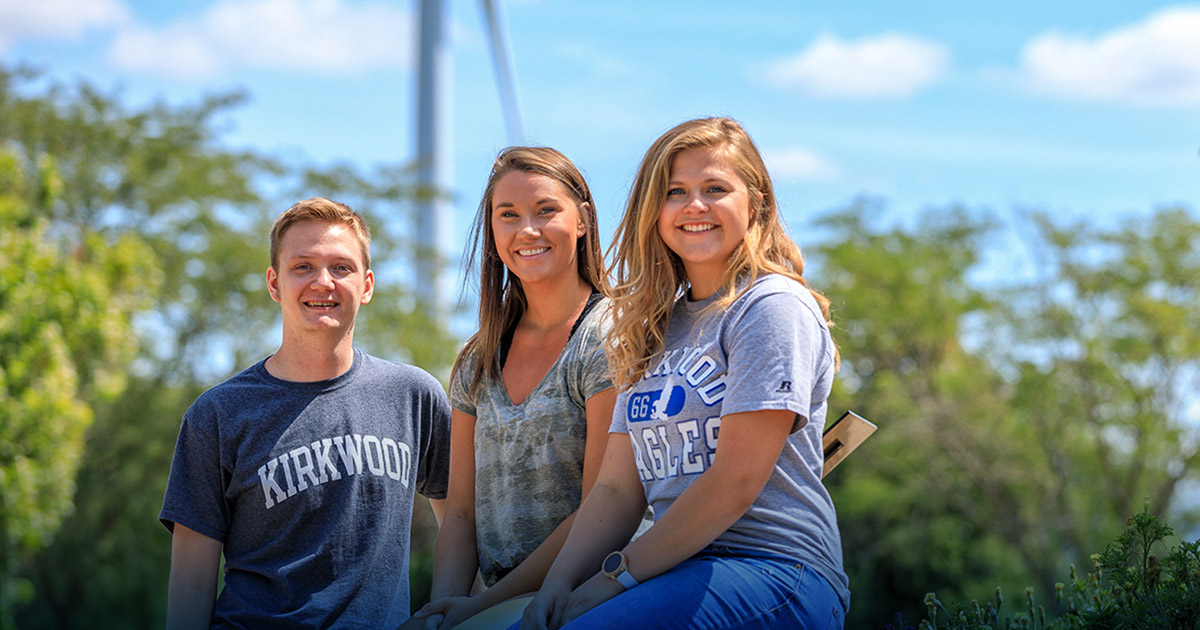
Admit it. You were young once. And when you were young, chances are you didn’t know what the future held. Enter job shadowing, a great way to explore careers and gain useful information about what it takes to succeed in different fields, according to Kirkwood Community College in Cedar Rapids, Iowa. As a higher education marketing firm and award-winning design agency, RNL was an ideal choice as a job shadowing partner.
When Kirkwood helps connect classroom learning to real-world opportunities, the results speak for themselves:
98% of job shadow/internship students said their experience provided valuable information regarding their career interests.
67% said their experience positively influenced their decision to live and work in Iowa.
Job shadows give teens a sneak peek into what it’s like to work in a professional setting. They offer an opportunity to meet people, make connections, and potentially land internships or even future jobs.
Joining forces with RNL
Kirkwood’s Workplace Learning Connection first teamed with RNL’s content writing services and design strategy team six years ago to expose students to marketing for higher education and fundraising tactics.
As Kirkwood advertises the RNL virtual shadowing day: “Use your creative powers for good! The concept behind art and design is for people to react to your work. Get a positive reaction to a product and — boom! That’s marketing. Chat with graphic designers, content writers and web designers at Ruffalo Noel Levitz. Learn how they use their creative abilities to help you make one of the most important decisions of your lives—where to go to college.”
Each year, high school students from seven Iowa counties register to listen, ask questions, and seek guidance about future positions in marketing. In turn, RNL creative team members share our work and the reasons we chose our profession.
Helping the next generation
Jolie Baskett has been the glue for the RNL job shadow team for years—this year, Sarah Reimer and I also participated.
“Six years ago, I volunteered because I wanted to be the help that I needed when I was young,” she said. Since then, she has advanced from designer to senior designer to director of design.
“I love working with wonderful clients and brands and helping others. I want to help the next generation find their paths and be the best they can be,” she said. Personally, I am a former high school teacher and am passionate about writing and public speaking, so I raised my hand several years ago to share my enthusiasm for writing with these high school students. As I tell them, effective writing and clear communication are essential to every career.
Senior Designer Sarah Reimer enjoys working with RNL’s collaborative creative team. She wants high school students to know graphic design is a competitive industry, but there’s room for everyone.
“It’s important that we share our experiences and expertise with the next generation of creatives coming up, getting them excited to be creative as a career, learn about collaboration, and how to work on a team,” said Reimer. “Those are job skills they can apply anywhere.”
Listening and learning
During a 90-minute presentation, our RNL team shares our experiences and answers questions from students, ranging from broad queries like “What advice would you give an aspiring writer?” to much more specific questions like “How do you code for accessible web design?”
The proof is in the pudding. Here’s what three students had to say about our presentation:
“I learned a lot about what specifically a creative marketing job would entail, and I also learned there are several different types of jobs within this field (coder, writer, designer).”
“It helped me think of what classes I need to get into for different careers.”
“I liked being able to ask questions about their day-to-day work and what exactly their responsibilities are.”
Refreshing perspectives
All three of us agree that seeing our experience through fresh eyes helps us appreciate our roles in a new perspective. Plus, when we help others, it’s a meaningful way to contribute to both the workforce and the community.
As we looked back through the years and considered ourselves as teenagers, we all had advice for our high school selves:
Baskett was an art kid her entire life and always had a drive to make the world a more beautiful place. To her teenage self, she’d say, “Believe in yourself.”
I knew I wanted to become a writer in fifth grade. I fell in love with feature writing and served as newspaper editor in high school. I’d tell my 17-year-old self: “You’re passionate about telling other’s stories. Do what you love.”
As for Reimer? Art wasn’t on her radar when she began college as a law enforcement major, before pivoting to graphic design. She would tell that college freshman: “You can make a career and support yourself being creative. Learn to be assertive, accept constructive criticism, and have fun letting that creative mind do its job!”
As school districts continue to seek new ways to enhance learning outcomes, Madison County School District represents an outstanding case study of the next-level success that may be attained by centralizing IT governance and formalizing procedures.
When Isaac Goyette joined MCSD approximately seven years ago, he saw an opportunity to use his role as Coordinator of Information Technology to make a positive impact on the most important mission of any district: student learning. The district, located in northern Florida and serving approximately 2,700 students, had made strides towards achieving a 1:1 device ratio, but there was a need for centralized IT governance to fully realize its vision.
Goyette’s arrival is noted for marking the beginning of a new era, bringing innovation, uniformity, and central control to the district’s technology infrastructure. His team aimed to ensure that every school was using the same systems and processes, thereby advancing the students’ access to technology.
Every step of the way, Goyette counted on the support of district leadership, who recognized the need for optimizing IT governance. Major projects were funded through E-rate, grants, and COVID relief funds, enabling the district to replace outdated systems without burdening the general fund. MCSD’s principals and staff have embraced the IT team’s efforts to standardize technology across the district, leading to a successful implementation. Auto rostering and single sign-on have made processes easier for everyone, and the benefits of a cohesive, cross-department approach are now widely recognized.
To successfully support and enable centralization efforts, Goyette recognized the need to build a strong underlying infrastructure. One of the key milestones in MCSD’s technology journey was the complete overhaul of its network infrastructure. The existing network was unreliable and fragmented in design. Goyette and his team rebuilt the network from the ground up, addressing connectivity issues, upgrading equipment, and logically redoing district systems and processes, such as the district’s IP network addressing scheme. This transformation has had a positive impact on student learning and engagement. With reliable connectivity, students no longer face disruptions.
The implementation of an enterprise-grade managed WAN solution has further transformed the educational experience for MCSD’s students and educators, serving as the backbone for all other technologies. Goyette’s innovative co-management approach, coupled with his deep understanding of network topology, has enabled him to optimize the resources of an experienced K-12 service provider while retaining control and visibility over the district’s network.
New School Safety Resources
Another significant milestone MCSD has achieved is the successful deployment of the district’s voice system. This reliable phone system is crucial for ensuring that MCSD’s schools, staff, and parents remain seamlessly connected, enhancing communication and safety across the district.
Goyette’s innovative leadership extends to his strategies for integrating technology in the district. He and his team work closely with the district’s curriculum team to ensure that technology initiatives align with educational goals. By acting as facilitators for educational technology, his team prevents app sprawl and ensures that new tools are truly needed and effective.
“Having ongoing conversations with our principals and curriculum team regarding digital learning tools has been critical for us, ensuring we all remain aligned and on the same page,” said Goyette. “There are so many new apps available, and many of them are great. However, we must ask ourselves: If we already have two apps that accomplish the same goal or objective, why do we need a third? Asking those questions and fostering that interdepartmental dialogue ensures everyone has a voice, while preventing the headaches and consequences of everyone doing their own thing.”
MCSD’s IT transformation has had a profound impact on student learning and engagement. With reliable connectivity and ample bandwidth, students no longer face disruptions, and processes like single sign-on and auto account provisioning have streamlined their access to educational resources. The district’s centralization efforts have not only improved the educational experience for students and educators but have also positioned Madison County School District as a model of success and innovation.
###
Jesus Peña, UDT
Jesus Peña serves as Executive Vice President and Chief Experience Officer (CXO) at UDT, where he leads customer-focused innovation and strategic growth initiatives. With a career spanning leadership roles in sales, service delivery, and executive management, he brings a proven ability to align technology with business outcomes. Prior to joining UDT, Jesus held senior positions at leading technology firms including Cisco, Modcomp, R2 Technologies, and Dimension Data, and co-founded Davocom One. Known for his people-first leadership and passion for delivering meaningful experiences, he consistently drives value for clients across public and private sector organizations. He may be reached at [email protected].
Latest posts by eSchool Media Contributors (see all)
Central vision loss–a condition that impairs the ability to see objects directly in front of the eyes–can have profound academic and social impacts on K-12 students. Because this type of vision loss affects tasks that require detailed focus, such as reading, writing, and recognizing faces, students with central vision impairment often face unique challenges that can affect their overall school experience.
In the classroom, students with central vision loss may struggle with reading printed text on paper or on the board, despite having otherwise healthy peripheral vision. Standard classroom materials are often inaccessible without accommodations such as large print, magnification devices, or digital tools with text-to-speech capabilities. These students might take longer to complete assignments or may miss visual cues from teachers, making it difficult to follow along with lessons. Without appropriate support, such as assistive technology, students may fall behind academically, which can affect their confidence and motivation to participate.
As a result, they may be perceived as aloof or unfriendly, leading to social isolation or misunderstanding. Group activities, games, and unstructured time like lunch or recess can become sources of anxiety if students feel excluded or unsafe. Moreover, children with vision loss may become overly dependent on peers or adults, which can further affect their social development and sense of independence.
While this may seem daunting, there are assistive technologies to help students navigate central vision loss and have fulfilling academic and social experiences.
One such technology, eSight Go from Gentex Corporation’s eSight, uses an advanced high-speed, high-definition camera to capture continuous video footage of what a user is looking at. Algorithms optimize and enhance the footage and share it on two HD OLED screens, providing sharp, crystal-clear viewing. The user’s brain then synthesizes the images to fill any gaps in their vision, helping them to see more clearly, in real time.
“The ability to have central perception brought back into your set of tools for education is critically important,” said Roland Mattern, eSight’s director of sales and marketing. “Ease of reading, ease of seeing the board, using tablets or computers–all of these things [lead to] the ability to complete an academic task with greater ease.”
One key feature, Freeze Frame, lets the user capture a temporary photograph with the device’s camera, such as an image on an interactive whiteboard, a textbook page, or a graphic. The student can magnify the image, scan and study it, and take what they need from it.
“This eases the ability to absorb information and move on, at a regular pace, with the rest of the class,” Mattern noted.
Socially, central vision loss can create additional barriers. A major part of social interaction at school involves recognizing faces, interpreting facial expressions, and making eye contact–all tasks that rely heavily on central vision. Students with this impairment might have difficulty identifying peers or teachers unless they are spoken to directly. The glasses can help with these social challenges.
“There’s a huge social aspect to education, as well–seeing expressions on teachers’ and fellow students’ faces is a major part of communication,” Mattern said.
What’s more, the glasses also help students maintain social connections inside and outside of the classroom.
“Think of how much peer-to-peer communication is digital now, and if you have central vision loss, you can’t see your phone or screen,” Mattern said. “The educational part is not just academic–it’s about the student experience that you want to enhance and optimize.”
Educators, parents, and school staff play a crucial role in fostering inclusive environments–by educating classmates about visual impairments, encouraging empathy, and ensuring that students with central vision loss are supported both academically and socially. With the right accommodations and social-emotional support, these students can thrive in school and build strong connections with their peers.
“If we can make daily living, hobbies, and education easier and facilitate participation, that’s a win for everybody,” Mattern said.
Laura Ascione is the Editorial Director at eSchool Media. She is a graduate of the University of Maryland’s prestigious Philip Merrill College of Journalism.
I’d be hard-pressed to find any person in higher ed who has had a larger influence on my own thinking than James Lang. Many folks will know Jim from his books like Cheating Lessons, Small Teaching and Distracted. He’s consistently ahead of the curve when it comes to identifying a problem in teaching and learning spaces—academic dishonesty, class disengagement, student attention problems—and proposing remedies that instructors can explore and make use of for themselves.
His new book, Write Like You Teach: Taking Your Classroom Skills to a Bigger Audience, part of the University of Chicago Press series of guides to writing, editing and publishing, is the best book I’ve ever seen for showing academics how to translate their current skills and practices to another audience and purpose. I’m excited by this book because we need as many academics as possible putting their voices into the world, not just because they have so many interesting and worthwhile things to say as individuals, but because it also helps remind everyone about the value of institutions where this kind of work happens.
I had a great time talking to Jim over email. This Q&A even breaks some news on Jim’s next book, too.
Jim Lang is a professor of the practice at the Kaneb Center for Teaching Excellence at the University of Notre Dame, and an emeritus professor of English at Assumption University. He’s the author of multiple books, including Small Teachingand Distracted, and a longtime columnist for The Chronicle of Higher Education. You can follow him on Substack at A General Education or connect with him on LinkedIn.
John Warner: One of my favorite initial questions for people who write is if they enjoy writing. So that’s my question: Do you enjoy writing?
James Lang: “Enjoyment” doesn’t seem like the right word for my feelings about writing. Writing has always been the activity that drives and gives meaning to my life. It helps me make sense of the world; if I have deep questions about the purpose of my life, or questions about anything important, I seek answers through writing, both within my published work and in my various notebooks. I have always been a very curious person who gets excited about learning new things, so writing has always been a way to satisfy those curiosities and push me into new places in my life.
If I focus specifically on the emotion of enjoyment … I hate to admit it, but I don’t seem to enjoy the actual writing process quite as much as I used to. I think I had a more unreserved embrace of writing when I was younger, when I felt like I had a lot to say and was confident that I had the ability to say it. I think both of those feelings have diminished, which I attribute in equal parts to the stroke I had a few years ago and to my age. I had to learn to speak and write again after my stroke, and while I have regained all of the words and writing skills I had before, I have to work a little harder than I used to [to] call them up and apply them. But even beyond the stroke, I guess I feel less of a desire to announce my ideas confidently to the world than I once felt. I have a great family, lots of friends and ongoing interests in many areas of my life. As my appreciation for those things has increased, the available real estate in the enjoyment part of my brain has shrunk slightly.
But the key word in that sentence is “slightly.” I do still take much pleasure from finding the perfect word, crafting a great sentence or launching a new essay or book. Writing still fills my life with meaning, and I could never envision my life without writing, or at least the desire to write, being part of who I am.
Q: What you describe sounds a bit like a winding down or maybe a shift in focus? I often say about myself that I’m never going to retire because I can’t imagine not reading and writing, which is both my pleasure and my work. But I do sometimes wonder if there’s a space to do less of it, if that makes sense. But as you note, it seems impossible to shut off that curiosity that drives those activities.
Where does that curiosity come from for you? You’ve had a varied career and it seems like every so often you shifted gears. Was that necessity or design or something else?
A: It comes from both a negative and a positive place. The negative place is that I do get bored of routines in any form, and when I feel like my life has fallen into a routine place, I start getting this itch to break it. I received tenure in the usual time frame, and it was only a couple of years after that I was seeking a new challenge, so I applied to direct our honors program. I enjoyed that work tremendously, but then once again sought a change and founded a new teaching center on campus. Right after the pandemic, based on the success of Small Teaching and Distracted, I decided to give myself a new challenge: give up tenure and try to make it with a mix of writing, speaking and adjunct teaching. That plan was upended by my long medical ordeal, but even after I was able to return to that life, I realized that I missed deeply having a home on a campus, which led me to Notre Dame. So that has definitely been a pattern in my career and in my life.
For the positive explanation for this restlessness, I would point to something my wife (an elementary school teacher) told me about the kids who come into her classrooms each year. She says that while we might be all born curious, by the time children get into school, they are already separating in terms of how much curiosity they bring to school. The differentiating factor she sees is how much exposure kids have to different kinds of life experiences. The kids who sit in their bedroom on their parents’ tablets all day or play video games in their rooms just don’t see as much of the world, and they aren’t being prompted to ask questions, wonder and explore. The ones who come in curious are the ones whose parents have deliberately tried to expose them to new things in some form—trips, walks outside, reading aloud, giving them books, etc.
When I heard that, I realized that I had been raised as one of those latter kids. My mother was also an elementary school teacher, but her best years were in preschool. She had a special love, and special gift, for very young children. And while I have only a few memories of my preschool years, I know from seeing how she interacted with my children that I must have been raised to become a curious person.
Q: I had a mini epiphany while reading the opening section of Write Like You Teach, which is that good teachers and good writers think of the needs of their audience (students/readers) first. This is something I think I’ve always done as a teacher, perhaps because I was a writer before I was a teacher, but you make it pretty explicit and then give it a little specific flesh. When did this connection first come to you?
A: I actually can’t quite remember where that specific connection came from. I do know that this book really came out of my desire to write some more about attention, the subject of my previous book. I have written books about several major issues in teaching and learning, and some of them I finished and felt like I was done with that topic. That wasn’t true for attention. The more you read and learn about attention, the more you realize how it has a part in almost everything that matters in our lives. Work, play, relationships, spirituality, learning—all of them demand our attention. They often go well or poorly depending upon the quality of our attention. And so I still find attention fascinating, and I keep reading and thinking and writing about it. I also just really enjoyed writing the book Distracted. So I think maybe I was trying to determine what else I could write about attention which would relate to another area where I have some interest and expertise.
Reading was the initial bridge to further thinking about attention. Anyone who reads a lot knows that some books capture our attention more than others. I think the teaching-writing connection that produced this book came from realizing both in classrooms and books, you have to be aware of the limits of a learner’s attention. Both as teachers and writers, we can either just expect people to pay attention or we can try to help them. I had made the case for the latter approach in Distracted and realized I could make the same case to writers: If you want readers to sustain their attention over the course of many pages, don’t just bang away at them with paragraph after paragraph of argument and idea. They need breaks, they need stories, they need space to pause and think—just as students do in the classroom. Seeing how attention informs both teaching and writing led to the basic idea of the book: The things we do in the classroom to help students learn can also be useful for our readers.
Q: In a note at Substack, Arvind Narayanan (coauthor of AI Snake Oil) offered a “hypothesis on the accelerating decline of reading.” It’s got a bunch of bullets, so I’ll do my best to paraphrase: Essentially, people mostly read for pleasure or to obtain information. These functions have been replaced by other things. Video is more entertaining than reading. We can use large language models to summarize long texts and deliver information to us. He theorizes that most people will be happy with the trade-off of increased speed/efficiency, the same way we’ve gravitated toward “shallow web search over deeper reading.” He’s worried about this but also believes that merely “moralizing” about this is not going to be helpful. (I tend to agree.) I’ve argued for years that getting students engaged with writing is a great way to get them reading, because reading is the necessary fodder for writing. Writing is also a tremendous way to cultivate our ability to pay attention. I’m wondering if you’re worried in the same way as Narayanan or if you have any additional ideas of what we can do about this.
A: First, thanks for sharing that note, which will be helpful to me as I am working on my next project—which I am happy to announce here. My next book will be The End of Reading?, which will be published by W. W. Norton, a publisher whose books I have been reading since high school and assigning in my courses for my entire teaching career. I’m so excited to dig into this project, but I am going to beg off on an answer here because I am just in the beginning of my thinking and writing and need more time to formulate my ideas. Put another way: Ask me that question again in two years!
Q: I have sort of the opposite problem as the folks this book is addressed to, in that I find it very natural to write to regular people—because that’s where I started—while writing for more formal or academic audiences is something I can struggle with. What is it about the experience of the academic that makes the transition you’re writing about difficult?
A: The problem here is that experts often lose track of what novices don’t know in their fields. The more we know in a discipline, the further away we get from our memories of what it was like to know very little about biology or literature or politics. When academics write to each other, they can assume their readers know certain things: basic facts, theories, common examples or cases, histories, major players in the field. Let’s say I’m a scholar of Victorian literature and want to write something about a work of Victorian literature. If I am writing to other scholars in that field, I can be confident that my readers know things I know: the expansion of the British Empire during that time period, the impact of Darwin and evolutionary theory on many writers in that era, the political turbulence and social unrest accompanying the Industrial Revolution.
If I am writing to a more public audience, I can’t assume my reader knows any of that stuff. In a classroom, I can always stop and just ask students, “Have you heard of this before?” If they haven’t, I can give a quick introduction. But as a writer with deep expertise in a subject, I have no idea what a more public audience knows or doesn’t know. Faced with that problem, I think a lot of academics just say, “Never mind, I’ll just keep writing to my people.” And that writing is important and can be great! I love a good scholarly book, and I still read them regularly. That kind of writing also helps people get and keep academic jobs, so I am not on some crusade to encourage everyone to write for the public. But I think the major sticking point for people who do want to expand their audiences is thinking more deeply about their audiences: what they know or don’t know, why they are reading your work, and what you want them to take away from the experience.
Q: Something I’ve often said about both writing and teaching is that they are “extended exercises in failure,” where failure means not missing the target entirely, but falling short of one’s initial expectations. I find this reality interesting, fascinating, really, because with both activities, you usually get a chance to try again. Does this make sense to you, or do you have any different frames for how you view these two activities?
A: No absolutely, and in fact that framework applies to all of the pursuits that give me satisfaction, including the other major intellectual pursuit of my life: learning languages. I did not start learning other languages until my first year of high school, where I started with Latin. Immediately I was fascinated, and so in my junior year I added ancient Greek into my curriculum. When I got to college, I took classes in both those languages, and then also took French. Over the next 30 years I have gone back and forth with those original three languages and also tried to learn Spanish and Italian and German.
I start every new language with this expectation that this time I’m going to really dig in and master this thing and become just totally fluent. The truth is that I have some basic knowledge in all six of those languages but know none of them particularly well. But I just love the fact that I can go back to any of them, at any time, and start trying again. I’m 55, and my brain has a different shape than it used to (because of the stroke), so I have to be realistic and acknowledge that it’s unlikely that I will ever become a fluent speaker in any other language than English. But gosh, I just love to keep trying.
As you say, teaching and writing are the same. You start off with such hope and expectation and excitement: This will be the best class I will ever teach! This essay or book is the one that will change people’s lives! But it never quite works out that way. Even when you teach a great course, not every class period will be perfect. Not every student will have a great experience. When I look at my own books, I am proud of them but can see places where I cringe and wish I had done better. But I don’t feel defeated by those feelings: They make me want to keep trying.
Q: The book is filled with practical approaches to writing for broader audiences, but I wouldn’t quite call it a book of “advice.” The word that comes to mind is “guidance.” Does that distinction make sense to you?
A: This distinction matters a lot to me, actually. I think because of the success of Small Teaching, which had a lot of concrete pieces of advice, people can view me as a “teaching tips” guy. I do love learning and thinking about specific practices in the classroom, so I don’t wholly disavow that association. Presenting theories and big ideas about teaching only gets people so far; they need to envision what those theories look like when they are standing in the classroom on Tuesday of week seven with 20 blank faces in front of them. Describing examples of specific practices helps them with that imaginative work.
But I always want people to understand that I am not advising them to do anything in particular: I am showing examples designed to spur their own creative thinking. Write Like You Teach, for example, has a chapter about the challenge of reader attention, and I do offer some very concrete pieces of advice based on writing strategies that I have observed in great writers. Ultimately, though, I want the readers of my book to move beyond these specific examples and develop their own strategies based on the principle readers are learners, and learners need support for their attention. With that principle in mind, I want people to analyze their classroom practices and see what translates to the page.
That leads me to the final thing I want to say: The first and final goal of this book is to help academics feel empowered and enabled to write for the public. The prospect of doing that kind of writing can be intimidating, and many of us shy away from it. But if I can convince academics of this one principle—a great teacher can become a great writer—then I hope they will be able to develop their own writing practices based on their experiences in the classroom.
Q: And finally, the last question I ask everyone: What’s one book you recommend that you think not enough people are aware of?
A: When people ask me to recommend a novel to them, or when people ask me to share my favorite novel, I always mention two: Zadie Smith’s White Teeth and Arundhati Roy’s The God of Small Things. I am cheating a little bit here because both of these novels were very well-known when they were published, sold many copies and won prizes. But they are both a couple of decades old now, and I believe that their themes are as relevant today as they were when they were first published. If you are a word person, choose Roy, whose prose comes as close to poetry as a novel can get; if you love a great plot, choose Smith, whose genius shines through the ebullience of her narrative construction. If I were forced to choose between the two, I would choose … I can’t. I just can’t.