
Tag: Heroes

  • Free Speech Forum empowers next generation of First Amendment heroes

    Free Speech Forum empowers next generation of First Amendment heroes

    By FIRE Summer Interns Eli Kronenberg, Suhani Mathur, and Matt Rigby.


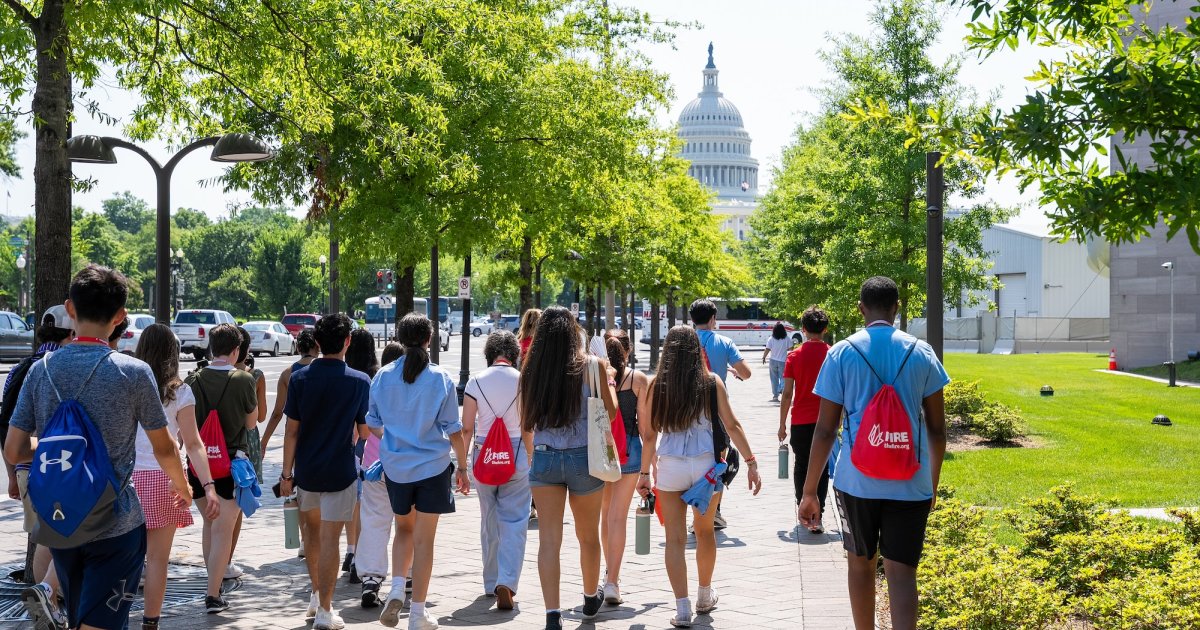
    This June, high school students from across the country assembled in our nation’s capital to offer a glimpse of one of the most important things in America — the future of the First Amendment.

    Held at American University in Washington, D.C., FIRE’s Free Speech Forum mixed big ideas with bigger conversations, bringing together 200 high schoolers to explore, deepen, and celebrate their interest in free speech. Thanks to the collaborative efforts of our generous donors, dedicated staff, enthusiastic counselors, and our incredible students, the forum was a resounding success, leaving us with a feeling of immense pride and a renewed belief in the power of young voices to shape the future of free expression.

    Throughout the week-long event, students had the opportunity to hear from world-renowned free speech advocates, engage in respectful discussions with their peers on pressing political issues, and explore the capital’s treasure trove of historic landmarks. But as one student remarked, the main highlight was simply “being around others who are also interested in civil discourse!”

    The conference kicked off in earnest with a keynote address by musician and activist Daryl Davis, who is known for convincing members of the Ku Klux Klan to renounce the group. Davis captivated the audience with his tales of attending KKK rallies as a black man, bringing Klan leaders inside his home for interviews, and even walking one Klansman’s wife down the aisle at her wedding. Through his commitment to civil dialogue, Davis has persuaded dozens of Klan officials to abandon their racist beliefs, and continues to inspire future generations of free speech advocates. 

    As one student reflected, “Opening with Daryl Davis made a big impact because it forced us to consider if this man can hear this hateful speech and still believe in free expression, then we should be able to do so as well.”


    WATCH VIDEO: An accomplished blues musician, Daryl Davis has dedicated decades of his life to a mission that defies conventional wisdom. Through the transformative power of conversation, Davis fearlessly takes on the challenging task of convincing members of the Ku Klux Klan and other extremist groups to renounce their deep-seated bigotry.

    Students also had the opportunity to meet former congressman and FIRE advisory councilmember Justin Amash during a live taping of FIRE Executive Vice President Nico Perrino’s So to Speak podcast. Campers thoughtfully engaged the former representative with questions about his time in office and his future political aspirations. 

    Capping off our keynote speakers for the week was Mary Beth Tinker, the plaintiff in the landmark Supreme Court decision Tinker v. Des Moines (1969). In 1965, Tinker and her brother wore black armbands in protest of the Vietnam War and were subsequently punished under the school’s code of conduct. Tinker’s victory in the Supreme Court paved the way for generations of students to enjoy greater First Amendment rights in the classroom. Tinker gave students an inspiring testimony about advocating for expression and taking an active role in defending causes you believe in. Her legendary story and lifelong dedication to public service was a striking reminder of students’ power to make an impact on a national scale.

    During the week, students learned the “dos and don’ts” of productive civil discourse, how to engage with opposing perspectives, the fundamentals of First Amendment case law, and how to connect and network with their peers in ways that foster lifelong personal and professional relationships. Breakout sessions like our model debate tournament gave students the chance to think on their feet and work together to form cohesive arguments about a variety of topics. In the session titled “Protected vs. Unprotected,” students tested their critical thinking skills by analyzing potential real-world speech scenarios and determining their protected status under the First Amendment.
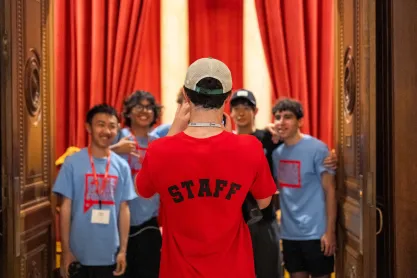
    Free Speech Forum students and counselors exploring the Supreme Court

    Free Speech Forum attendees and counselors explore the Supreme Court building in Washington, D.C.

    As the week progressed, it became clear that whether it was a lively discussion in the dining hall, a spirited debate on the walk to sessions, or the inquisitive questions posed to our speakers, students were engaged and used each opportunity to learn and mold their own perspectives, all while keeping an open mind and a curious attitude. One student said one of the things that most influenced their view on free speech was the “different debates and conversations we had amongst ourselves — on topics not everyone agreed with.”

    In addition, students had the chance to explore their nation’s capital beyond American’s campus, venturing to some of D.C.’s iconic museums and federal buildings. The National Archives, Library of Congress, Supreme Court, and Capitol Building each played host to scores of forum attendees, who supplemented their First Amendment education by standing at the sites where America’s enduring commitment to free speech has been cemented.

    And in true FIRE fashion, students who debated fervently in the classroom still managed to become friends outside of it. We would be remiss not to mention the impromptu piano sing-along during our game night when counselors and campers alike started belting out Ed Sheeran and Bruno Mars hits. The Free Speech Forum talent show was no snoozer either, featuring speed cubing, magic tricks, and cohort acapella. The show was capped off with a group of students presenting a new FIRE flag representing the forum’s transformative impact on our campers.

    “My daughter had an incredible experience,” one parent commented. “She particularly appreciated the chance to connect with other like-minded students from diverse backgrounds.” The parent added, “My daughter left the program feeling more confident in her ability to advocate for causes she cares about and to contribute to open, respectful dialogue.”

    It’s no surprise our Saturday dismissal was accompanied by teary goodbyes, the exchanges of contact information, and promises to stay in touch. We as interns hope students take what they learned at the conference to their communities and campuses, advocating for an America in which no one fears the censorious axe of the government, and in which political differences are resolved with mutually respectful discourse.
    Source link

  • Essay on the play “Heroes of the Fourth Turning” (opinion)

    Essay on the play “Heroes of the Fourth Turning” (opinion)

    A brief announcement: After 20 years of writing “Intellectual Affairs” for Inside Higher Ed, I am retiring at the end of the month—from the gig, that is, not from writing itself. The final column will run in two weeks.

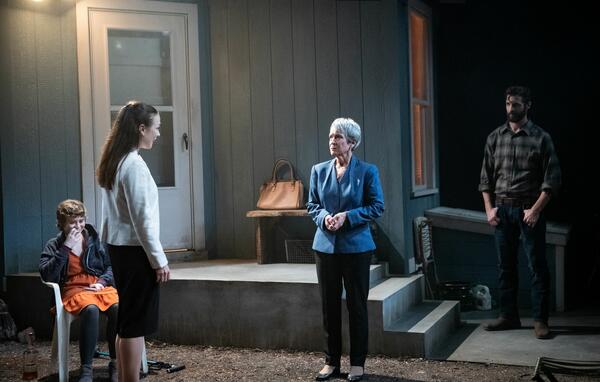
    Going to a play at the height of COVID-19 was effectively impossible, but I managed to see two productions of Will Arbery’s Heroes of the Fourth Turning in the fall of 2020. The first performance was via Zoom. The actors did what they could, but the suspension of disbelief was never a viewer option. Heroes was then produced by Philadelphia’s Wilma Theater and “captured digitally as a site-specific production, created in a closed quarantine ‘bubble’ at a private location in the Poconos, following strict health guidelines,” as press materials stated at the time.

    Set at a small Catholic college in rural Wyoming during the first months of Donald Trump’s presidency, Heroes centers on four friends (two men, two women) who reunite at a college function, a few years after graduation. They all admire a professor who has been appointed as president of the college. She joins them around two-thirds of the way through the play; one of the four is her daughter.

    The audience quickly picks up that Transfiguration College of Wyoming has a curriculum based on the Great Books, with a strong dose of conservative theology—not least on matters of sexual morality. And the lessons have gone deep. None of the four has drifted away from the faith, or skewed to the left, although one is clearly more troubled by punitive rhetoric than the rest.

    The play’s title alludes to a pop-sociological theory of history as moving through a cycle of four periods, each about two decades long. Since graduation, one member of the group has become a fairly successful figure in right-wing media (likely she has Steve Bannon on speed dial) and an ardent believer in the apocalypse promised by the fourth turning.

    “It’s destruction,” she says. “It’s revolution, it’s war. The nation almost doesn’t survive. Great example is the Civil War, and the economic crisis before that. Or the Great Depression and World War II. And it’s right now. The national identity crisis caused by Obama. Liberals think it’s Trump. It’s the fight to save civilization. People start to collectivize and turn against each other. It seems like everything’s ending—we’re all gonna die. No one trusts each other. But the people who do trust each other form crazy bonds. Somehow we get through it, we rise from the ashes …”

    The phoenix that emerges? An era of security, conformity and prosperity. The apocalypse has a happy ending.

    When the play premiered off-Broadway in 2019, reviewers often imagined the discomfort it would presumably give New York theatergoers—plunged into a continuous flow of red state ideology, with no character challenging it. But the play did more than that. The figures Arbery puts on stage are characters, not ventriloquist dummies. They have known one another at close proximity for years and formed “crazy bonds” of great intensity.

    Their conversation is rooted in that personal history as well as in Transfiguration College’s carefully tended vision of Judeo-Christian Western civilization. The playwright creates a good deal of inner space for the actors to occupy and move around in. When I finally got to see Heroes of the Fourth Turning onstage, in person, there were moments that felt like eavesdropping on real people.

    What comes out of a character’s mouth at times echoes well-worn culture-war talking points—many unchanged now, almost eight years after when the play is set. At the same time, the characters clash over points of doctrine and ethical disagreement, and express very mixed feelings about the MAGA crusade. The closest thing to an expression of enthusiasm for the new president (then and now) is when a character calls Trump “a Golem molded from the clay of mass media … Even if he himself is confused, he has the ability to spit out digestible sound bites rooted in decades of the work of the most brilliant conservative think tanks in the country.”

    This is cynical, but also naïve. When the president of the college appears before her adoring former students, she recites some points they have undoubtedly heard from her many times:

    “Progressivism moves too fast and forces change and constricts liberty. Gridlock is beautiful. In the delay is deliberation and true consensus. If you just railroad something through because you want it done, that’s the passion of the mob. Delaying is the structure of the [republic], which is structured differently in order to offset the dangers of democracy. I believe in slowness, gridlock.”

    She’s a fictional character, but I still wonder what she’s made of the last few weeks.

    Not long after Heroes opened in 2019, Elizabeth Redden wrote an in-depth article for Inside Higher Ed about Wyoming Catholic College, the not-so-veiled original for the play’s Transfiguration College. Arbery’s father was the college’s president at the time. All of which goes some ways toward explaining how a one-act play can evoke so palpably a college that is also a counterculture.

    Scott McLemee is Inside Higher Ed’s “Intellectual Affairs” columnist. He was a contributing editor at Lingua Franca magazine and a senior writer at The Chronicle of Higher Education before joining Inside Higher Ed in 2005.

    Source link