Tag: High school completion

  • ¿Qué ha pasado desde que Texas eliminó las matrículas estatales para los estudiantes indocumentados?

    ¿Qué ha pasado desde que Texas eliminó las matrículas estatales para los estudiantes indocumentados?

    SAN ANTONIO — Ximena tenía un plan. 

    La joven de 18 años de Houston iba a comenzar clases este otoño en la Universidad de Texas en Tyler, donde le habían concedido una beca de 10.000 dólares al año. Esperaba que eso le permitiera alcanzar su sueño: un doctorado en Química, seguido de una carrera como profesora o investigadora.

    “Y entonces se produjo el cambio en la matrícula estatal, y fue entonces cuando supe con certeza que tenía que dar un giro”, dijo Ximena. (The Hechinger Report se refiere a ella solo por su nombre de pila porque ella teme represalias por su situación migratoria).

    Aunque Ximena pasó sus primeros años en el norte de México, la mayoría de sus recuerdos son de después de mudarse a Estados Unidos con su padre. Ha asistido a escuelas en Estados Unidos desde el jardín de infancia y, para ella, el 12.º grado consistió principalmente en explicar conceptos avanzados de química a sus compañeros de clase y dirigir laboratorios como asistente de enseñanza.

    Pero en junio, los sueños de Ximena se vieron truncados cuando la oficina del fiscal general de Texas y la administración Trump colaboraron para poner fin a las disposiciones de una ley estatal que ofrecía a miles de estudiantes indocumentados como ella tasas de matrícula más bajas en las universidades públicas de Texas. Los funcionarios estatales y federales argumentaron con éxito ante los tribunales que la política vigente desde hacía mucho tiempo discriminaba a los ciudadanos estadounidenses de otros estados que pagaban una tasa más alta. Ese razonamiento se ha replicado ahora en demandas similares contra Kentucky, Oklahoma y Minnesota, como parte de una ofensiva más amplia contra el acceso de los inmigrantes a la educación pública.

    En la UT Tyler, la matrícula y las tasas estatales para el próximo año académico ascienden a un total de 9.736 dólares, frente a los más de 25.000 dólares que pagan los estudiantes de fuera del estado. Ximena y su familia no podían permitirse el elevado coste de la matrícula, por lo que la joven se retiró. En su lugar, se matriculó en el Houston Community College, donde los costos para los estudiantes de fuera del estado son de 227 dólares por hora semestral, casi tres veces más que la tarifa para los residentes en el distrito. La escuela solo ofrece clases básicas de química de nivel universitario, por lo que, para prepararse para un doctorado o para trabajar en investigaciones especializadas, Ximena seguirá necesitando encontrar la manera de pagar una universidad de cuatro años en el futuro.

    Su difícil situación es precisamente lo que los legisladores estatales de ambos partidos políticos esperaban evitar cuando aprobaron la Texas Dream Act o Ley de Sueños de Texas, una ley de 2001 que no solo abrió las puertas de la educación superior a los estudiantes indocumentados, sino que también tenía por objeto reforzar la economía y la mano de obra de Texas a largo plazo. Con esa ley, Texas se convirtió en el primero de más de dos docenas de estados en aplicar la matrícula estatal a los estudiantes indocumentados, y durante casi 24 años, esta política histórica se mantuvo intacta. Los legisladores conservadores propusieron repetidamente su derogación, pero a pesar de los años de control de un solo partido en la legislatura estatal, no hubo suficientes republicanos que apoyaran la derogación, incluso esta primavera, días antes de que la oficina del fiscal general de Texas y el Departamento de Justicia federal decidieran ponerle fin.

    Ahora, a medida que se acerca el semestre de otoño, los estudiantes inmigrantes están sopesando si darse de baja de sus cursos o esperar a que se aclare cómo les afecta el acuerdo de consentimiento firmado por el estado y el Departamento de Justicia. Los defensores de los inmigrantes temen que las universidades de Texas estén excluyendo a posibles alumnos que se encuentran en situación legal y siguen reuniendo los requisitos para pagar la matrícula estatal a pesar de la sentencia judicial, incluidos los beneficiarios del programa de Acción Diferida para los Llegados en la Infancia (DACA), los solicitantes de asilo y los que tienen Estatus de Protección Temporal o TPS, porque el personal de la universidad carece de conocimientos sobre inmigración y no ha recibido directrices claras sobre quién debe pagar exactamente la matrícula más alta.

    En el Austin Community College, que presta servicio a un área tan grande como el estado de Connecticut, los miembros del consejo de administración no están seguros de cómo aplicar correctamente la sentencia judicial. Mientras esperan respuestas, hasta ahora han decidido no enviar cartas a sus estudiantes solicitándoles información confidencial para determinar las tasas de matrícula.

    Una valla publicitaria que promociona el Austin Community College en español se encuentra en una autopista que conduce a Lockhart, Texas. Credit: Sergio Flores for The Hechinger Report

    “Esta confusión perjudicará inevitablemente a los estudiantes, porque lo que vemos es que, ante la falta de información y la presencia del miedo y la ansiedad, los estudiantes optarán por no continuar con la educación superior o se esconderán en las sombras y se sentirán como miembros marginados de la comunidad”, afirmó Manuel González, vicepresidente del consejo de administración del ACC.

    Por su parte, los expertos en políticas públicas advierten de que la mano de obra de Texas podría verse afectada, ya que los jóvenes con talento, muchos de los cuales han cursado toda su educación en el sistema de escuelas públicas del estado, ya no podrán permitirse los títulos de asociado y licenciatura que les permitirían seguir carreras que ayudarían a impulsar sus economías locales. En virtud de la Ley Texas Dream, los beneficiarios estaban obligados a comprometerse a solicitar la residencia permanente legal lo antes posible, lo que les daba la oportunidad de mantener puestos de trabajo relacionados con sus títulos. Sin la condición de residentes, es probable que sigan trabajando, pero en empleos peor remunerados y menos visibles.

    Relacionado: ¿Te interesa recibir más noticias sobre universidades? Suscríbete a nuestro boletín quincenal gratuito de educación superior.

    “Es una visión muy cortoplacista en lo que respecta al bienestar del estado de Texas”, afirmó Barbara Hines, antigua profesora de Derecho que ayudó a los legisladores a redactar la Ley Texas Dream.

    A principios de siglo, casi dos décadas después de que los niños indocumentados obtuvieran el derecho a asistir a la escuela pública en Estados Unidos, los estudiantes inmigrantes y sus defensores seguían frustrados porque la universidad seguía estando fuera de su alcance.

    Para el mayor general retirado de la Guardia Nacional del Ejército Rick Noriega, un demócrata que en ese momento formaba parte de la Legislatura de Texas, esa realidad le tocó de cerca cuando se enteró de que un joven trabajador de su distrito quería matricularse en el community college local para estudiar mecánica aeronáutica, pero no podía permitirse pagar la matrícula fuera del estado.

    Noriega llamó a la oficina del rector de la escuela, que pudo proporcionar fondos para que el estudiante se inscribiera. Pero esa experiencia le llevó a preguntarse: ¿cuántos niños más de su distrito se enfrentaban a las mismas barreras para acceder a la educación superior?

    Así que colaboró con un sociólogo para encuestar a los estudiantes de las escuelas secundarias locales sobre el problema, que resultó ser muy frecuente. Y el distrito de Noriega no era una excepción. En un estado que durante mucho tiempo ha tenido una de las mayores poblaciones de inmigrantes no autorizados del país, los políticos de todos los partidos conocían a electores, amigos o familiares afectados y querían ayudar. Una vez que Noriega decidió proponer la legislación, un republicano, Fred Hill, pidió ser coautor del proyecto de ley.

    Para los defensores de la Ley Texas Dream, el mejor argumento a favor de la matrícula estatal para los estudiantes indocumentados era de carácter económico. Después de que el estado ya hubiera invertido en estos estudiantes durante la educación pública K-12, tenía sentido seguir desarrollándolos para que, con el tiempo, pudieran ayudar a satisfacer las necesidades de mano de obra de Texas.

    “Habíamos gastado todo ese dinero en estos jóvenes, y ellos habían hecho todo lo que les pedimos —en muchos casos, eran superestrellas, los mejores de su promoción y cosas por el estilo— y luego se topaban con este obstáculo, que era la educación superior, cuyo costo era prohibitivo”, dijo Noriega.

    La legislación fue aprobada fácilmente por la Cámara de Representantes de Texas, que en ese momento estaba controlada por los demócratas, pero el Senado, liderado por los republicanos, se mostró menos complaciente.

    “Ni siquiera pude conseguir una audiencia. Me dijeron rotundamente: “No, esto no va a salir adelante””, afirmó Leticia Van de Putte, la entonces senadora estatal que patrocinó la legislación en su cámara.
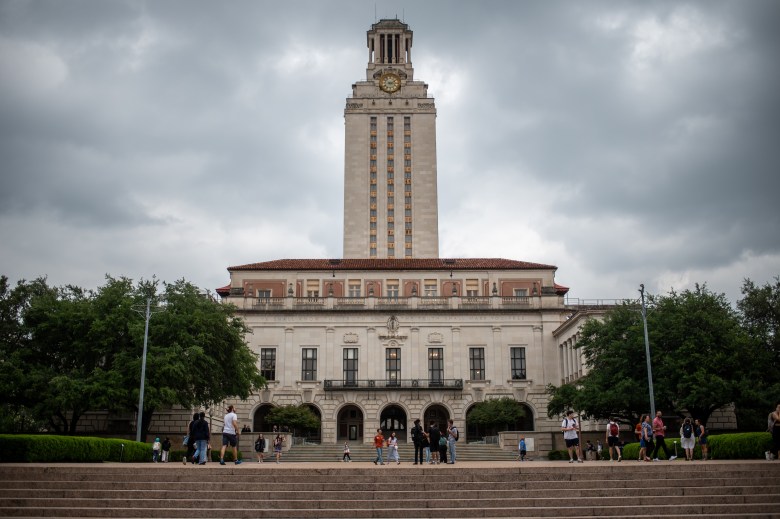
    Las nubes cubren el cielo detrás de la torre de la Universidad de Texas en Austin. Credit: Sergio Flores for The Washington Post via Getty Images

    Para persuadir a sus colegas republicanos, añadió varias restricciones, entre ellas la de exigir a los estudiantes indocumentados que vivieran en Texas durante tres años antes de terminar la escuela secundaria o recibir un GED. (Se estimó que tres años era el tiempo medio que tardaría una familia en pagar suficientes impuestos estatales para compensar la diferencia entre la matrícula estatal y la matrícula fuera del estado). También incluyó la cláusula que obligaba a los estudiantes indocumentados que accedían a la matrícula estatal a firmar una declaración jurada en la que se comprometían a solicitar la tarjeta de residencia tan pronto como pudieran.

    Van de Putte también recurrió a los grupos empresariales de Texas para insistir en los argumentos económicos a favor del proyecto de ley. Y convenció a la comunidad empresarial para que pagara los autobuses que llevarían a pastores evangélicos conservadores latinos de Dallas, San Antonio, Houston y otras zonas del estado a Austin, para que pudieran llamar a las puertas en apoyo de la legislación y rezar con los senadores republicanos y su personal.

    Después de eso, la Ley Texas Dream fue aprobada por abrumadora mayoría en el Senado estatal en mayo de 2001, y el entonces gobernador Rick Perry, republicano, la promulgó como ley al mes siguiente.

    Relacionado: El College Board cancela programa de premios para estudiantes negros y latinos de alto rendimiento 

    Sin embargo, en 2007, incluso cuando los defensores de los derechos de los inmigrantes, los grupos religiosos y las asociaciones empresariales formaron una coalición para defender a los inmigrantes contra las políticas estatales perjudiciales, la legislatura de Texas comenzó a presentar una serie de propuestas generalmente contrarias a los inmigrantes. En 2010, las encuestas sugerían que los tejanos se oponían de manera abrumadora a que los estudiantes indocumentados pagaran las tasas de matrícula estatales.

    En 2012, un nuevo grupo de políticos de derecha fue elegido para ocupar cargos públicos, muchos de ellos opuestos filosóficamente a la ley y muy críticos al respecto. La defensa de la política por parte de Perry se volvió en su contra durante las primarias presidenciales republicanas de 2012, cuando su campaña fue objeto de críticas después de que, durante un debate, dijera a los oponentes de la igualdad en las matrículas: “No creo que tengan corazón”.

    Aún así, ninguno de los muchos proyectos de ley presentados a lo largo de los años para derogar la Ley Texas Dream tuvo éxito. E incluso el gobernador Greg Abbott, un republicano partidario de la línea dura en materia de inmigración, se mostró en ocasiones ambiguo sobre la política, y su portavoz afirmó en 2013 que Abbott creía que “el objetivo” de la matrícula estatal independientemente del estatus migratorio era “noble”.

    Los observadores legislativos afirman que algunos republicanos del estado siguen apoyando la política. “Es una cuestión bipartidista. Hay republicanos que apoyan la matrícula estatal”, afirmó Luis Figueroa, director de asuntos legislativos de la organización sin fines de lucro Every Texan, dedicada a la investigación y la defensa de políticas públicas. “Pero no pueden decirlo públicamente”.

    Mientras tanto, a medida que el tema se volvía más controvertido políticamente en Texas, la Texas Dream Act acabó amplificando un debate más amplio que finalmente condujo a la creación del DACA, el programa de la era Obama que ha dado a algunos inmigrantes indocumentados acceso a protecciones contra la deportación y permisos de trabajo.

    Relacionado: Las amenazas de deportación de Trump pesan sobre los grupos que ofrecen ayuda con la FAFSA 

    Incluso antes del DACA, muchos inmigrantes trabajaban, y los que siguen sin papeles a menudo siguen haciéndolo, ya sea como contratistas independientes para empleadores que hacen la vista gorda ante su estatus migratorio o creando sus propios negocios. Un estudio de mayo de 2020 reveló que los residentes no autorizados constituyen el 8,2 % de la población activa del estado y que, por cada dólar gastado en servicios públicos para ellos, el estado de Texas recuperaba 1,21 dólares en ingresos.

    Pero sin el permiso legal inmediato para trabajar, los graduados universitarios indocumentados que se habían beneficiado de la Ley Dream de Texas se vieron limitados a pesar de sus títulos. A medida que la lucha por la equidad en las matrículas se extendía a otros estados, también lo hacía la lucha por una solución legal que apoyara a los estudiantes beneficiados.

    Cuando estos jóvenes, cariñosamente apodados “soñadores o dreamers”, pasaron a primer plano para defenderse más públicamente, su difícil situación despertó simpatía. En 2017, el mismo año en que Trump comenzó su primer mandato, las encuestas dieron un giro y mostraron que la mayoría de los tejanos apoyaba las matrículas estatales para los estudiantes indocumentados. Más recientemente, las investigaciones han indicado una y otra vez que los estadounidenses apoyan una vía para que los residentes indocumentados traídos a Estados Unidos cuando eran niños obtengan la residencia legal.

    Pero los argumentos en contra de la matrícula estatal, independientemente del estatus migratorio, también ganaron popularidad: los críticos sostenían que la política es injusta para los ciudadanos estadounidenses de otros estados que tienen que pagar tasas más altas, o que los estudiantes indocumentados están ocupando plazas en escuelas competitivas que podrían ser ocupadas por estadounidenses.

    El Departamento de Justicia se apoyó en una retórica similar en la demanda que acabó con la igualdad en las matrículas en Texas, alegando que la ley estatal queda invalidada por la legislación federal de 1996 que prohíbe a los inmigrantes indocumentados acceder a la matrícula estatal basada en la residencia. Ese argumento se ha convertido en un modelo, ya que la administración Trump ha presentado demandas para desmantelar las políticas de matrícula estatal de otros estados para los residentes indocumentados.

    En Kentucky, el fiscal general del estado, el republicano Russell Coleman, ha seguido los pasos de Texas y ha recomendado que el consejo estatal que supervisa la educación superior retire su normativa que permite el acceso a la matrícula estatal en lugar de luchar por defenderla en los tribunales.

    Al mismo tiempo, la administración Trump ha encontrado otras formas de recortar las oportunidades de educación superior para los estudiantes indocumentados, revocando una política que les había ayudado a participar en programas de formación profesional, técnica y para adultos, e investigando a las universidades por ofrecerles becas.

    Relacionado: Universidades recurren estudiantes hispanos para compensar disminución en la matrícula

    En Texas, el repentino cambio de política con respecto a las matrículas estatales está causando caos. Las dos universidades más grandes del estado, Texas A&M y la Universidad de Texas, están utilizando diferentes directrices para decidir qué estudiantes deben pagar las tasas fuera del estado.

    “Creo que las universidades son las que se encuentran en esta situación realmente difícil”, dijo Figueroa. “No son expertos en inmigración. Han recibido muy poca orientación sobre cómo interpretar el decreto de consentimiento”.

    En medio de tanta confusión, Figueroa predijo que es probable que surjan futuras demandas. Los estudiantes y organizaciones afectados ya han presentado mociones ante los tribunales para defender tardíamente la Ley Texas Dream contra el Departamento de Justicia.

    Mientras tanto, los jóvenes estudiantes se enfrentan a decisiones difíciles. Una estudiante, que pidió permanecer en el anonimato debido a su condición de inmigrante indocumentada, estaba leyendo las noticias en su teléfono antes de acostarse cuando vio un titular sobre el resultado del caso judicial del Departamento de Justicia.

    “Me eché a llorar porque, como alguien que ha luchado por salir adelante en sus estudios, ahora que estoy en la educación superior, ha sido una bendición”, dijo. “Así que lo primero que pensé fue: “¿Qué voy a hacer ahora? ¿Hacia dónde va mi futuro? ¿Los planes que tenía para mí tendrán que detenerse por completo?””.

    La joven, que vive en San Antonio desde que tenía 9 meses, se había matriculado en seis cursos para el otoño en la Universidad Texas A&M-San Antonio y no estaba segura de si abandonarlos. Sería su último semestre antes de obtener sus títulos en psicología y sociología, pero no podía imaginar pagar la matrícula fuera del estado.

    “Estoy en el limbo”, dijo, como “muchos estudiantes en este momento”.

    Comunícate con la editora Caroline Preston al 212-870-8965 o [email protected]

    Esta historia sobre los estudiantes indocumentados fue producida por The Hechinger Report, una organización de noticias independiente y sin fines de lucro que se centra en la desigualdad y la innovación en la educación. Suscríbase al boletín informativo del Hechinger.
    The Hechinger Report provides in-depth, fact-based, unbiased reporting on education that is free to all readers. But that doesn’t mean it’s free to produce. Our work keeps educators and the public informed about pressing issues at schools and on campuses throughout the country. We tell the whole story, even when the details are inconvenient. Help us keep doing that.

    Join us today.

    Source link

  • What’s happened since Texas killed in-state tuition for undocumented students

    What’s happened since Texas killed in-state tuition for undocumented students

    SAN ANTONIO — Ximena had a plan. 

    The 18-year-old from Houston was going to start college in the fall at the University of Texas at Tyler, where she had been awarded $10,000 a year in scholarships. That, she hoped, would set her up for her dream: a Ph.D. in chemistry, followed by a career as a professor or researcher.

    “And then the change to in-state tuition happened, and that’s when I knew for sure that I had to pivot,” said Ximena, who was born in Mexico but attended schools stateside since kindergarten. (The Hechinger Report is referring to her by only her first name because she fears retaliation for her immigration status.) 

    In June, the Texas attorney general’s office and the Trump administration worked together to end the provisions in a state law that had offered thousands of undocumented students like her lower in-state tuition rates at Texas public colleges. State and federal officials successfully argued in court that the long-standing policy discriminated against U.S. citizens from other states who paid a higher rate. That rationale has now been replicated in similar lawsuits against Kentucky, Oklahoma and Minnesota — part of a broader offensive against immigrants’ access to public education. 

    At UT Tyler, in-state tuition and fees for the upcoming academic year total $9,736, compared to more than $25,000 for out-of-state students. Ximena and her family couldn’t afford the higher tuition bill, so she withdrew. Instead, she enrolled at Houston Community College, where out-of-state costs are $227 per semester hour, nearly three times the in-district rate. The school offers only basic college-level chemistry classes, so to set herself up for a doctorate or original research, Ximena will still need to find a way to pay for a four-year university down the line. 

    Her predicament is exactly what state lawmakers from both political parties had hoped to avoid when they passed the Texas Dream Act, 2001 legislation that not only opened doors to higher education for undocumented students but was also meant to bolster Texas’s economy and its workforce long-term. With that law, Texas became the first of more than two dozen states to implement in-state tuition for undocumented students, and for nearly 24 years, the landmark policy remained intact. Conservative lawmakers repeatedly proposed to repeal it, but despite years of single-party control in the state legislature, not enough Republicans embraced repeal even as recently as this spring, days before the Texas attorney general’s office and the federal Department of Justice moved to end it. 

    Now, as the fall semester approaches, immigrant students are weighing whether to disenroll from their courses or await clarity on how the consent agreement entered into by the state and DOJ affects them.

    Immigration advocates are worried that Texas colleges and universities are boxing out potential attendees who are lawfully present and still qualify for in-state tuition despite the court ruling — including recipients of the Deferred Action for Childhood Arrivals program, asylum applicants and Temporary Protected Status holders — because university personnel lack immigration expertise and haven’t been given clear guidelines on exactly who needs to pay the higher tuition rate

    At Austin Community College, which serves an area as large as Connecticut, members of the board of trustees are unsure how to accurately implement the ruling. As they await answers, they’ve so far decided against sending letters asking their students for sensitive information in order to determine tuition rates. 

    “This confusion will inevitably harm students because what we find is that in the absence of information and in the presence of fear and anxiety, students will opt to not continue higher education,” said Manuel Gonzalez, vice chair of the ACC board of trustees.

    A billboard promoting Austin Community College in Spanish sits on a highway that leads to Lockhart, Texas. Credit: Sergio Flores for The Hechinger Report

    Policy experts, meanwhile, warn that Texas’s workforce could suffer as talented young people, many of whom have spent their entire education in the state’s public school system, will no longer be able to afford the associate’s and bachelor’s degrees that would allow them to pursue careers that would help propel their local economies. Under the Texas Dream Act, beneficiaries were required to commit to applying for lawful permanent residence as soon as possible, giving them the opportunity to hold down jobs related to their degrees. Without resident status, it’s likely they’ll still work — just more in lower-paying, under-the-radar jobs.  

    “It’s so short-sighted in terms of the welfare of the state of Texas,” said Barbara Hines, a former law school professor who helped legislators craft the Texas Dream Act. 

    Related: Become a lifelong learner. Subscribe to our free weekly newsletter featuring the most important stories in education. 

    By the turn of the century, almost two decades after undocumented children won the right to attend public school in the U.S., immigrant students and their champions remained frustrated that college remained out of reach. 

    For retired Army National Guard Maj. Gen. Rick Noriega, a Democrat who served in the Texas Legislature at the time, that reality hit close to home when he learned of a young yard worker in his district who wanted to enroll at the local community college for aviation mechanics but couldn’t afford out-of-state tuition. 

    Noriega called the school chancellor’s office, which was able to provide funding for the student to attend. But that experience led him to wonder: How many more kids in his district were running up against the same barriers to higher education? 

    So he worked with a sociologist to poll students at local high schools about the problem, which turned out to be widespread. And Noriega’s district wasn’t an outlier. In a state that has long had one of the nation’s largest unauthorized immigrant populations, politicians across the partisan divide knew affected constituents, friends or family members and wanted to help. Once Noriega decided to propose legislation, a Republican, Fred Hill, asked to serve as a joint author on the bill. 

    To proponents of the Texas Dream Act, the best argument in support of in-state tuition for undocumented students was an economic one. After the state had already invested in these students during K-12 public schooling, it made sense to continue developing them so they could eventually help meet Texas’ workforce needs. 

    “We’d spent all this money on these kids, and they’d done everything that we asked them to do — in many instances superstars and valedictorians and the like — and then they hit this wall, which was higher education that was cost prohibitive,” said Noriega. 

    The legislation easily passed the Texas House of Representatives, which was Democratic-controlled at the time, but the Republican-led Senate was less accommodating. 

    “I couldn’t even get a hearing,’” said Leticia Van de Putte, the then-state senator who sponsored the legislation in her chamber. 

    To persuade her Republican colleagues, she added several restrictions, including requiring undocumented students to live in Texas for three years before finishing high school or receiving a GED. (Three years was estimated as the average time it would take a family to pay enough in state taxes to make up the difference between in-state and out-of-state tuition.) She also included the clause mandating that undocumented students who accessed in-state tuition sign an affidavit pledging to pursue green cards as soon as they were able.   

    Van de Putte also turned to Texas business groups to hammer home the economic case for the bill. And she convinced the business community to pay for buses to bring Latino evangelical conservative pastors from Dallas, San Antonio, Houston and other areas of the state to Austin, so they could knock on doors in support of the legislation and pray with Republican senators and their staff. 

    After that, the Texas Dream Act overwhelmingly passed the state Senate in May 2001, and then-Gov. Rick Perry, a Republican, signed it into law the following month.

    Related: How Trump is changing higher education: The view from four campuses

    Yet by 2007, even as immigrant rights advocates, faith-based groups and business associations formed a coalition to defend immigrants against harmful state policies, the Texas legislature was starting to introduce a wave of generally anti-immigrant proposals. In 2010, polling suggested Texans overwhelmingly opposed allowing undocumented students to pay in-state tuition rates. 

    By 2012, a new slew of right-wing politicians was elected to office, many philosophically opposed to the law — and loud about it. Perry’s defense of the policy had come back to haunt him during the 2012 Republican presidential primary, when his campaign was dogged by criticism after he told opponents of tuition equity during a debate, “I don’t think you have a heart.” 

    Still, none of the many bills introduced over the years to repeal the Texas Dream Act were successful. And even Texas Gov. Greg Abbott, a Republican border hawk, at times equivocated on the policy, with his spokesperson saying in 2013 that Abbott believed “the objective” of in-state tuition regardless of immigration status was “noble.”

    Legislative observers say that some Republicans in the state continue to support the policy. “It’s a bipartisan issue. There are Republicans in support of in-state tuition,” said Luis Figueroa, senior director of legislative affairs at the public policy research and advocacy nonprofit Every Texan. “They cannot publicly state it.”

    Meanwhile, as the topic became more politically charged in Texas, the Texas Dream Act ended up amplifying a larger conversation that eventually led to the creation of DACA, the Obama-era program that has given some undocumented immigrants access to deportation protections and work permits. 

    Even before DACA, many immigrants worked, and those who remain undocumented often still do, either as independent contractors for employers that turn a blind eye to their immigration status or by starting their own businesses. A study from May 2020 found that unauthorized residents make up 8.2 percent of the state’s workforce, and for every dollar spent toward public services for them, the state of Texas recouped $1.21 in revenue. 

    But without the immediate legal permission to work, undocumented college graduates who had benefited from the Texas Dream Act found themselves limited despite their degrees. As the fight for tuition equity spread to other states, so did the fight for a legal solution to support the students it benefited. 

    When these young people — affectionately dubbed Dreamers — took center stage to more publicly advocate for themselves, their plight proved sympathetic. By 2017, the same year Trump began his first term, polling had flipped to show a plurality of Texans in support of in-state tuition for undocumented students. More recently, research has indicated time and time again that Americans support a pathway to legal status for undocumented residents brought to the U.S. as children. 

    But arguments against in-state tuition regardless of immigration status also grew in popularity: Critics contended that the policy is unfair to U.S. citizens from other states who have to pay higher rates, or that undocumented students are taking spots at competitive schools that could be filled by documented Americans. 

    The DOJ leaned on similar rhetoric in the lawsuit that killed tuition equity in Texas, saying the state law is superseded by 1996 federal legislation banning undocumented immigrants from getting in-state tuition based on residency. That argument has become a template as the Trump administration has sued to dismantle other states’ in-state tuition policies for undocumented residents.

    In Kentucky, state Attorney General Russell Coleman, a Republican, has followed in Texas’ footsteps, recommending that the state council overseeing higher education withdraw its regulation allowing for access to in-state tuition instead of fighting to defend it in court. 

    At the same time, the Trump administration has found other ways to cut back on higher education opportunities for undocumented students, rescinding a policy that had helped them participate in career, technical and adult education programs and investigating universities for offering them scholarships. 

    Related: Which schools and colleges are being investigated by the Trump administration? 

    Back in Texas, the sudden policy change regarding in-state tuition is causing chaos. Even the state’s two largest universities, Texas A&M and the University of Texas, are using different guidelines to decide which students must pay out-of-state rates. 

    Clouds fill the sky behind the tower at the University of Texas. Credit: Sergio Flores for The Washington Post via Getty Images

    “Universities, I think, are the ones that are put in this really difficult position,” Figueroa said. “They are not immigration experts. They’ve received very little guidance about how to interpret the consent decree.” 

    Amid so much confusion, Figueroa predicted, future lawsuits will likely crop up. Already, affected students and organizations have filed motions in court seeking to belatedly defend the Texas Dream Act against the DOJ.

    In the meantime, young scholars are facing difficult choices. One student, who asked to remain anonymous because of her undocumented immigration status, was scrolling through the news on her phone before bed when she saw a headline about the outcome of the DOJ court case. 

    “I burst in tears because, you know, as someone who’s been fighting to get ahead in their education, right now that I’m in higher education, it’s been a complete blessing,” she said. “So the first thing that I just thought of is ‘What am I going to do now? Where is my future heading?’ The plans that I have had going for me, are they going to have to come to a complete halt?’” 

    The young woman, who has lived in San Antonio since she was 9 months old, had enrolled in six courses for the fall at Texas A&M-San Antonio and wasn’t sure whether to drop them. It would be her final semester before earning her psychology and sociology degrees, but she couldn’t fathom paying for out-of-state tuition. 

    “I’m in the unknown,” she said, like “many students in this moment.”

    Contact editor Caroline Preston at 212-870-8965, via Signal at CarolineP.83 or on email at [email protected].

    This story about the Texas Dream Act was produced by The Hechinger Report, a nonprofit, independent news organization focused on inequality and innovation in education. Sign up for the Hechinger newsletter.

    The Hechinger Report provides in-depth, fact-based, unbiased reporting on education that is free to all readers. But that doesn’t mean it’s free to produce. Our work keeps educators and the public informed about pressing issues at schools and on campuses throughout the country. We tell the whole story, even when the details are inconvenient. Help us keep doing that.

    Join us today.

    Source link

  • How no-strings cash changed the lives of teens

    How no-strings cash changed the lives of teens

    NEW ORLEANS — Kapri Clark used the $50 to help pay for her braces. Lyrik Grant saved half of it, and used the rest for dance classes. Kevin Jackson said he squandered the cash on wings, ride shares for dates and some DJ equipment he later tossed.

    For the past five years, Clark, Grant, Jackson and hundreds of high schoolers in New Orleans have shopped — or saved — as part of a project to explore what happens if you give cash directly to young people, no strings attached.

    “That was the most helpful thing ever,” said Clark, now a student at the University of Louisiana at Lafayette, who said she could still use that extra cash.

    “The $50 study,” as it’s known, began at Rooted School, a local charter school, as an experiment to increase attendance. The study has since grown to eight other high schools in the city, as well as Rooted’s sister campus in Indianapolis, with students randomly selected to receive $50 every week for 40 weeks, or $2,000 total. By comparing their spending and savings habits to a larger control group, researchers wanted to figure out whether the money improved a teen’s financial capability and perception of themselves. They also wanted to know: Could the cash boost their grade-point averages and reading scores?

    Now, as the experiment expands to Washington, D.C., and perhaps Texas, a final report of the $50 study suggests a little bit of spending cash can make a difference in young people’s lives.

    The report, released Tuesday, shows students who received the cash payments were slightly more likely to attend school than those who didn’t. Academic performance did not differ between the groups. But financially, the extra cash helped students acquire stronger long-term planning skills and familiarity with savings accounts and other financial products. They ended the study, on average, with $300 saved away — a 15 percent savings rate, triple the national average for American adults.

    “When young people are given the opportunity to manage money in low-stakes environments, they build the habits that shape long-term financial health,” said Stacia West, an associate professor at the University of Tennessee, Knoxville and co-founder of the Center for Guaranteed Income Research, which partnered with the Rooted School Foundation to run the study. “The short-term habits we’re seeing are laying the foundation for lifelong financial capability.”

    Related: A lot goes on in classrooms from kindergarten to high school. Keep up with our free weekly newsletter on K-12 education.

    Across the United States and the globe, hundreds of communities have tinkered with some form of universal basic income, or UBI, a social welfare program that provides people with regular cash payments to meet their needs. Direct cash transfer programs like the $50 study or the child tax credit for families are similar, but they often provide smaller amounts and target specific populations to boost a person’s income. Many studies have linked UBI to financial stability and better employment and health outcomes.

    In the U.S. and Canada, researchers have found links between cash transfer pilots that focus on low-income families and better test scores and graduation rates for their kids. So far, though, few experiments have targeted young people or examined how the programs influence their lives specifically.

    Talia Livneh, senior director of programs at the Rooted School in New Orleans, poses for a portrait on the school grounds. Credit: Daniella Zalcman for The Hechinger Report

    “There’s a deep, deep distrust that we adults have of young people,” said Jonathan Johnson, CEO of the Rooted School Foundation, which operates the network’s four charter schools. “That distrust is to their detriment.”

    In New Orleans, roughly 4 in 5 of Rooted students come from economically disadvantaged families, and during the pandemic, many struggled to prioritize school. Some students skipped class to provide child care for their working parents, or because they needed to work themselves, according to Johnson. With some seed funding from a local education nonprofit, Rooted started a “micropilot” to test whether cash could help students make ends meet and get themselves to school.

    The original cohort included 20 students, half of whom received the $50 payment. In that micropilot, those receiving the cash saw their material wellbeing improve, meaning their family could more easily afford rent or utilities, and they gained skills around setting financial goals.  Rooted added students from its Indianapolis campus and another high school in New Orleans, G.W. Carver. And for their final report released this week, researchers sifted through the spending and survey data from 170 students who received the cash payments and 210 students who did not.

    The two-year report found students in the treatment group attended 1.23 more days of school, and  spent close to half their funds on essentials like food and groceries. The report also noted that 70 percent of all students at the participating schools qualify for subsidized meals, suggesting “this spending may reflect efforts to meet immediate nutritional needs.” One 12th grader in a survey mentioned using the money to feed their siblings.

    Kapri Clark recalled waiting every Wednesday morning for the $50 deposit to appear in her banking app. And every Wednesday afternoon, during her senior year at Carver High School, she put that money toward her $200 bill for braces she covered out of pocket.

    She braided hair to cover the rest, and still books clients when she has time in between her studies to become a nurse at the Lafayette campus. Even in college, Clark can see the need for some supplemental income for herself and her peers.

    “I make enough to take care of myself, but I watch every dollar,” said Clark. “There’s a lot of people struggling in life to eat, to live. Think if they got kids.”

    Read Irvin, chief of staff for Collegiate Academies in New Orleans, a network of five charter high schools that includes Carver High, said the $2,000 had provided the extra incentive a few students needed to stick it out until graduation. “That’s incredibly impactful for their life trajectories,” she said.

    Related: How to help young kids: Give their parents cash

    In January 2024, the city of New Orleans invested $1 million to bankroll another extension of the study, as part of an economic mobility initiative that tapped federal Covid relief funding. During the pandemic, a skyrocketing murder rate and spike in overall crime had convinced the city to help more residents, especially young people, find stability.

    “Research shows that people who are economically stable are less likely to commit crime,” said Courtney Wong, the city’s deputy director of economic development.

    The city funding not only expanded the $50 study to nine high schools, it also set a longer timeline for the research: About 800 seniors who participate will have their data tracked for 18 months after their graduation.

    A former high school teacher and administrator, Wong said $50 could have made a difference in the lives of many of her former students.

    “This targets young people in that perfect moment,” she said. “They’re in the right spot where even a little amount of help could have big, positive impacts before issues of crime or unemployment or things like that even come up.”

    Researchers also found students who received the $50 reported greater agency. They felt more control over their finances and more confidence about making long-term financial decisions. Students, according to the report, aligned their spending to future goals such as college prep classes and getting a driver’s license.

    Lyrik Grant, a rising junior at Carver High School, is the second-youngest of six kids with two working parents. She could ask them for help, but the $50 allowed Grant to afford the tights and tops she needed for dance class on her own. The money helped cover a college entrance exam, which she aced, and Grant wants to learn how to drive soon.

    “My first thought was: What am I going to do with all this money?” Grant said, adding that the cash helped some of her classmates find financial stability. “Children don’t always want to spend their parent’s money, and some parents don’t always have money to give them.”

    Still, for some students, the money wasn’t exactly life-changing. Irvin of Collegiate Academies said many used the cash to “just be teenagers.”

    That was true for Kevin Jackson, a rising junior at Rooted School New Orleans.

    “It’s cool to get free money,” he said. “I was spending it on the TikTok shop: posters, keyboards, lights — stuff I liked, not stuff I actually needed.”

    Related: All-charter no more: New Orleans opens its first traditional school in nearly two decades

    Despite the studies that show a positive impact from UBI, many Americans appear skeptical of the idea of a federal program that gives unconditional financial support to people. Aditi Vasan, a pediatrician and researcher at PolicyLab at the Children’s Hospital of Philadelphia, said skeptics often worry about recipients using public dollars for drug use or other illicit behavior, even though the data does not support that.

    Still, that fear will likely keep any large-scale cash transfer program from being adopted in the United States any time soon, she said.

    “That concern exists certainly for cash transfers in general but might be particularly magnified for teens,” Vasan said. “We’ve not seen that play out in the evidence from the quality studies that have been done.”

    Next year, in Washington, D.C., the nonprofit Education Forward will fund a pilot of the $50 study with 40 high schoolers. The Rooted school network resumed talks, meanwhile, to take the study to neighboring Texas, after state lawmakers earlier this year failed to pass legislation that threatened to ban local governments from adopting guaranteed income programs.

    Talia Livneh, senior director of programs for the Rooted School Foundation, said the politics may need to catch up to the research.

    “I don’t think what we’re doing is so radical. I believe this just works,” she said. “Kids don’t lack character. They lack cash,” Livneh added. “They deserve deep, deep trust that students and people know what’s best for them.”

    It’s been four years since Vernell Cheneau III received the $50 for 40 weeks while a student at Rooted in New Orleans, and his economic life isn’t easy. He struggled for months to find part-time work in his hometown. But on a recent summer morning, the same day he finally received a job offer, Cheneau recalled what he learned from the study.

    Vernell Cheneau III (left) with two other students who participated in the cash transfer program at Rooted School, in New Orleans.
    Credit: Courtesy of Rooted School

    “You learn that money goes fast, especially if it’s free,” said Cheneau, 22.

    As a student, he tried to use the money to build some credit history. Since then, he’s learned the full cost of being an adult in America: health care, fuel and maintenance for his car, getting your hair done before a new job. Cheneau has also spent that time trying to convince friends and family to support UBI.

    Most oppose giving “free” money to people, he said. “How much does it cost to feed children? Get to work? We can’t just allow people to drown.”

    “Everything costs something,” Cheneau added. “If you’re stuck in a rut, it’s expensive to restart. In this country, it’s expensive to be poor.”

    Contact staff writer Neal Morton at 212-678-8247, on Signal at nealmorton.99, or via email at [email protected].

    This story about cash transfer programs was produced by The Hechinger Report, a nonprofit, independent news organization focused on inequality and innovation in education. Sign up for the Hechinger newsletter.

    The Hechinger Report provides in-depth, fact-based, unbiased reporting on education that is free to all readers. But that doesn’t mean it’s free to produce. Our work keeps educators and the public informed about pressing issues at schools and on campuses throughout the country. We tell the whole story, even when the details are inconvenient. Help us keep doing that.

    Join us today.

    Source link

  • Apprenticeships for high schoolers are touted as the next big thing. One state leads the way

    Apprenticeships for high schoolers are touted as the next big thing. One state leads the way

    This story is part of Hechinger’s ongoing coverage about rethinking high school. See our articles about a new diploma in Alabama and a “career education for all” model in Kentucky. 

    ELKHART, Ind. — Ever since Ty Zartman was little, people told him he had to go to college to be successful. “It was engraved on my brain,” he said. 

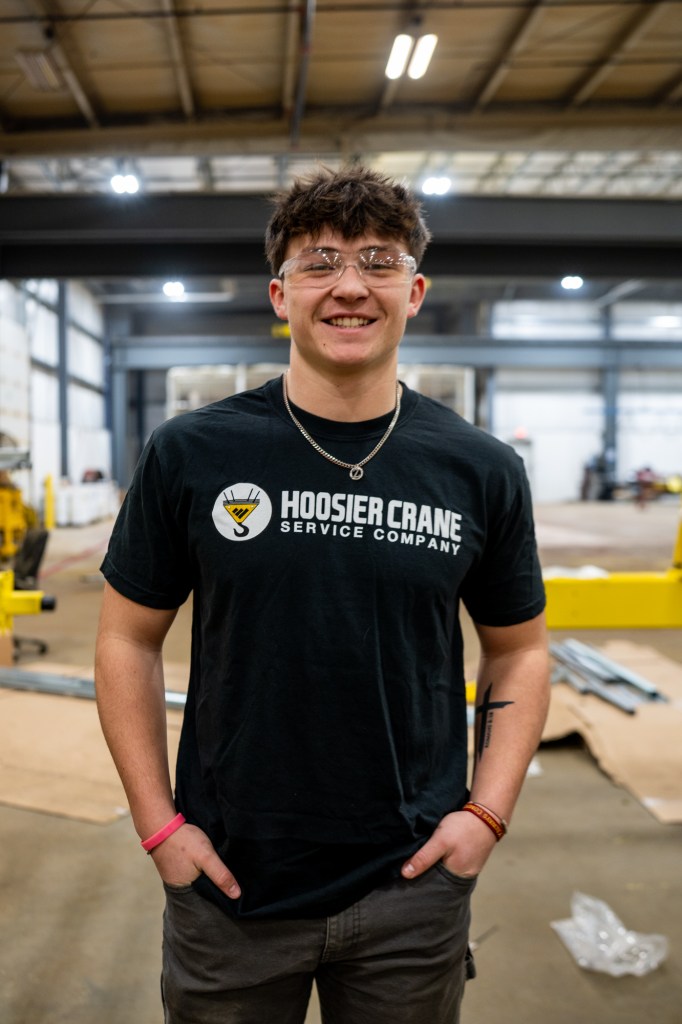
    But despite earning straight A’s, qualifying for the National Honor Society, being voted prom king and playing on the high school football and baseball teams, the teen never relished the idea of spending another four years in school. So in fall 2023 he signed up through his Elkhart, Indiana, high school for an apprenticeship at Hoosier Crane Service Company, eager to explore other paths. There, he was excited to meet coworkers who didn’t have a four-year degree but earned good money and were happy in their careers. 

    Through the youth apprenticeship, Ty started his day at the crane manufacturing and repair business at 6:30 a.m., working in customer service and taking safety and training courses while earning $13 an hour. Then, he spent the afternoon at his school, Jimtown High, in Advanced Placement English and U.S. government classes. 

    In June, the 18-year-old started full-time at Hoosier Crane as a field technician. 

    “College is important and I’m not dissing on that,” Ty said. “But it’s not necessarily something that you need.” 

    Elkhart County is at the forefront of a movement slowly spreading across Indiana and the nation to make apprenticeships a common offering in high school. 

    In 2019, as part of a plan to boost the region’s economic prospects, county leaders launched an effort to place high schoolers in apprenticeships that combine work-based training with classroom instruction. About 80 students from the county’s seven school districts participated this academic year, in fields such as health care, law, manufacturing, education and engineering. In April, as part of a broader push to revamp high school education and add more work-based learning, the state set a goal of 50,000 high school apprentices by 2034.  

    Tim Pletcher, the principal of Jimtown High, said students are often drawn first to the chance to spend less time in class. But his students quickly realize apprenticeships give them work-based learning credits and industry connections that help them after graduation. They also earn a paycheck. “It’s really causing us to have a paradigm shift in how we look at getting kids ready for the next step,” he said. 

    Related: Become a lifelong learner. Subscribe to our free weekly newsletter featuring the most important stories in education. 

    This “earn and learn” model is taking hold in part because of deepening disillusionment with four-year college, and the fact that well-paying jobs that don’t require bachelor’s degrees are going unfilled nationally. The past three presidential administrations invested in expanding apprenticeships, including those for high schoolers, and in April, President Donald Trump signed an executive order calling for 1 million new apprentices. In a recent poll, more than 80 percent of people said they supported expanding partnerships between schools and businesses to provide work-based learning experiences for students.

    Yet in the United States, the number of so-called youth apprenticeships for high schoolers is still “infinitesimally small,” said Vinz Koller, a vice president at nonprofit group Jobs for the Future. One estimate suggests they number about 20,000 nationally, while there are some 17 million high school students. By contrast, in Switzerland — which has been praised widely for its apprenticeship model, including by U.S. Education Secretary Linda McMahon — 70 percent of high schoolers participate. Indiana is among several states, including Colorado, South Carolina and Washington, that have embraced the model and sent delegations to Switzerland to learn more. 

    Elkhart, Indiana, known as the “RV capital of the world,” saw widespread unemployment during the Great Recession. That led community leaders to focus on apprenticeships as a way to diversify their economy. Credit: Camilla Forte/The Hechinger Report

    Experts including Ursula Renold, professor of education systems at the Swiss Federal Institute of Technology (ETH) Zurich, note that importing the model to the United States at a large scale won’t be simple. Most businesses aren’t accustomed to employing apprentices, parents can be resistant to their students trading four-year college aspirations for work, and public transportation to take students to apprenticeships is limited, especially in rural areas. Many high schoolers don’t have a driver’s license, access to a car or money for gas. School districts already face a shortage of bus drivers that makes transporting students to apprenticeships difficult or impossible.

    Still, Renold, who is known as the “grande dame of apprenticeships,” said Indiana’s commitment to apprenticeships at the highest levels of state government, as well as the funding the state has invested in work-based learning, at least $67 million, seem to be setting the state up for success, though it could take a decade to see results. 

    “If I had to make a bet,” said Renold, “I would say it’s Indiana who will lead the way.”

    Related: Apprenticeships are a trending alternative to college, but there’s a hitch

    Elkhart County’s experiment with apprenticeships has its roots in the Great Recession. Recreational vehicle manufacturing dominates the local economy, and demand for the vehicles plummeted, contributing to a regional unemployment rate at that time of nearly 20 percent. Soon after, community leaders began discussing how to better insulate themselves from future economic instability, eventually focusing on high school education as a way to diversify industries and keep up with automation, said Brian Wiebe, who in 2012 founded local nonprofit Horizon Education Alliance, or HEA, to help lead that work.

    Elkhart County, Indiana, was the first community in Indiana to encourage businesses to employ high school students as apprentices, where they can earn work-based learning credits and make industry connections that help them, even if they decide to go on to college. Credit: Camilla Forte/The Hechinger Report

    That year, Wiebe and two dozen local and state political, business, nonprofit and education leaders visited Switzerland and Germany to learn more about the apprenticeship model. “We realized in the U.S., there was only a Plan A, a path to college,” he recalled. “We were not supporting the rest of our young people because there was no Plan B.” 

    HEA partnered with Elkhart County school districts and businesses, as well as with CareerWise, a youth apprenticeship nonprofit that works nationally. They began rolling out apprenticeships in 2019, eventually settling on a goal of increasing participation by 20 percent each year. 

    In 2021, Katie Jenner, the new secretary of education for Indiana, learned about Elkhart’s apprenticeships as she was trying to revamp high school education in the state so it better prepared students for the workforce. Elkhart, as well as six other apprenticeship pilot sites funded by Indianapolis-based philanthropy the Richard M. Fairbanks Foundation, provided a proof of concept for the apprenticeship model, said Jenner. 

    In December, the state adopted a new diploma system that includes an emphasis on experiential and work-based learning, through apprenticeships, internships and summer jobs. 

    Related: Schools push career ed classes ‘for all,’ even kids heading to college

    On a weekday this winter, 17 sophomores at Elkhart’s Concord High School were sitting at computers, creating resumes they planned to use to apply for apprenticeships. The students were among some 50 sophomores at the high school who’d expressed interest in apprenticing and met the school’s attendance and minimum 2.5 GPA requirements, out of a class of roughly 400. They would receive coaching and participate in mock interviews before meeting with employers. 

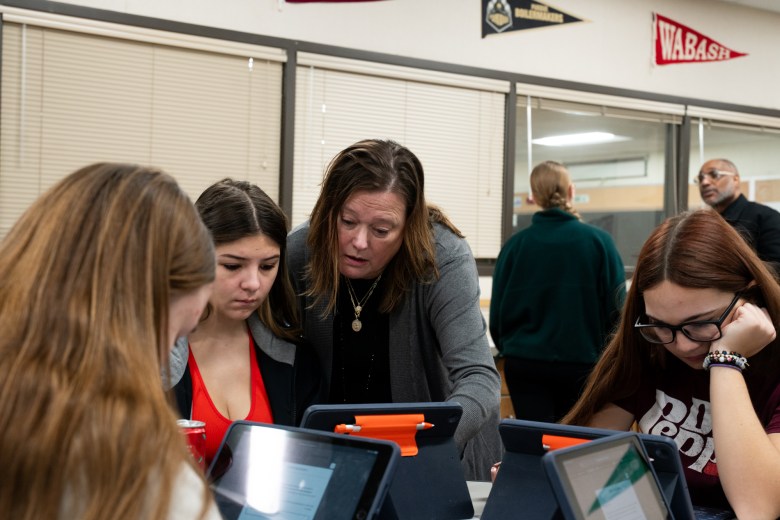
    Becca Roberts, a former English teacher who now oversees the high school’s college and career programs, said apprenticeships help convince students of the importance of habits like punctuality, clear communication and regular attendance. “It’s not from a book,” she said. “They’re dealing with real life.”

    Becca Roberts, who oversees college and career programs at Concord High School in Indiana, helps students research different companies offering apprenticeships, including job descriptions, work schedules and commuting distances. Credit: Camilla Forte/The Hechinger Report

    One student, Ava Cripe, said she hoped for an apprenticeship of some sort in the health care field. She’d only been a pet sitter and was nervous at the thought of having a professional job. “You’re actually going out and working for someone else, like not for your parents or your grandma, so it’s a little scary,” she said. 

    CareerWise Elkhart has recently beefed up its support for students and businesses participating in apprenticeships. It employs a business partnership manager and customer success managers who help smooth over issues that arise in the workplace — an apprentice who isn’t taking initiative, for example, or an apprenticeship that isn’t sufficiently challenging. “Before, if an issue came up, a business would just fire a student or a student would leave,” said Sarah Koontz, director of CareerWise Elkhart County. “We’re now more proactive.” 

    In Elkhart and across the state, the embrace of work-based learning has worried some parents who fear it will limit, not expand, their children’s opportunities. In previous generations, career and technical programs (then known as vocational education) were often used to route low-income and Black and Hispanic students away from college and into relatively low-paying career paths. 

    Anitra Zartman, Ty’s mother, said she and her husband were initially worried when their son said he wanted to go straight to work. They both graduated from college, and her husband holds a master’s degree. “We were like, ‘Don’t waste your talent. You’re smart, go to college.’” But she says they came around after seeing how the work experience influenced him. “His maturity has definitely changed. I think it’s because he has a responsibility that he takes very seriously,” she said. “He doesn’t want to let people down.”

    Her eldest daughter, Senica Zartman, also apprenticed during her final two years of high school, as a teacher’s assistant. She is now in college studying education. “The apprenticeship solidified her choice,” Anitra Zartman said, and it helped her decide to work with elementary students. Anitra Zartman said she would encourage her two youngest children to participate in apprenticeships too. 

    Ty Zartman works from 6 a.m. to noon at his apprenticeship at Hoosier Crane Service Company before he goes to school for afternoon classes. Credit: Camilla Forte/The Hechinger Report

    Sarah Metzler, CEO of the nonprofit HEA, said apprenticeships differ from the vocational education of the past that tended only to prepare students for relatively low paid, entry-level jobs. With apprenticeships, she said, students must continually learn new skills and earn new licenses and industry certifications as part of the program.

    Litzy Henriquez Monchez, 17, apprentices in human resources at a company of 50 people, earning $13.50 an hour. “I deal with payroll, I onboard new employees, I do a lot of translating. Anything that has to do with any of the employees, I deal with,” she said. She’s also earning an industry-recognized certification for her knowledge of a human resources management system, and says the company has offered to pay for her college tuition if she continues in the position. 

    Koontz said most companies pay for their apprentices to attend Ivy Tech, a statewide community college system, if they continue to work there. One is even paying for their apprentice’s four-year degree, she said. 

    Related: ‘Golden ticket to job security’: Trade union partnerships hold promise for high school students

    Attracting employers has proven to be the biggest challenge to expanding youth apprenticeships — in Elkhart and beyond. In total, 20 companies worked with the Elkhart school districts last year, and 28 have signed on for this coming school year — only enough to employ about a third of interested students. 

    The obstacles, employers say, include the expense of apprentices’ salaries, training and other costs. 

    Metzler and others, though, point to studies showing benefits for employers, including cost savings over time and improved employee loyalty. And in Indiana, the Fairbanks foundation and other organizations are working on ways to reduce employer costs, including by developing a standard curriculum for apprenticeships in industries like health care and banking so individual companies don’t bear the costs alone. 

    Business leaders who do sign on say they are happy with the experience. Todd Cook, the CEO of Hoosier Crane Service Company, employs 10 high schoolers, including Ty Zartman, as engineering and industrial maintenance technician apprentices, approximately 10 percent of his staff. He said the pipeline created by the apprenticeship program has helped reduce recruiting costs.

    “We’re starting to build our own farm system of talent,” he said. Students initially earn $13 an hour, and finish their apprenticeship earning $18. If they continue with the company, he said, they can earn up to $50 an hour after about five years. And if they go on to become trainers or mentors, Cook said, “Honestly, there is no ceiling.”

    Related: A new kind of high school diploma trades chemistry for carpentry 

    Transportation has been a limiting factor too. There’s no public transit system, and students who can’t rely on their parents for rides are often out of luck. “We’d love to offer a bus to every kid, to every location, but we don’t have people to run those extra bus routes,” said Principal Pletcher.

    The state has tried to help by investing $10 million to help students pay for costs such as transportation, equipment and certifications. Each school that provides work-based learning opportunities also receives an additional $500 per student. 

    Indiana has a goal to employ 50,000 high school students as apprentices by 2034. State leaders in business, education, government and nonprofits are working closely with Swiss experts to adopt a youth apprenticeship program similar to the one in that country. Credit: Camilla Forte/The Hechinger Report

    Trump’s executive order called for the secretaries of education, labor and commerce to develop a plan by late August for adding 1 million new apprenticeships. The order does not set a date for reaching that milestone, and it applies to apprentices of all ages, not just high schoolers. Vinz Koller of Jobs for the Future said the goal is modest, and achievable; the number of youth apprenticeships has doubled just in the past few years, he said, and California alone has a goal of reaching 500,000 apprenticeships, across all ages, by 2029. 

    Still, the order did not include additional funding for apprenticeships, and the Trump administration’s proposed budget includes major cuts to workforce development training. In an email, a White House spokesperson said the administration had promoted apprenticeships through outreach programs but did not provide additional information including on whether that outreach had a focus on youth apprenticeships.     

    Back in Elkhart, Ty Zartman, the Hoosier Crane apprentice, has begun his technician job with the company after graduating in early June. He is earning $19 an hour. He is also taking a class at the local community college on electrical work and recently received a certificate of completion from the Department of Labor for completing 2,000 hours of his apprenticeship. 

    Anitra Zartman said she wishes he’d attended more school events like pep rallies, and sometimes worried he wasn’t “being a kid.” But Ty said his supervisor is “super flexible” and he was able to go to the winter formal and prom. “I think I still live a kid life,” he said. “I do a lot of fun things.” 

    Of his job, he said, “I love it so much.”

    Contact editor Caroline Preston at 212-870-8965, via Signal at CarolineP.83 or on email at [email protected].

    This story about high school apprenticeships was produced by The Hechinger Report, a nonprofit, independent news organization focused on inequality and innovation in education. Sign up for the Hechinger newsletter.

    The Hechinger Report provides in-depth, fact-based, unbiased reporting on education that is free to all readers. But that doesn’t mean it’s free to produce. Our work keeps educators and the public informed about pressing issues at schools and on campuses throughout the country. We tell the whole story, even when the details are inconvenient. Help us keep doing that.

    Join us today.

    Source link

  • Alabama high school requirements now allow students to trade chemistry for carpentry

    Alabama high school requirements now allow students to trade chemistry for carpentry

    BIRMINGHAM, Ala. — In a corner of Huffman High School, the sounds of popping nail guns and whirring table saws fill the architecture and construction classroom.

    Down the hall, culinary students chop and saute in the school’s commercial kitchen, and in another room, cosmetology students snip mannequin hair to prepare for the state’s natural hair stylist license.

    Starting this fall, Alabama high school students can choose to take these classes — or any other state-approved career and technical education courses — in place of upper level math and science, such as Algebra 2 or chemistry.

    Alabama state law previously required students to take at least four years each of English, math, science and social studies to graduate from high school. The state is now calling that track the “Option A” diploma. The new “Option B” workforce diploma allows students to replace two math and two science classes with a sequence of three CTE courses of their choosing. The CTE courses do not have to be related to math or science, but they do have to be in the same career cluster. Already, more than 70 percent of Alabama high school students take at least one CTE class, according to the state’s Office of Career and Technical Education/Workforce Development.

    The workforce diploma will give students more opportunities to get the kind of skills that can lead to jobs right after high school, legislators said. But there’s a cost: Many universities, including the state’s flagship University of Alabama, require at least three math credits for admission. The workforce diploma would make it more difficult for students on that track to get into those colleges.

    The law passed in 2024 alongside a spate of bills aimed at boosting the state’s labor participation rate, which at 58 percent as of January remained below the national rate of 63 percent. Simply put, Alabama wants to get more of its residents working.

    Alabama is giving high school students a new pathway to a high school diploma: fewer math and science classes in exchange for more career and technical education courses. Credit: Tamika Moore for The Hechinger Report

    The new diploma option also comes at a time when public perception of college is souring: Only 36 percent of U.S. adults have a lot of confidence in higher education, according to a 2024 Gallup poll. Just 43 percent of Alabama high schoolers who graduated in 2023 enrolled in one of the state’s public colleges the following fall.

    “The world of higher education is at a crossroads,” said Amy Lloyd, executive director of the education advocacy nonprofit All4Ed and former assistant secretary for the Office of Career, Technical, and Adult Education at the U.S. Department of Education. “Americans are questioning the value of the return on their investment: Is it worth my money? Is it worth my time?”

    Related: A lot goes on in classrooms from kindergarten to high school. Keep up with our free newsletter on K-12 education.

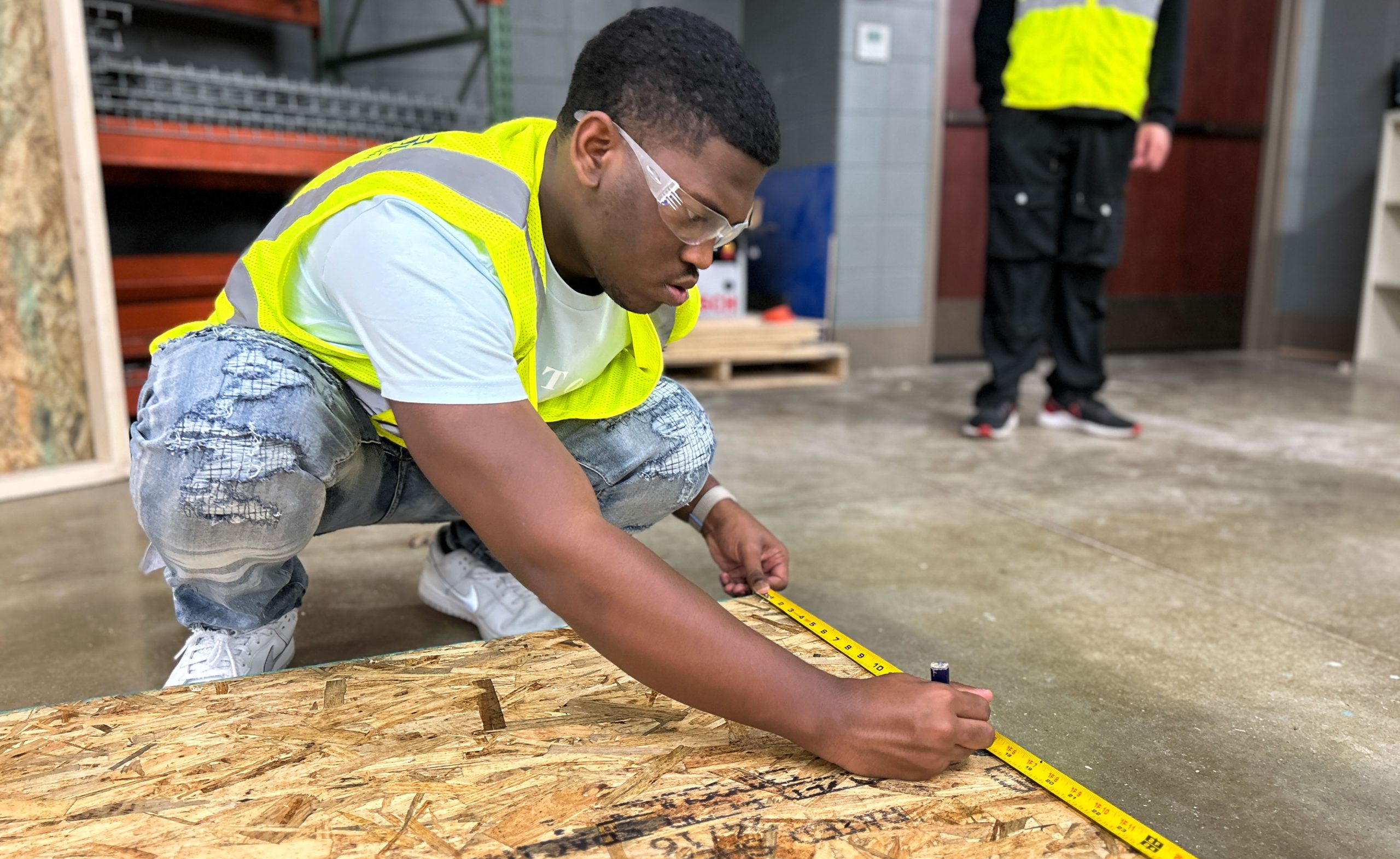
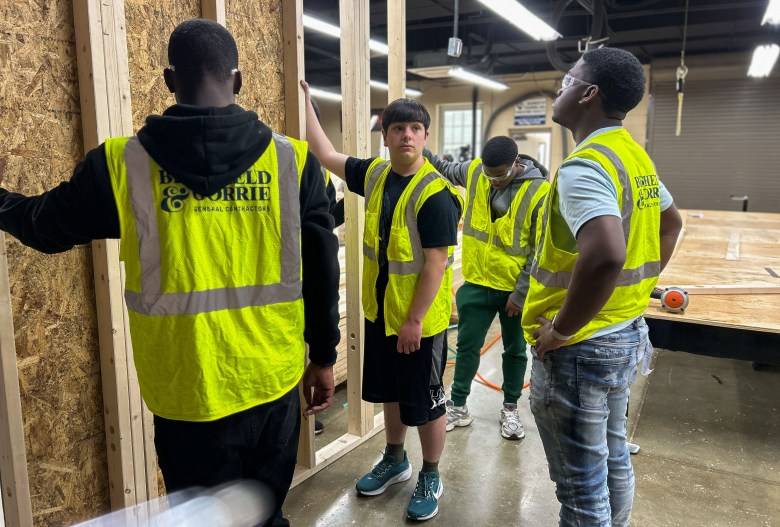
    One recent afternoon in Huffman High School’s architecture class, a few students in bright yellow safety vests were measuring a wall they had built. At the end of the semester, the project will culminate in a tiny home.

    Lucas Giles, a senior, started taking architecture his sophomore year as a way to “be able to fix things around the home without having to call other people,” he said. The new workforce diploma option won’t apply to him since he’s graduating this year, but he said he likely would have opted for it to fit more architecture classes into his schedule — that is, until he learned it would make it harder for him to attend college and study engineering.

    “I wouldn’t have the credits,” Giles realized.

    Students who earn a workforce diploma and end up wanting to go to college after all can enroll in community colleges, or aim for state colleges that have less stringent admissions requirements, said Alabama education chief Eric Mackey. The key to the new diploma will be ensuring school counselors are properly advising students, he added.

    “That’s where the counselor comes in and says, ‘If you want to be a nurse, then yes, you need the practical stuff at the career tech center — taking blood pressure and trauma support — but you also need to be taking biology, physiology, chemistry and all those things, too,’” Mackey said.

    Because the diploma only makes sense for a specific subset of students — those who do not plan to go to a four-year college that requires more math or science and who cannot otherwise fit CTE classes in their schedule — counselors have a huge role to play in guiding students. As of 2023, there were 405 students for every counselor in Alabama’s public schools, well over the recommended ratio of 250 to 1.

    Mackey said the state added career coaches in recent years to ease the counseling workload, but in many districts there is just a single coach, who rotates among schools.

    Samantha Williams, executive director of the nonprofit Birmingham Promise, fears the workforce diploma may shut off students’ options too early. Birmingham Promise helps students in Birmingham City Schools pay college tuition and connects them to internship opportunities while in high school.

    “Do you really think that all of our school districts are preparing students to know what they want to do” by the time they’re in high school, Williams asked.

    Williams also worries that lower-performing students might be steered to this diploma option in order to boost their schools’ rankings.

    Students who opt for the workforce diploma will not have their ACT test scores included in their schools’ public reports. Legislators decided that schools should not have to report standardized test scores for students who did not have to take the requisite math and science classes.

    “The concern a lot of people voiced was ‘Hey, isn’t everyone just going to place the kids who are underperforming in the workforce diploma so their ACT scores don’t bring down the whole?’” Williams said. “There’s a strong perverse incentive for people to do that.”

    Speaking to the state’s Board of Education last fall, Mackey warned the “furor of the state superintendent will come down on” anyone who tries to redirect students toward the workforce diploma because of low ACT scores.

    Related: What happened when a South Carolina city embraced career education for all its students

    At Headland High School in rural Henry County, Alabama, every student takes at least one CTE course, according to Principal Brent Maloy. The most popular classes, he said, are financial management and family consumer science.

    “We don’t force them in — everybody registers themselves, they pick their own classes,” Maloy said. “But there’s just about a zero percent chance that a kid’s not going to have a career tech class when they graduate.”

    The school has hosted information sessions for parents and students about the new diploma option ahead of next school year. In a poll of rising juniors and seniors, 20 percent said they would like to pursue a workforce diploma, and another 30 percent said they might be interested. Maloy is anticipating about 25 percent of students will actually opt in to the pathway.

    Most graduates of Headland enroll in a two-year school after graduation anyway, Maloy said, and the workforce diploma won’t hinder that. But the high school has only one counselor for its 450 students, and making sure students fully understand this diploma pathway — and its limitations — is likely to add pressure and extra responsibilities on counselors with heavy workloads.

    Students hold up the wall of a tiny home they’re building in a career and tech architecture class at Huffman High School in Birmingham, Alabama. Credit: Ariel Gilreath/The Hechinger Report

    “There’s so much pressure on our secondary counselors already just to make sure that all of the boxes are checked before graduation. It’s going to put an extra box for them to check,” Maloy said.

    Ultimately, state businesses and industries want this change, said Mackey, who started his career as a middle and high school science teacher.

    “They were saying, ‘We really need students with skills over, say, calculus,’” Mackey said. “That doesn’t mean some students don’t need calculus — we want to still offer those higher math courses and higher science courses.”

    But, reflecting on his own experience as a high school science teacher, “I can tell you that every student doesn’t need high school chemistry,” Mackey said.

    The chamber of commerce in Mobile, Alabama, is one group that advocated for the workforce diploma. Career tech classes are a good way for students to better learn what they want to do before graduating high school, and they are also an avenue for students to get skills in high wage industries prevalent in Alabama, said Kellie Snodgrass, vice president of workforce development at the Mobile Chamber.

    Less than half of high school graduates in the region end up enrolling in college after graduation, Snodgrass said, and only 20 percent of high-wage jobs in Mobile require a college degree. A large chunk of jobs in the state, and in Mobile in particular, are in manufacturing.

    “It’s terrible when a student goes away to college and comes back and can’t find a job, when we have thousands of open jobs here,” Snodgrass said.

    In an emailed statement, Trevor Sutton, the vice president of economic development at the Birmingham Business Alliance, said the diploma option was a “win for the state of Alabama” that would allow students a chance to learn both “hard and soft skills like communication and time management.”

    Related: States bet big on career education, but struggle to show it works

    At least 11 states have embraced policies that give students flexibility to use career tech courses for core academic credits, according to a review from the Education Commission of the States.

    Like Alabama, Indiana also made changes to its diploma requirements in 2024. After more than a year of public debate, the state created three graduation pathways that are meant to lead to college admissions, the workforce, or enlistment in the military. Those changes will be effective for students in the class of 2029, or current eighth graders.

    Having industry buy-in on career tech programs is important, said Lloyd with All4Ed, because most students will need either an industry or post-secondary credential to land a job with a comfortable wage.

    “The reality is a high school diploma is not enough in today’s labor market to have a guaranteed ticket to the middle class,” Lloyd said.

    The problem, Lloyd said, is most K-12 industry credentials have little use to employers. Only 18 percent of CTE credentials earned by K-12 students in the U.S. were in demand by employers, according to a 2020 report from the Burning Glass Institute.

    The key in Alabama will be ensuring students are going into career pathways that line up with job demand, Snodgrass said. Out of the more than 33,000 CTE credentials Alabama high school students earned in 2023, only 2 percent were in manufacturing, which is one of the state’s highest need areas.

    Still, attitudes toward high school CTE courses — once largely thought of as classes for students who struggled academically — have improved significantly over the years. And many schools offer CTE programs like aerospace, robotics or conservation that could help students get into high-demand undergraduate programs at universities.

    “We’re increasingly blurring the lines between what has been historically siloed in people’s minds in terms of career education versus academic education,” Lloyd said. “Those are very often one and the same.”

    Contact staff writer Ariel Gilreath at [email protected]

    This story about Alabama high school requirements was produced by The Hechinger Report, a nonprofit, independent news organization focused on inequality and innovation in education. Sign up for the Hechinger newsletter

    The Hechinger Report provides in-depth, fact-based, unbiased reporting on education that is free to all readers. But that doesn’t mean it’s free to produce. Our work keeps educators and the public informed about pressing issues at schools and on campuses throughout the country. We tell the whole story, even when the details are inconvenient. Help us keep doing that.

    Join us today.

    Source link

  • En Puerto Rico, la campaña de Trump para desmantelar el Departamento de Educación pega más fuerte

    En Puerto Rico, la campaña de Trump para desmantelar el Departamento de Educación pega más fuerte

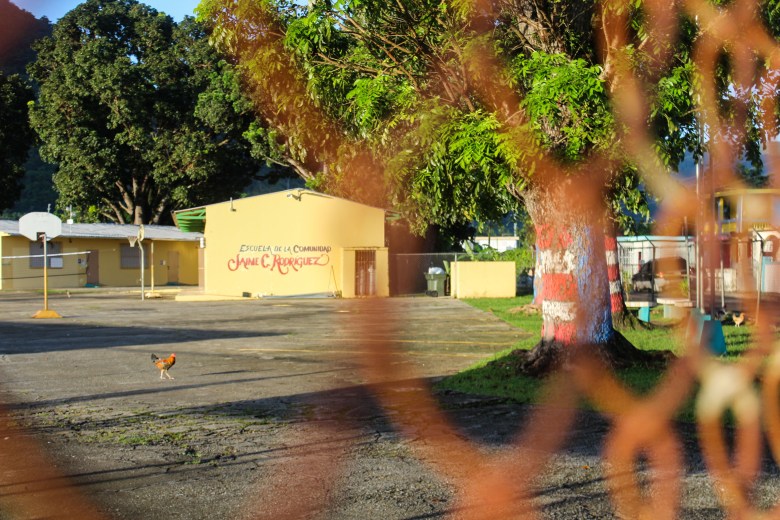
    Maraida Caraballo Martínez es educadora en Puerto Rico desde hace 28 años y directora de la Escuela de la Comunidad Jaime C. Rodríguez desde hace siete. Nunca sabe cuánto dinero recibirá del gobierno cada año porque no se basa en el número de niños matriculados. Un año recibió 36.000 dólares; otro año, 12.000 dólares.

    Pero por primera vez como educador, Caraballo notó una gran diferencia durante la administración Biden. Gracias a una inyección de fondos federales en el sistema educativo de la isla, Caraballo recibió una subvención de 250.000 dólares, una cantidad de dinero sin precedentes. La utilizó para comprar libros y ordenadores para la biblioteca, pizarras e impresoras para las aulas, reforzar el programa de robótica y construir una pista polideportiva para sus alumnos. “Esto significó una gran diferencia para la escuela”, dijo Caraballo.

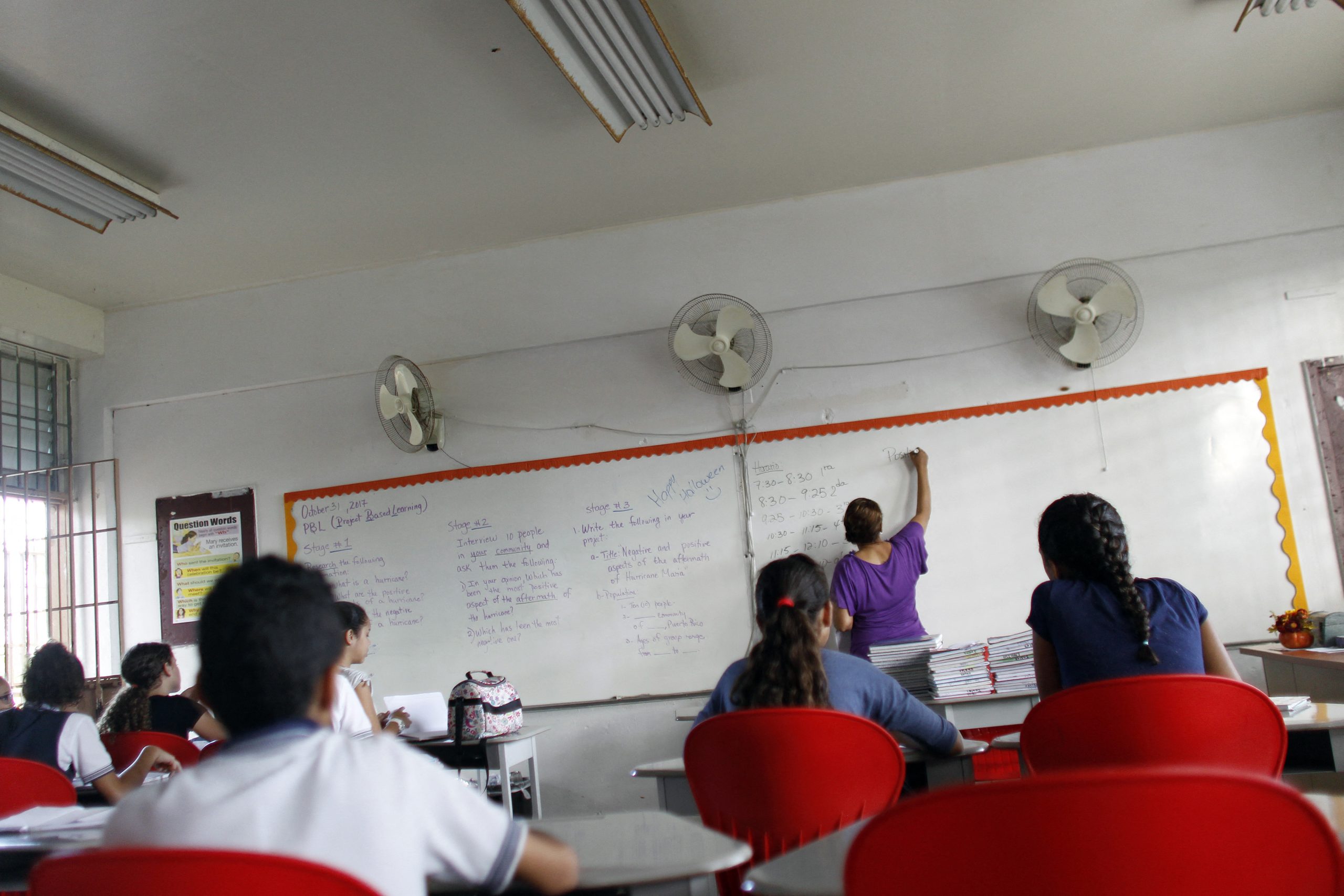
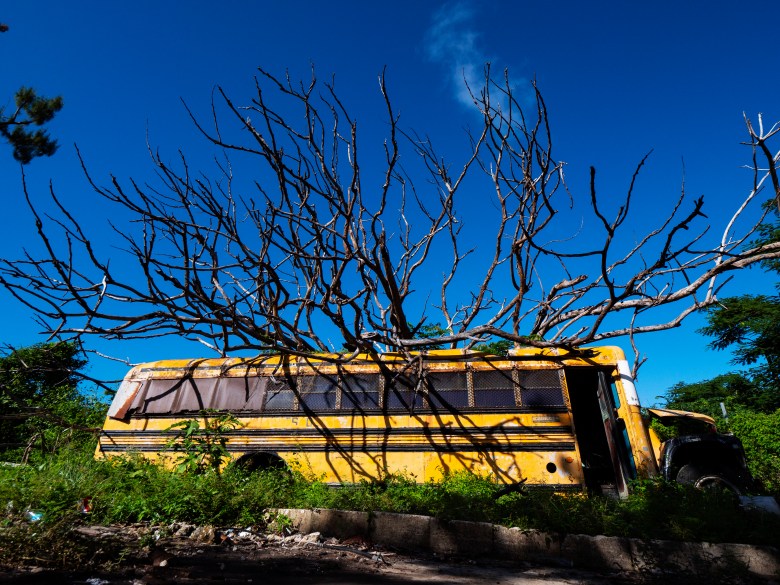
    Yabucoa, un pequeño pueblo del sureste de Puerto Rico, fue una de las regiones más afectadas por el huracán María en 2017. Y esta comunidad escolar, como cientos de otras en la isla, ha experimentado trastornos casi constantes desde entonces. Una serie de desastres naturales, como huracanes, terremotos, inundaciones y deslizamientos de tierra, seguidos de la pandemia de coronavirus en 2020, han golpeado la isla e interrumpido el aprendizaje. También ha habido una rotación constante de secretarios de educación locales: siete en los últimos ocho años. El sistema educativo puertorriqueño -el séptimo distrito escolar más grande de Estados Unidos- se ha vuelto más vulnerable debido a la abrumadora deuda de la isla, la emigración masiva y una red eléctrica paralizada.

    Relacionado: En las aulas de preescolar a secundaria pasan muchas cosas. Mantente al día con nuestro boletín semanal gratuito sobre educación.

    Bajo la presidencia de Joe Biden, se produjeron tímidos avances, respaldados por miles de millones de dólares y una atención personal sostenida por parte de altos funcionarios federales de educación, dijeron muchos expertos y educadores de la isla. Ahora les preocupa que todo se desmantele con el cambio en la Casa Blanca. El presidente Donald Trump no ha ocultado su desdén por el territorio estadounidense, habiendo dicho supuestamente que estaba sucio y que la gente era pobre.” Durante su primer mandato, retuvo miles de millones de dólares en ayuda federal tras el huracán María y ha sugerido vender la isla o cambiarla por Groenlandia.

    Una reciente orden ejecutiva para hacer del inglés el idioma oficial ha preocupado a los habitantes de la isla, donde solo 1 de cada 5 personas habla inglés con fluidez, y el español es el idioma de instrucción en las escuelas. Trump está tratando de eliminar el Departamento de Educación de EE.UU. y ya ha hecho recortes radicales a la agencia, lo que tendrá implicaciones en toda la isla. Incluso si los fondos federales -que el año pasado representaron más de dos tercios del financiamiento del Departamento de Educación de Puerto Rico, o DEPR- se transfirieran directamente al gobierno local, probablemente traerían peores resultados para los niños más vulnerables, dicen los educadores y expertos en políticas públicas. Históricamente, el DEPR ha estado plagado de interferencias políticas, burocracia generalizada y falta de transparencia.

     Maraida Caraballo Martínez ha sido educadora en Puerto Rico durante 28 años y ahora es directora de una escuela primaria. Su escuela ha estado a punto de cerrar tres veces debido a la emigración masiva de la isla. Credit: Kavitha Cardoza for The Hechinger Report

    Y el departamento de educación local no está tan avanzado tecnológicamente como otros departamentos de educación estatales, ni es tan capaz de difundir las mejores prácticas. Por ejemplo, Puerto Rico no dispone de una “fórmula por alumno”, un cálculo utilizado habitualmente en el continente para determinar la cantidad de dinero que recibe cada estudiante para su educación. Roberto Mujica es el director ejecutivo de la Junta de Supervisión y Gestión Financiera de Puerto Rico, convocada por primera vez bajo la presidencia de Barack Obama en 2016 para hacer frente al marasmo financiero de la isla. Mujica dijo que la actual asignación de fondos educativos de Puerto Rico es opaca. “Cómo se distribuyen los fondos se percibe como un proceso político”, dijo. “No hay transparencia ni claridad”.

    En 2021, Miguel Cardona, Secretario de Educación de Biden, prometió “un nuevo día” para Puerto Rico. “Durante demasiado tiempo, los estudiantes y educadores de Puerto Rico fueron abandonados”, dijo. Durante su mandato, Cardona aignó casi 6.000 millones de dólares federales para el sistema educativo de la isla, lo que se tradujo en un aumento salarial histórico para los profesores, financiamiento para programas de tutoría extraescolar, la contratación de cientos de profesionales de salud mental escolar y la creación de un programa piloto para descentralizar el DEPR.

    Cardona designó a un asesor principal, Chris Soto, para que fuera su persona de contacto con el sistema educativo de la isla, subrayando el compromiso del gobierno federal con la isla. Durante casi cuatro años en el cargo, Soto realizó más de 50 viajes a la isla. Carlos Rodríguez Silvestre, director ejecutivo de la Fundación Flamboyán, una organización sin fines de lucro de Puerto Rico que ha dirigido los esfuerzos de alfabetización infantil en la isla, dijo que el nivel de respeto e interés sostenido hicieron sentir que se trataba de una asociación, no un mandato de arriba hacia abajo. “Nunca había visto ese tipo de atención a la educación en Puerto Rico”, afirmó. “Soto prácticamente vivía en la isla”.

    Soto también trabajó estrechamente con Víctor Manuel Bonilla Sánchez, presidente del sindicato de maestros, la Asociación de Maestros de Puerto Rico, o AMPR, lo que dio lugar a un acuerdo por el que los educadores recibieron 1.000 dólares más al mes en su salario base, un aumento de casi el 30% para el maestro promedio. “Fue el mayor aumento salarial en la historia de los maestros de Puerto Rico”, dijo Bonilla, aunque incluso con el aumento, los maestros de aquí siguen ganando mucho menos dinero que sus colegas en el continente.

    Una de las mayores quejas que Soto dijo haber escuchado fue lo rígido y burocrático que era el Departamento de Educación de Puerto Rico, a pesar de una ley de reforma educativa de 2018 que permite un mayor control local. La agencia de educación -la unidad de gobierno más grande de la isla, con la mayor cantidad de empleados y el mayor presupuesto- estaba configurada de manera que la oficina central tenía que aprobar todo. Así que Soto creó y supervisó un programa piloto en Ponce, una región en la costa sur de la isla, enfocado en la descentralización.

    Por primera vez, la comunidad local eligió un consejo asesor de educación, y los candidatos a superintendente tuvieron que postularse en lugar de ser nombrados, dijo Soto. El superintendente recibió autoridad para aprobar directamente las solicitudes presupuestarias en lugar de enviarlas a través de funcionarios de San Juan, así como flexibilidad para gastar el dinero en su región en función de las necesidades de cada escuela.

    En el pasado, eso no se tenía en cuenta: Por ejemplo, Yadira Sánchez, psicóloga que lleva más de 20 años trabajando en la educación puertorriqueña, recuerda cuando una escuela recibió docenas de aires acondicionados nuevos aunque no los necesitaba. “Ya tenían aires acondicionados que funcionaban”, dice, “así que ese dinero se perdió”.

    Relacionado: Las amenazas de deportación de Trump pesan sobre los grupos que ofrecen ayuda con la FAFSA

    El proyecto piloto también se centró en aumentar la eficiencia. Por ejemplo, ahora se evalúa a los niños discapacitados en sus colegios, en lugar de tener que acudir a un centro especial. Y Soto dice que también intentó eliminar el uso de influencias y aumentar la transparencia en torno al gasto en el PRDE. “Puedes mejorar las facturas, pero si tus amigos políticos son los que se quedancon los trabajos, entonces no tienes un buen sistema escolar”, dijo.

    Bajo el mandato de Biden, Puerto Rico también recibió una subvención competitiva o grant  del Departamento de Educación de EE.UU. por valor de 10,5 millones de dólares para escuelas comunitarias, otro hito. Y el departamento federal empezó a incluir datos sobre el territorio en algunas estadísticas educativas recopiladas. “Puerto Rico ni siquiera figuraba en estos indicadores, así que empezamos a preguntarnos cómo mejorar los sistemas de datos. Desentrañar el problema de los datos significó que Puerto Rico puede ser debidamente reconocido”, dijo Soto.

    Pero ya hay planes para deshacer el esfuerzo de Cardona en Ponce. La recién elegida gobernadora de la isla, Jenniffer González Colón, es republicana y partidaria de Trump. El popular secretario de Educación, Eliezer Ramos Parés, regresó a principios de este año al frente del departamento tras dirigirlo desde abril de 2021 hasta julio de 2023, cuando la gobernadora le pidió inesperadamente que dimitiera, algo nada inusual en el gobierno de la isla, donde los nombramientos políticos pueden terminar de repente y con poco debate público. Ramos dijo a The Hechinger Report que el programa no continuará en su forma actual, calificándolo de “ineficiente”.

    “El programa piloto no es realmente eficaz”, dijo, señalando que la política puede influir en las decisiones de gasto no sólo a nivel central, sino también a nivel regional. “Queremos tener algunos controles”. También dijo que ampliar la iniciativa a toda la isla costaría decenas de millones de dólares. En su lugar, Ramos dijo que estaba estudiando enfoques más limitados de la descentralización, en torno a algunas funciones de recursos humanos y adquisiciones. Dijo que también estaba explorando una fórmula de financiación por alumno para Puerto Rico y estudiando las lecciones de otros grandes distritos escolares como la ciudad de Nueva York y Hawai.

    Un autobús escolar bajo un árbol que cayó durante el huracán María, que azotó la isla de Puerto Rico en septiembre de 2017. Más de un año después, no había sido retirado. Credit: Al Bello/Getty Images for Lumix

    Aunque la educación ha sido la mayor partida presupuestaria de la isla durante años, sigue siendo mucho menos de lo que cualquiera de los 50 estados gasta en cada estudiante. Puerto Rico gasta 9.500 dólares por estudiante, frente a una media de 18.600 dólares en los estados.

    El Departamento de Educación de EE.UU., que complementa la financiación local y estatal para los estudiantes en situación de pobreza y con discapacidades, tiene un papel desproporcionado en las escuelas de Puerto Rico. En la isla, el 55% de los niños viven por debajo del umbral de la pobreza, frente al 17% en los 50 estados; en el caso de los estudiantes de educación especial, las cifras son del 35% y el 15%, respectivamente. En total, durante el año fiscal 2024, más del 68 por ciento del presupuesto de educación en la isla procede de fondos federales, frente al 11 por ciento en los estados de EE UU. El departamento también administra las becas Pell para estudiantes de bajos ingresos -alrededor del 72 por ciento de los estudiantes puertorriqueños las solicitan- y apoya los esfuerzos de desarrollo profesional y las iniciativas para los niños puertorriqueños que van y vienen entre el continente y el territorio.

    Linda McMahon, la nueva secretaria de Educación de Trump, ha dicho supuestamente que el Gobierno seguirá cumpliendo sus “obligaciones legales” con los estudiantes aunque el departamento cierre o transfiera algunas operaciones y despida personal. El Departamento de Educación de Estados Unidos no respondió a las solicitudes de comentarios para esta historia.

    Algunos dicen que el hecho de que la administración Biden haya vertido miles de millones de dólares en un sistema educativo en problemas con escasa rendición de cuentas ha creado expectativas poco realistas y no hay un plan para lo que ocurre después de que se gasta el dinero. Mujica, director ejecutivo de la junta de supervisión, dijo que la infusión de fondos pospuso la toma de decisiones difíciles por parte del gobierno puertorriqueño. “Cuando se tiene tanto dinero, se tapan muchos problemas. No tienes que enfrentarte a algunos de los retos que son fundamentales para el sistema”. Y afirmó que apenas se habla de lo que ocurrirá cuando se acabe ese dinero. “¿Cómo se va a llenar ese vacío? O desaparecen esos programas o tendremos que encontrar la financiación para ellos”, dijo Mujica.

    Dijo que esfuerzos como el de Ponce para acercar la toma de decisiones a donde están las necesidades de los estudiantes es “de vital importancia”. Aún así, dijo que no está seguro de que el dinero haya mejorado los resultados de los estudiantes. “Esta era una gran oportunidad para hacer cambios fundamentales e inversiones que produzcan resultados a largo plazo. No estoy seguro de que hayamos visto las métricas que lo respalden”.

    Relacionado: ¿Un trabajo demasiado bien hecho?

    Puerto Rico es una de las regiones más empobrecidas desde el punto de vista educativo, con unos resultados académicos muy inferiores a los del continente. En la parte de matemáticas de la Evaluación Nacional de Progreso Educativo, o NAEP, una prueba que realizan los estudiantes de todo EE.UU., sólo el 2% de los alumnos de cuarto curso de Puerto Rico calificaron como competentes, la puntuación más alta jamás registrada en la isla, y el 0% de los alumnos de octavo curso lo fueron. Los estudiantes puertorriqueños no hacen la prueba NAEP de lectura porque aprenden en español, no en inglés, aunque los resultados compartidos por Ramos en una conferencia de prensa en 2022 mostraron que sólo el 1% de los estudiantes de tercer grado leían a nivel de grado.

    Hay algunos esfuerzos alentadores. La Fundación Flamboyán ha liderado una coalición de 70 socios en toda la isla para mejorar la alfabetización de los niños de preescolar a tercer grado, entre otras cosas mediante el desarrollo profesional. La formación del profesorado a través del departamento de educación del territorio ha sido a menudo irregular u opcional.

    La organización trabaja ahora en estrecha colaboración con la Universidad de Puerto Rico y, como parte de ese esfuerzo, supervisa el gasto de 3 millones de dólares en formación para la alfabetización. Aproximadamente 1.500 profesores de Puerto Rico (un tercio de los maestros de Kinder a 5º grado) han recibido esta rigurosa formación. Los educadores recibieron 500 dólares como incentivo por participar, además de libros para sus aulas y tres horas de formación continua. “Fueron muchas horas de calidad. No ha sido el método de ‘rociar (con un poco de agua) y rezar’”, dijo Silvestre. Ese esfuerzo continuará, según Ramos, que lo calificó de “muy eficaz”.

    Una nueva prueba de lectura para alumnos de primero a tercer grado que la organización sin fines de lucro ayudó a diseñar mostró que entre los años escolares 2023 y 2024, la mayoría de los niños estaban por debajo del nivel del grado, pero hubo avances en los resultados en todos los grados. “Pero aún nos queda un largo camino por recorrer para que estos datos lleguen a los profesores a tiempo y de forma que puedan actuar en consecuencia”, dijo Silvestre.

    Kristin Ehrgood, Directora General de la Fundación Flamboyán, afirma que es demasiado pronto para ver resultados espectaculares. “Es realmente difícil ver una tonelada de resultados positivos en un período tan corto de tiempo con la desconfianza significativa que se ha construido durante años”, dijo. Dijo que no estaban seguros de cómo la administración Trump podría trabajar o financiar el sistema educativo de Puerto Rico, pero que la administración Biden había construido una gran cantidad de buena voluntad. “Hay muchas oportunidades que podrían aprovecharse, si una nueva administración decide hacerlo”.

    Otra señal esperanzadora es que la junta de supervisión, que fue muy protestada cuando se formó, ha reducido la deuda de la isla de 73.000 a 31.000 millones de dólares. Y el año pasado los miembros de la junta aumentaron el gasto en educación en un 3%. Mujica dijo que la junta se centra en asegurarse de que cualquier inversión se traduzca en mejores resultados para los estudiantes: “Nuestra opinión es que los recursos tienen que ir a las aulas”.

    Relacionado: Un pequeño pueblo rural en Nebraska necesitaba más cuidado infantil en español. Esto fue lo que se hizo para obtenerlo

    Betty A. Rosa, comisionada de educación y presidente de la Universidad del Estado de Nueva York y miembro de la Junta de Supervisión, afirmó que la inestabilidad educativa en Puerto Rico se debe a los cambios en el liderazgo. Cada nuevo líder se dedica a “reconstruir, reestructurar, reimaginar, elija la palabra que elija”, dijo. “No hay coherencia”. A diferencia de su cargo en el estado de Nueva York, el Secretario de Educación de Puerto Rico y otros cargos son nombramientos políticos. “Si tienes un gobierno permanente, aunque cambie el liderazgo, el trabajo continúa”.

    Ramos, que vivió esta inestabilidad cuando el anterior gobernador pidió inesperadamente su dimisión en 2023, dijo que se reunió con McMahon, la nueva secretaria de Educación de EE.UU., en Washington, D.C., y que mantuvieron una “agradable conversación”. “Ella sabe de Puerto Rico, se preocupa por Puerto Rico y demostró total apoyo en la misión de Puerto Rico”, dijo. Dijo que McMahon quería que el DEPR ofreciera más clases bilingües, para exponer a más estudiantes al inglés. Queda por ver si habrá cambios en la otorgación de fondos o cualquier otra cosa. “Tenemos que ver lo que ocurre en las próximas semanas y meses y cómo esa visión y esa política podrían afectar a Puerto Rico”, dijo Ramos.

    La Escuela de la Comunidad Jaime C. Rodríguez es una escuela Montessori de Yabucoa, Puerto Rico, que carecía de instalaciones deportivas para sus alumnos. Recientemente comenzó las obras de un centro deportivo polivalente gracias a los fondos federales otorgados por la administración del presidente Biden. Credit: Kavitha Cardoza for The Hechinger Report

    Ramos fue muy apreciado por los educadores durante su primera etapa como Secretario de Educación. También tendrá que tomar muchas decisiones, como ampliar las escuelas charter y cerrar las escuelas públicas tradicionales, ya que la matriculación en las escuelas públicas de la isla sigue disminuyendo vertiginosamente. En el pasado, ambas cuestiones provocaron protestas feroces y generalizadas.

    Soto es realista y cree que la nueva administración tendrá “puntos de vista diferentes, tanto ideológica como políticamente”, pero confía en que el pueblo de Puerto Rico no quiera volver a la antigua forma de hacer las cosas. “Alguien dijo: ‘Ustedes sacaron al genio de la botella y va a ser difícil volver a ponerlo’ en lo que se refiere a un sistema escolar centrado en el estudiante”, dijo Soto.

    Cardona, cuyos abuelos son oriundos de la isla, dijo que Puerto Rico había experimentado un “estancamiento académico” durante años. “No podemos aceptar que los estudiantes rindan menos de lo que sabemos que son capaces”, dijo a The Hechinger Report, justo antes de despedirse como máximo responsable de educación del país. “Empezamos el cambio; tiene que continuar.

    La pequeña escuela de la directora Carabello, con 150 alumnos y 14 profesores, ha estado a punto de cerrarse ya tres veces, aunque en todas ellas se ha salvado en parte gracias al apoyo de la comunidad. Carabello confía en que Ramos, con quien ya ha trabajado anteriormente, cambie las cosas. “Conoce el sistema educativo”, afirma. “Es una persona brillante, abierta a escuchar”.  

    Pero las largas jornadas de los últimos años le han pasado factura. Suele estar en la escuela de 6:30 a.m. a 6:30 p.m. “Entras cuando anochece y te vas cuando anochece”, dice. Ha habido muchas plataformas nuevas que aprender y nuevos proyectos que poner en marcha. Quiere jubilarse, pero no puede permitírselo. Tras décadas en las que el gobierno local no financió suficientemente el sistema de pensiones, se recortaron los subsidios que compensaban el alto precio de los bienes y servicios en la isla y se congelaron los planes de pensiones.

    Ahora, en lugar de jubilarse con el 75% de su salario, Carabello recibirá sólo el 50%, 2.195 dólares al mes. Tiene derecho a prestaciones de la Seguridad Social, pero no son suficientes para compensar la pensión perdida. “¿Quién puede vivir con 2.000 dólares en un mes? Nadie. Es demasiado duro. Y mi casa aún necesita 12 años más para pagarse”.

    A Carabello, siempre tan fuerte y optimista con sus alumnos, se le saltaron las lágrimas. Pero es raro que se permita tiempo para pensar en sí misma. “Tengo una gran comunidad. Tengo grandes profesores y me siento feliz con lo que hago”, afirma.

    Está muy, muy cansada. 

    Comunícate con editora Caroline Preston al 212-870-8965 o [email protected].

    Este artículo sobre el Departamento de Educación y Puerto Rico fue producido por The Hechinger Report, una organización de noticias independiente sin fines de lucro centrada en la desigualdad y la innovación en la educación. Suscríbete a nuestro boletín de noticias.

    The Hechinger Report provides in-depth, fact-based, unbiased reporting on education that is free to all readers. But that doesn’t mean it’s free to produce. Our work keeps educators and the public informed about pressing issues at schools and on campuses throughout the country. We tell the whole story, even when the details are inconvenient. Help us keep doing that.

    Join us today.

    Source link

  • For Puerto Rican schools, Trump’s campaign to dismantle the Department of Education has a particular bite

    For Puerto Rican schools, Trump’s campaign to dismantle the Department of Education has a particular bite

    Maraida Caraballo Martinez has been an educator in Puerto Rico for 28 years and the principal of the elementary school Escuela de la Communidad Jaime C. Rodriguez for the past seven. She never knows how much money her school in Yabucoa will receive from the government each year because it isn’t based on the number of children enrolled. One year she got $36,000; another year, it was $12,000.

    But for the first time as an educator, Caraballo noticed a big difference during the Biden administration. Because of an infusion of federal dollars into the island’s education system, Caraballo received a $250,000 grant, an unprecedented amount of money. She used it to buy books and computers for the library, white boards and printers for classrooms, to beef up a robotics program and build a multipurpose sports court for her students. “It meant a huge difference for the school,” Caraballo said.

    Yabucoa, a small town in southeast Puerto Rico, was one of the regions hardest hit by Hurricane Maria in 2017. And this school community, like hundreds of others in Puerto Rico, has experienced near constant disruption since then. A series of natural disasters, including hurricanes, earthquakes, floods and landslides, followed by the coronavirus pandemic in 2020, has pounded the island and interrupted learning. There has also been constant churn of local education secretaries — seven in the past eight years. The Puerto Rican education system — the seventh-largest school district in the United States — has been made more vulnerable by the island’s overwhelming debt, mass emigration and a crippled power grid.

    Maraida Caraballo Martinez has been an educator in Puerto Rico for 28 years and is now the principal of an elementary school. Her school has been slated for closure three times because of mass emigration from the island. Credit: Kavitha Cardoza for The Hechinger Report

    Under President Joe Biden, there were tentative gains, buttressed by billions of dollars and sustained personal attention from top federal education officials, many experts and educators on the island said. Now they worry that it will all be dismantled with the change in the White House. President Donald Trump has made no secret of his disdain for the U.S. territory, having reportedly said that it was “dirty and the people were poor.” During his first term, he withheld billions of dollars in federal aid after Hurricane Maria and has suggested selling the island or swapping it for Greenland. 

    A recent executive order to make English the official language has worried people on the island, where only 1 in 5 people speak fluent English, and Spanish is the medium of instruction in schools. Trump is seeking to eliminate the U.S. Department of Education and has already made sweeping cuts to the agency, which will have widespread implications across the island. Even if federal funds — which last year made up more than two thirds of funding for the Puerto Rican Department of Education, or PRDE — were transferred directly to the local government, it would likely lead to worse outcomes for the most vulnerable children, say educators and policymakers. The PRDE has historically been plagued by political interference, widespread bureaucracy and a lack of transparency.

    And the local education department is not as technologically advanced as other state education departments, nor as able to disseminate best practices. For example, Puerto Rico does not have a “per pupil formula,” a calculation commonly used on the mainland to determine the amount of money each student receives for their education. Robert Mujica is the executive director of the Puerto Rico Financial Oversight and Management Board, first convened under President Barack Obama in 2016 to deal with the island’s financial morass. Mujica said Puerto Rico’s current allocation of education funds is opaque. “How the funds are distributed is perceived as a political process,” he said. “There’s no transparency and there’s no clarity.”

    Related: Become a lifelong learner. Subscribe to our free weekly newsletter featuring the most important stories in education.

    In 2021, Miguel Cardona, Biden’s secretary of education, promised “a new day” for Puerto Rico. “For too long, Puerto Rico’s students and educators were abandoned,” he said. During his tenure, Cardona signed off on almost $6 billion in federal dollars for the island’s educational system, leading to a historic pay increase for teachers, funding for after-school tutoring programs, hiring of hundreds of school mental health professionals and the creation of a pilot program to decentralize the PRDE.

    Cardona designated a senior adviser, Chris Soto, to be his point person for the island’s education system to underscore the federal commitment. During nearly four years in office, he made more than 50 trips to the island. Carlos Rodriguez Silvestre, the executive director of the Flamboyan Foundation, a nonprofit in Puerto Rico that has led children’s literacy efforts on the island, said the level of respect and sustained interest felt like a partnership, not a top-down mandate. “I’ve never seen that kind of attention to education in Puerto Rico,” he said. “Soto practically lived on the island.”

    Soto also worked closely with Victor Manuel Bonilla Sánchez, the president of the teachers union, Asociación de Maestros de Puerto Rico, or AMPR, which resulted in a deal in which educators received $1,000 more a month to their base salary, a nearly 30 percent increase for the average teacher. “It was the largest salary increase in the history of teachers in Puerto Rico,” Bonilla said, though even with the increase, teachers here still make far less money than teachers on the mainland.

    One of the biggest complaints Soto said he heard was how rigid and bureaucratic the Puerto Rico Department of Education was, despite a 2018 education reform law that allows for more local control. The education agency — the largest unit of government on the island, with the most employees and the biggest budget — was set up so that the central office had to sign off on everything. So Soto created and oversaw a pilot program in Ponce, a region on the island’s southern coast, focusing on decentralization.

    For the first time, the local community elected an advisory board of education, and superintendent candidates had to apply rather than be appointed, Soto said. The superintendent was given the authority to sign off on budget requests directly rather than sending them through officials in San Juan, as well as the flexibility to spend money in his region based on individual schools’ needs.

    In the past, that wasn’t a consideration: For example, Yadira Sanchez, a psychologist who has worked in Puerto Rican education for more than 20 years, remembers when a school got dozens of new air conditioners even though it didn’t need it. “They already had functioning air conditioners,” she said, “so that money was lost.”

    The pilot project also focused on increasing efficiency. For example, children with disabilities are now evaluated at their schools rather than having to visit a special center. And Soto says he tried to remove politics and increase transparency around spending in the PRDE as well. “You can improve invoices, but if your political friends are getting the work, then you don’t have a good school system,” he said.

    A school bus under a tree that fell during Hurricane Maria, which hit the island of Puerto Rico in September 2017. More than a year later, it had not been removed. Credit: Al Bello/Getty Images for Lumix

    Under Biden, Puerto Rico also received a competitive U.S. Department of Education grant for $10.5 million for community schools, another milestone. And the federal department started including data on the territory in some education statistics collected. “Puerto Rico wasn’t even on these trackers, so we started to dig into how do we improve the data systems? Unraveling the data issue meant that Puerto Rico can properly get recognized,” Soto said.

    But already there are plans to undo Cardona’s signature effort in Ponce. The island’s newly elected governor, Jenniffer González Colón, is a Republican and a Trump supporter. The popular secretary of education, Eliezer Ramos Parés, returned earlier this year to head the department after leading it from April 2021 to July 2023 when the governor unexpectedly asked him to resign — not an unusual occurrence within the island’s government, where political appointments can end suddenly and with little public debate. He told The Hechinger Report that the program won’t continue in its current form, calling it “inefficient.”

    “The pilot isn’t really effective,” he said, noting that politics can influence spending decisions not only at the central level but at the regional level as well. “We want to have some controls.” He also said expanding the effort across the island would cost tens of millions of dollars. Instead, Ramos said he was looking at more limited approaches to decentralization, around some human resource and procurement functions. He said he was also exploring a per pupil funding formula for Puerto Rico and looking at lessons from other large school districts such as New York City and Hawaii.

    Related: In Puerto Rico, the odds are against high school grads who want to go to college

    While education has been the largest budget item on the island for years, it’s still far less than any of the 50 states spend on each student. Puerto Rico spends $9,500 per student, compared with an average of $18,600 in the states.

    The U.S. Department of Education, which supplements local and state funding for students in poverty and with disabilities, has an outsized role in Puerto Rico schools. On the island, 55 percent of children live below the poverty line, compared with 17 percent in the 50 states; for students in special education, the figures are 35 percent and 15 percent, respectively. In total, during fiscal year 2024, more than 68 percent of the education budget on the island comes from federal funding, compared to 11 percent in U.S. states. The department also administers Pell Grants for low-income students — some 72 percent of Puerto Rican students apply — and supports professional development efforts and initiatives for Puerto Rican children who move back and forth between the mainland and territory.

    Linda McMahon, Trump’s new education secretary, has reportedly said that the government will continue to meet its “statutory obligations” to students even as the department shuts down or transfers some operations and lays off staff. The U.S. Department of Education did not respond to requests for comment.

    Some say the Biden administration’s pouring billions of dollars into a troubled education system with little accountability has created unrealistic expectations and there’s no plan for what happens after money is spent. Mujica, the executive director of the oversight board, said the infusion of funds postponed tough decisions by the Puerto Rican government. “When you have so much money, it papers over a lot of problems. You didn’t have to deal with some of the challenges that are fundamental to the system.” And he said there is little discussion of what happens when that money runs out. “How are you going to bridge that gap? Either those programs go away or we’re going to have to find the funding for them,” Mujica said.

    He said efforts like the one in Ponce to bring decision making closer to where the students’ needs are is “vitally important.” Still, he said he’s not sure the money improved student outcomes. “This was a huge opportunity to make fundamental changes and investments that will yield long-term results. I’m not sure that we’ve seen the metrics to support that.”

    Related: Are the challenges of Puerto Rico’s schools a taste of what other districts will face?

    Puerto Rico is one of the most educationally impoverished regions, with academic outcomes well below the mainland. On the math portion of the National Assessment of Educational Progress, or NAEP, a test that students across the U.S. take, just 2 percent of fourth graders in Puerto Rico were proficient, the highest score ever recorded for the island, and zero percent of eighth graders were. Puerto Rican students don’t take the NAEP for reading because they learn in Spanish, not English, though results shared by Ramos at a press conference in 2022 showed only 1 percent of third graders were reading at grade level.

    There are some encouraging efforts. Flamboyan Foundation, the nonprofit in Puerto Rico, has been leading an island-wide coalition of 70 partners to improve K-3 literacy, including through professional development. Teacher training through the territory’s education department has often been spotty or optional.

    The organization now works closely with the University of Puerto Rico and, as part of that effort, oversees spending of $3 million in literacy training. Approximately 1,500 or a third of Puerto Rico’s K-5 teachers have undergone the rigorous training. Educators were given $500 as an incentive for participating, along with books for their classrooms and three credit hours in continuing education. “It was a lot of quality hours. This was not the ‘spray and pray’ approach,” said Silvestre. That effort will continue, according to Ramos, who called it “very effective.”

    A new reading test for first through third graders the nonprofit helped design showed that between the 2023 and 2024 school years, most children were below grade level but made growth in every grade. “But we still have a long way to go so that this data can get to teachers in a timely manner and in a way that they can actually act on it,” Silvestre said.

    Kristin Ehrgood, Flamboyan Foundation’s CEO, said it’s too soon to see dramatic gains. “It’s really hard to see a ton of positive outcomes in such a short period of time with significant distrust that has been built over years,” she said. She said they weren’t sure how the Trump administration may work with or fund Puerto Rico’s education system but that the Biden administration had built a lot of goodwill. “There is a lot of opportunity that could be built on, if a new administration chooses to do that.”

    Another hopeful sign is that the oversight board, which was widely protested when it was formed, has cut the island’s debt from $73 billion to $31 billion. And last year board members increased education spending by 3 percent. Mujica said the board is focused on making sure that any investment translates into improved outcomes for students: “Our view is resources have to go into the classroom.”

    Related: A superintendent made big gains with English learners. His success may have been his downfall

    Betty A. Rosa, education commissioner and president of the University of the State of New York and a member of the oversight board, said leadership churn in Puerto Rico drives its educational instability. Every new leader is invested in “rebuilding, restructuring, reimagining, pick your word,” she said. “There is no consistency.” Unlike her New York state position, the Puerto Rican education secretary and other positions are political appointments. “If you have permanent governance, then even when the leadership changes, the work continues.”

    Ramos, who experienced this instability when the previous governor unexpectedly asked to resign in 2023, said he met McMahon, the new U.S. secretary of education, in Washington, D.C., and that they had a “pleasant conversation.” “She knows about Puerto Rico, she’s concerned about Puerto Rico, and she demonstrated full support in the Puerto Rico mission,” he said. He said McMahon wanted PRDE to offer more bilingual classes, to expose more students to English. Whether there will be changes in funding or anything else remains to be seen. “We have to look at what happens in the next few weeks and months and how that vision and policy could affect Puerto Rico,” Ramos said.

    Ramos was well-liked by educators during his first stint as education secretary. He will also have a lot of decisions to make, including whether to expand public charter schools and close down traditional public schools as the island’s public school enrollment continues to decline precipitously. In the past, both those issues led to fierce and widespread protests.

    Soto says he’s realistic about the incoming administration having “different views, both ideologically and policywise,” but he’s hopeful the people of Puerto Rico won’t want to go back to the old way of doing things. “Somebody said, ‘You guys took the genie out of the bottle and it’s going to be hard to put that back’ as it relates to a student-centered school system,” Soto said.

    Cardona, whose grandparents are from the island, said Puerto Rico had seen “academic flatlining” for years. “We cannot accept that the students are performing less than we know they are capable of,” he told The Hechinger Report, just before he signed off as the nation’s top education official. “We started change; it needs to continue.”

    Related: What’s left after a mass exodus of young people from Puerto Rico?

    Principal Carabello’s small school of 150 students and 14 teachers has been slated for closure three times already, though each time it has been spared in part because of community support. She’s hopeful that Ramos, with whom she’s worked previously, will turn things around. “He knows the education system,” she said. “He’s a brilliant person, open to listen.”  

    Escuela de la Communidad Jaime C. Rodriguez is a Montessori school in Yabucoa, Puerto Rico, that did not have any sports facilities for its students. It recently began work on a multipurpose sports center, made possible by federal funds under former President Joe Biden. Credit: Kavitha Cardoza for The Hechinger Report

    But the long hours of the past several years have taken a toll on her. She is routinely in school from 6:30 a.m. to 6:30 p.m. “You come in when it’s dark and you leave when it’s dark,” she said. There have been many new platforms to learn and new projects to implement. She wants to retire but can’t afford to. After decades of the local government underfunding the pension system, allowances that offset the high price of goods and services on the island were cut and pension plans were frozen.

    Now instead of retiring with 75 percent of her salary, Carabello will receive only 50 percent, $2,195 a month. She is entitled to Social Security benefits, but it isn’t enough to make up for the lost pension. “Who can live with $2,000 in one month? Nobody. It’s too hard. And my house still needs 12 years more to pay.”

    Carabello, who is always so strong and so optimistic around her students, teared up. But it’s rare that she allows herself time to think about herself. “I have a great community. I have great teachers and I feel happy with what I do,” she said.

    She’s just very, very tired. 

    This story about Puerto Rican schools was produced by The Hechinger Report, a nonprofit, independent news organization focused on inequality and innovation in education. Sign up for the Hechinger newsletter.

    The Hechinger Report provides in-depth, fact-based, unbiased reporting on education that is free to all readers. But that doesn’t mean it’s free to produce. Our work keeps educators and the public informed about pressing issues at schools and on campuses throughout the country. We tell the whole story, even when the details are inconvenient. Help us keep doing that.

    Join us today.

    Source link