North Carolina is taking bold steps to democratize college access with the expansion of its NC College Connect program, which will offer direct admission to more than 62,000 public high school seniors this fall. The initiative represents a significant shift toward equity-focused admissions practices that prioritize accessibility over traditional application barriers.
The program targets students who complete their junior year with a weighted GPA of 2.8 or higher. By eliminating the often overwhelming application process, NC College Connect removes financial and procedural obstacles that disproportionately affect first-generation college students and those from underrepresented communities.
“NC College Connect represents a fundamental shift in how we approach college admissions in North Carolina,” said Peter Hans, President of the University of North Carolina System. The initiative reflects growing national recognition that traditional admissions processes can perpetuate educational inequities.
Maurice “Mo” Green, State Superintendent of Public Instruction, praised the collaborative nature of the effort.
“When our entire education community works together like this, students win. NC College Connect removes barriers and creates clear pathways to college for thousands of our students,” he said.
The program’s inclusive design addresses systemic challenges that have historically limited college access for students from diverse backgrounds. By providing direct admission letters and eliminating complex application requirements, the initiative particularly benefits students who might otherwise be deterred by navigating multiple institutional processes.
Participating institutions span the full spectrum of North Carolina’s higher education landscape, including UNC System universities, independent colleges and universities, and community colleges. This comprehensive approach ensures students have pathways to various types of post-secondary education that align with their academic goals and financial circumstances.
Dr. Jeff Cox, President of the North Carolina Community College System, highlighted the program’s potential to transform access to affordable education.
“By removing barriers and simplifying the process, we’re helping more students access the life-changing opportunities our community colleges provide—close to home and at a price they can afford,” he said.
Community colleges have long served as crucial entry points for students from diverse socioeconomic backgrounds, offering both career preparation and transfer pathways to four-year institutions. The inclusion of community colleges in NC College Connect recognizes their vital role in democratizing higher education access.
The program’s commitment to equity extends beyond admissions to address affordability concerns through targeted financial aid initiatives. The Next NC Scholarship and NC Need-Based Scholarship specifically support students from households earning $80,000 or less, covering tuition and fees at participating institutions.
Additionally, students attending Elizabeth City State University, Fayetteville State University, University of North Carolina at Pembroke, and Western Carolina University benefit from the NC Promise plan’s $500 per semester tuition rate. These historically Black institutions and regional universities serve particularly diverse student populations, making the affordable tuition structure especially impactful for underrepresented students.
Hope Williams, President of North Carolina Independent Colleges and Universities, noted the unique value proposition of smaller institutions: the personalized attention and specialized programs that can be particularly beneficial for students who might struggle in larger university environments.
The program builds on a successful pilot year that served more than 70,000 students, demonstrating the demand for streamlined college access. The expansion indicates that initial outcomes validated the approach’s effectiveness in connecting students with higher education opportunities.
Students can verify their eligibility through the NCCollegeConnect.com portal or by consulting with high school counselors, ensuring multiple touchpoints for information and support. Eligible seniors will receive official admission letters this fall for the 2026-27 academic year, providing ample time for planning and preparation.
NC College Connect positions North Carolina as a leader in reimagining college admissions to prioritize access and equity. As higher education institutions nationwide grapple with declining enrollment and questions about traditional admissions practices, North Carolina’s comprehensive approach offers a replicable model for other states.
The initiative’s success will likely be measured not just in enrollment numbers, but in its ability to diversify the state’s college-going population and create pathways for students who might otherwise forego higher education. By removing procedural barriers and addressing financial constraints, NC College Connect represents a holistic approach to educational equity that extends well beyond the admissions office.
Today’s middle schoolers continue to struggle post-pandemic to read and write at the level needed to successfully navigate more complex academic content in the upper grades and beyond, according to a new report from NWEA, a K-12 assessment and research organization.
Based on NWEA’s research, current 8th graders would need close to a full academic year of additional instruction to catch up to their pre-pandemic peers in reading. This trend was reiterated in recent assessment results from the National Assessment on Educational Progress (NAEP), with only 30 percent of eighth-grade students performing at or above the NAEP proficient level.
While early literacy initiatives have garnered attention in recent years, the fact remains that many students struggle to read and are not prepared for the rigors of middle school. Students quickly find themselves challenged to keep up as they no longer receive explicit, structured reading instruction, even as they are expected to comprehend increasingly complex materials across subjects, like science, history, or English Language Arts.
“Our current middle and high schoolers were just starting their literacy journey when the pandemic hit, and we cannot lessen the urgency to support them. But, middle school literacy is complex even for students who are reading on grade level. This demands intentional, well-funded, and focused policy leadership that includes support across the K-12 spectrum,” said Daughtery. “Simply put, learning to read is not done when a student exits elementary school; support cannot stop there either.”
Policymakers and district leaders must adopt a systems-level approach that supports both early learners and the unique literacy needs of middle and high school students.
The new report provides four components that can be leveraged to make this happen:
Use high-quality, grade-appropriate assessments that provide specific data on the literacy needs of middle schoolers.
Look at flexible scheduling and policies that promote literacy development throughout the entire school day and help districts more effectively use instructional time.
Understand and support the unique literacy needs of middle schoolers across subjects and disciplines from a systems perspective and invest in teacher professional learning in all disciplines, including at the upper grades, within state and district literacy plans.
Curate relationships with external partners, like community organizations and nonprofits, who share similar goals in improving literacy outcomes, and can both support and reinforce literacy development, stretching beyond the school’s hours and resources.
eSchool Media staff cover education technology in all its aspects–from legislation and litigation, to best practices, to lessons learned and new products. First published in March of 1998 as a monthly print and digital newspaper, eSchool Media provides the news and information necessary to help K-20 decision-makers successfully use technology and innovation to transform schools and colleges and achieve their educational goals.
Everyone who can benefit from higher education deserves to do so. That’s pretty much what people remember the Robbins report as saying – and it is a comforting story that higher education likes to tell itself.
But it doesn’t really hold true in the experiences of an increasingly diverse pool of potential applicants.
The state of the art of supporting and regulating fair access to (and participation in) higher education in England has moved far beyond the (rather unsophisticated) idea of national targets and metrics. Like it or loathe it, the risk-based approach taken by the Office for Students is commendably grounded both in the experience of individual students and the academic literature.
However a weakness of this approach is the temptation to argue that any access gaps represent a failure of higher education providers rather than taking a whole system (educational and, indeed socio-economic) perspective. When we do glance at wider problems with, say schools attainment it may not always be universities that are best placed (or adequately supported) to address them.
The chart shows progression rates to HE, either to all providers or “high tariff providers” (of which more later) for each year since 2009-10. The size of the dots represent the number of students in that population, the colours represent the groups of characteristics: you get everything from measures of economic disadvantage, to ethnicity, to disability and – new for this year – care experience. We are looking at the students that might usually be expected to enter HE that academic year (so the cohort that turned 18 the previous year – those who took a year out before university or who progress after resits will not be shown as progression to HE).
SEN and EHCP
There’s thousands of potential stories in this data – for this article I’m going to focus on special educational needs (SEN) as a factor influencing progression.
As you can see from the chart 21.1 per cent of students with any special educational need progressed to higher education by the age of 19 in 2023-24. This is the highest on record, but before you break open the champagne we should add that the progression rate for their peers without SEN was more than 50 per cent. And for progression to high tariff providers the gap is even starker: 14.9 per cent without SEN, 3.8 with.
Though a traditional image of a student with SEN may be of someone who is less academically able, there are many very academically inclined students who have SEN and are able to progress to any destination you can think of if they can access the right support. Support is not exactly easy to come by, and it is very much a lottery whether support is available to a particular child or not. Progression to any higher education setting by 19 was 25.4 per cent for those with SEN who had more generalised support, and just 9.4 for those who managed to get an education, health, and care plan (EHCP).
Again, the experience of pupils with an EHCP may make it more likely that they apply later on (and thus not feature in their cohort data) – those who do progress often need to top up their level 2 or 3 qualifications before being able to progress to the next level of study, all of which takes time.
But just 1.5 per cent of students with an EHCP, 327 students, progressed to a high tariff provider. To me, that’s a systemic failing.
Regional dimensions
More so than any other characteristic, where you live (and, more germanely, where you go to school) has a huge impact on your educational experience with SEN. In Kensington and Chelsea, 45.5 per cent of students with SEN are in HE by the age of 19. In Thurrock, the figure is more like 10 per cent.
The variation is similar for all students – 71 per cent get to university in Redbridge, 26 per cent in Knowsley.
But this core variation (which covers everything from socio-economic status to school quality to aspirations) is overlaid by the varying proportions of students with SEN in each area, and the varying levels (and quality) of the support that can be provided.
Some 23.3 per cent of all students in Middlesbrough have a SEN marker. In Havering the figure is 8.85 per cent (there are some outliers with low numbers of students in total)
What is being done?
As Alex Grady of nasen wrote on the UCAS blog earlier this year, the many misconceptions around SEN indicating some form of “learning difficulty” that makes higher education irrelevant or impossible still persist. Students with SEN very often flourish at university, but the assumption that they will not attend higher education – so thinking around support through and beyond the transition between compulsory education and higher education often happens late or in a piecemeal fashion.
It is comparatively rare for a university to visit a non-mainstream school, or vice-versa. There are many reasons (not least financial) for this not to happen, but there is a clear benefit to introducing students from all settings to a range of post-compulsory routes early and often. Sometimes special schools and other alternate provision partner with larger local schools to make this happen.
Student records do not transition neatly between the compulsory sector and higher education, a situation not helped by the presumption that an EHCP extends to age 25 if you don’t go to university, but ends if they do (this, beautifully, is considered a “positive outcome”). A student may be used to assuming staff understand the best way to support them (as this is what happened at school) and feel uncomfortable or ill-equipped to effectively argue for similar support in HE.
Universities do address this, both in highlighting the support that they offer students and in signposting what is available via the Disabled Students’ Allowance (many students with SEN do not identify themselves as “disabled”, and the variations in terminology are a recognised issue). But schools also have a role to play in preparing students for an application and choice experience that is pretty bewildering for all students.
Additional data
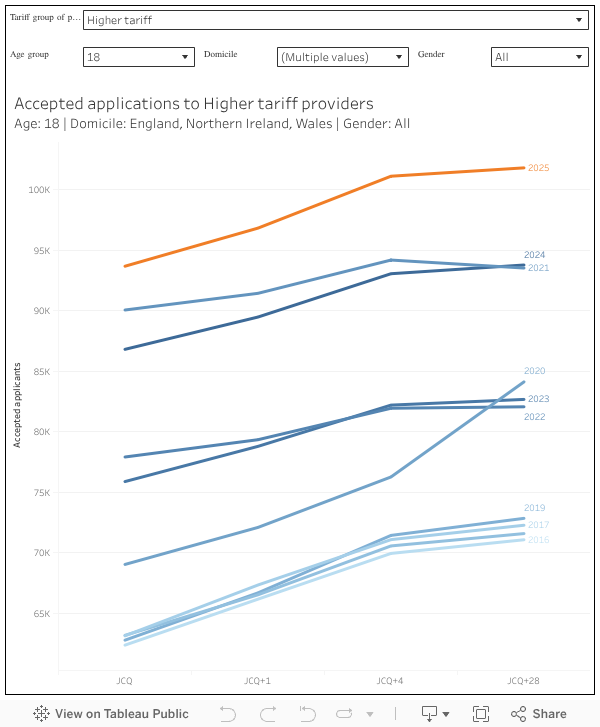
The DfE Widening Participation release is the only place where you get a definition of a “high tariff” provider – in 2023-24 this term referred to higher education providers with a mean tariff of 125.8 or above (last year this was 129.4).
Kurt Micklo lost interest in academics after he failed to make the basketball team as a sophomore at Chapin High School. Soon after, he fathered a son and began to work full time, which put him further behind in his studies.
A counselor finally advised him during his junior year that he should withdraw and try to earn a GED. He dropped out and – through hard work – found professional success as a general manager of a subcontracting logistics company. However, the lack of a high school diploma haunted him. He wants one to give his family – especially his mother – another reason to be proud of him.
A busy work and family schedule have kept him from returning to school, but the flexibility of a new state program aimed at people aged 18 and older without a high school diploma will allow him to earn a diploma and a college career and technical education, or CTE, credential for programs such as health care, welding or computer science at the same time.
The concept of Opportunity High School Diploma was part of House Bill 8, which the state Legislature passed in 2023. The state funneled about $2 million into this program to help the approximately 4.3 million Texans as of 2023, including about 30,000 adult El Pasoans, without a diploma to earn the academic credits most of them will need to acquire higher-paying jobs. The program is scheduled to launch in spring 2026.
“If I could juggle it, I’d be pretty interested” in the program, said 34-year-old Micklo, a father of three ages 15, 10 and 5. He is the general manager of three warehouses, two in El Paso and one in Laredo, Texas, as well as four sites near the international ports of entry with Mexico in El Paso, Tornillo and Santa Teresa, New Mexico, were commodities are offloaded.. “It would make my stepfather (a retired educator) and my mother happy if I earned my high school diploma.”
El Paso Community College is one of five community college districts in the state selected for the design and implementation phases of this program. The other institutions in the design phase are Alamo Colleges District, Austin Community College, Dallas College and San Jacinto College near Houston.
They work under the direction of the Texas Higher Education Coordinating Board. The board will review the instructional outcomes and performance expectations that the college collaborators created during an October meeting. Once finalized, the college faculty will begin to work with school districts to design the curriculum.
The program is flexible for students who probably work full time and have family obligations. Courses would have suggested timelines, but students would turn in assignments as their schedule allowed through the end of the term.
Micklo, a Northeast resident, said the promised flexibility is the only reason he might consider the program. As for his credential, he said he would need to review EPCC’s career and technical education options. The college offers more than 100 career programs such as HVAC, or heating, ventilation and air conditioning, and electrical, automotive or diesel technologies.
Students will be co-enrolled in competency-based high school curriculum such as math, civics, sciences and communication, and a career and technical workforce program. Competency based courses are focused more on a students’ mastery of a skill or subject than the amount of time spent in a classroom.
Isela Castañón Williams
Isela Castañón Williams, professor and coordinator of EPCC’s teacher preparation programs, is in charge of the college’s 13-member team. She called the project a “monumental task” because of its scope and uniqueness. She said her team, and its counterparts, played a critical role in the design phase.
“Faculty at EPCC are very innovative,” she said. “I think that my colleagues have approached this process with a great deal of enthusiasm. We’re always looking to provide better services and educational experiences to the community we serve.”
EPCC faculty advocated for the program to be designed to accommodate English Second Language and English Language Learner populations, a THECB spokesman said in a July 1 statement. He said last year that the board selected EPCC for the project’s design phase because of its border insights, and because its CTE degrees and credentials are in line with the program.
While the state wants to attract students aged 18 and older, EPCC officials will aim for people 25 and older so as to not compete with K-12 school districts that have their own dropout recovery programs. EPCC, which will offer the program at its five campuses, expects some of the program’s younger students to come from rural areas outside El Paso.
Steven E. Smith
Steven E. Smith, vice president of Instruction and Workforce Education at EPCC, said the state will provide funds to the colleges to cover tuition for initial cohorts. He expects the first groups will range from 30 to 50 students and scale up from there.
“We think this is a big market in El Paso, and I think once the word starts to get out, that will grow tremendously,” Smith said.
The administrator said that he would work on ways to market the program later this month with the college’s External Relations, Communication & Development Division. He said the college would work with school district partners to build lists of potential OHSD students.
“As you might imagine, that is a pretty difficult population to identify and reach out to because they are not in the system anymore,” Smith said.
RESTON, Va.(GLOBE NEWSWIRE) — K12, a portfolio brand of Stride, Inc. has been recognized for its steadfast commitment to quality education. In a recent review by Cognia, a global nonprofit that accredits schools, K12 earned an impressive Index of Education Quality (IEQ) score of 327, well above the global average of 296. Cognia praised K12 for creating supportive environments where students are encouraged to learn and grow in ways that work best for them.
For over 25 years, K12 has been a pioneer in online public education, delivering flexible, high-quality learning experiences to families across the country. Having served more than 3 million students, K12 has helped shape the future of personalized learning. This long-standing presence in the field reflects a deep understanding of what families need from a modern education partner. The recent Cognia review further validates K12’s role as a trusted provider, recognizing the strength of its learning environments and its commitment to serving all students.
“What stood out in this review is how clearly our learning environments are working for students,” said Niyoka McCoy, Chief Learning Officer at Stride, Inc. “From personalized graduation plans to real-time feedback tools and expanded course options, the Cognia team saw what we see every day, which is students being supported in ways that help them grow, stay engaged, and take ownership of their learning.”
K12’s impact extends well beyond the virtual classroom. In 2025, the organization was honored with two Gold Stevie® Awards for Innovation in Education and recognized at the Digital Education Awards for its excellence in digital learning. These awards highlight K12’s continued leadership in delivering meaningful, future-focused education. What sets K12-powered online public schools apart is a curriculum that goes beyond the basics, offering students access to STEM, Advanced Placement, dual-credit, industry certifications, and gamified learning experiences. K12’s program is designed to spark curiosity, build confidence, and help students thrive in college, careers, and life.
Through student-centered instruction and personalized support, K12 is leading the way in modern education. As the learning landscape evolves, K12 adapts alongside it, meeting the needs of today’s students while shaping the future of education.
To learn more about K12 and its accredited programs, visit k12.com.
About Stride, Inc.
Stride Inc. (LRN) is redefining lifelong learning with innovative, high-quality education solutions. Serving learners in primary, secondary, and postsecondary settings, Stride provides a wide range of services including K-12 education, career learning, professional skills training, and talent development. Stride reaches learners in all 50 states and over 100 countries. Learn more at Stridelearning.com.
eSchool Media staff cover education technology in all its aspects–from legislation and litigation, to best practices, to lessons learned and new products. First published in March of 1998 as a monthly print and digital newspaper, eSchool Media provides the news and information necessary to help K-20 decision-makers successfully use technology and innovation to transform schools and colleges and achieve their educational goals.
UK higher education is pulled between its lofty ambitions for transformative learning and the managerialism that sometimes constrains their realisation. This tension defines the contemporary Higher Education workplace, where the mantras of “more with less” and “highly regulated freedom” collide with the desire for rich, personalised student experiences amidst fiscal belt-tightening, quantification, and standardisation. Bubbling through the cracks in any long-term political or economic vision for the sector is a professional identity steeped in ambivalence of purpose and position, one whose contradictions are nowhere rendered more vividly than in England’s higher and degree apprenticeships (HDAs). Conceived to braid university learning with workplace productivity, HDAs promise the best of both worlds yet must be delivered within one of the most prescriptive funding and inspection regimes in UK higher education. This provision also sits amidst a precarious and volatile political landscape, with continuous changes to funding rules, age limits and eligibility of different levels of study, and ‘fit’ within a still poorly defined skills and lifelong learning landscape.
At the heart of this ongoing policy experiment stands an until-recently invisible workforce: Higher Education Tripartite Practitioners (HETP). These quiet actors emerged as a series of pragmatic institution level responses to the Education and Skills Funding Agency (ESFA, now subsumed into the Department of Education) related to progress reviews involving the provider, apprentice, and employer. Yet, as we argued in our paper at the SRHE International Conference in December last year, they have evolved into nuanced, often misunderstood boundary-spanners who simultaneously inhabit academia, industry, and compliance. Part coach, part conduit, part compliance specialist, they facilitate developmental conversations, broker cultural differences, and ensure every clause of the ESFA rulebook is honoured. The quality of this brokerage is decisive; without it even the most carefully designed apprenticeship fractures under audit pressure.
Consider the core activities of HETPs. Much of their time is spent in close personal engagement with apprentices – fostering professional growth, guiding reflective practice, and offering pastoral support traditionally associated with mentoring. They encourage apprentices to think holistically, integrate theory with workplace reality, and map long-term career aspirations. Almost simultaneously, they must document progress reviews, monitor the evidence of every single hour of learning, and tick every regulatory box along a journey from initial skills analysis through to end point assessment.
This duality produces a daily oscillation between inspiring conversations and tedious paperwork. The tension is palpable and exhausting, revealing a deeper struggle between two visions of education: one expansive, transformative, and relational; the other restrictive, measurable, and dominated by compliance. Fuller and Unwin’s expansive–restrictive continuum maps neatly onto this predicament, underscoring how universities are urged by policymakers to deliver high-skilled graduates for economic growth while simultaneously squeezed by intensifying regulation and managerial oversight.
Little wonder, then, that HETPs describe their roles with the language of complexity, ambiguity, and invisibility. They are neither purely academic nor purely administrative. Instead, they occupy a liminal institutional space, mediating competing demands from employers, regulators, apprentices, and colleagues. Esmond captures the resulting “subaltern” status of these practitioners, whose contributions remain undervalued even as they shoulder the brunt of institutional attempts to innovate without overhauling legacy systems.
Their experiences lay bare the contradictions of contemporary university innovation. Institutions routinely trumpet responsiveness to labour-market need yet bolt new programmes onto structures optimised for conventional classroom delivery, leaving HETPs to reconcile expansive educational ideals with restrictive managerial realities. The role becomes a flashpoint: universities ask boundary-spanners to maintain quality, build relationships, and inspire learners within systems designed for something else entirely.
Yet amidst these tensions lies opportunity. The very ambiguity of the HETP role highlights the limits of existing support systems and points towards new professional identities and career pathways. Formal recognition of boundary-spanning expertise – relationship-building, negotiation, adaptability – would allow practitioners to progress without abandoning what makes their contribution distinctive. Communities of practice could break the apprenticeship echo-chamber and enrich the wider HE ecosystem, while institutional investment in bespoke professional development would equip practitioners to navigate the inherent tensions of their work.
Senior leadership must also acknowledge the strategic value of these hidden roles, reframing them not as incidental administrative burdens but as essential catalysts for integrated educational practice. Making such roles visible and valued would help universities reconcile expansive aspirations with regulatory realities and signal genuine commitment to reshaping education for contemporary challenges.
Policymakers and regulators, too, have lessons to learn. While accountability has its place, overly rigid compliance frameworks risk stifling innovation. Trust-based, proportionate regulation – emphasising quality, transparency, and developmental outcomes – would free practitioners to focus on learning rather than bureaucratic survival. The current neo-liberal distrust that imagines only regulation can safeguard public value inflates compliance costs and undermines the very economic ambitions it seeks to serve.
Ultimately, the emergence of HETPs challenges HE institutions to decide how serious they are about bridging academic learning and workplace practice. Recognising and empowering these quiet brokers would signal a genuine commitment to integrated, expansive education – an education capable of meeting economic demands without losing sight of deeper human and intellectual aspirations. HETPs are far more than practitioners managing checklists; they are a critical juncture at which universities must choose either to treat boundary-spanning labour as a stop-gap or to embrace the complexity and potential it represents.
Dr Phil Power-Mason is Head of Department for Strategic Management at Hertfordshire Business School, University of Hertfordshire, where he leads a diverse portfolio spanning executive education, apprenticeships and professional doctorates. A practice-focussed academic with a passion for innovative workforce development, Phil has overseen significant growth in the school’s business apprenticeships, MBA, and generalist provision, while nurturing cross-sector partnerships and embedding work-aligned learning at every level. With a research background in educational governance and strategy, he is a Senior Fellow of Advance HE and co-convenor of national apprenticeship knowledge networks. Phil’s research and sector leadership focus on emerging pedagogic and HE workforce practices, driving collaborative solutions that meet employer, learner and university needs. An invited speaker at national forums and a frequent contributor to sector conferences and publications, he remains committed to transforming vocational and work-ready learning practice for the future. (herts.ac.uk)
Dr Helen Charlton is Associate Professor of Work Aligned Learning and Head of Executive Education at Newcastle Business School, Northumbria University, where she leads the school’s business apprenticeships, executive CPD and distance-learning programmes. After almost a decade steering apprenticeship design and compliance, she stays keenly attuned to each fresh regulatory tweak – and the learning opportunities it provides. A former senior HR manager in the arts and not-for-profit sectors, Helen holds a Doctorate in Education and an MSc in Human Resource Management, is a Senior Fellow of Advance HE, a Chartered MCIPD, and a Chartered Manager and Fellow of the CMI. Her research examines how learners, employers and universities negotiate the tripartite realities of degree apprenticeships. (northumbria.ac.uk)
Additionally, a 2024 report by Universities UK found that 18 per cent of students have used a drug in the past with 12 per cent imbibing across the previous 12 months. With a UK student population of 2.9m, this suggests the drug-savvy portion is around 348,000 to 522,000 people.
It’s prudent, therefore, for anyone involved within student safety provision to know that the UK is currently mired in a drug death crisis – a record 5,448 fatalities were recorded in England and Wales in the most recent statistics, while Scotland had 1,172, the highest rate of drug deaths in Europe.
In an attempt to ameliorate some of this risk, seven UK universities recently took delivery of nitazene strips to distribute among students, facilitated by the charity Students Organising for Sustainability (SOS-UK). These instant testing kits – not dissimilar to a Covid-19 lateral flow test in appearance – examine pills or powders for nitazenes: a class of often deadly synthetic opioids linked with 458 UK deaths between July 2023 and December 2024.
While these fatalities will have most likely been amongst older, habitual users of heroin or fake prescription medicines, these strips form part of a suite of innovative solutions aimed at helping students stay safe(r) if they do choose to use drugs.
The 2024 Universities UK report suggested drug checking and education as an option in reducing drug-related harm, and recommended a harm reduction approach, adding: “A harm reduction approach does not involve condoning or seeking to normalise the use of drugs. Instead, it aims to minimise the harms which may occur if students take drugs.”
With that in mind, let’s consider a world where harm reduction – instead of zero tolerance – is the de facto policy and how drug checking or drug testing plays a part in that.
Drug checking and drug testing
Drug checking and drug testing are terms that often get used interchangeably but have different meanings. Someone using a drug checking service can get expert lab-level substance analysis, for contents and potency, then a confidential consultation on these results during which they receive harm reduction advice. In the UK, this service is offered by The Loop, a non-profit NGO that piloted drug checking at festivals in 2016 and now have a monthly city centre service in Bristol.
Drug testing can take different forms. First, there is the analysis of a biological sample to detect whether a person has taken drugs, typically done in a workplace or medical setting. There are also UK-based laboratories offering substance analysis, that then gets relaid to the public in different ways.
WEDINOS is an anonymous service, run by Public Health Wales since 2013, where users send a small sample of their substance alongside a downloadable form. After testing, WEDINOS posts the results on their website (in regards to content but not potency) normally within a few weeks.
MANDRAKE is a laboratory operating out of Manchester Metropolitan University. It works in conjunction with key local stakeholders to test found or seized substances in the area. It is often first with news regarding adulterated batches of drugs or dangerously high-strength substances on the market.
Domestic testing is also possible with reagents tests. These are legally acquired chemical compounds that change colour when exposed to specific drugs and can be used at home. They can provide valuable information as to the composition of a pill or powder but do not provide information on potency. The seven UK universities that took delivery of nitazene strips were already offering reagents kits to students as part of their harm reduction rationale.
Although the Misuse of Drugs Act 1971 specifies that certain activities must not be allowed to take place within a university setting, the Universities UK report argued that universities have some discretion on how to manage this requirement. Specifically, it stated: “The law does not require universities to adopt a zero tolerance approach to student drug use.”
How to dispense testing apparatus
The mechanisms differ slightly between SUs but have broad similarities. We spoke with Newcastle and Leeds (NUSU and LUU) who both offer Reagent Tests UK reagent testing kits, fentanyl strips and now nitazene strips. Reagent’s UK kits do not test for either of these two synthetic opioids. They vary in strength compared to heroin – and there are multiple analogues of nitazene that vary in potency – but an established ballpark figure is at least 50 times as strong.
All kits and tests are free. Newcastle’s are available from the Welfare and Support centre, in an area where students would have to take part in an informal chat with a member of staff to procure a kit. “We won’t ask for personal details. However, we do monitor this and will check in with a welfare chat if we think this would be helpful,” says Kay Hattam, Wellbeing and Safeguarding Specialist at NUSU. At Leeds, they’re available from the Advice Office and no meeting is required to collect a kit.
Harm reduction material is offered alongside the kits. “We have developed messaging to accompany kits which is clear on the limitations of drug testing, and that testing does not make drugs safe to use,” says Leeds University Union.
Before the donation, kits were both paid for by the respective unions and neither formally collected data on the results. Both SUs both make clear that offering these kits is not an encouragement of drug use. Kay Hattam draws an analogy: “If someone was eating fast food every day and I mentioned ways to reduce the risks associated with this, would they feel encouraged to eat more? I would think not. But it might make them think more about the risks.”
You’ll only encourage them
In 2022, in a report for HEPI, Arda Ozcubukcu and Graham Towl argued, “Drug use matters may be much more helpfully integrated into mental health and wellbeing strategies, rather than being viewed as a predominantly criminal justice issue.”
The evidence backs up the view that a harm reduction approach does not encourage drug use. A 2021 report authored by The Loop’s co-founder Fiona Measham, Professor in Criminology at the University of Liverpool, found that over half of The Loop’s users disposed of a substance that tested differently to their intended purchase, reducing the risk of poisoning. Additionally, three months after checking their drugs at a festival, around 30 per cent of users reported being more careful about polydrug use (mixing substances). One in five users were taking smaller doses of drugs overall. Not only does this demonstrate that better knowledge reduces risk of poisoning in the short-term, but it also has enduring positive impacts on drug-using behaviours.
SOS-UK has developed the Drug and Alcohol Impact scheme with 16 universities and students’ unions participating. This programme supports institutions in implementing the Universities UK guidance by using a variety of approaches to educate and support students in a non-stigmatising manner.
Alongside them is SafeCourse, a charity founded by Hilton Mervis after his son Daniel, an Oxford University student, died from an overdose in 2019. The charity – which counts the High Court judge Sir Robin Knowles and John de Pury, who led the development of the 2024 sector harm reduction framework, among its trustees – is working to encourage universities to move away from zero tolerance.This is through various means, including commissioning legal advice to provide greater clarity on universities’ liability if they are not adopting best practice, and checking in one year on from the Universities UK report, to ascertain how they’re adapting to the new era of harm reduction.
SafeCourse takes the view that universities must not allow themselves to be caught up prosecuting a failed war on drugs when their focus should be student safety, wellbeing and success. A harm reduction approach is the best way of achieving those ends.
Students need more support around education paths and career options, including hands-on experiences, according to a new nationwide survey from the nonprofit American Student Assistance.
The survey of more than of 3,000 students in grades 7-12 offers insights into teens’ plans after high school. The research, Next Steps: An Analysis of Teens’ Post-High School Plans, uncovers evolving trends in teenagers’ attitudes, perceptions, and decision-making about their post-high school plans.
“This analysis of teens’ post high school plans reveals shifts in students’ thinking and planning. We need to change the way we help young people navigate the complex and evolving landscape of education and career options,” said Julie Lammers, Executive Vice President of ASA. “Starting in middle school, our young people need early access to opportunities that empowers them to explore careers that match their interests and strengths; hands-on, skills-based experiences in high school; and information and resources to navigate their path to postsecondary education and career. All of this will enable them to graduate informed, confident, and empowered about what they want to do with their futures.”
The survey offers notable findings regarding parental influence on teens’ planning, perceptions of nondegree pathways like trade or technical school, apprenticeships, and certificate programs, and a continued drop-off in kids’ plans to go to college immediately after high school graduation.
Key findings include:
Teens’ interest in college is down while nondegree paths are on the rise. Nearly half of all students said they aren’t interested in going to college, with just 45 percent saying two- or four-year college was their most likely next step. Meanwhile 38 percent of teens said they were considering trade or technical schools, apprenticeships, and technical bootcamp programs, although only 14 percent say that such a path is their most likely next step.
Parents are one of teens’ biggest influencers—and they’re skeptical of nondegree options. A vast majority (82 percent) of teens said their parents agree with their plans to go to four-year college, while only 66 percent said parents supported plans to pursue a nondegree route. In fact, teens reported parents were actually more supportive (70 percent) of foregoing education altogether right after high school vs. pursuing a nondegree program.
A concerning number of young people don’t have plans for further education or training. Nearly one quarter (23 percent) said they have no immediate plans to continue formal education or training upon graduation. Teens not planning to continue education after high school indicated they were thinking of beginning full-time work, entering a family business, starting their own business, or joining the military.
Teens, and especially middle schoolers, are feeling better prepared to plan their futures. In recent years policymakers, educators, employers, and other stakeholders have pushed to make career-connected learning a more prominent feature of our education to workforce system. Survey results say it’s paying off. Agreement with the statement “my school provides me with the right resources to plan for my next steps after high school” grew from just 59 percent in 2018, to 63 percent in 2021, to 82 percent in 2024. Notably, the largest increase occurred at the middle school level, where confidence in in-school planning resources jumped from 60 percent in 2018 to 90 percent in 2024.
Girls are much more likely to plan to attend college than boys. Boys and girls are equally interested in college when they’re in middle school, but by high school, more than half (53 percent) of girls say they’re likely to attend college compared to just 39 percent of boys. The gender gap is smaller when it comes to nondegree pathways: 15 percent of high school boys say they will likely attend vocational/trade school, participate in an apprenticeship, or take a certificate program, compared to 10 percent of high school girls.
City kids aren’t as “into” college. Urban teens were least likely (39 percent) to say they plan to go to college. Suburban teens are much more likely to plan to attend a college program (64 percent) while 46 percent of rural students planned on college.
Students of color are college bound. More than half (54 percent) of Black teens and 51 percent of Hispanic youth are planning to go to college, compared to 42 percent of White teens.
eSchool Media staff cover education technology in all its aspects–from legislation and litigation, to best practices, to lessons learned and new products. First published in March of 1998 as a monthly print and digital newspaper, eSchool Media provides the news and information necessary to help K-20 decision-makers successfully use technology and innovation to transform schools and colleges and achieve their educational goals.
DES MOINES, Iowa — Macon Smith stood in front of a nearly empty classroom 1,000 miles from home. He asked his opponent and the two judges in the room if they were ready to start, then he set a six-minute timer and took a deep breath.
“When tyranny becomes law, rebellion becomes duty,” he began.
In front of Macon, a 17-year-old high school junior, was a daunting task: to outline and defend the argument that violent revolution is a just response to political oppression.
In a few hours, Macon would stand in another classroom with new judges and a different opponent. He would break apart his entire argument and undo everything he had just said.
“An eye for an eye makes the whole world blind,” Macon started.
It doesn’t really matter what opinion Macon holds on violence or political oppression. In this moment in front of the judges, he believes what he’s saying. His job is to get the judges to believe with him.
Macon was one of more than 7,000 middle and high school students to compete in the National Speech and Debate Tournament this summer in Iowa, run by an organization that is celebrating a century in existence.
In that time, the National Speech and Debate Association has persevered through economic and social upheaval. It is entering its next era, one in which the very notion of engaging in informed and respectful debate seems impossible. The organizers of this event see the activity as even more important in a fracturing society.
“I don’t think there’s an activity in the world that develops empathy and listening skills like speech and debate,” said Scott Wunn, the organization’s president. “We’re continuing to create better citizens.”
Macon Smith, a rising senior from Bob Jones Academy in South Carolina, competes in the third round of the Lincoln-Douglas Debate at the National Speech and Debate Tournament in Iowa this summer. Credit: Meenakshi Van Zee for The Hechinger Report
Though the tournament is held in different cities around the country, for the 100th anniversary, the organizers chose to host it in Des Moines, where the association’s headquarters is based.
Preparing for this competition was a year in the making for Macon, who will be a senior at Bob Jones Academy, a Christian school in Greenville, South Carolina, this fall. Students here compete in more than two dozen categories, such as Original Oratory, in which they write and recite their own 10-minute speeches, or Big Questions, where they attempt to argue broad, philosophical ideas.
Macon’s specialty, the Lincoln-Douglas Debate, is modeled after a series of public, three-hour debates between Abraham Lincoln and Sen. Stephen Douglas in 1858. In this event, two students have just 40 minutes to set up their arguments, cross-examine each other and sway the judges.
“Even if I don’t personally believe it, I can still look at the facts and determine, OK, this is a good fact, or it’s true, and argue for that side,” Macon said.
Debaters often have to tackle topics that are difficult, controversial and timely: Students in 1927 debated whether there was a need for a federal Department of Education. In 1987, they argued about mandatory AIDS testing. In 2004, they debated whether the United States was losing the war on terror. This year, in the Public Forum division, students debated whether the benefits of presidential executive orders outweigh the harms.
While the speech and debate students practiced for their national event, adults running the country screamed over each other during a congressional hearing on state sanctuary policies. A senator was thrown to the floor and handcuffed during a press conference on sending the National Guard to immigration enforcement protests in Los Angeles. Most Americans feel political discourse is moving in the wrong direction — both conservatives and progressives say talking politics with someone they disagree with has become increasingly stressful and frustrating.
Speech and debate club, though, is different.
“First of all, it gives a kid a place to speak out and have a voice,” said Gail Nicholas, who for 40 years has coached speech and debate at Bob Jones Academy alongside her husband, Chuck Nicholas, who is Macon’s coach. “But then also learn to talk to other people civilly, and I think that’s not what’s being modeled out there in the real world right now.”
Macon Smith, a rising senior from Bob Jones Academy in South Carolina, shows off the notes that he took during debates at the National Speech and Debate Tournament in Iowa. Credit: Meenakshi Van Zee for The Hechinger Report
On the second day of the competition in a school cafeteria in West Des Moines, Macon was anxiously refreshing the webpage that would show the results of his rounds to learn whether he would advance to semifinals.
For most of the school year, Macon spent two days a week practicing after school, researching and writing out his arguments. Like many competitors, he has found that it’s easy to make snap judgments when you don’t know much about an issue. Decisively defending that view, to yourself and to others, is much harder.
“I tend to go in with an opinion and lose my opinion as the topic goes on,” said Daphne DiFrancesco, a rising senior from Cary Academy in Cary, North Carolina.
Traveling for regional events throughout the school year means Macon has become friends with students who don’t always share his conservative views. He knows this because in debate, discussing politics and religion is almost unavoidable.
“It doesn’t make me uncomfortable at all,” Macon said. “You don’t want to burn down a bridge before you make it with other people. If you stop your connection with a person right at their political beliefs, you’re already cutting off half of the country. That’s not a good way to conduct yourself.”
Macon, and other students in the clubs, said participating has made them think more deeply about their own beliefs. Last year, Macon debated a bill that would defund Immigration and Customs Enforcement, an agency he supports. After listening to other students, he developed a more nuanced view of the organization.
“When you look at the principle of enforcing illegal immigration, that can still be upheld, but the agency that does so itself is flawed,” he said.
Henry Dieringer, a senior from L.C. Anderson High School in Austin, Texas, went into one competition thinking he would argue in favor of a bill that would provide work permits for immigrants, which he agrees with. Further research led him to oppose the idea of creating a federal database on immigrants.
“It made me think more about the way that public policy is so much more nuanced than what we believe,” Henry said.
On the afternoon of the second day of the national tournament, Macon learned he didn’t advance to the next round. What’s sad, he said, is he probably won’t have to think this hard about the justness of violent revolution ever again.
“There’s always next year,” Macon said.
Callista Martin, 16, a rising senior from Bainbridge High School in Washington state, also didn’t make the semifinals. Callista and Macon met online this year through speech and debate so they could scrimmage with someone they hadn’t practiced with before. It gave them the chance to debate someone with differing political views and argument styles.
Macon Smith, a rising senior from Bob Jones Academy in South Carolina, takes notes during a round of the Lincoln-Douglas Debate at the National Speech and Debate Tournament in Iowa. Credit: Meenakshi Van Zee for The Hechinger Report
“In the rounds, I’m an entirely different person. I’m pretty aggressive, my voice turns kind of mean,” Callista said. “But outside of the rounds, I always make sure to say hi to them before and after and say things I liked about their case, ask them about their school.”
Talking to her peers outside of rounds is perhaps the most important part of being in the club, Callista said. This summer, she will travel to meet with some of her closest friends, people she met at debate camps and tournaments in Washington.
Since Callista fell in love with speech and debate as a freshman, she has devoted herself to keeping it alive at her school. No teacher has volunteered to be a coach for the debate club, so the 16-year-old is coaching both her classmates and herself.
A lack of coaches is a common problem. Just under 3,800 public and private high schools and middle schools were members of the National Speech and Debate Association at the end of this past school year, just a fraction of the tens of thousands of secondary schools in the country. The organization would like to double its membership in the next five years.
That would mean recruiting more teachers to lead clubs, but neither educators nor schools are lining up to take on the responsibility, said David Yastremski, an English teacher at Ridge High School in New Jersey who has coached teams for about 30 years.
It’s a major time commitment for teachers to dedicate their evenings and weekends to the events with little supplemental pay or recognition. Also, it may seem like a risk to some teachers at a time when states such as Virginia and Louisiana have banned teachers from talking about what some call “divisive concepts,” to oversee a school activity where engaging with controversial topics is the point.
“I primarily teach and coach in a space where kids can still have those conversations,” Yastremski said. “I fear that in other parts of the country, that’s not the case.”
Dennis Philbert, a coach from Central High School in Newark, New Jersey, who had two students become finalists in the tournament’s Dramatic Interpretation category, said he fears for his profession because of the scrutiny educators are under. It takes the fun out of teaching, he said, but this club can reignite that passion.
“All of my assistant coaches are former members of my team,” Philbert said. “They love this activity [so much] that they came back to help younger students … to show that this is an activity that is needed.”
On the other side of Des Moines, Gagnado Diedhiou was competing in the Congressional Debate, a division of the tournament that mimics Congress and requires students to argue for or against bills modeled after current events. During one round, Gagnado spoke in favor of a bill to shift the country to use more nuclear energy, for a bill that would grant Puerto Rico statehood, and against legislation requiring hospitals to publicly post prices.
Gagnado Diedhiou, a senior from Eastside High School in South Carolina, competing in the first round of the Congressional Debate at the National Speech and Debate Tournament in Iowa in June. Credit: Meenakshi Van Zee for The Hechinger Report
Just like in Congress, boys outnumbered girls in this classroom. Gagnado was the only Black teenager and the only student wearing a hijab. The senior, who just graduated from Eastside High School in Greenville, South Carolina, is accustomed to being in rooms where nobody looks like her — it’s part of the reason she joined Equality in Forensics, a national student-led debate organization that provides free resources to schools and students across the country.
“It kind of makes you have to walk on eggshells a little bit. Especially because when you’re the only person in that room who looks like you, it makes you a lot more obvious to the judges,” said Gagnado, who won regional Student of the Year for speech and debate in her South Carolina district this year. “You stand out, and not always in a good way.”
Camille Fernandez, a rising junior at West Broward High School in Florida, said the competitions she has participated in have been dominated by male students. One opponent called her a vulgar and sexist slur after their round was over. Camille is a member of a student-led group — called Outreach Debate — trying to bridge inequities in the clubs.
“A lot of people think that debate should stay the same way that it’s always been, where it’s kind of just — and this is my personal bias — a lot of white men winning,” Camille said. “A lot of people think that should be changed, me included.”
Despite the challenges, Gagnado said her time in debate club has made her realize she could have an influence in the world.
“With my three-minute speech, I can convince a whole chamber, I can convince a judge to vote for this bill. I can advocate and make a difference with some legislation,” said Gagnado, who is bound for Yale.
About 10,000 people attended the National Speech and Debate Tournament in Iowa this June during the organization’s centennial anniversary. Credit: Meenakshi Van Zee for The Hechinger Report
A day before the national tournament’s concluding ceremony, a 22-year-old attendee rushed the stage at the Iowa Event Center in Des Moines during the final round of the Humorous Interpretation speech competition, scaring everyone in the audience. After he bent down to open his backpack, 3,000 people in the auditorium fled for the exits. The man was later charged with possession of a controlled substance and disorderly conduct. For a brief moment, it seemed like the angry discourse and extreme politics from outside of the competition had become a part of it.
In response, the speech and debate organization shifted the time of some events, limited entrances into the building and brought in metal detectors, police officers and counselors. Some students, Gagnado among them, chose not to return to the event.
Still, thousands of attendees stayed until the end to celebrate the national champions. During the awards ceremony, where therapy dogs roamed the grounds, Angad Singh, a student from Bellarmine College Preparatory in California competing in Original Oratory, took the national prize for his speech on his Sikh identity and the phrase “thoughts and prayers” commonly repeated by American leaders after a tragedy, titled “Living on a Prayer.”
“I’ve prayed for change,” Singh told the audience. “Then I joined speech and debate to use my voice and fight for it.”
The Hechinger Report provides in-depth, fact-based, unbiased reporting on education that is free to all readers. But that doesn’t mean it’s free to produce. Our work keeps educators and the public informed about pressing issues at schools and on campuses throughout the country. We tell the whole story, even when the details are inconvenient. Help us keep doing that.
ELKHART, Ind. — Ever since Ty Zartman was little, people told him he had to go to college to be successful. “It was engraved on my brain,” he said.
But despite earning straight A’s, qualifying for the National Honor Society, being voted prom king and playing on the high school football and baseball teams, the teen never relished the idea of spending another four years in school. So in fall 2023 he signed up through his Elkhart, Indiana, high school for an apprenticeship at Hoosier Crane Service Company, eager to explore other paths. There, he was excited to meet coworkers who didn’t have a four-year degree but earned good money and were happy in their careers.
Through the youth apprenticeship, Ty started his day at the crane manufacturing and repair business at 6:30 a.m., working in customer service and taking safety and training courses while earning $13 an hour. Then, he spent the afternoon at his school, Jimtown High, in Advanced Placement English and U.S. government classes.
In June, the 18-year-old started full-time at Hoosier Crane as a field technician.
“College is important and I’m not dissing on that,” Ty said. “But it’s not necessarily something that you need.”
Elkhart County is at the forefront of a movement slowly spreading across Indiana and the nation to make apprenticeships a common offering in high school.
In 2019, as part of a plan to boost the region’s economic prospects, county leaders launched an effort to place high schoolers in apprenticeships that combine work-based training with classroom instruction. About 80 students from the county’s seven school districts participated this academic year, in fields such as health care, law, manufacturing, education and engineering. In April, as part of a broader push to revamp high school education and add more work-based learning, the state set a goal of 50,000 high school apprentices by 2034.
Tim Pletcher, the principal of Jimtown High, said students are often drawn first to the chance to spend less time in class. But his students quickly realize apprenticeships give them work-based learning credits and industry connections that help them after graduation. They also earn a paycheck. “It’s really causing us to have a paradigm shift in how we look at getting kids ready for the next step,” he said.
Related: Become a lifelong learner. Subscribe to our free weekly newsletter featuring the most important stories in education.
This “earn and learn” model is taking hold in part because of deepening disillusionment with four-year college, and the fact that well-paying jobs that don’t require bachelor’s degrees are going unfilled nationally. The past three presidential administrations invested in expanding apprenticeships, including those for high schoolers, and in April, President Donald Trump signed an executive order calling for 1 million new apprentices. In a recent poll, more than 80 percent of people said they supported expanding partnerships between schools and businesses to provide work-based learning experiences for students.
Yet in the United States, the number of so-called youth apprenticeships for high schoolers is still “infinitesimally small,” said Vinz Koller, a vice president at nonprofit group Jobs for the Future. One estimate suggests they number about 20,000 nationally, while there are some 17 million high school students.By contrast, in Switzerland — which has been praised widely for its apprenticeship model, including by U.S. Education Secretary Linda McMahon — 70 percent of high schoolers participate. Indiana is among several states, including Colorado, South Carolina and Washington, that have embraced the model and sent delegations to Switzerland to learn more.
Elkhart, Indiana, known as the “RV capital of the world,” saw widespread unemployment during the Great Recession. That led community leaders to focus on apprenticeships as a way to diversify their economy. Credit: Camilla Forte/The Hechinger Report
Experts including Ursula Renold, professor of education systems at the Swiss Federal Institute of Technology (ETH) Zurich, note that importing the model to the United States at a large scale won’t be simple. Most businesses aren’t accustomed to employing apprentices, parents can be resistant to their students trading four-year college aspirations for work, and public transportation to take students to apprenticeships is limited, especially in rural areas. Many high schoolers don’t have a driver’s license, access to a car or money for gas. School districts already face a shortage of bus drivers that makes transporting students to apprenticeships difficult or impossible.
Still, Renold, who is known as the “grande dame of apprenticeships,” said Indiana’s commitment to apprenticeships at the highest levels of state government, as well as the funding the state has invested in work-based learning, at least $67 million, seem to be setting the state up for success, though it could take a decade to see results.
“If I had to make a bet,” said Renold, “I would say it’s Indiana who will lead the way.”
Elkhart County’s experiment with apprenticeships has its roots in the Great Recession. Recreational vehicle manufacturing dominates the local economy, and demand for the vehicles plummeted, contributing to a regional unemployment rate at that time of nearly 20 percent. Soon after, community leaders began discussing how to better insulate themselves from future economic instability, eventually focusing on high school education as a way to diversify industries and keep up with automation, said Brian Wiebe, who in 2012 founded local nonprofit Horizon Education Alliance, or HEA, to help lead that work.
Elkhart County, Indiana, was the first community in Indiana to encourage businesses to employ high school students as apprentices, where they can earn work-based learning credits and make industry connections that help them, even if they decide to go on to college. Credit: Camilla Forte/The Hechinger Report
That year, Wiebe and two dozen local and state political, business, nonprofit and education leaders visited Switzerland and Germany to learn more about the apprenticeship model. “We realized in the U.S., there was only a Plan A, a path to college,” he recalled. “We were not supporting the rest of our young people because there was no Plan B.”
HEA partnered with Elkhart County school districts and businesses, as well as with CareerWise, a youth apprenticeship nonprofit that works nationally. They began rolling out apprenticeships in 2019, eventually settling on a goal of increasing participation by 20 percent each year.
In 2021, Katie Jenner, the new secretary of education for Indiana, learned about Elkhart’s apprenticeships as she was trying to revamp high school education in the state so it better prepared students for the workforce. Elkhart, as well as six other apprenticeship pilot sites funded by Indianapolis-based philanthropy the Richard M. Fairbanks Foundation, provided a proof of concept for the apprenticeship model, said Jenner.
In December, the state adopted a new diploma system that includes an emphasis on experiential and work-based learning, through apprenticeships, internships and summer jobs.
On a weekday this winter, 17 sophomores at Elkhart’s Concord High School were sitting at computers, creating resumes they planned to use to apply for apprenticeships. The students were among some 50 sophomores at the high school who’d expressed interest in apprenticing and met the school’s attendance and minimum 2.5 GPA requirements, out of a class of roughly 400. They would receive coaching and participate in mock interviews before meeting with employers.
Becca Roberts, a former English teacher who now oversees the high school’s college and career programs, said apprenticeships help convince students of the importance of habits like punctuality, clear communication and regular attendance. “It’s not from a book,” she said. “They’re dealing with real life.”
Becca Roberts, who oversees college and career programs at Concord High School in Indiana, helps students research different companies offering apprenticeships, including job descriptions, work schedules and commuting distances. Credit: Camilla Forte/The Hechinger Report
One student, Ava Cripe, said she hoped for an apprenticeship of some sort in the health care field. She’d only been a pet sitter and was nervous at the thought of having a professional job. “You’re actually going out and working for someone else, like not for your parents or your grandma, so it’s a little scary,” she said.
CareerWise Elkhart has recently beefed up its support for students and businesses participating in apprenticeships. It employs a business partnership manager and customer success managers who help smooth over issues that arise in the workplace — an apprentice who isn’t taking initiative, for example, or an apprenticeship that isn’t sufficiently challenging. “Before, if an issue came up, a business would just fire a student or a student would leave,” said Sarah Koontz, director of CareerWise Elkhart County. “We’re now more proactive.”
In Elkhart and across the state, the embrace of work-based learning has worried some parents who fear it will limit, not expand, their children’s opportunities. In previous generations, career and technical programs (then known as vocational education) were often used to route low-income and Black and Hispanic students away from college and into relatively low-paying career paths.
Anitra Zartman, Ty’s mother, said she and her husband were initially worried when their son said he wanted to go straight to work. They both graduated from college, and her husband holds a master’s degree. “We were like, ‘Don’t waste your talent. You’re smart, go to college.’” But she says they came around after seeing how the work experience influenced him. “His maturity has definitely changed. I think it’s because he has a responsibility that he takes very seriously,” she said. “He doesn’t want to let people down.”
Her eldest daughter, Senica Zartman, also apprenticed during her final two years of high school, as a teacher’s assistant. She is now in college studying education. “The apprenticeship solidified her choice,” Anitra Zartman said, and it helped her decide to work with elementary students. Anitra Zartman said she would encourage her two youngest children to participate in apprenticeships too.
Ty Zartman works from 6 a.m. to noon at his apprenticeship at Hoosier Crane Service Company before he goes to school for afternoon classes. Credit: Camilla Forte/The Hechinger Report
Sarah Metzler, CEO of the nonprofit HEA, said apprenticeships differ from the vocational education of the past that tended only to prepare students for relatively low paid, entry-level jobs. With apprenticeships, she said, students must continually learn new skills and earn new licenses and industry certifications as part of the program.
Litzy Henriquez Monchez, 17, apprentices in human resources at a company of 50 people, earning $13.50 an hour. “I deal with payroll, I onboard new employees, I do a lot of translating. Anything that has to do with any of the employees, I deal with,” she said. She’s also earning an industry-recognized certification for her knowledge of a human resources management system, and says the company has offered to pay for her college tuition if she continues in the position.
Koontz said most companies pay for their apprentices to attend Ivy Tech, a statewide community college system, if they continue to work there. One is even paying for their apprentice’s four-year degree, she said.
Attracting employers has proven to be the biggest challenge to expanding youth apprenticeships — in Elkhart and beyond. In total, 20 companies worked with the Elkhart school districts last year, and 28 have signed on for this coming school year — only enough to employ about a third of interested students.
The obstacles, employers say, include the expense of apprentices’ salaries, training and other costs.
Metzler and others, though, point to studies showingbenefits for employers, including cost savings over time and improved employee loyalty. And in Indiana, the Fairbanks foundation and other organizations are working on ways to reduce employer costs, including by developing a standard curriculum for apprenticeships in industries like health care and banking so individual companies don’t bear the costs alone.
Business leaders who do sign on say they are happy with the experience. Todd Cook, the CEO of Hoosier Crane Service Company, employs 10 high schoolers, including Ty Zartman, as engineering and industrial maintenance technician apprentices, approximately 10 percent of his staff. He said the pipeline created by the apprenticeship program has helped reduce recruiting costs.
“We’re starting to build our own farm system of talent,” he said. Students initially earn $13 an hour, and finish their apprenticeship earning $18. If they continue with the company, he said, they can earn up to $50 an hour after about five years. And if they go on to become trainers or mentors, Cook said, “Honestly, there is no ceiling.”
Transportation has been a limiting factor too. There’s no public transit system, and students who can’t rely on their parents for rides are often out of luck. “We’d love to offer a bus to every kid, to every location, but we don’t have people to run those extra bus routes,” said Principal Pletcher.
The state has tried to help by investing $10 million to help students pay for costs such as transportation, equipment and certifications. Each school that provides work-based learning opportunities also receives an additional $500 per student.
Indiana has a goal to employ 50,000 high school students as apprentices by 2034. State leaders in business, education, government and nonprofits are working closely with Swiss experts to adopt a youth apprenticeship program similar to the one in that country. Credit: Camilla Forte/The Hechinger Report
Trump’s executive order called for the secretaries of education, labor and commerce to develop a plan by late August for adding 1 million new apprenticeships. The order does not set a date for reaching that milestone, and it applies to apprentices of all ages, not just high schoolers. Vinz Koller of Jobs for the Future said the goal is modest, and achievable; the number of youth apprenticeships has doubled just in the past few years, he said, and California alone has a goal of reaching 500,000 apprenticeships, across all ages, by 2029.
Still, the order did not include additional funding for apprenticeships, and the Trump administration’s proposed budget includes major cuts to workforce development training. In an email, a White House spokesperson said the administration had promoted apprenticeships through outreach programs but did not provide additional information including on whether that outreach had a focus on youth apprenticeships.
Back in Elkhart, Ty Zartman, the Hoosier Crane apprentice, has begun his technician job with the company after graduating in early June. He is earning $19 an hour. He is also taking a class at the local community college on electrical work and recently received a certificate of completion from the Department of Labor for completing 2,000 hours of his apprenticeship.
Anitra Zartman said she wishes he’d attended more school events like pep rallies, and sometimes worried he wasn’t “being a kid.” But Ty said his supervisor is “super flexible” and he was able to go to the winter formal and prom. “I think I still live a kid life,” he said. “I do a lot of fun things.”
Of his job, he said, “I love it so much.”
Contact editor Caroline Preston at 212-870-8965, via Signal at CarolineP.83 or on email at [email protected].
The Hechinger Report provides in-depth, fact-based, unbiased reporting on education that is free to all readers. But that doesn’t mean it’s free to produce. Our work keeps educators and the public informed about pressing issues at schools and on campuses throughout the country. We tell the whole story, even when the details are inconvenient. Help us keep doing that.