Tag: higher education marketing

  • InsightsEDU 2026: The Sessions Higher Ed Can’t Afford to Ignore  

    InsightsEDU 2026: The Sessions Higher Ed Can’t Afford to Ignore  

    Higher ed is no longer inching towards change; it’s being forced to confront it. Demographic shifts, economic pressures and the rise of AI have exposed the cracks in legacy systems. The old playbook isn’t just outdated—it’s a liability. Institutions that cling to it risk irrelevance. 

    InsightsEDU 2026, happening February 17-19, 2026 at the Westin Fort Lauderdale, arrives with clear purpose: help higher ed leaders move faster, think bigger and build adaptive strategies that meet the moment

    This year’s theme, The Future Unbound, is a call to action. It invites leaders to challenge assumptions, dismantle silos and make bold decisions that drive real transformation. 

    In service of that mission, we’ve curated a speaker lineup and session program built around reinvention, student-centered innovation and the levers of growth that will define the next era. 

    Here’s your first look at the voices and ideas shaping InsightsEDU 2026. 

    Explore the Sessions Reinventing Higher Ed’s Playbook 

    The Great Reinvention 

    A candid fireside conversation with university presidents who are leading from the front. Expect bold perspectives on what higher ed must dismantle, redesign and accelerate to stay relevant in a rapidly shifting landscape. 

    Opening Session: The Modern Learner Intel 

    Get exclusive first-look access to EducationDynamics’ 2026 research on today’s Modern Learners—what they value, how they make decisions and why flexibility, career outcomes and undeniable ROI now drive every enrollment decision. 

    The AI-Powered Marketer: Evolving Your Approach for the ChatGPT Era 

    EducationDynamics’ Vice President of Marketing reveals how AI is rewriting the rules of search, content and digital engagement—and what marketers must do now to stay ahead. Learn how to unify search, social and storytelling into a single, high-performing strategy that meets today’s learners on their terms and moves them from first click to enrollment.  

    Aligning for Impact: Credentialing That Connects Campuses, Students & Employers  

    See how one institution built stackable, employer-aligned credentials that meet workforce demand and create clear career pathways, plus practical strategies any campus can use to deepen employer partnerships and market high-value programs. 

    AI for All Learners: Integrating AI Across Career Pathways 

    Learn how institutions are integrating AI across disciplines through accessible, scalable curriculum design. Attendees will leave with a sample syllabus, implementation roadmap and lessons learned from bringing AI education to diverse learners, including high-barrier communities. 

    Leading After Rapid Transformation: Culture, Clarity, and “What’s Next” in Higher Ed Marketing 

    Leaders from University of Cincinnati Online reflect on how to move forward after organizational transformation, discussing how they rebuilt culture, aligned teams and kept momentum amid ongoing change. Expect honest insights on sustaining creativity, clarity and trust in a world where transformation never stops. 

    Unifying Your Enrollment: Building a Cohesive Strategy for the Modern Learner 

    This session brings together university leaders and EducationDynamics enrollment experts to unpack how to break down silos and build a unified enrollment strategy that strengthens your brand, improves outcomes and meets the diverse needs of today’s Modern Learner. 

    InsightsEDU 2026 brings together changemakers from across the sector—each session designed to spark new thinking, foster connection and fuel collective reinvention. Explore the full, evolving agenda here.  

    Meet the Speakers Disrupting the Status Quo  

    From enrollment innovators to digital trailblazers, this year’s speakers are united by one goal: help institutions evolve faster than the market around them. Here’s a preview of who’s taking the stage. 

    Gregory Clayton

    President of Enrollment Management Services at EducationDynamics
    With over 30 years of experience in the higher education space, Greg brings valuable expertise in enrollment management and performance marketing. As President of Enrollment Management Services at EducationDynamics, he leads a comprehensive team offering agency marketing, enrollment services, strategic consulting, and research, all tailored to the higher ed sector. His leadership and career position him as a visionary strategist, equipped to offer insightful commentary on the higher education landscape and enrollment solutions. Join his session to learn more about how to better serve the Modern Learner and implement strategies that drive institutional success.

    Session: Opening Session,The Modern Learner Intel

    Amanda Serafin

    Associate Vice President of Enrollment at Indiana Wesleyan University 
    With more than twenty years in higher education enrollment, Amanda serves as the Associate Vice President of Enrollment at Indiana Wesleyan University, where she leads strategic initiatives and a high-performing team supporting IWU’s National & Global programs.

    At InsightsEDU, Amanda joins EducationDynamics’ Vice President of Enrollment Management Consulting to unpack three years of competitive research—revealing what secret shopping uncovered about competitor strategies, the depth and quality of student nurturing across the market and how IWU leveraged those insights to strengthen enrollment outcomes.

    Session: Mystery Shopping 2.0

    Alex Minot

    Client Partner Lead at Snapchat
    As Client Partner Lead at Snapchat, Alex helps higher ed institutions and nonprofits modernize their marketing through full-funnel strategies built for Gen Z and Millennial audiences. With experience spanning Snapchat, Reddit, Facebook and Google, he brings a deep understanding of how today’s learners discover, evaluate, and choose their next step.

    At InsightsEDU 2026, Alex will break down why traditional enrollment marketing no longer works—and what it takes to earn trust in a world where Gen Z is curating their own narratives. Joined by EducationDynamics’ Senior Social Media Strategist, Jennifer Ravey, he’ll explore how to design a content ecosystem that creates belonging, builds confidence and inspires advocacy from first touch to final decision..

    Session: From Awareness to Advocacy: Designing a Full-Funnel Strategy for Gen Z Engagement

    Chris Marpo

    Head of Education Partnerships at Reddit
    As Head of Education Partnerships at Reddit, Chris leads the charge in building high-impact collaborations with higher ed institutions and agencies. At InsightsEDU 2026, he’ll share how Reddit’s unique communities—and the behaviors driving them—are reshaping the way universities reach and influence the Modern Learner.

    Drawing on his experience helping scale advertising businesses at LinkedIn, Pinterest and Quora, Chris brings a sharp understanding of the digital landscape and what truly resonates with today’s audiences. Attendees can expect actionable insights on how institutions can meet prospective students where they are and stay relevant in an era of rapid change.

    Session: From Keywords to Conversations: Winning Student Mindshare in the Age of AI Search

    Kevin Halle


    VP of Enrollment at Wayne State College
    With more than a decade of experience leading undergraduate, transfer, graduate, and financial aid teams, Kevin brings a deep understanding of how to build enrollment pipelines that serve diverse learner groups.

    At InsightsEDU, he’ll unpack what it takes to break down the silos separating traditional, graduate and adult learner strategies and how institutions can create one unified approach that works for all students.

    Session: Unifying Your Enrollment: Building a Cohesive Strategy for the Modern Learner

    Katie Tomlinson

    Katie Tomlinson

    Senior Director of Analytics and Business Intelligence at EducationDynamics
    Prepare to unlock insights with Katie Tomlinson. As the Senior Director of Analytics and Business Intelligence, Katie expertly manages data and reporting, uncovering key trends to support EducationDynamics in delivering data-driven solutions for the higher ed community. Learn from her as she discusses findings from EducationDynamics’ latest report, where attendees will gain a deeper understanding of the evolving learning environment and the significant factors that influence Modern Learners’ educational choices.

    Session:  Opening Session, The Modern Learner Intel

    The voices shaping InsightsEDU continue to grow. Check out the full speaker lineup and new additions on our Speakers page

    This Isn’t Just a Conference. It’s a Catalyst. 

    Higher ed doesn’t need just another conference. It needs transformation. 

    InsightsEDU 2026 is where bold leaders confront what’s broken, challenge what’s outdated and build what’s next. If you’re ready to lead the future of higher education, this is your moment. 

    Join us in Fort Lauderdale and help rewrite the playbook for what comes next. 

    Source link

  • Why PR May Be One of Higher Ed’s Most Urgent Strategies Right Now 

    Why PR May Be One of Higher Ed’s Most Urgent Strategies Right Now 

    Trust in colleges and universities is slipping. Public narratives about higher education are being shaped without institutional input. At the same time, search behaviors that marketing teams have spent years refining are being rapidly overtaken by artificial intelligence and that shift is fundamentally altering how visibility is earned and maintained. If institutions do not begin treating public relations as a strategic imperative they risk being left out of the conversations that define relevance. 

    The urgency becomes clearer when we look at the data. According to our 2026 Landscape of Higher Education Report, 74% of Americans in 2010 believed college was “very important” to success. By 2025, that number has dropped to just 35%, as shown in Gallup’s latest trend data. Meanwhile, the percentage of people saying college is “not too important” has increased fivefold. These are not isolated shifts in public opinion. They are broad signals that confidence in higher education is diminishing and with it, the sector’s influence in shaping the future workforce and civic landscape. The reality that this is not business as usual, but what comes next, is becoming harder for leadership teams to ignore. 

    Despite this, many institutions continue to rely on messaging frameworks and digital strategies that were designed for a web environment that no longer exists. 

    AI Is Rewriting the Rules Quietly and Quickly 

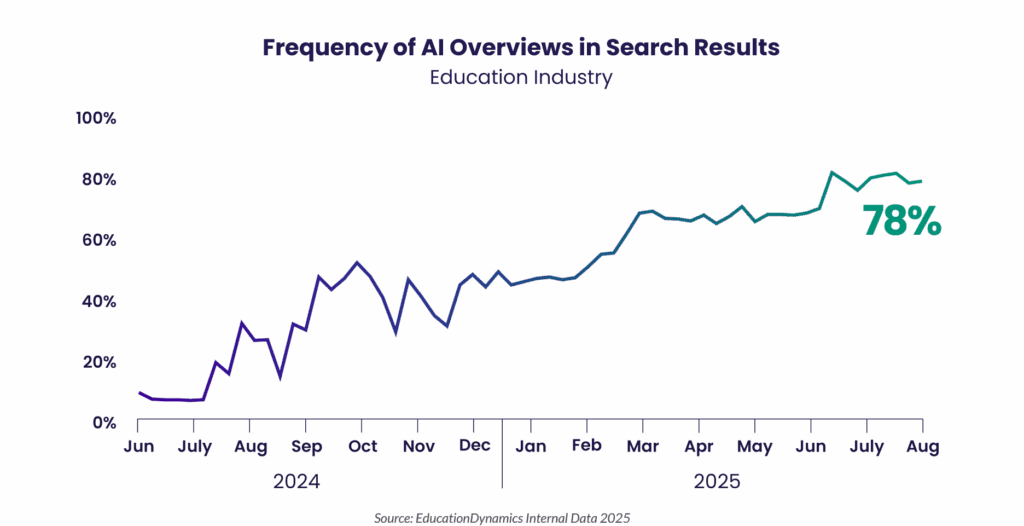
    Search behavior is evolving at a pace that is difficult to match and artificial intelligence is now redefining what visibility looks like. EducationDynamics’ Q3 2025 data shows that nearly 43% of all Google searches end without a click. In other words, users are getting their answers directly from AI-generated summaries, often without ever reaching an institution’s website. 

    That change does not diminish the importance of websites or blog content, but it does alter how they function. Pages that were once primary destinations are now source material feeding large language models and search algorithms. The value of that content is not in clicks alone, but in its ability to influence what AI tools surface in response to user questions. 

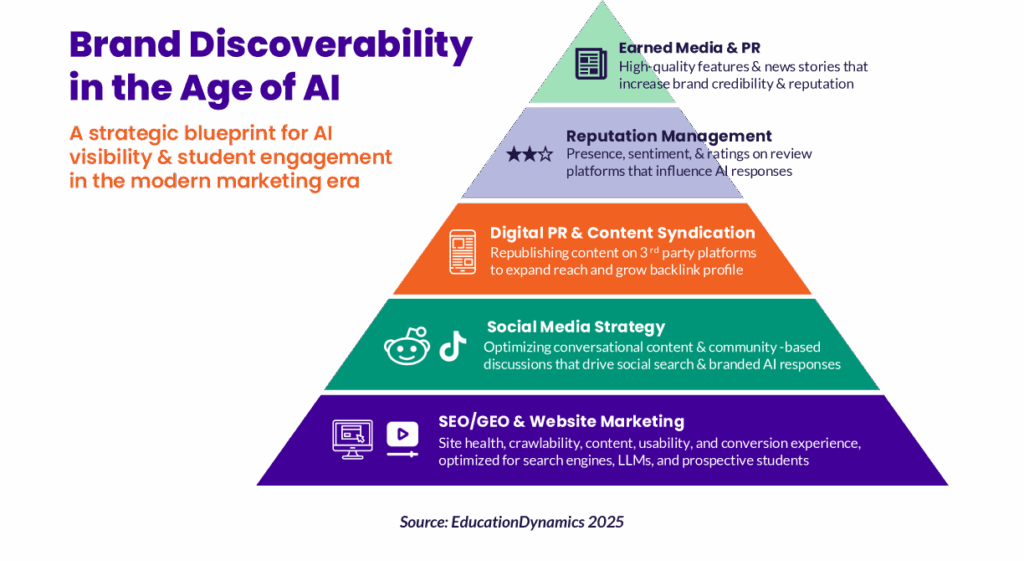
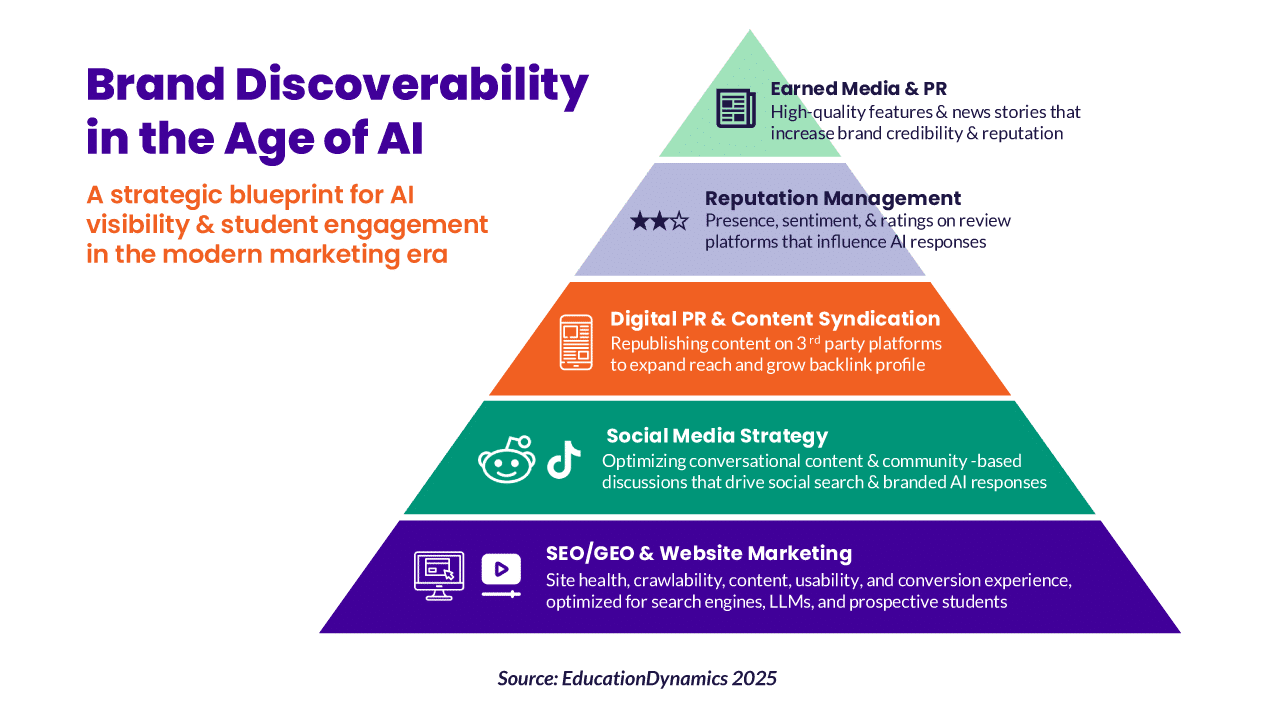
    The AI Visibility Pyramid featured in our 2026 Landscape of Higher Education Report illustrates how visibility is earned in this new environment. At its foundation is owned content, which includes blogs, faculty profiles, explainer articles and program pages. These assets contribute essential signals that shape how AI systems understand and rank institutional authority. However, they are not sufficient on their own. They must be elevated and validated through external sources to carry meaningful weight in this ecosystem. 

    Owned content becomes most effective when it is distributed and linked through credible channels. Media coverage, thought leadership placements and backlinks from high-authority outlets all play a critical role in reinforcing an institution’s visibility and shaping its reputation in the broader information landscape. What matters most is not just what institutions say about themselves, but where and how those messages are repeated, cited and trusted. 

    For leaders building their broader growth roadmap, the dynamics of AI, trust and visibility align directly with the strategies outlined in The 2026 Growth Strategy Higher Ed Needs Right Now and in the 2026 Higher Education Digital Marketing Trends and Predictions

    We Cannot Let the Work Go Unseen 

    The transformational work happening within higher education is substantial, but it is often not reaching the audiences who need to see it most. Whether it is a first-generation student securing a high-impact internship, a research partnership influencing policy or faculty-led innovation with industry implications, these stories are powerful proof points of institutional value. Yet too often, they remain confined within internal channels or are overlooked altogether. 

    Public relations plays an essential role in ensuring this work does not go unseen. Visibility must be actively cultivated, not assumed. Trust is built not only through consistent messaging, but through third-party validation that reinforces an institution’s credibility and relevance. As AI becomes the first layer of search for many users, the presence of credible, external proof will determine whether institutions are even included in the digital conversation. 

    The absence of that visibility has consequences. When institutions are not showing up in external media, not being cited in trusted sources and not contributing to narratives beyond their own platforms, they become harder to discover and easier to overlook. That decline in visibility often coincides with declines in public trust, prospective student interest and donor engagement. Reversing those trends begins with being present and recognized in the places that matter most. 

    For many colleges and universities, that also means grounding PR strategy in data from resources like the EducationDynamics’ Marketing and Enrollment Management Benchmarks, which tracks how visibility, demand and student behavior are shifting across the sector. 

    Public Relations Is Not a Press Release Function 

    In many institutions, public relations remains anchored to a traditional calendar of announcements tied to internal milestones. Press releases about new buildings, faculty honors, strategic plans and major gifts continue to dominate the output. While these updates have their place, they rarely break through the broader noise or shift the public narrative in a meaningful way. The same structural constraints that can keep marketing from leading, as we describe in Marketing Can’t Lead If Shackled by Structure, often limit what PR is allowed to be. 

    Today, public relations must function as a core strategic asset, not a service center. Its value lies in its ability to translate institutional mission and outcomes into public narratives that are credible, compelling and consistent with the institution’s brand. These stories should not be reactive, nor should they be generic. They should be aligned with the brand pillars that define what the institution stands for and where it is headed. 

    Institutions that claim leadership in areas like social mobility, research innovation or workforce readiness must make those claims evident through the stories they place and the voices they elevate. It is not enough to state the promise. It must be demonstrated through ongoing, credible engagement that reflects those themes in national and regional conversations. 

    This is where owned content and earned media intersect. Blogs, faculty profiles and campus features continue to matter, but they must be intentionally positioned and supported through media outreach and content distribution that expand their reach. 

    According to Muck Rack’s 2025 Generative Pulse report, more than 95% of the sources cited by generative AI tools are unpaid. Of those, 27% are journalistic, with the most frequently cited outlets including Reuters, NPR, the Associated Press, The New York Times and Bloomberg. These platforms are not pulling directly from institutional press centers. They are reflecting content that has been validated, shared and linked widely across trusted networks. 

    For institutions that want to shape public perception, these are the environments where visibility must be earned. That means placing stories where they will be seen, cited and shared. It also means ensuring that those stories reflect the strategic priorities and differentiators that define the institution’s place in a competitive market. 

    Leaders do not have to guess where to begin. EducationDynamics’ market research solutions and consulting services are built to help institutions translate insight into narrative strategy, then connect that strategy to measurable revenue and reputation outcomes. 

    Public relations is no longer optional. It is an infrastructure investment in how institutions are discovered, described and believed. It builds the signals that matter most to both human audiences and machine-driven systems. It is not enough to have a good story. It must be findable, credible and aligned with the identity the institution wants to project. 

    What Leadership Should Do Now 

    For presidents, CMOs and enrollment leaders, treating PR as infrastructure starts with a few concrete moves: 

    • Audit your external visibility 
      Compare how you are described on your own channels with how you show up in search results, media coverage and AI summaries. Identify the gaps between the story you tell and the story the market sees. 
    • Align PR with brand and enrollment goals 
      Build PR around a small set of institutional themes, such as social mobility, research impact or workforce readiness, that reinforce your brand and support priority programs. Measure success in terms of visibility, inquiry growth and reputation, not just clips. 
    • Prioritize a short list of voices and proof points 
      Elevate a consistent bench of leaders, faculty and partners who can speak to your themes with credibility. Match their stories to concrete outcomes, such as student trajectories, employer partnerships or policy influence. 
    • Resource PR to lead, not just respond 
      Shift PR from a press release calendar to a proactive pipeline of narratives aimed at the outlets, conversations and audiences that matter most. Integrate that work with marketing, enrollment and crisis leadership, as we emphasize in Leadership Matters During Crisis. 

    These steps move PR from a communications activity to a strategic system that shapes how your institution is discovered and believed. 

    Leadership Cannot Afford to Miss This Moment 

    The question is no longer whether an institution is doing meaningful work. It is whether that work is being seen, cited and valued in the right places. Institutions that fail to show up in earned media, in search results and in national conversations are not simply underexposed. They are at risk of becoming irrelevant, not because they have failed to deliver, but because they have failed to be discovered. 

    The stakes of that visibility gap increase during times of disruption. The same is true for the sector’s own story. EducationDynamics’ In the News presence and Insights hub illustrate how consistent, strategic visibility can reinforce a clear point of view and a challenger mindset in the market.  

    This is not a short-term communications problem. It is a long-term visibility challenge. For colleges and universities that want to remain vital to the communities they serve, public relations may be one of the most urgent and strategic tools available right now. When PR is aligned with full-funnel marketing services, enrollment strategy and market intelligence, it becomes a force multiplier for both revenue and reputation. 

    Discover how we help institutions proactively shape their narrative in an AI-driven world. Contact the PR experts at EducationDynamics for a personalized discussion. 

    Source link

  • The 2026 Growth Strategy Higher Ed Needs Right Now

    The 2026 Growth Strategy Higher Ed Needs Right Now

    Why Playing It Safe Is the Riskiest Strategy 

    The convergence of changing demographics, economic volatility and the relentless disruption of AI presents every leader with a stark choice: drive transformative growth or manage a legacy of decline. The choice is yours.

    The era of steady traditional enrollment is over. Beginning in 2026, most institutions will confront a lasting decline in their core undergraduate market. At the same time, public faith in higher education’s value is weakening, leaving institutions to rebuild trust through proof, not promises.

    Findings from EducationDynamics’ 2026 Landscape of Higher Education Report highlight a critical truth: volatility is the new normal and transformation is no longer optional.

    Growth in this new era demands more than adaptation—it demands reinvention. Institutions must lead with strategy, act with urgency and build around the Modern Learner. Because in a market defined by disruption, there are only two paths forward: reinvent or risk irrelevance.

    Key Takeaway #1: An Unstable Economic and Employment Landscape 

    Economic volatility is rising as job creation slows, and uncertainty spreads. The workforce is growing more cautious than ambitious, and in this climate, the traditional promise of a college degree is under siege.

    College graduates still enjoy higher employment rates, yet public faith in that value is eroding. The perception gap is widening, and institutions can no longer rely on reputation alone to carry their story.

    This is the moment to lead with proof, not platitude.

    Institutions must demonstrate return on investment with clarity and consistency. Publish outcomes data. Showcase alumni success. Connect every program to real career mobility. This isn’t just about convincing students, it’s about rebuilding trust across the entire ecosystem of alumni, employers, policymakers and the public.

    In today’s economy, outcomes are the new currency of reputation. The institutions that clearly and consistently prove their value will be the ones that grow.

    Key Takeaway #2: A Radically Transformed Enrollment Environment 

    Institutions now operate in a fundamentally different enrollment landscape. The long-anticipated demographic cliff is no longer a future threat; it’s here. The 2025 cycle marked the high-water mark for traditional-aged undergraduates. From 2026 on, institutions will face a sustained and irreversible decline in their core market. 

    But this doesn’t have to be a crisis. It’s an opportunity to pivot and capture where growth has moved. The new lifeblood of higher education lies in: 

    • Adult learners seeking rapid reskilling in a volatile economy 
    • Dual-enrollment students accelerating their path to a degree 
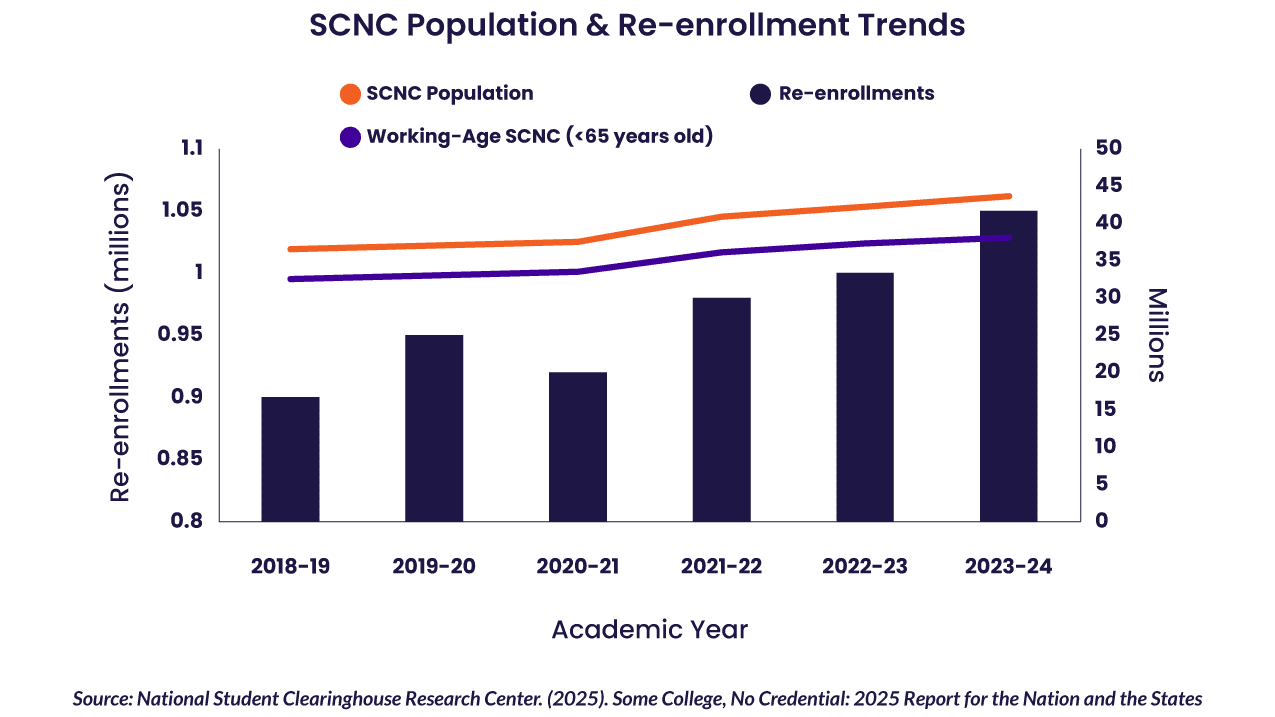
    • “Some college, no credential” learners returning to finish what they started 

    The lines between traditional and nontraditional students have disappeared. These aren’t separate segments—they’re one unified audience shaping the future of higher education.

    Leaders who continue to operate with outdated distinctions risk designing strategies for a market that no longer exists. Modern Learners value cost, convenience and career outcomes—and they expect institutions to deliver all three.

    This is the moment to retire the old playbook, embrace a new mindset and build for the learner who’s already redefining what comes next.

    Key Takeaway #3: AI Is an Unmistakable Force with Far-Reaching Implications 

    AI is accelerating change across every dimension of higher education, from how institutions engage to how graduates build careers. 

    While the technology itself isn’t new, its rapid integration is rewriting the rules. AI has fractured the traditional recruitment funnel. Modern Learners use AI-powered tools to search, compare and evaluate options before they reach an institution’s website. The student journey is now self-directed, hyper-personalized and constantly evolving, demanding that marketing and enrollment teams adapt in real time. 

    But AI’s impact extends far beyond recruitment. Its growing influence in the workforce is forcing institutions to rethink their academic mission. Institutions that lead will design education for the AI era by combining technical fluency with human-centered skills such as creativity, critical thinking and ethics. 

    Key Takeaway #4: AI Is an Unmistakable Force with Far-Reaching Implications 

    Incrementalism is now the greatest risk. In an age of constant disruption, small adjustments and siloed strategies hinder growth. The institutions that succeed will lead with clarity, agility and a unified vision centered on the Modern Learner. 

    Sustained growth demands leadership that acts decisively across three dimensions: 

    1. Align program portfolios with high-growth sectors. Move beyond tradition-bound curriculums. Invest in programs that meet labor-market demand and retire those that no longer serve a clear purpose. 
    2. Unify brand and enrollment strategies. The boundaries between undergraduate, graduate and online student populations are disappearing. Institutions must speak with one voice and focus on the three factors that drive every learner’s decision: cost, convenience and career outcomes. 
    3. Lead the conversation on value and outcomes. Public trust cannot be rebuilt through messaging alone. It must be earned through transparency, data and measurable results.

    This is the moment that will define the next decade of higher education. The difference between survival and sustainable growth hinges on decisive, informed action. Leaders must either seize this moment to shape the future or watch their institutions be defined by it. 

    From Insight to Action: Ten Strategic Imperatives for Sustainable Growth 

    The era of incremental adjustment is over. Conviction is now the currency of leadership. This moment demands bold leadership and a decisive strategy that converts disruption into a roadmap for measurable growth. 

    The EducationDynamics’ 2026 Landscape of Higher Education Report delivers that roadmap. Our Ten Strategic Imperatives are pragmatic, research-driven levers designed to help your institution build resilience and sustainable momentum for 2026 and beyond. 

    Imperative #1: Prove Outcomes. Protect Reputation.  

    Publish transparent results and illustrate career alignment to help students understand program value. 

    Imperative #2: Market ROI Relentlessly. 

    Lead with affordability and clearly communicate a projected and proven return on investment. 

    Imperative #3: Capture the Dual Enrollment Surge.   

    Build structured high school-to-degree pipelines. 

    Imperative #4: Own the Adult Learner Market.

    Offer flexible, online and stackable options with the support working learners need to balance their multiple priorities. 

    Imperative #5: Prioritize Accessibility through the Three C’s.  

    Deliver education that meets learners on cost, convenience and career outcomes. 

    Imperative #6: Lead in Responsible AI Adoption.  

    Optimize marketing for AI discoverability and AI powered platforms, while Integrating AI into advising, engagement and instruction. 

    Imperative #7: Reinvent Vulnerable Disciplines.  

    Reframe liberal arts around adaptability and skills attainment. 

    Imperative #8: Re-engage the Stopped-Out Majority. 

    Convert the 43 million with some college, no credentials into completers through credit recovery, tailored pathways and adult-first design. 

    Imperative #9: Stack Credentials into Careers.  

    Link short-term certificates to degree pathways. 

    imperative #10: Advocate for Policy Stability. 

    Simplify aid communication and push for predictable funding. 

    Together, these imperatives form a blueprint for how higher education can evolve from reactive adaptation to proactive growth. 

    Transform Disruption into Growth

    The time for caution has passed. Those who hesitate or fail to act with purpose will fall behind in a marketplace that does not wait. 

    At EducationDynamics, we partner with colleges and universities prepared to lead this transformation—those who understand that meeting the Modern Learner where they are is not just an enrollment strategy but the new mission of higher education. 

    For deeper insights and actionable strategies, download the full 2026 Landscape of Higher Education Report and learn how your institution can stay ahead of the curve. 

    Source link

  • Key Performance Indicators that Matter in 2026

    Key Performance Indicators that Matter in 2026

    Securing steady enrollment growth and keeping students happily on board are top priorities in higher education. But how do you ensure you’re truly meeting student needs and demands? It’s all about measuring performance effectively. Gone are the days of navigating blindly through raw data; Key Performance Indicators (KPIs) are the laser-focused measures that cut through the noise, providing clear direction and a true sense of what’s working. It’s time to harness the power of data to steer your institution toward success.

    Key Performance Areas

    So, where do you start?

    Determining your institution’s unique strategic goals is the first step. Once you know your target destination, KPIs become the navigation tools that guide you there. Look beyond generic metrics and choose a balanced set of KPIs across six performance areas:

    AI Readiness

    AI Readiness is the next-generation key area that proves you’re building a university that is smarter, more efficient and more responsive than anything the old systems could produce. If AI isn’t a core part of your institution’s DNA, you’re not just falling behind, you’re becoming obsolete. This isn’t about having a chatbot on your admissions page. It’s about a complete institutional transformation.

    You can’t manage what you don’t measure. Here are the metrics that will expose whether your institution has truly embraced the future.

    • AI density: Percentage of keywords that are ranking in AI overviews.
    • Engagement metrics from AI chatbots such as engaged sessions and views.
    • AI-Driven Workflow Automation Rate: Percentage of key administrative processes (e.g., admissions review, financial aid queries) that are fully or partially automated by AI.
    • AI-Informed Decision-Making Rate: Percentage of high-level strategic decisions made based on predictive analytics and AI models.
    • Student Support AI Integration: The percentage of student inquiries (e.g., in financial aid, advising or registrar services) handled by AI-powered tools.
    • Personalized Learning Platform Adoption: The percentage of courses or students utilizing AI-powered platforms to tailor educational content and pace.

    Enrollment and Student Retention Metrics

    Strong enrollment and retention lead to higher graduation rates, reduced revenue loss and an improved institutional reputation. Driving college or university enrollment and retention involves pinpointing relevant Persistence, Progression, Retention and Completion (PPRC) metrics, gathering data from all angles (think systems, surveys, records) and using those insights to craft action plans.

    These numbers aren’t just about growth. They are a measure of your institution’s ability to engage and keep students in a hyper-competitive market.

    We delve deeper into this area by tracking:

    • Enrollment rate: Percentage of applicants who accept and enroll in the program.
    • Retention rate: Percentage of students who continue their studies from one semester/year to the next.
    • Time-to-degree completion: Average time it takes students to graduate.
    • Student satisfaction: Overall satisfaction with the educational experience, measured through surveys or feedback.
    • Application start rate: Percentage of people who begin an application.
    • Application completed rate: Percentage of people who finish and submit an application.
    • New student start rates: Percentage of accepted students who actually begin their studies.

    Financial and Operational Performance

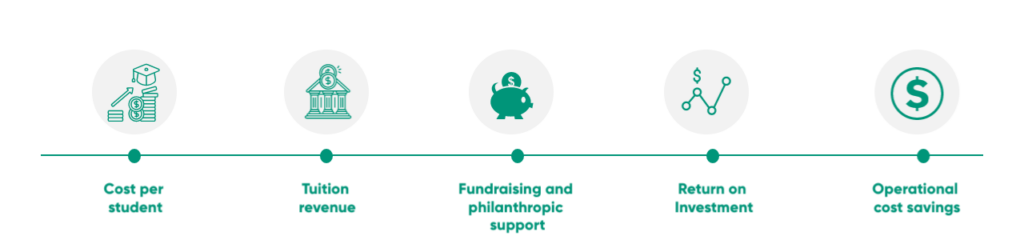
    A healthy financial and operational performance ensures sustainability, resource optimization, and the ability to reinvest in student success. We monitor:

    • Cost per student: Average cost of educating each student.
    • Tuition revenue: Income generated from student tuition fees.
    • Fundraising and philanthropic support: Donations and grants received to support the institution.
    • Return on investment: Measurable benefit in relation to resources invested.
    • Operational cost savings: Reductions in operational expenses without compromising quality.
    Infographic presenting key performance indicators (KPIs) for financial and operational performance of an educational institution. KPIs include: cost per student, tuition revenue, fundraising and philanthropic support, return on investment, and operational cost savings.

    Student Engagement and Learning Outcomes

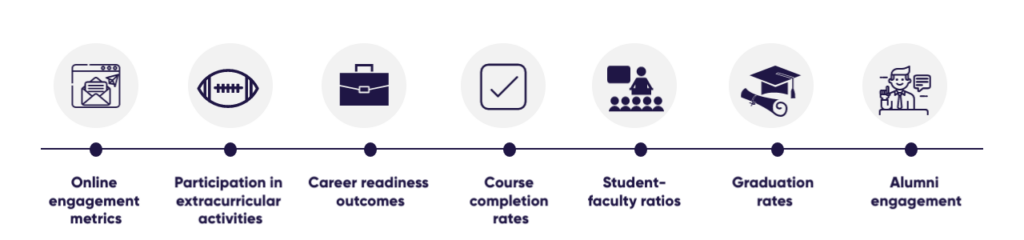
    High student engagement and successful learning outcomes translate to greater student satisfaction, improved graduate employability and a boost to your institution’s reputation. Track the following key performance indicators:

    • Online engagement metrics: Measures of student interaction and participation in online learning platforms.
    • Participation in extracurricular activities: Level of student involvement in non-academic activities.
    • Career readiness outcomes: Success of graduates in securing employment and achieving career goals.
    • Course completion rates: Percentage of students who successfully complete each course.
    • Student-faculty ratios: Number of students assigned to each faculty member.
    • Graduation rates: Percentage of students graduating within the expected or predefined timeframe.
    • Alumni Engagement: Level of engagement and involvement of graduates with the institution.
    Infographic showcasing KPIs related to student engagement, learning outcomes, and alumni involvement. KPIs include: online engagement metrics , participation in extracurricular activities, career readiness outcomes, course completion rates, student-faculty ratios, graduation rates, and alumni engagement.

    Diversity, Equity and Inclusion

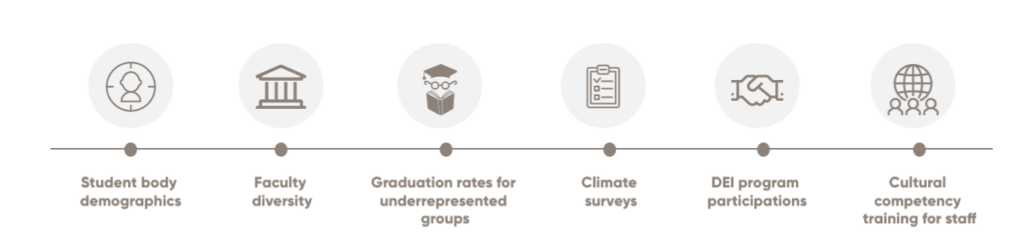
    Fostering a diverse and inclusive environment promotes equity in student success, attracts a wider talent pool, and strengthens your community. We assess:

    • Student body demographics: Representation of different ethnicities, genders, socioeconomic backgrounds, etc. in the student population.
    • Faculty diversity: Representation of different groups among faculty members.
    • Graduation rates for underrepresented groups: Success rates of students from minority or disadvantaged backgrounds.
    • Climate surveys: Assessments of the campus environment in terms of inclusivity and belonging.
    • DEI program participations: Number of students, faculty, and staff engaging in diversity, equity, and inclusion initiatives.
    • Cultural competency training for staff: Efforts to equip staff with knowledge and skills to support a diverse student body.
    Infographic displaying Diversity, Equity, and Inclusion (DEI) KPIs relevant to colleges and universities. KPIs include: student body demographics (e.g., race, ethnicity, gender), faculty diversity (representation of diverse identities), graduation rates for underrepresented groups, climate surveys (assessing inclusivity and belonging), DEI program participation (engagement in diversity initiatives), and cultural competency training for staff (developing understanding and skills to interact respectfully with diverse groups).

    Brand Key Performance Indicators for Reputation and Marketing Effectiveness

    Effective marketing strategies to increase student enrollment play a key role in establishing a strong brand reputation and contributing to a positive public image.
    We monitor these key performance indicators:

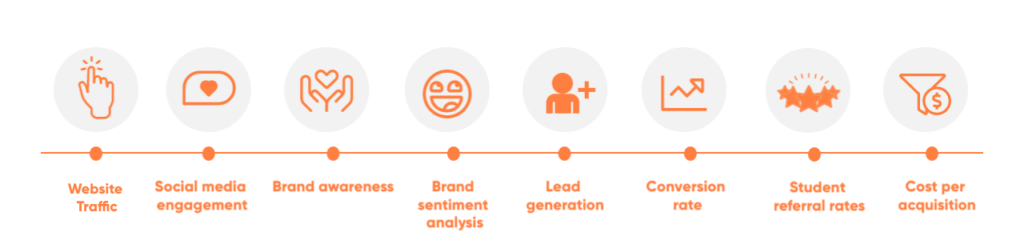
    • Website traffic: Number of visitors to the institution’s website.
    • Social media engagement: Likes, shares, comments, and other interactions on social media platforms.
    • Brand awareness: Recognition and familiarity with the institution by the target audience.
    • Brand sentiment analysis: Understanding public perception and opinion of the institution.
    • Lead generation: Number of potential students identified through marketing efforts.
    • Conversion rate: Percentage of leads who actually enroll in the program.
    • Student referral rates: Number of new students enrolled through recommendations from current or former students.
    • Cost per acquisition: Average cost of acquiring a new student through marketing campaigns.
     Infographic showcasing KPIs for brand reputation and marketing effectiveness of colleges and universities. KPIs include: website traffic (number of visitors), social media engagement (likes, shares, comments), brand awareness (recognition and familiarity), brand sentiment analysis (public perception), lead generation (potential student identification), conversion rate (leads enrolled), student referral rates (new students from recommendations), and cost per acquisition (average marketing cost per new student).

    Implementing KPIs for Success

    You’ve chosen your key performance indicators (KPIs). But hold up, don’t get lost in a sea of data just yet. We must translate those fancy metrics into real action.

    First things first, let’s talk SMART goals. Ditch the vague aspirations and define clear, measurable objectives. Instead of “improve student satisfaction,” aim for “increase student satisfaction score by 5% within the next semester.” See how much more focused and actionable that is?

    Data is your fuel, but dashboards are your engine. Imagine analyzing spreadsheets manually – cumbersome, right? Data visualization tools and dashboards are your secret weapons for making sense of all that information. They reveal trends, highlight areas for improvement and showcase your progress in a clear, digestible way.

    Collaboration is key. Don’t work in silos! Involve different departments – admissions, finance, academics, marketing – everyone who plays a role in achieving your goals. Share your KPIs, gather their insights and work together to track progress and make informed decisions. Remember, a data-driven culture thrives on shared ownership and collective action.

    Remember, adaptability is your superpower. The higher education landscape is dynamic, so your KPIs should be too. Review and update them based on new priorities, data-driven insights and feedback regularly. Be flexible, be responsive and embrace continuous improvement as your guiding principle.

    The Future is Not an Improvement. It’s a Revolution.

    Your competitors—the legacy players—are selling you on a slightly better version of the past. More data, a slightly cleaner CRM, a new consulting strategy. But what if the problem isn’t a lack of optimization but a fundamental design flaw?

    The next generation of enrollment demands a completely new approach built on intelligence, not just data.

    • From “Sticker Shock” to Financial Clarity
      You can’t afford to lose students to sticker price anxiety. The future is about radical transparency. It’s about a clear, simple financial aid process that tells a student their true cost of attendance from day one. No surprises. No opaque spreadsheets. Just clarity.
    • From Data Overload to Predictive Intelligence:
      Stop drowning in data. The future is about leveraging AI and predictive analytics to identify the students most likely to enroll and graduate. It’s about understanding their unique needs before they even ask and delivering a hyper-personalized experience that feels like it was designed just for them.
    • From Siloed Chaos to a Seamless Student Journey:
      Overthrow the departmental silos. The future of enrollment is an all-in-one platform that connects every stage of the student journey—from initial search to application, financial aid and enrollment. It’s one portal, one point of contact, one seamless experience.

    Stop Tinkering. Start Transforming.

    You have a choice. You can keep doing what you’ve always done, hoping a better website or a new consulting firm will solve a systemic problem. Or you can admit the old way of doing things is broken and choose to fundamentally transform your approach.

    Your KPIs aren’t just a measure of your progress; they are proof that the traditional system is failing. It’s time to stop measuring the problem and start building the solution.

    Ready to dismantle the old way and build the next generation of enrollment? Partner with EDDY to identify crucial KPIs, develop effective strategies to increase student enrollment, and track progress toward sustainable growth. Together, we can turn your data into a powerful force for positive change and empower your institution to reach its full potential.

    Take the first step today! Contact EDDY to learn how we can help you leverage the power of KPIs and achieve your strategic goals.

    Source link

  • 2026 Higher Education Digital Marketing Trends and Predictions

    2026 Higher Education Digital Marketing Trends and Predictions

    Hushed conversations about the budget, a shrinking applicant pool and that dreaded enrollment cliff are no longer whispers. The numbers are in and they tell a story you know all too well: the old way of doing things isn’t working any more.

    The traditional models are failing to keep pace with a new generation of students and a rapidly evolving job market. We’ve moved beyond the “enrollment cliff” as a future threat; it’s a present reality that is forcing institutions to fundamentally rethink their approach to marketing and enrollment.

    The old playbook of generic campaigns and static brochures is obsolete. In 2026, the game is no longer about reaching the most students but about connecting with the right students in the most authentic way possible. This new landscape is defined by data, driven by Artificial Intelligence (AI) and built on a foundation of radical transparency. It’s a world where the institutions that survive will be those willing to break away from the establishment and challenge the status quo.

    Explore the 2026 trends and predictions that are shaking up digital marketing for education industry, what it means for the next generation of enrollment and how institutions can position themselves to thrive in a new era of higher education.

    Shift to GEO/AEO and “Search Everywhere Optimization”

    With the rise of social search and AI Overviews, traditional Search Engine Optimization (SEO) is becoming insufficient. The new paradigm is “Search Everywhere Optimization.” This includes GEO (Generative Engine Optimization) to ensure your institution is favorably mentioned in AI-generated answers and AEO (Answer Engine Optimization) to appear in direct answers in AI Overviews as well as on platforms like TikTok, Reddit, Quora and voice assistants. By 2026, success will not be measured by a #1 ranking on a Google page, but by being the embedded answer wherever a student asks a question. 

    Conversational AI as the 24/7 Admissions Counselor

    AI is already strongly embedded in advertising platforms to capture student interest, but the next frontier is how institutions leverage AI in lead nurturing and admissions. As shown in EducationDynamics’ latest Engaging the Modern Learner Report, 60% of students use AI chatbots for college research, a significant jump from 49% just a year ago.  This will move beyond simple chatbots into sophisticated conversational AI that manages entire nurturing funnels, providing instant, personalized answers to complex questions about financial aid, credit transfers and program specifics via SMS and web chat. These AI assistants will be able to schedule campus tours, triage inquiries to the correct human counselor and provide 24/7 support, dramatically improving the prospective student experience and freeing up admissions teams to focus on high-intent, high-value interactions.

    Authentic Storytelling 

    Authentic user generated content will be a vital part of a brand’s storytelling as more students turn to social channels and short form video to research and validate individual brands. Brands will increasingly leverage content creators’ sphere of influence, leveraging short-form video to tell showcase their brand story.  This creates a massive opportunity for institutions to leverage user-generated content and partner with student-creators who can showcase the real, unpolished and relatable brand story. Think a “Day in the Life” series on TikTok or a student ambassador Q&A on Instagram Live—these genuine interactions build trust and connection in a way a static brochure never could.

    AI for Personalization

    AI picks up on individual user preferences and can serve ad creative that they are more likely to engage with due to better relevance. AI will use existing ad assets (images, videos, headlines, descriptions, etc.)  and landing page experiences to create unique and personalized ads. Landing page personalization will also emerge in 2026 as a way to increase relevance and conversion rate optimization. To be successful, advertisers need to provide a wide variety of existing assets and have a strong landing page experience. For example, if a prospective student has previously browsed your computer science program page, an AI-powered ad could then automatically show them a video testimonial from a current computer science student, rather than a generic campus tour video.

    Rise of Social for Search

    Over the past couple of years, we’ve seen students turning to social for search, we will continue to see this pattern and expect it to increase. Unlike a traditional search engine that provides a list of links, social platforms offer an immersive experience. Students can search for a university’s name and instantly see “day in the life” videos, unscripted dorm tours and Q&A sessions with real students. This content feels more genuine and trustworthy than a polished university-produced video. For them, a hashtag search is less about finding a fact and more about getting a feel for a school’s culture. Having an organic and paid presence on social channels will be vital for brands to be present where their audience is searching. 

    More Ads in AIOs/AI Mode

    To date, there have been very few instances of EDU ads within AI Overviews or AI Mode, but in 2026, we expect this to change dramatically. Google is actively integrating ads directly into its AI-generated summaries and institutions need to be prepared to take advantage of this new frontier for digital advertising for higher education.

    This shift is about more than just a new ad placement; it represents a fundamental change in how advertisers reach prospective students. Instead of relying solely on keywords, digital advertising for universities in AI Overviews are triggered by the full conversational context of a user’s query. This means an ad for your nursing program could appear not just on a search for “nursing school near me,” but also on a more exploratory query like “what are the best career paths in healthcare?” that generates an AI Overview response.

    To secure a presence in these valuable new placements, institutions will need to embrace Google’s AI-powered ad solutions. These include:

    • Broad Match:
      This uses Google’s AI to match your ads to a much wider range of relevant searches, including long-tail and conversational queries that are common in AI Overviews.
    • Performance Max:
      This campaign type leverages automation to find high-value conversions across all of Google’s channels, including Search, Display, YouTube and, increasingly, AI Overviews.
    • AI Max for Search (Beta):
      The newest iteration of Google’s AI-powered ad solutions, AI Max for Search is designed specifically to enhance creative relevance and expand reach within AI-driven search experiences.

    As AI-generated results take up more screen space, being present in these ad placements is crucial. This is a chance to get your brand in front of students at a new moment of discovery, where they are actively seeking complex, nuanced information. Shifting to these AI-powered tools is the key to ensuring your institution remains visible and competitive.

    First-Party Data is the Ultimate KPI

    As audience targeting and keywords continue to get broader, across paid search and paid social, properly training AI to find and optimize to the right user will be crucial to a campaign’s success. The best signal institutions can provide is through their own data. Institutions will need to prioritize regularly importing their 1st party data to fuel their audiences and bidding strategies. Bidding to outcomes will drive quality and as a result CPCs as a KPI will decrease in importance, especially as CPCs continue to increase. Instead, the focus should remain on the cost per outcome, such as cost per application and cost per enroll. Focusing on and optimizing to these ultimate KPIs will bypass front-end noise, ensure quality and prioritize outcomes that more closely correlate to business goals.

    Ready to Break Free From the Old Playbook in the Higher Education Industry?

    The time for waiting is over. The institutions that will survive and thrive in this new era are those that abandon the outdated playbooks of the past and embrace a new, data-driven and authentic approach to enrollment.

    This is not a time for incremental change. It’s a time for bold, strategic action. By leveraging AI for personalization and operational efficiency, embracing authentic storytelling and prioritizing first-party data, you can build a recruitment strategy that not only attracts the right students but also proves the enduring value of your institution.

    Ready to transform your enrollment strategy and secure your institution’s future? EducationDynamics is the only partner with the expertise, technology and end-to-end solutions to help you not just adapt, but thrive. Contact us today to future-proof your institution.

    Source link

  • How Marketers are Winning With AI-Powered Search

    How Marketers are Winning With AI-Powered Search

    Search Has Changed. Has Your Strategy?

    Paid search marketing has always played a central role in how students find and engage with colleges and universities. But how students search and what they expect from the experience has fundamentally changed. Today’s Modern Learners are digital-first and highly discerning, which raises the stakes for any higher education marketing strategy, especially when it comes to search visibility. Modern Learners are not just typing in keywords; they’re asking complex questions and increasingly expect fast, relevant answers that feel tailored to their individual goals.

    In this new reality, search is no longer just a tool; it is your institution’s reputational front door. For many students, the first impression comes from your search presence—whether your institution appears at all, and what shows up when it does. This moment shapes how they perceive your brand and can influence their decision to engage further.

    With advancements such as Google’s AI Overview and AI Mode, the line between paid and organic results is disappearing. These features pull from multiple sources to deliver a single, curated response designed to satisfy intent rather than merely match keywords. This means your search strategy can no longer operate in silos. Paid and organic efforts must work in tandem, and both need to be structured around how students actually search, not how institutions are used to marketing.

    Yet, many institutions still rely on legacy paid search strategies that are fragmented and overly focused on isolated keywords. These outdated tactics often miss the nuance of modern search behavior, leading to underperformance and missed opportunities.

    This is especially critical during a time when marketing budgets are under pressure and visibility is harder to earn. To remain competitive, higher ed marketers need to reimagine paid search not as a list of bid terms or ad placements, but as a strategic channel that influences both enrollment outcomes and institutional reputation. What’s at stake isn’t just performance. It’s how your brand is perceived in the channels that matter most.

    Intent Is the New Currency of Paid Search 

    Paid search has long been valued for its ability to deliver results quickly and cost-effectively. But in today’s environment, true efficiency means more than just driving volume through simply targeting the right keywords. Today, successful campaigns are built around understanding and aligning with the why behind a student’s search, not just the what.

    That’s where intent becomes essential. Intent reveals what a prospective student is trying to accomplish, what stage of the decision process they’re in and what they expect from their educational experiences. With today’s AI-powered platforms, marketers can now interpret and respond to this intent with greater precision than ever before.

    Modern tools like Performance Max—Google’s fully automated, goal-based ad campaign—and Broad Match—its flexible keyword matching option—draw from a range of real-time signals like device type, browsing behavior, location, and time of day. These platforms use that context to determine not just who to reach, but how and when to deliver the most relevant message.

    This shift is especially important when engaging adult and online learners. These prospective students often search in short, focused bursts across devices and platforms. Intent-based targeting helps ensure your message appears at the right moment, when a prospective student is most open to taking the next step.

    The benefit goes beyond smarter targeting. Institutions that embrace intent-based strategies often see improved efficiency, stronger lead quality and a higher return on investment. More importantly, they’re creating a search experience that meets students where they are.

    For higher education marketers, this requires a mindset shift. Paid search is no longer about chasing keywords or building lengthy lists of terms. It’s about reading behavior, responding with context and building relevance. Those who adapt to this new model will be better positioned to influence outcomes and build lasting brand reputations.

    Why Over-Segmentation Hurts AI Performance 

    Aligning with student intent requires more than new tools—it requires rethinking how campaigns are structured. That’s where over-segmentation becomes a critical barrier. Not long ago, higher education marketing professionals found success by keeping campaigns tightly focused. You’d build detailed audience segments, carefully tailor your messaging and control every aspect of targeting. It worked well in a time when more control often meant better results.

    That playbook doesn’t hold up in today’s AI-driven paid media environment. In fact, over segmentation actively holds your campaigns back.

    AI performs best when it’s given space to learn and optimize. It needs strong signals, such as first-party data, clear conversion goals and smart bidding strategies, to work effectively. Overly narrow targeting and rigid parameters create inefficiencies and limit performance.

    That’s why marketers should focus less on segmentation and more on supplying clear, meaningful data that helps AI reach the right students and drive outcomes like increased inquiries and stronger application intent. 

    At the same time, student journeys have changed. Modern Learners aren’t moving through the funnel in linear paths. Ther research process is fast-paced and shaped by real-life pressures like work schedules, finances and family responsibilities.  

    Prospective students don’t just want more content—they want information that’s relevant to their needs and arrives when it matters most. Modern paid media strategies must move beyond simple demographics to focus on behaviors, intent and how students search. 

    Transforming Strategy Into Results

    As search evolves, so too must the role of the higher ed marketer. In today’s AI-driven landscape, students are exploring their options in more nuanced ways. To keep pace, marketing strategies must shift from keyword-first thinking to approaches that prioritize context, content and the student journey. Here’s how forward-thinking teams are putting that into action:

    Smarter, Simpler Campaign Structures for Effective Paid Search Strategy

    AI works best when it has strong signals to learn from. That means it’s often more effective to group campaigns by intent rather than breaking them up by individual programs or markets. For example, grouping similar programs together can help your budget go further by focusing on where there’s actual search demand, even if it means less control over specific program-level results.

    Content That Works Harder

    When you’re working in a keywordless environment, your content does the targeting. Search platforms rely on your landing pages, headlines and descriptions to understand what you offer and who you want to reach. That’s why clear, relevant content is critical.  The schools seeing the best results are the ones creating content that aligns with what students are actually searching for. 

    Making the Most of First-Party Data 

    Performance Max campaigns are especially powerful when they’re fueled by high-quality first-party data. Feeding in enrollment signals, audience segments and behavioral insights allows AI to deliver more personalized outreach across platforms. This enhances reach and efficiency without compromising targeting precision.

    Scaling with AI Max and Broad Match 

    New tools like AI Max are opening doors to even more automation. AI Max combines broad match, keywordless targeting and AI-generated creative to help schools reach students in AI-driven placements. Paired with the right paid search strategy, Broad Match helps your content appear in the natural, conversational queries students actually use. 

    Aligning Paid and Organic Strategies  

    The strongest higher education marketing strategies bring paid search marketing and organic search marketing under one roof. When teams align on landing pages, keywords and messaging, both channels amplify each other—driving more qualified traffic, improving conversions and boosting visibility across search results. This gives AI clearer context and helps create a smoother experience for students. 

    Continuous Testing and Learning 

    AI doesn’t mean putting things on autopilot. The best results come when marketers stay involved—testing creative, improving landing pages and updating their audience signals. All of that helps the AI learn and get better over time. 

    When campaigns are built around clear intent and fueled by rich data and relevant content, AI moves beyond automation—it becomes a strategic partner. This empowers institutions to reach the right students with precision, reduce wasted spend and create meaningful connections that drive enrollment success. 

    Harness AI to Amplify Your Team’s Impact 

    AI isn’t here to replace your marketing team. Instead, it helps them work smarter and focus on what really matters. AI tools take care of the routine tasks like adjusting bids, testing creative and targeting audiences in real time. This gives your marketers more time to concentrate on strategy, keeping your brand consistent, understanding student journeys and improving conversions.

    This partnership between marketers and AI is the future of higher ed marketing. Adapting your strategy to today’s search landscape helps strengthen both your enrollment pipeline and your brand foundation.

    At EducationDynamics, we think differently about AI’s potential to power higher education marketing teams by combining creativity, data-driven insight and technology to drive meaningful growth.

    This is more than just a new way to run campaigns. It’s a shift toward meeting students more effectively—aligning enrollment and brand goals in a way that builds trust, boosts visibility and drives lasting success.

    Source link

  • What Higher Ed Marketers Can Learn from the Meltwater Summit 2025

    What Higher Ed Marketers Can Learn from the Meltwater Summit 2025

    In an era where higher education faces unprecedented challenges and opportunities, the recent Meltwater Summit offered crucial insights for leaders navigating a rapidly changing landscape. This gathering of creative minds, brand leaders and technology experts explored the critical intersection of compelling storytelling, branding and the power of artificial intelligence. Explore strategic takeaways poised to reshape how institutions connect with prospective students, build brand equity and harness AI to drive creative processes.  

    Creativity Flows with You 

    Reese Witherspoon set the tone with an honest reflection on the nature of creativity: it’s constantly flowing but rarely on a set schedule. The challenge isn’t finding ideas—it’s cultivating the environment and carving out dedicated time for them to flourish. The solution? Clear, consistent and intentional communication. Whether you’re bridging teams or brainstorming with collaborators, creating space for dialogue is what truly transforms good ideas into great ones. At EducationDynamics, we aren’t just completing tasks; we are constantly collaborating with each of our partners to ensure we produce the best content possible. Our solutions span creative services, brand strategy, awareness marketing and more—turning inspiration into action and strategy into results. 

    AI: A Teammate, Not a Replacement 

    AI emerged as a powerful ally throughout Meltwater Summit sessions, particularly when leveraged for the content creation process. One standout tactic shared was the “sandwich approach” to content creation, a straightforward framework for combining human creativity with AI support: 

    1. Draft with Intent: Begin by outlining your core message or ideas. This first layer is where your expertise and objectives take shape, setting the foundation for compelling content.  
    2. Expand with AI: Use AI tools to build upon your draft—generating copy variations, enhancing clarity or exploring new angles you may not have considered.  
    3. Refine with Purpose: Continue to refine and rework AI-enhanced content through your own lens. Strengthen the structure, sharpen the voice and align it with your audience and brand tone. Great content takes more than one pass; it’s built through deliberate iteration.  

    The takeaway was clear—AI isn’t here to replace your creativity. It should be used to to amplify it. When used intentionally, it becomes a partner in the process, helping ideas take shape faster than before. 

     At EducationDynamics, we embrace AI as a collaborative tool that helps streamline ideation and improve efficiency. It should be a jump-off point, not a final destination, supporting the creative process without replacing the human insight that drives it. 

    Prompt Writing with AI

    AI can be an amazing content marketing tool, especially when used to generate fresh ideas, streamline workflows, and tailor messaging for specific audiences. In order to achieve these goals using AI, effective prompt writing is also a critical asset.  

    While a typical Google search might consist of just a few words, an effective AI prompt can span hundreds. The more detail you provide, the better your results will be. Don’t hesitate to ask AI to evaluate or improve your original prompt; collaboration is your asset when using AI. Treat an AI assistant as a teammate. Work with it, and understand it is there to work the foundation, not complete it.  

    Important Tip: Protect your data. Avoid sharing sensitive information with public AI tools, and use secure, private systems that align with your institution’s compliance and governance policies. 

    Smarter Workflows with AI

    AI isn’t just for writing. It can streamline your entire workflow. From summarizing analytics and setting alerts for media mentions to helping coordinate across teams, AI is becoming an indispensable partner in day-to-day operations.

    The takeaway: AI won’t take your job—but it might take over the tasks that are holding you back from your best work.

    Content That Captures and Connects 

    Creative content marketing has the power to elevate your institution’s voice and drive meaningful engagement across platforms. Today’s most effective content does more than inform; it creates an emotional connection. That means capturing content that feels real, engaging and multi-layered. Even one filming session can yield a wealth of valuable content. In each filming session, aim to produce the following: 

    • A core message or question 
    • Authentic behind-the-scenes footage 

    At EducationDynamics, our creative services span the full content spectrum—including Organic Social strategies designed to help institutions tell their stories in ways that resonate and inspire, reaching students right at their fingertips.  

    Strategic Content Planning

    For university marketing leaders and content marketing managers alike, every piece of content should align with your larger content calendar and overarching brand goals. Don’t post just to fill the gap. Each piece should serve one (or more) of three purposes:

    • Educate: Deliver useful and relevant information. 
    • Engage: Spark genuine conversation and connection. 
    • Encourage: Motivate your audience to act, advocate, or explore further

    In higher education, for example, students crave content that both informs and resonates emotionally. Whether highlighting everyday moments or preparing for crisis communication, a plan—and a designated point of contact—ensures you can respond quickly and effectively.  

    Always ask: How does this content deepen connections, build school pride or inform?   You’re not just telling a story—you’re shaping your institution’s impact.  

    Build With Intention

    From AI integration to authentic content creation, one message echoed throughout this year’s Meltwater Summit: success in today’s digital world means being intentional.  

    The institutions that thrive are the ones building with purpose, thoughtfully engaging audiences and effectively leveraging technology. They listen, adapt and invest in strategies that meet the Modern Learner where they are, contributing to overall brand health and engagement.  

    Purposeful creation begins with understanding your community, amplifying their voices and delivering value through every interaction. As a higher education marketing agency, we empower institutions to transform attention into enrollment and inspire students to become advocates.  

    Your institution has the foundation: vision, community and purpose. With the right tools and the right partner, you can turn that foundation into measurable growth that aligns with your goals. If you are ready to grow with intention and engage on a deeper level, EducationDynamics is here to support you.  

    Source link

  • What Higher Ed Marketers Can Learn from the Meltwater Summit 2025

    What Higher Ed Marketers Can Learn from the Meltwater Summit 2025

    As higher education navigates rapid change, the Meltwater Summit, held in New York City in May, was a gathering of creative minds, brand leaders and technology experts. The Summit made one thing clear: compelling storytelling, intentional branding and the thoughtful use of artificial intelligence are interconnected forces that shape lasting reputations. Institutions that invest in purposeful content and strategic technology integration are best positioned to lead with both credibility and measurable impact, connecting brand reputation and revenue growth as part of a unified strategy.

    Meltwater is a leading platform in media intelligence, powering reputation management, press monitoring and social listening. At EducationDynamics, we use Meltwater to uncover trends, track brand perception and guide strategies across channels for our partners.

    This year, I had the opportunity to attend the Meltwater Summit—a two-day event designed for marketing and communications professionals focusing on how data and creativity shape brand strategy. In my role as Senior Social & Visual Strategist at EducationDynamics, I was especially tuned into the evolving role of social media.

    The conversations throughout the Summit reaffirmed the importance of developing content strategies that are cohesive, intentional and fully aligned with broader brand goals. Explore the key takeaways we gathered from the event and how they can benefit higher education marketers.

    Reese Witherspoon set the tone with a powerful opening session, delivering honest reflection on the nature of creativity. Creativity is constantly flowing but rarely on a set schedule. The challenge isn’t finding ideas—it is cultivating the environment and carving out dedicated time for them to flourish. The solution? Clear, consistent and intentional communication. Whether you’re bridging teams or brainstorming with collaborators, creating space for dialogue is what truly transforms good ideas into great ones.

    What we learned about the creative process is clear: creativity is not merely a component but a foundational pillar of your university’s reputation. When internal teams collaborate, align and ideate together, they build a cohesive and authentic brand that shapes how your institution is seen from the outside.

    Moreover, it is important to recognize that your organic social efforts, website content, press releases and all other communications are not isolated channels. They form an interconnected ecosystem. Each piece of content plays a role within a broader narrative of your institution’s reputation. Thinking holistically about how every element comes together and ensures that your university’s story is consistent and impactful at every touchpoint.

    For university marketing leaders and content managers, content should do more than fill space—it should move the needle. Every asset should align with your broader strategy, reinforce your institution’s brand and serve at least one of the following purposes:  

    • Educate: Share timely, valuable information your audience can trust. 
    • Engage: Spark genuine conversation and connection. 
    • Encourage: Motivate your audience to act, advocate, or explore further.

    Today’s Modern Learners seek content that not only informs but also resonates with their experiences and aspirations. Whether showcasing everyday moments or navigating a crisis, having a clear plan—and a designated point of contact—ensures your team can respond with timely, thoughtful responses.  

    As you develop your content, ask yourself: Does this content deepen connection, build school pride or inform? Does it strengthen our institution’s reputation? If it does not accomplish any of this, you are just creating noise. 

    Success in today’s digital landscape demands intentionality. It is not just about telling stories—it is about using every piece of content strategically to shape perception, deepen engagement and build a brand that endures.  

    To build a brand that endures, every content piece should be seen as an opportunity to reinforce your institution’s voice and values. Strategic content creation, especially through organic social, plays a vital role in shaping how your audience connects with and trusts your brand. 

    When aligned intentionally, organic social media is a powerful channel that strengthens brand affinity while complementing awareness and digital marketing efforts across multiple channels. Creative content marketing, particularly in video, continues to grow in importance as a relevant medium for establishing reputation. Today’s audiences prefer content that feels authentic and emotionally resonant. To capture that depth, institutions should plan how content will be used across multiple channels. For example, to get the most out of every filming session, aim to capture: 

    • A core message or question 
    • Authentic behind-the-scenes footage 
    • Action shots 
    • Introductory context 
    • Relatable soundbites

    These assets do more than fill channels. They bring your strategy to life across multiple touchpoints in a format that is both attention-grabbing and engaging. When your content reflects lived experiences and community voices, it fosters trust and connection. In today’s crowded digital space, trust is a vital currency that drives reputation and results.

    No conference in 2025 is complete without discussions of AI.  Throughout the Summit, AI was highlighted as a powerful ally, particularly when leveraged within the content creation process.  One key tactic shared was the “sandwich approach,” a straightforward framework for combining human creativity with AI support:  

    1. Draft with Intent: Outline your core message and ideas based on your expertise.
    2. Expand with AI: Use AI tools to generate variations, improve clarity or explore new angles.
    3. Refine with Purpose: Edit and polish AI-enhanced content to match your brand voice and audience.

    Strong results also depend on clear, detailed prompts. Providing AI with context like tone, audience and format helps produce relevant output. Beyond content creation, AI can streamline workflows, freeing marketers to focus on strategy and adding creative touches.

    At EducationDynamics, we view AI as a collaborative tool that boosts efficiency and creativity. It serves as a jump-off point, not the final destination, supporting the work driven by our team’s vision.

    Meltwater reinforced that when AI is thoughtfully integrated into the creative process, it does not replace your unique insight. Instead, it amplifies it, freeing your team to focus on the meaningful and strategic work that shapes your institution’s brand.

    If one message stood out at this year’s Meltwater Summit, it was that creativity and strategic content creation are essential to building a compelling strong and enduring reputation.

    The institutions best positioned to thrive are those that engage their audiences intentionally, invest in the right technologies and meet the Modern Learner where they are.

    Purposeful creation begins with understanding your community, amplifying their voices and delivering value through every interaction. As a higher education marketing agency, we empower institutions to transform attention into enrollment and inspire students to become advocates.

    Your institution already has the foundation: vision, community and purpose. With the right tools and the right partner, you can turn that foundation into measurable growth that aligns with your goals. If you are ready to grow with intention and engage on a deeper level, EducationDynamics is here to support you.

    Source link

  • 10 Website Marketing Strategies for Building Your Reputation

    10 Website Marketing Strategies for Building Your Reputation

    The internet has dramatically transformed and so has university website marketing. From basic online brochures relying on a “build it and they will come” approach, websites evolved into dynamic, interactive platforms driven by search engine optimization (SEO) and mobile optimization. Now, website marketing blends AI-driven insights with omnichannel experiences, as prospective students expect seamless, personalized interactions that clearly articulate an institution’s value. 

    With Google’s widespread release of AI-powered search to all users, your brand and reputation are more critical than ever. The internet’s collective opinion of your institution, interpreted by AI, now directly influences search results. Strong, positive brand reputations inherently signal authority and trustworthiness to AI, increasing visibility and recommendations.  

     This moment opens new doors for higher ed digital marketing. A website that simply exists today is a missed opportunity. If it doesn’t connect with the Modern Learner or clearly articulate your institution’s unique value, you’re not just losing their interest; you’re losing enrollments and damaging your reputation. For today’s Modern Learner, who expects seamless digital experiences and values authenticity and flexibility, your website is their first impression of your brand and reputation. 

    To transform your website into a reputation-building, revenue-generating asset, you need a holistic website marketing strategy that positions your EDU website as a strategic asset that continuously adapts to learner needs, builds authentic connections and signals authority to AI. Explore 10 essential website strategies to that will ensure your institution is found and chosen by the Modern Learner.

    1. Optimize Content to Feed AI Robots  

    The Modern Learner’s journey now begins with AI. To stand out, your website needs to engage prospective students and be optimized for how AI tools find and present information. At EducationDynamics, we’ve anticipated the rise of AI in search and adapted our website marketing strategies to help institutions stay ahead and continue to outrank the competition.     

    To optimize content for both audiences, structure it clearly with descriptive headings, concise copy and consistent formatting so AI can accurately surface your programs. Highlight outcomes like career paths, program value and student success to connect your offerings to what students truly want.  

    Use natural, straightforward language that’s easy for humans and AI to interpret. Prioritize content types that AI favors, such as FAQs, career guides and student stories, to build trust and boost discoverability.  

    Your website is a pivotal opportunity to tell a compelling story that highlights your institution’s core values and unique strengths. That way, when students ask the search engines questions about the right institution for them, your website is positioned to be a top answer.  

    2. Ensure Your Website Provides a Seamless User Experience (UX) and Prioritizes Accessibility 

    Modern Learners expect fast, intuitive and accessible digital experiences. From the moment a prospective student lands on your site, navigation should feel natural. Clear headers, streamlined menus and a consistent experience across all devices ensure visitors can easily find the information they need without frustration. 

    First impressions matter, and your website’s speed and mobile responsiveness are non-negotiables. Slow load times or clunky mobile layouts can lose students before they even reach your message. A user-centric website builds trust and reflects your institution’s commitment to meeting students where they are.  

    Accessibility isn’t an add on—it must be built into your website’s infrastructure. Inclusive design ensures every user, regardless of ability, can engage with your content.  

    At EducationDynamics, we consistently stay ahead by adopting UX and CRO technologies early, allowing our team to rapidly launch A/B tests and uncover what truly resonates with students. Through continuous optimization and real-time insights, we help institutions create user experiences that reflect their brand, support enrollment goals and keep prospective students moving forward. 

    3. Optimize for Modern Search (SEO & GEO) 

    The Modern Learner demands more. As search evolves with AI, your institution’s digital visibility isn’t just important—it’s paramount.  Traditional SEO, while foundational, falls short in today’s evolving search ecosystem where the rules of digital visibility are being rewritten. 

    With the widespread release of AI-powered search, prospective students are discovering their educational options without clicking on an actual link. As a result, institutions must embrace Generative Engine Optimization (GEO). GEO isn’t just about keywords; it’s about optimizing for how AI interprets, ranks and amplifies your institution’s content. A GEO-first strategy demands prioritizing well-structured content, rich media and authentic first-person perspectives from your students and faculty to command visibility in this new, AI-driven search reality. 

    EducationDynamics doesn’t just adapt to these shifts; we innovate by anticipating emerging trends, leveraging cutting-edge technology and leveraging data-driven insights.  Our research-driven approach to SEO for higher education and GEO is continuously evolving, placing your institution at the forefront of how Modern Learners discover and engage. We ensure your visibility, credibility and competitive edge are undeniable, whether through traditional search or the power of AI. 

    4. Amplify Your Brand Voice Across All Digital Touchpoints 

    In a crowded digital landscape, fragmented messaging is a liability. For the Modern Learner, a unified brand voice across every digital touchpoint isn’t just a best practice; it’s the foundation of trust and the catalyst for lasting connection. When prospective students move between your website, social media, emails and ads, they should encounter consistent messaging that reaffirms your brand identity. Anything else risks confusion. Consistency, on the older hand, builds clarity and drives connection.   

    That alignment must be grounded in a strong brand narrative that communicates your institution’s values, mission and what sets you apart. In a market where students are inundated by options, your ability to clearly communicate your institution’s unique offerings is critical and helps students quickly understand why your institution is the right choice.  

    Real stories from students and alumni bring that narrative to life. These experiences do more than inspire; they create emotional ties that help prospective students see themselves in your community. 

    A clear, consistent brand voice, supported by a strong website content strategy, is more than a marketing asset. It is a strategic imperative, turning interest into action that builds lasting loyalty from enrollment to graduation and beyond.  

    5. Personalize the Digital Experience for Each Prospective Student 

    Personalization is no longer optional. It is essential for driving engagement, building trust and supporting students through the enrollment process. 

    By leveraging personalized content marketing, institutions can create a one-to-one experience that feels relevant and responsive. Customized email campaigns, dynamic landing pages and virtual campus tours foster connections with students. These experiences demonstrate your institution’s understanding of Modern Learners and help each individual develop a meaningful connection. 

    Personalization works best when guided by data. By monitoring behavioral cues such as pages viewed, time spent and programs researched, institutions can tailor content and messaging to align with each student’s needs. This enhances the user experience and makes students feel understood. 

    This is more than optimization. It’s relationship-building. Strategic personalization transforms passive interest into meaningful engagement and builds confidence in your institution’s ability to support each student’s journey. 

    Modern Learners don’t respond to static messages. They engage in dynamic conversations. Through data-driven personalization, institutions can build digital experiences that feel tailored and conversational, moving students from curiosity to commitment faster and with greater trust. 

    6. Build Your Advocate Community  

    he most powerful testimonials come from those who live your brand. By cultivating a vibrant advocate community, your institution doesn’t just enhance its reputation; it ignites a powerful, authentic narrative that deeply connects with prospective students, solidifying their confidence and accelerating their enrollment decision.  

    Student testimonials and reviews are among the most effective tools for building trust and credibility on your website. Authentic stories bring your brand to life, helping prospective students envision themselves thriving at your institution. Featuring a diverse range of testimonials across various website pages ensures these voices resonate with a wide audience and reflect the true student experience. 

    Provide opportunities for students and alumni to share their stories, then amplify their voices across your website and broader digital presence. This cohesive approach weaves authentic advocacy into all touchpoints, enhancing emotional connection and making your institution more relatable. 

    By rooting your brand in real experiences, you strengthen reputation and build lasting relationships. Authentic connection sets your institution apart and drives enrollment in a competitive market. 

    7. Facilitate Communication and Engagement 

    In today’s fast-moving digital world, access matters. Offering multiple communication channels on your website such as forms, live chat, text messaging, email and phone ensures prospective students can easily reach out in the way that suits them best. Making information and enrollment support readily accessible improves the overall student experience and fosters a sense of control during the decision-making process. 

    Incorporating AI-powered chatbots can further enhance engagement by providing instant answers and personalized guidance 24/7. These tools handle routine questions efficiently, allowing your team to focus on high-impact interactions that require a human touch. 

    When institutions prioritize fast, flexible communication across digital, they do more than offer convenience. They build trust, open the door to deeper engagement and provide the seamless support that moves students closer to enrollment. 

    8. Use Data and Analytics for Continuous Improvement

    Website optimization isn’t a one-time task; it is a continuous process driven by data.  Institutions should regularly track key metrics such as page engagement, bounce rates, conversions and time spent on site to understand how visitors interact with their content. Tools like heatmaps and A/B testing provide valuable insights into user behavior and help identify what elements resonate and where improvements are needed. 

    By leveraging data-driven insights from user search patterns, click paths and drop-off points, institutions can make informed decisions to enhance user engagement and increase conversion rates. Testing different headlines, layouts and calls to action allows for experimentation that drives measurable results. In addition, effective website management requires a robust Content Management System and a clear governance policy to ensure ongoing maintenance and optimization. 

    As leading market research experts in higher education, EducationDynamics knows what it takes to transform data into action.  Our team’s relentless focus on analytics and optimization isn’t just about attracting students; it’s about continuously refining a digital experience that fortifies your institution’s reputation. We empower you to harness insights, ensuring your website is a dynamic asset that converts curiosity into committed enrollment and lasting brand loyalty. 

    9. Showcase Real Outcomes with Career-Focused Tools and Resources

    Today’s students are looking for more than a degree. They want a clear path to a successful future. Your website must deliver on this expectation by showcasing tangible outcomes that prove your institution’s value. Highlighting real-world results is one of the most powerful ways to build credibility and elevate your brand.  

    Integrate features that demonstrate the long-term impact of your programs. Job placement stats and alumni success stories reinforce your institution’s influence and give students confidence in their future. Spotlight employer partnerships and accessible career services to position your school as career-connected and student-focused. Interactive tools like salary calculators, career pathway infographics and program-matching quizzes deepen engagement and help students make informed decisions. 

    By clearly communicating return on investment through your website, you do more than just inform prospective students — you build trust, strengthen your institution’s reputation and guide students closer to enrollment. This isn’t merely sharing information, it’s about demonstrating that your institution delivers on its promises. When you connect outcomes to the student experience, you create the kind of meaningful, value-driven journey that today’s Modern Learners actively seek.  

    10. Develop a Robust Content Hub That Positions Your Institution as a Thought Leader 

    In today’s competitive higher education environment, institutions must take every opportunity to showcase their unique brand proposition. Your website is a mission-critical touchpoint with power to either build or break institutional reputation. When used strategically, it becomes more than a source of information. Rather, it can be a content hub that reflects your institution’s unique offerings, while building trust and elevating your brand. 

    By highlighting content such as faculty research, student initiatives, alumni achievements and blogs on timely topics, your institution can build relevance and authority. Your website content strategy should ensure your website becomes a living representation of your institution’s values and vision. This makes your website a living representation of the institution’s values and vision, creating an integral link to your audience and ultimately leading to stronger brand credibility, increased organic engagement and a lasting reputation as a thought leader in higher education.

    The Moment is Now: Elevating Reputation in the AI Era 

    Your website is more than a digital touchpoint; it is the heartbeat of your brand and foundation of your institution’s future. In an AI-driven world, standing still means falling behind.  

    At EducationDynamics, we’re here to help you navigate these changes with confidence. Transforming lives through higher education is at the core of our mission, and that means anticipating trends, understanding shifts and equipping our partners to thrive. 

    This is not merely an opportunity to adapt; it is an imperative to lead. Now is the decisive moment to fundamentally reimagine your website’s strategic role in driving unparalleled visibility, sustainable growth, and a strong reputation. Join John Weaver and Karina Kogan for “The New Rules of Website Marketing,” a live virtual masterclass that will show you how to turn your website into a high-impact tool for success in an AI-driven world. Secure your institution’s future advantage by reserving your spot today

    Source link

  • Stop Marketing to Yesterday’s Students: A New Era for Higher Ed 

    Stop Marketing to Yesterday’s Students: A New Era for Higher Ed 

    Is your institution’s marketing truly reaching today’s students, or are you shouting into the void? Higher education marketing is undergoing a seismic shift. With rapid changes in student behavior, the rise of AI and mounting constraints on institutional funding, marketing leaders can no longer rely on yesterday’s strategies to meet today’s challenges. Student expectations have evolved. Budgets are tightening. And yet, many institutions are still using outdated strategies that fail to resonate with the Modern Learner.  

    To stay competitive, institutions must embrace the new era of higher education marketing—an era defined by personalized engagement, brand-building and data-driven decision-making. In a world where marketing dollars work must work harder than ever, rethinking your strategy is no longer optional. It is essential to long-term success.  

    Students no longer passively wait for information. They actively seek it across multiple channels, from social platforms to AI-powered search tools. Their behaviors are more self-directed than they were even a decade ago, and the expectations they bring to the table are shaped by instant access, transparency and digital convenience. Modern Learners want institutions that reflect their values and aspirations. As a result, branding plays an even more critical role in decision-making than ever before. Trust, authenticity, and alignment with personal identity all contribute to conversion. Meanwhile AI is accelerating these shifts by analyzing behavior in real time and delivering tailored experiences at scale.  

    These changes are not on the horizon—they are already here. Institutions that fail to adapt risk being left behind.  

    This evolution is shaping the standard of higher education marketing, and redefining what it takes to attract and engage Modern Learners. Today’s students are not yesterday’s prospects. They are savvy, value-driven and self-directed. Marketing strategies must evolve to meet them where they are—not where they used to be.  

    At EducationDynamics, we are not here to maintain the status quo; we are here to challenge it. We rethink, rebuild and drive your institution into a future where growth isn’t just a goal—it’s a guarantee. With solutions designed to empower, we are continually adapting to the evolving needs of our partners to equip them for long-term success.  

    Evolving Student Behavior: Implications for Higher Education Marketing 

    The Changing Search Journey 

    Today’s students are no longer waiting to be guided; they are leading the charge. With a strong sense of autonomy and purpose, Modern Learners navigate the enrollment journey on their own terms. Their decisions are shaped by what EducationDynamics identifies as the Three C’s: cost, convenience, and career outcomes. These components are central to a student’s decision to apply or enroll. The challenge for institutions is not just to deliver value, but to demonstrate that value clearly and quickly in the digital environments that students operate in.  

    The student search journey has undergone a fundamental shift. No longer do students begin with degree or program keywords. Instead, 58 percent of Modern Learners now initiate their search with specific school names, according to EducationDynamics’ 2025 Engaging the Modern Learner Report. If an institution is not top-of-mind, it is already at a disadvantage. 

    Compounding this shift, nearly 60 percent of education-related searches result in no clicks. Students are making faster decisions, often based on AI-generated overviews that appear directly within search results. Currently, 65 percent of education searches trigger these overviews. This marks the rise of zero-click search and the emergence of Generative Engine Optimization (GEO) as a critical strategy.  

    The message is clear: if your institution is not immediately visible and delivering value within the search experience, it risks being excluded from the student’s consideration entirely. 

    Search engines like Google are prioritizing quick, curated answers, reflecting broader shifts in how users engage with content. Education-related searches have become more intricate, with students asking detailed and personalized questions. They are no longer browsing—they are making decisions. A static, cumbersome website is not just outdated; it is actively repelling Modern Learners. Institutions must create digital experiences that are responsive, student-focused and seamlessly accessible across all digital touchpoints. A lack of dynamic, intuitive design is no longer an option; it’s a failure to meet Modern Learners’ expectations. 

    In today’s search environment, visibility alone is not enough. Institutions must deliver relevance, clarity and authenticity across channels that Modern Learners use.  Institutions that want to remain competitive must not only be present at the beginning of the search journey, but also deliver information with the speed, clarity and authenticity that Modern Learners expect. Those that rise to this challenge will earn attention and trust, while those that don’t will fall behind amid competition.  

    The Demand for Authentic and Engaging Content 

    If your institution’s content strategy still leads with rankings, tradition or campus accolades, it is missing the mark. Modern Learners are not making enrollment decisions based on institutional prestige alone. They are looking for evidence of belonging, support and authenticity. Colleges and universities must shift from promotional messaging to content that mirrors the lived experiences of their students. Modern Learners want to see real people, real stories and a real sense of community. 

    Video content, especially in short-form, is now one of the most powerful mediums for delivering the connection that Modern Learners seek. Today’s students are not flipping through text-heavy brochures or watching ten-minute promotional videos. They are forming impressions in literal seconds, with the rise of TikTok, Instagram Reels and YouTube Shorts. These channels are avenues where your institution’s brand can come to life, showcasing content that is concise, compelling and aligned with the pace of student attention. Highlighting faculty, student testimonials, campus culture and day-in-the-life content in thirty seconds or less can drive significantly more engagement than polished but impersonal campaigns.  

    Authenticity is not a trend—it is a requirement for building trust. User-generated content (UGC) plays a critical role in building credibility. When students and alumni share their own stories, they give prospective students a transparent view of your institution’s impact. An honest glimpse into campus life helps cultivate connections and bolster credibility in ways that other marketing mediums cannot achieve. 

    At the same time, social media is no longer just a place for amplification. Increasingly, it is becoming an integral steppingstone in the student research journey. Modern Learners actively use platforms like TikTok, Instagram and Facebook to evaluate how your institution aligns with their lives and goals. Marketing strategies must evolve to include social-first storytelling and platform-specific content that makes the institution feel approachable and relevant. 

    At EducationDynamics, we don’t just help institutions meet the demand; we empower them to exceed it. We deliver Creative Solutions that are not only strategic but deeply human. Our approach centers on compelling storytelling, a student-first mindset and content designed for the channels where prospective students are making key decisions. Whether through video, social campaigns or user-driven narratives, we equip colleges and universities to show up in ways that make real impact and drive measurable results. We help our partners shape the future, rather than follow it.  

    Key Shifts in Higher Education Digital Marketing

    Website Marketing Evolution 

    In today’s higher education environment, your website is not just an accessory to your digital strategy; it is the central nervous system of your brand, the engine behind your reputation and a key driver of student engagement and revenue. With deep expertise in enrollment marketing, our team of experts transforms websites into high-performing conversion machines. Through data-driven UX, advanced SEO, GEO and conversion strategies, we ensure your website continuously evolves to meet the changing demands of the industry. If your institution’s website isn’t delivering results, it’s not just underperforming—it’s limiting your growth potential. 

    To remain competitive, website marketing must shift from static, siloed approaches to dynamic, user-centric experiences. As student behavior changes and new digital platforms emerge, institutions must design websites that can withstand these digital disruptions and provide seamless navigation, personalized content and clear pathways to action.  

    Search engine algorithms are now more sophisticated and volatile, requiring deeper alignment with how students search and engage. Website optimization now requires more than traditional SEO tactics. It demands an integrated approach that combines content marketing, user journey optimization and brand amplification. A seamless student experience is essential, but so is a strategy that ensures your content reaches prospective students across multiple platforms.  

    The role of an institution’s website as the front door of your brand remains as vital as ever. However, the digital space has evolved beyond simply driving traffic through SEO. Today, success hinges on ensuring your content is discoverable across a wide range of digital channels, and understanding how that content is delivered to students within the search engine results pages (SERPs).   

    AI has become a pivotal force in content discovery and visibility within SERPS. Visual shifts in the SERPs now prioritize rich media and first-person expertise, meaning your content must not only reflect relevance but also showcase real-world experiences to stay competitive. First-person expertise, such as student stories, faculty insights and user-generated content, is increasingly favored by search engines, underscoring the growing demand for authenticity. Rich media—images, videos and interactive elements—boost engagement and click-through rates. As visual content continues to dominate SERPs, your strategy must adapt to harness these trends effectively. 

    Looking to 2025 and beyond, SEO will demand a comprehensive, integrated approach that encompasses both on-site and off-site elements. Institutions that focus exclusively on on-page SEO or create content in isolation risk falling short of maximizing their potential. The most successful strategies will seamlessly connect content across multiple digital channels, driving not just visibility but also meaningful engagement. 

    Modern website optimization will be multi-faceted and multi-channel, anchored by four key components: 

    1. SEO: Search Engine Optimization will remain foundational, still being a critical part of driving organic traffic to your website but now must be paired with user-focused content creation. A strategic blend of blog posts, video content, graphics and articles will ensure that your website remains relevant and discoverable in a competitive search environment.  
    2. User Journey Optimization: Understanding the student journey is essential for converting traffic into applications. A data-driven approach that identifies usability roadblocks and tests the optimal path to conversion is key. A/B testing and ongoing adjustments will ensure that every touchpoint on your website drives students to take meaningful actions.  
    3. Brand Amplification: Strong content deserves to be seen. To achieve this, institutions must invest in amplifying their brand through content promotion, social media engagement, local profile optimization and PR. Engaging in user-driven discussions on forums and social media platforms will strengthen your brand’s visibility and credibility, allowing your message to reach broader audiences. 
    4. Content Marketing: The creation of high-quality content is a cornerstone of digital marketing. By producing content that directly speaks to student needs, you reinforce your institution’s position as a trusted authority. Strategic content creation is not just about filling your website but aligning content with student expectations and ongoing digital trends. 

    With these changes, institutions must take the driver’s seat in shaping their digital presence and optimizing web strategies. Meeting the moment requires a proactive approach to evolving digital trends, ensuring that your institution remains competitive, relevant and positioned for long-term success in an increasingly dynamic online environment. 

    The Transformation of Paid Media 

    The transformation of paid media has been just as significant as the evolution in organic search. With AI now playing a central role in optimization, marketers have had to rethink not only where they invest but how they manage campaigns. Gone are the days of manual bids and rigid keyword targeting. In what was once a highly controlled environment, advertisers would apply uniform bids across all matching search queries, rely on static text ads, and build campaigns around exact or phrase match keywords. These strategies offered precision but lacked adaptability and scalability.  

    Today, optimization is driven by automation, data and real-time decision-making. Smart bidding adjusts bids dynamically based on user behavior, intent and context. Responsive search ads tailor messaging to the user’s query, while improved broad match capabilities allow for more relevant and flexible reach. This shift demands a new approach, one away from managing structure and more on shaping signals for AI-based optimization. 

    Performance Max (PMax) campaigns exemplify this change. By consolidating efforts into a single campaign that spans Google’s full inventory, advertisers can let AI optimize toward specific outcomes. Institutions are increasingly shifting towards investments in branded PMax campaigns, using them to drive awareness and conversions across the funnel. Unlocking their full potential, however, requires consideration on inputs such as audience insights, quality creative and defined performance goals.  

    In this environment, marketers must shift their focus. Rather than managing granular campaign structures or keyword-level bids, success depends on a streamlined structure. Over-segmentation is now the enemy of AI—limiting data flow and stalling machine learning algorithms. Instead, consolidation, automation and audience-centric strategies are key to maximizing performance and achieving scale. The more robust your audience signals and creative assets, the more effectively AI can optimize for effective campaigns.  

    The Central Role of Brand in Modern Higher Education Marketing

    Brand as a Differentiator 

    In a competitive and crowded marketplace, brand is your most powerful differentiator. As enrollment pressures intensify and prospective students become more discerning, a clear and compelling brand narrative is not an accessory to success; it is essential for it. Yet many institutions struggle with perceived value leaving prospective students unsure of what truly sets them apart.  

    According to Hanover Research’s 2024 Trends in Higher Education report, 66% of Americans believe colleges are “stuck in the past” and no longer meet the needs of today’s students. This perception gap presents a unique opportunity for institutions to not just rebrand but redefine the role and relevance for higher education in the modern world. 

    Brand marketing plays a transformative role in addressing these challenges. Brand is not merely visual identity or taglines, it is about storytelling that resonates across platforms and inspires connection. With students engaging across an increasingly fragmented digital landscape, institutions must show up consistently across every touchpoint.  

    The emotional connection is especially important today, as higher education faces intense scrutiny from multiple forces. Amid ongoing conversations about cost, access and accountability, there is a pressing need for institutions to reshape the narrative. By investing in brand marketing, institutions can demonstrate their alignment with the needs of Modern Learners, reinforce their commitment to student outcomes and build trust in a time categorized by uncertainty.  

    Brand and reputation go hand in hand. One reflects your promise. The other reflects your proof. When balanced well, they shape a perception that drives enrollment, builds revenue and sustains long term success. 

    Today’s higher education marketers must engage students before they start their search. This requires delivering authentic content across channels that builds trust and awareness over time. The Modern Learner’s journey begins with emotion, not just information. Your brand must be visible, relatable, and memorable. 

    In an era marked by uncertainty and choice overload, institutions must lead with empathy, clarity, and purpose. Showcase a brand that resonates, builds confidence and drives action. 

    Balancing Brand and Performance Marketing 

    In higher education marketing, finding the right balance between brand and performance marketing channels is crucial for long-term success. Historically, higher education institutions have leaned heavily into performance marketing, driven by the immediate need for results like inquiries and applications. However, this strategy is becoming less sustainable in today’s dynamic and competitive landscape. While performance marketing continues to be essential for driving immediate conversions, it cannot be the sole focus. 

    Brand marketing plays an increasingly important role, especially in the upper funnel, where students are still in the process of exploring and considering their options. This phase of the student journey is more about building awareness, shaping perceptions and creating emotional connections, rather than expecting immediate results. Students are making life-changing decisions that require time, research and deep consideration, so brand-building efforts often take longer to produce tangible outcomes. 

    To navigate this, higher education marketers must strategically allocate resources across both brand and performance media. A suggested allocation might be 20-35% for brand marketing, including channels like Connected TV (CTV), OTT streaming video and audio, out-of-home (OOH) ads, display ads, and paid social. The remaining 65-80% can be allocated to performance marketing, focusing on paid search, paid social and website marketing. This balance allows for consistent brand presence while still driving immediate performance goals. 

    However, finding the right mix will depend on your institution’s unique needs and goals. There is no one-size-fits-all approach. It’s important to embrace a testing mentality when allocating your budget, understanding that this is a multi-year investment. Brand marketing’s impact often requires indirect measurement and time to mature, with a holistic cost per enrollment being a long-term goal. 

    By adopting a balanced approach and a willingness to test and iterate, institutions can achieve the right blend of short-term performance and long-term brand growth. 

    Adapting to Thrive in the New Era

    The higher ed landscape is evolving and so are your students. Marketing strategies that once worked are no longer enough. To succeed, leaders must challenge the status quo, evolve their higher education marketing strategies, and fully embrace the behaviors, tools and technologies that are shaping this new era. 

    Now is the time to invest in transformation. Whether that means rethinking your website, shifting your media mix or consolidating campaigns to improve performance, the path forward begins with taking action. 

    The transformation does not have to be navigated alone. A higher education marketing agency can be a vital partner in this evolution. At EducationDynamics, we bring together proprietary research, full-funnel strategy and decades of expertise to help institutions like yours grow with confidence.  

    Let’s shape the future together. Connect with an EDDY expert to assess your current strategies and identify new opportunities for growth.  

    The institutions that succeed will be the ones that are bold enough to evolve—strategically, creatively and with purpose. Now is your opportunity to lead that change.  

    Source link