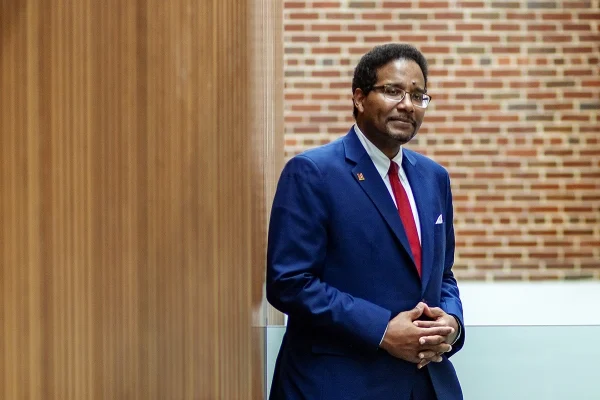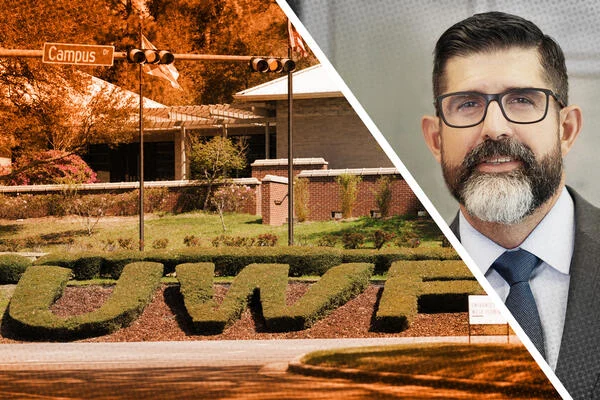
McMahon has said the recent government shutdown proved that the Education Department isn’t necessary.
Photo illustration by Justin Morrison/Inside Higher Ed | Anna Moneymaker/Getty Images | Pete Kiehart for The Washington Post via Getty Images
The Education Department is planning to move TRIO and numerous other higher education programs to the Labor Department as part of a broader effort to dismantle the agency and “streamline its bureaucracy.”
Instead of moving whole offices, the department detailed a plan Tuesday to transfer certain programs and responsibilities to other agencies. All in all, the department signed six agreements with four agencies, relocating a wide swath of programs.
For instance, the Labor Department is set to take over most of ED’s higher education programs, which include grants that support student success, historically Black colleges and universities, and other minority-serving institutions. Meanwhile, the State Department will handle Fulbright-Hays grants as well as those administered by the International and Foreign Language Education office. Indian Education and programs for tribal colleges are moving to the Interior Department.
Several of the offices that have overseen these grant programs were gutted in recent rounds of layoffs, but any staff members who are still managing them will move to the other agencies. ED also has sought to defund some of the grants, deeming them unconstitutional, so it’s not clear what is moving to the other agencies.
The agreements were signed Sept. 30—the day before the government shut down. ED officials expect the transition to take some time.
No programs, however, have been moved from the Office for Civil Rights, the Office of Federal Student Aid or the Office of Special Education and Rehabilitation Services. The department is still “exploring the best plan” for those offices, a senior department official said in a press call Tuesday afternoon.
“These partnerships really mark a major step forward in improving management of select programs and leveraging these partner agencies’ administrative expertise, their experience working with relevant stakeholders and streamlines the bureaucracy that has accumulated here at ED over the decades,” the senior department official said. “We are confident that this will lead to better services for grantees, for schools, for families across the country.”
Education Secretary Linda McMahon hinted at the sweeping announcement in a social media post Tuesday morning. The secretary posted an ominous video of a ticking clock followed by President Ronald Reagan urging Congress to dissolve the Department of Education. The video ended with a flickering screen that read “The Final Mission,” an echo of her first letter to Education Department staff in which she outlined how she would put herself out of a job.
President Donald Trump directed McMahon in March to close down her department “to the maximum extent appropriate and permitted by law.”
Liz Huston, a White House spokesperson, applauded the announcement describing it as a “bold, decisive action to return education where it belongs—at the state and local level.”
“The Trump Administration is fully committed to doing what’s best for American students, which is why it’s critical to shrink this bloated federal education bureaucracy while still ensuring efficient delivery of funds and essential programs,” she said in a statement.
These moves are the most significant steps McMahon has taken beyond the layoffs to comply with the president’s directive.
Congress has pressed McMahon multiple times to acknowledge that neither she nor the president can fully shut the department down without lawmakers’ approval. But when addressing these concerns, McMahon has made a point to note that shutting the department and its programs down entirely is different than dismantling bureaucracy and co-managing operations with other cabinet-level departments.
The department official echoed this Tuesday when talking with reporters, saying that policy and statutory oversight of the programs will still rest with employees at the Department of Ed. But execution of processes, particularly as it pertains to grants, will be managed by other agencies.
“Education has broad authority under several statutes to contract with other federal agencies to procure services, and the department has had that authority since its inception,” the official said. “We at the Department of Ed have engaged with other partner agencies over 200 times through [inter-agency agreements] to procure various services of other partner agencies over the years—even the Biden administration did it.”
The department has already moved Career, Technical and Adult Education to the Department of Labor. McMahon has said that effort was essentially a test run to see how other agencies could handle the department’s responsibilities. Democrats in Congress have decried the plan to move CTE to Labor as illegal.
Many of the department’s offices have already experienced dramatic disruptions this year, as McMahon used tworeductions in force to cut the head count of her staff by more than 50 percent. The latest mass layoff, which took place during the government shutdown, has since been enjoined by a federal court. President Trump also agreed to return affected employees to “employment status” administration when he signed a stopgap bill to temporarily end the 43-day shutdown.
But it remains unclear whether those staff members have returned or will ever return to work. Multiple sources told Inside Higher Ed that the language of the bill may allow Trump to leave employees on paid administrative leave until the bill is no longer effective on Jan. 30 and then re-administer the pink slips.
Prior to Tuesday’s announcement, many higher education experts as well as current and former ED employees were hesitant to declare the department dead. Some said as long as the department and its functions remain codified, it will still be alive. But one former staff member put it this way: “If you take the major organs out of a human, do you still have a human or do you have a corpse?”
Amy Laitinen, senior director of the higher education program at New America, a left-leaning think tank, said moving the offices to other federal agencies would not save tax dollars.
“It fractures and weakens oversight of those dollars, it’s duplicative and it’s wasteful,” she said. “How are you tracking student outcomes to ensure taxpayer dollars are well spent when all of the entities responsible are scattered to the wind? For example, separating the agency in charge of financial aid policy (OPE) from the entity responsible for financial aid implementation (FSA) makes no sense.”
This audio is auto-generated. Please let us know if you have feedback.
Dive Brief:
Texas Attorney General Ken Paxton is suing his state’s higher education coordinating board to end three work-study programs, alleging they are “unconstitutional and discriminatory”against religious students.
Under the rules established by the Texas Legislature, the programs require participating employers to provide students with nonsectarian work. Two of the programs also make students attending seminary or receiving religious instruction ineligible to participate.
The lawsuit filed Wednesday alleges that those provisions amount to theTexas Higher Education Coordinating Board “prohibiting participants from engaging in sectarian activities, including sectarian courses of study, to be eligible to receive state benefit.”He asked a state judge to bar the board from administering the programs.
Dive Insight:
Paxton argued in the lawsuit that the state work-study programs — all of which are need-based — exclude otherwise eligible students “based solely on the religious character of their course of study,” violating the First Amendment.
Texas is home to at least 14 seminary schools, according to The Association of Theological Schools.
The work-study programs also “effectively eliminate religious organizations with only sectarian employment opportunities from participating,” Paxton said.
The state board did not immediately respond to questions Monday.
The three programs being contested are:
The Texas College Work-Study Program.
The Texas Working Off-Campus: Reinforcing Knowledge and Skills Internship Program, better known asthe TXWORKS internship.
The Texas Innovative Adult Career Education, or ACE, Grant Program.
The work-study program and TXWORKS internship partially fund jobs for eligible students to help them pay for college. The ACE program provides grants to nonprofits “for use in job training, vocational education, and related workforce development” for eligible students, according to the lawsuit.
All the programs are geared toward low-income students, though some also target other demographic groups as well, such as ACE’s focus on veterans.
In a Friday statement, Paxton called the laws governing the programs “anti-Christian” and said they should “be completely wiped off the books.”
This is not the first time Paxton, who is running for U.S. Senate, has sought to overturn Texas state law through the courts. In June, he worked with the Trump administration to have a federal judge strike down Texas’ decades-old law offering in-state tuition rates to undocumented students.
Paxton’s lawsuit comes after a federal judge earlier this year struck down a Minnesota law that excluded some religious colleges from participating in a publicly funded dual enrollment program.
Minnesota’s dual enrollment program previously barred colleges from participating if they required students to sign faith statements.In August, U.S. District Judge Nancy Brasel ruled that the law infringed on the colleges’ constitutional rights by making them choose between participating in the program and practicing their religion.
The economy is uncertain, but eight in 10 undergraduates somewhat or strongly agree that their college is preparing them with the skills, credentials and experiences they need to succeed in today’s job market. At the same time, most students are stressed about the future. Their biggest stressors vary but include not being to afford life after graduation, not having enough internship or work experience to get a job, and feeling a general pressure to succeed. That’s all according to new data from Inside Higher Ed’s annual Student Voice survey of more than 5,000 two- and four-year students with Generation Lab.
What can colleges do to help? The No. 1 thing Student Voice respondents want their institution to prioritize when it comes to career readiness is help finding and accessing paid internships. No. 2 is building stronger connections with potential employers. Colleges and universities could also help students better understand outcomes for past graduates of their programs: Just 14 percent of students say their college or university makes this kind of information readily available.
Some 5,065 students from 260 two- and four-year institutions, public and private nonprofit, responded to this main annual survey about student success, conducted in August. Explore the data captured by our survey partner Generation Lab here and here. The margin of error is plus or minus one percentage point.
Shawn VanDerziel, president and CEO of the National Association of Colleges and Employers (NACE), said there’s “no doubt that the college experience equips students with a lifelong foundation for the general job market,” so it’s “heartening to hear” they have confidence that their academic programs are setting them up to succeed.
The challenge, however, “often becomes putting that learning and experience into the job market context—translating and articulating the experience that is meaningful to employers,” he added.
Beyond helping students frame what they’ve learned as competencies they can clearly communicate to prospective employers (who are increasingly interested in skills-based hiring), colleges also need to scale experiential learning opportunities. NACE has found that paid internships, in particular, give students a measurable advantage on the job market, and that Gen Z graduates who took part in internships or other experiential learning opportunities had a more favorable view of their college experience than those who didn’t. These graduates also describe their degree as more relevant to their eventual job than peers who didn’t participate in experiential learning.
While paid internships remain the gold standard for experience, student demand for them vastly outstrips supply: According to one 2024 study, for every high-quality internship available, more than three students are seeking one. Other students can’t afford to leave the jobs that fund their educations in order to take a temporary internship, paid or unpaid; still others have caring or other responsibilities that preclude this kind of experience. VanDerziel said all of this is why some institutions are prioritizing more work-based learning opportunities—including those embedded in the classroom.
Many institutions are “working toward giving more of their students access to experiential learning and skill-building activities—providing stipends for unpaid experiential experiences and ensuring that work-study jobs incorporate career-readiness skills, for example,” he said. “There is positive movement.”
One note of caution: Colleges adding these experiences must ensure that they have “concrete skill-building and job-aligned responsibilities in order to maximize the benefits of them for the students,” VanDerziel added.
Here are the career readiness findings from the annual Student Voice survey, in five charts—plus more on the experience gap.
Program outcomes data is unclear to students.
Across institution types and student demographics, a fraction of respondents (12 percent over all) say they know detailed outcomes data for their program of study. A plurality of students say they know some general information. Just 14 percent indicate this information is readily available.
outcomes-1h0n25opyx3xz4p
View online
Students remain lukewarm on career services.
Similar to last year’s survey, students are more likely to describe career services at their institution as welcoming (31 percent) than effective (17 percent), knowledgeable about specific industries and job markets (15 percent), or forward-thinking (9 percent). Career centers across higher education are understaffed, which is part of the reason there’s a push to embed career-readiness initiatives into the curriculum. But those efforts may not be made plain enough, or come across as useful, to students: Just 8 percent of respondents this year indicate that career services are embedded in the curriculum at their institution. Double that, 16 percent, say that career services should be more embedded in the curriculum. Three in 10 indicate they haven’t interacted with career services, about the same as last year’s 30 percent.
Students still want more direct help finding work-based learning opportunities.
Also similar to last year, the top thing students want their institution to prioritize regarding career readiness is help finding and accessing paid internships. That’s followed by stronger connections with potential employers and courses that focus on job-relevant skills. A few differences emerge across the sample, however: Adult learners 25 and older are less likely to prioritize help finding internships (just 26 percent cite this as a top need versus 41 percent of those 18 to 24); their top want is stronger connections with potential employers. Two-year college students are also less likely to prioritize help finding internships than are their four-year peers (30 percent versus 41 percent).
Most students are worried about life after college, but specific stressors vary.
Just 11 percent of students say they’re not stressed about life postgraduation, though this increases to 22 percent for students 25 and older and to 17 percent among community college students. Top stressors vary, but a slight plurality of students (19 percent) are most concerned about affording life after college. Adult learners and community college students are less likely than their respective traditional-age and four-year counterparts to worry about not having enough internship or work experience.
Despite their anxiety, students have an underlying sense of preparation for what’s ahead.
Some 81 percent of all students agree, strongly or somewhat, that college is preparing them with the skills, credentials and experiences they need to succeed in today’s job market. This is relatively consistent across institution types and student groups, but the share decreases to 74 percent among students who have ever seriously considered stopping out of college (n=1,204).
The Widening Experience Gap
Students increasingly need all the help they can get preparing for the workforce. For the first time since 2021, the plurality of employers who contributed to NACE’s annual job outlook rated the hiring market “fair,” versus good or very good, on a five-point scale. Employers are projecting a 1.6 percent increase in hiring for the Class of 2026 when compared to the Class of 2025, comparable to the tight labor market employers reported at the end of the 2024–25 recruiting year, according to NACE.
Economic uncertainty is one factor. Artificial intelligence is another. VanDerziel said there isn’t meaningful evidence to date that early-talent, professional-level jobs are being replaced by AI, and that even adoption of AI as a tool to augment work remains slow. Yet the picture is still emerging. One August study found a 13 percent relative employment decline for young workers in the most AI-exposed occupations, such as software development and customer support. In NACE’s 2026 Job Outlook, employers focused on early-career hiring also reported that 13 percent of available entry-level jobs now require AI skills.
The August study, called “Canaries in the Coal Mine? Six Facts about the Recent Employment Effects of Artificial Intelligence,” frames experience as a differentiator in an AI-impacted job market. In this sense, AI may be widening what’s referred to as the experience gap, or when early-career candidates’ and employers’ expectations don’t align—a kind of catch-22 in which lack of experience can limit one from getting the entry-level job that would afford them such experience.
Ndeye Sarr, a 23-year-old engineering student at Perimeter College at Georgia State University who wants to study civil and environmental engineering at a four-year institution next fall, believes that her studies so far are setting her up for success. Earlier this year, she and several Perimeter peers made up one of just 12 teams in the country invited to the Community College Innovation Challenge Innovation Boot Camp, where they presented RoyaNest, the low-cost medical cooling device they designed to help babies born with birth asphyxia in low-resource areas. The team pitched the project to a panel of industry professionals and won second-place honors. They also recently initiated the patenting process for the device.
Ndeye Sarr
“This has helped me have a bigger vision of all the problems that are happening in the world that I might be able to help with when it comes to medical devices and things like that,” Sarr said, adding that faculty mentorship played a big role in the team’s success. “I think that’s what we’re most grateful for. Perimeter College is a pretty small college, so you get to be in direct contact with most of your mentors, your professors, which is very rare in most settings. We always get the support we need it anytime we’re working on something, which is pretty great.”
RoyaNest was born out of a class assignment requiring students to design something that did not require electricity. Sarr said she wishes most courses would require such hands-on learning, since it makes class content immediately relevant and has already helped put her in touch with the broader world of engineering in meaningful ways. This view echoes another set of findings from the main 2025 Student Voice survey: The top two things students say would boost their immediate academic success are fewer high-stakes exams and more relevant course content. And, of course, there are implications for the experience gap.
Sometimes you can even be in your senior year, and you will be like, ‘I don’t think I have all these skills!’ Even for an entry-level job, right?”
—Student Ndeye Sarr
“Mostly it’s like you go to class, and they will give you a lecture because you have to learn, and then you go do a test,” Sarr said of college so far. “But my thinking is that you can also do those hands-on experiences in the classroom that you might have to do once we start getting into jobs. Because when you look at the job descriptions, they expect you to do a lot of things. Sometimes you can even be in your senior year, and you will be like, ‘I don’t think I have all these skills!’ Even for an entry-level job, right?”
This challenge also has implications for pedagogy, which is already under pressure to evolve—in part due to the rise of generative AI. Student success administrators surveyed earlier this year by Inside Higher Ed with Hanover Research described a gap between the extent to which high-impact teaching practices—such as those endorsed by the American Association of Colleges and Universities—are highly encouraged at their institution and widely adopted (65 percent versus 36 percent, respectively). And while 87 percent of administrators agreed that students graduate from their institution ready to succeed in today’s job market, half (51 percent) said their college or university should focus more on helping students find paid internships and other experiential learning opportunities.
In addition to the national innovation challenge, Sarr attended the Society of Women Engineers’ annual conference this year, where she said the interviewing and other skills she’s learned from Perimeter’s career services proved helpful. Still, Sarr said she—like most Student Voice respondents—worries about life postgraduation. Top concerns for her are financial in nature. She also feels a related pressure to succeed. Originally from Senegal, she said her family and friends back home have high expectations for her.
“You pay a lot of money to go to college, so imagine you graduate and then there’s no way you can find a job. It’s very stressful, and I am from a country where everybody’s like, ‘OK, we expect her to do good,’” Sarr said. But the immediate challenge is paying four-year college expenses starting next year, and financing graduate school after that.
“I want to go as far as I can when it comes to my education. I really value it, so that’s something I am very scared about,” she said. “There’s a lot of possibilities. There are scholarships, but it’s not like everybody can get them.”
VanDerziel of NACE said that, ultimately, “Today’s labor market is tough, and students know it. So it doesn’t surprise me that they are feeling anxiety about obtaining a job that will allow them to afford their postgraduation life. Many students have to pay back loans, are uncertain of the job market they are going to be graduating into and are concerned about whether their salary will be enough.”
This independent editorial project is produced with the Generation Lab and supported by the Gates Foundation.
As the £4.3 million National Civic Impact Accelerator (NCIA) programme draws to a close in December, universities across the country are grappling with a fundamental question: what does sustainable civic engagement actually look like?
After three years of momentum building and collective learning, I find myself observing the sector at a crossroads that feels both familiar and entirely new. The timing feels both urgent and opportune.
The government’s renewed emphasis about universities’ civic role – most notably through Bridget Phillipson’s explicit call for institutions to “play a greater civic role in their communities” – creates opportunity and expectation. Yet this arrives at a challenging time for universities, with 43 per cent of England’s institutions facing deficits this year.
Despite this supportive policy context, I still find myself having conversations like, “but what exactly is civic?”, “is civic the right word?” or – most worryingly – “we can’t afford this anymore.”
As universities face their most challenging financial circumstances in decades, we need to be bolder, clearer, and more precise about demonstrating our value to places and communities, across everything we do.
Determination
Instead of treating place-responsive work as a competition on some imagined league table or trying to redefine the term to fit the status quo, we need to come together to demonstrate our value to society collectively. But perhaps most importantly, we need to commit to reflect and do better despite the financial challenges.
This isn’t about pinning down a narrow, one-size-fits-all definition and enforcing uniformity. Instead, it’s about recognising and valuing the diversity of place-responsive approaches seen across the country. From the University of Kent’s Right to Food programme to Anglia Ruskin University’s co-creation approach to voluntary student social impact projects. From Dundee’s Art at the Start project to support infant mental health and address inequalities, to how Birmingham City University is supporting local achievement of net-zero ambitions through their climate literacy bootcamps.
Sometimes, it means making tough choices to reimagine how these valuable ways of working can be embedded across everything we do. Sometimes it means making this work visible, using a shared language to bring coherence – and crucially – committing, even in tough times, to honest reflection on our practice and a determination to keep improving.
The waypoint moment
I’ve found it helpful to describe civic engagement as an expedition. Most of us can imagine some kind of destination for our civic ambitions – perhaps obscured by clouds – with many paths before us, lots of different terrains, and a few hazards on the trail.
Through the NCIA’s work – led by Sheffield Hallam University in partnership with the National Coordinating Centre for Public Engagement (NCCPE), the Institute for Community Studies, City-REDI, and Queen Mary University of London – we’ve distilled three years of intensive evidence gathering and experimentation into fourteen practical “waypoints” for civic engagement, now launching as part of our Civic Field Guide (currently in Beta version).
These aren’t just statements – they’re navigation signals based on well-trodden paths from fellow explorers. They come with a bespoke set of tools, ideas and options to deal with the terrain ahead.
You can think of them like those reassuring signs on coastal walks. Helping you understand where you are and what direction you’re heading but giving you freedom to explore or take a detour.
Take our waypoint on measuring civic impact. It encourages universities to develop evaluation systems that can document progress quantitatively, alongside the rich narratives that illustrate how civic initiatives transform real lives and strengthen community capacity. It draws on examples from universities that have tried to tackle this challenge, acknowledging both their successes and the obstacles they’ve encountered, whilst offering practical tools, frameworks and actionable guidance. But it deliberately avoids prescribing a one-size-fits-all measurement approach. Because every place has different needs, ambitions and challenges. Both the civic work itself and how we measure it must be tailored to the unique character of our places and communities.
Our waypoints cover everything from embedding civic engagement as a core institutional mission to navigating complex policy landscapes. They address the “passion trap” that many of us might recognise, where civic work is reliant on a few individual champions rather than an institutional culture. They tackle issues of partnership development, cultivating active citizenship, and contributing to regional policymaking.
Perhaps most importantly, they recognise that authentic civic engagement isn’t about universities doing things to or even for their places, it’s about embracing other anchor institutions, competitors, businesses and communities as equal partners throughout the entire process of identifying needs, designing solutions, and implementing change.
This often means decentring the university from the relationship. Some of the strongest partnerships start with universities asking not “what can we do for you?” but “what are you already trying to achieve, and how might we contribute?”.
The embedding challenge
James Coe’s recent thoughts on how to save the civic agenda challenged us all to think about how universities move beyond “civic-washing” to genuine transformation. The NCIA’s evidence suggests the answer lies in weaving civic responsibility into everything we do, not just the obvious.
Being civic means thinking about procurement policies that support local businesses. It means campus facilities genuinely accessible to community groups. It means research questions shaped by community priorities, not just academic curiosity. It means student placements that address local challenges whilst developing skills and confidence.
Such as at the University of Derby. Their CivicLAB supports academics, students and the community to share insights on research and practice through a place-based approach to knowledge generation. Located centrally within the university, this interdisciplinary group cuts across research, innovation, teaching, and learning. Established in late 2020, CivicLAB has already created civic opportunities for over 14,600 staff, students and external stakeholders and members of the public.
The civic question also means responding to the sceptics with evidence: demonstrating how place-based engagement creates richer contexts for research and more meaningful experiences for students; showing how equitable partnerships, far from distracting from core academic work, can actually enhance teaching and scholarship; and providing examples of how civic engagement has strengthened global excellence, helping local communities connect their priorities and assets to broader movements and opportunities.
The future of civic engagement
At CiviCon25 – our national, flagship conference which took place in Sheffield last month – we brought together civic university practitioners, engaged scholars, senior leaders and community partners to wrestle with the challenges that will shape the next decade of civic engagement.
Our theme of “where ideas meet impact” captured something fundamental about our work: too often in higher education, brilliant ideas never quite make it into practice, or practice develops in isolation from the best thinking. We sometimes get stuck reinventing the wheel, endlessly debating definitions instead of delivering for our communities.
But something different is happening now. A new generation of determined, ambitious civic universities are leading this movement forward, and I’ve been privileged to witness their journeys first-hand. They’ve been extraordinarily generous. Sharing what’s worked, being honest about setbacks, and helping others navigate the same challenges many of them faced alone. It’s their insights, experiments, and wisdom that have shaped the NCIA’s fourteen waypoints.
As the NCIA draws to its scheduled conclusion, there’s something bittersweet about this moment. The infrastructure exists. The evidence is compelling. The policy environment has never been more supportive. But whatever happens next, we need to demonstrate our value to society collectively and commit to reflect and do better despite the financial challenges.
The civic trail will always have its hazards. We’ve learned that much. But with good maps, experienced guides, and companions who share the commitment to reach the destination, these hazards become navigable challenges rather than insurmountable barriers.
The fourteen waypoints offer the higher education sector a map and compass. Not every university need follow this path, but those that choose civic engagement as core mission must commit fully to the patient work of institutional change, equitable partnership building, and community-led impact.
The trail is well marked now. The question is: who else will join the journey?
About 3.8 million new high school graduates are expected to enroll in higher education next fall. The number of former students with some college credits but no credential is, at nearly 38 million working-age American adults, 10 times larger. If institutions could re-engage just 1 percent of the some college, no credential (SCNC) learners, they would net nearly 400,000 additional enrollments.
Stopped-out learners represent an enormous market—and colleges should be competing for them. But these former students and other adult learners require much different approaches from a postsecondary institution than do 18-year-olds straight out of high school. Here are three simple actions institutions can take to connect with adult learners and put them on a more direct path to enroll.
Start With Your Own Stopped-Out Students
The fiercely competitive market for adult students is dominated by national online universities that pump millions of dollars each year into sophisticated marketing campaigns. That makes it difficult for traditional colleges to make inroads with adult learners. But traditional institutions have a leg up on one subset of adult learners: their own former students.
These students know their institutions. They might remember some classmates, professors or classes they took. And they probably still live nearby—if not in the same community, then in the same state.
Institutions unsure about enrolling these students should look at the examples set by other nearby and national colleges that are successfully re-enrolling their own stop-outs. More likely than not, they’re emphasizing what they can do specifically for adult learners and offering a rapid and simplified admissions process. Successful institutions also apply credit for prior learning before a learner re-enrolls and can tell incoming students exactly how long a program will take and how much it costs. Institutions that can convince their former students to re-enroll can increase the odds of attracting other adults with no connection to the institution.
Make It Easier for Former Students to Enroll
Colleges should configure the re-enrollment process to address the particular situations of stopped-out students. That means colleges should map the start-to-finish re-enrollment process for stopped-out students just like they have for their first-time, first-year students, and then streamline it to meet the needs of returning adult learners. One key place to begin is identifying the academic, financial or procedural barriers that prevent adult learners from re-enrolling and then communicating options for remediation.
Before students begin classes, institutions should be ready to illustrate the most direct pathway for students to complete a credential, one that accommodates the complicated lives of time-crunched adult learners and leads to a postgraduation job in a high-demand, high-paying field. Institutions should clarify pathways and credit requirements for learners looking to change from their original major.
Institutions should also consider devoting a section of their website to their own stopped-out students. That webpage should contain detailed re-enrollment information tailored to the specific needs and support services that can assist with the transition back to college.
Assist Them Financially
Here’s a quiz for institutions: How does your tuition discount rate for re-enrolling students compare to that for first-time students? Chances are, it’s extremely low relative to other enrollment segments.
Unlike first-time, first-year students, adult learners are financially independent and must squeeze college expenses into already tight household budgets. Even a small increase in the discount rate for returning learners can increase the likelihood that they’ll re-enroll. Even better, calling it an “academic scholarship” confers prestige on the recipient and can give a stopped-out student the boost they need to come back strong.
If stopped-out students have outstanding balances from their previous enrollment, consider reducing or waiving those unpaid fees to eliminate one more barrier to re-enrollment. For institutions that spend millions of dollars annually to recruit and retain traditional-age students, small-dollar investments in adult learners can pay big enrollment dividends.
Adult learners and stopped-out students are no longer a niche population in the higher education ecosystem, and the data suggests that they’re a worthwhile investment for institutions concerned about evolving demographics, enrollment cliffs and their precarious bottom lines. If institutions can reconnect with their own stopped-out students, make it easier for them to enroll and provide some financial assistance, they can begin to bring back more of these learners and stand a little taller in the crowded higher education marketplace.
Scott Lomas is the chief strategy officer for ReUp Education.
In every sector, including higher education, change has become the defining condition of professional life. Budgets shift, opportunities change, teams reorganize and expectations evolve faster than most of us can keep up. Students, postdocs and seasoned professionals alike are being asked to adapt constantly, often without ever being taught how to do it.
As directors of career centers, our job is to spot the skills tomorrow’s leaders will need and to design ways to help them build those skills now. At the top of that list is the ability to navigate change and to help others do the same. It’s not a “nice-to-have” skill anymore; it’s part of how one leads, collaborates and makes their own work sustainable.
We’ve been discussing how to help trainees and professional colleagues negotiate change for a long time. Naledi developed the Straight A’s for Change Management framework through National Science Foundation–funded work focused on training biomedical professionals in people management and managing-up skills. Dinuka has used this approach in his own leadership practice and integrated its lessons into his work supporting trainees and professionals. Together, we wanted to share what this looks like in real life.
What’s often missing in professional skill development isn’t the outcome; it’s the process. The Straight A’s for Change Management framework offers exactly that. Built on four steps—acknowledge and accept, assess, address, and appreciate achievement—it helps people build agency: the capacity to act skillfully even when they can’t control external events.
Acknowledge and Accept
Step one is to acknowledge reality and then accept what it means to and for you.
Many people we work with, from first-year students to senior leaders, stop short of even this first step. They can acknowledge the problem—funding has been cut, hiring has slowed or their people are struggling with change—but they don’t take the harder step of acceptance.
Acceptance means internalizing that your long-standing plan or approach may no longer be viable and that you will need to adjust your goals or strategies. It can also mean accepting that you might need support or community beyond your institution to help hold this heavy truth. But this is the inflection point where agency begins: not wishing conditions were different, but accepting the need for you to think and act differently, too.
For a postdoc, acceptance might mean recognizing that a principal investigator’s funding constraints could shorten the timeline of their project. That realization could prompt them to seek alternative support, accelerate a job search or pivot their research scope. For a student, acceptance might mean realizing that since their adviser’s experience is limited to academic careers, they will need to proactively seek additional mentorship to position themselves for biotech careers.
For Dinuka, acceptance came during a period of leadership transition. The role he had taken on had quietly shifted beneath him—new expectations, new reporting lines and values that no longer aligned with what drew him to the work in the first place. He agonized over whether to stay and adapt or to acknowledge that something essential had changed. The moment he admitted that reality, uncomfortable as it was, he could finally see a path forward. Acceptance meant reclaiming his agency.
Reflection Prompts:
What change in your environment are you resisting acknowledging?
What might acceptance make possible that resistance is currently blocking?
Who can help you process this shift with honesty and perspective?
Assess the Change
Once you’ve acknowledged and accepted a situation, the next step is to assess it strategically. This is where you shift from emotional reaction to analytical clarity.
A useful tool here is a SWOT analysis (strengths, weaknesses, opportunities, threats). Ask yourself:
Strengths: What are your skills? Where can you leverage them in this situation?
Weaknesses: Where are you vulnerable?
Opportunities: What new directions might this open?
Threats: What could block your goals?
Answering these questions encourages balance. Some start with weaknesses and threats; others begin with strengths and opportunities. What matters is that you consider all four dimensions.
It’s also helpful to share your SWOT with a mentor or trusted colleague. Instead of laying out your situation and asking, “What should I do?” you can say, “Here’s how I’m assessing my situation. Can you help me identify what I might be missing?” Tools like a SWOT provide structure for both your reflection and your conversations with those who support you.
When Dinuka reached this stage, he turned to trusted mentors, colleagues and family members to triangulate perspectives. His SWOT involved asking, what strengths could he draw on if he stayed? Where were the risks if he left? What opportunities might emerge if he stepped away? What threats might come from doing so? Speaking these questions aloud prevented him from getting stuck in his own echo chamber and restored clarity. Assessment gave his uncertainty a shape.
Reflection Prompts:
How fully have you mapped the situation you’re in—emotionally and strategically?
Which perspective (strengths, weaknesses, opportunities, threats) do you tend to overemphasize or neglect?
Who could provide an outside view to help you see what you might be missing (trusted mentors, colleagues, friends or family members)?
Address the Change
To address change is to use what you’ve learned to respond skillfully.
Sometimes it starts by envisioning your best possible outcome six to 12 months out and working backward from there. Other times it means short-term triage, only figuring out the next logical step rather than solving everything at once. That might mean updating your CV, signing up for job boards or reaching out to a mentor.
One postdoc Naledi worked with wanted to keep his career options open. In response, he began carving out one hour a week to set up informational interviews with alumni in biotech and communication careers, learning which skills were in demand. With that insight, he added a side project that strengthened his technical skills, focused on service and leadership opportunities to communicate science, and kept his network apprised of his progress.
In Dinuka’s case, addressing the change meant testing what was still possible before making a decision. He clarified expectations with new leadership, re-aligned priorities and gave the situation space to evolve. When it became clear that the trajectory no longer matched his values or goals, he made the intentional choice to step away. That decision, though difficult, came from a place of calm rather than crisis.
Addressing change when the future is unclear means shifting from awareness to iterative forward motion, using your definition of integrity as your compass.
Reflection Prompts:
What is one small, concrete step you can take this week to move forward?
If you imagine the best version of this situation a year from now, what would need to happen between now and then?
How can you act with integrity even when you can’t control outcomes?
Appreciate Achievements
The final step, often overlooked, is to appreciate achievements. Many wait for a situation to resolve before celebrating. But change often unfolds over a long arc, and there may never be a moment when everything “returns to normal.”
That means recognizing that even small wins are a big deal. Did you talk to a friend to process your situation? Celebrate. Did you update your CV? Celebrate. Did you gain greater clarity about your direction? Celebrate!
Shifting from celebrating only outcomes (a publication, a job offer, a raise) to also celebrating progress, milestones and effort helps sustain momentum and motivation.
When Dinuka finally left that role, he felt grounded. He appreciated the mentors who guided him, the colleagues who supported him and the lessons learned in difficulty. He celebrated not the exit itself, but the growth that came with it. That sense of gratitude transformed what could have been resentment into renewal.
Appreciating achievements is not self-indulgent; it is strategic. It focuses attention on what you have accomplished despite uncertainty, which builds confidence to keep going.
Reflection Prompts:
What progress have you made in the past month that you haven’t acknowledged?
Whom can you thank or recognize for supporting your journey through change?
How do you remind yourself that growth often looks like struggle before success?
Why Straight A’s Matter
Taken together, the A’s—acknowledge and accept, assess, address and appreciate achievement—form a road map for agency. We may not control personal setbacks, professional disappointments, shifting organizational priorities, unfair practices or political turbulence. But with every new challenge, we can start responding intentionally, identifying where we can still move.
Our experiences reinforced that agency is learned through practice. The Straight A’s provide both structure and language for something many of us attempt intuitively: turning uncertainty into direction. The framework accepts complexity and teaches us to meet it with clarity and integrity.
By practicing the Straight A’s, we build the muscles of agency and leadership. If we teach the next generation of leaders these approaches as part of their training and development, they will be prepared to lead skillfully in a world where the only constant is change.
Naledi Saul is director of the Office of Career and Professional Development at the University of California, San Francisco, She coaches and frequently presents on people management and managing-up skills for higher education and biomedical audiences.
Dinuka Gunaratne (he/him) has worked across several postsecondary institutions in Canada and the U.S. and is a member of several organizational boards, including Co-operative Education and Work-Integrated Learning Canada, CERIC—Advancing Career Development in Canada, and the leadership team of the Administrators in Graduate and Professional Student Services knowledge community with NASPA: Student Affairs Administrators in Higher Education.
They are both members of the Graduate Career Consortium, an organization that provides an international voice for graduate-level career and professional development leaders.
I recently caught up with a former student pursuing her doctorate. Her project is timely. She is Cameroonian and a legal resident in the United States studying how pro-democracy movements succeed or how and when they fail. Students like her benefit our nation’s economy and our global ability to promote democracy and peace at home and abroad.
As she and I chatted, I detected exhaustion in her voice. I asked her how she is holding up. She replied with unmistakable sadness: “In Cameroon, I felt like my voice was stifled. I thought I could finally use my voice in the United States. I no longer feel that way.”
As a current international student, she lives in constant fear. Campus administrators have cautioned her against speeding or driving with a broken taillight. Her faculty adviser serves as her emergency contact if she is detained by federal immigration authorities.
The extraordinary crackdown on international students enrolled at U.S. universities, including the more than 400 students in my state of Texas alone who learned that their visa status had been canceled in spring of 2025, has little precedent in recent history. While officials in Washington restored students’ visa statuses in response to court rulings, the Department of State has begun reviewing visa applicants’ social media accounts “for any indications of hostility towards the citizens, culture, government, institutions or founding principles of the United States.”
As a university instructor, my classes have been enriched by the perspectives of international students. But their benefit to this country extends beyond their academic participation. Each year, upwards of 150,000 college-age youth participate in the little-known low-wage employment-based categories of the J-1 visa, including the Summer Work Travel, trainee, intern and au pair programs. Participants work in low-wage jobs at restaurants, in hotels and in homes providing live-in day care for thousands of American families.
The J-1 Exchange Visitor Program began with modest enrollment in the 1960s to promote Cold War–era public diplomacy. But numbers have grown in recent decades, transforming these employment-based categories into a significant stream of temporary foreign workers. A major draw is the low cost of employing them. Employers avoid most payroll taxes and sidestep bureaucratic red tape. Since the State Department oversees the program, there is no labor market testing or commitment to public data as is standard with Department of Labor foreign worker programs.
My multiyear findings and those of others—including the findings from a recent investigation by The New York Times—illuminate several J-1 program shortcomings: fraud in recruitment, inadequate and overpriced housing, and a failure of the State Department and designated cultural sponsors to address reports of abuse. In practice, sponsors amount to labor brokers who collect $1,000 to $5,000 to match a J-1 participant with an employer. I will never forget the Peruvian Summer Work Travel participant who wept as he described losing his job and housing amid COVID shutdowns. Neither his employer nor sponsor came to his aid. Instead, the Peruvian consulate sheltered and fed him until he found a way home. What his experience made clear to me was how weak J-1 protections are and how, amid a crisis like COVID, instead of building bonds of international friendship and goodwill, his J-1 cultural sponsor host and employer abandoned him in a crucial time of need.
Similarly, the demand for work authorization through the Optional Practical Training program, available to international students here on the F-1 visa, has skyrocketed, growing from 154,522 in 2007 to 418,781 in 2024. Like for J-1 visas, the Labor Department has no formal regulatory role over the OPT program, which instead is administered by the Department of Homeland Security. The OPT program originated in 1992 as a pilot initiative, and after intensive corporate lobbying, the government tripled the maximum duration of the program.
The resulting problems with the OPT program are obvious and preventable. Journalists and scholars have documented unchecked and underregulated growth, sham employment offers, and systematic underpayment, along with the proliferation of so-called body shops, staffing agencies that hire foreign workers and then rent them out to big-name tech firms—often at bargain-basement rates.
Undoubtedly, the risks faced by international students on campus versus at work differ substantially. So do their causes: The threat to international students on campus results from a hard political turn against immigration in rhetoric and policy and an effort to censor free speech in higher education. The risks faced by J-1 and F-1/OPT workers stem from the ongoing demand among U.S. employers for cheap, compliant migrant workers. Yet, Congress legislated pathways for both to promote democracy and global understanding between U.S. and foreign citizens, aims from which we have drastically strayed.
Prohibiting J-1 recruitment fees, shifting oversight of J-1 and OPT programs to the Labor Department, and making available comprehensive labor data for both would result in far better treatment and stewardship of international youth and more fairness to U.S. workers. It would also shed light on the opaque inner workings of U.S. temporary migrant worker policy at a time when mass deportation and the gutting of temporary protected status and refugee programs only heighten demand for new sources of low-priced and flexible labor, labor that immigrant populations have long been called upon by U.S. employers to do.
Cate Bowman is an associate professor of sociology at Austin College, specializing in immigration and labor issues.
A quarter of employers said they plan to increase the number of hires, primarily citing a commitment to succession planning and the talent pipeline.
fizkes/iStock/Getty Images Plus
Forty-five percent of employers consider the job market to be “fair,” and they are projecting a 1.6 percent year-over-year increase in hiring for the Class of 2026, according to a new report from the National Association of Colleges and Employers.
The last time a plurality of employers gave the job market a “fair” rating was in 2021, when hiring projections were also flat. During the four interim years, most employers rated the job market as “good” or “very good,” the report shows.
About 60 percent of the 183 employers NACE polled for the 2026 Job Outlook Survey said they are planning to keep the number of people they hire stable next year. A quarter of employers said they plan to increase the number of hires, primarily citing a commitment to succession planning and the talent pipeline, as well as company growth, as key reasons. The top five industries for projected hiring growth are miscellaneous professional services; engineering services; construction; finance, insurance and real estate; and management consulting.
About 14 percent of employers said they plan to decrease the number of people they hire next year, citing reductions in business needs and projects, an uncertain economy and budget cuts. These employers are primarily concentrated in the chemical pharmaceutical manufacturing, transportation, wholesale trade, food and beverage manufacturing, and miscellaneous manufacturing industries.
NACE surveyed employers between Aug. 7 and Sept. 22 of this year for their thoughts on the job market, hiring trends and salaries. About 40 percent of employers plan to increase salaries for bachelor’s degree holders in 2026, and 28.3 percent will do the same for master’s degree holders. No employers reported plans to decrease salaries for either group next year, the report states.
Skills-based hiring remains popular—69.5 percent of employers reported they use the approach. Asked how students can best prepare for a skills-based hiring process, employers primarily said applicants should “prepare for interviews that demonstrate their skills,” “participate in experiential learning or work during college” and “translate college coursework into a skills language.”
Meanwhile, fewer employers care about applicants’ GPAs—only 42.1 percent of employers plan to screen GPAs in 2026, compared with 73.3 percent in 2019. Academic majors, industry experience and internships, and internships at the employer’s organization are top decision-making factors for employers that don’t screen for GPAs.
Artificial intelligence is also top of mind, but many employers are still figuring out exactly how AI will integrate into their business, said Christine Cruzvergara, chief education strategy officer at the job and internship platform Handshake. NACE data reflects a similar sentiment toward AI among employers—nearly 59 percent said they are not planning to or unsure whether they’ll augment entry-level jobs with AI, and 25 percent said they’re currently discussing it. About 13 percent of jobs require AI skills, the report shows, and 10.5 percent of entry-level jobs include AI in their descriptions.
“I think the majority of employers are still experimenting with how AI will supplement or augment the work that their employees are doing from entry level all the way to more senior folks,” Cruzvergara said. “And I think some functions have probably already started to figure that out a little bit more, like in some of the technical roles, or marketing is another big one, versus customer success or some of the other types of roles that people have. It’s a varied spectrum that you’re seeing at the moment.”
The percentage of fully hybrid jobs has declined since spring 2025, from 47 percent to 42 percent, while the percentage of fully in-person jobs increased from 43 percent to 48 percent, the report shows. The percentage of fully remote jobs has held steady at 10 percent. More entry-level jobs are fully in-person—50 percent—and fewer are fully remote, 6 percent.
On his website, antizionist.net, Ramsi Woodcock asks fellow legal scholars to sign a “Petition for Military Action Against Israel.” He says Israel is a colony and war is needed to decolonize, and he calls for the war to continue until “Israel has submitted permanently and unconditionally to the government of Palestine everywhere from the Jordan River to the Mediterranean Sea.”
In his lawsuit, filed Thursday in U.S. District Court for the Eastern District of Kentucky, Woodcock asks a judge to order the university and top officials to restore his normal teaching and other duties, allow him back into the College of Law building, end the university’s investigation of him, and pay monetary damages. But he also asks the judge to order Education Secretary Linda McMahon to “refrain from requiring or using” the controversial International Holocaust Remembrance Alliance definition of antisemitism when enforcing Title VI of the Civil Rights Act of 1964.
The IHRA says antisemitism “might include the targeting of the state of Israel,” “comparisons of contemporary Israeli policy to that of the Nazis” or claims “that the existence of a State of Israel is a racist endeavor.” Earlier this year, Kentucky state lawmakers ordered public universities to use the IHRA definition in their policies combating antisemitism. Woodcock is also asking the judge to declare that that order violates the First Amendment.
His lawsuit alleges the state and federal actions are related to his “suspension,” saying the university’s tolerance of his speech “ended in summer 2025” after the federal government threatenedto withdraw funding from universities and moved to enforce the IHRA definition. He also cited the passage of thestate legislation that “enabled and pressured administrators to suppress speech critical of Israel and Zionism.”
The Education Department didn’t respond to requests for comment Friday. A university spokesperson said Woodcock hasn’t been suspended but was “reassigned pending the outcome of an investigation,” adding that the university will be “limited in our comments while that investigation is ongoing.”
In an email to Inside Higher Ed, Woodcock responded, “Israel is a colonization project that practices apartheid and is currently exterminating two million Palestinians in Gaza. The scandal is not that I am calling for immediate military action to end Israel but that the university is willing to violate our nation’s constitution in order to preserve Israel. Every American scholar has a First Amendment right to oppose Israel and I look forward to holding the university accountable for breaking the law.”
Leaders of faith-based colleges and universities have spoken out on a slew of political issues in recent months, sometimes standing alongside secular universities and at other times differentiating themselves and defending their unique standing and missions.
The Council for Christian Colleges and Universities and the Association of Catholic Colleges and Universities signed on to an October statement from the American Council on Education opposing the administration’s higher education compact, for example. Over the summer, CCCU also came out with a statement on the One Big Beautiful Bill Act that echoed those of secular associations and institutions, expressing concern that “it ultimately falls short in supporting student access and success.”
ACE’s Commission on Faith-Based Colleges and Universities was among the higher ed groups that lobbied hard against Pell Grant cuts, later dropped from the bill. At the same time, the University of Notre Dame and other faith-based institutions fought for an exemption for religious institutions from the higher education endowment tax, ultimately left out of the legislation’s final version.
Like their secular peers, faith-based colleges and universities have been buffeted by the rapid-fire policy changes roiling higher ed this year. Some leaders of religious colleges say their institutions are enjoying renewed support that they hope sets a precedent for future policymakers across party lines. At the same time, some advocates fear religious colleges—and their missions—are suffering collateral damage in Trump’s war against highly selective universities, and they’re making careful decisions about when and how to speak out.
“I knew change would be coming,” said David Hoag, president of CCCU, “but I never expected the pace to be this fast.”
Raising Concerns
Under any administration, CCCU’s job is to “make it possible for our institutions to achieve their missions,” Hoag said. But some recent policy changes pose an obstacle to that.
Christian colleges—which tend to be small, enrolling about 2,500 students on average—can’t afford to join Trump’s proposed compact for higher ed, he said. He believes some of the compact’s demands, such as freezing tuition for five years, are a tall order with campus expenses on the rise. He also opposes the compact’s standardized test mandate when so many Christian colleges offer broad access, and he’s concerned by the possibility that government could have some control over curriculum, though he said the compact was unclear on that score.
“On the curriculum side, most of our institutions are conservative. We have a solid Christian mission,” Hoag said. “I’m fine with civics being a part of some of the work that we do, but it, to me, starts to … step over academic freedom.”
Christian colleges are also balking at the new $100,000 fee for H-1B visas, which these institutions use to bring in visiting professors from other countries.
“Our institutions can’t afford anything like that,” Hoag said. Such a fee might be more easily affordable for tech or other industries that use H-1B visas to hire foreign employees, he said, “but for nonprofit colleges and Christian colleges, that’s a big financial burden.”
He’s also alarmed by some of the provisions in the One Big Beautiful Bill Act, including the requirement that programs prove students will earn more than high school graduates in order to access federal loans. Hoag worries that won’t bode well for institutions where a significant portion of students go into ministry, social work or other public service jobs that don’t necessarily pay high wages. He said the end of the Grad PLUS program is also poised to hurt Christian colleges; graduate students borrowed about $460 million annually to attend CCCU institutions, he said. Now he expects many will struggle to pay. Caps on loans for professional school students are also going to affect those earning master’s degrees in divinity.
Donna Carroll, president of the Association of Catholic Colleges and Universities, said Catholic institutions are hardly “immune” to the challenges rocking the rest of higher ed. She said her nonpartisan organization has decided to speak up on a particular set of policy issues, including financial aid and supports for low-income students, autonomy for faith-based institutions, and immigration policy and access for international students. For example, the association signed on to a statement by U.S. bishops condemning “indiscriminate mass deportation” as an “affront to God-given human dignity.”
“There are some issues and situations where there is consensus and a unity across Catholic institutions,” Carroll said. “There are other situations where different institutions have different perspectives.”
In a similar vein, Clark G. Gilbert, commissioner of the church educational system for the Church of Jesus Christ of Latter-day Saints and chair of the Commission on Faith-Based Colleges and Universities, said members of his coalition had mixed views on parts of the bill involving federal loans—he’d like to see colleges drop their prices—but they collectively pushed hard against proposed cuts to Pell Grants, which didn’t make it into the legislation.
“We’re concerned about first-generation and low-income students. That’s not a partisan issue,” Gilbert said.
‘Not Like Some of These Ivies’
A mounting frustration for some faith-based institution leaders is the blowback their campuses face from Trump administration policies targeting expensive, highly selective private universities, even though they view their missions as distinct.
Hoag pointed out that, while some Christian colleges are pricier, the average tuition costs about $30,600 per year, not including room and board, and the average tuition discount rate is about 52 percent.
“Christian schools are very affordable, and we’re not like some of these Ivies that have tuition from $80,000 to $100,000 a year,” Hoag said. Yet “I do feel that they’re … putting everybody in the same category.”
Some faith-based institutions, led by the University of Notre Dame, sought to distinguish themselves from other higher ed institutions when they pushed for a religious exemption from the One Big Beautiful Bill Act’s endowment tax.
Gilbert said Brigham Young University joined that effort because university leaders viewed the situation as a religious freedom issue.
“We feel like there are public goods of faith-based schools that are often ignored,” such as research from faith-based perspectives, he said. “Without the internal funding at these schools, it wouldn’t happen. We feel like there is a religious liberty issue at stake there.”
“I’m sure secular schools would feel their unique missions need that protection, too—that’s not my job to write and defend that,” he added.
Gilbert said he feels a particular need to advocate on behalf of religious colleges, compared to higher ed as a whole, because he believes faith-based institutions are too often maligned. He said such institutions are doing research on topics ignored by their secular counterparts—like how family structures affect intergenerational poverty or how faith and religious community resources affect health outcomes—but these projects struggle to get federal funding or recognition from secular peers. He also stressed that these institutions provide a campus climate religious students can’t find elsewhere.
“Many Jewish students do not feel safe at Columbia and at Harvard and at UCLA. Many LDS students do not feel welcome in certain programs,” he said. “Faith-based schools do feel like they need to preserve their rights.” He emphasized that doesn’t mean he wants to see any university lose out on cancer research funding, for example, but “faith-based scholars are doing things that no one else is doing, and why isn’t that getting the attention, the funding and the support, regardless of who the administration is?”
Despite their policy disagreements, some leaders of faith-based institutions believe the Trump administration is offering them a warmer reception than they’ve perhaps received in the past. The president issued an executive order in February founding a task force on eradicating “anti-Christian bias” within government. In May, Trump’s Education Department also rescinded a $37.7 million fine levied by the Biden administration on Grand Canyon University, a private Christian institution, for allegedly misleading doctoral students about its cost. And the Trump administration recently partnered with Hillsdale College, a conservative Christian campus in Michigan, on a series of videos for the country’s 250th anniversary. The president of Yeshiva University, Rabbi Ari Berman, gave the benediction at Trump’s inauguration.
Amid renewed outreach to faith-based institutions under Trump, Gilbert said he’s trying to walk a fine line, advocating for more attention and resources for faith-based institutions’ research but doing so in a way that remains apolitical.
“We don’t care about party politics. We care about the American family. We care about alleviating poverty,” he said. “We’re going to continue to help shine a light on the contributions these schools make in the current climate, but not so overboard that when things may change, and they will, that we can’t make the same arguments using the same principles with a different administration.”