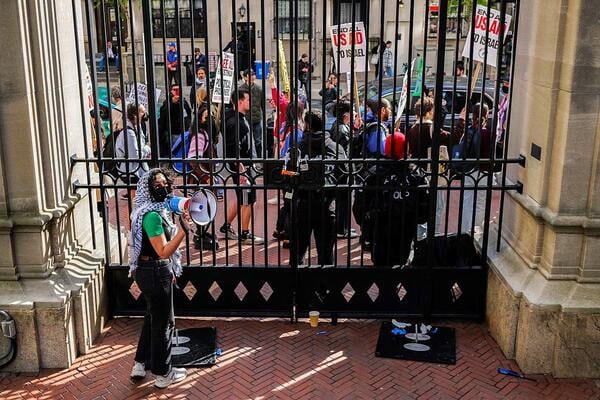
The University of Michigan hired dozens of private investigators to go undercover on campus and surveil pro-Palestinian student protesters,The Guardian reported Friday.
Some of the investigators, who work for a Detroit-based security firm, were caught on camera trailing, recording and harassing students; one reportedly drove a car at one student, who had to jump out of the way.
“It’s so insane that they have spent millions of dollars to hire some goons to follow campus activists around,” one student who’d been followed by agents told The Guardian. “It’s just such a waste of money and time.”
A spokesperson for the university did not deny hiring the investigators in responses to The Guardian’s questions and defended “security measures” as essential to “maintaining a safe and secure campus environment.”
Through this work, and in collaboration with international partners, we have identified what genuinely supports inclusion and what simply pays lip service to it. While AI is often heralded as a tool for levelling the educational playing field, our research shows that without intentional support structures and inclusive design, it can reinforce and even widen existing disparities.
Supporting mature students’ AI literacy is, therefore, not just a pedagogical responsibility; it is an ethical imperative. It intersects with wider goals of equity, social justice, and sustainable digital inclusion. If higher education is to fulfil its mission in an age of intelligent technologies, it must ensure that no learner is left behind, especially those whose voices have long been marginalised.
Why Mature Students Matter in the AI Conversation
Mature students are one of the fastest-growing and most diverse populations in higher education. They bring a wealth of life and work experience, resilience, and motivation. Yet, they are often excluded from AI-related initiatives that presume a level of digital fluency not all possess. However, they are often left out of AI-related initiatives, which too frequently assume a baseline level of digital fluency that many do not possess. Media portrayals tend to depict older learners as technologically resistant or digitally inept, reinforcing deficit narratives that erode confidence, undermine self-efficacy, and reduce participation.
As a result, mature students face a dual barrier: the second-order digital divide—inequity in digital skills rather than access—and the social stigma of digital incompetence. Both obstruct their academic progress and diminish their employability in a rapidly evolving, AI-driven labour market.
Principles that Support Mature Learners
The QAA-funded project, developed in partnership with five universities across the UK and Europe, embedded AI literacy through three key principles—each critical for mature learners:
Accessibility
Learning activities were designed for varying levels of digital experience. Resources were provided in multiple formats (text, video, audio), and sessions used plain language and culturally inclusive examples. Mature students often benefited from slower-paced, repeatable guidance and multilingual scaffolding.
Collaboration
Peer mentoring was a powerful tool for mature students, who often expressed apprehension toward younger, digitally native peers. By fostering intergenerational support networks and collaborative projects, we helped reduce isolation and build mutual respect.
Personalised Learning
Mature students frequently cited the need for AI integration that respected their goals, schedules, and learning styles. Our approach allowed learners to set their own pace, choose relevant tools, and receive tailored feedback, building ownership and confidence in their digital journeys.
Inclusive AI Strategies That Work – Based on What Mature Learners Told Us
Here are four practical strategies that emerged from our multi-site studies and international collaborations:
1. Start with Purpose: Show AI’s Relevance to Career and Life
Mature learners engage best when AI tools solve problems that matter to them. In our QAA project, students used ChatGPT to refine job applications, generate reflective statements, and translate workplace policies into plain English. These tools became career companions—not just academic add-ons.
‘When I saw what it could do for my CV, I felt I could finally compete again,’ shared a 58-year-old participant.
2. Design Age-Safe Learning Spaces
Many mature students fear embarrassment in digital settings. We created small, trust-based peer groups, offered print-friendly guides, and used asynchronous recordings to accommodate different learning paces. These scaffolds helped dismantle the shame often attached to asking for help.
3. Make Reflection Central to AI Literacy
AI use can be empowering or alienating. We asked students to record short video reflections on how AI shaped their thinking. This helped them develop critical awareness of what the tool does, how it aligns with academic integrity, and what learning still needs to happen beyond automation.
4. Use Media Critique to Break Stereotypes
Drawing on my research into late-life workers and digital media, we used ageist headlines, adverts, and memes as classroom material. Mature learners engaged critically with how society depicts them, transforming deficit narratives into dialogue, and boosting confidence through awareness.
How We Measured Impact (and Why It Mattered)
We evaluated these strategies using mixed methods informed by both academic and lived-experience perspectives:
Self-reflective journals and confidence scales tracked growth in AI confidence and self-efficacy
Survey data from mature students (aged 55+) in the UK and Albania (from my older learners study) revealed the key role of peer support, professional experience, and family encouragement in shaping digital resilience
Narrative mapping, developed with COST DigiNet partners, was used to document shifts in learners’ digital identity—from anxious adopter to confident contributor
Follow-up interviews three months post-intervention showed sustained engagement with AI tools in personal and professional contexts (e.g., CPD portfolios, policy briefs)
Policy and Practice: Repositioning Mature Learners in AI Strategy
As highlighted in our Tirana Policy Workshop (2024), national and institutional policy often fails to differentiate between age-based needs when deploying AI in education. Mature students frequently face a “second-order digital divide,” not just in access, but in relevance, scaffolding, and self-belief.
If UK higher education is serious about digital equity, it must:
Recognise mature learners as a distinct group in AI strategy and training
Fund co-designed AI literacy programmes that reflect lived experience
Embed inclusive, intergenerational pedagogy in curriculum development
Disrupt media and policy narratives that equate older age with technological incompetence
Conclusion: Inclusion in AI Isn’t Optional – It’s Foundational
Mature learners are not a marginal group to be retrofitted into digital learning. They are core to what a sustainable, equitable, and ethical higher education system should look like in an AI-driven future. Designing for them is not just good inclusion practice—it’s sound educational leadership. If we want AI to serve all learners, we must design with all learners in mind, from the very start.
The breadth of what we expect from the public sector is such that expertise needs to be distributed around the civil service.
There are numerous costly initiatives, allocations, and activities fueled by state spending – all of them have advocates and skeptics, and hidden pitfalls and tensions.
Even if there was a single brain that had a grasp of everything, how would that person weigh up the costs and benefits of spending on lifesaving drugs against maintaining housing benefits? Or expanding school breakfast clubs against meaningful support for public libraries? Or properly maintaining research infrastructure against properly maintaining flood defences?
A spending review is an exercise in compromise – a search for the least worst answer – that almost by design disappoints nearly everyone. If there’s good news in one area of spending, there is pain coming elsewhere.
Where did spending reviews come from?
The idea of taking the time every few years to gather together all current public sector spending demands and assess the possibilities for savings feels like it has been around for ever.
In fact, the first multi-year spending review took place as recently as 1998.
Before this, UK spending and taxation was decided based on prevailing economic conditions – leading to accusations of short-termism in government thinking. After all it is difficult to plan sustainable programmes of spending with only one year of funding confirmed.
The first multi-year comprehensive spending review was a Gordon Brown innovation – coming off the back of two years with public sector finance (politically) constrained by the previous government’s last year of allocations, it represented (in the language of the time) an opportunity for a newish Labour government to demonstrate ongoing “prudence”.
By looking not just at what government spends but at what government does, the review has identified the modernisation and savings that are essential. The first innovation of the Comprehensive Spending Review is to move from the short-termism of the annual cycle and to draw up public expenditure plans not on a one year basis but on a three year basis. And the review‘s second conclusion is that all new resources should be conditional on the implementation of essential reforms, money but only in return for modernisation
Labour stuck a pattern of three year reviews throughout their last period of office – including another comprehensive spending review in 2007. Under Conservative-led administrations the pattern became more irregular (largely for reasons of political expediency, but also to respond to one off events like the Covid-19 pandemic). The last spending review was in 2021 – three governments (and three Prime Ministers) ago.
How a spending review works
The specifics may vary, but the review is a series of conversations conducted by the treasury (usually under the auspices of the Chief Secretary to the Treasury) and each department. Starting with officials modelling the impact of broad-brush cuts at various levels and arguing about what constitutes the work their department is required to do (the ambit) and what (for non-zero based spending reviews) the baseline funding should be, the process ends with ministers taking the argument directly to the treasury – or overhead to the prime minister and via carefully placed stories in the press.
Eventually – the key date this year was as recent as late May – ministers and the Chancellor will come to a final agreement over what will be allocated and what, in broad terms, it will be spent on.
Those who have been closely involved tend not to be enamoured of the process – former DfE adviser Sam Freedman recently described it as “demented” and “not a good or strategic way to make decisions about government spending”.
In 2024
The current iteration kicked off straight after the 2024 election, with the first part of it announced by Rachel Reeves alongside the autumn budget. Alongside some punchy political lines (that “£22bn black hole” for one) she confirmed the overall envelope for the spending review:
Day to day spending from 2024-25 onwards will grow by 1.5 per cent in real terms, and total departmental spending, including capital spending, will grow by 1.7 per cent in real terms.
We also got some broad promises on education spending – an extra £300m for further education, a £2.3bn increase in the schools core budget and a reform of special educational needs provision. However, the Institute for Fiscal Studies is warning that given other promises, most notably on defence and health, “unprotected” DfE recurrent spending (which would include spending on higher education) is likely to fall by around 3 per cent over the three years the review covers – and significant schools and FE spending (which the government is likely to want to protect) also appears within that bucket.
Higher education is by no means alone in facing a very tight multi-year settlement – but it suffers in terms of public salience. While, thanks to the efforts of universities and trade unions, there is a general consensus that the sector is struggling it is neither as totemic (NHS, schools, defence) or visible (local services, adult skills, social care) as the recipients of other public spending. There’s been a lot of work done in making the arguments for investment, but these arguments are never going to be as strong as they need to be.
That’s (flat) capital
What Reeves appears to be promoting in the run up to the review is the availability of capital. Traditionally, spending reviews have only addressed departmental expenditure limits (DEL) – recurrent funding that can reasonably be controlled by the department in question – involving capital spending only really started in 2020 and 2021. Changes to, for example, eligibility rules for benefits can also have an impact on recurrent annual managed expenditure (AME) and spending reviews have moved further in that direction in recent times.
Capital is more traditionally allocated and spent in fiscal events – it makes for big numbers and eyecatching infrastructure investments and doesn’t usually form a part of the spending reviews, but it was always in scope for 2024 to set capital budgets for at least five years.
And the big sector-focused news has been about research and development funding. While by no means all R&D funding goes to universities, a substantial proportion will end up there – and the news that the overall allocation for R&D will keep pace with inflation until 2029-30 is undoubtedly good in the context of a very tight overall recurrent settlement. As my colleague James Coe sets out elsewhere on Wonkhe, there are other calls on R&D beyond the traditional UKRI allocations (though we know UKRI allocations will be broadly stable this year): there are calls for increased spending in defence research, there will be small (£30m to each current mayoral strategic authority) regional allocations, and there will likely be funding streams attached to each of the government’s missions.
Recall also, the manifesto promise of ten-year funding settlements for some research activity. Five years of flat (inflation-compensated) funding represents exactly the kind of stable and predictable income that some parts of the sector have been asking for – if there are people unhappy with that, promising stability for ten years isn’t going to feel much different.
Teaching funding
Fans of the national accounts will know that the majority of funding allocated to teaching in higher education (the student loan outlay) is, in fact, AME capital. There has been some initial hope that the portion that isn’t (the recurrent DEL that is allocated via the grant letter to the Office for Students) would form a part of the long promised review of funding – but this looks less likely than a commitment to continue inflationary fee-cap uplifts alongside measures to improve efficiency in spending (rooting out fraudulent applications and suchlike, promoting shared services).
The parallel is with funding for 16-19 students – an extra £190m will push per-student funding up an inflation-busting 5.9 per cent next year, to £5,105. The recurrent funding simply isn’t there to do anything like that for direct higher education funding, but using an increase in capital spending offers a release valve via the tuition fee loan mechanisms.
Fee increases would be unpopular (a tax on aspiration, if you like) with young people and their parents. The temptation would be to favourably tweak the conditions of repayment, and there may be some headroom here – if you recall last year’s earnest and sporadically understood talk around PSNFL in the fiscal rules, one of the upshots was that loans count as assets, and the more loans we have the more (in the short-to-medium term at least) assets we have. While this could fuel a further expansion of the sector, the current policy weather suggests that this flexibility could instead be used to offer young people a better loan deal.
On the day
While a multi-year spending review is an exercise in demonstrating the long term planning capacity of a government, the event itself has to interface with the short-term news cycles. There needs to be some good news in there – and the pre-announced transport capital, R&D capital, and above-inflation settlement for health are part of that.
Good news could also take the form of announcing popular savings. Very few people will be disappointed in cuts to bureaucracy (at least in the short term, people do tend to become very upset when waiting times rise and services become less effective) and measures to address fraud. Here we’ve already heard a lot of mood music around fraud within the higher education funding system – the very high profile case of Oxford Business College suggests that ministers see the opportunity to better manage the current allocations of funding, and there is a consultation response ready to drop. We’d assumed this would come alongside the promised white paper, but I wouldn’t be surprised to see at least headline proposals sneak out earlier.
Finally we have the broader favourite that is “efficiency” savings. Universities have been very engaged with this agenda ever since the HE Reform letter – the conjunction of the Universities UK report, the release of TRAC data (slightly delayed over last year), and the spending review may not be entirely coincidental.
Liberty University, one of the largest Christian universities in the United States, has built an educational empire by promoting conservative values and offering flexible online degree programs to hundreds of thousands of students. But behind the pious branding and patriotic marketing lies a troubling pattern: Liberty University Online has become a master’s degree debt factory, churning out credentials of questionable value while generating billions in student loan debt.
From Moral Majority to Mass Marketing
Founded in 1971 by televangelist Jerry Falwell Sr., Liberty University was created to train “Champions for Christ.” In the 2000s, the school found new life through online education, transforming from a small evangelical college into a mega-university with nearly 95,000 online students, the vast majority of them enrolled in nontraditional and graduate programs.
By leveraging aggressive digital marketing, religious appeals, and promises of career advancement, Liberty has positioned itself as a go-to destination for working adults and military veterans seeking master’s degrees. But this rapid expansion has not come without costs — especially for the students who enroll.
A For-Profit Model in Nonprofit Clothing
Though technically a nonprofit, Liberty University operates with many of the same profit-driven incentives as for-profit colleges. Its online programs generate massive revenues — an estimated $1 billion annually — thanks in large part to federal student aid programs. Students are encouraged to take on loans to pay for master’s degrees in education, counseling, business, and theology, among other fields. Many of these programs are offered in accelerated formats that cater to working adults but often lack the rigor, support, or job placement outcomes associated with traditional graduate schools.
Federal data shows that many Liberty students, especially graduate students, take on substantial debt. According to the U.S. Department of Education’s College Scorecard, the median graduate student debt at Liberty can range from $40,000 to more than $70,000, depending on the program. Meanwhile, the return on investment is often dubious, with low median earnings and high rates of student loan forbearance or default.
Exploiting Faith and Patriotism
Liberty’s marketing strategy is finely tuned to appeal to Christian conservatives, homeschoolers, veterans, and working parents. By framing education as a moral and patriotic duty, Liberty convinces students that enrolling in an online master’s program is both a personal and spiritual investment. Testimonials of “calling” and “purpose” are common, but the financial realities can be harsh.
Many students report feeling misled by promises of job readiness or licensure, especially in education and counseling fields, where state licensing requirements can differ dramatically from what Liberty prepares students for. Others cite inadequate academic support and difficulties transferring credits.
The university spends heavily on recruitment and retention, often at the expense of student services and academic quality.
Lack of Oversight and Accountability
Liberty University benefits from minimal federal scrutiny compared to for-profit schools, largely because of its nonprofit status and political connections. The institution maintains close ties to conservative lawmakers and was a vocal supporter of the Trump administration, which rolled back regulations on higher education accountability.
Despite a series of internal scandals — including financial mismanagement, sexual misconduct cover-ups, and leadership instability following the resignation of Jerry Falwell Jr. — Liberty has continued to expand its online presence. Its graduate programs, particularly in education and counseling, remain cash cows that draw in federal loan dollars with few checks on student outcomes.
A Cautionary Tale in Christian Capitalism
The story of Liberty University Online is not just about one school. It reflects a broader trend in American higher education: the merging of religion, capitalism, and credential inflation. As more employers demand advanced degrees for mid-level jobs, and as traditional institutions struggle to adapt, schools like Liberty have seized the opportunity to market hope — even if it comes at a high cost.
For students of faith seeking upward mobility, Liberty promises a path to both spiritual and professional fulfillment. But for many, the result is a diploma accompanied by tens of thousands in debt and limited economic return. The moral reckoning may not be just for Liberty University, but for the policymakers and accreditors who continue to enable this lucrative cycle of debt and disillusionment.
The Higher Education Inquirer will continue to investigate Liberty University Online and similar institutions as part of our ongoing series on higher education debt, inequality, and regulatory failure.
Grant House, the plaintiff in a now settled antitrust lawsuit against the NCAA, swam for Arizona State University.
Michael Reaves/Getty Images
Federal district judge Claudia Wilken granted final approval to a multi-billion-dollar settlement in the yearslong House v. NCAA lawsuit late Friday evening, effectively transforming college sports: Starting July 1, institutions will be allowed to pay student athletes directly.
In accordance with the settlement, the National Collegiate Athletic Association and colleges in Division I conferences will distribute nearly $2.8 billion in back damages over the next 10 years to athletes who competed any time since 2016, as well as to their lawyers. The case also allows each college that opted in to pay their athletes collectively up to $20.5 million per year, in addition to scholarships. That figure will increase incrementally over time.
The ruling, which technically resolves three antitrust lawsuits against the NCAA, essentially turns student-athletes from amateurs into professionals. But experts say this isn’t likely to end court battles over athletics. The creation of the revenue-sharing model (where schools distribute money earned from areas such as media rights or merchandise), combined with existing turmoil over the regulation of name, image and likeness (NIL) deals, will only invite more lawsuits, they say.
“The judge said, in essence, this is not a perfect settlement that solves everyone’s concerns, but it makes progress towards ‘righting the wrongs’ of higher education’s desire to maintain amateurism status for the players but no one else,” Karen Weaver, adjunct assistant professor in the graduate school of education at the University of Pennsylvania, wrote in an email to Inside Higher Ed.
Although many colleges began making changes to their programs in anticipation of the settlement’s approval, the timing of the ruling could present logistical challenges as they move to start revenue-sharing with students from the July 1 deadline set out in the suit.
Current and former athletes have celebrated the ruling.
“It’s historic,” former college basketball star Sedona Prince, a co-lead plaintiff in one of the lawsuits, told ESPN. “It seemed like this crazy, outlandish idea at the time of what college athletics could and should be like. It was a difficult process at times … but it’s going to change millions of lives for the better.”
Wild West Yet to be Tamed
Judge Wilken’s ruling comes nearly two months after both parties presented arguments in early April for approving the settlement, and nearly five years after the suit was first filed in 2020. But contentious debates over how to manage paying student athletes really erupted in 2021, when NIL deals were first legalized.
Since then, collectives made up of alumni and boosters have paid athletes millions of dollars to play at schools through unregulated NIL partnerships. Top football and basketball players have earned the most.
College leaders have argued that the collectives could give wealthier institutions an unfair recruiting advantage. The House settlement, which not only allows colleges to pay athletes directly but also gives conferences the power to regulate booster influence, could help solve that problem.
“For several years, Division I members crafted well-intentioned rules and systems to govern financial benefits from schools and name, image and likeness opportunities, but the NCAA could not easily enforce these for several reasons,” NCAA president Charlie Baker wrote in a statement Friday. “The result was a sense of chaos: instability for schools, confusion for student-athletes and too often litigation.”
“The settlement opens a pathway to begin stabilizing college sports,” Baker said. “This new framework that enables schools to provide direct financial benefits to student-athletes and establishes clear and specific rules to regulate third-party NIL agreements marks a huge step forward for college sports.”
The settlement alsoestablishes a new clearinghouse, run by Deloitte, that will vet any endorsement deal between a booster and an athlete worth more than $600, with the goal of ensuring it is for a “valid business purpose.”
Still, doubts remain about how the watchdog will work; one commenter on X noted that all it takes for boosters to create an NIL regulatory loophole is to pay athletes in multiple $599 payments rather than one mass sum
Despite the efforts to regulate NIL payments through the clearinghouse, Weaver said the settlement will create “a feeding frenzy of agents and dealmakers capitalizing on a few athletes wealth while schools scramble to lock down players who could bolt for a better offer at any moment.”
“I expect to see the first Title IX lawsuits, and requests for an immediate stay, filed as soon as this week,” she said. “It’s important for higher education leaders to understand the far-reaching impact on our industry—it’s only just begun.”
Last month, Peter Hans, president of the University of North Carolina system, casually dropped a bombshell announcement that the system and others were in talks to launch a new accreditor.
“We’ve been having a number of discussions with several other major public university systems, where we’re exploring the idea of creating an accreditor that would offer sound oversight,” Hans said at a UNC system Board of Governors meeting last month, The News & Observer reported.
Since then, no additional details have emerged, though Hans teased an update to come in July.
But public records obtained by Inside Higher Ed show UNC system officials have been quietly engaged in conversations about launching a new accreditor for at least a year, including discussions with unnamed collaborators in Florida, where the effort could be headquartered. UNC officials have also spoken with officials at the U.S. Department of Education, even getting a heads-up on what an April 23 executive order from the Trump administration on accreditation would entail.
Here’s what those documents show.
‘The Florida Project’
In early April, UNC officials appeared ready to tell the world about their plans for a new accreditor that “would be publicly accountable, outcomes-based, and more efficient and effective in its reviews,” according to the draft of a statement that was never publicly released.
“We believe it is past time for the creation of a new accreditor focusedon the unique needs of public colleges and universities,” the statement said. “We have worked collaboratively over the past year to explore and develop such a cross-state partnership.”
Andrew Kelly, a senior adviser to Hans, sent a draft of the statement to other UNC officials. The statement argued that accreditors “wield enormous power, but too often have opaque and counterintuitive governance” and fail to “focus on matters that are significant to students.” He argued in the statement that the current model “creates unnecessary duplication and cost, conflicts with the authority of state governments, and does little to ensure educational quality.”
An unidentified number of state systems of higher education were supposed to sign the statement, according to the draft.
Kelly drafted the statement in response to the Trump administration’s anticipated changes to accreditation, which included streamlining the processes for ED to recognize accreditors and for institutions to switch agencies, among other changes to the system that serves as gatekeeper to federal financial aid.
But the public did not hear about the UNC system’s quiet effort to launch a new accreditor until Hans spoke up at the May board meeting.
Other emails yielded some insights into whom the UNC system might be partnering with.
Daniel Harrison, vice president for academic affairs at the UNC system, sent an email on April 23 to fellow officials recapping a call with the U.S. Department of Education and what could be expected in the coming executive order on accreditation (which was issued shortly after his email).
In that email, Harrison also pointed to potential partners in the accreditation effort.
“An update on the Florida project—we met with the new entities [sic] attorneys and made substantial progress toward determining the legal structure of the new accreditor. It is likely to be a single member Florida nonprofit corp. Florida would be the sole member, but would delegate all delegable powers to a Board of Directors made up of the participating states,” Harrison wrote.
But despite having met with potential partners, UNC considered going its own way.
In a response to Harrison, Hans asked him to convene several system officials involved with the effort to weigh the pros and cons of “joining [a] multi-state coalition” or “forming a NC entity.” Email records obtained by Inside Higher Ed don’t show what the group recommended, but remarks made by Hans at May’s meeting indicate the system opted for the coalition approach.
UNC system officials did not respond to requests for comment from Inside Higher Ed.
System leaders also appear to have discussed the effort with state legislators in private. On May 15, Hans asked senior vice president of government relations Bart Goodson to set up a meeting with Michael Lee, the Senate majority leader in the Republican-dominated Legislature. When Goodson asked about the topic, Hans replied, “accreditation update with good news.”
Lee did not respond to a request for comment from Inside Higher Ed.
Potential Partners?
Like their UNC counterparts, other public systems are staying quiet on the effort.
Inside Higher Ed contacted a dozen public university systems, all in red states, to ask if they are partnering with UNC or others in an effort to launch a new accreditor, or if they participated in such discussions. Only two replied: the Arkansas State University system and the University of Alabama system. Both noted they had not been involved in those accreditation discussions.
The State University System of Florida—which did not reply to media inquiries—is the most likely potential partner, given the details in Harrison’s email and the governor’s recent political fury with accreditors.
In 2022, Florida’s dark-red Legislature passed a law requiring state institutions to switch accreditors regularly. That move came after the Southern Association of Colleges and Schools Commission on Colleges, which accredited all 40 of Florida’s public institutions, inquired about a potential conflict of interest at Florida State University, which was considering Richard Corcoran for its presidency despite his role on the Florida Board of Governors. (He now leads New College of Florida.)
SACS also raised questions about an effort by the University of Florida to prevent professors from testifying against the state in a legal case challenging voting-rights restrictions. (UF later dropped that policy amid a torrent of criticism.) Both incidents occurred in 2021.
Florida governor Ron DeSantis has been a vocal critic of the federal accreditation system.
Joe Raedle/Getty Images
Following the 2022 law, some institutions began the process of switching accreditors,though state officials argued that the Biden administration slowed down that effort and Florida tried unsuccessfully to get a federal judge to rule the current system of accreditation unconstitutional.
Outside of Florida, North Carolina is the only other state with a similar law. In 2023, legislators quietly slipped a provision into a state budget bill that required state institutions to change accreditors every cycle. The law was passed with no debate among North Carolina lawmakers. The change came after UNC clashed with SACS in early 2023 over shared governance.
Florida governor Ron DeSantis did not confirm to Inside Higher Ed whether the state is launching a new accreditor, but recent remarks from the GOP firebrand suggest, albeit vaguely, that something is in the works.
“For too long, academic accreditors have held our colleges and universities hostage,” DeSantis said in an emailed statement. “These accreditation cartels have worked behind the scenes to shape university behavior, embedding ideological concepts like Diversity, Equity, and Exclusion Indoctrination into the accreditation process. If you weren’t meeting politically motivated standards, like enthusiastic participation in DEI, they would hamper your accreditation and access to federal funding. In Florida, we refuse to let academic accreditation cartels hold our colleges and universities hostage to ideology at the expense of academic excellence. Stay tuned.”
Wade Maki, Faculty Assembly chair and a philosophy professor at UNC Greensboro, said he and other faculty members recently met with system officials to share their thoughts on the plan.
“We had a very open conversation with the system office and shared our hopes that we get an accreditor that is independent, that maintains the strong reputation of the UNC system and helps keep the politics out of higher ed and the curriculum, whether that’s from the politicians or the accreditors themselves,” Maki said. “We’ve seen it come from both directions over the years.”
He also thinks the narrow focus of such an accreditor could be a positive.
“My leadership team, the Faculty Assembly Executive Committee and the faculty that we’ve talked to on campuses, we see the potential benefits of trying something like this, of having an accreditor that focuses just on the accrediting of state-supported public institutions,” Maki said.
Outside observers were more critical of the UNC system’s plans.
Accreditation expert Paul Gaston III, an emeritus trustees professor at Kent State University, argued that building an accreditor composed only of public institutions would omit valuable perspectives in review processes. He argued that colleges undergoing accreditation reviews benefit from the diversity of experiences from evaluators working at a broad range of institutions.
“What would be the advantage of, in a sense, separating classes of institutions for accreditation? I think one of the strengths of accreditation has been that it brings a variety of perspectives to the evaluation of a particular institution,” Gaston said.
Then there’s the arduous process of getting a new accrediting agency up and running; gaining federal recognition, which is required, takes years. Although Trump’s executive order on accreditation promised a smoother pathway to recognition for new entrants, it does not supersede federal regulations.
“Becoming federally recognized, typically, is a five-plus-year process,” said Edward Conroy, a senior policy manager at the left-leaning think tank New America. Under current federal regulations, Conroy doesn’t expect the new accreditor to be recognized until 2030 or so.
Conroy also questioned whether the effort to create a new accreditor is about institutional quality assurance or political control.
“Everything Florida has done on accreditation over the past few years appears to be politically and ideologically driven, rather than about what is best for students and ensuring that they go to high-quality institutions and get a good education when they’re paying a lot of money for it and when taxpayers are investing a lot of money in public funding for higher education,” he said.
Conroy worries that state lawmakers in either Florida or North Carolina would require public colleges in their state to be accredited by their new accreditor. That would undermine the current requirement that colleges get to choose their own accreditor.
“It undercuts the principle of the higher education accountability triad, where states, accreditors and the Department of Education are all meant to do different things,” Conroy said. “If you have a state that becomes both, to some degree or another, the accreditor, as well as the state authorizing entity, then we’ve combined two legs of a three-legged stool.”
Purdue University has ended a long-standing partnership with its independent student newspaper, The Purdue Exponent, and will no longer distribute papers, give student journalists free parking passes or allow them to use the word “Purdue” for commercial purposes.
The Purdue Student Publishing Foundation board (PSPF), the nonprofit group that oversees The Exponent—the largest collegiate newspaper in Indiana—said the changes came without warning.
On May 30, PSPF received an email from Purdue’s Office of Legal Counsel notifying the group that their contract had expired more than a decade ago and the university would not participate in newspaper distribution or give the students exclusive access to newspaper racks on campus.
In addition, the message said, the university will not enter into a new contract for facility use with the paper to remain consistent with the administration’s stated policy on institutional neutrality.
According to a statement from the university, it is not consistent “with principles of freedom of expression, institutional neutrality and fairness to provide the services and accommodations described in the letter to one media organization but not others.”
The Exponent is the only student newspaper, though Purdue also has two student news channels, FastTrack News and BoilerTV.
Legal counsel also asked The Exponent to keep “Purdue” off the masthead and out of the paper’s URL because “The Foundation should not associate its own speech with the University.” PSPF says it has a trademark on “The Purdue Exponent” until 2029.
PSPF and Purdue have held distribution agreements since 1975, in which Exponent staff would drop papers off at various locations across campus and staff would then place them on newspaper racks.
In 2014, the Exponent delivered the university a new contract to renew the agreement for the next five years, according to paper staff. The contract was never signed, but the terms of the agreement continued until Monday, June 2.
Now, The Exponent is permitted to distribute papers themselves and have nonexclusive access to newspaper stands on campus, according to the university; students said they don’t have early access to many of the buildings the way staff do.
“Purdue’s moves are unacceptable and represent not only a distortion of trademark law but a betrayal of the university’s First Amendment obligations to uphold free expression,” Dominic Coletti, a student press program officer for the Foundation for Individual Rights and Expression, told The Exponent. “Breaking long-standing practice to hinder student journalism is not a sign of institutional neutrality; it is a sign of institutional cowardice.”
The Trump administration is asking Congress to cut funds for tribal colleges and universities by nearly 90 percent, according to the Department of the Interior’s proposed budget released Monday.
Tribal college advocates told ProPublica, which first reported on the cuts, that tribal colleges could have to shutter if Congress approves the plan, leaving thousands of students without the support they need to complete a degree program. And reports from ProPublicashow that it will only further devastate institutions that were already underfunded.
“The numbers that are being proposed would close the tribal colleges,” Ahniwake Rose, president and CEO of the American Indian Higher Education Consortium, told ProPublica. “They would not be able to sustain.”
The budget request calls for about $860 million to operate Indian Education Programs, which includes two federally controlled tribal colleges—Haskell Indian Nations University and Southwestern Indian Polytechnic Institute. Of that $860 million, about $22 million would go toward postsecondary programs. That’s about a $161 million cut compared to fiscal year 2024.
Tribal colleges argue that their funding is protected by treaties and contend that the institutions up for discussion are critical providers in some of the country’s poorest areas.
“It doesn’t make sense for them to [approve the cuts[ when they’re relying on us to train the workforce,” Dawn Frank, president of Oglala Lakota College in South Dakota, told ProPublica. “We’re really relying on our senators and representatives to live up to their treaty and trust obligation.”
A federal judge ordered the Trump administration to restore funding to AmeriCorps programs in 24 states and Washington, D.C., following a lawsuit that challenged the April cuts to the program, The Hill reported Thursday.
The judge, Obama appointee Deborah Boardman, ruled that the states were likely to succeed in their argument that the agency’s funding could not legally be cut without a notice-and-comment period. The ruling did not reinstate any of the agency’s staff.
AmeriCorps volunteers and grants support at least 100 college-access organizations across the U.S., many of which had to lay off their AmeriCorps members in the wake of the cuts.
It’s the latest court order blocking the administration’s crusade to reduce the size of the federal government; recently, judges reversed layoffs at the Department of Education and ruled that a lawsuit challenging funding cuts at the National Institutes of Health could move forward.
President Trump issued two directives targeting international students just hours apart on Wednesday night. One is a ban on entering the U.S. for citizens from 12 countries and heightened visa restrictions for those from another seven. The other bans all international students, researchers and other “exchange visitors” from Harvard University.
The orders represent another escalation of the Trump administration’s simultaneous, and sometimes overlapping, campaigns to both punish Harvard and curtail the number of foreign students studying in the U.S.
Chris Glass, a professor of higher education at Boston College and a member of the college’s Center for International Education, said the combination of the travel ban and the Harvard order are part of the administration’s “flood the zone” strategy for its higher education agenda. He added that the timing of the dual orders, following on the heels of a “seemingly indefinite” pause on student visa interviews and a promise to “aggressively revoke” Chinese students’ visas, seems intended to cause the most chaos possible.
“The timing couldn’t be worse … this is when 70 percent of international students are getting or renewing their visas,” he said. “It injects catastrophic uncertainty, and the uncertainty is the strategy from my perspective.”
On Thursday evening, Harvard filed a legal challenge to the proclamation targeting the university and asked a judge to issue a temporary restraining order against the administration. Judge Allison Burroughs from the District of Massachusetts quickly granted that request and extended the current restraining order issued last month. She set a hearing for June 16.
2017 Again
The last time Trump instituted a travel ban, in his first term, it threw colleges into chaos and left students and researchers stranded for months in the middle of winter break, sending colleges scrambling to find ways to bring them back. Higher ed has been bracing for a repeat of that travel ban since Trump was elected in November; many institutions told their international students to return to campus before the inauguration to avoid the same fate.
The new ban is not as drastic as many predicted; when the White House initially proposed another travel ban in March, officials rolled out a list of 43 potential target countries. But it is more expansive than the 2017 ban—it affects 19 countries instead of eight—and, combined with the administration’s barrage of attacks on international students over the past three months, could be even more damaging to international enrollment.
The full ban applies to Afghanistan, Chad, Republic of the Congo, Eritrea, Equatorial Guinea, Haiti, Iran, Libya, Myanmar, Somalia, Sudan and Yemen—largely Middle Eastern and African countries with substantial Muslim populations. Trump also restricted visas from Burundi, Cuba, Laos, Sierra Leone, Togo, Turkmenistan and Venezuela.
The travel ban doesn’t immediately affect students currently in the U.S. or who have already been approved for visas. But with many admitted international students still languishing in a visa process that the State Department halted two weeks ago, it will likely prevent thousands of students from attending in the fall and upend institutions’ projected enrollments.
The countries on the list send a relatively small number of students to U.S. colleges. Of the affected countries, Iran has by far the most students studying in the U.S. It is the 15th most common origin country for international students, with 12,430 studying at American colleges and universities as of fall 2024, according to the latest report from the Institute for International Education.
Still, the order is likely to compound the uncertainty and fear that has grown among international student populations, leading to signs of a large decline in student visa applications. Glass’s research, along with more recent reports, shows a double-digit decline in student visas from March 2024 to this March alone; the latest moves could double that, he said.
“[The] COVID [pandemic] was a disruption of 15 percent,” he said. “This looks like it could be more significant than COVID, if the pause is extended and the uncertainty continues.”
In his proclamation announcing the travel ban, Trump wrote that the targeted countries had “deficient” vetting and screening processes for visa applicants, or had “taken advantage of the United States in their exploitation of our visa system and their historic failure to accept back their removable nationals.”
Sarah Spreitzer, vice president and chief of staff for government relations at the American Council on Education, said the rationale outlined in the travel ban—that students pose a unique national security threat and have been overstaying their visas—doesn’t align with reality.
“If this is for national security concerns, our students are some of the most vetted visas out there,” she said. “And I don’t know if our students actually overstay their visas very often.”
Fanta Aw, the president of NAFSA, an association of international educators, echoed Spreitzer and said that international students are already “among the most tracked individuals entering the United States.”
“Actions such as halting student visa issuance and implementing nationality-based travel bans do not enhance national security,” she wrote in an email. “Instead, they weaken it—undermining our economy, diminishing our global competitiveness and eroding our country’s ability to effectively engage with the global population.”
The 2017 travel ban was amended twice after being challenged in the courts and eventually exempted nonimmigrant visas, including student and exchange visas. Spreitzer said the administration’s outsize focus on student visa holders over the last few months makes that outcome less likely, but only time—and the courts—will tell.
Havoc at Harvard
The travel ban came on the heels of another White House proclamation Wednesday night, this one banning foreign students and scholars from attending Harvard.
Trump restricted visa applicants from entering the country “solely or principally to participate in a course of study at Harvard University or in an exchange visitor program hosted by Harvard,” claiming that allowing foreign students on campus would be “detrimental to the interests of the United States because, in my judgment, Harvard’s conduct has rendered it an unsuitable destination for foreign students and researchers.”
A Harvard spokesperson wrote that the proclamation is “another illegal retaliatory step taken by the administration in violation of Harvard’s first amendment rights” and that the university “will continue to protect its international students.”
The proclamation is the latest jab in a weeks-long fight over international students on Harvard’s campus. Last month the Trump administration attempted to revoke Harvard’s Student Exchange and Visitor Program certification, which would have banned the university from enrolling international students altogether, affecting not just visa applicants but also foreign students and researchers currently on campus. Harvard challenged the effort in court, and a judge swiftly granted the university an injunction; on Monday, the Trump administration lost its appeal to overturn that decision.
Harvard amended that lawsuit to include a challenge to the newest proclamation, calling it “an unlawful evasion of the Court’s order.”
“When the Court enjoined the Secretary [of State’s] efforts to revoke Harvard’s certifications and force its students to transfer or depart the country, the President sought to achieve the same result by refusing to allow Harvard students to enter in the first place,” the amended suit reads.
Unlike the SEVP decertification attempt, Trump’s executive proclamation doesn’t immediately affect international students currently enrolled at Harvard, only those who have yet to secure visas—though it does instruct the State Department to determine whether current students “should have their visas revoked.”
The proclamation runs through a gamut of justifications for its international student ban. Trump cites data on increasing campus crime rates in the interest of student safety, alleges discrimination in the admissions process that he claims foreign students exacerbate and points to academic partnerships and financial contributions from countries like China that he says endanger U.S. national security interests.
Notably, Trump also says Harvard has failed to cooperate with the administration’s demands for student misconduct records; the university has provided data on “only three students,” which Trump wrote was evidence that “it either is not fully reporting its disciplinary records for foreign students or is not seriously policing its foreign students.”
Glass said the move is almost certainly an attempt to work around the court injunction using executive powers rather than the visa bureaucracy. And making the issue about constitutional authority in the national security realm—rather than whether the proper SEVP decertification process was followed—could change the legal calculus in court.
“That’s what’s going to set a precedent for generations,” Glass said. “Will the precedent of autonomy and academic freedom at Harvard win in the courts? Or will the precedent of national security powers for the government win the day?”
(This story has been updated to correct the list of banned countries to include Republic of the Congo.)