Tag: Higher

  • Drops in International Student Tuition Could Pose Credit Risk

    Drops in International Student Tuition Could Pose Credit Risk

    Photo illustration by Justin Morrison/Inside Higher Ed | skynesher/E+/Getty Images

    Colleges and universities with a high percentage of international students face a credit risk as the federal government continues to target international students, according to a new report from Moody’s Ratings.

    Those most at risk include the 11 percent of American institutions where international students make up more than 20 percent of the student body, the ratings agency said, as well as institutions that are already struggling financially. (In total, 6 percent of students at U.S. institutions come from other countries.)

    “The reduction in international students presents a credit risk for universities heavily reliant on this demographic because of potential declines in tuition income, as international students typically pay full tuition fees,” the report states. “Additionally, with declining numbers of high school students over the next several years in the U.S. leading to fewer domestic students, universities intending to fill the gap with more international students may fall short.”

    The report follows the Trump administration’s months-long attack on immigrants and international students specifically, which began with the sudden removal of thousands of students from the Student Exchange and Visitor Information System, putting their legal status at risk. Since then, the administration has implemented a travel ban that includes 12 countries, prohibiting students from those countries from studying in the United States, and has targeted international students at Harvard University specifically, attempting to end the university’s ability to host international students. The State Department has also increased scrutiny into student visa applicants’ social media presences.

    It’s unclear as of yet how those factors will impact international enrollment in the fall. According to a recent report by the Institute of International Education, an approximately equal number of colleges and universities said they expected their international enrollment in the 2025–26 academic year to increase (32 percent), decrease (35 percent) and stay the same (32 percent) from this year’s numbers. But the percentage who expect a decrease was much higher than last year, when only 17 percent of institutions thought they might lose international students.

    The hit to the sector may not be as significant as it would be in countries like the United Kingdom and Australia, where about 25 percent of all students are international, Moody’s reported. Still, if the U.S. lost 15 percent of its international student population, a substantial number of colleges could experience at least moderate financial repercussions, according to one projection.

    About one in five colleges’ and universities’ EBIDA (earnings before interest, depreciation and amortization) margins would shrink by 0.5 to two percentage points, according to the ratings agency’s calculations.

    “For entities that already are under fiscal stress and have low EBIDA margins (the median EBIDA for private nonprofit colleges and universities was 11.7 percent in fiscal 2024 and 10.7 percent for publics), a change of one or two percentage points could push them into negative territory, especially if they are heavily discounting domestic tuition or losing enrollment because of demographic shifts,” according to the report. “Also, many small private schools may need to contend with federal changes to student loan and aid programs, further depressing domestic enrollment prospects and stressing budgets, especially for those with low liquidity.”

    The report stresses that this model does not account for any steps the institutions might take to mitigate those losses—especially at wealthier institutions. (Fifty-four percent of institutions with at least 15 percent international students are highly selective, while 25 percent are nonselective.)

    “Institutions that are highly selective, or those with considerable reserves, may better absorb the impacts by adjusting operations or increasing domestic enrollment,” it states. “Some elite institutions are less reliant on tuition, deriving income from endowments, fundraising or research, thereby mitigating the financial impact.”

    Source link

  • The Meaning of July 4 to Political Science Teacher (opinion)

    The Meaning of July 4 to Political Science Teacher (opinion)

    Every year for the past 25 years, I have taught an intermediate-level undergraduate course at Indiana University Bloomington called The Declaration of Independence and the Meaning of American Citizenship. I love teaching this course, because it allows students to engage history by interpreting a rather simple text that is well recognized even if not necessarily well understood—and this tension between vague familiarity and real understanding makes the teaching fun.

    My basic approach to the topic and the course, outlined on the syllabus, has remained pretty fixed over the years:

    This class will pay special attention to the meaning of “America.” It will address serious questions about what it means to think “historically.” It will trace and analyze the many ways that the meanings of American citizenship have been contested since 1776, and it will do so through a focus on alternative interpretations of the Declaration of Independence, which has sometimes been called the “birth certificate of American democracy.”

    The Declaration is not the only important text in American political history. In particular, we will pay attention to its complex relationship to the U.S. Constitution, the other seminal “founding” document of the U.S. political system. But it is a very important touchstone for many important historical debates, and it is an even more important symbol of American political identity (which is why the late historian Pauline Maier referred to it as “American Scripture”).

    The Declaration is also a very instructive example of the fact that core political symbols, texts and principles can be interpreted in different ways and are often heavily contested. Such rhetorical contests play an important role in the evolution of democracy over time, as disenfranchised groups appeal to “foundational” texts, like the Declaration, to justify their demands for recognition and inclusion—and as those who oppose recognition and inclusion also sometimes draw upon the same texts, though in very different ways.

    In this course we will discuss how the Declaration has been a source of inspiration for activists and social movements seeking to democratize American society, and how it has also been used, differently, by opponents of democratization.

    As we will see, there is not one true “meaning” of the Declaration.

    But there are more and less nuanced, and more and less inclusive, interpretations of the Declaration. The primary goal of this course is to develop a historically and philosophically informed understanding of the Declaration—what it says, what it has meant, how it has justified many of the things most of us hold dear and some things many of us find revolting—and, by doing so, to nurture a more informed and reflexive understanding of contemporary American democracy. And because it is a course taught in a U.S. public university, to students most if not all of whom are citizens of the U.S., such an understanding has potentially significant implications for the way each of us thinks and acts as a citizen.

    The course was originally inspired by a chance encounter, many decades ago, with a fascinating anthology, published in 1976—the year of the Bicentennial—and edited by famed labor historian Philip S. Foner, entitled We, The Other People: Alternative Declarations of Independence by Labor Groups, Farmers, Woman’s Rights Advocates, Socialists, and Blacks, 1829–1975. This volume, as its title suggests, furnishes a wide range of texts to explore with students. Over the years, I have incorporated dozens of other texts, some modeled directly on the 1776 Declaration, others simply drawing heavily on it, including the speeches of a great many presidents, especially Lincoln.

    Central to the course are three famous speeches delivered by dissenters who were widely reviled in their time: Frederick Douglass’s 1852 “What to the Slave is the Fourth of July?”; Eugene V. Debs’s “Liberty,” given in 1895 upon his release from six months in prison for leading the 1894 Pullman strike; and Martin Luther King Jr.’s “I Have a Dream” speech, given at the August 1963 March on Washington for Jobs and Freedom.

    But the syllabus also includes speeches by Confederate leaders Jefferson Davis and Alexander Stephens; populist Tom Watson; and segregationist governor George C. Wallace. Elizabeth Cady Stanton’s “Declaration of Sentiments,” adopted in 1848 at the Seneca Falls Convention for women’s rights, plays an important role; so too the 1898 “White Declaration of Independence” published by white racists in Wilmington, N.C., who overthrew a multiracial city government and terrorized the Black community.

    The course is very historical, but also very contemporary, because July 4 comes every year, and because past historical struggles over the meaning of the Declaration continue to resonate in the present—and indeed are sometimes revived in the present.

    But in the coming year the course will be more relevant than ever, because President Donald Trump has made clear that he plans to turn the entire year leading up to next year’s 250th anniversary of the Declaration’s signing into a celebration of “American greatness”—and thus of himself.

    Back in May 2023, Trump released a campaign video promising what Politico described as “a blowout, 12-month-long ‘Salute to America 250’ celebration,” including “a ‘Great American State Fair,’ featuring pavilions from all 50 states, nationwide high school sporting contests, and the building of Trump’s ‘National Garden of American Heroes’ with statues of important figures in American history.”

    In his second week in office, Trump issued two executive orders centered on the Declaration. The first, “Celebrating America’s 250th Birthday,” announced that “it is the policy of the United States, and a purpose of this order, to provide a grand celebration worthy of the momentous occasion of the 250th anniversary of American Independence on July 4, 2026.” The other, “Ending Radical Indoctrination in K–12 Schooling,” mandated the termination of “radical, anti-American ideologies” and the re-establishment of a “President’s Advisory 1776 Commission” charged with promoting patriotic education.

    Trump has long laid claim to “the spirit of July 4, 1776.” In the final days of his first term, as the nation was overtaken by a wave of Black Lives Matter demonstrations protesting the police killing of George Floyd, he established his “1776 Commission,” which was intended to legitimate his increasingly repressive approach to the demonstrations and to energize his 2020 re-election campaign (the resulting report was also an explicit repudiation of The New York Times’ 2019 “The 1619 Project”).

    The commission and its hurriedly draftedThe 1776 Report” failed to help fuel Trump’s failing 2020 campaign. But its broader ideological mission—to inaugurate a MAGA-inflected cultural revolution in a second Trump term—was hardly defeated.

    The MAGA movement’s attempt to overthrow Joe Biden’s 2020 election— “Today is 1776,” tweeted MAGA congresswoman Lauren Boebert on Jan. 6, 2021, speaking for the thousands of “3 Percenters,” “Proud Boys” and assorted “patriot” groups that invaded the Capitol building—may have failed. But only temporarily. For Trump has returned to the White House with a vengeance and has commenced an ideological and economic assault on higher education, committed to “Restoring Truth and Sanity to American History” by purging society of “divisive narratives that distort our shared history.”

    Historical understanding and social criticism are out and national reverence is in.

    I cannot imagine a more exciting time to be teaching a course on the Declaration of Independence and the meaning of American citizenship.

    But I also cannot imagine a more challenging and indeed precarious time to do so.

    For the course—which does not seek to promote reverence or national pride or “American greatness”—is at odds with the prevailing spirit of the time, or at least its ascendant ideology.

    It seeks to promote historical understanding, based on serious historical scholarship, and a general appreciation for the complex ways that the Declaration has figured in debates and conflicts over the shifting meaning of American citizenship. The course refuses to ignore or whitewash the ways that patriotism and even the preamble of the Declaration itself have been mobilized to oppose the forms of inclusion, and democratization, that we now take for granted (like the abolition of chattel slavery, considered by Southern states to be such a despotic violation of slaveholder property rights that they seceded from the Union, and formed the Confederacy, by appealing to the Declaration’s “consent of the governed”).

    It also refuses to treat American history as the happy working out over time of a beneficent commitment to universal freedom that was embraced from the beginning by all Americans. For while certain universalist words were there from the beginning—coexisting with much less universalistic words, to be sure—a commitment to their universal application was most definitely not there from the beginning. That promise took decades and even centuries to be even haltingly redeemed, partially and in steps, due to the blood, sweat and tears of generations of brave activists—a process that continues to this day. And the fact that the Declaration’s words played such an important role in this contentious politics is the very reason why it is such a seminal text, one that deserves appreciation and celebration even as it is a human invention not above moral reproach or historical critique.

    In politics as in life, criticism, and not easy praise, is the sincerest form of flattery.

    As a professor, my approach to the course material is not partisan in any sense. I have no interest in changing the minds of any of my students, whatever they happen to think, except in the sense that all good teaching is about getting students to think more deeply and more regularly. In this sense, I seek to change the mind of every student, by engaging every student with historical materials, and ideas, and intellectual challenges, and by fostering a climate of respectful questioning and disagreeing in the classroom so that students can hear and listen to those with viewpoints different from their own. The pedagogy of higher education is not normal out in the world beyond the academy, though it would not be a bad thing if it were much more normalized than it currently is. That is why colleges and universities exist.

    All the same, we have arrived at a historical moment in the U.S., perhaps unlike any before, in which such education is considered partisan, and denounced as “indoctrination,” by a MAGA movement and a Trump administration obsessed with a closing of borders, and ranks, and minds, in the name of patriotic “unity” and “American greatness.”

    At a time when historical education is reduced to the celebration of national greatness, a historically serious course on the Declaration of Independence that treats it as a text to be critically engaged, not worshipped, might be considered subversive. Indeed, GOP-controlled state legislatures across the country, following the Trump administration’s lead, have instituted a wide range of measures designed to subject university teaching to heightened political scrutiny (in my own state of Indiana, vague “intellectual diversity” standards have been enacted into law, and Attorney General Todd Rokita has created a web portal, ominously named “Eyes on Education,” that encourages parents and teachers to report “objectionable” forms of teaching).

    The problem with such censoriousness is that, if taken seriously, it is hard to see how the Declaration is worth anything at all. None other than Frederick Douglass himself noted precisely this back in 1852: “There was a time when, to pronounce against England, and in favor of the cause of the colonies, tried men’s souls. They who did so were accounted in their day, plotters of mischief, agitators and rebels, dangerous men. To side with the right, against the wrong, with the weak against the strong, and with the oppressed against the oppressor! Here lies the merit, and the one which, of all others, seems unfashionable in our day. The cause of liberty may be stabbed by the men who glory in the deeds of your fathers.”

    Since July 4, 1776, the Declaration’s words have resonated at every moment when citizens have together sought to make the society, in the words of that other foundational text, the Constitution, “a more perfect union.” To dismiss the critical appropriation of the Declaration is to devalue both the text itself and the entire course of American history.

    This July 4, I will be reflecting on the historical and the contemporary meaning of the text whose publication Americans will celebrate, and gearing up to once again teach The Declaration of Independence and the Meaning of American Citizenship at a time when it could not be more relevant.

    Jeffrey C. Isaac is completing a book, entitled Defending Democracy’s Declaration, that challenges the ways that the MAGA movement is poised to weaponize the 250th anniversary of the signing of the Declaration of Independence. The James H. Rudy Professor of Political Science at Indiana University Bloomington, Isaac writes regularly on current affairs at his blog, Democracy in Dark Times, and at his new Substack dedicated to the forthcoming book, also named Defending Democracy’s Declaration.

    Source link

  • Public Higher Education is Splitting in Two (Robert Kelchen)

    Public Higher Education is Splitting in Two (Robert Kelchen)

    Even though there have been longstanding ideological differences across states, higher education leadership was largely insulated against these differences over the last half-century. Yes, they popped up in meaningful ways on topics such as South African divestment, affirmative action, and antiwar protests, but it was possible for university leaders to move from red states to blue states and vice versa. It helped to share the state’s political leanings, but it was generally not a requirement.

    The last month has clearly shown that potential presidents now must pass an ideological litmus test in order to gain the favor of governing boards and state policymakers. Here are three examples:

    • Santa Ono’s hiring at Florida was rejected by the system board (after being approved by the campus board) due to his previous positions in favor of diversity initiatives and vaccine mandates. He tried to pivot his views, but it was not enough for Republican appointments on the board.
    • Six red states, led by Florida and North Carolina, are seeking to launch a new accreditor to break free from their longtime accreditor (which was the only major institutional accreditor to never have a DEI requirement, although their diversity page is now blank). Florida Governor Ron DeSantis used his press conference to go on a tirade against higher education, but the North Carolina system’s statement was more cautious, focused on academic quality.
    • The Trump administration’s Justice Department effectively forced out University of Virginia president James Ryan over his alleged noncompliance in removing diversity initiatives from campus. This effort was successful because Virginia’s Republican governor also supported removal and has the ability to push the institution’s governing board to take action.

    While there has been a long history of politicians across the ideological spectrum leading universities (such as Mitch Daniels at Purdue, John King at the State University of New York, and Dannel Molloy at Maine), these politicians have generally set aside most of their ideological priors that are not directly related to running an institution of higher education. But now a growing number of states are expecting their campus presidents to be politicians that are perfectly aligned with their values.

    There are two clear takeaways from recent events. The first is that college presidents are now political appointments in the same way that a commissioner of education or a state treasurer would be in many states. Many boards will be instructed (or decide by themselves) to only hire people who are ideologically aligned to lead colleges—and to clean house whenever a new governor comes into power. The median tenure of a college president is rapidly declining, and expect that to continue as more leaders get forced out. Notably, by threatening to withhold funding, governors do not even have to wait for the composition of the board to change before forcing a change in leadership. New presidents will respond by requesting higher salaries to account for that risk.  

    Second, do not expect many prominent college presidents to switch from red states to blue states or vice versa. (It may still happen among community colleges, but even that will be more difficult). The expectations of the positions are rapidly diverging, and potential leaders are going to have to choose where they want to be. Given the politics of higher education employees, blue-state jobs may be seen as more desirable. But these positions often face more financial constraints due to declining enrollments and tight state budgets, in addition to whatever else comes from Washington. Red-state jobs may come with more resources, but they also are likely to come with more strings attached.

    It is also worth noting that even vice president and dean positions are likely to face these same two challenges due to presidential transitions and the desire of some states to clean house within higher education. That makes the future of the administrative pipeline even more challenging.  

    [This article first appeared at the Robert Kelchen blog.]

    Source link

  • University Autonomy Stems From Corporate Rights (opinion)

    University Autonomy Stems From Corporate Rights (opinion)

    In an April 21 article entitled “We Haven’t Seen a Fight Like Harvard vs. Trump in Centuries,” Steven Brint wrote that the ongoing dispute between Harvard University and the federal government is “the most important showdown between state power and college autonomy since 1816, when the New Hampshire Legislature attempted to convert Dartmouth College into a public entity.”

    While the Dartmouth College case, which the U.S. Supreme Court decided in 1819 in Dartmouth’s favor, looms large in American history, universities have, prior to and since that decision, regularly fought for their rights—their corporate rights.

    Today, we call this institutional academic freedom. But, as Richard Hofstadter wrote in his portion of The Development of Academic Freedom in the United States (1955), co-authored with Walter Metzger, “academic freedom is a modern term for an ancient idea.” That ancient idea holds that university freedom is based on corporate rights, which is why Hofstadter begins with a section subtitled “Corporate Power in the Middle Ages.” Recovering that old idea could not be more important today.

    It is no exaggeration to say that, in spring 2025, we may have entered the nadir of American academic freedom. Austin Sarat rightfully urged us, even before then, to find new ways to guard academic freedom “against external threats.” Now, in the face of ongoing hostility from both state and federal governments, it is imperative that universities deploy the full range of arguments at their disposal, including those based on their forgotten corporate rights. In other words, it’s time for universities to invoke their corporate rights. Allow me to explain.

    Corporateness is the university’s hidden superpower. While every university is constituted differently, they are all corporations, regardless of whether they present themselves as public or private. That is because “corporation” is a general legal term denoting a unity at law.

    “Incorporation,” David Ciepley has written, “is a powerful tool.” Corporations can sue and be sued in their own names, hold property, enter contracts, use their own seals and legislate. Importantly, the university’s corporateness bears no necessary relationship to its current autocratic constitution, whereby, according to Timothy V. Kaufman-Osborn, universities are “ruled by external lay governing boards vested with the panoply of powers customarily granted to corporations, including the power to adopt, amend, and revoke its basic rules of institutional governance.” Thus, we can use the university’s corporateness to rebuff external attacks, while also working, as Arjun Appadurai wrote recently, “to break the unilateral power of boards of trustees.”

    The university’s cherished autonomy springs from its corporate rights. In the U.S., these rights were first articulated in a now-forgotten line of cases starting with the 1805 North Carolina Supreme Court case Trustees of University of North Carolina v. Foy, a decision issued more than a century before the American Association of University Professors’ famous 1915 Declaration of Principles on Academic Freedom and Academic Tenure—and the U.S. Supreme Court’s 1957 discovery of a theretofore unknown academic freedom right in the First Amendment to the U.S. Constitution.

    Like Dartmouth College, these cases were about corporate rights. But, unlike Dartmouth College, they concerned universities we now consider public; they were decided by state supreme courts, rather than by the U.S. Supreme Court; and, when they implicated constitutional rights, they implicated rights protected by state constitutions, rather than by the federal one.

    What I call the corporate theory of academic freedom explains why the rights that originally protected the American scholarly enterprise, including in the Dartmouth College case, were corporate rights by emphasizing that universities are, by law, corporations. (It’s actually in the name itself: “university,” derived from the Latin universitas, simply means “corporation.”)

    Rather than an individual right, academic freedom is, properly understood, what Stanley Fish called “a guild concept.” More specifically, it is a concept belonging to the incorporated guild of professors and students (and others). This theory bases academic freedom not on freedom of speech—a troublesome basis for academic freedom—but on the university’s corporate rights. These corporate rights, not infrequently finding expression in constitutions, are also sometimes constitutional rights. By substituting corporate rights for freedom of speech, we turn a foundation of sand into stone.

    It might prove difficult for some in the university to embrace a term they associate only with business corporations, but corporate rights have been, and still can be, used to protect universities. In this connection, it might help to recall the many corporations that are not business corporations, including municipal corporations, nonprofit corporations (often euphemized as “organizations”), church corporations and university corporations.

    At a moment when the U.S. Supreme Court seems keen on granting corporate rights to business corporations, one might wonder why business corporations should get all the rights. With state and federal governments increasingly targeting universities, we simply cannot afford to leave these arguments on the table. Understanding and utilizing these neglected corporate rights cases requires shifting our focus, on the one hand, from private to public universities, and, on the other hand, from federal to state courts (where Dartmouth College began).

    While the federal government’s recent attacks on Columbia and Harvard have captured headlines across the country, state legislatures continue to menace public universities. Although these universities have, through centuries of experience, become highly familiar with governmental intrusion, they have become less adept at repulsing it than they once were. As a result, one recent article in The Chronicle of Higher Education could observe that “it’s well understood that public colleges are in the thrall of their state lawmakers.” The corporate theory of academic freedom challenges this understanding.

    Consider two post–Dartmouth College cases about universities we call public today. The first is an 1887 Indiana Supreme Court case about Indiana University. The second is an 1896 Michigan Supreme Court case about the University of Michigan. Each case furnishes ideas about how to address academic freedom’s most vexing and persistent challenge: protecting public universities from state legislatures.

    In an 1887 case called Robinson v. Carr, the Indiana Supreme Court considered what interest rate applied to a fund established by the Indiana Legislature for Indiana University. The statute that established the university fund indicated that any loan made from the university fund would carry a 7 percent interest rate. The trustees of Indiana University, who were established as a “body politic” by the Indiana Legislature, could then use the interest to cover annual university expenses. But a later statute repealed laws concerning certain funds, including “public funds,” and applied an 8 percent interest rate instead. The question as to which interest rate applied therefore turned on whether the university fund was a “public fund.” If it was a public fund, an 8 percent rate would apply; if it was not, the 7 percent rate would remain.

    The Indiana Supreme Court concluded that the university fund was not a public fund because “the university, although established by public law, and endowed and supported by the state, is not a public corporation, in a technical sense.” The court meant by this that the Board of Trustees “has none of the essential characteristics of a public corporation.” The university was “not a municipal corporation,” and “its members are not officers of the government, or subject to the control of the legislature in the management of its affairs.”

    The court reasoned, “That the university was established under the direct authority of the state, through a special act of the legislature, or that the charter contains provisions of a purely public character, nor yet that the institution was wisely established, and is and should be perpetually maintained at the public expense, for the public good, does not make it a public corporation, or constitute its endowment fund a public fund.” In the final analysis, “the legal status of the state university being that of a technically private, or at most a quasi public, corporation, the university fund, of which it is the sole beneficiary, is therefore not a public fund, within the meaning of the law.” In short, the court’s careful analysis under the corporate framework led it to conclude that the university’s legislative establishment and public funding did not make it public.

    Less than a decade after Robinson, the Michigan Supreme Court decided a case called Regents of the University of Michigan v. Sterling. There, the court had to decide whether the Michigan Legislature could require the University of Michigan Board of Regents to relocate its homeopathic medical college from Ann Arbor to Detroit. The Michigan regents had refused to comply with the Legislature’s relocation law, and Charles Sterling, a private citizen, then asked the Michigan Supreme Court to order the Regents to comply.

    The court denied Sterling’s request, noting that, “under the [Michigan] constitution of 1835, the legislature had the entire control and management of the university and the university fund. They could appoint regents and professors, and establish departments.” But, after the university languished under this governance model, the people of Michigan withdrew the power of the Legislature to control the university. To that end, the 1850 Michigan Constitution ordained that “the board of regents shall have the general supervision of the university, and the direction and control of all expenditures from the university interest fund.”

    The court offered three “reasons to show that the legislature has no control over the university or the board of regents.” First, both entities “derive their power from the same supreme authority, namely, the constitution,” and, “in so far as the powers of each are defined by that instrument, limitations are imposed, and a direct power conferred upon one necessarily excludes its existence in the other, in the absence of language showing the contrary intent.”

    Second, the Board of Regents “is the only corporation provided for in the constitution whose powers are defined therein”—whereas “in every other corporation provided for in the constitution it is expressly provided that its powers shall be such as the legislature shall give.” Third, “in every case except that of the regents the constitution carefully and expressly reposes in the legislature the power to legislate and to control and define the duties of those corporations and officers.”

    Because the constitution entrusted “the general supervision” of the university to the regents, “no other conclusion … is possible than that the intention was to place this institution in the direct and exclusive control of the people themselves, through a constitutional body elected by them.” The people of Michigan had entrusted the university’s governance to the regents directly, thereby removing the university from the Legislature’s purview. As a result, the Legislature could no longer govern the university.

    These 19th-century cases, together with many other state cases like them, contain resources that universities can use to meet today’s extraordinary challenges. (Edwin D. Duryea lists many, but not all, of these cases in the first appendix to his 2000 monograph, The Academic Corporation: A History of College and University Governing Boards.) Indeed, the cases remain relevant today. The Montana Supreme Court’s 2022 decision affirming the Montana regents’ “exclusive authority to regulate firearms on college campuses” borrowed, with slight alterations and no attribution, one of the aforementioned passages from Sterling.

    Harvard’s battle with the federal government is truly momentous, but it is one of many that American universities—public and private—have consistently waged for centuries. When these universities rose up to defend their corporate rights, state supreme courts across the country often affirmed those rights. The time has come to assert those rights once again. As state governments, along with the federal government, apply new and in some ways unprecedented pressure, universities can no longer ignore their powerful claims to corporate rights. Continuing to do so may incur costs none of us are willing to pay.

    Michael Banerjee, a 2019 graduate of Harvard Law School, is a doctoral candidate in jurisprudence and social policy at the University of California, Berkeley, where his dissertation focuses on universities’ corporate rights.


    Source link

  • Vermont’s Dual-Enrollment Cybersecurity Certificate

    Vermont’s Dual-Enrollment Cybersecurity Certificate

    With the cost of a college degree rising, more young people are considering alternative forms of postsecondary education.

    Data from ECMC Group found that fewer high school students today (52 percent) are considering attending a four-year college compared to their peers in 2020 (71 percent), and a number are weighing community college or career and technical education instead (25 percent). Nearly half of respondents to ECMC’s survey said their ideal post–high school education should last three years or fewer.

    A new offering from Champlain College in Vermont allows high school students to earn a certificate in cybersecurity before graduation, providing both career exploration and workforce development. The 12-credit certificate equips students with college-ready skills and a pathway to an evolving career.

    The background: The new program, CyberStart, builds on Champlain’s Virtual Gap Program, launched in summer 2020, which allows traditional-aged college students to complete 15 weeks of classes and an internship course remotely before formally enrolling.

    In Vermont, high school students can participate in two college-level courses at no cost. But statewide trends show the students most likely to engage in dual enrollment live in larger towns, have access to a college campus or are enrolled at a high school with an integrated dual-enrollment program, said Adam Goldstein, program director of CyberStart and academic director of the Leahy Center for Digital Forensics and Cybersecurity at Champlain. Most of the programs available to rural high school students consisted of asynchronous courses.

    “We saw a need for something in the middle, where students had the ability to be remote, but to have that synchronous element where they were meeting with other students and working directly with faculty members,” Goldstein said.

    Survey Says

    A 2023 report from the American Council on Education found that 41 percent of high school seniors said the pandemic changed their thinking on their choice of future career, and one in four students changed their view on what college major to pursue.

    How it works: CyberStart is a partnership between Champlain and cybersecurity group NuHarbor Security, designed to give high school students a peek into that work. Champlain also offers certificates for a working adult population, but CyberStart is modeled a little differently, relying on NuHarbor to identify which skills students need to be successful in an entry-level position.

    All Vermont high school juniors and seniors are eligible to participate if they meet dual-enrollment requirements.

    The program consists of 12 credits over four courses: two introductory courses and two internship experiences. The first internship course is led by Champlain faculty and includes other college students at the Leahy Center. The second is orchestrated by NuHarbor and has students work alongside cyber professionals, finessing their workplace skills.

    Courses take place synchronously with a Champlain instructor and follow a flipped classroom model, requiring students to complete readings or lectures prior to meeting and reserving class time for active learning, activities and collaboration among students. Courses are supported by a current student who serves as a mentor.

    A digital focus: CyberStart’s curriculum is built for someone with no prior experience, making it an accessible pathway for students with an interest in STEM. It also provides introductory college courses for students still exploring their career ambitions.

    “We feel that almost anybody in any discipline they want to go into could benefit from a cybersecurity class,” Goldstein said. “Regardless of where they head into the digital age, having an understanding of cybersecurity is a really, really critical skill set.”

    According to the Boys and Girls Club of America’s fall 2024 Youth Right Now survey, over half of high school students are interested in taking science-related courses after they graduate (57 percent), and 48 percent are interested in a STEM-related job in the future.

    Champlain’s program is intentionally structured as an on-ramp for students who want to launch into a career or postsecondary education, allowing them to build professional skills in an emerging field or kick-start their college education. Students who complete the certificate are also given conditional acceptance to Champlain, and high-performing students may be eligible for scholarships.

    “I think it can open up students’ eyes to the possibilities that maybe they weren’t initially thinking of, whether it is a workforce track and thinking about future training and experience or thinking about college and how that can ultimately have a very valuable return on investment,” Goldstein said.

    The initiative also provides students, particularly those in rural areas, with greater insight into career opportunities available to them in the region or remotely.

    State of play: Since launching the program in 2024, Champlain has established relationships with dozens of teachers and high schools across the state, Goldstein said. CyberStart is also available at Vermont’s centers for technology education.

    Some students in the program’s first cohort have continued into a second year or transitioned into a STEM discipline in higher education after graduating high school; many have chosen to pursue cybersecurity.

    The success of CyberStart may provide a model for similar programs in other fields, Goldstein said, such as computer science and data or digital humanities.

    Get more content like this directly to your inbox. Subscribe here.

    Source link

  • Austin Community College Joins Fight Against DOJ and Texas

    Austin Community College Joins Fight Against DOJ and Texas

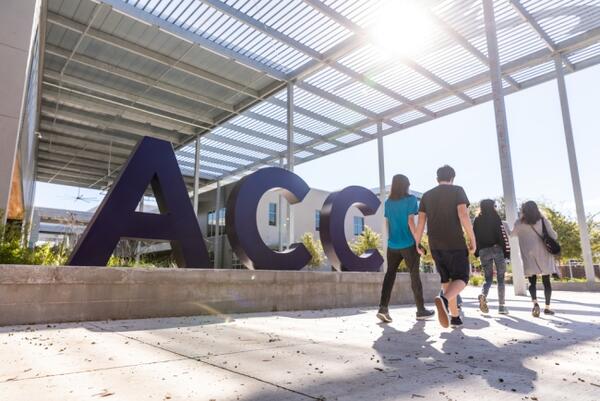
    Civil rights groups have been piling on to intervene in the recent Texas court case that ended in-state tuition for noncitizens living in the state. Now Austin Community College and a Texas undocumented student are joining the effort to defend the now-defunct law.

    College officials worry they’ll lose students and revenue if undocumented students’ tuition prices suddenly skyrocket. Austin Community College is the first Texas college to try to join the lawsuit.

    The Texas Dream Act, which allowed noncitizens who grew up in the state to benefit from in-state tuition, was overturned last month after the Department of Justice sued Texas over the law. The state didn’t fight back and instead sided with the DOJ mere hours after the legal challenge. A week later, the Mexican American Legal Defense and Educational Fund, a Latino civil rights organization, filed a motion on behalf of a group of Texas undocumented students to intervene in the lawsuit. The group argued the swift resolution of the DOJ’s legal challenge denied those affected any chance to weigh in, so the students should become intervenors, or a party to the case, and have their day in court.

    Other groups quickly followed MALDEF’s lead. Since last week, the American Civil Liberties Union of Texas, the Texas Civil Rights Project, Democracy Forward and the National Immigration Law Center have joined the fight, representing the activist group La Unión del Pueblo Entero, the Austin Community College District’s Board of Trustees and Oscar Silva, a student at University of North Texas. The groups filed emergency motions on their behalf to intervene in the lawsuit and get relief from the judgment that killed the law. If these legal efforts are successful, a case so quickly open and shut by Texas and the DOJ could be reopened.

    Austin Community College board chair Sean Hassan said in a news release from the Texas ACLU chapter that college officials deserved to have their say on the policy shift.

    “Employers and taxpayers are looking to community colleges to produce a sufficient number of highly skilled graduates to meet workforce needs,” Hassan said. “If legislation or court decisions will impact our ability to meet these expectations, we should have a seat at the table to help shape responsible solutions. The action by our board asks the court to ensure our voice is heard.”

    Calculating the Costs

    In court filings, Austin Community College leaders argue that the institution will lose revenue because of the abrupt end of the Texas Dream Act. They estimated that about 440 students will see their tuition rates quadruple, and as a result, hundreds of students will stop out and prospective students will avoid enrolling in the first place. College leaders also argued in the motion to intervene that the need for scholarships will rise, putting extra financial pressure on the community college.

    They cited other potential costs as well, including setting up new processes to identify and notify noncitizen students of tuition rate changes and ramping up public relations efforts so the college can continue to “market itself as an accessible, inclusive, and affordable institution for all Texas high school graduates,” despite the policy change.

    “The loss of these students will have a cascading effect on campus life, academic programs, and student support services,” Austin Community College chancellor Russell Lowery-Hart said, according to court filings.

    The motion also detailed how Silva, the student, would likely have to withdraw from his joint bachelor’s and master’s program at the University of North Texas if he lost his in-state tuition benefits. He was expected to graduate next spring. Silva has lived in Texas since the age of 1 and attended Texas K–12 schools.

    “The Texas Dream Act means everything to me,” Silva said in the ACLU of Texas news release. “This law has made my education possible. Without it, college would’ve been out of reach for me as a first-generation college student.”

    The motion comes after Wynn Rosser, commissioner of higher education for the Texas Higher Education Coordinating Board, sent out a June 18 memo directing colleges and universities to determine which of their students are undocumented and need to be charged higher tuition starting this fall.

    Trouble Over Timelines

    Texas, the DOJ and civil rights groups have since been haggling over how fast the U.S. District Court should move in response to the new motions.

    The civil rights groups want a decision soon. But, in a joint submission to the court on June 30, the Trump administration and Texas argued emergency motions were uncalled-for and the legal proceedings shouldn’t be expedited, though they acknowledged the intervenors raised issues “which merit response.”

    “Expediting responses to intervenors’ motions would only serve [to] put the United States and Texas at a disadvantage, having to brief and respond to intervenors’ myriad of arguments in a drastically shorter timeframe than would otherwise be necessary, and would do nothing to help intervenors expedite any potential relief,” the response read.

    But the civil rights groups representing Austin Community College and other intervenors weren’t having it. On July 1, they asked that the court deny the request.

    The attorneys argued that the state and the federal government moved quickly to resolve the DOJ’s lawsuit and end the Texas Dream Act, but “when asked to respond on an expedited basis to the consequences of their actions and the imminent harm raised” by the motions, “the parties balk, insisting that the court should postpone its consideration of these motions until well past the point when the looming harms become irreversible.”

    That same day, Judge Reed O’Connor gave the Trump administration and Texas until July 14 to respond to the motion to intervene, which aligns with their requested timeline. He also delayed briefings on the motions to stay the judgement and for relief until he rules on the motion to intervene.

    As this fight plays out in Texas, the DOJ is targeting other states that offer in-state tuition benefits to undocumented students. Last month the Trump administration filed similar lawsuits in Kentucky and Minnesota, which have yet to be resolved.

    Source link

  • What’s inside the Senate megabill for higher education?

    What’s inside the Senate megabill for higher education?

    The Senate on Tuesday passed its mammoth domestic policy package, which would reshape the federal student lending system and delay major higher education regulations. 

    Vice President JD Vance cast the tie-breaking vote to pass the legislative package 51-50. Lawmakers passed the bill through the reconciliation process, which allows the Senate to bypass the usual 60 votes needed to overcome a filibuster. 

    The House and the Senate will have to reconcile their two versions of the bill before they can send it to President Donald Trump’s desk. 

    That could prove difficult. Although the two proposals would both extend tax cuts and fund Republican priorities like increased immigration enforcement, some aspects are dramatically different. 

    That includes for the higher education sector. For instance, while the House version would put colleges on the hook for their former students’ unpaid student loans, the Senate’s version creates an entirely different system intended to hold institutions accountable for their student outcomes. 

    Below, we’re rounding up some of the Senate bill’s major provisions. 

    Cutting off student loan eligibility to college programs

    One of the biggest provisions in the Senate’s bill would prevent college programs from being eligible to receive student loan funding if their graduates can’t meet certain earnings thresholds. 

    For undergraduate degree programs, they would have to prove that at least half of their graduates earn more than the typical worker in their state with only a high school diploma. Similarly, graduate programs would have to show their graduates earn more than the typical bachelor’s degree holder working in the same field and region. 

    College programs would lose their eligibility for federal student loans if they fail the earnings test in two out of three consecutive years. 

    Reshaping federal student loans

    Like the House-passed version, the Senate bill would end Grad PLUS loans, which allow graduate students to borrow up to the cost of the attendance for their programs, including tuition, fees, textbooks and living expenses. 

    The bill would moreover cap graduate student lending to $100,000 per borrower, or $200,000 for students enrolled in professional programs, such as law or medicine. It would also cap Parent PLUS loans to $65,000 per student. 

    Additionally, the Senate’s plan would consolidate the number of repayment options for federal student loans. Starting July 1, 2026, borrowers taking out new loans would only have access to two plans: one standard plan with fixed payments and one income-driven repayment plan with remaining balances forgiven after 30 years. 

    Major changes to Pell

    The Senate’s version of the bill would allow Pell Grants to be used for short-term programs between eight and 15 weeks. 

    However, lawmakers took out a controversial provision that would have also extended short-term Pell Grants to unaccredited providers. The move came after the Senate’s parliamentarian said the original provision should be subject to a 60-vote approval versus the simple majority needed for reconciliation.

    The package also would increase funding for Pell Grants to cover expected shortfalls while removing eligibility for students if they receive scholarships that cover their full cost of attendance. 

    Endowment tax hikes

    The Senate’s version of the bill would raise the tax that wealthy private nonprofit colleges pay on their endowment returns. The new system would introduce a tiered tax, starting at the current rate of 1.4% and jumping up to 4% and 8% based on endowment assets per student. 

    Currently, only colleges with at least $500,000 in endowment assets and 500 tuition-paying students pay the tax. But the new bill provides an exemption for smaller colleges, excluding those with 3,000 tuition-paying students or fewer from having to pay the tax. Like the initial short-term Pell proposal, lawmakers took out an earlier proposed exemption for religious colleges after scrutiny from the chamber’s’s parliamentarian.

    Delays to Biden-era regulations

    The Senate’s original plan would have rolled back permanently two Biden-era versions of regulations: the borrower defense to repayment and closed school discharge rules. The former allows borrowers to receive debt relief if they were defrauded by their colleges while the latter offers forgiveness if their institutions closed before they could finish their programs. 

    Source link

  • Penn Agrees to Trump’s Demands, Will Strip Trans Athlete’s Awards

    Penn Agrees to Trump’s Demands, Will Strip Trans Athlete’s Awards

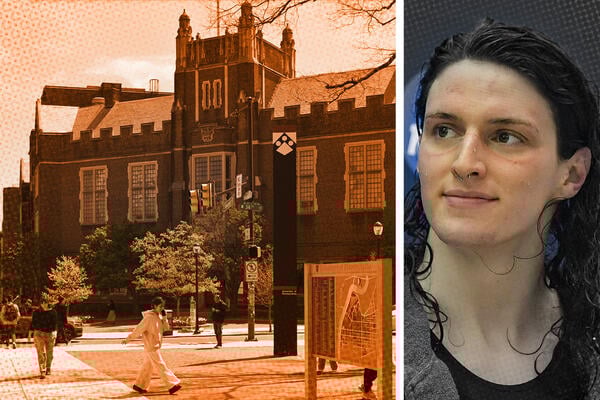
    Photo illustration by Justin Morrison/Inside Higher Ed | Kyle Mazza/Anadolu/Getty Images | Rich von Biberstein/Icon Sportswire/Getty Images

    The University of Pennsylvania will concede to the Trump administration’s demands that the university “restore” swimming awards—and send apology notes—to female competitors who lost to a trans athlete, the Department of Education’s Office for Civil Rights announced Tuesday.

    The department previously found that Penn violated Title IX for allowing a trans woman to compete on a women’s sports team—presumably referring to Lia Thomas, who rose to national attention while competing on Penn’s women’s swim team three years ago.

    To end the investigation, the administration demanded in part that Penn apologize to cisgender women whose swimming awards and honors were “misappropriated” to trans women athletes. Multiple Title IX advocates lambasted the department’s demands, arguing the agency was misusing the landmark gender-equity law to punish trans students and their institutions.

    Penn is one of multiple higher education institutions and K–12 schools that the administration has targeted for allowing trans women to play on women’s sports teams, in accordance with NCAA policy at the time. But it appears to be the first institution of higher education to reach a resolution agreement over the issue since Trump took office.

    “Penn remains committed to fostering a community that is welcoming, inclusive, and open to all students, faculty, and staff,” Penn president J. Larry Jameson said in a statement Tuesday. “I share this commitment, just as I remain dedicated to preserving and advancing the University’s vital and enduring mission. We have now brought to a close an investigation that, if unresolved, could have had significant and lasting implications for the University of Pennsylvania.”

    Separate from the department’s investigation, the White House paused $175 million in funding to the university because Penn “infamously permitted a male to compete on its women’s swimming team,” an official said in March. It’s not clear if the funding will be restored or when.

    Jameson stressed in the statement that the university was in compliance with Title IX and all NCAA guidelines at the time that Thomas swam for Penn’s women’s team from 2021 to 2022. But, he said, “we acknowledge that some student-athletes were disadvantaged by these rules. We recognize this and will apologize to those who experienced a competitive disadvantage or experienced anxiety because of the policies in effect at the time.”

    Title IX advocates have emphasized that trans athletes are not, in fact, explicitly forbidden from playing on women’s sports teams under the current Title IX regulations, which were finalized under the previous Trump administration and are the same ones that were in effect when Thomas was competing.

    In addition to stripping Thomas’s awards, Penn agreed to ED’s demands to make a public statement that people assigned male at birth are not allowed in Penn’s women’s athletic programs or its bathrooms and locker rooms, according to the department’s news release. The institution must also promise to adopt “biology-based definitions for the words ‘male’ and ‘female’ pursuant to Title IX” and Trump’s February executive order banning trans athletes from playing on the team that aligns with their gender.

    That statement also went up Tuesday. In it, the university promised to follow Trump’s trans athlete ban, as well as the executive order he signed that withdraws federal recognition of transgender people, with regard to women’s athletics.

    In the department’s announcement, Paula Scanlan, one of Thomas’s former teammates who has since led the crusade against trans women athletes, said she was “deeply grateful to the Trump Administration for refusing to back down on protecting women and girls and restoring our rightful accolades. I am also pleased that my alma mater has finally agreed to take not only the lawful path, but the honorable one.”

    Shiwali Patel, senior director of safe and inclusive schools at the National Women’s Law Center, criticized the agreement in a statement Tuesday as a “devastating and shameful outcome.” She blamed Penn’s “utter failure” as well as the department’s “continued manipulation of Title IX.”

    “The Trump administration’s attacks on civil rights protections, including Title IX, and obsession with undermining bodily autonomy is the real harm to women and girls, unlike transgender athletes who want to compete in sports alongside their peers and pose no threat to women’s sports, contrary to Trump’s lies,” Patel said in the statement. “In fact, their inclusion benefits all women and girls. We will continue to support Lia Thomas and her peers and their right to compete.”

    Source link

  • What Is IT Governance and Why Is It So Important in Higher Ed?

    What Is IT Governance and Why Is It So Important in Higher Ed?

    Technology can be one of the most powerful tools an institution has to advance its mission. But without clear, strategic guidance, that same technology can quickly become a source of frustration, inefficiency, and risk. That’s where IT governance comes in.

    Today’s colleges and universities are navigating rising cybersecurity threats, tighter budgets, and an expanding ecosystem of platforms and tools. In this environment, IT governance isn’t just an operational necessity — it’s a strategic imperative.

    In this article, I’ll define what higher ed IT governance is, why it matters more than ever, and how institutions can build a framework that aligns technology investments with institutional priorities.

    What is IT governance in higher ed?

    Put simply, IT governance is the structure that ensures every technology investment and decision supports the institution’s goals and strategies. While IT management focuses on maintaining day-to-day systems — like patching servers or updating networks — IT governance answers a different set of questions, such as:

    • Which projects should we prioritize?
    • How do we allocate limited resources for the greatest impact?
    • Who needs to be involved in shaping these decisions?

    A thoughtful approach to IT governance isn’t just a collection of policies. It’s an intentional structure that fosters transparency, collaboration, and accountability across the entire institution.

    When done well, governance clarifies how decisions are made, who is responsible for making them, and what criteria determine success. This clarity reduces confusion, builds trust, and ensures that technology investments consistently support the institution’s mission and priorities.

    An effective governance framework typically includes:

    • Decision-making structures such as IT governance committees with representation across academic and administrative areas
    • Policy development that guides how technology projects are evaluated and approved
    • Risk management and compliance oversight to keep pace with evolving regulations and security requirements

    When institutions embrace governance as a shared responsibility, technology becomes a strategic asset rather than a departmental concern.

    Why higher ed IT governance matters more than ever

    The complexity of higher ed technology ecosystems has grown exponentially. Many institutions now rely on cloud platforms, ERP and student information systems, learning management systems, and emerging tools like AI.

    Without governance, it’s easy for tech investments to become siloed or redundant — especially when departments act independently. This fragmentation can lead to:

    • Financial waste due to functional redundancy
    • No clear system of record/unclear data access policies
    • Missed opportunities for collaboration and efficiency

    External pressures are also intensifying. Regulatory requirements such as FERPA and GLBA have expanded. Accrediting bodies increasingly expect transparent, documented technology processes. And stakeholders — from faculty to students — demand seamless, secure digital experiences.

    In an era of constrained budgets, institutions can’t afford to treat IT governance as an afterthought.

    Ready for a Smarter Way Forward?

    Higher ed is hard — but you don’t have to figure it out alone. We can help you transform challenges into opportunities.

    The risks of poor or nonexistent IT governance

    When governance isn’t in place, institutions face serious consequences that extend far beyond the IT department. Gaps in oversight and alignment can ripple across every facet of the organization, undermining financial stability, operational efficiency, and stakeholder confidence. Over time, these issues can erode the very foundation of an institution’s mission and reputation.

    Some of the most common (and costly) problems include:

    • Financial inefficiency and wasted resources: With shrinking enrollments and limited funding, institutions can’t afford investments that fail to deliver measurable value or duplicate existing capabilities.
    • Missed opportunities to maximize impact: When IT resources are spread thin across too many projects, even high-priority initiatives can stall or underperform.
    • Increased security vulnerabilities: Technology risks are growing faster than most budgets. Without clear governance to prioritize spending on solutions that mitigate the most critical threats, institutions are more exposed to breaches and compliance failures.
    • Resistance to change: If end users feel excluded from decisions, adoption suffers—and so does return on investment.
    • Reputational damage: Failed implementations and security incidents can erode trust with students, staff, and stakeholders.
    • Inability to scale or innovate effectively: Disconnected systems and uncoordinated efforts make it harder to keep pace with evolving needs.

    We’ve seen this firsthand, where IT leadership at institutions make major platform decisions without involving departmental leaders. The result was widespread resistance and a perception that technology was imposed rather than collaborative. When people don’t have a seat at the table, they’re far less likely to champion change.

    “When people don’t have a seat at the table, they’re far less likely to champion change.”

    What effective higher ed IT governance looks like

    Good governance is intentional, inclusive, and transparent. It doesn’t happen by accident — it requires clear structures and a shared commitment to align technology decisions with institutional goals. When these elements come together, colleges and universities create an environment where technology can thrive as a strategic asset rather than a siloed expense.

    To build this kind of foundation, governance should include:

    • Cross-functional committees: Cabinet members typically designate representatives from key areas (e.g., academic affairs, enrollment, finance) to ensure diverse perspectives.
    • Clear processes: Policies that define how projects are proposed, prioritized, and evaluated.
    • Defined success metrics: Criteria for measuring whether investments deliver the intended impact.
    • Regular reviews: Governance frameworks should be revisited at least annually to keep pace with evolving needs and regulations.

    Moving forward: IT governance as a strategic imperative

    IT governance in higher ed isn’t just about compliance or risk avoidance. Done well, it empowers colleges and universities to:

    • Use technology as a force multiplier
    • Align financial and technology resource investments with strategic goals
    • Build a culture of collaboration and shared accountability

    As institutions navigate emerging priorities — from AI policies to hybrid learning environments — governance will only grow more critical. If you haven’t assessed your governance framework recently, now is the time.

    Ready to strengthen your IT governance?

    At Collegis, we help institutions develop and operationalize IT governance models that balance innovation with accountability. Our team brings decades of expertise with deep experience aligning technology strategy with institutional vision.

    If you’re ready to move beyond reactive technology decisions and build a governance model that drives lasting success, let’s connect!

    Innovation Starts Here

    Higher ed is evolving — don’t get left behind. Explore how Collegis can help your institution thrive.

    Source link

  • A Multiday In-Class Essay for the ChatGPT Era (opinion)

    A Multiday In-Class Essay for the ChatGPT Era (opinion)

    A successful humanities course helps students cultivate critical, personally enriching and widely applicable skills, and it immerses them in the exploration of perspectives, ideas and modes of thought that can illuminate, challenge and inform their own outlooks.

    Historically, the out-of-class essay assignment has been among the best assessments for getting students in humanities courses to most fully exercise and develop the relevant critical thinking skills. Through the writing process, students can come to better understand a problem. Things that seem obvious or obviously false before spending multiple days thinking and writing suddenly become no longer obvious or obviously false. Students make up their minds on complex problems by grappling with those problems in a rigorous way through writing and editing over a sustained period (i.e., not just writing in a blue book in one class session).

    Unfortunately, since ChatGPT became widely available, out-of-class writing assignments keep becoming harder to justify as major assessments in introductory-level humanities courses. The intense personal engagement with perspectives and cultural artifacts central to the value of the humanities is more or less bypassed when a student heavily outsources to AI the generation and expression of ideas and analysis. As ChatGPT’s ability to write convincing papers goes up, so does the student temptation to rely on it (and so too does the difficulty for professors of reliably detecting AI).

    Having experimented very extensively with ChatGPT, I have found that, at least when it comes to introductory-level philosophy courses, the material that ChatGPT can produce with 10 minutes of uninformed prompting rivals much of what we can reasonably expect students to produce on their own, especially given that one can upload readings/course materials and ask ChatGPT to adjust its voice (the reader should try this).

    And students are relying on it a lot. Based on my time-consuming-and-quickly-becoming-obsolete detection techniques, about one in six of my students last fall were relying on ChatGPT in ways that were obvious. Given that it should take a student no more than 10 extra minutes on ChatGPT to make the case no longer obvious, I have to conclude that the real number of essays relying on ChatGPT in ways that conflict with academic integrity must be at least around 30 percent.

    It is unclear whether AI-detection software is sufficiently reliable to justify its use (I haven’t used it), and—at any rate—many universities prohibit reliance on it. Some instructors believe that making students submit their work as a Google Doc with track-changes history is an adequate deterrent and detection tool for AI. It is not. Students are aware of their track-changes history—they know they simply have to type ChatGPT content instead of copying and pasting it. Actually, students don’t even have to type the AI-generated content: There are readily available Google Chrome extensions that take text and “type” it at manipulable speeds (with pauses, etc.). Students can copy/paste a ChatGPT essay and have the extension “type” it into a Google Doc at a humanlike pace.

    Against this backdrop, I spent lots of time over the last winter break familiarizing myself with Lockdown Browser (a tool integrated with learning management software like Canvas that prevents access to and copying/pasting from programs outside of the LMS) and devising a new assignment model that I happily used this past semester.

    It is a multiday in-class writing assignment, where students have access through Lockdown Browser to (and only to): PDFs of the readings, a personal quotation bank they previously uploaded, an outlining document and the essay instructions (which students were given at least a week before so they had time to begin thinking through their topic).

    On Day 1 in class, students enter a Canvas essay-question quiz through Lockdown Browser with links to the resources mentioned above (each of which opens in a new tab that students can access while writing). They spend the class period outlining/writing and hit “submit” at the end of the session.

    Between the Day 1 and Day 2 writing sessions, students can read their writing on Canvas (so they can continue thinking about the topic) but are prevented from being able to edit it. If you’re worried about students relying on ChatGPT for ideas to try to memorize/regurgitate (I don’t know how worried we should be about students inevitably trying this), consider introducing small wrinkles to the essay instructions during the in-class sessions (e.g. “your essay must somewhere critically discuss this example”).

    On Day 2, students come to class and can pick back up right from where they left off.

    A Day 2 session looks like this:

    One can potentially repeat the process for a third session. I had my 75-minute classes take two days and my 50-minute classes take three days for a roughly 700-word essay.

    This format gives students access to everything we want them to have access to while working on their essays and nothing else. While it took lots of troubleshooting to develop the setup (links behave quite differently across operating systems!), this new assignment model offers an important direction worthy of serious exploration.

    I have found that this setup preserves much of what we care about most with out-of-class writing assignments: Students can think hard about the topic over an extended period of time, they can make up their minds on some topic through the process of sustained critical reflection and they experience the benefits and rewards of working on a project, stepping away from it and returning to it (while thinking hard about the topic in the background all the while).

    Indeed, I have talked with several students who noted that they ended up changing their minds on their topic between Day 1 and Day 2—they (for instance) set out to object to some view, and then they realized (after working hard through the objection on Day 1 and reflecting on it) that what they now wanted to do was defend the original view against the objection that they had developed. Perfect: This is exactly the kind of experience I have always wanted students to have when writing essays (and it’s an experience that students don’t get with a one-day blue-book essay exam).

    Because the setup documents each day’s work, it invites wonderful opportunities for students to reflect on their writing process (what are they seeing themselves prioritizing each session, and how/why might they change their approach?). The opportunities for peer review at different stages are also robust.

    For those interested, I have made a long (but time-stamped) video that illustrates and explains step by step how to build the assignment in Canvas (it also discusses troubleshooting steps for when a device isn’t getting into Lockdown Browser). The video assumes very minimal knowledge of Canvas and Lockdown Browser, and it describes the very specific ways to hyperlink everything so that students aren’t bumped out of the assignment or given access to external resources (in Canvas—I cannot currently speak to other LMS platforms). The basic technical setup for the assignment is this:

    • Create a Canvas quiz for Day 1, create an essay question, link to resources in the question (PDFs must be uploaded with the “Preview Inline” display option to work across devices), require a Lockdown Browser with a password to access it, then publish the quiz.
    • Post arbitrary, weightless grades for Day 1 after the first writing session so that students can read (but not edit) what they wrote before Day 2 (students cannot read their submitted work until you post some grade for it).
    • Create a Canvas quiz for Day 2 just like Day 1, but this time, in the essay question, link to the Day 1 Canvas quiz (select “external link” rather than “course link,” and copy/paste the Day 1 Canvas quiz link).

    As I mentioned at the beginning of this piece, a successful humanities course helps students cultivate critical, personally enriching and widely applicable skills, and it immerses them in the exploration of perspectives, ideas and modes of thought that can illuminate, challenge and inform their own outlooks. The research I have done over the past three years tells me I can no longer be confident that an intro-level course that nontrivially relies on out-of-class writing assignments can be a fully successful humanities course so understood. Yet a humanities course that fully abandons sustained essay assignments deprives students of the experience that best positions them to fully exercise and develop the skills most central to our disciplines. Something in the direction of this multiday in-class Lockdown Browser essay assignment is worthy of serious consideration.

    Source link