I’m sitting quietly this morning, reflecting in the final minutes before my interview with Jim Lang. Our conversation will focus on his latest book, Write Like You Teach. In the book, Jim suggests that we ought to be good company in our writing. He has embodied this guidance since I first met him more than a decade ago.
Jim has been good company through his many books as I’ve yearned to be gentle with myself, resisting the urge to reinvent each class I teach with every new semester (Small Teaching). He’s helped me wrestle with what it might look like to ignite students’ imaginations rather than control their behaviors (Distracted). He transformed the way I think about academic integrity, encouraging me to focus on fostering intrinsic motivation and self-efficacy while cultivating the conditions in which mastery and deep learning can thrive (Cheating Lessons).
In the meantime, the gardens need tending. If you continue to believe in the value of the plants that have always flourished in your garden, keep growing them.
In Jim’s eighth appearance on Teaching in Higher Ed, I have no doubt he will once again be good company. I’m thankful for all the ways he has shaped my teaching, my learning, and this podcast over the years.
American higher education is under pressure from within and without—squeezed by financial strain, declining enrollment, political hostility, and technological disruption. But the greatest challenge may be coming from a group of powerful outsiders—figures with deep influence in politics, technology, and media—who are actively reshaping how education is perceived, delivered, and valued. Among them: Donald Trump, Elon Musk, Peter Thiel, Sam Altman, Alex Karp, and Charlie Kirk. Each brings a different ideology and strategy, but their combined influence represents an existential threat to traditional colleges and universities.
Donald Trump’s second rise to power has included a full-spectrum attack on elite and public institutions of higher learning. From threats to strip funding from schools that promote diversity, equity, and inclusion, to freezing billions in research grants at elite institutions like Harvard, Trump has positioned universities as enemies in a broader cultural and political war. His proposed education policy emphasizes trade schools and short-term credentials over liberal arts and research, while his administration has floated revoking accreditation from institutions that resist his agenda. Rather than investing in public education, the Trump agenda calls for punishment, privatization, and obedience. And for institutions that don’t comply, there are growing threats of taxation, defunding, and public humiliation.
Elon Musk is undermining higher education in a different way. Musk has openly mocked the need for college degrees, suggesting that “you can learn anything online for free.” While that’s partly rhetoric, it’s also a blueprint for disruption. His experimental school Astra Nova already offers a glimpse into a post-institutional future—one that favors creative, independent thinking over traditional credentialing. Now, with plans to launch the Texas Institute of Technology & Science, Musk is betting that elite training can happen outside the bounds of accreditation and federal oversight. Musk’s future is technocratic and libertarian, with universities seen as bloated, slow-moving, and culturally out of touch.
Peter Thiel’s vision is even more radical. Thiel has compared American higher education to the Catholic Church before the Reformation—rich, corrupt, and intellectually bankrupt. His Thiel Fellowship pays young people to skip college entirely, offering $100,000 to start companies instead of accumulating debt. He argues that universities reward conformity and delay adulthood. For Thiel, colleges don’t just fail to prepare students—they actively mislead them. His endgame is a decentralized, market-driven system in which talent rises through initiative and capital, not credentials.
Sam Altman, CEO of OpenAI, presents yet another threat—this time from artificial intelligence. Altman doesn’t reject learning, but he does question the institutions that monopolize it. With tools like ChatGPT and future AI tutors, Altman envisions personalized, real-time learning for everyone, everywhere. In this model, universities risk becoming obsolete—not because they are wrong, but because they are too slow and too expensive. Altman has also pushed universities to take a more active role in shaping AI policy; if they don’t, the tech industry will do it for them. The message is clear: adapt or be replaced.
Alex Karp, CEO of Palantir, is building a new kind of corporate university. Through programs like the Palantir Meritocracy Fellowship and “Semester at Palantir,” Karp is recruiting students directly out of elite schools—particularly those disillusioned by what he sees as anti-Israel sentiment or campus censorship. These programs offer practical, high-paid experience that bypasses traditional academic pathways. Karp’s vision doesn’t require the elimination of universities—it just renders them unnecessary for the most competitive jobs in tech and intelligence. His model suggests a future in which corporations, not universities, decide who is qualified.
Charlie Kirk, founder of Turning Point USA, has weaponized the culture war to delegitimize higher education entirely. Kirk’s brand of activism portrays universities as corrupt, anti-American indoctrination centers. Through social media campaigns, donor networks, and student chapters, he has built an infrastructure of resistance against academic institutions. His goal isn’t reform—it’s replacement. Through efforts like the Freedom College Alliance, Kirk is helping to build a parallel educational system rooted in conservative Christian values, classical curricula, and ideological purity. In Kirk’s world, higher education isn’t broken—it’s the enemy.
Together, these six men are shaping a new, fragmented future for American education. Some want to burn it down. Some want to replace it. Some want to privatize it or profit from its collapse. What they share is a conviction that traditional universities no longer serve their intended purpose—and that a new model, rooted in tech, politics, or religion, must take its place.
This isn’t a theoretical debate. Universities are already responding—cutting liberal arts programs, racing to implement AI tools, rebranding themselves as career accelerators, and seeking favor with donors who increasingly resemble these disruptive outsiders. For those who resist, the future may include not just funding cuts, but political investigations, lawsuits, and public smear campaigns.
Higher education faces a stark choice. It can double down on its public mission—defending critical thinking, civic engagement, and social mobility—or it can retreat into elite credentialing and survival mode. What it cannot do is ignore the forces gathering at its gates. These forces are rich, powerful, ideologically driven—and they are not waiting for permission to remake the system.
Phillip Levine, an economics professor at Wellesley College, has been studying college financial aid and students’ higher ed spending habits for more than a decade. When his children first started applying to college about 15 years ago, he was amazed by how difficult it was to get a clear answer on how much it was really going to cost them—and he was a trained economist.
Imagine, he thought, how the average family felt reading through interminable webpages and offer letters explaining the detailed price breakdowns, differences in tuition and fees, added expected costs, and loans versus grants. Then he tried to imagine how parents who’d never gone to college might feel.
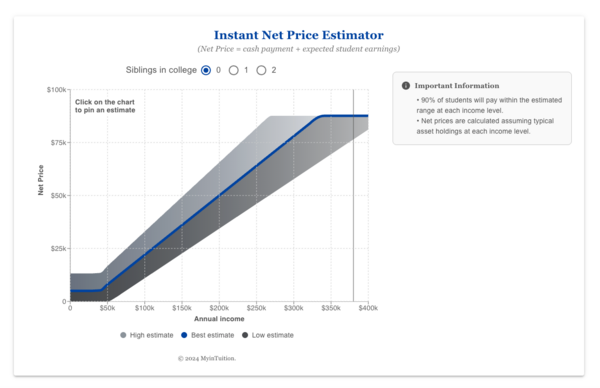
Since then, Levine has worked on a number of college cost transparency initiatives. His most recent project is the Instant Net Price Estimator, a streamlined digital tool that he hopes will make it easier for colleges to break through the noise and deliver a clear estimate to families.
As public skepticism about the value of a postsecondary degree grows and $100,000 sticker prices make front-page news, colleges are in the market for a simple way to let families know that their degrees can be affordable. Washington University in St. Louis became the first institution to adopt the tool and served as a kind of pilot program this application cycle. Interest from colleges has grown swiftly: This fall, an additional 19 institutions will introduce Levine’s calculator on their websites, and he anticipates that number will triple next academic year.
Levine spoke with Inside Higher Ed about his new tool, how low-income students get stuck in the financial aid “funnel” and how colleges can be better communicators in a time of widespread public distrust of higher ed. The conversation has been edited for length and clarity.
Q: Walk me through the genesis of this idea. What were you hoping to achieve?
A: I don’t think it’s a state secret that college pricing is complicated. If you go to any college website and look at the financial aid webpage, there’s tons of stuff there trying to explain how much they charge, but they overshoot it in terms of what people are looking for. You’re taking a high school kid and their family and giving them a Ph.D.-level course in financial aid. Not surprisingly, they don’t usually get it.
I think about the admissions process like a funnel: You give me a little information, I’ll give you a basic answer that’s pretty imprecise. You give me more information, I’ll give you a better answer that’s a little more precise. You can keep going down the process until eventually, you know, ultimately you fill out the FAFSA or the CSS Profile.
To maximize access, that funnel needs to have a very wide mouth at the top; in financial aid language, what that means is you need to communicate extremely quickly to as wide an audience as possible that college is not $100,000. It doesn’t even matter exactly what it is. But if you can’t get people off of the ledge at the $100,000 number—the mainstream media puts out stories all the time that college costs a million dollars a year, so their perception is that it’s extremely expensive. All you want them to do at the beginning stages is to be like, “Hey, maybe this is something I can afford.” Then you need to lead them through the rest of the funnel.
Phillip Levine
Ultimately, the financial aid process really is complicated because we have this concept of what a family can afford to pay, and there’s no right answer to that question, but we have all these complicated formulas that are trying to find it anyway. Over time, colleges have been trying to do a better job of getting past that point, just not very successfully. What I’ve been working on for the last 10 or 15 years is to make an easier entry point, and this tool is even higher up the funnel than what I’ve been working on in the past.
It takes three seconds to get a sense of what college is going to cost you, and in particular to get you over that hurdle that it’s probably not $100,000. My goal is within a matter of literally a few seconds to give people a sense that college is very unlikely to be as expensive as they fear. And then you can start having a more substantive conversation. Otherwise, you close the door on the poor kids, way before they’re into the process.
Q: Colleges have been trying to do this kind of thing on their own for a while. What makes your tool an improvement on institutional efforts?
A: Colleges understand that this is a problem. But to be quite honest, the only people who actually understand the way the financial aid system works are the people in the financial aid office, and they don’t speak English, so to speak. It’s an unbelievably complicated process, very complex, and now they have to explain it to a regular person, and they can’t do that. It’s not their fault; they try, they’re just not successful. There’s a handful of people in the admissions office who understand it, too, but not many. And once you get past those two audiences, nobody else at the college understands it, including the public affairs people.
I got started on this because when my kids were looking at colleges, I just wanted to know whether I was eligible for any financial aid, yeah. And I realized how unbelievably hard it was to figure it out. Back then [around 2010] it was actually impossible to figure out. Things have evolved a lot since then.
Q: Like you said, there are other tools out there now. What makes this one different?
A: I’m just trying to push it to the next stage of development. I’m an economist; I can speak geek as well as anyone. But as I started doing this, I’m learning more and more about how you sell a product, which is basically what you’re doing with college cost. I’m realizing how little time you have to communicate a message.
I’m in a weird position, because I’m doing the research on the pricing issues, and I’m developing the tools. It was in one of the Brookings [Institution] papers I wrote when these ideas were just kind of coming together and we were thinking about how you do the graphics. And it just kind of came together that we can visually display this information in a simulator, what I really refer to as a simple game. So I thought, if I can do it for a Brookings paper, why can’t I do this for a school or a family? And about that time, Washington University [in St. Louis] came to me looking for assistance on some other issues, and I pitched this to them, and they bought into it. So they paid for the development, and it’s been up and running there since December. If you go to most schools’ webpages, including my own, there’s stuff there, but you gotta read forever. And you know as well as I do that nobody reads that much anymore.
That’s what I’m trying to accomplish with this: just get the ball rolling with something that speaks to where students are.
A demo version of Levine’s Instant Net Price Estimator, which can be customized to fit colleges’ specific needs and profiles.
Screenshot from myintuition.org
Q: I assume the calculator doesn’t factor in things like merit aid?
A: You want it as simple as possible. So you just slide your input and it essentially just tells you what the average cost is going to be for you based on income, and tells you the range, which may be very broad. At Washington University, they don’t give a lot of merit aid, so, like, it would not be a big deal there, but at schools that do a lot of merit aid, that range could also include merit. They can factor that into the calculator.
But mainly, you just want the light bulb to go off of, “Oh, maybe I can afford this.” And then maybe they’re willing to go spend some time reading instead of getting scared off right from the start. Their initial instinct is, there’s no way I can afford to go to Washington University. And it’s the school’s job in terms of marketing to communicate to people. The problem, in my mind, is that the door is closed so early for so many people that you need to be able to just let them get through that first door in the process. There’s still a lot of hurdles you have to get through after that, yeah, but if you don’t make it through the first one, you don’t even approach any of the others.
Q: There’s been legislation introduced at the federal level and passed in many states to mandate that colleges take certain steps toward cost transparency. Do you think there’s a good understanding of what that takes among policymakers?
A: Clearly, policymakers have figured out that transparency is an issue, and they’re right. But their intentions are often better than their proposals. The net price calculator law [a federal law mandating institutions include a price calculator on their websites by 2011], for instance, was very well intended. But it’s easy to see the big picture problem; to then come up with a solution that actually works, you have to have a little bit more inside baseball. The net price calculator law is a perfect example. It was so well intended, they completely had the right idea, and they blew it. I obviously don’t know all of the details of all the different state laws, but I’ve seen proposals, and generally I look at them and go, right idea, wrong solution.
Q: Have there been any good policy solutions?
A:The College Cost Transparency Initiative. It’s much better if the schools can fix this problem on their own, because they know what they’re doing. It’s a tiny step, and you have to already apply and get accepted before you get your letter. And then it tells you, in a more clear way than it used to. It’s lower on the funnel, really at the bottom. But it’s a good step.
[Levine later clarified that he sat on the technical advisory committee for the CCTI.]
Q: Has there been a lot of interest in your instant price calculator from other colleges? And what kinds of colleges seem to be most invested in these transparency efforts?
A: Nineteen more colleges will roll it out in the fall. It’s a small range right now, from relatively wealthy to very wealthy. I think at the very high end of higher ed, the Ivies and such, where they have a lot of money to spend on financial aid, they’re trying to increase access in a very direct way. It is good for them to enroll more lower-income students from a public relations perspective. And I think every school wants to do the right thing. But as you stray from the very top of the spectrum, there’s also an interest in simply increasing enrollment, where they don’t want to be turning away students because they think they can’t afford it when they can. They’re just looking for more students, especially because there’s fewer kids. So the ability to open the door to as many kids as possible at this moment has appeal.
The Trump administration’s financial and political attacks on higher education, as well as more pressing problems across the sector, mean it’s unlikely U.S. colleges will prioritize sustainability work in the near future.
While seven Canadian universities—including Queen’s University, McMaster University and the University of Alberta—ranked in the global top 50, Arizona State University, ranked joint sixth, is the only U.S.-based institution to crack the top 50. Three highly ranked U.S. colleges fell out of the global top 50 this year: Michigan State University is now at joint 61st, Penn State at joint 64th and Florida International University at joint 71st.
Western Sydney University in Australia topped the global ranking for the fourth year in a row.
THE—Inside Higher Ed’s parent company—ranked the sustainability efforts of 2,526 universities from 130 countries; 52 institutions from across the U.S. participated in the 2025 ranking, down from 58 in 2024.
Since 2019, THE has evaluated the performance of thousands of higher education institutions across the globe on the U.N.’s 17 Sustainable Development Goals. Universities that want to participate in the rankings are required to submit information for SDG 17, Partnerships and Goals, and at least three other SDGs. How well an institution meets those goals is then evaluated across four broad categories: research, stewardship, outreach and teaching.
Phil Baty, chief global affairs officer for THE, described American universities’ “general lack of direct engagement with the SDGs” as “disappointing,” especially because the U.S. has some of the world’s strongest research universities. “I’d hope they can turn their greatest minds more overtly towards tackling the world’s most pressing and urgent challenges.”
Under Trump, SDGs May Be ‘More Risky’
Although the nation’s lackluster showing in the 2025 Impact Rankings is based on university data that predates the start of President Donald Trump’s second term, the administration’s attacks on the sector and political stances suggest the country’s higher education institutions may only face more barriers to becoming global sustainability leaders.
In March, the Trump administration denounced the SDGs, which the U.N. created in 2015 during President Barack Obama’s administration with the aim of reaching them by 2030. The second Trump administration has also pulled out of other international sustainability initiatives, including the Paris Agreement on climate change, and moved to cut billions in funding for scientific research and social programs—including many focused on reducing social inequities, addressing climate change and advancing diversity, equity and inclusion efforts.
Bryan Alexander, a scholar who studies the future of higher education and author of 2023’s Universities on Fire: Higher Education in the Age of Climate Crisis, wrote in an email to Inside Higher Ed that even before the Trump administration’s denouncement of the SDGs, they’d failed to gain much traction among U.S. universities.
“When I mention SDGs in academic settings, I usually see blank faces and have to explain what they are,” he wrote, attributing the indifference to a stronger focus on other, seemingly more pressing matters plaguing higher education, such as financial instability. “That sense of institutional urgency, heightened by a steady stream of campuses closing, merging, or cutting programs and staff, looms large. In that context, the SDG goals look like noble but not essential, nice-to-haves rather than imperatives.”
According to Alexander, other deterrents to the sector launching a widespread commitment to sustainable development include faculty burnout, scarce resources, anti-expert animus, doubts from faculty and administrators that their efforts will make a difference, and anxiety about associated political risks.
And he expects all those problems to persist, if not worsen, in the coming years as Trump continues his assault on universities and pro-sustainability initiatives. “The anti-DEI campaign strikes directly at several SDGs,” Alexander wrote. “It will be harder for academics to win external support for any such work, from doing research to offering new academic programs, overhauling a campus power system to replacing vehicles with electric vehicles. It will appear to be politically even more risky.”
However, he said there are some less risky actions U.S. institutions can take to be more sustainable.
“First, renewable energy, especially solar, is simply cheaper than fossil fuels. Switching a campus’ power supply just makes financial sense,” he said. “Second, traditional-age undergraduates are much more interested in climate change and sustainable development than their elders, which means they will tend to be eager to take classes and study in programs along those lines.”
Walking a Fine Line
ASU also tops the global ranking for SDG 14: Life Below Water, which means it’s at the forefront of developing strategies that support the health and sustainability of aquatic ecosystems.
It launched one of the nation’s first schools of sustainability nearly 20 years ago, and although its main campus is located in the Arizona desert, ASU launched the School of Ocean Futures in 2024. The school connects research and teaching facilities in the Pacific and Atlantic Oceans with research happening on its main campus in Tempe.
The school is one example of how universities can help to “restore balance within the global environment,” said Marc Campbell, ASU’s assistant vice president of sustainability and deputy chief sustainability officer.
“Fundamentally, the work of sustainability is about trying to be more efficient in the use of our resources and trying to protect what’s out there,” Campbell said. “A lot of people can support the foundational work of sustainability, but we need to unload some of the baggage that’s associated with the word and the discipline.”
Doing that, he said, will come from making a case for the economic and social value of investing in sustainable development initiatives.
“In any organization there are supporters and detractors. You have to figure out how to walk that fine line to get people supporting the greater good and recognizing what that is,” Campbell said.
“When we can do that more effectively across the board and build broader collaborative partnerships with other organizations that are focused on the same goals, then I think we can get past some of the [political] baggage.”
A federal district judge declined to issue an injunction that would block the Trump administration’s recent cuts to staff and contracts at the Institute of Education Sciences—an agency charged with collecting and analyzing data about both K–12 and higher education.
In an opinion released last week, Maryland judge Stephanie A. Gallagher acknowledged that the new administration has terminated 90 percent of the agency’s staff and therefore IES “is not doing a number of tasks Congress requires of it.” Gallagher, a Trump appointee, also empathized with the two education research associations that filed the lawsuit—the American Educational Research Association and the Society for Research on Educational Effectiveness—saying she trusts that not receiving the data they expected from IES “will harm them.”
But that does not mean the plaintiffs have a strong enough case to stop the Trump administration from continuing to dismantle the agency. Gallagher said that the associations’ arguments are at times too broad or too narrow, that they lump together numerous cuts—some of which may be justified—and that they include “factual discrepancies” and improper interpretations of “no fewer than a dozen statutes.”
Over all, she said, “They have not shown they are entitled to this sort of extraordinary relief.”
“These Plaintiffs have alleged, and have provided some evidence to support, a troubling pattern of conduct at IES,” Gallagher wrote. “But because they cannot make the requisite showings on the preliminary injunction factors, and in particular have not shown they have standing to seek the relief they are asking for, their motion for a preliminary injunction must be denied.”
This ruling is not final, however, and “should not be taken as predictive of this Court’s ultimate decision,” Gallagher added.
But the Education Department is already walking back some of the IES cuts, according to court filings in the lawsuit that The Hechinger Report first reported on. Department officials disclosed earlier this month that they are reinstating at least 20 out of the 101 contracts that were terminated. The restored contracts include one that requires the National Center for Education Statistics to participate in the Program for International Student Assessment. (According to Hechinger, Congress mandates that the department take part in international assessments.)
SREE president Elizabeth Tipton told Hechinger that the limited reversal was “upsetting” and not enough to fix the problem.
“They’re trying to make IES as small as they possibly can,” she said.
After the National Institutes of Health tried earlier this year to cut funding for universities’ costs indirectly related to research and set off alarm bells across higher education, 10 higher education associations decided to come up with their own model for research funding rather than having the government take the lead.
Now, after just over six weeks of work, that group known as the Joint Associations Group is homing in on a plan to rework how the government funds research, and they want feedback from the university research community before they present a proposal to Congress and the Trump administration at the end of the month.
“Unfortunately, something is going to change,” said Barbara Snyder, president of the Association of American Universities. “Either we will be part of it or it will be imposed upon us … Significant division in the research community is going to kill us.”
Snyder and other JAG members said at a virtual town hall Tuesday that the current system for direct and indirect research funding costs has served the community well, but it isn’t transparent and leads to confusion about how the rates are calculated, among other challenges. AAU and other higher ed groups sued the NIH in February after the agency proposed capping indirect expenses for all institutions at 15 percent of the direct research costs—down from the average of 28 percent. (Historically, colleges negotiate their own reimbursement rates directly with the federal government.)
The White House said the cap would make more money available for “legitimate scientific research,” but universities warned that the change would halt lifesaving research and lead to job losses, among other consequences. The NIH rate cap would mean a cut of $4 billion for university-based research.
Court challenges have since halted the NIH plan, as well as similar caps proposed by twoother federal agencies; meanwhile, the Department of Defense is working on its own plan related to indirect costs. Snyder said the lawsuits are about fiscal year 2025, while the JAG effort looks ahead to fiscal year 2026 and beyond.
Over the years, Congress and federal agencies have sought to rethink the funding model but didn’t reach an agreement. In fact, after the first Trump administration proposed a 15 percent cap on indirect costs in 2017, Congress specifically prohibited such a move. But now that prohibition doesn’t seem likely to stick as lawmakers consider bills to fund the government for fiscal year 2026, so a new model is necessary. Adding to the pressure on universities, Trump has proposed significant cuts to research funding in his budget.
JAG’s panel of experts presented two options to the university research community at a webinar last week and then answered questions at the town hall Tuesday. Colleges and universities have until June 22 to test the proposed models and provide feedback before JAG sends its final proposal to the government June 27, though any model will likely need additional work.
“No one would choose to work at this rapid pace and rethink how to effectively, fairly and transparently cover these real and unavoidable costs,” said Matt Owens, president of the Council of Government Relations, at last week’s webinar. “But we are where we are, and it’s vital that we meet this moment so that we can emerge with an improved and sustainable indirect cost policy that will enable our country to continue leading the world in research and innovation.”
Proposed Models
Both versions of what JAG is calling the Fiscal Accountability in Research model, or FAIR, are geared toward offering more accountability and transparency about how federal research dollars are spent. JAG hopes that in the end, the new model will be simpler than the current one. They also want to nix terms like “indirect costs rate” and “overhead” for either essential research support or general research operations in an effort to underscore that the money goes toward the real costs of research.
“This will require a bit of a culture change in institutions, but we think the benefit of that far outweighs the downsides,” said Kelvin Droegemeier, a professor and special adviser to the chancellor for science and policy at the University of Illinois at Urbana-Champaign, who led the JAG effort, at the webinar.
One model, which the group calls FAIR No. 1, would include costs related to managing the grant, general research operations and facilities as a fixed percentage of the total budget. The percentage would be based in part on the type of institution and research. This approach is designed to be simple and reasonable, according to the group’s presentation, but it’s more general, which makes it “difficult to account for the wide array of research frameworks that now exist.”
The other model, FAIR No. 2, would more accurately reflect the actual costs of a project and make the structure for federal grants more like those from private foundations. Under this model, essential research support would be lumped into the project costs while funding for general research operations, such as payroll and procurement, would be a fixed percentage of the total budget. That change would likely increase the direct costs of the project.
Droegemeier and other members of JAG’s expert panel noted that FAIR No. 2 would be a “significant departure” from the current approach, and universities would likely need more time to overhaul their processes for tracking costs. Still, the group said this model would better show what the money goes toward, addressing a key concern from Congress.
Droegemeier described the two models as “bookends” and said the group would probably end up somewhere between the two.
‘In a Good Spot’
At Tuesday’s town hall, attendees questioned whether Congress or the Trump administration would even consider JAG’s proposal and why any change was necessary.
Droegemeier said he’s met with members of Congress who have endorsed their process, and he’s kept in touch with Trump administration officials about the group’s work. So far, he’s seen a positive response to the models, adding that officials at the Office of Management and Budget indicated that they weren’t “oceans apart.”
“We’ve done everything possible to build goodwill and trust,” he said. “There’s a long road ahead of us, but I think we’re in a good spot.”
Other speakers echoed that point, noting that Sen. Susan Collins, a Republican from Maine and chair of the powerful Appropriations Committee, publicly supported the models at a recent hearing. And NIH director Jay Bhattacharya called the proposals “quite promising” at the same hearing, STAT Newsreported.
Additionally, the House’s appropriations bill for the Department of Defense calls on the agency to “work closely with the extramural research community to develop an optimized Facilities and Administrative cost reimbursement solution for all parties that ensures the nation remains a world leader in innovation.”
Across the board, speakers at the town hall said they must act to have a say in discussions about the future of research funding.
“The two models are a significant change,” said Deborah Altenburg, vice president for research policy and advocacy at the Association of Public and Land-grant Universities. “But all of our organizations are responding to a new political situation.”
Just over half of student loan borrowers consider themselves financially insecure, while about three-quarters said they had experienced an adverse financial event, like skipping a bill, in the past year, according to a survey from the Pew Charitable Trusts exploring the attitudes of student loan borrowers after federal student loan repayments restarted in October 2023 following a three-year pause. The survey was conducted in the summer of 2024.
Existing financial challenges are closely associated with struggles to repay student loans, the survey found. About 23 percent of respondents indicated they had missed some or all of their student loan payments since October 2023, but that number was higher among those who are financially insecure (34 percent) and those who had experienced a negative financial event (30 percent).
But paying off student loans isn’t just challenging for those facing other financial difficulties. Among all borrowers, 57 percent said they found it difficult to afford their loans, including 41 percent of those who said they do not consider themselves financially insecure. Over a third of borrowers also said they found repaying their student loans more stressful than paying their other bills.
The Education Department estimates that nearly 25 percent of borrowers have either defaulted on their loans or will default in the next several months. In May, the agency restarted collections on unpaid loans.
As colleges across the country cut staff, implement hiring freezes and slash budgets, fewer people could see higher education as a long-term career path, according to Kevin McClure, a professor of higher education and chair of the Department of Educational Leadership at the University of North Carolina at Wilmington.
In a recent episode of The Key, Inside Higher Ed’s news and analysis podcast, McClure told IHE editor in chief Sara Custer that in the current environment, demoralization is high among faculty and staff. “It’s just really difficult to do good work. There’s a significant amount of uncertainty, there is stress, there is trauma that people are still living through from COVID and the great resignation … and there is no doubt that the workforce in higher education is struggling,” he said.
“It’s not the case that across the board every institution is in this scenario …but every single institution is being cautious right now, and there is enough uncertainty and enough question about multiple revenue streams coming into institutions that there are cascading effects for working conditions.”
McClure said he’s concerned institutions are not doing a good enough job of articulating their values. This, he said, is what colleges should “double down” on to combat the demoralization he’s observed in current employees and to show future talent “what they’re all about.”
“In the current environment, I think we have seen some backsliding, some backtracking, some revisions of our websites—all of these signposts suggesting to people who work here that the things we stand for are actually maybe flexible and can be modified as the political winds blow.”
Let me tell you about Andrew, a motivated student who graduated high school early with impressive dual-enrollment credits. After attending a private college for a year and taking some time to work, he rekindled his educational ambitions at a community college. With approximately 30 credits remaining for his bachelor’s degree, he applied to an R-1 university, ready to complete his journey.
What should have been a seamless transition became an unexpected challenge. Despite submitting his transfer work in October and regularly checking in with his adviser, Andrew discovered in January—after classes had already begun—that he faced “at least three years of coursework” rather than the anticipated single year to graduation.
This isn’t a rare occurrence or some administrative anomaly. Rather, it is the norm for individuals who aren’t pursuing a four-year degree on the traditional timeline. Higher education talks endlessly about completion and student success while maintaining systems and policies that actively undermine these goals.
Andrew’s story represents a critical opportunity for higher education. While his family successfully advocated for a refund and found another institution that better recognized his prior learning, his experience highlights a fundamental challenge we must address collectively.
The Scale of the Challenge
We have 42 million Americans with some college credit but no degree. We have 200,000 military personnel transitioning to civilian life annually. We have an economy desperately needing upskilled workers. Yet higher education’s response to credit mobility remains anchored in outdated policies and processes that fail to serve today’s students, institutions or workforce needs.
Many institutions have made meaningful progress in supporting diverse student needs through childcare services, flexible scheduling and online options. These are important steps. Now we must extend this same commitment to the academic evaluation processes that directly impact students’ time to degree and financial investment.
The Disconnect
Transfer articulation agreements—where they have been struck—have created valuable pathways, but their implementation often lacks the consistency and transparency students deserve. When agreements include qualifying language without firm commitments, students can’t effectively plan their educational journeys or make informed financial decisions.
The contradiction is striking: We express concern about student debt and extended time to degree, questioning why students take 150 credits when they only need 120 to graduate. Meanwhile, our credit evaluation processes remain opaque, slow and often costly.
The current reality—where students frequently must apply, pay deposits or even enroll before understanding how their previous academic work will be valued—creates unnecessary barriers. We can do better—and, frankly, must. It’s like buying a car and finding out the price after you’ve signed the paperwork. In what other industry would this be acceptable?
The Opportunity
Consider the possibilities if we fully embraced credit mobility as a cornerstone of student success:
Students could make informed decisions about their educational pathways before committing financially.
Institutions could demonstrate their commitment to affordability by recognizing prior learning.
Graduation rates would improve as students avoid unnecessary course repetition.
The workforce would benefit from skilled professionals entering more quickly.
Addressing the Objections
The objections to credit mobility typically fall into three categories:
Faculty workload: Faculty are being asked to do more, and evaluating credits for prospective students can feel like an unnecessary burden. But what if more students could see that their learning had value, that their degree was within reach, that they didn’t have to retake classes they’ve already mastered? This shift in perspective could transform the evaluation process from a burden to an opportunity.
Lost revenue: The focus on enrollments often overshadows the reality that only 50 percent of students who start college actually finish within six years. What if our goal was to expand opportunities so more students could complete their degrees? What if students were taking classes that genuinely added to their experience and built their confidence rather than repeating content they’ve already learned?
Quality concerns: Quality is often cited as justification for delayed evaluation. In reality, transparent evaluation supports faculty’s desire to maintain academic standards. Clear processes allow for informed decisions and data collection that ensures the focus remains on student outcomes.
The AI Opportunity
The emergence of artificial intelligence presents a tremendous opportunity to enhance our credit-evaluation processes—addressing issues of time and cost while creating transparency for data analysis. A new study just released by AACRAO on the role of AI in credit mobility makes a compelling case as to why the technology could help unlock new ways of working. We can harness technology as a powerful tool to support faculty decision-making and administrative resource allocations. AI could:
Identify potential course equivalencies based on learning outcomes.
Highlight relevant information in transfer documentation.
Streamline evaluation processes, allowing human experts to focus on complex cases.
Provide leadership with insights into where credit mobility is operating effectively.
Identify areas needing additional resources or training.
With proper implementation and training, AI can become a tool to achieve our goals of access and completion at scale—reducing both the cost and timeline to graduation.
The Path Forward
If we truly believe in access and completion, then credit mobility must become a shared priority across higher education. This means:
Making course information, learning outcomes and sample syllabi readily accessible.
Expanding recognition of diverse learning experiences, including microcredentials, corporate training, internships and apprenticeships.
Establishing and honoring clear timelines for credit evaluation.
Eliminating financial barriers to credit assessment.
Providing updated articulation and equivalency tables in easy-to-find locations on admissions websites.
Andrew’s experience should be the exception, not the rule. Colleges and universities that embrace this challenge will not only better serve their students but will also position themselves for long-term sustainability in an increasingly competitive landscape. Those that resist change risk becoming irrelevant to the very students they aim to serve and perpetuating the cost and time-to-completion conundrum.
The Call to Action
The question before us isn’t whether credit mobility matters—it’s whether we have the collective will to make it a reality at scale, not just at a handful of institutions, but across systems and all institutions. We must recognize that our students are learning in new ways, on new timelines, and bringing knowledge that evolves faster than our curriculum. Our students deserve nothing less than our full commitment to recognizing their learning, regardless of where it occurred.
So I’ll ask: How committed are you to credit mobility at scale? Your answer says everything about how seriously you take college completion.
Jesse Boeding is the co-founder of Education Assessment System, an AI-powered platform mapping transfer, microcredentials and prior learning to an institution’s curriculum to enable decision-making and resourcing.
The Maine Legislature’s budget-writing committee voted last week in favor of ending the state’s free college program, to the great disappointment of community college leaders.
The move by Democrats on the Appropriations and Financial Affairs Committee contradicts Governor Janet Mills’s proposal earlier this year to make the program a permanent fixture. The free college program, which Mills initially put forward, went into effect in 2022 to support students affected by the pandemic. It originally covered two years of community college tuition for anyone who graduated high school between 2020 and 2023, after other forms of aid were applied. Though created with one-time funding, the program enjoyed strong bipartisan support and was extended in 2023 to include the Classes of 2024 and 2025. Students have a certain amount of time to enroll; for example, 2025 graduates have to start college no later than the 2027–28 academic year to take advantage of the program.
Since the program began, Maine’s community college enrollment has surged—enrollment of all degree-seeking students in the system jumped from 11,308 in 2022 to 14,278 in 2024. A total of 17,826 students have participated in the program since it started, according to data from the Maine Community College System. Many hoped, and expected, the program would continue.
But the Appropriations and Financial Affairs Committee’s proposal would give the community college system $20 million over two years to help current participants finish their studies before winding down the program for good, Maine Public Radio reported. The recommendation comes as Maine faces a lean budget year, with federal funding for the state hard to predict. President Donald Trump threatened to cut Maine’s federal funds after a tense exchange with Mills in February over his executive order barring transgender athletes from competing on the teams that match their gender identity.
Maine representative Michael Brennan said at the committee meeting last week, “We’ve had to make hard decisions about what we think we can afford and not afford,” though he called the free college program “tremendously successful.”
Senator Peggy Rotundo, co-chair of the Appropriations and Financial Affairs Committee, emphasized in a statement to Inside Higher Ed that state lawmakers are honoring their commitment to fund students who graduated in 2025 and expected to receive the program’s support. She implied the program could still be made permanent in the future.
“When considering what comes next, our focus is on ensuring this program’s long-term sustainability,” she wrote. “The Appropriations and Financial Affairs Committee is seeking additional data and evaluation from the community college system to inform a responsible, future-focused approach. In a tough budget year, we have a duty to balance expanding opportunity with fiscal responsibility—and that means looking ahead to build a durable model that can serve Maine students for years to come.”
The decision to nix the program isn’t set in stone—the state budget still needs to make its way through the state House and Senate and finally to the governor’s desk. But state legislators indicated they plan to wrap up the budget by today.
David Daigler, president of the Maine Community College System, wrote a letter to the system’s Board of Trustees on Saturday expressing “deep disappointment” over the committee’s vote. He told the board it’s “highly unlikely” there will be any major changes to funding for the free college program at this point.
“Ultimately, the committee’s vote reflects the state’s challenging financial situation, which made it hard to get support even though Free College is a very popular, effective program that directly benefits Maine families, students, and employers,” Daigler said in the letter. “You can be certain that we will build on the momentum of this program to emerge stronger, wiser, and re-dedicated to providing an affordable, accessible education to Mainers looking to improve their lives.”
In February, Daigler and community college staff members advocated for the program before the committee. Multiple students also spoke out in support, some arguing they wouldn’t have attended college without the program.
Brianna Michaud, a health-science student at Southern Maine Community College, told the budget-writing committee she considered not going to college because, despite her working two jobs, her family couldn’t afford it. Then she heard about the free college program.
“As a first-generation college student who’s entirely responsible for paying off their education, the Maine free college scholarship is the reason why I’m able to put my hard work and dedication toward fulfilling my purpose in life, which is to help others,” said Michaud, who plans on becoming a pediatric occupational therapist.
Payson Avery, a student representative at Southern Maine, said he graduated high school in 2020, during the height of the pandemic, and didn’t know what to do. He felt like his grades senior year didn’t show his potential. After two years, while working at a restaurant, he decided to take the state up on its free college offer. Now he has plans to attend the University of Maine at Farmington to major in education, he told the committee.
“Without this program, I’m not sure I would have been able to make it to this point,” he said.