Job interviews have become significantly more formulaic and predictable. Employers seem to increasingly favor standardized or structured interviews, in which each applicant is presented with the same questions in the same order, with no variation permitted.
Over the past few years, I have had almost 20 such interviews for faculty positions, all almost exactly identical, as if the questions were read from a script. I was able to prepare my answers ahead of time just by consulting the ad. After I answered each question, the search committees moved on to the next one, with little or no follow-up. Every interview ended with “do you have any questions for us?” but even then there was no sense of conversational give and take.
There are two main reasons employers use structured interviews. One is that they are supposed to level the playing field between candidates, ensuring fairness. They are considered a best practice for the elimination of unconscious biases in interviewing. The other reason is that unstructured or open interviews are lousy predictors of job performance, as research has repeatedly shown.
But neither of these arguments is convincing. The structured interview is based on a flawed conception of fairness as well as a misguided understanding of what a job is. These flat and dehumanizing conversations are just as pointless as they seem to anyone who has been subjected to one. In the interest of genuine fairness and for the sake of healthy workplaces, the structured interview should be eliminated.
Start with the confusion about fairness. The structured interview rests on the assumption that the elimination of the interviewer’s subjective, individual perspective results in greater objectivity and thus less discrimination. But there’s nothing intrinsically fair about making everyone answer the same questions. On the contrary—making everyone answer the same questions goes against the very idea of equity.
Equity is the idea that individuals start in different places and that adjustments must be made to ensure fairness. It’s a worthy and important principle. In an emergency room, it might dictate that patients be treated based on the severity of their condition rather than on when they arrived. In a workplace, it might dictate that employees with physical disabilities be provided with additional resources to allow them to perform the job.
In the case of interviews, equity requires that employers make the effort to meet candidates where they are, so that each candidate can showcase their unique strengths. If a candidate served in the Iraq War before entering academia, for example, it might make more sense to spend more time discussing that experience than it would discussing previous jobs with a candidate who had worked only in academia.
This kind of imbalance in the interview process would hardly be unfair. Indeed, it would be unfair not to give the Iraq veteran a chance to discuss the relevance of her war experience.
It also makes the candidate feel seen and interesting. My structured interviews were exhausting, not because the questions were difficult, but because they were alienating and depressing. Designed to stifle the candidate’s individuality, structured interviews can end up costing candidates a lot in dignity and self-esteem. They are supposed to eliminate emotions from the hiring process, but in reality the candidate may go through intense negative emotions: In my experience, it felt like running a gantlet, in which questions were not real problems to solve, but a string of reminders that I was just one of many faceless cogs.
This brings us to the argument that unstructured interviews are lousy predictors of job performance. That argument assumes that what counts as “performance” is skills and deliverables, rather than the human element of the workplace. But what is a job, really, apart from working with other people? The structured interview neglects what really impacts job performance: the personal attributes of the individuals involved, their commitment to the work and their ability to work with colleagues. These interviews cannot predict how well my co-workers and I will get along, how long I will stay, how dedicated I will feel over time, how the job will challenge me and build my character—all essential elements of successful performance.
Job interviews are more equitable and more informative about what really matters when they are open-ended conversations. And such conversations let applicants evaluate prospective employers, too: Structured interviews give the candidate very little insight into their potential employer. The perfunctory and dreaded “do you have any questions for us?” tells me nothing about why I should want the job. Open interviews, by contrast, take the candidate seriously, as someone who can accept an offer or walk away.
Having unconscious biases is part of the human condition—everyone has them. We should strive to mitigate them in hiring practices, but not at the cost of the candidates’ self-esteem. What should we talk about in open interviews? The job, of course. But the absence of a formula allows the exchange to center on the people and take place in the moment. Is this not the ultimate goal behind our desire to eliminate unconscious bias—to be able to see people as they truly are?
Margret Grebowicz is the Maxwell C. Weiner Distinguished Professor of the Humanities and professor of philosophy at the Missouri University of Science and Technology.
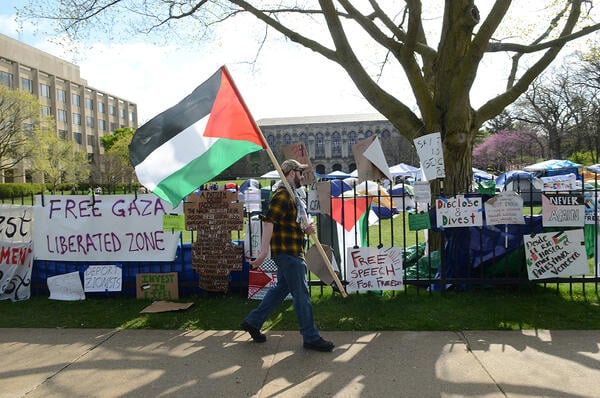
Last spring, as pro-Palestinian demonstrators set up encampments from coast to coast, a small number of college presidents struck agreements with students to get them to pack up their tents.
But a year after those protests ended, have the presidents lived up to their promises?
While the agreements varied widely by campus, the answer appears to mostly be yes, though many initiatives are still in progress.
Divestment from Israel or companies with ties to the Israeli government or military was the most common demand student protesters made, and while some presidents agreed to hold votes on the issue, they made no promises about how such decisions would go. In the vast majority of cases, universities outright rejected divestment demands; on rare campuses where administrators agreed to divest, the actions were largely contained, focused mostly on defense contractors.
Beyond divestment votes, colleges also struck agreements on multiple other points, including scholarships for displaced Palestinian students and increased support for Muslim students. Here’s a look at where such promises stand a year after the encampment protests ended.
Northwestern University
Few protest deals made more headlines than the one at Northwestern University, where President Michael Schill signed on to the Dearing Meadow agreement, as it came to be known, in late April of last year. Schill agreed to various concessions in exchange for protesters concluding the encampment. Those promises included support for Palestinian students and visiting Palestinian faculty, more space for Muslim student groups, and greater transparency in how the university invests its $14.3 billion endowment.
In signing the agreement, Schill caught the attention of Congress, which summoned him for a hearing last May alongside the leaders of Rutgers University and the University of California, Los Angeles. Schill defended the agreement, pushing back on GOP scrutiny.
The Daily Northwestern, the university’s student newspaper, confirmed that Schill has followed through on various initiativess; the university is currently supporting at least one Palestinian scholar and providing temporary space for Muslim students and the Middle Eastern and North African Student Association. (Renovation for a permanent space is ongoing.) The newspaper also confirmed that Northwestern added support for Jewish and Muslim students through the office of Religious and Spiritual Life, which funds weekly Shabbat dinners. But Northwestern officials have been reticent to discuss such efforts, ignoring requests for comment from the student newspaper and Inside Higher Ed.
(Multiple student activists also did not respond to requests for comment from Inside Higher Ed.)
Despite promising more transparency on its endowment, Northwestern does not appear to be living up to that part of the deal. According to the agreement, Northwestern “will answer questions from any internal stakeholder about specific holdings, held currently or within the last quarter, to the best of its knowledge and to the extent legally possible.” Officials promised to respond to such inquiries within 30 days or, if unable to do so, to “provide a reason and a realistic timeline.”
However, The Daily Northwestern reported last month that it sent officials questions about endowment holdings in February and did not receive a response within 30 days. The student newspaper noted that Northwestern did not provide a reason for the delay or a timeline for a response. A student reporter told Inside Higher Ed that the newspaper followed up on March 30 and the university then referred the questions to the Advisory Committee on Investment Responsibility.
The Daily Northwestern is still awaiting answers.
Rutgers University
Rutgers also struck a deal with encampment protesters last spring. As at Northwestern, that agreement landed then-president Jonathan Holloway in front of Congress mere weeks later.
Rutgers leaders agreed to eight of the students’ 10 demands; while they rejected calls to divest from Israel and terminate a partnership with Tel Aviv University, they agreed to accept 10 displaced Gazan students, establish Arab cultural centers at each Rutgers campus, seek a partnership with Birzeit University in the West Bank, hire faculty members who specialize in Palestinian and Middle East studies, and release a statement calling for a ceasefire, among other concessions.
Rutgers officials said all of the agreed-upon initiatives are currently in progress.
Rutgers agreed to eight out of 10 of the protesters’ demands.
“Work continues to advance a series of actions we believe will strengthen and build upon positive change across our community,” spokesperson Megan Schumann told Inside Higher Ed. “These efforts are grounded in the university’s values of free expression, inclusion, and mutual respect—and in the fundamental right of all members of our community to learn, teach, and carry out the university’s essential work in a safe and supportive environment.
University of Oregon
At the University of Oregon, the administration’s agreement with protesters included a statement calling for a ceasefire and condemning genocide, the addition of visiting scholars with expertise in Palestine and Israel, support for academics displaced by the war, new faculty hires with related expertise, new cultural spaces, and more.
Officials said they have lived up to their end of the agreement, though some initiatives are still underway. They noted that the university has already awarded its first International Crisis Response Scholarship, which was established by the agreement to support students affected by the conflict, and the recipient has begun studies at UO. The university has also funded two speaking events as part of its Special Initiative on Constructively Engaging the Conflict and the Pursuit of Peace in Palestine/Israel. Another five proposals for speaking events have already been approved, according to officials. Past and upcoming events have focused on topics such as Palestine and the future of U.S. campus activism and Palestinian identity.
Other efforts, such as faculty recruiting, are ongoing, with several academic units submitting hiring-plan proposals that are undergoing a standard review process. Plans to forge partnerships with Birzeit University in the West Bank and several universities in Israel are also underway.
Evergreen State College
The public institution in Washington agreed to various concessions in a deal with protesters. Officials launched four committees to work on different issues, including “divestment from companies that profit from gross human rights violations and/or the occupation of Palestinian territories,” according to language in the signed protest agreement. Another task force will develop policies to determine whether the college should accept or reject grants that “facilitate illegal occupations abroad, limit free speech, or support oppression of minorities.” The other two task forces are slated to review policing at Evergreen State and to develop a new “non–law enforcement” model for crisis responses.
President John Carmichael also kept his promise to protesters by making a statement on the bloodshed in Gaza last May, in which he called for a ceasefire, the release of hostages and the restoration of international law, which he wrote “requires that the International Court of Justice fairly adjudicate charges of genocide.” He also urged the university community to be “on guard against Islamophobia and antisemitism as we engage with each other in this moment.”
Those efforts are ongoing; the agreement provided a timeline for the task forces to complete their work, with deadlines to adopt their recommendations ranging from spring 2026 to 2030.
California State University, Sacramento
When Sacramento State struck an agreement with pro-Palestinian protesters last May, students framed the move as divestment in a social media post. But a more accurate reading would be that the university determined it did not have direct investments in companies profiting off the war effort and declared that it would not pursue such holdings. The university also established a “de minimis policy for indirect investments that prioritizes socially responsible investments,” a spokesperson wrote to Inside Higher Ed.
Sacramento State president Luke Wood said at the time, “The finance committee of our University Foundation has been so committed to socially responsible investments that we have no direct investments in any of the companies about which many of our students have concerns.” He also announced a policy to formalize socially responsible investment practices, in order to “avoid funding students’ education based on companies that profit from war and desolation,” the spokesperson said.
University leaders announced multiple other actions at the same time, which Wood said grew out of listening sessions with over 1,500 students, faculty, staff and alumni that began when he arrived the previous year. Those changes include introducing more halal and kosher food options on campus, new cultural centers and training on Islamophobia and antisemitism, as well as university task forces to address both Islamophobia and antisemitism. Other efforts include the development of recruitment plans to attract Palestinian and Jewish students to the university.
(This section has been updated to incorporate the university’s response.)
Sonoma State University
Sonoma State University may offer the most visible case of promises made and broken.
Last spring, then-president Mike Lee agreed to demands from protesters that included reviewing contracts to consider divestment opportunities, introducing a Palestinian studies curriculum and adding Students for Justice in Palestine members to a Sonoma State advisory council. Most controversially, he agreed to what was effectively an academic boycott, promising not to “pursue or engage in any study abroad programs, faculty exchanges, or other formal collaborations that are sponsored by, or represent, the Israeli state academic and research institutions.”
However, the agreement was not approved by his bosses in the California State University system, prompting officials to walk the deal back and Lee to retire suddenly. A new deal put forward by an acting president who replaced Lee scrapped much of the prior agreement.
A campus spokesperson noted that despite the changes to the initial agreement, SSU Foundation officials met with students to discuss investment holdings and launched other actions, including a three-part lecture series providing “differing viewpoints on the situation in Gaza and differing religious perspectives,” as well as new groups to support Jewish life.
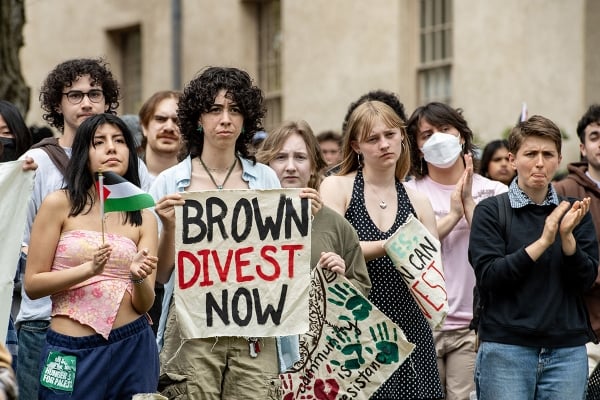
Protesters at Brown University demand divestment, April 29, 2024.
Joseph Prezioso/AFP/Getty Images
Divestment Demands
Multiple universities agreed to hold votes on some form of divestment in response to protesters, including Brown University, the University of Minnesota, the New School and others.
Governing boards, however, have largely rejected divestment except in a few cases.
The University of San Francisco announced several weeks ago that it would divest from four U.S. companies with ties to the Israeli military: Palantir, L3Harris, GE Aerospace and RTX Corporation. The university plans to sell off direct investments in those companies by June 1.
Nearby San Francisco State University has also adopted a form of divestment; in December, the public university’s governing board voted to add new investment screening policies. Now SFSU will no longer invest in companies that make 5 percent or more of their revenues from weapons manufacturing. SFSU also adopted more transparency around endowment holdings.
Many people are losing hope because of the anti-DEI policies that state legislators and governors have enacted over the past four years, as well as the Trump administration’s brutal attacks via executive orders and the U.S. Department of Education’s now-infamous Valentine’s Day Dear Colleague letter. Hopelessness also has ensued following the swift renaming and discontinuation of offices, centers and institutes, programs and professional positions on campuses. It all happened so fast—in some contexts, over four years; everywhere else, in a matter of months. A significant experience I had three decades ago gives me hope in the possibility of eventual recovery from these politicized storms that have produced such extraordinary damage to DEI initiatives in higher education.
I was born and spent the first 22 years of my life in South Georgia, a place that frequently experiences violent hurricanes and tornadoes. I have seen entire communities wiped out within minutes. In July 1994, just six weeks before the start of my freshman year in college, Tropical Storm Alberto brought torrential rains to Albany, Ga. The National Weather Service reports that more than 30 people died, nearly 50,000 residents were forced to evacuate their homes and over 18,000 structures were completely lost. Many of those buildings were at Albany State, a historically Black university located along the Flint River, which flooded during the storm. Nineteen of its 34 buildings were destroyed beyond repair and ultimately demolished.
Somehow, our fall quarter miraculously started on time. Instead of residence halls, most students in my first-year class moved into mobile homes on campus; dump trucks were scooping massive quantities of mud and recovery crews were still assembling modular units where we would sleep on the day I arrived. There was so much mud. The mess was widespread—everywhere, in fact.
For years, many classrooms and offices were located in trailers. Despite the chaos and abundance of annoying mud everywhere at Albany State, there was hope. As my family and I drove into campus for move-in day, I remember seeing a huge banner on one of the few surviving buildings that simply read, “Unsinkable.” That one word became an inspirational chant and declaration that still pervades the institution, now more than 30 years later.
The flood took so much from my beloved alma mater, but recovery efforts, which required tremendous reliance on the federal government, resulted in a more modernized campus with attractive new facilities that are atypical for most HBCUs due to state and federal funding inequities. Because of what I witnessed firsthand during my four undergraduate years, as well as in the aftermath of numerous other calamitous weather crises that occurred throughout my youth, I know that communities can rebuild homes and structures that are more solid, attractive and high-tech than what previously existed. Even still, a sense of community, family heirlooms and, in some instances, the lives of people and pets are lost. No amount of federal aid can restore those things.
While the context and circumstances are different, living through this disastrous moment in American higher education because of, but not limited to, the politicized teardown of DEI is familiar to me. Put differently, I have lived through and witnessed recovery from many tragic storms.
That does not make it any less distressing. But my four-year undergraduate experience taught me how to envision possibilities beyond the daily inescapability of mud, debris and devastation. When I arrived at Albany State as an 18-year-old freshman, rebuilding had not yet started. The institution instead was working as hard as it could with the resources it had at the time to educate, house and serve us. That is where many contemporary college and university campuses are at this very moment as it pertains to DEI.
Understandably, many students and employees who are most affected by the abandonment of institutional commitments to DEI only have the capacity to survive this catastrophic moment; they are not yet able to begin recovery work. The unavailability of federal, state and institutional resources makes it even less possible for most people to think about the next iteration of DEI efforts on campuses.
Notwithstanding, hope for something better—even if we do not know when that something better will become available—could be the one and only thing that sustains those of us who are truly committed to DEI. To be sure, I do not believe that hope alone will be enough—coalitions, elections, stock taking and documentation of harm, fundraising, activism, institutional and governmental accountability, and sophisticated strategizing are also required.
Right now, there is so much mud. The mess is widespread—everywhere, in fact. Like Albany State, the beautiful HBCU that still stands strong more than 30 years after its neighboring Flint River flooded, DEI in higher education is unsinkable. I have no choice but to believe this, and I will continue doing all I can to achieve this outcome for colleges, universities and our democracy.
Shaun Harper is University Professor and Provost Professor of Education, Business and Public Policy at the University of Southern California, where he holds the Clifford and Betty Allen Chair in Urban Leadership.
Math courses are often a barrier for students seeking to pursue a college credential, and for some, a lack of math curriculum during high school can make a STEM career seem out of reach.
A new course at Wentworth Institute of Technology in Boston serves as a stepping-stone for students who may not have had access to precalculus or calculus courses but are still interested in calculus-based learning. The university hopes the program will boost student enrollment and eliminate barriers to access for disadvantaged students.
What’s the need: The conversation about offering precalculus at Wentworth began in 2019, after university leaders saw that some students, despite having the same GPAs and high school transcripts as their peers, were less mathematically prepared, said Deirdre Donovan, Wentworth’s director of first-year math and interim associate dean of the School of Computing and Data Science.
At that time, Wentworth did not offer a math placement course, so all enrolled students launched at the calculus level.
Wentworth, like many colleges and universities, requires students to have already completed calculus coursework to enroll in specific major programs, which is “a barrier that can prevent otherwise qualified students from pursuing engineering and computing degrees,” Donovan said.
To complete calculus by the end of high school, students had to complete Algebra I in eighth grade, and not every student was ready, aware of or offered that course at their school, Donovan said.
Some high schools also push students to complete AP Statistics in lieu of calculus, and Donovan said this shift “can actually close more doors at STEM schools than it might open, because those AP credits can’t replace the calculus-based statistics required for engineering degrees.”
Campus leaders at Wentworth opted to review policies that were barring students from participating in STEM programs, starting with creating a math placement process and then developing a precalculus course.
How it works: In 2024, Wentworth removed precalculus as an admissions requirement for students, paving the way for the college to admit about 10 percent more students who might have previously received a conditional acceptance, Donovan said.
New students without calculus credit are now enrolled in a four-credit, first-semester course called Foundations of Calculus that helps them get up to speed. The investment in additional content hours is an indication of the university’s commitment to opportunities for students who may not have been able to enroll and succeed previously, Donovan said.
In addition to two hours of lectures each week, students also participate in two hours of labs that focus on engineering problem-solving skills, using real-world problems that are tied directly to a student’s major.
The course is also supported by embedded peer tutors who can address student questions, clarify confusing content and facilitate study groups outside of class time.
It was important to Donovan and her faculty team not to work from a deficit-minded perspective about students’ knowledge gaps. Language regarding the course and its content hours was specifically crafted to help students feel like they’re being guided onto an on-ramp, not held back or punished for not having precalculus experience.
The results: After the first semester, staff have seen promising results, Donovan said. “We are pinching ourselves that it went exactly how we had hoped it would go.”
In fall 2024, about 200 students participated in precalculus either because they lacked the course in high school or their placement exam results indicated it would benefit them.
Approximately 75 percent of precalc students passed their course in the first term, on par with national averages. When they attempted calculus in their second semester, students had similar passing rates to their peers who completed calculus in the first term.
University faculty and staff were encouraged to see that engineering programs received 20 percent more applications this year, signaling an increased level of interest in rigorous programs, Donovan said.
Fall-to-spring retention rates were slightly lower for precalc students, but that could be due to other factors, including students re-evaluating their chosen major or deciding whether they want to be at a STEM-focused institution.
The course has also expanded enrollment opportunities for students who otherwise might not have considered Wentworth. Overall applications were up 25 percent year over year this past application cycle, and deposits were up 30 percent, Donovan said.
What’s next: Student feedback from the first term has indicated a need for an additional credit hour of in-person, interactive lab work, which will be implemented this fall. The hour, which the university is calling a companion class, will function similarly to a first-year seminar, teaching students study skills and metacognition, as well as connecting back math concepts.
None of the downstream courses such as physics have undergone a curriculum change, requiring students to get up to speed in their first term to be successful over all in college. Students who complete precalc also may need to take summer classes to ensure they graduate in four years, but the university is looking to offer affordable online courses to accommodate learners, Donovan said.
Do you have an academic intervention that might help others improve student success? Tell us about it.
After 13 years of testing higher-order active learning modalities in the classroom, collecting data, building a database, and analyzing student learning results in bi-annual principles of marketing classes, my colleague and I saw two important results emerge. First, all students, regardless of their SES (socio-economic status) standing, showed significantly higher levels of retained learning than the control group which used the time-honored lectures, basic active learning techniques, and case approaches. Secondly, of greater importance, lower-level SES students showed significantly higher retained learning than the general student population. In surveying the literature, significant results have been reported for all students, but not significantly higher than the norm for lower-level SES students.
In the beginning, we decided to build a database measuring what might work better than the currently accepted flipped classroom concept. This step was taken especially since it became more difficult for me over the years in the classroom to keep today’s device-driven students focused beyond 10 seconds or less on an assigned major concept for each of my fifty-minute classes. Retained learning was there but not at the expected levels. In the last 15-20 years as a college professor, especially in marketing and management courses, I have struggled to keep students’ attention, keep them engaged, and keep them on the desired path to improved retained learning of the important course concepts. Fortunately, the classic lecture format, “we speak-you listen”, was replaced years ago by variations of the flipped classroom—students read and studied course content on their own and came to class ready to discuss the major components and issues of what was being studied. However, in this environment, professors must also demonstrate how to apply major concepts to actual problems.
What are the Necessary Steps to Specifically Help SES Students?
We started with guidance from Jean Piaget’s Constructivist Learning Theory, “a process of constructing knowledge based on experience” which embraced active learning modalities as viable examples of the theory. In doing so, we were able to proceed to acceptable testing for TBL/PjBL (Task-Based Learning/Project-Based Learning), simulation, and TBL/PjBL aspects of active learning. With the promise of significantly improving student retained learning experiences, we proceeded to apply the processes to the major classroom concepts under study, connecting them to relevant, firsthand, rigorously applied applications. The best results came from the highest order TBL/PjBL combined modalities where teams chose their own community service projects,
How do you start this process? Some form of testing should be considered if such modalities have not been tried in the past. While our data collection was for entry level classes to a major, it is not recommended that you do that. For that class level, I recommend the simulation modality as offered by some of the major publishers. In addition, we found that problem-based learning, using specific real -world problems, did not work well in my classes as every semester had a different local problem supplied. I also realized that any single problem assignment for the semester in the PjBL format could not be stretched to cover all the semester’s major concepts in the discipline.
Here is a basic framework for using simulation or the TBL/PjBL combination in certain marketing, management, and other related business classes as examples:
1. Choose a Familiar Visualization
To start with, for any principles or like-named introductory classes in the major, regardless of how you introduce the higher order modalities, it is important that you choose a visualization for students to use in their application exercises. In marketing, I use a bookbag (backpack) because of the obvious student familiarity. In management, it might be a company. In sociology, it might be a defined demographic group. In picking a visualization, make sure students have experience with it as a necessary knowledge base on which to build their applications for greater retained learning. This step is essential in all forms of active learning, especially in the higher order modalities. Even though current generational students resist group work, I encouraged them to team up with a study partner (for experience) where they can help each other with content, application, and reporting (even though all submissions must be individual and not just copied from their partner).
If you do not have experience with simulation or TBL/PjBL, it is strongly recommended to test the various forms in a segment of the course, such as in the last four weeks. The easiest way to start this segment is to use a graded, flipped simulation where students apply the application outside of class in that timeframe, with you testing the applied learning results using one concept per week. The way I did this was to have each student submit a written weekly ¾ page minimum response showing how they applied that week’s concept. This will require extra work for you, but the results should be enlightening to your teaching success along with problem areas that should be addressed.
If you choose just simulation, McGraw Hill, for example, uses 8-10 application-based activities (called ABAs) for critical inclusion at set times throughout the semester. Because of the lack of student experience in a general business operation, I allowed three tries at each activity before posting a student’s grade. Two weeks before the end of the semester, I offered students extra credit if they ran the whole marketing process to sell backpacks. Anecdotally, adding TBL/PjBL modalities were too much for them to manage and there was too much group conflict. Thus, a month of individual response classes could be considered a capstone for the class. Now, with the introduction to generative AI, you will now need to review how to let the students use it as a source, just like Google or any other such media; however, be sure to have them quote their source along with properly noting with exact quotes for any AI content used as presented.
For your classes at upper levels such as marketing communications and consumer behavior, use the combined higher order active learning TBL/PjBL model. On the first day of class, define the visualization requirement; however, this will be different for each group as they choose their project. Next, in that same class period, note that they will be working in groups for their TBL/PjBL project with each formed group confirmed by you two weeks in. Define the group size as no more than four students; no less than two students if necessary (class size, resistance etc. may impact choices). Even if you have used or are familiar with higher order modalities in the classroom, you should review the most current literature on how and why components of cooperation must be included (which includes collaboration) and what constitutes an effective TBL/PjBL group. My colleague and I have found that TBL/PjBL projects worked better if developed, designed, and implemented by each student team and with our professorial guidance.
I suggest that you review the details on why the community service project is best, starting with Kuh, Kinzie, Schuh, and Whitt (2005) who first mentioned this approach and recognized its benefits, and Kuh (2008) who expanded on them. See also von Freymann and Cuffe (2020) for six reasons to choose community service projects. Our university has been quite pleased with the outcomes and publicity—along with a sizable donation to one of our schools as a thank you.
2. Form Intentional Teams and Track Achievement Data
Be sure to devise measurement methods for data collection from the start of class to record and compare lower-level SES student achievement versus non-lower-level SES student achievements. Allowing groups to form on their own may not allow for using all the aspects of higher-order cooperation. As an aside: Group composition is often the most difficult step in upper-level classes as many may have their friends in class and who they feel more comfortable working with. A class vote has not worked in the past, so you need to consider setting up the teams yourself guided by your experience with these students and their posted GPAs. You will get some pushbacks, but you should explain in class at the beginning of the semester why this will work better for everyone in the end.
3. Syllabus Inclusions
Syllabus inclusions—promise and provide proper guidance throughout the semester with individual teams outside of class. Also review situations and/or results in class that apply to all the groups’ efforts. Once decided, be sure to update your syllabus with the revised details of what’s expected, how to do it, and what graded parts will be needed.
From the beginning, it’s important to clearly explain in your syllabus how the process will be conducted and assessed, including the required written submissions and final presentation for all higher-order modality applications. For TBL/PjBL, part of the process should require a group response of what was found in the literature review. This will help support the plan recommendation in the final written document and presentation. (Students in the simulation classes should be assigned some individual concept research as well to help them get used to using other sources.) Due to the added student workload, the team research should be submitted by mid-semester for acceptance and separate grading by the professor. Each team member must submit three to five supporting articles with an assessment of how it will help the planning process.
Using the tenants of Constructivist Theory for support, explain to students how the theory should work for them and remind them throughout the course to focus on what they might know, can vicariously relate to, and what they have adapted to, as their base experience in learning the course core concepts as they are revealed by you throughout the semester.
Dr. von Freymann spent thirty years in advertising and marketing as a practitioner working with many companies from high tech to consumer products, national to local. Moving on, Jeff earned an MBA and DBA, each with a marketing emphasis and spent the later part of his career teaching, settling at Wingate University as an associate professor. Using his business experience, he was able to show students how the business process works and why it’s essential for them to be able to apply that learning after graduation.
Oh this year we’re off to sunny Spain! (If you’re old enough, you’ll know.) But we’re not taking the Costa Brava plane, instead we’re off to Mallorca.
In 1483 King Ferdinand of Aragon (yes, that one; half of the double-act Ferdinand and Isabella) authorised the establishment of the Estudi General Lul-Lià in Palma, on the island of Mallorca. This was a college named in honour of Ramon Llull.
Ramon Llull, philosopher and theologian, who lived from 1232 to 1316, and was a native Mallorcan. The entry for him in the Stanford Encyclopaedia of Philosophy – it’s linked at the start of this paragraph – merits a read. Even if you don’t grasp the philosophical bits, the history and biography is quite something. I like him for three reasons. First, he was a unifier: trying to bring together philosophy, theology and mysticism into one body of knowledge and practice. Second, he wrote in languages that people could read: he was the first philosopher, for example, to write in vernacular Catalan. And finally, he believed that it would be possible to convert people to Christianity from Islam and Judaism by means of rational argument. As they say in the south of the USA, bless his heart.
Anyway, back to the main strand. The college acquired its first owned premises in 1561, and by 1673 it was granted a Papal Bull by Pope Clement X, recognising it as the Royal and Pontifical Literary University of Mallorca. It drafted statutes in 1692 which were approved by King Carlos II of Spain in 1697: the Pontifical, Royal, and Lulian Literary University of Majorca was on the map!
The university moved hither and thither in Palma over the next couple of centuries until, in 1835, it was disestablished. I can’t give chapter and verse as to why this was, but as at that time Spain was engulfed in a monumental civil war, contesting the succession to the throne and the nature of the monarchy (absolute or constitutional), I suspect it had to do with notions of bringing the former Aragon (which included the Balearic islands) back into line. But, this may be absolutely wrong – and if anyone who knows Spanish history can tell the story here, that would be great!
And so from 1835 students in the Balearic Islands had to go to mainland Spain to undertake higher study: there was no university.
Until in 1949 the University of Barcelona established what we would now call a branch campus in Mallorca, offering programmes in philosophy and philology at a reconstituted Estudi General Lul-Lià. In 1972 two further faculties were added: sciences, sponsored by the Autonomous University of Barcelona, and arts, sponsored by the University of Barcelona. A faculty of law was subsequently added and, in 1978, the branch campus became the University of Palma.
The university continued to expand, with campuses on Ibiza and Menorca, and in 1985 it became the University of the Balearic Islands.
Here’s a jigsaw of the card – it’s a tough one this week. The card itself shows, in the main, the rather splendid basilica of Santa María de Mallorca. But if you look about halfway up the left had side of the card, there’s a white building just to the left of the left-most of the cathedral’s four towers. And just behind that you can see roofs, one of which is the roof of the Estudi General, which is now a cultural centre.
This week’s card was requested by, and is in honour of, Susannah Marsden, who is a big fan of Mallorca. As always, if there’s a university you’d like me to feature, let me know in the comments!
University of Florida presidential pick Santa Ono could earn nearly $3 million a year if confirmed by the Florida Board of Governors next week, according to a copy of the contract proposal.
Ono’s proposed base salary for the presidential role is $1.5 million, an increase from the $1.3 million he earned at the University of Michigan before stepping down to pursue the Florida job. He could also earn 20 percent annual performance bonuses and a yearly raise of 3 percent.
In addition, the proposal includes a role for Ono at UF Health, where he will chair the board and serve as a principal investigator, overseeing a lab, which comes with a $500,000 annual salary. That role also earns a 3 percent annual raise and performance and retention bonuses.
Other elements of the contract, such as benefits and deferred compensation, bring its total value to more than $3 million a year if Ono is approved by the Board of Governors, which has called a special meeting for Tuesday to decide.
Ono, an ophthalmologist by training, would also receive a tenured faculty role in the UF College of Medicine.
The contract includes some unusual provisions. It requires Ono to work with the Florida Department of Government Efficiency “to evaluate and reduce administrative overhead, ensuring that University resources are directed to teaching, research, and student success while safeguarding taxpayer and donor investments.” In addition, he would be prohibited from spending “any public or private funds” on “DEI or political or social activism.”
Though the University of Florida Board of Trustees unanimously approved Ono as president earlier this week, he has faced opposition from conservative critics over past support of diversity, equity and inclusion efforts. Ono spent much of his public interview with the board this week articulating how he changed his mind on DEI. He argued that while he was initially supportive of DEI, he now believes such initiatives are costly, divisive and counterproductive.
Ono’s public about-face comes amid a campaign from anti-DEI activist Chris Rufo, who circulated numerous videos on social media ahead of the UF Board of Trustees meeting that showed Ono supporting DEI and speaking against systemic racism, which Rufo argued was disqualifying because it ran counter to the goals of Republican governor Ron DeSantis.
Other conservative figures have since leveled additional criticism at Ono, including state officials and Donald Trump Jr., who wrote online, “This woke psycho might be a perfect fit for a Communist school in California, but how is he even being considered for this role in Florida?” Trump Jr. also encouraged the Florida Board of Governors to vote against confirming Ono.
While DeSantis, who has wielded considerable influence over university hiring decisions, told local media that Ono’s past comments on DEI have made him “cringe,” he has not joined the chorus of conservatives calling to block Ono and has expressed confidence in the search.
Administrators at Duke University have devised a creative program to encourage medical students to practice mindfulness and take time for themselves during a rigorous and demanding course of study.
A partnership between the Office of Learning Environment and Well-Being and Duke Arts Create established a free workshop that takes place twice a month to provide students the chance to unwind using various artistic media. The events help students engage in new art forms, connect with their peers and learn skills they can apply to their careers and beyond.
In the Literature
A 2018 research study found that medical students who had greater exposure to arts and humanities had better empathy, emotional intelligence and wisdom than those who didn’t. They were also less likely to develop burnout. Another study showed that art courses reduced stress for students enrolled in medical school.
Crafting opportunities: Duke’s School of Medicine enrolls over 1,400 students in a variety of health-profession programs, including doctor of medicine, physician assistant, master of biomedical sciences and doctor of physical therapy programs, each with its own goals and accrediting body. Students represent a variety of backgrounds and experiences, so “there is no one-size-fits-all strategy for well-being,” said Jane Gagliardi, associate dean for learning environment and well-being for the medical school.
Medical school students are able to participate in wider campus events, but the programs often feel siloed or off-limits to them, Gagliardi explained.
Gagliardi first met Anna Wallace, who is the student engagement coordinator for Duke Arts, the university’s school of arts, at a student resource fair where they both had tables. Wallace had decorated hers with brown paper and crayons, allowing visitors to stop by and color.
Gagliardi realized how much something as simple as coloring could be a pick-me-up for students, and she created a partnership with Wallace to provide art workshops for those in the medical school.
Getting artsy: The free workshops, part of Duke Arts Create Workshops, take place twice monthly throughout the academic year on Duke Medicine’s Wellness Wednesdays.
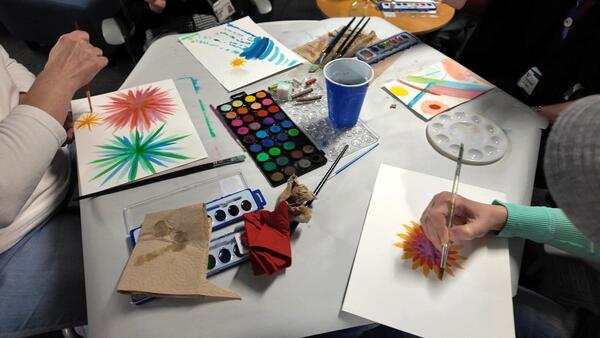
Activities include watercolor painting, needle felting, poetry through text deconstruction, zine making and singing workshops. One notable art project focused on the Duke chapel; students used watercolors to decorate a freely drawn image of the chapel.
Students bring a variety of skills and talent levels to the workshops, sometimes surprising the staff.
“It’s the students you think are the most clearly science-focused who are also just brilliant at expressing themselves creatively and supporting their classmates and colleagues at doing those things,” Gagliardi said.
Some of the events are cohosted by affinity organizations on campus; for instance, the Lunar New Year celebration was conducted in partnership with the Duke Med Chinese Association, which taught students paper cutting and shared treats like boba tea.
Events have been well received by everyone who’s participated, Gagliardi said, but having high attendance isn’t a goal. Rather, Gagliardi hopes such efforts show students that the school cares about their mental health and well-being.
“I wanted an outlet to be free and let my creativity flow,” said Carly Williams, a Ph.D. student in the department of biochemistry, according to a Duke Arts press release. “I remembered doing watercolors as a kid and loving it, so this seemed like the perfect art session for me. And it turned out to be a relaxing two hours of painting and good company.”
One of the benefits of the program is that it’s fairly low budget and easy to implement, Gagliardi said, allowing the school to pivot and be responsive to student interests as they arise.
Holistic support: In addition to art workshops, Gagliardi heads various well-being initiatives across the medical school to support students and staff.
“Finding ways to maintain your humanity while pursuing your rigorous study is important,” she said, particularly in a field like medicine, in which students learn about illness, recovery and death. “Equipping people with skills and strategies to deal with distress is important to maintain a functional ability to learn.”
Each week, she hosts Granola With Gagliardi, open hours for anyone to stop by, pick up a KIND bar and talk with her.
Duke Medicine also regularly collaborates with Medicine in Motion, hosting events like power yoga, running or pickleball tournaments to promote physical activity and well-being.
In the future, Gagliardi hopes to connect additional student groups with Wellness Wednesday events.
Do you have a wellness intervention that might help others promote student success? Tell us about it.
Every day, in articles, podcasts and social media, I learn about American higher education.
I learn that it aggressively stifles ideas that deviate from a narrow leftist orthodoxy. I learn that it privileges identity and politics over merit and knowledge.
I learn that it is rife with antisemitism while serving as a safe harbor for people of color and LGBTQ+ people. I learn that Harvard, Columbia and other Ivy League universities are the prominent tip of a higher education iceberg that threatens to destroy our culture and country.
If that is all I knew about American higher education, I would support tearing it down.
I would think that American higher education, in anything resembling its current form, cannot and should not be saved.
However, because I am a college president and have the opportunity to engage with students, faculty, staff and other college leaders every day, I think otherwise.
Every day, I see students from myriad backgrounds and with disparate beliefs flourishing because they interact with one another in class, in the dining hall, in student residences, on athletic teams and in clubs. I hear about students whose understanding of the world is being pushed and transformed by faculty who expose them to new perspectives and new information.
Every day I interact with students and alumni who are achieving their full potential because our college and our donors provide financial aid that caps student loans at $27,000 over four years, which is less than the average new car loan. Every day I am reminded that racism, sexism and transphobia have not been eliminated from our classrooms or our campuses—despite seeing daily evidence of our efforts to ensure that neither race, religion, nor any other identity confers advantages or disadvantages on our students, faculty and staff.
It is because I see what college is every day, and not just what occurs on rare days on some campuses, that I know that ongoing efforts to tear down higher education are a travesty for our children and our country.
It is why I know that the actions of those who are rarely on campus, and those who are focused on scoring political points, represent existential threats to America in what will continue to be a world in which knowledge and technology dominate.
Much of the past 80 years shows what happens when the United States chooses knowledge over ignorance and decides to invest in its young people. After World War II, the U.S. made it possible for veterans, and then women, people of color and lower-income students, to attend college, raising the quality of life for millions.
Our government partnered with universities to develop a research infrastructure that became the envy of the world. Innovations transformed lives and society. Diseases were cured. People lived longer and healthier lives.
So, what confronts us now is a decision that will determine what kind of lives our children and grandchildren have.
Are there too many colleges and universities at current prices? Are there some faculty who are intolerant of views that are inconsistent with their own? Would some college curricula benefit from more engagement with the real world?
Yes, yes and yes.
But will future generations thank us if we destroy the higher education system that took generations to build? Will they be better off if we judge every faculty member, administrator and student by the actions of those on the fringe, or by what we observe at a small number of colleges? Will they be better off if we shift control of scientific and intellectual innovations, course content and pedagogy from scholars to bureaucrats and politicians?
For the sake of future generations and our country, we must find ways to convene a national discussion on the future of higher education. What are we trying to accomplish as a country, what part does each college play in that collective goal and how can we ensure the system is effective? What is right for the country is not the sum of the paths colleges set for themselves. It is not what colleges individually decide while trying to avoid existential threats from protesters, activist donors or state and federal governments.
We must continue constructive engagement involving representatives from government, boards of trustees, college leadership, think tanks, student groups, the American Association of University Professors and other critical constituencies. The result must be a plan and action.
As a soon-to-be former college president and the father of a future college student, I look forward to continuing to be part of this fight in the years to come. Those who sacrificed to create our great country, and those who will be impacted by our actions in the future, deserve nothing less.
David R. Harris will step down in June after seven years as president of Union College in Schenectady, N.Y. He will join Harvard Graduate School of Education in the fall as a president in residence.
In reflecting on my feelings about the advent of artificial intelligence in our lives, I must report they are mixed. I have the strong sense of the inevitability that this technology will meet and exceed its hype to alter the course of humanity, generally for the better. However, at the same time there is a measure of trepidation in my awe of the potential power and performance of AI.
I am receiving more frequent emails from colleagues reporting renewed intransigence among faculty regarding the push to adapt to AI use by students, to integrate the technology into teaching and to help prepare learners for the AI-enhanced workplace. I see parallels to the 1990s and early 2000s, when faculty also resisted the advent of online and blended learning. That resistance gradually subsided until the pandemic, when remote learning, albeit a less refined use of the technology, came to the rescue of universities.
In both instances, the resistance seems to be prompted by a general lack of understanding and comfort with the technology. This creates an elevated level of anxiety. It also requires a change in pedagogy to adapt to expanded capabilities in the hands of students. This involves reconceiving and rewriting lesson plans and, in some cases, learning outcomes for multiple classes. This can be time-consuming. Yet, this is not the first time that emerging technology has impacted teaching modes and methods.
I am fortunate to remember, as a faculty member, the advent of the personal computer in the late 1970s, graphing calculators in the mid-1980s, the rise of the World Wide Web in the early 1990s, Google Search in 1998 and, in 2001, the launch of Wikipedia. Each one of these technologies demanded changes in the ways we presented and assessed learning. Questions of student integrity were raised in each of these cases. We also were urged to consider the students’ needs to become facile with these tools as they left to commence their careers. Imagine HR’s response to applicants who could not conduct an internet search or use a personal computer. The pressure was on to adapt to the emerging technologies while ensuring integrity.
Each of the technologies has become incrementally more sophisticated and more capable. They have required more and more attention by faculty to maintain a quality learning environment, and to prepare students for the rapidly changing workplace environment. In the case of AI, larger leaps in sophistication are coming on a weekly or monthly basis. The stakes are high. The integrity of the instruction, the relevance of the learning and the future employment of the students hang in the balance. The pressure is on the faculty to maintain quality and security in a rapidly changing environment.
Change in the AI field comes not on the rather pedestrian pace of new releases of the past, when we would see new versions released on annual schedules by just a handful of providers. Now, we must track 10 or 12 of the largest providers, as each of them releases new versions about every three or four months, or more often. Generative models still see improvements while agentic models offering awesome deep research and autonomous agents are flooding the market from around the world.
In a TED talk recorded last month in Vancouver, former Google CEO and chairman Eric Schmidt explained that, if anything, artificial intelligence is wildly underhyped, as near-constant breakthroughs give rise to systems capable of doing even the most complex tasks on their own. He points to the staggering opportunities, sobering challenges and urgent risks of AI. Schmidt asserts that everyone will need to engage with this technology in order to remain relevant. Meanwhile, in an interview this month, the current Alphabet/Google CEO, Sundar Pichai, on the All In podcast, affirms the commitment of the company to developing AI. He describes the evolution from Google search through AI, while it continues on the continuum of a discovery path of quantum computing and pursuing the concept of autonomous robots.
Just as Google is working to further develop and refine their multiple versions of AI, so too are many other major corporations and start-ups. What they come up with over the coming months and years will have a huge impact on higher education, the workplace, job market and society as a whole. The very nature of human jobs will change. Meanwhile, Elon Musk predicts smart robots will proliferate and will outnumber humans. His Optimus robots are to sell under the Tesla label, priced at $20,000 to $30,000. Of course, AI is central to the operation and functioning of such humanoid robots.
So, what might the workplace, or more specifically the individual human work assignment within that workplace, look like? In his recent podcast, Wes Roth reviews “The Age of the Agent Orchestrator” by OpenAI’s Shyamal Hitesh Anadkat. In the article, Anadkat describes the key new role that humans may play in the AI-enhanced workplace, noting that in the future “the scarce thing is no longer ‘who knows how to do that task by hand.’ The scarce thing becomes ‘who can orchestrate resources well’—compute, capital, access to data, and human/expert judgment.” That role he describes as the “agent orchestrator.” In sum, Anadkat writes,
“As always, the most important thing is to build something that users want. In a world where your marginal cost of expertise/knowledge goes to zero, your ability to turn cheap intelligence and expensive resources into valuable products is what will matter. i’m [sic] very excited to see the new companies, the new tools, and the new jobs that come out of this. Welcome to the Age of the Agent Orchestrator!”
The human will orchestrate what may be a very large number of highly capable intelligent AI agents. That may not seem as creative of a job as many of us now hold, such as authors, researchers, graphic designers, Web developers and the diversity of positions in designing and enhancing instructional resources. Yet, there is creativity, and certainly impact, in marshaling the vast resources at hand in the workplace of the future. Implicitly, the job becomes one of orchestrating abundant resources in conducting a symphony of interacting virtual workers to achieve desired goals. Doing so in the very best way calls upon higher-order creative thinking, strategic planning and execution.
All of these developments bring to mind the assertion of the pre-Socratic philosopher, Heraclitus, who is credited with saying 2,500 years ago, “The only constant is change.” We can expect much more change in the field of AI over the coming months and years. It will be far-reaching and long-lasting. It will penetrate the very essence of what it means to be a human in a technological society. We in higher education cannot ignore this change or make it stop simply because it is inconvenient or incompatible to our teaching style. The money, momentum and weight of advantages of AI make it an inevitable advance to civilization. It is not stoppable. We must change our practice to meet the needs of the students and society.
I am left with a less-than-easy feeling to welcome artificial intelligence with all of its sweeping ramifications into our work, lives and future. Yet, at the same time, I know that we must move forward to meet that future, if not so much for ourselves, but rather for our students who will live the greater part of their lives alongside their AI companions.
In the late 1960s, a gifted folk music composer and performer, Joni Mitchell, released an impactful song titled “Both Sides Now.” Within that song is a phrase that has stayed with me through the decades: “Well, something’s lost, but something’s gained in living every day.” I suppose it helps to sum up my feelings about this new technology that is rapidly gaining momentum and promising to change our learning systems, workplaces, lives, identities and society.