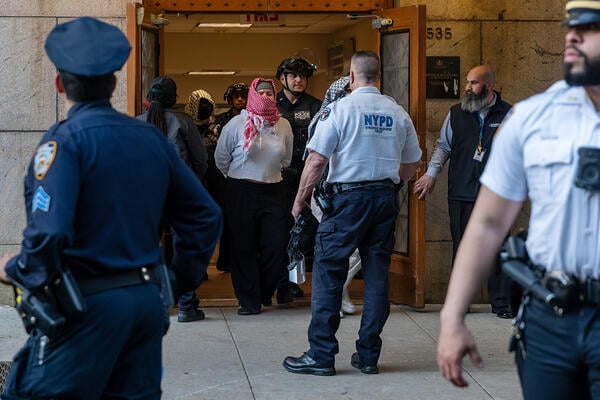
The Trump administration presented Harvard University with a letter Thursday outlining “immediate next steps” the institution must take in order to have a “continued financial relationship with the United States government,” The Boston Globe reported and Inside Higher Ed confirmed.
The ultimatum came just three days after the president’s Joint Task Force to Combat Anti-Semitism notified the university it had been placed under review for its alleged failure to protect Jewish students and faculty from discrimination. If the case follows the precedent set at other universities, Harvard and its affiliate medical institutions could lose up to $9 billion in federal grants and contracts if they do not comply.
Sources say the move is driven less by true concern about antisemitism on campus than by the government’s desire to abolish diversity efforts and hobble higher ed institutions it deems too “woke.” This week alone, the administration has retracted funds from Brown and Princeton Universities. Before that, it targeted the University of Pennsylvania and Columbia University and opened dozens of civil rights investigations at other colleges, all of which are ongoing.
Many of the task force’s demands for Harvard mirror those presented to Columbia last month, including mandates to reform antisemitism accountability programs on campus, ban masks for nonmedical purposes, review certain academic departments and reshape admissions policies. The main difference: Columbia’s letter targeted specific departments and programs, while Harvard’s was broader.
For example, while the letter received by Columbia called for one specific Middle Eastern studies department to be placed under receivership, Harvard’s letter called more generally for “oversight and accountability for biased programs [and departments] that fuel antisemitism.”
Inside Higher Ed requested a copy of the letter from Harvard, which declined to send it but confirmed that they had received it. Inside Higher Ed later received a copy from a different source.
Some higher education advocates speculate that the Trump administration’s latest demands were deliberately vague in the hopes that colleges will overcomply.
“What I’ve learned from various experiences with higher ed law is that it’s unusual to be general in legal documents,” said Jon Fansmith, senior vice president of government relations and national engagement for the American Council on Education. Trump’s “open-ended” letter “starts to look like a fishing expedition,” he added. “‘We want you to throw everything open to us so that we get to determine how you do this.’”
But conservative higher ed analysts believe the demands—even when broadened—are justified.
“Many of these are extremely reasonable—restricting demonstrations inside academic buildings, requiring participants and demonstrations to identify themselves when asked, committing to antidiscrimination policies, intellectual diversity and institutional neutrality,” said Preston Cooper, a senior fellow at the American Enterprise Institute.
Still, he raised questions about how certain mandates in the letter will be enforced.
“When you see this in the context of the federal government trying to use funding as a lever to force some of these reforms, that’s where one might raise some legitimate concern,” he said. “For instance, trying to ensure viewpoint diversity is a very laudable goal, but if the federal government is trying to … decide what constitutes viewpoint diversity, there is a case to be made that that is a violation of the First Amendment.”
The demands made of Harvard Thursday largely target the same aspects of higher ed that Trump has focused on since taking office in January.
Some center on pro-Palestinian protests, like the requirements to hold allegedly antisemitic programs accountable, reform discipline procedures and review all “antisemitic rule violations” since Oct. 7, 2023.
Others focus on enforcing Trump’s interpretation of the Supreme Court’s 2023 ruling on affirmative action; the university must make “durable” merit-based changes to its admissions and hiring practices and shut down all diversity, equity and inclusion programs, which the administration believes promote making “snap judgments about each other based on crude race and identity stereotypes.”
The letter was signed by the same three task force members who signed Columbia’s demand letter: Josh Gruenbaum, commissioner of the Federal Acquisition Service; Sean Keveney, acting general counsel for the Department of Health and Human Services; and Thomas Wheeler, acting general counsel for the Department of Education.
The most notable difference in Harvard’s letter is that the task force is demanding “full cooperation” with the U.S. Department of Homeland Security. That department and its Immigration and Customs Enforcement agency have been arresting and revoking visas from international students and scholars who, the government says, are supporting terrorist groups by participating in pro-Palestinian protests.
Harvard already appears to be taking steps to comply. On Wednesday, the university put a pro-Palestinian student group on probation. The week before, a dean removed two top leaders of the Center for Middle Eastern Studies, which has been accused of biased teaching about Israel.
A letter to the campus community from university president Alan Garber also suggested capitulation is likely.
“If this funding is stopped, it will halt life-saving research and imperil important scientific research and innovation,” Garber wrote following the task force’s review. “We will engage with members of the federal government’s task force to combat antisemitism.”
But Fansmith noted such actions may not be enough to predict whether Harvard will fully acquiesce to the Trump administration’s demands.
“If you look at all of these institutions over the last two years, they’ve been making a number of changes in policies, procedures, personnel and everything else,” he said. “And a lot of that was happening and was at pace before this administration took office and started sending letters.”
Harvard was one of the first three universities that the House Committee on Education and the Workforce grilled about antisemitism on campus in December 2023. Shortly after, then-president Claudine Gay—the first Black woman to lead Harvard—resigned. The university has since been working to make changes at the campus level.
Both Fansmith and Cooper pointed to Trump’s mandates regarding curriculum as the most likely to face opposition, as was the case at Columbia.
A little over a week after the Trump administration laid out its ultimatum, Columbia capitulated and agreed to all but one demand: The university refused to put its department of Middle Eastern studies into receivership, a form of academic probation that involves hiring an outside department chair. Instead, it placed the department under internal review and announced it would hire a new senior vice provost to oversee the academic program.
“You need to be making sure that Jewish students are not subject to harassment,” Cooper said. But “where that crosses the line is if the federal government is telling the universities … ‘this is how you have to appoint somebody to put an academic department into receivership,’ as was the original demand made of Columbia.”
Regardless of how Harvard responds, one thing seems likely: There are more funding freezes to come.
“A lot of folks were expecting Columbia to file a legal challenge, and when that didn’t happen, that might have emboldened the administration a bit to go after some of these other institutions,” Cooper said. But sooner than later, “one of these institutions might say, ‘We’re not going to make the reforms.’”
“I don’t have a great guess as to which institution that will be,” he added, “but I would expect we probably will see a lawsuit at some point.”

SAN DIEGO, CA — Community members will gather at the San Diego Civic Center Plaza for
a “Hands Off!” march on April 5 to protest DOGE and the Trump
administration’s attack on programs and services used by San Diego
residents. The local march will coincide with a nationwide day of
demonstrations expected to be attended by hundreds of thousands…
Organizers
describe the event as a collective response to policies impacting our
community. “San Diegans who are veterans, who are postal workers and
teachers, who rely on Social Security, Medicaid or Medicare, and who are
horrified at the Trump-Musk billionaire takeover of our government are
coming together to protest the Trump Administration’s attacks on the
rights and services they depend upon, many of them for survival” said
Angela Benson, a member of the organizing coalition.
Event Details:
What:
Over 10,000 San Diegans expected to peacefully demand “HANDS OFF!”
their rights and services in one of over 1,000 HANDS OFF! events
scheduled nationwide on April 5
Who: Coalition of San Diego Pro-Democracy Groups
When: Saturday, April 5, noon, 1 mile march to leave approximately 12:15 PM
Where: March starts at Civic Center Plaza Fountain by 1200 Third St., ends at Hall of Justice at 330 W Broadway
Transportation: Participants are encouraged to take public transit to the event
Planning group:
Change Begins With ME
CBFD Indivisible
Indivisible49
Indivisible North San Diego County
Democratic Club of Carlsbad and Oceanside
Encinitas and North Coast Democratic Club
SanDiego350
Swing Left/Take Action San Diego
Activist San Diego
50501 San Diego
Media Opportunities:
The following representatives will be available day-of the march for interviews.
If interested, please coordinate with Richard (770-653-6138) prior to
the event, and plan to arrive at the location marked below by 11:30 AM
Pacific
Representatives
Sara Jacobs – House of Representatives, CA-51 district
Scott Peters – House of Representatives, CA-50 district
Chris Ward – California State Assemblymember, 78 district
Stephen Whitburn – San Diego Councilmember
Reverend Madison Shockley II – Pilgrim United Church of Christ
Yusef Miller – Executive Director of North County Equity & Justice Coalition
Brigette Browning – Executive Secretary San Diego and Imperial Counties Labor Council and President, Unite Here!
Crystal Irving – President, Service Employees International Union (SEIU)
Andy Kopp – Veteran
Patrick Saunders – Veteran
Phil Petrie – SanDiego350, Climate Activist
Recommended Schedule
11:30 AM – 11:40 AM: Representative introductions – Group/cause they’re representing, why they’re marching
11:40 AM – 12:05 PM: Representatives break off, available for interview by Press
12:05 PM – 12:15 PM: Representatives move to beginning of march
12:15 PM: March begins
12:15 PM – 2:00 PM: March to Hall of Justice
2:00 PM: March ends at Hall of Justice, participants may disperse or continue to federal plaza

Queens College is one of The City University of New York’s 25 colleges. My daughter transferred from another school within the system yet despite mastering course material, she was told to take what was basically the same course all over again.
Fortunately, I understood the appeals process and was able to point her in the right direction. As a result, she obtained credit for the course, which counted toward her major. At the same time, reality struck: A student should not need to have an associate provost as a parent to transfer college credits. Frankly, they shouldn’t even need to appeal credits within the same system.
Nationally, the transfer system has been set up to let students fail for decades. On average, students lose a fifth of their credits when transferring to a four-year college, according to the U.S. Government Accountability Office. This leads to wasted tuition dollars and makes it more challenging to earn a bachelor’s degree. A 2023 report by the Community College Research Center found that only 16% of community college students earned a bachelor’s program within six years and just 10% of low-income students did.
As the largest public urban university system in the nation, CUNY had a real opportunity to make a change. In 2023, CUNY’s Board of Trustees charged the University’s leadership – including myself – to fix the transfer system.
CUNY has long been dedicated to eliminating the obstacles that result when a student transfers. In fact, the expectation that CUNY should provide a seamless ability to transfer between its constituent colleges dates to its formation as a centralized system in the 1960s.
Enshrined in New York state education law is the mandate for CUNY to “maintain its close articulation between senior and community college units.” Each year, up to 15,000 CUNY students – like my daughter – transfer between campuses, most commonly from a community college to a four-year college.
The purpose of an integrated university system is to offer an array of options for students which transfer seamlessly across all colleges. And over the years there have been efforts to achieve that at CUNY.
In 2013, the University implemented the Pathways initiative which established the seamless transfer of general education courses across its undergraduate colleges. There are also many individual articulation agreements between colleges. But such agreements, between a singular CUNY community college’s program and a corresponding bachelor’s level program at another college, could only go so far in addressing a systemic problem and sometimes result in credits transferring as blanket elective, which does not help a student make progress in their major. Truly universal transferability would require faculty buy-in and better digital tools.
And so, one of the first things I knew I needed to do was engage our University Faculty Senate, both out of respect for their role in our decision-making process as part of shared governance and to leverage their expertise. This would come to be one of the most important steps in making this effort successful.
As we engaged faculty in discussions about transfer, we shifted the focus from simply identifying equivalent courses to defining the essential competencies students must master in the first half of their major. Faculty across institutions readily reached consensus on the core knowledge and skills students needed to succeed in the second half of their program.
This competency-based approach then led to productive conversations about how specific courses developed these critical skills. Initially, the goal was to group courses into equivalent “blocks,” ensuring students could transfer seamlessly. In some cases, this process led faculty to align their individual courses more closely; others maintained course groupings but ensured consistency across institutions. Both approaches resulted in universal transfer pathways, guaranteeing students full credit toward their major at any receiving college.
At the same time, faculty helped us navigate practical roadblocks. For instance, we recognized that a universal approach could not always apply to programs leading to licensing exams— such as the CPA exam— where external accrediting bodies impose strict curricular requirements. While this nuance was clear to accounting faculty, it underscored for others the importance of discipline-specific constraints in shaping transfer policy.
Ultimately, this collaborative process ensured that transfer credit advances students’ progress toward degree completion rather than being lost as elective credit. Through collaboration, more than 300 courses, or blocks of courses, are now universally equivalent to each other across all colleges.
Starting in fall 2025, for over 75% of students transferring anywhere within the system, they will carry over most credits in their major. The University tackled the six most common transfer majors first – accounting, computer science, biology, math, psychology and sociology – ensuring credits transfer retroactively. We will work to align 100% of majors next.
The new system creates consistency on what students across CUNY campuses need to learn in the first half of their major and is expected to save students an average of $1,220 in wasted credits.
The CUNY Transfer Initiative extends beyond curricular alignment; it also involves evaluating the tools, policies, and practices that affect transfer student success. By reviewing policies, we identified gaps where new policies were needed and determined where existing policies required adjustments to better achieve their intended outcomes. We enhanced the CUNY Transfer Explorer (T-Rex), a tool that shows students how their credits transfer across the system, by adding leaderboards with key transfer metrics for each college and a feature that estimates how much of a degree would be completed at any CUNY school.
On January 21, the University automated a critical process in its student information system, known as CUNYfirst, ensuring admitted transfer students can immediately see how their credits apply at their new college. Previously, this was a manual, campus-specific process that required student advocacy and often caused delays. On its first day, the automation benefited 18,850 students, reducing stress and supporting informed academic decisions.
Fixing the transfer crisis will take continued effort.
To make sure that this system does not break again, we will be working with faculty to adjust how we develop the curriculum for new courses. This means we will now proactively consider how a potential new course will transfer across the CUNY system before it even exists. As the initiative grows, we will have 100% of credits in the first half of a major count towards a degree when students transfer from one of CUNY’s associate programs to the same major in a CUNY bachelor’s degree program.
The conversation is also continuing across the country. In 2023, the United States Department of Education hosted a summit of 200 higher education leaders on improving the transfer process. Then-U.S. Secretary of Education Dr. Miguel Cardona acknowledged that the current state of the college transfer system is broken, saying that it, “stacks the deck against community college students who aspire to earn four-year degrees.”
As part of my research when starting this effort, I reached out to my colleagues from colleges across the country to see what I could learn about what may work in improving outcomes for our transfer students. The collective response? “If you find a solution, please let us know.”
Everyone sees that the current state of our higher education system does a great disservice to students who transfer, presenting logistical and financial challenges that derail students who are otherwise dedicated to enhancing their education. While there is still work to be done, I am proud to say that we’ve truly begun to dismantle those barriers in an effort that I hope other public institutions of higher education will take inspiration from.
Dr. Alicia M. Alvero is the interim executive vice chancellor and university provost at The City University of New York. A professor of organizational behavior management for nearly two decades at CUNY’s Queens College, she also served as the college’s associate provost for academic and faculty affairs.

From the day he retook office, President Donald Trump’s campaign to disrupt higher education has been unrelenting. He’s targeted diversity, equity and inclusion. His administration slashed more than a billion dollars in federal grants and contracts for universities, and it plans to cut more. It’s also attempted to deport pro-Palestinian international scholars, accusing them of sympathizing with terrorism.
Prominent—or infamous—among the administration’s escalating actions was its decision last month to cut $400 million from Columbia University for allegedly failing to address on-campus antisemitism. Trump officials followed this by demanding that the university, among other things, place its Middle Eastern, South Asian and African Studies Department in academic receivership.
As the disruption has mounted, many college and university presidents have kept silent. But unions representing higher ed employees have stepped up to the plate. They’ve protested in Washington, D.C., and on their campuses, organized open letters and filed a flurry of lawsuits against the Trump administration. Union leaders say they are filling a void in an existential fight for higher ed’s future. They wish others would join their resistance, but their unified strength in numbers may protect their members from federal retaliation in ways that higher ed officials aren’t.
Concerns about higher ed’s future under Trump and calls for a forceful response to his actions pervaded a recent gathering on collective bargaining in higher ed. The conference—held in Manhattan just two days after Columbia announced it would capitulate to multiple demands the administration made—offered a snapshot into a large pocket of resistance.
We couldn’t actually be better positioned to fight back against the kind of authoritarian attacks that we’re seeing.”
—Ian Gavigan, national director of Higher Ed Labor United
William A. Herbert, executive director of the National Center for the Study of Collective Bargaining in Higher Education and the Professions, kicked off the event addressing what he has called the Trump administration’s “assault on higher education.”
“We gather today during a very perilous time. To paraphrase Tom Paine, these are the times that try our souls,” Herbert said, adding that “in this crisis, we must care for ourselves and others—particularly our students, our immigrants and others most vulnerable in this time of danger.”
He spoke to roughly 150 people gathered in the historic home of Franklin Delano Roosevelt. Invoking the wartime president’s Four Freedoms speech, Herbert said FDR’s listed freedoms—of speech and worship, and from want and fear—“are threatened more today than ever before. So it is our obligation to those who came before us to fight for freedom and to fight against tyranny.”
Rejecting nonintervention, Herbert said, “Neutrality in defense of higher education’s mission and the principles of collective bargaining is not an option. We must reject appeasement. We must reject capitulation to the enemies of higher education and collective negotiations.”
As the conference progressed last week, unions showed they weren’t capitulating. The American Association of University Professors, an organization of scholars that also represents many of them as a union, alongside the American Federation of Teachers, with which the AAUP is affiliated, filed together or individually three lawsuits against the Trump administration’s moves. These suits seek to stop the dismantling of the Education Department, end deportations of noncitizen students and faculty who demonstrated for Palestinians, and restore Columbia’s lost $400 million.
Even before last week, the AFT had sued the Education Department to stop it from enforcing a sweeping Dear Colleague letter targeting DEI, and together with the AAUP sued the department and Trump to overturn his anti-DEI executive orders. The AAUP and its partners did secure a temporary injunction blocking parts of the anti-DEI orders—an early victory—but an appeals court overturned that court order. (Other higher ed groups and unions have sued, but the AAUP and AFT are involved in multiple lawsuits that Inside Higher Ed is tracking.)
Atop the litigation, presidents and members of those unions and others—such as the United Autoworkers, a major organizer of graduate student workers—have rallied in Washington, D.C., against cuts to universities and federal research agencies. This week, the UAW joined other, nonunion organizations in suing to overturn the administration’s cancellations of National Institutes of Health grants.
Attempts at more national shows of force are coming. Across dozens of campuses, multiple unions are sponsoring a “Kill the Cuts” day of action on April 8, focused on reversing the NIH cuts and other federal funding reductions, followed by a more general protest April 17. It all adds up to campus unions taking a public stand where administrators largely haven’t.
“I think that labor needs to fill the vacuum of leadership we’re seeing in the sector,” said Todd Wolfson, national president of the AAUP. “I don’t see another way forward.”
Expecting powerful resistance from labor organizations might seem irrational in the U.S., where union membership among workers over all dropped to 10 percent in 2024—a record low since data collection began in 1983. But the picture is starkly different when you look at faculty and grad student workers alone.
Bucking the national trend, grad workers’ unionized ranks increased 133 percent from 2012 to the start of 2024. Roughly 38 percent of them are now unionized. That’s according to a report released last year by Herbert’s collective bargaining study center at Hunter College; Herbert said the share of unionized grad workers is even greater today, but he didn’t have an updated figure.
The number of unionized faculty also increased over that 12-year period, from roughly 374,000 in 2012 to 402,000 in January 2024. Roughly 27 percent of faculty are now unionized. And the Biden years saw a growing phenomenon of postdoctoral and undergraduate student workers unionizing. Trump has shaken up the National Labor Relations Board and experts predict a rollback in rights for union workers, but higher ed strikes are continuing into his administration in Massachusetts and California.
“We have more power now on our campuses than we’ve had in recent memory,” said Ian Gavigan, national director of Higher Ed Labor United, or HELU, and formerly a unionized grad worker himself. “And we couldn’t actually be better positioned to fight back against the kind of authoritarian attacks that we’re seeing.”
“I’m scared,” Gavigan said, but “that power gives me hope.”
The White House didn’t return Inside Higher Ed’s requests for comment.
HELU seeks to unify all types of higher ed workers—including nonacademic workers, and regardless of whether they’re unionized or not—into a single, national coalition. Gavigan spoke during a late-addition panel to the conference. (The whole conference was renamed, after Trump’s election, “Unity in Defense of Higher Education and Collective Bargaining.”)
Panelists and the audience discussed the Trump administration’s ongoing targeting of higher ed and how to respond.
“We are under absolutely relentless assault,” said Rebecca Givan, general vice president of the Rutgers University AAUP-AFT and a HELU steering committee member. “It’s constant, it’s everywhere, it’s in every direction, but it would be so much worse if we didn’t have our unions. And so we have these structures and we need to use them to fight back.”
Givan said that “none of us have been sleeping,” but “if we can’t organize within our unions to fight back, we have nothing.” She said unions have to work within state and federal politics and agencies, fighting for changes such as higher taxes on the rich to fund higher ed.
“We also have to give our university administrators a strong invitation to do the right thing,” Givan said. “And if they do not, we have to fill that leadership vacuum. We cannot let them back down. We cannot let them do a Columbia and capitulate.”
Some other higher ed groups beyond unions are resisting as well. The American Council on Education, which represents colleges and universities, has sued to stop the NIH from capping reimbursements for costs indirectly related to research. As for why many presidents aren’t publicly speaking up, Jon Fansmith, ACE’s senior vice president for government relations, told Inside Higher Ed that they have an “incredible tightrope to walk.”
“They are responsible for the jobs and livelihood of thousands—tens of thousands—of people in some cases,” Fansmith said.
They’re also responsible for the continuation of university work that includes treating patients and other important concerns. Speaking up could come at a price. Fansmith noted that the Trump administration froze about half of Princeton University’s federal grants after President Christopher Eisgruber wrote in The Atlantic that the “Trump administration’s recent attack on Columbia” represented “the greatest threat to American universities since the Red Scare of the 1950s.”
Wolfson, the AAUP president, told Inside Higher Ed that individual university presidents might not speak out because that puts targets on their backs. But there’s “no reason why we haven’t seen a letter signed by 1,000 presidents” speaking out against what the administration did to Columbia, Wolfson said.
“It’s a real disappointment,” he said, adding that “labor has to step in and be the main focal point of a strong, powerful and vigorous response to the federal government.”

Earlier this week, University of North Carolina professor and New York Times columnist Tressie McMillan Cottom remarked on BlueSky, “It’s so weird that we’re all working like this is just a normal country.”
Indeed, I have recently been struck repeatedly by the immediate juxtaposition of the banal, logistical work of being a freelance writer and speaker and the fact that the stuff I write and speak about—teaching, academia, et al.—are under concerted attack as part of a larger assault on democratic institutions, to the point where one wonders if they’re going to collapse entirely.
I’ve accepted speaking invites for six months from now wondering if we will still have operating higher education institutions six months from now. I mean, I think we will, but at this moment I wouldn’t 100 percent guarantee it, which is a strange thing to even consider given that some of these places are literally hundreds of years old.
I even just accepted an invitation to speak at a teachers’ conference in Alberta, Canada, in April 2026, and even as I signed the contract I wondered if we will still be able to travel freely between the U.S. and Canada by then.
It strikes me that part of the strategy of those currently committing these assaults on democracy is to create this kind of cognitive dissonance. Every day brings a new example of something we didn’t think could happen: disappearing people to foreign countries without even a semblance of due process, dismantling the federal infrastructure around cancer research, a president speculating about a third term and it being taken seriously as a question of legality.
That’s just this week, by the way.
The discordancy is probably greater for those working in or adjacent to higher ed, as the sector finds itself so directly in the Trump administration crosshairs. There is more not-normal in education than elsewhere right now, though the recently announced tariffs suggest that not normal is now going to be extended worldwide.
It strikes me that we are on one of two possible trajectories. One is essentially a slide into what scholars call competitive authoritarianism, where there are some external trappings of democratic society like courts and elections still existing, but where the fix is largely in as to who and what maintains power. Hungary and Turkey are the two most obvious examples that experts cite, but we’re seeing plenty of evidence for joining them right here at home.
The so-called Big Law firms that have capitulated to Trump and pledged to do hundreds of millions of dollars of legal work in exchange for being removed from the target list seem like examples of organizations that are making their bet that they can survive in a nondemocracy provided they’re willing to curry favor with power. Republican office holders seeking to carve out exceptions from Trump tariffs for their state’s industries are another example.
So too are the higher ed institutions, such as Columbia, bending the knee to Trump. They apparently view their continued existence—be that in a democratic society or something else—as more important than protecting values like academic freedom or the First Amendment. Noah Feldman, a Harvard Law professor who apparently is an expert on First Amendment law, sees these responses (as characterized by The New York Times) as “rational,” saying, “Sometimes people who are eager for the university to get up and make big statements have a slightly unrealistic conception of what the real-world effect of those statements would be.”
One of the upsides of the present turmoil—and it is a very small upside, I admit—is that folks are showing their true stances when it comes to the occasional fraught intersection of their purported values and material reality. Here is an esteemed First Amendment lawyer who is willing to countenance an unprecedented assault on academic freedom because the “real-world” consequences are apparently too great.
I have often lamented in this space how there has appeared to be a significant disconnect between the lofty ideals attached to higher education and how many higher education institutions act when they have a choice between living their mission or funding their operations. Feldman makes it clear which side of the divide he sits on, and he is not alone.
The other possible trajectory is that the sheer incompetence and erratic nature of Trump and those who surround him will lead to an unraveling of the assault as it implodes under the weight of public disapproval. The recent election results in Wisconsin and Florida, which showed a significant swing toward Democrats, suggest that if the public is activated and motivated, there is sufficient sentiment to defeat Trump and Republicans at the ballot box—provided we still have elections, that is.
Personally, I keep returning to the question I asked back in February: “What’s next for higher ed?” My argument that one era was over and another is to come has only been made stronger over the last month and a half. There is no going back for Columbia University. They have chosen to be something other than what they previously claimed to be. I’m certain Columbia will survive in some form, but we should not be asked to pretend that they are an example of the values we’d like to claim for higher education institutions.
Most days, I am both freaked out and hopeful, which is maybe my answer to Cottom’s musing about how we’re able to act like we’re living in a normal country. Part of the time I’m freaked out, certain that we are decidedly not a normal country and we are hurtling toward disaster.
But other times I am doing work that I think advances the values of free inquiry and personal freedom and development. I imagine going to some college or university six months from now, where we will talk about the importance of human expression through the act of writing, and then after that maybe I sit down to write a blog post, forcing myself to grapple with the world in front of me and make sense of it, even when, or especially when, it appears senseless.
Next thing you know, some thoughts have been gathered and you share them with the world.
When I first read the BlueSky post, I imagined that Cottom was thinking that we’re experiencing a disconnect or disassociation that allows us to deny the weirdness and even terror happening around us, but I think it’s the opposite.
I think it’s a sign that the work matters and that we must throw our continued support behind the leaders and institutions who are pledging to make the work that remains consistent with educational values possible. I don’t know how Feldman’s soft capitulation gets us there.
Bring me the fighters.

Florida Atlantic University reportedly has a pending agreement with the federal government to allow its campus police department to question and detain individuals who are suspected of being in the U.S. without legal authorization, The Florida Phoenix reported.
The public university located in Boca Raton is a Hispanic-serving institution.
If FAU police acquire immigration enforcement authority, the university would seemingly be the first in the nation to deputize campus cops as federal enforcement agents, the Phoenix noted.
However, it appears that all other Florida institutions with sworn police departments will follow FAU’s lead to comply with a February directive from Gov. Ron DeSantis requiring state law enforcement agencies to enter into an agreement “to execute functions of immigration enforcement within the state” so “deportations can be carried out more efficiently.”
“All state law enforcement agencies are expected to follow the governor’s Feb. 19 directive on working U.S. Immigration and Customs Enforcement,” FAU spokesperson Joshua Glanzer wrote to Inside Higher Ed. “This includes FAUPD and other state university police departments.”
The move comes after Florida Atlantic hired former GOP lawmaker Adam Hasner to be president in February. Hasner, who once boasted of being “the most partisan Republican in Tallahassee,” served in the Florida House of Representatives from 2002 to 2010. Prior to taking the top job at FAU, Hasner was an executive at the GEO Group, a for-profit prison company.
The GEO Group currently runs more than a dozen U.S. Immigration and Customs Enforcement detention centers in California, Florida, Texas and various other states, according to its website.
Hasner’s history with the GEO Group was a matter of contention for students and others during the hiring process; some raised objections during public forums about his for-profit prison past. Other critics expressed concerns about his lack of administrative experience in higher education.

The American Association of University Professors is warning college and university lawyers not to provide the U.S. Education Department’s Office for Civil Rights the names and nationalities of students or faculty involved in alleged Title VI violations.
The AAUP’s letter comes after The Washington Post reported last week that Education Department higher-ups directed OCR attorneys investigating universities’ responses to reports of antisemitism to “collect the names and nationalities of students who might have harassed Jewish students or faculty.” The department didn’t respond to Inside Higher Ed’s requests for comment Thursday.
In a 13-page Wednesday letter to college and university general counsels’ offices, four law professors serving as AAUP counsel wrote that higher education institutions “are under no legal compulsion to comply.” The AAUP counsel further urged them “not to comply, given the serious risks and harms of doing so”—noting that the Trump administration is revoking visas and detaining noncitizens over “students’ and faculty members’ speech and expressive activities.” The administration has targeted international students and other scholars suspected of participating in pro-Palestinian advocacy.
Title VI of the federal Civil Rights Act of 1964 prohibits discrimination based on, among other things, shared ancestry, which includes antisemitism. But the AAUP counsel wrote that “Title VI does not require higher education institutions to provide the personally identifiable information of individual students or faculty members so that the administration can carry out further deportations.”
And Title VI investigations, they wrote, “are not intended to determine whether the students and faculty who attend these schools have violated any civil rights laws, let alone discipline or punish students or faculty.” They wrote that investigations are instead “intended to determine whether the institution itself has discriminated.”
Providing this information to the federal government may violate the First Amendment rights of those targeted, plus the Family Educational Rights and Privacy Act and state laws, they wrote, adding that this information shouldn’t be turned over without “clear justification for the release of specific information related to a legitimate purpose in the context of a particular active investigation.”

After tussling over proposed legislation to allow community colleges to offer a bachelor’s of nursing degree, Los Angeles County’s 19 community colleges and the California State University system are working together to tackle local nursing shortages. The partnership, spearheaded by Compton College, may signal a new phase of cooperation between the two systems.
The Nursing 2035 Initiative aims to foster collaboration between community colleges, the CSU system and other stakeholders; conduct research; and devise strategies to graduate more registered nurses in the region over the next decade. The project also includes the Los Angeles Economic Development Corporation, the Department of Economic Opportunity with the County of Los Angeles and California Competes, an organization focused on higher ed and workforce development in the state.
Keith Curry, president of Compton College, said the need for more nurses in the region is dire. Lightcast, a labor market analytics firm, projected 6,454 job openings for registered nurses in Los Angeles County annually through 2035, but degree-completion data from 2023 shows local colleges only produced 5,363 graduates with relevant degrees that year.
Curry described a nearby medical clinic’s emergency room as “flooded” with patients at the same time aspiring nurses face barriers to entering the profession, such as vying for limited spots in nursing programs. Programs, meanwhile, struggle to grow because of challenges with retaining nursing faculty, who can find better wages working in hospitals, and competition for scarce clinical placements.
The goal is “really trying to address health disparities in the community I’m from, and nursing is just another one of those issues that we have to address,” Curry said.
The move comes after Gov. Gavin Newsom encouraged more CSU–community college partnerships on nursing last year after he vetoed two bills that would have allowed some community colleges to offer B.S.N. programs as part of a pilot program.
At the time, community college leaders argued that expanding their nursing offerings beyond associate degrees would make nursing education more affordable and combat nurse shortages in the state. But CSU leaders opposed the legislation, countering that the new programs would be duplicative and force the CSU’s existing programs to compete for resources, like clinical placements. (The two systems have also cyclically battled over community college baccalaureate degrees since the state allowed them a decade ago.)
Newsom came down on the CSUs’ side.
“All segments of higher education should continue to focus on building these programs together,” he wrote in one of his veto messages, “and I am concerned this bill could inadvertently undermine that collaboration.”
The initiative is an attempt to do just that, Curry said.
“It’s not us versus them,” he said. “It’s about how can we partner together to solve a problem. So, I felt that CSU has to be the table.”
Jose Fierro, president of Cerritos College and co-chair of the Los Angeles Regional Consortium, a coalition of L.A. County’s 19 colleges, said he and other community college leaders were “disappointed” by Newsom’s rejection of community college B.S.N. degrees because he felt like they would help his place-bound students. He said his campus is nine miles on average from local universities.
Students “may not be within driving distance because they would have to uproot their families, or because of the high cost of housing, they wouldn’t be able to move to a different city to be able to access these programs,” he said.
At the same time, he believes the collaborative approach will benefit students.
“We are bringing county representatives, hospital representatives, state officials, California State and community colleges to look at our programs and our shortage of nurses in a comprehensive manner,” to think about “how can we work together to meet the needs of the community?”
Some nursing partnerships between community colleges and CSUs already exist. For example, California State University, Northridge, has an A.D.N.-B.S.N. Community College Collaborative Program, which allows students earning nursing associate degrees at partnering community colleges to earn a B.S.N. on an accelerated timeline. A program at Cal State Long Beach also allows nursing associate degree students to take B.S.N. classes while in community college.
Nathan Evans, deputy vice chancellor for academic and student affairs and chief academic officer at the CSU Office of the Chancellor, believes the Nursing 2035 Initiative can serve as an example of how community college and CSU leaders can strategically confront local nursing shortages together.
“The boundaries of our institutions don’t have to be what they were in the past,” he said. “Our hope is that this is a model of what collaboration looks like between our segments and there’s a lot less friction in terms of the student experience, that there are clear road maps for students, particularly in the nursing field.”
As a first step, the group plans to research the region’s nursing education and workforce and release a report in the fall with policy and budget recommendations on how to expand nursing programs in the area. The goal is to work on the recommendations through 2035.
Evans said the initiative is “using data to really drive a needs assessment and then allow that to lead us to, what are the ways we collectively can respond?”
The hope is that process leads to new, innovative partnerships, said Fierro. For example, he can imagine CSUs offering B.S.N. programs on community college campuses, or partnering with community colleges on collaborative programs, so that students who struggle to commute to universities because of work or family obligations have more options.
“To me, the main objective is to ensure that we bring that value to the local communities,” he said, “regardless of whose name is issuing the diploma.”

Mark Carney’s whirlwind start as Canadian prime minister has seen his party surge in the polls against the backdrop of Donald Trump’s threats but has provided little time to flesh out the newcomer’s policies on higher education and science.
When Justin Trudeau announced his resignation in January, the Liberal Party was trailing the Conservatives by more than 20 percentage points and was only narrowly ahead of the New Democratic Party.
But since Trump started a trade war with what he has belittled as his “51st state,” the Liberals have rebounded remarkably in the polls and are now favorites to retain power in the snap election on April 28.
Although the federal government is the primary player when it comes to investments in research and innovation in Canada, higher education has seldom been a major issue in national elections, said Glen Jones, professor of higher education at the University of Toronto.
“Not surprisingly, the entire election is focusing on the trade war that has been initiated by President Trump,” he said.
“The Carney platform, at least to date, has largely been about providing support and stability to individuals and industries that will be directly impacted by tariffs.”
Carney has been focusing primarily on positioning himself as the leader best able to respond to the new, evolving relationship with the U.S.—a strategy that seems to be working, added Jones.
Conservative leader Pierre Poilievre’s echoes of Trump—and his promises to “defund wokeism and fight antisemitism” in universities—have been a disaster for his party since the start of the year, particularly when contrasted with Carney’s “elbows up” mantra.
Sarah Laframboise, executive director of Evidence for Democracy, a science policy nonprofit organization, said Carney’s background—as a former United Nations special envoy for climate action—suggests that he will remain committed to his views on climate policy, and that his pro-economic growth platform could translate into targeting investments in research, innovation and artificial intelligence.
“We will also likely see an increased focus on defense-related research, particularly around Arctic security and collaborative defense technologies. However, it remains unclear if this will extend to basic research,” said Laframboise.
“Additionally, his restrictive stance on international student admissions could have significant consequences for Canada’s higher education sector.”
It remained to be seen what impact accusations of plagiarism aimed at Carney dating from his time at the University of Oxford will have on the race.
Carney, who has never previously held elected office, earned a master’s degree and a doctorate in the U.K. before later going on to become governor of the Bank of England from 2013 to 2020.
Marc Johnson, professor of biology at Toronto’s Mississauga campus, said Trudeau made important investments in science funding during the last federal budget, but it was only a “partial investment that stanched the bleeding” from previous mistakes.
“The investment fell short of reinvigorating funding for science, tech and the innovation sector,” he said.
“If the Carney Liberals are elected to power, I think we can expect the previous government’s investment to stay … but will they double down on that investment?”
Having examined Carney’s website—which mentions artificial intelligence 11 times, innovation once and science not at all—Johnson said the prime minister’s priorities in future funding seemed fairly clear.
With either Carney or Poilievre in charge, he said the next government will have an “amazing opportunity” to invest in science, technology and innovation.
“Given the USA’s deep cuts to science funding, Canada has the opportunity to leap forward as a global leader in strategic areas, but only if we increase our investment in science, training, technology and mobilization of the innovations that come from these activities.”