The National Institutes of Health is deciding, per court agreements, whether to award or deny droves of grant applications that the agency previously either rejected or shelved. This funding was stalled last year amid the Trump administration’s blunt moves to restrict research into certain disfavored topics, such as diversity, equity and inclusion—though researchers and state attorneys general said officials shot down a greater range of projects, including ones that could save lives.
The NIH’s agreements, laid out in court filings in two ongoing lawsuits, are already bearing fruit. A spokesperson for the Massachusetts attorney general’s office, which is leading one of the cases, said the agreement in that suit promises decisions on more than 5,000 grants nationally. On Dec. 29, the date of the agreement, the NIH issued 528 grant decisions, 499 of which were approvals, the spokesperson said.
A spokesperson for the American Civil Liberties Union, which is leading the other case, said the agreement in that case involves about 400 grants. He said the NIH awarded at least 135 out of 146 applications in a batch of decisions on Dec. 29.
The filings set a series of dates by which the NIH agreed to decide on awarding or denying other types of grants. The last deadline is July 31.
The agreements are another example of the Trump administration reversing many of its sweeping cuts to research funding in response to litigation. Researchers and organizations filed suit after suit last year after the NIH and other federal funding agencies abruptly terminated previously awarded grants and sat on applications for new ones.
In a news release, the ACLU said the grants that the NIH will now decide on “address urgent public health issues, including HIV prevention, Alzheimer’s disease, LGBTQ+ health, and sexual violence.” ACLU of Massachusetts legal director Jessie Rossman said in the release that the NIH’s “unprecedented” and “unlawful” actions put “many scientists’ careers in limbo, including hundreds of members of the American Public Health Association and the UAW union.”
ACLU lawyers are among the attorneys representing those groups, Ibis Reproductive Health and individual researchers in a suit they filed in April against the NIH and the larger Health and Human Services Department for stalling and rejecting grant funding. Democratic state attorneys general filed a similar suit in the same court, the U.S. District Court of Massachusetts.
The agencies agreed to decide these grant applications in exchange for the plaintiffs dismissing some of their claims. The agencies didn’t admit wrongdoing.
In a news release, the Massachusetts attorney general’s office said the Trump administration “indefinitely withheld issuing final decisions on applications that had already received approval from the relevant review panels,” leaving the states that sued “awaiting decisions on billions of dollars.”
The release said that, for example, when the suit was filed in April, the University of Massachusetts “had 353 applications for NIH funding whose review had been delayed, signifying millions in potential grant funding that would aid in lifesaving medical research.” Massachusetts attorney general Andrea Joy Campbell said in a statement that “lifesaving studies related to Alzheimer’s disease, cancer, and other devastating illnesses were frozen indefinitely—stealing hope from countless families across the country and putting lives at risk.”
It’s unclear how much money the NIH may dole out in total. An HHS spokesperson told Inside Higher Ed that the “NIH cannot comment on the status of individual grant applications or deliberations.”
“The agency remains committed to supporting rigorous, evidence-based research that advances the health of all Americans,” the spokesperson said. HHS and the NIH didn’t provide interviews or further comment.
Meanwhile, a legal fight continues over grants that the NIH previously approved but later canceled.
Lingering Questions
In June, in these same two cases, U.S. District Judge William Young ordered the NIH to restore grants the agency had awarded but then—after Trump retook the White House—terminated midgrant.
Young, a Reagan appointee, criticized the federal government for not formally defining DEI, despite using that term to justify terminating grants. He said at a hearing that he’d “never seen racial discrimination by the government like this” during his four decades as a federal judge.
But, two months later, the U.S. Supreme Court, in a 5-to-4 preliminary decision, stayed Young’s ruling ordering restoration of the grants. Justice Amy Coney Barrett, a Trump appointee, wrote for the majority that Young “likely lacked jurisdiction to hear challenges to the grant terminations, which belong in the Court of Federal Claims.” However, STAT reported that the NIH had restored more than 2,000 terminated grants following Young’s ruling, and it didn’t reverse course after the Supreme Court decision.
That question of whether researchers with canceled grants must ultimately try their luck before the Court of Federal Claims is now before the U.S. First Circuit Court of Appeals. There’s a hearing Tuesday in that matter.
Questions linger about when the grant fight will really end. In a video interview with journalist Paul Thacker—released Wednesday and previously reported on by STAT—NIH director Jay Bhattacharya said that, despite the grant restorations, any grants dealing with DEI that come up for renewal this year won’t be funded. Bhattacharya distinguished between cutting a grant and not renewing it.
He said that, “as best I can understand the legal aspects,” the courts have said his agency can’t cut restored grants. “But, when it comes to renewal, those grants no longer meet NIH priorities … so when they come up for renewal over the course of the year, we won’t renew them,” he said.
Bhattacharya said the NIH’s DEI-related work “did not actually have any chance of improving the health of minority populations.” He said, “I think that the shift away from DEI is of a piece with the rest of what we’re trying to do at the NIH, which is to do research that actually makes the lives of people better.”
Nearly nine years later, that confidence has collapsed.
A comprehensive review of publicly available data, investigative journalism, court records, and government reports shows that 17 of the Higher Education Inquirer’s 18 predictions—94.4 percent—have been fully or partially confirmed. What was once framed as speculation now reads as an early diagnosis of a system already in advanced decline.
This article is not a victory lap. It is an accounting—of warnings ignored, of structural failures compounded, and of a higher education system reshaped less by learning than by debt, austerity, and financial engineering.
The Growth of Student Debt
In 2016, total student loan debt stood at approximately $1.4 trillion. By 2025, it had surpassed $1.8 trillion, despite repeated claims that the crisis was stabilizing. Millions of borrowers cycled in and out of forbearance, delinquency, and default, often unaware of the long-term consequences of capitalization, interest accrual, and damaged credit.
Temporary relief programs—pandemic pauses, income-driven repayment plans, and selective forgiveness—offered short-term breathing room while failing to address the underlying cost structure of higher education. Legal challenges and administrative reversals further destabilized borrower expectations, reinforcing the sense that student debt had become a permanent feature of American life rather than a transitional burden.
The Higher Education Inquirer warned in 2016 that student loans would increasingly function as a disciplinary mechanism, constraining career choice, delaying family formation, and suppressing economic mobility. That warning has proven prescient.
Graduate Underemployment and the Erosion of the Degree Premium
Another core prediction concerned the labor market. While headline unemployment numbers often appeared strong, the quality of employment deteriorated. By the early 2020s, a majority of recent four-year college graduates were underemployed—working in jobs that did not require a degree or offered limited advancement.
Wages stagnated even as credential requirements rose. Employers demanded more education for the same roles, while offering less stability in return. The result was a generation of graduates caught between rising expectations and diminishing returns.
This shift exposed a contradiction at the heart of the modern university: institutions continued to market degrees as pathways to prosperity, even as internal data increasingly showed that outcomes varied dramatically by institution, major, race, and class.
Enrollment Decline and the Demographic Cliff
The enrollment downturn predicted in 2016 arrived in waves. First came post–Great Recession skepticism. Then demographic decline reduced the number of traditional college-age students. Finally, the pandemic accelerated distrust, remote learning fatigue, and financial strain.
By the mid-2020s, enrollment losses were no longer cyclical. They were structural.
Colleges responded not by rethinking pricing or mission, but by cutting costs. Programs were eliminated, faculty positions left unfilled, and student services hollowed out. In rural and working-class regions, entire communities lost anchor institutions that had served as employers, cultural centers, and pathways to upward mobility.
Institutional Debt, Financialization, and Risk Shifting
One of the most underreported developments has been the rise of institutional debt. Facing declining tuition revenue, many colleges turned to bond markets to finance operations, capital projects, or refinancing. This strategy delayed collapse but increased long-term vulnerability.
The Higher Education Inquirer warned that debt-financed survival strategies would transfer risk downward—onto students through higher tuition, onto staff through layoffs, and onto local governments when institutions failed. That pattern has repeated itself across the country.
Meanwhile, elite universities with massive endowments continued to expand, insulate themselves from risk, and benefit from tax advantages unavailable to less wealthy institutions.
Closures, Mergers, and Asset Stripping
Since 2016, well over one hundred colleges have closed, merged, or been absorbed. Many closures were preceded by years of warning signs: declining enrollment, deferred maintenance, accreditation scrutiny, and emergency fundraising campaigns.
In some cases, institutions sold land, buildings, or entire campuses to survive. In others, boards pursued mergers that preserved branding while eliminating local governance and jobs.
These were not isolated failures. They were the predictable outcome of a system that prioritized growth, prestige, and financial metrics over resilience and public accountability.
The Limits of Reform and the Failure of Oversight
Perhaps the most sobering confirmation of the 2016 analysis is not any single data point, but the broader failure of reform. Despite abundant evidence of harm, regulatory responses remained fragmented and reactive. Accreditation agencies rarely intervened early. Federal enforcement was inconsistent. Media coverage often framed crises as unfortunate anomalies rather than systemic outcomes.
The Higher Education Inquirer argued in 2016 that the greatest risk was not collapse itself, but normalization—the slow acceptance of dysfunction as inevitable. That normalization is now visible in policy debates that treat mass underemployment, lifelong debt, and institutional instability as the cost of doing business.
A Crisis Foretold
The U.S. college meltdown did not arrive as a single dramatic event. It unfolded slowly, unevenly, and predictably—through spreadsheets, bond prospectuses, enrollment dashboards, and borrower accounts.
The accuracy of these forecasts underscores a deeper truth: the crisis was foreseeable. It was documented. It was warned about. What was missing was the willingness to act.
The Higher Education Inquirer published its predictions in 2016 not to provoke fear, but to provoke accountability. Nine years later, the record is clear. The meltdown was not an accident. It was a choice—made repeatedly, by institutions and policymakers who believed the system could absorb unlimited strain.
It could not.
Sources
LendingTree; EducationData; Inside Higher Ed; Higher Ed Dive; Forbes; NPR; Brookings Institution; National Bureau of Economic Research (NBER)
Higher education is entering a new era defined by proactive, intelligent digital helpers. Tech leaders such as Marc Benioff and Sam Altman have described 2025 as a pivotal year for AI agents, as colleges shift from basic chatbots to more advanced, autonomous AI systems. AI agents are not just tools; they are digital partners designed to support the entire student lifecycle.
AI agents are transforming how colleges recruit, support, and engage learners. Unlike static chatbots, these systems analyze context, adapt over time, and take initiative. Their capabilities include automating application nudges, answering complex questions, and supporting academic success. This marks a major technological leap for institutions aiming to do more with fewer resources.
In this article, we’ll define what AI agents are, explain how they differ from traditional digital assistants, and explore the growing role of agentic AI in higher education. We’ll also highlight practical benefits and examine why 2025 is a turning point for adoption.
Are you prepared for the next evolution of enrollment and student support?
What Is an AI Agent in Higher Education?
In higher education, an AI agent is a software-based digital colleague designed to carry out tasks and make decisions autonomously, much like a human team member. Unlike traditional rule-based chatbots or static analytics dashboards, AI agents are dynamic, context-aware, and capable of proactive engagement. They anticipate needs, analyze data, and take meaningful action without waiting for human prompts.
Key Capabilities of AI Agents in Higher Ed:
Real-Time Data Analysis: AI agents continuously ingest data from various systems, such as student information systems (SIS), learning management systems (LMS), and CRMs, and analyze it instantly. For example, if a student hasn’t logged into their course portal in over a week, the agent can flag this as a concern before a human staff member might even notice.
Complex Reasoning: While a basic chatbot might reply, “You missed your payment deadline,” an AI agent can infer that the student might be facing financial hardship. It reasons through that context and may recommend financial aid outreach or support services.
Proactive Action: Rather than waiting for a student to reach out, an AI agent can send reminders, book appointments, or trigger alerts based on predefined conditions and patterns it observes. This proactive behavior is one of the defining features that separates agents from other digital tools.
Human Collaboration: AI agents are not replacements for staff but digital teammates. They handle repetitive and data-heavy tasks, freeing up staff to focus on complex, high-touch interactions like one-on-one advising or sensitive student concerns.
Imagine a first-year student named Alex who begins missing classes and deadlines. An AI agent, let’s call it “Corey,” detects these signs, reviews Alex’s recent activity, and notices additional indicators such as a missed financial aid deadline and a recent visit to the counseling center. Corey logs this information and acts.
Corey sends Alex a supportive message suggesting tutoring and financial aid options, recommends an advising appointment, and even books a time. It also notifies the academic advisor and shares a detailed context summary, ensuring a more informed, empathetic meeting. Behind the scenes, the agent identifies other at-risk students based on similar patterns and launches personalized interventions.
This example illustrates the power of agentic AI in higher education in managing complex student workflows with speed, precision, and care. From recruitment and enrollment to retention and autonomous student support, AI agents are redefining digital service delivery across higher education.
AI Agents vs. Chatbots: How Are They Different?
As colleges explore digital tools to improve student support and enrollment outcomes, it’s critical to understand the difference between AI agents and traditional chatbots. While the two terms are sometimes used interchangeably, their capabilities and strategic value are markedly different.
Reactive vs. Proactive
Chatbots are reactive tools. They wait for a student to initiate a question and respond with a scripted answer, often drawn from an FAQ database. Their usefulness is limited to straightforward interactions like, “What’s the application deadline?” AI agents, by contrast, are proactive.
They can detect when something needs attention, such as a missing transcript or a disengaged student, and initiate outreach or action without being prompted.
Scripted Responses vs. Intelligent Actions
Chatbots operate within a narrow script. If a question falls outside their programmed flow, they may fail to respond meaningfully. AI agents go further. They are autonomous systems capable of analyzing context, making decisions, and completing tasks.
For example, if a student asks about uploading a transcript, a chatbot might share a link. An AI agent would identify the missing document, send a personalized reminder, check for completion, and escalate if necessary, driving the outcome rather than just responding.
Single-Channel vs. Omnichannel Engagement
Chatbots often live on a single webpage and lack memory of past conversations. AI agents work across platforms, web chat, SMS, email, and student portals, and retain context across all interactions. They recognize students, recall prior discussions, and tailor communications accordingly, enabling more seamless and personalized support.
FAQ Support vs. Lifecycle Engagement
Chatbots help with quick answers, but AI agents support multi-step processes and lifecycle touchpoints. In admissions, for instance, a chatbot might handle inquiries, but an AI agent can follow up on incomplete applications, suggest resources, and nurture leads through enrollment. In student services, chatbots may share library hours, while AI agents detect academic disengagement and initiate support outreach.
In short, chatbots answer questions. AI agents drive outcomes. As one expert noted, chatbots are like automated help desks, while AI agents function as full digital assistants embedded in institutional workflows. In an era of rising service expectations and limited staff capacity, this distinction matters more than ever. Institutions that embrace AI agents gain a powerful ally in delivering timely, personalized, and outcome-driven student experiences.
How Do AI Agents Benefit Colleges and Students?
The excitement around AI agents in higher education isn’t just about cool technology. It’s about solving real problems and creating tangible improvements for both institutions and learners. Here are some of the major benefits AI agents offer:
AI agents provide around-the-clock assistance, giving every student a digital personal assistant. Whether it’s midnight before an assignment is due or a weekend deadline looms, students can get timely help. More importantly, the support becomes proactive. For example, Georgia State University’s “Pounce” chatbot texts reminders to new students about critical steps like completing financial aid.
The result? Summer loss dropped from 19% to 9%, meaning hundreds more students showed up in the fall. Multiple surveys indicate that a significant share of students feel AI-powered tools help them learn more effectively, often citing faster access to personalized support.
2. Increased Efficiency and Staff Augmentation
AI agents act as force multipliers for campus teams. They handle thousands of repetitive inquiries, freeing staff for high-value work. Maryville University’s AI assistant “Max” answers thousands of student questions each month, resolving the majority without the need for human intervention.
Some institutions report up to 75% time savings on routine tasks. Agents send deadline reminders, track document submissions, and streamline follow-ups. This eases staff workload and ensures faster responses for students.
3. Improved Outcomes (Enrollment, Retention, and Success)
AI agents improve key metrics. Integrated AI systems have been linked to measurable gains in student engagement and retention, particularly when used to support proactive outreach and early intervention.
At Bethel University, a chatbot named “Riley” helps identify and guide prospective students to relevant resources, reducing the risk of drop-off. Since every 1% yield increase can represent hundreds of thousands in tuition revenue, tools that drive application completion and enrollment are essential.
4. Consistency, Accuracy, and Scalability
AI agents help deliver more consistent and accurate information across student-facing touchpoints. Unlike human staff who may interpret rules differently, agents follow uniform protocols. They scale effortlessly during peak periods.
When the University of Pretoria launched its chatbot, it handled 30,000+ queries in just months, easing pressure on staff and speeding up student responses. In crises or transitions, agents can quickly disseminate accurate updates to thousands.
5. More Engaging and Proactive Student Experience
AI agents make engagement feel more personalized. They nudge students with reminders and timely suggestions, reducing anxiety. For instance, an agent might prompt early tutoring or check in on disengaged students.
Nearly 48% of students report that chatbots improve their academic performance. For routine questions, many prefer AI over navigating office bureaucracy.
6. Addressing Staff Challenges and Burnout
With high student-to-staff ratios, burnout is common. AI agents ease this by managing low-level tasks, allowing staff to focus on complex support. Georgia Tech’s AI teaching assistant “Jill Watson” answered student questions so effectively that many didn’t realize she wasn’t human. The result was higher satisfaction and improved grades. Faculty benefit from fewer repetitive queries and more time for meaningful instruction.
7. Data-Driven Decision Making
AI agents generate actionable insights. For example, if hundreds of students ask how to change majors, administrators might simplify that process. Rising mental health-related queries might justify expanding counseling services. These agents serve students individually and help institutions see patterns and improve policies.
AI agents are not about replacing human support. Instead, they enhance it. They handle scale, speed, and consistency, while humans deliver empathy, strategy, and complex care. In the ideal model, AI handles the routine so people can focus on relationships, creating a stronger, more responsive higher education experience for all.
Why 2025 Is Called “The Year of the AI Agent”
AI in higher education is not new. Predictive analytics, early chatbots, and automated workflows have existed on campuses for years. So Why is 2025 considered the “Year of the AI Agent”?
The answer lies in a rare convergence of technological maturity, institutional urgency, and cultural readiness. Together, these forces have pushed AI agents out of experimentation and into real, scalable deployment across higher education.
From Generative AI Hype to Agentic Execution
The last few years have delivered dramatic advances in generative AI, particularly large language models capable of human-like reasoning and communication. By late 2024, however, many institutions were still grappling with a familiar challenge: impressive technology without clear operational value.
That changed as agentic AI frameworks emerged. Unlike standalone chatbots, AI agents can reason across systems, make decisions, and take action autonomously. By 2025, the standards, tooling, and governance models needed to deploy these agents had largely solidified. Technology leaders across industries began openly describing 2025 as the moment when AI moves from novelty to infrastructure, and higher education followed suit.
A Shift From Reactive to Proactive Campus Systems
Perhaps the most profound change is philosophical. Traditional campus technologies are reactive: staff respond to dashboards, alerts, or student inquiries after problems arise. AI agents invert that model.
In 2025, institutions are deploying systems that continuously monitor behavior, detect risk signals, and intervene before issues escalate. Instead of waiting for a student to ask for help, AI agents can proactively reach out with reminders, resources, or guidance. This shift, from responding to problems to preventing them, marks a fundamental evolution in how universities support students.
A Mature Ecosystem Ready for Scale
Another reason 2025 stands out is ecosystem readiness. Major CRM and LMS platforms now support AI agent integrations, while many universities have already launched institution-wide AI environments that allow teams to build custom tools safely and responsibly.
Equally important, AI literacy has improved dramatically. Faculty, administrators, and students now have a shared baseline understanding of AI, reducing resistance and accelerating adoption. The organizational “soil,” in other words, is finally fertile.
Urgency in a Challenging Higher Ed Landscape
The broader context cannot be ignored. Enrollment pressure, budget constraints, staffing shortages, and growing student support needs have created an acute demand for scalable solutions. AI agents offer a compelling return on investment: automating routine tasks, extending staff capacity, and directly supporting recruitment, retention, and student success.
Early results have reinforced this case, demonstrating that modest investments can yield outsized operational and experiential gains.
Momentum and Institutional Confidence
Finally, momentum matters. As respected associations, peer institutions, and sector leaders publicly endorse AI adoption, hesitation gives way to action. The conversation has shifted decisively, from “Should we use AI?” to “How do we implement it effectively and responsibly?”
Taken together, these forces explain why 2025 feels different. This is the year of AI execution in higher education. Agentic AI has moved from concept to practice, and institutions embracing it now are redefining what responsive, student-centered operations look like in the modern university.
Real-World Examples of AI Agents in Higher Ed
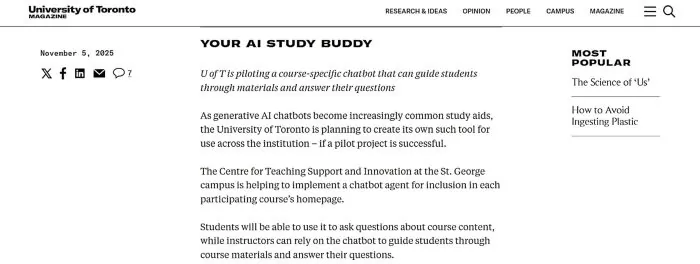
University of Toronto (Canada): U of T is integrating AI agents into autonomous student support and advising. A university-wide task force recommended deploying AI tools in these areas, and a pilot program is underway for a course-specific AI chatbot that lives on course websites. This “virtual tutor” agent can answer students’ questions about class materials and guide them through content.
Unlike public chatbots, U of T’s version runs on a secure platform with course-specific knowledge, protecting instructors’ content and student privacy. If successful, the AI tutor will be rolled out across the institution to enhance how students receive academic help outside of class.
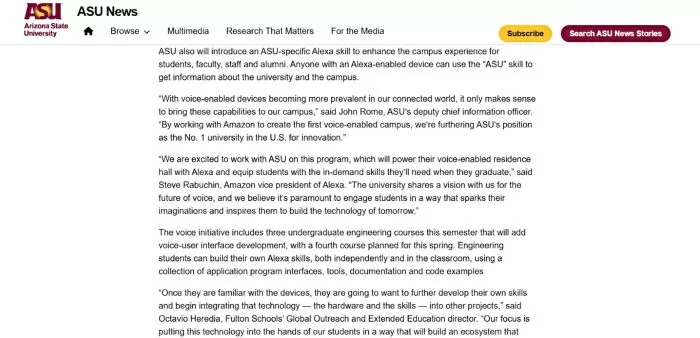
Arizona State University (USA): ASU has implemented AI-powered digital assistants – including a voice-activated campus chatbot through Amazon’s Alexa. In a first-of-its-kind program, ASU provided Echo Dot smart speakers to students in a high-tech dorm and launched an “ASU” Alexa skill that anyone can use to get campus information.
Students can ask the voice assistant about dining hall menus, library hours, campus events, and more. This AI agent offers on-demand answers via natural conversation, extending student engagement and support to a hands-free, 24/7 format.
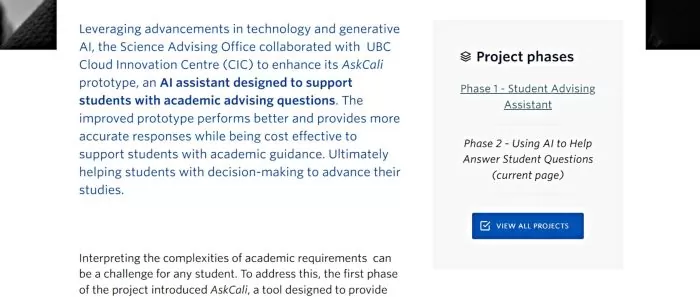
University of British Columbia (Canada): UBC is leveraging AI agents to enhance advising and student services. For example, the Faculty of Science piloted “AskCali,” an AI academic advising assistant that uses generative AI to answer students’ questions about course requirements and program planning at any time of day.
AskCali draws on UBC’s academic calendar and official documents to provide accurate, personalized guidance, helping students navigate complex requirements. UBC’s Okanagan campus has also deployed chatbots for departments like IT help and student services, reportedly handling the vast majority of routine inquiries and dramatically reducing wait times.
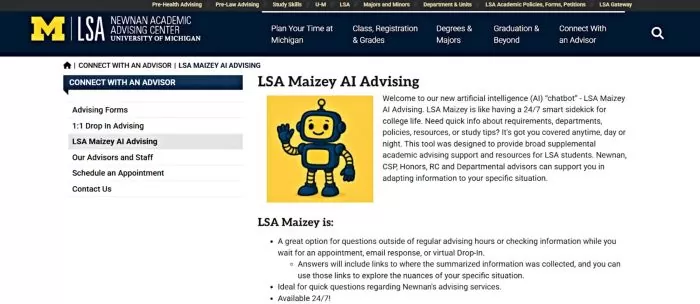
University of Michigan (USA): U–M has rolled out AI-driven assistants to support students in academics and campus life. Notably, the College of Literature, Science, and Arts introduced “LSA Maizey,” a 24/7 AI advising chatbot described as a “smart sidekick for college life.” Maizey answers questions about degree requirements, academic policies, registration, study strategies, and more – anytime, day or night. It provides links to official information and helps students find advising info outside of business hours.
This AI agent augments U–M’s human advisors by handling common queries and pointing students to the right resources instantly. (U–M has also developed a campus-wide assistant called “MiMaizey” for general questions like dining, events, and wayfinding, further personalizing the student experience)
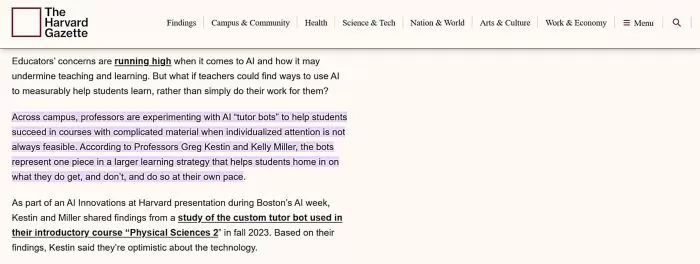
Harvard University (USA): Harvard is experimenting with autonomous AI tutors and assistants to improve learning and advising. In one pilot, Harvard faculty built a custom AI “tutor bot” for an introductory science course that allows students to get immediate help with difficult concepts outside of class.
Students could ask this bot unlimited questions at their own pace, without fear of judgment, and a study found it improved engagement and motivation in the course. Harvard’s IT department has also launched AI chat assistants (nicknamed “HUbot” and “PingPong”) to aid students with tech or academic questions, and Harvard Business School tested an AI teaching assistant in a finance course.
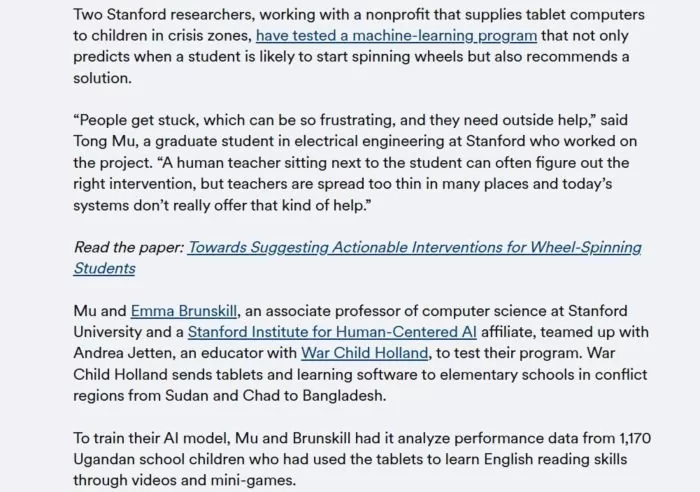
Stanford University (USA): Stanford has been a leader in using AI agents to support students academically. One example is a Stanford-developed AI system that monitors online learning platforms to detect when a student is struggling. Researchers created a machine-learning agent that predicts when a student will start “wheel-spinning” (getting stuck repeatedly on practice problems) and recommends targeted interventions to help the student overcome the obstacle.
Essentially, the AI acts like an autonomous tutor/coach in self-paced digital courses, flagging at-risk students and suggesting that instructors or the system intervene (for example, by reviewing an earlier concept). Beyond this, Stanford has trialed AI chatbots as virtual TAs in large classes (answering common questions on course forums) and used data-driven AI models to alert advisors about students who may need support.
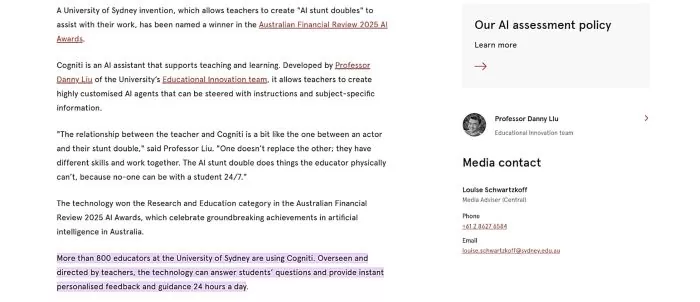
University of Sydney (Australia): The University of Sydney developed “Cogniti,” an AI platform that serves as an “AI stunt double” for instructors, essentially allowing teachers to clone their expertise into custom AI agents for their courses. More than 800 Sydney faculty are already using Cogniti to support their teaching.
These AI agents (designed by the educators themselves) can answer student questions, provide instant feedback on practice exercises, and offer guidance 24/7, in alignment with the instructor’s curriculum and guidelines.
For example, a speech pathology class uses a Cogniti bot that role-plays as a patient’s parent to help students practice clinical conversations. Cogniti won a national award for innovation, and it’s given students at Sydney access to personalized help at all hours – while letting instructors remain in control of the AI’s scope and knowledge.
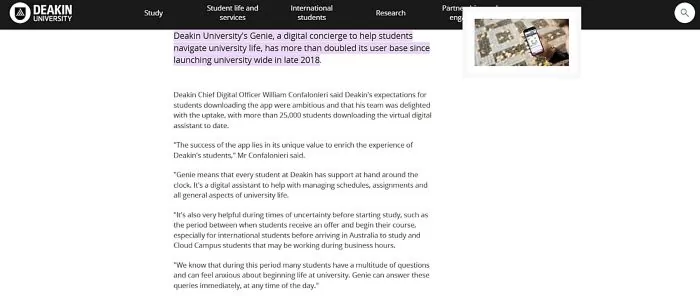
Deakin University (Australia): Deakin Genie is a pioneering digital assistant that has been serving Deakin students since late 2018. Branded as a “digital concierge,” Genie lives in the Deakin University mobile app and uses AI (natural-language processing with voice and text) to help students navigate university life. It can answer thousands of common questions (“When is my assignment due?”, “Where is the library?”), manage personal schedules and reminders, and even proactively prompt students to study or register for classes.
Genie’s rollout was phased; it started with pilot groups and went university-wide in 2018. Within the first year, its user base more than doubled, reaching over 25,000 student downloads by 2019. At peak times (such as the start of term), Genie handles up to 12,000 conversations per day, a volume equivalent to Deakin’s call center traffic. Top queries center on first-year needs: class timetables, assignment details, finding unit (course) resources, and key dates. The Genie team closely monitors performance and tracks whether Genie’s answers resolve the question or if a human staff follow-up is needed, continually updating Genie’s knowledge base and dialog flow.
This iterative improvement has paid off in high student satisfaction; many students treat Genie like a supportive “friend” always on hand. Genie is also context-aware: it knows who the student is (program, year, campus) and personalizes responses (“Your next class is…”, “Your assignment 2 is due next Monday”).
As AI agents gain traction across higher education, one point deserves emphasis: their value lies not in replacing people, but in working alongside them. The most successful institutions view AI agents as tools that extend human capacity rather than diminish it.
The goal is a blended workforce in which routine, data-heavy tasks are automated, freeing faculty and staff to focus on what humans do best: empathy, judgment, creativity, and mentorship.
In practice, this collaboration is already taking shape across campus operations. Admissions offices are using AI agents to track application completeness and communicate with prospective students, while human counselors retain responsibility for final decisions and nuanced conversations.
Advising teams rely on agents to monitor engagement data and flag potential risks, but the advising itself remains a human-centered interaction and is strengthened by better insight and preparation rather than automated away.
This shift also requires a cultural adjustment. Institutions leading the way are investing in AI literacy and professional development to help staff understand how these tools work and how they can be applied responsibly. When employees are empowered to experiment and contribute ideas, AI adoption becomes collaborative rather than imposed, encouraging innovation from the ground up.
From Experimentation to Organizational Advantage
Human oversight remains essential to responsible AI deployment. AI agents operate most effectively within clear governance frameworks that prioritize data privacy, institutional policy alignment, and human oversight. For high-impact decisions, such as academic standing, financial aid determinations, or student well-being, humans stay firmly in the loop. The agent may analyze data or draft recommendations, but people make the final call.
Importantly, AI agents can actually strengthen the human touch. By helping staff prioritize outreach and monitor large student populations, they reduce the likelihood that students fall through the cracks. The result is a campus environment that is more responsive, more personalized, and ultimately more humane, where technology supports, rather than replaces, meaningful human connection.
Are you prepared for the next evolution of enrollment and student support?
Frequently Asked Questions
Question: What is an AI agent in higher education?
Answer: In higher education, an AI agent is a software-based digital colleague designed to carry out tasks and make decisions autonomously, much like a human team member. Unlike traditional rule-based chatbots or static analytics dashboards, AI agents are dynamic, context-aware, and capable of proactive engagement. They anticipate needs, analyze data, and take meaningful action without waiting for human prompts.
Question: How do AI agents benefit colleges and students?
Answer: The excitement around AI agents in higher education isn’t just about cool technology. It’s about solving real problems and creating tangible improvements for both institutions and learners. Here are some of the major benefits AI agents offer:
Question: Why is 2025 considered the “Year of the AI Agent”?
Answer:The answer lies in a rare convergence of technological maturity, institutional urgency, and cultural readiness. Together, these forces have pushed AI agents out of experimentation and into real, scalable deployment across higher education.
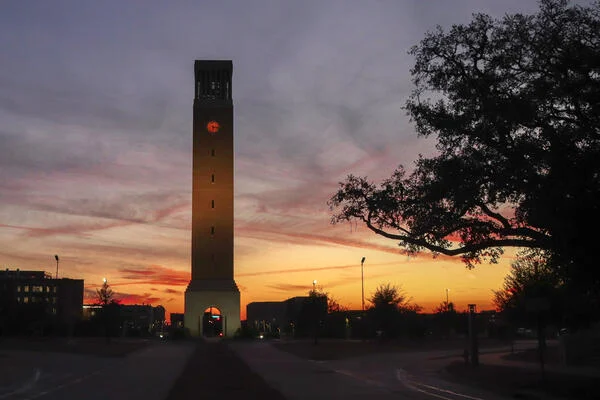
In a Dec. 19 memo that McCoul’s lawyer Amanda Reichek shared with the Times, the Texas A&M system’s vice chancellor for academic affairs, James Hallmark, wrote that he had “determined that Dr. McCoul’s dismissal was based upon good cause.”
McCoul was “disappointed by the university’s unexplained decision to uphold her termination but looks forward to pursuing her First Amendment, due process and breach of contract claims in court very soon,” Reichek said in a statement to the Times.
In 2025, the landscape of higher education is dominated by contradictions, crises, and the relentless churn of what might be called “collegemania.” Underneath the polished veneer of university marketing—the glossy brochures, viral TikToks, and celebrity endorsements—lurks a network of systemic pressures that students, faculty, and society at large must navigate. The hashtags trending below the masthead of Higher Education Without Illusions capture the full spectrum of these pressures: #accountability, #adjunct, #AI, #AImeltdown, #algo, #alienation, #anomie, #anxiety, #austerity, #BDR, #bot, #boycott, #BRICS, #climate, #collegemania, #collegemeltdown, #crypto, #divest, #doomloop, #edugrift, #enshittification, #FAFSA, #greed, #incel, #jobless, #kleptocracy, #medugrift, #moralcapital, #nokings, #nonviolence, #PSLF, #QOL, #rehumanization, #resistance, #robocollege, #robostudent, #roboworker, #solidarity, #strikedebt, #surveillance, #temperance, #TPUSA, #transparency, #Trump, #veritas.
Taken together, these words map the terrain of higher education as it exists today: a fragile ecosystem strained by debt, automation, political polarization, and climate urgency. Students are increasingly treated as commodities (#robostudent, #strikedebt), faculty are underpaid and precarious (#adjunct, #medugrift), and universities themselves are subjected to the whims of markets and algorithms (#algo, #AImeltdown, #robocollege).
Financial pressures are unrelenting. The FAFSA system, once intended as a bridge to opportunity, now functions as a tool of surveillance and debt management (#FAFSA, #BDR). Public service loan forgiveness (#PSLF) continues to be delayed or denied, leaving graduates to navigate the twin anxieties of indebtedness and joblessness (#jobless, #doomloop). Meanwhile, austerity measures squeeze institutional budgets, often at the expense of research, mental health support, and academic freedom (#austerity, #anomie, #anxiety).
Automation and artificial intelligence are now central to the higher education ecosystem. AI grading tools, predictive enrollment algorithms, and administrative bots promise efficiency but often produce alienation and ethical dilemmas (#AI, #AImeltdown, #roboworker, #bot). In this context, “robocollege” is not a metaphor but a lived reality for many students navigating hyper-digitized classrooms where human mentorship is increasingly rare.
Political and cultural currents further complicate the picture. From the influence of conservative campus organizations (#TPUSA, #Trump) to global shifts in power (#BRICS), universities are battlegrounds for ideological and material stakes. Moral capital—the credibility and legitimacy of an institution—is increasingly intertwined with corporate sponsorships, divestment movements, and climate commitments (#moralcapital, #divest, #climate). At the same time, greed and kleptocracy (#greed, #kleptocracy) permeate administration and policy decisions, eroding trust in higher education’s social mission.
Yet amid this bleakness, there are threads of resistance and rehumanization. Student debt strikes, faculty solidarity networks, and advocacy for transparency (#strikedebt, #solidarity, #transparency, #rehumanization) reveal a persistent desire to reclaim the university as a space of collective flourishing rather than pure financial extraction. Nonviolence (#nonviolence), temperance (#temperance), and boycotts (#boycott) reflect strategic, principled responses to systemic crises, even as anxiety and alienation persist.
Ultimately, higher education without illusions demands that we confront both the structural and human dimensions of its crises. Universities are not just engines of credentialing and profit—they are social institutions embedded in broader networks of power, ideology, and technology. A recognition of #veritas and #QOL (quality of life) alongside the demands of #collegemania and #enshittification is essential for any hope of reform.
The hashtags are more than social media markers—they are diagnostics. They chart a system in flux, exposing the frictions between automation and humanity, austerity and access, greed and moral responsibility. They call on all of us—students, educators, policymakers, and citizens—to act with accountability, solidarity, and courage.
Higher education without illusions is not pessimism; it is clarity. Only by naming the pressures and contradictions can we begin to imagine institutions that serve human flourishing rather than perpetuate cycles of debt, alienation, and social inequality.
Sources & Further Reading:
An American Sickness, Elisabeth Rosenthal
Medical Apartheid, Harriet Washington
Body and Soul, Alondra Nelson
HEI coverage of student debt, adjunct labor, and AI in higher education
History often portrays social change as the work of seasoned leaders, elected officials, or famous intellectuals. Yet again and again, it is young people—often teenagers with little formal power—who ignite movements that reshape institutions and force nations to confront injustice. Long before they could vote, hold office, or even graduate, these teens recognized wrongs that adults had normalized and acted with courage that altered the course of history.
Among the most consequential examples in U.S. education history is Barbara Rose Johns, a 16-year-old high school student whose leadership in 1951 helped set in motion events that would culminate in Brown v. Board of Education and the formal end of legalized school segregation.
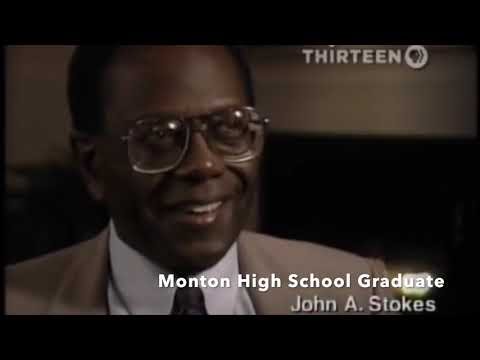
In the spring of 1951, Johns was a junior at Robert Russa Moton High School in Farmville, Virginia. The school, designated for Black students under Jim Crow law, was overcrowded and severely underfunded. Students were taught in makeshift tar-paper shacks without adequate heat. Textbooks and supplies were outdated, and facilities bore little resemblance to those at the nearby white high school. For years, parents and community leaders had petitioned local officials for improvements, but their appeals were ignored.
Johns concluded that waiting for adults or authorities to act was futile. Acting largely on her own initiative, she secretly organized a student strike. On April 23, 1951, more than 450 students walked out of their classrooms. Johns had planned an assembly in advance, arranging for a speaker and framing the protest not as a request for cosmetic improvements but as a challenge to the underlying injustice of segregation itself. At just 16 years old, she demonstrated a sophisticated understanding of how institutional inequality operated and how public action could force change.
The strike quickly attracted attention beyond Prince Edward County. It led to involvement from the NAACP, including attorneys Spottswood Robinson and Oliver Hill, and later Thurgood Marshall. What began as a protest against unsafe and unequal facilities evolved into a direct legal challenge to segregated schooling. The resulting case, Davis v. County School Board of Prince Edward County, became one of the five cases consolidated into the Supreme Court’s 1954 decision in Brown v. Board of Education, which declared that “separate educational facilities are inherently unequal.”
The personal consequences for Johns were severe. She and her family faced threats and intimidation, and she was sent to live with relatives outside Virginia for her safety. For decades, her role received relatively little public recognition, even as the Brown decision became one of the most celebrated rulings in American history. Yet without her initiative, one of the central cases behind Brown might never have existed.
Barbara Johns’ story underscores a broader truth about social change: teenagers are not merely passive recipients of policy decisions, especially in education. They experience institutional inequality firsthand, and when they organize, they often articulate moral truths that adults have learned to tolerate or rationalize. From desegregation to contemporary student movements challenging unequal funding, surveillance, gun violence, and climate inaction, youth activism has repeatedly forced institutions to confront contradictions between democratic ideals and lived reality.
More than seventy years after the Moton High School strike, American education remains deeply unequal. Schools are still segregated by race and income, facilities vary dramatically by zip code, and access to opportunity is uneven. Johns’ legacy remains relevant precisely because the conditions that provoked her action have not fully disappeared. Her story challenges educators, policymakers, and communities to ask why it so often falls to young people to demand justice—and why their leadership is so frequently overlooked.
Barbara Rose Johns did not wait for permission to make history. She organized, resisted, and changed the trajectory of American education while still a teenager. In remembering her, we are reminded that meaningful change often begins not in boardrooms or legislatures, but in classrooms where students decide that injustice is no longer acceptable.
Sources
Barbara Rose Johns, Wikipedia.
Smithsonian National Museum of American History, “The Moton School Strike, 1951.”
Library of Congress, Civil Rights History Project, Prince Edward County and Davis v. County School Board.
National Park Service, Robert Russa Moton High School National Historic Landmark.
Kluger, Richard. Simple Justice: The History of Brown v. Board of Education and Black America’s Struggle for Equality.
To win the higher education system we want will require national, coordinated, multi-union organizing campaigns that build collective power across the sector. As one important step towards this broader goal, HELU is organizing a Northeast Regional Bargaining Summit in Amherst, MA on Jan 9-10, 2026.
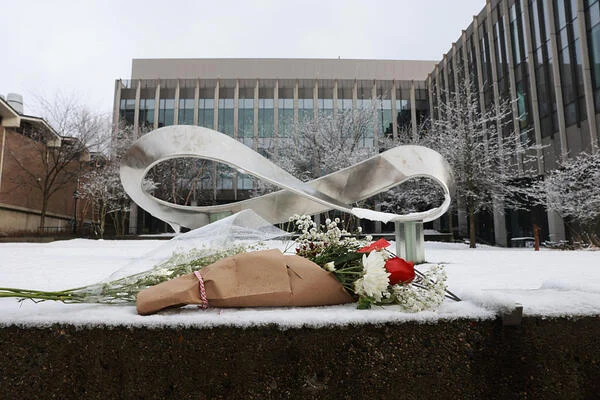
The Department of Education is investigating whether Brown University violated the Clery Act in relation to a campus shooting earlier this month that left two students dead.
“After two students were horrifically murdered at Brown University when a shooter opened fire in a campus building, the department is initiating a review of Brown to determine if it has upheld its obligation under the law to vigilantly maintain campus security,” U.S. Secretary of Education Linda McMahon said in a Monday news release announcing the investigation.
The release also questioned whether Brown’s video surveillance system was “up to appropriate standards” and accused the university of being “unable to provide helpful information about the profile of the alleged assassin” in the aftermath of the shooting.
The suspected shooter, Claudio Manuel Neves Valente, a former Brown student, evaded capture and was found dead from a self-inflicted gunshot wound following a five-day manhunt. While some observers accused Brown of substandard security practices, which critics say delayed the capture of the suspected shooter, others allege the FBI bungled the search.
ED is also probing whether Brown’s emergency notifications about the shooting were delayed.
The department requested various records to aid in the investigation, including copies of annual security reports; crime logs; student and employee disciplinary referrals “related to the illegal possession, use, and/or distribution of weapons, drugs, or liquor”; and copies of all Brown policies and procedures, among other campus safety documents.
The same day that ED announced the investigation into Brown, the private university in Rhode Island placed its top campus safety official, Rodney Chatman, on administrative leave as it reviews the shooting. Hugh T. Clements, the former chief of police of the Providence Police Department, will take on the top public safety job as Brown conducts a security assessment.
Brown officials did not respond to a request for comment from Inside Higher Ed.
The final rule, released by the Department of Homeland Security (DHS) on Tuesday is due to take effect on February 27, in time for the annual H-1B spring lottery.
It is currently under review by the Office of Management and Budget (OMB) and is set to be officially published on December 29.
Alongside favouring “higher-skilled” and “higher-paid” workers, DHS said the change would “disincentivise abuse of the H-1B program to fill relatively lower-paid, lower-skilled positions, which is a significant problem under the present H-1B program”.
It is part of wider government efforts to ensure H-1B visas are issued to high earners, which saw the administration hiking the H-1B visa fee to $100,000 – a move it later clarified would not apply to F-1 students changing status within the US.
The drastic hike, which is up to 20 times more than what employers previously paid, has drawn three legal challenges, including one from the US Chamber of Commerce.
Today’s rule will come as little surprise to the sector after it was proposed in the Federal Register on September 24, with critics arguing that the change would constrain the US tech sector which they say would be moved to ramp up offshoring facilities and jobs.
53% of current international students say they would not have enrolled in the US if H-1B access was determined by wage levels
NAFSA
“There simply are not enough American computer science graduates to support the decades-long record of US innovation and economic growth. That is the wonder of the US tech sector,” Intead CEO Ben Waxman previously told The PIE.
“Why would the US government want to constrain that engine?” he asked.
What’s more, the change is likely to contribute to the declining appeal of the US among prospective international students who increasingly cite work experience and job opportunities as primary factors shaping study decisions.
In a recent NAFSA survey of current US international students, over half of respondents (53%) said they would not have enrolled in the first place if access to H-1B was determined by wage levels.
A similar proportion (54%) indicated they would never have enrolled in the US if it wasn’t for Optional Practical Training (OPT), which experts anticipate is also under threat.
The H-1B visa, popular with the likes of Amazon, Microsoft and Apple, enables US employers to temporarily employ international workers in “specialty occupations” across a wide range of industries such as healthcare, computer science and financial analysis.
Currently, there is an annual cap of 85,000 new H-1B visas, and when this cap is exceeded, applicants are placed into a random lottery which determines who is awarded a visa.
Under the new weighted system, higher earners will be entered into the selection pool more times than lower earners, ranging from one to four times.
A DOJ report is the latest in the Trump administration’s attempts to dismantle minority-serving programs.
Photo illustration by Justin Morrison/Inside Higher Ed | d1sk and nullplus/iStock/Getty Images
The Department of Justice has declared a slew of Department of Education programs and grants unconstitutional based on the Supreme Court’s decision in Students for Fair Admissions v. Harvard and the University of North Carolina.
According to a report by the DOJ’s Office of Legal Counsel (OLC), minority-serving institution (MSI) programs are unlawful because they award money to colleges and universities based on the percentage of students of a certain race. The report said such programs “effectively [employ] a racial quota by limiting institutional eligibility to schools with a certain racial composition” and should no longer be funded.
The report also deemed it unconstitutional that two scholarship providers, the United Negro College Fund and the Hispanic Scholarship Fund, both of which award scholarships to students of a specific race, are given access to Free Application for Federal Student Aid data.
In a statement from the education department, Secretary Linda McMahon said that the report is “another concrete step from the Trump Administration to put a stop to DEI in government and ensure taxpayer dollars support programs that advance merit and fairness in all aspects of Americans lives. The Department of Education looks forward to working with Congress to reform these programs.”
The statement noted that the department is “currently evaluating the full impact of the OLC opinion on affected programs.”
The OLC also evaluated the constitutionality of two TRIO programs, the Ronald E. McNair Postbaccalaureate Achievement Program, a scholarship that helps students from underrepresented backgrounds work towards Ph.D.s, and Student Support Services, which provides grants for institutions to develop academic support infrastructure. It ultimately concludes that those programs are constitutional and may continue to be funded.
Nevertheless, in ED’s announcement of the DOJ decision, those TRIO programs were included in a list of “affected programs.”
The Trump administration’s attack on MSI programs began in July, when the U.S. Solicitor General declined to defend against a lawsuit challenging the definition of a Hispanic-serving institution (HSI) as one that enrolls a student body with at least 25 percent Hispanic students. In September, ED officially announced its plans to end these programs, terminating the majority of MSI grants for FY2025.
Supporters of MSI programs strongly criticized the OLC’s report.
“Today’s baseless opinion from the Justice Department is wrong, plain and simple. Donald Trump and his Administration are once again attacking the institutions that expand opportunity for millions of aspiring students of all backgrounds. The opinion ignores federal law, including Congress’ bipartisan support for our nation’s Hispanic-Serving Institutions and Minority-Serving Institutions, including more than 100 MSIs in California alone,” Senator Alex Padilla, a California Democrat who chairs the Senate HSI Caucus, wrote in a statement. “Every student deserves access to the American Dream. This unconscionable move by this Administration will harm millions of students who deserve better.”
Presidents of institutions that could be impacted by the legal decision are also speaking out. Wendy F. Hensel, president of the University of Hawai’i, called the news “disappointing” in a statement to the campus community. UH is an Alaskan Native and Native Hawaiian-serving institution, an Asian American and Native American Pacific Islander-serving institution, and a Native Hawaiian Career and Technical Education grantee; Hensel said these programs are “vital” to UH and the state of Hawai’i.
She wrote that the university’s general counsel is examining the full report and that campus leadership is currently “evaluating the full scope of the impact on our campuses and programs and implementing contingency plans for the loss of funding.”
“We recognize that this news creates uncertainty and anxiety for the students, faculty and staff whose work and educational pathways are supported by these funds. We are actively assessing how best to support the people and programs affected as we navigate this evolving legal landscape,” she wrote.
Trump’s allies, however, applauded the report and ED’s efforts to end MSI programs.
“Today’s announcement is a strong step by the Trump administration to end racial discrimination in our higher education system. These programs determine funding eligibility through arbitrary, race-based quotas which unfairly assume a student’s background determines his or her educational destiny,” Education and Workforce Committee Chairman Tim Walberg, a Republican representative from Michigan, wrote in a statement. “America was founded on the principles of freedom and equality, and that every citizen can chase the American Dream. In Congress, we are working with the Trump administration to create a fairer higher education system so every student has a strong chance at success.”