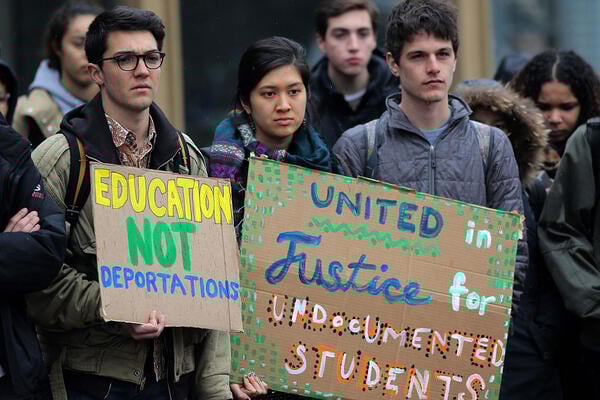
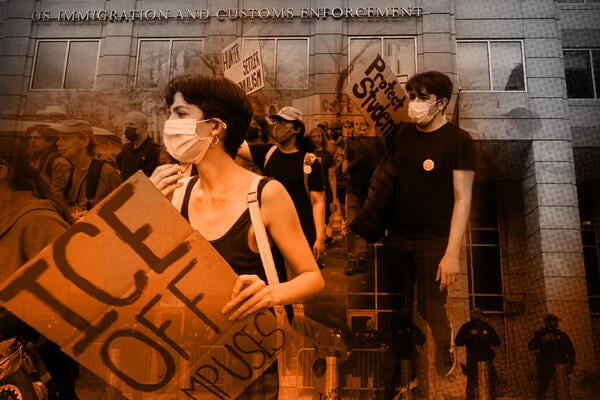
Immigrant rights advocates are urging state and higher ed leaders not to make any hasty changes to their in-state tuition policies after President Trump issued an executive order on Monday threatening to crack down on sanctuary cities and localities with laws that benefit undocumented immigrants.
The blow to undocumented students, who in nearly half the country pay in-state tuition, is tucked into an executive order focused mostly on pressuring state and local officials to abandon their cities’ sanctuary status and cooperate with federal immigration authorities. The order demands federal officials make lists of “sanctuary jurisdictions” and the federal funds that could be suspended or cut if they don’t change course. The order also commands them to take “appropriate action” to stop the enforcement of state and local laws and practices “favoring aliens over any groups of American citizens,” including in-state tuition benefits to undocumented students “but not to out-of-state Americans.”
The move has the potential to affect 24 states and Washington, D.C., which allow in-state tuition for local students with or without citizenship. (Florida previously allowed undocumented students to pay in-state tuition rates but ended its decade-old, historically bipartisan policy in February.) Undocumented students and supporters have long touted these policies as a way to make college more affordable for those who can’t access federal financial aid but who grew up in the states and plan to work in their local communities after they graduate.
“What immigrant, international and refugee students bring is needed talent, skills and contributions,” said Miriam Feldblum, executive director of the Presidents’ Alliance on Higher Education and Immigration. “In-state tuition increases the number of a state’s residents who are college educated, who are able to contribute far more to the state’s economy and to their communities than if they did not have a college education.”
Gaby Pacheco, president and CEO of TheDream.US, a scholarship provider for undocumented students, said many of these students come from low-income backgrounds and couldn’t afford college otherwise.
Her organization is currently scrambling to help undocumented students in Florida pay for the remainder of their credits and graduate before they have to pay much higher out-of-state tuition rates. In some cases, that means helping them transfer to more affordable institutions.
For many, “it’s just impossible for them to be able to come up with that money,” she said.
She’s encouraging state and institutional leaders to avoid “panicking” or “making abrupt policy changes” in response to the executive order.
Other executive orders have “created so much panic and unnecessary movement from colleges, universities, states, that it was more hurtful than anything,” she said. The administration is putting forward a “belief” that charging undocumented students in-state tuition rates is unlawful, but “that belief is legally dubious.”
Deciphering the Executive Order
Immigrants’ advocates and legal scholars say the meaning of the executive order is somewhat hazy. For example, it’s unclear what it means for federal officials to “take appropriate action” to prevent in-state tuition policies from being enforced.
The order also doesn’t directly say states or institutions with such laws will lose any federal funding, noted Ahilan Arulanantham, professor from practice at the UCLA School of Law and co-director of the law school’s Center for Immigration Law and Policy.
Still, the order’s threatening tone toward sanctuary cities’ federal funds could be “a window into where this fight could go if the federal government wants to expend significant political capital on this issue,” Arulanantham said. Congress, for example, could decide to pass a law to cut federal funds from universities that offer undocumented students in-state tuition—a proposal outlined in Project 2025. But the executive order itself doesn’t explicitly take away federal dollars from anyone or have the power to do so, he said.
“If I were a local government or state government official, I probably wouldn’t sue tomorrow over this,” Arulanantham said. “I would wait to see if this is actually going to have any teeth, or if it’s just like a press release.”
Pacheco similarly described the order as “warning” states of the administration’s posture toward these policies. At the same time, she believes it’s important to plan ahead in case Trump takes the issue further.
“They’re trying to tell states, ‘We believe that you providing certain benefits for undocumented students is against the law,’” she said. “We’ve known this forever—these states are not violating the law.”
The order suggests that in-state tuition for undocumented students “may violate” a federal statutory provision that says undocumented people can’t receive higher ed benefits unless citizens are also eligible. But in-state tuition policies are designed to serve citizens living in these states, as well. For example, under California’s Assembly Bill 540, any nonresident who spent three years in California high schools is eligible for in-state tuition. That policy also benefits citizens who grew up in the state who may have left for any reason and returned.
These types of in-state tuition policies, including California’s, have faced legal challenges in the past, “but all the challenges have failed, said Kevin Johnson, dean of the UC Davis School of Law. He described the executive order as “vaguely worded,” while the state laws, by contrast, are “very clear.”
The legal argument is that undocumented students are “just being treated equally as all other residents of the state,” he said. “The idea is that they’re residents, which means they’re taxpayers—maybe it’s sales tax, maybe state income tax, federal income tax—whatever it is, they should be treated like other residents and not discriminated against because of their immigration status.”
What Happens Next
Arulanantham worries that despite their strong legal foundation, states and higher ed institutions may rush to end in-state tuition benefits for undocumented students out of fear.
“That’s actually almost certainly the primary purpose of this order”: to spur “pre-emptive discrimination because [institutions] think they have to or they think it’s safer to,” he said.
Feldblum noted that, prior to the executive order, some state lawmakers were already starting to shift on the issue, perhaps “to align themselves with the federal government.”
While some states have recently doubled down on such policies, proposing new legislation to expand in-state tuition eligibility, others have also moved to curtail them. Following in Florida’s footsteps, lawmakers in other states, including Kansas, Kentucky and Texas, are considering legislation to prohibit in-state tuition for undocumented students. Texas was the first to allow undocumented students to pay in-state tuition rates in 2001, joined by California that same year.
“This is not coming in a vacuum … We have to take this seriously and substantively, consider the kinds of actions we need to take to defend in-state tuition—including, if needed, legal action,” Feldblum said. “And then also make sure we’re placing equal emphasis on supporting and communicating with potentially impacted students so that they know their education is important and that they’re important.”
The Trump administration issued plans earlier this week for a new policy that vastly expands federal officials’ authority to terminate students’ legal residency status, according to newly released court documents.
The policy detailed in the filings asserts that immigration officials have the “inherent authority” to terminate students’ legal residency status in the Student Exchange and Visitor Information System “as needed.” It also explicitly lays out two new justifications for SEVIS terminations: the vague “evidence of failure to comply” with nonimmigrant visa terms, and a visa revocation, which can be issued without evidence of a violation by the State Department—and which, crucially, is not subject to court challenges.
Immigration attorneys told Inside Higher Ed that if implemented, the new policy would enshrine broad permission for ICE to begin deporting students practically at will.
“This is very bad news for foreign students,” said Charles Kuck, an immigration attorney representing 133 international students in the largest lawsuit challenging recent SEVIS terminations. “Any student who’s arrested, literally for any reason, is probably going to have their status terminated going forward.”
Last Friday a U.S. attorney promised an official update to ICE policy on SEVIS terminations. On Tuesday, U.S. attorneys presented the document as evidence in a court filing in Arizona, describing it as “recently issued … policy regarding the termination of SEVIS records.”
It was the first time that details of a new SEVIS termination policy were made public, and it was not at first clear whether it reflected official federal policy. On Tuesday, U.S. attorney Johnny Walker confirmed during another hearing for a SEVIS lawsuit in D.C. that it did, though the policy had yet to be finalized. Spokespeople for ICE did not respond to multiple questions from Inside Higher Ed.
The plan comes less than a week after the administration began restoring thousands of foreign students’ SEVIS statuses after a series of court decisions overturned hundreds of status terminations. Kuck said the plan seemed to be a way for ICE to get around those rulings.
“This is basically a cover-your-ass policy,” he said. “The fact that ICE initially reinstated visas was no surprise. They probably had U.S. attorneys screaming at them, ‘What are you doing?’ Now they’re trying to retroactively develop a policy that would allow them to do what they already did.”
Immigration lawyer and Columbia University Immigrants’ Rights Clinic director Elora Mukherjee has been counseling international students across New York City for the past two months. After the visa-restoration decision last week, some students wanted to know if they were in the clear; she cautioned them against celebrating prematurely.
“Whiplash is a good way to describe it,” she said. “Students are losing sleep—not just those whose visas have been terminated but those who are worried theirs could be next any day.”
Fly-by-Night Policymaking
The updated policy was outlined in an internal Department of Homeland Security memo filed as evidence in an Arizona federal court on Wednesday, where one of more than 100 lawsuits challenging visa revocations is being litigated.
The unorthodox manner in which it was publicized has left immigration attorneys scratching their heads and international students’ advocates wondering how to respond.
It also appears to have taken some federal officials by surprise. Kuck said that when he heard about the memo and brought it before the judge in his own case in Georgia, the U.S. attorney defending the government asked if he could send him a copy.
Fanta Aw, president of NAFSA, an association of international educators, wrote in an email to Inside Higher Ed that the document “should not be relied upon as ICE’s new policy.” She also emphasized that there is no change to ICE’s visa termination policy included in the memo, only SEVIS terminations.
The document is labeled as a “broadcast message … for internal SEVP use only,” meaning it would have been sent to Designated School Officials working in colleges’ international student offices. But Aw said that’s not accurate, either, because it lacks the customary broadcast message number, and DSOs in her organization said they had not received it.
Kuck said the lack of a rule-making process for a sweeping policy change like the one outlined in the memo is most likely unlawful, and he was working on filing an amendment to challenge it on Thursday. But that doesn’t mean it should be taken lightly.
“People should view this as the future,” Kuck said. “This is clearly the power ICE wants to give itself, so they’re going to move ahead with it.”
‘A Nightmare Booby Trap’
Mukherjee said such a broad license to terminate SEVIS status would allow ICE to deport international students far more quickly and with less accountability. The new policy, if implemented and upheld by the courts, wouldn’t just revert to the status quo of the last few months, she said; it would create a landscape in which ICE could begin deportation proceedings with impunity.
“We’ve already seen many students whose SEVIS terminations led directly to removal proceedings,” Mukherjee said. “It’s terrifying.”
Kuck said it’s crucial that students understand that they’re still in danger of deportation even if their status was restored last week—and not just because of the new policy plan.
The few hundred students who won a temporary restraining order in court over the past week have had their statuses reinstated and backfilled to when they were revoked. But the status of thousands more who did not file lawsuits was only reactivated from that point onward. That means they have a gap in status for the days or weeks in between—which, according to ICE policy, is grounds for removal from the country, even if their initial SEVIS termination was accidental.
“This is a nightmare booby trap for these kids,” Kuck said.
The only way to protect them, he said, is by filing a class action lawsuit for all affected international student visa holders. Kuck said he’s working on filing an injunction for one right now, and he is acting with urgency.
In the meantime, Mukherjee said students—both those in the country and those who had planned to come in the fall—are “deeply unsettled.” She’s been asking them questions she’d never been concerned about before: whether they have any social media accounts or even tattoos.
“I’m talking to international students who are currently in the U.S., to international students who’ve been admitted to study in the U.S. starting in the fall, and they’re asking, ‘Will we be able to complete our degree program?’” she said. “The answer is that it’s unclear.”
Inside Higher Ed journalists analyze the first 100 days of the Trump administration in this week’s episode of The Key, IHE’s news and analysis podcast.
Editor in chief Sara Custer, along with news editor Katherine Knott and reporters Johanna Alonso and Liam Knox, discuss the major events of the last three months and the impact they have had on universities and colleges.
The team summarizes the executive orders that will affect higher education, including one to shutter the Department of Education, another to overhaul accreditation and another to tackle alleged antisemitism.
The conversation also explores the new relationship the federal government has established between itself and higher education and how the administration is threatening federal research funding to set ultimatums and progress its agenda, in particular with Columbia and Harvard University.
The group updates listeners on the latest developments with international students’ Student Exchange and Visitor Information System status reinstatements. Alonso and Knox also talk about what they learned about the administration’s targeting of international students from speaking to students, their advisers and digging through dozens of lawsuits brought against the government.
While what comes next is anyone’s guess. The team discusses what they’ll be watching over the next 100 days, including what Congress will be working on, the fallout from the international student crackdown and how summer might shift the vibe on campus.
This is Mason Science College, founded in 1875 by Sir Josiah Mason. It was one of the institutions which formed the nucleus of the University of Birmingham in 1900 (the other was Queen’s College, founded in 1825 as the Birmingham Medical School). The buildings were used by the university until the 1960s but are now gone.
Mason had made his fortune in manufacturing – mostly steel pens, but other products too.
The card was posted on 17 April 1905 in Bournemouth to an address in Doncaster.
Thanks for letter and will answer in a day or so. Went to hear Sousa’s band today. Have you heard him? I trust you are stronger dear. Love in haste …
John Philip Sousa and his band were touring Britain in 1905, but I can’t pin down where they played on Monday 17 April.
Apologies for the brevity of this post – I’m under the cosh this week, with work and other stuff, so the postcard blog is short and sweet. Hopefully back to normal next week!
It’s been five years since colleges moved their teaching and learning online in response to the COVID pandemic, and Inside Higher Ed’s 2025 Survey of Campus Chief Technology/Information Officers, released today, shows that while online learning may still be adjusting to a new post-pandemic normal, it’s not going anywhere.
Half of surveyed CTOs indicate that student demand for online and/or hybrid course options has increased substantially year over year at their institution. Nearly the same share say their college has added a substantial number of new online or hybrid course options over the same period. Meanwhile, the most recent Changing Landscape of Online Education Project report found something similar: Nearly half of chief online learning officers surveyed said that enrollment in online degree programs at their institution is now higher than that of on-campus programs—and even more said their college had undergone a strategic shift in response to such demand.
And even while identifying increased student interest in on-site learning for certain activities, the 2025 Students and Technology Report from Educause also reveals general student appreciation of flexible learning formats and an outright preference for online courses among older learners.
Amid this growing demand for online and hybrid courses, we surveyed students studying in different modalities to understand how their needs and interests might differ.
Our annual Student Voice survey of 5,025 two- and four-year learners with Generation Lab polled learners about their study experiences relative to their peers taking all their courses online and those taking a mix of both in-person and online courses, as of spring 2024. We looked for gaps in responses and key overlaps between those groups, along with potentially counterintuitive responses from online-only learners. (The survey asked all students about academic success, health and wellness, involvement in college life, career readiness, and more.)
Experts say the findings, listed below, have big implications for institutions looking to better serve online learners. One clear takeaway, up front? Online-only students’ sense of belonging—a student success factor linked to academic performance, persistence and mental health—lags that of peers studying in person. But promoting belonging among online learners may look different than it does in other classroom settings.
“In general, if we want to foster belonging among online learners, we need to stop importing in-person solutions into digital environments,” said Omid Fotuhi, director of learning innovation at WGU Labs and a research associate at the University of Pittsburgh who studies online learners, belonging, motivation and performance. “Belonging online isn’t a watered-down version of the campus quad—it’s a different ecology altogether. And that ecology requires deliberate psychological attunement to the lived realities of today’s increasingly diverse, time-strapped, digitally distributed students.”
Stephanie L. Moore, associate professor of organization, information and learning sciences at the University of New Mexico and editor in chief of the Journal of Computing in Higher Education, who also reviewed the data for Inside Higher Ed, had a similar take: that it’s a “good impetus for higher education leaders and planners to think about what belonging means beyond extracurricular activities.”
But first—and to Fotuhi’s point about diversity—who are online learners? Across the U.S., they tend to be older and more likely to be working already than their in-person peers. And the 854 online-only Student Voice respondents are significantly more likely than the 4,000-plus other respondents to be working full-time: Some 45 percent are working 30 or more hours per week, versus 22 percent of the group as a whole.
Most are first-generation college students, as well, at 59 percent, compared to 33 percent of in-person students and 48 percent of those taking a mix of in-person and online courses.
Perhaps related to their working status, online-only students are less likely than the group over all to be taking a full-time course load, at 48 percent versus 68 percent. But they’re roughly as likely as the group over all to report a learning disability or difference (14 percent), a physical disability or condition (14 percent), or a mental health condition or illness (35 percent).
Whatever their characteristics, Moore said online students want to feel that “they are truly part of the university,” viewed by an institution as “our students” versus “those students.” That’s a helpful lens through which to interpret the following findings.
What We Found
Online-only students rate their sense of academic fit and educational quality highly. Their sense of belonging? Not so much.
Online-only students’ perceptions of quality are somewhat lower than those of respondents studying exclusively in person, but a majority of each group still rate their educational quality good or excellent: 67 percent of online students versus 76 percent of in-person learners. Students taking a mix of online and in-person courses split the difference, at 71 percent. And while online-only students’ sense of academic fit at their college approaches that of the group over all, the gap widens on sense of social belonging. Just 31 percent of online-only students rate their sense of belonging as good or excellent, compared to 48 percent of in-person students. Those taking a mix of online and in-person courses again split the difference.
The responses suggest that colleges and universities over all have work to do on belonging, regardless of modality. But the especially low ratings among online-only students merit particular attention, given that online learners have elsewhere been shown to complete at lower rates. It’s not immediately clear from this survey to what online-only students attribute this lower sense of belonging, as they’re less likely than the group over all to say that professors getting to know them better, study groups and peer learning, and more opportunities for social connection—all factors associated with belonging—would help boost their success. They’re also less likely than in-person-only peers to attribute what’s been called the mental health crisis to increased loneliness, when presented with a list of possible drivers (21 percent versus 33 percent, respectively).
However, online-only students are significantly less likely to have participated in extracurriculars than other peers: 64 percent say they haven’t participated in any such activities, compared to 35 percent of the group over all. Similarly, 57 percent of online-only learners have attended no events at their college, compared to 26 percent of the group over all. (More on that later.)
Online-only students, like their other peers, want more affordable tuition and fewer high-stakes exams.
Across the board, students say fewer exams and lower tuition will improve their chances of success. The No. 1 non-classroom-based thing all students—including online-only students—say would boost their academic success, when presented from a list of possibilities, is making tuition more affordable so they can better balance academics with finances and other work. And the No. 1 classroom-based action online students and their other peers say would help is encouraging faculty members to limit high-stakes exams, such as those counting for more than 40 percent of a course grade.
Online-only students tend to prefer online, asynchronous courses.
Would online students prefer to be studying in person? Many Student Voice respondents studying online say no, supporting other data suggesting that online learners value the modality for its flexibility and convenience. Asked about their preferred modality, the largest share of online-only students, 54 percent, choose online, asynchronous courses. Still, the second-most-popular option for this group—if by a wide margin—is in person, selecting up to two options.
In-person students, meanwhile, overwhelmingly prefer in-person learning, at 74 percent. Many students taking a mix of in-person and online courses also tend to prefer the in-person setting, with 52 percent choosing this.
As for their preferred class formats and teaching practices, beyond modality, online-only students and students over all are most likely to prefer interactive lectures, in which the professor delivers a short lecture but punctuates the class with active learning strategies. About a quarter of online students also prefer case studies, which connect course concepts to real-world problems. That’s when selecting up to two options from a longer list.
One bonus finding: Online-only students are slightly less likely than the group over all to say they consider themselves customers of their institution in some capacity (58 percent versus 65 percent, respectively).
Many online-only students, like their other peers, report that stress is impeding their academic success.
Online-only students report experiencing chronic academic stress (distinct from acute academic stress) at half the rate of in-person students: 13 percent versus 26 percent. This could be related to the fact that relatively fewer online students are taking a full-time course load. But online-only students are more likely to cite balancing academics with personal, family or financial responsibilities as a top stressor (52 percent versus 44 percent of in-person students). And they are about as likely as the group over all to say that stress impacts their ability to focus, learn and do well academically “a great deal,” at 42 percent. This overall finding on stress was one of the most significant of this Student Voice survey cycle, and online-only students’ responses mean that institutions trying to tackle student stress should keep these learners in mind.
To that point: The top thing all students say their institution could do to boost their overall well-being is rethinking exam schedules and/or encouraging faculty members to limit high-stakes exams: 42 percent of online-only students say this would be a big help, as do 46 percent of respondents over all (when presented with a list of options, selecting up to three).
Most online-only students don’t participate in extracurriculars, and some say they could benefit from more virtual participation options.
Two in three online-only students say they haven’t participated in any extracurricular activities, much more than the group over all. Online-only students are also less likely than the group over all to believe that participation in extracurriculars and events is important to their overall well-being and success: Just 21 percent of online-only students say this is very important to their success as a college student, while 23 percent say this is true for success after graduation.
As for what would increase online students’ involvement, the top two factors from a longer list of options are if they lived on or near campus and if there were more virtual attendance options (34 percent each). These numbers don’t necessarily amount to a ringing endorsement of virtual participation options, but they do signal that colleges could be doing more in this area. And beyond virtual participation, while many online learners do not live close to their institutions, many do live within an hour’s drive, according to existing data. This means that institutions might also benefit from including local or semi-local online students in their campus involvement initiatives.
Only-online students are confident in their futures but highlight career support needs.
Online-only students indicate they’ve interacted with their college career center at comparable rates to their peers. Their perceptions of career-readiness efforts across different dimensions are also comparable to their peers’. For example, 21 percent of online-only students describe their career center as having sufficient online resources, compared to 20 percent of the group over all—a sign that these resources may be lacking across the board. Many online students, like students generally, also say they want more help from their institutions connecting with internships and job opportunities, when presented with a list of career-readiness priorities.
At the same time, 74 percent of online students are very or somewhat confident that their education and college experiences are preparing them for success postgraduation, however they define it, as are 80 percent of in-person students.
What Faculty and Institutions Can Do
Fotuhi, of WGU Labs, said the findings resonate with national trends he and colleagues track in their College Innovation Network research—notably, “the tension between the appeal of flexibility and the risks of isolation” for online learners.
Fotuhi described what’s been called “the efficiency-belonging dilemma” as when online learning “meets students’ logistical needs, but often falls short on the emotional and relational dimensions of engagement.” Yet if online students (like those in our survey) aren’t demanding engagement in the form of study groups or professor familiarity, what do they want instead—or at least more acutely?
Fotuhi’s answer: “From our work, we see strong signals that online learners benefit from institutionally scaffolded structures of connection.” These include:
Proactive nudges from advisers and coaches, especially those personalized to milestones or struggles
Peer mentorship or cohort-based models that operate virtually
Role clarity about where (and to whom) to go for academic, emotional and professional support
Interventions to support students’ digital confidence may also be a “powerful, indirect lever for fostering belonging,” Fotuhi said. Same for virtual participation options for involvement as well as services “that mirror the convenience of their academic experience.” Think asynchronous orientation materials, online student organizations and virtual mentoring.
Tony Bates, a now-retired online learning expert based in Canada, also highlighted the role of the classroom in promoting belonging in online learning, where there remains much variation in teaching methods: Course activities “are more likely to be the only way online students can bond with other students,” and the “online course environment needs to be designed to encourage such interactivity.”
Moore, of the University of New Mexico, added that in online learning, students “look for and experience belonging through increased interactions with their fellow learners and their instructors, through seeing themselves represented in examples, cases and readings, and through access to support services and resources.”
Similar to Fotuhi’s framework for an “ecology” of supports, Moore encouraged institutions to take an “ecosystems” approach to supporting online learners, beyond offering them mere access to courses. This can include health and wellness offerings, librarians who “make support feel more personal,” and career services that are “proactive.”
When it comes to students’ attitudes toward high-stakes exams, Moore said the Student Voice data point to “continued overreliance on testing, especially high-stakes testing, as a primary assessment method.”
Adult learners, in particular—many of whom are online learners—“are looking for learning that is relevant to their careers and futures,” she said. And in the realm of assessment, this “is facilitated by different instructional and assessment strategies than tests.”
Bates argued that online learning “lends itself to continuous assessment,” or frequent, formative assessment, as it’s “much easier to track individual students’ progress through an online course,” where all their learning activities can be monitored and recorded.
Moore said that shifting assessment away from high-stakes testing has some “added bonuses of increasing learner motivation, decreasing their stress—specifically the kind that might motivate some to cheat—and increasing their learning outcomes.”
This report benefited from support from the Education Writers Association’s Diving Into Data program. We’re also gearing up for our 2025 Student Voice survey cycle. What would you like to know about student success, from a student’s perspective? Drop us a line here.
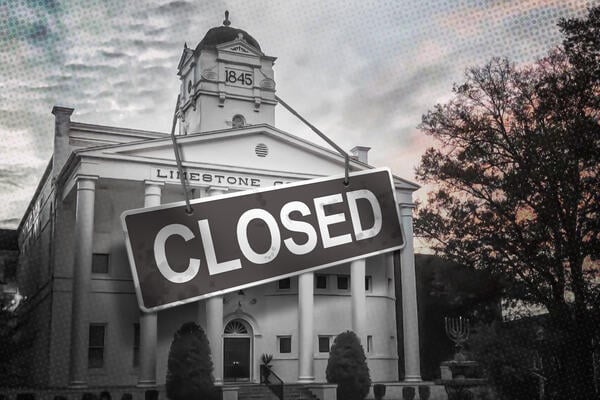
Limestone University survived the Civil War and the Great Depression, but protracted financial struggles have proven harder to overcome: After nearly 180 years, Limestone will cease operations next week.
Officials announced the closure Tuesday night.
“Words cannot fully express the sorrow we feel in having to share this news,” Limestone president Nathan Copeland said in a statement. “Our students, alumni, faculty, staff, and supporters fought tirelessly to save this historic institution. While the outcome is not what we hoped for, we are forever grateful for the passion, loyalty, and prayers of our Saints family.”
The move follows a tumultuous period for the university. After years of financial challenges, the Board of Trustees was set to decide last week on whether to shift to online-only operations or close altogether. At the last minute it decided to hold off on the decision because a “possible funding source” had emerged.
Limestone was seeking a $6 million infusion to help facilitate the shift to a fully online model. Though the university was able to secure $2.1 million in pledged commitments from almost 200 donors, according to the closure announcement, it ultimately fell well short of the goal, prompting the board to close the private institution in South Carolina.
The closure comes on the heels of significant enrollment and financial losses. The university enrolled 3,214 students in fall 2014, according to federal data; Limestone recently noted enrollment at around 1,600.
It has also operated for years with substantial budget deficits. The latest audit for the university noted “significant doubt” about Limestone’s ability to remain open, given that it had “suffered recurring significant negative changes in net assets and cash flows from operations” and had “a net deficiency in [unrestricted] net assets.”
Limestone’s board also borrowed heavily from the university’s meager endowment in recent years.
In 2023, the South Carolina attorney general agreed to lift restrictions on Limestone’s endowment to allow the board to increase spending from those funds. As a result, the endowment collapsed in value, falling from $31.5 million at the beginning of fiscal year 2022 to $12.6 million at the end of FY23. Auditors noted that “all endowment funds are underwater” as of last June.
Auditors also expressed skepticism that Limestone would be able to pay off mounting debts.
The university had more than $30 million in outstanding debt in the last fiscal year, including $27.2 million owed to the U.S. Department of Agriculture. Limestone’s latest audit shows the university listed its buildings and land as collateral for both the U.S. Department of Agriculture and another bank loan.
Auditors also found that Limestone’s “internal controls over financial reporting are informal and lack formal documentation,” and that the university’s accounting department was understaffed.
Despite the abrupt nature of the closure, Limestone officials wrote in Tuesday’s announcement that the university “will proceed with an orderly wind-down process” and help students transfer to other institutions and support faculty and staff with more information to come on those efforts.
Limestone will hold its final commencement on Saturday.
“Our Limestone spirit will endure through the lives of our students and alumni who carry it forward into the world,” Limestone board chair Randall Richardson said in the closure announcement. “Though our doors may close, the impact of Limestone University will live on.”
The closure announcement comes less than a week after St. Andrews University, a private institution in North Carolina, made a similar decision to cease operations due to fiscal issues.
To help folks think through what we should be considering regarding the impact on education of generative AI tools like large language models, I want to try a thought experiment.
Imagine if, in November 2022, OpenAI introduced ChatGPT to the world by letting the monster out of the lab for a six-week stroll, long enough to demonstrate its capacities—plausible automated text generation on any subject you can think of—and its shortfalls—making stuff up—and then coaxing the monster back inside before the villagers came after it with their pitchforks.
Periodically, as new models were developed that showed sufficient shifts in capabilities, the AI companies (OpenAI having been joined by others), would release public demonstrations, audited and certified by independent expert observers who would release reports testifying to the current state of generative AI technology.
What would be different? What could be different?
First, to extend the fantasy part of the thought experiment, we have to assume we would actually do stuff to prepare for the eventual full release of the technology, rather than assuming we could stick our heads in the sand until the actual day of its arrival.
So, imagine you were told, “In three years there will be a device that can create a product/output that will pass muster when graded against your assignment criteria.” What would you do?
A first impulse might be to “proof” the assignment, to make it so the homework machine could not actually complete it. You would discover fairly quickly that while there are certainly adjustments that can be made to make the work less vulnerable to the machine, given the nature of the student artifacts that we believe are a good way to assess learning—aka writing—it is very difficult to make an invulnerable assignment.
Or maybe you engaged in a strategic retreat, working out how students can do work in the absence of the machine, perhaps by making everything in class, or adopting some tool (or tools) that track the students’ work.
Maybe you were convinced these tools are the future and your job was to figure out how they can be productively integrated into every aspect of your and your students’ work.
Or maybe, being of a certain age and station in life, you saw the writing on the wall and decided it was time to exit stage left.
Given this time to prepare, let’s now imagine that the generative AI kraken is finally unleashed not in November 2022, but November 2024, meaning at this moment it’s been present for a little under six months, not two and a half years.
What would be different, as compared to today?
In my view, if you took any of the above routes, and these seem to be the most common choice, the answer is: not much.
The reason not much would be different is because each of those approaches—including the decision to skedaddle—accepts that the pre–generative AI status quo was something we should be trying to preserve. Either we’re here to guard against the encroachment of the technology on the status quo, or, in the case of the full embrace, to employ this technology as a tool in maintaining the status quo.
My hope is that today, given our two and a half years of experience, we recognize that because of the presence of this technology it is, in fact, impossible to preserve the pre–generative AI status quo. At the same time, we have more than info information to question whether or not there is significant utility for this technology when it comes to student learning.
This recognition was easier to come by for folks like me who were troubled by the status quo already. I’ve been ready to make some radical changes for years (see Why They Can’t Write: Killing the Five-Paragraph Essay and Other Necessities), but I very much understood the caution of those who found continuing value in a status quo that seemed to be mostly stable.
I don’t think anyone can believe that the status quo is still stable, but this doesn’t mean we should be hopeless. The experiences of the last two and a half years make it clear that some measure of rethinking and reconceiving is necessary. I go back to Marc Watkins’s formulation: “AI is unavoidable, not inevitable.”
But its unavoidability does not mean we should run wholeheartedly into its embrace. The technology is entirely unproven, and the implications of what is important about the experiences of learning are still being mapped out. The status quo being shaken does not mean that all aspects upon which that status quo was built have been rendered null.
One thing that is clear to me, something that is central to the message of More Than Words: How to Think About Writing in the Age of AI: Our energies must be focused on creating experiences of learning in order to give students work worth doing.
This requires us to step back and ask ourselves what we actually value when it comes to learning in our disciplines. There are two key questions which can help us:
What do I want students to know?
What do I want students to be able to do?
For me, for writing, these things are covered by the writer’s practice (the skills, knowledge, attitudes and habits of mind of writers). The root of a writer’s practice is not particularly affected by large language models. A good practice must work in the absence of the tool. Millions of people have developed sound, flexible writing practices in the absence of this technology. We should understand what those practices are before we abandon them to the nonthinking, nonfeeling, unable-to-communicate-with-intention automated syntax generator.
When the tool is added, it must be purposeful and mindful. When the goal of the experience is to develop one’s practice—where the experience and process matter more than the outcome—my belief is that large language models have very limited, if any, utility.
We may have occasion to need an automatic syntax generator, but probably not when the goal is learning to write.
We have another summer in front of us to think through and get at the root of this challenge. You might find it useful to join with a community of other practitioners as part of the Perusall Engage Book Event, featuring More Than Words, now open for registration.
I’ll be part of the community exploring those questions about what students should know and be able to do.
Federal immigration officials targeted student visa holders by running their names through a federal database of criminal histories, according to court testimony given by Department of Homeland Security officials on Tuesday and reported by Politico.
As part of the Student Criminal Alien Initiative, as officials dubbed the effort, 20 ICE agents and several federal contractors ran the names of 1.3 million potential student visa holders through the database, searching for those that were both still enrolled in programs and had had some brush with the criminal justice system. Many of those students had only minor criminal infractions on their record like traffic violations, and they often had never been charged. ICE used that information to terminate students’ SEVIS records.
Officials testified that ICE ultimately flagged around 6,400 Student Exchange and Visitor Information System records for termination and used the data to revoke more than 3,000 student visas—far more than the 1,800 that Inside Higher Ed tracked over the past month.
The officials’ testimony came in a hearing for one of many lawsuits filed by international students and immigration attorneys challenging the sudden and unexplained visa terminations; dozens of the cases have been successful so far. Last week the agency restored international students’ visas amid the flurry of court losses and said it would release an updated policy in the near future.
On Monday, the Trump administration released a draft of that policy, which vastly expands the prior one and makes visa revocation legal grounds for a student’s legal residency to be terminated as well.
Over half of graduating seniors feel pessimistic about entering the workforce, due in part to a competitive job market and poor outlook on the economy, according to a recent survey by Handshake.
In this episode of Voices of Student Success, host Ashley Mowreader spoke with Christine Cruzvergara to discuss Handshake’s latest survey of college seniors and how they’re feeling about entering the workforce. Later, Cruzvergara shares how higher education institutions can respond to these new challenges by pulling from existing literature regarding preventive health measures.
An edited version of the podcast appears below.
Inside Higher Ed: This is not the most fun episode, because the job market is bad right now. We are preparing a group of students to enter the workforce—or go to grad school—in a few weeks, and it is a tricky situation for them.
Handshake just released a survey, which said that 56 percent of graduating seniors feel at least somewhat pessimistic about starting their careers. How do we launch students into the workforce, given today’s context and circumstance? This is a really tough environment, and students are entering a world that is a little different than the one that they thought they might be getting. What kind of conversations are you all having or considering when we’re supporting students in this time?
Christine Cruzvergara: That is a good place to start. It’s definitely a tough market. As you said, seniors are feeling pessimistic as they think about how to get their foot in the door.
Christine Cruzvergara, chief education officer
I think it’s important to also step back and remember, though, that these go in cycles. This is not that different than the graduates who graduated into the 2008, 2009 recession, right? They also felt like, “Oh my gosh, what I went into school expecting is definitely not what I’m graduating with. And now I need to pivot. Now I need to think differently.”
So every so often we have cycles like this where, unfortunately, some of the graduating class experiences this downturn, and they have to figure out, how am I going to get creative? And I think this class in particular is doing just that. They’re trying to adapt quickly. They’re trying to pivot. They’re trying to be more flexible in the ways that they think about their careers and how they might want to get started. And I think they’re, quite frankly, not being precious about what they consider a dream job or their first job. They’re just being more practical about all of that. And I think that’s really smart.
Q: [Having a dream job] is something that Handshake surveyed students on. And I don’t know if that’s a question that you all have used in prior surveys, but this idea of a dream job has been changing for young people. Can you speak a little bit about that data and sort of the trends that you’re seeing?
A: Personally, I’m not a fan of the term “dream job.” I think for a lot of folks, it feels like too much pressure to have this so-called ideal job that exists out there that you’re always gunning for. The reality is, we did have 57 percent of the Class of 2025 who had a dream job in mind when they entered college, however they personally define dream job. Fewer than half of them have that same goal now. And I think that really speaks honestly to the grit and the resilience of this graduating class.
I like to see it from a glass-half-full perspective, in that these students have said they are exploring other industries, they have changed or added a minor to ensure that they’re even more competitive in the market. They are considering other ways that they can use the skills that they have gathered, and how to think about that in ways that they can still contribute to society. And I think that’s really fantastic, because the reality is, with the advance of technology and how quickly things are changing these days, these students are going to need to invent and reinvent themselves over and over again over the entire course of their career. And they’re essentially getting a crash course in how to do that and how to do that well, right from the get-go.
Q: That’s something we see commonly in today’s workforce. I kind of coined the phrase, “not your granddad’s career,” where you don’t start at the factory and work your way up and then maybe you’re a vice president by the time you retire. We see a lot more lateral changes today. We see more young people who might start in one field and then transition into another.
We talk a lot in higher ed about jobs of the future, and these ideas that there are going to be new industry needs and new professions and new roles for students to take on. The idea of higher education preparing students for that is great. And like you mentioned, this is a new environment for students, if we want to frame it as the silver lining for them to identify, “OK, what are those things that I really do like doing, even if it’s not my dream job, even if it’s not the career that I thought I was going to have on the way out?”
I wonder if you can speak to that dynamic of how higher ed is actually preparing students for this kind of weird uncertainty.
A: I think this is actually where a lot of our career center partners really come into play. They are at the ready to work with students to help them see, “these are the amazing skills that you’ve gained while you’ve been in college, whether that’s through your courses or through extracurriculars or through your internships. And this is how you can market that. This is how you can reinvent what your identity is or your narrative or where you want to go.”
These are professionals that know what’s happening in the job market. They know from employers what they are looking for, and they stand ready to essentially help a student make those connections and connect the dots about their own experiences.
So often, when I talk to a student, they have all the ingredients to make themselves a really wonderful candidate. What they lack is the understanding of how to put it all together. They don’t know how to talk about it. They don’t know how to translate some of those skills into language that employers want to hear. That’s exactly what our schools can be doing right now to help support students through this challenging and competitive time.
I think the other piece, and I know that many of my partners in higher ed would probably agree with this, students love to shoot off a ton of résumés. You’ve probably heard this, they’re applying to, like, hundreds of jobs, and then they complain that they’re not hearing back. And then they also complain in the very next breath how competitive everything is. We see through our data that that is true. The Class of 2025, as of this past March, has already submitted 21 percent more job applications in Handshake than the previous class. There is more competition.
But the reality is, if you are not tailoring your application, and you’re not spending time networking and actually getting to know people, your application kind of is going into a big black hole, and it’s very hard to get traction. And then it becomes this spiral, because as a student, you start to feel hopeless—“I sent out all these things. I’m not hearing back. Maybe I’m not good enough”—and you start to feel dejected when the reality is you can actually be a little bit more tailored. You can be a little bit more specific, and your institution, your career centers, can help you to actually narrow in on that. I’m not saying to only apply for like five jobs or 10 jobs. You can certainly apply to more than that, but the intentionality around what you apply to is really important.
Q: I saw that trends are up for young people graduating from college, applying for internships or nontraditional roles instead of going straight into the workforce. Graduate school applications are up, law school applications are up several hundred percent [at some institutions] year over year. We’re seeing more students pivoting or thinking of different ways that they can spend their time after graduation than just getting a job. I wonder if you can speak to that idea of students taking maybe a pause or looking at a different direction before entering the workforce, given how tough this job market has been?
A: I think any time you see a downturn like this, you tend to see an increase in grad school, for sure. That’s how the market just generally works. You do tend to see people get a little bit more creative about how they use their time. Do they take a gap year? Do they do volunteer work? Do they try and do X, Y and Z?
I think what’s important in this part of the conversation is a lot of students don’t have the luxury of being able to do that. I think if you do happen to have the safety net or the privilege to be able to take some time to do just an internship, or to do volunteer work, or to take a gap year, by all means, do that. Just make sure that you’re really documenting your learning, you’re documenting the experience and you’re thinking intentionally about how you’re going to narrate that period of time in your life.
I would say it is not surprising to me to hear that some graduating seniors are applying to internships. They want anything that will pay them. And if these are paid internships, it is worth it to go get that experience, because you could almost treat it like a mini on-the-job job interview, right? You can prove yourself. You can build relationships, and hopefully, if there is an opening afterward, they will want to offer it to you, because they now have experienced your work ethic and your work product. And I think that is smart. In the absence of full-time jobs that you are able to get or interested in, you should go to the next-best option, and you should consider those opportunities. But that does, of course, make things a little bit more competitive for some of the folks that are juniors or sophomores that are going out for those same opportunities. And that’s part of the challenge right now.
Q: We’re seeing job sectors, specifically in technology and federal hiring roles, [that] are down year over year, which, anybody who’s been reading the news is probably not surprised by that trend. But we still see that students are interested in tech jobs, and they are still interested in working for the federal government or for their state governments. I wonder if you have any insights into how we can continue to motivate students to have these kinds of jobs that they are working towards but maybe not able to land their first role right this second?
A: I think what’s really important to help students wrap their heads around is that your first job is not your last job. Your first job is literally just your first job. You can go do a number of different things, and you can gain lots of skills. Quite frankly, what’s really helpful, often, is you can gain perspective in the way another sector or another industry area tackles a similar problem, and with that, that actually becomes an amazing stepping-stone later, when you’re getting your second job or your third job, in which case, by then, the market may have changed again. Now those opportunities may be more plentiful, and so you can take that and apply it in a different way.
I think that it is important to just step back and help them see the long term. It doesn’t mean if you have to pivot from a sector that you wanted to go into, which doesn’t have as many opportunities right now, that you’re never going to be able to do that; it just means that you might take a slightly different route to get there. You’ll get there a little bit later, but now you have greater perspective.
Q: Do you think that’s messaging employers can be giving to students as well? I think sometimes, as a student, your major feels like the most important thing, or your internship feels like the most important thing. But like you mentioned, having multiple sectors of experience is valuable, and it gives you really great perspective. Who else needs to be joining that conversation for students to be able to say, “Oh, OK, that makes sense?”
A: One hundred percent, employers need to be saying this. I think lots of schools, definitely lots of career centers, have been saying it for a while. I feel like sometimes that is the equivalent to like your parents telling you [something], and you’re like, “Yeah, OK, cool, cool, cool. I’m not sure if I’m gonna really listen to that or pay attention to that.” But if you have a cool friend or somebody else tell you the same thing, all of a sudden, “Yeah, I should totally listen. I think that’s such a valuable insight.” So I think employers play that role in this conversation.
I do think media also plays a role in that conversation. I think a lot of articles that are written about college to career, about the workforce, about early talent pipeline, often centers around [the academic] major. And I think that that does perpetuate a belief or a thinking amongst students, amongst their parents, that the major is the end-all, be-all, is so, so important, and if you make a mistake around that decision, you’re never going to be able to get a job. And that’s just false. We need to be better about how we share those narratives and talk about the reality that more than 50 percent of the general workforce does something that is not directly related to their major. They might use skills and knowledge from those majors, but it’s not directly related to those majors.
So I think employers and the media in particular are two entities that I would say should be part of this conversation and can play a very, very important role in shaping people’s thinking.
Q: Those darn journalists.
You mentioned your career center can feel like Mom or Dad, where they’re a trusted source, but maybe they’re not the first one you turn to about market information. Handshake’s most recent survey pointed to that as well, where students said [their career center] was a trusted source of job market information, but they’re more likely to turn to social media, to online job boards or to career fairs and employer events. Do you think this ties back to this idea of making career services more visible, or do we need to make sure that our career services are better equipped with timely, relevant information, like a job board or social media might be?
A: It’s both. I think on one hand, there’s definitely a visibility issue. I think on too many campuses, career services is still seen as a peripheral service, that if you happen to wander into it, cool, they’ll help you, you’re going to be in good shape. But for more than 50 percent of students, they don’t wander in, and so they never end up getting that particular support. Visibility is a really important component, and I think schools and administrators can actually do a lot to really help with that, just in thinking through, how do you embed career services, whether that’s the events, the programs, an appointment, a required internship? How do you embed that into the curriculum or into the student experience, even if it’s not in the curriculum? How do you do that in a way that makes it feel as if this is just part of what it means to go to school here, that part of going to school is learning these things and preparing myself for afterward? So that’s one piece of it, the visibility.
I do think the second component, though, really varies depending on school and depending on the career center. I have some career center partners that we work with who are so on top of the data, they know exactly who the employers are that want to hire their students. They know exactly what skills those employers want. They’re serving as a really tight feedback loop to their academic partners, to their deans, and sharing that information. And then I’ve got other partners who, quite frankly, are one- or two-person shops and don’t have the bandwidth to be able to try and keep up with some of that, and there’s no way they would be able to meet with every single student on their campus.
I think the third bucket is actually just the reality of how the new generation consumes information. Let’s just be honest, every generation has consumed information slightly differently than the generation before, and Gen Z is very tied to social media. They’re tied to short tidbits of information, and that is how they like to consume information. Part of it is, don’t fight it, use it, and I think that’s exactly what we try and create on our platform is an opportunity and a way for students to learn from other students, and for students to be able to learn from both career centers and employers, but in, like, the bite-sized way that they are used to consuming in traditional social media.
Q: Embedding career services into the student experience is so critical, and we know there’s so much research out there that says that a student who engages with their career center early and often is more likely to have better outcomes. But there’s also, on the other end, if a student leaves higher education without a job, the career center can still be a resource and can still be there to support them in finding that next step, or maybe their second step. I wonder if you can just speak to the value of career services, not only as a student experience, but as that alumni experience as well.
A: For many, many schools, they will continue to support alumni for life, and if not for life, sometimes for five years, 10 years out. That can be a valuable source to go to when you’re thinking about a pivot, or, as you said, just thinking about your second or third job and what it means to now market yourself with a little bit more experience, or how to make that pivot.
I think our career center partners are really exceptional at trying to make sure that they provide not only advice and information, but that they can help you discern based on your past experiences. “OK, now you know a little more because you’ve had this first job, what you like, what you don’t like, what type of environment you can thrive in or not thrive in. Let’s take that and then let’s make sense of it and look at it against both the job market and the labor market and what’s available, so that you’re making, ideally, hopefully, a better choice in your second job or your third job.”
And then I think it’s also important, but a lot of the things that students do find value in and that they find as a trusted source—you mentioned career fairs and events, for example—the sheer majority of those are provided by the career center, and I don’t think students realize that. I think it’s also drawing that connection because they are being supported by the career center. They just maybe didn’t go into the literal career center, but they went to an event that was hosted by the career center, they went to a program that was hosted by the career center, and they got a lot out of it. And I think that’s OK, too. It’s not about the career center getting credit. It’s about the career center facilitating all the ways that a student can feel ultimately supported, and that’s true for alums as well.
Q: There’s a high likelihood that some students do not land their dream job after graduation because of whatever it might be—the sector is having a hard time hiring, the economy is not great, whatever. Sometimes that leads to people doubting the value of higher education, or thinking that college didn’t prepare that student well enough, or that they didn’t need that degree to get a job after college, or things like that. I want to set you up on a little soapbox here about why it’s still valuable for students to go to college, or how higher education does play a role in preparing students for their future, even if that first six months or that first year might be a really, really difficult environment.
A: I appreciate that. I am a huge believer that higher education is still one of the best ways that a student can change their social mobility. I think for so many students, what is really core and really key is that no one can ever take your knowledge or your education away from you once you have that. Once you’ve learned that, once you’ve consumed that, that’s yours. It’s yours to keep. It’s yours to do with. It’s yours to apply. And I think that’s really powerful, because we don’t know exactly what the future is going to hold. We don’t know exactly what types of jobs are going to exist 10, 15, 20 years from now, and we need to be able to stay adaptable and agile and resilient, and that is actually what schools teach you to do. They don’t just teach you about a content area. They teach you about how to think about the content area. They teach you about how to communicate about that, how to synthesize information, how to hear different perspectives. All of those are traits that are more needed now in our society than ever before.
So even if your first job, or even your second job, is not exactly what you want to do, it’s up to you to take what you’ve learned and to start to figure out, how are you going to apply that in a way that can start to change your career trajectory moving forward? There’s nothing better than an education that’s going to position you for that.
I will just say, lastly, we have a huge population of students, first generation, many of whom don’t come from families or communities that know other people or have connections, and going to a college or university is literally that stepping-stone to starting to meet and expand your network. It’s really hard to do that without sometimes having that experience. I think there’s also real, true value in the ability to build that network through your university or college that also isn’t often talked about or sometimes is only talked about with the most elite institutions. But this is actually still true for a public flagship, for a regional public, you’re still gaining exposure to more people, and to have that affinity that is shared that allows you to jump-start your ability to create that network.
Get more content like this directly to your inbox. Subscribe here.
Inside Higher Ed’s fourth annual Survey of Campus Chief Technology/Information Officers, conducted with Hanover Research, is out now. The survey gathered insights from 108 college and university chief technology and information officers at two- and four-year institutions across the U.S. about the following issues:
CTOs as strategic partners
IT infrastructure and investments
Artificial intelligence adoption and governance
Cybersecurity readiness and challenges
Sustainability and environmental impact of technology
Staff recruitment and retention challenges
Digital transformation priorities and barriers
Emerging technologies beyond AI
Digital learning
Data and student success
On Wednesday, June 18, at 2 p.m. Eastern, Inside Higher Ed will present a webcast with campus technology leaders who will share their perspectives on the findings. Register for that discussion here.
Read our initial reporting on the survey—on uneven student access to generative AI tools and how institutions are struggling to respond to the rise of AI amid other fundamental challenges—here and here. Download the full survey here. And check out these key findings:
While many CTOs (59 percent) do have a seat at the executive leadership table at their institution, only about half (53 percent) feel their knowledge is fully leveraged to inform strategic decisions involving technology.
Legacy infrastructure is hampering innovation, say 60 percent of CTOs, with implications for student success: Most rate their learning management systems highly (91 percent), but just a third (33 percent) believe their investments in student success technology have been highly effective.
Despite the buzz about AI, only a third of CTOs (34 percent) report that investing in generative AI is a high or essential priority for their institution, with even fewer prioritizing investment in AI agents (28 percent) or predictive AI (24 percent).
While most CTOs report effective collaboration channels between IT and academic affairs on AI policy (66 percent), only one in three (35 percent) believe their institution is handling the rise of AI adeptly. Just 11 percent indicate their institution has a comprehensive AI strategy.
Cybersecurity remains a concern, with only 31 percent of CTOs feeling very or extremely confident in their institution’s ability to prevent cyberattacks. The most common security measures taken include multifactor authentication (90 percent) and required cybersecurity training for staff (86 percent). But just a fraction (26 percent) report required cybersecurity training for students, who are important players in this space.
Technology staffing remains a significant challenge, with 70 percent of CTOs struggling to hire new technology employees and 37 percent facing retention issues. The primary factor is a usual suspect for higher education: competition from better-paying opportunities outside the sector.
Student success is driving digital transformation priorities, with 68 percent of CTOs saying leveraging data for student success is a high or essential priority, followed by teaching and learning (59 percent). The top barriers to digital transformation in 2025 are insufficient IT personnel, inadequate financial investment and data-quality issues.
Environmental sustainability is largely overlooked in technology planning, with 60 percent of CTOs reporting that their institution has no sustainability goals related to technology use, and 69 percent saying senior leaders don’t consider environmental impact in technology decisions.
A majority of institutions represented (61 percent) have not partnered with online program managers and aren’t considering it. At the same time, 59 percent of CTOs express confidence in the quality of their institution’s online and hybrid offerings in general, and half (49 percent) somewhat or strongly agree that student demand for online and/or hybrid course options has increased substantially in the last year.
While most CTOs believe their institution effectively uses data to support student success (60 percent), and nearly as many report a data function structure that supports analytics needs (52 percent), just 11 percent report having unified data models, which can reduce data siloes and improve data governance
This independent editorial project was made possible with support from Softdocs, Grammarly, Jenzabar and T-Mobile for Education.