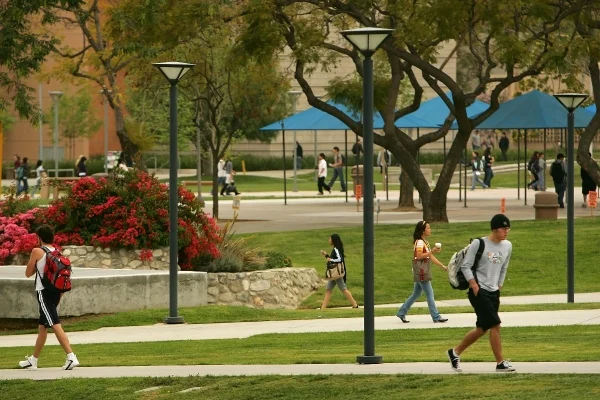
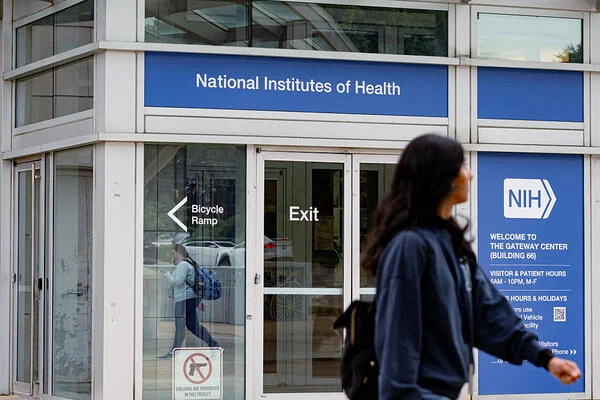
California State University, Fullerton, (above) is one of the 22 campuses where teamsters are prepared to strike.
David McNew/Getty Images
Members of Teamsters Local 2010, a union representing 1,100 skilled trade employees at the California State University system, voted Monday to authorize a strike across all 22 campuses.
CSU refused to pay contractually guaranteed five percent raises and salary step increases in July, and the union has filed several unfair labor practice complaints against the university system, union representatives said in a news release. Teamsters members are not striking yet, but are prepared to do so “if CSU continues to break the law, ignore their contract, and refuse to pay the raises that its skilled workforce is owed,” the release stated.
“CSU is steering itself into a completely avoidable battle with the Teamsters Union. Our members will not stand by while the University commits unfair practices, misuses state funds, breaks its promises, and enriches executives at the expense of the workers who keep its campuses running,” Jason Rabinowitz, secretary-treasurer of Teamsters Local 2010, said in the release. “CSU’s greed, dishonesty and disrespect for its workforce are indefensible. This vote makes clear that we are ready to strike if CSU continues to rip us off while lining their own pockets.”
In a statement, a spokesperson for the CSU Chancellor’s office said the vote is procedural and that a strike is not necessarily “imminent.”
“The result of the strike authorization vote is disappointing, as the current labor agreement, negotiated and ratified through the collaborative collective bargaining process, contained clear contingency provisions language that tied certain salary increases to the receipt of new, unallocated, ongoing state funding. Those contingencies were not met, leading to the current reopener negotiations on salary terms,” the spokesperson said. “We believe the time and resources of all parties would be more productively devoted to the bargaining table, where meaningful progress can be made, rather than toward preparing for a strike.”
The September 2025 assassination of conservative activist Charlie Kirk sent shockwaves through the political and academic worlds. It also ignited a public feud between two figures whose influence stretches across campus activism and national media: Candace Owens, a former Turning Point USA (TPUSA) strategist turned media provocateur, and Erika Kirk, the widow of Charlie Kirk and newly appointed leader of TPUSA. The conflict exposes not only the personal and political stakes involved but also the broader dynamics of media influence, ideological factionalism, and the politics of grief in contemporary higher education.
Charlie Kirk: Architect of Campus Controversy
Charlie Kirk built his public persona on provocation and confrontation. He staged highly orchestrated debates on college campuses, often targeting liberal-leaning students with “Prove Me Wrong” events that were designed to go viral. Turning Point USA’s social media strategy amplified these conflicts, rewarding spectacle over substantive discussion. Kirk also courted controversy through statements on race and opportunity, claiming in interviews that a Black woman had “taken his slot” at West Point, and through his unabashed support of fossil fuels, rejecting many climate mitigation policies.
Under Kirk’s leadership, TPUSA expanded its influence with aggressive initiatives. The Professor Watchlist cataloged faculty allegedly promoting leftist propaganda, drawing condemnation from academic freedom advocates who argued it chilled open debate and exposed professors to harassment. In 2019, TPUSA, through its affiliated nonprofit Turning Point Action, acquired Students for Trump, integrating campus organizing with national political campaigns. These moves cemented Kirk’s reputation as a strategist who thrived on conflict, spectacle, and the orchestration of young conservative voices, setting the stage for the posthumous clashes between Owens and Erika Kirk.
Candace Owens leveraged her experience as a TPUSA strategist into a national media presence. Her commentary is known for being provocative, frequently conspiratorial, and sometimes antisemitic. After Kirk’s death, Owens publicly questioned the official narrative, hinting that TPUSA leadership may have failed Kirk or been complicit. She amplified unverified reports, including accounts of suspicious aircraft near the crime scene, drawing criticism for exploiting tragedy for attention. Owens’ stature as a former insider gave her claims credibility in some circles, but her approach exemplifies the hazards of insider knowledge weaponized against organizations and individuals in moments of vulnerability.
Erika Kirk: Navigating Grief and Ideological Contradiction
Erika Kirk’s public response has been markedly different. As TPUSA’s new CEO and widow of its co-founder, she emphasized factual communication, transparency, and respect for grieving families. Yet her messaging presents a striking tension. She has publicly urged women to “stay at home and have children,” even as she leads a major national organization herself. This contradiction highlights the challenges faced by leaders whose personal actions do not neatly align with ideological prescriptions, especially within high-profile, media-saturated contexts.
Erika Kirk’s stance against conspiracy and misinformation underscores the responsibilities of institutional leadership in politically charged environments. By rejecting Owens’ speculation and emphasizing ethical communication, she models crisis management that prioritizes credibility and accountability, even as ideological tensions complicate her public image.
The Groypers: External Pressure on Campus Politics
The feud did not remain internal. The Groypers, a far-right network led by Nick Fuentes, inserted themselves into the controversy, criticizing TPUSA for insufficient ideological purity and aligning with Owens’ confrontational rhetoric. Their intervention escalated tensions, highlighting how external actors can exploit internal disputes to influence narratives, polarize supporters, and pressure campus organizations. The Groypers’ involvement illustrates the precarious environment student-focused organizations face, where internal conflict can quickly become a battleground for external ideological agendas.
Media, Campus Power, and Ethical Considerations
The Owens–Kirk conflict exemplifies the challenges inherent in politically engaged campus organizations. Insider knowledge can confer authority, but it can also be leveraged in ways that destabilize institutions. Personal grief and tragedy can be amplified in the media, creating narratives that are part advocacy, part spectacle. Organizations like TPUSA, with expansive networks, high-profile donors, and initiatives such as the Professor Watchlist and Students for Trump, are uniquely vulnerable to reputational damage and internal discord. Kirk’s legacy of confrontation and spectacle created fertile ground for sensationalism, factionalism, and opportunistic interventions by groups such as the Groypers.
Toward Responsible Leadership
The feud offers a cautionary lesson for student-focused political organizations and higher education at large. While former insiders may provide valuable insight, amplification of unverified claims can destabilize leadership, undermine institutional credibility, and warp student engagement. Erika Kirk’s insistence on restraint, transparency, and fact-based discourse demonstrates the importance of ethical leadership, media literacy, and principled decision-making in sustaining credible campus organizations.
Entangled Worlds as Spectacle
The conflict between Candace Owens and Erika Kirk is more than a personal dispute. It reflects the entangled worlds of media influence, ideological factionalism, and institutional accountability in higher education. For observers, the episode offers a vivid study of how grief, ideology, and spectacle collide, and how effective leadership must navigate these pressures with clarity, ethical judgment, and a steady commitment to institutional integrity.
Historically White Institutions (HWIs) occupy a distinctive position in the U.S. higher education landscape. Defined by their origins as institutions serving predominantly White students during eras of segregation, HWIs today include many of the nation’s most prominent colleges and universities. While often overlooked in discussions about equity, their historical and structural context provides key insight into why these institutions remain financially resilient even as other colleges, particularly smaller or more diverse institutions, struggle (Darity & Hamilton, 2015; Jackson, 2018).
Understanding HWIs
HWIs are schools founded to educate White students in a segregated society. Unlike Historically Black Colleges and Universities (HBCUs) or tribal colleges, HWIs historically excluded students of color. Today, they often enroll more diverse student populations than in the past, but their demographic and financial legacies remain.
Some of the largest and most prominent HWIs in the U.S. include:
Brigham Young University (UT) — affiliated with the Church of Jesus Christ of Latter-day Saints (LDS); majority White enrollment; nationally recognized academic and athletic programs.
University of Notre Dame (IN) — Catholic research university with a large endowment and historically majority White student body; high national profile academically and athletically.
Boston College (MA) — Catholic research university; historically White, strong alumni networks, and notable national reputation.
Marquette University (WI) — Catholic university; majority White; prominent regionally and nationally in academics and athletics.
Select public flagships in predominantly White states — such as University of Wisconsin–Madison and University of Michigan, whose student bodies historically reflect state demographics and remain disproportionately White relative to national averages.
These institutions collectively represent a significant portion of the elite, high-profile U.S. higher education sector, and they share common financial and structural advantages rooted in their historical composition (Smith, 2019; Harper, 2020).
Financial Advantages Linked to Demographics
Several factors stemming from HWI status contribute to financial stability:
Alumni Wealth and Giving
Historically, HWIs drew students from communities with greater intergenerational wealth. Today, this translates into strong alumni giving networks, major gifts, and multi-generational planned giving (Darity & Hamilton, 2015; Gasman, 2012). Universities like Notre Dame, BYU, and Boston College leverage these networks to maintain robust endowments and fund major campaigns.
Endowment Growth and Stability
HWIs often have substantial endowments accumulated over decades. Early access to philanthropic networks and preferential funding opportunities during eras when colleges serving communities of color were systematically underfunded contributed to long-term financial resilience (Gasman, 2012; Perna, 2006). Endowments provide flexibility for scholarships, faculty hiring, campus infrastructure, and new initiatives — crucial buffers against enrollment volatility.
Religious and Regional Networks
Many prominent HWIs are faith-based (BYU, Notre Dame, Boston College, Marquette). Their institutional networks foster recruitment, donations, and career placement. These social structures create operational and financial advantages that are difficult for newer or demographically diverse institutions to replicate (Harper, 2020; Museus & Quaye, 2009).
Comparative Risks: HWIs vs. Other Institutions
The financial and structural advantages of large HWIs become especially apparent when compared to smaller or mid-sized colleges that have closed or struggled in recent years, including faith-based and regional institutions with smaller endowments or more diverse student populations (Perna, 2006; Gasman, 2012). The historical demographic composition of HWIs — and the associated alumni wealth and networks — provides a buffer that allows them to weather challenges that might otherwise threaten institutional survival.
Challenges and Future Considerations
While HWIs enjoy structural advantages, they are not invulnerable. Changing demographics, particularly declining percentages of White high school graduates in key regions, present long-term enrollment challenges (Harper, 2020). HWIs that fail to diversify both their student bodies and donor bases may find these historical advantages eroded over time.
Moreover, institutions must balance financial stability with commitments to equity and inclusion. Over-reliance on historically White alumni networks can reinforce systemic inequities if not paired with active strategies to support students of color and broaden philanthropy (Smith, 2019; Jackson, 2018).
Legacies of Religion and White Privilege
Historically White Institutions provide a clear example of how demographic legacy intersects with financial resilience in higher education. Large HWIs such as Notre Dame, BYU, Boston College, Marquette, and select public flagships have leveraged endowments, alumni networks, and religious and regional structures to maintain stability and prominence.
Yet these advantages carry responsibilities: HWIs must adapt to shifting demographics, diversify both student and donor populations, and ensure that financial strength supports equity alongside institutional growth. Understanding HWIs is essential for policymakers, educators, and funders seeking to navigate the complex landscape of American higher education.
Selected Academic Sources
Darity, W.A., & Hamilton, D. (2015). Separate and Unequal: The Legacy of Racial Segregation in Higher Education. In The Color of Crime Revisited.
Gasman, M. (2012). The Changing Face of Private Higher Education: Wealth, Race, and Philanthropy. Journal of Higher Education, 83(4), 481–508.
Harper, S.R. (2020). Racial Inequality in Higher Education: The Dynamics of Inclusion and Exclusion. Review of Research in Education, 44(1), 113–141.
Jackson, J.F.L. (2018). Diversity and Racial Stratification at Predominantly White Colleges. New Directions for Higher Education, 181, 7–23.
Museus, S.D., & Quaye, S.J. (2009). Toward an Understanding of How Historically White Colleges and Universities Handle Racial Diversity. ASHE Higher Education Report, 35(1).
Perna, L.W. (2006). Understanding the Relationship Between Resource Allocation and Student Outcomes at Predominantly White Institutions. Review of Higher Education, 29(3), 247–272.
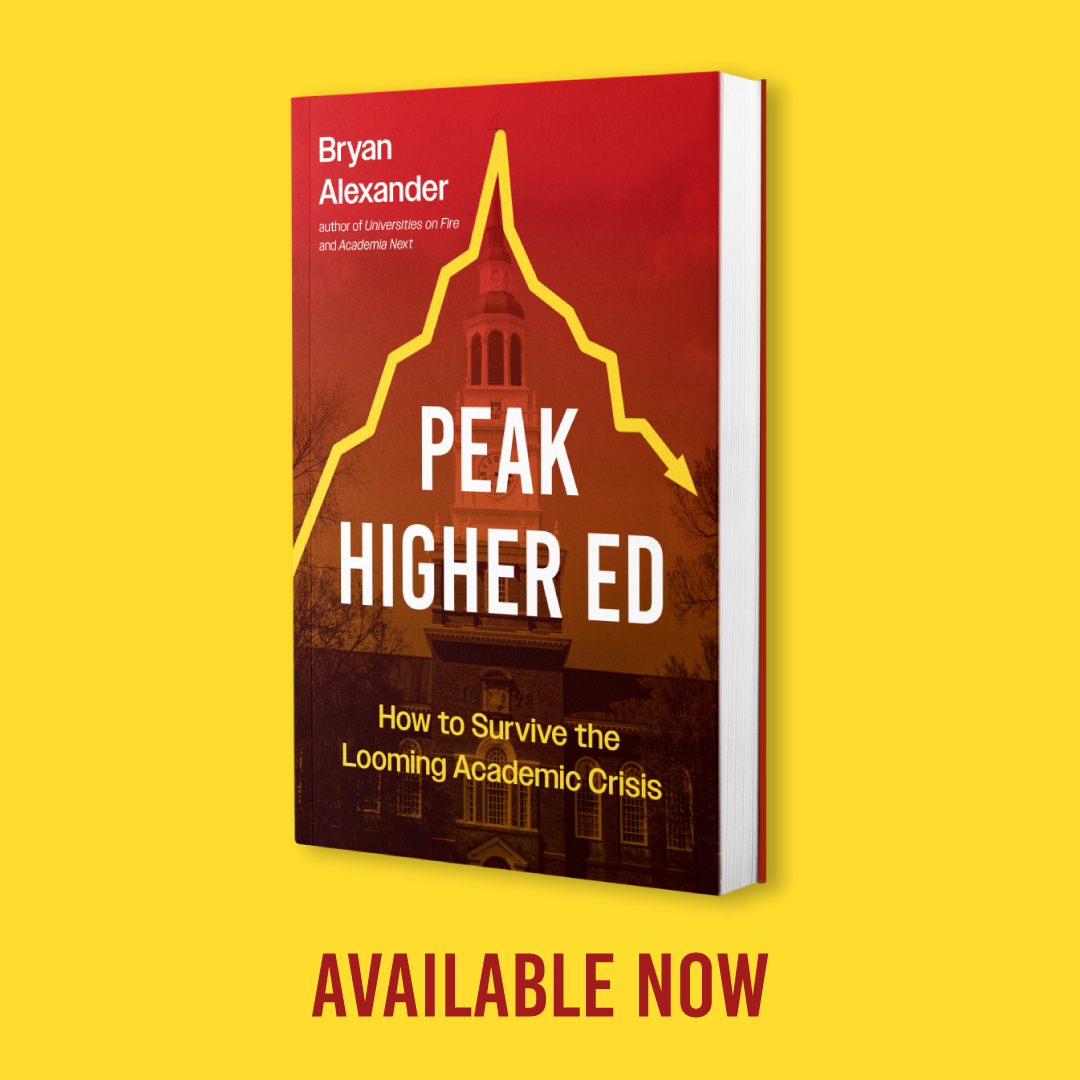
Greetings from the darkest week of the year in the northern hemisphere. As winter solstice draws nigh I’m preparing some end-of-year posts. But first, this month Johns Hopkins University Press is publishing my new book, Peak Higher Ed: How to Survive the Looming Academic Crisis. and I’m very excited. Go, little book!
I wanted to write about it here to share the news, but also because this book grew out of a blog post. Let me explain.
A dozen years ago I was doing some environmental scanning and was struck by some data which surprised me. In 2012-13 American higher ed enrollment had declined slightly and this got me thinking. As far as I knew student numbers had always been rising, at least in my experience. What might a reversal mean? If this one year’s decline wasn’t an aberration, what might a further decrease look like? If higher ed was starting to slide down past its peak, what could happen to colleges and universities? I did some futures analysis then jotted down thoughts in a blog post.
In the ways blogs worked back then, this post stirred some comments and interest. I reflected and noodled at the idea, next writing up the idea as an Inside Higher Ed column. Josh Kim wrote a riposte which helped develop things further. People wrote me offline and approached me in person, worried about what post-peak academia might become. I developed peak higher ed into a future scenario and started presenting on it to in-person and virtual audiences, adjusting it as feedback rolled in, while continuing to blog about it as new data appeared. For example, in 2018 I noted that enrollment was still declining, as per the peak model. Again, Josh Kim responded. In 2019 I turned in the book manuscript for Academia Next and it included a peak higher ed scenario chapter. That book covered a lot of ground, dwelling on many trends and multiple scenarios.
Time passed. I continued to track and analyze trends reshaping higher education, including those which formed the peak model. I bounced the idea around with many people (see the book’s acknowledgements). I published a second Hopkins book, Universities on Fire, which focused on one single trend, climate change.
In 2023 I wanted to change from writing about a trend to focusing on a scenario at length and pitched a book proposal to Johns Hopkins University Press. In my offer I worked in many issues besides the core peak idea to see how they might intersect. The publisher agreed to a contract. Being a pro-open person, I quickly blogged my proposal and plan in 2024 then set to work. I actually followed the plan closely, developing each chapter in the proposed sequence, and now the book is in the world. As a lifelong science fiction fan, I’m delighted to have a trilogy in print.
That’s quite a journey starting from a single blog post.
Let me say a bit more about what the book contains. The first two chapters sketch out the scenario in some detail, describing how enrollment and the number of post-secondary institutions rose, peak, and fell. Next, “After the Consensus Shattered” examines that story in light of the call for “college for everyone,” which has fallen on hard time (as I blogged). A major and open question is: what collective understanding of higher education will succeed it?
The next three chapters engage with three major forces or problems in the world and how they might intersect with post-peak academia. “Automation Comes for the Campus” focuses on AI and ends up offering several scenarios for how that technology might impact colleges and universities. “The Anthropocene Is Here, Ready or Not” addresses climate change, the subject of my previous book, and explores several ways higher ed might engage that enormous force. Then “Academia and the Struggle for Humanity’s Future” picks up my hypermodern/demodern idea to ponder how post-secondary education could grapple with emerging ideologies of human progress.
The book concludes with two visions of the academy’s next phase. One, “Managed Descent,” imagines the sector continuing to slide down away from peak. The last, “Climbing Back to Peak,” offers some ways by which academics might reverse course and transform our institutions. We could, if we dream boldly and with care, realize “peak” as in “peak performance.”
In the evolving landscape of U.S. higher education, one emerging force has attracted growing concern from the Higher Education Inquirer but remarkably little attention from policymakers: Ambow Education’s HybriU platform. Marketed as a next-generation AI-powered “phygital” learning solution designed to merge online and in-person instruction, HybriU raises serious questions about academic credibility, data governance, and foreign influence. Yet it has remained largely outside the scope of inquiry by the House Select Committee on the Chinese Communist Party.
Ambow Education has long operated in opaque corners of the for-profit higher education world. Headquartered in the Cayman Islands with a U.S. presence in Cupertino, California, the company’s governance and leadership history are tangled and controversial.
Under CEO and Board Chair Jin Huang, Ambow has repeatedly survived regulatory and institutional crises, prompting the HEI to liken her to “Harry Houdini” for her ability to evade sustained accountability even as schools under Ambow’s control deteriorated. Huang has at times held multiple executive and board roles simultaneously, a concentration of authority that has raised persistent governance concerns. Questions surrounding her academic credentials have also lingered, with no publicly verifiable evidence confirming completion of the doctoral degree she claims.
Ambow’s U.S. footprint includes Bay State College in Boston, which was fined by the Massachusetts Attorney General for deceptive marketing and closed in 2023 after losing accreditation, and the NewSchool of Architecture and Design in San Diego, which continues to operate under financial strain, low enrollment, leadership instability, and federal Heightened Cash Monitoring. These institutional failures form the backdrop against which HybriU is now being promoted as Ambow’s technological reinvention.
Introduced in 2024, HybriU is marketed as an AI-integrated hybrid learning ecosystem combining immersive digital environments, classroom analytics, and global connectivity into a unified platform. Ambow claims the HybriU Global Learning Network will allow U.S. institutions to expand enrollment by connecting international students to hybrid classrooms without traditional visa pathways. Yet independent reporting has found little publicly verifiable evidence of meaningful adoption at major U.S. universities, demonstrated learning outcomes, or independent assessments of HybriU’s educational value, cybersecurity posture, or data governance practices. Much of the platform’s public presentation relies on aspirational language, promotional imagery, and forward-looking statements rather than demonstrable results.
Compounding these concerns is Ambow’s extreme financial fragility. The company’s market capitalization currently stands at approximately US$9.54 million, placing it below the US$10 million threshold widely regarded by investors as a major risk category. Companies at this scale are often lightly scrutinized, thinly traded, and highly vulnerable to operational disruption. Ambow’s share price has also been highly volatile, with an average weekly price change of roughly 22 percent over the past three months, signaling instability and speculative trading rather than confidence in long-term fundamentals. For a company pitching itself as a provider of mission-critical educational infrastructure, such volatility raises serious questions about continuity, vendor risk, and institutional exposure should the company falter or fail.
Ambow’s own financial disclosures report modest HybriU revenues and cite partnerships with institutions such as Colorado State University and the University of the West. However, the terms, scope, and safeguards associated with these relationships have not been publicly disclosed or independently validated. At the same time, Ambow’s reported research and development spending remains minimal relative to its technological claims, reinforcing concerns that HybriU may be more marketing construct than mature platform.
The risks posed by HybriU extend beyond performance and balance sheets. Ambow’s corporate structure, leadership history, and prior disclosures acknowledging Chinese influence in earlier filings raise unresolved governance and jurisdictional questions. While the company asserts it divested its China-based education operations in 2022, executive ties, auditing arrangements, and opaque ownership structures remain. When a platform seeks deep integration into classroom systems, student engagement tools, and institutional data flows, opacity combined with financial fragility becomes a systemic risk rather than a marginal one.
This risk is heightened by the current political environment. With the Trump Administration signaling a softer, more transactional posture toward the CCP—particularly in areas involving business interests, deregulation, and foreign capital—platforms like HybriU may face even less scrutiny going forward. While rhetorical concern about China persists, enforcement priorities appear selective, and ed-tech platforms embedded quietly into academic infrastructure may escape meaningful oversight altogether.
Despite its mandate to investigate CCP influence across U.S. institutions, the House Select Committee on the CCP has not publicly examined Ambow Education or HybriU. There has been no hearing, subpoena, or formal inquiry into the platform’s governance, data practices, financial viability, or long-term risks. This silence reflects a broader blind spot: influence in higher education increasingly arrives not through visible programs or exchanges, but through software platforms and digital infrastructure that operate beneath the political radar.
For colleges and universities considering partnerships with HybriU, the implications are clear. Institutions must treat Ambow not merely as a technology vendor but as a financially fragile, opaque, and lightly scrutinized actor seeking deep integration into core academic systems. Independent audits, transparent governance disclosures, enforceable data-ownership guarantees, and contingency planning for vendor failure are not optional—they are essential.
Education deserves transparency, stability, and accountability, not hype layered atop risk. And oversight bodies charged with protecting U.S. institutions must recognize that the future of influence and vulnerability in higher education may be written not in classrooms, but in code, contracts, and balance sheets.
The University of Austin (UATX) markets itself as the cure for the alleged decay of American universities—a “fearless pursuit of truth” dedicated to restoring rigor, patriotism, and civic virtue. In a recent fundraising appeal, UATX’s president Carlos Carvalho argued that America’s youth have been “miseducated, unwise, and confused” by elite institutions and that only UATX’s model can reverse these trends.
But beneath the rhetoric lies a deeply ideological project that raises serious questions about educational substance, inclusivity, and the influence of wealthy backers. Rather than addressing the structural challenges facing higher education, UATX simplifies complex societal shifts into a moral blame game, offering solutions grounded in a narrow set of political and cultural assumptions.
A Narrow Diagnosis for a Complex Problem
UATX highlights surveys showing declining patriotism among young Americans and growing interest in alternative economic systems such as socialism. The university concludes that mainstream universities are to blame for this generational malaise—a claim both simplistic and selective. Attitudes toward identity, governance, and civic life are shaped by economics, media, community, and lived experience, not solely by seminar-room pedagogy. Reducing broad societal trends to grading policies or curriculum choices obscures complexity and risks promoting moral panic over reasoned analysis.
UATX’s Prescriptions: Tradition Over Inquiry
The university champions meritocratic admissions emphasizing test scores, small seminars, and strict grading as antidotes to the so-called “gutting of academic standards.” While rigorous study has value, these proposals reflect a particular vision of education: one centered on classical Western texts, narrow definitions of excellence, and pedagogical models that prioritize conformity over intellectual exploration. Rather than fostering openness, this approach risks reinforcing orthodoxy.
Donors, Ideology, and Influence
UATX rejects tuition and government support in favor of private philanthropy, a choice that amplifies questions of ideological influence. The university’s early and major backers are heavily aligned with conservative and libertarian priorities, raising doubts about whether the institution can serve as a genuinely neutral forum for intellectual inquiry. Notable supporters include Jeff Yass, billionaire co-founder of Susquehanna International Group and major Republican donor, who pledged $100 million to UATX, launching a $300 million campaign; Harlan Crow, real estate developer and GOP donor, reported as an early backer; Len Blavatnik, investor whose family foundation has donated to UATX; and Bill Ackman, hedge fund manager supporting UATX’s free-speech mission.
Founders and trustees include Bari Weiss, journalist and co-founder who remains a trustee, framing UATX as a response to “censoriousness” in higher education; Joe Lonsdale, venture capitalist and founding trustee linked to UATX’s fiscal sponsor; and Niall Ferguson, Pano Kanelos, and others who played founding leadership roles. The concentration of wealth and ideological alignment among donors raises pressing questions: can a university built on such a foundation truly function as a neutral intellectual space?
Alarmism, Ideology, and Academic Freedom
UATX portrays mainstream universities as ideologically monolithic and hostile to free speech. Critics note that such framing conflates disagreement with censorship, overlooking the robust debates already occurring on campuses nationwide. Moreover, by marketing itself as an alternative to “woke indoctrination,” UATX signals a particular cultural orientation rather than offering a neutral platform for diverse perspectives.
UATX presents itself as an education revolution. Yet its model appears more rooted in ideological branding than in addressing real structural and pedagogical challenges: affordability, accessibility, genuine academic freedom, and engagement with both classical and contemporary ideas. True reform demands more than a privately funded bubble of aligned donors and like-minded students; it requires grappling with complexity rather than caricaturing crisis.
Sources
Green, Erica L. At the U. of Austin, a Raft of Departures Leaves More Questions Than Answers.Chronicle of Higher Education.
Zaleski, Olivia. Austin’s Anti‑Woke University Is Living in Dreamland.The New Republic.
Smith, Helen. Is the University of Austin Betraying Its Founding Principles?Quillette.
CBS News. UATX Launches, Touting Ideological Openness and Debate.
Austin Monthly. How the So‑Called University of Austin Is Faring Nearly Two Years After Conception.
Chron.com. University of Austin Staff Exodus.
Reformaustin.org. GOP Donors Pour Millions Into Anti‑Woke University in Texas.
Salon.com. Bari Weiss’ Field of Right‑Wing Dreams: Will the University of Austin Ever Actually Exist?
When a new university president arrives on campus, they inherit more than a title and a set of obligations. They inherit a political ecosystem, a financial tangle, an entrenched culture of silence, and a long list of unresolved failures handed down like family heirlooms. Academic folklore captures this reality in the famous story of the three envelopes, a darkly humorous parable that has circulated for decades. But the contemporary landscape of higher education—with its billionaire trustees, private-equity logic, political interference, and donor-driven governance—demands an updated version. In 2025, the story no longer ends with three envelopes.
It begins the usual way. On the new president’s first day, they find a note from their predecessor and three envelopes in the top drawer. A few months later, enrollment stumbles, faculty grow restless, and trustees begin asking pointed questions. The president opens the first envelope. It reads: “Blame your predecessor.” And so they do, invoking inherited deficits, outdated practices, and “a period of transition.” Everyone relaxes. Nothing changes.
The second crisis comes with even less warning. Budget gaps widen. Donors back away. A scandal simmers. Morale erodes. The president remembers the drawer and opens the second envelope. It says: “Reorganize.” Suddenly the campus is flooded with restructuring proposals, new committees, new vice provosts, and flowcharts that signal movement rather than direction. The sense of activity buys time, which is all the president really needed.
Eventually comes the kind of crisis that neither blame nor reshuffling can contain: a revolt among faculty, a public scandal, a collapse in confidence from every constituency that actually keeps the university functioning. The president reaches for the third envelope. It contains the classic message: “Prepare three envelopes.” Leadership in higher education is cyclical, and presidents come and go with the expensive inevitability of presidential searches and golden-parachute departures.
But that is where the old story ends, and where the modern one begins.
In the updated version, the president sees one more envelope in the drawer. This one is heavier, embossed, and unmistakably official. When they open it, they find a severance agreement and a check already drafted. The fourth envelope is a parting gift from megadonor and trustee Marc Rowan.
The symbolism is blunt. In an era when billionaire donors treat universities like portfolio companies and ideological battlegrounds, presidential tenures can end not because of institutional failure but because the wrong donor was displeased. Rowan, the financier who helped drive leadership changes at the University of Pennsylvania, represents a broader shift in American higher education: presidents are increasingly accountable not to faculty, staff, students, or the public, but to wealthy benefactors whose money exerts gravitational pull over governance itself. When those benefactors want a president removed, the departure is not a matter of process or principle but of power.
The fourth envelope reveals the new architecture of control. It tells incoming presidents that their exit was negotiated before their first decision, that donor influence can override shared governance, and that golden severance packages can help smooth over conflicts between public mission and private interest. It is a warning to campus communities that transparency is not a value but an obstacle, and that leadership stability is fragile when tied to the preferences of a handful of financiers.
The revised story ends not with resignation but with a question: what happens to the public mission of a university when private wealth dictates its leadership? And how long will faculty, students, and staff tolerate a structure in which the highest office is subject not to democratic accountability but to donor impatience?
The four envelopes are no longer folklore. They are a mirror.
Sources Chronicle of Higher Education reporting on donor-driven leadership pressure at Penn Inside Higher Ed coverage on presidential turnover and governance conflicts Public reporting on Marc Rowan’s influence in university decision-making Research literature on billionaire philanthropy and power in higher education
Ask just about any federally funded researcher to describe 2025, and they use words like chaotic, demoralizing, confusing, destabilizing and transformational.
“It’s been a very destabilizing year [that’s made] people question the nation’s commitment to research,” Heather Pierce, senior director for science policy at the Association of American Medical Colleges, told Inside Higher Ed.
She expects 2026 to be a year of rebuilding and standard setting.
Speaking of the National Institutes of Health, which calls itself the world’s largest public biomedical research funder, Pierce said the research community is expecting more major regulation and written policy changes in 2026, which will shed more light on how grants will be funded, how much the federal government will invest in the research enterprise and what priorities will emerge from this administration.
If the administration’s attacks on federally funded research in 2025 are any indication, the federal government of 2026 will likely be just as willing to advance its conservative ideological agenda by controlling universities through the nation’s research enterprise. And while the administration may not let up in the new year, courts stymied some of its most sweeping changes in 2025 and may continue to be an obstacle in the new year.
Soon after President Donald Trump started his second term in January, the National Institutes of Health, National Science Foundation, Department of Education and numerous other federal agencies that collectively send billions in research dollars to universities, began freezing and terminating hundreds of grants. Many of the targeted grants—including projects focused on vaccines, climate change, and health and education disparities among women, LGBTQ+ and minority communities—were caught in the crossfire of Trump’s war against diversity, equity and inclusion initiatives and so-called woke gender ideology.
Not only would the terminations lead to the loss of jobs, staff and income, a lawsuit filed by a group of NIH-funded researchers in April predicted that “scientific advancement will be delayed, treatments will go undiscovered, human health will be compromised, and lives will be lost.”
The true damage comes from the betrayal, the sense of uncertainty and the loss of trust researchers have—or had—vis-à-vis with the federal government. That’s really hard to quantify.”
Scott Delaney, cofounder of Grant Witness
Terminated federal grants encompassed a wide range of research projects. Some of the casualties included funding to study the erosion of democracy, the effectiveness of work study, dementia, COVID-19, cancer and misinformation. Others supported teacher-training programs and initiatives designed to attract more underrepresented students into STEM fields.
“The premise of this award is incompatible with agency priorities,” read a letter the NIH sent to numerous researchers back in March, terminating their active grants. “[R]esearch programs based primarily on artificial and nonscientific categories, including amorphous equity objectives, are antithetical to the scientific inquiry, do nothing to expand our knowledge of living systems, provide low returns on investment, and ultimately do not enhance health, lengthen life, or reduce illness.”
But it didn’t stop there.
The Trump administration also temporarily froze billions more dollars in federal research grants at a handful of the nation’s wealthiest, most selective institutions, including Harvard University, Columbia University and the University of California at Los Angeles, for allegedly failing to address antisemitism on campus and ignoring the Supreme Court’s ban on affirmative action, among other allegations. (Most of the universities got their money back after cutting deals with the administration or via court orders.)
Faculty in the University of California system successfully fought the administration’s funding cuts, winning court orders to restore the money.
Justin Sullivan/AFP/Getty Images
And because the NIH, NSF, ED and several other federal agencies also laid off thousands of workers, researchers with questions had far fewer resources to help them navigate changes to application and award processes.
By some estimates, the government disrupted upward of $17 billion in NIH grants alone this year, according to Scott Delaney, a former lawyer and Harvard University epidemiologist who the university laid off as a result of grant terminations.
Earlier this year, he cofounded Grant Witness, a website that has been tracking grant cancellations at the NIH, NSF and the Environmental Protection Agency. While both the NIH and NSF have since restored thousands of grants, Delaney said those and other restorations won’t be enough to repair the now-fractured relationship between faculty and federal funding agencies.
“The true damage comes from the betrayal, the sense of uncertainty and the loss of trust researchers have—or had—vis-à-vis with the federal government. That’s really hard to quantify,” he told Inside Higher Ed this month. “In the years ahead, there will be folks who don’t want to plan long-term research projects because they don’t know if their funds are going to get summarily yanked out from underneath them; folks who don’t want to continue their careers in academic research or train in academic research; trainees who would have had training grant support who don’t now and go do something else. And some researchers will just leave the country.”
In addition, some of the Trump administration’s research funding proposals have stoked worry this year about the long-term sustainability of the nation’s academic research enterprise.
Numerous agencies—including NIH, NSF and Department of Energy—have attempted to cut university reimbursement rates for indirect research costs. Higher education and science advocates characterized such policies as “shortsighted and dangerous,” and said it would hamper university budgets, hurt the economy and stymie scientific progress. Although federal courts have since blocked the rate caps, the mere anticipation of such policy changes led some universities—including the Massachusetts Institute of Technology and Northwestern University—to freeze hiring and, in some cases, graduate admissions.
But by September, the NIH said it was on track to spend its full $47 billion budget by the end of the fiscal year that month.
However, the NIH awarded 3,500 fewer competitive grants this year with the biggest declines at the Institutes of minority health, nursing, human genome, alcohol abuse and alcoholism and mental health, according to The New York Times. Those changes are part of the White House’s plan to streamline scientific funding by eliminating wasteful spending and cutting “woke programs” that “poison the minds of Americans.”
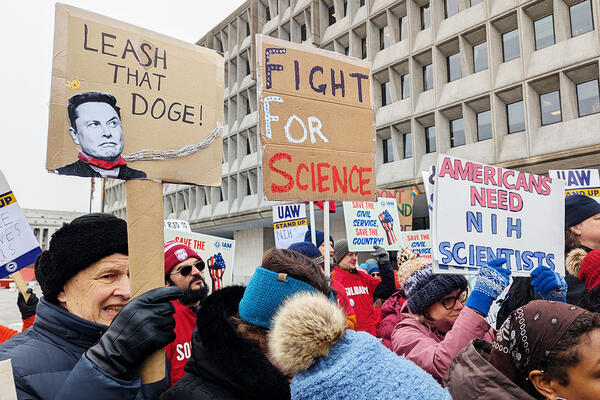
The cuts to federal agencies and research spurred protests in the spring.
As 2025 fades into 2026, the federal research funding picture isn’t looking as bleak—at least not on the surface.
A flurry of litigation from universities, individual researchers, trade associations and labor unions prompted several federal agencies to reinstate some research grants.
All things considered, 2025 “could have been worse, but it was still awful,” Delaney said, noting that there are still thousands of grants in limbo at the NSF, DOE and numerous other agencies beyond the NIH.
“So many people fought so hard—some of them sacrificed their jobs inside these federal agencies—and they succeeded in many ways. To tell a story that doesn’t include both their sacrifice and their success discredits what was a Herculean and heroic effort for scientists, many who have never spoken up in a political way before this year,” he added. “But it’s also important to emphasize that this fight isn’t over, and we need to keep fighting. It can get worse.”
‘Not Insulated From Politics’
Katie Edwards, a social work professor at the University of Michigan, is one of the researchers who sued the NIH. In March, the agency canceled six grants she was using to research mental health and violence prevention among marginalized young people, including Indigenous and LGBTQ+ youth. Valued at $10 million, the grants supported roughly 50 staff, community collaborators and trainees and put them all at risk of losing their jobs.
“For many trainees—especially those who are LGBTQ+ or people of color—the message they internalized was painful: that research on their communities is ‘ideological’ or expendable,” Edwards wrote in an email to Inside Higher Ed. “The emotional toll of fighting for and protecting staff, reassuring community partners, and trying to navigate a constantly shifting federal landscape has been immense.”
Fighting for Public Health Research
April: A group of NIH researchers, a public health advocacy organization and a union representing more than 120,000 higher education workers sued the NIH for terminating more than $2.4 billion in grants.
August: The U.S. Supreme Court ruled by a vote of 5 to 4 that any legal challenges to the grant terminations should be litigated in the Court of Federal Claims, not the federal district court system they’ve been moving through for months.
Edwards
University of Michigan
Although her grants have since been reinstated—albeit some with reduced dollar amounts, administrative delays and anti-DEI language in the notice of award—and her team has resumed their work, this year has forever changed her perspective on research.
“This year made clear that science is not insulated from politics—and that researchers must be prepared to defend not only their projects, but the people those projects exist to serve,” Edwards said. “Federally funded research with marginalized communities requires constant vigilance, strong partnerships, and collective resistance. We cannot simply adjust our science to political winds when real communities rely on this work.”
But not every researcher who appealed a grant termination got their money back.
In March, the Education Department informed Judith Scott-Clayton, a professor of economics and education at Teachers College, Columbia University, that it was cancelling her six-year grant to examine the impact of receiving federal work-study funding on enrollment and persistence among low-income students four and a half years into the grant.
Teachers College appealed the decision in April, but the government rejected it in September, stating that Education Department grants were specifically excluded from Columbia University’s settlement with the Trump administration. Support from a private foundation allowed Scott-Clayton and her team to resume their research this November, but she told Inside Higher Ed that the disruptions to research have been “extremely unsettling and demoralizing.”
And she’s not certain that 2026 will be any better.
“Even though I believe in the value of what I do, self-doubt can flare up when an authority as significant as the federal government formally declares your work to be a waste of resources,” she said. “I am not sure what the future of our field looks like if our federal government no longer values research evidence. And I am not sure what our society looks like if the federal government can make decisions so arbitrarily without any consequences or constraints.”
New Year, Old Concerns
This year is ending with unresolved questions about what the Trump administration’s research policies will ultimately be, and how much the federal government will fund research. Pierce at the Association of American Medical Colleges said she expects next year will provide answers.
Joanne Padrón Carney, chief government relations officer for the American Association for the Advancement of Science (AAAS), said “I think the [the Energy Department’s] Genesis mission and the prioritization of artificial intelligence and emerging technologies is going to be a key driver in—I guess you could say—filling in the cracks of the foundation of the research enterprise that has been kind of hit by this earthquake in the past year.”
The National Institutes of Health has cut staff and is eyeing other changes to how it funds research.
Wesley Lapointe/The Washington Post via Getty Images
The continuing resolution that ended the historically long federal government shutdown in November expires Jan. 30, and Congress is leaving town for the holidays without passing funding bills for some major science funding agencies, including the NIH, NSF and Energy.
Trump proposed slashing about $5.2 billion from the NSF. But House appropriators have suggested cutting $2.1 billion, while senators only put forth axing $60 million, according to an appropriations debate tracker from the AAAS. And while the president proposed cutting nearly 40 percent from the NIH—$18.1 billion—the House and Senate have instead suggested increasing its funding by roughly $1 billion, the tracker shows. That pushback from Congress is promising, advocates say.
And colleges and universities are still waiting for federal research funding agencies to set indirect cost reimbursement caps, after litigation blocked their plans to set the limit at 15 percent. The forthcoming OMB guidance setting those caps is also supposed to help agencies implement Trump’s controversial August executive order directing “senior appointees” to take charge of awarding, denying, reviewing and terminating new and already awarded grants. Among other changes, that order also said grants can’t “promote” racial preferences or “the notion that sex is a chosen or mutable characteristic,” and that they “should be given to a broad range of recipients rather than to a select group of repeat players.”
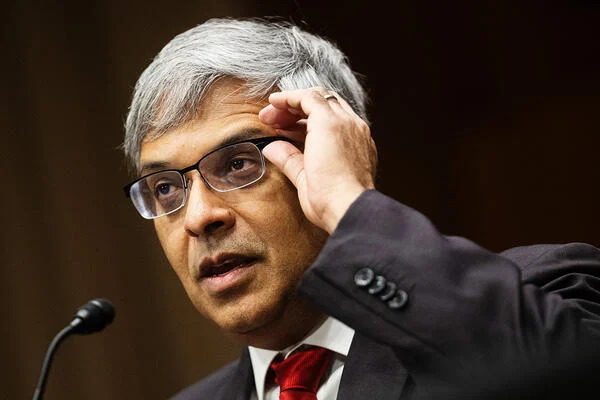
Dr. Jayanta Bhattacharya took over the National Institutes of Health and has pledged to support what the administration calls “gold standard science.” He’s become a vocal supporter of the Make America Healthy Again agenda, which focuses more on chronic diseases.
Jim Watson/AFP/Getty Images
Further, the NIH is eyeing ways to reduce how much of its grant dollars researchers can use to pay scientific journals to publish their work. The proposed options ranged from limiting how much could be spent per publication or capping the percentage of a grant that can go toward publishing fees overall, to no longer funding publication costs whatsoever. The NIH said in the summer that it planned to make whatever policy it chose effective early next year, but it only recently released the public comments, and an agency spokesperson said he couldn’t provide a definitive implementation timeline.
Just this week, Science published a memo showing that NSF is scaling back its reviews of grant proposals, citing its “significantly reduced” workforce and a need to expedite approvals and denials to address a “significant backlog of unreviewed proposals and canceled review panels” from the government shutdown. The memo also said NSF program officers are “expected to maximize their use of available automated merit review tools, especially tools that identify proposals that should be returned without review.”
And the NIH ordered staff last Friday to start using a “computational text analysis tool” to scan current and new grants for words and phrases that may mean they’re misaligned with NIH priorities. Staff were told to look out for terms such as “health equity” and “structural racism.” How this and the NSF policy changes will work in practice remains to be seen.
The educational improvement research field also awaits word on the future of the congressionally required Institute of Education Sciences (IES), which the administration gutted early this year amid its ongoing push to dismantle the larger Education Department. IES is the federal government’s central education data collection and research funding agency. Education secretary Linda McMahon hired a special adviser to “re-envision” it, but the plan hasn’t been released.
Overall, Pierce said 2026 “will continue to be a challenging year, especially for those researchers, institutions and trainees that have seen their grants terminated.” But she noted medical research is marked by passion for improving the nation’s health.
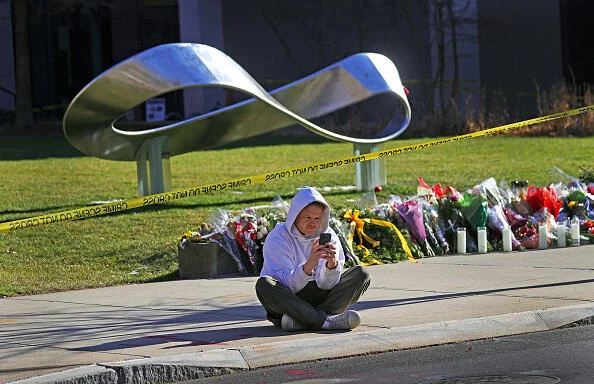
The suspect wanted in connection to a mass shooting at Brown University that killed two students and injured nine was found dead in a storage unit in Salem, N.H., authorities said at a news conference Thursday night.
They identified Claudio Manuel Neves Valente, 48, a former Brown student and Portuguese national, as the man they say barged into an engineering classroom at Brown last Saturday and opened fire on students attending a review session. Valente died from a self-inflicted gunshot wound.
“We are 100 percent confident that this is our target and that this case is closed from a perspective of pursuing people involved,” Rhode Island attorney general Peter Nerhona said.
Officials said they believed Valente was also connected to the murder of MIT nuclear physicist Nuno Loureiro earlier in the week. The same rental car had been spotted near Brown and outside Loureiro’s home, authorities said.
Loureiro was shot at his home Monday night and died at the hospital the next day. His home in Brookline, Mass., is about 50 miles from Brown. Authorities said that in the 1990s, Valente had attended the same university in Lisbon as Loureiro.
Brown President Christina Paxson said at the press conference that Valente had been a student at Brown in the early 2000s but withdrew. She noted that he was a physics student and had likely spent a lot of time in the Barus and Holley science building, where Saturday’s shooting took place.
Paxson wrote in an update Friday that the students injured Saturday were all improving; three had been released from the hospital and six remained in stable condition.
Officials said Valente entered the U.S. in 2000 on a student visa; he became a lawful permanent resident in 2017.
On Friday, the Trump administration announced it was suspending the green card lottery program through which Valente entered the country in 2017. The Diversity Immigrant Visa program, or DV1, allows some 50,000 people a year from low-immigration countries to participate in a random selection process for entry to the U.S.
Valente “entered the United States through the diversity lottery immigrant visa program (DV1) in 2017 and was granted a green card,” Secretary of Homeland Security Kristi Noem wrote on X. “This heinous individual should never have been allowed in our country. … At President Trump’s direction, I am immediately directing [United States Citizenship and Immigration Services] to pause the DV1 program to ensure no more Americans are harmed by this disastrous program.”
This story was updated 12/19 with news about the condition of the injured Brown students and the Trump administration’s pause on a visa lottery program.
For nine years, Inside Higher Ed published an annual list of predictions known as the In-and-Out List, before taking a four-year hiatus. That ends now. In the last edition, IHE staff called 2020 “a year from hell” and a “rough year for higher ed.”
As another year looms, colleges and universities are bracing for yet more upheavals as they try to navigate the new normal. Time—and 2026—will tell whether the sector is resilient enough to do so.
Below, we look at the rollercoaster that was 2025 and offer our own very loose predictions for what may lie ahead. Happy 2026.