Tag: Higher

  • Freshman enrollment up this fall; data error led to miscount

    Freshman enrollment up this fall; data error led to miscount

    Freshman enrollment did not decline this fall, as previously reported in the National Student Clearinghouse Research Center’s annual enrollment report in October. On Monday, the NSC acknowledged that a methodological error led to a major misrepresentation of first-year enrollment trends, and that first-year enrollment appears to have increased.

    The October report showed first-year enrollments fell by 5 percent, in what would have been the largest decline since the COVID-19 pandemic—and appeared to confirm fears that last year’s bungled rollout of a new federal aid form would curtail college access. Inside Higher Ed reported on that data across multiple articles, and it was featured prominently in major news outlets like The New York Times and The Washington Post.

    According to the clearinghouse, the error was a methodological one, caused by mislabeling many first-year students as dual-enrolled high school students. This also led to artificially inflated numbers on dual enrollment; the October report said the population of dually enrolled students grew by 7.2 percent.

    “The National Student Clearinghouse Research Center acknowledges the importance and significance of its role in providing accurate and reliable research to the higher education community,” Doug Shapiro, the center’s executive director, wrote in a statement. “We deeply regret this error and are conducting a thorough review to understand the root cause and implement measures to prevent such occurrences in the future.”

    On Jan. 23, the clearinghouse will release another annual enrollment report based on current term estimates that use different research methodologies.

    The Education Department had flagged a potential issue in the data this fall when its financial aid data showed a 5 percent increase in students receiving federal aid. In a statement, Under Secretary James Kvaal said the department was “encouraged and relieved” by the clearinghouse’s correction.

    Source link

  • A Response to ‘Online Degrees Out of Reach’

    A Response to ‘Online Degrees Out of Reach’

    A Response to ‘Online Degrees Out of Reach’

    Susan H. Greenberg

    Mon, 01/13/2025 – 03:00 PM

    An ed-tech consultant writes that a recent article about online completion rates “shows a disturbing disregard for the complexities of education outcomes.”

    Byline(s)

    Letters to the Editor

    Source link

  • Career planning advice for grad students/mentors (opinion)

    Career planning advice for grad students/mentors (opinion)

    lvcandy/DigitalVision Vectors/Getty Images

    As a trained scientist, I had a fantastic research mentor. We talked about my research project, which experiments to prioritize and what the data meant, and we even sometimes discussed personal things like family and ties to home. When I joined his lab, I was open with my mentor about my interest in a teaching career and my desire to run a small research program working primarily with undergraduates. However, my career aspirations evolved over the course of my graduate training, and I found myself hesitant to share my new career goals. Though I recognized that my interactions with my mentor were quite positive and supportive, I still feared that sharing my non–academic scientist aspirations would somehow disappoint him, or worse, that I wouldn’t get the fullest support for my research training.

    Now, as a career development professional who advises biomedical Ph.D. students, I see this same pattern often. Students express feeling comfortable discussing their research and academic endeavors with their research mentors but hesitate when it comes to discussing career plans outside academic research. They fear not receiving the same level of support and training, letting their mentor down, or being seen as less committed to their research and academic pursuits.

    While I find these feelings familiar, I now encourage students to push past these fears. Students can receive valuable guidance and access to further opportunities when they engage in career conversations with their mentors. I also advocate for research mentors to be intentional about incorporating career planning into their training and mentoring conversations. What follows is advice for both students and research mentors for having more productive and positive career conversations.

    For Students

    Having career conversations is a professional skill you can learn.

    The first thing you need to know is you are not alone. Feeling apprehensive about talking to your mentor about your career is completely normal, especially if you have not engaged in these conversations before or if you are expressing a desire to explore careers outside academia. Even if your mentor hasn’t followed the career path you’re considering, they can still offer guidance, opportunities to help you develop transferable skills and connections within their network who may offer inroads into other career sectors.

    Start career conversations early. Waiting until you’re rushing to graduate or scrambling for the next step often results in missed opportunities to prepare effectively. Starting these conversations early gives you time to explore different options, take advantage of targeted learning opportunities and make more informed decisions. For example, you could start the conversation with your mentor by saying, “I’ve been learning about careers in science policy and how Ph.D.s can impact policy and regulatory rules in government roles. I’d love to hear your thoughts on this type of career and any advice you might have for exploring it further.” This approach invites your mentor to join the conversation as a collaborator and can set the stage for regular career conversations.

    Engage in reverse mentorship. Instead of assuming your mentor cannot help with careers outside academia, consider this an opportunity to take a proactive approach in researching career options and sharing what you learn with your mentor. This can help educate your mentor and also serve as a springboard to discuss transferable skills and potential opportunities. For example, you might say, “I’ve been learning about career opportunities for Ph.D.s in biotech project management roles. These positions value skills like leadership, data interpretation and cross-functional communication. Could we talk about how I might develop these skills further in my current work?” This approach positions you as an active learner and invites your mentor to help you acquire the skills you need. As your mentor learns about the transferable skills most relevant to your career preparation, it may also lead to opportunities where you and your mentor can align your research endeavors with skills needed for your future.

    Use an individual development plan to guide regular conversations. Having one career conversation is a great start, but ideally you would have these conversations on a more regular basis. An IDP is a great tool for structuring regular career discussions with your mentor and is often used on an annual or semiannual basis. The IDP can guide you to reflect on your career interests, identify skills you want to develop and set clear, actionable goals. You can then share and discuss your IDP with your mentor during regular check-ins to seek their advice on your goals and progress. This provides a collaborative approach to your career planning, keeps your discussions focused and over all helps you both be more transparent with your planning. Many Ph.D. programs provide their own customized IDPs that incorporate research and career planning. Another widely used resource is the myIDP tool from Science Careers, which provides a step-by-step framework for self-assessment, career exploration and goal-setting.

    For Research Mentors

    You can support career discussions, even outside your area of expertise.

    For research mentors, it’s understandable that these conversations can feel daunting when you don’t have experience in the career fields your students are interested in. However, mentors don’t need to be experts in every career to provide students with meaningful support, valuable connections and opportunities for skill enhancement.

    Normalize career discussions. Encourage your student to talk about their career aspirations early in the mentoring relationship and be supportive of careers outside of academia. This signals to your student that their career is just as important as their research, and you’re invested in helping them succeed whether they choose an academic career or not. You can start by simply saying, “I know your interests may change throughout your studies, but what are some career options you are currently considering after graduate school?” Asking your student what they are considering is a much less intimidating question than “What do you want to do or be?” It also invites your student to be more open with what they are thinking and creates space for their choices to evolve as they gain further experiences.

    Ask questions and offer connections. Even if you don’t know much about, say, a career in science communication or technology commercialization, you can still ask reflective questions to help your student clarify their goals. Asking, “What excites you about this path?” or “What skills do you think are important in that field?” shows interest and invites further conversation. If possible, you can then connect them with lab alumni or professionals in your network who may have more expertise in that specific career field. Your institution may also have a career development office that you can refer your student to for further career-readiness support. If you truly don’t know about the career, sharing a willingness to learn can set the stage for productive conversations in the future.

    Recognize the value of transferable skills. Your student is learning a wealth of skills in their academic and research experiences. As their mentor, you can assist your student in understanding how the research skills they’re developing—such as critical thinking, data analysis, grant writing and project management—can apply broadly across many careers. Additionally, as your student identifies skills they will need in the specific career they are targeting, you may be able to help them gain experiences honing those skills. The student interested in scientific writing may become your go-to person for editing, and together you can plan to have the student lead efforts on a comprehensive review and assist more with grant writing. Or you may ask the student aspiring to move into data science to take on a project analyzing large data sets and give them more opportunities to practice their programming skills. When you align transferable skill development with research endeavors, you’re actively supporting your student’s career goals in a way that is productive for both of you.

    Acknowledge that career choices are based on personal and professional goals. Your student’s career decisions are based on both their personal priorities as well as their professional ambitions. Family planning, financial stability, caregiving responsibilities, health needs, visa restrictions or a need for geographic flexibility are just a few of the many factors that influence career decision-making. If you treat these considerations as unimportant or secondary to research, you will not adequately help your student navigate key factors in their long-term career decision-making. However, encouraging your student to integrate both personal and professional priorities into their career planning demonstrates an investment in them as a whole person and supports them in making thoughtful and sustainable career choices aligned with their personal needs.

    Coda

    I still remember my own mentor’s reaction when I finally shared my career goals. He admitted that he didn’t know much about the career I wanted to pursue—academic administration—but he then reassured me of his support. It turned out that I didn’t need to be nervous about this conversation. He was happy to provide supportive recommendation letters, help me make connections, serve as a positive job reference and offer general job-seeking advice. I graduated shortly thereafter, and his support played a critical role in landing positions early in my career. My only regret when I think back to my time as a graduate student is knowing that I could have begun to have these career conversations sooner.

    Raquel Y. Salinas is the director of student affairs and career development at the University of Texas MD Anderson Cancer Center UTHealth Houston Graduate School of Biomedical Sciences. She is a member of the Graduate Career Consortium, an organization providing an international voice for graduate-level career and professional development leaders.

    Source link

  • University 4.0: A Vision for the Future of Higher Education

    University 4.0: A Vision for the Future of Higher Education

    ***It’s not too late to register for HEPI’s events this week: ‘Earning and learning: What’s the reality for today’s students?‘ webinar with Advance HE at 10am, Tuesday 14 January and ‘Who Pays? Exploring Fairer Funding Models for Higher Education‘ Symposium at Birkbeck, Thursday 16 January 10am to 5pm.***

    By Professor Aleks Subic, Vice-Chancellor and Chief Executive, Aston University.

    Universities have always been at the heart of knowledge and innovation. But in today’s rapidly evolving world, they must transcend their traditional roles to address complex global challenges, harness emerging opportunities and embrace heightened responsibilities. They must become champions of inclusive innovation and drivers of positive socioeconomic transformation, creating thriving innovation ecosystems that deliver sustainable, place-based development and inclusive growth. This is the promise of University 4.0.

    From Classical Roots to Transformational Ecosystems

    In late 2024, Aston University hosted the Global Federation of Competitiveness Councils (GFCC) University Research and Leadership Forum, marking a pivotal moment in the reimagining of higher education. Leaders, innovators, and visionaries from universities, industry, government, and communities gathered to confront a critical question: How can universities redefine their role in a world that is transforming at an unprecedented pace?

    The GFCC, a global multi-stakeholder membership organisation, is dedicated to accelerating productivity, growth, prosperity, and sustainability through best practices. Central to this forum was the exploration of University 4.0 — a bold and transformative vision for the future of higher education in an era of digital disruption, hyper-connectivity, the emergence of powerful technologies like artificial intelligence, social inequities, and sustainability challenges.

    The Global Federation of Competitiveness Councils (GFCC) University Forum, which I have had the privilege to lead from Aston University, and Elsevier Fourth Generation University (4GU) Development Group, inspired by the pioneering work of the University of Technology Eindhoven, have independently arrived at remarkably aligned perspectives on the evolution of universities to date. This shared understanding traces the progression through four distinct generations of higher education institutions, culminating in the transformative vision of University 4.0 (or 4GU).

    Universities have evolved through several transformative stages to meet the demands of each era:

    1. The Classical University: The first generation focused on teaching, by transmitting knowledge through oral communication and manuscripts. Its primary purpose was education.
    2. The Research University: The second generation emphasised the creation of new knowledge through scientific research, making universities hubs of research and innovation.
    3. The Entrepreneurial University: The third generation saw universities become economic players, commercialising research, fostering start-ups, and forging closer ties with industry. This era marked the rise of the ‘triple-helix’ model, integrating academia, industry, and government.
    4. University 4.0: The fourth generation is a response to a rapidly changing, technology-driven world. It envisions universities that are focused on socio-economic impact, inclusive innovation, and sustainable development goals, interconnected with industry, government, and society. These institutions are engines of innovation and transformation, embracing the ‘quadruple-helix’ model by integrating academic expertise with diverse societal needs to deliver real-world impact.

    The University 4.0 model is not about solitary academic pursuits. Instead, it thrives on collaboration, drawing diverse perspectives and inputs to address real-world challenges. Innovation precincts and districts — geographically concentrated hubs of high-tech companies, research institutions, and civic infrastructure — are emerging as the epicentres of economic revitalisation, creating opportunities for skilled workforces and fostering sustainable and high-value growth through place-based innovation.

    Universities embedded in such precincts, acting as catalysts of engagement and innovation are emerging as the fourth-generation universities – University 4.0. They are aligned more closely to technological and digital transformations, ensuring greater interconnectivity between the future of work and learning, bringing society along and alleviating the so-called societal pain when education lags behind industrial and digital revolutions.

    University 4.0 in Action: Aston University and the Birmingham Innovation Precinct

    At Aston University, the University 4.0 vision is central to our Aston 2030 Strategy. We are transforming into a fourth-generation university that is future-ready and aligned with national higher education reform priorities as outlined recently by Secretary of State for Education Bridget Phillipson. Universities must shift from isolated knowledge hubs to active participants in their regional and national ecosystems, embracing transformational business models and their roles as civic anchors.

    A flagship example of this vision is the Birmingham Innovation Precinct, part of the West Midlands Investment Zone. This innovation cluster, based on the quadruple-helix model, integrates academia, industry, government, and communities to create a globally significant hub of collaboration and innovation. By co-locating stakeholders, the precinct fosters digital innovation, improves health equity, drives skills development, and accelerates the transition to net-zero emissions.

    Key initiatives within the Birmingham Innovation Precinct include:

    • 10 Woodcock Street: A newly acquired 225,000 sq ft facility, set to house Aston Business School, the Aston Integrated Healthcare Hub, the Aston Business Incubator, and the Green Energy Centre delivering sustainable energy solutions to the precinct with net zero emissions.
    • The Aston Integrated Healthcare Hub: A model for community healthcare that offers preventative health and wellbeing services while showcasing advancements in digital healthcare technology, including remote patient monitoring. Operating as a ‘living lab’, it integrates translational research and inclusive innovation, student placements, and training to address local health inequities.
    • The Aston Business Incubator: Launching in 2025, the incubator will provide a home to 100 tech startups and innovative businesses. Offering state-of-the-art facilities, collaborative workspaces, and access to academic expertise, mentoring and investment, it will transform ideas into thriving enterprises.

    These initiatives are more than projects; they are integral to Aston University’s commitment to place-based innovation, delivering measurable socioeconomic impact for Birmingham, the West Midlands, and beyond.

    A Call to Action for the Future of Higher Education

    The transition to University 4.0 represents a fundamental shift in how higher education operates, collaborates, and contributes to society. However, to fully realise this vision, systemic change is required—not only within universities but across the funding models and evaluation frameworks that shape them.

    The current funding and ranking systems often prioritise traditional metrics that fail to capture the broader socioeconomic contributions of universities, like access and participation, employability, social mobility, digital inclusion, contributions to health outcomes and sustainability, and impacts stemming from knowledge transfer and innovation. To truly support and reward the transformative impact of University 4.0, these systems must evolve to measure and incentivise the right indicators. As we move forward, it is essential to ask not just what we are good at but what we are good for. Only then can universities fulfil their potential as engines of innovation, inclusion, and growth for a better future.

    Source link

  • 7 Essential Benefits of Interoperability in Higher Education

    7 Essential Benefits of Interoperability in Higher Education

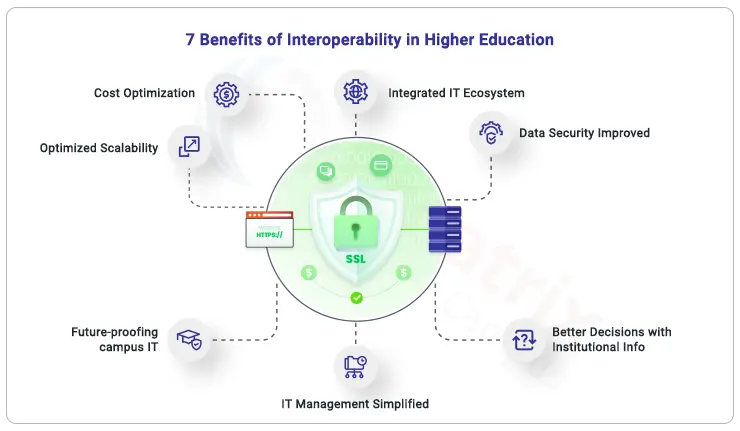
    It is true that institutions trying to adapt, innovate, and provide excellent experiences to staff, teachers, and students now depend critically on their capacity to easily integrate and share data across many platforms! Interoperability in higher education—the ability of technologies to cooperate effectively—is not a luxury but rather a need for building responsive and efficient campuses. Particularly, the need for interoperability in student management systems is regarded as crucial for changing the higher education student experience. These seven main arguments explain why developing the university of the future depends on interoperability.


    Benefits of Student System Integration for Your Higher Education Team


    How to Integrate Systems for a Smarter Campus Environment?

    For a smarter campus, facilities, academic tools, and administrative systems must be seamlessly integrated. Interoperable technologies improve student and staff campus experiences via real-time data sharing, automated workflows, and resource management. Energy efficiency, security, and academic creativity can improve with smart buildings and IoT networks.


    Top 7 Benefits of Interoperability in Higher Education

    EDUCAUSE conducted a survey revealing that 74% of institutions utilizing integrated data systems reported significant enhancements in their monitoring of student performance and retention rates. Let’s split up the core benefits for you!


    7 benefits-of-interoperability-in-higher-education


    1. Optimized Scalability

    Swift transformations, such as the demand for enhanced online provisions, necessitate scalable systems. Interoperable solutions facilitate the integration of Learning Management Systems (LMS), Enterprise Resource Planning (ERP) technologies, and other systems into a cohesive digital platform. This guarantees that institutions can effectively expand operations, automate workflows, and incorporate new tools without interruption. A 2024 European Education Area finding figured out that HE’s interoperability can better student mobility and credit recognition by 5X times.


    2. Cost Optimization

    Historically, the implementation of new systems in isolation resulted in elevated expenses. A cloud-based, interoperable platform reduces costs through centralized management, streamlined processes, and minimized hardware needs. By leveraging real-time access to advanced tools, institutions may enhance their return on investment and save IT costs. It strengthens relationships and collaborations between students and educators.


    3. Cohesive IT Ecosystem

    An incoherent array of solutions represents an administrative burden. Interoperability, whether on-site or cloud-based, enhances a cohesive IT infrastructure suitable for hybrid configurations. This method guarantees harmonious functionality of all technologies and facilitates system integration.


    4. Enhanced Data Security

    Higher education emphasizes data security. Student and institutional data are protected through encryption and customized access controls across compatible platforms. Risks are alleviated and adherence to regulations is attained. Reducing duplicate systems lowers operational costs. The 2024 NASCIO research indicates that interoperable technology allows organizations to focus on strategic goals instead of fragmented systems.


    5. Better Decisions with Institutional Info

    Institutions can use integrated data by eliminating system silos. Leaders can use real-time data to plan enrollment, student progress, fundraising, and resource allocation. Automating operations dramatically improves efficiency.


    6. IT Management Simplified

    Interoperability in higher education simplifies system management. Cloud solutions enable streamlined IT staff to concentrate on strategic objectives by delegating technical upkeep. Real-time data can assist leaders in making informed decisions on enhancing engagement, supporting student success, generating revenue, and optimizing resource utilization. Automation significantly enhances operational efficiency.


    7. Future-proofing campus IT

    Security-focused interoperable systems protect sensitive data better. United data governance reduces breach risk, matching with cybersecurity principles in many higher education technology reports.


    Best Practices for Achieving Interoperability in Universities

    The best way to get systems in line with institutional goals is to set clear integration goals. 

    • Implement open standards for assured compatibility and nicer data interchange.
    • Remember, encryption and compliance with privacy legislation should be your top priorities when it comes to data security!
    • Set up a centralized system for managing data such that there is only one accurate source.
    • Ensure ongoing system integration and schedule ongoing training for your teammates.
    • Choose scalable solutions that can grow with the institution and a vendor with robust integrated campus management systems! 
    • Remember, partnering with the right vendor simplifies integration, service, and follow-up!


    Conclusion: Building a foundation for the future

    Understanding how to combine systems and data will become more important as higher education changes. Interoperable solutions provide the flexibility, security, and scalability institutions need to thrive in an ever-changing environment. Explore how Creatrix’s integrated campus management system can help you create the college of the future with a unified, cross-platform system created for higher education.


    Source link

  • Higher Education and the American Empire

    Higher Education and the American Empire

    The Higher Education Inquirer has had the good fortune to include scholars like Henry Giroux, Gary Roth, Wendy Lynne Lee, Bryan Alexander and Richard Wolff.  And their work certainly informs us about higher education. With those authors and others from the past and present (like Upton Sinclair, Craig Steven Wilder, Davarian Baldwin, and Sharon Stein), we can better understand puzzling issues that are rarely pieced together.  

    In 2023, we suggested that a People’s History of US Higher Education be written. And to expand its scope, the key word “Empire” is essential in establishing a critical (and honest) analysis. Otherwise, it’s work that only serves to indoctrinate rather than educate its citizens.  And it’s also work that smart and diligent students know is untrue.  

    A volume on Higher Education and the American Empire needs to explain how elite universities have worked for US special interests and the interests of wealthy people across the globe–often at the expense of folks in university cities and places around the world–and at the expense of the planet and its ecosystems. With global climate change in our face (and denied), and with the US in competition with China, India, Russia, in our face (and denied), this story cannot be ignored.

    This necessary work on Higher Education and the US Empire needs to include detailed timelines, and lots of charts, graphs, and statistical analyses–as well as stories. Outstanding books and articles have been written over the decades, but they have not been comprehensive. And in many cases, there is little to be said about how this information can be used for reform and resistance. 

    Information is available for those who are interested enough to dig. 

    Understanding the efforts of the American Empire (and the wealthy and powerful who control it) is more important than ever. And understanding how this information can be used to educate, agitate, and organize the People is even more essential.  We hear there are such projects in the pipeline and look forward to their publication. We hope they don’t pull punches and that the books do not gather dust on shelves, as many important books do. 

    Key links:

    The Best Classroom is the Struggle (Joshua Sooter)

    Higher Education Must Champion Democracy, Not Surrender to Fascism (Henry Giroux)

    Source link

  • Denied vote on pro-BDS resolution, MLA members protest

    Denied vote on pro-BDS resolution, MLA members protest

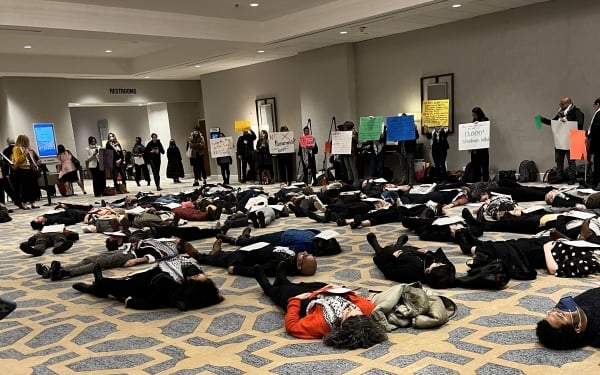
    A “die-in” protest at the MLA annual convention before Saturday’s Delegate Assembly meeting.

    As the Modern Language Association Delegate Assembly was beginning its meeting Saturday in New Orleans, audience members stood inside the hotel ballroom and chanted, “The more they try to silence us the louder we will be!” a video posted online shows. 

    The protesters, who made up a large number of the meeting’s attendees, read out a resolution endorsing the international boycott, divestment and sanctions movement against Israeli policy—the very resolution that the MLA’s elected Executive Council had blocked from going to the Delegate Assembly and the association’s full membership for a vote. Then the demonstrators walked out of the meeting. 

    It was one of multiple protests at this weekend’s annual MLA conference aimed at the Executive Council’s fall decision to reject the resolution without letting members vote on it.

    That resolution—like one that American Historical Association conference attendees overwhelmingly passed Jan. 5—also would have accused Israel of “scholasticide,” or the intentional eradication of an education system. But the AHA resolution didn’t endorse the BDS movement.  

    The demonstrations at the two conventions are the latest examples of scholarly associations and their members debating whether they should say anything as an organization about the ongoing war in Gaza at a time when politicians and people both inside and outside academe are criticizing scholars and institutions for expressing opinions on current events.  

    Anthony Alessandrini, an English professor at the City University of New York’s Kingsborough Community College, said he led a call and response demonstration. A few shouts of “Shame!” rang out.

    “Sometimes, this is what democracy looks like!” the demonstrators chanted in unison during the call and response. They raised hands or fists in the air, and some held signs that Alessandrini said bore the names of Palestinian academics killed in Gaza since October 2023. Protesters held a large banner that read, “MLA is Complicit in Genocide.”

    As they were walking out of the ballroom, protesters chanted “Free free Palestine!” and “You don’t have quorum!”—the minimum required numbers of attendees to conduct official business at a meeting. However, the MLA said quorum was maintained and the meeting continued.  

    The MLA Executive Council, an elected body, released a lengthy statement last month explaining its October decision to shoot down the resolution. The Council said it was concerned about “substantial” revenue loss if members endorsed the BDS movement, saying legal restrictions in many states on partnering with BDS-supporting organizations would end the MLA’s ability to contract with numerous colleges and universities and their libraries. It added that “some private institutions and major library consortia” also have such prohibitions.

    “Fully two-thirds of the operating budget of the MLA comes from sales of resources to universities and libraries, including the MLA International Bibliography,” the Council said.

    Dana Williams, president of the Executive Council and a professor of African-American literature at Howard University, told Inside Higher Ed Saturday that “the primary reason” for the council’s decision “was fiduciary.” But she also mentioned concerns about dividing the membership over endorsing the BDS movement, noting that “collegiality was one of many things that we were considering.”

    The Council’s statement in December suggested MLA members consider something short of endorsing the BDS movement. “Could not a motion calling for a statement protesting scholasticide in Gaza, while not focusing on BDS, be a powerful expression of solidarity?” it said.

    The fallout from the Executive Council’s decision included the resignation of two of its roughly 15 members, who were nearing the end of their terms. One was Esther Allen, a professor at the City University of New York’s Graduate Center and Baruch College.

    “The really don’t feel comfortable with any kind of member activism, they really don’t want it at all on any subject,” Allen told Inside Higher Ed.

    Williams said she supports members’ right to protest. “The association is the membership, we want to reiterate,” she said. What the members who walked out missed “was the one-hour open discussion [during the meeting] that … was really fruitful, thoughtful engagement with those delegates who were present that will inform the actions of the council going forward,” she added. The MLA didn’t provide a remote option for watching the meeting.

    The Council continues to believe that rejecting the resolution “was the right decision that would allow the association to continue to do its really important work to serve the members,” she said. “We had the benefit of a council that is bold enough and courageous enough to make very hard decisions.”

    MLA Members for Justice in Palestine is circulating a pledge for members to promise not to renew their memberships in protest. Alessandrini noted some other scholarly groups have endorsed the BDS movement.

    “My sort of forecast is a lot of people are going to move from organizations like the MLA and, I would add, the AHA [American Historical Association] if they don’t sort of endorse the will of the members—and towards the many organizations that have in fact taken the right stand,” he said. 

    Source link

  • Pro-Palestine Columbia professor departs after investigation

    Pro-Palestine Columbia professor departs after investigation

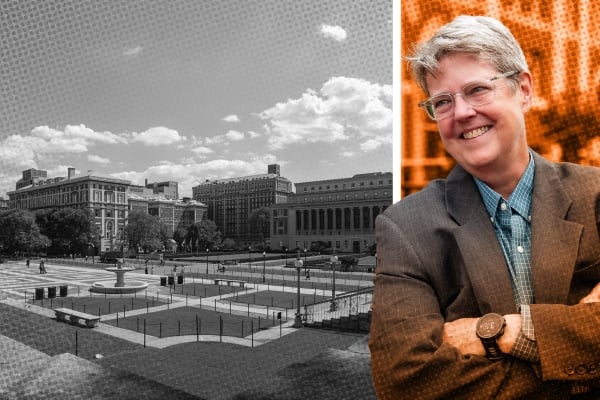
    A longtime tenured Columbia University law professor who faced public criticism from Columbia’s president and congressional Republicans will no longer teach at the institution, after more than 25 years as a faculty member there.

    Katherine Franke said Friday in a letter that she’s effectively been terminated, following a university investigation into a media interview she gave in which she criticized students who formerly served in the Israel Defense Forces for allegedly harming other students at Columbia. The investigation found that her media comments, and her alleged retaliation against a complainant in subsequent comments, had violated Columbia’s Division of Equal Opportunity and Affirmative Action Policies and Procedures. 

    She’s among multiple U.S. faculty members who’ve been investigated or punished in connection to speech that can broadly be considered pro-Palestinian.

    In a statement, Franke said she reached an agreement with Columbia “that relieves me of my obligations to teach or participate in faculty governance after serving on the Columbia law faculty for 25 years.” She added, “While the university may call this change in my status ‘retirement,’ it should be more accurately understood as a termination dressed up in more palatable terms.”

    She did not share a copy of the departure agreement, nor did the university. Columbia didn’t directly respond to her characterization of her departure.

    In a broadcast last January on Democracy Now!, a left-leaning radio and television newscast, Franke talked about an incident on campus in which pro-Palestinian protesters said they had been sprayed with a harmful chemical. Students were hospitalized, and protest organizers accused other students who had served in the Israeli military. The university said in August that the substance sprayed was “a non-toxic, legal, novelty item.”

    Franke told the host that Columbia has a program that connects it with “older students from other countries, including Israel. And it’s something that many of us were concerned about, because so many of those Israeli students, who then come to the Columbia campus, are coming right out of their military service. And they’ve been known to harass Palestinian and other students on our campus. And it’s something the university has not taken seriously in the past.”

    Most Jewish citizens of Israel must serve in the military for at least 32 months for men and 24 for women.

    “We know who they were,” Franke said on the program of the alleged attackers at Columbia. (Franke wrote in her statement Friday that, “I have long had a concern that the transition from the mindset required of a soldier to that of a student could be a difficult one for some people, and that the university needed to do more to protect the safety of all members of our community.”)

    Franke’s Democracy Now! comments became the subject of a university investigation as well as a broader congressional hearing related to campus antisemitism. Representative Elise Stefanik, a New York Republican, asked then–Columbia president Minouche Shafik what disciplinary action had been taken against Franke. She characterized Franke as saying, “Israeli students who have served in the IDF [Israel Defense Forces] are dangerous and shouldn’t be on campus.”

    Shafik didn’t answer Stefanik straightforwardly, but replied, “I agree with you that those comments are completely unacceptable and discriminatory.” Later during the televised hearing, Shafik confirmed that Franke was under investigation.

    That investigation found that in addition to the interview comments, Franke violated campus policy by retaliating against the complainants.

    A November 2024 Columbia EOAA Investigation Determination letter to one of the complainants, which was provided to Inside Higher Ed, says, “You also alleged retaliation on three separate occasions during the course of this investigation when complainant: (i) provided your name to a reporter who publicized your identity as an individual who initiated the complaint; (ii) reposted a tweet referring to you as a ‘genocide advocate’ and ‘McCarthyite bigot’; and (iii) posted a link to a document on social media indicating that you had made additional complaints against respondent.” (Franke had named the complainants—two of her faculty colleagues—to Inside Higher Ed for a July story.)

    The letter says the university concluded that the interview and the first two retaliation allegations violated the policy.

    In her statement Friday, Franke said she did appeal. But “upon reflection, it became clear to me that Columbia had become such a hostile environment that I could no longer serve as an active member of the faculty.”

    Over the last year, people have posed as students to secretly videotape her, and clips have ended up on “right-wing social media sites,” she said. Students have enrolled in her classes to provoke discussions they can record and complain about, she said, adding that law school colleagues have also secretly taped her and yelled “at me in front of students that I am a Hamas supporter.”

    “After President Shafik defamed me in Congress, I received several death threats at my home,” Franke said. “I regularly receive emails that express the hope that I am raped, murdered and otherwise assaulted on account of my support of Palestinian rights.”

    Columbia Law dean Daniel Abebe told colleagues Thursday that Franke “is accelerating her planned retirement and now will retire from Columbia on Friday.” Abebe praised her work.

    But Franke contests the word “retirement.” In an email to Inside Higher Ed on Friday, Franke explained that she signed an agreement with Columbia a year ago “to retire in a few years—phased in.” But she said the university “reneged on” providing routine retirement benefits, such as recommending her for emeritus status with the university’s Board of Trustees, providing her an office for five years and still allowing her to teach some classes.

    “Columbia University’s leadership has demonstrated a willingness to collaborate with the very enemies of our academic mission,” Franke wrote in her statement. “In a time when assaults on higher education are the most acute since the McCarthyite assaults of the 1950s, the university’s leadership and trustees have abandoned any duty to protect the university’s most precious resources: its faculty, students and academic mission.”

    The university didn’t provide an interview Friday. In an emailed statement, a Columbia spokesperson wrote, “Columbia is committed to being a community that is welcoming to all and our policies prohibit discrimination and harassment.”

    “As made public by parties in this matter, a complaint was filed alleging discriminatory harassment in violation of our policies,” the statement continued. “An investigation was conducted, and a finding was issued. As we have consistently stated, the university is committed to addressing all forms of discrimination consistent with our policies.”

    Source link

  • Higher education postcard: University of Al Quaraouiyine

    Higher education postcard: University of Al Quaraouiyine

    Greetings from Morocco!

    I’ve covered some of the UK’s ancient universities – Oxford, Cambridge, St Andrews, Glasgow, Aberdeen, and Edinburgh – in this blog. And if I tell you that the University of Al-Qaraouyine used to be known as the University of Fez, you might know that we’re going to look at somewhere that makes these universities look like the new kids on the block.

    We need to start in the year 859, using the common era calendar. In Britain, there were many small kingdoms. The great Viking invasion hadn’t yet happened. Æthelbald was King of Wessex (you might have heard of his brother Alfred, the Great). Rhodri Mawr was asserting kingship over something approximating to modern Wales. The unified Kingdom of Alba in Scotland hadn’t yet happened. It was a long time ago.

    In continental Europe the Byzantine empire still had hundreds of years to go. The empire formed by Charlemagne was already in the process of breaking up; France was just beginning to emerge as a single political entity. There were emerging states in Serbia and Hungary. There was not yet a Russia, although the Kievan Rus’ were around and about.

    Further south, across the Mediterranean, there was less flux. In Baghdad and Cairo there were caliphates; there was an emirate in Cordoba; and in Fez the Idrisid dynasty had ruled for almost 100 years. And in Fez, or so the story goes, a woman named Fatima al-Fihriya founded the al-Qarawiyyin Mosque. She was daughter of a merchant, and inherited money, which she used to establish the mosque. And her sister Mariam similarly used her share of the inheritance to establish another mosque in Fez.

    It is obviously hard to know the truth from a distance of over eleven centuries, but historians have disputed this foundation story. Some say that the mosque was founded by the son of Idris II, the then ruler. But in any event, it was founded. At that time mosques tended to be centres for teaching and other civic roles, as well as their religious function, and it seems that this was true for the al-Qarawiyyin Mosque. Certainly in the early 900s it became the Friday mosque for Fez – the main one in the city.

    Now hang on a moment, I hear you say, this is meant to be higher education postcard, not religious building postcard. To which I’d reply, remember that in many cultures, education and religion have at times gone hand-in-hand. Christ Church Oxford, which I wrote about last year, is both college and cathedral. And when Galileo was prosecuted by the Catholic Church, part of the case was made by the church’s own astronomers, who were proper scientists.

    In the same spirit, bear with me on the al-Qarawiyyin Mosque. For it became much more learned. No doubt with the patronage of Fez’s richer residents, some scholars believe that it gained status as a teaching institution from the 1040’s onwards. And certainly in the twelfth and thirteenth centuries it was offering a wide curriculum, similar to that at Oxford and Cambridge: as well as theology and jurisprudence, students studies grammar, rhetoric, logic, mathematics, medicine, astronomy and geography. Indeed, in 1207 the university (as it was now known) awarded the earliest known doctor of medicine degree to Abdellah BenSaleh Al Koutami. Other sources suggest that Pope Sylvester II (before he was Pope) studied at the university, although, to be fair, specific evidence for this has not been found.

    The university then went into decline – as has happened elsewhere – with a narrower curriculum, perhaps aligned to an increasingly conservative approach to religion. Fez had become less important over the centuries, and perhaps this lack of access to power and cultural significance contributed to the decline.

    As the nineteenth century turned to the twentieth century, the political landscape was changing. European powers were increasingly flexing their muscles, fuelled by colonial ambitions and notions of racial superiority. Morocco went to war with France in 1844 and Spain in 1859, coming out worse both times. Increasing European influence further weakened the Moroccan state, and in 1912, after some gunboat diplomacy, Morocco became a French protectorate, via the Treaty of Fez.

    The postcard dates from this time: my French isn’t up to scratch, but I think it is saying that the image was taken by one of the French air force units stationed in Fez in 1927. The picture on the front of the postcard shows two mosques. The Al Quaraouiyine university is the building to the right centre, with the tall stone minaret and the white-walled buildings with steep roofs. The presence of the French military reminds us that the French occupation was by force: it was only in 1926 that the first armed resistance to French rule was ended.

    In 1947 Al Quaraouiyine university was integrated into the state education system, and women were admitted as students. By 1956 Morocco had gained independence from France, and in 1963 Al Quaraouiyine officially became a university, by royal decree. Classes moved from the mosque to an old barracks; faculties were established. It became officially the University of Al Quaraouiyine in 1965.

    But history moves in fits and starts, not in a straight line. In the 1970s secular subjects were moved to another university; Al Qaraoiyine was to focus on theological disciplines; and in 1988 traditional Islamic teaching was resumed at the university. And then the pendulum swung again – in 2015 the university was re-founded. The words of the university president are worth quoting in full:

    His Majesty King Mohammed VI May God Assist Him, keen on conferring to Al Qaraouyine University its intellectual and social influence anew, and given the historical role it played in teaching and training scientists, scholars, lecturers and orators for nearly twelve centuries and in order for Al Qaraouyine University to regain its scientific clout as referenced in specialized, distinguished and judicious training in legal sciences, Islamic studies, comparative jurisprudence and Maliki heritage, and in order to develop scientific research and its methods in such fields Royal Dahir (Decree) no 1.15.71 dated on Ramadan 7th, 1436 corresponding to June 24th 2015, was issued, stipulating the reorganization of Al Qaraouyine University as a public higher education and scientific research institution, with a legal body, financial, educational and scientific autonomy.

    Such a new regulation aims at enabling Al Qaraouyine University and its affiliated institutions to optimally and efficiently carry out its mission. Such will be performed through improving the content of programs at all levels of training cycles on one hand, and enhancing the supervision at all affiliated institutions or the ones under its educational supervision on the other hand

    Generating and passing on knowledge requires building and highlighting the qualifications, revealing and confirming the skills to ease the educational process in Qoran, Hadith, Figh studies and legal sciences, besides the religious supervision.

    Whereas Al Qaraouyine University wishes to train researchers, specialized scholars, Imams, male and female qualified guides, by means of methods and knowledge that enable them to perform their tasks as best as possible, such training requires being aware of the key contemporary issues. This implies teaching foreign living languages and impregnating with a dialog culture and a break-off with preconceived ideas and slavish imitation. In this regard, it is now necessary that Al Qaraouyine University students know about open and illuminated Islamic thought issues, imbued with the dialog culture, so they would be become more open and prone to exchange and coexistence using all granted communication tools.

    Such openness will undoubtedly make Al Qaraouyine graduates strongly quipped in the face of the future, with solid science and efficient culture, while greatly combining the heritage drawn from religious principles and national values, Moroccan identity resources, good knowledge of Morocco’s history, and the contemporary life that allows them to manifest modernity free from intellectual alienation. Ultimately, this will help improve the image of Islam and Muslims in countless fields, so that the glorious past of Al Qaraouyine University will serve its present, bestowing it with the position it well deserves and shining its light in the near future with its usual influence in the Arab, African and Islamic world, and worldwide.

    I like a university seeking to regain its “scientific clout”; and you can see in “this implies teaching foreign living languages and impregnating with a dialog culture and a break-off with preconceived ideas and slavish imitation” a defence of university values. It’s worth remembering that all universities exist within a society’s culture, and that if a university is worth having it will be pushing the boundaries of that culture. That’s what I see here.

    So that’s the University of Fez, or as it is more properly known, the University of Al Quaraouiyine. It’s a UNESCO world heritage site as well as being a modern university. And here’s a jigsaw of the card to keep you occupied.


    Source link

  • A path to wellness for women of color in higher ed (opinion)

    A path to wellness for women of color in higher ed (opinion)

    I often ignore my well-being—mind, body and spirit—while advancing my academic career. As a woman of color academic, balancing work and life feels very hard. My personal and professional lives are tangled, pulling at me in tiring ways. Relaxing seems wrong, and resting feels like a luxury.

    I get so caught up in meetings and deadlines that on a typical day I often skip lunch. I forget to drink water and don’t even step outside for fresh air. My self-care plan has been “out of sight, out of mind.”

    Now, in my 40s, I see the toll this has taken. I struggle with muscle spasms, neck pain, mental health issues and deep exhaustion. The hardest part? My six-year-old daughter says, “Mom works a lot.”

    Enter Slow Living: A Revolutionary Recalibration

    The slow living movement, rooted in the slow food movement, promotes a lifestyle centered on mindfulness, sustainability and quality over quantity. It encourages us to slow down and make intentional choices in a world that often values speed and productivity. This philosophy emphasizes the importance of relationships, well-being and balance.

    For women of color in academia, slow living practices provide a means to counteract the intense pressures of teaching, administration, funding and publication. These pressures are heightened by systemic challenges such as microaggressions, tokenism, code-switching and the obligation to mentor students from similar backgrounds. This leads to cultural taxation and the demands of invisible labor, resulting in increased stress and burnout. The slow living approach promotes self-care and helps us reconnect with what truly matters, enhancing resilience and mental well-being.

    The Invisible Burdens Women of Color Carry

    Women of color in academia often face unique challenges that remain invisible to many of their peers. For example, the overwhelming burden of service work, particularly mentoring students of color, frequently contributes to feelings of isolation and burnout. While mentorship is vital and rewarding, it takes a significant toll, contributing to a sense of alienation, invisible labor and racial battle fatigue. The emotional and intellectual labor involved often detracts from time that could otherwise be spent on research, teaching or personal pursuits. Addressing these issues requires a deeper understanding of systemic obstacles and intentional efforts to foster equitable academic environments.

    Furthermore, women of color academics often encounter challenges related to tokenism within predominantly white academic settings. Their roles can be perceived as symbolic, which leads to the expectation that they represent entire racial or ethnic communities. Faculty of color are frequently called upon to address student concerns regarding racism or to spearhead diversity, equity and inclusion initiatives, a burden not equally shared by their white colleagues.

    Moreover, microaggressions—subtle yet harmful discriminatory behaviors—can create an environment in which faculty of color feel compelled to continually validate their competence. These experiences highlight the need for systemic change to cultivate a more inclusive atmosphere where women of color faculty can thrive and contribute their invaluable perspectives.

    The Slow Living Solution

    The principles of slow living offer women of color academics a robust way to reclaim their time and energy, enabling them to focus on their well-being, passions and purpose. Embracing slow living practices may aid us in navigating the often overwhelming demands of academic life with greater intention and balance, which may amplify self-agency.

    Mindfulness practices such as morning meditation or walking in nature can provide essential moments of peace. Setting boundaries, saying “no” to additional commitments and taking mental health days are other strategies that allow academics to preserve their energy. Intentional time management helps reduce stress and ensures alignment with personal values, creating a more fulfilling academic experience. Institutional support for mindful practices can be crucial in promoting the well-being and retention of women of color faculty by creating environments that prioritize self-care, work-life balance and mental health.

    Slow living enhances career satisfaction by aligning daily tasks with long-term goals. Reflecting on work can help identify opportunities that bring purpose and joy, like prioritizing collaborative projects that match personal values. A model that reflects this intentional approach is transformational leadership in academia. This model focuses on leaders encouraging collaboration, promoting shared goals and emphasizing personal growth and well-being. Women of color faculty may use this model to engage in work that is aligned with their values and supported by institutional leadership, promoting meaningful collaboration and decreasing the likelihood of feeling disconnected or burned out.

    Incorporating slow living into academia can inspire a ripple effect across departments and institutions. Women of color faculty prioritizing well-being and balance set a powerful example for colleagues and students. These shifts can foster a culture that values mental health and personal fulfillment as much as professional achievement. Over time, tailored slow-living principles could encourage academic institutions to reimagine success metrics, emphasizing sustainability, collaboration and community impact.

    From Individual Change to Institutional Transformation

    Slow living can’t flourish in a vacuum. For women of color faculty to thrive, institutions must provide meaningful support. Structural changes can transform individual efforts into a sustainable culture shift—and, honestly, wouldn’t academia be better off for it?

    Institutions can enhance the well-being and retention of women of color faculty through several structural changes. Implementing flexible work policies, such as remote teaching and flexible hours, helps faculty manage their professional and personal lives. A holistic approach to tenure and promotion that values work-life balance, teaching quality, mentorship and community impact fosters inclusivity. Mentorship programs and employee affinity groups provide essential support and collaboration. Additionally, dedicated mental health resources help mitigate burnout. Programs like the Advancing Faculty Diversity initiative at the University of California celebrate (and fund) faculty DEI contributions. Finally, incentivizing collaborative work can shift success metrics to prioritize impactful contributions, benefiting faculty and institutions.

    A Paradigm Shift Worth Embracing

    After years of pushing myself to the limit, I realized it was time for a change. While moving to a peaceful countryside cottage wasn’t possible, I discovered that small daily habits could transform my busy life. I started by walking: Each morning, I would take a 10-minute walk through my neighborhood, paying attention to the rhythm of my steps and allowing myself to immerse in the present moment fully. I also began typing slower, breathing mindfully and speaking intentionally. These simple changes introduced mindfulness, making me feel less frantic about productivity and helping me prioritize quality family time.

    Embracing slow living in my professional life has been a game-changer. It’s helped me focus on well-being and redefine success as living better rather than just doing more. As academics, we should celebrate lifelong learning and incorporate slow living into our lives. After all, if we’re too busy to care for ourselves, what are we truly working for?

    So here’s my challenge to you, dear reader: Take a deep breath. Walk a little slower. Break away from the chime of an email sitting in your inbox. Speak with intention. Let’s rewrite the script that tells us we must hustle to the point of harm. Our careers, families and, most importantly, we are worth it.

    Kenyatta Y. Dawson is a program director and faculty member at Texas Woman’s University. She specializes in diversity, equity, inclusion, student success and professional development in higher education. Her research focuses on mentoring adult learners, career satisfaction and equity-driven leadership. Grateful to Texas Woman’s University’s Women’s Thought Leadership Program for advancing underrepresented voices, Dawson embraces the Write to Change the World mission for inclusivity and social impact.

    Source link