Tag: Higher

  • Challenging climate hypocrisy in higher education learning and teaching 

    Challenging climate hypocrisy in higher education learning and teaching 

    By Dr Adrian Gonzalez (@AGonzalez05) Senior Lecturer in Sustainability and Director of Learning and Teaching, Department of Environment and Geography at the University of York.

    Climate hypocrisy in Higher Education

    The climate crisis and global attempts at strengthening the sustainable and low-carbon transition is arguably the most critical issue we face and there is clear evidence to show strong Higher Education (HE) support for this twin approach. However, HE, particularly in the Global North, faces increasing scrutiny and critique over its implementation of the sustainability agenda. This has led to accusations of greenwashing, in which universities (willingly or perhaps erroneously) overmarket and/or underdeliver their sustainability policies, and climate hypocrisy, where an internationalist agenda frames student recruitment (the drive towards overseas markets), research activities and partnerships. For example, in UK tertiary education (further education and higher education), the largest sources of travel emissions are student flights, but there has been limited focus on the emissions stemming from learning and teaching, particularly fieldtrips, which this post is keen to reflect on.

    Destination long haul; Higher Education residential undergraduate student fieldtrips

    Outdoor education, particularly fieldtrips, offer a wide array of learner benefits and can be integral to different undergraduate programmes such as Geography, Earth and Environmental Sciences (GEES), archaeology, history and classics. However, the competitive UK higher education market has helped generate an internationalisation of undergraduate fieldtrips which are now used as a critical marketing tool to attract prospective students, who as ‘consumers’, are increasingly keen on knowing where these trips go to inform applications. For example, a brief internet search of UK GEES departments shows undergraduate trips heading to exotic locations such as the Amazonia region, Colombia (BSc Environmental Science), Bahamas (BSc Ocean Science and Marine Conservation) and Malawi (BA Human Geography). 

    Climate hypocrisy is evident here; students are studying programmes that acknowledge and grapple with the climate crisis and the need for transformational structural changes, yet at the same time will be enrolled on degrees that facilitate long-haul international learning opportunities without significant acknowledgement or reflection of the environmental impacts. Whilst there is no reliable publicly available data on the level of carbon emissions generated by GEES and other subject fieldtrips in UK higher education, I can give an indication by drawing on a case study of the department I work in.

    Department of Environment and Geography, University of York

    The department runs a wide variety of one-day and residential fieldtrips across its undergraduate and postgraduate programmes. It is the undergraduate residential trips that, owing to their design, have particularly significant carbon emissions and were made the focus of the subsequent investigation. Until 2022-2023, the department ran several residential fieldtrips that encompassed both UK and overseas destinations for its four undergraduate programmes (BSc Environmental Science; BSc Physical Geography and Environment; BSc Environment, Economics and Ecology; BA Human Geography and Environment). 

    I used the University of York’s carbon calculator, which draws upon the UK government’s Department for Environment, Food and Rural Affairs greenhouse conversion factors to calculate the carbon emissions stemming from travel and accommodation and the offsetting requirements. The table below shows the residential fieldtrips and carbon emissions from travel (including coach and flights where relevant) and accommodation on a per-person and 50-person basis. For four 50-person trips, this generated 108,521.85 kg CO2e (or 109 metric tonnes rounded up), equating to a carbon offsetting cost of £3,437.97 for the Department on an annual basis.

    Table 1: Department of Environment and Geography, University of York fieldtrips up to 2022-2023

    What does this total figure equate to? A good comparison is the Stockholm Environment Institute (SEI), an international non-profit that focuses on environment and development challenges and employs 170 staff working across several international regional centres. At the time of these fieldtrips operating, SEI’s 2020 annual report indicated that its air travel emissions were almost 550 metric tonnes CO2e (in 2019). So these department fieldtrips made up the equivalent of almost 20% of the total air travel emissions of a major international research organisation.

    Conclusion: a call to action

    These figures indicate the scale of the socio-environmental impacts caused and the urgent need for UK higher education learning and teaching operations, particularly in GEES given the subject areas, to be seen as ‘walking the talk.’ There have been recent efforts to address this issue through the work of the RGS-IBG who have developed a list of voluntary principles to guide geography fieldwork, including the adoption of ‘sustainable fieldtrips’ which acknowledge the need to recognise and justify the resulting carbon impacts. Whilst it is positive to see 31 institutions signed up, this is less than half of the UK GEES departments and does not incorporate any wider disciplinary commitments. 

    This article raises a call to action for all learned institutions and UK HE departments operating residential fieldtrips to adopt sustainable fieldtrip principles and operations. Without system-wide change, climate hypocrisy remains unchallenged in UK higher education learning and teaching. 

    To support academic staff and departments, several steps towards sustainable fieldtrips can be taken:

    • Conduct a carbon audit of fieldtrips to ascertain the impacts as undertaken at the Department of Environment of Environment and Geography, University of York
    • Using this data, consider revising long-haul fieldtrip locations to relevant localised destinations that can be reached through low carbon (i.e. no flights) transport; 
    • Publish the carbon costs on the department or university website to support wider debate and discussion of sustainable fieldtrips;
    • Implementing sustainable fieldtrips can lead to multiple Equity, Diversity and Inclusion (EDI) benefits, particularly around accessibility and inclusivity. Use this opportunity to review and seek to strengthen the EDI agenda. 
    • Disseminate best practice guidance through research and conference outputs;
    • Lobby learned institutions to adopt sustainable fieldtrip principles that align with those adopted by the RGS-IBG;

    Through these steps, UK higher education can begin to create a more holistic, robust and transparent sustainability and decarbonisation agenda. 

    However, these actions cannot happen in isolation or nullify wider critical discussions around the UK HE sustainability agenda. One of the most significant discussion points is the impact of international students studying in the UK, a country which is the second most popular study destination in the world. Whilst these students provide significant economic benefits to the UK economy (£41.9 billion between 2021/22) and are vital to the UK higher education business model (one in six universities get over a third of their total income from overseas students), the carbon footprint far surpasses the UK higher education fieldtrip contribution. A 2023 report from 21 UK further education and higher education providers concluded that student flights accounted for 2.2 metric tonnes of CO2e or 12% of total emissions, whilst globally, student mobility is estimated to generate at least 14 megatones of Co2e per year (14 million metric tonnes). It is clear therefore that in the UK context, there is an urgent need for a robust policy debate on UK higher education funding and student mobility, otherwise the sector’s decarbonisation agenda will remain only partially addressed through sustainable fieldtrips. 

    Source link

  • Top 5 Strategies to Enhance Cloud Security in Higher Education

    Top 5 Strategies to Enhance Cloud Security in Higher Education

    The transition to cloud computing has revolutionized higher education by enabling enhanced collaboration, scalability, and flexibility. On the other hand, the cloud’s ability to improve data security is a substantial advantage that is often overlooked. Securing a cloud environment necessitates a proactive approach, rather than solely implementing cloud-based technologies. Here We have collated the top are five strategies to optimize cloud security in higher education:


    Cloud security in higher education: Importance of data protection for HEIs

    Higher education institutions have a great deal of sensitive student and institutional data to handle, hence data security and cloud security in higher education is a top issue. Safeguarding sensitive data depends on strong adherence to laws including FERPA and GDPR, therefore guaranteeing ethical usage, limited access, and safe storage. According to surveys, giving transparency and strong data protection a top priority and opting for solutions to protecting student data in the cloud not only helps to prevent breaches but also fosters staff and student confidence, hence improving engagement and institutional reputation.


    5 Clever Strategies for Secure Cloud Adoption in Universities


    1. Emphasize control rather than location

    The belief that on-premises data storage is intrinsically more secure may be deceptive. Although server rooms appear concrete, they remain susceptible to breaches, natural calamities, and maintenance issues. Cloud solutions offer superior security features, like powerful firewalls, automatic backups across many sites, and multi-site processing to reduce risks and enhance recovery efficiency. Institutions may be confident that their data is secured by superior infrastructure.


    2. Adopt the paradigm of shared responsibility.

    Cloud security is not the responsibility of a single individual; it requires collaboration. The vendor is able to manage hardware maintenance, patching, and enhancements in physical infrastructure security by collaborating with a reliable cloud provider. This enables your internal IT staff to concentrate on strategic data governance, institutional policies, and user access control. By coordinating activities, academic institutions can enhance their security and facilitate more effective departmental decision-making.


    3. Employ sophisticated security features

    Cloud platforms offer a diverse array of integrated security features, including identity management systems, multifactor authentication (MFA), and advanced encryption. These features guarantee that only authorized individuals can access sensitive information. Moreover, cloud providers consistently enhance their security protocols to address emerging attacks, enabling your organization to remain proactive against potential hazards.


    4. Make scaling easier without putting security at risk

    Higher education needs are changing quickly, and old IT systems often can’t keep up. But the cloud lets you grow without sacrificing protection. Institutions can increase or decrease storage space, processing power, and entry controls without affecting the security of academic institutions and their data. For instance, access can be tailored to each role, so administrators, faculty, and students will only see data that is important to them.


    5. Invite everyone to be conscious of cloud security in higher education

    Usually, people are the weakest component in data security. As you migrate to the cloud, for instance, teach your employees and children about best practices include using secure passwords, turning on multifactor authentication, and identifying phishing efforts. Successful usage of the security features of the cloud reduces user error-related risks by means of informed communities.


    Cloud technology in campus management – Creatrix Campus higher education cloud suite

    The move to cloud technology in higher education is more than just a trend; it’s a huge chance to make data safer. Despite early concerns, institutions that follow these criteria can fully utilize the cloud’s data protection capabilities.

    Higher education institutions can adapt to this new reality with Creatrix Campus’s robust, secure cloud-based technologies. Can you commit to data security? Secure cloud solutions for academic institutions may help your institution.Get in touch for details.


    Source link

  • Dartmouth Men’s Basketball Team Drops Union Bid

    Dartmouth Men’s Basketball Team Drops Union Bid

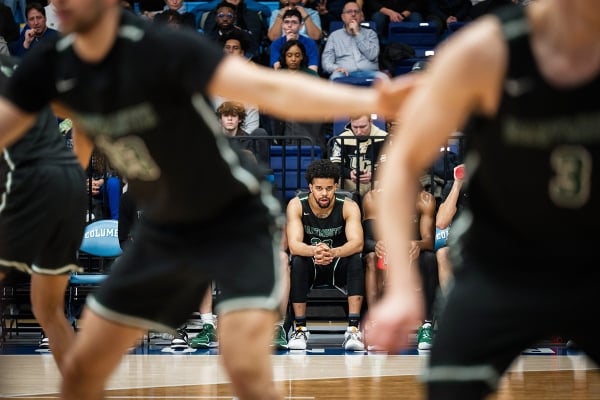
    The Dartmouth College men’s basketball team is dropping its historic bid to form a union, months after voting to do so. 

    The decision, announced Tuesday, comes as Republicans are poised to take control of the National Labor Relations Board, which could affect who is allowed to unionize on college campuses. A regional office of the board cleared the way earlier this year for the players to vote on the petition, ruling that the student-athletes were employees and thus allowed to unionize.

    Dartmouth disagreed with that opinion and refused to bargain with the team until the five-member NLRB ruled on the issue. Currently, the five-member panel has two vacancies, so incoming President Donald Trump could quickly reshape the board. In withdrawing the petition, the Service Employees International Union, Local 560, which represents the players, decided not to gamble with the new board and potentially risk a negative opinion.

    “By filing a request to withdraw our petition today, we seek to preserve the precedent set by this exceptional group of young people on the men’s varsity basketball team,” local president Chris Peck said in a statement to the Associated Press. “They have pushed the conversation on employment and collective bargaining in college sports forward and made history by being classified as employees, winning their union election 13-2, and becoming the first certified bargaining unit of college athletes in the country.”

    The Dartmouth team union threatened to upend college sports and added more urgency to the National Collegiate Athletic Association’s efforts to settle the question of whether student athletes are employees who can collectively bargain. The NCAA has lobbied Congress to pass a law affirming that college athletes aren’t employees. The incoming Congress seems likely to grant that request.

    Source link

  • Biden administration finalizes distance ed, TRIO rules

    Biden administration finalizes distance ed, TRIO rules

    The Biden administration’s regulations changing how colleges are held accountable and adding new requirements for institutions to access federal financial aid are now in place, though legal challenges loom. 

    Demetrius Freeman/The Washington Post/Getty Images

    Colleges will have to submit to the federal government new data on their distance education programs under a batch of new rules the Biden administration finalized Monday.

    The rules, which will take effect July 1, 2026, will likely be the president’s last package of new regulations for colleges and universities before Trump takes office Jan. 20.

    The new regulations carry out Biden’s plan to increase federal oversight of online programs, but the final version doesn’t go as far as the president initially intended After receiving significant pushback from online education lobbyists, the Education Department conceded, backing off a plan to  disallow asynchronous options for clock-hour courses or require colleges to take attendance in online classes.

    The package does, however, still include rules that require colleges to report more data on enrollment in distance education classes, which include those offered online or via correspondence. Higher ed institutions won’t have to begin submitting the data until July 1, 2027.

    “Online learning can reach more students and sometimes at a lower cost to students, but what we know about the outcomes of online education compared to traditional in-person instruction is woefully inadequate,” Under Secretary James Kvaal said in the release. “The new reporting in this final rule will help the department and the public better assess student outcomes at online programs and help students make informed choices.”

    The final rule also included technical changes to federal college prep programs known as TRIO. But the department decided not to move forward with a plan to open eligibility to some TRIO programs to undocumented students—a long-sought goal of some TRIO directors and advocates, as well as higher education associations. 

    Distance Education

    But one of the most controversial parts of the rule for colleges and universities was whether Biden would decide to end any asynchronous options for students in online clock-hour programs, which are typically short-term workforce training programs that lead to a certificate.

    A Trump-era rule allowed asynchronous learning activities—such as watching a prerecorded video—to count toward the required number of credits in short-term clock-hour programs. But the department said in its proposal that because of the hand-on nature of many clock-hour programs, the change often results in a “substandard education” that “puts students and taxpayers at risk.” 

    Hundreds of professors and higher education groups disagreed. Some, particularly those representing for-profit programs, argued in public comments that the proposal exceeded the department’s authority and would burden institutions. Others said the new rules reflected an antiquated mindset about college modality, arguing that disallowing asynchronous options could limit access for students who benefit from the flexibility that online education provides.

    While the department decided not to end asynchronous distance ed programs, the agency intends to keep a close eye on the courses. 

    “The department refined these final rules based upon extensive public comment on a notice of proposed rulemaking published over the summer,” department officials said in a news release. “However, we remind institutions that asynchronous clock hours cannot be used for homework and that there must be robust verification of regular and substantive interaction with an instructor.”  

    No Expanded TRIO

    Although the decision not to expand eligibility for TRIO has fewer implications for colleges, the move is a blow for the TRIO directors and immigration equity advocates who have been working for years to open up the program.

    Miriam Feldblum, executive director of the Presidents’ Alliance on Higher Education and Immigration, told Inside Higher Ed that nearly 100,000 undocumented students graduate from high school each year, many of whom could benefit from TRIO services. 

    But Republicans opposed the idea. Six GOP members of Congress, including Virginia Foxx, a North Carolinian and former chair of the House education committee, blasted the concept in a letter to Secretary Miguel Cardona in August.

    “The proposed expansion is a blatant attempt to provide additional taxpayer-funded services to those not seeking citizenship in the name of reducing ‘burden.’ The department’s proposed expansion will stretch funding thin and risk those currently eligible for TRIO,” they wrote.

    Some college administrators and TRIO directors in red states are worried about the potential political backlash Biden’s new regulation could cause for their programs.

    “The fighter in me thinks that this is a tough time to go to battle and have an unforced error or a target on our backs and [on] TRIO, given the contentious nature of immigration policy right now,” Geoffrey Garner, a TRIO program director from Oregon, said in at January 2024 advisory committee meeting. “We just think right now is not the best time for this proposal, as much as it breaks my heart to say that out loud.”

    That advisory committee ended up backing the changes to expand some TRIO programs to undocumented students.

    Education Department officials said its decision wasn’t due to political tensions. Rather, they said the proposal “was too narrow … in scope of additional populations to be served.”

    Under the department’s proposed rule, high school students who aren’t citizens or permanent residents could qualify for Upward Bound, Talent Search and Educational Opportunity Centers but not Student Support Services or the McNair Scholars Program.

    “An expansion of student eligibility under only certain TRIO programs would create confusion, as many grantees administer grants under more than one TRIO program,” officials wrote in the final rule. “Eligibility for only certain TRIO programs would increase administrative burden by requiring grantees to deny similarly situated noncitizens from participating under certain TRIO programs, but not others.”

    Source link

  • Higher Education Inquirer : 2025 Will Be Wild!

    Higher Education Inquirer : 2025 Will Be Wild!

    2025 promises to be a disruptive year in higher education and society, not just in DC but across the US. While some now can see two demographic downturns, worsening climate conditions, and a Department of Education in transition, there are other less predictable and lesser-known trends and developments that we hope to cover at the Higher Education Inquirer. 

    The Trump Economy

    Folks are expecting a booming economy in 2025. Crypto and AI mania, along with tax cuts and deregulation, mean that corporate profits should be momentous. The Roaring 2020s will be historic for the US, just as the 1920s were, with little time and thought spent on long-range issues such as climate change, economic inequality, or the potential for an economic crash.  

    A Pyramid, Two Cliffs, a Wall and a Door  

    HEI has been reporting about enrollment declines since 2016.  Smaller numbers of younger people and large numbers of elderly Baby Boomers and their health and disability concerns spell trouble ahead for states who may not consider higher education a priority. We’ll have to see how Republican promises for mass deportations turn out, but just the threats to do so could be chaotic. There will also be controversies over the Trump/Musk plan to increase the number of H1B visas.  

    The Shakeup at ED

    With Linda McMahon at the helm of the Department of Education, we should expect more deregulation, more cuts, and less student loan debt relief. Mike Rounds has introduced a Senate Bill to close ED, but the Bill does not appear likely to pass. Diversity, Equity, and Inclusion (DEI) efforts may take a hit. However, online K12 education, robocolleges, and surviving online program managers could thrive in the short run.   

    Policies Against Diversity, Equity, and Inclusion

    Florida, Texas, Alabama, Iowa and Utah have banned diversity, equity and inclusion (DEI) offices at public universities. Idaho, Indiana and Kansas have prohibited colleges from requiring diversity statements in hiring and admissions

    Failing Schools and Strategic Partnerships 

    People should expect more colleges to fail in the coming months and years, with the possibility that the number of closures could accelerate. Small religious schools are particularly vulnerable. Schools may further privatize their operations to save money and make money in an increasingly competitive market.

    Campus Protests and Mass Surveillance

    Protests may be limited out of fear of persecution, even if there are a number of legitimate issues to protest, to include human induced climate change, genocide in Palestine, mass deportations, and the resurgence in white supremacy. Things could change if conditions are so extreme that a critical mass is willing to sacrifice. Other issues, such as the growing class war, could bubble up.

    The Legitimization of Robocollege Credentials    

    Online higher education has become mainstream despite questions of its efficacy. Billions of dollars will be spent on ads for robocolleges. Religious robocolleges like Liberty University and Grand Canyon University should continue to grow and more traditional religious schools continue to shrink. University of Southern Hampshire, Purdue Global and Arizona Global will continue to enroll folks with limited federal oversight.  Adult students at this point are still willing to take on debt, especially if it leads to job promotions where an advanced credential is needed. 


    Apollo Global Management is still working to unload the University of Phoenix. The sale of the school to the Idaho Board of Education or some other state organization remains in question.

    AI and Cheating 

    AI will continue to affect society, promising to add more jobs and threatening to take others.  One less visible way AI affects society is in academic cheating.  As long as there have been grades and competition, students have cheated.  But now it’s become an industry. Even the concept of academic dishonesty has changed over the years. One could argue that cheating has been normalized, as Derek Newton of the Cheat Sheet has chronicled. Academic research can also be mass produced with AI.   

    Under the Radar

    A number of schools, companies, and related organizations have flown under the radar, but that could change. This includes Maximus and other Student Loan Servicers, Guild Education, EducationDynamics, South University, Ambow Education, National American UniversityPerdoceo, Devry University, and Adtalem

    Related links:

    Survival of the Fittest

    Austerity and Disruption

    Shall
    we all pretend we didn’t see it coming, again?: higher education,
    climate change, climate refugees, and climate denial by elites

    The US Working-Class Depression: “Let’s all pretend we couldn’t see it coming.”

    Tracking
    Higher Ed’s Dismantling of DEI (Erin Gretzinger, Maggie Hicks, Christa
    Dutton, and Jasper Smith, Chronicle of Higher Education). 

    Source link

  • Univ. of Arizona Global Campus faculty respond to professor

    Univ. of Arizona Global Campus faculty respond to professor

    In a recent article, “Dear Prospective UAGC Students: Stay Away,” a professor from the University of Arizona discourages students from attending the University of Arizona Global Campus (UAGC). Unfortunately, this article was based on the author’s perspective rather than on facts and thus lacked the academic rigor of factual data from credible sources. This opinion piece was a collection of baseless assumptions, completely overlooking the true mission of UAGC, its faculty, and the diverse students we proudly serve. Frankly, the article has no merit.

    There is power in knowledge and truth. As such, the article could have accurately depicted the realities of UAGC instead of relying on inaccurate critiques about educational quality, enrollment numbers, adjunct faculty, and alleged student dissatisfaction. To set the record straight, UAGC is committed to providing online higher education for non-traditional students, including working adults, military personnel, parents, and underserved communities. Our students juggle countless responsibilities, and UAGC offers the flexibility and support they need. UAGC is vital in making higher education accessible to those who need it most, breaking barriers that traditional institutions often ignore.

    Furthermore, UAGC is unwavering in its commitment to supporting students, staff, and faculty, ensuring consistent educational quality and professional growth. As we continue to evolve, we focus on transparent evolution and collaboration, learning from past oversights to create an environment where our students can improve employment opportunities. Our pursuit of high-quality education is not a destination but an ongoing journey to which UAGC is deeply committed. Like any reputable university, we conduct regular course and program reviews, embrace continuous improvement, and acknowledge areas for development as a perpetual process. This commitment to educational quality is a cornerstone of our institution, ensuring our students receive the best education possible and can be confident in our dedication to their success. 

    The UAGC faculty, the backbone of our institution, is growing increasingly weary of misleading and disparaging remarks against the university and the faculty. It is time to move forward constructively and collegially. In the name of higher education, we implore you to stop defaming our university, staff, faculty, and students. To that end, we welcome meeting and educating any skeptical faculty or staff on our university’s mission and approach to serving non-traditional adult learners. Above all, we’re eager to clear any misconceptions by providing accurate data, helping to ensure that your words align more closely with the truth moving forward.

    As we look to the future (Dr. Cabrera), the late President Franklin D. Roosevelt, who signed the unprecedented G.I. Bill into legislation, stated, “A smooth sea never made a skilled sailor” (Roosevelt, n.d.).”


    Yvonne M Lozano, Ph.D. UAGC Faculty Council Co-Chair
    Teresa Handy, Ph.D. UAGC Faculty Council Representative
    Deanna Lauer, UAGC Associate Faculty Council Representative
    Carl Marquez, UAGC Faculty Council Representative
    Cara Metz, Ph.D. UAGC Faculty Council Co-Chair
    Darla Branda, Ph.D. UAGC Program Chair

    Source link

  • Higher Education Inquirer : Survival of the Fittest

    Higher Education Inquirer : Survival of the Fittest

    Social philosopher Herbert Spencer
    was wrong in many respects when he coined the term survival of the fittest to discuss human behavior and Victorian social policies. But
    social scientists would not be wrong today in comparing humans to other organisms, or to understanding (but not necessarily agreeing with) Spencer’s application of survival of the fittest, especially as the guardrails of government and religion are weakened. 

    Humans may appear sophisticated in some ways, but we are animals, nevertheless. Many of the laws of human behavior are consistent with the laws of nature, despite commonly held beliefs about human civilization that seemingly make us different. Yet like other animals, humans are prone to disease and vulnerable to the environment. We can adapt to change, and survive using a variety of means which may comport to our values or cause cognitive dissonance. Humans imitate, innovate, manipulate, connive, and steal. Non-human organisms, including viruses, bacteria, fungi, and more complex beings, like insects and rodents, can also adapt, and have so for millions of years, much longer than we have. We live in an ecosystem, and in communities. When other organisms thrive or die, it affects us.  


    This new social reality (or a return to older social realities) should become more apparent in the coming years as humans across the globe deal with a number of existential issues, including war, famine, and disease–and the human-induced climate change that will pour fuel on these issues. Not only must we reexamine Herbert Spencer, we must also reexamine Thomas Malthus and determine what aspects of his theories on population may be coming back to life, and what aspects may not be as relevant

    Related links: 

    Austerity and Disruption

    Shall we all pretend we didn’t see it coming, again?: higher education, climate change, climate refugees, and climate denial by elites

    The US Working-Class Depression: “Let’s all pretend we couldn’t see it coming.”

    Source link

  • Biden scraps debt relief plans, other regs

    Biden scraps debt relief plans, other regs

    Andrew Caballero-Reynolds/AFP via Getty Images

    The Biden administration’s ambitious plans to provide debt relief for millions of Americans is officially dead along with a number of other proposed regulatory changes.

    The administration said Friday it’s withdrawing two debt relief proposals from consideration. The Education Department had been reviewing thousands of comments on the plans and preparing to finalize at least one proposal before Friday’s announcement. The Associated Press first reported on the decision.

    The department is also scraping its proposal to amend Title IX to prohibit blanket bans barring transgender students from participating in the sport consistent with their gender identity. That proposal proved controversial, receiving more than 150,000 comments and prompting legal challenges to the department’s separate overhaul of Title IX. added

    “In light of the comments received and those various pending court cases, the department has determined not to regulate on this issue at this time,” officials wrote in a notice on the Federal Register. added

    The department also said Friday that it’s abandoning the effort to update the rules for accreditation, state authorization and cash management. Regulatory proposals were hashed out in the spring but have stalled since. Proposals to gather more data about distance education and open up college-prep programs to undocumented students appear to be moving forward. added

    The department said terminating the rule-making process or those three areas will “allow for additional evaluation of recent changes in other regulations and industry practices.” added

    The debt relief plans have been in the works since summer 2023 after the Supreme Court struck down President Biden’s first attempt at providing student loan forgiveness. Republicans and other critics said these latest debt relief plans, which would have benefited 36 million Americans, were unconstitutional and amounted to an unfair wealth transfer.

    Education Department officials maintain that they have the authority to forgive student loans for borrowers who meet certain criteria or are facing financial hardship, but they concluded that they don’t have the time to implement the proposals before Biden leaves office Jan. 20.

    “With the time remaining in this administration, the Department is focused on several priorities including court-ordered settlements and helping borrowers manage the final elements of the return to repayment,” officials wrote in a Federal Register notice. “At this time the Department intends to commit its limited operational resources to helping at-risk borrowers return to repayment successfully.”

    Withdrawing the rule “will assure agency flexibility in reexamining the issues,” officials added. The move means that the incoming administration would have to start from scratch on a rulemaking process rather than just rewrite the pending proposal.

    Some Republican attorneys general sued the administration over one of the plans, which would have provided targeted debt relief to borrowers who owe more than they initially borrowed or have been repaying their loans for more than 20 years, among other groups. That plan was blocked by a federal judge before the department could finalize it.

    The department’s decision came on the same day the Biden administration announced another round of loan forgiveness. The Education Department announced Friday morning that it would forgive loans for 55,000 borrowers who reached eligibility through Public Service Loan Forgiveness. A program created in 2007 and retooled under Biden, PSLF relieves an individual’s remaining debt if they properly complete 120 monthly payments while working full-time in a public interest career like law enforcement, health care or education. 

    Including Friday’s batch of relief, which totaled $4.28 billion, the Biden administration has now forgiven $180 billion in student loans for 4.9 million borrowers.

    Borrower advocacy groups like the Student Borrower Protection Center say that while they are deeply disappointed the Biden administration has to withdraw its regulations in response to legal pushback from right-wing attorneys, they appreciate Biden’s efforts and celebrate the regulations he was able to finalize. 

    “President Biden’s fixes to the Public Service Loan Forgiveness program and other student loan relief programs have once again delivered lasting change and will benefit millions of borrowers for years to come,” said Persis Yu, deputy executive director of the Student Borrower Protection Center, in a statement. But, at the same time, Yu added that “the actions of right-wing attorneys general have blocked tens of millions of borrowers from accessing critical student debt relief.” 

    Meanwhile, Republican lawmakers, including Senator Dr. Bill Cassidy of Louisiana, described Biden’s unfinalized attempts at student debt relief as a “scheme to transfer student debt onto American taxpayers.”

    “The Biden-Harris administration’s student loan schemes were always a lie,” the senator said in a statement. “With today’s latest withdrawal, they are admitting these schemes were nothing more than a dishonest attempt to buy votes by transferring debt onto taxpayers who never went to college or worked to pay off their loans.”

    Jessica Blake contributed to this report.

    Source link

  • Roundup of select spring university press titles (opinion)

    Roundup of select spring university press titles (opinion)

    Johns Hopkins University Press/MIT Press/University Press of Kentucky/Duke University Press/Princeton University Press/University of Minnesota Press/University of California Press

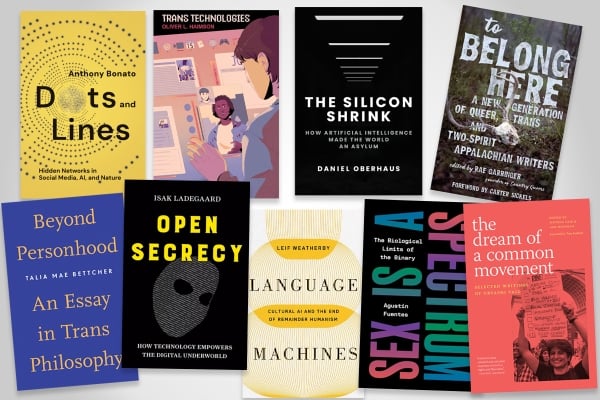
    More catalogs from university presses started arriving almost immediately after the last roundup of spring titles appeared—and in going through them, a couple of topical clusters of books struck me as notable. Here is a quick overview. Quoted passages come from material provided by the publishers.

    What do ant colonies, online subcultures, the publishing industry and the device you are using to read this all have in common? Each is, in some sense, a network embedded in still wider networks. They, like myriad other phenomena, can be depicted in geometric diagrams in which the components of a system (“vertices”) are connected by lines (“edges”) representing interactions or relationships.

    Researchers across many disciplines understand how systems and processes can be conceptualized as networks. The lay public, on the whole, does not. Anthony Bonato’s Dots and Lines: Hidden Networks in Social Media, AI, and Nature (Hopkins University Press, May) aims to bring nonspecialist readers up to speed on elements of the network perspective. Everything from “Bitcoin transactions to neural connections” and “political landscapes to climate patterns” can be mapped via dots and lines. The author’s use of demotic labels seems well-advised, given that “Vertices and Edges” seems much less commercially viable as a title.

    Some networks make it a priority to remain diagrammable, of course. Isak Ladegaard’s Open Secrecy: How Technology Empowers the Digital Underworld (University of California Press, May) looks into the “military-grade encryption, rerouting software, and cryptocurrencies” enabling “shadowy groups to organize collective action.” Examples include dark-web markets for illegal drugs, the activities of online hate groups and the efforts of Chinese citizens to remain connected to parts of the internet blocked by the Great Firewall. In each case, those running stealth networks “move through cyberspace like digital nomads, often with law enforcement and other powerful actors on their tails.”

    Leif Weatherby’s Language Machines: Cultural AI and the End of Remainder Humanism (University of Minnesota Press, June) offers “a new theory of meaning in language and computation” applicable to the production of texts by artificial intelligence based on large language models.

    Generative AI “does not simulate cognition, as widely believed,” he argues, “but rather creates culture” instead of just shuffling together fragments of it. (This is perhaps as good an occasion as any to issue my prediction that 2025 will see the first best-selling novel written by an AI algorithm.)

    On an altogether more dire note, Daniel Oberhaus’s The Silicon Shrink: How Artificial Intelligence Made the World an Asylum (MIT Press, February) warns that the use of AI in psychiatry has shown “vanishingly little evidence” of improving patient outcomes. The problem is not one of engineering but of programming: The algorithms incorporate “deeply flawed psychiatric models of mental disorder at unprecedented scale,” posing “significant risks to vulnerable people.”

    In old-school psychodynamic therapy, what’s said during the consultation does not leave the room. The author warns that a “psychiatric surveillance economy” is emerging, one “in which the emotions, behavior, and cognition of everyday people are subtly manipulated by psychologically savvy algorithms.”

    Doubling down on a strictly defined and vigilantly enforced understanding of sex and gender as binary is high on the MAGA cultural agenda. A few books out this spring insist on the ambiguities and complexities, even so.

    Agustín Fuentes offers perhaps the most basic challenge to traditional assumptions with Sex Is a Spectrum: The Biological Limits of the Binary (Princeton University Press, May). Arguing on the basis of recent scientific research, the book “explain[s] why the binary view of the sexes is fundamentally flawed,” with “compelling evidence from the fossil and archaeological record that attests to the diversity of our ancestors’ sexual bonds, gender roles, and family and community structures.”

    The ability to survive and thrive in unwelcoming circumstances is a focus of the writings collected in To Belong Here: A New Generation of Queer, Trans, and Two-Spirit Appalachian Writers (University Press of Kentucky, April), edited by Rae Garringer. The term “two-spirit” refers to a nonbinary gender category recognized among some Indigenous peoples in North America. Contributors discuss “themes of erasure, environmentalism, violence, kinship, racism, Indigeneity, queer love, and trans liberation” in Appalachia, exploring “the writers’ resilience in reconciling their complex and often contradictory connections to home.”

    Transgender philosophy is covered at some length in an entry recently added to the Stanford Encyclopedia of Philosophy. Talia Mae Bettcher, whose work figures prominently in the entry’s bibliography, continues her work in the field with Beyond Personhood (University of Minnesota Press, March), presenting “a theory of intimacy and distance” that proposes “an entirely new philosophical approach to trans experience, trans oppression, gender dysphoria, and the relationship between gender and identity.”

    Engineering and programming enter transgender studies’ already interdisciplinary ambit with Oliver L. Haimson’s Trans Technologies (MIT Press, February), which draws on the author’s “in-depth interviews with more than 100 creators of technology” for trans people, showing “how trans people often must rely on community, technology, and the combination of the two to meet their basic needs and challenges.” From the book’s description and the author’s published articles, it seems that the technology in question tends to be digital: social networks, games, extended reality systems (akin to virtual reality but with additional capacities). The book also considers the factors shaping, and in some cases restricting, innovation in trans tech.

    To close this list, there’s The Dream of a Common Movement (Duke University Press, April), a collection of writings by and interviews with Urvashi Vaid (1958–2022) edited by Jyotsna Vaid and Amy Hoffman. Urvashi Vaid was a feminist and a civil rights advocate whose work “over the course of four decades fundamentally shaped the LGBTQ movement.” Her perspective that “the goal of any liberation movement should be transformation, not assimilation” seems compatible with an older principle, which holds that an injury to one is an injury to all.

    Scott McLemee is Inside Higher Ed’s “Intellectual Affairs” columnist. He was a contributing editor at Lingua Franca magazine and a senior writer at The Chronicle of Higher Education before joining Inside Higher Ed in 2005.

    Source link

  • College holiday videos feature mascots, movie references

    College holiday videos feature mascots, movie references

    It’s been another challenging year in higher ed, and colleges are unsure what 2025 could bring, especially with the Biden administration coming to an end and former president Trump returning to the White House. But that doesn’t mean there’s nothing for them to celebrate this holiday season, whether it’s increased enrollment, new awards and recognitions, a close-knit campus community—or just the fact that there are students on campus willing to star in a silly holiday video.

    Here are Inside Higher Ed’s favorite greetings of this holiday season, including five presidential cameos, four mascot stunts, three live music performances, two Die Hard references … and a partridge in a pear tree.

    University of Wisconsin–Superior

    Since when can yellowjackets ice-skate? Google tells me that wasps need to find somewhere warm to hide away when temperatures drop below 40 degrees—but Buzz the Yellowjacket, the University of Wisconsin at Superior’s mascot, appears to be the exception. In this holiday greeting video, Buzz not only makes an impressive ice hockey goal but also displays some figure skating prowess, pulling off a top-rate arabesque. Could Buzz become the nation’s first ever apian Olympian?

    Riverland Community College, Austin, Minn.

    In this video from Riverland Community College in southern Minnesota, different groups of students wish viewers a happy holiday in turn. Their greetings give glimpses into the unique programs, clubs and spaces on campus, from cosmetology students giving pedicures in a salon to handy welders- and electricians-in-training showing off their skills.

    Iowa State University, Ames, Iowa

    Iowa State’s Cyclone Marching Band comes together in perfect harmony in this artfully choreographed video, marching across campus to provide some brassy musical accompaniment for the campus’s tree lighting. From what I could find in my research, the group first plays the university’s alma mater, “The Bells of Iowa State,” which was written in 1931 by Iowa State English professor Jim Wilson, followed by a rousing rendition of ISU’s fight song.

    Georgia State University College of the Arts, Atlanta

    Coniferous trees spring from sidewalks and dance studios in this collage-like animation by a GSU alumnus, featuring background music by a current undergraduate student. The video concludes with punny well-wishes for the holidays: “May the arts spruce up your season with good cheer!”

    Eastern Washington University, Cheney, Wash.

    This sketch from Washington’s EWU opens with the university’s president, Shari McMahan, jokingly bemoaning the fact that she had run out of acorns on which to use her large collection of nutcrackers. But the campus community takes that joke seriously and shifts into high gear, with each department researching how to help her get her hands on more “nutcracker food.” I hope those math students were able to finally solve for the numeric value of acorn!

    Howard University, Washington, D.C.

    Howard president Ben Vinson III highlights the university’s 2024 achievements in this holiday message, including the D.C. university’s record-breaking freshman class and its 100th homecoming. “As we prepare for the holidays, I look forward to all that lies ahead. I wish everyone a joyful and restful break and a successful start to the new year,” Vinson said.

    Whitman College, Walla Walla, Wash.

    Rhythmic choral music rings out through Whitman College’s Memorial Building before the singers are eventually joined by an instrumental septet in this distinctive holiday video. What makes this video so unusual is the choice to use not a well-known holiday carol but a choral song by living composer Jeff Newberry with lyrics by Malcolm Guite, a poet and Anglican priest, that nevertheless speak to the gratitude and peace of the holiday season: “Become an open singing-bowl, whose chime / Is richness rising out of emptiness, / And timelessness resounding into time.”

    Massachusetts Institute of Technology, Cambridge, Mass.

    MIT’s video this year is a short animated sequence that shows what happens after it magically begins snowing inside one of the university’s academic buildings. A student walks through the snow-dusted hallway, eventually happening upon an atrium where her classmates are playing instruments crafted from ice, sledding and crafting a snow beaver in the image of the institution’s mascot.

    University of North Carolina at Charlotte

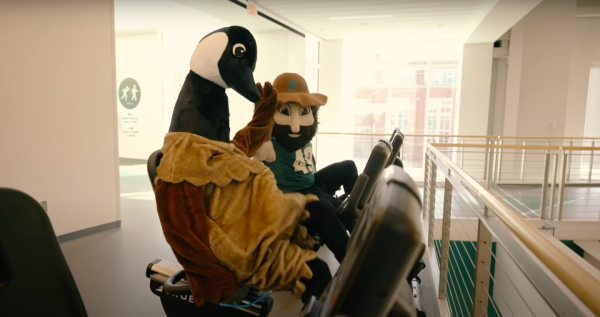
    What a beautiful message for this holiday season: the importance of friendship across differences. When Norm the Niner, the University of North Carolina at Charlotte’s gold-mining mascot, orders goose on a food delivery app, he’s expecting dinner to arrive. But instead, he finds a live goose at his door at ready to move onto UNC-Charlotte’s campus. At first, the goose only wants to cause chaos, but eventually he mellows out, learning to enjoy college basketball, fine art and taking selfies before eventually departing south for the winter.

    Tarrant County College, Tarrant County, Tex.

    In this heartfelt video from one of Texas’s largest counties, members of the Tarrant County College community join together at a beautifully set table for what looks to be a homemade holiday dinner, reminding TCC students that they will always “have a seat at the table.” Joining them is college chancellor Elva Concha LeBlanc and Toro the Trailblazer, the college’s blue bull mascot, which is dancing in the background.

    Oral Roberts University, Tulsa, Okla.

    Hot takes abound in this video of Oral Roberts students answering Christmas-related questions, like their favorite holiday songs and films. Is Home Alone 2 superior to the original? Does the Phineas and Ferb Christmas special really qualify as a Christmas movie? Does anyone actually know the words to “Grandma Got Run Over by a Reindeer”? If you and your family don’t have enough to argue about this holiday, these are some questions you could bring up to really cause a ruckus.

    Yale University, New Haven, Conn.

    Why does it seem like there’s a trend this year of rebuffing all the classic carols in favor of introducing new songs to represent the spirit of the season? I’m not complaining; apparently the song in this video is from Frozen 2, a movie I have never seen, but Yale’s student performers make it sound as loved and lived-in as a warm woolen sweater. This video also features Handsome Dale, Yale’s bulldog mascot, and Angus, the university’s First Puppy.

    Clackamas Community College, Oregon City, Ore.

    One of two institutions returning to this list from last year, Clackamas Community College in Oregon is back with another parodic holiday heist. This year, the college took inspiration from Die Hard. It stars Adam Hall, a math instructor at the college, in the role of John McClane, having to fight against a plot to “encrypt the digits of pi to ruin their holiday joy.” I’ve never seen Die Hard, but I have to assume that’s extremely accurate to what happens in the movie.

    Oakland Community College, Oakland County, Mich.

    Oakland Community College is the second to make another appearance on this list from last year. In this year’s self-aware video, chancellor Peter Provenzano decides to use ChatGPT—one its few, if only, appearances in any of these videos!—to gather ideas for a Christmas movie parody that Talon, OCC’s owl mascot, could star in. The AI spits out It’s a Wonderful Life, Die Hard, A Charlie Brown Christmas and more, but none satisfy Provenzano. The moral of the story? “There are a lot of stories Talon can tell to capture the season’s joy, but none better than the story we tell at OCC,” he says. (And stick around to the end for bloopers!)

    Source link