Tag: Higher

  • New Instructions Clarify USCIS Fee Rule Reductions and Exemptions for Higher Ed – CUPA-HR

    New Instructions Clarify USCIS Fee Rule Reductions and Exemptions for Higher Ed – CUPA-HR

    by CUPA-HR | March 6, 2024

    On March 1, 2024, U.S. Citizenship and Immigration Services published updated forms and filing instructions for the I-129, Petition for a Nonimmigrant Worker and the I-140, Immigrant Petition for Alien Workers. These updates incorporate new fee calculations as outlined in the USCIS fee rule. Notably, the filing instructions state that institutions “of higher education, as defined in section 101(a) of the Higher Education Act of 1965” are eligible for the reduced fees and exemption from the Asylum Program fee.

    This clarification follows the issuance of a final rule by USCIS on January 31, 2024, which adjusted the fees for most immigration applications and petitions, resulting in significantly higher fees for most employment-based petitioners. However, due to concerns raised by stakeholders, including CUPA-HR and other higher education institutions, the final rule provided relief for nonprofit organizations in the form of fee reductions as well as an exemption from a newly introduced fee intended to fund the Asylum Program.

    In a previous blog post, CUPA-HR addressed the confusion stemming from the final rule’s reliance on the Internal Revenue Code’s definition of a nonprofit organization, particularly 26 U.S.C. 501(c)(3). This definition caused uncertainty among public universities and colleges, which, while tax-exempt, are not classified as 501(c)(3) entities. The preamble to the final rule suggested that the agency’s approach to defining “nonprofit” was designed to ensure that the primary types of organizations eligible for the American Competitiveness and Workforce Improvement Act’s fee reduction — specifically, educational institutions, nonprofit research organizations, and governmental research organizations — would also qualify for fee reductions and exemptions under this rule. However, the possibility of a strict interpretation of “nonprofit” might have left public universities and colleges facing increased fees.

    The updated filing instructions offer much-needed clarity on the fee reductions and exemptions, ensuring that institutions of higher education as defined by the Higher Education Act of 1965 will not be overly burdened by petitioner fees.


    Source link

  • NLRB Higher Education Union Election Data for 2023 – CUPA-HR

    NLRB Higher Education Union Election Data for 2023 – CUPA-HR

    by CUPA-HR | March 5, 2024

    During calendar year 2023, union organizing continued to rise at institutions of higher education. Data from the National Labor Relations Board on union organizing show that 31.2% of all private-sector workers who successfully unionized in 2023 were employed by institutions of higher education. Public institutions also saw considerable union activity, though this is not reflected in NLRB data.*

    To provide an update regarding collective bargaining at private colleges and universities across the country, CUPA-HR’s government relations team has compiled the following NLRB data** from 2023 and early 2024 to summarize organizing activity.

    Organizing Efforts at Private Institutions in 2023

    • There were 132,303 workers in bargaining units that held elections in 2023. Of this total, 32,477 workers were from institutions of higher education.
    • There were 92,574 workers in total who joined certified bargaining units in the U.S. in 2023. Of this total, 28,859 workers were from institutions of higher education.

    Private Institution Union Drive Data in 2023

    • There were 55 union elections held at private institutions of higher education last year.
    • Of the 55 held, 48 union elections resulted in worker unionization. Again, this totaled 28,859 workers from private institutions of higher education.***
      • 20 elections included non-faculty, non-student workers with various positions.
      • 14 elections included graduate students with various positions (including two RA elections).
      • 13 elections included undergraduate students with various positions (including five RA elections).
      • Two elections included faculty.
      • Two elections included non-tenured faculty specifically.
      • Two elections included adjunct faculty.
      • Two elections included postdoctoral workers.
    • Three elections did not result in unionization. Four elections have been held at institutions, but they have not yet been closed. It is unclear why they are pending.

    Private Institution Election Data since January 1, 2024

    • So far this year, there have been eight union elections at institutions of higher education. Seven of the elections resulted in worker unionization, and one is still open for unknown reasons.
      • In the seven decided elections, 2,477 workers are included in the bargaining units.
      • In the one open case, 290 workers could be unionized.
    • Since January 1, 2024, there are seven pending petitions for unionization at institutions of higher education. In the seven pending petitions, 3,674 workers could be unionized depending on the result of the elections.

    CUPA-HR will continue to monitor this NLRB data and keep members apprised of future higher education union organizing trends.


    *The NLRB is a federal agency and only has jurisdiction over private employers, which includes private higher education institutions. Public institutions handle collective bargaining activity with their state and local labor relations agencies. CUPA-HR regularly tracks activity from the NLRB and is providing an overview of union activity at private institutions, but members at public institutions are encouraged to share union activity with the CUPA-HR government relations team as it occurs.

    **To compile the data, CUPA-HR searched for “Election Results” and “R Case Reports” that included the search terms “university,” “college,” and “school” during the calendar year 2023 and from January 1, 2024 to March 4, 2024.

    ***The grouped data below do not add up to 48 total elections because some units included multiple groups (i.e. undergraduate and graduate students, tenured and non-tenured faculty, etc.).


    Source link

  • Newly Updated CUPA-HR Data Shed Light on Trends in Representation and Pay Equity in the Higher Ed Workforce – CUPA-HR

    Newly Updated CUPA-HR Data Shed Light on Trends in Representation and Pay Equity in the Higher Ed Workforce – CUPA-HR

    by Julie Burrell | January 22, 2024

    Progress in both representation and equitable pay for women and people of color remained sluggish in most roles on college and university campuses in academic year 2022-23, according to the newest data. Through several interactive graphics representing years of research, CUPA-HR highlights the progress that has been made and the disparities that persist. The data track gender and racial composition as well as pay of administrative, faculty, professional, and staff roles, collected from CUPA-HR’s signature surveys.

    While the representation of women and people of color across all roles has steadily increased, inequity remains, especially when it comes to compensation for women and people of color. However, there were some notable areas of progress when it comes to compensation. Asian women and men of color (except for Native American/Alaskan Native men) in administrative roles saw better pay equity than most other groups.

    Administrators

    The share of racial and ethnic minorities in administrative roles continued to grow over the past decade, but gaps in both representation and pay remained steady. This is especially true for women of color, who represented less than 11% of these roles and, for the most part, received lower salaries than White men.

    In 2022-23, people of color made up 18.7% of administrators, up from 12.9% in 2011-12. Although the proportion of people of color in higher ed administrator positions grew steadily over the last decade, these increases have not kept pace with the rate at which minorities are obtaining graduate degrees.

    No improvement was shown in pay disparities for most women administrators. All female administrators except for Asian women received lower salaries than White men. Conversely, men of color, except for Native American/Alaskan Native men, were paid salaries greater than those of White men.

    The Administrators in Higher Education Survey collects data on administrator positions that manage a higher ed institution or a division within it.

    See the Administrators Composition and Pay Equity by Gender and Race/Ethnicity interactive graphics, as well as data broken out by CEO, provost and chief HR officer.

    Faculty

    There are two notable findings regarding faculty composition. First, more women faculty were represented in non-tenure-track roles than in tenure-track roles in 2022-23. Second, with each increase in rank, the proportions of women faculty and faculty of color decreased for both tenure-track and non-tenure-track faculty. Taken together, this means that women were over-represented in the lowest-paying and lowest-ranking positions.

    Pay gaps within rank persist, particularly for women faculty at the professor level, regardless of tenure status. These gaps are most notable for female professors of color in non-tenure-track positions. Pay gaps for assistant and associate professors have narrowed over time, particularly for tenure-track faculty.

    The factor that most impacts faculty pay is promotion to a higher rank, which is often the only time faculty receive significant increases in salary. When there is bias in promoting women and faculty of color to successive ranks, as our data continued to show, this results in career earnings gaps that far exceed what is often detected in pay equity studies within rank for a given year.

    The Faculty in Higher Education Survey collects data on tenure-track faculty positions and non-tenure-track teaching faculty positions.

    See the Faculty Composition and Pay Equity by Gender and Race/Ethnicity interactive graphics.

    Professionals

    In academic year 2022-23, women of all races and ethnicities were paid less than their male counterparts in professional roles, while women’s representation increased from 58% to 61% across all professional positions since 2016-17. The growth is due to slight increases in the representation of women of color, from 13.1% in 2016-17 to 15.7% in 2022-23.

    Representation by gender and race/ethnicity varied widely by position. Human resources had the greatest share of women professionals, with 82% being women, including 28% women of color. Information technology had the lowest percentage of professional women (27%), and librarians and development/fundraising professionals had the lowest representation of professionals of color (14%).

    While pay was more equitable for most groups (apart from Hispanic/Latina women and men of two or more races), pay disparities persisted. Women of all races and ethnicities were paid less than their male counterparts. In addition, Hispanic/Latino men, Native Hawaiian men, and men of two or more races were paid less than White men.

    The Professionals in Higher Education Survey collects data on positions in specific functional areas in higher ed institutions, such as academic or student services, that usually require a baccalaureate degree.

    See the Professionals Composition and Pay Equity by Gender and Race/Ethnicity interactive graphics.

    Staff

    Staff roles continued to have a higher representation of people of color than any other higher ed employee group last year. Staff also continued to be the lowest-paying positions in higher ed, with women particularly hard hit by pay disparities.

    In 2022-23, women of color represented about 19% of all higher ed staff, and men of color represent about 13% of all higher ed staff — a modest increase since 2016-17. Skilled craft employees were the least racially diverse, a finding that has persisted across the past six years. Notably, skilled craft staff are among the highest-paid staff positions.

    Since 2016-17, women were paid consistently and considerably less than White men. Pay equity for American Indian/Alaska Native women, Asian women, and Native Hawaiian/Other Pacific Islander women was better in 2022-23 than in 2016-17. Pay equity was the same or worse in 2022-23 than in 2016-17 for Black women, Hispanic/Latina women, women of two or more races, and White women. Men of color fared considerably better than women of color when it came to pay equity.

    The Staff in Higher Education Survey collects data on positions that are generally non-exempt and do not require a college degree.

    See the Staff Composition and Pay Equity by Gender and Race/Ethnicity interactive graphics.

    CUPA-HR Research

    CUPA-HR is the recognized authority on compensation surveys for higher education, with its workforce surveys designed by higher ed HR professionals for higher ed HR professionals and other campus leaders.


    Source link

  • Ten Higher Ed HR Stories That Defined 2023 – CUPA-HR

    Ten Higher Ed HR Stories That Defined 2023 – CUPA-HR

    by Julie Burrell | January 17, 2024

    Last year brought major changes to the higher education landscape. Turnover reached a peak, prompting more attention than ever to retention and recruitment, while looming policy changes in overtime pay and Title IX regulations further complicated long-term planning. And, though it may feel like unprecedented change is the new normal, timeless HR topics like onboarding and compensation strategy also captured readers’ attention in 2023.

    We’ve rounded up the CUPA-HR articles, resources and research that defined 2023 and will continue to shape your 2024. These are the most-viewed stories on our website as well as some resources you may have missed.

    Top Stories

    CUPA-HR members were understandably concerned about the impact of two issues — the retention crisis and the potential shake-up to overtime pay rules — on their campuses.

    1. The Higher Ed Employee Retention Crisis — And What to Do About It

    Key Takeaway: Turnover in higher ed reached a peak last year — the highest level since we started tracking it in 2017 — so it’s no surprise that talent management and recruitment was top of mind. This article marshals a wealth of insights from our members and the CUPA-HR research team to aid HR pros, including a blueprint for employee recognition, as well as strategies for rethinking compensation and flexible work.

    1. The CUPA-HR 2023 Higher Education Employee Retention Survey

    Key Takeaway: The data provided here help explain the record-high turnover. The report also digs into the factors that most impact retention, offering a model for understanding higher ed retention. Analyzing data from 4,782 higher ed employees — administrators, professionals and non-exempt staff, with faculty excluded — from 529 institutions, the survey found that more than half (56%) of employees are at least somewhat likely to search for a new job in the coming year. (Looking for an overview of report findings? Check out our press release.)

    1. Overtime and Title IX Final Rules Targeted for Early 2024 Release in Fall Regulatory Agenda

    Key Takeaway: Last year, the Department of Labor announced that they would target April 2024 for the release of a final rule to update the Fair Labor Standards Act’s overtime pay regulations. The rule seeks to substantially increase the minimum salary threshold required for white-collar professionals to maintain exempt status. To stay abreast of any updates, don’t forget to register for our Washington Update webinars and visit our FLSA overtime resources page.

    Relationships and Well-Being

    The demands on HR pros are at an all-time high. Last year, our members sought ways to care for themselves, their team and their campuses. Two of the most popular resources of 2023 addressed mental health and resolving interpersonal conflict.

    1. Managing Stress and Self-Care: “No” Is a Complete Sentence

    Key Takeaway: In this highly rated recorded webinar, Jennifer Parker, professional development and training manager of the Colorado Community College system, gives practical tools for minimizing stress and leads participants in creating a self-care plan.

    1. Ushering in the New Wave of Conflict Resolution: Tulane University’s Restorative Approach

    Key Takeaway: Learn how Tulane University’s Office of Human Resources and Institutional Equity launched a conflict resolution program, all while successfully managing the pivot to virtual offerings during the pandemic. One of the few university programs in the country to provide a restorative approach, Tulane’s program is a roadmap for fostering and maintaining campus relationships.

    Retention and Recruitment

    Our members offered real-world case studies of talent management and attraction in these feature articles in Higher Ed HR Magazine. They provide success stories and practical tips you can tailor to fit your needs.

    1. Modernizing Workplace Culture and the Employee Experience — Strategies for HR

    Key Takeaway: Workplace culture encompasses so much that it’s tricky to pin down. Jacob Lathrop, consultant to the vice president/CHRO at Michigan State University, defines workplace culture as the feeling employees are left with when they leave work. It’s how they describe their days to family or friends. Old ways of doing things may be harmful to employees’ well-being, while modernizing workplace culture might mean retaining and attracting talent. Lathrop’s tips include embracing flexibility and autonomy, evolving your paid-leave policies, and updating career exploration programs, among others.

    1. A Tale of Two Onboarding Programs: North Carolina State University and
    2. A Tale of Two Onboarding Programs: The University Of St. Francis

    Key Takeaway: A perennially popular topic, onboarding can look very different depending on the institution. In the first article, North Carolina State University’s onboarding manager Amy Grubbs tells the story of their efforts to create consistent new-hire experiences, get supervisors involved in the onboarding process, and bring a full-service Onboarding Center to life through strategic campus partnerships. (Check out Amy’s webinar too, which provides even more information on the Onboarding Center and strategic partnerships.) With more limited resources, Carol Sheetz, formerly of the small, private University of St. Francis, shares her solo effort to build USF’s onboarding program from scratch. This article contains her top tips and resources for other HR pros in the same situation.

    1. Investing in Employees During an Economic Downturn: How We Implemented Our Living Wage Strategy

    Key Takeaway: A decade ago, the Maricopa County Community College District committed to a $30,000 livable wage for its full-time employees, but employees found it challenging to keep up with inflationary pressures and the COVID-related economic downturn. Maricopa responded by raising the livable wage by 15.5 percent, from $14.42 to $16.65. This article explains how HR managed to implement this raise, while preventing additional pay compression and reduced employee morale. (The second phase of MCCCD’s plan, focusing on progressive pay practices, internal pay equity and market alignment, is explored here.)

    1. Recalibrating Employee Recognition in Higher Education

    Key Takeaway: “Most of us continue churning out the same recognition programs — many decades old — often without questioning their value, validating their impact or reviewing for bias,” says author Sharri Margraves, the executive director of organization and professional development for Michigan State University’s human resources. She surveyed 65 higher education institutions to find out how they formally and informally recognize employees. This article not only presents these findings, but also suggests ways to redesign your own recognition program, including a self-audit tool to assess your strengths and weaknesses.


    Source link

  • Dr. Jennifer T. Edwards: A Texas Professor Focused on Artificial Intelligence, Health, and Education: Preparing Our Higher Education Institutions for the Future

    Dr. Jennifer T. Edwards: A Texas Professor Focused on Artificial Intelligence, Health, and Education: Preparing Our Higher Education Institutions for the Future

    As we prepare for an upcoming year, I have to stop and think about the future of higher education. The pandemic changed our students, faculty, staff, and our campus as a whole. The Education Advisory Board (EAB) provides colleges and universities across the country with resources and ideas to help the students of the future.

    I confess, I have been a complete fan of EAB and their resources for the past ten years. Their resources are at the forefront of higher education innovation.

    🏛 – Dining Halls and Food Spaces

    🏛 – Modern Student Housing

    🏛 – Hybrid and Flexible Office Spaces

    🏛 – Tech-Enabled Classrooms

    🏛 – Libraries and Learning Commons

    🏛 – Interdisciplinary Research Facilities


    Higher education institutions should also focus on the faculty and staff as well. When I ask most of my peers if they are comfortable with the numerous changes happening across their institution, most of them are uncomfortable. We need to prepare our teams for the future of higher education. 

    Here’s the Millennial Professor’s Call the Action Statements for the Higher Education Industry

    🌎 – Higher Education Conferences and Summits Need to Provide Trainings Focused on Artificial Intelligence (AI) for Their Attendees

    🌎 – Higher Education Institutions Need to Include Faculty and Staff as Part of Their Planning Process (an Important Part)

    🌎 – Higher Education Institutions Provide Wellness and Holistic Support for Faculty and Staff Who are Having Problems With Change (You Need Us and We Need Help)

    🌎 – Higher Education Institutions Need to Be Comfortable with Uncommon Spaces (Flexible Office Spaces)

    🌎 – Faculty Need to Embrace Collaboration Opportunities with Faculty at Their Institutions and Other Institutions

    Here are some additional articles about the future of higher education:

    Higher education will continue to transition in an effort to meet the needs of our current and incoming students. 

    For our particular university, we are striving to modify all of these items simultaneously. It is a challenge, but the changes are well worth the journey.

    Here’s the challenge for this post: “In your opinion, which one of the items on the list is MOST important for your institution?”

    ***. 

    Check out my book – Retaining College Students Using Technology: A Guidebook for Student Affairs and Academic Affairs Professionals.

    Remember to order copies for your team as well!


    Thanks for visiting! 


    Sincerely,


    Dr. Jennifer T. Edwards
    Professor of Communication

    Executive Director of the Texas Social Media Research Institute & Rural Communication Institute

    Source link

  • Reflections from the Higher Education for Good Book Release Celebration – Teaching in Higher Ed

    Reflections from the Higher Education for Good Book Release Celebration – Teaching in Higher Ed

    What a way to start my week!

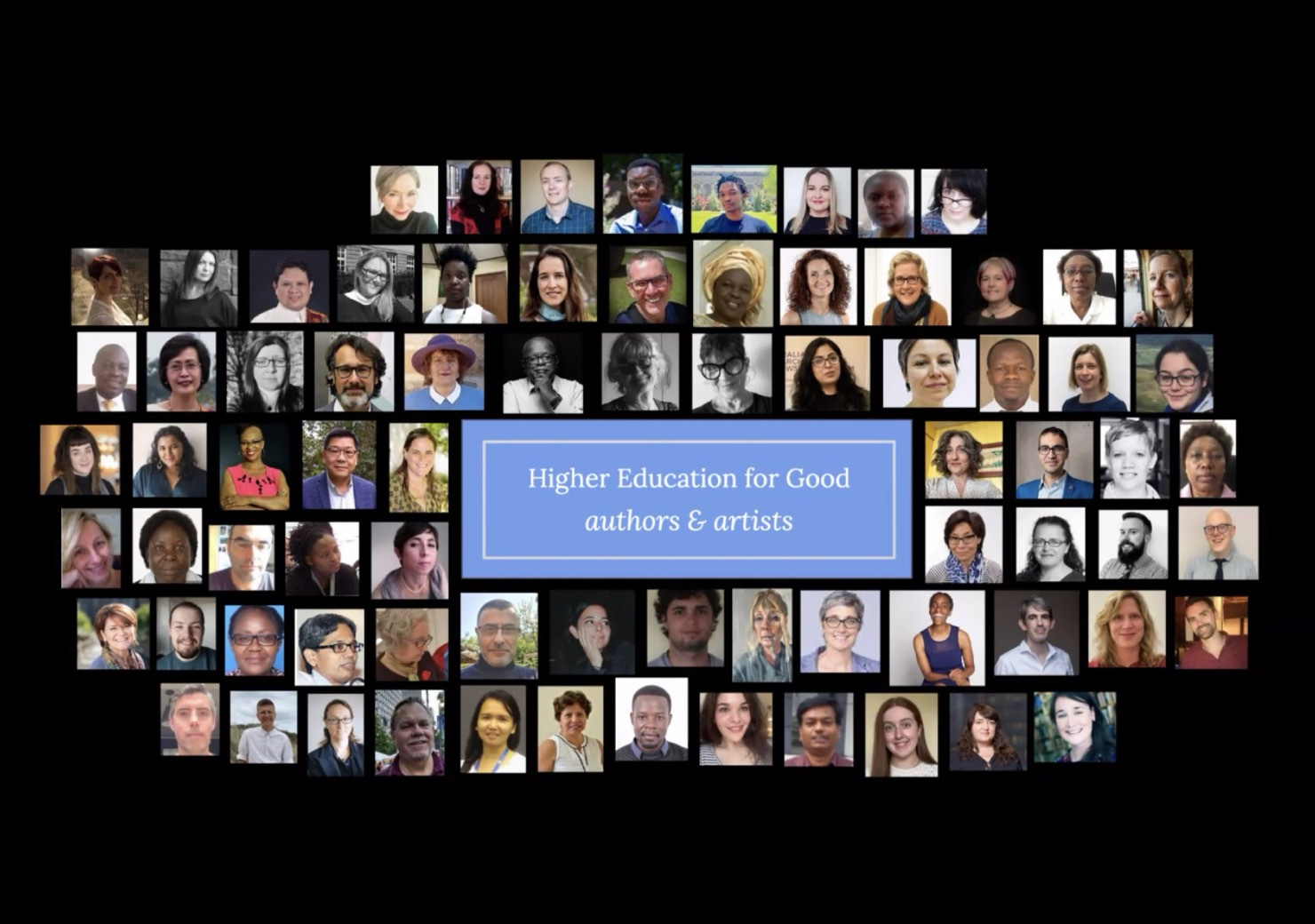
    November 20, 2023, I attended an online launch celebration event for a magnificent project. The book Higher Education for Good: Teaching and Learning Futures brought together 71 authors around the globe to create 27 chapters, as well as multiple pieces of artwork and poetry. Editors Laura Czerniewicz and Catherine Cronin shared their reflections of writing the book and invited chapter authors, and Larry Onokpite, the book’s editor, to celebrate the release and opportunities for collaboration. In total, the work represents contributions from 29 countries from six continents. Laura Czerniewicz was invited to talk about the book by the Academy of Science of South Africa (ASSAf), where she describes the values of inclusion woven throughout this project.

    Higher Ed for Good Aims

    At Monday’s book launch, Laura shared how the authors aimed to write about the tenants that were directed toward the greater aims of the book. Catherine described the call for authors to engage in this project, such that the resulting collection would help people:

    • Acknowledge despair
    • Engage in resistance
    • Imagine alternative futures and…
    • Foster hope and courage

    Laura stressed the way articulating what we stand for and not simply what we are against is essential in facilitating systemic change. Quoting Ruha Benjamin, Laura described ways to courageously imagine the future:

    Only by shifting our imagination, can we begin to think of a world that is more egalitarian, less extractive, and more habitable for everyone not just a small elite.

    It was wonderful to see the community who showed up to help celebrate this magnificent accomplishment. Toward the end of the conversations, someone asked about what might be next for this movement. Frances Bell responded by joking that she wasn’t sure she was necessarily going to answer the question, as she is prone to do. Instead, she described her use of ‘a slow ontology,’ a phrase which quickly resonated with me, even thought I didn’t know exactly what it meant.

    In some brief searching, I discovered a bit more about slow ontology. My novice understanding is that slow ontology asks the question of what lives might look like, were we to live them slowly and resist the socialization of speed as productivity and self-worth. Ulmer offers a look at a slow ontology for writing, while Mol uses slowness to analyze archeological artifacts. One piece I absolutely want to revisit is Mark Carrigan’s Beyond fast and slow: temporal ontology in critical higher education scholarship

    Next Steps

    I’ll have the honor, soon, of interviewing Laura and Catherine for the Teaching in Higher Ed podcast. I’m ~30% through Higher Education for Good and am glad I don’t have to rush through the reading too quickly. I mentioned as a few of us remained online together after the book release celebration that reading Higher Education for Good and Dave Cormier’s forthcoming Learning in a Time of Abundance has been an interesting juxtaposition. Rissa Sorensen-Unruh described a similar serendipity of reading Belonging, by Geoffrey Cohen at the same time as Rebecca Pope-Ruark’s Unraveling Faculty Burnout. After skimming the book description of Belonging, I instantly bought it… adding it to the quite-long digital to-read stack. I suppose that while I struggle with slowing down, that challenge doesn’t apply when it comes to my reading practice.

    Resources:

    Source link

  • Department of Education Issues Report on Diversity and Opportunity in Higher Education – CUPA-HR

    Department of Education Issues Report on Diversity and Opportunity in Higher Education – CUPA-HR

    by CUPA-HR | October 18, 2023

    On September 28, 2023, the Department of Education released a report titled “Strategies for Increasing Diversity and Opportunity in Higher Education.” The report was issued in response to the Supreme Court’s June 2023 ruling against affirmative action in college admissions and it outlines ways institutions and states can adapt to prioritize improved accessibility to educational opportunities for underserved students.

    The Report

    In an introductory message for the report, Secretary of Education Matthew Cardona emphasized the enduring commitment to equal opportunity and student body diversity in higher education on behalf of his department and the president’s administration. While condemning the Supreme Court’s decision on affirmative action, Cardona pledged the Department of Education’s and the Biden administration’s support in promoting inclusivity and equity and stimulating long-term prosperity.

    The Department of Education’s report centers around four areas that the administration believes institutions should consider when working to promote diversity and opportunity on campus: student recruitment, admissions, financial aid and student retention. The report focuses mostly on promoting diversity, equity and inclusion (DEI) initiatives in these areas to ensure underserved students have an equitable opportunity to be admitted into and succeed in postsecondary programs.

    Relevant to higher education HR, the report discusses the need for improved training of admissions officers and other employees to ensure consistent, equitable evaluations of applicants.

    Moving Forward

    Prior to the release of the Supreme Court’s affirmative action decision, stakeholders also raised concerns regarding the impact such a decision could have on hiring and employment decisions as well as programs or initiatives focused on creating diverse and inclusive workplaces that align with institutional values. The decision to strike down race-based affirmative action in admissions practices could leave employers open to future legal challenges regarding their hiring decisions and other diversity programs.

    CUPA-HR endorses efforts to promote inclusive communities on campuses across the nation. The government relations team continues to track developments impacting these efforts and will inform members of updates as they become available.


    Source link

  • The Top Predictor of Higher Ed Employee Retention May Surprise You – CUPA-HR

    The Top Predictor of Higher Ed Employee Retention May Surprise You – CUPA-HR

    by CUPA-HR | September 12, 2023

    In 2022-23, turnover of higher ed employees was the highest in five years. A new report from CUPA-HR explores the issue of higher ed employee retention and the factors that impact retention.

    The CUPA-HR 2023 Higher Education Employee Retention Survey analyzed data from 4,782 higher ed employees — administrators, professionals and non-exempt staff, with faculty excluded — from 529 institutions. It found that 33% of higher ed employees surveyed answered they were “very likely” or “likely” to look for new employment opportunities in the next year. More than half (56%) of employees are at least somewhat likely to search for a new job in the coming year.

    Top Reasons Higher Ed Employees Are Looking for a New Job

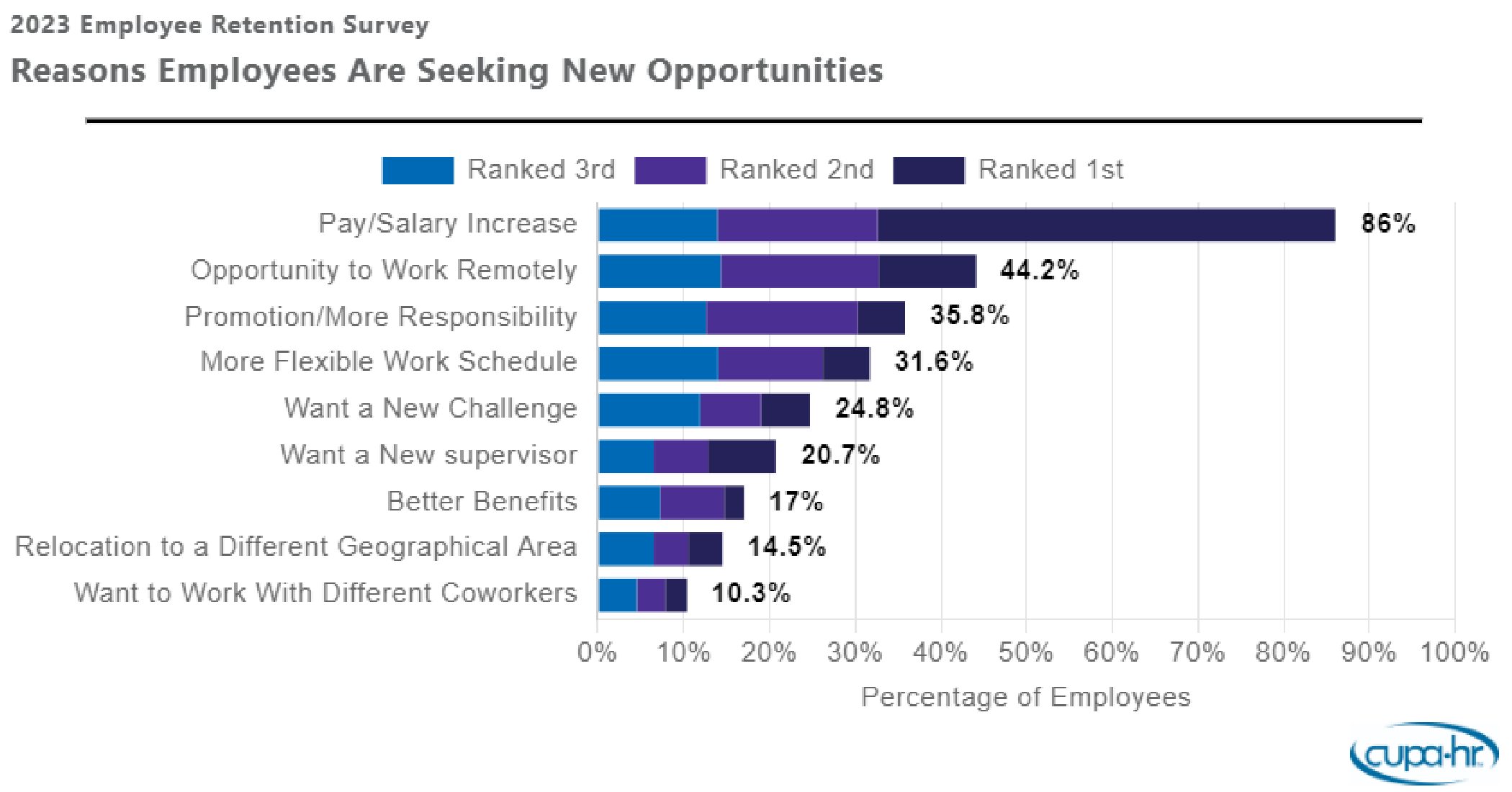
    According to the findings, respondents say that pay is the number one reason they’re looking for a new job. Other influential reasons are an opportunity to work remotely, desire for a promotion or more responsibility, and the need for a more flexible work schedule.

    But while pay is the top concern mentioned by employees, retention challenges are more complex.
    Strongest Predictors of Retention

    Digging deeper into the data, the strongest predictors of retention are factors related to job satisfaction and well-being. Only 58% of higher ed employees are generally satisfied with their jobs. Of the 16 aspects of job satisfaction and well-being the survey measured, the three that have the most impact on retention are:

    • Recognition for Contributions
    • Being Valued by Others at Work
    • Having a Sense of Belonging

    Only 59% of respondents say they receive regular verbal recognition for doing good work. The good news is that programs, training and policies that increase employee satisfaction in these areas can make a significant impact on retention without necessarily breaking the budget.

    Three Things You Can Do

    Employees are not necessarily planning to flee higher ed. Most job seekers will be looking within higher ed, and nearly half will be looking within their own institution, indicating that it’s not too late to implement retention strategies. Here are three things you can do to assess and address job satisfaction:

    1. Read the Report. The CUPA-HR 2023 Higher Education Employee Retention Survey provides not only data but also a model for understanding higher ed retention. (Looking for an overview of report findings? Check out our press release.)
    2. Explore CUPA-HR Resources. Here are several that focus on aspects of job satisfaction:
    1. Plan Next Steps. Share the report or press release with leaders on your campus. Determine areas where your institution could strengthen career development and implement training to increase job satisfaction.


    Source link

  • Award-Winning Work in Higher Ed HR – 2023 Regional Awards – CUPA-HR

    Award-Winning Work in Higher Ed HR – 2023 Regional Awards – CUPA-HR

    by CUPA-HR | May 23, 2023

    From developing supervisor competencies to transforming HR operations, human resources teams and HR practitioners across the country are doing great work every day.

    CUPA-HR’s regional Higher Education HR Awards program recognizes some of the best and brightest in higher ed HR and honors HR professionals who have given their time and talents to the association.

    Here are this year’s regional award recipients:

    HR Excellence Award

    This award honors transformative HR work in higher education and recognizes a team that has provided HR leadership resulting in significant and ongoing organizational change within its institution.

    Office of Human Resources, Towson University (Eastern Region)

    Towson University has had a partnership with Humanim, a nonprofit community workforce-development program, for many years. However, the pandemic created challenges that threatened to derail the partnership and the program. TU’s office of human resources, along with other anchor institutions, worked with Humanim to move parts of the program online, including virtual mock interviews, information sessions and panel discussions. Despite turnover created by the pandemic, the TU HR team was determined to maintain its relationship with Humanim and continue to provide employment opportunities to Baltimore residents. As TU’s top provider of quality temporary candidates for the university’s administrative functions, Humanim was also essential to the university during pandemic. For their outstanding work, CUPA-HR has contributed $1,000 to Towson University.

    Human Resources, Grand Valley State University (Midwest Region)

    In February 2022, Grand Valley State University’s HR team began implementing a total transformation of their operations, shifting from a 60-year-old compliance-driven approach to HR to an HR business partner approach. This change resulted in the creation of a “one-stop shop,” where HR services could be delivered more efficiently and consistently across all campus departments. The team also moved to improve efficiency by merging payroll, HR administration and technology, and benefits into a total rewards unit. And in the fall of 2022, HR established a formal talent management unit to organize and advance talent efforts. With these changes, HR is well positioned to unify and transform the university’s organizational culture. For their outstanding work, CUPA-HR has contributed $1,000 to Grand Valley State University.

    Culture Team, Utah Valley University (Western Region) 

    Recognizing a need for a better leadership experience for supervisors on their campus, Utah Valley University’s culture team set out to create a set of standardized leadership competencies that would help ensure that they were hiring the right people, communicating clear expectations during onboarding, providing leadership resources through training, and allowing supervisors to receive feedback. The Leadership Competency Experience, based on six leadership competencies and the university’s core values, established a standardized method of hiring, onboarding, training and feedback processing intended to cultivate effective leadership at all levels. Two years in, the program has made a significant impact on the quality of supervisors being hired and the training and support they receive, and the number of employee relations cases and volume of turnover due to bad supervision have decreased sharply. In fact, it has been so successful that in July 2022 the team released the Staff Competency Experience. For this impressive achievement, CUPA-HR has contributed $1,000 to Utah Valley University.

    Higher Ed HR Rock Star Award

    This award recognizes an individual who is serving in the first five years of a higher education HR career who has already made a significant impact.

    Miranda Arjona, Rollins College (Southern Region)

    From day one, Miranda Arjona, assistant director of human resources at Rollins College, has impressed colleagues with her positive outlook, creativity, willingness to learn and helpful attitude. Whether she’s building relationships within the HR team or leading a service excellence subcommittee, Miranda is focused on strengthening connections and making a difference. When she was asked to temporarily assist in student affairs to help manage contact tracing and consulting during the pandemic, she did so with her typical positivity and commitment to the task. Just as seamlessly, she transitioned back to her talent management role with the same mindset and tenacity. Her commitment to being a relationship-builder has not only served Rollins but also the higher ed HR community. She has been a speaker at two local HR events, and she is currently serving as president-elect of the CUPA-HR Florida Chapter.

    Lyndon Huling, University of California-Davis (Western Region)

    Lyndon Huling, manager of leadership recruitment, temporary staffing and diversity services at UC Davis, routinely taps his broad intergenerational and cross-cultural campus connections in his work, making him an exceptionally effective leader. His commitment to reimagining HR and recruitment best practices through a DEI lens shows in the strategies he’s developed and the innovative programs he’s been instrumental in establishing. Among other projects, he has co-sponsored and delivered transformative Race Matters workshops that create a safe space to learn and discuss race at work, which he has shared through presentations at regional and national CUPA-HR conferences. Through his work to create and share resources, Lyndon has demonstrated himself to be a passionate, progressive leader in higher ed HR.

    Chapter Excellence Awards

    These regional awards recognize chapters that are making a significant impact through their commitment to CUPA-HR and to the higher ed HR community. They work to achieve this through financial responsibility, commitment to CUPA-HR chapter guiding principles, cultivation of strong leadership, and development of creative networking and professional development opportunities.

    This year’s Chapter Excellence regional recipients are:

    • The CUPA-HR Michigan Chapter (Midwest Region)
    • The CUPA-HR Kentucky Chapter (Southern Region)
    • The CUPA-HR Northern and Central California Chapter (Western Region)


    Source link

  • Pay Increases for Higher Ed Employees Sharply Improve, But Still Fall Short of Inflation Rate – CUPA-HR

    Pay Increases for Higher Ed Employees Sharply Improve, But Still Fall Short of Inflation Rate – CUPA-HR

    by CUPA-HR | April 3, 2023

    New research from CUPA-HR has found that although employees across the higher education workforce saw the most substantial pay raises in 2022-23 than in the past several years, they are still being paid less than they were in 2019-20 in inflation-adjusted dollars.

    Some of the key findings from an analysis of CUPA-HR’s higher ed workforce salary survey data from 2016 to 2023:

    • This academic year, raises for higher ed employees were the largest seen in the past seven years, and all position types (administrators, professionals, staff and faculty) received an increase of at least 1.11 percentage points compared to the previous year.
    • Tenure-track and non-tenure-track teaching faculty continue to receive the smallest pay increases of any higher ed employee category. In 2022-23, tenure-track faculty saw a median pay increase of 2.9 percent and non-tenure-track faculty saw an increase of 3.2 percent. Tenure-track faculty salary increases have not kept pace with inflation since at least 2015, and non-tenure-track salary increases last met or exceeded inflation in 2016-17, meaning full-time faculty in general continue to be paid less every year in inflation-adjusted dollars.
    • Staff, which is typically the lowest-paid category of higher ed employees, saw the biggest raises this academic year at 5.3 percent (up from 2.9 percent in 2021-22).

    Explore this data and more in CUPA-HR’s newest interactive graphic.

    CUPA-HR Research

    CUPA-HR is the recognized authority on compensation surveys for higher education, with its workforce surveys designed by higher ed HR professionals for higher ed HR professionals and other campus leaders. CUPA-HR has been collecting data on the higher ed workforce for more than 50 years, and we maintain one of the largest workforce databases in existence. CUPA-HR also publishes numerous research publications and interactive graphics highlighting trends and issues around higher ed workforce planning, pay equity, representation of women and racial/ethnic minorities and more. Learn more about CUPA-HR research.


    Source link