
Tag: Higher

  • Making Higher Education More Affordable: The Role of Financial Aid Strategies

    Making Higher Education More Affordable: The Role of Financial Aid Strategies

    Key Takeaways:

    • Financial aid optimization transforms financial resource allocation into a strategic enrollment tool, aligning affordability for students with institutional goals.


    • By leveraging real-time data and tools like Liaison Othot, institutions can craft tailored financial aid strategies that address individual student needs and enrollment strategies.


    • Optimization enables proactive adjustments to financial aid strategies, ensuring accessibility while supporting student retention and institutional sustainability.


    • Strategic financial aid leveraging balances affordability for students with long-term enrollment and revenue objectives.


    The rising costs of higher education and fear of long-term debt have left many prospective students and their families questioning whether they can afford to pursue their academic dreams. For institutions, this presents a dual challenge: attracting diverse students and ensuring enrollment goals align with their mission. An effective and aligned financial aid optimization strategy offers a powerful tool to meet a campus’s enrollment goals. By combining institutional funds with federal and state resources effectively, colleges and universities can increase access and affordability in higher education while achieving broader enrollment objectives.

    From offering enough aid to make tuition manageable to continuously refining financial aid strategies based on real-time information, optimizing plays a pivotal role in strategic enrollment management (SEM). It transforms financial aid awarding from a static process into a dynamic tool that not only attracts and enrolls students but also supports their retention by effectively meeting their financial needs.


    What Is Financial Aid Optimization?

    Financial aid optimization transforms the allocation of financial resources into a critical enrollment tool. By aligning the overall enrollment leveraging strategy—regularly and in real-time at the individual level—optimization allows campuses to address student affordability needs in a unique and tailored way.

    At its core, optimization is a dynamic, data-informed process. Institutions develop annual plans for allocating financial aid (leveraging), basing decisions on previous cycles’ successes and challenges. Unlike traditional static leveraging models, modern optimization approaches incorporate continuous adjustments informed by real-time data. This lets colleges and universities respond proactively to shifting enrollment trends and keeps their financial aid strategies effective throughout the year.


    How to Make Higher Education More Affordable and Accessible

    More accessible higher education starts with understanding the financial challenges students face. For many undergraduates, the cost of tuition, housing, books, and other expenses can make college seem out of reach, even with federal and state aid. For example, a student from a low-income household may find that even the maximum Pell Grant award leaves a significant financial gap. Similarly, a middle-income family might struggle to cover tuition despite not qualifying for significant need-based aid.

    Financial aid leveraging allows institutions to tackle these challenges head-on by creating tailored aid packages that remove financial barriers for students. This approach relies on a mix of need-based and merit-based strategies, often informed by tools like FAFSA data and predictive analytics.

    One of the key advantages of financial aid optimization is its flexibility. Institutions can use data to fine-tune aid offerings based on unique student needs and behaviors. For instance, Liaison’s Othot platform, a cloud-based predictive and prescriptive analytics tool designed specifically for higher ed, can analyze factors such as a student’s location, academic profile, and campus engagement to build aid packages thatneeds. This granularity ensures that the financial aid awarding strategy not only meets the affordability threshold for students also aligns with the overall enrollment strategy being employed on the campus. An aligned optimization approach ensures that the affordability component is integrated into the strategy for specifically targeted cohorts or students, maximizing the likelihood of their enrollment.

    Optimization also lets institutions adapt aid policies for entire cohorts or demographic groups. For example, schools can address rising inflation in high school GPAs by recalibrating merit-based awards to prioritize equity and maintain fairness in their financial aid distribution. This adaptability keeps aid plans relevant as the dynamics of higher education continue to shift. By relying on data and continuously streamlining their financial aid models, institutions can make higher education more attainable for all students while maximizing their impact.


    The Strategic Impact of Financial Aid Optimization

    Financial aid optimization goes beyond simply helping students cover tuition—it’s about achieving a delicate balance between affordability for students and sustainability for institutions. By carefully crafting aid packages that meet the financial needs of students without overextending institutional resources, colleges and universities can enhance their enrollment efforts while maintaining financial health.

    For example, reallocating funds for strategic distribution among students could result in higher net tuition revenue (NTR) without sacrificing enrollment numbers. This demonstrates how strategic adjustments can yield significant results when financial aid decisions are guided by data, tailored to meet institutional priorities, and aligned to overall enrollment strategies.

    Retention and persistence are critical factors to consider when determining how to optimize financial aid. An effective leveraging model doesn’t stop at enrollment and the conclusion of a successful first year—it considers the long-term success of students. By analyzing which cohorts are more likely to persist and graduate, institutions can refine their aid offerings to improve outcomes for all students. This approach ensures that financial aid strategies not only attract students but also support their success throughout their academic journey.


    Aligning Financial Aid With Student Success and Institutional Goals

    Financial aid optimization is a powerful way to make higher education more accessible while helping institutions achieve their objectives. By combining institutional, federal, and state resources with data-driven optimization tools, colleges and universities can craft aid strategies that address affordability, bolster student retention, and maximize their impact.

    Institutions looking to enhance their financial aid and enrollment can benefit from Liaison’s suite of solutions, including Othot. Whether your team is just beginning to explore financial aid leveraging or has years of experience, Liaison’s tools provide the flexibility and insights needed to meet your unique goals. From devising an initial plan to optimizing existing processes, our solutions are designed to assist schools at every stage of their journey. Contact us today to learn more.



    Source link

  • Beyond the Rhetoric: Mexico’s Higher Education Reality with Alma Maldonado Maldonado

    Beyond the Rhetoric: Mexico’s Higher Education Reality with Alma Maldonado Maldonado

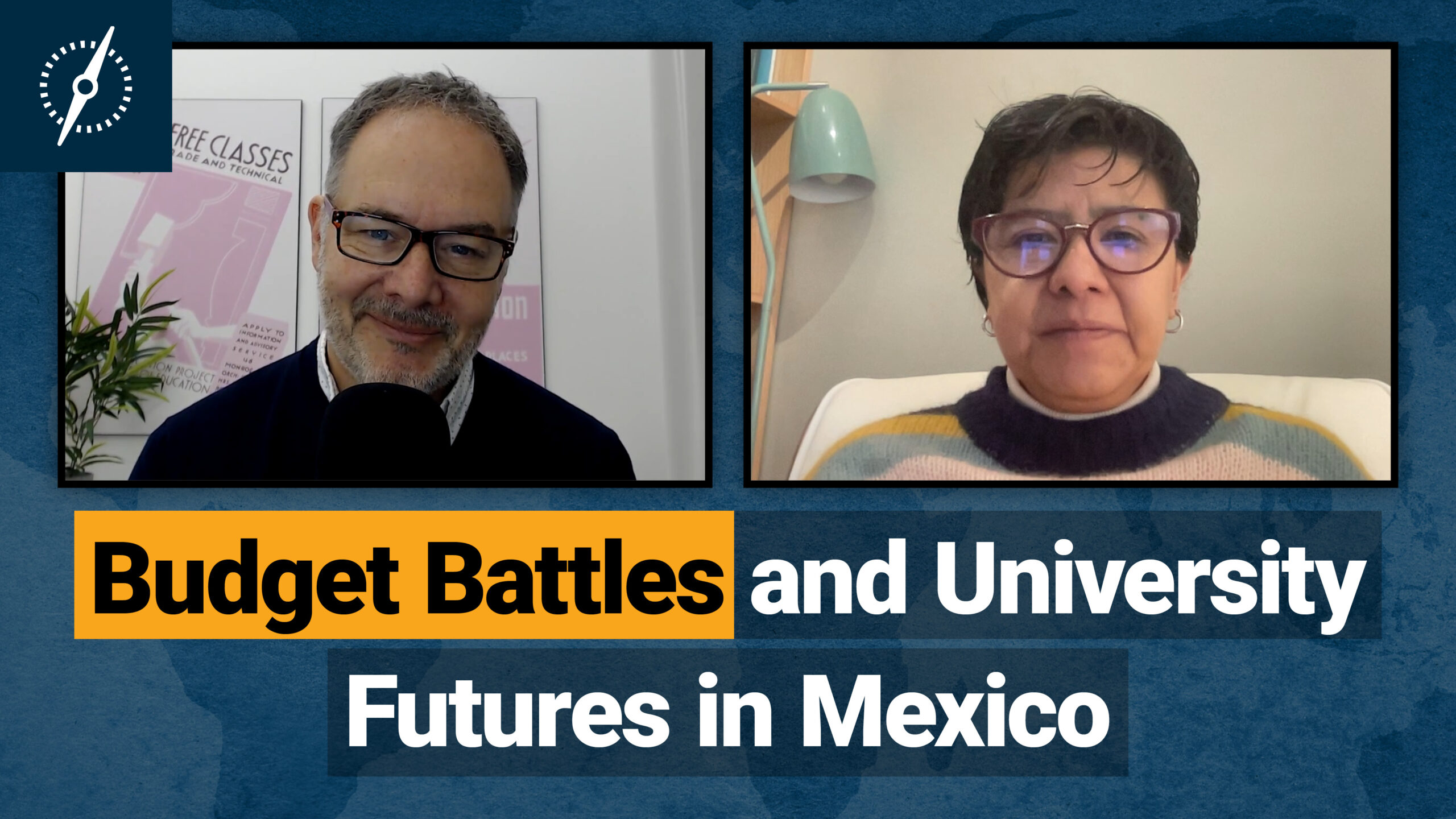
    Hi everyone. I’m Alex Usher, and this is the World of Higher Education podcast. If you’re a really faithful listener, you may remember that when the show was in beta and we were fooling around with formats and guests, we did an episode about Mexican higher education and its tribulations under the populist president Andres Manuel Lopez Obrador or AMLO for short.

    Our guest that day was my friend, Alma Maldonado Maldonado, an education researcher at Cinvestav, which is the Center for Research and Advanced Studies of the National Polytechnic Institute. That interview was so brilliant, we turned this podcast into a full-time investigation of higher education developments in various countries around the world.

    Today, Alma’s back with us again to talk about how things have and have not changed in Mexico over the past two years. The big story there is that there’s a new president in town. Last spring, Claudia Sheinbaum became the country’s first ever woman president. One who happens to have a PhD in engineering with a specialty in energy and sustainability.

    You’d think that might be an advantage to a higher education sector, but Scheinbaum comes from AMLO’s Morena party and her instincts seem to be to continue her predecessor’s tradition of attacking higher education as being a dissolute elite enterprise.

    So what does this mean for Mexican higher education? Well, in general, it’s not good. Alma takes us through the implications of Morena’s supermajority in Congress, as well as its early attempts to put fiscal pressure on universities, and its continued fascination with the experimental and kind of shambolic Benito Juarez universities.
    Spoiler alert, there are not a lot of silver linings in this story, either for public or private sector universities in Mexico. But enough from me, let’s hand things over to Alma to explain.


    The World of Higher Education Podcast
    Episode 3.16 | Beyond the Rhetoric: Mexico’s Higher Education Reality with Alma Maldonado Maldonado

    Transcript

    Alex Usher (AU): Alma, almost two years ago, then-President López Obrador had about a year and a half left in his mandate and was essentially at war with the university sector and the scientific community. How did his administration end with respect to higher education? Did anything change? Did things get better or worse in his final months? Were there any significant policy shifts we should know about?

    Alma Maldonado Maldonado (AMM): Hi Alex, thanks for inviting me. It’s a pleasure to be here. Well, I think most things didn’t change. Essentially, everything stayed the same. His rhetoric and narrative against higher education institutions, against graduates from abroad, and especially against UNAM, continued until the end of his term, unfortunately.

    There wasn’t anything that made him change that rhetoric. One reason for this is that he had political capital—he knew his base supported him fully. So, why change something that was working for him? On the contrary, the attacks on universities and the restriction of resources continued right until the end.

    AU: So, nothing was resolved. But earlier this year, there were elections for the presidency and both the Chambers of Deputies and the Senate. Did higher education play any role in that election? Were there significant policy differences between the parties?

    AMM: Not really. Education didn’t feature much in the campaign—similar to what we see in the U.S. It just wasn’t important. There were only a few mentions here and there about education, but in general, it wasn’t a key part of any campaigns.

    What we did see, unfortunately, was this sort of competition around scholarships. One candidate would say, “I’ll offer scholarships for secondary education,” and the other would respond, “Well, I’ll offer scholarships for secondary, but also primary, and even preschool!” That was the extent of the debate around education policy between the two main candidates. I’m not surprised but it was very disappointing because in a country like Mexico, where education can be a major driver of social change, it wasn’t given the attention it deserves.

    AU: The winner of the election was Claudia Sheinbaum of the Morena party, the same party as López Obrador. But she has a somewhat different image—she’s a scientist with an advanced degree from UNAM, a doctorate, I think. Does her presidency signal any kind of shift for higher education?

    AMM: It’s complicated. On paper, yes, she’s better. She has a PhD from UNAM and worked as an academic—one of the few cases where an academic has become president. Not the first, of course, but still, it’s notable.

    She has a pro-science and pro-higher education rhetoric, especially given her background in the student movement at UNAM in the 1980s. She fought alongside people like Emanuel Ordorica, Carlos Simas (her former husband), and Antonio Santos. She wasn’t a leader in that movement, though now some are rewriting history to present her as one.

    Her narrative emphasizes free higher education and the idea that education is a right, not a privilege. But since she took office a few months ago, we haven’t seen much change in terms of the most important issue—financing. It’s clear: follow the money.

    In the initial draft of the national budget, the funding for UNAM and other major universities was cut. Later, the government said, “Oh no, it was a mistake. We didn’t mean to cut the budget. Sorry, let’s fix it.” Imagine—someone who champions free higher education putting universities in that position. It’s a contradiction.

    AU: She has large majorities in both chambers of parliament, so she has significant power to implement her agenda. Why do you think she proposed cuts to education funding initially?

    AMM: Well, because she’s seen as the president of higher education and science. Reducing the budget as her first move would’ve been disastrous for her image.

    But you’re right—she has total control of Congress and the Senate. Right now, she’s focused on other reforms, particularly in the judicial system, and she’s changing a lot of laws. Education isn’t on the map because López Obrador already changed the Constitution’s third article, which governs education. There’s no immediate need for her to revisit it.

    AU: Let’s circle back to the budget cuts. Last month, the proposed budget included a cut of 10 billion pesos—about 500 million U.S. dollars—to higher education, with half of that falling directly on UNAM. There was significant outcry, and she backtracked somewhat. Do we know how this will end up? Will the universities be held whole, or are cuts still coming?

    AMM: They decided to reorganize the budget, but now they’re cutting other areas instead. Unfortunately, that includes initial education and other sectors. They also cut the Senate’s budget, which has caused disputes.

    In terms of higher education, they’ve claimed that funding will remain the same as last year, with a slight adjustment for inflation. But the adjustment is minimal—about 3%—while experts estimate inflation at around 5% but they’re just adding 3%. So, effectively, there’s still less money to spend. There’s less money for infrastructure, materials, and other essentials. Universities are in a slightly better position than they were a few weeks ago, but the situation remains difficult. The contradictions in her policies have drawn a lot of criticism.

    AU: Why was so much of the proposed cut targeted at UNAM? Was it deliberate? Is there animosity toward the university?

    AMM: There’s speculation about that. Some believe it was a punishment for UNAM’s independence, particularly regarding topics like judicial reform. UNAM has maintained a critical stance, which Morena and Claudia don’t like.

    Let’s not forget that one of the first things López Obrador did when he came to power six years ago was to modify the Constitution’s third article, removing university autonomy. When there was backlash, they said, “Oh, it was a mistake. We didn’t mean it.” But there have been many such “mistakes.”

    AU: Going back to AMLO, he also set a goal of increasing enrollment by 1.5 million students while also underfunding institutions at the same time. How did that play out? Did he reach that goal? How did the funding play into the final result?

    AMM: Currently, enrollment coverage in higher education is about 44%—very low compared to other Latin American countries. AMLO’s goal was to reach 50%, but he fell short.

    Now, Claudia Sheinbaum is aiming for 55%. I don’t think that’s realistic. The common system in Mexico is to add 5% on any policy, even if the last one isn’t achieved. To achieve that, they’d need to add about 1.2 million students, which isn’t feasible with the current system.

    The problem is that the educational spaces being created aren’t in the places where students want to go. There’s a clear contradiction between their enrollment goals and actual planning.

    AU: Part of AMLO’s strategy was the Benito Juárez Universities—small, access-oriented institutions in remote areas. You previously described them as “Potemkin institutions.” What’s the current situation? Will Sheinbaum continue with this policy?

    AMM: Yes, she’s continuing the project. But as I’ve said before, it remains very obscure. We don’t know who attends these universities, who teaches there, or what students are learning. I have a student doing their master’s dissertation on these universities, and they can’t get access for research.

    Sheinbaum recently announced plans to open 50 more. But we don’t even know what’s happening with the existing 140—or whether that number is accurate. There have been protests at these universities over issues like unreceived degrees and inadequate resources. I wouldn’t be surprised that Colombia would adopt them because they’re friends of Claudia. The idea is that these institutions could increase 40,000 new spaces. While they’re meant to provide education in remote areas with programs tailored to local communities, they’re not addressing the larger participation gaps.

    AU: We’ve been talking mainly about the public sector, but what about the private sector? Institutions like Tecnológico de Monterrey are highly regarded. How does the disarray in the public sector affect them? Does it make them stronger?

    AMM: I think they are struggling too, but we need to distinguish between the high-prestige institutions and the low-prestige ones. So, let’s start with the high-prestige institutions like Tecnológico de Monterrey or Universidad Autónoma de Guadalajara.

    They are struggling financially, particularly because some scholarships they used to receive for graduate programs have been eliminated. For example, many students in their graduate programs previously got scholarships from the National Science and Technology Council. But now, under the current rhetoric, those scholarships are only being given to students in public institutions.

    This has forced high-prestige private institutions to get more creative with their resources to maintain their programs.

    On the other hand, there are low-prestige private institutions, some of which are as bad as the Benito Juárez Universities. They lack quality, but the government lets them operate because they solve a demand problem. Parents want their kids to attend college, and these institutions offer that possibility, even if the education isn’t great. Families make sacrifices to pay for these degrees because, in their minds, a degree is still a degree.

    And then, in the middle, there are institutions that are more decent in terms of quality. But the big question is: who ensures the quality of these institutions? That’s been a longstanding issue, and it hasn’t improved under the current government.

    AU: It’s a classic trade-off we see in many countries. Alma, we’ve covered a lot of doom and gloom. Are there any bright spots you foresee for 2025?

    AMM: I wish I could say I see more positive things coming, but honestly, I don’t. A big part of my concern is tied to North America and what a Trump presidency could mean for Mexico. If he returns to power, we’re likely to face serious challenges around migration and broader U.S.-Mexico relations.

    It’s really sad that Mexico didn’t take advantage of opportunities to strengthen ties with the U.S. while Biden was in office. There could have been agreements, collaborations, and advancements, but those didn’t materialize.

    In the face of all this, creativity will be key. Maybe we’ll see new programs to support migrants with higher education degrees who end up staying in Mexico. It’s critical that we do better this time than we did during the Dreamers situation. But honestly, I’m not confident that the government is prepared to handle these challenges effectively. So, unfortunately, I don’t see much good news ahead.

    AU: Well that’s a good reminder that international affairs do intrude on higher education affairs sometimes. Alma, thanks for being with us.

    AMM: Thank you very much, Alex.

    AU: And thank you to our excellent producers, Tiffany MacLennan and Samantha Pufek. If you have comments or questions, reach out at [email protected]. Don’t forget to subscribe to our YouTube channel. Join us next week when Michael Shattock will discuss governance in European universities. Bye for now.

    *This podcast transcript was generated using an AI transcription service with limited editing. Please forgive any errors made through this service.

    Source link

  • New York governor proposes free community college initiative

    New York governor proposes free community college initiative

    During her State of the State address on Tuesday, New York governor Kathy Hochul announced a plan to make community college tuition-free for residents pursuing associate degrees in certain high-demand fields. 

    The program would be open to adults aged 25 to 55 pursuing degrees in nursing, teaching, technology fields and engineering. If enacted, it could take effect as early as this fall and cover tuition, fees and textbook costs for students attending State University of New York and City University of New York community colleges. Hochul also proposed the creation of new apprenticeship programs for similar high-demand jobs. 

    Currently, New York students from families making under $125,000 can attend SUNY and CUNY schools tuition-free, regardless of their degree program. For most of its nearly 200-year existence, all CUNY schools were free for New York residents to attend. That policy was abandoned after the 1976 city financial crisis.

    In recent years, a number of states have enacted free tuition initiatives targeted to midcareer adults and aimed at boosting employment in specific high-demand jobs. Massachusetts’s new MassReconnect program led to a surge in community college enrollment last year, and Michigan enacted a similar plan last summer.

    Source link

  • What could WNMU’s ex-president’s exit package pay for?

    What could WNMU’s ex-president’s exit package pay for?

    Former Western New Mexico University president Joseph Shepard received an exit package that included severance pay of $1.9 million, and a tenured faculty job, with perks adding up to an estimated $3.5 million.

    Photo illustration by Justin Morrison/Inside Higher Ed | skodonnell/iStock/Getty Images | rawpixel

    The controversial exit package for former Western New Mexico University president Joseph Shepard could have funded multiple scholarships, according to one analysis, while the state’s governor says that the money could have helped feed hungry students at the university for a year.

    Judith Wilde, a research professor at George Mason University who studies presidential compensation and contracts, previously told Inside Higher Ed that Shepard’s exit package could have funded 90 scholarships for undergraduate students at Western New Mexico.

    To Governor Michelle Lujan Grisham, a Democrat, the decision to green-light a $1.9 million severance payment to the departing president “demonstrated an appalling disconnect from the needs of our state, where the median income of a family of four is just $61,000.”

    “The amount of money contained in Dr. Shepard’s separation agreement could have addressed food insecurity across the entire WNMU student body for a full year,” Lujan Grisham said in a news release last week.

    The estimated $3.5 million package—including benefits—for a president accused of improperly spending taxpayer dollars has infuriated state lawmakers and led to the resignations of several regents. More fallout is expected as the state attorney general seeks to claw back the severance payment.

    Shepard’s last day as president was Wednesday.

    Shepard, who led the university for 13 years, made a base salary of $365,000 a year. He’s not the only college president to get a generous severance on his way out the door, but compared to deals at other institutions, the agreement is unusually lucrative and will cost the university more than multiple line items in its budget. For example, when Ben Sasse stepped down as president of the University of Florida, he struck a deal to keep his $1 million annual salary through 2028 despite exiting the top job. But UF’s annual budget is just over $5 billion, meaning Sasse’s exit package comprises a tiny fraction of university expenses.

    Comparatively, Shepard’s exit package far exceeds those of other former presidents in his state. Former New Mexico State University system chancellor Dan Arvizu received an exit package valued at between $500,000 and $650,000 when he announced his early departure in 2023, a move both parties referred to as a “mutual separation” amid tensions. In 2016, Bob Frank left the University of New Mexico presidency early amid allegations of bullying, striking a deal for a $190,000-a-year tenured faculty job—down from the $350,000 annual salary initially considered.

    At WNMU, a university that enrolled 3,570 students in fall 2023, Shepard’s total exit package adds up to almost 5 percent of its $74.2 million fiscal year 2024 budget, an Inside Higher Ed analysis found.

    In one of the poorest states in the union, more than half of WNMU’s students receive Pell Grants. A 2023 survey also found nearly 60 percent of college students in New Mexico were food insecure, prompting efforts at Western New Mexico and other colleges to address the issue.

    Shepard’s exit package has roiled lawmakers, particularly in light of the economic challenges in the state and a state investigation that found the outgoing president improperly spent $360,000 in taxpayer money on international travel, splashy resorts and expensive furniture. Had the board elected to fire Shepard without cause, it could have spent roughly $600,000 to cut ties with him. Or the board could have waited for the conclusion of another state investigation, which might have given them cause to fire him without spending any additional money, depending on the findings.

    Instead, regents cut him a $1.9 million check and gave him a tenured faculty job teaching two courses a year with a remote option. Altogether those perks add up to a $3.5 million, Wilde estimated. (WNMU officials said the money was paid for out of reserves.)

    Four out of five WNMU regents have since resigned under scrutiny from lawmakers, including the governor. Attorney General Raúl Torrez also demanded an investigation into Shepard’s “golden parachute” and sought a restraining order to prevent him from accessing the $1.9 million severance payment as the state challenges the contract. However, a judge shot down the request to place a hold on those funds Monday. A legal challenge to the contract is pending.

    ButJohn C. Anderson, an attorney for Shepard, defended the payment as “appropriate” and said that the former president had “worked tirelessly on behalf of Western New Mexico University for nearly 14 years to increase graduation rates, modernize the campus through major renovations and the construction of new facilities, and expand the school’s programs,” among other accomplishments. (Shepard’s legal team also disputed the estimate of $3.5 million but did not provide their own figure.)

    As the legal wrangling continues, Inside Higher Ed took a look at WNMU’s budget to determine how Shepard’s controversial exit package stacks up to spending on athletics, academic support, faculty salaries and other line items in the fiscal year 2024 budget, which was last updated in December. While Shepard has already received a nearly $2 million severance payment, the remainder of his deal will be paid out to him as a tenured faculty member where he’ll initially make $200,000 a year. His salary will be paid for by the business school.

    • WNMU athletics teams—known as the Mustangs—compete on the NCAA Division II level. Western New Mexico University sponsors 13 sports with an athletics budget of $5.4 million.
    • The student services budget at WNMU is $4.5 million. That money is spread across a range of offerings from disability services to funding for special events and student health and well-being.
    • WNMU budgeted $4.4 million for the operation and maintenance of campus.
    • WNMU budgeted $3.9 million in academic support.
    • The student financial aid budget at WNMU was $1.2 million.
    • Shepard’s exit package also surpasses the total faculty salaries for any department at WNMU. The nursing department has 19 full-time faculty members, earning a combined salary of $1.4 million, according to budget documents. Nursing appears to be the largest program at WNMU based on the number of full-time employees listed. Social work is also among the university’s largest programs, with 17.2 full-time faculty members listed earning just over $1 million.

    Source link

  • Illinois guarantees transfer for all state high school grads

    Illinois guarantees transfer for all state high school grads

    Students who graduated from an Illinois high school, no matter where they’re currently enrolled, will soon be guaranteed transfer admission to any University of Illinois system institution—including the University of Illinois at Urbana-Champaign, which has a regular acceptance rate below 50 percent. 

    Illinois’s new policy, set to take effect this fall, builds on its previous transfer guarantee, which applied only to current Illinois community college students. Typical state transfer guarantee programs apply only to those currently enrolled in another state institution; Illinois’s more expansive approach may help bring back former residents who left the state for college.

    To be eligible, students must have graduated from an Illinois high school, earned at least 36 transferable credit hours toward their transfer institution and maintained a minimum 3.0 GPA in all transferable courses. Students will still have to apply, but if they meet the requirements, they’ll be automatically accepted. Admission to specific programs and majors, however, is not guaranteed. 

    Source link

  • Higher ed is not a public good—but it could be (opinion)

    Higher ed is not a public good—but it could be (opinion)

    ogichobanov/iStock/Getty Images Plus

    When 85,000 Cornhuskers all wear red on game day, it’s easy to think of college as something larger than students and professors, classes, research and extracurriculars. Berkeley, Penn State and Michigan each have hundreds of thousands of online followers. Tar Heel nation is, after all, a nation.

    But wearing “college” on our chests does not a polity make. Higher education is not a public good and Americans know it.

    In the plainest sense, public goods aren’t excludable. Think of the air we breathe, interstate freeways and national defense. Everyone is affected by carbon dioxide levels, can travel by open roads and is protected, equally, from foreign threats.

    But when it comes to higher ed, exclusion is the name of the game.

    Admissions offices reject most applicants from selective colleges and create barriers at others. Tuition, even when subsidized, deters those shocked by sticker prices or unable to pay. Courses are controlled by departments, yet some intellectual climates drive students away. Governance, when behind closed doors, excludes parents, students, employers and other stakeholders.

    All told, the labyrinth of exclusionary practices makes higher ed more of a private than public good. We can interpret low public confidence in higher education as reflecting a belief that college is for someone else. Of those who matriculate, two-thirds of new community college students form the same opinion and drop out or enter a broken transfer system. One-third of new B.A. students will drop out or take more than six years to graduate. Once they’re gone, it’s often for good: Only 2.6 percent of stop-outs re-enrolled in the 2022–23 academic year. All told, this has led to a societal “diploma divide”: More people without a college degree voted for Donald Trump’s re-election in 2024 than in 2020.

    Colleges and universities do need to reclaim a place of pride in American society. But instead of ambiguous calls “reaffirming higher education’s public purpose,” why not simply be more public? And deliver an education that is, well, more good?

    My new book, Publicization: How Public and Private Interests Can Reinvent Education for the Common Good (Teachers College Press), argues that educational institutions of any sort—private nonprofit, state-controlled or proprietary—can be more publicly purposed when they meet two criteria. First, they must prepare each generation to sustain the common goods on which American life rests: a vibrant democracy, a productive economy, a civil society and a healthy planet. These are three long-standing aims and one new existential goal, around which colleges and universities can better organize the student experience.

    Second, institutions must themselves operate in ways that are more public than private. To do so, Publicization offers an “Exclusion Test” applicable to six domains—funding, governance, goals, accountability, equity and an institution’s underlying educational philosophy. Colleges and universities can apply the test to these areas and identify where operations can be less exclusionary and therefore more public.

    For example, do policies assume that some students aren’t “college ready,” or do we meet everyone—particularly those impacted by COVID-19—where they are? To what extent do applications create formal and informal hurdles, or do we offer more streamlined direct admission? Are inequitable proxies like Advanced Placement Calculus blocking talented students from admission, or does coursework in more widely relevant areas like statistics matter equally? Are free college plans riddled with eligibility fine print or open to anyone?

    Are courses gated by size, section, time of day and instructor approval, or are they more accessible? Are we mostly catering to young adults or presenting real options for the almost 37 million Americans with some college but no degree? Is federal funding considered a necessary evil, or is Washington engaged as a key stakeholder? Do boards focus narrowly on institutional issues or see themselves as hinges between school and society, mediating higher ed’s role in a democracy? Do we tolerate every private belief or hold ourselves to an epistemology premised on shared evidence and public scrutiny, what Jonathan Rauch calls the “Constitution of Knowledge”?

    As for an experience that’s good, higher ed’s 15-year-old success agenda focuses on access, affordability and student support. These aren’t enough. Quality must join the list, with a particular focus on our technical core: teaching and learning.

    Ask any of the nation’s 1.5 million professors and most will tell you they were not taught how to teach. They are world-class scholars. They serve their institutions. They are committed to students. But hardly any received comprehensive training in effective instruction. This persists despite the fact that most Americans believe the best colleges have the best teaching and evidence that effective instruction leads to more positive mindsets about one’s academic abilities, deeper learning, stronger retention and life readiness.

    As such, it’s no surprise that Richard Arum and Josipa Roksa found, in Academically Adrift (University of Chicago Press), “limited learning on college campuses.” That was in 2010 and not enough has changed, as recent articles in USA Today, The Washington Post, Washington Monthly, Forbes, Deseret News and The Chronicle of Higher Education affirm.

    But change is afoot. The National Academies of Sciences, Engineering and Medicine soon plan to publish STEM teaching standards, a first. Groups like the Equity-Based Teaching Collective have identified policies and practices to promote effective teaching campuswide. Over the past 10 years, the Association of College and University Educators, which I co-founded, has credentialed 42,000 professors in effective teaching at 500 institutions nationwide with proof of positive student impact. Last June’s second National Higher Education Teaching Conference gathered hundreds of higher education leaders and professors to accelerate the teaching excellence movement.

    College as a “public good”? Let’s give the public what it wants and deserves: a good education. In which the “best” colleges aren’t, by definition, the most exclusive. So that at family gatherings, our students tell their voting, poll-taking relatives how much they are learning, how great their professors are and how college is for them.

    Jonathan Gyurko teaches politics and education at Teachers College, Columbia University. His new book, Publicization: How Public and Private Interests Can Reinvent Education for the Common Good, was published by Teachers College Press last March.

    Source link

  • Biden administration discharges $4.5B in loans for Ashford students

    Biden administration discharges $4.5B in loans for Ashford students

    The Education Department is discharging any remaining loans for more than 260,000 borrowers who attended Ashford University and will move to bar a key executive at Ashford’s former parent company from the federal financial aid system, the agency announced Wednesday.

    The agency’s action, totaling $4.5 billion, builds on an August 2023 decision to forgive $72 million in loans for 2,300 former Ashford students after finding that the college repeatedly lied to them about the cost, time requirement and value of its degree program. The discharges through the department’s borrower-defense program are among the largest in the program’s history. Wiping out the loans for Corinthian College students cost the department $5.8 billion, while the discharges for former ITT Technical Institute students totaled $3.9 billion.

    The University of Arizona acquired the predominantly online institution Ashford in 2020 and rebranded it as the University of Arizona Global Campus. At first, the university partnered with Zovio Inc., a publicly traded company that owned Ashford, to run the rebranded entity but decided in 2022 to buy Zovio’s assets. The University of Arizona has since moved to completely absorb the online campus.

    Borrowers who attended Ashford from March 1, 2009, through April 30, 2020, are eligible for relief.

    “Numerous federal and state investigations have documented the deceptive recruiting tactics frequently used by Ashford University,” said U.S. under secretary of education James Kvaal in a statement. “In reality, 90 percent of Ashford students never graduated, and the few who did were often left with large debts and low incomes. Today’s announcement will finally provide relief to many students who were harmed by Ashford’s illegal actions.”

    The Biden administration has forgiven $34 billion via borrower defense for 1.9 million borrowers, the department said.

    But forgiving loans for Ashford students isn’t enough for the department. Officials proposed a governmentwide debarment of Andrew Clark, who in 2004 founded Bridgepoint Education, which later became Zovio. He stepped down in March 2021.

    The debarment would mean Clark could no longer be employed in any role at any institution that receives funding from Title IV of the Higher Education Act of 1965, which authorizes federal financial aid programs, for at least three years.

    “The conduct of Ashford can be imputed to Mr. Clark because he participated in, knew, or had reason to know of Ashford’s misrepresentations,” the department said in a news release. “Mr. Clark not only supervised the unlawful conduct, he personally participated in it, driving some of the worst aspects of the boiler-room-style recruiting culture.”

    The department’s Office of Hearings and Appeals has final say on whether to debar Clark, who can contest the decision.

    Source link

  • Retention tied to timely completion for college students

    Retention tied to timely completion for college students

    Phira Phonruewiangphing/iStock/Getty Images Plus

    Over 36 million Americans have earned some college credits but have yet to complete a credential, demonstrating gaps in higher education that leave students with only part of a degree and often student loan debt.

    Colleges and universities have invested in their retention strategies to improve students’ completion and the cost of education by helping them complete a degree in a timely manner.

    Recent data from the National Student Clearinghouse Research Center found that academic outcomes in the first year and first- to second-year persistence were significant indicators of a student’s likelihood of completing a degree and doing so expeditiously.

    Survey Says 

    A 2023 Student Voice survey from Inside Higher Ed and College Pulse found 69 percent of undergraduate survey respondents (n=3,004) expected to graduate in the standard two- or four-year time frame.

    Thirteen percent of respondents said they didn’t expect to graduate in a timely manner because they planned or expected to take longer, and 3 percent said it was due to factors that they believe to be the fault of the institution.

    The background: The federal government tracks first-time degree seekers’ graduation rates in terms of six- and eight-year completion, but a typical associate or bachelor’s degree program can be categorized as two-year or four-year, respectively.

    The six-year completion rate for all college students entering two-year and four-year institutions in 2017 was 62.2 percent, with a 34-percentage-point gap between private nonprofit four-year institutions (77.5 percent) and public two-year colleges (43.4 percent).

    Timely completion is associated with lower financial burdens, due to prolonged enrollment and improved socioeconomic mobility for students, as well as optimized institutional resources for the institution. Individual challenges and institutional policies can impact students’ timely progression, including academic challenges, personal struggles, basic needs insecurity, financial instability, transfer barriers, unclear degree requirements, developmental education, registration policies or insufficient advising.

    The study evaluates early success indicators, including first-year GPA, credit completion ratios, second-year enrollment and credits earned, and how these indicators predict completion across credential types and demographic profiles.

    Methodology

    Timely completion, as defined by the report authors, is “the student having earned the credential they initially sought, at any institution, within a specific time frame,” allowing for variance between associate, credential or bachelor’s programs.

    Researchers evaluated four factors: first-year credit completion ratio, first-year credits earned, first-year grade point average and second-year enrollment. Study participants (n=307,500) included first-time, full-time starters enrolled in fall 2016 in bachelor’s degree (63 percent) or associate programs (37 percent). Data was sourced from the Postsecondary Data Partnership by the National Student Clearinghouse and therefore is not representative of the national population.

    The findings: Researchers found a majority of timely completers demonstrated early success indicators, including having a significant number of credits earned, above a 3.3 GPA and re-enrollment for a second year. Further, “Students who completed in a timely manner had higher early indicators than non-completers, regardless of race, gender, age at entry, or major field of study,” according to the report.

    Even students who took 150 percent (three years for an associate degree, six years for a bachelor’s) or 200 percent (four and eight years, respectively) of the expected time to complete had higher success indicators than their noncompleting peers.

    In their first year, students who completed a credential had higher GPAs, earned more credits and completed on average 90 percent of the credits they attempted. They were also more often enrolled in their second year—even if at another institution—compared to their peers who did not finish in a timely manner.

    First- to second-year persistence was a distinct factor of timely completion for two-year or certificate students; students who did not complete enrolled in their second year at a rate 32 percentage points lower than those who did complete. This was the most important success indicator, followed by first-year credits earned.

    For bachelor’s degree seekers, a student’s first-year GPA was the most important early success indicator, followed by second-year retention.

    A student’s field of study can also relate to their timely completion, with bachelor’s degree seekers majoring in social sciences or business more likely to complete and associate degree seekers pursuing STEM or a social science degree more likely to complete. However, the researchers utilized program of study as a demographic category, and therefore analysis cannot be made of program requirements or courses that could help or hinder student completion.

    “These findings emphasize the need for targeted, evidence-based interventions that prioritize early academic achievement, support retention, and address program-specific challenges to improve completion outcomes,” according to the report.

    Get more content like this directly to your inbox every weekday morning. Subscribe here.

    Source link

  • 22 ideas for department chair merit badges (opinion)

    22 ideas for department chair merit badges (opinion)

    A running joke with my department chairs, when I was a dean, involved the awarding of merit badges for the accomplishment of a particularly thorny task that the outside world (outside of academia, that is) would not otherwise have known about. Generals rising in the ranks of the military accumulate ribbons. Why shouldn’t there be a similar accumulation of ceremonial badges for accomplishments on the way up the academic leadership ladder?

    The granting of ribbons or merit badges will be ever more important in the AI era, in which leaders cannot simply speak about something but rather demonstrate and present the knowledge physically. As the Boy Scouts Merit Badge Hub states, “If it says ‘show or demonstrate,’ that is what you must do. Just telling about it isn’t enough. The same thing holds true for such words as ‘make,’ ‘list,’ ’in the field,’ and ‘collect,’ ‘identify,’ and ‘label.’”

    For example: Consider details of just two of the 12 areas Scouts must master to earn the Boy Scout Bird Study Merit Badge:

    Demonstrate that you know how to use a bird field guide. Show your counselor that you are able to understand a range map by locating in the book and pointing out the wintering range, the breeding range, and/or the year-round range of one species of each of the following types of birds:

    1. Seabird
    2. Plover
    3. Falcon or hawk
    4. Warbler or vireo
    5. Sparrow

    Observe and be able to identify at least 20 species of wild birds. Prepare a field notebook, making a separate entry for each species, and record the following information from your field observations and other references.

    1. Note the date and time.
    2. Note the location and habitat.
    3. Describe the bird’s main feeding habitat and list two types of food that the bird is likely to eat.
    4. Note whether the bird is a migrant or a summer, winter, or year-round resident of your area.

    When scouts earn a Bird Study merit badge, you will know they know what they’re talking about and feel comfortable with those scouts running a birding outing. You will feel confident putting matters in their hands.

    Wouldn’t this approach be helpful for showing department chair expertise as well?

    The Basic Badges: Survival Skills for New Chairs

    I propose the list below as standard merit badges any department chair should be working toward. Following the Bird Study merit badge model, the specific tasks involved in earning the first badge are listed in detail. Follow this model and logic if you decide to document and award any or all of these badges at your institution.

    Meeting Management Merit Badge (for mastering the art of running efficient faculty meetings while maintaining collegiality and reaching actual decisions)

    1. Show that you are familiar with the terms used to describe meetings by doing the following:
      1. Sketch or trace a meeting room and then label 15 different aspects of a meeting.
      2. Draw up a meeting agenda and label six types of agenda items.
    2. Demonstrate that you know how to properly follow an agenda, use the AV equipment in the room and use the hybrid camera, plus monitor for virtual attendees:
      1. Explain what the Roman numerals mean on an agenda.
      2. Show how to present a PowerPoint to both present and virtual members.
      3. Show how to see, in a timely manner, when a virtual hand is up.
      4. Describe how to bring a latecomer up to speed on an agenda item already discussed.
    3. Demonstrate that you know how to use Robert’s Rules of Order. Show your dean that you are able to understand each chapter in the book, pointing out the debate rules, the tabling-a-motion rules and the majority requirements for each of the following types of votes:
      1. Motion to accept minutes.
      2. Motion to object.
      3. Motion to suspend consideration of an item.
      4. Motion to call the question.
      5. Motion to take up matter previously tabled.
      6. Procedure to select a second when everyone’s hand is up.
    4. Observe and be able to identify at least 20 types of meetings. Prepare a field notebook, making a separate entry for each species of meeting, and record the following information from your field observations and other references:
      1. Note the date and time.
      2. Note the location and room capacity.
      3. Describe each attendee’s main feeding habitat and list two types of food that the attendees are likely to eat.
      4. Note whether the attendee is a tenure-line professor, career-line or part-time/adjunct resident of your department.
    5. Successfully defuse at least three of these common meeting scenarios:
      1. The Filibuster Professor who “just has a quick comment” that turns into a 20-minute monologue.
      2. The Side Conversation Insurgents who start their own parallel meeting.
      3. The “Actually …” Interrupter who must correct every minor detail.
      4. The Passive-Aggressive Email Sender who “just wants to follow up on some concerns.”

    Do you not feel comfortable with any department chair who has earned a Meeting Management merit badge running a meeting? Following are some additional basic badges that one can earn for adept engagement in the everyday and more occasional department chair work.

    Budget Detective Merit Badge (for successfully tracking down and reallocating mysterious fund transfers and finding hidden resources)

    Schedule Tetris Merit Badge (for fitting 47 course sections into 32 available time slots while satisfying everyone’s preferences)

    Diplomatic Relations Merit Badge (for mediating between feuding faculty members without taking sides or losing sanity)

    Paperwork Expedition Merit Badge (for successfully navigating a minor curriculum change through six committees and three levels of administration)

    Assessment Survival Merit Badge (for completing a program review cycle without uttering the phrase “this is meaningless”)

    Email Endurance Merit Badge (for maintaining inbox zero while receiving 200-plus daily messages during registration week)

    Faculty Development Sherpa Merit Badge (for successfully guiding junior faculty through the tenure process wilderness)

    Student Crisis Navigation Merit Badge (for handling everything from grade appeals to mental health emergencies with grace—and documentation)

    Accreditation Archive Merit Badge (for creating and maintaining the sacred assessment documents for the next site visit)

    Interdepartmental Peace Treaty Merit Badge (for negotiating shared resources and cross-listed courses without starting a turf war)

    Conference Room Warrior Merit Badge (for surviving 50 consecutive hours of committee meetings in a single semester while maintaining consciousness)

    The Advanced Badges

    As department chairs move toward the “seasoned category,” akin to Eagle Scouts’ level of capability, these are the advanced merit badges department chairs should be moving toward:

    Everyone Remained Seated Merit Badge (for successfully hosting a controversial speaker event where the Q&A didn’t require campus police, no one stormed out, everyone actually asked questions instead of making speeches, and the dean didn’t have to issue a statement the next day)

    Viewpoint Diversity Navigator Merit Badge (for successfully resolving ideological tensions between the “universities are too woke” faculty member and the “universities aren’t woke enough” faculty member, while keeping both the university counsel office and the campus newspaper uninterested in your department)

    Social Media Firefighter Merit Badge (for managing department communications after a faculty member’s tweet goes viral, while upholding both academic freedom and institutional reputation)

    Soft Landing Merit Badge (for compassionately guiding a struggling graduate student toward alternative career paths while avoiding lawsuits, maintaining departmental reputation for mentoring, preventing faculty infighting about “standards” and ensuring the student leaves with dignity and future options intact)

    Side Hustle Tackler Merit Badge (for successfully filling out outside employment forms for a professor simultaneously consulting for Google, running a resale textbook start-up and offering expert testimony, while ensuring university compliance, managing jealous colleagues and preventing the local newspaper from running a “professors don’t work” exposé)

    Advanced Curriculum Shepherding Merit Badge (for successfully shepherding an interdisciplinary, multimodal, study abroad–required curriculum through 17 different committees without having it transformed into “just add one elective to the existing major”)

    Bonus points for maintaining revolutionary elements like “required internships,” “community-engaged capstone” and “two semesters abroad” through final approval, while fielding questions like “but how will student athletes do this?” and “what exactly do you mean by ‘transdisciplinary’?” and “have you checked with Risk Management?” and “will this impact our parking situation?”

    Fresh Blood Without Bloodshed Merit Badge (for successfully integrating an outside chair into a department that has been “led” by the same three faculty trading the position since 1987; includes surviving the “but that’s not how we do it” phase, the “well, in my day as chair” phase and the “I’ll just CC the dean on this email to help you understand our culture better” phase)

    Special recognition for preventing the emeritus faculty from creating a shadow government in the department’s second-floor conference room.

    The King Has Voluntarily Left the Building Merit Badge (For masterfully orchestrating the graceful exit of a chair who has held the position since before email existed, memorized every bylaw and has an office containing 27 years of irreplaceable paper files organized in a system only they understand; successfully convince them that spending more time on research is a promotion, not a demotion, while ensuring they actually hand over the department credit card and graduate student admissions spreadsheet before leaving)

    Bonus points if the outgoing chair willingly shares the password to the department’s social media accounts and reveals where they’ve been hiding the good coffee maker.

    The “Reply All” Survivor Merit Badge (for maintaining composure during the dreaded accidental reply-all chain that encompasses the entire college)

    And, finally (drum roll) the Ultimate Achievement: The Phoenix Chair Merit Badge (for successfully completing a term as chair and willingly agreeing to serve again)

    This highest honor requires:

    1. Completing all previous merit badges
    2. Still believing in the mission of higher education
    3. Retaining enough optimism to sign up for another term

    Note: This badge has only been awarded twice in recorded higher education history.

    Hollis Robbins is professor of English and former dean of humanities at the University of Utah.


    Source link