Tag: Higher

  • What were we reading about higher education in 2024?

    What were we reading about higher education in 2024?

    As 2024 draws to a close, Josh Freeman, Policy Manager, and the HEPI team look back on a remarkable year in higher education policy.

    We have a fantastic programme of events to look forward to in 2025, which you can read all about here.

    One of the best things about working at HEPI is that we can take a bird’s eye view of the sector. Today, we gaze over quite a different policy landscape from the one I wrote about this time last year. We have a new Government which, unlike the last one, is not afraid to raise tuition fees. The Graduate Route visa survived in its current form, largely because of the international fee income it helps bring to struggling institutions. Universities UK published its Blueprint, proving it is possible to get 140 vice-chancellors (or thereabouts) to agree on something. Despite all this, nothing seems to stop the interminable slide into financial precarity with up to three-quarters of institutions at risk of running deficits in 2025.

    It has been a privilege to capture many of these moments and more on the HEPI blog, which had another exceptionally busy year. As we approach the end of 2024, the HEPI team reflects on the pieces which set the tone for the year, struck a chord in institutions, led policy change or were just a great read.

    Winter

    In January, we heard from Laura Coryton MBE about period poverty in higher education, the stigma attached to it and the strategies institutions can take to address it. HEPI intern Famke Veenstra-Ashmore also discussed this issue, among many others, in her report on the gender awarding gap at Oxbridge in November.

    Richard Courtney of the University of East London won the prize for best analogy of the year with his comparison of a Chinese meal to higher education qualification types in February.

    And HEPI published its best-read report of the year, Provide or punish? Students’ views on generative AI in higher education. (Watch out for an update in early 2025!) Our other top reports of the year include:

    Spring

    This spring was a season of reflection, with Susan Mueller, Director at Stand Alone, bidding farewell and marking the closure of a charity which supported estranged students since 2015.

    And Naimat Zafary, PhD researcher at the University of Sussex, marked 1,000 days since girls’ education was banned in Afghanistan with an extraordinarily powerful piece reminding us not to take education for granted:

    Last week, I visited the British Library, one of my favourite places in London. I was attracted by the Magna Carta which declared: ‘No free man shall be seized, imprisoned, dispossessed, outlawed, exiled or ruined in any way, nor in any way proceeded against, except by the lawful judgment’.

    But where is lawful judgment for those denied? What fault in Afghan girls? My little nieces don’t understand their crime. Is love of education a criminal act if you happen to be female?

    Summer

    As we absorbed the previous day’s General Election results, attention turned to its consequences for higher education. While some of us were struggling to function on two hours’ sleep, HEPI Director Nick Hillman was already analysing how far students’ had swayed the results, building on his own analysis of the 2019 General Election and my analysis ahead of the 2024 vote.

    University of Southampton Chief of Staff Giles Carden made his pitch for 10 policies the new Government could implement to fill the policy vacuum, including ‘fundamental reform’ to the Office for Students and setting out a new strategy for digital education.

    And our political commentary came to a head when Rose Stephenson, Director of Policy and Advocacy, and I described what we had seen and heard at the Labour Party Conference.

    Autumn

    The introduction of the Renters’ Rights Bill to Parliament in September 2024 generated much discussion, including several pieces by former Unipol CEO Martin Blakey. His essential primer from October is a must-read for those trying to get their heads around the draft legislation. Martin also wrote for us in June and November on the same topic.

    HEPI Director Nick Hillman asked whether restricting access to the Russell Group would improve social mobility (he was sceptical).

    Also in October, outgoing Open University Vice-Chancellor Tim Blackman asked, responding to Office for Students (OfS) analysis of degree classifications, whether and how we should measure ‘grade inflation’. In the words of our Director of Partnerships, Lucy Haire, the blog:

    poses challenges to the OfS’s methods and use of data, but even more than that, it gets to the heart of what learning is all about and how it is achieved. It tackles prejudice about disadvantage and weak prior learning and, above all, recognises the strides that students take, the role of good teaching and the importance of skilled teachers.

    Our piece with a star-studded lineup, including former Welsh Director of Skills, Higher Education and Lifelong Learning Professor Huw Morris and Professor of Public Policy at Manchester Andy Westwood, set out a vision for a new tertiary system.

    And particular credit goes to one of our highest-performing pieces of the year from Meti Basiri, CEO of ApplyBoard. He asks which international student populations institutions should be recruiting from. He also wins the (coveted) prize for best graphics.

    That’s it from us

    Thank you to everyone who has written for us, supported our research, kept up with our daily 6:30am blogs and engaged with us in any way over the past year.

    The HEPI blog will continue in a limited form over the break, so do keep an eye out between mince pies. We will be back in full force in January.

    Until then, have a wonderful festive break and we will see you for more in 2025!

    Source link

  • It’s the higher education Christmas movie and TV guide

    It’s the higher education Christmas movie and TV guide

    There’s nothing on the telly this Christmas.

    There never is. Unless you’re searching for some hidden nuance in repeats of The Chase.

    But if, like me, you have trouble switching off from work but also enjoy being slumped in front of the box with a tub of Quality Street, I have good news.

    I’ve picked out ten films and TV shows released this year that either have something to say about higher education, are set on campus and/or depict contemporary student life.

    You’ll laugh, you’ll cry, you’ll shell out for a VPN, you’ll get frustrated by torrent ratios, and you’ll almost certainly switch off, which is what the break is for – eventually.

    It really was slim pickings this year from a UK perspective. Everyone talks a lot about how universities are portrayed “in the media”, but I think they mean on Newsnight or in the Telegraph. The sector will probably win more hearts and minds on Netflix, if anyone knows anyone that might be able to help.

    Before you take to the comments, I’ve not put in books or podcasts. I do enough reading in this job, and I edit ours, so my appetite for either is fairly thin – but do pop suggestions below if there are any.

    You’re welcome – and apologies in advance if you’re at work over the next couple of weeks.

    If having worked in or around the sector you’ve not quite had your fill of toxic and manipulative relationships this year, the second season of Tell Me Lies is a good bet. Filmed largely on the picturesque campus of Agnes Scott College in Georgia, we’re whisked into a world of 2008 fashions, messy frat parties, tense dorm room interactions and academics’ office hours – all used to illustrate how central character Lucy Albright’s university experiences shaped her later life. It’s all a bit soapy, but the deep discomfort at having to hang out with your exes that campus life can require is very well played.

    There are more depictions of dorm life in Sweethearts, a romantic comedy whose set-up centres on two friends breaking up with their girlfriends from home over a holiday weekend. It’s all a bit loaded lads retro – flying urine and a flaccid full-frontal give you a sense of the tone here – but treat it like gazing out of the window on a train, and you’ll take in some lovely interior scenes from Ramapo College in Mahwah, and some lush exterior shots from the Vermont College of Fine Arts.

    This is a low-budget “feminist horror thriller” that follows a fraternity pledge who, during a brutal hazing ritual, is pressured to lose his virginity by leading a drugged girl upstairs at a party – something that has unexpected and increasingly disturbing consequences. It’s cleverly filmed, there’s a cracking soundtrack and it’s comically gruesome – until you remember that without the blood and gore of act three, it’s depicting an unsettlingly common scenario.

    Yôji Minamimaru, the central character of Land of Tanabata, navigates all the typical challenges of being a student – academic life, social relationships, self-discovery, and a supernatural ability to create small holes in objects, something he shows off as the President of the New Skills Development Research Society. It’s an unlikely hook for a series, and the murder (of a professor) mystery that ensues is a struggle to stick with in this manga adaptation.

    Two old friends enroll in an adult university, looking for adventure, love and fun. What could go wrong? Quite a lot, it seems, in this Dominican go at mature student life that drags up some particularly dated caricatures of women and LGBT+ people. I got about 15 minutes in before I was tired of the buffering.

    What do you fancy watching. A drama? A rom-com? A thriller? An overdone Indonesian horror film based on a viral Twitter thread from 2016? On the assumption that it’s the latter, Dosen Ghaib: Sudah Malam atau Sudah Tahu (The Ghost Lecturer: Is It Night Already or Do You Already Know) follows four university students who fail the year and are required to enrol onto a catch-up module over the holiday, who pitch up only to get a message that the lecturer can’t make it – so who is the person already in the room? For clarity, it’s a murdery ghost man, not one of his PhD students.

    You might remember a story from 2023 that involved an academic specialising in the social impacts of climate change avoiding air travel to minimise his carbon footprint – only to get sacked for doing so. The Researcher chronicles Gianluca Grimalda’s 40-day journey via trains, buses, and ships to reach his research site in Papua New Guinea. Maybe he was sacked for not using Key Travel to book it all.

    Decades on from the end of apartheid, Afrikaans media is only just starting to break away from its historically conservative roots. Wyfie – opening up conversations about rape, sexuality and politics – caused quite a stir when it appeared in 2023, and this year’s second season of the show, about four mismatched university roommates at a womens’ residence at the fictional Eike University, takes things up a notch. It’s especially fascinating for the insights into university life – first-year initiation ceremonies, cheating on a test to maintain academic standing and a mother-and-daughter tea event all make it in, as does a whole bunch of drama over an annual photo of those in the halls. It’s especially good on both portraying and dramatising that “you befriend people that aren’t like you” cliche.

    If all of these sensitive and revealing portrayals of student life are a bit woke for your liking, and you’ve never got around to reading The Coddling of the American Mind, you’ll be pleased to learn that you watch it now instead. The central conceit of the Lukianoff and Haidt viral article-cum-bestseller gains some visuals, voxpops and dramatic music here – but decent evidence for their claims, which to these eyes and ears is age-old generational indignation dressed up as science – is still in short supply. That said, the idea that pervasive racism, sexism, homophobia and transphobia are merely bad ideas that a good debate will solve is at least in the solid tradition of Christmas TV escapism.

    This is set in Kota, Rajasthan – a city known as a hothousing hub for coaching centers that prepare students for India’s highly competitive IIT-JEE entrance exams. Back for a darker yet compelling third season this year, there’s plenty to learn here about the coaching system’s human impact as the focus shifts a little to draw in the coaches themselves and the choices made between the gifted students and everyone else. If there’s a fault with it, it’s the season ending – a crowbarred bit of plotting presumably designed to hang out the prospect of a fourth run.

    Admissions were quite a big story in the US in 2023 – the supreme court banned the use of affirmative action policies that had been in place for decades – and Bad Genius plays into the slipstream by overlaying some higher education race politics to a remake of a Thai blockbuster from 2017. The plot centres around a clever student who helps her friends cheat on their entrance exams to reflect the struggles of first-generation Americans pressured to support their immigrant families. If you’re a fan of the original you’ll be wondering why they bothered – but given you’ve not seen the original, this is a fun way to while away an afternoon if you’re into watching the underdog poor outmaneuvering the rich.

    Finally, (and no I’m not including One Day), I won’t have a word said against Big Boys, which had a criminally under-celebrated season 2 this year. The search for student housing, mental health, student sex work and plenty of students’ union activity all feature at Brent University, where Jack and Danny’s decidedly uncool struggles with the second year manage to be both laugh-out loud funny, heart-wrenching and revealing often all in the same scene. Set somewhere near Watford (and filmed largely on the Harrow campus of the University of Westminster), it’s the polar opposite of glamorous, and all the better for it.

    Source link

  • Higher education postcard: Christ Church, Oxford

    Higher education postcard: Christ Church, Oxford

    We’re well into advent, so it seems apposite to look at Christmas and, in the context of higher education postcards, a college named after its eponymous protagonist.

    We’ll start in 1002, which is well before there was a university at Oxford, let alone a college. King Æethelred had ordered a massacre of Danes within his kingdom, which took place on 13 November, St Brice’s day. Amidst the massacring, St Frideswide’s nunnery was destroyed (with, presumably, woeful consequences for the nuns). As a result of the massacre of the Danes – which Æethelred had apparently been advised would be an effective pre-emptive strike – the Danes, led by Sweyn Forkbeard, went on a bit of a rampage. This, by the way, was why Æethelred was the unrede – not “unready” but “badly advised”.

    Anyway, back to the main story. Æethelred had St Frideswide rebuilt as a priory, and under Henry I this became an Augustinian foundation. Which rubbed along with the people of Oxford until in 1524 it was suppressed, by Cardinal Wolsey. He used the proceeds from the suppression of other priories, including Wallingford Priory, to repurpose the priory’s buildings and establish Cardinal College.

    Which you may never have heard of, at least until now. And that’s because Wolsey had a spectacular fall from grace. Having failed to secure a divorce for psychopathic king Henry VIII, he was cast from the inner court. In 1530, ill with dysentery, he died in Nottingham as he was returning to London to face trial for treason.

    Now Henry was not the sort of king to let bygones be bygones. He suppressed Cardinal College in 1531, and the following year re-founded it. As King Henry VIII’s College. He wasn’t a modest man.

    And in 1546 he was a much richer man. Using the Protestant reformation as cover for personal aggrandisement, he broke from Rome, founded the Church of England with himself as its head (like I said, he wasn’t a modest man), and moved from dissolving priories to dissolving monasteries – far richer pickings. This enabled him to re-found King Henry VIII’s College as Christ Church College, and simultaneously made the priory church into the cathedral of the Church of England diocese of Oxford. The college’s full formal name reflects all of this: the Dean and Chapter of the Cathedral Church of Christ in Oxford of the Foundation of King Henry the Eighth.

    The buildings started by Wolsey were completed, and added to. Christoper Wren designed the Tom Tower, the one on the card. This holds the Great Tom bell, which is rung 101 times every night at 9pm Oxford time (yes, of course it has its own time zone), or about five minutes past 9pm Greenwich Mean Time.

    Let’s fast forward to 1642. Supporters of Parliament were at war with supporters of the king; armies had been raised. A pitched battle had been fought at Edgehill; it was indecisive, enabling the king – Charles I, or Charles as he was known at the time – to continue his march on London. Realising London could not be taken by force, Charles retreated to Oxford, and made his base there. (In the meantime, parliamentarian forces had arrested the university’s vice chancellor, John Prideaux, an event which must, even today, give hope to people across higher education.)

    Charles set up shop in Christ Church. He used the deanery as his royal apartments, and the college’s great hall became the meeting place for the parliament. (Parliament had not been dissolved before the outbreak of the war. Charles summoned it to Oxford. Most of the Lords attended, and about a third of the Commons. It met from January to April 1644 and again from October 1644 to March 1645. What did it do? We don’t really know, as its records were burnt in 1646 before parliamentary forces retook the city.)

    Christ Church’s alumni include thirteen British Prime Ministers, although one of the them, William Pulteney, first Earl of Bath, held office for two (2) days only, and whether he actually ever was Prime Minister is now disputed by historians. The parliamentary history records that after his two-day prime ministership he “spent the rest of his life in retirement, consoling himself with the pleasures of avarice, to which he had always been notoriously, indeed scandalously, addicted.”

    Alumni also include many politicians of ministerial rank (for example, Nigel Lawson, David Willetts, Chris Skidmore); monarchs (including Edward VII, although he transferred to Trinity Cambridge); scientists (such as Robert Hooke, Martin Ryle); a whole gaggle of top-drawer philosophers (such as John Locke, Freddie Ayer, Daniel Dennett, John Rawls, and a personal favourite, Gilbert Ryle); literary figures including Lewis Carroll, W H Auden, and John Ruskin; and, perhaps best of all, both Flanders and Swann.

    There are a few additional points to cover before I wrap up this account.

    Firstly, an epic disagreement between the former dean of Christ Church and the college. This long statement by the college sets out one side of the issue.

    Secondly, what a wonderful set of buildings! They’ve inspired the buildings of the University of Galway, and have also, apparently, featured in the Harry Potter films, although as your correspondent has never seen any of these we have to take this on trust.

    And finally, Christ Church’s arms: these are Cardinal Wolsey’s arms; properly described they are Sable, on a cross engrailed argent, between four leopards’ faces azure a lion passant gules; on a chief or between two Cornish choughs proper a rose gules barbed vert and seeded or. And its always good to see a chough, whether from Cornwall or anywhere else.

    Here’s a jigsaw of the postcard, to give you a bit of festive diversion; and a bonus jigsaw of the college kitchen, which is a bit harder, should you need an excuse to spend more time secluded with your computer over the festive season.

    And that’s it for 2024’s higher education postcards. I’ll be back in January with more; in the meantime, a very merry Christmas to you all.

    Source link

  • What does Christmas shopping have to do with higher education?

    What does Christmas shopping have to do with higher education?

    For the time being, John Cater is the longest-serving Vice-Chancellor in UK higher education, having held his current post for approaching 32 years. He hands over the reins at Edge Hill University at the end of January 2025. In the blog below he finds parallels between what is happening in the high street and in the university sector…

    This week Mark Allen, the Chief Executive of Land Securities, announced that his company had paid £490m for a 92% stake in Liverpool One, the shopping centre. In quotes, he explained that the top one per cent of UK retail shopping destinations provide access to 30 per cent of all in-store retail spend, “which is why we continue to see brands focus on fewer but bigger and better stores in the best locations”.

    You may well ask, ‘What has this to do with higher education?’ First, there is a tangential link, in that Mark Allen is a former Chief Executive of Unite Students, the sector’s largest housing provider and a company that has, indeed, sought to maximise access to student residential spend and in the ‘best’ locations, typically cities with universities that are part of the perceptual elite.

    But are we seeing this in higher education too? Any graph of higher education participation since the removal of the student number cap in 2015 has seen an increasing bifurcation between high-tariff institutions and, initially, low and, more recently, mid-tariff institutions. If you’re in the latter categories and you look at the 2024 intake data, the new cohort is in the sector, just not, in all probability, in your institution.

    So, are we seeing Land Securities’ retail revolution, a race to the best locations, a clear focus of demand, in higher education? A decade of ‘spending’ decisions by each new intake, their friends, families and schools and colleges – ‘where do I go to draw down my loan?’ – says so. The UCAS 2024 End of Cycle data, as ever ably summarised by David Kernohan for Wonkhe, makes it clear that “higher tariff providers have been fishing in deeper waters”, with both lower tariff offers and a more flexible approach to clearing. And this is clearly understood by those making ‘purchasing’ decisions, with the exponential growth of self-release highlighting (perceived) trading-up.

    With no constraints on an institution’s numbers, this trend appears inexorable, whilst a constraint on numbers would constitute a significant reduction in choice. There may be a middle road, a managed market, with limitations on the pace of growth, possibly determined by discipline, but the howls of protest would reverberate, particularly in elements of the media, constituency postbags and selective schools. And, whilst the Department for Education has indicated that it is no longer using Russell Group entries as a measure of a school’s success, the Treasury has yet to mirror that action.

    The crunch is coming. With very few exceptions, university sustainability depends on two variables, number and price. The failure to secure, at least to date, a five-year index-linked settlement has curtailed price, and, with it, investment and forward planning. And a broadly static market, with no signs of an increase in all-age participation, is reflected in curtailed demand and fewer numbers.

    From 2030 the age cohort declines by one-sixth. Demand for traditional higher education is broadly static and increasingly differentiated by tariff. Innovation, be it Lifelong Learning or apprenticeships, has yet to grip the market.

    In retail investment has headed in two directions, niche providers in up-market ‘village’ style communities, whilst the big city retail brands, such as those in Liverpool One, acquire floor space and greater market penetration. Quoted companies pay nine figure sums for a piece of the big city pie, whilst non-niche players, the poor, the periphery, the ‘red wall’ towns, suffer.

    Is this relevant to higher education? I believe so. Demand for higher education is broadly static and increasingly concentrated in a smaller number of providers. In-migration is severely constrained and the number of UK-resident eighteen-year-olds is heading towards a cliff edge.

    I have written previously on the possible shape of higher education in the coming decade. Trifurcation: a three-way split. A perceptual elite offering three-year away from home residential degrees. Sub-regional providers closely tied to further education, anchor institutions in their communities. And, a (re-) emergence of global online players in the education marketplace, with strong brands and an almost uncapped resource; providers with the capacity, largely unfettered, to shape opinions and behaviours on whim.

    Source link

  • 2025 Higher Ed Disruptions | Collegis Education

    2025 Higher Ed Disruptions | Collegis Education

    As 2024 draws to a close, the holiday season inspires gratitude and reflection. Personally, I’m very grateful for the incredible partners and colleagues I’ve had the privilege to work with this year. Together, we accomplished so much.

    • We collaborated with our partners throughout the year to deliver great experiences for their students, alumni, and staff.
    • We collectively navigated some of higher education’s biggest challenges, driving partner growth and enabling impact.
    • We pushed the boundaries of innovation, embracing the power of data-enabled technologies.

    I’m so proud of the positive impact the Collegis team generated with our partners across the entire student lifecycle, from the moment prospective students first inquire about a program to the day they graduate.

    Let’s look back at some of 2024’s meaningful results

    Recruitment and Enrollment Growth

    We supported double-digit year-over-year (YoY) enrollment growth –– as high as 57% –– for many partner institutions in first-year, program-specific, transfer, and graduate populations. Engagement from our enrollment teams was instrumental in connecting students with the right programs and guiding them through the admissions process.

    IT Managed Services and Student Support

    Our IT team ensured seamless operations, providing reliable technology solutions that empower students and faculty. Some of my favorite examples from 2024 include:

    • Integrating systems to drive process improvement across enrollment, financial aid, academics, and career services.
    • Modernized campus infrastructures and networks to drive student engagement at a college’s main hall.
    • Significantly improved student experience by implementing a user-friendly, single sign-on (SSO) solution across student-facing systems.
    • Led an institution through a critical component of its digital transformation journey by migrating its on-premise, legacy ERP to a cloud-based, next-generation solution.

    Innovative Learning Experiences

    Our instructional design team enabled partners to grow their online course offerings on platforms such as Brightspace, Canvas, Coursera, and Blackboard Ultra, including course and online library development, course migrations, maintenance, faculty support, and term start/end deployment activities.

    We collaborated with the nursing program at one partner to revamp the entire library of online courses to meet new accreditation standards. Another partner was able to add 200 online courses to fill the needs of 13 online programs at three schools.

    Marketing Impact

    Our web team conducted a user survey and other research to refine a partner’s website, which increased clicks to inquire by 82%, the request for information (RFI) click rate to 71%, and clicks to apply by 7.5%.

    Another shining example was uncovering a way to target a healthcare provider’s employees who are eligible for a tuition discount. Because of healthcare regulations, the partner could not provide an audience list, so Collegis addressed this niche audience using in-platform targeting tools available on social media platforms. The return on ad spend (ROAS) is 2.2:1 overall in 2024 with plans to expand the program next year.

    Student Success

    Our student support team provided essential services to help students thrive and continue to pursue their academic goals.

    • At a public, four-year institution in Ohio, Collegis Student Success Coaches helped new students with the registration process, driving admit-to-enroll numbers and YOY growth of +66% in Fall 2024.
    • At a private, four-year institution in Texas, Fall retention was 97%, with a 90% retention rate since the partnership launched.
    • At a private, four-year institution in New York, term-over-term retention from Summer to Fall is 96%, with a 91% average retention rate since the partnership launched.
    • At a public, two-year institution in the Pacific Northwest, Collegis helped drive the sixth consecutive term of enrollment growth, with Fall enrollment trending toward +8%.

    Research and Portfolio Planning

    Because we are ingrained in every step of the student lifecycle, partners often ask us to assist with forward-looking strategies. For example, our team helped a partner understand the pros and cons of expanding their full-time Accelerated Bachelor of Science in Nursing (ABSN) with a part-time program. With our marketplace analysis, recommendations for how to offer courses, and a marketing launch plan, the institution is currently accepting applications for Summer 2025.

    Another institution asked for Collegis’s assistance to develop a multi-year strategic approach to graduate enrollments. The partner’s team lead noted that, “[Collegis] led productive brainstorming and strategic planning sessions with the team. Their deep knowledge of graduate enrollment trends, market analysis for graduate programs and expertise in leading our team from conceptualization to the delivery of specific recommendations on our next steps were invaluable.”

    Strategic Innovation and Workshop Design

    Our strategy and solutions team helped colleges and universities unpack complex problems and find innovative, human-centered solutions. We architected and facilitated numerous design thinking workshops, guiding leadership teams through critical strategic discussions about the future of their institutions. I’ll let some of the participants of the workshops explain the value they got out of the sessions:

    • “Collegis didn’t just help us evaluate our processes — they led us on a journey to uncover areas of improvement we hadn’t even considered. Their expert guidance illuminated the path forward, empowering us to create a more positive, streamlined, and truly enjoyable student experience.”
    • “My team and I were thoroughly impressed with your ability to take what essentially was a speck of an idea and collaboratively ideate possibilities for [the university] to offer new academic programs and training to underserved high school populations.”
    • “Collegis took the time to meet with leadership prior to the sessions and came prepared to tackle the challenges at the college. The activities were well thought-out and allowed individuals time to really think about the core issues. Thanks to Collegis, I am hopeful that our college can make key changes that will benefit our student experience and lighten our faculty/staff workload.”

    Looking Forward

    As you can see, 2024 has been a year of growth, innovation, and collaboration. We are grateful for the opportunity to work with our partners and look forward to even greater achievements in the years to come.

    I’d like to extend my sincere gratitude to my Collegis colleagues, who amaze me with their creativity, expertise, and dedication to delivering exceptional results. I can’t wait to see what you do in 2025 to continue inspiring each other and driving growth for our partners.

    Happy Holidays and best wishes for a prosperous New Year!

    — Kim Fahey, CEO Collegis Education

    Source link

  • Higher education in England needs a special administration regime

    Higher education in England needs a special administration regime

    Extra government funding for the higher education sector in England means the debate about the prospect of an HE provider facing insolvency and a special administration regime has gone away, right?

    Unfortunately not. There is no additional government funding; in fact the additional financial support facilitated by the new Labour government so far is an increase to tuition fees for the next academic year for those students that universities can apply this to. It is estimated that the tuition cost per student is in excess of £14K per year, so the funding gap has not been closed. Add in increased National Insurance contributions and many HE providers will find themselves back where they are right now.

    It is a problem that there is no viable insolvency process for universities. But a special administration regime is not solely about “universities going bust.” In fact, such a regime, based on the existing FE special administration legislation, is much more about providing legal clarity for providers, stakeholders and students, than it is about an insolvency process for universities.

    Managing insolvency and market exit

    The vast majority of HE providers are not companies. This means that there is a lack of clarity as to whether current Companies and Insolvency legislation applies to those providers. For providers, that means that they cannot avail themselves of many insolvency processes that companies can, namely administration, company voluntary arrangements and voluntary liquidation. It is debatable whether they can propose a restructuring plan or be wound up by the court, but a fixed charge holder can appoint receivers over assets.

    Of these processes, the one most likely to assist a provider is administration, as it allows insolvency practitioners to trade an entity to maximise recoveries from creditors, usually through a business and asset sale.

    At best therefore, an HE provider might be able to be wound up by the court or have receivers appointed over its buildings. Neither of these two processes allows continued trading. Unlike administration, neither of these processes provides moratorium protection against creditor enforcement either. They are not therefore conducive to a distressed merger, teach out or transfer of students on an orderly basis.

    Whilst it is unlikely that special administration would enable survival of an institution, due to adverse PR in the market, it would provide a structure for a more orderly market exit, that does not currently exist for most providers.

    Protections for lenders

    In addition to there being no viable insolvency process for the majority of HE providers, there is also no viable enforcement route for secured lenders. That is a bad thing because if secured lenders have no route to recovering their money, then they are not going to be incentivised to lend more into the sector.

    If government funding is insufficient to plug funding gaps, providers will need alternative sources of finance. The most logical starting point is to ask their existing lenders. Yes, giving lenders more enforcement rights could lead to more enforcements, but those high street lenders in the sector are broadly supportive of the sector, and giving lenders the right to do something is empowering and does not necessarily mean that they will action this right.

    Lenders are not courting the negative press that would be generated by enforcing against a provider and most probably forcing a disorderly market exit. They are however looking for a clearer line to recovery, which, in turn, will hopefully result in a clearer line to funding for providers.

    Protections for students

    Students are obviously what HE providers are all about, but, if you are short of sleep and scour the Companies and Insolvency legislation, you will find no mention of them. If an HE provider gets into financial distress, then our advice is that the trustees should act in the best interest of all creditors. Students may well be creditors in respect of claims relating to potential termination of courses and/or having to move to another provider, potentially missing a year and waiting longer to enter the job market.

    However, the duty is to all creditors, not just some, and under the insolvency legislation, students have no better protection than any other creditor. Special administration would change that. The regime in the FE sector specifically provides for a predominant duty to act in the best interest of students and would enable the trustees to put students at the forefront of their minds in a time of financial distress.

    A special administration regime would therefore help trustees focus on the interest of students in a financially distressed situation, aligning them with the purposes of the OfS and charitable objects, where relevant.

    Protections for trustees

    Lastly, and probably most forcefully, a special administration regime would assist trustees of an HE provider in navigating a path for their institution in financial distress. As touched on above, it is not clear, for the vast majority of HE providers, whether the Companies and Insolvency legislation applies.

    It is possible that a university could be wound up by the court as an unregistered company. If it were, then the Companies and Insolvency legislation would apply. In those circumstances, the trustees could be personally liable if they fail to act in the best interest of creditors and/or do not have a reasonable belief that the HE provider could avoid an insolvency process.

    Joining a meeting of trustees to tell them that they could be personally liable, but it is not legally clear, is a very unsatisfactory experience; trust me, this is not a message they want to hear from their advisors.

    A special administration regime, applying the Companies and Insolvency legislation to all HE providers, regardless of their constitution or whether they are incorporated, would allow trustees to have a much clearer idea of the risks that they are taking and the approach that they should follow to protect stakeholders.

    In the event a special administration was to be brought in, we would hope it would not need to be applied to a market exit situation. Its real value, however, is in bringing greater legal clarity for lenders and trustees and more protection for students, in the current financial circumstances that HE providers find themselves in.

    Source link

  • Top 10 U.S. Higher Ed Stories of 2024 with Robert Kelchen

    Top 10 U.S. Higher Ed Stories of 2024 with Robert Kelchen

    Robert Kelchen is a prolific higher education researcher and also the head of the University of Tennessee at Knoxville’s Department of Educational Leadership and Policy Studies. He is also a pretty steady blogger on higher education, but he doesn’t have the time to post quite as much as he did before he took on all those extra admin duties. One of the casualties of his reduced blogging schedule is that he no longer posts his regular “top ten” stories of the year in US higher education, which I, as an outsider, always used to find a handy way to keep track of what mattered over the long term in the US.

    But last year, Robert agreed to reprise his role of summarizer-in chief for us on the year’s final pod, and reaction was so positive, we thought we would have him on again for our final podcast of 2024. As always, Robert is sharp, succinct, and not one to shy away from unconventional calls. And so, without further ado, let’s hear Robert’s Top Ten.


    The World of Higher Education Podcast
    Episode 3.14 | Top 10 U.S. Higher Ed Stories of 2024 with Robert Kelchen

    Transcript

    Alex Usher (AU): Robert, let’s start things off. What’s your number 10 story this year?

    Robert Kelchen (RK): Number 10 out of the U.S. is more changes to big-time college athletics. It seems like things cannot stay stable, and that’s in part because there is so much money involved. So, the big changes this year are more teams changing athletic conferences. Everyone is trying to jockey for position in big-time college athletics to be on the right side of TV contracts. Never mind that the next round of TV contracts may look very different with people cutting the cord from cable. The other big piece is a landmark settlement with former athletes. That requires a financial settlement and then also athletes going forward are going to get about 20 percent or so of all revenue.

    AU: Gross revenue?

    RK: Yeah. So, this also affects the number of scholarships that programs can offer. Previously for big-time athletics, that number was limited. Now, it’s not limited. They focus more on roster sizes instead. This means colleges have some really tough financial choices to make. Because they have to pay athletes, and if they want programs to be competitive, they need to offer more scholarships. That means what will probably happen is some colleges are going to look at dropping sports to club status so they don’t have to pay for scholarships. While also keeping in mind they can’t just drop the women’s sports, at least under Title IX regulations. Although, who knows what’s going to happen for regulations.

    AU: We’ll get to that. We’ll get to that. Let’s move along to number nine.

    RK: Number nine is college closures. It always seems to hang on the list because we continue to see closures. We had a really chaotic closure in early June with the University of the Arts in Philadelphia. I don’t think they were on anyone’s radar for closing.

    Their public financials at the time looked decent, but then their accreditor stepped in, saying, “We’re going to shut you down,” and it happened within a week.

    It was apparently for financial reasons. And it wasn’t immediately obvious from the financial statements from, say, a year and a half ago, what was going on. But it seems like they just ran out of cash very quickly. And it got to the point where, with a week’s notice, students couldn’t finish, faculty couldn’t find jobs, and staff couldn’t find jobs. It was just the absolute worst way to do things.

    AU: Has the number of closures actually ticked up—I mean, you’ve made the point on many occasions that there are always program closures.

    RK: Yeah, you know, there are always program closures. They really did try to push a lot of the low-performing for-profits out, and there just aren’t as many now.

    But I think the big piece that’s coming now is not college closures as much as program closures and academic restructuring. It’s a great time to be a consultant in this industry. Because consultants are the ones brought in to help do the studies on this, identify programs that may need to be closed, and institutional leaders like it because someone else is making the tough calls.

    AU: What about number eight?

    RK: Does anyone want international student? They’ve been a cash cow for many institutions for a while now but that’s beginning to change. Australia’s gotten the majority of the global news coverage on this, with their efforts to try to cap enrollment, which is really divisive there, especially among the more rural institutions that would like more international students. You’re seeing it in Canada, the UK, and the US looking to move in that direction. That potentially creates opportunities in Southeast Asia or in Europe.

    Another wildcard in international students is what’s going to happen with both China and India? Where China is always at risk of having a major policy change, and there seems to be a fair amount of instability in India right now.

    AU: Number seven?

    RK: Number seven is state funding for higher education. There’s been a lot made in the U.S. about disinvestment in public higher education, but over the last decade or so, state funding for higher education in most states has been pretty strong. The states where it’s been the weakest are often the more politically liberal states, and that’s basically because they’ve had more longstanding budget issues. But a number of the more conservative states have funded pretty well, and state funding is at a two-decade high right now.

    I have a hard time seeing that continuing because state budgets have largely flatlined for the upcoming fiscal year. There have been some states that have gone down the route of tax cuts from post-pandemic money that’s starting to come due. But also, there’s just more skepticism about the value of public higher education. And there are states like Utah where enrollment is up substantially. But they’re looking at cutting funding and telling universities and colleges to expect less in the way of enrollment. This really creates the haves and have-nots in public higher education. The big-name public universities are growing like crazy. The regionally focused colleges are struggling mightily.

    AU: You’ve talked about a flight to quality among students. Is it likely that state funding starts to follow into the flagships more than it used to?

    RK: It depends in part on the funding model. If it’s an enrollment or performance funding type model, then that will happen. But also, states don’t want to see regional institutions fail. So they need to have some kind of capacity there.

    The big question that states have to wrestle with is how big they want their flagship institution to be. Do they want to push students to regional institutions? In some states, they have the governance structure in place to do that, even though it’s extremely politically painful. And in other states, there’s no centralization whatsoever, so there’s really nothing they can do about it.

    AU: What about number six?

    RK: Number six is the protests about the war in Gaza and the fall of several Ivy League presidents. I did some analysis back in the spring, and it was really only at a fairly small number of colleges, these protests. But they happened at the institutions that policymakers care about — the super-elite private colleges and some of the big public flagships. Congressional Republicans found that hauling in college presidents — especially women of color — plays really well to their base. And I think that was one of the reasons behind republican elector success.

    AU: That appearance in front of Congress by the presidents of Penn, MIT, and Harvard really was kind of the flashpoint of the year, wasn’t it? I mean, two of them were out within a month of that appearance. It’s another example of Americans assuming that what happens at a very small handful of prominent private institutions is actually reflective of something bigger, isn’t it?

    RK: That’s exactly it. And one of the big reasons is that so many of the policymakers and so many of the journalists — that is their sphere, that’s what they know. We’re also seeing a really interesting dichotomy as President-elect Trump announces his key political appointments. He’s abolishing the Department of Education, reforming higher education, but at the same time, all his press releases highlight the colleges these people went to. So, he’s saying, “They went to NYU, they went to Penn,” while simultaneously dumping on them.

    AU: Robert, what about number five?

    RK: Number five is the increased political realignment by educational attainment. It used to be that if people had a bachelor’s degree, there was a pretty good chance they were pro-business Republicans. That was a substantial part of the base — part of what really kept the party going post-Reagan through the George W. Bush years.

    Then, I think we saw a bit of this starting with Obama, and then it really moved forward. The Democrats made substantial gains among college-educated individuals, especially those with postgraduate degrees. Then Trump came in 2016 and really accelerated the realignment, where college-educated individuals shifted to the Democratic Party, while non-college-educated individuals moved toward the Republican Party.

    That is a sea change to where pollsters now are focusing on weighting polls based on education instead of race or gender. There are still divides in those areas, of course. But what this means for higher ed is that higher education has long been relatively apolitical in the U.S. — probably had a 50-year run that way. But that has started to change dramatically, and that change threatens higher education enrollment as well as public support for the sector.

    AU: It’s tough for a public university. I mean, it’s like saying hospitals are Democrats, right? Or K-12 schools are Republican. It’s weird for a public institution to be identified as partisan. It can’t be easy for public university presidents to be in that position. What can they do? What are they doing to try to reverse that trend?

    RK: One piece of it is who becomes a president of a university or system. We’re seeing more politicians take on those roles. Some of them are unsuccessful, but some of them are very successful as they try to be the bridge between academics and the legislature.

    The other big piece is focusing on outreach and the public mission. Public higher education has two main advantages: one is community outreach, which includes things like agricultural extension classes and community programming. The other is athletics like football, it’s a big driver of public support.

    AU: Okay, what about number four?

    RK: Number four is accreditation. It’s a topic that’s deep in the weeds for a lot of people, but it’s in the political spotlight right now.

    Two big examples stand out. One is the toughest accreditation job in the U.S., which is at the Southern Association of Colleges and Schools (SACS). We no longer have truly regional accreditation in the U.S. — that went away under the first Trump administration. But SACS is still largely focused on conservative southern states, and those states are not happy with accreditation. In Florida, for instance, they decided you have to switch accreditors every cycle. SACS President Belle Whelan is retiring, and I have no idea who in the world would want that job. That is probably the most difficult job in American higher education.

    AU: What’s the potential impact of accreditation becoming more politicized?

    RK: Some of it is just administrative burden for higher ed. If institutions are expected to switch accreditors or if accreditation standards change constantly, that’s a lot of administrative cost.

    But the bigger issue is, will accreditors uphold basic standards? They’ve largely punted on academic standards because every time they try, they get sued. They often win those cases, but it’s expensive. So, accreditors have largely focused on finance. But, the perception is that they’re focused too much on diversity, equity, and inclusion. SACS is actually the only major accreditor that does not require that.

    Another big pressure on accreditation is that several accreditors are now trying to push for shorter bachelor’s degrees. The U.S. traditionally has 120-credit bachelor’s degrees, but there’s a push for 90-credit degrees — shorter, faster, cheaper, better. There’s a strong rationale for it, but also concerns about educational quality. This could completely upend the higher ed finance system. If you get less revenue per student and you eliminate some of the upper-level courses, that might work. But it seems like they’re taking away more of the lower-level general education courses, and those courses subsidize other parts of the system.

    AU: Interesting. Okay, I think DEI has something to do with number three as well.

    RK: Yes. State governments are pushing higher education hard on more of these social issues. Texas and Florida have taken the lead on trying to ban any mention of diversity, equity, and inclusion. In a lot of conservative states — including mine — DEI is now known as “access and engagement” or “access and belonging” or something else. They don’t want to use those words because people expect emails and course syllabi to be searched for those terms.

    At the University of North Texas, for example, the new leader, who came from the Texas Higher Education Coordinating Board, required that all mentions of DEI be eliminated. They focused on the education school, which is also searching for a new dean.

    AU: But it’s gone beyond just excising words or renaming units. If I recall correctly, at North Texas, they were even getting rid of words like “racism” from course syllabi, which makes it hard to teach U.S. history, doesn’t it?

    RK: It does. There was a round of this about a half dozen years ago where the response was to get rid of the words and do the same thing, the legislatures did not like that so now they’re trying to go back and root all of these out.

    AU: Alright, let’s move on. What’s number two? We’ve got to be coming pretty soon to the election, right?

    RK: We are. But I actually don’t think the election is number one this year. The election of Trump is a big deal, and it will have large effects on American higher education. Will the U.S. Department of Education go away? I’m still extremely skeptical of that. Every Republican since 1979 has said they want to abolish it, but it’s difficult to get rid of an agency. And also, Republicans may have unified control in Washington, D.C., but it’s by the skin of their teeth. They can afford to lose, I think, only two votes in the House of Representatives, and it’s a fractured caucus. They’ve got a lot of other priorities, too.

    Plus, you have members looking ahead to 2026 and wondering if they can get re-elected when the majority party typically loses seats in a midterm election. So, it’s going to be a very unsettled, interesting time. But I don’t see the Department of Education going away.

    The bigger question is, what can sneak its way onto that one bill each year that can be passed completely on a partisan basis? The U.S. has a mechanism called reconciliation, where anything with a budgetary impact can go through the Senate with just 50 votes instead of 60. So, that’s where the action will be.

    If they wanted to make changes to student loans, for example, that would have a direct budgetary impact, so it could be part of a reconciliation bill. The challenge is then uniting the Republican caucus. They’re not always well-aligned. And they’ll have to figure out their priorities. Is it immigration? Is it tax cuts, since the Trump tax cuts are set to expire at the end of 2025?

    And even within education, how big is their focus going to be on K-12 education versus higher education? If history is any guide, K-12 will get most of the attention.

    AU: We also have a new Secretary of Education. She seems quite different from Betsy DeVos. What do you expect from her?

    RK: Yeah, she’s definitely different. Her name’s Jovita Carranza. She ran the Small Business Administration, and by all accounts, she got fairly good marks from employees over there. She’s actually one of the few high-level Trump appointees who did not go to an elite institution. She got a teaching certificate and a French degree from East Carolina University. I just found that fascinating. But I think it’s part of the strategy — put the person with a teaching credential in charge of the Department of Education. From a management perspective, she seems competent. From a policy perspective, it’s a little less clear.

    The stated goal is still to get rid of the Department of Education. But even if that’s their goal, actually pulling it off is another story. There’s legislation to basically break apart the department and shuffle its components into other federal agencies. But that’s a long, complicated process. I’d probably say the chances of it happening are maybe 5 to 10 percent at best.

    AU: Yeah, that sounds about right. Okay, bring us to number one.

    RK: Number one doesn’t come from the White House this year — it comes from the U.S. Supreme Court. And it’s a big one. The Supreme Court decision in Loper Bright overturned a 40-year-old precedent called Chevron. The Chevron doctrine gave federal agencies broad discretion to interpret laws where the statute was vague, and courts would generally defer to the agency’s interpretation. It was seen as a major source of power for the so-called “administrative state.”

    But conservatives have wanted to get rid of Chevron for years. They saw it as giving too much power to unelected bureaucrats. Well, they finally got what they wanted. The Supreme Court’s ruling says, “No more deference to agencies. If the statute isn’t clear, it’s Congress’s job to fix it.”

    AU: So why is that such a big deal for higher ed?

    RK: It’s a big deal because so much of higher education policy in the U.S. happens through administrative rulemaking. Look, the Higher Education Act hasn’t been reauthorized since 2008. Congress hasn’t done anything. So everything that’s happened since then — like changes to student loans, Title IX rules, and accreditation requirements — has been done through executive action or rulemaking by the Department of Education.

    With Loper Bright, that power is now significantly reduced. Agencies can no longer just “interpret” laws as they see fit. They need clear statutory authority from Congress.

    So, here’s the twist. Loper Bright was something conservatives pushed for because they didn’t like how Democratic administrations used Chevron to expand regulations on, say, environmental protection or labor standards. But now, with a Republican administration on the way, they’ve tied their own hands.

    If Trump wants to make big changes to higher education — like dismantling the Department of Education, reforming student loans, or changing Title IX — he’s going to have a harder time doing it through executive action. He’s going to need Congress, and Congress isn’t exactly known for its efficiency.

    AU: So, to summarize, when Democrats were in power, Chevron was seen as a bad thing because it gave them more power. But now, with a Republican in power, they’ve realized that Chevron would’ve been useful for them, too.

    RK: That’s it. It’s ironic, right? They dismantled their own ability to govern. And I think the Trump administration learned a lot the first time about how to effectively use executive authority. They were pretty bad at it in the early years, but they figured it out by the end. Well, now their hands are tied in some crucial areas.

    AU: So, in the end, the impact of the Trump presidency might be a lot less than people think because he won’t be able to wield executive power in the same way.

    RK: That’s quite possible.

    AU: Fascinating. Well, Robert, thank you so much for being with us today. It’s been a great ride, as always. We’ll see you back here in 12 months, and we’ll see how much has changed by the end of 2025.

    RK: Probably quite a bit.

    AU: Yeah, no doubt. Thanks, Robert. And it just remains for me to thank our excellent producers, Tiffany MacLennan and Sam Pufek, and of course, you — our listeners — for tuning in. If you have any questions or comments about today’s episode, feel free to reach out to us at [email protected]. And don’t forget to subscribe to our YouTube channel so you never miss an episode of The World of Higher Education.

    We’ll be back on January 9th with our first episode of the new year. Our guest is a mystery for now — you’ll just have to wait and see. Stay well, have a good holiday season, and bye for now.

    *This podcast transcript was generated using an AI transcription service with limited editing. Please forgive any errors made through this service.


    Source link

  • Institutional constraints to higher education datafication: an English case study

    Institutional constraints to higher education datafication: an English case study

    by Rachel Brooks

    ‘Intractable’ datafication?

    Over recent years, both policymakers and university leaders have extolled the virtues of moving to a more metricised higher education sector: statistics about student satisfaction with their degree programme are held to improve the decision-making processes of prospective students, while data analytics are purported to help the shift to more personalised learning, for example. Moreover, academic studies have contended that datafication has become an ‘intractable’ part of higher education institutions (HEIs) across the world.

    Nevertheless, our research (conducted in ten English HEIs, funded by TASO) – of data use with respect to widening participation to undergraduate ‘sandwich’ courses (where students spend a year on a work placement, typically during the third year of a four-year degree programme) – indicates that, despite the strong claims about the advantages of making more and better use of data, in this particular area of activity at least, significant constraints operate, limiting the advantages that can accrue through datafication.

    Little evidence of widespread data use

    Our interviewees were those responsible for sandwich course provision in their HEI. While most thought that data could offer useful insights into the effectiveness of their area of activity, there was little evidence of ‘intractable’ data use. This was for three main reasons. First, in some cases, interviewees explained that no relevant data were collected – in relation to access to sandwich courses and/or the outcomes of such courses. Second, in some HEIs, relevant data were collected but not analysed. Such evidence tends to support the contention that ‘data lakes’ are emerging, as HEIs collect more and more data that often remain untapped. Third, in other cases, appropriate data were collected and analysed, but in a very limited manner. For example, one interviewee explained how data were collected and analysed in relation to the participation of students from under-represented ethnic groups, but not with respect to any other widening participation categories. This limited form of datafication, in which only some social characteristics were datafied, was not, therefore, able to inform any action with respect to the participation of widening participation students generally. Indeed, across all ten HEIs, there was only one example of where data were used in a systematic fashion to help analyse who was accessing sandwich courses within the institution, and the extent to which they were representative of the wider student population.

    Constraints on data use

    Lack of institutional capacity

    In explaining this absence of data use, the most commonly identified constraint was the lack of institutional capacity to collect and/or analyse appropriate data. For example, one interviewee commented that they did not have a very good data system for placements – ‘we are still quite Excel- based’. Excel spreadsheets were viewed as limited as they could not be easily shared or updated, and data were relatively hard to manipulate. This, according to the interviewee, made collection of appropriate data laborious, and systematic analysis of the data difficult. Interviewees also pointed to the limited time staff had available to analyse data that the institution had collected.

    Prioritisation of ‘externally-facing’ data

    Several interviewees described how ‘externally-facing data’ – i.e. that required by regulatory bodies and/or that fed into national and international league tables – was commonly prioritised, leaving little time for information officers to devote to generating and/or analysing data for internal purposes. One interviewee, for example, was unclear about what data, if any, were collected about equity gaps but believed that they were generally only pulled together for high-level reports ‘such as for the TEF’.

    Institutional cultures

    A further barrier to using data to analyse access to and outcomes of sandwich courses was perceived to be the wider culture of the institution, including its attitude to risk. An interviewee explained that the data collected in their institution was limited to two main variables – subject of study and fee status (home or international) – because of ‘ongoing cautiousness at the university about how some of that data is used and how it’s shared with different teams’.

    In addition, many participants outlined the struggles they had faced in gaining access to relevant data, and in influencing decisions about what should be collected and what analyses should be run. Several spoke of having to ‘request’ particular analyses to be run (which could be turned down), leading to a fairly ad hoc and inefficient way of proceeding, and illustrating the relative lack of agency accorded to staff – typically occupying mid-level organisational roles – in accessing and manipulating data.

    Reflections

    Examining a discrete set of activities within the UK higher education sector – those relating to sandwich courses – provides a useful lens to examine quotidian practices with respect to the availability and use of data. Despite the strong emphasis on data by government bodies and HEI senior management teams, as well as the claims made about the ‘intractability’ of HEI data use in the academic literature, our research suggests that datafication is perhaps not as widespread as some have claimed. Indeed, it indicates that some areas of activity – even those linked to high profile political and institutional priorities (in this case, employability and widening participation) – have remained largely untouched by ‘intractable’ datafication, with relevant data either not being collected or, where it is collected, not being made available to staff working in pertinent areas.

    As a consequence, the extent to which students from widening participation backgrounds were accessing sandwich courses – and then succeeding on them – relative to their peers typically remained invisible. While the majority of our interviewees were able to speculate on the extent of any under-representation and/or poor experience, this was typically on the basis of anecdotal evidence and their own ‘sense’ of how inequalities were played out in this area. Although reflecting on professional experience is obviously important, many inequalities may not be visible to staff (for example, if a student chooses not to talk about their neurodiversity or first-in-family status), even if they have regular contact with those eligible to take a sandwich course. Moreover, given the status often accorded to quantitative data within the senior management teams of universities, the lack of any statistical reporting about inequalities by social characteristic, as they pertain to sandwich courses, makes it highly likely that such issues will struggle to gain the attention of senior leaders. The barriers to the effective use of metrics highlighted above may thus have a direct impact on HEIs’ capacity to recognise and address inequalities.  

    The research on which this blog is based was carried out with Jill Timms (University of Surrey) and is discussed in more detail in this article Institutional constraints to higher education datafication: an English case study | Higher Education

    Rachel Brooks is Professor of Higher Education at the University of Oxford and current President of the British Sociological Association. She has conducted a wide range of research on the sociology of higher education; her most recent book is Constructing the Higher Education Student: perspectives from across Europe, published (open access) with Policy Press.

    Author: SRHE News Blog

    An international learned society, concerned with supporting research and researchers into Higher Education

    Source link

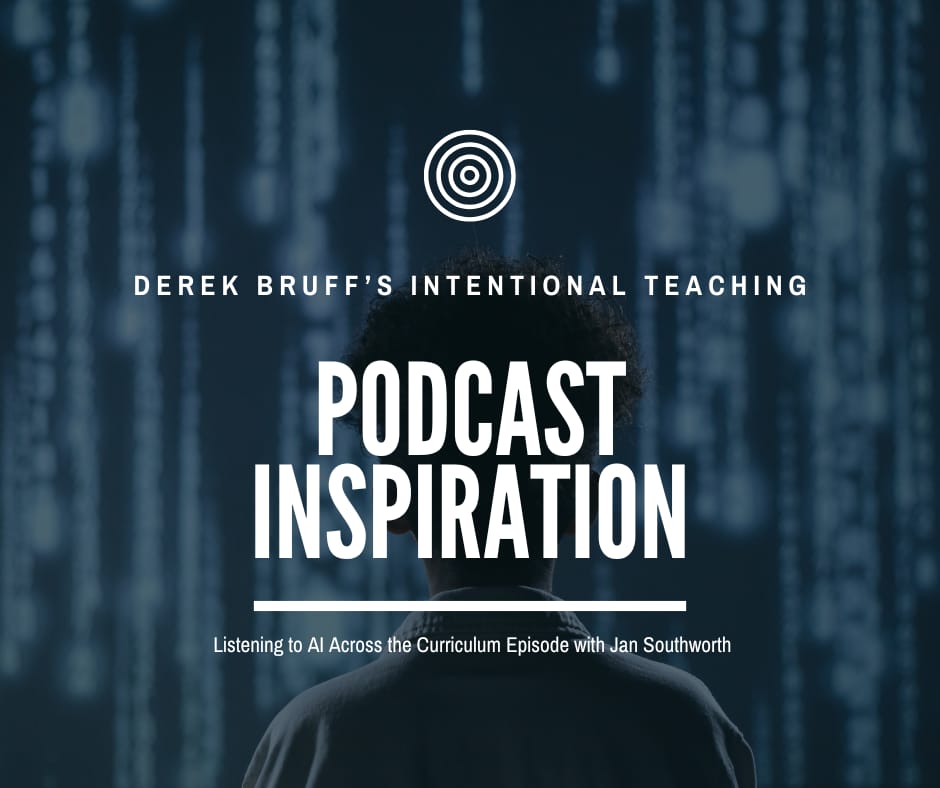
  • Lessons Learned from Intentional Teaching Podcast Episode About AI Across the Curriculum – Teaching in Higher Ed

    Lessons Learned from Intentional Teaching Podcast Episode About AI Across the Curriculum – Teaching in Higher Ed

    I drew much inspiration from this morning’s listen to Derrick Bruff’s interview with Jane Southworth about AI across the curriculum. Derrick Bruff’s podcast, Intentional Teaching, gives us bountiful opportunities to learn from the experiences of educators who are transforming educational experiences for students across a wide variety of disciplines and contexts. While the episode did focus on what is obvious from the title, AI Across the Curriculum, I drew a lot of inspiration well beyond just that topic of AI. There are many layers of what they talked about that go well beyond the broad topic of artificial intelligence. Other aspects of leading and teaching within a university context are shared well beyond the particular initiative they discuss.

    Jane talks about the difficulty of making such a massive change across a complex institution. She made a few jokes about the difficulties, although she said it was such lightheartedness that I felt such kindness toward her in what must have been such challenging endeavors. Consider what it takes to make something like this happen, and all the committee work that it takes, all the different people that are need to be talked to, all the perspectives to consider. The intricacies, not just to make something work, but to make the fruit of that work visible to students such that they enroll in the program and pursue the educational aims beyond the requirements for their majors. Jane shares examples of them starting an AI certificate program within their curriculum. The mammoth effort that it was to make that technically possible from an operations standpoint, such that someone could take the right classes and that they would go through all the curriculum committees and get that to work within their policies and procedures is one thing. But another layer I found quite fascinating was how do you then make that visible to students such that they’re even aware that this certificate exists and that they find it of interest and worthwhile to pursue further learning.

    As Sam Cooke sang years ago, I also “don’t know much about geography.” There’s no doubt in my mind that I have subscribed to some of the myths that Jane described about her discipline of geography. Jane described how in the United Kingdom, when she was in college, that it was the third or fourth most popular degree. Geography graduates found themselves receiving among the highest earnings as they left school, as well as being surprised when they discovered just how much more the field is than studying rocks, like they had initially believed.

    In the show notes for the episode, Derek shares a couple of resources that come both from conversations with Jane, as well as from his ongoing collaborations with Flower Darby, co-author of Small Teaching Online: Applying Learning Science in Online Classes and The Norton Guide to Equity-Minded Teaching. The first article linked by Derek in the show notes is Developing a Model for AI Across the Curriculum: Transforming the Higher Education Landscape via Innovation in AI Literacy by Southworth et al. The second article was Building an AI University: An Administrator’s Guide by Joe Glover. I’m grateful, as always, to Derek and all of the opportunities he makes available to those of us interested in teaching with intention.

    Resources

    Source link

  • The Power of Personal Storytelling in Higher Education Leadership

    The Power of Personal Storytelling in Higher Education Leadership

    When I became president of the University of La Verne in 2011, I often shared the story of why I was drawn to this role—and why it resonated so deeply with my family’s values. My husband and I were committed to raising our daughters in a community that embraced inclusivity, service, and the transformative power of education. These were not just abstract ideals; they were principles we wanted to live by and instill in our children. And sharing this connection wasn’t just about explaining my leadership—it was about building trust and fostering relationships across campus.

    Today, as higher education leaders face unprecedented scrutiny—from political attacks on academic freedom and diversity efforts to growing public skepticism about the value of a college degree—this kind of authenticity and connection is more critical than ever. Our institutions are being challenged to prove their relevance and align their missions with the needs of diverse and sometimes skeptical communities. In this climate, personal storytelling offers a powerful way to build bridges, humanize our roles, and reaffirm the values that define higher education. In navigating the complexities of our current environment, storytelling is not just a leadership tool—it’s a leadership imperative.

    Why personal storytelling matters

    Building authentic relationships: Personal stories bridge the gap between leaders and campus communities. Sharing your experiences, challenges, and successes makes your role more relatable and human. When leaders share stories authentically, we foster trust and encourage deeper connections with our students, faculty, alumni, donors, and other stakeholders. A compelling story has a way of bringing people together, sparking that feeling of connection through common experiences.

    Inspiring action and change: Stories are powerful motivators. They show how education can transform lives, encouraging students to pursue their dreams, sparking innovation among faculty, and connecting with alumni and donors. At the University of La Verne’s annual Scholarship Gala, I used to share my mother’s story—how, as an immigrant, she stayed committed to education despite countless challenges. When she, her two older sisters, and their parents first immigrated to the United States from Czechoslovakia, they had to build a new life, learn a new language, and adapt to new customs. My grandfather would bring used tires to their home, where the family would cut them into small squares and sew them together to create doormats. He sold these mats door-to-door, and the money they earned not only supported their daily life but was also saved so that my mother could attend nursing school.

    Each year following my story, students would respond with their own incredible stories of resilience. Those moments didn’t just inspire greater scholarship donations—they raised awareness about the challenges that so many students face, underscoring just how vital access to education really is.

    Shaping institutional culture: Personal stories are a big part of what shapes a university’s identity, creating a sense of inclusion, resilience, and shared values. Early on in my time at the University of La Verne, a board member told me why the university—her alma mater—meant so much to her and why she chose to give back as a donor and leader. She often spoke about how she and her husband met while attending La Verne, and that they both loved the supportive and inclusive environment at the university. Then one of her children enrolled, and a particular professor took him under his wing and helped him with his academic career. She felt La Verne was always there when she and her family needed support.

    Her story stuck with me, and I shared it often as an example of how personal connections can inspire others to support the university’s mission. By encouraging storytelling like this, we brought our community closer together and reinforced our shared purpose.

    Engaging with diversity: Every story brings something unique to a campus community. When we make room for diverse voices, we naturally build stronger connections and a sense of belonging. Serving on the board of Antioch University, I’ve had the privilege of hearing a wide range of students and faculty share their experiences—some inspiring, some challenging, all meaningful. These moments are a great reminder of how much we gain when we listen to and learn from each other.

    Strategies for Effective Storytelling

    Connect stories to the institution’s mission: Personal stories are powerful, but they work best when they connect back to the institution’s goals. I once attended a university event where the president’s stories, while memorable, didn’t really support the message of the institution—they overshadowed it, leaving the audience entertained but not necessarily inspired about the university’s future. It’s a good reminder that storytelling should always reinforce the mission and build confidence in what lies ahead.

    Balance sharing with relevance: Finding the right balance between personal and professional storytelling is key. Oversharing can make people uncomfortable or distract from your message. A story might be heartfelt, but if it’s too detailed, the audience might lose track of why it matters. The best approach is to share meaningful anecdotes that highlight your points while keeping your audience and the setting in mind.

    Maintain honesty and humility: The best stories come from a place of honesty and humility—they build credibility and trust. Think about great leaders: the ones who acknowledge the contributions of others tend to connect more than those who focus on their own achievements. On the flip side, self-congratulatory stories can feel off-putting and even break trust with the audience. Keep it grounded, which always resonates better.

    Avoid unethical exaggeration: Stretching the facts or making up stories can seriously damage trust. And people can usually tell when a story isn’t genuine, whether it’s because of over-the-top details or a lack of authenticity in the delivery. It’s important for leaders to stay honest, sharing meaningful details without straying from reality. In today’s world, where fact-checking is everywhere, even small inconsistencies can hurt your credibility—and by extension, the reputation of your institution. Keep it real, and your message will always carry more weight.

    Repetition without redundancy: Repeating key messages can really help drive them home, but it’s all about balance. When you tell the same story to different audiences, it can show consistency and authenticity, which is great. But if you overdo it, people might start to tune out, feeling like they’ve heard it too many times. We all recycle our favorite speeches and stories when we speak often, and that’s fine as long as we’re mindful of keeping it fresh. A thoughtful approach to storytelling means your message stays powerful without losing its impact.

    ************

    Personal storytelling is one of the most powerful tools leaders in higher education have at their disposal. When done right, it builds trust, inspires action, and strengthens the sense of community. Sharing authentic stories helps connect audiences to the mission and values of an institution, creating a shared sense of purpose and vision.

    As higher education continues to navigate challenges like public skepticism and political scrutiny, storytelling offers a way to highlight the transformative power of education. It allows us to address concerns with honesty and integrity, while keeping the focus on the positive impact education has on individuals and society. Reaching beyond the academy, these stories help build connections with the wider community—and ideally, around the world—showing how education shapes lives and strengthens society.


    dotEDU Global Voices

    This December, ACE will feature a special podcast series, dotEDU Global Voices, which will spotlight personal stories from accomplished international women university presidents. These leaders share their unique challenges, insights, and strategies, offering authentic and inspiring perspectives on leadership.

    The series builds on my book, Spotlighting Female Leadership: Strategies, Stories, Perspectives, which highlights the journeys of ten accomplished university presidents. To learn more, download the book here and tune into the podcast for further inspiration.

    Episode 1: Trailblazing Leadership in Turkey: Gülsün Sağlamer

    Episode 2: Discovering Your Leadership Path: Sue Cunningham

    Episode 3: Changing History at Colegio de México: Silvia Giorguli


    If you have any questions or comments about this blog post, please contact us.

    Source link