Tag: Higher

  • Dr. Jennifer T. Edwards: A Texas Professor Focused on Artificial Intelligence, Health, and Education: Preparing Our Higher Education Institutions for the Future

    Dr. Jennifer T. Edwards: A Texas Professor Focused on Artificial Intelligence, Health, and Education: Preparing Our Higher Education Institutions for the Future

    As we prepare for an upcoming year, I have to stop and think about the future of higher education. The pandemic changed our students, faculty, staff, and our campus as a whole. The Education Advisory Board (EAB) provides colleges and universities across the country with resources and ideas to help the students of the future.

    I confess, I have been a complete fan of EAB and their resources for the past ten years. Their resources are at the forefront of higher education innovation.

    🏛 – Dining Halls and Food Spaces

    🏛 – Modern Student Housing

    🏛 – Hybrid and Flexible Office Spaces

    🏛 – Tech-Enabled Classrooms

    🏛 – Libraries and Learning Commons

    🏛 – Interdisciplinary Research Facilities


    Higher education institutions should also focus on the faculty and staff as well. When I ask most of my peers if they are comfortable with the numerous changes happening across their institution, most of them are uncomfortable. We need to prepare our teams for the future of higher education. 

    Here’s the Millennial Professor’s Call the Action Statements for the Higher Education Industry

    🌎 – Higher Education Conferences and Summits Need to Provide Trainings Focused on Artificial Intelligence (AI) for Their Attendees

    🌎 – Higher Education Institutions Need to Include Faculty and Staff as Part of Their Planning Process (an Important Part)

    🌎 – Higher Education Institutions Provide Wellness and Holistic Support for Faculty and Staff Who are Having Problems With Change (You Need Us and We Need Help)

    🌎 – Higher Education Institutions Need to Be Comfortable with Uncommon Spaces (Flexible Office Spaces)

    🌎 – Faculty Need to Embrace Collaboration Opportunities with Faculty at Their Institutions and Other Institutions

    Here are some additional articles about the future of higher education:

    Higher education will continue to transition in an effort to meet the needs of our current and incoming students. 

    For our particular university, we are striving to modify all of these items simultaneously. It is a challenge, but the changes are well worth the journey.

    Here’s the challenge for this post: “In your opinion, which one of the items on the list is MOST important for your institution?”

    ***. 

    Check out my book – Retaining College Students Using Technology: A Guidebook for Student Affairs and Academic Affairs Professionals.

    Remember to order copies for your team as well!


    Thanks for visiting! 


    Sincerely,


    Dr. Jennifer T. Edwards
    Professor of Communication

    Executive Director of the Texas Social Media Research Institute & Rural Communication Institute

    Source link

  • Reflections from the Higher Education for Good Book Release Celebration – Teaching in Higher Ed

    Reflections from the Higher Education for Good Book Release Celebration – Teaching in Higher Ed

    What a way to start my week!

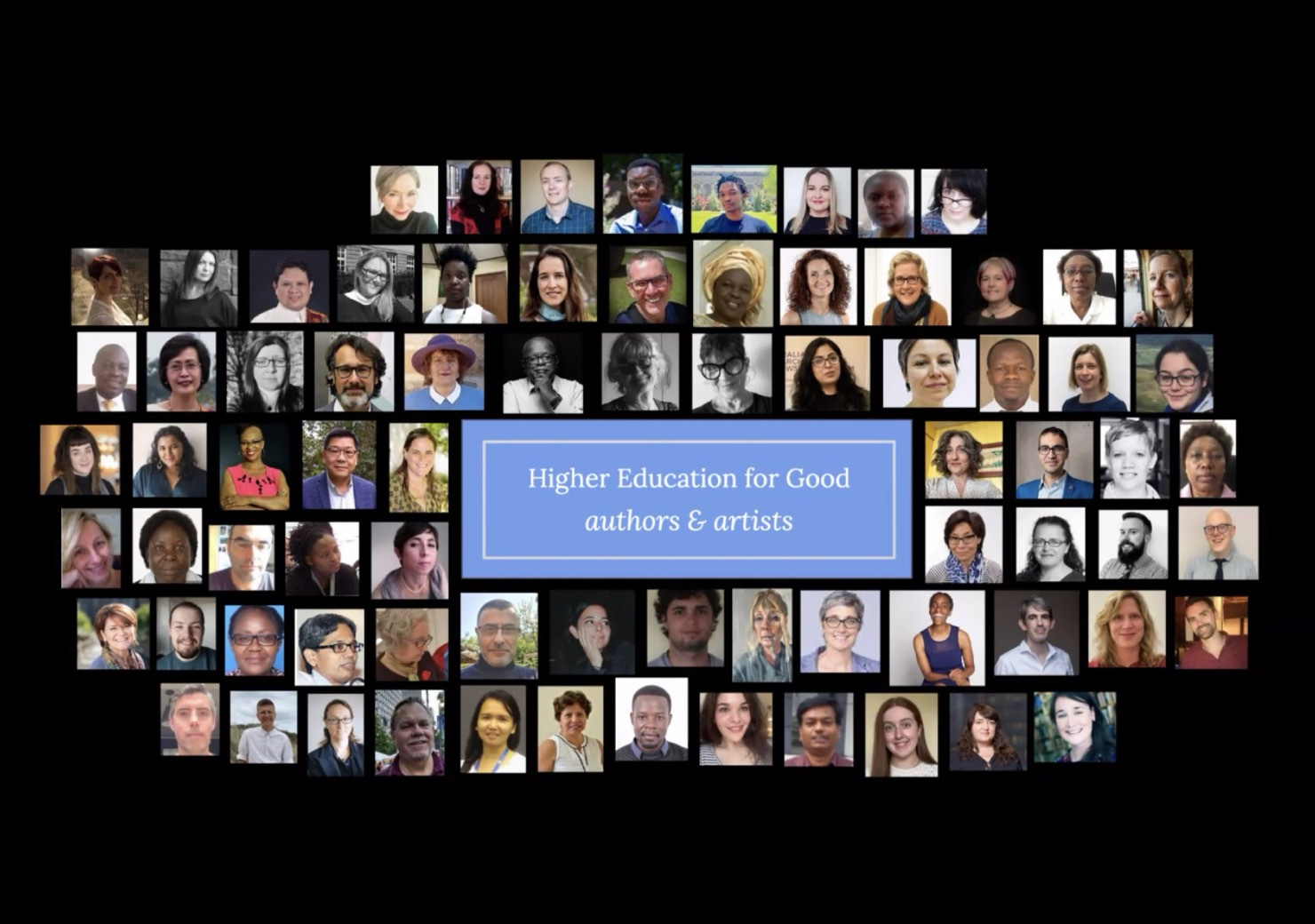
    November 20, 2023, I attended an online launch celebration event for a magnificent project. The book Higher Education for Good: Teaching and Learning Futures brought together 71 authors around the globe to create 27 chapters, as well as multiple pieces of artwork and poetry. Editors Laura Czerniewicz and Catherine Cronin shared their reflections of writing the book and invited chapter authors, and Larry Onokpite, the book’s editor, to celebrate the release and opportunities for collaboration. In total, the work represents contributions from 29 countries from six continents. Laura Czerniewicz was invited to talk about the book by the Academy of Science of South Africa (ASSAf), where she describes the values of inclusion woven throughout this project.

    Higher Ed for Good Aims

    At Monday’s book launch, Laura shared how the authors aimed to write about the tenants that were directed toward the greater aims of the book. Catherine described the call for authors to engage in this project, such that the resulting collection would help people:

    • Acknowledge despair
    • Engage in resistance
    • Imagine alternative futures and…
    • Foster hope and courage

    Laura stressed the way articulating what we stand for and not simply what we are against is essential in facilitating systemic change. Quoting Ruha Benjamin, Laura described ways to courageously imagine the future:

    Only by shifting our imagination, can we begin to think of a world that is more egalitarian, less extractive, and more habitable for everyone not just a small elite.

    It was wonderful to see the community who showed up to help celebrate this magnificent accomplishment. Toward the end of the conversations, someone asked about what might be next for this movement. Frances Bell responded by joking that she wasn’t sure she was necessarily going to answer the question, as she is prone to do. Instead, she described her use of ‘a slow ontology,’ a phrase which quickly resonated with me, even thought I didn’t know exactly what it meant.

    In some brief searching, I discovered a bit more about slow ontology. My novice understanding is that slow ontology asks the question of what lives might look like, were we to live them slowly and resist the socialization of speed as productivity and self-worth. Ulmer offers a look at a slow ontology for writing, while Mol uses slowness to analyze archeological artifacts. One piece I absolutely want to revisit is Mark Carrigan’s Beyond fast and slow: temporal ontology in critical higher education scholarship

    Next Steps

    I’ll have the honor, soon, of interviewing Laura and Catherine for the Teaching in Higher Ed podcast. I’m ~30% through Higher Education for Good and am glad I don’t have to rush through the reading too quickly. I mentioned as a few of us remained online together after the book release celebration that reading Higher Education for Good and Dave Cormier’s forthcoming Learning in a Time of Abundance has been an interesting juxtaposition. Rissa Sorensen-Unruh described a similar serendipity of reading Belonging, by Geoffrey Cohen at the same time as Rebecca Pope-Ruark’s Unraveling Faculty Burnout. After skimming the book description of Belonging, I instantly bought it… adding it to the quite-long digital to-read stack. I suppose that while I struggle with slowing down, that challenge doesn’t apply when it comes to my reading practice.

    Resources:

    Source link

  • Making Online Learning More Engaging in Higher Education – Edutechniques

    Making Online Learning More Engaging in Higher Education – Edutechniques

    With my recent work in Maynooth University (MU) in Ireland and my ten years of refining and teaching the courses we offer in the MAET program at Michigan State University (MSU), Ive been pontificating and procrastinating on what is current state of play with making more engaging online content in the higher education realm.

    Using Multiple Platforms for Collaboration/Communication

    At MSU we utilise Slack alongside our Brightspace D2L learning platform. This is the latest in a long line of platforms we have added to encourage collaboration and communication amongst our students. Discussion forums on LMS are by default….not the best..and not conducive to authentic engagement. We have found with Slack that engagement is up due to the interface and the fact that Slack has an app. Threads are logical and embedding multimedia works well. At Maynooth University, I taught the blended course TL517 Digital Technology in Higher Education which was delivered in Moodle, the old course framework had a weekly requirement to post to Moodle. I mixed it up a bit by incorporating live Microsoft Team activities along with collaborative Padlets. Padlet gave the students a different visual approach to communicating their thoughts and collaborating with others. The use of breakout rooms in Microsoft Teams gave the students the opportunity to navigate smaller groups in socially constructing knowledge and understanding.

    MORE INTERACTIVE CONTENT

    Quite logical and predictable, right? However, from my time in MU, the majority of online learning courses are merely substitutions of the analog courses that were delivered within the university walls. Working with lecturers to comb through their content to pinpoint areas that may become more interactive with technology is a very rewarding process. This process might be framed by the ABC protocols or just evolve organically through conversations.

    HUMANISE THE PROCESS

    When I am teaching an online course I always start with creating a video introducing myself and detail my professional and personal history. I also tell the students about my hobbies and interests. Seeing my face and hearing my voice always gives a human element to a potentially impersonal first impressions of an online course. It is also important to empathise with students online and realise the stress and pressures of real life that students are going through. Being flexible and empathetic with deadlines (to a certain degree) is greatly appreciated.

    CONSISTENT WORD-OLOGY

    When sorting out a course layout I like to organise the different activities in to action verbs. If a unit is mainly research based then the title will be “Research: “. If a unit involves creating something, then the title will be “Create”. If a unit involves reading to gain knowledge, then the title could be “Learn” or “Inquire”. Consistent wording enables the learner to understand what each unit of a course entails.

    VISUALS, VISUALS, VISUALS

    If the LMS allows I will create an interface of a grid of icons (which Moodle and other LMSs allow). If a student opens a course and encounters a wall of text it is usually quite daunting. A nice array of colourful yet not distracting icons makes a world of difference. Obviously, videos, infographics, images, and other elements that break down walls of text are all beneficial to the end user.

    CREATE ALL THE THINGS

    If we still adhere to the adage that to create is to know, then creating artefacts of learning in an online environment makes a lot of sense. I was surprised that the lecturers at MU were overjoyed when I asked them to create infographics to present their understandings of the concepts we had just read about. They immediately could see them using infographics with their students in their field. Something that I have used in K-12 education for a long time had not found its way to higher education and made me realise that certain pedagogical approaches that I may deem mainstream may be innovative in other realms.


    Discover more from Edutechniques

    Subscribe to get the latest posts sent to your email.

    Source link

  • Department of Education Issues Report on Diversity and Opportunity in Higher Education – CUPA-HR

    Department of Education Issues Report on Diversity and Opportunity in Higher Education – CUPA-HR

    by CUPA-HR | October 18, 2023

    On September 28, 2023, the Department of Education released a report titled “Strategies for Increasing Diversity and Opportunity in Higher Education.” The report was issued in response to the Supreme Court’s June 2023 ruling against affirmative action in college admissions and it outlines ways institutions and states can adapt to prioritize improved accessibility to educational opportunities for underserved students.

    The Report

    In an introductory message for the report, Secretary of Education Matthew Cardona emphasized the enduring commitment to equal opportunity and student body diversity in higher education on behalf of his department and the president’s administration. While condemning the Supreme Court’s decision on affirmative action, Cardona pledged the Department of Education’s and the Biden administration’s support in promoting inclusivity and equity and stimulating long-term prosperity.

    The Department of Education’s report centers around four areas that the administration believes institutions should consider when working to promote diversity and opportunity on campus: student recruitment, admissions, financial aid and student retention. The report focuses mostly on promoting diversity, equity and inclusion (DEI) initiatives in these areas to ensure underserved students have an equitable opportunity to be admitted into and succeed in postsecondary programs.

    Relevant to higher education HR, the report discusses the need for improved training of admissions officers and other employees to ensure consistent, equitable evaluations of applicants.

    Moving Forward

    Prior to the release of the Supreme Court’s affirmative action decision, stakeholders also raised concerns regarding the impact such a decision could have on hiring and employment decisions as well as programs or initiatives focused on creating diverse and inclusive workplaces that align with institutional values. The decision to strike down race-based affirmative action in admissions practices could leave employers open to future legal challenges regarding their hiring decisions and other diversity programs.

    CUPA-HR endorses efforts to promote inclusive communities on campuses across the nation. The government relations team continues to track developments impacting these efforts and will inform members of updates as they become available.


    Source link

  • The Top Predictor of Higher Ed Employee Retention May Surprise You – CUPA-HR

    The Top Predictor of Higher Ed Employee Retention May Surprise You – CUPA-HR

    by CUPA-HR | September 12, 2023

    In 2022-23, turnover of higher ed employees was the highest in five years. A new report from CUPA-HR explores the issue of higher ed employee retention and the factors that impact retention.

    The CUPA-HR 2023 Higher Education Employee Retention Survey analyzed data from 4,782 higher ed employees — administrators, professionals and non-exempt staff, with faculty excluded — from 529 institutions. It found that 33% of higher ed employees surveyed answered they were “very likely” or “likely” to look for new employment opportunities in the next year. More than half (56%) of employees are at least somewhat likely to search for a new job in the coming year.

    Top Reasons Higher Ed Employees Are Looking for a New Job

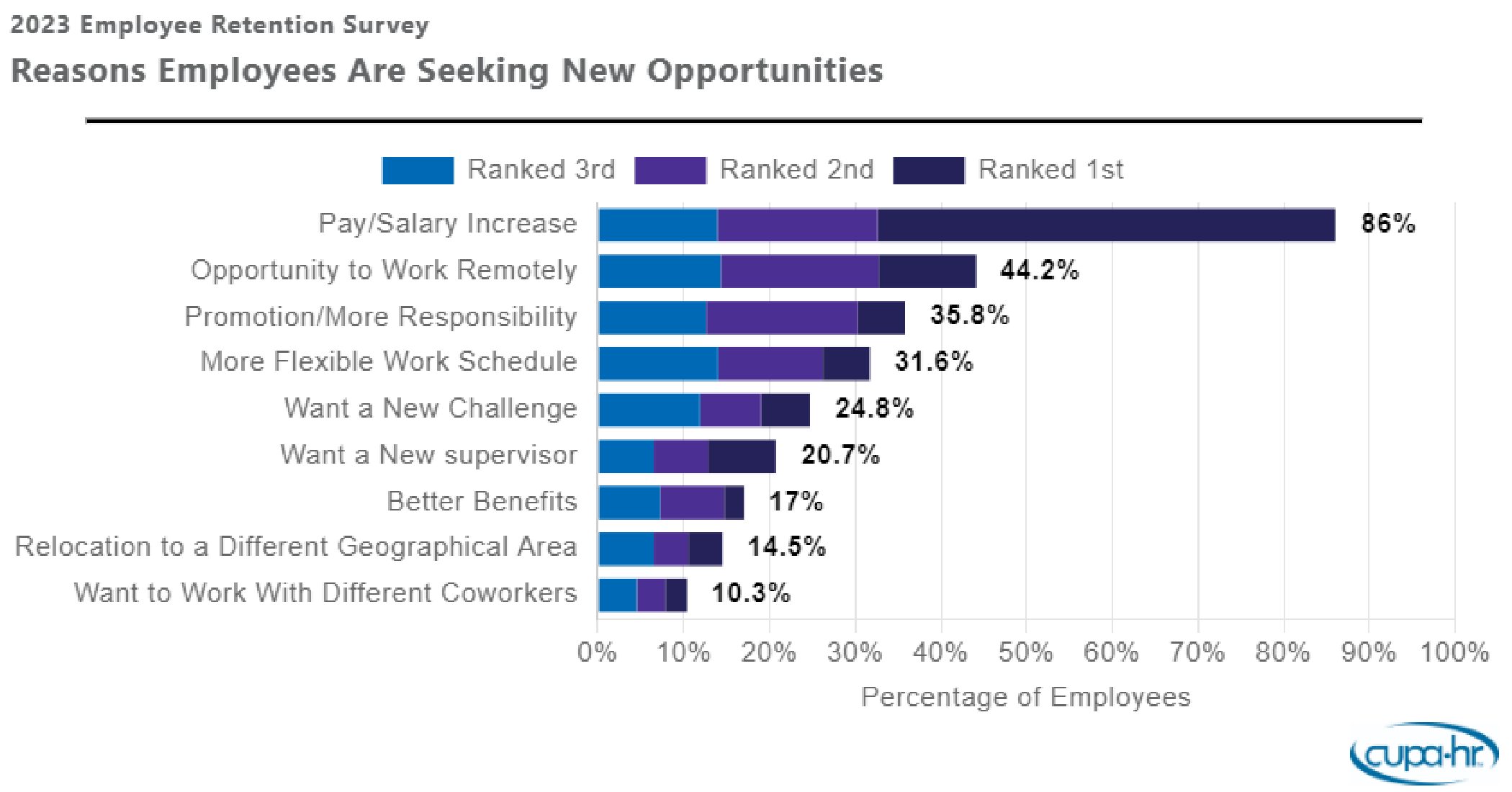
    According to the findings, respondents say that pay is the number one reason they’re looking for a new job. Other influential reasons are an opportunity to work remotely, desire for a promotion or more responsibility, and the need for a more flexible work schedule.

    But while pay is the top concern mentioned by employees, retention challenges are more complex.

    Strongest Predictors of Retention

    Digging deeper into the data, the strongest predictors of retention are factors related to job satisfaction and well-being. Only 58% of higher ed employees are generally satisfied with their jobs. Of the 16 aspects of job satisfaction and well-being the survey measured, the three that have the most impact on retention are:

    • Recognition for Contributions
    • Being Valued by Others at Work
    • Having a Sense of Belonging

    Only 59% of respondents say they receive regular verbal recognition for doing good work. The good news is that programs, training and policies that increase employee satisfaction in these areas can make a significant impact on retention without necessarily breaking the budget.

    Three Things You Can Do

    Employees are not necessarily planning to flee higher ed. Most job seekers will be looking within higher ed, and nearly half will be looking within their own institution, indicating that it’s not too late to implement retention strategies. Here are three things you can do to assess and address job satisfaction:

    1. Read the Report. The CUPA-HR 2023 Higher Education Employee Retention Survey provides not only data but also a model for understanding higher ed retention. (Looking for an overview of report findings? Check out our press release.)
    2. Explore CUPA-HR Resources. Here are several that focus on aspects of job satisfaction:
    1. Plan Next Steps. Share the report or press release with leaders on your campus. Determine areas where your institution could strengthen career development and implement training to increase job satisfaction.


    Source link

  • Award-Winning Work in Higher Ed HR – 2023 Regional Awards – CUPA-HR

    Award-Winning Work in Higher Ed HR – 2023 Regional Awards – CUPA-HR

    by CUPA-HR | May 23, 2023

    From developing supervisor competencies to transforming HR operations, human resources teams and HR practitioners across the country are doing great work every day.

    CUPA-HR’s regional Higher Education HR Awards program recognizes some of the best and brightest in higher ed HR and honors HR professionals who have given their time and talents to the association.

    Here are this year’s regional award recipients:

    HR Excellence Award

    This award honors transformative HR work in higher education and recognizes a team that has provided HR leadership resulting in significant and ongoing organizational change within its institution.

    Office of Human Resources, Towson University (Eastern Region)

    Towson University has had a partnership with Humanim, a nonprofit community workforce-development program, for many years. However, the pandemic created challenges that threatened to derail the partnership and the program. TU’s office of human resources, along with other anchor institutions, worked with Humanim to move parts of the program online, including virtual mock interviews, information sessions and panel discussions. Despite turnover created by the pandemic, the TU HR team was determined to maintain its relationship with Humanim and continue to provide employment opportunities to Baltimore residents. As TU’s top provider of quality temporary candidates for the university’s administrative functions, Humanim was also essential to the university during pandemic. For their outstanding work, CUPA-HR has contributed $1,000 to Towson University.

    Human Resources, Grand Valley State University (Midwest Region)

    In February 2022, Grand Valley State University’s HR team began implementing a total transformation of their operations, shifting from a 60-year-old compliance-driven approach to HR to an HR business partner approach. This change resulted in the creation of a “one-stop shop,” where HR services could be delivered more efficiently and consistently across all campus departments. The team also moved to improve efficiency by merging payroll, HR administration and technology, and benefits into a total rewards unit. And in the fall of 2022, HR established a formal talent management unit to organize and advance talent efforts. With these changes, HR is well positioned to unify and transform the university’s organizational culture. For their outstanding work, CUPA-HR has contributed $1,000 to Grand Valley State University.

    Culture Team, Utah Valley University (Western Region) 

    Recognizing a need for a better leadership experience for supervisors on their campus, Utah Valley University’s culture team set out to create a set of standardized leadership competencies that would help ensure that they were hiring the right people, communicating clear expectations during onboarding, providing leadership resources through training, and allowing supervisors to receive feedback. The Leadership Competency Experience, based on six leadership competencies and the university’s core values, established a standardized method of hiring, onboarding, training and feedback processing intended to cultivate effective leadership at all levels. Two years in, the program has made a significant impact on the quality of supervisors being hired and the training and support they receive, and the number of employee relations cases and volume of turnover due to bad supervision have decreased sharply. In fact, it has been so successful that in July 2022 the team released the Staff Competency Experience. For this impressive achievement, CUPA-HR has contributed $1,000 to Utah Valley University.

    Higher Ed HR Rock Star Award

    This award recognizes an individual who is serving in the first five years of a higher education HR career who has already made a significant impact.

    Miranda Arjona, Rollins College (Southern Region)

    From day one, Miranda Arjona, assistant director of human resources at Rollins College, has impressed colleagues with her positive outlook, creativity, willingness to learn and helpful attitude. Whether she’s building relationships within the HR team or leading a service excellence subcommittee, Miranda is focused on strengthening connections and making a difference. When she was asked to temporarily assist in student affairs to help manage contact tracing and consulting during the pandemic, she did so with her typical positivity and commitment to the task. Just as seamlessly, she transitioned back to her talent management role with the same mindset and tenacity. Her commitment to being a relationship-builder has not only served Rollins but also the higher ed HR community. She has been a speaker at two local HR events, and she is currently serving as president-elect of the CUPA-HR Florida Chapter.

    Lyndon Huling, University of California-Davis (Western Region)

    Lyndon Huling, manager of leadership recruitment, temporary staffing and diversity services at UC Davis, routinely taps his broad intergenerational and cross-cultural campus connections in his work, making him an exceptionally effective leader. His commitment to reimagining HR and recruitment best practices through a DEI lens shows in the strategies he’s developed and the innovative programs he’s been instrumental in establishing. Among other projects, he has co-sponsored and delivered transformative Race Matters workshops that create a safe space to learn and discuss race at work, which he has shared through presentations at regional and national CUPA-HR conferences. Through his work to create and share resources, Lyndon has demonstrated himself to be a passionate, progressive leader in higher ed HR.

    Chapter Excellence Awards

    These regional awards recognize chapters that are making a significant impact through their commitment to CUPA-HR and to the higher ed HR community. They work to achieve this through financial responsibility, commitment to CUPA-HR chapter guiding principles, cultivation of strong leadership, and development of creative networking and professional development opportunities.

    This year’s Chapter Excellence regional recipients are:

    • The CUPA-HR Michigan Chapter (Midwest Region)
    • The CUPA-HR Kentucky Chapter (Southern Region)
    • The CUPA-HR Northern and Central California Chapter (Western Region)


    Source link

  • Pay Increases for Higher Ed Employees Sharply Improve, But Still Fall Short of Inflation Rate – CUPA-HR

    Pay Increases for Higher Ed Employees Sharply Improve, But Still Fall Short of Inflation Rate – CUPA-HR

    by CUPA-HR | April 3, 2023

    New research from CUPA-HR has found that although employees across the higher education workforce saw the most substantial pay raises in 2022-23 than in the past several years, they are still being paid less than they were in 2019-20 in inflation-adjusted dollars.

    Some of the key findings from an analysis of CUPA-HR’s higher ed workforce salary survey data from 2016 to 2023:

    • This academic year, raises for higher ed employees were the largest seen in the past seven years, and all position types (administrators, professionals, staff and faculty) received an increase of at least 1.11 percentage points compared to the previous year.
    • Tenure-track and non-tenure-track teaching faculty continue to receive the smallest pay increases of any higher ed employee category. In 2022-23, tenure-track faculty saw a median pay increase of 2.9 percent and non-tenure-track faculty saw an increase of 3.2 percent. Tenure-track faculty salary increases have not kept pace with inflation since at least 2015, and non-tenure-track salary increases last met or exceeded inflation in 2016-17, meaning full-time faculty in general continue to be paid less every year in inflation-adjusted dollars.
    • Staff, which is typically the lowest-paid category of higher ed employees, saw the biggest raises this academic year at 5.3 percent (up from 2.9 percent in 2021-22).

    Explore this data and more in CUPA-HR’s newest interactive graphic.

    CUPA-HR Research

    CUPA-HR is the recognized authority on compensation surveys for higher education, with its workforce surveys designed by higher ed HR professionals for higher ed HR professionals and other campus leaders. CUPA-HR has been collecting data on the higher ed workforce for more than 50 years, and we maintain one of the largest workforce databases in existence. CUPA-HR also publishes numerous research publications and interactive graphics highlighting trends and issues around higher ed workforce planning, pay equity, representation of women and racial/ethnic minorities and more. Learn more about CUPA-HR research.


    Source link

  • CUPA-HR Data Highlights Trends in Representation and Pay Equity in the Higher Education Workforce, and the News Is Mixed – CUPA-HR

    CUPA-HR Data Highlights Trends in Representation and Pay Equity in the Higher Education Workforce, and the News Is Mixed – CUPA-HR

    by CUPA-HR | March 1, 2023

    When it comes to representation and pay equity for women and people of color in the higher education workforce, colleges and universities have frequently struggled to make meaningful progress. Through several new interactive graphics representing years of research, CUPA-HR shines a light on the progress that has been made and the disparities that persist. These graphics represent data from CUPA-HR’s four signature higher ed workforce surveys — Administrators, Faculty, Professionals, and Staff — through 2022.

    Administrators

    While the proportion of people of color in higher ed administrator positions has grown steadily over the last 10 years, these increases have not kept pace with the rate at which minorities are obtaining graduate degrees. In 2022, people of color made up 18.2 percent of administrators, up from 12.9 percent in 2012.

    The data also show that pay gaps for women administrators of all races/ethnicities are consistent across the past 10 years and notably wide. Pay inequity is particularly egregious for women administrators of color (with the exception of Asian women). Men of color, on the other hand, have been paid salaries equitable to or greater than those of White men in recent years.

    The Administrators in Higher Education Survey collects data on administrator positions that manage a higher ed institution or a division within it.

    See the Administrators Composition and Pay Equity by Gender and Race/Ethnicity interactive graphics, as well as data broken out by CEO, provost and chief HR officer.

    Faculty

    There are two notable findings in faculty composition. First, more women are represented in non-tenure-track than in tenure-track faculty. Second, for each tenure status and with each increase in rank, the proportions of women and faculty of color decrease. This means that women are over-represented in the lowest-paying and lowest-ranking positions. This remains the case despite the fact that the proportion of women and faculty of color have increased slightly at each rank over the past five years.

    Pay gaps for women faculty, regardless of tenure status or rank, continue to persist, particularly at the rank of professor. These gaps are most notable for women of color. Pay gaps at other ranks have narrowed over time, particularly for tenure-track faculty. Importantly, the factor that most impacts faculty pay is promotion to a higher rank. Often, the only significant increases in salary happen with these promotions. These data show that the only group that has greater representation with each increase in rank is that of White male faculty, and this pattern has persisted over time.

    The Faculty in Higher Education Survey collects data on tenure-track faculty positions and non-tenure-track teaching faculty positions.

    See the Faculty Composition and Pay Equity by Gender and Race/Ethnicity interactive graphics.

    Professionals

    Women’s representation has increased across all professionals’ positions since 2017, and in 2022, women represented more than 60 percent of higher ed professionals. This change is due to slight increases in representation of women of color since 2017. In 2022, representation of people of color was 24 percent overall, with the highest percentage among human resources professionals (34 percent) and diversity and equal opportunity professionals (33 percent).

    In 2022, women were consistently paid less than White men, a pattern that has worsened since 2017. However, men of color were paid more equitably in 2022 compared to previous years.

    The Professionals in Higher Education Survey collects data on positions in specific functional areas in higher ed institutions, such as academic or student services, that usually require a baccalaureate degree.

    See the Professionals Composition and Pay Equity by Gender and Race/Ethnicity interactive graphics.

    Staff

    Staff employees have a higher representation of people of color than any other higher ed employee group. This is notable in that these are the lowest-paying positions in higher ed. In 2022, women of color represented about 19 percent of all higher ed staff, and men of color represented about 13 percent of all higher ed staff. These numbers have increased since 2017, though modestly. Skilled craft employees were the least racially diverse group, as 80 percent were White men, a finding that has persisted across the past six years. Notably, skilled craft staff are among the highest-paid staff positions.

    Since 2017, women in staff positions have been paid consistently and considerably less than White men in staff positions, a pattern that has worsened over time, particularly for women in office and clerical positions. Men of color were paid more equitably in 2022 when compared to 2017.

    The Staff in Higher Education Survey collects data on positions that are generally non-exempt and do not require a college degree.

    See the Staff Composition and Pay Equity by Gender and Race/Ethnicity interactive graphics.

    CUPA-HR Research

    CUPA-HR is the recognized authority on compensation surveys for higher education, with its workforce surveys designed by higher ed HR professionals for higher ed HR professionals and other campus leaders. CUPA-HR has been collecting data on the higher ed workforce for more than 50 years, and we maintain one of the largest workforce databases in existence. CUPA-HR also publishes numerous research publications and interactive graphics highlighting trends and issues around higher ed workforce planning, pay equity, representation of women and racial/ethnic minorities and more. Learn more about CUPA-HR research.


    Source link

  • Trends in Higher Ed Employee Learning and Development – CUPA-HR

    Trends in Higher Ed Employee Learning and Development – CUPA-HR

    by CUPA-HR | February 1, 2023

    Employee learning and development (L&D) offerings at higher ed institutions have changed significantly over the last three years. To find out what other institutions are doing in this area, Krista Vaught, assistant director of employee learning and engagement at Vanderbilt University, conducted a survey in the summer of 2022. Survey responses from L&D professionals at 115 institutions reveal the following trends in program delivery, attendance, topics and outcomes.

    Program Delivery

    Since 2020, synchronous online sessions have been offered by most (89) institutions, followed by self-paced modules (85). Some institutions indicated that at certain points, employees were limited to online learning and self-paced only, as they did not host live workshops.

    Prior to the pandemic, synchronous, in-person workshops were the primary delivery method at most institutions. Now, synchronous online is the primary method at 35 percent of institutions surveyed, asynchronous online at 30 percent of institutions, synchronous in-person at 18 percent of institutions and hybrid at 17 percent of institutions.

    Attendance

    Attendance and participation have fluctuated. In the early 2020 shift to remote work, there was a sense that employees had newfound time to pursue L&D, at least initially. From March 2020 to December 2021, 31 percent of institutions surveyed saw increased participation, while 27 percent said it was mixed or hard to tell. Eighteen percent said it increased then decreased, and 17 percent said it decreased.

    What did institutions see in 2022? Results were mixed again. Twenty five percent said attendance and participation were about the same as prior to 2022, 23 percent said it decreased, 21 percent said it increased and 27 percent said it was mixed or hard to tell.

    What’s causing the fluctuations and challenges in attendance and participation?

    • Time and availability
    • Burnout
    • Increased workload as employees transition back to more on-campus work or take on additional responsibilities because of turnover, leaving less time to pursue learning
    • Unsupportive supervisors who see learning as taking away time from work rather than part of work
    • Employee preference for different delivery methods (in-person versus virtual)
    • Learning opportunities are not always prioritized, resulting in last-minute no-shows

    Topics

    According to respondents, the most popular workshop topics fall under management and leadership, and wellness and communication.

    Assessing Outcomes

    Follow-up surveys are the most popular tool for assessing outcomes of workshops, followed by attendance and participation numbers.

    Prioritizing Learning and Development 

    In the ongoing competition for talent, L&D can be a game changer, both in attracting new talent and retaining the talent you already have. By investing in and prioritizing programs to support managers, develop leaders and promote better communication, institutions can create a workplace that’s hard to leave.

    Interested in more data and insights HR pros can use when brainstorming L&D initiatives, making a case for those initiatives, and designing them and assessing them? Head over to the full article, Higher Education Learning and Development Trends in 2022 – Where We Are now and Where We’re Headed (members-only) in the winter issue of Higher Ed HR Magazine.

    To learn how one institution launched a multi-faceted retention initiative, including manager and leadership development opportunities, watch the recording of the recent CUPA-HR webinar Solving the Retention Puzzle.

    Related Resources:

    CUPA-HR Learning Framework and Resources

    Management and Supervisor Training Toolkit (CUPA-HR Knowledge Center)

    Creating Your Individual Development Plan (E-Learning Course)

    Understanding Higher Education (E-Learning Course)


    Source link

  • New Research Finds Higher Ed Institutions Are at Risk of Losing Supervisors to Other Employers – CUPA-HR

    New Research Finds Higher Ed Institutions Are at Risk of Losing Supervisors to Other Employers – CUPA-HR

    by CUPA-HR | January 11, 2023

    As previous research from CUPA-HR has shown, America’s colleges and universities are in the midst of a talent crisis, as many employees are considering other employment opportunities due to a number of factors. As a follow-up to the initial findings of CUPA-HR’s 2022 Higher Education Employee Retention Survey, CUPA-HR has released new findings focused specifically on those in supervisory roles, and the data show that many supervisors are overwhelmed, under-resourced, and struggling to fill positions and maintain morale.

    The newly published report, The CUPA-HR 2022 Higher Education Employee Retention Survey: Focus on Supervisors, explores supervisors’ likelihood of looking for new employment, their current challenges and working environments, and which job aspects specific to supervisors are associated with their retention. The report analyzes data from the 3,815 higher ed administrators, professionals and non-exempt staff, most (57 percent) of whom were supervisors, who responded to CUPA-HR’s 2022 Higher Education Employee Retention Survey.

    Findings

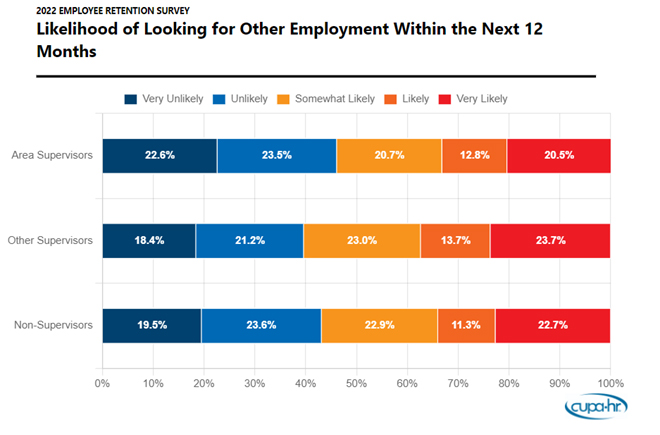
    Higher ed supervisors are looking for other employment opportunities, and less than half would seek new opportunities at their current institution. Nearly two in five (36 percent) supervisors indicate they are likely to look for other employment in the next 12 months, and only 40 percent say they would seek job opportunities at their current institution. The most common cited reason for seeking other employment is pay.

    Most higher ed supervisors work long hours and have absorbed more duties since the onset of the COVID-19 pandemic. Data show that supervisors are more likely than non-supervisors to work additional hours. Fewer than half (47 percent) of non-supervisors work more hours than what is considered full-time. However, 89 percent of area supervisors and 76 percent of other supervisors work more hours per week than what is considered full-time at their institution. Additionally, supervisors are more likely than non-supervisors to agree that they have absorbed additional responsibilities of other staff who have left the institution since the onset of COVID-19. Supervisors are also more likely than non-supervisors to report that they experienced an increase in job expectations since the start of the pandemic.
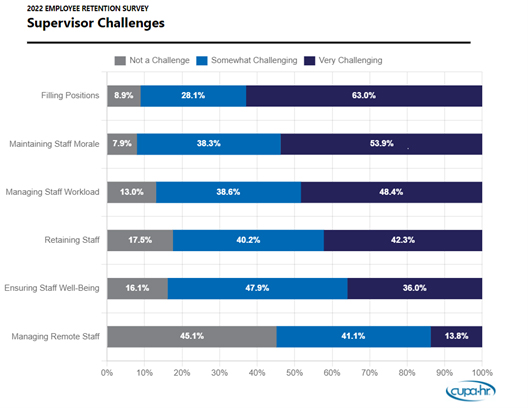
    Filling positions and maintaining morale are supervisors’ top challenges. As shown in the figure below, almost two-thirds (63 percent) of supervisors indicated they find filling positions very challenging and over half (54 percent) found maintaining staff morale very challenging.

    Higher ed supervisors report a lack of adequate training and support. Only three in five supervisors agree that they have resources and support in their supervisory role. Less than half (46 percent) agree that they have been provided with adequate management training for their supervisory role. However, when supervisors have more resources and support in their supervisory roles, more power to advocate for their staff, more power to allow flexible schedules, and more power to allow their staff to work remotely, they are less likely to seek other employment.

    Implications of Supervisor Turnover and How to Combat It

    Turnover in any role can impact an institution due to loss of talent, institutional knowledge and team or interdepartmental rapport. However, turnover in a supervisor role has more far-reaching implications. Supervisor turnover also impacts direct reports, who must adjust to a new supervisor and may need to adapt to new team priorities and vision. Loss of supervisors also equates to a loss of leaders who are key to succession plans.

    In light of what the data show, there are several actions higher ed institutions can take to keep their supervisors:

    • Provide supervisors with resources and support in their capacity as supervisors, particularly around filling empty positions and managing staff morale.
    • Ensure supervisors have the ability, knowledge and resources to advocate for their staff.
    • Give supervisors more autonomy to determine their staff’s working arrangements, as the data show that supervisors who have more power to allow their staff to work remotely and have flexible schedules are less likely to seek other employment.
    • Commit to reducing supervisor workload.
    • If possible, raise salaries for supervisors (but not at the expense of non-supervisors).

    For a deeper look into the data, read the full report.

    Note: In the findings, “area supervisors” refer to those supervisors who are the top-most leaders in their department, units or areas (self-identified in the survey; 26 percent of respondents). “Other supervisors” are those who self-identified as having at least one direct report but were not the top-most leader in their department (31 percent of respondents). “Non-supervisors” are those employees who have no direct reports (43 percent of respondents).

    CUPA-HR Research

    CUPA-HR is the recognized authority on compensation surveys for higher education, with its workforce surveys designed by higher ed HR professionals for higher ed HR professionals and other campus leaders. CUPA-HR has been collecting data on the higher ed workforce for more than 50 years, and we maintain one of the largest workforce databases in existence. CUPA-HR also publishes numerous research publications and interactive graphics highlighting trends and issues around higher ed workforce planning, pay equity, representation of women and racial/ethnic minorities and more. Learn more about CUPA-HR research.


    Source link