



Fitch’s report details a dour year for higher ed, but one that affects colleges unequally.
The shifting federal landscape, for example, will have “a wide but uneven impact on the sector,” the report said, citing possible changes to research funding and the Republicans’ massive spending bill that passed this summer. The analysts specifically pointed to new federal lending limits for graduate programs, set to take effect in July, which could limit colleges’ pricing power.
Fitch also expects international enrollment to falter. Preliminary surveys about fall 2025 enrollment have found colleges reporting a drop in international students, especially those enrolled in graduate programs.
International enrollment can be a financial boon to colleges, especially those heavily dependent on tuition revenue, as these students often pay full sticker price.
But under President Donald Trump, the federal government has repeatedly attacked foreign students, from expanding the vetting process to revoking their visas by the thousands. It has also moved to tighten international student visa programs.
“This fragile pipeline will become another area of increasing competition for fewer students and may further erode any meaningful student fee revenue growth prospects for 2026 and beyond,” the report said.
The number of high school graduates is expected to peak this year after years of growth, according to the Western Interstate Commission for Higher Education. In the coming years, the number of traditional-age college students is expected to drop, leaving colleges fighting for fewer attendees.
Overall enrollment in the sector has recovered from the pandemic, according to the National Student Clearinghouse Research Center.
But those gains have been largely concentrated at two-year institutions, according to Fitch. The report noted that these institutions offer increasingly popular certificate programs and dual enrollment, which allows students to take college courses while in high school. However, those options may not ultimately lead to more transfer students at four-year colleges, it said.
Amid these factors, colleges will face “strained revenue growth prospects,” according to Fitch Senior Director Emily Wadhwani.
“A vulnerable international student pipeline, a shrinking domestic student base and rising scrutiny on the value proposition of a higher education degree are likely to erode any meaningful student fee revenue growth prospects in the coming year,” Wadhwani said in the report.
The number of colleges merging or closing is expected to “continue at an elevated pace” in 2026, Fitch analysts said.
In a political moment defined by economic confusion, precarity, and widening inequality, the
has positioned itself as one of the most forceful critics of how the U.S. government measures economic well-being. Founded in 2019 by Eugene “Gene” Ludwig—banking regulator, financier, and longtime critic of official labor statistics—the institute argues that the traditional indicators used by policymakers, economists, and the media no longer reflect the lived experience of most working and middle-class Americans.
Taken together, these indicators paint a sobering picture. LISEP’s most recent TRU data suggests that nearly one in four Americans—far more than the official unemployment rate—remains functionally unemployed or trapped in low-wage, unstable work. Its analysis of living costs shows that basic necessities such as housing, childcare, food, healthcare, and digital access are rising at rates that far outpace reported inflation. Its income distribution research finds that the bottom 60% of households fall severely short of the after-tax income required to meet even minimal quality-of-life thresholds.
In a time when both parties often claim economic success—pointing to record stock markets, low headline unemployment, and steady GDP growth—LISEP argues that these triumphal narratives obscure the steady erosion of working-class security.
But LISEP’s work does more than diagnose hardship; it challenges the legitimacy of the economic story that the United States tells about itself. That is precisely why its metrics have garnered attention—and controversy.
Methodological Innovations and the Pushback They Attract
Economists, policymakers, labor advocates, and academics have responded to LISEP’s work with a mixture of praise and skepticism. Some see LISEP as filling a critical gap—offering metrics that better capture the realities of gig workers, part-time workers, workers with unpredictable hours, and families priced out of life’s essentials. Others argue that LISEP’s approach risks injecting subjectivity into economic measurement and complicating long-established statistical frameworks.
One major point of debate centers on LISEP’s definition of unemployment. Traditional unemployment statistics only count individuals actively seeking work. LISEP’s TRU metric, by contrast, includes the underemployed, part-time workers who want full-time jobs, and discouraged workers who have given up looking. Critics argue that combining these groups creates a metric that resembles a policy argument more than a neutral measurement. Supporters counter that ignoring these groups produces an artificially rosy portrait of economic health and undervalues persistent structural inequality.
LISEP’s True Living Cost and Minimal Quality of Life indices face a different critique: they define “necessities” more broadly than some economists are comfortable with. Including internet access, basic technology, early childhood education, and modern transportation standards is, according to LISEP, essential to functioning in the 21st-century economy. Critics contend that because these standards go beyond subsistence, the metrics risk shifting from measuring need to measuring aspiration. The institute responds that “subsistence” is not an acceptable measure of human dignity in a wealthy nation.
Other scholars raise questions about transparency. While LISEP publishes summaries and explanations of its methodologies, some economists argue that its approaches would require broader independent replication and peer review to become standard tools. Yet others note that the Bureau of Labor Statistics itself has long used imperfect methods that were never designed to measure well-being—only labor market participation.
Where supporters and skeptics agree is on one point: LISEP has forced a deeply needed conversation about what economic dignity means in the United States today.
Why LISEP Matters for Higher Education and Public Policy
For institutions of higher learning—especially those that produce the economists, policymakers, and journalists who shape public discourse—LISEP’s challenge to economic orthodoxy is a call to scrutiny and humility. Universities continue to rely on traditional metrics in research, teaching, and policy labs, even when these metrics fail to capture the economic and social pressures facing students and their families.
Students at community colleges, regional publics, and underfunded institutions live the realities LISEP describes: multiple jobs, unpredictable hours, rising food and housing insecurity, and persistent underemployment after graduation. Yet their struggles are too often minimized by conventional indicators that suggest a thriving labor market.
If academia takes LISEP’s work seriously, it could shift research priorities, reshape debates on student debt, influence regional economic development strategies, guide labor-market forecasting, and elevate the experiences of the most economically vulnerable students.
For policymakers, LISEP’s metrics offer a different foundation for assessing whether economic growth is reaching ordinary people. They provide tools for evaluating whether wages are livable, whether childcare is accessible, whether housing is affordable, and whether the economy produces stable, family-supporting jobs. If adopted or even partially embraced, LISEP’s indicators could inform legislation on minimum wage, labor protections, social services, tax reform, cost-of-living adjustments, and more.
The institute’s broader message is simple: the United States cannot address inequality if it continues to celebrate misleading statistics.
A New Economic Narrative
Whether LISEP becomes a permanent influence or a dissenting voice will depend on how policymakers, journalists, and academic economists respond. If its metrics remain on the margins, they will serve as a moral indictment of traditional measures that ignore the reality of economic insecurity. If they are adopted, they could trigger a profound reevaluation of American economic policy—one grounded not in aggregate success but in shared prosperity.
LISEP insists that a healthy economy is not one that grows on paper but one that allows ordinary people to live decently. That premise alone places the institute on the front lines of the battle over how the United States understands its own economic health.
Sources
Ludwig Institute for Shared Economic Prosperity, “True Rate of Unemployment (TRU),” 2025, lisep.org.
Ludwig Institute for Shared Economic Prosperity, “True Living Cost (TLC),” 2025, lisep.org.
Ludwig Institute for Shared Economic Prosperity, “Shared Economic Prosperity (SEP) Measure,” 2025, lisep.org.
PR Newswire, “Majority of Americans Can’t Achieve a Minimal Quality of Life, According to New Ludwig Institute Research,” May 12, 2025.
Ludwig Institute for Shared Economic Prosperity, “Wage Inequality Grows With Low-Income Workers Losing Ground,” Press Release, April 16, 2025.

She had been awarded the prize for her book Ghostly Pasts, Capitalist Presence: A Social History of Fear in Colonial Bengal, published in August 2024.
Tithi Bhattacharya, a history professor at Purdue University, formally declined the Modern Language Association’s Aldo and Jeanne Scaglione Prize for South Asian Studies in protest of decisions by the MLA regarding Israel’s attacks on Gaza.
“This decision is not a reflection of the committee’s rigorous work or the value of the prize itself, but a stand taken in light of the institutional silence and policy decisions made by the Modern Language Association regarding the ongoing genocide in Palestine, including the MLA leadership’s appalling suppression of the Delegate Assembly’s right to vote on a proposed resolution to boycott, sanction, and divest from Israel,” Bhattacharya wrote Wednesday in a blog post about her decision.
She had been awarded the 2025 prize for her book Ghostly Pasts, Capitalist Presence: A Social History of Fear in Colonial Bengal, published in August 2024.
“I also hope that by declining, I can contribute to the urgent conversation about the ethical responsibilities of professional academic organizations when facing colonialism, brutal state violence, and genocide,” Bhattacharya wrote. “My book, which my generous colleagues on the committee have recognized, is about how colonial capitalism does not even spare ghosts. Against such power, I still believe our weapon remains solidarity.”

The “intergenerational retirement living community” about to sprout on an Australian university’s suburban campus will generate clinical training opportunities for students while it “strengthens the social fabric” of the city, its advocates claim.
The University of Canberra plans to convert unused land—currently occupied by gum trees, grassland, dilapidated fencing and the odd hungry kangaroo—into a mini village complete with 230 “independent living units,” a 180-bed care facility, a retail center and health services on tap.
The project is designed to ease housing shortages and help older Australians in “downsizing” while promoting intergenerational mingling.
It will also provide practical educational opportunities across multiple disciplines. “Our students here, from allied health through to the built environment … nursing and many other vocations, will be able to get on-the-job training whilst they are at the university,” said Vice Chancellor Bill Shorten.
“University education makes a lot more sense when … you’re practicing what you’re learning. Nothing beats that real-world experience.”
Under a deal signed with property developers Pariter and residential aged care provider Opal, the university will lease the 2.2-hectare site—nestled between UC’s hospital and health hub—for 100 years. The two companies will bankroll the project’s capital costs, estimated at about 150 million Australian dollars ($99.2 million).
The university will pocket “lease receipts and revenue share,” although it declined to say how much. The deal will facilitate collaborative employment and “co-designed” learning programs, along with joint research projects and student placements on campus and elsewhere.
The older residents will be encouraged to engage with each other and their younger neighbors, including the more than 2,000 students who live on campus. Pedestrian links will connect them to cafés, the library, medical services and nearby bushland.
Shorten said the construction still requires final approval, but he expects it to begin within about two years and finish within four. He insisted that the project, which had been the subject of long-standing negotiations with various partners, would have gone ahead irrespective of the university’s financial position.
“It just makes sense,” he told reporters. “This is an idea [whose] time has come. I think this is what modern universities should be doing. At the end of the day, trying to suppress a good idea is like trying to keep a ball below the surface of the water.”
UC is among a throng of Australian universities that are converting parts of their considerable landholdings into revenue-earning opportunities matched to their educational and community support missions. The University of Wollongong is seeking final development approval for an “intergenerational university community” that features health services, integrated research and education spaces, an early-learning center and accommodation for more than 400 older residents on its seaside campus.
La Trobe and Flinders Universities have also flagged the possible establishment of aged care facilities as part of multibillion-dollar developments of their campuses in suburban Melbourne and Adelaide.
Opal’s director of communications and sustainability, Rosanne Cartwright, said similar precincts were springing up in countries with aging demographics including Germany, Japan and the Netherlands. “The aging population is a global issue that needs to be solved locally,” Cartwright said.
“Australians across every generation are dealing with loneliness as a real issue,” she added. “Younger people need to look after older people and older people need to look after younger people.”
Commercial redevelopments on campus have sparked criticism that vice chancellors are diverging from their educational mission into property speculation—grievances that run strong if universities invest in capital projects while reducing staff to save costs.
The National Tertiary Education Union said it was comfortable with the UC project “so long as it contributes to rather than detracts from” teaching and research.
“From time to time there are some objections to using university land in that way, but it’s not really in short supply at the University of Canberra,” said the union’s divisional secretary, Lachlan Clohesy. “If there’s revenue … supplementing the university and therefore able to contribute to the core mission, that’s a good thing.”
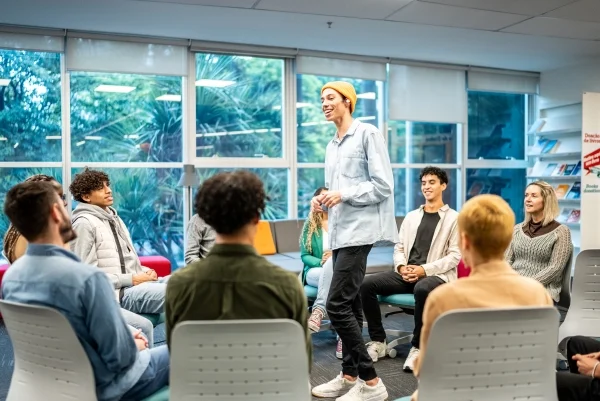
Academic inquiry and exploring new opinions are cornerstones of higher education, but some students say they’re not encouraged to engage in new ideas on campus. According to 2025 data from Inside Higher Ed and Generation Lab, approximately one in eight Student Voice respondents (13 percent) said they felt “not very” or “not at all” supported in their efforts to explore different perspectives at their college; 7 percent said they were unsure.
More colleges and universities are seeking to establish ways to advance civil discourse and allow students to disagree respectfully, but creating productive classroom dialogue remains a challenge for many professors.
A November webinar hosted by the Association of College and University Educators (ACUE) offered practical insights for instructors looking to build a supportive and thoughtful environment for exchanging ideas.
What’s the need: Constructive dialogue activities help students thrive in and outside the classroom.
“We need to have our students, whether they’re 40 and going back to school or just starting out in higher ed, we need to have adults in this world who are able to have meaningful conversations with others, to solve problems and to understand the viewpoints of others,” said Laurie Pendleton, executive director of faculty success at ACUE, during the webinar.
Such skills can also help students in their careers. “There are critiques of Gen Z [that] they don’t know how to work with each other in the workspace,” Zack Ritter, associate director of strategic initiatives at UCLA’s Center for Community Engagement, said during the webinar. “We’re providing a skill of, how do you listen to someone deeply at the workplace? How do you collaborate and find consensus among a bunch of different people?”
Defining terms: Deliberative dialogue, also called civil discourse or constructive conversation, is distinct from a casual discussion or engaging in debate, Pendleton said.
“When we think about debate, we’re really thinking more about winners and losers,” Pendleton said. “I’m stating my opinion or my facts. You’re stating your opinions and your facts, and we’re looking at who has the stronger case.”
Deliberative dialogue, however, is comparing different views, looking for mutual appreciation and potentially leading to collective action, Pendleton said.
“We’re looking for more shared understanding, things like, ‘I didn’t think about it from that perspective,’ or, ‘That’s interesting evidence; where did it come from?’” she explained.
Setting the stage: One of the common missteps faculty can make when establishing deliberative dialogue is neglecting to lay the groundwork, Ritter said. “You can’t just jump into the hot topic, because people are going to come with different baggage, different hates, different misunderstandings,” he said.
Instead, faculty should facilitate activities that allow students to share more about themselves and their cultures and to learn about their peers. Even better is when the class can build trust by doing some type of action project to solidify their connections, Ritter said, such as volunteering in the community.
Creating a classroom space that is responsive to discussion can also be key, said Adam A. Smith, founder and senior consultant at Smith Education Associates. Smith arranges his classroom to have “pods” of students grouped at desks or tables to allow them to connect in a more intimate way.
Navigating tensions: The goal of a deliberate discussion is not to make everyone comfortable, said Rosina Bolen, director of solidarity, engagement and success initiatives at Mount Saint Mary’s University.
“If everyone’s comfortable, you’re probably not having the kind of conversation that stretches people’s comfort zones,” Bolen said.
Faculty members should be prepared to make mistakes and for students possibly to get offended, and be equipped to handle “hot” or “cold” moments.
A hot moment is when tensions are high and conflict may erupt in the classroom. A cold moment, on the other hand, is when students don’t feel comfortable speaking out and a silent chill descends on the room.
Establishing community guidelines, ground rules or space agreements can be one way to mitigate or navigate uncomfortable situations by providing a working framework of what is or is not appropriate in the dialogue, Bolen said. Instructors should not assume students know the rules of engagement; it is their responsibility to outline the norms of the setting, Smith said.
It can be helpful to name what is happening in the outside world, including any prominent political or social tensions, and how they might inform individuals’ contributions to the conversation, Ritter said. “Naming the inequalities in society that are cutting across a bunch of different identities is also a way to build solidarity in the classroom.”
Professors should also conduct a self-evaluation of what may trigger their own emotional responses and prepare for how they will navigate such feelings so as to not disrupt the larger classroom goal. Similarly, faculty can give students an opportunity to share any of their own behaviors that might lead to misinterpretation.
“I’ve found it successful where students front-load some of their mannerisms and they say, ‘Hey everybody, sometimes I talk really loud, and it doesn’t mean that I’m mad at you, it’s just when I get excited about something, I just talk really loud and I use my hands,’” Ritter explained. “Having folks be vulnerable about their little mannerisms might result in a lot of pain reduction in the future.”
Continuing the conversation: After the formal discussion, faculty should create an opportunity for the class to reflect, Bolen said. How did the conversation go? How did people react? What did students learn?
“That debrief can go a long way towards ameliorating any negative impact on the rest of the course,” Bolen said. “And if something comes up that impacts individual students, it’s a great idea to go and check in with them afterwards and see how they’re doing.”
Deliberative dialogues should not be one-off events that occur in a vacuum, Pendleton said, but can be woven into the curriculum and connected to disciplinary content.

Philanthropist MacKenzie Scott continued her latest giving spree this week, showering millions of dollars on another slew of higher ed institutions.
Scott gave $50 million each to California State University, East Bay, the largest single donation in the university’s history, and to Lehman College, part of the City University of New York system, according to announcements from the institutions on Thursday. (Scott also gifted Lehman College $20 million in 2020 and has given a total of $125 million to campuses across the CUNY system in the last five years.)
Texas A&M University–Kingsville and Seminole State College in Oklahoma also reported Scott gave them their largest gifts ever this week, $38 million and $17 million, respectively.
Scott recently made several new contributions to tribal colleges, as well, including $9 million to Bay Mills Community College in Michigan, $8 million to Blackfeet Community College in Montana and $10 million to College of the Menominee Nation in Wisconsin.
As a kid, I remember science often being taught through myth busting. It was an engaging way to learn to ask questions, even if some examples worked better than others. (When someone responded to “people thought the earth is flat because it looks flat” with “what would it look like if it were round?” it broke my pre-adolescent brain.) The lesson behind the lesson was that science is a good way to fact-check, even if the facts in question seem obvious.
In that spirit, I loved Joshua Goodman and Joseph Wilkelmann’s new NBER paper about community college enrollments. It takes on several widely held myths, subjects them to empirical scrutiny and shows that they’re mostly false. It should be required reading for anyone discussing higher education policy.
The whole thing is worth reading, but I’ll give a few highlights.
Taken together, these points refute several popular narratives. First, the most famous universities are not remotely representative of higher education as a sector. Second, the major driver of decline has been the availability of entry-level jobs, not six-figure tuition. Third, there simply has not been a “flight to quality” as the term is often used. The most compelling argument for free community college isn’t that it would somehow stick it to Harvard; it’s that it would enable more students to complete programs by reducing the need to work for pay while going to school. The primary competition for community college students is low-end employment.
Those narratives need to be discredited because they aren’t just wrong; they’re damaging. They put the blame for macroeconomic conditions on institutions that don’t control them, and they divert discussion from measures that would help to measures that are irrelevant at best and actively harmful at worst.
The story that strikes me as much closer to the truth goes like this: Higher education exists in a larger political economy. The increasingly bifurcated economy we have now—growth on the high end and the low end, with a hollowing-out of the middle—creates a sort of gravitational pull on institutions. Elite institutions are thriving, since they draw on the (anxious) upper classes. Low-end employers are thriving. Institutions built to help create a middle class are struggling. If you have a billion-dollar endowment and the stock market is offering double-digit returns, you’re doing great. If you’re a community or state college with flat or declining public funding, you’re struggling.
It doesn’t have to be this way, of course. The public sector could choose to act as a counterweight, pushing opportunity where we want it to go. That option exists. It has been done before.
But doing that involves first getting the facts right. Kudos to the NBER team for bringing relevant facts to the table. Now we just need to knit them into a compelling narrative.
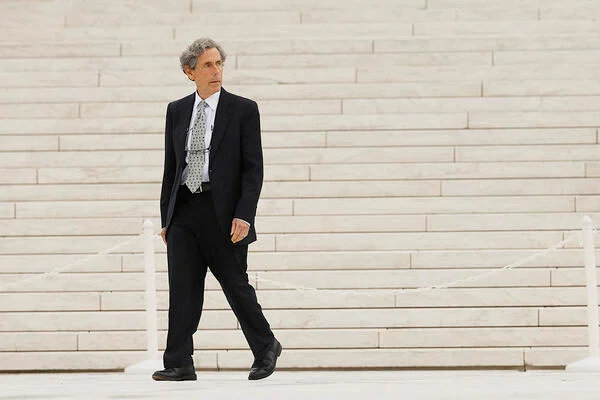
Edward Blum founded the American Alliance for Equal Rights and Students for Fair Admissions.
Chip Somodevilla/Getty Images
A new lawsuit argues the Hispanic Scholarship Fund—a nonprofit that says it has provided more than $756 million in scholarships over its 50-year history—is illegally restricting its funding to Hispanics and Latinos. The litigation seeks to bar HSF “from knowing or considering ethnicity in any way” in its Scholars Program.
HSF, which didn’t return requests for comment Thursday, says on its website that it provides $500 to $5,000 scholarships, among other benefits, to 10,000 students annually.
The American Alliance for Equal Rights filed the suit Wednesday against HSF in the U.S. District Court for the District of Columbia, saying it has non-Hispanic members “who are ready and able to apply for HSF’s program but cannot because of their ethnicity.” Two such unnamed members are Asian American and white, the group said.
“The program bans Blacks, Asians, and Native Americans that aren’t Hispanic,” the American Alliance notes. “But it welcomes whites that are.”
To make its case that the ethnic restriction is illegal, the American Alliance is using a law passed during the Reconstruction era that bans racial discrimination in contracts. And it’s alleging that HSF is entering into contracts with scholarship applicants.
“The HSF Scholars Program is a contract that offers applicants a chance at a lucrative scholarship if they agree to HSF’s terms, assent to its privacy policy, draft several essays, and sign a binding pledge,” the suit says. It goes on to allege that HSF’s terms of use, which applicants must agree to, specifically say, “This is a contract between you and HSF.”
Opening up such “contracts” only to Hispanics and Latinos violates the Civil Rights Act of 1866, which prohibits racial discrimination in contracts, the suit argues.
It’s another example of how the campaign against affirmative action and programs that specifically benefit minorities didn’t end with the 2023 Students for Fair Admissions Supreme Court ruling, which rendered affirmative action in college admissions illegal. The American Alliance was founded by the same man, Edward Blum, who created Students for Fair Admissions, the nonprofit that’s the namesake of the 2023 ruling.
It’s also another example of a suit that uses an Asian plaintiff and a Reconstruction-era law to attempt to open up a minority-specific scholarship to all races and ethnicities. Earlier this year, the Pacific Legal Foundation cited the Ku Klux Klan Act of 1871, which Congress passed to protect African Americans, to attack a financial aid program that helped only Black students at the University of California, San Diego.
That conservative nonprofit law firm sued on behalf of the Californians for Equal Rights Foundation, which said it had multiple “Asian-American high school members who plan to apply to UCSD” and who could’ve been excluded. Before that case reached a hearing, the nonprofit philanthropy that administered the Black Alumni Scholarship Fund announced the fund was being renamed.
Blum told Inside Higher Ed on Thursday that the American Alliance filed its first suit after his other group’s 2023 victory. He estimated it’s filed about 20 more since then.
“There are tens of thousands of students who are affected by race-exclusive scholarship funds, fellowships, internships, things along those lines,” Blum said. “And so it is the mission of the American Alliance for Equal Rights to challenge these racially exclusive programs and policies.”
In the current case, Blum said, “The race exclusivity of this scholarship fund was brought to our attention by a young Asian American student” of “modest financial background.”
“This nation cannot remedy past discrimination with new discrimination, and I think the vast percentage of Americans agree with that,” Blum said.

Three credit rating agencies have issued unfavorable outlooks for higher education in 2026.
Fitch Ratings issued the latest outlook on Thursday, declaring that it anticipates a “deteriorating credit environment for U.S. Public Finance Higher Education in 2026 relative to 2025.” That outlook is based on various pressures, including concerns about declining enrollment, new limits on federal loan programs and obstacles for international students seeking to study in the U.S.
The organization noted state funding is “vulnerable” due to an “uncertain policy trajectory” that will “generally shift more costs previously borne by the federal government on to the states.”
The rating agency also noted public concerns about “the value proposition of a higher education degree” amid declining job-placement rates and rising concerns about affordability. Fitch anticipates limited revenue growth for colleges as they grapple with those challenges and projected consolidation across the sector, from mergers and closures to restructuring and more.
S&P Global Ratings also issued a negative sector outlook on Tuesday. That analysis cited some of the same concerns raised in the Fitch report. S&P Global warned of “intense competition for students” and rising operating costs for the sector in the year ahead.
“Our sector view is negative, as we expect colleges and universities will struggle to navigate through mounting operating pressures and uncertainty that will require budgetary and programmatic adjustments,” officials at S&P Global Ratings noted on their website.
Moody’s Ratings was the first to issue a sector outlook last month, deeming it negative for many of the same reasons cited by other agencies in their 2026 assessments for higher ed.