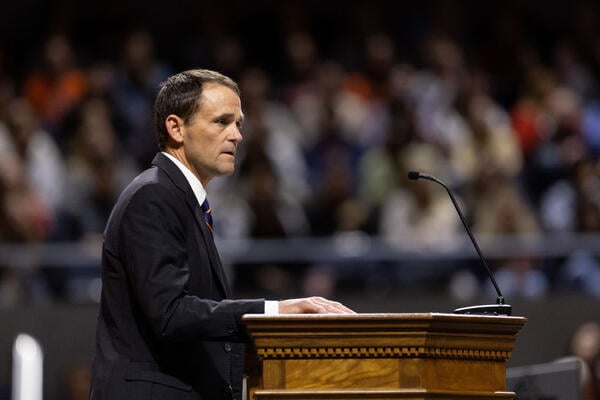
The directors felt they were fired as part of the administration’s crackdown on diversity, equity and inclusion and for political reasons.
Wesley Lapointe/The Washington Post via Getty Images
Four directors at the National Institutes of Health who were placed on administrative leave earlier this year have now been fired, Sciencereported.
The ousted leaders led the National Institute of Allergy and Infectious Diseases, the National Institute of Child Health and Human Development, the National Institute on Minority Health and Health Disparities, and the National Institute of Nursing Research. Tara Schwetz, the deputy director for program coordination, planning and strategic initiatives, was also fired. The directors were put on leave in the spring around the same time that the administration laid off thousands at the Department of Health and Human Services.
Science reported that the directors felt they were targeted as part of the administration’s crackdown on diversity, equity and inclusion and for political reasons. Jeanne Marrazzo, the former NIAID director, took over for Anthony Fauci, a frequent target for Republicans who took issue with his approach to the COVID-19 pandemic. Marrazzo filed a whistleblower complaint in early September that in part accused NIH leadership of downplaying the value of vaccines, The New York Timesreported.
“It’s not surprising, but it’s still incredibly disappointing,” Marrazzo told Science. “I would have been quite happy to serve under the new administration as long as we were allowed to do our jobs.”
The measure would alter the long-standing policy known as duration of status, which allows international students to stay in the U.S. until their course of study is complete. Among other concerns, commenters argued that the rule would unnecessarily restrict international students, who are already closely monitored by the government and their institutions of study. Many commenters also drew attention to the potential consequences for the health-care system and employers.
The proposed rule would instead cap the amount of time students could stay in the U.S. to just four years, though they would be able to request an extension from U.S. Citizenship and Immigration Services. It would also prevent international students from changing their majors or transferring between U.S. institutions.
According to DHS, the proposal aims to lessen the number of students who overstay their F and J visas. However, NAFSA, the international education association, argued that research has shown that DHS overestimates overstay rates. The organization, along with other commenters, also noted that the Student Exchange and Visitor Information System—the online system that monitors international students—already alerts Immigration and Customs Enforcement if a student overstays their visa.
The comment period closed on Sept. 29. DHS will now have to review and respond to more than 15,700 comments before deciding whether to move forward with the elimination of duration of status.
More Than 4 Years
Numerous commenters noted that a significant number of students take more than four years to complete their undergraduate degree—and it’s incredibly rare to complete a Ph.D. in that length of time. That means a significant number of students will be at risk of being unable to complete their programs if they are unable to secure extensions.
Commenters noted a range of reasons they, their peers or their students have struggled to finish a degree in under four years, including medical and family emergencies, the death or departure of a faculty mentor, completing cooperative internships, and more.
Others pointed out that some programs are even intended to take longer than four years. Jessica Goswick, an architect and a lecturer, wrote that a B.Arch., a professional bachelor’s degree in architecture, is intended to be completed in five years. The University of Illinois system—one of several dozen institutions that opposed the rule in written comments—said that its main Urbana-Champaign campus has over 30 undergraduate programs requiring more than 120 credit hours.
“Limiting initial entry to four years would require students in these programs to take more than 15 credits every semester for four years, which would reduce performance and graduation rates,” the system’s comment reads. “Undergraduate students should be encouraged to take course loads appropriate for success rather than rush toward an arbitrary completion date determined by their date of entry to the United States.”
Several researchers and current Ph.D. students also stressed that graduate students frequently need more time to complete their research.
“Reducing this time for foreign student scientists would make it impossible for them to earn a Ph.D. in many fields, including my own field of neuroscience. Science takes years to build, develop, execute, and compile in order [to] share the information with the world and enrich the scientific community,” wrote Grace Swaim, a postdoctoral researcher at Yale University.
Although students would have the option to get their visas extended beyond the four-year cap, experts warned that doing so is costly, time-consuming and uncertain, and it would add to USCIS’s already-lengthy processing time—about 6.5 months—for such extensions, according to NAFSA. The University of Illinois system also emphasized that the rule would force the system to hire 13 new full-time and one part-time employee and spend over $2 million in the first year alone to apply for these extensions.
These added barriers could ultimately lead fewer students to want to study in the United States, commenters warned, which many faculty said would be a loss for their labs, their larger institutions and the country as a whole.
“These students not only make crucial contributions to the fundamental research in our department, but often end up filling important roles in industry, academia and national labs in the U.S. Others contribute to the international efforts unraveling the nature of matter and developing novel technologies even after returning to their home country,” wrote Sebastian Kuhn, chair of the physics department at Old Dominion University. “International graduate students are an indispensable contribution to the success of the U.S. research enterprise and the international standing of our country.”
Beyond the Campus
Other commenters shared that the rule could have an impact outside of the classroom and the lab. Physicians and hospital administrators said the roughly 17,000 J-1 visa holders currently working in hospitals as part of their medical training would be affected and detailed in comments how the change could ultimately disrupt Americans’ access to health care.
“It is important to recognize that the 17,000 J-1 physicians training in the U.S. do not displace domestic medical graduates; rather, they fill residency slots that would otherwise remain unfilled each year,” wrote the American Hospital Association in a comment. “These physicians disproportionately train in high-need specialties that continue to be in substantial shortage, such as internal medicine, pediatrics and family medicine. They also frequently work in rural and underserved communities, and many who train in those settings continue to work in them when their training is complete. J-1 physicians not only help sustain the physician workforce pipeline but also help expand patient access to essential care.”
Numerous commenters who identified themselves as leaders in industries from financial services to pharmaceuticals also explained how their companies and industries at large rely on the contributions of international students.
“The maximum stay restrictions are especially problematic for Ph.D. students and those conducting long-term clinical trials, which often span five to seven years,” wrote an anonymous commenter who identified themself as a senior executive in a global pharmaceutical company. “Reducing this flexibility would disrupt important research in drug efficacy and public health. Students engaged in such long-term research projects would be forced to abandon their work prematurely, leading to a waste of time, resources, and intellectual capital that the U.S. cannot afford to lose.”
A seemingly small number of comments were in favor of the change, with many of the supportive comments claiming international students are taking jobs and spots at colleges away from Americans.
One higher education association—the Council for Christian Colleges and Universities—did not outright oppose the measure, but rather encouraged DHS to limit it just to colleges with admission rates under 30 percent. The council’s president, David A. Hoag, argued that those are the institutions at which the administration is concerned about “foreign students potentially displacing American students.”
“This approach directly addresses the administration’s stated concern by focusing on the subset of institutions where foreign student enrollment is most likely to impact domestic applicants,” he wrote. “By limiting the rule’s scope in this way, DHS can more effectively target its regulatory efforts while minimizing unnecessary restrictions on less selective schools where this displacement issue is less pronounced.”
Faculty may include a preferred name policy on their syllabi, but they are advised against mentioning pronouns, the FAQ said.
Photo illustration by Justin Morrison/Inside Higher Ed | menonsstocks/E+/Getty Images | snorkulencija/iStock/Getty Images
After a confusing week, Texas Tech University officials offered the first written clarification on new university policies that prohibit faculty members from speaking or teaching about transgender identity. On Sunday, the provost’s office posted a lengthy frequently asked questions page that, among other things, addressed the definition of “noncompliant language,” explained how the new policies impact research and answered whether faculty can write on their syllabi that they are an ally to transgender people.
But after three days, the FAQ was taken down. Faculty have not been told why the information was removed, and health-care instructors are concerned students will not be trained in care for transgender patients, as required by certification exams.
A university spokesperson did not respond to Inside Higher Ed’s questions on the matter. Some faculty suspect that Brandon Creighton, who was officially named the Texas Tech system’s next chancellor on Tuesday, may have orchestrated the removal of the FAQ. Creighton was the lead author of the Texas Senate’s sweeping ban on diversity, equity and inclusion in 2023, and of the recent bill giving control of faculty senates to university presidents and boards. He will assume the chancellor role on Nov. 19.
While it was the first and most comprehensive written guidance Texas Tech has posted on its anti-trans policies, the FAQ left a lot of questions unanswered. The word “transgender” wasn’t included in any of the written answers. In one answer, officials wrote that noncompliant language “refers specifically to outdated or inaccurate syllabus content (i.e., COVID-era statements or statements referring to offices or units that no longer exist at Texas Tech.),” but said nothing about gender identity.
In response to a question about academic freedom, officials wrote, “Faculty may include course content that is relevant to a student’s program of study and post-graduation opportunities, including workforce and additional education. Faculty are encouraged to be thoughtful about including content that is described in the Chancellor’s memo.”
The new directives do not impact research, the FAQ clarified. Officials advised against including a “personal statement of student support” or a statement professing LGBTQ allyship, writing that “such a statement could attract unwanted attention.” They also wrote that faculty could include a preferred name policy on their syllabi, but that “until further clarification is available, it is advisable to omit personal pronoun language.” When relevant, instructors are permitted to facilitate classroom discussions in which students examine the state’s position on gender alongside other views, but the instructor may not advocate for any particular view.
In a later question about government censorship and faculty retention, officials wrote, “We recognize that faculty recruitment and retention may be affected. At present, the issued guidance applies only to instructional activities, not a faculty member’s independent research.”
The Texas conference of the American Association of University Professors has pushed back on the anti-trans policies at Texas Tech and other public universities in the state.
“Colleges and universities have an obligation to develop campus policies that protect the constitutional rights of their faculty to teach and research the subjects in their areas of expertise without intimidation or censorship,” said Brian Evans, president of the Texas conference of the AAUP. “By ensuring that teachers can speak freely, campus administrators should enable students to explore and learn the widest set of topics for civil engagement and successful careers. Campus policies related to academic freedom and free speech should be devised with the full participation of faculty in the spirit of a shared commitment to excellence.”
The FAQ—as short-lived as it was—only applied to Texas Tech’s flagship campus. The four other campuses in the public system, including Angelo State University, where faculty have received a profusion of conflicting verbal information, were not included.
A faculty member at the Texas Tech University Health Sciences Center who asked to remain anonymous for fear of retribution confirmed to Inside Higher Ed that faculty at their campus have been told not to use certain terms in their course content, including “transgender”; “gender-affirming care”; “diversity, equity and inclusion”; and “affirmative action.” Health Sciences Center faculty have not received any written guidance, and the deans don’t have clarifying information, either, the faculty member said. It is an especially troubling policy to enforce for health-care students, because care for transgender patients is included in some certification exams students must pass to be licensed, they said.
“There are certainly many things that our government has [outlawed] … but I can’t think of another thing that we’ve been told we can’t talk about,” the faculty member said. “Sex trafficking is illegal, but we can talk about how to care for people who have been victims of sex trafficking. Drunk driving—there’s about a million examples.”
It is unclear how much information students have about these new policies, according to the faculty member. Some students are bringing up transgender care in classroom discussions, and instructors are unsure how to respond.
Mike Gavin, the founder of Education for All, a grassroots group of community college administrators fighting legislative attacks on diversity, equity and inclusion, will step down as president of Delta College in January. He has been in the post since 2021.
Gavin informed the Delta College Board of Trustees last week that he would resign to lead a national coalition focused on defending equity in higher ed.
“My whole career has been focused on equity and how higher ed is situated in the democratic experiment, so when I was asked to do the next thing, I felt compelled to do it,” Gavin told Inside Higher Ed.
“I was not looking for a job. Delta has been amazing. The faculty and staff are some of the most insightful and student-centered I’ve ever seen,” he said.
More information about the coalition, including its priorities and funding model, will be released soon, he added.
Since the early days of the second Trump administration, Gavin has been a leading voice in defending DEI work in higher ed, especially at community colleges. Participation in Education for All surged at the beginning of the year as college leaders sought advice on protecting programs and navigating compliance with Trump administration mandates.
“My scholarship rests on the great thinkers of our past, from Benjamin Franklin to James Baldwin. It is also grounded in the belief that our country depends on a higher education sector that must be free from partisan interference, in order to democratize higher education for all,” Gavin wrote in a letter to the Delta College community.
Delta College trustees said they will begin the process of appointing Gavin’s successor in the coming weeks.
A federal judge rejected an effort to overturn the gainful-employment rule, which was put in place during the Biden administration.
In an opinion issued Thursday, Judge Reed O’Connor from the Northern District of Texas sided with the Education Department on every point. One of the plaintiffs, a trade association representing cosmetology schools, had argued in its lawsuit that the regulations jeopardized the “very existence” of cosmetology schools and used flawed measures to determine whether graduates of career education programs are gainfully employed.
Under the rules, for-profit and nondegree programs have to prove that their graduates can afford their loan payments and earn more than a high school graduate. Those that fail the tests in two consecutive years could lose access to federal financial aid. The regulations also included new reporting requirements for all colleges under the financial value transparency framework.
The lawsuit started under the Biden administration, and Trump officials opted to defend the regulations in court and urged the judge to keep the rules in place.
Similar gainful-employment rules survived a legal challenge in 2014 but were ultimately scrapped by the first Trump administration. However, in recent years, lawmakers on both sides of the aisle have become more interested in finding ways to hold colleges accountable for their students’ career outcomes. Under legislation that Congress passed this summer, most college programs will have to pass a similar earnings test. How the Education Department carries out that test will be subject to a rule-making process set to kick off later this year.
Jason Altmire, president and chief executive officer of Career Education Colleges and Universities, which represents the for-profit sector and opposed the Biden rule, said in a statement that he looks forward to revisiting the issue during the rule-making process.
“We are confident the Biden Gainful Employment Rule will be revised to incorporate a fairer accountability measure that will apply equally to all schools, ensuring all students can benefit,” he said. “We look forward to a full consideration of these issues during the months ahead.”
Dan Zibel, vice president of the legal advocacy group Student Defense, applauded the court ruling in a statement.
“Higher education is supposed to offer students a path to a better life, not a debt-filled dead end,” he said. “The 2023 Gainful Employment Rule reflects a common-sense policy to ensure that students are not wasting time and money on career programs that provide little value.”
We’ve seen before how the University of Southampton was founded by a bequest from Henry Robinson Hartley. Today we’re going to look at a college which grew out of the university, and then became part of another one.
Hartley died in 1850, but his bequest was not finally clear of the courts until 1858, and the town could then think how to create the institution he had suggested. The advice of the government was sought, and in April 1859 Professor Lyon Playfair – secretary to the Department of Science – proposed that the new institution should include a school of trade and navigation. His argument was reported in the Hampshire Advertiser on 15 May 1858:
Did the council listen to this advice? They did not. And so the Hartley Institute – the nascent University of Southampton – did not have a school of navigation.
Or not yet anyway. In 1909 Captain Gilchrist opened the South of England Navigation School to prepare students for the Board of Trade’s maritime examinations. And in 1932, the school – now known as Gilchrist’s Navigation School – was incorporated into University College Southampton as the Department of Nautical Training. At a celebratory luncheon with the Southampton Master Mariners’ Club, the university college principal Kenneth Vickers said that “it was preposterous to think that a university was going to teach a man his practical job when he got to it.”
The department taught the theoretical foundations of navigation and seamanship, enabling its students to progress to apprenticeships on merchant vessels and, in due course, to take the exams to become qualified second mates.
In the second world war the school continued to train sailors for the merchant marine, but also taught for the navies of the allied countries. It moved in 1942 to Warsash, a site further down the Solent, which was shared with a Royal Navy training site teaching the use of landing craft. (Fun fact: Royal Navy land bases are called HMS – HMS being His Majesty’s Ship. In this case the base was called HMS Tormentor.)
After the war HMS Tormentor was decommissioned, but its site and buildings were added to the school of navigation. And by the late 1950s new accommodation was built at the school, to replace the WW2 pre-fabs. And it is the design for this that you can see on the card.
In 1970 the school ceased to be part of the University of Southampton. My guess is that this was related to how technical education was funded: this would have been a move into local authority control. And in 1984 the school merged with the Southampton College of Technology, forming the Southampton Institute of Higher Education. And this in time became what is now Southampton Solent University, but more of that another time.
The school is now known as the Warsash Maritime Academy, and operates both from a city centre site and, I think, in part still from the waterside site at Warsash. There’s a fabulous site maintained by alumni which includes memories from former students – well worth a browse when you have a little time to spare.
The card was written and posted on Wednesday 18 May 1966. Very unusually, it is a typed message. A busy senior staff member, perhaps, who had access to secretarial support?
The department is largely closed due to the government shutdown. In the meantime, the Trump administration is using furloughed workers’ emails to make a political statement.
Photo illustration by Justin Morrison/Inside Higher Ed | Tierney L. Cross/Getty Images | nevodka/iStock/Getty Images
Wednesday morning, as the government shutdown began, chief officers at the Department of Education distributed a standard out-of-the-office statement to all furloughed staff members and instructed them to copy and paste it into their email. So that’s what they did.
But just hours later, those same nonpartisan staffers began to hear that the message they’d pasted into their email account was not the message being received by the public.
“On Wednesday evening, my supervisor reached out to me on my personal equipment and said, ‘You’re going to want to log in and change your out-of-office status,’” one department staffer told Inside Higher Ed on the condition of anonymity out of fear of losing her job.
When she followed her supervisor’s direction and logged in, the automatic message she saw was not the one she had saved earlier that morning.
Rather than the original note, which had said, “There is a temporary shutdown … due to a lapse in appropriations,” the new message said, “Unfortunately, Democrat Senators are blocking passage of [a bill] … which has led to a lapse in appropriations.”
This is one of the more than 10 emails Inside Higher Ed received as automatic responses including the same political message. Although Keast was appointed by Trump, most of the staffers we contacted were not.
The outgoing message had been changed internally without her consent. And this staffer was not alone. Inside Higher Ed emailed 10 separate Education Department staffers Thursday, all of whom had been placed on furlough, and each one bounced back with identical responses. One senior leader from the department, who also spoke anonymously, said that to his knowledge the politically charged message was set as the out-of-office notification for all furloughed employees.
(The Department of Education did not immediately provide comment. In fact, the emails sent to both deputy press secretary Ellen Keast and the general press team account were met with the same automatic response.)
The first staffer said that while she was caught off guard by the override at first, it made sense the more she thought about it. Similar messages blaming Democratic senators for the shutdown had already been put at the top of HUD.gov, the landing page for all things Department of Housing and Urban Development, and other federal websites.
As of Thursday evening, the HUD website noted, “The Radical Left in Congress shut down the government. HUD will use available resources to help Americans in need.”
Republicans control the White House, the House and the Senate. In the Senate, they need the votes of at least seven Democratic senators to reach the 60-vote threshold necessary to overcome a filibuster.
“I was really surprised, because we had gotten such explicit instructions on what to use for our out-of-office message,” the staffer said. But “when I saw that message from my supervisor, I assumed it had been changed to something more political than the original neutral one.”
She has already logged back in multiple times to change the automatic response back to the neutral language. But each time, within hours, the department has overridden her changes.
“It’s what [is being sent] to people who contact me, and they could reasonably misunderstand it as coming from me, and I don’t feel comfortable as a federal employee communicating a political message like that,” she said.
A second staffer told Inside Higher Ed that he has worked through multiple shutdowns prior but not experienced anything like this.
“It’s just wild to see your name attached to a message that you had nothing to do with,” he said. “It feels like a violation … You know that you don’t have any expectation of privacy when you’re working for the federal government. But it’s a different thing to say that you don’t have autonomy over your own words.”
The second staffer noted that in his view, not only did this seem to be a violation of his personal rights, but also a violation of federal law.
The Hatch Act, passed in 1939, was intended to ensure that nonpartisan federal workers who worked across administrations remained just that—nonpartisan. And according to documents from the Office of Special Counsel website, the Hatch Act “limits certain political activities of federal employees,” like using official authority for political purposes, soliciting political donations, wearing partisan political gear at work and posting or sharing partisan content on government systems.
“It’s crazy to see the law violated on your behalf,” the second staffer said.
None of the department employees Inside Higher Ed spoke with intended to file an individual lawsuit, nor had they heard anything from their union about a collective legal response. But one shared that Democracy Forward, a nonprofit legal organization that has sued the Trump administration several times this year, will be going to court over the matter as soon as Friday.
The Trump administration has asked nine universities to sign on to a proposed compact, mandating certain changes in exchange for preferential treatment on federal funding.
First reported by The Washington Post and confirmed, with additional details, by The Wall Street Journal, the proposal seeks an agreement with nine institutions that are being asked to commit to a 10-point memo referred to as the “Compact for Academic Excellence in Higher Education.”
Among the various conditions, institutions are reportedly being asked to:
Ban consideration of race or sex in hiring and admissions processes
Freeze tuition for a five-year period
Limit international undergraduate enrollment to 15 percent of the student body
Commit to institutional neutrality
Require applicants to take standardized tests, such as the SAT or ACT
Clamp down on grade inflation
Ensure a “vibrant marketplace of ideas on campus”
Restrict employees from expressing political views on behalf of the institution
Shut down departments that “punish, belittle” or “spark violence against conservative ideas”
Anonymously poll students and employees on compact compliance and publish the results
Another requirement mandates that signatories “deploy their endowments to the public good,” such as by not charging tuition to students “pursuing hard science programs (with exceptions, as desired, for families of substantial means)” for universities with more than $2 million per undergraduate student in endowment assets. Universities would also be required to post more details about graduates’ earnings and refund tuition to those who drop out in their first semester.
After leveraging funding freezes and other tactics to pressure colleges to make changes, the compact reflects a different approach from the administration while still geared toward the same goal—remaking higher education in Trump’s image. May Mailman, a Trump adviser, hinted at the plan in a New York Times interview a week before the proposal emerged, saying it could be a way for universities to affirm they are “doing the right things.”
“The Trump administration does not want to be all Whac-a-Mole or all negative, but these are the principles that universities and the Trump administration and, frankly, private donors can ascribe to to say, ‘This makes a great university,’” she told the Times.
Institutions reportedly invited to join are: Brown University, Dartmouth College, the Massachusetts Institute of Technology, the University of Arizona, the University of Pennsylvania, the University of Southern California, University of Texas at Austin, the University of Virginia and Vanderbilt University.
Those that agree will receive “multiple positive benefits,” including “substantial and meaningful federal grants,” according to a copy of the memo published by The Washington Examiner.
But failure to comply with the agreement would come with steep consequences. Noncompliant universities would “lose access to the benefits of this agreement” for a year. Subsequent violations would lead to a two-year punishment. And the federal government could claw back “all monies advanced by the U.S. government during the year of any violation.” Private donations would also be required to be returned, upon request.
The Department of Justice would be tasked to enforce the agreements.
Institutional Responses
Most universities did not respond to requests for comment from Inside Higher Ed. But Texas officials seem eager to sign on, sharing a statement indicating their enthusiasm for the compact.
University of Texas system Board of Regents chairman Kevin P. Eltife wrote in the statement that the flagship was “honored” to be among the institutions “selected by the Trump Administration for potential funding advantages” under the proposed compact, which it is currently reviewing.
“Higher education has been at a crossroads in recent years, and we have worked very closely with Governor [Greg] Abbott, Lt. Gov. [Dan] Patrick and Speaker [Dustin] Burrows to implement sweeping changes for the benefit of our students and to strengthen our our [sic] institutions to best serve the people of Texas,” Eltife wrote. “Today we welcome the new opportunity presented to us and we look forward to working with the Trump Administration on it.”
University of Virginia spokesperson Brian Coy told Inside Higher Ed by email that interim president Paul Mahoney “created a working group under the leadership of Executive Vice President and Provost Brie Gertler and Executive Vice President and Chief Operating Officer J.J. Davis to advise him” on UVA’s response to the letter but has not yet made a decision to sign or not.
USC simply said in a statement, “We are reviewing the Administration’s letter.”
Both the White House and the Department of Education initially responded to requests for comment with automatic replies because of the federal government shutdown, which began Wednesday. A press office official later responded only to confirm The Wall Street Journal’s reporting.
Outside Perspectives
News of the proposal prompted a flurry of criticism within academic circles.
American Association of University Professors president Todd Wolfson blasted the idea in a Thursday statement and called on governing boards to reject it.
“The Trump administration’s offer to give preferential treatment to colleges and universities that court government favor stinks of favoritism, patronage, and bribery in exchange for allegiance to a partisan ideological agenda. This compact is akin to a loyalty oath. Adherence by university administrations would usher in a new era of thought policing in American higher education,” Wolfson wrote.
The executive committee of Penn’s AAUP chapter also opposed the proposal.
The Foundation for Individual Rights and Expression also criticized it in a post on X, writing that “the compact includes troubling language” specifically pointing to the call to eliminate academic departments critical of conservative ideas, which it cast as undermining free speech.
“A government that can reward colleges and universities for speech it favors today can punish them for speech it dislikes tomorrow. That’s not reform. That’s government-funded orthodoxy,” FIRE officials wrote.
Trinity Washington University president Pat McGuire called the proposal “political extortion.”
Brendan Cantwell, a higher education professor at Michigan State University, told Inside Higher Ed there are multiple issues with the proposal, including vague language about political speech that could allow universities or the federal government to single out faculty members for publicly discussing topics within their expertise. He added that “enforcement is so vague” that it would be easy for the federal government to declare universities out of compliance with the agreement.
Cantwell suggested, “This is probably a bigger deal than the Columbia [settlement] because it’s creating an incentive structure” that spurs universities to go along or opens them up to retaliation from the federal government, making it risky whether a university signs on or not.
(Columbia agreed to far-reaching changes to admissions, hiring, disciplinary processes and more in July, including a $221 million fine, when it reached a deal with the federal government to settle over findings that it failed to properly police antisemitism on campus. Columbia did not admit to wrongdoing, but administrators have acknowledged the need for reforms.)
Brian L. Heuser, a Vanderbilt professor and long-standing member of the university’s Faculty Senate, urged fellow senators and other faculty colleagues to organize against the idea in an email shared with Inside Higher Ed. Heuser called the compact “a dangerous departure from the core values that should underpin our institutions—namely, free inquiry, open debate, and institutional autonomy” and argued that it endangers academic freedom, among other concerns.
But some conservatives have lauded the idea and want ED to push harder.
“Secretary [Linda] McMahon deserves credit for working to disincentivize the use of race or sex in college admissions,” U.S. Sen. Todd Young, an Indiana Republican, wrote in a social media post. “We must go further—federally accredited institutions should eliminate ALL preferences grounded in ancestry, such as legacy status, or other factors unrelated to merit.”
Why These 9?
While it is unclear how the federal government landed on the nine schools as candidates for the proposal, one official told The Wall Street Journal the Trump administration believed they would be “good actors.” But contextual clues offer insights into why some may have been picked.
Of the nine, only five presidents signed on to a letter published earlier this year by higher education organizations pushing back on government overreach and political interference, which ultimately gathered 662 signatures. Of those five presidents, one has since resigned: Jim Ryan at UVA, who faced pressure from the Trump administration after it claimed the university failed to fully dismantle diversity, equity and inclusion programs.
Two institutions—Brown and Penn—previously struck deals with the federal government.
Others have drawn attention for political reasons. At Vanderbilt, Chancellor Daniel Diermeier has emerged as a leading voice advocating for institutional neutrality and has clashed with other campus leaders, arguing that higher education is in desperate need of reform, agreeing with frequent conservative criticisms of the sector. And Texas—one of three public institutions on the list—has an overwhelmingly conservative board, and both the system and flagship are led by former Republican elected officials.
On Oct. 1, the Wall Street Journal reported that the White House is asking colleges to sign an agreement to secure preferential treatment for government funding. FIRE is working to obtain the full agreement, but initial reporting already indicates it raises threats to free speech and academic freedom.
The following statement can be attributed to Tyler Coward, FIRE lead counsel for government affairs.
Freedom thrives when the people, not bureaucrats, decide which ideas are worthy of discussion, debate, or support.
As FIRE has long argued, campus reform is necessary. But overreaching government coercion that tries to end-run around the First Amendment to impose an official orthodoxy is unacceptable. And the White House’s new Compact for Academic Excellence in Higher Education raises red flags.
The compact includes troubling language, such as calling on institutions to eliminate departments deemed to “purposefully punish, belittle, and even spark violence against conservative ideas.” Let’s be clear: Speech that offends or criticizes political views is not violence. Conflating words with violence undermines both free speech and efforts to combat real threats.
The compact also requires university employees to refrain from “actions or speech related to politics.” If the language merely barred high-ranking employees from engaging in partisan political activity on behalf of the university, it would reflect existing and generally permissible IRS restrictions. But the compact’s reported wording goes further by suggesting a blanket prohibition on all staff engaging in political speech. For public institutions, that is deeply problematic. Public university faculty have the First Amendment right to speak about politics in their teaching and scholarship. Outside of their official duties, faculty and non-faculty university employees retain full First Amendment rights to speak off-the-clock as private citizens on matters of public concern. Banning them from doing so would be flatly unconstitutional.
A government that can reward colleges and universities for speech it favors today can punish them for speech it dislikes tomorrow. That’s not reform. That’s government-funded orthodoxy.
One of the consequences of Vladimir Putin’s invasion of Ukraine has been a vast reconfiguring of Russia’s academic and intellectual life. Universities, thought of as a potential hotbed of opposition since the White Ribbon movement of 2011, came under intense control and its personnel placed under even greater scrutiny.
Many faculty fled. Connections with international partners in the West were severed. And then to top it off, the Russian government announced that it would abandon the three degree bachelor’s, master’s doctoral system introduced when the country joined the Bologna Process 20 years earlier.
All this has combined to create what some have called a slow motion collapse in Russian higher education. But to understand what’s been happening in Russian Universities since February 2022, you really need to go back to the dawn of the Putin era in January 2000, and understand how ideological control of institutions has come to rest squarely inside the Kremlin.
Joining the podcast today is Dmitry Dubrovsky. He’s a scholar at the Institute for International Studies at Charles University in Prague, where he has taught ever since being designated as a foreign agent by the Putin regime in early 2022. And he writes primarily about the politics of academic freedom and civil society in Russia.
He’s with us today to talk about this slow motion collapse, the internal governance of Russian institutions, and how the country might one day be put back on a track to integration with European academia. Over to Dmitry.
The World of Higher Education Podcast Episode 4.5 | Undoing Bologna: Russia’s Conservative Turn in Higher Education with Dmitry Dubrovsky
Transcript
Alex Usher (AU): Dmitry, I want to take us back to the year 2000. Vladimir Putin is the new president of the Russian Federation. What was the state of the higher education sector at the time, and how did Putin approach it? How did he view higher education as an instrument of state policy?
Dmitry Dubrovsky (DD): Well, the legacy of the 1990s left Putin with a serious challenge. The system faced underfunding and fragmentation. At the same time, scholars were eager to join the European system. There had been attempts in the 1990s, but the biggest problems were the lack of financing and the absence of international mechanisms or tools to fully integrate into the European system of higher education and science.
Putin saw higher education and science, first and foremost, as a tool to join Europe—to become part of the European family and a prominent member of the global market of ideas. That’s why Russia joined the Bologna Process in 2003 and actively pushed for internationalization.
AU: So in that sense, it’s probably not that different from most other countries in the former socialist bloc, like Poland or Romania—the idea that internationalization would bring about an improvement in higher education. Is that about right?
DD: It is right, with one very important difference. At first it might seem small, but it became a very serious issue. In higher education and science, everywhere in the world, there are always people who believe that their own system is highly advanced—at the very top.
The problem in the late Soviet Union and the Russian Federation was that a substantial number of people survived the collapse of the USSR still believing that Russian and Soviet science was the most advanced in the world. In some cases, for certain disciplines, that might have been true. But in most areas—especially the humanities and social sciences—it wasn’t.
By the late 1990s, there was a substantial group of people who were deeply disappointed in the results of democratic reforms and in what democracy had brought, both to the country overall and to higher education and science in particular.
AU: Okay, now, Putin was president until 2008, and then he switched places for four years with Prime Minister Medvedev. He returns to power as president in 2012. And as you say, it’s a different Putin—a much more authoritarian Putin. How did his approach to higher education change? If we think of “Putin 1.0” around 2000, what does “Putin 2.0” look like after 2012? How does he try to exert greater control over the system?
DD: It’s important to note that before Putin came back to power, there was a very significant period of reform in Russian higher education. Especially around 2007–2008, reforms were focused on improving quality and gaining international recognition. This was the era of what we call “managerialist modernization.”
The idea was to select flagship universities that would drive the rest of the system forward into a brighter future.
AU: And eventually that becomes the 5–100 Project.
DD: Yes, the 5–100, or “5–2020” project. The goal was that at least five Russian universities should appear in the world rankings. It was a very interesting period because it marked a serious transformation in the sociocultural landscape of Russian higher education.
For the first time, the so-called “effective managers” entered the system. From the mid-2000s onward, higher education began receiving serious investment from the state, making it appealing to a new managerial class and their approaches. Internationalization advanced, but it went hand in hand with growing managerial control over universities.
Even before Putin returned in 2012, higher education was already being used as a tool to demonstrate the effectiveness of Russian policy and as an instrument of soft power, particularly through supporting Russian universities in former Soviet countries like Armenia, Azerbaijan, and Tajikistan.
When Putin came back, however, the situation changed dramatically. What I call the “conservative shift” began—not just in politics broadly, but within higher education and science.
AU: And some of that has to do with the broader crackdown at the time. I remember there was a lot of pressure on foreign organizations, which made international cooperation more difficult. For example, the government targeted the Open Society Foundations, George Soros’ network that had been active in supporting the social sciences and humanities. There was also a crackdown on things like gender studies and spaces for LGBTQ students.
Masha Gessen wrote about this in her book The Future is History. Why did that happen at that moment? What was it about Putin that made him say, “This is an area I want to control and push in a more conservative direction”?
DD: First and foremost, we have to remember the protests of 2011–2012. That was the time of the so-called “white ribbon” movement. It came very close to a revolution, though in the end it never happened—we failed. I was a member of that movement myself.
The significant participation of scholars and students in those protests put higher education under special scrutiny from the security services and the political apparatus. They believed that control over the education system could restore their legitimacy and symbolic power in society.
And remember, these leaders were, in many ways, Soviet people. They genuinely believed, “This is how the Soviet Union ruled—through control, especially in education and ideology.” And to some extent, that was true. The Soviet Union consolidated its power in part through universities.
Putin believed the same could work for him—that restoring control over higher education would allow him to strengthen his government, which had been undermined by the events of 2011–2012.
AU: We’ve been talking about the relationship between institutions and the government, but the government also changed the way institutions were run a couple of times, right? How has the exercise of power within Russian universities changed? I’m pretty sure there’s been a change in the process of selecting university leaders. How has that affected Putin’s ability to control universities?
DD: The specificity of Russian universities in the 1990s was that there was an enormous amount of democracy. There was absolutely no money in the system, so it was extremely poor—but at the same time, it was a kind of “poor democracy.” There were numerous elections, and the whole system of university governance was very active in self-governance.
There were real political struggles. People fought for the position of dean, they competed for the position of rector. Even department chairs could be elected. Almost every administrative position within a Russian university could be filled through an election.
When Putin consolidated power, especially during the managerial reforms, there was pressure—particularly on the flagship universities in the 5–100 Project—to amend their charters and replace elections with government appointments.
The official explanation was simple: if the state was providing so much budget support, then the state should also assign the rector rather than leave it to an election.
Even now, some Russian rectors are still technically elected. But in Putin’s Russia, an “election” is not an election in the normal sense. The ministry proposes the candidate, people watch the process, and it ends up looking very much like the way Putin himself is “elected.”
AU: Dmitry, in the early days of the 2022 invasion of Ukraine, one thing that surprised a lot of people in the West—it seemed to come out of the blue—was a letter in support of the invasion signed by several hundred university rectors. Why did they do that? I mean, presumably they were ordered to by Putin, but why did Putin think that would be legitimizing?
DD: In post-Soviet societies there is a very high level of trust in higher education and science. The leaders of higher education were expected to officially support the so-called “hard decision” about the war.
But it’s important to remember—something some of our colleagues abroad seem to forget—that most of these rectors were never democratically chosen. They do not represent the voices of Russian scholars, lecturers, or faculty members. They mostly represent the vision of the presidential administration. Their role was to collect names for a list of support and then sign this shameful document.
And of course, this didn’t start in 2022. Under the “foreign agent” law of 2015, the government began a long anti-Western campaign—searching for “un-American” groups of influence, cutting connections with international centers, and declaring institutions like Central European University or Bard College in New York to be “undesirable organizations.”
This created a climate of fear and anxiety among the leaders of higher education. And there was direct blackmail: if you decided not to sign, that was your choice—but you had to think about your faculty, your team, your colleagues. They would probably be fired soon.
AU: What changed on university campuses after the invasion? Obviously, if I were in Putin’s position, I’d be worried about student unrest. So what happened in terms of surveillance on campus, and how did faculty react? I mean, you were a faculty member at the time, and you’re one of many who left fairly quickly after the invasion. How big a brain drain was there?
DD: Not as big as you might think, for different reasons. Academics can’t move as easily as other people—they need to be sure they’ll have a way to continue working, and for many there simply wasn’t anywhere to settle quickly.
My personal story was different. By coincidence, I had an invitation for a fellowship. Long story short, I relocated quickly from my home city of St. Petersburg to Prague. But for many others, leaving was far more difficult.
As for institutional surveillance—yes, it was there. It looks like Russia had been preparing for war for about two years beforehand. Around two years before the invasion, they started introducing special vice rectors responsible for “youth” whose actual role was to monitor and control loyalty.
At the same time, they established special departments within Russian universities with very long titles—things like “Promoting Civic Consciousness, Preventing Extremism, and Managing Interethnic Relations.” In practice, these were institutions embedded in higher education to control and discipline students and scholars.
Their real work was searching social networks, looking for so-called “betrayal” behaviors among students and faculty, and reporting them to the security services and police. Today, almost every region of the Russian Federation has one of these departments to oversee and report on improper behavior.
AU: After that rectors’ letter, Russia was suspended from the Bologna Process, and in retaliation Putin announced a return to the pre-Bologna system. So, getting rid of the bachelor’s, master’s, PhD framework and bringing back the old Russian model with the second PhD. How is this process unfolding? How easy is it to undo Bologna?
DD: That’s a good question. I don’t think Russia is really going to undo Bologna. They’re not planning a full reversal or trying to recreate the Soviet path.
From one side, there’s direct pressure on the Ministry of Higher Education and its bureaucrats to dramatically change a system that has been built over twenty years. But this system cannot simply be reversed. Legally, if students have already been admitted to a particular program, the state can’t just stop it midstream. At the very least, it would take four or five years to change. It can’t happen overnight.
Secondly, to me this feels like an exercise in mimicry or emulation from the old Soviet-style bureaucratic circles in higher education. I follow what’s happening closely—the statements from the Minister of Education—and they always try to explain what will be different, but they can’t. They have no clear idea what they’re trying to create.
Officially, they say, “This is not Bologna anymore. It has proved to be ineffective. Now we will collect the best achievements of the Russian system of education.” But what does that even mean? It’s absolutely impossible to understand. From my perspective, they are trying more to sabotage the process than to implement something substantial.
AU: Looking ahead, what do you think a post-Putin higher education system in Russia might look like? Is there a path back into the European higher education space, and what would it take to undo the damage that’s been done since 2012?
DD: That’s a good question. Currently, I would describe the situation as a “fourth deglobalization.” We’ve essentially gone back to the conditions of 2003, before joining the Bologna Process.
That doesn’t mean there’s no capacity—many faculty members still working in Russia earned their degrees in Western institutions. There is still substantial expertise within the system. But the fate of Russian higher education is very difficult to predict because it is so closely tied to the political fate of the Russian Federation itself.
If sanctions were to decrease and the war were to end, perhaps things could return to something like “normalcy.” But even that is debatable—what would “normalcy” mean in this context? At best, it might look like the Cold War era, perhaps similar to the late 1970s.
There are already serious restrictions in place: academic sanctions, boycotts, and bans on cooperation imposed by many institutions and countries. These severely limit Russia’s ability to develop visible academic exchanges with Europe. Instead, Russia is turning elsewhere—towards an “alternative globalization,” aligning more closely with countries like China, Iran, South Africa, and Brazil within the BRICS framework, [a political and economic bloc of major emerging economies that positions itself as an alternative to Western-led alliances].
AU: Dmitry, thank you so much for being with us today. It just remains for me to thank our excellent producers, Sam Pufek and Tiffany MacLennan, and you, our listeners, for joining us. If you have any questions or comments on this week’s episode, or suggestions for future ones, please don’t hesitate to get in touch at [email protected].
Join us next week when our guest will be Joshua Travis Brown from Johns Hopkins University’s School of Education. He’ll be joining us to talk about his fascinating new book from Oxford University Press, Capitalizing on College: How Higher Education Went from Mission-Driven to Margin Obsessed. Bye for now.
*This podcast transcript was generated using an AI transcription service with limited editing. Please forgive any errors made through this service.Please note, the views and opinions expressed in each episode are those of the individual contributors, and do not necessarily reflect those of the podcast host and team, or our sponsors.