Tag: Higher

  • Judge Rules Campaign Against Noncitizen Protesters Unlawful

    Judge Rules Campaign Against Noncitizen Protesters Unlawful

    In a scathing decision published Tuesday, a federal judge ruled that two federal agencies led a campaign to detain and deport international students and faculty for pro-Palestinian speech with the goal of chilling further protests, violating the First Amendment.

    “There was no ideological deportation policy,” wrote senior U.S. District Judge William G. Young, a Reagan appointee, in the 161-page ruling. “It was never the Secretaries’ [Marco Rubio, of the Department of State, and Kristi Noem, of the Department of Homeland Security] immediate intention to deport all pro-Palestinian non-citizens for that obvious First Amendment violation, that could have raised a major outcry. Rather, the intent of the Secretaries was more invidious—to target a few for speaking out and then use the full rigor of the Immigration and Nationality Act (in ways it had never been used before) to have them publicly deported with the goal of tamping down pro-Palestinian student protests and terrorizing similarly situated non-citizen (and other) pro-Palestinians into silence because their views were unwelcome.”

    He also stated unequivocally that noncitizens in the U.S. have the same First Amendment rights as citizens—despite the Trump administration’s argument to the contrary during the trial.

    The decision, which Young said may be the most important ever to fall within his district, comes about two months after the conclusion of a two-week trial in the case of American Association of University Professors v. Rubio, during which State Department and DHS employees explained that they had been tasked with identifying noncitizen pro-Palestinian activists to investigate and deport. Young wrote in his decision that the departments’ actions make it clear that they were working together to conduct targeted deportations with the goal of chilling speech—the repercussions of which are still being felt now.

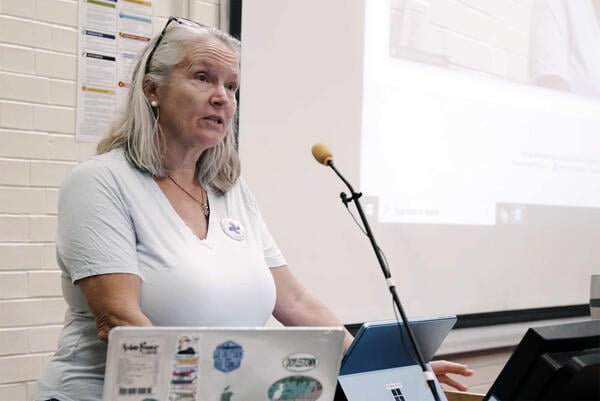
    The plaintiffs, which include the AAUP, three of its chapters—at Rutgers University, Harvard University and New York University—and the Middle East Studies Association, celebrated the win in a remote press conference Tuesday afternoon.

    “That’s a really important victory and a really historic ruling that should have immediate implications for the Trump administration’s policies,” said Ramya Krishnan, the lead litigator on the case and a senior staff attorney at the Knight First Amendment Institute. “If the First Amendment means anything, it’s that the government cannot imprison you because it doesn’t like the speech that you have engaged in, and this decision is really welcome because it reaffirms that basic idea, which is foundational to our democracy.”

    Still, despite the victory, several of the plaintiffs emphasized just how worrying the federal government’s crusade against pro-Palestinian noncitizen students and faculty is. Todd Wolfson, the president of the AAUP, said he believes those actions, as well as the federal government’s other attacks against academic freedom, are an even greater threat to higher education than McCarthyism was.

    “The only equivalents might be the Red Scare and McCarthyism, but this is even worse, right? Because it’s not only attacking individual speech, it’s also attacking institutional independence and speech, right?” he said. “The Trump administration’s attacks on higher ed are the greatest assault on this sector that we have ever seen in the history of this country.”

    So, What Comes Next?

    Young previously separated this case into two phases, one focused on the government’s liability and the other on relief for the plaintiffs. According to Krishnan, the judge will schedule a later hearing to determine that relief. The plaintiffs hope Young will forbid the government from continuing to target noncitizens based on their political views, making permanent an injunction that the judge granted in March.

    But Young noted in his ruling Tuesday that he is unsure what a remedy for the plaintiffs might look like in an era when the president consistently seems able to avoid recourse for unconstitutional acts.

    “I fear President Trump believes the American people are so divided that today they will not stand up, fight for, and defend our most precious constitutional values so long as they are lulled into thinking their own personal interests are not affected,” he wrote, concluding the decision.

    “Is he correct?”

    Source link

  • The Em Dash Debate We Should Be Having (opinion)

    The Em Dash Debate We Should Be Having (opinion)

    It seems a day does not go by without seeing someone confidently assert on social media that an em dash is not an indicator of AI-written text. Those social media posts are in response to an ongoing debate about whether or not the em dash is a dead giveaway of writing produced by generative AI. Some writers and academics resent that their cherished em dash is getting a bad rap. As one writes, “You can take my em dash from my cold, dead hands.”

    As a writer who does not use AI, I understand the frustration with the recent em-dashes-are-a-sign-of-AI-use bandwagon. I certainly do not want to be accused of using AI whenever I use an em dash. And as an English composition instructor who wants students to write without using AI, I understand how easy it can be to latch on to a purported way of quickly identifying AI-generated writing.

    But rather than get angsty about it as a writer or accusatory as an instructor, I am choosing to view the current em dash–AI kerfuffle as serendipitous. AI might be new, but a controversy about em dash usage is not, and the current debate provides an opportunity to try and temper its overuse—again.

    A year before what is recognized as the birth of the World Wide Web, Robert Bringhurst, in The Elements of Typographic Style, took a shot across the bow at em dash usage. An em, in typesetting vernacular, is a square measurement where, as Bringhurst explains, “One em is a distance equal to the type size”: therefore “the em is a sliding measure.” In other words, an em is not a fixed horizontal length; it is a horizontal space proportional to the point size. So if someone is using 12-point type, then one em would be 12 points horizontally. Half of an em is called an en. So when using 12-point type, an en is six points horizontally.

    In post-typesetting days, Bringhurst recommends that spaced en dashes – like this – be used—instead of nonspaced em dashes like this—to set off phrases within a sentence. Although he did see valid uses for the em dash, such as for written dialogue, Bringhurst contends that “the em dash is the nineteenth-century standard” and “too long for use with the best text faces” in modern times. According to Bringhurst, just as we no longer put two spaces after a period at the end of a sentence (a holdover from typesetting and later typewriter days), the em dash “belongs to the padded and corseted aesthetic of Victorian typography.”

    While Bringhurst’s suggestion was to replace ungainly em dashes with en dashes to offset sentence interruptions, continuing debates over the em dash focus on limiting such interruptions in the first place.

    In 2011, Philip Corbett of The New York Times noted an increasing use of the em dash in newspaper articles. The problem? The em dash “can seem like a tic; worse yet, it can indicate a profusion of overstuffed and loosely constructed sentences, bulging with parenthetical additions and asides.”

    That same year, Noreen Malone, writing for Slate, demonstrated how the em dash “discourages truly efficient writing” and “disrupts the flow of a sentence.” Granted, a purpose of the em dash is to interrupt, but the problem was not just that people were interrupting their writing a lot, but that they were also using it in place of better-suited punctuation. Rather than figuring out the best punctuation to use for specific writing situations and purposes, people were using the em dash as the jack-of-all-trades but master of none. Would it be best to use a comma, semicolon, period or colon? Who cares? Just throw in the exotic em dash.

    Now, as a direct result of its overuse as a substitute for more apt punctuation and its ubiquity in the written material that became the training data for LLMs, it is no surprise that the em dash is frequently showing up in AI-generated writing. There is no indication, as far as I am aware, that AI is intentionally trying to wrest the em dash from those who use it ethically and responsibly. But AI is fortuitously forcing us to grapple with the cavalier use of the em dash across recent decades. So what can writers and teachers do about it?

    As writers, we have a roster of punctuation marks from which to draw upon for specific purposes, and our choices can bring better clarity to our writing and demonstrate writerly skill. As Andi Zeisler points out in “AI can’t have my em dash,” em dashes “don’t really need to be there,” “aren’t integral to sentence structure” and “are decidedly extra.” That does not mean that writers must lay down all their em dashes and surrender them to AI. But as writers, we should be connecting thoughts smoothly and taking care to use just the right punctuation for a specific purpose while resisting the allure of an em dash that might save us the expert work of choosing the precisely placed period, comma, parenthesis, semicolon or colon.

    As teachers, we should not automatically think a student used AI when we see an em dash. I reject the notion that em dashes are a telltale of AI-written text. Whenever I suspect that something I am reading was written by AI, it is due to the writing style, not the presence of an em dash. Regardless, whether its use is attributable to AI or simply disjointed or imprecise writing, the presence of an em dash provides an opportunity to teach students how to better connect their thoughts in their writing and more carefully consider when and how to use the best punctuation for different situations.

    Richard Mitchell (a.k.a. the Underground Grammarian) once wrote, about the word “input,” that “a word that means almost anything means almost nothing” and “no longer makes any useful distinction.” The same can be said about the em dash. It might be that the em dash is necessary in select situations, but in most others it is not.

    Brenda Thomas has worked in various roles in online higher education, including as an adjunct faculty member and instructional designer, at several colleges and universities since 2015.

    Source link

  • Trump May Attempt to Tie Grant Allocation to Capitulation

    Trump May Attempt to Tie Grant Allocation to Capitulation

    Brendan Smialowski/AFP/Getty Images

    The Trump administration may be moving away from using individual investigations to try to force colleges into compliance with the president’s agenda and instead encourage compliance by giving institutions that demonstrate adherence to his policies a competitive advantage in obtaining research funding, according to The Washington Post.

    The new plan, which Post reporters heard about from two anonymous White House officials, would change the grant-application process and give a leg up to institutions that conform to President Donald Trump’s agenda regarding admissions, hiring and other campus policies. 

    If the plan takes effect, the Trump administration will no longer have to go after universities one by one through investigations and corresponding penalties, but rather can induce compliance from hundreds of institutions at once.

    “It’s time to effect change nationwide, not on a one-off basis,” one official told the Post.

    The current award-selection process for federal research grants is based primarily on scientific merit. Critics say that overriding such a standard would be a demonstrable example of executive overreach and a violation of academic freedom.

    “I can’t imagine a university in America that would be supportive of this,” said Ted Mitchell, president of the American Council on Education. 

    Source link

  • Featured Gig: eLearning Developer at UConn

    Featured Gig: eLearning Developer at UConn

    One of my goals for growing this Featured Gig series is to highlight early-career opportunities. When I saw on LinkedIn that UConn is searching for an e-learning developer, I reached out to Desmond McCaffrey, director of UConn Online, to learn more about the role.

    Q: What is the university’s mandate behind this role? How does it help align with and advance the university’s strategic priorities?

    A: The university is committed to expanding and enhancing its online and mixed-mode offerings as part of its strategic priorities. The e-learning developer 1 plays a central role in this effort by collaborating with instructional designers, faculty and staff to design and deliver high-quality courses that meet compliance requirements and research-based standards. Beyond content development, the role supports faculty growth and creates opportunities to integrate new technologies, experiment with innovative solutions and strengthen both teaching and learning. This work ensures that students benefit from inclusive, engaging and flexible educational experiences in an evolving digital environment.

    Q: Where does the role sit within the university structure? How will the person in this role engage with other units and leaders across campus?

    A: The e-learning developer is part of eCampus and UConn Online, units within the Center for Excellence in Teaching and Learning dedicated to supporting online and mixed-mode education. While the role works closely with colleagues in eCampus and CETL, it also engages with University IT Services, the University Library and faculty and staff across departments, schools and colleges. Developers contribute as members of cross-unit production teams and committees while also managing individual projects. Along the way, they collaborate on innovative pilots, explore and integrate emerging technologies, and engage with faculty and students to improve learning experiences and to help shape the university’s evolving digital learning ecosystem.

    Q: What would success look like in one year? Three years? Beyond?

    A: By the end of year one, success means moving beyond basic proficiency into advanced contribution, bringing creative solutions to course design and development, collaborating effectively across units, and helping faculty integrate best practices in accessibility and inclusion. The developer demonstrates growing confidence in evaluating and applying new technologies, employs strong communication skills, and distinguishes effective pedagogical, while building trust as a reliable partner on course and program teams.

    By three years and beyond, the e-learning developer is recognized as an innovator and campuswide contributor. They not only design inclusive, high-quality courses and learning objects but also pilot new tools and approaches, engage with faculty to improve learning experiences, and share insights through research and conference presentations. Their role evolves into mentorship and leadership, guiding projects and shaping conversations about digital learning strategy. At this stage, they are seen as a trusted resource and emerging leader who connects pedagogy, technology, and innovation to strengthen UConn’s online teaching and learning environment.

    Q: What kinds of future roles would someone who took this position be prepared for?

    A: This role provides a strong foundation for advancement into positions such as e-learning developer 2 or 3, instructional designer, faculty development specialist, or educational technology support professional, depending on the individual’s background and career goals. It also opens pathways into broader leadership roles in online education and digital learning. Along the way, developers gain hands-on experience by building courses, experimenting with new technologies, engaging with faculty and contributing to research and conference presentations—positioning them for long-term growth at the intersection of learning, technology and innovation.

    Please get in touch if you are conducting a job search at the intersection of learning, technology and organizational change. If your gig is a good fit, featuring your gig on Featured Gigs is free.

    Source link

  • Students Who Lack Academic Confidence More Likely to Use AI

    Students Who Lack Academic Confidence More Likely to Use AI

    Colleges and universities have sought to equip students with the skills to use generative artificial intelligence tools thoughtfully and ethically, but a recent study finds students often outsource thinking to chatbots.

    Research from the University of Southern California Center for Generative AI and Society found that the average student who uses generative AI services does so to get a direct answer, not to learn. Students who feel less confident in a course or who do not engage with their peers are also more likely to turn to technology for help.

    The findings point to a need for greater learning support for students, including teaching them improved internet search skills, providing more faculty assistance on how to use generative AI and instilling a sense of belonging in the classroom.

    State of play: As generative AI tools become more common, a large share of students say they engage with AI regularly. Two-thirds of students say they use generative AI chatbots weekly, according to a 2025 study from Tyton Partners.

    Faculty have expressed concern that students are circumventing thinking and learning by using artificial intelligence tools, but students claim they’re using AI to advance their educations. A recent survey by Inside Higher Ed and Generation Lab found that 85 percent of students said they’d used generative AI for coursework in the past year; 55 percent said they used it for brainstorming, half asked it questions as if it were a tutor and 46 percent used it to study for quizzes or exams.

    Nearly all students Inside Higher Ed surveyed said colleges and universities should respond to threats against academic integrity, with over half of students requesting clear, standardized policies about when and how to use AI or for colleges to provide additional flexibility around AI for transparent student use.

    The study: USC researchers surveyed 1,000 U.S. college students to understand when and how they’re using generative AI, compared to other help sources. Researchers distinguished between instrumental help-seeking behaviors—such as getting clarification on a topic covered in class—versus executive help-seeking as a means to an end, like getting quick answers to complete an assignment.

    Students said they were most likely to turn to the internet or an instructor for learning assistance, ranking tutors and peers below generative AI. For executive help, students similarly turned to the internet most often, but then looked to generative AI or a peer before instructors or tutors.

    To researchers, the trend indicates that students feel more comfortable turning to technology than human sources for help.

    National data on how and when students engage with technology versus human supports is mixed; one analysis from the Center for Studies in Higher Education at the University of California, Berkeley, found that post-pandemic, fewer students reported helping their classmates. However, Tyton Partners found that 84 percent of students said they first turn to people, including a peer or instructor, when they need help in a course, and only 17 percent primarily use AI tools.

    USC’s research also found that certain students were less likely to depend on AI; those who had better internet search skills or perceived themselves as competent in their courses were less likely to turn to generative AI tools for help.

    Conversely, students who were averse to asking peers for support or perceived themselves as less competent were much more likely to engage with generative AI. Students who trusted generative AI, similarly, were more likely to use the tools to find answers.

    A recent survey from WGU Labs found that students from marginalized backgrounds, including first-generation students and students of color, were more likely to say they’re open to AI tools for academic support. WGU Labs’ report theorized this trend could be tied to what they see as a lack of support in other traditional forms offered by institutions.

    However, pedagogy can have an impact on how students interact with AI; if the professor encourages thoughtful generative AI use, students are more likely to engage in learning-oriented behaviors, rather than just ask for answers from chatbots. Researchers believe this speaks to the social impact professors can have on how students use AI.

    Source link

  • UChicago Sells Off Research Center

    UChicago Sells Off Research Center

    The University of Chicago is selling a celebrated research center as the generously endowed university navigates layoffs and program cuts amid a heavy debt load, Financial Times reported Monday.

    UChicago is reportedly selling the Center for Research in Security Prices, founded in 1960, for $355 million to Morningstar, a research and investment firm also located in Chicago. The center, known as CRSP, developed a market database more than 65 years ago that “allowed investors to measure historic rates of return for U.S. stocks,” according to its website, which notes that its data has been used in more than 18,000 peer-reviewed studies and by hundreds of entities.

    CRSP formally became a limited liability company in 2020 but remained wholly owned by UChicago and maintained its affiliation with the university and the Booth School of Business.

    The sale comes as financial issues are adding up for the university. UChicago has borrowed heavily in recent years and seen substandard returns on its $10 billion endowment. University officials recently announced plans to pause admission to multiple Ph.D. programs and to cut 400 staff jobs as the private institution grapples with a debt load that has grown to $6 billion.

    UChicago is currently trying to shed $100 million in expenses.

    The Trump administration’s cancellation of dozens of federal grants in recent months has also hurt the university’s bottom line. UChicago president Paul Alivisatos wrote in late August that the “profound federal policy changes of the last eight months have created multiple and significant new uncertainties and strong downward pressure on our finances.”

    Source link

  • University of Maine Cancels Wind Power Summit

    University of Maine Cancels Wind Power Summit

    The University of Maine cancelled its annual summit on floating offshore wind power as federal support for renewable energy wanes, Maine Public reported.

    The university decided against holding the American Floating Offshore Wind Technical Summit, or AFLOAT, “in recognition of changing federal policies and priorities,” university spokesperson Samantha Warren said in a statement. The university’s Advanced Structures and Composites Center has hosted the summit since 2020.

    The state of Maine came out with an energy plan this year that includes offshore wind as a pivotal part of meeting renewable energy goals. But the Trump administration has shown opposition to such projects—the federal government suspended a $12.5 million grant to the University of Maine’s floating offshore wind power program this spring. The university nonetheless moved forward with the grant project, launching an experimental floating wind turbine a month later.

    The university has no plans at this time to revive AFLOAT in the future, Warren told Maine Public. But the university plans to hold private meetings with relevant parties, like industry, research and government leaders, “given growing interest in commercializing its cutting-edge technology, which has promising applications that advance the nation’s economy and security well beyond ocean energy.”

    Source link

  • Back to the Future? What could system reform of higher education look like? 

    Back to the Future? What could system reform of higher education look like? 

    Author:
    Mike Boxall

    Published:

    This HEPI blog was kindly written by Mike Boxall, writing in a personal capacity.  

    According to the latest survey by PA Consulting, over 90% of university vice-chancellors endorse a call for ‘fundamental system reforms’ to secure the survival of their sector against what they universally regard as an unprecedented combination of existential threats and challenges. Yet the responses seen from across the sector to date have been distinctly conventional and, in a literal sense, conservative: cost-cutting, portfolio rationalisation, recruitment freezes and redundancies, and forgone investments. While undoubtedly necessary in some cases to stave off short-term financial crises, such measures hardly represent transformational innovations; indeed, almost half the survey respondents predicted that their institutions would look and feel much the same in ten years’ time as today. As one vice-chancellor put it:  

    We have been propping up a 20th-century system that is no longer fit for the purposes of the early 21st century 

    Meanwhile, policymakers in the Department of Education and the Office for Students are busily preparing contingency measures against the heightened risk of multiple institutional failures and institutions plan for continued retrenchment. Big questions remain unanswered: Why might ‘fundamental system reforms’ be needed? What could (or should) a fundamentally reformed higher education system look like? And how might it be brought about in an era of continued fiscal and policy austerity? 

    Unlike just about every other sector facing seismic shifts in their markets and operating environments, universities have remained uniformly committed to what many regard as self-limiting and increasingly outdated business models: 

    • Reliance on providing essentially similar subject-based courses to limited cohorts of school-leavers, largely neglecting the more diverse learning needs of much larger populations of in-career professionals and their employers. 
    • Adherence to misleadingly named ‘full-time’ study schedules typically limited to 30 weeks a year or less, with single annual entry points and campuses and facilities largely empty of students and staff for almost half the year. 
    • A deficit-based business model in which devolved expenditure plans are set (and spent) separately from confirmed earnings, often resulting in unexpected year-end shortfalls and relying on cross-subsidies from international student fees to balance budgets. 
    • Over 150 autonomous and self-determining universities competing with one another for shares of largely fixed or even shrinking markets and funding sources, with success judged more in terms of reputational standings than by the quality and social value of their services. 

    It must be acknowledged that, despite these self-imposed limitations, the current university system has defied repeated prophesies of its demise. It has survived largely intact for many decades, with few provider closures or even forced mergers, and continues to recruit almost 1.5 million domestic and international students each year, generating over £55 billion in revenues. A handful of global institutions with annual incomes exceeding £1 billion or more may be considered too big and important to fail, and indeed these few continue to do relatively well, often at the direct expense of less-favoured rivals.  However, many, perhaps even most, others face a future of chronic struggles to cover inexorably rising costs and to protect their shares of markets eroded by new competitors and alternative options for students, employers, knowledge users and public programmes. Survival for these providers through continued efficiency drives might be possible, but it won’t be fun; nor will it be sufficient to secure the pivotal roles of universities in educating and informing an increasingly complex and precarious world. 

    The roles and contributions of universities in today’s and tomorrow’s learning society are no less important than in the past, but they will be different. In particular, they have a unique responsibility for sustaining human and social intelligence in the face of impersonal AI and related technological advances. To fulfil this role, universities must move beyond the limitations of their legacy models, expanding their roles within national and localised ecosystems to promote: 

    • Lifelong and continuous learning and professional development for all adults, from post-secondary to late-career stages, and from initial formation to periodic upskilling and personal renewal, facilitated and supported through the Lifelong Learning Entitlement and related schemes  
    • Cumulative and personalised learning attainments, embracing the rounded acquisition and development of knowledge, competences, experience and personal development, incorporating micro-credentials and stackable awards on the lines proposed by the OECD 
    • Variety and choice of accessible pathways through different modes of provision for useful learning as and when sought by individuals and employers, embracing universities, colleges, training providers and online services, as is being developed in Greater Manchester  
    • Funding and economic structures based on the value and benefits of different modes of learning provision, shared equitably between individuals, employers, civic authorities and the State, on the lines explored by the UNESCO Innovative Funding for Education project. 

    While fully articulated and integrated learning and skills ecosystems built on these principles may seem a long way off, the examples cited show that prototypes can already be seen in localised initiatives and emerging proposals across the international tertiary formation landscape. A variety of models built around these principles might emerge, displaying the characteristics of complex adaptive systems: self-organising and dynamic networks of diverse partners and stakeholders, producing emergent results in response to changing experiences.   

    Unpredictable and sometimes surprising outcomes of these kinds cannot easily be planned or fitted into pre-determined blueprints. They are thus unsuited to the normal pattern of government policy interventions. Rather, the role of government should be to provide the enabling conditions and supportive frameworks (including funds) within which self-organising solutions can emerge. A good start would be to reduce the fragmentation of policy, funding and regulatory constraints to innovation and enterprise across existing learning and skills provision. The Commission on Tertiary Education and Research (Medr) in Wales offers a laudable start towards that end, now being emulated in the Republic of Ireland and in New Zealand

    System-wide reforms on this scale do not in any way diminish the importance or critical roles of universities in serving fast-changing national needs for advanced education and skills. What they would do would be to shift the debate on the health of higher education provision from its current focus on enabling universities to continue doing what they have always done, on their own terms, to redefining and consolidating their roles at the heart of sectoral or place-related advanced learning ecosystems.  In spirit, if not in forms, this would represent returns to the principles on which most universities (both pre- and post-1992) were first established and which many would argue are needed even more today. 

    Source link

  • Government Shutdown Could Delay ED Rule Making

    Government Shutdown Could Delay ED Rule Making

    J. David Ake/Getty Images

    If the government shuts down Wednesday, it’s not clear whether the Department of Education will be able to continue with the meetings it had planned to iron out a batch of regulatory changes this week.

    The advisory rule-making committee began its work Monday and was originally slated to continue through Friday. But at the start of Monday’s meeting, department officials noted that if the government runs out of funding Oct. 1, the remainder of the session would be delayed and the plan would be to resume virtually in two weeks. (This was consistent with a pending notice that was posted to the Federal Register in the morning.) 

    That all changed once again moments before Monday’s meeting ended when Jeffrey Andrade, the deputy assistant secretary for policy, planning and innovation, said the department was reconsidering its earlier statement and that the negotiated rule-making committee might be able to continue operating in person through the end of the week.

    “There is a possibility that we can work through this,” Andrade said, adding that he had just received word of the possibility himself. 

    The department is planning to furlough nearly 87 percent of its employees, according to its shutdown contingency plan. But officials are planning to keep employees who are working on the rule-making process on board as well as those working to implement Congress’s One Big Beautiful Bill Act, which passed in July.

    This rule-making session is focused on clarifying the details of new graduate loan caps and a consolidated version of the multiple existing income-driven repayment plans.

    Going into this week’s meetings, multiple higher education experts said that finalizing new regulations before the caps and repayment plans take effect July 1, 2026, would be difficult no matter what. A government shutdown, one added, could throw a wrench into the already tight timeline.

    “With such a crunched timeline for finishing the rules in the first place, this makes the department’s job much more challenging,” said Clare McCann, managing director of policy for the Postsecondary Education and Economics Research Center at American University. 

    One of this week’s rule-making committee members, who spoke with Inside Higher Ed on the condition of anonymity, said that while they were still uncertain how the rest of the week will play out, Andrade’s last-minute announcement gave them hope.

    “I’m not sure what to make of it and will be waiting for clearer answers in the morning,” the committee member said. “But I know the department is working hard to get as much done as possible.”  

    That said, if the session does end up moving online, it wouldn’t be too out of the ordinary for department staff members. All sessions prior to the start of the second Trump administration were held online since the COVID-19 pandemic broke out in 2020.

    The real challenge, McCann noted, would likely be having enough staff to facilitate the session, regardless of its modality. 

    “Certainly the department will be able to keep some of this moving, but they will undoubtedly also have some employees who are not considered essential and are furloughed during a shutdown,” McCann said. “It takes many people at the department to make a rule making happen, and so any loss of personnel is going to present a challenge, even if they’re able to keep some of the core team that’s involved.”

    Under the contingency plan, student aid distributions will not be paused and loan payments will still be due. The department will, however, pause civil rights investigations and cease grant-making activities, though current grantees will still be able to access funds awarded by Sept. 30.

    Source link

  • HHS Looks to Block Harvard From Federal Funds

    HHS Looks to Block Harvard From Federal Funds

    Joseph Prezioso/AFP/Getty Images

    The U.S. Department of Health and Human Services’ Office for Civil Rights announced Monday that it’s moving to cut off Harvard University’s eligibility to receive federal funding.

    The announcement comes amid a power struggle between Harvard and the White House. 

    While the Trump administration has accused Harvard of allowing antisemitism to run amok on campus—and the university has acknowledged concerns on the front—it has sought sweeping power over the institution and changes that go beyond addressing antisemitism. The HHS Office for Civil Rights previously found that Harvard violated Title VI of the Civil Rights Act of 1964, which bars discrimination based on race, color and national origin, and acted with “deliberate indifference toward discrimination and harassment against Jewish and Israeli students,” according to an HHS news release.

    Now HHS OCR has recommended cutting off federal funding to Harvard “to protect the public interest” through a suspension and debarment process operated by the HHS Office of the Assistant Secretary for Financial Resources. Suspension would be temporary and debarment would last “for a specified period as a final determination that an entity is not responsible enough to do business with the federal government because of the wrongdoing,” according to the agency. The move comes less than two weeks after the Education Department placed Harvard on heightened cash monitoring—a highly unusual move given the university’s significant resources.

    Harvard did not immediately respond to a request for comment Monday.

    “OCR’s referral of Harvard for formal administrative proceedings reflects OCR’s commitment to safeguard both taxpayer investments and the broader public interest,” HHS OCR director Paula M. Stannard said in a statement. “Congress has empowered federal agencies to pursue Title VI compliance through formal enforcement mechanisms, including the termination of funding or denial of future federal financial assistance, when voluntary compliance cannot be achieved.”

    Harvard has 20 days to request a hearing in front of an HHS administrative law judge, who will decide whether the university violated Title VI.

    Monday’s announcement is the latest salvo by the federal government after Harvard emerged initially victorious in a legal battle over more than $2 billion in frozen federal research funding. While a judge ruled that the Trump administration illegally froze funds granted to Harvard, the federal government has continued to pressure the private institution to make changes to disciplinary processes, admissions, hiring and more. Other Ivy League institutions, such as Columbia University and Brown University, have agreed to such deals, under federal scrutiny.

    Source link