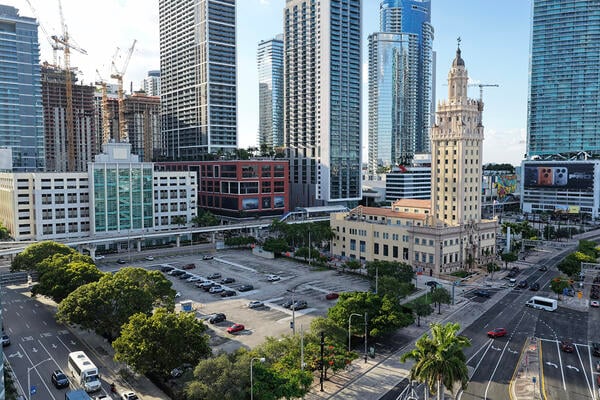
Ever since Miami Dade College announced last month that it was donating land for the construction of Donald J. Trump’s presidential library, the community college has faced criticism. Now it is fighting in court to prevent a public hearing on the deal, which would resolve a lawsuit brought by a citizen who has argued the move is illegal.
At a Sept. 23 board meeting, Miami Dade College transferred land to the state of Florida to be used for Trump’s presidential library. Critics alleged that the meeting was rushed, failed to offer adequate public notice on the specifics of the deal and lacked any discussion or debate; a public notice referenced only a “potential real estate transaction” as the reason for the meeting.
Some estimates have put the value of the 2.6-acre site in downtown Miami at $250 million to $300 million, though others say it is worth $67 million. But regardless of the dollar amount, Miami Dade College is giving the land away for free.
Marvin Dunn, a local historian, sued to block the transfer, alleging in his lawsuit that the Board of Trustees “unquestionably violated” state anticorruption laws. Dunn argued in a court filing that “depriving the public of reasonable notice of this proposed decision was a plain violation of the Sunshine Act and of the Florida Constitution” and asked for an injunction to block the transfer.
Judge Mavel Ruiz of Florida’s 11th Judicial Circuit granted Dunn a temporary injunction earlier this month, noting that he is likely to prove his claims about sunshine law violations, but she did not altogether block the land transfer. She also left the door open for the Board of Trustees to redo the deal.
“It is understood that the board can provide the reasonable disclosure and convey this property as they see fit,” Ruiz said. “That’s why this is not a case, at least for this court, rooted in politics.”
Jesus Suarez, an attorney for Continental Strategy (founded in 2022 by former Republican lawmaker Richard Corcoran, who was later tapped to lead New College of Florida), which is representing Miami Dade College, has contended that the deal is completely aboveboard.
“The law doesn’t require that there be any specificity in the notice,” Suarez has argued. College lawyers also said they would appeal the ruling to temporarily block the transfer.
State officials have bristled at Ruiz’s temporary injunction. Florida attorney general James Uthmeier, who has assigned members of his staff to assist the college in its legal battle, told The Miami Herald the temporary injunction is not technically in place because it was not issued as a written order.
Dunn, meanwhile, is seeking to expedite legal proceedings, aiming for a trial to begin by January.
While Ruiz emphasized that the case is not about politics, the MDC board, which is appointed by Republican governor Ron DeSantis, is overwhelmingly comprised of Republican donors. Board chair Michael Bileca and trustee Jose Felix Diaz are also former GOP lawmakers.
Of the seven trustees, six have donated to Republican candidates and causes. Miami Dade College president Madeline Pumariega, who has defended the way the board handled the transfer, has also donated to GOP candidates, though she has given to Democrats in the past as well. (Most of the presidents at Florida’s 40 public institutions have either Republican ties or past donations.)
Miami Dade College officials did not respond to a request for comment from Inside Higher Ed.
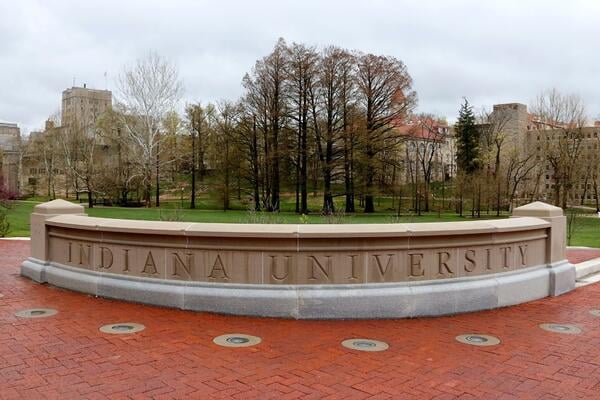
Indiana University’s decision to suspend the print publication of its student newspaper is costing the institution: Alumni are pulling donations in protest. The university ended the Indiana Daily Student’s print edition after firing the paper’s adviser, who refused to comply with administrators’ request to remove news coverage from a homecoming edition of the paper.
University leaders insist they’re not censoring the student paper but moving it to a digital platform in line with a business plan adopted last year to address the paper’s deficits. But alumni aren’t buying it, IndyStarreported. Some are asking what came of donations they made to a fund dedicated to the student publication after the newspaper reported students faced hurdles to spending the money. Other alumni are pulling their donations altogether.
Former journalism student Patricia Esgate canceled $1.5 million in bequests she planned to leave to the university. Alum Ryan Gunterman, executive director of the Indiana High School Press Association and the faculty adviser of Franklin College’s student newspaper, posted on Facebook that he and his wife were ceasing all future donations after giving money to the university and newsroom for over two decades. Toby Cole, a fourth-generation alum of the institution, told IndyStar in an email that his family was ending its monthly contributions and a $300,000 planned gift for scholarships.
“If IU can pay our [football] coach almost $100mm we can fund our IDS,” Cole said in the email. “Problem is ‘they’ don’t want an independent free speaking print newspaper because students actually wield power with it.”
In an essay for Minding the Campus titled, “College Students in a Romance Recession, Boys Blame ‘Hoeflation,’” Jared Gould blames women for these imagined problems on campus, part of “a broad feminization of our institutions, which, to say the least, is not a good thing.”
Gould uses the term “hoeflation” in his title to explain the problem of women being more selective than men on dating apps: “This imbalance has led young men to coin the term ‘hoeflation,’ the grind of chasing women they might barely fancy, but will date just to escape loneliness.” Oh, the poor lonely men, forced to work so hard to get laid by women they don’t like and call a “ho.” Why do all of these women—sorry, “hoes”—reject these obviously wonderful and respectful men?
But ultimately the real problem, Gould says, is “leftist professors, who, bent on fueling radicalization, are largely to blame for the chasm between the sexes.” Those feminist faculty, Gould says, must be eliminated from universities to allow beautiful romances to blossom between the real men and their “hoes.”
Why is Minding the Campus publishing this misogynist nonsense? Minding the Campus is a leading conservative voice about academia, owned by the National Association of Scholars, with Peter Wood as its executive editor.
For a moment, I wondered if perhaps the NAS had been fooled by a left-wing hoax, publishing a work of such gross misogyny that had been planted to humiliate them. But no, Gould is not some random idiot. This idiot is the managing editor of Minding the Campus, following positions as a research fellow at Speech First and a senior editor at Campus Reform. He’s an influential voice and editor within the conservative movement.
Beyond his open embrace of misogyny, Gould suffers from a lack of fact-checking skills.
Gould wrote, “This August, a University of Tennessee professor canceled class to celebrate Taylor Swift’s engagement. Rather than using the moment to critique Swift’s portrayal of marriage as the ultimate career capstone, his canceling class quietly reinforced the idea that dating and partnership are secondary to education, career, and financial goals.”
In reality, Tennessee communications professor Matthew Pittman was teaching his social media class and recorded a skit with his students pretending to cancel class despite the “biochem midterm” (in August!) he claimed was planned that day. It was a test of how misinformation spreads online and persists even after the truth is revealed, and Gould failed the test miserably.
Gould got fooled multiple times by the hoax after being informed that it was a hoax, initially writing in August that the cancellation of class was “staged” but still somehow thinking it was real, both in his own article and another essay by Samuel Abrams at Minding the Campus. Just two months later, Gould is still repeating the fake story.
Of course, even if a professor had canceled class to celebrate Swift’s upcoming marriage, that would be precisely the opposite of showing how “dating and partnership are secondary” to other goals. Gould managed to repeatedly fall for a hoax and still draw all the wrong conclusions from the fake news.
But let’s not allow Gould’s misogyny and incompetence to distract us from how incredibly stupid his essay truly is. Gould began his article with a remarkably broad generalization based on one strange anecdote: “Love seems to be over for college students. That’s at least what I gathered from a recent conversation with a student in Texas.” Gould reported that this man is “not scoring dates” even though he took a dance class, which, it turned out was “a giant sausage fest” full of men seeking to find that most elusive creature, the single woman on a college campus. Assuming that this student is real, it’s still difficult to connect Gould’s bizarre conclusions from this pointless story with a data set of precisely one dude.
According to Gould, “College girls have stopped looking for dates, and the men—well, they’ve learned to keep their eyes glued to the ground, lest they star in a viral TikTok captioned, ‘Guy looked at me—send help.’” Ah, yes, the poor men, unable to even look at anyone on campus because the feminazis will call 911 if they can see a man’s eyes. No wonder men are so rare on college campuses, when even their eyes are oppressed and they must pay the terrible price of “hoeflation.”
Although it may be tempting to laugh at Gould’s embarrassing attempt at cultural analysis, his solution is ominous: “reforming higher education. We should dismantle the careerist catechism that emanates from it and shutter its sex fairs that peddle pleasure as a proxy for partnership.”
Beyond banning “sex fairs,” Gould wants massive repression to “de-trench institutions of leftist professors.” We’ve seen a lot of awful excuses on the right for silencing speech on campus, from pretending to care about antisemitism to defending white people from the crime of diversity. But helping men get dates and sparing them the costs of “hoeflation” may be the worst reasons yet offered by conservatives for their campaign of campus censorship.
John K. Wilson was a 2019–20 fellow with the University of California National Center for Free Speech and Civic Engagement and is the author of eight books, including Patriotic Correctness: Academic Freedom and Its Enemies (Routledge, 2008), and his forthcoming book The Attack on Academia. He can be reached at [email protected], or letters to the editor can be sent to [email protected].
The Trump administration demanded that UCLA pay $1.2 billion and restrict student freedoms.
Juliana Yamada/Los Angeles Times/Getty Images
The details of the Trump administration’s demands on the University of California, Los Angeles—in addition to the previously reported $1.2 billion payout the federal government asked for—have finally been revealed. A lawsuit by UC faculty unions forced the higher ed system to release a copy of a draft resolution agreement, shedding light on the terms UC was first faced with nearly three months ago.
The Trump administration has demanded, among other things, that UCLA not enroll “foreign students likely to engage in anti-Western, anti-American, or antisemitic disruptions or harassment.” In the same paragraph, the proposed resolution agreement says UCLA would have to “socialize international students to the norms of a campus dedicated to free inquiry and open debate.”
The federal government also demanded that UCLA ban overnight campus demonstrations and mandate that masked campus protesters reveal their identities when asked.
Multiple provisions aim to limit transgender individuals’ rights. The document demands that UCLA’s medical school and affiliated hospitals stop “performing hormonal interventions and ‘transgender’ surgeries” on anyone under 18; stop allowing transgender women to play on women’s sports teams; strip records, awards and other recognition from transgender women athletes; and send personal apologies to the cisgender women who placed lower than trans athletes.
California voters banned affirmative action in public education nearly 30 years ago, but the demand letter suggests the Trump administration doesn’t think UCLA has complied. It would require UCLA to bar providing “information about candidates’ race, sex, ethnicity, or other protected characteristics to faculty or other UCLA personnel with decision-making authority over hiring, retention, promotion or tenure.”
Other provisions target affirmative action in hiring and student admissions, including a line that says, “UCLA shall discontinue race- and ethnicity-based scholarships.” The proposed agreement says “proxies used to effectuate race-based or sex-based outcomes” aren’t allowed in selecting for fellowship programs and also bans the use of such undefined proxies in hiring and admissions.
The document’s release comes after UC said in early August that it would negotiate with the federal government, citing the estimated $584 million in funding that at least three different federal agencies had announced they were suspending. That funding freeze followed a July 29 letter to UC from the Department of Justice, which said its months-long investigations across the system had so far concluded that in its response to a pro-Palestinian protest encampment in spring 2024, UCLA violated the equal protection clause of the 14th Amendment and Title VI of the Civil Rights Act of 1964.
It was yet another example of the Trump administration accusing a selective university of tolerating antisemitism and cutting off hundreds of millions of federal dollars. But, unlike Harvard and Columbia Universities, UCLA is a public institution, and its targeting by the federal government represents an expansion of the administration’s campaign to overhaul higher ed.
Last week, the University of Virginia became the first known public institution to settle with the administration over discrimination allegations. That settlement didn’t require a payout, but among other things, UVA committed to not use proxies for race; to end all diversity, equity and inclusion programming; and to prohibit trans athletes from participating in sports.
Media earlier reported some of the administration’s demands on UCLA, but university officials didn’t make the details public until Friday, when a lawsuit by the UCLA Faculty Association and Council of UC Faculty Associations forced them to.
“Accession to these demands would be to undermine everything that has made the UC the successful engine of social mobility and economic might that it has been for our state,” Anna Markowitz, president of the UCLA Faculty Association, wrote in an email. “It will harm undergraduate learning opportunities, and hamper UC’s ability to be a scholarly leader on the international stage. It enshrines ideology at the heart of the institution rather than decades of empirical and scholarly understanding. We stand against this extortion effort.”
Markowitz said the “UCLA FA and CUCFA have stood with our union colleagues in calling for no negotiations since the beginning.” The university administration “is under intense federal pressure,” she said, and she urged them to resist—“particularly because other faculty legal action has resulted in the restoration of nearly all of the temporarily suspended federal grants.”
Indeed, Stett Holbrook, a UC spokesperson, wrote in an email to Inside Higher Ed Monday that “as for terminated federal research funds, that figure is in the tens of millions”—a far cry from the August estimate of $584 million.
He provided a statement saying, “UC has been clear it must evaluate its response to the administration’s settlement proposal that, like all settlement communications, is confidential. As stated previously, the proposed $1.2 billion settlement payment alone would derail work that saves lives, grows our economy, and fortifies our national security. UC remains committed to protecting the mission, governance, and academic freedom of the University.”
White House and DOJ officials didn’t respond to requests for interviews Monday or answer written questions.
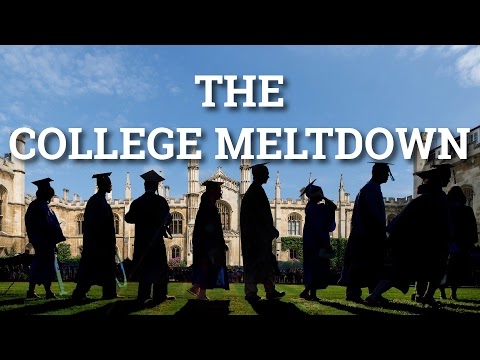
(In 2017, we collaborated with Crush the Street on a video describing the College Meltdown.)
“Education is not merely a credentialing system; it is a humanizing act that fosters connection, purpose, and community.”
Origins
The College Meltdown began in the early 2010s as a blog chronicling the slow collapse of U.S. higher education. Rising tuition, mounting student debt, and corporatization were visible signs, but the deeper crisis was structural: the erosion of public accountability and mission.
By 2015, the warning signs were unmistakable to us. On some campuses, student spaces were closed to host corporate “best practices” conferences. At many schools, adjunct instructors carried the bulk of teaching responsibilities, often without benefits, while administrators celebrated innovation. Higher education was quietly being reshaped to benefit corporations over students and communities — a true meltdown.
Patterns of the Meltdown
Enrollment in U.S. colleges began declining as early as 2011, reflecting broader demographic shifts: fewer children entering the system and a growing population of older adults. Small colleges, community colleges, and regional public universities were hardest hit, while flagship institutions consolidated wealth and prestige.
Corporate intermediaries known as Online Program Managers (OPMs) managed recruitment, marketing, and course design, taking large portions of tuition while universities retained risk. Fully automated robocolleges emerged, relying on AI-driven templates, predictive analytics, and outsourced grading. While efficient, these systems dehumanized education: students became data points, faculty became monitors, and mentorship disappeared.
“Robocolleges and AI-driven systems reduce humans to data points — an education stripped of connection is no education at all.”
Feeding the AI Beast
As part of our effort to reclaim knowledge and influence public discourse, we actively contributed to Wikipedia. Over the years, we made more than 12,000 edits on higher education topics, ensuring accurate documentation of predatory practices, adjunct labor, OPMs, and corporatization. These edits both informed the public and, inadvertently, fed the AI beast — large language models and AI systems that scrape Wikipedia for training data now reflect our work, amplifying it in ways we could never have predicted.
“By documenting higher education rigorously, we shaped both public knowledge and the datasets powering AI systems — turning transparency into a tool of influence.”
Anxiety, Anomie, and Alienation
The College Meltdown documented the mental health toll of these transformations. Rising anxiety, feelings of anomie, and widespread alienation were linked to AI reliance, dehumanized classrooms, insecure faculty labor, and societal pressures. Students felt like credential seekers; faculty suffered burnout.
“Addressing the psychological and social effects of dehumanized education is essential for ethical recovery.”
Trump, Anti-Intellectualism, and Fear in the Era of Neoliberalism
The project also addressed the broader political and social climate. The Trump era brought rising anti-intellectualism, skepticism toward expertise, and a celebration of market logic over civic and moral education. For many, it was an era of fear: fear of surveillance, fear of litigation, fear of being marginalized in a rapidly corporatized, AI-driven educational system. Neoliberal policies exacerbated these pressures, emphasizing privatization, metrics, and competition over community and care.
“Living under Trump-era neoliberalism, with AI monitoring, corporate oversight, and mass surveillance, education became a space of anxiety as much as learning.”
Quality of Life and the Call for Rehumanization
Education should serve human well-being, not just revenue. The blog emphasized Quality of Life and advocated for Rehumanization — restoring mentorship, personal connection, and ethical engagement.
“Rehumanization is not a luxury; it is the foundation of meaningful learning.”
FOIA Requests and Whistleblowers
From the start, The College Meltdown relied on evidence-based reporting. FOIA (Freedom of Information Act) requests were used to obtain internal communications, budgets, and regulatory filings, shining light on opaque practices. Whistleblowers, including adjunct faculty and staff at universities and OPMs, provided firsthand testimony of misconduct, financial malfeasance, and educational dehumanization. Their courage was central to the project’s mission of transparency and accountability.
“Insider testimony and public records revealed the hidden forces reshaping higher education, from corporate influence to predatory practices.”
Historical Sociology: Understanding the Systemic Collapse
The importance of historical sociology cannot be overstated in analyzing the decline of higher education. By examining the evolution of educational systems, we can identify patterns of inequality, the concentration of power, and the commodification of knowledge. Historical sociology provides the tools to understand how past decisions and structures have led to the current crisis.
“Historical sociology reveals, defines, and formulates patterns of social development, helping us understand the systemic forces at play in education.”
Naming Bad Actors: Accountability and Reform
A critical aspect of The College Meltdown was the emphasis on naming bad actors — identifying and holding accountable those responsible for the exploitation and degradation of higher education. This included:
University Administrators: Prioritizing profit over pedagogy.
Corporate Entities: OPMs profiting at the expense of educational quality.
Political Figures and Ultraconservatives: Promoting policies that undermined public education and anti-intellectualism.
“Holding bad actors accountable is essential for meaningful reform and the restoration of education’s ethical purpose.”
Existential Aspects of Climate Change
The blog also examined the existential dimensions of climate change. Students and faculty face a dual challenge: preparing for uncertain futures while witnessing environmental degradation accelerate. Higher education itself is implicated, both as a contributor through consumption and as a forum for solutions. The looming climate crisis intensifies anxiety, alienation, and the urgency for ethical, human-centered education.
“Climate change makes the stakes of education existential: our survival, our knowledge, and our moral responsibility are intertwined.”
Mass Speculation and Financialization
Another critical theme explored was mass speculation and financialization. The expansion of student debt markets, tuition-backed bonds, and corporate investments in higher education transformed students into financial instruments. These speculative dynamics mirrored broader economic instability, creating both a moral and systemic crisis for the educational sector.
“When education becomes a commodity for speculation, learning, mentorship, and ethical development are subordinated to profit and risk metrics.”
Coverage of Protests and Nonviolent Resistance
The College Meltdown documented student and faculty resistance: tuition protests, adjunct labor actions, and campaigns against predatory OPM arrangements. Nonviolent action was central: teach-ins, sit-ins, and organized campaigns demonstrated moral authority and communal solidarity in the face of systemic pressures, litigation, and corporate intimidation.
Collaboration and Resistance
Glen McGhee provided exceptional guidance, connecting insights on systemic collapse, inequality, and credential inflation. Guest authors contributed across disciplines and movements, making the blog a living archive of accountability and solidarity:
Guest Contributors:
Bryan Alexander, Ann Bowers, James Michael Brodie, Randall Collins, Garrett Fitzgerald, Erica Gallagher, Henry Giroux, David Halperin, Bill Harrington, Phil Hill, Robert Jensen, Hank Kalet, Neil Kraus, the LACCD Whistleblower, Wendy Lynne Lee, Annelise Orleck, Robert Kelchen, Debbi Potts, Jack Metzger, Derek Newton, Gary Roth, Mark Salisbury, Gary Stocker, Harry Targ, Heidi Weber, Richard Wolff, and Helena Worthen.
Lessons from the Meltdown
The crisis was systemic. Technology amplified inequality. Corporate higher education rebranded rather than reformed. Adjunctification and labor precarity became normalized. Communities of color and working-class students suffered disproportionately.
Dehumanization emerged as a central theme. AI, automation, and robocolleges prioritized efficiency over mentorship, data over dialogue, and systems over human relationships. Rising anxiety, anomie, and alienation reflected the human toll.
“Rehumanization, mentorship, community, transparency, ethical accountability, and ecological awareness are essential to restore meaningful higher education.”
Looking Forward
As higher education entered the Trump era, its future remained uncertain. Students, faculty, and communities faced fear under neoliberal policies, AI-driven monitoring, mass surveillance, litigation pressures, ultraconservative influence, climate crises, and financial speculation. Will universities reclaim their role as public goods, or continue as commodified services? The College Meltdown stands as a testament to those who resisted dehumanization and anti-intellectualism. It also calls for Quality of Life, ethical practice, mental well-being, environmental responsibility, and Rehumanization, ensuring education serves the whole person, not just the bottom line.
Sources and References
Washington, Harriet A. Medical Apartheid. Doubleday, 2006.
Rosenthal, Elisabeth. An American Sickness. Penguin, 2017.
Skloot, Rebecca. The Immortal Life of Henrietta Lacks. Crown, 2010.
Nelson, Alondra. Body and Soul. University of Minnesota Press, 2011.
Paucek, Chip. “2U and the Growth of OPMs.” EdSurge, 2021. link
Ravitch, Diane. The Death and Life of the Great American School System. Basic Books, 2010.
Alexander, Bryan. Academia Next. Johns Hopkins University Press, 2020.
U.S. Department of Education. “Closed School Information.” 2016–2020. link
Federal Reserve Bank of New York. Student Debt Statistics, 2024. link
Wayback Machine Archive of College Meltdown Blog: link
Seven in 10 college students say most or nearly all students on their college campus feel welcomed, valued and supported, according to a July 2025 survey by Inside Higher Ed and Generation Lab.
The data, collected from over 260 two- and four-year colleges across the country, paints a relatively rosy picture of students’ sentiments on campus this fall against the backdrop of free speech restrictions, tense protests and cutbacks to programs that serve students from racial minorities.
While respondents indicated the average student is welcome at their institution, they were less confident about whether they themselves fit in academically or socially.
Fewer than one-third of respondents said they have an “excellent” or “above average” sense of social belonging on campus; 42 percent reported “average” feelings of belonging. Additionally, 38 percent of students said they had an “excellent” or “above average” sense of academic fit at their institution, while just under half said they had an average sense of academic fit.
Survey data also pointed to positive sentiments about personal and academic inquiry. When asked how encouraged and supported they felt to explore different perspectives and challenge their beliefs, a majority of students indicated they feel “somewhat” (45 percent) or “very” supported (35 percent) on campus.
A Warm Welcome
Campus climate, or the perception of how much respect and inclusion students feel on campus, is tied to learning; research shows that students who face discrimination are less likely to succeed academically. Research has also found that students of color are less likely than their white peers to report feeling at home at college.
Inside Higher Ed’s Student Voice survey found minor variance among racial groups in reporting a generally positive campus climate. White students (75 percent) and Asian American or Pacific Islander students (73 percent) were most likely to indicate “most” or “nearly all” students are welcome on campus, compared to Hispanic (71 percent) or Black (68 percent) respondents. Seventy percent of “other” students, which Generation Lab classifies as students of two or more races or who come from outside the U.S., had positive reviews on campus climate.
Adult and two-year students were more likely to say nearly all students are welcome on campus (24 percent) than the average respondent (20 percent), which could reflect the diverse student bodies at two-year institutions and the preferences of adult learners to enroll in two-year or online institutions.
By comparison, students who had considered leaving college were less likely to say “most” or “nearly all” students are welcomed (64 percent) compared to all respondents (73 percent) or students who had never considered dropping out (77 percent).
Three percent of survey respondents wrote in other responses, indicating they completed their classes online and therefore could not speak to the campus climate.
Academic Success and Belonging
The survey also asked students to rank their own sense of social belonging and academic fit on a scale of poor to excellent.
Across racial demographics, Asian American and Pacific Islander (AAPI) students were most likely to rate their social belonging as high (33 percent), followed by white and international students (30 percent each), Black students (25 percent), and Latinos (22 percent).
On academic fit, white students had the highest ratings; 43 percent of respondents said their fit was “excellent” or “above average,” followed by AAPI (42 percent), Black students (33 percent) and Latino students (30 percent).
Students who had considered leaving college were much more likely than their peers to report they had a “poor” sense of belonging (15 percent versus 6 percent).
First-generation students were more likely to rate their sense of academic fit and social belonging as “below average” or “poor” (17 percent and 37 percent, respectively) compared to their continuing-generation peers (13 percent and 28 percent).
DEI Cutbacks
Inside Higher Ed’s survey also asked students whether federal actions to limit diversity, equity and inclusion have impacted their experiences. The most popular response was “no real impact on my experience” (37 percent), and a handful of students wrote in that they anticipated greater impact after returning to campus this fall. This view held across racial groups, with the greatest share of respondents saying it hasn’t impacted their experience.
About 20 percent of students said the changes to DEI on campus have “somewhat negatively impacted my experience” and 16 percent indicated “I don’t feel impacted, but my peers have been negatively impacted.”
Nonbinary students were most likely to say it’s severely negatively impacting their experience (39 percent).
Ten percent of respondents said they are somewhat or significantly impacted in a positive manner by the changes.
For over two decades, the National Institute for the Study of Transfer Students has bridged two worlds—the researchers who study transfer students and the campus staff who work with them. Located at the University of North Georgia, NISTS has gathered these groups for annual conferences, disseminated resources and research, and doled out awards for groundbreaking work.
Now, university leaders say they can no longer afford to fund NISTS. At the end of October, NISTS, at least in its current form, will shutter.
The institute “has made a lasting impact in improving transfer policy and practice nationwide,” and “its research has informed how colleges and universities support transfer student success,” university officials said in a statement.
But “unfortunately, due to ongoing budget constraints and a realignment of institutional priorities, the university is no longer able to financially support the Institute,” the statement read. “We are proud of the Institute’s legacy and the many partnerships it has built, and we remain committed to serving transfer students through our academic programs and student success initiatives.”
Janet Marling, NISTS’s executive director, said that over the past year, institute staff tried but ultimately couldn’t find a new permanent home for their work—at least for now. She hopes that other organizations will carry on parts of the institute’s work, including its conferences and programs, and house its research and resources so transfer professionals can continue to benefit from them.
“We have heard, time and time again, there just isn’t anyone else providing the resources, the community, the networking, the translation of research to practice in the transfer sphere in the way that NISTS is doing it,” Marling said.
‘A Terrible Loss’
NISTS prides itself on taking a unique approach, connecting staff who span the transfer student experience—from admissions professionals to advisers to faculty members—in an effort to holistically improve transfer student success. Transfer practitioners and researchers worry NISTS’s closure will have ripple effects across the field.
Alexandra Logue, professor emerita at the CUNY Graduate Center, said the transfer process inherently involves multiple institutions working together, including, in some cases, across state lines; about a quarter of transfer students choose to go to a four-year college or university in another state.
Logue appreciated that NISTS conferences offered a rare “chance for people from all the different states in the country to come together” to coordinate and swap best practices. Such programs also allowed transfer researchers like her to share their findings with staff working directly with transfer students on campuses.
“The research that we do is pointless if it isn’t put into practice,” Logue said.
While other organizations are doing powerful work to improve transfer student outcomes, NISTS played a major role in bringing new visibility to transfer students’ needs by making them a singular focus, said Stephen Handel, a NISTS advisory board member.
The institute “added a legitimacy to a constituency of students that often got forgotten,” Handel said. “NISTS was completely focused on that constituency alone, and that’s what made it unique.”
Eileen Strempel, also on the advisory board, said she got involved with NISTS when she served as an administrator at Syracuse University and sought to create a strategic plan to improve transfer outcomes—an area she hadn’t done much work in before.
“I felt like, oh, wow, there’s a brain trust already for me, the neophyte, the learner who doesn’t know very much about transfer at all,” she said. She called the closure “a terrible loss.”
She said NISTS leaders often asked conference participants how many of them had never attended a convention focused on transfer students before; Each year, most hands went up.
“To me, what that moment always crystallized was the important role that NISTS had” in helping practitioners figure out “how they could learn from other colleagues, that they didn’t need to recreate the wheel,” Strempel said.
Those lessons have had downstream effects on students.
Each practitioner came out better equipped “to help hundreds, if not thousands of students,” Strempel said.
Marling said one of the most exciting parts of the work was seeing its impact on students across the country. For example, she watched graduates of NISTS’s post-master’s certificate program in transfer leadership and practice go on to make meaningful changes on their campuses, such as establishing new transfer partnerships with other institutions or revamping training for advisers to improve transfer students’ experiences.
She said she feels “profoundly sad” about NISTS shuttering at University of North Georgia, but she also believes NISTS will live on in some form because of the “tremendous outpouring of support and concern” that followed the announcement of its closure.
“I’m very hopeful that the spirit of NISTS will continue,” whether that’s as an institute elsewhere or “within the many, many transfer champions that are working in higher education across the country. I’m really excited to see how individuals and institutions take what they’ve learned from NISTS and continue to grow their focus on transfer students and continue to provide equitable opportunities for these students.”
The arrests were made on the campus in Ann Arbor on Wednesday evening.
Courtesy of the University of Michigan.
Three pro-Palestinian protesters were arrested on the University of Michigan campus Wednesday, MLive Media Group, a local news organization, reported.
The TAHRIR Coalition, a campus student group, led the protest in response to an event held by the university’s Students Supporting Israel chapter, which featured several Israel Defense Forces soldiers.
Melissa Overton, the university’s deputy chief of public safety and security, told MLive that the individuals arrested were not affiliated with the university. She said the protesters blocked the exit to an underground parking garage and refused to move when ordered to.
They were charged with resisting and obstructing police, attempting to disarm an officer, disorderly conduct, and outstanding warrants, Overton said. The case has been forwarded to a prosecutor, she noted.
Erek Mirque, a member of TAHRIR, told MLive that the arrests came as a surprise and that he was unaware of any confrontation with officers before the arrests.
“We did not expect the situation to escalate the way that it did,” he said.
The topic for this lesson is fake news. Jarche instructs us that there are four primary types of fake news and he asks us to find an example of each type. I don’t normally post overtly political content here on my blog, but when it comes to the topic of fake news, it seemed easier to focus on politics than teaching and learning.
Propaganda – Ideas, facts, or allegations spread deliberately to further one’s cause or to damage an opposing cause.” – Merriam WebsterExample – Snopes shares 12 times AI generated or doctored content was shared by Trump or the White House. These examples seem to fit under propaganda, since they attempt to influencing people’s attitudes and beliefs. Though that also sounds like disinformation to me and I’m still not clear I know the difference.
Disinformation – “False information deliberately and often covertly spread (as by the planting of rumors) in order to influence public opinion or obscure the truth.” – Merriam WebsterExample – Trump states that there is no inflation in the US. There are some who say that Trump’s specific type of lying falls under the category of bullshit, as defined by Harry Frankfurt in his book, On Bullshit. Either way, it feels like shooting fish in a barrel to find examples of disinformation from this administration.
Conspiracy theory – “Persist for a long time even when there is no decisive evidence for them… Based on a variety of thinking patterns that are known to be unreliable tools for tracking reality.” – The Conspiracy Theory Handbook, by Lewandowski + CookExample – Ok. So this isn’t a genuine conspiracy, rather it was satirical from the start. But given how I feel after finding those examples of propaganda and disinformation, I needed a little break. The “birds aren’t real” satirical conspiracy scratches a certain itch for me, as someone who enjoys learning about birds.
Clickbait – “Text or a thumbnail that is designed to attract attention and to entice users to follow (“click”) that link and view, read, stream or listen to the linked piece of online content, being typically deceptive, sensationalized, or otherwise misleading… A defining characteristic of clickbait is misrepresentation in the enticement presented to the user to manipulate them to click onto a link.” – WikipediaExample – Bryan Tyler Cohen is rather notorious for using clickbait YouTube video titles on his main channel. I saw a video of him explaining that he knows they are frustrating to people, but that they really generate far more views, in his testing. He even created an alternate channel (Bryan Tyler Cohen News) with more toned down titles, which he suggests can be better to send to people who may be on a different side of the issues than him, politically.
My Muddiest Point
I’m having a hard time distinguishing between disinformation and propaganda. Jarche shared a quote from researcher Renée DiResta, who would prefer our focus be on the word propaganda, as it is more descriptive of the problem at hand.
Q. Why do you prefer the word “propaganda” to “misinformation”?
A. Misinformation implies that the problem is one of facts, and it’s never been a problem of facts. It’s a problem of people wanting to receive information that makes them feel comfortable and happy. Anti-vaccine messages don’t appeal to facts, but to the identity of the recipient. They’re saying: “If you are a person on the right, you should not trust these vaccines.” It’s very much tied to political identity. Misinformation implies that if you were to say that Robert F. Kennedy Jr. is an absolute clown who knows absolutely nothing about vaccines or their relationship to autism, and that this has been researched to ad nauseam by scientists, if it were a problem of misinformation, you would assume that people would say, “Oh, here’s the accurate information, so I’m going to change my mind.” But that’s not the case. It’s a topic of identity, of beliefs, and that’s why propaganda is a more appropriate term.
But I’m still not entirely clear I can distinguish propaganda from disinformation at this time.
Handling Conspiracy Theories with Students
I have such a hard time navigating conspiracy theories with students who take business ethics with me. We have a whole section of the class where they learn how to use Mike Caulfield’s SIFT framework to fact check the articles they read about business ethics related news stories throughout our semester together. I’ve found it is practically useless to ask them the question from Mike’s mini course about if they or someone they’re close to has ever believed in a conspiracy theory before.
There’s so much of one’s identity that gets wrapped up in what we believe. Generally, they don’t view these beliefs as conspiracies if they or their loved ones believe in them.
For many college students, connecting their interests to career and life goals can be a challenge. Transfer students may find it especially difficult because they lack familiarity with the campus resources available to help them make those connections. A course at the University of Minnesota Carlson School of Management aims to help these students chart their path, in part by sending them on an international trip.
The Design Your Life in a Global Context course encourages transfer students to apply design thinking principles to their college career and beyond and organizes a short study abroad trip led by a faculty member. The experience, mostly paid for by the institution, breaks down barriers to the students’ participation and aims to boost their feelings of belonging at the university.
The background: Since 2022, all students in the Carlson School of Management undergraduate program have been required to complete an international experience. The goal is to motivate them to be globally competent, to support their development as business leaders and to create collaboration with international colleagues, according to the school’s website.
Study abroad experiences have been tied to personal and professional development. A recent survey of study abroad alumni by the Forum on Education Abroad found that 42 percent of respondents indicated studying in another country helped them get their first job.
For U of M’s business school students, these experiences are made possible by funding from the Carlson Family Foundation, which provides scholarships through the Carlson Global Institute and the Learning Abroad Center.
In addition to Design Your Life in a Global Context, the university offers Design Your Career in Global Context, which sends students on a similar short study abroad experience.
The framework: Design Your Life in a Global Context meets once a week throughout the fall semester and then culminates in a 10-day trip to Japan, a country instructor Lisa Novak selected because of its unique focus on work-life balance and well-being.
“If you’re familiar with the concepts ofikigai, it’s all about finding one’s purpose and aligning what you love, what the world needs, what you’re good at and what you can be paid for,” said Novak, director of student engagement and development at the Carlson School. “We’re going to be learning about this concept while we’re abroad.”
In addition, the course helps students apply life design principles to their whole lives, modeled after Stanford University’s design thinking framework.
“Through the class, we equip students with the tools and strategies to design their college and career experience that aligns with their values, interests, strengths, needs and goals,” Novak said.
Going abroad: During the 10-day trip, students explore Tokyo and Okinawa.
They visit Gallup’s Tokyo office to learn about the Clifton strengths assessment and the research the organization is doing in Japan. In Okinawa, students learn from residents living in a “blue zone,” an area of the world where people live the longest and have the fewest health complications.
“We learn about some of the factors that contribute to longevity in that area of the world and then connect that back to designing one’s life and a life of purpose,” Novak said.
In addition to class content, the trip offers students an opportunity to participate in intercultural learning and experience international travel that may be unfamiliar.
Before they leave for Japan, Novak and her colleagues from the Carlson Global Institute support students with travel logistics, including securing a passport, creating a packing list and navigating currency exchange.
“I also bring in different food from the area,” Novak said. “We call it ‘taste of Japan.’ I have different candy or snacks from Japan and they get to experience the culture a little bit in that way and get excited about what we’re doing.”
Novak also leads guided reflections with students before, during and after the trip to help them make sense of their travels and how the experience could shape their worldview.
“I just hope that they recognize that the world and business are increasingly global and connected,” Novak said. “Being able to navigate difference and build connections and have conversations with people that are so different than you is a powerful learning experience.”