The University of Virginia is the fourth university, and the first public one, to agree to a settlement with the Trump administration over allegations of discrimination.
Jabin Botsford/The Washington Post via Getty Images
The University of Virginia has reached a settlement agreement with the Department of Justice that will pause pending investigations in exchange for assurances from the public flagship that it will not engage in unlawful practices around admissions, hiring, programming and more.
As part of the deal, UVA agreed to follow a July memo from U.S. Attorney General Pam Bondi that bars the use of race in hiring and admissions practices as well as scholarship programs. UVA will be required to provide “relevant information and data” to the DOJ, according to the news release.
While the recent investigations into allegedly illegal diversity, equity and inclusion programs have been paused, that doesn’t mean those probes have been altogether closed. However, the DOJ will close the investigation “if UVA completes its planned reforms prohibiting DEI,” officials said.
“This notable agreement with the University of Virginia will protect students and faculty from unlawful discrimination, ensuring that equal opportunity and fairness are restored,” Assistant Attorney General Harmeet K. Dhillon of the DOJ’s Civil Rights Division, and a UVA alum, said in a statement. “We appreciate the progress that the university has made in combatting antisemitism and racial bias, and other American universities should be on alert that the Justice Department will ensure that our federal civil rights laws are enforced for every American, without exception.”
The settlement comes nearly four months after former UVA president James Ryan stepped down abruptly, reportedly under DOJ pressure to resign as part of an effort to resolve investigations.
UVA officials released a statement as well as the text of the agreement on Wednesday.
“We intend to continue our thorough review of our practices and policies to ensure that we are complying with all federal laws,” Interim President Paul Mahoney wrote. “We will also redouble our commitment to the principles of academic freedom, ideological diversity, free expression, and the unyielding pursuit of ‘truth, wherever it may lead,’ as Thomas Jefferson put it. Through this process, we will do everything we can to assure our community, our partners in state and federal government, and the public that we are worthy of the trust they place in us and the resources they provide us to advance our education, research, and patient care mission.”
Education Secretary Linda McMahon called the deal “transformative” in a post on X.
“The Trump Administration is not backing down in our efforts to root out DEI and illegal race preferencing on our nation’s campuses,” McMahon wrote. “A renewed commitment to merit is a critical step for our institutions to once again become beacons of truth-seeking and excellence.”
UVA is one of several institutions to reach an agreement with the Trump administration in recent months, but the first public university to do so. Previously Columbia University, the University of Pennsylvania and Brown University all agreed to deals with the federal government after the Trump administration froze federal research funding over alleged civil rights violations.
While UVA reached a settlement with the federal government, it has rejected other proposals such as the “Compact for Academic Excellence in Higher Education,” which would have required institutions to agree to tuition freezes, caps on international students and campuswide assessments of viewpoint diversity, among other demands, in order to receive preferential treatmentfor federal research funding. UVA was one of nine institutions originally asked to join the compact, though none of the original group, nor others invited later, have announced they will sign the proposal.
Student recruitment has never been more competitive, or more personal. The institutions standing out right now aren’t the ones shouting the loudest; they’re the ones showing the most truth. That’s where authenticity comes in.
Prospective students want to see real stories from real people, not polished marketing copy or staged photos. They want to hear from the student who filmed a late-night study session, the alum who just landed their first job, or the professor who shares genuine classroom moments. That’s the power of user-generated content (UGC). It turns your community into your most credible storytellers.
In this guide, we’ll look at what authentic content really means, why it works, how to build it into your strategy, and how to measure its impact. Along the way, you’ll see examples of schools already doing it well and learn simple ways to kickstart your own approach.
If your goal is to humanize your brand and connect with Gen Z on a deeper level, authenticity isn’t a trend. It’s the foundation. Let’s get into it.
Struggling with enrollment?
Our expert digital marketing services can help you attract and enroll more students!
What Is User-Generated Content (UGC) in Higher Education Marketing
User-Generated Content (UGC) is any material created by people outside your marketing team: students, alumni, faculty, or even parents. It includes everything from TikToks and Instagram stories to blog posts, reviews, and testimonial videos. What makes UGC powerful is its honesty. It’s not scripted or staged; it’s content created by individuals sharing their own experiences. That authenticity lends it credibility that traditional marketing can’t replicate.
Authentic content, on the other hand, goes beyond UGC. It’s any content that feels real, relatable, and trustworthy, even if your institution produces it. A student-led vlog created by your admissions team, a behind-the-scenes video from orientation week, or an unfiltered faculty Q&A on LinkedIn can all count as authentic content. The goal is to showcase genuine stories without the hard sell.
Here’s the distinction: UGC is always created by your community, while authentic content can come from anyone, as long as it feels natural and transparent. The most effective education marketers use both. Inviting their audiences to create, while also producing school-made content that keeps the same raw, human touch. Together, they tell a believable story that draws students in and builds lasting trust.
What Is Authentic Storytelling in Higher Education Marketing?
Authenticity is the backbone of modern education marketing. Students trust people more than institutions, and they can spot inauthenticity instantly, especially Gen Z, who’ve grown up spotting inauthenticity from miles away. Research shows people are about 2.4× more likely to say UGC feels authentic than brand-created content. That difference matters: authentic stories make prospects stop scrolling, listen, and believe.
Authenticity also builds emotional connection. Gen Z and Millennials want to see themselves in your content, to think, “That could be me at that school.” A student-run TikTok showing dorm life or a grad’s blog about their first job after graduation brings that feeling to life. It’s no surprise that social is now a default research channel. The vast majority of students use social media to research colleges, and peer-created posts carry even more sway.
The impact extends to engagement. Across benchmarks, UGC often delivers meaningfully higher social engagement and can drive up to ~4× higher CTR in ads. And over time, that engagement builds trust: 81% of consumers trust UGC more than branded content. In a high-stakes decision like education, that trust can make all the difference.
Benefits of UGC in Campaigns
Incorporating user-generated content (UGC) into your marketing mix delivers tangible gains in both performance and perception. The first, and often most noticeable, benefit is higher engagement. According to industry data, social campaigns featuring UGC see up to 50% higher engagement, while ads with UGC achieve 4× higher click-through rates (CTR) than standard creative. The reason is simple: real photos and videos from students feel relatable. Prospects engage with them more readily than with polished brand assets. The August 2025 HEM webinar confirmed this pattern, showing that UGC consistently lifted social engagement by 50% and CTRs by a factor of four.
UGC also stretches your marketing budget. Instead of producing every asset in-house, you can tap into the creativity of your student community. UGC can reduce content production costs by shifting more creation to students and alumni, and in paid campaigns, CPC/CPL are often lower when UGC is used.
Beyond performance metrics, UGC builds credibility. It’s a living form of social proof, real students sharing their experiences in their own words. That authenticity creates trust and fosters community pride. When students and alumni contribute content, they become advocates, helping schools turn everyday stories into powerful recruitment tools that attract, engage, and convert.
Best Practices for Implementing UGC
Launching a user-generated content (UGC) initiative takes planning and structure. Here’s how to build a sustainable, effective framework that keeps authenticity at the heart of your strategy.
Make UGC a Core Content Pillar: Treat UGC as a foundational part of your marketing plan, not an add-on. Include it in your annual content calendar alongside official updates, blogs, and campaigns. Schools that do this well, like the University of Glasgow’s #TeamUofG campaign, consistently weave student voices into their newsletters, social feeds, and websites, making authenticity a constant thread, not a seasonal feature.
Align with Enrollment Cycles: Timing matters. Match UGC themes with where prospects are in the funnel. Early awareness? Share student life and orientation highlights. Decision season? Spotlight testimonials and day-in-the-life videos. Seasonal UGC enrollment marketing tactics, like winter study sessions or graduation snapshots, keep your school top of mind year-round.
Assign Ownership and Collaboration: Even though UGC is created externally, internal management is key. Assign a small cross-functional team, including marketing, admissions, and communications, to coordinate, moderate, and track results. Admissions can identify standout students to act as ambassadors, while marketing supports them with creative direction.
Guide Contributors Without Scripted Control: Students thrive with light structure. Provide a short framework—Hook → Introduction → Key Message → Call-to-Action. To help them share meaningful stories that align with your brand. Offer practical production tips: use natural light, steady shots, and clear audio. Authentic doesn’t mean low quality.
Protect Participants and Your Brand: Always secure written permission before reposting UGC, especially when featuring minors. Create clear content-use policies, moderate posts regularly, and track your branded hashtags with social listening tools. This ensures alignment with your school’s tone and values.
Prioritize Diversity and Inclusion: Feature a range of student perspectives, including international, mature, online, and graduate learners. Authentic storytelling thrives on variety. Prospects should be able to see themselves reflected in your content.
Examples of Real UGC Applications in School Marketing
To inspire your own strategy, let’s look at the many ways schools are using UGC and authentic storytelling to strengthen engagement and humanize their brands. Across the education sector, institutions are experimenting with creative formats that empower students, faculty, alumni, and even parents to share their real experiences.
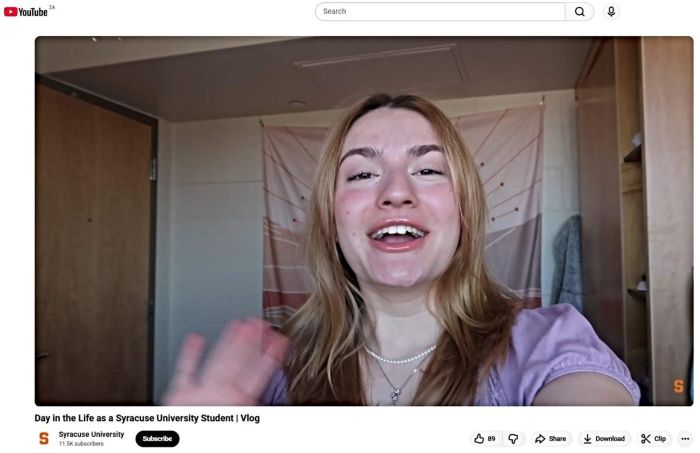
Example: Syracuse University, Student Vlog on YouTube. A Syracuse student’s “Day in the Life” YouTube vlog offers an unscripted, immersive look into campus life: lectures, study sessions, and community activities. YouTube’s longer format allows for deeper storytelling and helps prospective students experience the campus virtually.
Student “Day in the Life” Takeovers One of the most effective UGC formats is the student takeover, where a student documents a typical day on campus through Instagram or TikTok. These videos often follow an unscripted, narrative flow, showing classes, dorm life, study sessions, and social activities from morning to night. Schools typically host these takeovers on official channels or promote student posts through hashtags. This format resonates because it offers an unfiltered look at campus life and helps prospective students picture themselves in that environment.
Example: Stanford University, UGC Nature Reel Stanford University curated a student-shot Instagram Reel featuring the aurora borealis over Pinnacles National Park. The video, captured entirely by a student, embodies the spirit of authentic storytelling, showing beauty, wonder, and student life through the lens of a real experience.
Behind-the-Scenes of Events UGC thrives on authenticity, and few things feel more genuine than spontaneous moments from student events. Encouraging students to share behind-the-scenes perspectives from orientations, club fairs, or sports games helps outsiders experience the energy and community spirit that define your school. These candid glimpses make institutional content more approachable and emotionally engaging.
Faculty or Staff Takeovers and Reflections Authentic content doesn’t have to come solely from students. Faculty and staff can also contribute by sharing casual reflections or quick videos about their daily work. A professor might record a short lab update, while an admissions officer could post a quick tour from a college fair. These snapshots add a human touch to your education marketing strategies by showing the passion, personality, and commitment that drive your institution.
Student-Run Q&As and AMAs Interactive Q&A sessions, where current students answer prospective students’ questions live on Instagram or through social threads, are among the most effective UGC formats. This setup offers unfiltered, peer-to-peer insights that prospects trust. When real students respond in their own voices, it builds transparency and community, turning your social platforms into spaces for genuine connection.
Social Media Contests and Hashtag Campaigns Encouraging students to create around shared prompts or themes is another great UGC driver. Campaigns like “Show your campus pride” or “Dorm room decor challenge” can generate dozens of authentic submissions in a short time. Just ensure clear rules and creator permissions (and parent consent for minors) so you can safely feature the best entries across your platforms. These initiatives not only supply fresh content but also boost engagement and school spirit.
Testimonials from Parents and Alumni UGC isn’t limited to current students. Parents and alumni can offer powerful, credible perspectives through short testimonial videos or written stories. Sharing how a parent watched their child grow or how an alumnus found career success can feel more authentic than any scripted message, and often connects strongly with audiences considering your programs.
Example: Louisiana State University, Alumni-Submitted Carousel LSU showcased an alumna’s entrepreneurial journey through a carousel post featuring her photos and story. The alumni-submitted visuals celebrate post-graduation success while reinforcing a sense of lifelong belonging, transforming alumni into ambassadors for the LSU brand.
Fun Trends and Challenges Participating in lighthearted social trends can also create strong UGC moments. Whether it’s a campus meme, a TikTok challenge, or a humorous group video, joining or amplifying these moments signals that your institution is lively, student-centered, and culturally aware. These pieces of content not only entertain but also reinforce your brand’s relatability and spirit.
Using Podcasts to Showcase Authenticity
Podcasts have become one of the most powerful tools for education marketers looking to connect with audiences through genuine, long-form storytelling. Unlike short-form social media content, podcasts allow room for nuance, emotion, and conversation, making them ideal for showcasing the real voices and experiences that define your school community. Whether you’re featuring students, faculty, or alumni, the format gives your audience something they crave: authenticity.
Set a Clear Purpose and Goals Before launching a podcast, clarify its purpose.
What role will it play in your marketing strategy?
Is it meant to support recruitment by spotlighting programs and student experiences?
To engage current students through campus discussions?
To deepen alumni connections with nostalgia and advice?
Each episode can have a distinct focus, but your overall series should align with strategic objectives. Identify your audience: prospective students, parents, current students, or alumni, and craft episodes that meet their needs. A school emphasizing innovation might produce a series around student research and campus projects, while one focused on student life could highlight real stories about growth, belonging, and discovery.
Plan Your Content Strategy Successful podcasts rely on structure and consistency. Choose a defined theme or niche rather than covering every topic under the sun. Themes like Student Voices: First-Year Journeys or Faculty Conversations: Research That Matters help listeners know what to expect. Pre-plan your first 8–10 episodes to maintain a steady release rhythm.
Aim for a predictable cadence (biweekly or monthly) so listeners know when to expect new episodes. Formats can vary: student interviews, faculty discussions, narrative storytelling, or on-site event recordings. Involving student co-hosts or interviewers adds natural authenticity and relatability, bridging the gap between your institution and prospective students.
Focus on Storytelling and Value Every episode should deliver something meaningful. Encourage guests to share honest stories, not scripted talking points. A student might recount a defining academic challenge; a professor might discuss what inspires their teaching; an alum could describe their career journey post-graduation.
Let conversations unfold naturally; even small moments of humor or vulnerability can make an episode memorable. Strive to balance emotional connection and practical value, offering listeners insight, inspiration, or tangible takeaways.
Feature Diverse Voices Authenticity thrives on diversity. Feature a wide range of speakers—students from different backgrounds, professors across disciplines, and staff who shape campus life behind the scenes. Mixing perspectives gives your audience a fuller, more human picture of your institution. Episodes could spotlight student-led initiatives, faculty research, or stories that reflect different aspects of campus life, from residence halls to community outreach.
Production and Promotion Good audio quality matters. Use a reliable microphone, record in a quiet space, and lightly edit to maintain clarity while preserving natural conversation flow. Publish episodes consistently and promote them across channels, email newsletters, your website, and social media. Short audiograms or quote graphics can extend your podcast’s reach while reinforcing its authentic tone.
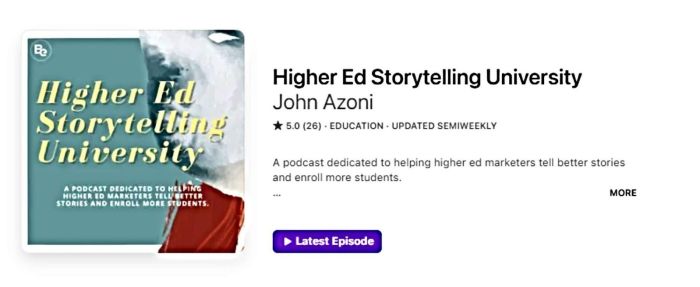
Example: Higher Ed Storytelling University Podcast. The Higher Ed Storytelling University podcast features marketers, educators, and students discussing authenticity, narrative strategy, and digital storytelling. This example illustrates how schools and industry experts are using long-form audio to humanize their messaging and reach broader audiences.
Building a successful user-generated content (UGC) strategy doesn’t require starting from scratch. With the right tools and a few well-planned quick wins, your institution can begin collecting and showcasing authentic stories almost immediately. Below are practical tools and easy-to-implement tactics that can help you get started.
UGC Creation and Curation Tools
Canva: A go-to tool for both marketing teams and students. Canva makes it easy to design branded graphics, quote cards, and short visuals using preset templates. Students can create Instagram takeover intros, testimonial cards, or club event spotlights, all while staying on-brand thanks to shared school colors and fonts.
CapCut: A free, mobile-friendly video editing app perfect for short-form social content. Encourage students to use it to trim clips, add subtitles, and polish their footage before submission. Subtitles, in particular, improve accessibility and help engagement since many viewers watch videos without sound.
Later or Buffer: Social media scheduling platforms like these help teams plan and publish UGC consistently. For example, you can schedule weekly “Student Spotlight” features or testimonial series, keeping your feeds active with minimal daily effort.
TINT or Tagboard: These UGC management tools collect content tagged with your campaign hashtags across multiple platforms into one dashboard. They also help you request permissions, filter submissions, and display curated UGC feeds on your website (such as a live “#CampusLife” wall on your admissions page).
Quick Wins to Kickstart UGC
Identify 3 Student Storytellers: Start small. Find three enthusiastic students, perhaps a club leader, athlete, or international student, and invite them to share their stories through takeovers, vlogs, or blog posts. Their content will serve as authentic examples and inspire others to participate.
Launch a Branded Hashtag: Create a memorable, campaign-specific hashtag like #[YourSchool]Life or #Future[YourMascot] and start promoting it immediately. Add it to your bios, marketing emails, and on-campus signage. Repost tagged content regularly to reward engagement and grow participation.
Pilot an Authentic Video Post: Experiment with one short, genuine video on Instagram or TikTok. Try a student Q&A, a “what I wish I knew” segment, or a move-in day recap. Compare engagement metrics with your usual posts. You’ll often find authentic, lightly produced clips outperform polished ads.
Amplify Existing UGC: Look for what’s already out there. Students are likely tagging your school in posts or videos. Engage with those by resharing or commenting, signaling that you value authentic voices.
Offer Student Club Consultations: Provide quick content workshops or audits for student groups. Helping them improve their storytelling or branding indirectly elevates the quality of UGC being created across campus.
Measuring the Impact of UGC
Just like any other marketing initiative, your user-generated content (UGC) strategy needs to be measured to prove its value and refine future campaigns. The impact of UGC goes beyond clicks and likes. It touches trust, community sentiment, and enrollment. That’s why it’s important to measure both quantitative and qualitative outcomes. Here’s how to assess what’s working and why.
Track Engagement and Reach Start with the fundamentals: likes, comments, shares, saves, and views. Compare these against your institution’s regular branded posts. UGC often performs better, signaling a stronger connection and authenticity. Also track reach and impressions—are your hashtags expanding visibility? If your student takeover generates thousands of views and dozens of replies, that’s evidence of increased awareness and interest at the top of the funnel.
Monitor Cost Efficiency If UGC is part of paid campaigns, track cost per click (CPC) and cost per lead (CPL). Ads using student-generated content tend to have higher click-through rates and lower costs because they appear more genuine. Run A/B tests: one glossy ad versus one featuring a real student photo. If the authentic ad drives more engagement at a lower cost, you’ve got clear ROI data to share with stakeholders.
Measure Conversions and ROI Track what happens after engagement. Did a UGC-driven post increase form submissions or event sign-ups? Ask applicants how they heard about your school. If they mention your social media or specific student stories, that’s qualitative proof of impact. You can also calculate Return on Ad Spend (ROAS) by comparing tuition value or lead generation to ad spend, or use proxy metrics like cost-per-application to show improved performance. Learn more in HEM’s social media playbook.
Gather Feedback from Students and Staff Numbers don’t tell the whole story. Collect feedback from your community through surveys or informal polls. Ask whether students feel represented in your content or whether prospective students found your UGC helpful. Anecdotal comments, like “Your Instagram takeovers made me want to apply,” are qualitative gold and demonstrate the emotional impact of authenticity.
Track Sentiment and Community Growth Pay attention to the tone of comments and discussions. Are people tagging friends or expressing excitement? Positive sentiment indicates your content resonates. Also, monitor the growth of branded hashtags and organic posts. If more students are tagging your school or sharing their own stories without prompting, your UGC strategy is inspiring real advocacy.
Build a UGC Dashboard Bring it all together with a simple dashboard that tracks UGC performance quarterly, engagement rates, CPC/CPL trends, sentiment highlights, and standout examples. This helps visualize the tangible outcomes of authenticity-driven marketing and makes it easier to communicate results to leadership.
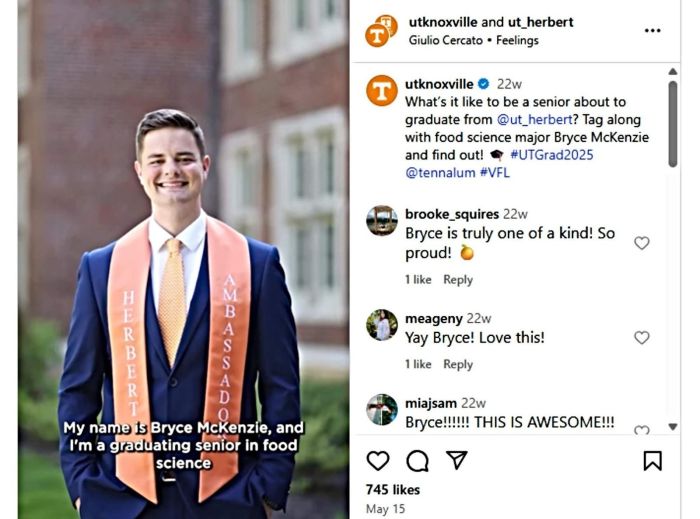
Example: University of Tennessee, Knoxville A University of Tennessee senior’s “Day in the Life” video exemplifies how authentic, student-produced content can outperform traditional marketing posts. The Reel’s organic engagement, thousands of views, and high interaction highlight the measurable impact of relatability on social media reach and engagement.
Authenticity in marketing is the foundation of meaningful connection. By weaving user-generated and authentic content into your strategy, your institution can foster trust, spark engagement, and inspire real relationships with students and families. Throughout this guide, we’ve explored how to define UGC, why it works, and how to implement it strategically through proven best practices and simple quick wins. The takeaway is clear: campaigns that feel real outperform those that feel rehearsed.
Of course, launching an authenticity-driven strategy takes more than good intentions. It demands planning, creativity, and a partner who understands how to balance storytelling with measurable results. That’s where Higher Education Marketing (HEM) comes in. Our team has helped colleges and universities around the world capture genuine student stories and transform them into powerful digital campaigns. Whether you’re planning a branded hashtag initiative, building a library of student video testimonials, or training student ambassadors and UGC programmes to create engaging social content, HEM can guide you every step of the way.
Authentic voices are your greatest marketing asset, and with HEM’s expertise, you can amplify them strategically. Reach out today for a free UGC strategy consultation and discover how genuine stories can drive real enrollment results. Let’s build trust, engagement, and community authentically.
Struggling with enrollment?
Our expert digital marketing services can help you attract and enroll more students!
Frequently Asked Questions
Question: What Is User-Generated Content (UGC) in Higher Education Marketing
Answer:User-Generated Content (UGC) is any material created by people outside your marketing team: students, alumni, faculty, or even parents. It includes everything from TikToks and Instagram stories to blog posts, reviews, and testimonial videos.
Question: What Is Authentic Storytelling in Higher Education Marketing?
Answer: Authenticity is the backbone of modern education marketing. Students trust people more than institutions, and they can spot inauthenticity instantly, especially Gen Z, who’ve grown up spotting inauthenticity from miles away.
National data suggests today’s college students are less prepared to succeed in college than previous cohorts, due in part to the COVID-19 pandemic and remote instruction. Students lack academic and socio-emotional readiness, administrators say, prompting colleges to implement new interventions to get them up to speed.
For years, Mount Saint Mary’s University in California has offered a summer bridge program for students who may be less prepared to make the transition to college, such as first-generation students.
This summer, MSMU launched Summer Pathways, which is designed for all incoming students to get a head start on college. They complete two college courses for free and are able to connect with peers and explore campus before starting the term.
“We felt the earlier we can engage students, the better,” said Amanda Romero, interim assistant provost.
How it works: Summer Pathways is a six-week, credit-bearing experience that takes place in the middle of the summer, after orientation in June but before classes start in August.
During the program, students complete a Summer Pathway seminar and one additional introductory course, choosing among sociology, English and mathematics.
Students take classes Mondays, Wednesdays and Fridays; on Tuesdays and Thursdays they participate in workshops about managing their time, dealing with impostor syndrome or maintaining well-being.
“We’ve invited the whole campus community to come in, meet with our students in person, talk about their careers, their offices, how they ended up at the Mount, what their hopes and aspirations are for the future,” said Elizabeth Sturgeon, interim assistant provost and director for Summer Pathways.
The goal is to make students aware of campus resources and connect them with faculty and staff early in their college careers.
The program also takes students on fun excursions around Los Angeles, including to the ballet, the Hollywood Bowl and the Getty Museum.
The experience is free, and students are given a $250 stipend to help pay for gas and food. They can also pay $3,000 to live in a residence hall for the six-week program if they don’t want to commute to campus each day.
A community approach: While many faculty work on eight-month contracts and have the summers off, Sturgeon and Romero said it wasn’t difficult to get professors engaged and on campus for the program.
“We had departments that had never participated in Summer Pathways before, never knew what it was about, opting in and coming down in person to present to our students,” Sturgeon said.
“It’s important for our core faculty to get in front of students, and this is a great opportunity to do just that,” Romero said.
Returning students also stepped up to serve as peer mentors for new students.
The program has paid off thus far, leaders said, with students hitting the ground running at the start of the term.
“It offers a smoother transition,” Romero said. “A lot of anxiety with starting a new place is ‘where’s this, where’s that, where do I go?’”
“They know what the resources are, they know where to park, what to order in the cafeteria,” Sturgeon said. “They have a friend group; they have that one peer mentor who’s their friend they can reach out to. From day one, in the business of being a college student, they’re an alum after six weeks.”
What’s next: In summer 2025, 66 out of 90 incoming students participated in Summer Pathways, engaging in five different courses. And 98.5 percent of them matriculated in the fall.
In the future, campus leaders hope to introduce project-based learning into the courses, interweaving the university’s mission as a Sisters of St. Joseph of Carondelet institution.
“We just want to make it bigger going forward, with more classes and students participating,” Sturgeon said.
The overarching dream is to get all incoming students to sign up, but administrators recognize that those who don’t live in the region may face additional barriers to engaging in in-person activities because they lack housing. Sturgeon and Romero are pushing for additional resources to offer housing and seeking solutions to address the need for additional funding and staffing.
If your student success program has a unique feature or twist, we’d like to know about it. Click here to submit.
California’s community college–to–four-year university transfer pipeline has not delivered the outcomes students need. While 80 percent of community college students intend to transfer, just 19 percent reach a California State University campus within four years. The gap is stark. While there have been numerous statewide efforts to define clear pathways to California State University and the University of California, time and time again it’s taken local innovation and collaboration between sending and receiving colleges to make a real difference.
In Los Angeles, which enrolls a quarter of the state’s students, educators and partners have spent nearly a decade working to support student-centered transfer innovations by focusing attention on implementation of the associate degree for transfer (A.D.T.), a 2+2 pathway intended to offer community college students guaranteed admission to the CSU and an efficient path to graduation. Cross-sector education and workforce collaboratives like the L.A. Compact and the L.A. Region K–16 Collaborative, both convened by UNITE-LA—a nonprofit advancing equitable education and career pathways—have stewarded this work.
In 2017, UNITE-LA brought together leaders from California State University, Northridge; the L.A. Community College District; and other local public and private universities to attempt to solve a common challenge: re-engaging students who stopped out. Recognizing that institutions had a shared responsibility to support this student population, California’s first reverse-transfer program was born.
CSUN Connections went further than traditional reverse-transfer models by helping disengaged students seamlessly transfer their credits to a partnering community college, apply them to an A.D.T. when available and then transfer back to CSUN to complete their bachelor’s with all the benefits of an associate degree. This work required us to take stock of the student data and identify where institutional and systemwide policy barriers, including degree offerings, residency requirements and program misalignments, were costing students additional time and money
Concurrently, campus partners wanted to better understand A.D.T. pathway availability and student outcomes from a regional perspective. Recognizing that the benefits of the A.D.T. unravel when such degrees are not locally available or, when available, rendered inaccessible by enrollment impaction, 16 community colleges and four CSUs engaged in historic data sharing to assemble a clearer picture.
The findings were clear: The A.D.T. was not yielding the desired results. Students who earn the A.D.T. transfer to CSU at half the rate of non-A.D.T. earners. A.D.T. earners often did not complete their degree in two years, and many did not enter CSU in the same field of study. This is due, in part, to the fact that A.D.T.s are not offered locally in many high-paying fields in popular majors like STEM and health. Students of color, especially L.A.’s African American student population, were even less likely to earn the degree, transfer or enter high-demand fields.
In response, UNITE-LA convened a 2021 community of practice focused on improving transfer pathways in the region, asking, to what extent do our educational systems yield inequities in transfer, and for whom? Why is this happening? And how might we bring change? The group surfaced systemic challenges and also revealed that meaningful solutions must be developed at the campus level.
From 2022 to 2024, UNITE-LA piloted a new approach: the Student-Centered Transfer Redesign Process. In partnership with California State University, Dominguez Hills; Cal Poly Pomona; and their feeder community colleges, campus administrators and staff in academic affairs, student services and enrollment management worked together alongside faculty to diagnose barriers and design strategies to improve transfer and bachelor’s attainment.
The process went beyond policy change—it built campus capacity. Participants gained deeper understanding of equity gaps, stronger cross-campus relationships and hands-on tools for problem solving. Empathy interviews with transfer students shifted the focus from what students did or didn’t do to what they experienced, learned and overcame. This perspective is critical to making a student-ready system instead of making students conform to existing policies that don’t serve them.
For example, through the Transfer Redesign Process, CSUDH looked at data-backed recommendations of the statewide AB 928 Committee and assessed the viability of expanding its campus emergency aid program for prematriculated transfer students. Such aid could help incoming transfer students navigate unexpected expenses associated with transfer, such as moving costs, childcare costs and additional transportation expenses like up-front parking or transit pass fees.
In another example, Cal Poly Pomona sought to partner with a feeder community college to implement eTranscript in order to create faster and more consistent transcript and data-sharing processes to support transfer student success. As noted in a recent study of five public institutions in California, despite improvements in available technology, transcript sharing remains a highly manual process that can delay transfer students in receiving final credit-evaluation decisions that are needed for accurate advisement and on-time course registration.
These efforts underscore a core lesson: Localized collaboration is essential for effective implementation of state policy, to diagnose new challenges as they arise, to develop responsive solutions from the ground up and then to advocate for the scaling of innovations that work. The size of California’s higher education systems and complexity of degree pathways require more robust investments to support this type of cross-campus work. State-funded initiatives like the K–16 Collaboratives have provided flexible funding to make it possible in places like Los Angeles. But sustained, dedicated funding is key to turning localized innovation into statewide reforms that reach all Californians. With the state’s Cradle-to-Career Data System, the new Master Plan for Career Education and proposed Education Interagency Council, California has an opportunity to embed these lessons statewide.
Los Angeles is fortunate in that it has a coalition of education leaders willing to cut through the bureaucracy and advance change for the well-being of students. It’s taken data sharing, relationship building, intermediaries and a creative blend of funding, but our students deserve systems that work. Campuses deserve resources to improve them. By aligning funding, policy, practice and partnership, we can ensure their success—and, in turn, the prosperity of our communities and our state.
Adam Gottlieb is the director of postsecondary strategy and policy at UNITE-LA.
Getting shut out of a preferred course can have lasting negative effects on incoming female students, a recent working paper found.
The paper, published by the National Bureau of Economic Research, tracked first-year students at Purdue University who couldn’t take their first-choice classes in 2018 because of a surge in enrollment. Incoming students had to rank their course preferences; 49 percent got into all the courses they wanted, but 51 percent were shut out of a course.
The study found that female students locked out of a course were 7.5 percent less likely to graduate within four years than women who got to take their desired courses. Their cumulative college GPAs were also slightly lower—by 0.05 points—than those of female students who took their preferred classes their first semester. Women locked out of a course were 5 percent less likely to major in STEM fields and even earned about 3.5 percent less in salary after they graduated, compared to female students who took their top-choice courses their first year.
The working paper found no statistically significant effects on male students.
“Our estimates suggest that reducing course shutouts, particularly for STEM courses, can be an effective way to improve female-student outcomes,” co-author Kevin Mumford, an associate dean and professor at Purdue’s Mitch Daniels School of Business, told The Wall Street Journal.
A UIC official said the system made the decision after “considering the increased risk to our faculty and to the University that these criteria present in the current climate.”
Just_Super/iStock/Getty Images Plus
The University of Illinois system is telling its institutions they can’t consider race, color, national origin or sex in hiring, tenure, promotion and student financial aid decisions—a move that’s drawn opposition from a faculty union at the University of Illinois at Chicago.
Aaron Krall, president of UIC United Faculty, an affiliate of the American Federation of Teachers and the American Association of University Professors, said the UI system circumvented shared governance.
“This was a directive that came down and surprised everyone,” Krall said.
The system implemented a policy saying it and its universities don’t consider race or the other factors in determining eligibility for need- or merit-based financial aid. In a statement, the system further said it “issued guidance to its universities to ensure that hiring, promotion, and tenure processes follow the same standards.”
The statement said, “There may be some variation in how and when changes are fully operationalized” across its three universities: UIC, Springfield and Urbana-Champaign. The system didn’t provide Inside Higher Ed an interview Tuesday about why it’s making this change now.
Krall shared communications that he said UIC officials sent out last week. One, from Chancellor Marie Lynn Miranda and others, suggested the student aid change would apply to “donor-funded, college-determined and institutionally funded scholarships” and said “UIC will replace its Affirmative Action Plan with a Nondiscrimination and Merit-Based Hiring Plan.”
In another message Krall provided, a UIC official wrote that “faculty may no longer submit a Statement on Efforts to Promote Diversity, Equity, and Inclusion in the dossier, nor may faculty members be evaluated on norms related to” DEI. The official wrote that the system “made this decision after carefully considering the increased risk to our faculty and to the University that these criteria present in the current climate.”
Krall said. “The most shocking thing to me, really, is they want to change the policy and make it retroactive—so we have [affected] faculty members going up for promotion right now who have already submitted their promotion materials.” He said the union has demanded the right to bargain over these changes.
This blog was kindly authored by Dr. Ismini Vasileiou, Associate Professor at De Montfort University.
The government’s new Post-16 Education and Skills White Paper reframes how the UK prepares people for work, learning, and life. It promises a simpler, more coherent system built around quality, parity of esteem, and progression – introducing new V-Levels, reforming Level 3 and below qualifications, and setting out clearer routes into higher education and skilled employment.
Within it there is an unmistakable message for universities: higher education is no longer a separate tier but a partner in a joined-up skills ecosystem.
This direction of travel strongly echoes the recommendations of the Cyber Workforce of the Future white paper, which called for a unified national skills taxonomy, stronger coordination between education and employers, and consistent frameworks for developing technical talent. The government’s post-16 reforms, though broader in scope, now seeks to achieve at system level what the cyber sector has already begun to pilot.
Reimagining pathways: from fragmentation to flow
At the heart of the White Paper lies the ambition to create “a seamless system where every learner can progress, without duplication or dead ends.” The proposed V-Levels for 16-19-year-olds aim to sit alongside A-Levels, replacing hundreds of overlapping technical qualifications and creating a nationally recognised route into both higher technical and academic study.
Reforms to Level 2 and entry-level qualifications will introduce new “Foundation Programmes” that build essential skills and prepare learners for work or further study. Alongside these, stepping-stone qualifications in English and Mathematics will replace automatic GCSE resits, acknowledging that linear repetition has failed to deliver progress for many young people.
The emphasis on simplified, stackable routes reflects the very principles behind the Cyber Workforce of the Future model, which proposed interoperable learning pathways connecting schools, further education, higher education, and industry within a single skills continuum. What began as a sector-specific call for alignment in cyber is now being written into national policy.
Higher education’s new context
The White Paper links post-16 reform directly to the Industrial Strategy and to Skills England’s mission to align learning with labour-market demand. For universities, several themes stand out:
Progression and parity: Higher education is expected to work together with further education and employers to ensure that learners completing V-Levels and higher technical qualifications can progress seamlessly into Level 4, 5, and 6 provision.
Higher Technical Qualifications (HTQs): The expansion of HTQs in growth areas such as AI, cyber security, and green technology positions universities as key co-developers and deliverers of technical education.
Quality and accountability: The Office for Students will have powers to limit recruitment to poor-quality courses and tie tuition-fee flexibility to demonstrable outcomes, reinforcing the need for robust progression and employability data.
Lifelong learning and modularity: The commitment to the Lifelong Learning Entitlement demands interoperability of credits across further education and higher education – another concept long championed in the cyber-skills ecosystem.
Taken together, these reforms require universities to move beyond disciplinary silos and become brokers of opportunity – enabling flexible, lifelong learning rather than simply delivering three-year degrees.
From strategy to delivery: lessons from cyber that can scale
The Cyber Workforce of the Future paper provides a live example of how the government’s post-16 vision can be delivered in practice. Its framework rests on three transferable pillars:
Unified skills taxonomy – mapping qualifications and competencies against occupational standards to create a common language for education and industry.
Education – industry bridge – aligning curriculum design and placements to real-world demand through structured partnerships between universities, FE colleges, and employers.
Inclusive pipeline development – embedding equity and access by designing pathways that work for diverse learners and career changers, not just traditional entrants.
These principles are not unique to cyber; they represent a template for how any technical or digital field can align with the White Paper’s objectives. The challenge now is scaling this joined-up approach nationally across disciplines – from advanced manufacturing to health tech and green energy.
Six priorities for universities
Redefine admissions and progression routes Recognise new qualifications such as V-Levels and HTQs as rigorous, valued entry points to higher education.
Co-design regional skills ecosystems Partner with futher education colleges, local authorities, and industry to map regional growth sectors and align provision accordingly.
Develop flexible, modular curricula Build stackable learning blocks that learners can access and re-enter throughout their careers under the Lifelong Learning Entitlement.
Co-create with employers Move from consultation to collaboration, embedding placements, apprenticeships, and micro-credentials that reflect labour-market demand.
Support learner transition Provide structured academic and digital-skills support for students from vocational or stepping-stone routes.
Measure outcomes transparently Track progression, attainment, and employability by qualification route to evidence value and inform continuous improvement.
Opportunities and risks
The White Paper’s success will depend on genuine partnership between universities, further education providers, and employers. Without coordination, the new structure could replicate old hierarchies – leaving V-Levels or technical routes seen as second-tier options. Similarly, tighter regulation must not deter universities from widening participation or admitting learners who require additional support.
The cyber-skills sector demonstrates what can work when these risks are managed: clear frameworks, shared standards, and collaborative delivery that bridges academic and technical domains. Replicating this across disciplines will require sustained investment and policy stability, not short-term pilots.
A new social contract for tertiary education
The Post-16 Education and Skills White Paper represents a genuine reset for tertiary education – one that values technical excellence, lifelong learning, and regional growth alongside academic achievement.
Its goals mirror those already embedded within the Cyber Workforce of the Future initiative: building a national system where education and employment are continuous, mutually reinforcing stages of one journey. The cyber model shows that when universities act as integrators – connecting further education, employers, and government – policy ambitions translate into measurable workforce outcomes.
What began as a sector-specific experiment can now serve as a blueprint for system-wide reform. If universities across all disciplines embrace this pivot, they can help turn the White Paper’s vision into reality – a cohesive, agile, and inclusive skills ecosystem ready for the future economy.
This post is one of many, related to my participation in Harold Jarche’s Personal Knowledge Mastery Workshop.
The Medium: The “Smart” Phone
Shhhh… Don’t tell anyone, but our 13 year-old son will likely be getting his first “smart” phone for Christmas this year. I don’t think he has ever read my blog, so we should be good until December. As long as you cooperate with this secret surprise.
I remember reading a few years back that the average child in the United States gets a phone at the age of 11. That seemed really early to me then. By the time Christmas rolls around, he will be about a month away from turning 14, which seems awfully late.
Our son would agree.
He tells us that he and one other guy in school are the only kids without a phone at this point. This may sound like a stereotypical story of woe that young people tell their parents to let them have something. But when we discuss the subject, there’s a common theme:
What he really wants is a camera, disguised as a phone.
A primary driver for his wanting the camera and messaging functionality is his upcoming middle school Washington DC trip in the Spring. When I tossed the idea around of getting him a camera, instead, he had no interest in that, though. Dave and I have talked a lot about it and figure this is a good time for him to get a phone and we’ve started our discussions about how we want to handle that, as parents.
We also link in the video’s notes to the parent resources from The Social Institute, which are recommended by the academic leadership at our kids’ school. Now, on to why I’m bringing up smart phones in this particular post.
Here’s my best, novice’s understanding of the framework:
It starts with a new medium.
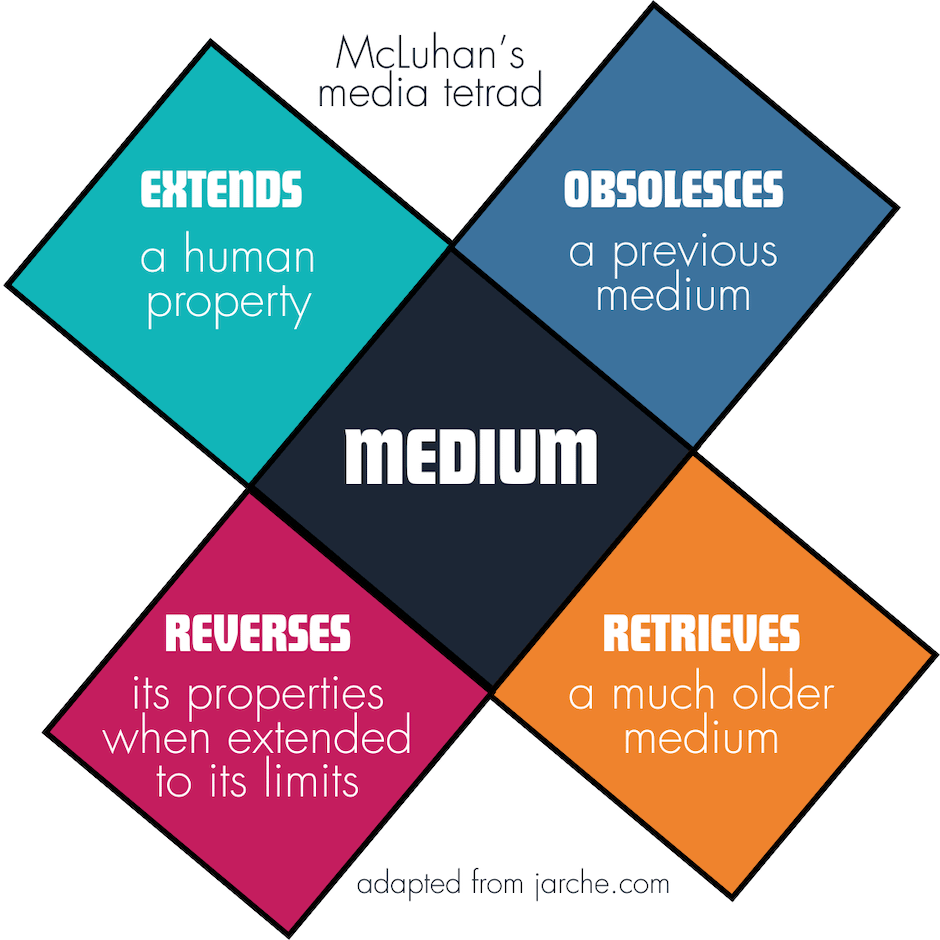
McLuhan posits through his Laws of Media that every new medium results in four effects. Jarche explains that under McLuhan’s laws, each new medium:
Extends a human property,
Obsolesces the previous medium (& makes it a luxury good)
Retrieves a much older medium &
Reverses its properties when pushed to its limits
When we take time to understand what happens with new media, we can put in place steps to negate or minimize the negative effects. Ample examples exist of ways that social media extends humans’ voices, while ultimately making healthy, human-to-human conversation obsolete. Then, our more tribal affiliations can kick in (Twitter, anyone?) and we reverse into “populism and demagoguery,” according to Jarche’s example.
Jarche writes:
The reversals are already evident — corporate surveillance, online orthodoxy, life as reality TV, constant outrage to sell advertising. The tetrads give us a common framework to start addressing the effects of social media pushed to their limits. Once you see these effects, you cannot un-see them.
My Example
As I mentioned earlier, I’ve selected the “smart” phone as the medium to analyze.
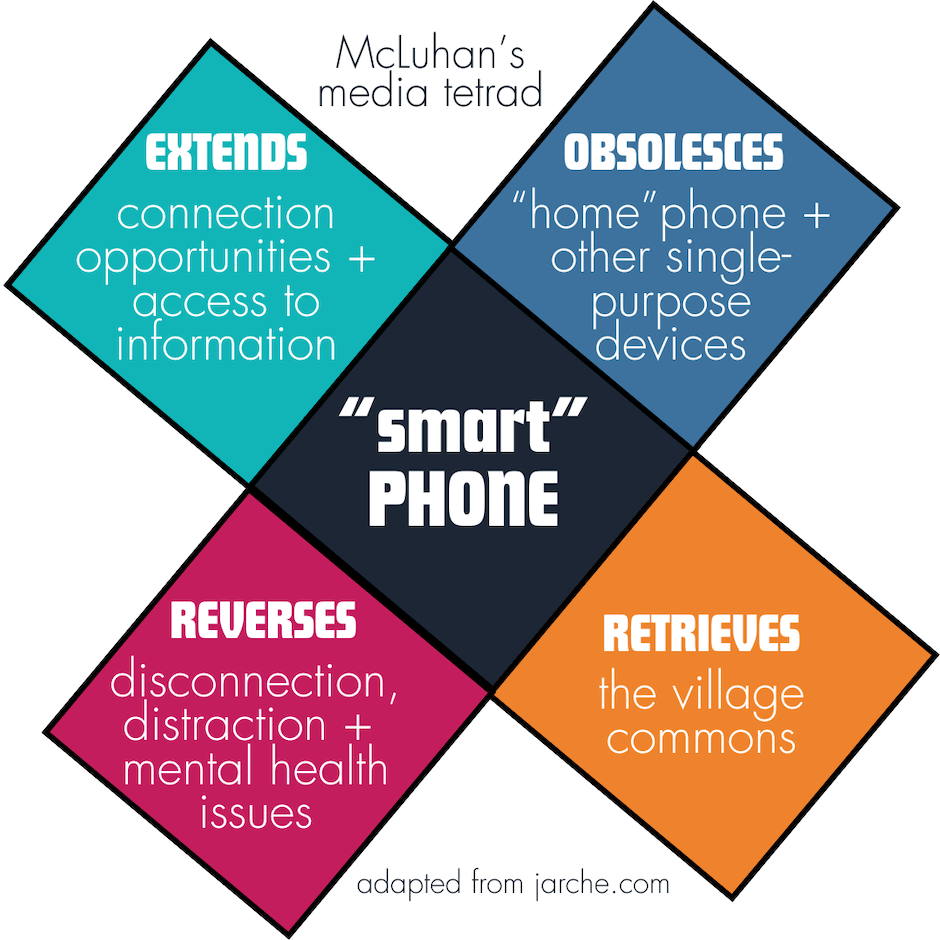
Here’s my attempt at the tetrad:
Jarche suggested that we first explore what the technology enhances and then what it obsolesces. That felt easy and hard, simultaneously. Today’s “smart” phones contain so many features that the definition of what this technology is can be blurred. Our son, for example, has understandably brought up that when adults raise concerns about phones, they can often be actually talking about social media (which he presently has zero interest in).
The “smart” phone:
Extends: connection opportunities and access to information
Obsolesces: “home” phone + other single-purpose devices
As Jarche predicted, these two elements of the tetrad were fairly easy to identify (though I could have chosen to go in a bunch of different directions). I can still recall what it felt like to go with my brother to a convenience store that was about two miles from our house and involved climbing down a super steep, dirt hill. The idea that I could have called my Mom to ask her to pick us up, so we could have avoided the steep hill on the way home would not have occurred to me at the time.
That’s despite the fact that we watched Star Trek as a family and they had these transporter beams that would transmit the characters in the show from the starship and a planet’s surface.
The idea of extending our home phone to one that could be carried around in my pocket (if women’s pants had pockets, that is…) would have been a welcome idea to me. Then, there are all the other single-purpose devices that the “smart” phone can take the place of, such as:
📞 Landline phone
📷 Camera
🎧 MP3 player
🗺️ GPS
⏰ Alarm clock
📺 Video player
💾 Disk or hard drive
📝 Notepad
🧮 Calculator
💡 Flashlight
💳 Wallet
🧭 Compass
✉️ Mail service
I could have kept going with that list for a long time and just be getting started.
Productive Struggle
Cognitive psychologists talk about how helpful productive struggle can be in the learning process. As Jarche thought we might, I had trouble with what the smart phone might retrieve a much older medium, in terms of the way I had anchored the framework with the other two components (extends and obsolesces). I then moved my focus over to the reverses portion of the tetrad and thought how it was the polar opposite (disconnection) of what it promises to extend (connection).
For the retrieves part, I kept getting stuck between two, broad ideas: the pubic square or the commons.
I considered how the promise of today’s phones as the device to connect us with others and with information winds up making loneliness more likely and seeding a potential decline in mental health. I also fixated on how the “extends, obsolesces, and reverses” descriptions I had come up with were more geared toward individuals, yet the promise of the common good is only possible when we come together in community.
I would like to learn more about the history of the public square, as well as regarding the commons in medieval and early modern Europe. I’m also intrigued to keep my learning going regarding “the commons” in digital contexts (Wikipedia, Wikis, Creative Commons, etc.). There are also a lot of places I continue to want to explore about the attention economy and surveillance capitalism.
Until next time, when I share my reflections from Jarche’s Fake News lesson. That should be fun, ehh? Nothing going on there in the world, right? 🫠
In SRHE News and Blog a series of posts is chronicling, decade by decade, the progress of SRHE since its foundation 60 years ago in 1965. As always, our memories are supported by some music of the times.
So here we are, with many people taking stock of where HE had got to in 2005 – suddenly I see. Evan Schofer (Minnesota) and John W Meyer (Stanford) looked at the worldwide expansion of HE in the twentieth century in the American Sociological Review, noting that: “An older vision of education as contributing to a more closed society and occupational system—with associated fears of “over-education”—was replaced by an open-system picture of education as useful “human capital” for unlimited progress. … currently about one-fifth of the world cohort is now enrolled in higher education.”
Mark Olssen (Surrey) and Michael A Peters (Surrey) wrote about “a fundamental shift in the way universities and other institutions of higher education have defined and justified their institutional existence” as different governments sought to apply some pressure. Their 2005 article in the Journal of Educational Policy traced“… the links between neoliberalism and globalization on the one hand, and neoliberalism and the knowledge economy on the other. … Universities are seen as a key driver in the knowledge economy and as a consequence higher education institutions have been encouraged to develop links with industry and business in a series of new venture partnerships.”
Åse Gornitzka (Oslo), Maurice Kogan (Brunel) and Alberto Amaral (Porto) edited Reform and Change in Higher Education: Analysing Policy Implementation, also taking a long view of events since the publication 40 years earlier of Great Expectations and Mixed Performance: The Implementation of Higher Education Reforms in Europe by Ladislav Cerych and Paul Sabatier. The 2005 book provided a review and critical appraisal of current empirical policy research in higher education with Kogan on his home territory writing the first chapter, ‘The Implementation Game’. At the same time another giant of HE research, SRHE Fellow Michael Shattock, was equally at home editing a special issue of Higher Education Management and Policyon the theme of ‘Entrepreneurialism and the Knowledge Society’. That journal had first seen the light of day in 1977, being a creation of the OECD programme on Institutional Management in Higher Education, a major supporter of and outlet for research into HE in those earlier decades. The special issue included articles by SRHE Fellows Ron Barnett and Gareth Williams, and by Steve Fuller (Warwick), who would be a keynote speaker at the SRHE Research Conference in 2006. The journal’s Editorial Advisory Group was a beautiful parade of leading researchers into HE, including among others Elaine El-Khawas, (George Washington University, Chair), Philip Altbach (Boston College, US), Chris Duke (RMIT University, Australia), Leo Goedegebuure (Twente), Ellen Hazelkorn (Dublin Institute of Technology), Lynn Meek (University of New England, Australia), Robin Middlehurst (Surrey), Christine Musselin (Centre de Sociologie des Organisations (CNRS), France), Sheila Slaughter (Arizona) and Ulrich Teichler (Gesamthochschule Kassel, Germany).
I’ve got another confession to make – Shattock had been writing about entrepreneurialism as ‘an idea for its time’ for more than 15 years, paying due homage to Burton Clark. The ‘entrepreneurial university’ was indeed a term “susceptible to processes of semantic appropriation to suit particular agendas”, as Gerlinde Mautner (Vienna) wrote in Critical Discourse Studies. It was a concept that seemed to break through to the mainstream in 2005 – witness, a survey by The Economist, ‘The Brains Business’ which said: “America’s system of higher education is the best in the world. That is because there is no system … Europe hopes to become the world’s pre-eminent knowledge-based economy. Not likely … For students, higher education is becoming a borderless world … Universities have become much more businesslike, but they are still doing the same old things … A more market-oriented system of higher education can do much better than the state-dominated model”. You could have it so much better, said The Economist.
An article by Simon Marginson (then Melbourne, now Oxford via UCL), ‘Higher Education in the Global Economy’, noted that “… a new wave of Asian science powers is emerging in China (including Hong Kong and Taiwan), Singapore and Korea. In China, between 1995 and 2005 the number of scientific papers produced each year multiplied by 4.6 times. In South Korea … 3.6 times, in Singapore 3.2. … Between 1998 and 2005 the total number of graduates from tertiary education in China increased from 830,000 to 3,068,000 ….” (and Coldplay sang China all lit up). Ka Ho Mok (then Hang Seng University, Hong Kong) wrote about how Hong Kong institutional strategies aimed to foster entrepreneurship. Private education was booming, as Philip Altbach (Boston College) and Daniel C Levy (New York, Albany) showed in their edited collection, Private Higher Education: a Global Revolution. Diane Reay (Cambridge), Miriam E David and Stephen J Ball (both IoE/UCL) reminded us that disadvantage was always with us, as we now had different sorts of higher educations, offering Degrees of choice: class, race, gender and higher education.
The 2005 Oxford Review of Educationarticle by SRHE Fellow Rosemary Deem (Royal Holloway) and Kevin J Brehony (Surrey) ‘Management as ideology: the case of ‘new managerialism’ in higher education’ was cited by almost every subsequent writer on managerialism in HE. 2005 was not quite the year in which journal articles appeared first online; like many others in 2005 that article appeared online only two years later in 2007, as publishers digitised their back catalogues. However by 2005 IT had become a dominant force in institutional management. Libraries were reimagined as library and information services, student administration was done in virtual learning environments, teaching was under the influence of learning management systems.
The 2005 book edited by Paul Ashwin (Lancaster), Changing higher education: the development of learning and teaching, reviewed changes in higher education and ways of thinking about teaching and learning over the previous 30 years. Doyenne of e-learning Diana Laurillard (UCL) said: “Those of us working to improve student learning, and seeking to exploit elearning to do so, have to ride each new wave of technological innovation in an attempt to divert it from its more natural course of techno-hype, and drive it towards the quality agenda.” Singh, O’Donoghue and Worton (all Wolverhampton) provided an overview of the effects of eLearning on HE andin an article in the Journal of University Teaching Learning Practice.
UK HE in 2005
Higher education in the UK kept on growing. HESA recorded 2,287,540 students in the UK in 2004-2005, of whom 60% were full-time or sandwich students. Universities UK reported a 43% increase in student numbers in the previous ten years, with the fastest rise being in postgraduate numbers, and there were more than 150,000 academic staff in universities.
Government oversight of HE went from the Department for Education (DfE) to the Department for Education and Employment (DfEE), then in 2001 the Department for Education and Skills (DfES), which itself would only last until 2007. Gillian Shepherd was the last Conservative Secretary of State for Education before the new Labour government in 1997 installed David Blunkett until 2001, when Estelle Morris, Charles Clarke and Ruth Kelly served in more rapid succession. No party would dare to tangle with HE funding in 1997, so a cross-party pact set up the Dearing Review, which reported after the election. Dearing pleaded for its proposals to be treated as a package but government picked the bits it liked, notably the introduction of an undergraduate fee of £1000, introduced in 1998. Perhaps Kelly Clarkson got it right: You had your chance, you blew it.
The decade after 1995 featured 12 separate pieces of legislation. The Conservative government’s 1996 Education (Student Loans) Act empowered the Secretary of State to subsidise private sector student loans. Under the 1996 Education (Scotland) Act the Scottish Qualifications Authority replaced the Scottish Examination Board and the Scottish Vocational Education Council. There was a major consolidation of previous legislation from the 1944 Education Act onwards in the 1996 Education Act, and the 1997 Education Act replaced the National Council for Vocational Qualifications and the School Curriculum and Assessment Authority with the Qualifications and Curriculum Authority.
The new Labour government started by abolishing assisted places in private schools with the 1997 Education (Schools) Act (an immediate reward for party stalwarts, echoed 20 years later when the new Labour government started by abolishing VAT relief for private schools). The 1998 Education (Student Loans) Act allowed public sector student loans to be transferred to the private sector, which would prompt much subsequent comment and criticism when tranches of student debt were sold, causing unnecessary trouble. The 1998 Teaching and Higher Education Act established General Teaching Councils for England and Wales, made new arrangements for the registration and training of teachers, changed HE student financial support arrangements and allowed fees to rise to £3000, passing narrowly after much Parliamentary debate. The 1998 School Standards and Framework Act followed, before the 2000 Learning and Skills Act abolished the Further Education Funding Councils and set up the Learning and Skills Council for England, the National Council for Education and Training for Wales, and the Adult Learning Inspectorate. The 2001 Special Educational Needs and Disability Act extended provision against discrimination on grounds of disability in schools, further and higher education.
The 2004 Higher Education Act established the Arts and Humanities Research Council, created a Director of Fair Access to Higher Education, made arrangements for dealing with students’ complaints and made provisions relating to grants and loans to students in higher and further education. In 2005 in the Journal of Education PolicyRobert Jones (Edinburgh) and Liz Thomas (HE Academy) identified three strands – academic, utilitarian and transformative – in policy on access and widening participation in the 2003 White Paper which preceded the 2004 Act. They concluded that “… within a more differentiated higher education sector different aspects of the access discourse will become dominant in different types of institutions.” Which it did, but perhaps not quite in the way they might have anticipated.
John Taylor (then Southampton) looked much further back, at the long-term implications of the devastating 1981 funding cuts, citing Maurice Kogan and Stephen Hanney (both Brunel) “Before then, there was very little government policy for higher education. After 1981, the Government took a policy decision to take policy decisions, and other points such as access and efficiency moves then followed.”.
SRHE and research into higher education in 2005
With long experience of engaging with HE finance policy, Nick Barr and Iain Crawford (both LSE) boldly titled their 2005 book Financing Higher Education: Answers From the UK. But policies were not necessarily joined up, and often pointed in different directions, as SRHE Fellow Paul Trowler (Lancaster), Joelle Fanghanel (City University, London) and Terry Wareham (Lancaster) noted in their analysis, in Studies in Higher Education, of initiatives to enhance teaching and learning: “… these interventions have been based on contrasting underlying theories of change and development. One hegemonic theory relates to the notion of the reflective practitioner, which addresses itself to the micro (individual) level of analysis. It sees reflective practitioners as potential change agents. Another relates to the theory of the learning organization, which addresses the macro level … and sees change as stemming from alterations in organizational routines, values and practices. A third is based on a theory of epistemological determinism … sees the discipline as the salient level of analysis for change. … other higher education policies exist … not overtly connected to the enhancement of teaching and learning but impinging upon it in very significant ways in a bundle of disjointed strategies and tacit theories.”
SRHE Fellow Ulrich Teichler (Kassel) might have been channelling The Killers as he looked on the bright side about the growth of research on higher education in Europe in the European Journal of Education: “Research on higher education often does not have a solid institutional base and it both benefits and suffers from the fact that it is a theme-base area of research, drawing from different disciplines, and that the borderline is fuzzy between researchers and other experts on higher education. But a growth and quality improvement of research on higher education can be observed in recent years …”
European research into HE had reached the point where Katrien Struyven, Filip Dochy and Steven Janssens (all Leuven) could review evaluation and assessment from the student’s point of view in Evaluation and Assessment in Higher Education:“… students’ perceptions about assessment significantly influence their approaches to learning and studying. Conversely, students’ approaches to study influence the ways in which they perceive evaluation and assessment.” Lin Norton (Liverpool Hope) and four co-authors surveyed teachers’ beliefs and intentions about teaching in a much-cited article in Higher Education: “… teachers’ intentions were more orientated towards knowledge transmission than were their beliefs, and problem solving was associated with beliefs based on learning facilitation but with intentions based on knowledge transmission.” Time for both students and teachers to realise it was not all about you.
SRHE had more than its share of dislocations and financial difficulties in the decade to 2005. After its office move to Devonshire Street in London in 1995 the Society’s financial position declined steadily, to the point where survival was seriously in doubt. Little more than a decade later we would have no worries, but until then the Society’s chairs having more than one bad day were Leslie Wagner (1994-1995), Oliver Fulton (1996-1997), Diana Green (1998-1999), Jennifer Bone (2000-2001), Rob Cuthbert (2002-2003) and Ron Barnett (2004-2005). The crisis was worst in 2002, when SRHE’s tenancy in Devonshire Street ended. At the same time the chairs of SRHE’s three committees stepped down and SRHE’s funds and prospective income reached their lowest point, sending a shiver down the spine of the governing Council. The international committee was disbanded but the two new incoming committee chairs for Research (Maria Slowey, Dublin City University) and Publications (Rosemary Deem, Royal Holloway) began immediately to restore the Society’s academic and financial health. SRHE Director Heather Eggins arranged a tenancy at the Institute of Physics in 76 Portland Place, conveniently near the previous office. From 2005 the new Director, Helen Perkins, would build on the income stream created by Rosemary Deem’s skilful negotiations with publishers to transform the Society’s finances and raise SRHE up. The annual Research Conference would go from strength to strength, find a long-term home in Celtic Manor, and see SRHE’s resident impresario François Smit persuade everyone that they looked good on the dancefloor. But that will have to wait until we get to SRHE in 2015.
Rob Cuthbert is editor of SRHE News and the SRHE Blog, Emeritus Professor of Higher Education Management, University of the West of England and Joint Managing Partner, Practical Academics. Email [email protected]. Twitter/X @RobCuthbert. Bluesky @robcuthbert22.bsky.social.
In the late 1990s, a group of commuters would board the early-morning Amtrak train from Philadelphia to Washington, D.C. They’d sit in the first car behind the locomotive, enjoying communal, consensual silence. Eventually and with the conductor’s help, their car was officially designated as a noise-free zone. Soon after, Denise LaBencki-Fullmer, an Amtrak manager, recognized the value of a peaceful ride and institutionalized the program as the quiet car. At the request of passengers, it soon spread to a number of other commuter services.
The educational technology sector has something to learn from the Amtrak commuters’ deliberate design of their environment. Learning requires the ability to concentrate. You need a space where you are allowed to process information, recall facts, analyze complex questions and think creatively about ideas, problems and solutions. Learning is not a smooth and easy process—in fact, it is desirable that it’s a bit difficult, because that is how we actually learn. Getting someone to do learning tasks for you, as tempting or comfortable as that might be, won’t work.
A great deal of learning still happens online, even at colleges that value in-person teaching as much as Princeton University does. The learning management system is where our students find readings, review lecture slides and practice their skills and comprehension on homework assignments. It is also where many instructors administer assessments, both low-stakes quizzes and high-stakes exams.
Last month, Google launched a feature called “Homework help” in Chrome—a shiny blue button right in the address bar. By engaging it, a student could prompt Google Gemini to summarize a reading or solve a quiz question in a matter of seconds. It thereby robbed the student of the learning activity that they were there to do. A few weeks later Google repositioned the feature so it is a bit less obvious (at least for now), but the question remains: What kind of AI tools should we make available to our students in learning management systems and assessment platforms?
You might be thinking that this is a pointless question: AI is going to be everywhere—it already is. And sure, that is true. Also, if a student wants to use AI, it is easy enough to open another browser tab and ask an LLM for help. But installing the AI right in the environment in which the student is trying to learn is equivalent to sitting next to the most obnoxious cell yeller on your train ride: You can’t think your own thoughts, because the distraction is so big.
Just as there are quiet cars on trains, there can be quiet areas of the internet. Learning management systems and assessment platforms should be one such area. That doesn’t mean that there can’t be good uses of AI in learning. Our students should know how to use AI responsibly, thoughtfully and critically, as should the faculty who teach them (I sometimes use AI in my own teaching, for instance). But we should also ask that the companies that provide us with learning technologies think critically and carefully about whether AI aids the difficult, careful work that learning requires or, in fact, removes the opportunity for it. AI is inevitable, but that doesn’t mean we can’t be intentional about how, why and where we implement it.
I have spent the last few weeks talking with colleagues at other colleges and universities and with the partners that provide our educational technology. Everyone I have spoken with cares about education, and none of them think it’s a good idea that we implement AI in a way that so clearly pulls students out of the learning process. It is actually not unrealistic that people in the tech industry and education sector come together to make the same kind of pact that the train commuters made some 25 years ago and declare our online learning systems an AI quiet zone. We would be doing the right thing by our students if we did.
Mona Fixdal provides strategic planning and pedagogical leadership for Princeton University’s suite of teaching and learning technologies as well its online learning program. She has a Ph.D. in political science from the University of Oslo and is the author of Just Peace: How Wars Should End and a number of chapters and articles on postwar justice and third-party mediation.