The university has vowed to honor financial commitments made to M.F.A. and Ph.D. students.
Brown University will give money to some of its graduate students whose federal research grants were cut by the Trump administration, The Brown Daily Herald reported.
“We want to make sure that we’re able to give each of you all of the attention and support that you need to get through comfortably [and] well supported,” Janet Blume, interim dean of the graduate school, said at a Graduate Student Council meeting Wednesday. She said the university will honor the financial commitments of M.F.A. and Ph.D. students who lost their grants.
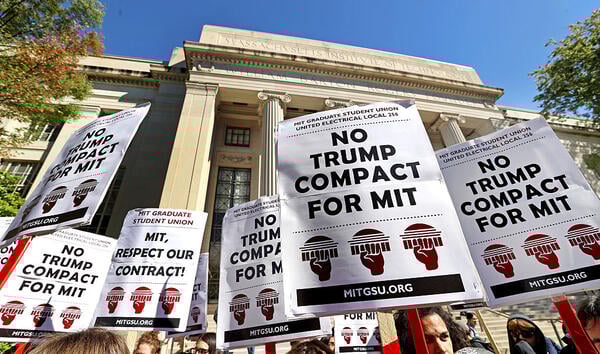
The National Institutes of Health, the National Science Foundation and other federal agencies have terminated thousands of academic researchers’ grants—including many at Brown—that don’t align with the Trump administration’s ideological agenda.
Blume said Brown is also reducing its graduate student admissions target this year to allow “time to work out issues of the federal financial landscape and also shifts in the job market.”
In addition to canceling research grants, numerous federal agencies have put forth plans to cap the amount of money they reimburse universities to cover indirect research costs, which universities say will hurt their budgets and slow innovation. Brown is among the institutions suing the government over its changes to indirect cost reimbursement rates, which are on pause during ongoing litigation.
Brown, which had a $46 million deficit before President Trump took office in January, has also faced targeted scrutiny from the Trump administration. The university implemented a hiring freeze in March. In April, the government froze $510 million of Brown’s federal research dollars in retaliation for the university’s alleged failures to address antisemitism on campus.
In June, administrators warned of the potential for “significant cost-cutting” measures amid the “deep financial losses” resulting from grant cuts, increased endowment taxes and threats to international student enrollment.
The following month, Brown and the government came to an agreement, and the frozen grant money is coming back to the university. However, the deal did not restore the grants of researchers whose funding was terminated as part of the broader ideologically driven policy changes.
The U.K. and China will be the biggest beneficiaries of the U.S. health secretary’s “own goal” of pulling funding for mRNA vaccines, according to experts.
Paul Hunter, professor of medicine at the University of East Anglia, said other countries with active biotechnology industries will benefit, but the decision will still delay the development of new vaccines worldwide.
“Progress will continue but not as quickly as otherwise. Lives will be lost that could have been saved had there been a vaccine,” he told Times Higher Education.
The U.S. Department of Health and Human Services said 22 projects by major pharmaceutical companies, including Pfizer and Moderna, will be affected. The projects were working on vaccines against bird flu and other viruses.
“It will certainly make the U.S. poorer for not having a biotechnology industry that is not as competitive as it could be,” added Hunter. “The U.S. will certainly lose out to China and Europe, and when its researchers move overseas, it may not be easy to get them to return later.”
Kennedy said mRNA technology “poses more risks than benefits” for respiratory viruses and announced a shift toward “safer, broader vaccine platforms that remain effective even as viruses mutate.”
“I would certainly say it’s an own goal for the U.S. and something they are likely to regret,” said Robin Shattock, professor of mucosal infection and immunity at Imperial College London.
Shattock said innovation would continue at pace in the U.K., mainland Europe and Asia. While China pushes ahead with RNA technologies, the U.S. appears to be looking to shift to older technology used by Chinese companies.
“This current retrograde step by the U.S. will allow others to catch up and likely pull ahead in the context of vaccines,” he added. “It will only take another pandemic for them to rapidly see their mistake.”
“The disinvestment in mRNA vaccine development and production is, in my view, a serious error.”
“It is a blow to the U.S.’ own interests—they’re shooting themselves in the foot.”
In the absence of any strong evidence that COVID-19 vaccines caused adverse reactions, Bangham said it was hard to rationalize why the U.S. was acting so decisively on “the basis of a few anecdotes.”
“It’s more than a lack of competency. I think it’s active and explicit, and often voiced, opposition and denigration and disavowal of the value of scientific evidence, which I think is extremely damaging.”
Along with the U.K., Europe and China, there are now “huge opportunities” for research development in Southeast Asia, he added.
The Sept. 3 ruling for Harvard by federal judge Allison Burroughs is the most important decision so far for defending academic freedom against the attacks by the Trump administration. The permanent injunction against the Trump administration’s ban on funding to Harvard will eliminate much of the Trump regime’s ability to hold Harvard hostage—unless it is able to find a higher court willing to defend these illicit attacks on higher education and free expression.
With this ruling, Columbia’s decision to submit to the Trump administration and pay $221 million looks not merely spineless but financially stupid. While former Harvard president Lawrence Summers praised Columbia’s submission and urged Harvard to obey, a large group of Harvard faculty and students fortunately pressured their administrators to hold firm, at least for long enough to enable a court ruling that restores the money researchers at Harvard are entitled to.
Now that this ruling has been won, Harvard needs to take the fight to its conclusion. It cannot settle with the Trump administration and give away this victory, since that would leave Harvard at the mercy of Trump officials anytime they decided to punish Harvard again. A settlement by Harvard now would be not only cowardly but crazy.
The conservatives on the Supreme Court may soon be forced to choose between obeying the law and the Constitution or obeying Donald Trump, and they have shown little desire to defy the president’s commands no matter how illicit they are.
The most likely path for the Supreme Court justices to help the Trump administration destroy higher education is jurisdictional. The Trump administration argued unsuccessfully that this entire lawsuit must be heard in another federal court because it relates to federal contracts.
The court could order that the legal process begin anew in a different court, reinstate the Trump bans against Harvard and hope that the long pathway to a resolution would pressure Harvard to give Trump his $500 million extortion and agree to suppress academic freedom without the Supreme Court needing to review a case where the law is unquestionably on Harvard’s side.
But while the unprincipled political hacks who dominate the Supreme Court make that evasion of moral and legal responsibility a possible result, it’s also possible that enough conservative justices have a modicum of integrity left to question the obviously illegal and unconstitutional attacks on Harvard—not because they like Harvard, but because they recognize the necessity of the Supreme Court restraining a president who is indifferent to the law and the Constitution.
It’s important to point out just how dumb the Trump administration officials are. By issuing a May 5 freeze order stating, “Today’s letter marks the end of new grants for the University,” the Trump administration removed any possible doubt that it had made a final decision against Harvard in violation of the law and the First Amendment.
If the Trump administration had simply frozen grants but pretended to make an ongoing evaluation, it might have created enough doubt to survive judicial scrutiny long enough to force Harvard into submission. Instead, the overwhelming desire to punish Harvard by any means possible may ultimately lose this case for the Trump administration. For all of the partisan posturing and ideological bias, some judges still will follow the law, and the law is clearly on Harvard’s side, as the Foundation for Individual Rights and Expression noted in what it called “the flatly unlawful and unconstitutional means used by the Trump administration in this attempted hostile takeover.”
Every other university now has a clear path for what it needs to do: resist, sue, win. It’s absolutely shocking that Harvard has been the only university to (however reluctantly) undertake the aggressive litigation approach that is the only reasonable strategy against the repression of the Trump regime.
The fight by Harvard against Trump’s authoritarianism could be a victory not just for higher education, but for democracy. But Harvard needs to keep on fighting if it wants to prevail.
This summer, I did a gig as an international cat courier. As a favor, I agreed to fly from my home in Spokane, Wash., to D.C., meet my sister-in-law and travel with her to her new government post—taking responsibility for one of her two cats—on a plane to Algiers.
Having never visited a Muslim country, I was game, though people who’d traveled widely warned me that Algiers is unusually conservative and restrictive. I got warnings not to ask about religion or politics. A friend who works for the U.N. gave me a talking-to about what to wear, which boiled down to: no exposed skin.
My sister-in-law would start work the day after we arrived, so I’d be on my own in a country where my options were limited. You cannot use credit cards, only cash, and can’t change money. I’d tough it out and then five days later head to Italy for a vacation.
The only thing I could do in Algiers was walk around, make friends with many street cats, and talk to strangers. In French brushed up from college with some recent Duolingo practice, I spoke with shopkeepers, chatted with security guards outside embassies and met people hanging out on the streets. I didn’t always bother conjugating verbs and probably misgendered every noun.
What I found were people who love their homeland and were eager to show me around. Even in a country that fought for independence in the 1960s, endured a bloody civil war in the ’90s and now exists under a repressive government, pride endured. But I also noticed what wasn’t there: easy travel, open political discourse, casual criticism of authority. Their pride lived alongside careful silence.
In my layover on the way home, I struck up a conversation with a Delta employee from Algeria. I told him how generous and openhearted I’d found everyone I’d met. His face lit up. “It’s good now. It’s better.” But when he spoke of the government and the civil war—even in the Minneapolis airport—his voice dropped to a whisper.
He now lived in the U.S., scanning bags as they rode around the carousel, having earned a Ph.D. in economics in his home country and taught for 30 years at a university in Poland. He would be going “home” to Algeria in September.
People, I’m just gonna go there and say it: I love America.
Given my politics, profession and (hippie Vietnam War–protesting) parentage (father: regional public faculty; mother: community college and Ivy lecturer), I’m a little surprised to find myself feeling a surge of patriotism, especially these days, I know I’m expected to be cynically critical of everything our (legitimate) government does. Many of my friends and colleagues dismiss folks who vote differently from us and wave a virtue flag at “those people” who drape their homes in red, white and blue.
And yet, many who share my convictions about diversity, equity and inclusion have often been intolerant of others. We’ve gotten shouty, telling others they’re wrong, uneducated and a bucket of creeps. Maybe some of them are. Maybe some of us are, too. But we sure have stopped talking to each other. We’re not even getting the same news or finding the same facts. Some of my friends say they’ve become numb to what’s coming out our nation’s capitol. Not me. Every day I am shocked by where we are now, and where I fear we might be heading (another bloody civil war).
In academe, we have the luxury to spout off. We spouted and in 2016 learned a big lesson: Not everyone was buying what we were selling. Which is how we got to the current political, cultural and societal shit show.
And yet, I still love America. I love the values expressed in the documents that established us, written in such beautiful language I often assign them to creative writing students. The autobiography of our funniest founder—the first best-selling book—still carries so much wit and wisdom I’m filled with awe and envy when I reread it. The America Lincoln described in speeches with the brevity and power of a prose poem can bring me to my knees. And I love that over the past two centuries, our best leaders hoped by their criticism to form a more perfect union, to correct the many things we’ve gotten wrong.
Just before I boarded a long and uncomfortable flight, a friend sent me a link to Ronald Reagan’s last speech. In it, he quoted from a letter he’d received: “You can go to live in France, but you cannot become a Frenchman … But anyone, from any corner of the Earth, can come to live in America and become an American.” His point: “If we ever closed the door to new Americans, our leadership in the world would soon be lost.”
If you’d told me decades ago I’d write in praise of Ronald freaking Reagan, I’d have said that’s as likely as 2001: A Space Odyssey’s HAL becoming reality. But, well, here we are.
We can’t stop critiquing our country—that’s the essence of democracy and the real value of higher ed. But instead of just spouting off about what’s wrong with America, we need to model how to engage constructively with imperfect institutions. We need to teach our students how to critique while also participating, how to demand better while acknowledging what’s worth preserving.
Seeing a country like Algeria, that has closed itself down politically, isolated from the other North African nations and in many ways the rest of the world, even after throwing off colonial rule, felt like a cautionary example. In higher education, when we shut ourselves off to uncomfortable truths or dismiss those who disagree with us, we risk becoming like that whispered conversation in the airport—fearful, constrained, diminished.
Which is why, after five days of wandering Algiers with bad French and heat-slick layers of covered skin, I boarded my flight to Rome to stuff myself with pasta alla carbonara, gelato and vigorous discussions about what’s wrong with today’s world with an odd mix of relief and resolve. You don’t have to think your country’s perfect to love it, but you do have to notice when the door’s still open and fight to keep it that way. In democracy, as in academe, the moment we stop letting in new voices, new challenges, new possibilities, we begin to die from the inside out.
Rachel Toor is a contributing editor at Inside Higher Ed and the co-founder of The Sandbox, a weekly newsletter that allows presidents and chancellors to write anonymously. She is also a professor of creative writing and the author of books on weirdly diverse subjects. Reach her here with questions, comments and complaints compliments.
I will never forget the student who—upon being given 15 minutes at the end of class to get rolling on the writing assignment I’d just given—whipped out their phone and starting furiously typing away.
At first, I thought this was an act of defiance, a deliberate wasting of time I’d been generous enough to provide following a carefully constructed discussion activity that was meant to give students sufficient kindling to get the flames of the first draft flickering to life.
I said something about maybe texting people later and the student said that they were working on their draft, that they, in fact, first wrote everything on their phone. Not wanting to make a fuss in the moment, I shut up about it, but a week or so later in an individual conference I asked the student about their method, and they showed me the reams and reams of text in their phone’s Notes app.
The phone itself was a fright, the screen cracked, a particularly dense web of fractures at the bottom, but when I asked the student to show me how they used the app for writing, it became clear that they could type at a speed comparable or better to the average student on a computer keyboard.
I’d been teaching the writing process for my entire career, talking students through the steps and sequence to producing a satisfactory piece of work—prewriting, drafting, revision, editing, proofreading—with more detailed dives into each of those stages, but until that incident I didn’t fully appreciate that I shouldn’t be teaching the writing process per se, I should be giving students the kinds of challenges that allowed them to develop their own writing processes.
As I considered this distinction, I realized how truly idiosyncratic my own process is and how different it can be depending on the occasion and situation. An outside observer looking at how I put together a column or book or proposal would see all manner of inefficiency and declare my method … madness.
But the key thing about my method is that it’s mine, and I think I have sufficient proof that it works. It may continue to evolve over time, which I suppose we could equate with improvement, but it’s really just different.
My student’s strategy was rooted in resource constraints, both time and money. Typing on the phone had started as a way to get stuff done during brief in-between times when working as a bicycle delivery person for one of the downtown-Charleston sandwich shops. They’d capture a draft on the phone on the fly and then transfer it to a computer for further development. The phone text had notes like “put thing from that thing here” as place markers for sources or evidence.
I realized that this method required the student to fundamentally work from a place of their own thoughts and ideas, something that was actually at odds with some of their first-year writing classmates who had been conditioned to defer to their readings, seeing their job as students to prove that they’d read and (generally) understood the content, rather than building on that content with ideas of their own, as I’d been asking them to do.
At the time of the conference, the student didn’t even have a computer, having had theirs stolen and not having sufficient funds at the time to immediately replace it. The student had been using the terminals in the library computer lab for the nonphone work.
This conference also revealed the reason for the rather up-and-down nature of this student’s work that semester. This was a clearly curious and driven person who had a number of extra challenges at simply completing the work of college. The assignment we were working on at the time, an alternate history analysis where students had to take a past event, change some aspect of it and imagine a different future, was probably the most challenging experience of the semester, but according to my archives at least, it proved to be this student’s best work.
Writing the initial draft untethered from any sources or even being able to easily move between information online and the text on the screen required the student to think creatively and analytically in ways that unlocked interesting insights into their choice of subject. Because of fate and circumstance, and without me really planning it, this student was getting a high-level experience in how to harness their own mind.
I started thinking more deeply about the intersection between the affordances of the tools and the writing process. One of the biggest shifts in my method over the years was when I acquired an external monitor that allowed me to see two full pages of text simultaneously on screen. This was something I’d longed for for years but resisted because I’m cheap. I now have a hard time working without it.
This incident happened as I was also experimenting with approaches to alternative grading, so it became a natural fit to start asking students to reflect more purposefully on the literal mechanics of their writing process so they could identify missing needs that they might be able to fulfill.
At the time I hadn’t yet come up with my framework of the writer’s practice, but now I can see how integral asking students to be this mindful about their own process can be to the development of a practice.
It’s also a good route for introducing mindfulness into the choices they may make when it comes to using generative AI tools. If they understand their labor and its meaning, they will have the capacity to assess how using the tool may enhance or—what I think is more likely—distort their process. It is also a reminder to us to design challenges that encourage the kind of labor we want students to be doing.
Before we retreat to old technology that dodges these challenges, like blue books, I think we could do a lot of good by really leaning in to helping students see writing as an experience that will differ based on their unique intelligences, and that if they pay attention, if what they are doing matters, they can come to know themselves a bit better.
We’ve seen before how, at the end of the nineteenth century, a college for the working classes was opened in Oxford. Ruskin College was strongly associated with the trade union movement, and the left of British politics. And in 1923 a Conservative equivalent opened – the Philip Stott College.
Philip Stott (1858-1937) was, properly, Sir Philip Sidney Stott, and went, apparently, by Sidney Stott. Whichever first names he chose, he was an architect, who specialised in designing cotton mills. And so he became a wealthy and influential man, having designed 77 mills across Oldham and Lancashire more broadly, and having acquired shares in many of them. He had broad interests. He played rugby league for Oldham – the Athletic of 2 November 1881 records him playing at half-back, and making some “very strong runs” in Oldham’s comprehensive victory over Breightmet. He was president of the Oldham Lyceum.
And, as soon as he could afford it, he moved to Gloucestershire, setting up home in Stanton Court, a Grade II listed Jacobean manor house. And here it seems he devoted his time and energy to the Conservative Party: he became president of the local Conservative Association. He was created a baronet in 1920, and in 1925 was High Sheriff of Gloucestershire.
Stott wanted the Conservative Party to have a college of its own. The Conservative Party archives, held at the Bodleian library, record that:
It having been decided to accept the generous offer of Sir Philip Stott, Bt., of the use of Overstone Park, Northampton, for the purposes of a permanent school for the study of Economics and Constitutional History, the first Session for Students commenced there on the 28th April last, and fortnightly courses have continued until the 29th September. During that period over 500 Students attended the College. They have been drawn from all classes, and from all parts of Great Britain, the majority being working men and Trade Unionists. Very encouraging reports have been received of the working of the College, and of the results achieved, the splendid efforts of the Lecturers and Tutors being greatly appreciated. Gifts of books from supporters of the Party and donations to be utilised in the purchase of books for the College Library have been thankfully received and acknowledged. The College was officially opened by the Prime Minister on the 27th September last.
Gloriously, there is footage of the Prime Minister opening the college: this is from British Pathé in October 1923. The Prime Minister at the time was Stanley Baldwin – the first of his three periods in that office. And I defy you to find other footage of a Prime Minister being towed in a car by students acting as horses. This was a different age.
The Spectator in June 1923 ran an account of the college’s early life. The college was initially aimed at working class conservatives, especially trade unionists, and it seems that the idea was to have intensive two-week courses, paid for by local associations and occasional bursaries. But it seems that this was insufficient to pay the college’s way, and its course were broadened to be open to Conservative party members more generally. There’s a good short account of the college (and a photograph from its early years) by Alastair Lexden, Lord Cooke, official historian to the Conservative Party.
The college closed in 1929. By then a rival had been set up by the then Conservative Party chairman, J C C Davidson. Bonar Law Memorial College – later to become the Ashridge Business School – was opened by Stanley Baldwin in 1929. Philip Stott College’s programmes and assets were transferred to the Bonar Law Memorial College, but it seems that nobody consulted Philip Sott about this. Which must have been a little galling. He resigned from the Conservative Party in 1935.
I’ll write more about the Bonar Law Memorial College another day; but for now, here’s a jigsaw of the card – hope you enjoy it.
Following more than a year of scrutiny from Republicans over how Northwestern University handled pro-Palestinian campus protests last year as well as a months-long federal funding freeze, President Michael Schill plans to step down.
Schill, who has been president since 2022, announced his departure Thursday.
“Over the past three years, it has been my profound honor to serve as president of Northwestern University,” Schill wrote in a message to the campus community. “In that time, our community has made significant progress while simultaneously facing extraordinary challenges. Together, we have made decisions that strengthened the institution and helped safeguard its future.”
Schill’s exit marks an end to a tumultuous tenure at Northwestern.
The wealthy private institution in Illinois has weathered attacks from congressional Republicans over a deal Schill struck with pro-Palestinian campus protesters who set up an encampment on university grounds. Congress hauled Schill in for a hearing on antisemitism in May 2024 over his agreement with the protesters. Schill agreed to provide more insight and input into university investment decisions, amid demands to divest from companies attached to the Israeli war effort. He also promised more support for Palestinian students and faculty, among other concessions.
(However, Northwestern has not provided the level of endowment transparency it promised.)
The president defended the deal before Congress. Schill, who appeared alongside the leaders of Rutgers University and the University of California, Los Angeles, was the main target for congressional Republicans, but he stood his ground—batting away hypothetical questions and refusing to discuss the conduct of individual faculty members.
Still, accusations that Northwestern mishandled antisemitism have continued to dog Schill since, and the Trump administration launched an investigation into alleged civil rights violations and later froze $790 million in federal research funding at the university, which led to deep job cuts this summer.
Schill and other Northwestern leaders said in July that they were working to restore the research funding and were “hopeful it will happen soon.”
Faculty members and other critics also raised concerns about actions taken by Northwestern under his leadership. Steven Thrasher, a journalism professor involved in pro-Palestinian protests on campus, alleged in March that Northwestern denied him tenure for his activism.
Schill also navigated turmoil in athletics when a whistleblower alleged in late 2002 that hazing was allowed to run unchecked in the football program. Schill briefly suspended and later fired Northwestern football coach Pat Fitzgerald and a subordinate. The coach sued Northwestern for wrongful termination in 2023; the two parties reached an undisclosed settlement last month.
“As I reflect on the progress we have made and what lies ahead, I believe now is the right time for new leadership to guide Northwestern into its next chapter,” Schill said Wednesday.
Schill will remain in his role until an interim president steps into the job.
Schill’s pending exit now means only one of seven campus leaders who were called to testify in congressional hearings on campus antisemitism in late 2023 and 2024 still has her job. Leaders at Harvard University, the University of Pennsylvania, Columbia University, UCLA, Rutgers and now Northwestern stepped down within a year of the hearings. (Then–UCLA chancellor Gene Block was already set to retire.) Only Sally Kornbluth at Massachusetts Institute of Technology remains in her job.
Rep. Elise Stefanik, a New York Republican, who emerged as one of the more aggressive inquisitors in prior campus antisemitism hearings, celebrated the news on social media.
“LONG overdue!” she wrote on X. “@NorthwesternUni President Michael Schill finally resigned today after he failed protect Jewish students, caved to the demands of the antisemitic, pro-Hamas mob on Northwestern’s campus, and failed to hold students who perpetuate antisemitic attacks accountable at an Education and the Workforce Committee hearing.”
The White House also welcomed Schill’s resignation in an emailed statement.
“The Trump Administration looks forward to working with the new leadership, and we hope they seize this opportunity to Make Northwestern Great Again,” spokesperson Liz Huston wrote.
Welcome back to our fourth season. Time Flies. We’ve gone back to an audio only format ’cause apparently y’all are audio and bibliophiles and not videophiles, so we decided to chuck the extra editing burden. Other than that, though, it’s the same show. Bring you stories on higher education from all around the world. So, let’s get to it.
Today’s guest is Pedro Teixeira. He’s a higher education scholar from the University of Porto in Portugal, focusing to a large extent on the economics of education, but he also just finished a term as that country’s Secretary of State for higher education. That’s a position closer to a junior minister rather than a deputy minister, but it has elements of both.
I first met Pedro about 20 years ago, and I ran into him again this summer in Boston at the Center for International Higher Education’s biannual shindig, where he was giving the Philip Altbach lecture. And let me tell you, this was the best lecture I have listened to in a long time.
Two reasons for this. First, Pedro spoke about his experiences as a Secretary of State trying to negotiate a new funding formula with universities in that country. I won’t spoil the details, but one big highlight for me was that he was in the rare position of being a politician, trying to convince universities not to have a performance-based element in their funding formula. And second, he talked about the future of higher education in the face of possible falling returns to education due to wider adoption of artificial intelligence.
It was such a good talk, I knew my World of Higher Education podcast listeners would think it was great too. And while I couldn’t record it, I did do the next best thing. I invited Pedro to be our lead off guest for this season’s podcast. Let’s listen to what he has to say.
The World of Higher Education Podcast Episode 4.1 | From Funding Formulas to AI: Pedro Teixeira on Higher Education’s Next Challenges
Transcript
Alex Usher: Okay, so Pedro, you were an academic at CIPES (Centre of Research on Higher Education Policy) at the University of Porto, and you went from that to being a minister of state. That’s not an unfamiliar path in Portuguese higher education—Alberto Amal, I think, did something similar. But that move from academia to government, how big a shift was that? What did you learn, and what were you not expecting when becoming a minister of state?
Pedro Teixeira: I think you’re right in the sense that there are quite a few people who have done this, not only in Portugal but also in other parts of Europe, in different areas. And I think it’s always a bit of a challenge, because there’s this expectation that, since you’re an academic—and especially if you’re an expert on the topic—people expect you to have a solution for all the problems. And it’s not exactly like that.
At the same time, I think one is worried that what you do in office will be coherent with what you had advocated as an academic and with what you had written about specific topics. That’s challenging.
In some respects, I wasn’t very surprised by what I faced, because I had been involved in advisory roles and I knew people who had been in that kind of policy role. So I think I wasn’t—I mean, there were the things you expect, like the amount of work and the long days. But I never felt that was really the most difficult part. Of course, going through these things and living them is a little different than knowing them in the abstract.
But I think the main concern for me was the permanent pressures. You are always concerned with something, always worried either about the problems you have to deal with or the problems that will emerge.
What I was not so happy with was the lack of a sense of urgency in some of the actors, both on the government side and on the side of stakeholders in the sector. Because if you feel the problems are significant, you need to move forward—of course not rushing, but you do need to move forward.
On the positive side, I think the quality and dedication of staff was very important. Civil service is often criticized, but I found that very important. And the other thing that was also very important was the role of data and evidence, while at the same time you also need to develop arguments and persuade people about the points you’re trying to make.
Alex Usher: So what were those urgent issues? I know one of the big things you dealt with was a funding formula—and we’ll come to that later—but what, to your mind, were the other big urgent issues in Portuguese higher education at that time?
Pedro Teixeira: As we know, most people in their higher education system always think their system is very specific, very different from everyone else. But in fact, we know there are a lot of commonalities across education sectors.
In many ways, the challenges were the same ones that people describe as belonging to mass systems, or what others might call mature systems. One significant issue, of course, was the adverse demographic trends.
Another was the tension between, on the one hand, wanting to broaden access and enhance equity in the system, and on the other, facing enormous pressures toward stratification and elitism, with the system tending to reproduce socioeconomic inequalities.
There were also issues related to diversity versus isomorphism. On the one hand, people agree that in order for a mass system to function, it needs to be diverse. But there are pressures in the system that tend to push institutions toward mimicking or emulating the more prestigious ones.
The balance between missions is another challenge. This relates to that issue of isomorphism, because research has become so dominant in defining what higher education institutions do and how they see their mission.
And, of course, there were issues of cost and relevance: who should pay for higher education, and how can we persuade society to put more resources into a sector that, because it is a mass system, is already absorbing a significant amount of public funding?
Alex Usher: All right. On that point about demographics, I saw a story in one of the Portuguese newspapers this week saying that applications were down 15% this year. Is that a rapidly evolving situation? That seems like a lot.
Pedro Teixeira: No. There’s been a downward trend over the last three or four years, but because the number of applicants was bigger than the number of places, it didn’t disturb things much. Most of what we’re seeing now is actually due to the fact that in 2020, with the pandemic, exams for the conclusion of secondary education were suspended.
They were only reintroduced this year. That decision was taken at the end—actually by the government I was part of—at the beginning of 2023. But in order to give students and schools time to adjust, the change only applied to the students who were starting secondary education then. Those are the students who applied this year for higher education.
Basically, when you look at the data—we don’t yet have the numbers on how many graduated from secondary education—but the number of applicants is very much in line with what we had in 2019, which was the last year we had exams for the conclusion of secondary education.
And in fact, if you take into account the declining trend of the last three or four years, I would say it’s not a bad result. It actually means the system managed to compensate for those losses.
Alex Usher: Managed to absorb.
Pedro Teixeira: Yeah, yeah. But it’s also a signal for the sector in that respect.
Alex Usher: So let’s go back to the funding formula issue, because I know that was a big part of your tenure as Secretary of State for Higher Education. What was wrong with the old formula, and what did you hope to achieve with a new one?
Pedro Teixeira: There are two things. I think there were some issues with the old formula. It was designed in 2006, so 15 years had passed. The sector was very different by then—the situation, the challenges, everything had changed.
Also, like many formulas of that time, it was quite complicated, with many indicators and many categories for fields of study. That didn’t make the system very transparent. If you introduce too many indicators and variables, in many ways the message you want to convey is lost. A funding formula is supposed to be an instrument to steer the system.
But the larger problem was that this old formula hadn’t been applied for the last 12 years. When the Great Recession started around 2005–2010, the government suspended its application. Since then, the budgets of all institutions have evolved in the same way—same amount, same direction—regardless of their number of students or their performance.
So when we came into government in 2022, the situation was, in many cases, very unbalanced. Some institutions that had grown significantly didn’t have funding to match that growth. Others that had declined hadn’t seen any adjustments either.
The idea of having a new formula was preceded by an OECD review commissioned by the previous government, which we took over. Our idea was to design a simpler and more transparent formula that would form part of the funding system. In addition to the formula, we introduced funding contracts, focused mainly on institutions located in more peripheral regions of the country.
The idea was also to have a four-year period of gradual implementation of the new model and funding system. At the same time, this would correct some of the imbalances caused by not having applied any formula for 12 years.
Alex Usher: And how did institutions respond to those proposals? Were they on your side? Were there things they liked, and things they didn’t like? Universities don’t like change, after all.
Pedro Teixeira: On the other hand, I think a significant part of the sector was very keen to finally have some kind of formula—some set of rules that would be applied to the whole sector. Of course, some institutions were afraid that by reintroducing a formula, given their recent evolution, they might end up on the losing side.
But one of the key aspects of the process was that this was always seen as a formula, or a new system, that would be introduced within a pattern of growth in funding for the sector—not as a way of redistributing funds from some institutions to others. That made the process easier. It would have been much more difficult if we had been taking money from some institutions to give to others.
This required political commitment from the government, and it was very important to have the backing of the Prime Minister and the Minister of Finance. That meant we could correct imbalances without creating disruption for institutions.
I would say the main critical points were, first, the differentiation between sectors. We have a diverse education system with universities and vocational institutions. Then there was the question of whether to differentiate between regions. Our decision was to have a formula that applied in the same way to all regions, and then use funding contracts as additional resources targeted for strategic purposes—mainly for institutions located in more deprived or less populated regions.
Another point raised in discussions was fields of study. Everyone wants their own fields—or the ones in which they are strongest—to be better funded. But we really wanted to simplify the mechanism, and I think that helped.
Finally, there was the issue of performance indicators. We didn’t propose to introduce them from the start. Because we had gone so many years without a formula, we didn’t have consistent data, and moreover we wanted performance indicators to be developed collaboratively with institutions. The idea was that institutions themselves would decide which areas they wanted to focus on, which areas they wanted to contribute to, and therefore which indicators they wanted to be assessed by.
Because we decided that performance indicators would come in a second step, some institutions wanted them introduced earlier. That was also a point of discussion.
Alex Usher: I find that fascinating, because I don’t think I’ve ever heard of universities—maybe “demanding” is the wrong word—but being disappointed that there wasn’t enough performance-based funding in a system. Why do you think that was?
Pedro Teixeira: I’m not sure I was surprised, but it was significant that some institutions were pressing for it. In some ways, it could have been a strategic approach by certain institutions because they thought they would be on the winning side.
But I think it also has to do with the fact that this competitive, performance ethos has so deeply permeated higher education. At some point, I even said to some institutions: be careful what you wish for. Because in some cases, this could curtail your autonomy and increase the possibility of government interference in your ability to devise your own strategy.
Actually, I think that was, in many ways, the only real public criticism that came up. And that was quite interesting, to say the least.
Alex Usher: I want to shift the ground a little bit from Portugal to Boston. Two months ago, you gave the Philip B. Altbach Lecture at Boston College’s Center for International Higher Education. You devoted a lot of your talk to artificial intelligence and how it’s likely to change higher education. Could you tell us a little bit about your views on this?
Pedro Teixeira: That’s a fascinating topic. Of course, it’s an important issue for many people around the world and for many education institutions.
It’s fascinating because, to a certain extent, we’ve been nurtured by a view that has dominated over the last decades—that progress has been skill-biased. In previous waves of technological progress, the labor market tended to favor those with higher skills. Education was often seen as contributing to that, helping people be on the winning side, and the returns to more education and more skills seemed to confirm it.
My concern is that this wave may be slightly different. I’m not saying it will destroy a lot of jobs, but I am concerned that it may affect skilled and experienced workers in ways that previous waves did not.
We’ve already seen, and many of us have already experienced in our own jobs, that AI is performing certain tasks we no longer have to do. It’s also changing the way we perform other tasks, because it works as a collaborative tool.
So I think there is a serious possibility that AI—especially generative AI—will change the tasks associated with many jobs that today require a higher education degree. We need to pay attention to that and respond to it.
I worry that because education has been such a success story over the last half-century in many countries, there is a degree of complacency. People take a relaxed attitude, saying: “We’ve seen previous changes, and we didn’t experience so many problems, so we’ll be fine this time as well.”
I think there are quite a few aspects we need to change in our approach.
Alex Usher: And what might those areas be? Because I have to say, whenever I hear people discussing AI and radical change in the labor market, I think: that’s the stuff that’s actually hardest for higher education to deal with—or for any kind of education to deal with.
Education is often about teaching a corpus of knowledge, and there is no corpus of knowledge about AI. We’re all flailing blindly here—it’s totally new.
I think a lot about James Bessen and his book Learning by Doing. He was talking about how education worked during the Industrial Revolution in Manchester, and in other parts of England that were industrializing. Basically, when there’s a totally new technology, who are you going to get to teach new people? There’s no settled corpus of knowledge about it.
What do you think higher education institutions should be doing in that context?
Pedro Teixeira: One of the major concerns I have is that we tend to focus so much on the impact of digitalization and technology on science and technology fields. But we should be much more attentive to how it’s changing non-technical fields—health professions, the humanities, and the social sciences. These make up a very large part of higher education, and a very large part of the qualified workforce in many of our countries.
I think there are several things we need to do. The first is to rethink the balance between the different missions of higher education. At the moment, so much of the pressure and so many of the rewards are focused on missions other than education, teaching, and learning. We need to rebalance that. If institutions don’t commit themselves to education, it will be much more difficult for anything significant to happen at the basic level—among professors, programs, and so on.
If AI does affect more experienced workers, that means many people will need more support in terms of lifelong learning. They will need support in reskilling, and in some cases, in changing their professional trajectories. This is an area where many higher education institutions preach much more than they practice.
So I think we need to rethink how we allocate our efforts in education portfolios, moving more attention toward lifelong learning. So far, the focus has been overwhelmingly on initial training, which has been the core of the sector in many systems.
Finally, we would need to rethink—or at least introduce—changes at the level of initial training: the way we teach, the way we assess students, the way we train and retrain academic staff. None of this will be obvious. But in the end, it will all come down to how much institutions are committed to education as the prime mission of higher education.
Alex Usher: So even if AI is not a mass job killer—either now or in the future—we are seeing declining rates of return on higher education around the world. There’s massive graduate unemployment in China, quite a bit in India, and in the United States, for the first time, young graduates are less likely to be employed than non-graduates of the same age.
What does it mean for the higher education sector globally if rates of return decline? Are we heading for a smaller global higher education sector?
Pedro Teixeira: I tend to be cautious with some of these conclusions. We may be extracting too much from what could be transitional situations. We’ve seen in the past moments where there were problems adjusting supply and demand for graduates, and those didn’t necessarily lead to a permanent or structural situation where education became less relevant.
In countries like China and India, higher education systems have expanded tremendously in recent years. In some ways, what we’re seeing now is similar to what other countries experienced when they went through massive expansions and the economy couldn’t absorb the rising number of graduates as quickly as the education system was producing them.
It’s also not surprising that in many countries we’re seeing lower relevance of initial training—bachelor’s or first-cycle degrees. That’s a supply-and-demand issue. As systems move from elite to mass, that’s normal. But in many cases, we’ve seen a growing premium for postgraduate degrees and for continuing education. So I’d be cautious about concluding that education will become less and less relevant.
That said, I would repeat my concern about complacency. I don’t necessarily expect a decline in the sector, but perhaps a slower pattern of growth. That will be a challenge, because we’re coming out of decades of relentless growth in many education systems.
I also think we’ll see a broader scope in how we approach education and differences in higher education portfolios. It’s not that there aren’t many things we can do, but it will probably require us to rethink what we expect from professors and where institutions should focus their attention.
Alex Usher: Right. Pedro, thank you so much for being with us today.
Pedro Teixeira: My pleasure.
Alex Usher: And it just remains for me to thank our excellent producers, Sam Pufek and Tiffany MacLennan, and you, our listeners and readers, for joining us. If you have any questions or comments about today’s episode, or suggestions for future episodes, don’t hesitate to get in touch with us at [email protected].
Join us next week when our guest will be the University of Melbourne’s Andrew Norton. He’ll be talking about what lies ahead for Australian higher education under a second Labor government. Bye for now.
*This podcast transcript was generated using an AI transcription service with limited editing. Please forgive any errors made through this service.Please note, the views and opinions expressed in each episode are those of the individual contributors, and do not necessarily reflect those of the podcast host and team, or our sponsors.
In a nearly daily barrage, President Trump and his MAGA forces heave fireballs at science and higher education. In the last weeks alone, the administration has been busy hurling a demand for a billion dollars from the University of California, Los Angeles; axing proven mRNA vaccine research; and demanding colleges submit expanded sex and race data from student applications, among other startling detonations. Amid the onslaught of these unsettling developments, it would be easy to miss the decisive change in conventional scientific and scholarly practice, one so vast that it threatens to overturn our revered American research achievements.
On Aug. 7, Trump issued an executive order that uproots more than a half century of peer review, the standard practice for funding federal scientific grants. Taking approval out of the hands of experts, the new rule makes grant approval contingent upon the assent of political puppets who will approve only those awards the president finds acceptable.
When I first came upon the order, I was immediately struck by how closely it resembles the unquestioned authority granted to senior political appointees in Soviet Russia and Communist China. As if dictated by commissars, the new rule requires officials to fund only those proposals that advance presidential priorities. Cast aside, peer review is now merely advisory.
It took my breath away, suddenly realizing how completely threatening the new order is to the very foundations of the democratic practice of research and scholarship. As Victor Ambros, Nobel laureate and co-discoverer of microRNA, aptly put it, the order constitutes a “a shameless, full-bore Soviet-style politicization of American science that will smother what until now has been the world’s pre-eminent scientific enterprise.”
Decades ago, long before I entered higher ed, I worked at a small publishing company in New York that translated Russian scientific and technical books and journals into English. As head of translations, I’d travel once or twice a year over many years to Moscow and Leningrad (now, once again, St. Petersburg) to negotiate with Soviet publishers to obtain rights to our English translations.
One evening in the late ’60s, I invited a distinguished physicist to join me for dinner at a Ukrainian restaurant not far from my hotel in Moscow. We talked for some time openly over a bottle of vodka about new trends in physics, among other themes. As dinner drew to a close, he let his guard down and whispered a confidence. Mournfully, he told me he’d just received an invitation to deliver the keynote address at a scientific conference in England, but the Party official at his institution wouldn’t permit him to travel. I still remember the sense of being privy to a deep and troubling secret, reflected in the silence that followed and the palpable unease at the table. Shame enveloped him.
Over a couple of dozen years of frequent trips to the Soviet Union and Communist China, I never met a single Party official. My day-to-day interactions were with administrators, editors, researchers and faculty who managed scientific publishing or were involved in teaching, research or other routine matters. The Party secretary remained hidden behind a curtain of power as in The Wizard of Oz.
On one rare occasion in the 2010s, at a graduation ceremony at a local technical university in Beijing where I ran a couple of online master’s degrees in partnership with Stevens Institute of Technology, a student seated next to me in the audience drew near and identified a well-dressed official several rows ahead of us up front. “The Party secretary,” he revealed in hushed tones. I saw the officer later at the reception, standing by himself with a dour expression, as faculty, students and family members bustled about at a distance.
One afternoon at that university in Beijing, I came upon a huddle of faculty in a corner office. As they chatted quietly among themselves in Mandarin, I took a seat at the far end of the room to give them privacy. But I could make out that a man in the group was disturbed, his face flushed and his eyes close to tears. Later, I approached one of the faculty members in the group with whom I’d grown close and asked what had troubled his colleague.
“Oh,” he replied. “He often gets upset when the Party secretary objects to something we’re doing. He worries that our joint program is in jeopardy.”
These personal reflections, based on my limited encounters with scientists and faculty, do not reveal the full extent of the control over scientific research exerted by Party functionaries. But if you compare the president’s new order with that of the Party’s authority in Soviet Russia and Communist China, you’ll find they’re all out of the same playbook.
The order’s demand for political appointee approval takes decisions out of the hands of apolitical, merit-based peer-review panels. In the Soviet Union and China, adherence to the Party line and loyalty to the regime was (or is) paramount, with grant funds being used to advance ideological or state power. Similarly, the president’s order establishes a party line, stating that federal money cannot be used to support racial preferences, “denial … of the sex binary in humans,” illegal immigration or initiatives deemed “anti-American.”
Relegating peer review is no small matter. It is at the center of modern science, distributing responsibility for evaluating scholarly work among experts, rather than holding this responsibility in the fist of authority. Even though peer review is under criticism today for its anonymity and potential biases, among other perplexing features, when researchers referee proposals, they nevertheless participate in a stirring example of collaborative democracy, maintaining the quality and integrity of scholarship—characteristics anathema to far-right ideologues.
Of all the blasts shattering American science and higher education since the president assumed office in January, this executive order may be the most devastating. It is not one of Trump’s random shots at research and scholarship, but an assault on democracy itself.
About 10 years ago, the guided pathways movement got its user’s manual. Redesigning America’s Community Colleges, by Thomas Bailey, Shanna Smith Jaggars and Davis Jenkins of the Community College Research Center at Columbia University’s Teachers College, was a sustained and well-received brief in favor of community colleges moving away from a “cafeteria” or “food court” model and toward a “guided pathways” model.
The idea was that the quasi-libertarian view that more choice is invariably good didn’t match the reality of most students’ lives; in fact, most students crave direction. Without clear direction, the argument went, students often flounder. They take credits that won’t transfer, get lost in remediation or drop out because they don’t see the point. Colleges should streamline their offerings—especially in remediation—and ensure that students get on pathways quickly and stay on them.
The book resonated. It picked up on the “completion agenda,” as it was known, and offered a series of steps that colleges could take to improve retention and graduation rates. It popularized “meta-majors,” subjected remedial courses to severe scrutiny and offered a unifying theme (and a brand name) to what could have looked like a disparate set of reforms.
To its considerable credit, the CCRC has subjected its own recommendations to empirical study. Now, with the benefit of 10 years’ worth of data, it has issued a follow-up. More Essential Than Ever, by Davis Jenkins, Hana Lahr, John Fink, Serena Klempin and Maggie Fay, looks closely at what happened as colleges implemented the recommendations of the earlier book. (Jenkins co-authored both the original and the follow-up.) The new book also takes stock of developments in the field in the last 10 years that weren’t focuses of the first book, including dual enrollment, short semesters and support for student basic needs.
Conceptually, the major innovation in the new book is the expansion of the goals of the guided pathways movement to include postgraduation outcomes. It looks primarily at labor market outcomes, though transfer also gets some attention. Instead of defining the task as getting students to graduation, the new book defines the task as getting students credentials that will lead to salaries that can sustain families. Where a social work graduate and a nursing graduate may show up interchangeably in a graduation rate, the latter is much more likely to make a living wage.
Liberal arts/transfer degrees come in for considerable skepticism, on the grounds that they only help if students actually transfer. That struck me as a bit unfair—nursing degrees only help if students pass the NCLEX, too. Degrees have intended outcomes; using them off-label is taking a risk. That’s not unique to the liberal arts. As the book correctly notes, most of the jobs that pay family-sustaining wages require a bachelor’s degree or higher; in that light, seamless and effective transfer is very much a workforce initiative. Transfer degrees, used as intended, can open doors to those jobs.
The new book is a follow-up, and it reads like one. Although there’s a helpful synopsis of earlier recommendations in the beginning, the book likely makes the most sense if the reader is familiar with both the earlier work and the world of community colleges generally. This one is very much for practitioners. That makes it somewhat less fun to read, but probably more useful.
I read it with a pen and dog-eared too many pages. It makes compelling arguments for embedding academic advisers in specific majors, helping students identify career goals early, adopting a case-management model of advising, ensuring that students get at least one identifiably goal-relevant or exciting class in the first semester, assessing academic programs’ labor market outcomes and supporting contextualized teaching, among other possibilities. I was particularly struck at the observation that changing the culture of an institution takes steady leadership and that it’s reasonable to expect full-scale change to take five to 10 years. In a time of rapid presidential and cabinet turnover, that’s a big ask. Having seen the damage that rapid turnover can do, though, I think they’re right.
The specific measures are, for me, the highlights of the book. They’re the reason I plan to keep my copy near my desk. True to the CCRC’s mission as a research center, the authors back up their recommendations with ample citations, as well as narrative case studies. It’s dense in the best way: The ratio of useful ideas per page is off the charts. It looks like a trade paperback, but I’d file it under reference.
Of course, no book is perfect. I would have liked to see a deeper discussion of internal resistance, for example, as well as the impact of high turnover and low pay among adjuncts on aspirations for more adventurous teaching.
Those are questions of emphasis. The one substantive flaw I couldn’t write off as a stylistic choice is its chapter on dual enrollment. In arguing for more career-focused dual enrollment, the book neglects the key role of dual credit in ensuring that students graduate high school on time. It underplays questions of funding—in a parent-pay state like my own, the absence of financial aid effectively prices dual enrollment out of possibility for many students—and treats questions of faculty credentials much more blithely than they deserve. In a largely flattering profile of the dual-enrollment program at Lee College in Texas, they note approvingly that the college addressed concerns about ninth graders making career choices by urging them to just “pick something to try out,” which comes dangerously close to the “random acts of dual enrolment” they otherwise advise against (p. 144). And they ignore the reality of credit loss upon transfer after dual enrollment when students decide to change majors upon arrival to college. I’ve seen it myself; the disappointment is real.
Still, this is likely to be one of the most referred-to, useful, practical books for improving student success for a long time. It stands as a testimony to what a funded community college research center can do; although it wasn’t conceived this way, it makes for a hell of a counterargument to the claim that research funds aren’t necessary. In this political moment, the CCRC’s work is more essential than ever; the book’s title couldn’t have been better chosen.