Tag: Higher

  • Student Success Coaching Success Stories

    Student Success Coaching Success Stories

    For Chianti Grantham, her vocation in life crystallized the moment she started teaching.

    “The first time I stepped foot in a classroom, I knew that that’s what I was supposed to do. I knew that was my happy place.”

    Grantham works as an academic success coach at Houston’s University of St. Thomas, in the Kolbe School of Innovation and Professional Studies, an associate degree–granting arm of the university that supports nontraditional learners. In her role, Grantham assists students who are facing challenges that are impeding their academic progress, including those who have fallen below a 2.0 GPA.

    In an interview with Inside Higher Ed, Grantham discusses how she does the work and effective strategies she’s used to support her students.

    Q: What experiences or training have helped you establish your student success philosophy?

    A: All of the experience that I’ve had over the years has taught me how to do what I do. I have a varied amount of experience from teaching, from being a tutor, and I think that it grew as I matured and grew as an educator. So did my skill level and paying attention to the needs of the students, and establishing those relationships with the students.

    One of my very first classes that I taught, I had a student disclose in a paper that he had HIV. I learned quickly, like, “OK, this is about more than just teaching these students how to write. I have to be a mother. I have to be a support system. I have to be that person that they can go to.” Because if he felt comfortable enough in disclosing something like that with me, then I have a lot of power, and I can use that power for good, or I can use that power for bad. I decided that I wanted to use that power for good, and I specifically wanted to serve the nontraditional, underserved population.

    I’ve been an academic success coach for going on four years at St. Thomas and then two years prior with Lone Star College. I have found that, once I reach out to a student and I’m like, “Hey, your instructor indicated that you have fallen behind. You haven’t turned in your assignments. Your assignments have been subpar. You’ve been unresponsive,” whatever the situation is—I always ask for very detailed information about what’s going on with the student—it’s like the floodgates open. Students are like, “Oh my gosh, somebody called me, somebody cares.” And that’s what I normally hear, like, “Yes, I’m sorry. I lost my job,” or “I’m overwhelmed with work,” or “I’m overwhelmed with life,” or “I’m depressed,” or “My husband and I have separated.” It’s generally an external factor that is impeding them from being successful in the classroom.

    What I tell our instructors is: We have to get to the root of the issue, but we have to get to the root of the issue early. Early intervention is the best and most viable way to help a student to be successful. If I don’t know until a week before classes end, I can’t help that student, right? But if I know week one, they haven’t submitted any assignments within that first week, I tell the instructors to contact me, give me their information, tell me what’s going on and I’m reaching out. In that instance, I can help a student to turn it around.

    Q: You recently started a program to support students on academic probation. Can you talk about where that idea came from and where you saw a need to improve processes for these students?

    A: What we’re trying to do is find as many ways to support the students in their success. So, specifically, when they’re on academic probation—meaning that they’ve fallen below a 2.0 grade point average—at that time, they go under my wing.

    They’re required to be in contact with me, either through phone call or meeting face-to-face or virtually, just to help them get back on track. We’re sitting down, we are creating a routine and a study schedule that also includes their personal lives.

    What I tell a student is “Let’s look at your personal as well as your professional life. Let’s put all of those responsibilities in a calendar.” So whether it be a paper calendar or on a cellphone—I’m an old-school person, so I actually do paper and I do my cellphone—I help them in that way.

    I also refer them to other resources. If they’re telling me they’re having some type of housing issue, I will contact our residence life department. I’ve also sought out shelters, other community resources. I have advocated for students to get scholarships so that they can pay their rent. It’s a gamut of things.

    I’m in the process now with one of my colleagues to write an academic probation course that the students must take for an entire semester, and it focuses on time management, organizational skills and some mental wellness tips. All of these things that I have either seen myself in interacting with students or in my conversations with faculty and adjuncts, things that they’ve seen. We’ll be launching that this semester.

    Q: How do you balance the complexity of student support work? Each student is going to need a different thing, so how do you keep yourself educated as to what those resources are and who’s going to help you and be a partner in this work?

    A: What I found early on in this role is that it’s super important, actually, that I build relationships with other departments around the campus.

    I have also learned that it’s super important that I build relationships within the community. So there have to be people within the community that I can have a conversation with about, like, “Hey, I have a student that is unhoused. Can you help me? They need food; they need somewhere to live. They need clothing.” Those relationships are key. If I didn’t have those relationships, I wouldn’t be able to support my students.

    Q: How have you built up relationships with instructors as well, letting them know that you’re here to help with students’ success?

    A: At the beginning of every semester and then midway through the semester, I always send an email to all of the instructors reminding them, “I’m here. These are the services that I offer. These are the hours that I’m available if the students are performing at a lower level, if they’ve inquired about additional resources, if they’re unresponsive, if they said, ‘Hey, I just need help.’” If faculty feel they can’t offer that, those are the kind of things that I tell the instructors that I am able to help the students with.

    Also, I advocate for the students. Because I know these students very well, I’m copied on all emails that are sent to students when there is an external factor that’s going on that’s impeding them from being successful. I’m able to just keep a pulse on what’s going on. But yeah, my relationships with the faculty are great. It has to be, because otherwise I wouldn’t be able to support my students.

    Q: Do you have any advice for other academic success coaches you’d like to share?

    A: The one thing that I would say is the relationships that you build are so key. If you have relationships, if you reach across the aisle, so to speak, and you keep an open mind, just because someone doesn’t look like you, just because someone doesn’t share the same interests and beliefs as you, doesn’t mean that you can’t have a relationship with them.

    Some of the most beneficial relationships that I’ve had with students have been with people that are not like me and don’t share similar interests as me, but we’ve been able to come together.

    A perfect example is I had a student come to campus. He is local, but he didn’t ever come on campus because our programs are fully online. He’s really shy, so when he came to campus, I made a point to introduce him to one of my colleagues over at the peer-mentor program so that he could become a peer mentor. I took him over to career services because he was interested in an internship program, so I put him in touch directly with the person that handles that. Then he was like, “Oh, well, I also want to get involved in this particular club.” Well, it just so happened that the person in career services is also over [at] that particular club.

    I didn’t just pass him off like he was a baton or a number. I took him to these specific people. We had a conversation. We determined what the need was. I already knew what the need was, but I also have to help students advocate for themselves, right? That is the biggest thing—those relationships have been key, because I’ve been able to go into spaces that I wouldn’t otherwise be able to, or maybe not effectively go into.

    If your student success program has a unique feature or twist, we’d like to know about it. Click here to submit.

    Source link

  • Recipe for Science Superpower? “Pay Your Taxes With Pride”

    Recipe for Science Superpower? “Pay Your Taxes With Pride”

    Denmark’s world-leading success in commercializing research should not be written off as a one-off confined to the country’s booming weight loss drug industry, a Nobel-winning scientist has argued.

    Since Novo Nordisk’s diabetes treatment Ozempic was sold as weight-loss drug Wegovy, the Danish biotech company has quickly grown into one of the world’s biggest companies and Denmark’s largest single corporate taxpayer, contributing almost $4 billion in corporate taxes in the year ending March 2025—about half of the country’s total corporate take.

    A further $3.8 billion in income taxes—which can reach up to 56 percent for higher earners—was also collected from Novo Nordisk staff in 2024.

    That success has led to major interest in how Denmark’s model of combined strong fundamental and applied research paid off so spectacularly and whether it can be replicated, although some pundits have wondered whether the serendipitous discovery of Ozempic—whose roots lie in research on snake venom—represents a one-shot for its industrial science sector.

    Speaking to Times Higher Education, however, the Nobel laureate Morten Meldal, who is professor of chemistry at the University of Copenhagen, said Novo Nordisk’s story should not be seen as an outlier in Danish research but one of many prosperous science-based companies based in the country of just six million people.

    “Novo Nordisk is the result of Denmark’s system—its success is directly attributable to how our society operates: We have high taxes, but those taxes result in huge tax-exempt industrial foundations funding science and creating opportunities for both academic and industrial success. That is why Novo Nordisk happened in Denmark,” said Meldal, who won the Nobel Prize for chemistry in 2022.

    While Novo Nordisk—whose $570 billion valuation last year was famously larger than Denmark’s entire GDP—has captured the interest of research policymakers, it should be understood in a wider context of sustained investment in research from industry, he added.

    “Look at Novozymes, Maersk, Carlsberg—if you consider how much our companies invest in research, it is far more than the government. Novo Nordisk has the blockbuster product now, but it arrived within the context of our system—there are lots of companies doing well by commercializing research.”

    Noting the advances made by U.S.-based Eli Lilly, which has two medications—Mounjaro and Zepbound—approved for use by American regulators, Meldal predicted that Novo Nordisk’s undisputed advantage in this area will eventually be eroded. But Denmark’s system will produce other big science success stories, said the biochemist, who leads the synthesis group in the chemistry department at the Carlsberg Laboratory.

    “We have won so much with Novo Nordisk, but its scientific success is the rule, not the exception,” he said, underlining the importance of basic research to create the opportunities of tomorrow.

    Denmark’s success in research has an even simpler root, continued Meldal, who was speaking at the annual Lindau Nobel Laureate Meeting held in southern Germany last month.

    “The best investment that any country can make is education; the payback on this is huge, and that allows for other investments, such as science. To do this you need our high-tax system and a government dedicated to long-term success of the entire society,” he said.

    “My advice to any country who wants Denmark’s system of science is simple: Pay your taxes with joy and ask for return on investment for the community.”

    Source link

  • CEO Reflects as the Common App Marks 50 Years

    CEO Reflects as the Common App Marks 50 Years

    Ever since 15 private colleges and universities teamed up to launch the Common App 50 years ago, the college admissions form has shifted practices and technology to meet the changing needs of institutions and students.

    For instance, the latest iteration of the application, which opened Aug. 1 for the 2026–27 academic year, has what the organization calls a “refreshed look” and a new question that allows students to share their experiences with working at a paid job or taking care of their siblings. Common App, the nonprofit that runs the portal, piloted the Responsibilities and Circumstances question over the last three years, which showed in part “the importance of giving students space—beyond the personal essay—to share how these factors have shaped their high school experience,” the organization wrote in its innovation guide.

    Common App is continuing to build out its Direct Admissions program, in which eligible students get an admissions offer before they actually apply. In its second year, 119 institutions have participated in the initiative and more than 700,000 students received offers.

    Nearly 1.5 million first-time applicants completed the Common App in the 2024–25 cycle, submitting more than 10 million applications, according to a report released this week. That included just over 571,000 first-generation students—a 14 percent increase compared to the previous cycle. The Common App is aiming to continue to increase the number of applicants who are first-generation and from low- or middle-income households as it seeks to close equity gaps.

    For this current cycle, more than 1,100 institutions are participating in the Common App, which includes 10 community colleges—yet another change for the organization aimed at ensuring students know about the available opportunities.

    As the organization marks its 50th anniversary, CEO Jenny Rickard sat down with Inside Higher Ed to talk about how the Common App has changed over the years and what’s next. The conversation has been edited for clarity and length.

    Q: How has the founding and the history of Common App influenced the organization today?

    Jenny Rickard has led Common App since 2016.

    A: The thing about Common App that is unique is how its mission actually has not changed over the 50 years of history. It still is an organization that is governed by our members. The mission has always been to simplify the admission process to enable more students to gain access to higher education. So the idea of trying to simplify the college application process by collaborating and working with all the different stakeholders in the admission process—that include students, applicants, school counselors and, obviously, admission officers—is how we go about developing this application, and it’s critically important that we listen to all of those different constituencies. Over the 50 years of Common App, what has changed is technology and the demand for higher education has continued to grow over that time. Just as the times have changed, we’ve expanded the types of institutions that we serve. As a result of that, the students and the different high schools or secondary schools that we’re able to reach.

    Q: As the demographics of who is attending college have changed, Common App has made an effort to adjust to that, such as working to better serve financially independent students. So what are the biggest demographic shifts happening now and that you see coming in the applicant pool over the next few years? And how are you looking to accommodate and invest in those changes?

    A: I think one of the main challenges over the past 50 years has actually been reaching different socioeconomic groups. So our moon shot that we launched to close our gap in the income bands of students using Common App shined a light on the access challenges that higher ed has faced. And some of the initiatives that we have launched are to address that gap—70 percent of the students using Common App to apply to college are from above the national median income and 30 percent are below. And that’s something that has been pretty constant in the college admissions space. We’re working through some of the initiatives that we’ve launched to reach out to more low- and middle-income students who may not think that college is something that’s possible for them, to let them know it is possible and you can go to college, and colleges would love to see you there.

    So it’s trying to go beyond addressing some of what I’d call the logistical barriers that students face to apply to college and get to some of the social and economic barriers that students face in applying to college. The main theme of what we’re trying to accomplish these days is expanding access to students who have felt that higher education may not be attainable for them.

    Q: One of those initiatives is direct admissions. Why is that something you wanted to invest in and how’s the program going?

    A: There are students who won’t even create a Common App account because they fear that rejection. And so one of the things that we’re working on is, how do we give students the positive reinforcement that you are going to be able to find a college? There are colleges that would love to enroll you. That can then inspire them to not only perhaps apply to some of the colleges that are reaching out to them, but also maybe think more broadly about where they might want to go to school and understand that they have some agency in this process.

    How we went about doing our direct admission work was inspired by the state of Idaho that had launched a program to let high school students know about the state institutions that they could get into. And we looked at that and thought, “Wow, what could Common App do nationally to help students in states that may not have a direct admission program, but also be able to expose them to the 1,100 colleges and universities that are members of this nonprofit membership association?”

    We did three different pilots to email students. We worked on the language and tried to understand from the student perspective what they were experiencing. We worked with our member colleges to understand the process from their vantage point as well as school counselors to see what might work best for their students and how to support them in this effort. And after the three pilots, we decided we could scale it and also enhance the technology so that we went beyond an email notification.

    Once they’re in Common App, they can now have a dashboard to see which schools would already admit them if they just continued in the process with those institutions. Every year, we make enhancements to the process as we learn from all the different stakeholders about which aspects are supporting students the best and which are supporting the institutions the best.

    Q: And the number of institutions participating in the direct admissions program is going to increase to more than 200 this fall, correct?

    A: I found it overwhelming, in a really great way, that we reached out to over 700,000 individual students with direct admission offers last year. Thinking about the scale that we have and being able to provide that positive reinforcement to help encourage students to continue in the admission process and be able to attain higher education is really exciting.

    Q: Certain elements of the admissions process are under scrutiny, such as concerns about standardized tests. I recently wrote about a report led by a Common App researcher that found letters of reference for some minority groups tend to skew shorter. What do you make of those debates and how do you think college admissions will change over the next several years?

    A: As technology changes and institutions look at their own way of doing their admission processes, we will continue to work with our members to understand what they are experiencing and what they are wanting in order to enroll the classes of students that they want and who will thrive on their campuses. We have a common platform, but there is also flexibility by institutional type, as well as a section for colleges to have their own questions beyond what’s on the common form. That format has provided the flexibility for us to be able to have a very diverse group of members, and also in welcoming associate’s degree–granting community colleges to the platform.

    We’ve been constantly evolving as the higher education environment has evolved, as technology has evolved. When you look back at Common App 50 years ago, its technology inspiration was the photocopier, and the idea was a really great idea of admissions deans seeing that they were asking some similar questions, maybe they could streamline this process for students. And then floppy disks came along, and admissions officers and college counselors said, “We need to move into this floppy disk area.” And they quickly pivoted when the internet came out, and in 1998 launched the first online application. So we will continue to evolve. Obviously, with artificial intelligence, we’re looking into how this can assist in the process.

    Q: Common App has reams of data about students’ applications, and the organization has worked to make that information more easily available. What do you see as Common App’s role in the world of higher ed research?

    A: We were very grateful to the Gates Foundation who, over five years ago, awarded us a grant to create a data warehouse so that we could share nationally about trends in the college application process and help shine a light on areas where there are differences across institutions and across students. So you pointed to that research about how recommendations for some populations of students aren’t as strong as others. What does that mean? And is that a reflection of the students? Is it a reflection of the secondary schools that they might attend?

    Because when you think about the great diversity of colleges, the diversity of secondary schools is that much more, and the opportunities that students have [are] so different, and being able to really highlight what that means from a student access perspective is critically important for all of us to try to make sure that students have the same level of opportunities.

    So investing in that data warehouse—and that investment from the Gates Foundation—is something that has really transformed us, not just only from the research reports that we’re able to do but also during COVID, we were able to see right away that first-generation college students’ applications had really dropped off. And we were able to alert all of our members that COVID was really having an impact on first-generation college students and [look into] what we could all do to try to mitigate that negative impact.

    It also has been important for us to be able to understand how students are persisting within the Common App, and to help us enhance the system to try to ensure that students are not only able to start an application but to complete the application. And we’ve been able to collaborate with organizations like the National Student Clearinghouse to see if students are persisting in college. We have been able to add the texture that the admission application provides to the clearinghouse data to understand more about student behavior, not only in Common App but also in college.

    I see that as all critical in terms of informing our broad community about the kinds of changes we might need to make or things that we might want to stop doing because it’s not helping the situation. The data has really just shined a light on a number of the challenges in the admission process and informed us about ways that we might be able to mitigate those challenges. Direct admission is one of those.

    Source link

  • ANNE M. CIZMAR | Diverse: Issues In Higher Education

    ANNE M. CIZMAR | Diverse: Issues In Higher Education

    Anne M. Cizmar has been named associate dean of research administration at Eastern Kentucky University. This newly created role will support EKU’s strategic research initiative, aimed at building a holistic and scalable infrastructure to support the growth of sponsored research for faculty, staff and students across the university. Cizmar will oversee pre-award management, post-award administration and grant compliance. She will play a key role in enhancing EKU’s research environment through collaboration, transparency and innovation across all academic and administrative divisions. 

    Cizmar earned a Ph.D. in government and politics from the University of Maryland, College Park, where she specialized in American politics and quantitative research methods. She joined the Department of Government at EKU in 2011 and was promoted to professor of political science in 2022. She served as the Master of Public Administration program coordinator from 2020 to 2023. She serves as an active member of the university community through various committee roles, including vice chair of the Essential Education Transformation Committee.

    Source link

  • Autistic College Students Face Dramatically Higher Rates of Mental Health Challenges, New Research Shows

    Autistic College Students Face Dramatically Higher Rates of Mental Health Challenges, New Research Shows

    Autistic college students are experiencing anxiety and depression at significantly higher rates than their non-autistic peers, according to new research from Binghamton University that analyzed data from nearly 150,000 undergraduate students across 342 institutions nationwide.

    The study, published in the Journal of Autism and Developmental Disorders, represents one of the most comprehensive examinations to date of mental health challenges facing autistic students in higher education—a population that researchers say has been historically underrepresented in academic research despite growing enrollment numbers.

    “What we found is really staggering—autistic individuals endorse much higher rates of anxiety and depression compared to their non-autistic peers,” said Diego Aragon-Guevara, the study’s lead author and a PhD student in psychology at Binghamton University.

    The research team analyzed data from the National Survey of Student Engagement (NSSE), which in 2021 became the first year that autism was included as an endorsable category in the survey. This milestone allowed researchers to conduct the first large-scale comparison of mental health outcomes between autistic and non-autistic college students.

    “We were really excited to see what the data would tell us. It was a big opportunity to be able to do this,” said Dr. Jennifer Gillis Mattson, professor of psychology and co-director of the Institute for Child Development at Binghamton University, who co-authored the study.

    The findings come at a critical time for higher education institutions as autism diagnoses continue to rise nationwide and more autistic students pursue college degrees. The research highlights a significant gap in support services that could impact student success and retention.

    “We know the number of autistic college students continues to increase every single year,” Gillis-Mattson noted. “We really do have an obligation to support these students, and to know how best to support these students, we need to look beyond just autism.”

    The study reveals that campus support systems may be inadvertently overlooking mental health needs while focusing primarily on autism-specific accommodations. Aragon-Guevara, whose research focuses on improving quality of life for autistic adults, said this represents a critical oversight in student services.

    “Support personnel might address an individual’s autism and, in the process, overlook their mental health issues,” he explained. “More care needs to be put into addressing that nuance.”

    The research underscores the need for institutions to develop more comprehensive support frameworks that address both autism-related needs and concurrent mental health challenges. The findings suggest that traditional disability services approaches may need significant enhancement to serve this population effectively.

    “We want to provide the best support for them and to make sure that they have a college experience where they get a lot out of it, but also feel comfortable,” Aragon-Guevara said.

    Dr. Hyejung Kim, an assistant professor in Binghamton’s Department of Teaching, Learning and Educational Leadership, noted that the complexity of factors affecting autistic students requires deeper investigation. 

    “This population often skews male, and interactions between personal factors and conditions such as anxiety and depression may shape overall well-being in college,” she said.

    Kim also pointed to additional considerations that institutions should examine. 

    “Autistic students are also more likely to pursue STEM fields, and many report different experiences with faculty and staff across institutional settings,” she said. “We still have much to learn about how these and other contextual factors relate to mental well-being.”

    The Binghamton team views this study as foundational research that confirms the scope of mental health challenges among autistic college students. Their next phase will investigate specific contributing factors, including social dynamics, faculty support, campus accessibility, and other environmental elements that influence student well-being.

    “There are so many elements that go into being comfortable in the new environment that is college,” Aragon-Guevara explained. “We want to look into that and see if there are any deficits in those areas that autistic college students are experiencing, so that we know where we can help support them, or create institutional things to help improve quality of life as a whole.”

    The research is part of a broader effort at Binghamton to better understand and support autistic students in higher education, with plans to collaborate with campus partners to develop targeted interventions based on their findings.


    Source link

  • Working with our places will help us to spread the benefits of higher education more widely

    Working with our places will help us to spread the benefits of higher education more widely

    In the North East of England, fewer than one in three 18 year olds enter higher education, compared to a national average of 37 per cent.

    For higher education institutions, including my own, this is more than a regrettable statistic. It must be a call to action. The Sutton Trust’s Opportunity Index highlights that the North East ranks lowest of all English regions for social mobility prospects, with the poorest students in the region facing some of the most limited chances for progression into higher education and good employment.

    As a country we have undoubtedly made progress in widening participation, but as someone who spends their days thinking about such things, I worry: are we measuring that progress in the right ways? It’s not just about the gateway to university, it’s about the university journey and beyond. Or, to put it in more human terms: are people who previously wouldn’t have gone to university not only getting in, but thriving once they’re in?

    If we carry on measuring widening participation purely by entry stats and graduate salaries, we’ll miss the bigger picture, and what many of us went into higher education to try to achieve: deeper, transformative impact. A university education does more than prepare someone for a job. There is good evidence that links it to longer life expectancy, better health, and greater stability.

    The benefits of university go beyond the individual. Children of university graduates are much more likely to attend university and perform better once there. When a young person from a disadvantaged background earns a degree, it can spark a ripple effect that changes their family’s trajectory for good.

    There’s also a clear economic case for seeing success more broadly. Graduates typically pay more in tax, rely less on welfare services, and are more likely to engage in civic life. In regions like ours, where economic renewal and social mobility are deeply connected, that impact is amplified. A university education doesn’t just boost an individual’s prospects – it helps build stronger, more resilient communities.

    Whole-journey approach

    If we are truly serious about transforming lives and levelling up opportunity, especially in so-called “cold spots” like County Durham, then we need to dig deeper, beyond continuation rates and into attainment and the feeling of belonging. Financial strains, cultural barriers, wellbeing concerns, and more must be recognised and overcome. These are challenges not just for admissions, but across the entire student journey.

    Attainment gaps have a substantial impact, and disadvantaged students can be up to 22.7 months behind advantaged peers by the time they take their GCSEs. GCSE performance is strongly correlated with later life outcomes, including university attendance and employment quality. Early outreach is therefore pivotal in closing these long-standing gaps.

    It’s a challenge we take seriously. We’re not just widening the door – we’re reshaping the whole experience: investing nearly £1.5m in programmes for Key Stage 4 and 5 students, strengthening our foundation programme, and working with Sunderland AFC’s Foundation of Light to create a new health hub in one of our most deprived communities.

    One of the clearest messages of our new access and participation plan is how deeply place and perception are intertwined. Many young people in North East England don’t just lack opportunities – they’re not even sure those opportunities are meant for them. And, sadly, some still perceive Durham to be a place where they wouldn’t belong. Multiple studies show a strong link between a sense of belonging and academic success, particularly for underrepresented groups. So we’re investing in transition support and the Brilliant Club’s Join the Dots programme, which connects incoming students with peer coaches from results day onward.

    What we’re trying to achieve with our strategy cannot and should not be measured solely in continuation rates and degree classifications. Our evaluation strategy includes:

    • Sense of belonging as a core outcome: Building on Durham-led research, we are embedding a validated survey tool into our access and participation work. This tool captures students’ sense of belonging across multiple domains — from college life to academic confidence. These survey findings will help us identify and support groups at higher risk of exclusion.
    • Quasi-experimental design: Where sample sizes allow, we will use matched control groups and multiple regression analysis to compare outcomes between intervention participants and non-participants, tracking progress from outreach through to graduation. Intermediate metrics include not only continuation and attainment but also self-efficacy and engagement.
    • Pre/post measures: Our use of TASO’s validated access and success questionnaire enables pre- and post-intervention analysis of psychosocial outcomes such as academic self-efficacy and expectations of higher education.
    • Theory of change models: These have been developed for each intervention strand and will be regularly updated to ensure our work is aligned with evidence and outcomes over time.

    While our approach is rigorous, we anticipate several challenges. Students from disadvantaged backgrounds face cost-related pressures that may impact belonging and continuation. And persistent concerns about whether students from working-class or Northern backgrounds “belong” at Durham risk undermining recruitment and retention. We aim to confront this through co-designed interventions, but change in perception takes time.

    Co-development is key

    We believe that we can only succeed for the North East by working with others: through Universities for North East England – which includes Durham, Newcastle, Northumbria, Sunderland, and Teesside; and the new Durham Learning Alliance partnership with four local colleges – we must expand educational opportunities and drive economic growth.

    When people see that their goals and dreams are genuinely realisable, they’re far more likely to engage. After all, who are we to define what success should look like for someone else?

    The government’s opportunity mission gives higher education a rare, and much-needed, moment to pause and reset. Let’s not waste it. We’ve got a chance to rethink what success means – not just for universities, but for the people and places we serve. Let’s broaden the conversation beyond who gets through the door. Let’s put co-development at the heart of everything we do. And above all, let’s keep listening – not just to what students need, but to what they hope for. In the end, the real test of progress isn’t just who gets in. It’s who gets on – and how far they go, with us walking alongside them.

    Source link

  • UChicago Freezing Ph.D. Admissions for Multiple Programs

    UChicago Freezing Ph.D. Admissions for Multiple Programs

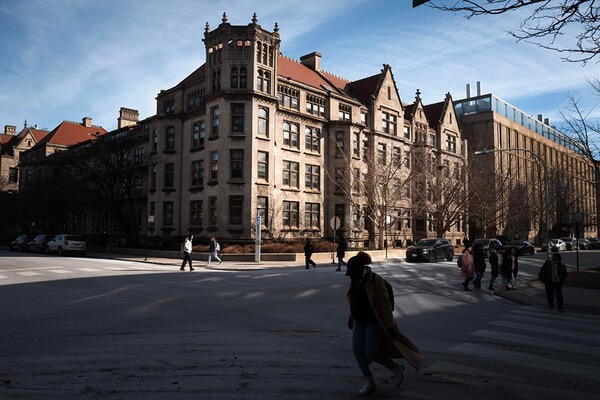
    The University of Chicago’s Arts and Humanities Division is reducing how many new Ph.D. students it admits for the 2026–27 academic year across about half of its departments and completely halting Ph.D. admissions elsewhere. Multiple language programs are among those affected.

    In a Tuesday email that Inside Higher Ed obtained, Arts and Humanities dean Deborah Nelson told faculty, staff and Ph.D. students, “We will accept a smaller overall Ph.D. cohort across seven departments: Art History, Cinema and Media Studies, East Asian Languages and Civilizations, English Language and Literature, Linguistics, Music (composition), and Philosophy.” The university didn’t tell Inside Higher Ed how many fewer Ph.D. students would be accepted across those departments.

    “Other departments will pause admissions,” Nelson wrote.

    Andrew Ollett, an associate professor of South Asian languages and civilizations, said that means no new Ph.D. students for these departments: classics, comparative literature, Germanic studies, Middle Eastern studies, Romance languages and literatures, Slavic languages and literatures, and South Asian languages and civilizations, plus the ethnomusicology and history and theory of music programs in the music department.

    While the university didn’t provide an interview or respond to multiple written questions, a spokesperson did point out that the UChicago Crown Family School of Social Work, Policy and Practice is also pausing Ph.D. admissions, while the Harris School of Public Policy is pausing admissions for the Harris Ph.D., the political economy Ph.D. and the master of arts in public policy with certificate in research methods.

    “A small number of PhD and master’s programs at the University of Chicago will pause admissions for the 2026–2027 academic year while divisions and schools undertake comprehensive reviews of the programs’ missions and structures,” UChicago said in a statement. It said the aim is “ensuring the highest-quality training for the next generation of scholars” and the pauses “will not affect currently enrolled students.”

    UChicago, which faces debt issues, has become yet another example of well-known universities freezing or scaling back Ph.D. admissions and programs amid financial pressures and other factors. In November, before Trump retook the presidency, Boston University said it was pausing accepting new Ph.D. students in a dozen humanities and social sciences programs, including philosophy, English and history. In February, the Universities of Pennsylvania and Pittsburgh announced pauses, following other institutions. 

    But UChicago’s reductions for language programs also reflect a broader trend of universities scaling back foreign language education offerings. In 2023, West Virginia University became infamous in academe for its leaders’ decision to eliminate all foreign language degrees.

    “It’s sad and pathetic,” Ollett said of the pause at UChicago, “because it represents the domination of one set of values, which is money, over the values that we say that we are pursuing in our lives as faculty members, as educators and as researchers.”

    He argued that the university can’t say it’s committed to the humanities as a field for producing knowledge while turning away from Ph.D. programs.

    Nelson’s email said, “This one-time decision applies only to the 2026–2027 academic year.” But Clifford Ando, the Robert O. Anderson Distinguished Service Professor of Classics, History and the College, questioned whether this is just a pause.

    “I see no reason to think that we would resume doctoral education if we are simultaneously dismantling the curricula that sustain undergraduate training in these fields,” Ando wrote in an email sent to a classical studies Listserv. “Why would one have a doctoral program in a discipline that undergraduates can’t even study?”

    Ollett also said this comes as Nelson has pushed to consolidate smaller departments. He said a big question for the coming academic year was “Do we do Ph.D. admissions if we’re not sure that our department is going to exist?”

    Not Rule by Committee

    Ando provided Inside Higher Ed the “charge” UChicago gave to the Arts and Humanities Languages Working Group on June 17.

    “UChicago is known as a global leader in the instruction of ancient and modern languages,” the charge begins. “Language instruction and expertise is not simply a valuable object in its own right; it is an important foundation for the larger UChicago College education, for graduate education, and for the research and scholarship of our faculty.”

    But it then says, “language instruction at this extraordinary scope is also expensive.” It listed several questions for the committee to explore, including:

    • “Should there be a universal or suggested minimum number of students?
    • “Do we need to teach every class every year?
    • “Are there languages we no longer need to teach?
    • “Are there opportunities for partnerships with peer institutions (with similar standards and schedules) to share language instruction?
    • “How can we use technology more effectively to support and enhance language instruction?”

    Ollett said, “We teach more than 50 languages in the division, which seems to be too much because the committee was asked to find ways of getting that number down.”

    Tyler Williams, another associate professor in the South Asian languages and civilizations department and a member of the committee, said the committee members “unanimously declined to endorse any of the suggestions about cutting languages or outsourcing language teaching.” He said Nelson “did not wait for the committee to submit its report,” nor did she “consult with that committee before she made this decision.”

    Ando also provided the charge for a separate Ph.D. Working Group, which outlined a number of “existential challenges” for Ph.D. programs. Those include significantly reduced demand for entry-level faculty, increasing costs for the university and long times to degree, which can deter students.

    Additionally, the document notes that the programs are facing “heightened public skepticism about the value of what is taught in Arts & Humanities PhD programs, and how it is taught. Yet Ph.D. programs remain a critical part of the research university model, necessary to teaching, research, scholarship, and creativity.”

    Among other questions, that committee was asked to explore whether there should be a minimum size for Ph.D. cohorts in order to offer a program.

    Williams said that this committee indicated it wasn’t going to endorse an admissions pause, but said it should be divisionwide if it occurred.

    Nelson’s email announcing the changes stressed that “this decision is not the recommendation of any committee.”

    Williams said the Ph.D. admissions cuts are part of “a crisis manufactured by the university administration itself.” Ollett said he worries for the future of their field.

    “We are quite unique in that there’s not a lot of South Asia area studies departments in the United States, and especially ones that train the next generation of scholars,” he said. He said he’s “already turned away prospective Ph.D. students because of this, and that’s just going to keep happening.”

    He said he worries that “if we’re not doing it, no one will do it, and the field will wither and die.”

    Source link

  • Jin Huang, Higher Education’s Harry Houdini

    Jin Huang, Higher Education’s Harry Houdini

    Ambow CEO Has Repeatedly Slipped Through the Fingers of Shareholders and Regulators

    In the opaque world of for-profit higher education, few figures have evoked the mixture of fascination and alarm generated by Jin Huang, CEO—and at times interim CFO and Board Chair—of Ambow Education Holding Ltd. Huang has repeatedly navigated financial crises, regulatory scrutiny, and institutional collapse with a Houdini-like flair. Yet the institutions under her control—most notably Bay State College and NewSchool of Architecture & Design—tell a far more troubling story.


    Ambow’s Financial Labyrinth

    Ambow, headquartered in the Cayman Islands with historic ties to Beijing (former address: No. 11 Xinyuanli, Chaoyang District, Beijing, China), has endured years of financial instability. As early as 2010, the company pursued ambitious acquisitions in the U.S. education market, including NewSchool and eventually Bay State College, often relying on opaque financing and cross-border investments.

    By 2013, allegations of sham transactions and kickbacks forced Ambow into liquidation and reorganization. Yet the company repeatedly avoided delisting and collapse. Financial reports reveal a recurring pattern: near-catastrophe followed by minimal recovery. In 2023, net revenue fell 37.8% to $9.2 million with a $4.3 million operating loss. By 2024, Ambow reported a modest $0.3 million net income, narrowly avoiding another financial crisis. 


    Early Years: 2010–2015

    From 2010 to 2015, Ambow aggressively pursued U.S. acquisitions and technology projects while expanding its presence in China. The company leveraged offshore corporate structures and relied heavily on PRC-linked investors. Huang’s leadership style during this period prioritized expansion and publicity over sustainable governance, leaving institutions financially vulnerable.

    Despite claims of educational innovation, Ambow’s track record in these years included multiple warnings from U.S. regulators and questionable accounting practices that would later contribute to shareholder lawsuits and delisting from the NYSE in 2014.


    Bay State College: Closed Doors, Open Wounds

    Acquired in 2017, Bay State College in Boston once enrolled over 1,200 students. By 2021, enrollment had collapsed, despite millions in federal COVID-era relief. In 2022, the Massachusetts Attorney General secured a $1.1 million settlement over misleading marketing, telemarketing violations, and inflated job-placement claims.

    Accreditation probation followed, culminating in NECHE’s withdrawal of accreditation in January 2023. Eviction proceedings for over $720,000 in unpaid rent preceded the college’s permanent closure in August 2023. Bay State’s demise exemplifies the consequences of Ambow’s pattern: the CEO escapes, the institution collapses, and students and faculty are left in the lurch.


    NewSchool of Architecture & Design: Stabilization in San Diego

    NewSchool, Ambow’s other U.S. acquisition, has faced persistent challenges. Enrollment has dropped below 300 students, and the school remains on the U.S. Department of Education’s Heightened Cash Monitoring list. Leadership instability has been chronic: five presidents since 2020, with resignations reportedly tied to unpaid salaries and operational dysfunction.

    As of 2025, lawsuits with Art Block Investors, LLC have been settled, and NewSchool is now housed in three floors of the WeWork building in downtown San Diego. Despite receiving a Notice of Concern from regional accreditor WSCUC, the college remains operational but financially precarious.


    Questionable Credentials and Leadership Transparency

    Huang has claimed to hold a PhD from the University of California, but investigation reveals no record of degree completion. This raises further concerns about leadership credibility and transparency. Ambow’s consolidated executive structure—Huang serving simultaneously as CEO, CFO, and Board Chair—exacerbates governance risks.

    While headquartered in Cupertino, California, Ambow continues to operate with ties to Chinese interests. SEC filings from the PRC era acknowledged that the Chinese government exerted significant influence on the company’s business operations. Ambow has also expressed interest in projects in Morocco and Tunisia involving Chinese-affiliated partners.


    HybriU and the EdTech Hype

    In 2024, Ambow launched HybriU, a hybrid learning platform promoted at CES and the ASU+GSV conference. Marketing materials claim a 5-in-1 AI-integrated solution for teaching, learning, connectivity, recording, and management, including immersive 3D classroom projections.

    Yet there is no verifiable evidence of HybriU’s use in actual classrooms. A $1.3 million licensing deal with a recently formed Singapore company, Inspiring Futures, is the only reported commercial transaction. Photos on the platform’s website have been traced to stock images, and the “OOOK” (One-on-One Knowledge) technology introduced in China in 2021 has not demonstrated measurable results in U.S. education settings.

    Reports suggest that Ambow may be in preliminary talks with Colorado State University (CSU) to implement HybriU. HEI has not confirmed any formal partnership, and CSU has not publicly acknowledged engagement with the platform. Any potential relationship remains unverified, raising questions about the legitimacy and scope of Ambow’s outreach to U.S. universities.

    Ambow’s 2025 press release promotes HybriU as a transformative global learning network, but HEI’s review finds no verified partnerships with accredited U.S. universities, no independent validation, and continued opacity regarding student outcomes or data security.


    Financial Oversight and Auditor Concerns

    Ambow commissioned a favorable report from Argus Research, but its research and development spending remains minimal—$100,000 per quarter. Prouden CPA, the current auditor based in China, is new to the company’s books and has limited experience auditing U.S. education operations. This raises questions about the reliability of Ambow’s financial reporting and governance practices.


    Conclusion: The Illusion of Rescue

    Jin Huang’s repeated escapes from regulatory and financial peril have earned her a reputation akin to Harry Houdini. But the cost of each act is borne not by the CEO, but by institutions, faculty, and students. Bay State College is closed. NewSchool remains operational in a WeWork facility but teeters on financial fragility. HybriU promises innovation but offers no proof.

    Ambow’s trajectory demonstrates that a company can survive on hype, foreign influence, and minimal governance, while leaving the real consequences behind. Any unconfirmed talks with CSU highlight the ongoing risks for U.S. institutions considering engagement with Ambow. For regulators, students, and higher education stakeholders, Huang’s Houdini act is less a marvel than a warning.


    Sources

    • Higher Education Inquirer. “Ambow Education Facing NYSE Delisting.” May 2022.

    • Higher Education Inquirer. “Ambow Education and NewSchool of Architecture and Design.” October 2023.

    • Higher Education Inquirer. “NewSchool of Architecture and Design Lawsuits.” March 2025.

    • Boston Globe. “Bay State College Faces Uncertain Future.” January 3, 2023.

    • Inside Higher Ed. “Two Colleges Flounder Under Opaque For-Profit Owners.” October 18, 2022.

    • Inside Higher Ed. “Bay State College Loses Accreditation Appeal.” March 21, 2023.

    • GlobeNewswire. “Ambow Education Announces Full-Year 2024 Results.” March 28, 2025.

    • Ambow Education Press Releases and SEC Filings

    • Wikipedia. “Bay State College.” Accessed August 2025.

    • Wikipedia. “NewSchool of Architecture and Design.” Accessed August 2025.

    Source link

  • The New Higher Ed SEO Playbook: Content Ecosystems for the AI Era

    The New Higher Ed SEO Playbook: Content Ecosystems for the AI Era

    Imagine a prospective student asking an AI, “Which colleges offer the best online MBA for working parents?

    Instead of matching keywords, the AI delivers an answer drawn from credible, connected content that blends facts, context, and intent to guide the decision.

    For higher ed leaders, this represents a major shift. Institutions that adapt will earn greater visibility in search, attract more qualified prospective students, and convert curiosity into enrollment growth. The old playbook of targeting single, high-volume keywords just isn’t enough anymore.

    AI-driven search rewards comprehensive, connected, and trustworthy content ecosystems, and institutions that embrace this approach will be the ones students find first. 

    The AI search shift in higher ed 

    Traditional search engine optimization (SEO) rewarded institutions that could identify the right keywords, create targeted pages, and build backlinks. But generative AI and conversational search have changed the rules of the game. 

    Here’s what’s different now: 

    • From keywords to context: AI search models don’t just match words — they interpret meaning and intent, returning results that connect related topics and concepts. 
    • Authority signals matter more: AI favors sources that consistently provide accurate, in-depth information across multiple touchpoints. 
    • Content is interconnected: A single page doesn’t win on its own. Its value depends on how it fits within the institution’s broader web presence. 

    This shift also raises the bar for internal collaboration. Marketing, enrollment, and IT can no longer work in silos. AI search success depends on shared strategy, consistent messaging, and coordinated execution. 

    The takeaway? Institutions need to stop thinking about SEO as an isolated marketing tactic and start treating it as part of a broader content ecosystem. 

    Why a content ecosystem beats keyword lists 

    A content ecosystem is the interconnected network of program pages, admissions information, faculty bios, student stories, news, and resources — all working together to answer your audiences’ questions. 

    It’s the difference between a brochure and a campus tour. A brochure offers quick facts; a tour immerses prospects in faculty, classrooms, student life, and services—building a fuller, more confident picture. 

    A keyword list is the brochure. A content ecosystem is the tour — immersive, connected, and designed to guide prospects from curiosity to commitment. 

    When built intentionally, a content ecosystem gives institutions three clear advantages in today’s AI-driven search environment: 

    Increased relevance 

    AI search tools don’t look at a single page in isolation; they interpret the relationships between topics across your domain. Internally linked, topic-rich pages show the depth of your expertise and help algorithms recommend your institution for nuanced, conversational queries. 

    Example: A prospective student searching “flexible RN-to-BSN options for full-time nurses” is more likely to find you if your nursing program page is connected to articles on nursing career paths, flexible modality, and student success stories. 

    Compounding authority that builds lasting trust

    Authority isn’t built from one or two high-performing pages. It’s earned when every part of your online presence reinforces your credibility. Program descriptions, faculty bios, and testimonials must align in tone, accuracy, and quality. Outdated or inconsistent details can quickly erode the trust signals AI uses to rank content. 

    Conversion that’s built in 

    A keyword list may bring someone to your site, but a content ecosystem keeps them there and moves them closer to action. When visitors can move seamlessly from an informational blog to a program page to an application guide or chat with an advisor, conversion becomes a natural next step. 

    The most effective ecosystems are living assets — constantly updated, monitored, and optimized to reflect evolving programs and audience needs. For institutions looking to compete in an AI-powered search landscape, that adaptability is the real competitive advantage. 

    Is Your Website Built for AI Search?

    Get a personalized AI Readiness Assessment that identifies gaps, surfaces opportunities, and helps build a digital content strategy that meets the moment.

    How to build an AI-ready content ecosystem 

    At Collegis, we help institutions take a holistic approach that bridges marketing, enrollment, and IT. Here’s how we see it coming together: 

    1. Gather actionable data insights 

    Don’t just chase the most-searched terms. Look at historical enrollment, inquiry trends, and page performance to identify the queries that actually lead to applications and registrations, not just clicks. 

    2. Map content to the student journey 

    From the first touchpoint to enrollment, every content asset should serve a clear purpose: 

    • Top of funnel: Informational articles, career outlooks, program overviews 
    • Middle of funnel: Financial aid resources, student success stories, faculty profiles 
    • Bottom of funnel: Application guides, event sign-ups, chat support 

    Linking these pieces guides prospective students through the decision process seamlessly. 

    3. Optimize for AI discoverability 

    Structured data, schema markup, and well-organized site architecture make it easier for AI tools to interpret and recommend your content. Accuracy and consistency are critical — outdated program descriptions or conflicting statistics can undermine authority signals. 

    4. Create continuous feedback loops 

    The work doesn’t stop at publishing. Monitor how content performs in both traditional and AI search, then feed those insights back into planning. AI search algorithms evolve, and so should your content strategy. 

    Turning visibility into meaningful enrollment growth

    AI search is changing how students discover institutions, and how institutions must present themselves online. It’s no longer enough to appear in search results. You need to appear as the most authoritative, most relevant, and most trustworthy source for the questions that matter to prospective students. 

    By building an AI-ready content ecosystem, colleges and universities can meet this challenge head-on, earning not just visibility but the confidence and interest of future learners. 

    Collegis partners with colleges and universities to design content strategies that aren’t just visible, they’re built to convert and scale across the entire student lifecycle. 

    Ready to see how your institution stacks up in the age of AI search?

    Request your AI Readiness Assessment to receive a personalized report outlining your institution’s digital strengths, content gaps, and practical next steps to boost visibility and engagement. It’s your roadmap to staying competitive in an AI-first search landscape.

    Innovation Starts Here

    Higher ed is evolving — don’t get left behind. Explore how Collegis can help your institution thrive.

    Source link

  • PHILIP CAVALIER | Diverse: Issues In Higher Education

    PHILIP CAVALIER | Diverse: Issues In Higher Education

    Dr. Philip Cavalier Philip Cavalier  has been named president of Kutztown University. Cavalier most recently served as provost and senior vice chancellor for Academic Affairs at the University of Tennessee at Martin (UTM), a regional public university with more than 7,000 students in northwest Tennessee. He served as interim chancellor for five months in 2023. During his seven years at the university, he led the creation of UTM’s 2025- 30 strategic plan, and two strategic enrollment plans and developed or enhanced eight academic programs aligned with student interests and local workforce needs. Before joining UT Martin, Cavalier held several faculty and senior leadership roles in higher education, including provost at Lyon College, provost and dean of the college at Eureka College, and dean of general education at Catawba College. 

    Cavalier holds a doctorate in English from the State University of New York at Buffalo, a master’s degree in English from Northeastern University, Boston, Mass., and a bachelor’s degree in economics from Swarthmore College.

    Source link