Tag: Higher

  • Cost Remains Primary Barrier to Study Abroad

    Cost Remains Primary Barrier to Study Abroad

    Three in four U.S. students say they hope or plan to study abroad, but a lack of financial resources may hinder those dreams, according to a 2025 Terra Dotta survey.

    The survey, which included responses from 275 college students, found that 80 percent of students said insufficient funds would prevent them from studying abroad. Of respondents who have studied abroad or committed to a program abroad, two in five students said they expect to pay over $10,000 for their experiences.

    Terra Dotta’s report also noted students want more clarity from their institution about financial aid opportunities to address study abroad expenses.

    Methodology

    Terra Dotta’s survey included 275 respondents from two- and four-year colleges and universities, both public and private. The study was fielded in February. A majority of respondents had plans to study abroad or had studied abroad previously.

    Barriers to access: Study abroad is linked to personal and professional development for participants. A 2024 survey of students from Terra Dotta found that those who studied abroad said the experience helped them identify adaptability and resilience, cross-cultural communication, and problem-solving in new situations as the benefits most useful for their future careers.

    However, not every student is able to participate due to financial burdens; among students who don’t plan to study abroad, 48 percent attributed their decision to financial concerns. Cost of attendance is one of the top reasons college students leave higher education, and it can also be a barrier to student participation in on-campus events. A 2024 Student Voice survey by Inside Higher Ed and Generation Lab found that 17 percent of students would get more involved in campus activities and events if attendance or participation were less expensive.

    Other reasons a student might choose not to study abroad include safety concerns (40 percent), geopolitical issues (28 percent) and worried parents (25 percent). Three-quarters of respondents indicated the wars in Ukraine and Gaza impacted their interest in going abroad.

    Academic requirements and a lack of alignment are other challenges for students. Eighteen percent of students said they wouldn’t study abroad due to their major program requirements, and 16 percent think greater alignment between their field of study and study abroad would make the experience more accessible.

    Seventeen percent of respondents said they don’t know anything about study abroad or haven’t heard of opportunities, “indicating an opportunity for [colleges] to reach more students,” according to the report.

    Footing the bill: When asked to add up tuition, housing, airfare and other expenses, 83 percent of respondents said they plan to spend or spent more than $5,000 on study abroad, and 11 percent said the experience costs roughly $15,000.

    Twelve percent of respondents said study abroad experiences were included in their tuition, so they expect to pay nothing additional. Approximately one in five students said they’d pay for study abroad experiences themselves, a 20 percent change from the previous year, according to the report.

    Student respondents indicated they want their institution to take on a larger role in addressing the cost of study abroad; one-third of respondents said colleges could make study abroad experiences more accessible by providing more education on financial aid for such programs. If respondents could give their campus advice on improving study abroad experiences, two-thirds said they’d like easier access to financial aid.

    Other trends: In addition to the barriers to study abroad, Terra Dotta’s report explored student interests and development related to the experience.

    The U.K. is the most popular study abroad destination for respondents (41 percent), mirroring an emerging trend among U.S. students indicating interest in U.K. undergraduate education. Australia (32 percent), Spain (26 percent), Italy (21 percent) and Ireland (21 percent) were other popular destinations. Only 1 percent of students said they planned to travel to China to study.

    Three in five respondents said they think study abroad is at least somewhat important for their personal growth, and about a third said experiencing personal growth is one of the top reasons they plan to study abroad.

    Of students who had completed a study abroad experience (n=170), a majority said it impacted their worldview by exposing them to new ideas. Students said they were most surprised by social norms and etiquette (47 percent), as well as dining and food customs (24 percent) and the local educational system and values (24 percent).

    Source link

  • They Attack Because Higher Ed Is Strong, Not Weak (opinion)

    They Attack Because Higher Ed Is Strong, Not Weak (opinion)

    Academics are cynics. We have to be. We critique our students, our peers and ourselves. It’s how we were trained. It’s how we write and publish and secure grants. But sometimes you have to know when to declare victory.

    There is a lot that is troubling higher education. The Trump administration is canceling research grants, changing indirect cost rates, proposing cuts to future federal research funding and reductions in the size of need-based Pell Grants, and raising taxes on some university endowments. States are banning critical race theory or other “divisive concepts”; dissolving diversity, equity and inclusion programs; attacking faculty unions; and undermining tenure. In many parts of the country, enrollment is down. It is easy to focus on the moment. It is easy to focus on problems within our departments, within the dean’s office or within the university.

    If instead of looking at President Trump’s first 100-plus days, we look at higher education as an institution over the past 100-plus years, it becomes clear we should be celebrating higher education’s triumph and not bemoaning its demise. A century ago, U.S. universities lagged their European counterparts. In fact, many universities that are household names today were still teachers’ colleges (San Diego State University was San Diego State Teachers College) or had yet to be founded (the University of California, San Diego). Ivy League campuses like Harvard, Princeton and Yale Universities actively excluded Jewish and Black applicants. The concepts of academic freedom and tenure were nascent. The National Science Foundation did not exist.

    Universities did great things during the 20th century. Presidents and faculty found strength and legitimacy through relevance. They helped in the all-out effort to win the Second World War. Universities anticipated the needs of the Cold War. Research labs produced products that improved people’s daily lives. The University of Minnesota patented Honeycrisp apples. The University of Wisconsin patented fortifying milk with vitamin D.

    Universities not only solved practical problems, but they also helped us understand ourselves. Faculty explored and legitimized new areas of study: women’s studies, ethnic studies, area studies. They fused disciplines to create fields to understand our bodies and our minds, such as neuroscience and biotechnology.

    As universities expanded graduate education, they trained cadres of researchers and professionals who populated state, federal and international agencies. For instance, the rise of the global environmental movement has been traced to the emergence of communities of actors with similar scientific understanding and motivations to identify and address hazards. The almost exponential increase in university training and science production was not limited to our shores; it was global. Over the 20th century, the rapid expansion of mass schooling, up to and through higher education, sparked the education revolution and created a “schooled society.”

    The Challenge

    Many faculty talk about higher education as though it is weak, when arguably it has been the most successful and influential social institution over the past 100 years. If we take a longer-term view, higher education has not lost. Higher education won. But the game is being reset.

    Higher education’s victories were hard fought. They were political. They were negotiated. They required collective action. Through decades of fighting, universities moved past excluding applicants based on race and sex. Then for decades they used affirmative action, followed by holistic review, to more equitably admit students. They established norms for academic freedom and tenure. They became sites for open debate and social and political protest.

    These types of wins are not easy to come by. They require common principles and interests and a shared sense of what counts as knowledge and how the world works. It is hard to mobilize if everything is socially constructed and morally relative and if we look for ways to critique rather than concur.

    Our challenge in this new era is primarily one of legitimacy. Too many politicians and voters see us as illegitimate because too much of what we do is irrelevant. I have had my work on voter turnout criticized for not correctly guessing which of the following was the reviewer’s preferred term: Chicano, Chicana/o, Chicano/a, Chicanx, Hispanic, Latina and Latino, Latina/o, Latino/a, Latin@, Latinx, Latine. Though there is a place for thinking about names and their usage, the point of the paper was: How do we get more Hispanic students to vote?

    The Good News

    Some of the most direct efforts to limit the influence of higher education are occurring on our own turf. Moneyed interests and Trump acolytes have sought to create conservative centers at Ohio State University, the University of Texas at Austin and the University of Florida. When centers like these are founded, we should recognize that we have the home court advantage. We should engage with their leaders and faculty—we are not outnumbered. We should send our students to enroll in their courses and invite their students to dialogue with us. We have immense forms of cultural and social capital and vast networks. Our disciplines have rich traditions for ways of understanding the world and addressing its problems. We have insightful perspectives for understanding the human condition, thinking about natural law and questioning what the social contract should look like in the 21st century.

    We should look back to how faculty made such strong advances in the last century. For instance, in 1915, the American Association of University Professors adopted a Declaration of Principles. That document served as the foundation for the future 1940 Statement of Principles on Academic Freedom and Tenure, which was jointly developed with the Association of American Colleges (now the American Association of Colleges and Universities). The 1940 document was so promising because it represented agreement between faculty and university leaders.

    Those documents are worth revisiting for both their substance and process. For example, we should remind our detractors that academic freedom comes with concomitant responsibilities. We are criticized for attempting to brainwash America’s youth, but the AAUP’s 1915 Declaration of Principles states,

    “The university teacher, in giving instruction upon controversial matters, while he is under no obligation to hide his own opinion under a mountain of equivocal verbiage, should … set forth justly, without suppression or innuendo, the divergent opinions of other investigators; he should cause his students to become familiar with the best published expressions of the great historic types of doctrine upon the questions at issue; and he should, above all, remember that his business is not to provide his students with ready-made conclusions, but to train them to think for themselves.”

    In the world of social media and generative artificial intelligence, training students to think for themselves may be more important than ever. As faculty, we should practice thinking like the early leaders of the AAUP and seek to build national solidarity and articulate a shared purpose for higher education.

    We should accept that conservative politicians are attacking higher education not because it is weak but because it is so strong. In this time, we must rededicate ourselves to a cause that will outlast our careers, a cause worthy of the collective efforts of generations of scholars. We must advance the public good. By improving the public good, we will be relevant, and by being relevant, we will reclaim legitimacy. We must show that we can do what Google and ChatGPT cannot: We can train students to think and to be good citizens.

    Frank Fernandez is an associate professor of educational leadership and policy analysis at the University of Wisconsin at Madison. He writes about the role of higher education in society.

    Source link

  • DEI Skepticism Threatens to Derail Japan’s Gender Equity Push

    DEI Skepticism Threatens to Derail Japan’s Gender Equity Push

    Japan needs to admit that long-running efforts to address gender inequality in higher education aren’t working, experts say, with antidiversity sentiment spreading from the U.S. and threatening to gain traction.

    Despite government policies spanning nearly two decades, women remain severely underrepresented across Japanese universities, particularly in science, technology, engineering and mathematics fields.

    As of 2022, women made up just 26.7 percent of faculty nationwide and fewer than half of all students, with even starker disparities in senior academic roles and male-dominated disciplines.

    Sayaka Oki, a professor at the University of Tokyo, described the situation as “terrible.”

    “Gender equality doesn’t really exist here,” she added.

    As of 2022, only 11 percent of professors at Oki’s university were female, with particularly low representation in engineering. In undergraduate programs in physics and engineering, women typically make up only about 15 percent of the student population.

    “The gender imbalance starts at the student level and gets worse in higher positions,” she said. The university has launched repeated initiatives that have attempted to address the problem and has reported that it has “steadily increased the number of women in faculty positions.”

    Since 2006, Japan’s government has implemented a “goal and timetable” policy aimed at increasing women researchers in natural sciences, setting numerical hiring targets every five years.

    However, these targets have remained largely unchanged because the proportion of women earning doctoral degrees—the main feeder for research roles—has not significantly increased.

    Ginko Kawano, professor of gender equality at Kyushu University, said that, “after nearly two decades, the policy has not produced significant results, and it appears we are now at a turning point in terms of policy design.”

    Kawano noted recent government encouragement for universities to adopt admission quotas for women in STEM to improve applicant numbers.

    Yet “while this sends a positive message that women are welcome in these disciplines, it is unlikely to serve as a fundamental solution to the underlying issues,” she said.

    She also acknowledged strong opposition from students and faculty: “Institutions that choose to introduce this system should clearly explain the reasoning behind it.

    “At the same time, it is crucial for university faculty to have access to the information and knowledge necessary to evaluate the merits and drawbacks of such quotas.

    “For example, they should be aware of the historical exclusion of women from science, and recognize the persistent bias that suggest[s] women are not suited for STEM fields—biases that continue to shape the choices women feel able to make,” Kawano said.

    Adding to the complexity is a political environment increasingly wary of diversity initiatives.

    Kawano warned that antidiversity sentiment similar to that in the U.S. could gain traction in Japan, although opposition to gender equality policies has existed independently for years.

    Akiyoshi Yonezawa, professor of higher education in the Global Strategy Office at Tohoku University, highlighted demographic pressures pushing universities toward diversity.

    “Since around 1990, the number of 18-year-olds has continuously declined and is expected to continue until at least 2040,” he said.

    In response, women and international students have been framed as essential for sustaining Japan’s knowledge economy.

    Yonezawa criticized how diversity initiatives in Japan are often framed: “DEI initiatives in Japanese universities and society tend to be promoted as a ‘catch-up’ Western mindset rather than intrinsic value formation through daily experience. This makes DEI activities in Japan’s higher education fragile in the long term when faced with controversy.”

    Institutional barriers also persist. Oki described how her university’s collegial governance system complicates efforts to implement top-down diversity policies and secure funding, which often comes with centralized control conditions.

    “To access the fund, we’re required to adopt a more top-down management style,” she said. “That’s difficult because our university traditionally follows a collegial governance model.”

    Oki agreed that there was a risk that international developments had made the situation potentially more difficult—particularly in the U.S., where things like the ban on affirmative action had made colleagues “more cautious about what might happen here.”

    Source link

  • Brown University Takes Out $500M Loan After Funding Freeze

    Brown University Takes Out $500M Loan After Funding Freeze

    Brown University is taking out a $500 million loan as it faces a prolonged federal funding freeze and braces for other changes to federal policy, Bloomberg reported.

    The university previously borrowed $300 million in April after the Trump administration said it was freezing about $510 million in federal grants and contracts at the Ivy League institution. 

    “Given recent volatility in capital markets and uncertainty related to evolving federal policy related to higher education, research and other important priorities of Brown, the university is fortunate to have a number of sources of liquidity,” a Brown spokesperson told Bloomberg.

    Other universities have turned to loans or bonds to get immediate cash amid federal funding freezes.

    In a June message that warned of the potential for “significant cost-cutting” measures, Brown administrators pointed to numerous challenges such as federal research grant cuts, the increasing tax on university endowments and threats to international students. Administrators were considering, among other measures, service reductions as well as changes to staffing levels and graduate student admissions. Brown was already grappling with a $46 million deficit before President Trump took office in January, and the university implemented a hiring freeze in March.

    “All these losses represent an ongoing threat to Brown’s financial sustainability and, consequently, our ability to fulfill our mission,” university officials wrote of the federal policy changes. “We are doing everything possible to minimize the impact, and we are proud of the response of this community in making important changes to operations to reduce expenses over the past year. Unfortunately, the level of savings to date is not enough to counter the deep financial losses Brown is experiencing and must prepare for in the coming year.”

    Source link

  • Migrant Higher Ed Program Still in Limbo After ED Lifts Freeze

    Migrant Higher Ed Program Still in Limbo After ED Lifts Freeze

    College leaders are breathing a tentative sigh of relief after the Trump administration promised Friday to release roughly $5 billion in withheld education funding, slated for a range of K–12 programs but also $716 million for adult education programs. Not included in Friday’s announcement, however, was $52 million allocated for migrant higher education programs.

    On June 30, the Department of Education paused nearly $7 billion in education funding expected on July 1, as part of a review by the Office of Management and Budget. Over the weeks of uncertainty that followed, community college leaders feared that, without the funds, they’d need to strip back adult education programming, like GED programs, and lay off personnel. Lawmakers on both sides of the aisle called for the funds’ release. A group of 10 Republican senators demanded an end to the freeze in a July 16 letter to OMB. Democratic governors from 18 states also wrote to Education Secretary Linda McMahon with the same plea.

    Rachel Gasseling, adult education director at Western Nebraska Community College, said that she was heartbroken when the Education Department paused the adult education funds. Her program serves the rural Nebraska panhandle and had a record 27 graduates this past academic year, an almost 69 percent increase over the year before. Adult ed programs served more than 9,300 students statewide last year, she said.

    “By all measures, we were going above and beyond to help our communities and help people build better lives,” Gasseling wrote to Inside Higher Ed. “Every day we waited to know whether we had to start looking for a new job or hold out one more day in hopes we can keep doing what we love.”

    Now she knows her work can continue. Her college was able to float the program until the funds returned. But for some programs across the country, the damage is already done, she said. They closed or reduced staff or services when the funds didn’t come through.

    “A great deal of people have been affected by this decision, and I hope that programs are able to rebuild or stay afloat for the sake of neighbors and communities,” she said.

    David Baime, senior vice president for government relations at the American Association of Community Colleges, said nationwide, state and campus leaders are “extremely relieved” by the news of the restored adult education funds. Now community college leaders hope these programs receive continued support in the 2026 fiscal year appropriations process. 

    “The loss of these funds would have been devastating to hundreds of community colleges, and some programs were already scaled back given the hiatus in support,” he wrote in an email to Inside Higher Ed. “Community colleges are deeply thankful that key legislators stood up for this essential function.”

    Heather Morgan, executive director of the Kansas Association of Community Colleges, said she’s glad to see the funds released but remains wary about the future of adult education programs under the Trump administration. Trump proposed axing these programs in his budget proposal for fiscal year 2026.

    “While this funding helps the programs continue, we will continue to watch the upcoming appropriations process as adult basic education is one of the areas proposed in the president’s budget for elimination,” Morgan wrote to Inside Higher Ed. “The uncertainty of funding makes keeping positions filled difficult as we work to serve adult learners.” The budget proposal would also eliminate funding for migrant education.

    The Education Department and the Office of Management and Budget did not respond to requests for comment.

    Migrant Programs In Flux

    Funds for other postsecondary programs still hang in the balance. Even as the Education Department released funding to states for migrant education at the K–12 level, money for two postsecondary migrant programs remains frozen: the High School Equivalency Program, a program that supports migrant farmworkers and their families in earning their GEDs, and the College Assistance for Migrants Program, which helps recruit and support those students through their first year of college.

    Greg Contreras, the director of the National HEP/CAMP Association, told Inside Higher Ed that the release of funds for the K–12 Migrant Education Program was “definitely encouraging.” But he said he has still received no word on if and when the review of HEP and CAMP may come to an end.

    Without the money to support HEP and CAMP, colleges and universities have been forced to shutter their programs and lay off employees who work with migrant students.

    “As each week rolls by, more programs are starting to drop off,” Contreras said. He received a layoff notice for his own position leading the CAMP initiative at Portland Community College in Oregon; originally, he was told his last day would be in August, but he is working with administrators to see if he might be able to stay through the start of PCC’s fall semester in September.

    Along with funding resources for migrant students, money for CAMP also goes toward scholarships and stipends. Michael Heim, the director of HEP and CAMP at Washington State University, said that his program’s incoming students are grappling with whether they will be able to enroll if the money doesn’t come through. Potentially losing out on scholarships they were promised will be a major factor in their decision-making, he said. But they’re also concerned about their academic success without access to the specialized resources CAMP typically offers, such as tutoring and mentorship.

    “The question they ask themselves is, ‘How do I find community, how do I know people will be in my corner to support me?’” he said. “I think it speaks to a mentality within our students, over all, that they know they want to go to college, but they want to be successful, because the values their families are instilling them are: They know education is important, and they don’t want to miss this opportunity to make their parents proud, make their siblings proud.”

    The National HEP/CAMP Association and its members aren’t backing down yet. The board recently traveled to Washington, D.C., where Contreras said they met with over 30 congressional staff members who they hope will pass along their messages about the importance and effectiveness of the programs.

    Even HEP and CAMP staff who have lost their jobs are staying involved in the effort to get their funding restored, he said, contacting their own congresspeople to ask them to push for the funds to be released.

    “We’re not giving up,” he said.

    Source link

  • Vanderbilt Reportedly Considering a San Francisco Campus

    Vanderbilt Reportedly Considering a San Francisco Campus

    Vanderbilt University is in talks with the city of San Francisco to establish a campus there, the San Francisco Chronicle reported.

    A Vanderbilt spokesperson confirmed to the Chronicle that the university—which is based in Nashville, Tenn., but also has satellite campuses in New York City and West Palm Beach, Fla.—has been working with the San Francisco mayor’s office on a plan to gain a foothold in the Bay Area.

    “Vanderbilt is always exploring new opportunities to expand our impact and further our mission,” the spokesperson told the newspaper. “We recognize the long-term global leadership of San Francisco and its ever-growing potential, defined by a vibrant culture, dynamic innovation ecosystem and the talent drawn to its leading technology companies and top-caliber arts and cultural institutions.”

    The spokesperson added that the institution’s aim is “to create unique student experiences, fuel pathbreaking research and foster close connections to the ideas and companies that will lead the next generation of the nation’s economy.”

    San Francisco mayor Daniel Lurie has expressed interest in partnering with a university to revitalize the city.

    “Our administration is working every day to create a clean, safe and thriving downtown—one that draws people, businesses and investments back to our city,” Lurie told the Chronicle. “As I said during my campaign, welcoming a world-class university like Vanderbilt to our city would bring new energy and foot traffic downtown, and we will continue working to make that happen.”

    A source told the Chronicle that the mayor has approached a handful of other universities, but the arrangement with Vanderbilt appears to be the “most promising”; city officials have met with university leaders multiple times.

    Source link

  • What DOJ Letters to UVA Say About Trump Attack on Higher Ed

    What DOJ Letters to UVA Say About Trump Attack on Higher Ed

    Before James Ryan stepped down as president of the University of Virginia last month, the Department of Justice accused him and other leaders of actively attempting to “defy and evade federal antidiscrimination laws.” Harmeet Dhillon, assistant attorney general of the DOJ’s civil rights division, said that needed to change.

    “Dramatic, wholesale changes are required, now, to repair what appears to be a history of clear abuses and breaches of our nation’s laws and our Constitution by the University of Virginia under its current administration,” she wrote.

    In a series of seven letters obtained by Inside Higher Ed via an open records request, Dhillon and other Department of Justice officials laid out their increasingly aggressive case that the university was at risk of losing federal funding, just as Ivy League institutions like Harvard and Columbia Universities had in the months prior for allegations of antisemitism. The Cavalier Daily first published the letters in full.

    Taken together, the letters sent between April 11 and June 17 were used to launch what the DOJ called an investigation but that legal experts say is among the latest instances in an all-out pressure campaign against higher education.

    Dhillon and the DOJ have defended their actions, stating multiple times that they did not explicitly call for Ryan’s resignation.

    But now, with similar investigations launched against George Mason University (also located in Virginia), many onlookers view these letters as a template for how President Trump will continue to leverage federal funding to impose his priorities on colleges and universities across the country—altering who is admitted and what is taught and by whom. Higher education experts say it’s an aggressive tactic that will create a climate of uncertainty for years to come.

    “There is not much pushback that that administrators—President Ryan or others—can make, if they want to continue receiving these funds and performing the research that they do,” said Brandt Hill, a partner and litigator with the higher education practice group of Thompson Coburn LLP. “This is all about collecting scalps that [the Trump administration] can then publicize. Each time Trump gets a win, that gives it a snowball effect and gives the impression that he can do it elsewhere.”

    Here is a copy of each letter and three key takeaways about what the letters say.

    Expanding Reach of Affirmative Action Ban

    At the crux of the department’s demands outlined in the letters is the claim that UVA has failed to provide equal opportunity and has violated Title VI of the Civil Rights Act of 1964, which prohibits discrimination based on race, color or national origin.

    To justify the allegations, the letters repeatedly cite the Supreme Court’s 2023 ruling in Students for Fair Admissions v. Harvard, which barred colleges from considering race in admissions, as well as President Trump’s executive orders against diversity, equity and inclusion, which aim to expand the high court’s ruling to all campus scholarships and programs.

    Compliance with the Civil Rights Act as well as the administration’s interpretation of Supreme Court’s ruling and the president’s orders, Dhillon states, “is not optional.”

    “Moreover,” the June 16 letter states, “you will certainly recall Attorney General of Virginia Jason Miyares’ admonition that the UVA Board of Visitors and the president of the university are public officials of the Commonwealth of Virginia who owe fiduciary duties and duties of loyalty first and foremost to the Commonwealth, not the interests or ideologies of university administrators or faculty members.”

    And while the department does have the grounds to investigate a possible consideration of race in admissions, extrapolating that to scholarships and other aspects of campus life does not have the same legal backing and precedent, higher ed legal experts said. In February, the Education Department attempted to extend the ban to cover all race-based programming and activities, but a federal judge blocked that guidance in April.

    Jodie Ferise, a partner at Church Church Hittle + Antrim, a higher education–focused law firm in Indiana, noted that the second sentence of the April 11 letter describes the alleged racial discrimination as “immoral.” That’s not by accident, she said.

    “It’s a barely disguised method of pandering to a constituency that no longer has a particular political issue to cling to” when they vote, as the Supreme Court did bar colleges from using affirmative action, Ferise said. “We’re holding up actions that heretofore have been looked at as very moral things, like trying to have more doctors or lawyers of color or women in engineering … Now, to frame them as being very immoral is really an interesting thing to do.”

    Sweeping Demands Created Pressure

    In addition to new and untested legal interpretations, the DOJ’s letters are also unprecedented in the breadth and urgency of their demands.

    Typically, a letter from the department would follow a specific complaint and be more narrow, legal experts explained. But in this case, DOJ officials begin with vague allegations and make sweeping requests that would be difficult—if not impossible—for a university to comply with in a limited amount of time.

    For example, in the first two letters in which the Trump administration asks UVA to certify its compliance with the Supreme Court’s ruling in SFFA v. Harvard, DOJ officials gave university administrators just two weeks to collect and submit “any and all relevant documents guiding your admissions policies and procedures.” Additionally the assistant attorney general asks for “all admissions data for the past five academic years, including applicant test scores (SAT/ACT), GPA, extracurricular activities, essays, and admission outcomes, disaggregated by race and ethnicity,” as well as “any and all relevant documents about your policies and procedures relating to scholarships, financial assistance, or other benefits programs.”

    In the third letter, sent April 28, DOJ officials expanded the list of demands to include all DEI programming.

    “The department says it hasn’t reached any conclusions regarding the University of Virginia’s liability, but I don’t think the department ever really planned to make any final conclusions or planned to receive all the documents and carry out an exhaustive investigation,” said Hill from Thompson Coburn.

    The deadline was later extended by one week, but multiple sources said that still wouldn’t be enough time. And it wasn’t until the fourth letter, sent May 2, that DOJ officials first cited a direct complaint. (The complaint officials referred to was focused on antisemitism, not racial discrimination.)

    John Pistole, former deputy director of the Federal Bureau of Investigation and president emeritus of Anderson University, said he was shocked by how “aggressive” the DOJ was “right out of the gate.” The Trump administration, he added, is likely trying to “bury” colleges in “discovery, basically—motions, if you will.”

    Although the letters do give UVA officials a chance to comply voluntarily by making changes to the university’s campus policies and programs with no penalty, the threat of losing access to federal aid places an abnormal pressure on the institution, Pistole and others said.

    “At what point does all the negativity associated with that become a bargaining chip for the DOJ?” he asked. “At what point does it make sense to say, ‘OK, you win and we’ll comply?’”

    Up until the sixth letter, sent June 16, DOJ officials addressed both the university’s president and its board, but after that, only the board is listed as a recipient. The letter states that “Ryan and his proxies are making little attempt to disguise their contempt and intent to defy these fundamental civil rights and governing laws.” DOJ officials never explicitly requested Ryan’s resignation.

    “I don’t think the Department of Justice wants to put that threat on the table in a formal letter, because I’m not even aware that there is any such kind of authority to force a president to resign,” said Hill. “But the undertone here is that President Ryan needs to be ousted or else this is going to continue.”

    No Clear DEI Definition

    Moving forward, legal experts say, the key question will be whether the DOJ has the authority to probe DEI programs on campus.

    Multiple lawsuits have been filed against the president’s executive order at the heart of the investigations. A district judge blocked the order, but an appeals court overturned that national injunction in March.

    “The whole problem here is no one really has a clear understanding of what DEI extends to,” Hill said. “Until there is some more definitive interpretation, perhaps by the Supreme Court, then federal agencies are going to continue to carry out the president’s ideological view.”

    But in the meantime, what colleges will deal with, Pistole said, is tension over federal funding and a precarious relationship with the government, regardless of who is in charge.

    “Most boards are focused on, how do we best resolve this and get out of the bull’s-eye, because nobody wants to be the focus of intense, persistent scrutiny by a government agency that has the ability to impact your livelihood,” he said. “And the concern is for not just this administration, but what happens in the next administration—whoever it is, fill in the blank. If the policies are changed dramatically by the new administration, that reliability, predictability and the autonomy of higher education would be disrupted.”

    Source link

  • Conservative Org. Requests Materials for 70 Chapel Hill Courses

    Conservative Org. Requests Materials for 70 Chapel Hill Courses

    The Oversight Project, a spinoff of the conservative Heritage Foundation known for deluging government agencies with public records requests, has set its sights on the University of North Carolina at Chapel Hill.

    According to Chapel Hill’s open records request database, Mike Howell, the Oversight Project’s president, submitted a sweeping request to the university on July 2, asking for syllabi and class materials presented to students in roughly 70 courses that contain “any of the following search terms, whether in titles, body text, footnotes, metadata, or hyperlinks.” He then listed 30 search terms he wanted Chapel Hill to use, including “Diversity, Equity, Inclusion, and Belonging”; “gender identity”; “intersectionality”; “white privilege”; “cultural humility”; “racial equity”; “implicit bias”; “microaggressions”; “queer”; and “sexuality.”

    The courses whose materials he asked the university to search included Gender and Sexuality in Islam, Increasing Diversity in STEM Research and Black Families in Social and Contemporary Contexts, as well as Right-Wing Populism in Global Perspective; First-Year Seminar: Mobility, Roads, NASCAR, and Southern Culture; and Introduction to the American Stage Musical.

    Howell also asked the university to waive any fees for searching for or providing these possibly voluminous records. His explanation for why the Oversight Project deserved to pay nothing suggested what he was seeking to do with the information.

    “Disclosure of these records will contribute significantly to the public’s understanding of university operations and student-facing programming, particularly considering ongoing public concern regarding institutional compliance with current Executive Orders issued by the President of the United States,” Howell wrote, specifically mentioning President Trump’s anti-DEI executive orders from January. The records “will shed light on potential inconsistencies between internal practices and public representations made by officials in a matter of substantial national importance,” he wrote.

    Government agencies that are subject to open records requests such as the one the Oversight Project has submitted often charge for such work; the State Department’s fees range from $21 to $76 per hour, depending on the personnel fulfilling the request, and $0.15 per page, for example.

    It’s another example of conservatives using open records laws to target what’s being researched or taught—or what they think is being taught—at public universities. And using keyword searches for terms such as “DEI” echoes the approach federal agencies under Trump have adopted to search grants to determine which might be canceled. Some universities have also conducted their own similar hunts to find content on internal websites and within courses that may run afoul of federal or state prohibitions related to DEI.

    In February, the UNC system ordered its 16 public universities to immediately stop requiring “course credits related to diversity, equity and inclusion,” without defining what that meant. Some university administrations used keyword searches of course descriptions, looking for terms such as “cultural” to choose which courses to review. The system allowed institutional chancellors to grant waivers for dozens of courses with diversity themes that remain necessary for certain degrees. A system administrator said about 95 percent of programs identified for exemptions “had accreditation and licensure requirements attached.”

    The request for syllabi is also another example of conservative groups targeting UNC system campuses for allegedly continuing to practice DEI, despite multiple efforts by the UNC system Board of Governors to stamp it out. Since April, another group, Accuracy in Media, has released undercover videos allegedly showing staffers at other UNC institutions still promoting DEI.

    Chris Petsko’s business course, Leading and Managing, was among those the Oversight Project requested records for. Petsko, an assistant professor of organizational behavior, said a small part of the course includes segments on stereotyping and prejudice as they relate to workplace outcomes, such as hiring.

    Petsko said the university notified him of the request, and he looked up what the Oversight Project was. Based on what he found, he won’t give up his course materials, he said. He didn’t like the request’s implication that he was violating executive orders and said those sympathetic to the Trump administration seem “perfectly willing to make outlandish legal arguments that they know will lose in lower courts simply to give their ideology some kind of legitimacy.” The Oversight Project has been accused of releasing misleading information before.

    Petsko said he didn’t want to give the Oversight Project something to “twist” in its mission to keep “targeting public universities for doing the work they need to do.”

    ‘Meant to Intimidate’

    Chapel Hill says it’s a faculty member’s right not to share their course information. Though the media relations office didn’t provide an interview Monday, a university spokesperson wrote in an email, “The University has not responded to this public records request and is still in the process of identifying what—if any—records will be produced. Course materials, including but not limited to exams, lectures, assignments and syllabi, are the intellectual property of the preparer and are owned by the preparer as non-traditional work.”

    The Oversight Project also didn’t provide an interview to Inside Higher Ed. In an email, Howell wrote, “UNC is a public school which has a long track record of discrimination. Syllabi are public records and belong to the public. We intend to let the public know what is being taught at a public school. That’s not intimidation, it’s good governance and transparency. If a professor is too much of a wimp to let me read his syllabus then he’s in the wrong business.”

    When asked to provide a list of donors to the Oversight Project, Howell responded, “And no of course I’m not sending you a list of donors but please do send donors to our website.”

    Petsko shared his research into the rules regarding responding to Howell’s group with other faculty on LinkedIn.

    “At many public universities, syllabi are considered intellectual property,” he wrote in a post. “As such, at many schools (mine included) professors are not required to share their syllabi in response to public records requests. My advice is to check what your university policy is prior to complying with requests in advance.”

    He also wrote that “at public universities, you have a legal right to decide how to teach your course and to decide what topics to include” if it’s relevant to the course.

    “Keep doing the work you were trained to do,” he wrote. “Keep educating others. Keep sharing your expertise. And don’t let vague references to executive orders make you question whether you have a right to be sharing your knowledge with the world.”

    Zach Greenberg, a First Amendment attorney at the Foundation for Individual Rights and Expression, said his organization advocates for narrow exemptions to open records laws to keep private faculty records, correspondence and other written materials for the purpose of scholarship, research and teaching.

    “These very broad and vague requests for faculty academic records such as syllabi and faculty communications about their academic pursuits chill free speech by putting a large burden on the faculty members and revealing private academic information they use to teach their classes,” Greenberg said. Forcing disclosure, he said, can result in altering these courses.

    Joan Scott, a member of the American Association of University Professors’ Committee A on Academic Freedom and Tenure and one of the founders of Chapel Hill’s women’s studies program, said this use of open records requests is “not a new tactic.” She said these requests are “meant to intimidate” and suggested the targeting of Chapel Hill is part of a pressure campaign on state legislators to overturn the Democratic governor’s veto of anti-DEI legislation.

    “Whatever they’re claiming the legal right is, it’s a violation of academic freedom, it’s a violation of individual free speech rights and it’s an intrusion into the teaching of university faculty in the name of, it seems to me, a right-wing ideological agenda,” Scott said.

    Source link

  • DOJ Investigating George Mason Faculty Senate

    DOJ Investigating George Mason Faculty Senate

    Bill O’Leary/The Washington Post via Getty Images

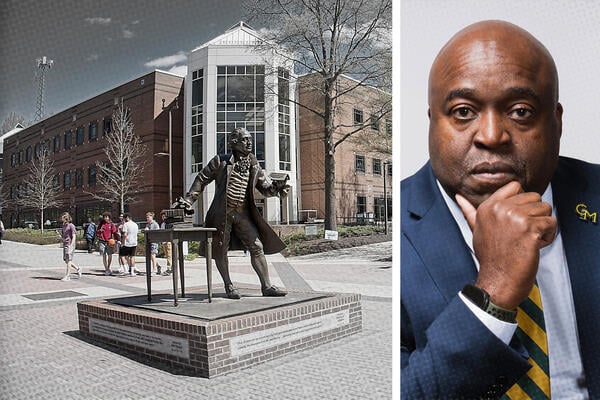
    The Justice Department is now investigating the Faculty Senate at George Mason University after the panel backed the university president and affirmed that “diversity is our strength,” The New York Times reported.

    DOJ officials requested drafts of a faculty resolution passed in support of the president, Gregory Washington, who is facing multiple investigations from various federal agencies related to the diversity, equity and inclusion practices at the university. The DOJ also wants communications among Faculty Senate members who drafted the document as well as communications among those faculty and the president’s office. 

    The George Mason board is set to review the president’s performance at a meeting Friday, and faculty are worried Washington could be pushed out. 

    Harmeet Dhillon, assistant attorney general of the civil rights division at DOJ, wrote in a letter to GMU that the Senate’s resolution was concerning in that it praised Washington’s efforts to diversify faculty and staff to reflect the student population

    Dhillon wrote, according to the Times, that “it indicates the GMU Faculty Senate is praising President Washington for engaging in race- or sex-motivated hiring decisions to achieve specific demographic outcomes among faculty and staff.”

    Source link

  • Higher Education Inquirer : Forgetting Neil Postman

    Higher Education Inquirer : Forgetting Neil Postman

    [For my good friend, a higher education executive who has seen it all, and suggested that all of us pause, take a look back, and think.]

    Neil Postman first gained national attention in 1969 with Teaching as a Subversive Activity, co-authored with Charles Weingartner. In a period marked by war, civil unrest, and cultural transformation, Postman offered a bold challenge to the status quo of American education. Schools, he argued, were failing not because they lacked resources or rigor, but because they had lost sight of their deeper purpose. Instead of fostering critical thinking and civic engagement, they were manufacturing conformity through standardized tests, textbooks, and passive learning. Postman envisioned classrooms without fixed curricula, where teachers would become co-learners and facilitators, helping students develop the tools of inquiry and what he memorably called “crap detection.” It was a radical vision: education as an act of democratic resistance.

    By the early 1980s, Postman had turned his attention to how media was shaping society—and deforming education. In The Disappearance of Childhood (1982), he claimed that television was dissolving the cultural boundaries between children and adults. Television, unlike print, made no distinction in content delivery; it treated all viewers as equal consumers of images and sensation. The consequences, he warned, were profound: children were becoming prematurely cynical while adults increasingly behaved like children. The medium, he believed, flattened developmental distinctions and eroded the cultural function of school as a place for guided maturation and ethical formation.

    Then came Amusing Ourselves to Death in 1985, Postman’s most widely read and enduring work. Written during the ascendancy of television and Reagan-era consumer culture, the book argued that television had transformed public discourse into entertainment. It was not merely the content of television that disturbed him, but its form—its bias toward speed, simplification, and emotional stimulation. In such a media environment, serious discussion of politics, education, science, or religion could not survive. News became performance, candidates became celebrities, and education was increasingly judged by its entertainment value. Postman lamented the way Sesame Street, often hailed as educational television, conditioned children to love television itself—not learning, not schools, not the slow, difficult process of study.

    As the decade progressed, Postman began articulating a broader cultural critique that culminated in Technopoly: The Surrender of Culture to Technology (1992). In this work, he defined technopoly as a society that not only uses technology but is dominated by it—a culture that believes technology is the solution to all problems, and that all values should be reshaped in its image. Postman acknowledged that tools and machines had always altered human life, but in a technopoly, technology becomes self-justifying. It no longer asks what human purpose it serves. Postman noted that schools were being wired with computers, not because it improved learning—there was no solid evidence of that—but because it seemed modern, inevitable, and profitable. His question—“What is the problem to which this is the solution?”—was a challenge not just to education reformers, but to an entire ideology of progress.

    In The End of Education (1995), Postman returned to the question that haunted all his work: what is school for? He argued that American education had lost its narrative. Without compelling guiding stories—what he called “gods”—schools could not inspire loyalty, discipline, or moral development. In place of narratives about democracy, stewardship, public participation, and truth-seeking, schools now told the story of market utility. They trained students for jobs, not for life. They emphasized performance metrics over philosophical inquiry, and they treated students as customers in a credential economy. Education, he warned, was becoming just another mass medium, modeled increasingly after television and later the internet, with predictable results: shallowness, fragmentation, and disengagement.

    By the time Postman died in 2003, the world he had warned about was rapidly taking shape. Facebook had not yet launched. Smartphones had not yet arrived. Generative AI was decades from the mainstream. But already, education was being reshaped by branding, performance metrics, digital delivery, and venture capital. The university was becoming a platform. The classroom was being converted into content. Students were treated not as citizens in formation, but as users to be optimized. The language of education—once rooted in moral philosophy and civic purpose—had begun to sound more like business strategy. Postman would have heard the rise of terms like “learning outcomes,” “human capital development,” and “scalable solutions” as evidence of a culture that had surrendered judgment to systems, wisdom to code, and meaning to metrics.

    Postman’s refusal to embrace digital culture made him easy to ignore in the years that followed. He never gave a TED Talk. He didn’t blog. He didn’t build a brand. He never even used a typewriter. He wrote every word by hand. In a world of media influencers, LinkedIn thought leaders, and edtech evangelists, Postman’s ideas didn’t fit. But the deeper reason we forgot him is more unsettling. 

    Remembering Postman would require a painful reckoning with how far higher education has drifted from its public mission and democratic roots. It would mean admitting that education has been refashioned not as a sacred civic institution but as a delivery mechanism for marketable credentials. It would mean asking questions we’ve tried hard to bury.

    What is higher education for? What kind of people does it produce? Who decides its purpose? What stories do our schools still tell—and whose interests do those stories serve?

    Postman would not call for banning screens or abolishing online learning. He was not nostalgic for chalkboards or print for their own sake. But he would demand that we pause, reflect, and resist. He would ask us to think about what kind of citizens our institutions are shaping, and whether the systems we’ve built still serve a human purpose. He would remind us that information is not wisdom, and that no innovation can substitute for meaning.

    As the Higher Education Inquirer continues its investigations into the commercialization of academia, the credentialing economy, and the collapse of higher ed’s public trust, we find Postman’s voice echoing—uninvited but indispensable. His critiques were not popular in his time, and they are even less welcome now. But they are truer than ever.

    We may have forgotten him. But we are living in the world he tried to warn us about.


    Sources

    Neil Postman and Charles Weingartner, Teaching as a Subversive Activity (1969)

    Neil Postman, Amusing Ourselves to Death (1985)

    Neil Postman, Technopoly: The Surrender of Culture to Technology (1992)

    Neil Postman, The End of Education: Redefining the Value of School (1995)

    Postman’s archived writings: https://web.archive.org/web/20051102091154/http://www.bigbrother.net/~mugwump/Postman/

    Source link