Tag: HighImpact

  • Unlock High-Impact Machine Learning Projects with Source Code for MBA Project

    Unlock High-Impact Machine Learning Projects with Source Code for MBA Project

    Machine learning is the new trend which is transforming how the business world makes decisions. For MBA students, who are integrating the machine learning projects with source code into final year project work would be adding a real value and to differentiate their profile in placements or higher studies.

    Why MBA Students Should Explore Machine Learning Projects?

    Unlike computer science students, MBA students mainly focus on solving business problems. Still, machine learning opens doors to:

    • Marketing – Customer churn prediction, recommendation engines
    • Finance – Fraud detection, risk scoring, stock price forecasting
    • HR – Employee attrition prediction, talent acquisition analytics
    • Operations – Demand forecasting, supply chain optimization

    Working on machine learning projects for final year, MBA students would be bridging their gap between management and technology.

    Where to Find Machine Learning Projects with Source Code?

    1. Machine Learning Projects Kaggle

    Kaggle offers real-world datasets and pre-built models. For MBA projects, students can explore:

    • Sales forecasting
    • Retail Customer churn
    • Social media analysis and Brand sentiment.

    2. Machine Learning Projects GitHub

    GitHub repositories contain ready-to-use machine learning projects with source code. Mba Final year students can download them, customize datasets, and align them with their final year project theme.

    Best Machine Learning Project Ideas for MBA Final Year

    Marketing Analytics

    • Customer segmentation using K-Means on Fitness Centre
    • Customer Churn on local restaurant
    • Sentiment analysis of customer churn prediction in Banks

    Finance Analytics

    • Comparative study of Loan approval prediction using machine learning Methods.
    • Machine learning prediction on Stock price trend forecasting.

    HR & Operations

    • Comparative study of employee attrition prediction of an organization
    • Utilization of Machine learning in Demand and inventory forecasting.
    • Get more machine leaning titles in this link.Click here

    How MBA Students Can Use These Projects

    1. Students should choose the relevant topics (Marketing, Finance, HR, or operations).
    2. They have to Download machine learning projects with source code from Kaggle or GitHub.
    3. Modifying the datasetsas per the project context.

    Should be focussing on business insights and not just algorithms.

    Check out this video for more indepth knowledge on Machine Learning

    Conclusion

    For MBA students, machine learning projects with source code are not about becoming data scientists—it’s about using data intelligently to make right business decisions.

    By leveraging Kaggle and GitHub, students can transform their final year project into a powerful showcase of management plus analytics skills.

    The main intent of the blog is to help students understand how to find the right mentor who can guide mba students to provide hands-on experience with ml code base.

    This content will help gain more knowledge for capstone projects,thesis work or mba project by applying customer analytics, finance strategy to complement theoretical business knowledge in machine learning and build portfolio for job interviews or internships.

    Download machine learning projects for final year pdf

    Latest Blogs
    Source link

  • How Portland Public Schools can afford to offer high-impact tutoring

    How Portland Public Schools can afford to offer high-impact tutoring

    This audio is auto-generated. Please let us know if you have feedback.

    SEATTLE — In 2024, nearly half — 48% — of Oregon’s 4th graders scored below basic in reading on the National Assessment of Educational Progress

    Not only is that 7 percentage points worse than the national average, but 48% represented a significant jump from pre-pandemic levels in 2019, when 36% of Oregon’s 4th graders tested below basic for reading. 

    The state’s latest reading scores are “disgraceful” and “unacceptable,” said Darcy Soto, director of learning acceleration at Portland Public Schools.

    But unlike for the state at large, the Portland district has seen an increase — albeit a slight one of 1% — in reading scores since the pandemic, said Karla Hudson, program administrator for the district’s learning acceleration team. Still, Portland’s progress has been slow and incremental, she said, and less than 60% of the district’s students are proficient in reading.

    “We have a lot of work to do,” Hudson said, which is why the 43,500-student district has zeroed in on providing high-impact tutoring.

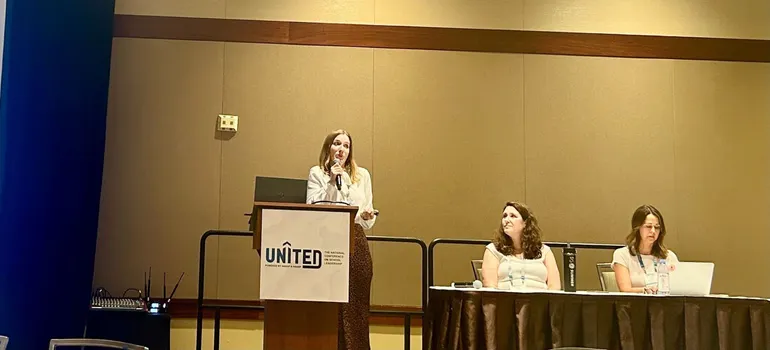
    Joined by Stanford University’s Nancy Waymack, Soto and Hudson shared what Portland has learned from its efforts during a July 12 session at UNITED, the National Conference on School Leadership.

    High-impact tutoring is a data-driven service that is embedded into the school day and uses consistent, well-supported tutors, said Waymack, director of research, partnerships and policy for Stanford University’s National Student Support Accelerator. The tutors use high-quality instructional materials and hold sessions at least three times a week in small groups of no more than four students, she said. 

    While teachers can be successful tutors, Waymack said, so too can community members like college students and retirees. Regardless, it’s important that students be able to build a relationship with their tutors, she said. 

    Data also plays a valuable role in tracking student progress throughout the tutoring, Waymack said. When tutoring occurs during school hours or shortly before or after class time, she said, research shows students are far more likely to attend sessions. 

    Years in the making

    Portland began its early literacy tutoring program through a small after-school pilot initiative in 2021-22 at a few elementary schools for students in grades 3-5, said Soto. The pilot started to show “some really great outcomes,” she said, allowing the district to expand the program from 6 to 20 schools by the 2022-23 school year.

    During those first two years, teachers were trained on the curriculum and paid for extended hours to tutor after school and. While that approach did improve students’ reading skills, Soto said, “it was very expensive” given teacher pay and the small student group size. This made the pilot difficult to scale to other schools.

    As the tutoring program continued into the 2023-24 school year, the district began shifting to a more cost-effective model — especially as federal pandemic relief funds were sunsetting, Soto said. 

    By the 2024-25 school year, Soto said, the district used some of its last remaining Elementary and Secondary School Emergency Relief funds to partner with the Oregon Department of Education and Oregon State University to develop a free K-3 tutoring curriculum aligned with structured literacy instruction. 

    After successfully piloting the new curriculum in summer 2024, the district launched a $1.2 million program across 50 of its 58 elementary schools to serve over 1,200 students in 2024-25, Soto said. The program hired 152 tutors — mostly paraprofessionals — and was embedded during school hours during 30-minute blocks that didn’t interfere with core instruction. 

    Source link

  • How to Build a High-Impact Data Team Without the Full-Time Headcount [Webinar]

    How to Build a High-Impact Data Team Without the Full-Time Headcount [Webinar]

    You’re under increased pressure to make better, data-informed decisions. However, most colleges and universities don’t have the budget to build the kind of data team that drives strategic progress. And even if you can hire, you’re competing with other industries that pay top dollar, making it hard, if not impossible, to find the right data resource with all the skills to move your operation forward. Don’t let hiring roadblocks make you settle for siloed insights and stagnant dashboards.

    How to Build a High-Impact Data Team
    Without the Full-Time Headcount
    Thursday, June 26
    2:00 pm ET / 1:00 pm CT 

    In this webinar, Jeff Certain, VP of Solution Development and Go-to-Market, and Dan Antonson, AVP of Data and Analytics, break down how a managed services model can help you create a high-impact data team at a fraction of the cost and give you access to a robust bench of highly specialized data talent. They will also share some real-world examples of nimble, high-impact data teams in action. 

    You’ll walk away knowing: 

    • Which data roles are needed for success and scale in higher ed 
    • How to rapidly scale data operations without adding FTEs 
    • Why managed services are a smarter investment than full-time hires 
    • Ways to tap into cross-functional expertise on demand 
    • How to build a future-ready data infrastructure without ballooning your org chart 

    Whether you’re starting from scratch or trying to scale a lean team, this session will offer practical, flexible strategies to get there faster — and more cost-effectively.  

    Who Should Attend:

    If you are a data-minded decision-maker in higher ed or a cabinet-level leader being asked to do more with less, this webinar is for you. 

    • Presidents and provosts 
    • CFOs and COOs 
    • Enrollment and marketing leaders  

    Expert Speakers

    Jeff Certain

    VP of Solution Development and Go-to-Market

    Collegis Education

    Dan Antonson

    AVP of Data and Analytics

    Collegis Education

    It’s time to move past the piecemeal approach and start driving real outcomes with your data. Complete the form to reserve your spot! We look forward to seeing you on Thursday, June 26. 

    Source link