
Earlier this year, Pennsylvania State University announced it would close seven campuses due to financial constraints, while Louisiana State University implemented a hiring freeze and other cost-cutting measures.
Months later both institutions fired their head football coaches—for a price. Despite Penn State’s financial challenges, administrators were willing to pay more than $45 million to make head coach James Franklin go away after the Nittany Lions posted a 6-3 record. LSU fired Brian Kelly after a 5-3 start and gave him a buyout of $54 million.
Franklin’s total buyout was ultimately reduced to $9 million when he landed the head coaching job at Virginia Tech, and Kelly’s exit package will also shrink should he find another position. But the eye-popping compensation numbers are adding up—and setting new records at a time when many colleges and universities are cutting costs.
Record Buyouts
Recent data compiled by the Knight Commission on Intercollegiate Athletics shows that failing is a lucrative business for college football coaches. Fifteen fired football coaches have already racked up collective buyouts of nearly $228 million from public universities, compared to $120 million in fiscal year 2024. (Those totals are for Football Bowl Subdivision coaches only, formerly known as Division I-A, and only include public universities, since private institutions don’t release such contract details.)
Former LSU coach Brian Kelly landed one of the largest buyouts in the history of college sports.
Gus Stark/LSU/University Images/Getty Images
The Knight Commission noted that individual coaching buyouts this year “are the second, third, fourth, and fifth highest severance pay obligations in history.” The top slot still belongs to Texas A&M University, which fired Jimbo Fisher in 2023 with an exit package of more than $75 million.
Looking across a longer timeline, the commission estimates that universities shelled out a total of $852 million in severance pay for football coaches, including assistants, between 2012 and 2024.
University Responses
Universities often stress that coaching buyouts are paid with donor funds, not public money. Even so, some experts argue that paying vast sums of money to fire coaches is problematic and damages faculty and staff morale, especially at universities that are slashing jobs and budgets.
Penn State defended its recent buyout to Inside Higher Ed by emphasizing that its athletic program is among the few in the nation “that is self-sustaining and therefore does not use any tuition or taxpayer dollars.” In addition, the university said, it has a major economic impact on the surrounding area.
“Decisions regarding budgets and operations of the academic enterprise are separate and distinct,” a spokesperson wrote in an emailed response to a question about closing rural campuses across Pennsylvania. “As noted, no tuition or tax dollars are used for athletics. The difficult but necessary decisions Penn State has made impacting campuses and unit budgets, have been made with a core focus on setting our students up with the best opportunities for success.”
LSU did not provide a statement to emailed questions prior to publication.
Congressional Scrutiny
While Congress has deliberated capping pay for college athletes—whom institutions can now pay directly, as of earlier this year—Knight Commission on Intercollegiate Athletics CEO Amy Privette Perko has encouraged lawmakers to rein in coaching salaries.
“As Congress debates the merits of federal legislation to place limits and guardrails on college athlete compensation, it should also examine the conditions that allow for the continued growth of excessive compensation and severance for football coaches at non-profit universities,” she said in a statement accompanying the organization’s report on buyouts.
Some members of Congress appear interested in taking on runaway salaries and buyouts.
In October, Representative Michael Baumgartner, a Washington Republican, introduced the Correcting Opportunity and Accountability in Collegiate Hiring Act, a proposal that would cap annual pay for all athletics department employees. Baumgartner’s proposed bill would limit annual pay to no more than 10 times the cost of in-state tuition for undergraduate students.
While new LSU coach Lane Kiffin is set to make $13 million a year, his annual salary would be dramatically lower—about $280,000—under the pay scheme proposed by Baumgartner.
Multiple state attorneys general have already voiced opposition to the proposal.
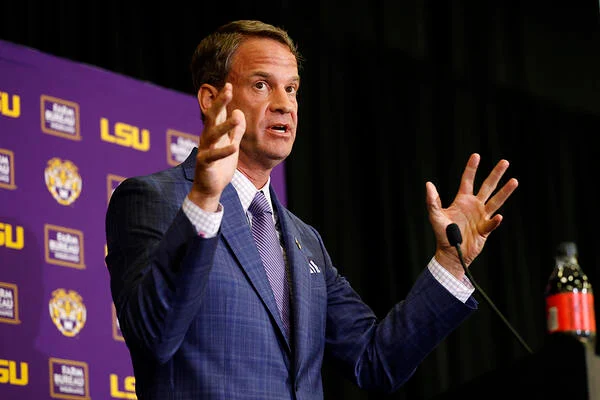
New LSU coach Lane Kiffin is poised to make $13 million a year.
Tyler Kaufman/Getty Images
Some lawmakers have also questioned whether college sports should remain tax-exempt. Senator Maria Cantwell, a Democrat representing Washington, wrote a letter to the Joint Committee on Taxation earlier this year, seeking an analysis of the implications of stripping the NCAA, member institutions and athletic conferences of their ability to continue as tax-exempt organizations.
“Given the evolving market dynamics of college sports coupled with changes in the legal framework affecting college athletes, legitimate questions have been raised about whether it is time to rethink the tax-exempt regime under which college sports currently operates,” she wrote.
But so far, legislation to alter the college sports landscape has proven difficult to pass. The latest effort to overhaul athletics—which would have limited student transfer eligibility and how much universities can spend on name, image and likeness deals—collapsed short of the end zone last week when House members balked on the GOP-backed bill and sponsors pulled it from a vote.