Tag: History

  • Clear and Present Danger – A history of free speech

    Clear and Present Danger – A history of free speech

    Why have kings, emperors, and governments killed and imprisoned people to shut them up? And why have countless people risked death and imprisonment to express their beliefs? Jacob Mchangama guides you through the history of free speech from the trial of Socrates to the Great Firewall.
    Stay up to date with Clear and Present Danger on the show’s website at freespeechhistory.com

    Source link

  • Trump’s push for ‘patriotic’ education could further chill history instruction

    Trump’s push for ‘patriotic’ education could further chill history instruction

    High school history teacher Antoine Stroman says he wants his students to ask “the hard questions” — about slavery, Jim Crow, the murder of George Floyd and other painful episodes that have shaped the United States. 

    Now, Stroman worries that President Donald Trump’s push for “patriotic education” could complicate the direct, factual way he teaches such events. Last month, the president announced a plan to present American history that emphasizes “a unifying and uplifting portrayal of the nation’s founding ideals,” and inspires “a love of country.” 

    Stroman does not believe students at the magnet high school where he teaches in Philadelphia will buy this version, nor do many of the teachers I’ve spoken with. They say they are committed to honest accounts of the shameful events and painful eras that mark our nation’s history.

    “As a teacher, you have to have some conversations about teaching slavery. It is hard,” Stroman told me. “Teaching the Holocaust is hard. I can’t not teach something because it is hurtful. My students will come in and ask questions, and you really have to make up your mind to say, ‘I can’t rain dance around this.’” 

    Related: Become a lifelong learner. Subscribe to our free weekly newsletter featuring the most important stories in education. 

    These are tense times for educators: In recent weeks, dozens of teachers and college professors have been fired or placed under investigation for social media posts about their views of slain 31-year-old conservative activist Charlie Kirk, ushering in a slew of lawsuits and legal challenges

    In Indiana, a portal called Eyes on Education encourages parents of school children, students and educators to submit “real examples” of objectionable curricula, policies or programs. And nearly 250 state, federal and local entities have introduced bills and other policies that restrict the content of teaching and trainings related to race and sex in public school. Supporters of these laws say discussion of such topics can leave students feeling inferior or superior based on race, gender or ethnicity; they believe parents, not schools, should teach students about political doctrine.

    “It has become very difficult to navigate,” said Jacob Maddaus, who teaches high school and college history in Maine and regularly participates in workshops on civics and the Constitution, including programs funded by the Sandra Day O’Connor Institute. Almost 80 percent of teachers surveyed recently by the institute say they have “self-censored” in class due to fear of pushback or controversy. They also reported feeling underprepared, unsupported and increasingly afraid to teach vital material.

    After Kirk’s death Trump launched a new “civics education coalition,” aimed at “renewing patriotism, strengthening civic knowledge, and advancing a shared understanding of America’s founding principles in schools across the nation.” The coalition is made up made up almost entirely of conservative groups, including Kirk’s Turning Point USA, whose chief education officer, Hutz Hertzberg, said in a statement announcing the effort that he “is more resolved than ever to advance God-centered, virtuous education for students.” 

    So far, no specific guidelines have emerged: Emails to the Department of Education — sent after the government shut down — were not returned. 

    Related: Teaching social studies in a polarized world 

    Some students, concerned about the shifting historical narratives, have taken steps to help preserve and expand their peers’ access to civics instruction. Among them is Mariya Tinch, an 18-year-old high school senior from rural North Carolina. “Trump’s goal of teaching ‘patriotic’ education is actually what made me start developing my app, called Revolve Justice, to help young students who didn’t have access to proper civic education get access to policies and form their own political opinions instead of having them decided for them,” she told me. 

    Growing up in a predominantly white area, Tinch said, “caused civic education to be more polarized in my life than I would like as a young Black girl. A lot of my knowledge in regard to civic education came from outside research after teachers were unable to fully answer my questions about the depth of the issues that we are taught to ignore.”

    Mariya Tinch, a high school senior in North Carolina, at the 2025 Ready, Set, App! competition (second from left). She developed an app to help students get access to policies and form their own political opinions. Credit: Courtesy of Mariya Tinch

    Other students are upset about federal cuts to history education programs, including National History Day, a 50-year-old nonprofit that runs a history competition for some 500,000 students who engage in original historic research and provides teachers with resources and training. Youth groups are now forming as well, including Voters of Tomorrow, which has a goal of building youth political power by “engaging, educating, and empowering our peers.” 

    Related: What National Endowment for the Humanities cuts mean for high schoolers like me

    There will surely be more attention focused on the founders’ original ideals for America as we approach the 250th anniversary of the signing of the Declaration of Independence this July. Some teachers and groups that support civics teachers are creating resources, including the nonprofit iCivics, with its “We can teach hard things — and we should” guidelines.

    How all of these different messages resonate with students remains to be seen. In the meantime, Jessica Ellison, executive director of the nonprofit National Council for History Education is fielding a lot of questions from history teachers and giving them specific advice.

    “They might be anxious about any teaching that could get them on social media or reported by a student or parent,” Ellison told me, noting the strategy she shares with teachers is to focus on “the three S’s –— sources, state standards and student questions.” 

    Ellison also encourages teachers to “lean into the work of historians. Read the original sources, the primary sources, the secession documents from Mississippi and put them in front of students. If it is direct from the source you cannot argue with it.”

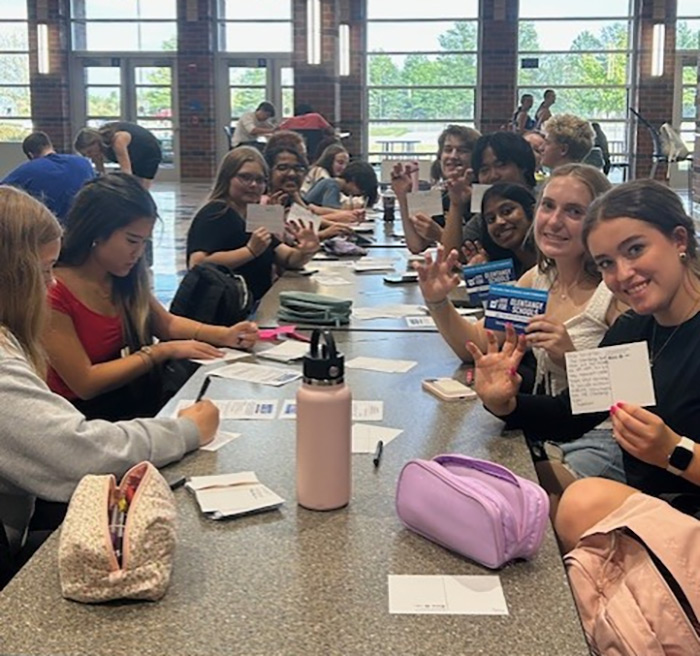
    In September, students at Berlin High School in Delaware, Ohio, participated in a sign creation and postcard campaign for a levy on the ballot. Credit: Courtesy Michael LaFlamme

    Michael LaFlamme has his own methods: He teaches Advanced Placement government and U.S. history at Olentangy Berlin High School outside of Columbus, Ohio, where many of his students work the polls during elections to see up close how voting works. They learn about civics via a participatory political science project that asks students to write a letter to an elected official. He also encourages students to watch debates or political or Sunday morning news shows with a parent or grandparent, and attend a school board meeting.

    “There is so much good learning to be done around current events,” LaFlamme told me, noting that “it becomes more about community and experience. We are looking at all of it as political scientists.”

    For Maddaus, the teacher in Maine, there is yet another obstacle: How his students consume news reinforces the enormous obstacles he and other teachers face to keep them informed and thinking critically. Earlier this fall, he heard some of his students talking about a rumor they’d heard over the weekend. 

    “Mr. Maddaus, is it true? Is President Donald Trump dead?” they asked. 

    Maddaus immediately wanted to know how they got this false news. 

    “We saw it on TikTok,” one of the students replied — not a surprising answer, perhaps, given that 4 out of 10 young adults get their news from the platform.

    Maddaus says he shook his head, corrected the record and then went back to his regularly scheduled history lesson. 

    Contact editor in chief Liz Willen at [email protected].

    This column about patriotism in education was produced by The Hechinger Report, a nonprofit, independent news organization focused on inequality and innovation in education. Sign up for the Hechinger newsletter.

    The Hechinger Report provides in-depth, fact-based, unbiased reporting on education that is free to all readers. But that doesn’t mean it’s free to produce. Our work keeps educators and the public informed about pressing issues at schools and on campuses throughout the country. We tell the whole story, even when the details are inconvenient. Help us keep doing that.

    Join us today.

    Source link

  • AI Hallucinations May Soon Be History

    AI Hallucinations May Soon Be History

    We all are witness to the incredibly frenetic race to develop AI tools, which publicly kicked off on Nov. 30, 2022, with the release of ChatGPT by OpenAI. While the race was well underway prior to the first public release, we have been able to follow, version by version, the updates from OpenAI (GPT), Google (Gemini) and Anthropic (Claude), which are among the many versions of AI for personal and commercial use. This competition has been fast and furious. One of the most disturbing issues that has surfaced along the way has been the proclivity of generative AI to hallucinate.

    In 2023, IBM dug into the hallucination issue:

    “Generally, if a user makes a request of a GenAI tool, they desire an output that appropriately addresses the prompt (that is, a correct answer to a question). However, sometimes AI algorithms produce outputs that are not based on training data, are incorrectly decoded by the transformer or do not follow any identifiable pattern. In other words, it ‘hallucinates’ the response. The term may seem paradoxical, given that hallucinations are typically associated with human or animal brains, not machines. But from a metaphorical standpoint, hallucination accurately describes these outputs, especially in the case of image and pattern recognition (where outputs can be truly surreal in appearance).”

    Roland Moore-Colyer reported in Live Science earlier this year that instances of hallucinations seemed to become more difficult to detect as the prompts became more advanced:

    “However, AI hallucinations present a problem when it comes to delivering accurate and correct information, especially if users take the information at face value without any checks or oversight. ‘This is especially problematic in domains where decisions depend on factual precision, like medicine, law or finance,’ Watson said. ‘While more advanced models may reduce the frequency of obvious factual mistakes, the issue persists in more subtle forms. Over time, confabulation erodes the perception of AI systems as trustworthy instruments and can produce material harms when unverified content is acted upon.” And this problem looks to be exacerbated as AI advances. “As model capabilities improve, errors often become less overt but more difficult to detect.’”

    A variety of attempts were made to correct the hallucination issue. Most notable was that many AI models added an architecture to optimize and enhance AI responses titled retrieval augmented generation (RAG). IBM explains in this article:

    “RAG allows GenAI models to access additional external knowledge bases, such as internal organizational data, scholarly journals and specialized datasets. By integrating relevant information into the generation process, chatbots and other natural language processing (NLP) tools can create more accurate domain-specific content without needing further training.”

    On Sept. 14, OpenAI researchers published a not-yet-peer-reviewed paper, “Why Language Models Hallucinate,” on arXiv. Gemini 2.5 Flash summarized the findings of the paper:

    Key Findings from the Paper

    Systemic Problem: Hallucinations are not simply bugs but a systemic consequence of how AI models are trained and evaluated.

    Evaluation Incentives: Standard evaluation methods, particularly binary grading systems, reward models for generating an answer, even if it’s incorrect, and punish them for admitting uncertainty.

    Pressure to Guess: This creates a statistical pressure for large language models (LLMs) to guess rather than say “I don’t know,” as guessing can improve test scores even with the risk of being wrong.

    Fundamental Flaw: The paper highlights a fundamental flaw in the industry’s approach to evaluating AI progress, prioritizing raw accuracy over reliability and factual correctness.

    This is much like the test-taking strategy in certain standardized tests, for which subjects are advised to guess rather than not answering a question for which they don’t have a reliable answer. Hence, in order to achieve the best outcome, models invent answers that could be plausible, but for which they don’t have solid evidence. That, of course, undermines the validity of the response and the credibility of the tool.

    This, clearly, is unsatisfactory. With the realization of this shortcoming in the training protocol for the models, the companies have begun tweaking their products to respond that they are unable to answer. However, we are also seeing the increasing prevalence of “deep research”–capable models such as GPT-5 and Gemini 2.5 Pro. These are able to dig deeper and deeper, uncovering more and more sources that can hold the desired answer.

    Here’s an example that is prompted by my lifelong enthusiasm for baseball. In previous “Online: Trending Now” columns, I have advocated we all provide more context and greater detail in our prompts. But, in this case, I presented a simple one-sentence prompt without context to three leading frontier generative AI apps: “Who called a players’-only meeting during a rain delay on a Wednesday night in Cleveland?” I included no mention of what sport, what team, what season, etc. Claude Sonnet 4 responded,

    “I’d need more context to answer this question accurately. There have been many baseball games with rain delays on Wednesday nights in Cleveland over the years, and players’-only meetings during such delays aren’t always widely reported or memorable events.

    Could you provide more details about:

    • What year or approximate timeframe this occurred?
    • Which team(s) were involved?
    • Any other context about the situation or why this meeting was significant? With more specific information, I’d be better able to help identify who called the meeting and the circumstances surrounding it.”

    Note that Claude, without deep research, did not hallucinate. It did recognize this was likely baseball, and it said it needed more information. Certainly, that is better than making up an answer such as we might have seen in previous months and years.

    GPT-5 thought for 11 seconds and came up with the right answer in a succinct response.

    Gemini 2.5 Pro thought for about the same length of time, digging through multiple sources, found the answer and confirming sources, then responded in more detail,

    Jason Heyward Rallied Cubs with Players’-Only Meeting During Historic World Series Rain Delay

    During a tense rain delay in the decisive Game 7 of the 2016 World Series, Chicago Cubs right fielder Jason Heyward called a players’-only meeting that has since become a legendary moment in the franchise’s storied history. The brief stoppage in play occurred on a Wednesday night in Cleveland after the ninth inning, with the Cubs and the then–Cleveland Indians locked in a tie. With the weight of a 108-year championship drought on their shoulders, Heyward gathered his teammates in the weight room behind the visitor’s [sic] dugout at Progressive Field … Following the delay and Heyward’s impromptu meeting, the Cubs came out in the top of the tenth inning and scored two runs. The Indians would rally for one run in the bottom of the frame, but the Cubs ultimately held on to win 8-7, securing their first World Series title since 1908.

    Know that hallucinations are fading from generative AI. We can be more confident in the recently released deep research models. This provides the kind of reliable research that we depend upon in higher education.

    Source link

  • ASALH Brings Annual Conference to Atlanta Amid Attacks on Black History Education

    ASALH Brings Annual Conference to Atlanta Amid Attacks on Black History Education

    The Association for the Study of African American Life and History (ASALH) will convene its annual conference in Atlanta from September 24-28, 2025, bringing together Black leaders, academics, educators, and community members during what organizers describe as a “critical hour” for Black history and education.

    TDr. Stephanie Y. Evanshe conference, themed “African Americans and Labor,” comes as educational institutions nationwide face mounting pressure over diversity, equity, and inclusion initiatives, and as several states have enacted legislation restricting how race and racism can be discussed in classrooms.

    The conference will feature several prominent voices in African American studies and social justice, including Pulitzer Prize-winning historian Dr. Edda Fields-Black and scholar-activist Dr. Ibram X. Kendi. Labor organizer Chris Smalls, who led the successful effort to form the first independent union at an Amazon warehouse in the United States through the Amazon Labor Union, will headline the Friday John Blassingame Luncheon.

    Other featured speakers include historians Drs. Peniel Joseph, Maurice Hobson, Stephanie Evans, and Joe Trotter Jr., along with civil rights leaders Ambassador Andrew and Andrea Young and Rev. Jamal Bryant.

    A key component of the conference programming will address current challenges facing educators and institutions seeking to teach Black history. Specialized sessions will provide guidance to librarians, teachers, and community organizers on establishing Freedom Schools and teaching Black history “in the current challenged national environment.”

    Dr. Peniel JosephDr. Peniel JosephThe Wednesday plenary session, “The Fire Now!,” will specifically examine how budgets and policies are “Undermining Preservation of the African American Experience,” featuring experts from the National Parks Conservation Association, Trust for Public Land, and the U.S. Department of the Interior.

    “Our goal is to make as many of the activities free and accessible to the public as possible,” organizers announced, with Wednesday sessions, plenaries, film festival screenings, poster sessions, and vendor exhibits offered at no charge.

    Thursday’s plenary, “Towards a Theory of Liberation: The State of Black Radicalism Today,” will feature scholars Drs. Charisse Burden-Stelly, Gerald Horne, Akinyele Umoja, Joy James, and Ashley Howard examining contemporary Black liberation movements.

    Friday’s session will honor the scholarship of historian Dr. Joe William Trotter Jr., a leading expert on African American labor history and urban studies.

    A Saturday luncheon titled “An Unusual Emphasis on Scholarship: Carter G. Woodson, Omega Psi Phi, and the Power of Black History” will explore the legacy of ASALH’s founder and the role of Black Greek letter organizations in preserving African American history.

    Registration for the ASALH Conference is open, with both free and ticketed events available. The annual gathering represents one of the premier venues for African American historical scholarship and community engagement in the United States.

    Source link

  • Campus Cops, A Critical History

    Campus Cops, A Critical History

    Campus policing in the United States has a long and complicated history, one that cannot be understood apart from the larger culture of violence in the nation. Colleges and universities, far from being sanctuaries of peace, have mirrored the broader society’s struggles with crime, inequality, and abuse of power. The development of campus police forces is both a symptom of these realities and a contributor to them.

    From Watchmen to Armed Police

    In the early 20th century, many colleges relied on night watchmen or unarmed security guards to keep order. Their duties were limited: locking buildings, checking IDs, and responding to minor incidents. But as campuses expanded in size and complexity—particularly after the GI Bill opened higher education to millions—colleges began to formalize security forces. By the 1960s and 1970s, during an era of political unrest and rising crime rates, many institutions established their own sworn police departments with full arrest powers.

    The rationale was simple: the surrounding society was becoming more violent, and colleges were not immune. Campus shootings, from the University of Texas tower massacre in 1966 to Virginia Tech in 2007, underscored the vulnerability of universities to extreme violence. Administrators and legislators justified campus policing as a necessary protection against a culture of guns, crime, and fear.

    The Expansion of Campus Policing

    Today, more than 90 percent of U.S. colleges and universities with 2,500 or more students have some form of armed campus police. Many operate as fully accredited police departments, indistinguishable from municipal counterparts. They are tasked with preventing theft, responding to assaults, and increasingly, preparing for mass shootings. This expansion reflects the broader American decision to deal with social breakdown through policing and incarceration rather than through prevention, education, or healthcare.

    Yet the rise of campus police also brings deep contradictions. If colleges are supposed to be places of learning and community, what does it mean that they are patrolled by officers trained in the same punitive logics as city police? What does it say about the United States that students—especially students of color—often feel surveilled rather than protected?

    Campus Coverups and the Protection of Institutions

    Beyond concerns about over-policing, there is another side to the story: under-policing and coverups. Colleges have long been criticized for minimizing reports of sexual assault, hazing, hate crimes, and other misconduct in order to protect their reputations. Title IX litigation, Department of Education investigations, and journalism have revealed systemic patterns of universities failing to report crimes or discouraging survivors from coming forward.

    Campus police departments have sometimes been complicit in these coverups. Because they report to university administrations rather than independent city governments, their accountability is compromised. The incentive to “keep the numbers down” and maintain the appearance of a safe, prestigious campus can lead to the suppression of reports. Survivors of sexual violence often describe being dismissed, ignored, or retraumatized by campus police who appeared more concerned about institutional liability than student well-being.

    The Contradictions of Campus Safety

    The dual role of campus police—protecting students from external dangers while shielding institutions from internal accountability—illustrates the contradictions of higher education in a violent society. Universities are expected to provide safety in a nation awash with firearms, misogyny, racism, and economic desperation. But instead of challenging these conditions, many campuses rely on armed policing, surveillance technologies, and public relations strategies.

    The result is a paradox: campuses are policed as if they are dangerous cities, yet when crimes happen within their walls, especially those involving sexual violence or elite fraternities and athletes, those same crimes are often hidden from public view.

    Toward a Different Model of Safety

    Critics argue that true campus safety requires moving beyond reliance on police alone. Investments in mental health services, consent education, community accountability processes, and structural reforms to address gender violence and racial inequities are essential. Some advocates push for independent oversight of campus police, ensuring they are accountable not just to administrators but to students, staff, and the broader public.

    If campus policing has grown because America has normalized violence, then reimagining campus safety requires confronting the roots of that violence. As long as universities remain more committed to protecting their brands than their students, campus cops will embody the contradictions of American higher education—part shield, part coverup, and part reflection of a society unable to address its deeper wounds.


    Sources

    • Sloan, John J. and Fisher, Bonnie S. The Dark Side of the Ivory Tower: Campus Crime as a Social Problem. Cambridge University Press, 2011.

    • Karjane, Heather M., Fisher, Bonnie S., and Cullen, Francis T. Campus Sexual Assault: How America’s Institutions of Higher Education Respond. National Institute of Justice, 2002.

    • U.S. Department of Education, Clery Act Reports.

    • Armstrong, Elizabeth A. and Hamilton, Laura. Paying for the Party: How College Maintains Inequality. Harvard University Press, 2013.

    Source link

  • Enroll in the Beatles MA Online: Study Music History

    Enroll in the Beatles MA Online: Study Music History

    I recognise that specialist courses, ‘Star Wars’ Studies, or Soap Opera Studies, often attract significant criticism from discipline purists. However, having a focus, a passion, and a shared point of reference that engages students across a range of disciplines, including cultural studies, sociology, anthropology, and economics, is a way to engage interest and ensure motivation—exposing students to academic perspectives while having them study something that they’re already passionate about. One has to wonder why there aren’t more programmes like this, particularly at the postgraduate level.


    Get ready, Beatles fans! Soon, students will be able to ‘come together’ with fellow enthusiasts and scholars from around the world to study the Fab Four. The University of Liverpool is reviving its unique Master of Arts course on the Beatles, and this time, it will be offered fully online.

    Launching in September 2026, the part-time MA in The Beatles, Heritage, and Culture programme will delve deeply into the band’s lasting cultural and economic influence on Liverpool and its surrounding areas.

    This course isn’t just about the songs. It explores how the Beatles’ legacy continues to shape everything from urban planning and civic design to heritage, tourism, and the creative industries in their hometown. Students get a chance to see how four lads from Liverpool changed not only music but also the very landscape of their city.

    While the program is online, students have the option to add a special two-week experience in Liverpool. This module includes daily lectures and site visits to iconic Beatles locations. It’s presented as students’ chance to interact with lecturers, peers, and industry professionals, and see the history they’re studying firsthand.

    Dr. Holly Tessler, the Program Director, offering the program online will allow people from all over the globe to “study Liverpool’s unique Beatles environment, history and heritage from scholars and practitioners who are immersed in this work.”

    The University of Liverpool is a leading authority on the academic study of the Beatles. The university’s Department of Music staff are part of the City of Liverpool’s Beatles Legacy Group, where they help shape local policy on Beatles heritage and tourism. Dr. Tessler herself is the co-editor of The Journal of Beatles Studies, so students will be learning from those who literally write the book on the subject.

    Applications for the programme will open in October 2025.

    Here a link for more information: https://news.liverpool.ac.uk/2025/08/26/liverpools-beatles-ma-returns-in-distance-learning-format/

    Source link

  • Project POTUS 2025 Middle School Winners Announced

    Project POTUS 2025 Middle School Winners Announced

    Indianapolis, IN — Project POTUS, a national middle school history initiative from the Benjamin Harrison Presidential Site, has named winners for this year’s competition. 

    Since the founding of our nation, there have been nearly half a billion American citizens. Of those, over 12,000 of us have served in Congress. Just 115 have become Supreme Court Justices. Only 45 citizens have become President of the United States. There’s something exceptional about each POTUS — good, bad, or otherwise. Project POTUS? challenges students in middle school to research an American president and create a video, 60 seconds or less, representing the POTUS chosen in a way that is creative, supported by good history research, and fun. A Citizen Jury made up of nearly 100 people reviewed all qualifying submissions and selected this year’s winners.

    Grand Jury’s Grand Prize and Spotlight Award Selections  

    Grand Prize Winner ($500 award) 

    • 6th grader Peter Gestwicki from Muncie, Indiana won grand prize for his video about Theodore Roosevelt. Watch his winning video  here.

    Spotlight Award  Winners ($400 award winners) 

    • 8th grader Grace Whitworth from St. Richard’s Episcopal School in Indianapolis, Indiana won for her video about President Thomas Jefferson. Watch her winning video  here.
    • 8th grader Izzy Abraham from Sycamore School in Indianapolis, Indiana for her video about President Calvin Coolidge. Watch his winning video  here.
    • 8th grader Clara Haley from St. Richards Episcopal School in Indianapolis, Indiana for her video about President George W. Bush. Watch his winning video  here
    • 8th graders Delaney Guy and Nora Steinhauser from Cooperative Middle School in Stratham, New Hampshire for their video about President James Polk. Watch their winning video  here.

    37 students throughout the country each won their Presidential Category and received $100 awards. Check out all of their videos  here.

    The 2026 Project POTUS competition begins Election Day, November 4, 2025 and all submissions must be entered by Presidents Day, February 16, 2026. Learn more  here.

    Project POTUS is made possible by the generous support from Russell & Penny Fortune. 

    About the Benjamin Harrison Presidential Site

    The Benjamin Harrison Presidential Site is the former home of the 23rd U.S. President. Now celebrating its 150th anniversary, it is a stunningly restored National Historic Landmark that shares the legacy of Indiana’s only President and First Lady with tens of thousands of people annually through guided tours, educational programs, special events and cultural programs. Rated “Top 5 Stately Presidential Homes You Can Visit” by Architectural Digest, the Harrison’s 10,000 square foot Italianate residence in downtown Indianapolis houses nearly 11,000 curated artifacts spanning more than two centuries of American and presidential history. Recently expanded and restored through a $6 million campaign, the Benjamin Harrison Presidential Site is also consistently ranked a Top 5 Thing To Do in Indianapolis by TripAdvisor. Signature programs and initiatives include: Future Presidents of America; Project POTUS, Candlelight Theatre; Juneteenth Foodways Festival; Wicket World of Croquet; and Off the Record. Founded in 1966 as a private 501c(3) that receives no direct federal support, the Benjamin Harrison Presidential Site is dedicated to increasing public participation in the American system of self-government through the life stories, arts and culture of an American President. Find out more at PresidentBenjaminHarrison.org

    eSchool News Staff
    Latest posts by eSchool News Staff (see all)

    Source link

  • All that glitters is not gold: A brief history of efforts to rebrand social media censorship

    All that glitters is not gold: A brief history of efforts to rebrand social media censorship

    Whenever a bill aimed at policing online speech is accused of censorship, its supporters often reframe the conversation around subjects like child safety or consumer protection. Such framing helps obscure government attempts to shape or limit lawful speech, yet no matter how artfully labeled such measures happen to be, they inevitably run headlong into the First Amendment.

    Consider the headline-grabbing Kids Online Safety Act (KOSA). Re-introduced this year by Sens. Marsha Blackburn (R-Tennessee) and Richard Blumenthal (D-Connecticut) as a measure to protect minors, KOSA’s sponsors have repeatedly characterized its regulations as merely providing tools, safeguards, and transparency. But in practice, it would empower the federal government to put enormous pressure on platforms to censor constitutionally protected content. This risk of government censorship led KOSA to stall in the House last year after passing the Senate. 

    Child safety arguments have increasingly surfaced in states pursuing platform regulation, but closer inspection reveals that many such laws control how speech flows online, including for adults. Take Mississippi’s 2024 social media law (HB 1126), which was described as a child safety measure, that compelled platforms to verify every user’s age. Beneath that rhetoric, however, is the fact that age verification affects everyone, not just children. By forcing every user — adult or minor alike — to show personal identification or risk losing access, this law turned a child-safety gate into a universal speech checkpoint. That’s because identity checks function like a license: if you don’t clear the government’s screening, you can’t speak or listen. 

    A judge blocked HB 1126 last month, rejecting the attorney general’s argument that it only regulated actions, not speech, and finding that age verification gravely burdens how people communicate online. In other words, despite the bill’s intentions or rationales, the First Amendment was very much at stake.

    Utah’s 2023 Social Media Regulation Act demanded similar age checks that acted as a broad  mandate that chilled lawful speech. FIRE sued, the legislature repealed the statute, and its 2024 replacement — the Minor Protection in Social Media Act — met the same fate when a federal judge blocked it. Finding there was likely “no constitutionally permissible application,” the judge underscored the clear conflict between such regulations and the First Amendment. 

    Speech regulations often show up with different rationales, not just child safety. In Texas, HB 20 was marketed in 2021 as a way to stop “censorship” by large social media companies. By trying to paint the largest platforms as public utilities and treating content moderation decisions as “service features,” the legislature flipped the script on free expression by recasting a private actor’s editorial judgment as “conduct” the state could police. When the U.S. Court of Appeals for the Fifth Circuit upheld the law, in a decision that was later excoriated by the Supreme Court, the court repeated this inversion of the First Amendment: “The Platforms are not newspapers. Their censorship is not speech.” 

    Florida tried a similar strategy with a consumer-protection gloss. SB 7072 amended the state’s Deceptive and Unfair Trade Practices Act to include certain content moderation decisions, such as political de-platforming or shadow banning, exposing platforms to enforcement and penalties for their speech. Unlike the Fifth Circuit, the Eleventh Circuit blocked this law, calling platform curation “unquestionably” expressive and, therefore, protected by the First Amendment. 

    In July 2024, the Supreme Court took up the question when considering challenges to these two state laws in Moody v. NetChoice. Cutting through the branding, the Court rejected the idea that these laws merely regulated conduct or trade practices. Instead, it said content moderation decisions do have First Amendment protection and that the laws in Texas and Florida did, in fact, regulate speech. 

    The Court clarified in no uncertain terms that “a State may not interfere with private actors’ speech to advance its own vision of ideological balance.” And it added that “[o]n the spectrum of dangers to free expression, there are few greater than allowing the government to change the speech of private actors in order to achieve its own conception of speech nirvana.”

    California tried the dual framing of both child safety and consumer protection. AB 2273, the California Age Appropriate Design Code Act, was described as a child-safety bill that just regulated how apps and websites are built and structured, not their content. The bill classified digital product design features, such as autoplaying videos or default public settings, as a “material detriment” to minors as well as an unfair or deceptive act under state consumer-protection statutes. But this too failed and is now blocked because, the court noted, “the State’s intentions in enacting the CAADCA cannot insulate the Act from the requirements of the First Amendment.”

    Multiple nationwide lawsuits now claim social media feeds are defective products, using product-liability law to attack the design of platforms themselves. But by calling speech a “product” or forcing it into a product liability claim, it recharacterizes the editorial decisions of lawful content as a product flaw, which attempts to shift the legal analysis from speech protections to consumer protection. State attorneys general, however, cannot erase the First Amendment protections that still apply.

    A sound policy approach to online speech looks not at branding, but impact. Even when packaged in terms of child safety, consumer protection, or platform accountability, it is essential to ask whether the rule forces platforms to host, suppress, or reshape lawful content. Regardless of the policy goal or rhetorical framing, if a requirement ultimately pressures platforms to host or suppress lawful speech, expect judges to treat it as a speech regulation. 

    Unfortunately, re-branding speech regulations can obfuscate their censorial ends and make them politically attractive. That’s what’s happening with KOSA’s obvious appeal of protecting children, combined with the less obvious censorship threat from targeting “design features,” has made it popular in the Senate.

    Giving the government power to censor online speech puts everyone’s liberty at risk. Just as Americans enjoy the right to read, watch, and talk about whatever we want offline, those protections extend to our speech online as well. Protecting free expression now keeps the marketplace of ideas open and guards us from sacrificing everyone’s right to free expression.

    Source link

  • A New Project to Preserve HBCU History

    A New Project to Preserve HBCU History

    A group of Claflin University students were perusing old campus photos when one image caught a student’s eye—it was a picture of his grandmother from her college days. He knew they attended the same historically Black university in South Carolina, but he had never seen a picture of her in her younger years.

    For Cassandra Illidge, vice president of global partnerships and executive director of the HBCU Grants Program at Getty Images, such moments both drive and affirm the company’s expanding work with HBCUs to preserve photos, documents and records in partnership with the genealogy website Ancestry.

    Identifying his grandmother gave that student “a deeper connection with that institution, with the history and that legacy,” Illidge said, “and that’s what we’re hoping everyone will enjoy with this relationship and this partnership.”

    Funded by Getty Images’ HBCU Grants Program, which started in 2021 with four institutions, the new partnership aims to digitize HBCU archival materials ranging from photos to student newspapers to course catalogs. Getty and Ancestry are working with 10 HBCUs—and counting—to create searchable digital archives for each institution, accessible to students and staff on Ancestry’s website. HBCUs maintain full copyright ownership of all their materials, and any money made from licensing the photos goes back into the digitization project. Meanwhile, students on each campus, who can receive stipends provided by the restaurant chain Denny’s, help to identify documents and photos to preserve and digitize them using scanners donated by Epson.

    The companies are also preserving current documents and records for students and alumni of the future.

    “You’ll see campus queens from the1950s and campus queens from 2025,” Illidge said, referencing a time-honored HBCU tradition of crowning royal courts.

    The project is an expansion of Getty Images’ ongoing work to preserve HBCU photography through its HBCU Grants Program. Illidge had long wanted to put HBCUs’ archival materials on Getty but found the institutions didn’t necessarily have the resources or technology to digitize their rich photography collections. The grant supported that work, but she soon realized that HBCUs needed resources to immortalize pieces of their histories beyond imagery, and Ancestry seemed like the right partner.

    “There were so many stories that needed to be told,” she said. “There’s so much material that still needs to be uncovered for research purposes, for licensing, for storytelling.”

    ‘History Coming to Life’

    Lincoln University in Pennsylvania, the first degree-granting HBCU in the country, was also the first to participate in the joint project. So far, about 700 of its archival photos have been digitized, with plans to add documents and records, dating back to its charter in 1854.

    Harry Stinson III, interim vice president of institutional advancement at Lincoln and the executive director of the university’s foundation, said prior to 1910, U.S. Census records for African Americans weren’t well-kept, but Lincoln has “impeccable records” of its students dating back to 11 years before Emancipation. So, the university is now digging up documents and information about people’s ancestors they’d be hard-pressed to find elsewhere, and making those materials available to students, employees and Ancestry users outside of campus.

    Lincoln University students and staff edit an edition of the campus newspaper, The Lincolnian, in 1954. 

    Lincoln University/Getty Images

    Stinson hopes people use Lincoln’s digital archive to “find their own story of themselves. That’s what college is for,” he said. The archive can “help you connect the dots of your family and your history, your heritage. We want people to learn more about themselves.”

    Meanwhile, students working on the project get to try their hand at archival work, photography restoration and other skills and learn about potential career paths.

    Already, people are uncovering their families’ stories. When Maryland governor Wes Moore came to campus recently to speak at commencement, for example, he was able to see his grandfather’s writing in Lincoln’s student newspaper, as well as his grades and photos.

    Stinson has also been excited to uncover photos of well-known Lincoln alumni and visitors to campus, including U.S. Supreme Court Justice Thurgood Marshall studying and actor Paul Robeson, whose father and grandfather attended Lincoln, coaching football.

    “It’s just seeing history coming to life,” he said.

    The Political Moment

    The project comes at a time when preserving and sharing Black history, and American history more broadly, has become a contentious political issue.

    President Donald Trump signed an executive order in March, titled “Restoring Truth and Sanity to American History,” which took issue with portrayals of the country as “inherently racist, sexist, oppressive, or otherwise irredeemably flawed.” The order accuses the Smithsonian museums of adopting a “divisive, race-centered ideology” and calls to “remove improper ideology” from these institutions—including the National Museum of African American History and Culture.

    A January executive order aimed at K-12 schools also demanded children be provided a “patriotic education” and included guidelines for the teaching of history. Further, the administration recently fired the librarian of Congress, in part for doing “concerning things” in “pursuit of DEI,” according to White House press secretary Karoline Leavitt.

    Meanwhile, many companies and academic institutions have backed off initiatives or projects focused on Black communities and perspectives amid a broader federal backlash to any initiatives officials perceive as DEI-related.

    Lincoln University Professor Willie Williams teaches students in a classroom.

    Lincoln University professor Willie Williams teaches students, 1970.

    Lincoln University/Getty Images

    Some civil rights groups have adopted a fighting stance against federal attempts to dictate how history is remembered and taught. For example, a coalition of groups, including the African American Policy Forum, the National Urban League and the National Action Network, signed an “affirmation in defense of Black history, texts and art” and held a demonstration earlier this month in support of the National Museum of African American History and Culture.

    “We must protect our history not just in books, schools, libraries, and universities, but also in museums, memorials, and remembrances that are sites of our national memory,” the affirmation reads. “Racial inequality remains real; if we are not able to understand it, tell its history, and honor those who have risked everything to solve it, then we lose our capacity to carry the legacy, brilliance and resilience of these freedom fighters in our lives and to future generations.”

    Stinson said it feels “fulfilling” to collect and digitize Lincoln’s history right now, and it’s “ideal timing.” He believes the documents and photos being preserved through Getty Images and Ancestry are of value to all Americans. He highlighted the fact that Thurgood Marshall and other Lincoln alumni are historical figures not just for Black Americans but for the country at large.

    “We’re not just talking about Black history, we’re talking about American history,” he said. The images and records collected show “what African Americans have been able to achieve when given the space and the opportunity to learn and to thrive.”

    Illidge emphasized that Getty Images is working to “preserve history … Black history, all history.”

    “This amazing material that’s coming from HBCUs is just another line of history that we can share with the world,” she said. “Regardless of administration, or any other changes, we’re not changing our goals and mission.”

    (This story has been updated to correct the sport Robeson coached.)

    Source link

  • A history lesson on Europe for Donald Trump

    A history lesson on Europe for Donald Trump

    “The European Union was formed in order to screw the United States, that’s the purpose of it.” So said U.S. President Donald Trump in February. He repeats this assertion whenever U.S.-European relations are a topic of debate.

    Trump voiced his distorted view of the EU in his first term in office and picked it up again in the first three months of his second term, which began on January 20 and featured the start of a U.S. tariff war which up-ended international trade and shook an alliance dating back to the end of World War II.

    What or who gave the U.S. president the idea that the EU was “formed to screw” the United States is something of a mystery. If he were a student in a history class, his professor would give him an F.

    Trump’s claim does injustice to an institution that won the Nobel Peace Prize in 2012 in recognition for having, over six decades, “contributed to the advancement of peace and reconciliation, democracy and human rights in Europe” as the Nobel committee put it.

    So, here is a brief guide to the creation of the EU, now the world’s largest trading bloc with a combined population of 448 million people, and the events that preceded its formal creation in 1952. 

    Next time you talk to Trump, feel free to brief him on it. 

    Staving off war

    With Germans still clearing the ruins of the world war Adolf Hitler had started in 1939, far-sighted statesmen began thinking of ways to prevent a repeat of a conflict that killed 85 million people. 

    The foundation of what became a 28-country bloc lay in the reconciliation between France and Germany. 

    In his speech announcing the Nobel Prize, the chairman of the Norwegian Nobel Committee, Thorbjorn Jagland, singled out then French Foreign Minister Robert Schuman for presenting a plan to form a coal and steel community with Germany despite the long animosity between the two nations; in the space of 70 years, France and Germany had waged three wars against each other. That was in May 1950. 

    As the Nobel chairman put it, the Schuman plan “laid the very foundation for European integration.”

    He added: “The reconciliation between Germany and France is probably the most dramatic example in history to show that war and conflict can be turned so rapidly into peace and cooperation.”

    From enemies into partners

    In years of negotiations, the coal and steel community, known as Montanunion in Germany, grew from two — France and Germany — to six with the addition of Italy, Belgium, the Netherlands and Luxembourg. The union was formalized with a treaty in Paris in 1951 and came into existence a year later. 

    The coal and steel community was the first step on a long road towards European integration. It was encouraged by the United States through a comprehensive and costly programme to rebuild war-shattered Europe.

    Known as the Marshall Plan, named after U.S. Secretary of State George C. Marshall, the programme provided $12 billion (the equivalent of more than $150 billion today) for the rebuilding of Western Europe. It was part of President Harry Truman’s policy of boosting democratic and capitalist economies in the devastated region.

    From the six-nation beginning, the process of European integration steadily gained momentum through successive treaties and expansions. Milestones included the creation of the European Economic Community and European Atomic Energy Community.

    In 1986, the Single European Act paved the way to an internal market without trade barriers, an aim achieved in 1992. Seven years later, integration tightened with the adoption of a common currency, the Euro. Used by 20 of the 27 member states, it accounts for about 20% of all international transactions.

    Brexiting out

    One nation that held out against the Euro was the United Kingdom. It would later withdraw from the EU entirely after the 2016 “Brexit” referendum led by politicians who claimed that rules made by the EU could infringe on British sovereignty. 

    Many economists at the time described Brexit as a self-inflicted wound and opinion polls now show that the majority of Britons regret having left the union.

    In decades of often arduous, detail-driven negotiations on European integration, including visa-free movement from one country to the other, no U.S. president ever saw the EU as a “foe” bent on “screwing” America. That is, until Donald Trump first won office in 2017 and then again in 2024.

    What bothers him is a trade imbalance; the EU sells more to the United States than the other way around; he has been particularly vocal about German cars imported into the United States.

    Early in his first term, the Wall Street Journal quoted him as complaining that “when you walk down Fifth Avenue (in New York), everybody has a Mercedes-Benz parked in front of his house. How many Chevrolets do you see in Germany? Not many, maybe none, you don’t see anything at all over there. It’s a one-way street.”

    This appears to be one of the reasons why Trump imposed a 25% tariff, or import duty, on foreign cars when he declared a global tariff war on April 2. 

    His tariff decisions, implemented by Executive Order rather than legislation, caused deep dismay around the world and upended not only trade relations but also cast doubt on the durability of what is usually termed the rules-based international order

    That refers to the rules and alliances set up, and long promoted by the United States. For a concise assessment of the state of this system, listen to the highest-ranking official of the European Union: “The West as we knew it no longer exists.”

    So said Ursula von der Leyen, president of the Brussels-based European Commission, the main executive body of the EU. Its top diplomat, Kaja Kallas, a former Prime Minister of Estonia, was even blunter: “The free world needs a new leader.”


    Questions to consider:

    1. Why was the European Union formed in the first place?

    2. How can trade serve to keep the peace?

    3. In what ways do nations benefit by partnering with other countries?


    Source link