Tag: hits

  • School Admissions Anxiety Hits Parents of Young Children, Too – The 74

    School Admissions Anxiety Hits Parents of Young Children, Too – The 74

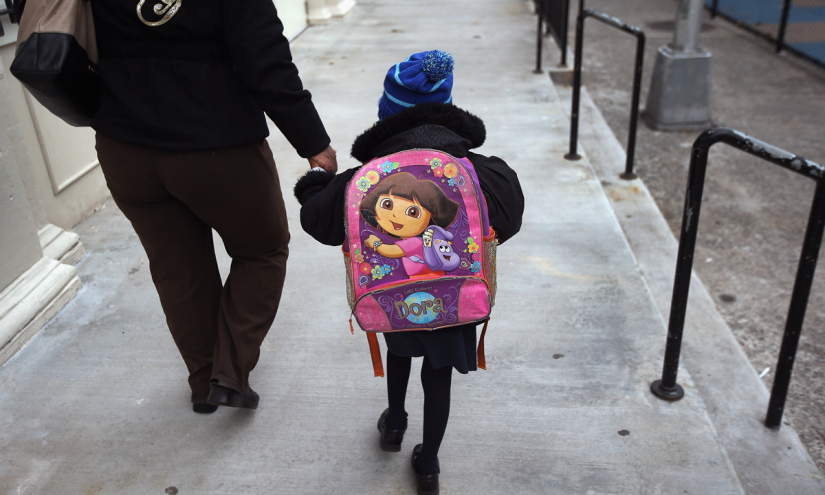
    A few factors have made selecting an elementary school particularly challenging in recent years. For one, there are simply more schools for parents to pick from over the past few decades, ranging from traditional public and private to a growing number of magnet and charter programs. There are also new policies in some places, such as New York City, that allow parents to select not just their closest neighborhood public school but schools across and outside of the districts where they live.

    As a scholar of sociology and education, I have seen how the expanding range of school options – sometimes called school choice – has spread nationwide and is particularly a prominent factor in New York City.

    I spoke with a diverse range of more than 100 New York City parents across income levels and racial and ethnic backgrounds from 2014 to 2019 as part of research for my 2025 book, “Kindergarten Panic: Parental Anxiety and School Choice Inequality.”

    All of these parents felt pressure trying to select a school for their elementary school-age children, and school choice options post-COVID-19 have only increased.

    Some parents experience this pressure a bit more acutely than others.

    Women often see their choice of school as a reflection of whether they are good moms, my interviews show. Parents of color feel pressure to find a racially inclusive school. Other parents worry about finding niche schools that offer dual-language programs, for example, or other specialties.

    Navigating schools in New York City

    Every year, about 65,000 New York City kindergartners are matched to more than 700 public schools.

    New York City kindergartners typically attend their nearest public school in the neighborhood and get a priority place at this school. This school is often called someone’s zoned school.

    Even so, a spot at your local school isn’t guaranteed – students get priority if they apply on time.

    While most kindergartners still attend their zoned schools, their attendance rate is decreasing. While 72% of kindergartners in the city attended their zoned school in the 2007-08 school year, 60% did so in the 2016-17 school year.

    One reason is that since 2003, New York City parents have been able to apply to out-of-zone schools when seats were available. And in 2020, when the COVID-19 pandemic began, all public school applications moved entirely online. This shift allowed parents to easily rank 12 different school options they liked, in and outside of their zones.

    Still, New York City public schools remain one of the most segregated in the country, divided by race and class.

    Pressure to be a good mom

    Many of the mothers I interviewed from 2015 through 2019 said that getting their child into what they considered a “good” school reflected good mothering.

    Mothers took the primary responsibility for their school search, whether they had partners or not, and regardless of their social class, as well as racial and ethnic background.

    In 2017, I spoke with Janet, a white, married mother who at the time was 41 years old and had an infant and a 3-year-old. Janet worked as a web designer and lived in Queens. She explained that she started a group in 2016 to connect with other mothers, in part to discuss schools.

    Though Janet’s children were a few years away from kindergarten, she believed that she had started her research for public schools too late. She spent multiple hours each week looking up information during her limited spare time. She learned that other moms were talking to other parents, researching test results, analyzing school reviews and visiting schools in person.

    Janet said she wished she had started looking for schools when her son was was 1 or 2 years old, like other mothers she knew. She expressed fear that she was failing as a mother. Eventually, Janet enrolled her son in a nonzoned public school in another Queens neighborhood.

    Pressure to find an inclusive school

    Regardless of their incomes, Black, Latino and immigrant families I interviewed also felt pressure to evaluate whether the public schools they considered were racially and ethnically inclusive.

    Parents worried that racially insensitive policies related to bullying, curriculum and discipline would negatively affect their children.

    In 2015, I spoke with Fumi, a Black, immigrant mother of two young children. At the time, Fumi was 37 years old and living in Washington Heights in north Manhattan. She described her uncertain search for a public school.

    Fumi thought that New York City’s gifted and talented programs at public schools might be a better option academically than other public schools that don’t offer an advanced track for some students. But the gifted and talented programs often lacked racial diversity, and Fumi did not want her son to be the only Black student in his class.

    Still, Fumi had her son tested for the 2015 gifted and talented exam and enrolled him in one of these programs for kindergarten.

    Once Fumi’s son began attending the gifted and talented school, Fumi worried that the constant bullying he experienced was racially motivated.

    Though Fumi remained uneasy about the bullying and lack of diversity, she decided to keep him at the school because of the school’s strong academic quality.

    Pressure to find a niche school

    Many of the parents I interviewed who earned more than US$50,000 a year wanted to find specialty schools that offered advanced courses, dual-language programs and progressive-oriented curriculum.

    Parents like Renata, a 44-year-old Asian mother of four, and Stella, a 39-year-old Black mother of one, sent their kids to out-of-neighborhood public schools.

    In 2016, Renata described visiting multiple schools and researching options so she could potentially enroll her four children in different schools that met each of their particular needs.

    Stella, meanwhile, searched for schools that would de-emphasize testing, nurture her son’s creativity and provide flexible learning options.

    In contrast, the working-class parents I interviewed who made less than $50,000 annually often sought schools that mirrored their own school experiences.

    Few working-class parents I spoke with selected out-of-neighborhood and high academically performing schools.

    New York City data points to similar results – low-income families are less likely than people earning more than them to attend schools outside of their neighborhoods.

    For instance, Black working-class parents like 47-year-old Risha, a mother of four, and 53-year-old Jeffery, a father of three, who attended New York City neighborhood public schools themselves as children told me in 2016 that they decided to send their children to local public schools.

    Based on state performance indicators, students at these particular schools performed lower on standard assessments than schools on average.

    Cracks in the system

    The parents I spoke with all live in New York City, which has a uniquely complicated education system. Yet the pressures they face are reflective of the evolving public school choice landscape for parents across the country.

    Parents nationwide are searching for schools with vastly different resources and concerns about their children’s future well-being and success.

    When parents panic about kindergarten, they reveal cracks in the foundation of American schooling. In my view, parental anxiety about kindergarten is a response to an unequal, high-stakes education system.

    Bailey A. Brown, Assistant Professor of Sociology, Spelman College

    This article is republished from The Conversation under a Creative Commons license. Read the original article.
    Source link

  • Canadian sector hits back over plan to cancel study permits in crises

    Canadian sector hits back over plan to cancel study permits in crises

    Immigration Minister Lena Diab told a House of Commons committee last week that the Strengthening Canada’s Immigration System and Borders Act (Bill C-12) would target “people who are going to be committing large-scale fraud”.

    However, an opposition member, Conservative MP Michelle Rempel Garner, rejected the idea that the Liberal government needs sweeping powers to keep the immigration system functioning.

    “That sounds like an authoritarian dictatorship to me,” Rempel Garner said.

    Languages Canada Executive Director Gonzalo Peralta told The PIE News there was a need to define under what conditions Immigration Refugees and Citizenship Canada (IRCC) could cancel student visas.

    “The term ‘public interest’ as grounds for cancelling visas or applications is vague and does not provide the assurances needed to ensure that legitimate students are not inadvertently impacted by the legislation,” Peralta said.

    At the committee meeting, Rempel Garner argued: “It seems like you’re trying to give yourself and your department more powers to correct mistakes in the system that they could have made in screening out potential fraud to begin with.” 

    The term ‘public interest’ as grounds for cancelling visas or applications is vague and does not provide the assurances needed

    In the wake of a large number of fraudulent study permit applications made by unscrupulous education agents, in 2023 the department implemented a system requiring applicants to present a verified letter of acceptance from a designated learning institution in order to obtain a study permit.

    In many cases, the students said they were not aware that their agent was submitting fraudulent documents on their behalf.

    MP Rempel Garner called out the minister for blaming students and other newcomers to Canada. “Why don’t you make the system work instead of punishing the victims of human trafficking,” she demanded at the meeting.

    Larissa Bezo, president of the Canadian Bureau for International Education (CBIE), told The PIE her group supports measures to uphold the integrity of the International Student Program. “However, we do not want to see international students who have been the victims of fraud unfairly punished,” Bezo said.

    Peralta of Languages Canada condemned the Liberal government for failing to consult with the sector about this legislation and other policy changes.

    “In the case of the proposed Bill C-12, a more comprehensive definition is needed of the specific conditions under which IRCC could cancel visas,” Peralta said.

    Canadian immigration policy has hit the headlines over the past week after Prime Minister Mark Carney’s government set out its intention to cut new international study permits by more than 50% in 2026-2028 – going further with enrolment caps that are already causing significant problems for the international education sector.

    Source link

  • Student acceptance of violence in response to speech hits a record high

    Student acceptance of violence in response to speech hits a record high

    The sickening assassination of Charlie Kirk at a campus speech this week has brought attention to worrying trends in political violence and the public’s stated support for it. 

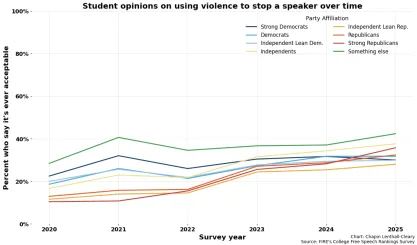
    According to FIRE’s annual College Free Speech Rankings survey, in 2020, the national average showed about 1 in 5 students said it was ever acceptable to use violence to stop a speaker. That number has since risen to a disturbing 1 in 3 students.

    While we have seen no evidence that Kirk’s shooter is a student, there’s no doubt that the 50% increase in this level of support for political violence among college students over the last 5 years has broad implications for the future of the country.

    When we subdivide by party affiliation, we see a more complete story, but the trends are roughly the same.

    Student opinions by party

    Students who identify as “Strong Democrats” are one of the few groups that haven’t markedly increased in support for using violence to stop a speaker, but only because they started at a higher rate of acceptance. Once the second most accepting of violence, they are now the second least accepting, thanks to a rise in acceptance by other groups. In other words, they didn’t get better — everyone else got worse. But consistently the worst group of all remains those who identify as “Something else.” 

    The portions of “Strong Republicans” and “Republicans” who accept the use of violence to stop a speaker have more than tripled in four years. Even acceptance among “Independents” has more than doubled. To give you a sense of how bad things have gotten, the group that currently accepts violence the least, Republican-leaning independents, would have ranked alongside those who accepted it the most back in 2020.

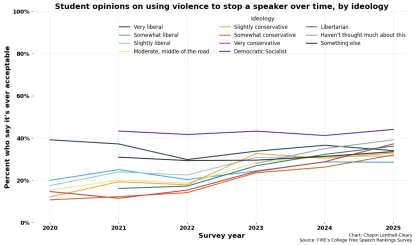
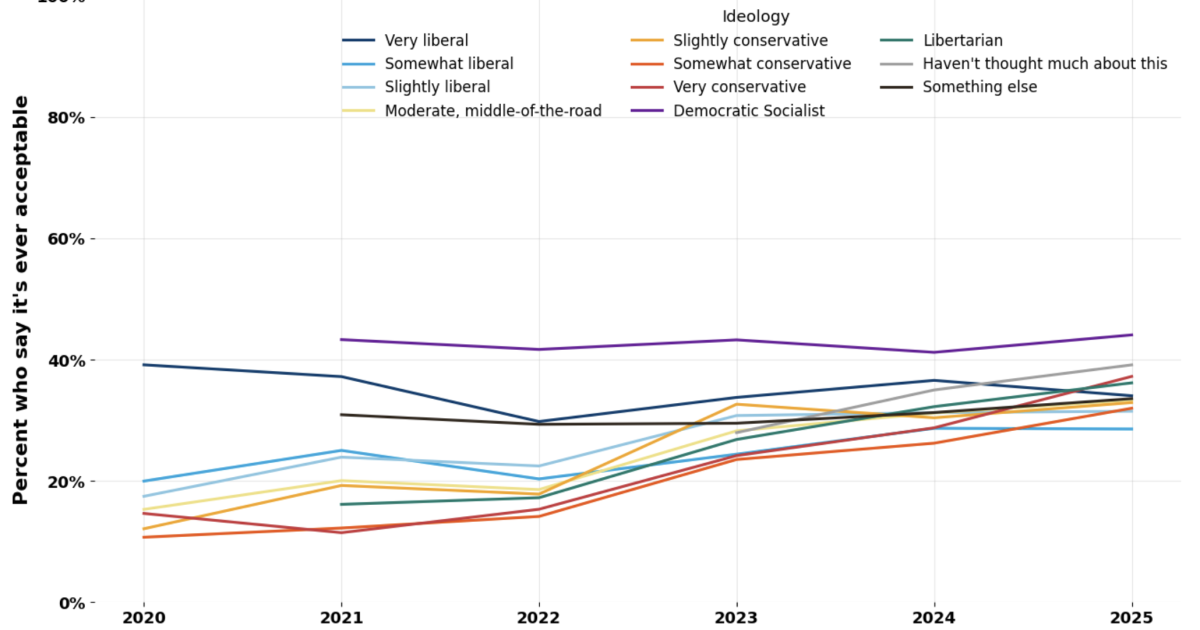
    Now let’s take a closer look at the problem by switching from party affiliation to examining specific ideologies:

    Student opinions by ideology

    Those students who are the furthest to the left have been the most accepting of violence for as long as we’ve asked the question. That includes very liberal and democratic socialist students. But a rising tide of acceptance of violence has raised all boats. Now, regardless of party or ideology, students across the board are more open to violence as a way to shut down a speaker. What was once an extreme and fringe opinion has become normalized.

    Where do we go from here? Violence is antithetical to free speech, and political violence is wholly incompatible with — and toxic to — democracy. As FIRE Executive Vice President Nico Perrino put it, it is a cancer in our body politic. Hopefully, the horrific image of the assassination of a young father, in front of his family, during a campus speech will show students who say they support violence what that actually looks like in practice.

    The great innovation of free speech is that we settle disputes with words and arguments, not violence. Too many have turned away from this principle. For the sake of all Americans, we must return to it.

    Source link

  • Hack at Columbia University Hits 870K People

    Hack at Columbia University Hits 870K People

    A recent hack of Columbia University’s computer system compromised the personal information of hundreds of thousands of people, including students and applicants, new documents show. Over all, about 870,000 individuals were affected by the breach.

    The university provided draft notices to officials in Maine and California that it intends to send to affected parties in their states, according to the state attorneys general’s websites. Both states require that their residents be swiftly informed of any breach that includes their data, according to Bloomberg, which reported on the notices.

    The notices said a technical outage disrupted some of the university’s IT systems in June, which led university leaders to suspect a possible cybersecurity attack. An investigation revealed that a hacker had taken files from Columbia’s system in May.

    The stolen data includes any personal information prospective students provided in their applications or current students gave Columbia over the course of their studies, including their contact details, Social Security numbers, birthdays, demographic information, academic history, financial aid information, insurance details and health information. No patient data from the Columbia University Irving Medical Center seems to have been compromised, according to the notices. The university encouraged those affected to monitor account statements and credit reports to keep an eye out for any fraudulent activity. It also offered them two years of free credit monitoring and identity restoration services from a financial and risk advisory firm.

    “We have implemented a number of safeguards across our systems to enhance our security,” the letters read. “Moving forward, we will be examining what additional steps we can take and additional safeguards we can implement to prevent something like this from happening again.”

    A public statement from the university’s Office of Public Affairs last week said that since June 24, Columbia has seen no evidence of any further unauthorized access to the university’s system. Starting Aug. 7, the university promised to begin notifying affected students, employees and applicants on a rolling basis via mail.

    “We recognize the concern this matter may have raised and appreciate your ongoing patience during this challenging time,” the statement read. “Please know we are committed to supporting the University community.”

    A Columbia official previously told Bloomberg that the hacker seemed to be trying to further a “political agenda.” The investigation into the matter also found that the hacker was “highly sophisticated” and “very targeted.”

    The alleged hacker, who got in contact with Bloomberg, gave the news outlet 1.6 gigabytes of data, claiming it contained decades’ worth of applications to Columbia. That application data included New York City mayoral candidate Zohran Mamdani, who applied to Columbia but didn’t get in.

    Bloomberg confirmed with eight Columbia students and alumni, who applied between 2019 and 2024, that the information about them contained in the data was accurate. They verified that details such as their university-issued ID codes, citizenship statuses and admissions decisions were all correct. The data provided to Bloomberg didn’t contain names, Social Security numbers or birth dates.

    The person claiming to be the hacker, who didn’t provide their name, texted Bloomberg that the purpose of the stolen data was to prove the university continued affirmative action in admissions after the 2023 Supreme Court ruling against such practices. They claimed to have hacked about 460 gigabytes of data total from the university—including 1.8 million Social Security numbers of employees, students and their family members—after spending more than two months ensuring their access to Columbia’s computer systems.

    Source link

  • Panic hits Harvard international students after Trump crackdown

    Panic hits Harvard international students after Trump crackdown

    As per a statement released by Kristi Noem, US homeland security secretary, Harvard’s Student and Exchange Visitor Program (SEVP) certification has been revoked because of their “failure to adhere to the law.” 

    “As a result of your refusal to comply with multiple requests to provide the Department of Homeland Security pertinent information while perpetuating an unsafe campus environment that is hostile to Jewish students, promotes pro-Hamas sympathies, and employs racist “diversity, equity, and inclusion” policies, you have lost this privilege,” read the letter by Noem to Harvard University, shared on X, formerly Twitter. 

    “The revocation of your Student and Exchange Visitor Program certification means that Harvard is prohibited from having any aliens on F- or J- nonimmigrant status for the 2025-2026 academic school year.”

    Students set to join Harvard this year are now relying on the institution to take urgent action to keep their dreams of studying at the Ivy League institution alive.

    “I already had to defer my intake from last year to this year due to lack of funds. Deferring again just isn’t an option for me,” stated Pravin Deshmukh, an incoming student at Harvard’s Graduate School of Education. 

    “We’re hoping the university can find some form of solution and keep us updated on what’s happening. Harvard has been very proactive over the past few weeks. They’ve reassured incoming students like me of their commitment through emails, provided details on continuing classes online, and shared ways to stay in touch with the International Office.”

    Currently, over 6,800 international students are enrolled at the university, making up 27% of this year’s student body, with a significant portion hailing from countries such as China, India, Canada, South Korea, and the UK.

    WhatsApp groups are on fire – everyone’s panicking, wondering what’s going to happen next. Some parents were planning to attend graduation ceremonies, but now students are telling them, ‘Don’t say you’re coming to visit us.’

    Harvard GSE student

    The vast international student cohort at the campus will also have to transfer to another US university or risk losing their legal immigration status, according to Noem, which puts the current students in jeopardy. 

    “For graduating students, it feels like our degrees could be rendered useless and we might even be labeled as illegal immigrants,” a student at Harvard’s GSE, who requested anonymity, told The PIE. 

    “Some students are considering staying in the U.S. by transferring their SEVIS to community colleges if Harvard can’t find a solution.”

    “WhatsApp groups are on fire – everyone’s panicking, wondering what’s going to happen next. Some parents were planning to attend graduation ceremonies, but now students are telling them, ‘Don’t say you’re coming to visit us,’” the student added. 

    While Noem has issued a 72-hour ultimatum to Harvard, demanding the university hand over all disciplinary records from the past five years related to international students involved in illegal activities and protests on and off campus, students across Harvard’s schools told The PIE that professors and deans have arranged meetings with them to address any questions or concerns.

    “We received an email from the Harvard University president regarding available support, information about Zoom sessions hosted by Harvard’s international offices, and a text-message service for ICE-related threats. Today, a session is being held in person at our school with professors and the Dean,” the Harvard student stated.

    “This is Harvard — they will take a stand, unlike Columbia University or MIT. They have our backs.”

    Some students have voiced concerns about their parents traveling to the US for their graduation ceremonies, but feel reassured by Harvard’s stand that commencement will proceed as planned on May 29th.

    “The Harvard website is being updated regularly, and we have been asked to keep an eye on it, but there’s still a lot of uncertainty. Since yesterday, many of us have been wondering whether we will graduate and the next steps. The morning email confirmed that commencement will continue as planned,” stated another Harvard student, who didn’t wish to be named. 

    “There’s a shift in the atmosphere, making it very difficult to plan the next steps. We couldn’t have imagined something like this happening six months ago, but you have to be prepared for anything.”

    In the meantime Harvard has a released a statement, doubling down on its commitment towards international students.

    “We are fully committed to maintaining Harvard’s ability to host our international students and scholars, who hail from more than 140 countries and enrich the University – and this nation – immeasurably,” stated the University. 

    “We are working quickly to provide guidance and support to members of our community. This retaliatory action threatens serious harm to the Harvard community and our country, and undermines Harvard’s academic and research mission.”

    Furthermore, the institution’s swift lawsuit against the Trump administration over the international student ban resulted in a major victory, as US District Judge Allison Burroughs issued a temporary restraining order against the government’s plan to strip Harvard of its ability to recruit international students.

    According to Sameer Kamat, founder, MBA Crystal Ball, a leading MBA admissions consultancy in India, the Trump administration could choose to extend the deadline for Harvard to comply with its requirements, similar to its approach on trade tariffs in recent weeks.

    “For all we know, Trump may ease off the pressure and give Harvard more time to comply, like he did with the tariff deadlines on his trade partners. But for now, it puts all international students in a limbo. They’ve become collateral damage in a fight that they never wanted to be part of,” stated Kamat.

    “He had played a similar move on Canada and Mexico by giving them a very tight deadline to bring down their tariffs for American goods. This was to push them into action. And then on the final day, he pushed the deadline by a month. Which is why I am thinking, we can’t rule out the possibility of that happening this time. Considering he put a 72-hour deadline, which runs into the weekend.”

    According to Namita Mehta, president, The Red Pen, consultancies like hers are actively supporting affected students by providing guidance, clarifying policy updates, and connecting them with legal or immigration experts as needed.

    “While the announcement has understandably caused concern, it’s essential to recognise that such decisions are often part of broader political narratives and may be temporary,” stated Mehta.

    “While students and families should stay engaged, informed, and proactive, it is equally important to remain hopeful. The strength of institutions like Harvard lies in their academic excellence and capacity to navigate complex challenges with integrity and vision.”

    Source link

  • A surge of DEI cuts hits colleges across the US

    A surge of DEI cuts hits colleges across the US

    This audio is auto-generated. Please let us know if you have feedback.

    Recent attacks on diversity, equity and inclusion have rocked the higher education sector, with the Trump administration ratcheting up the conservative-led fight against those efforts.

    President Donald Trump has signed multiple executive orders aimed at eliminating DEI across higher education and other sectors.

    More recently, the U.S. Department of Education issued guidance barring colleges from weighing race in any decision-making or promoting diversity efforts. The letter — which used broad language and stirred confusion among colleges — triggered immediate backlash from free speech and faculty groups.

    The department gave colleges until Friday to comply or risk losing their federal funding.

    Higher education groups have challenged the legality of the directives from both the White House and the Education Department. 

    A federal judge temporarily blocked major portions of Trump’s anti-DEI executive orders last week. And the American Federation of Teachers, one of the largest unions in the higher education sector, sued the Education Department over its guidance.

    But with no clear outcome, the following colleges are stripping down their diversity efforts to avoid endangering their funding.

    Ohio State University

    Ohio State University said Thursday it will eliminate its DEI offices and programming effective Friday. The state flagship plans to close its Office of Diversity and Inclusion and discontinue services at its Center for Belonging and Social Change less than 24 hours after announcing the change.

    The move will result in job cuts, though Ohio State did not specify how many.

    “The federal government has signaled its intent to enforce guidance invalidating the use of race in a broad range of educational activities, including by withdrawing federal dollars that are so important to our student, academic and operational success,” Ohio State President Ted Carter wrote in a letter to students and employees.

    In addition to federal forces, the university faces anti-DEI efforts from the Ohio Legislature. The Republican-controlled body is weighing a massive higher education bill that would, among other things, ban the state’s public colleges from having DEI offices or taking positions on “controversial” topics, such as climate or immigration policies, DEI, or abortion.

    “Here in Ohio, a bill barring DEI is also making its way through the legislature, and the Attorney General of Ohio – our statutory counsel – has advised us that his office concurs with the federal government’s position regarding the use of race in educational activities,” Carter said.

    The university’s Office of Academic Affairs will continue to offer the Young Scholars Program and the Morrill Scholarship Program with modified eligibility. The former is currently open to low-income, first generation students, while the latter is open to students “actively engaged in diversity-based leadership, service, and social justice activities,” according to their web pages. 

    The university will also rename its Office of Institutional Equity as the Office of Civil Rights Compliance “to more accurately reflect its work,” according to Carter.

    “Our goal is to ensure that Ohio State continues to be a place where all are welcomed and treated with respect, while following the letter and spirit of the laws and regulations that govern us,” he said.

    Ohio State leaders announced earlier this month they were evaluating the university’s roles and DEI work so they could “make changes if state or federal law requires it or if we decide a different approach is in the university’s best interests.”  

    The cuts to DEI will not reduce current student scholarships or financial aid, Carter said Thursday. Ohio State will offer alternative jobs to affected student employees.

    The University of Cincinnati

    The University of Cincinnati is stuck in limbo — its president announced a complete dissolution of the public institution’s DEI efforts before appearing to walk back the announcement just days later.

    On Feb. 21, President Neville Pinto said the university would eliminate all DEI initiatives to comply with one of Trump’s executive orders and the Education Department’s guidance. 

    Source link