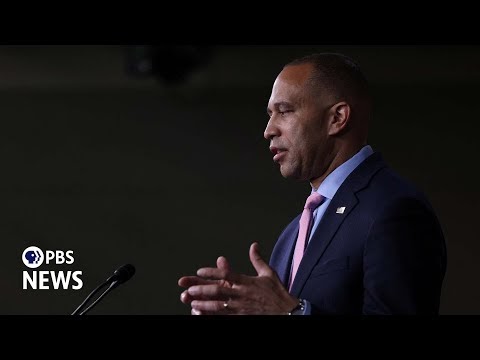

US House Minority Leader Hakeem Jeffries (D-NY) gives a marathon speech, calling out the destructive path that House Republicans are going down. This is a Bill that undermines the United States of America and its national security. It is also a threat to democracy. Folks should listen to every minute of this historical speech.

by CUPA-HR | June 24, 2025
On June 10, Senators Josh Hawley (R-MO) and Peter Welch (D-VT) introduced the Higher Wages for American Workers Act (S. 2013). The Higher Wages for American Workers Act would amend the Fair Labor Standards Act (FLSA), raising the federal minimum wage to $15 per hour and directing the secretary of labor to adjust the minimum wage annually based on inflation.
Higher Wages for American Workers Act
The bill proposes to increase the federal minimum wage from $7.25 to $15 per hour beginning January 1 of the first year after enactment. Each year after, the secretary of labor is directed to increase the minimum wage annually by “the percentage increase, if any, in the Consumer Price Index for Urban Wage Earners and Clerical Workers.”
Although the federal minimum wage has not been increased since 2009, several states have increased their state minimum wage above the current $7.25 per hour. As of January 1, 2025, 30 states and the District of Columbia have minimum wage laws set above the federal level, and 10 states and the District of Columbia have a minimum wage of $15 per hour or higher. All other states must follow the minimum wage set by Congress through the FLSA.
Looking Ahead
While legislation has been introduced in recent years to increase the federal minimum wage, calls to increase the level to $15 per hour have mostly come from Congressional Democrats. It is therefore notable that Republican Senator Josh Hawley is leading efforts on this issue. It remains to be seen if enough Republicans in the Senate will also support this effort to give the legislation the chance to receive 60 votes to bypass the filibuster and whether House Republicans will take up similar legislation.
CUPA-HR will keep members apprised of further developments related to federal minimum wage laws.


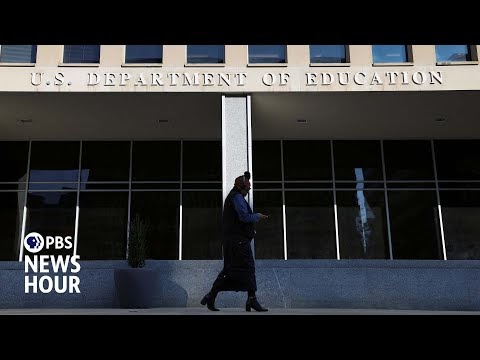
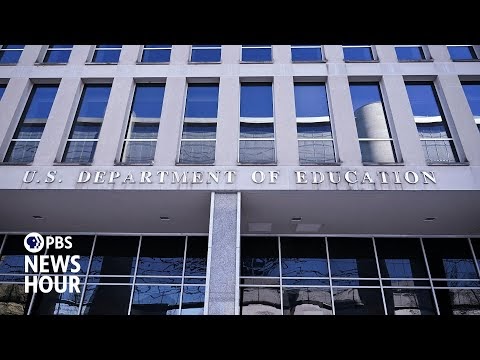
The Department of Education is on the Trump chopping block. Details have not been fully released yet, but the president has signaled plans to dismantle it and move some of its key functions elsewhere. The department oversees student loans, federal funds for lower-income students, special education programs and more. Geoff Bennett discussed more with Laura Meckler of The Washington Post.


by CUPA-HR | February 21, 2023
On February 9, the Department of Labor’s Wage and Hour Division (WHD) issued an opinion letter stating that employees with chronic serious health conditions may use Family and Medical Leave Act (FMLA) leave to reduce work hours indefinitely. The WHD opinion letters serve as a means by which the public can develop a clearer understanding of what FMLA compliance entails. This particular letter is the first issued by the Biden administration.
The letter from the WHD and Acting Administrator Jessica Looman comes in response to an employer’s letter asking whether “an employee may use FMLA leave to limit their work schedule for an indefinite period of time if the employee has a chronic serious health condition and a healthcare provider certifies that the employee has a medical need to limit their schedule.” The question only applies to employees who are regularly scheduled to work more than eight hours per day.
The opinion letter specifies that if an employee is regularly scheduled to work more than eight hours per day but has an FMLA-qualifying condition that grants them to take FMLA leave, then the employee is entitled to use the 12 weeks of FMLA leave to reduce their work hours to eight hours per day. It adds that an employee may indefinitely reduce their work hours so long as they don’t surpass the 12 weeks of FMLA leave in a 12-month period that they are entitled to under the law.
The letter also addresses concerns from the employer that the need for a work day limited to eight hours may be “better suited” as a reasonable accommodation granted under the Americans with Disabilities Act (ADA). The letter states that the requirements and protections of the FMLA and ADA are separate and distinct, and that employees may be entitled to use protections granted under both laws at the same time. It further states that an employee who has exhausted all of the afforded FMLA leave for a 12-month period may have additional rights granted under the ADA to continue to work at the reduced level, but it clarifies that the WHD does not “interpret or provide any advice for” the ADA and its requirements.
Finally, the letter states that employees are entitled to the equivalent of 12 standard workweeks of FMLA leave, which may be more than 480 hours (equivalent to working 40 hours per week for 12 weeks) if the regular schedule of the employee is greater than 40 hours per week. The letter uses an example of an employee regularly working 50 hours per week, in which case the employee would be entitled to 600 hours of FMLA leave.
It’s worth noting that the content of the letter is consistent with long-standing guidance and enforcement of the FMLA. The letter may draw increased attention to the issue, however, since the letter is the first provided by the Biden administration’s WHD.
CUPA-HR will continue to monitor for any future WHD opinion letters and will keep members apprised of any significant updates in the future.