This audio is auto-generated. Please let us know if you have feedback.
Dive Brief:
A Republican-led House committee is pushing seven research universities to cut ties with a scholarship programsponsored by the Chinese government.
In four-page letters Tuesday, Republican Rep. John Moolenaar, chair of the Select Committee on the Chinese Communist Party, decried the China Scholarship Councilas “one of the nefarious mechanisms” the Chinese government uses to advance its technologies and urged each college involved with the council to “reconsider its participation.”
Moolenaarfurther set a July 22 deadline for college leaders to provide his committee with extensive documentation on their institutions’ work with the council from May 2020 to May 2025.
Dive Insight:
The China Scholarship Council, a program funded by the Chinese Communist Party, partners with colleges in other countries and sponsors both Chinese students studying abroad and international students studying at Chinese universities.
Participating Chinese students must return to China after graduating and work for at least two years.
In Moolenaar’s letters to college officials Tuesday, he announced that the House committee on the Chinese government is conducting a “systematic review” of “the China Scholarship Council’s infiltration of U.S. colleges.”
“CSC purports to be a joint scholarship program between U.S. and Chinese institutions,” he said. “However, in reality it is a CCP-managed technology transfer effort that exploits U.S. institutions and directly supports China’s military and scientific growth.”
About 7% of Chinese citizens studying abroad — some 65,000 students — are sponsored by the China Scholarship Council,according to a 2020 analysis by Georgetown University’s Center for Security and Emerging Technology.
A relatively small minority of them end up in the U.S. In 2024, the council announced plans to sponsor up to 240 students to study at seven U.S. colleges this year, the South China Morning Post reported.
The seven participating institutions, all of which received a letter from Moolenaar on Tuesday, are Dartmouth College, Temple University, the University of Tennessee,the University of Notre Dame andthree campuses in the University of California system — Davis, Irvine and Riverside.
The number of sponsored students and the length of their studies in the U.S. vary by college. For example, the University of California, Davis co-sponsors up to 10 Ph.D. candidates, while Temple co-sponsors up to 60 graduate students, according to Moolenaar’s letters.
However, a Dartmouth spokesperson said the college cut ties with China Scholarship Council well before receiving Moolenaar’s letter, making the decision last academic year,per the college’s student newspaper.The spokesperson told the publication that the college’s partnership with the council led to the enrollment of fewer than 10 participants over the last decade.
Likewise, the University of Notre Dame this week told The Associated Press that it began to cut ties with the council earlier this year.
Moolenaar noted that all the institutions rely on “significant federal funding” for their research, citing research funding levels from years before Trump retook office. And China has “a history of exploiting the openness of the American higher education and research system to enhance its technological competitiveness and military capabilities,” he said.
A 2020 proclamation from President Donald Trump, made during his first term, restricted certain Chinese researchers and graduate students from gaining visas to study in the U.S.The goal, Trump wrote at the time, was to prevent Chinese nationals from attempting to “acquire and divert foreign technologies.”
Several months after Trump issued the proclamation, the University of North Texas cut off ties with the China Scholarship Council, abruptly forcing more than a dozen Chinese researchers participating in the program to leave the country.
Former President Joe Biden continued to enforce the proclamation during his term.
“It is imperative to assess how the UCD-CSC joint scholarship program — explicitly designed to develop [Chinese] talent in cutting edge technology at graduate levels — serves U.S. interests,” Moolenaar said in his letter to the chancellor of the University of California, Davis. He echoed the line in his letters to the heads of the other six colleges.
Among his document requests, Moolenaar called for colleges to list if any Chinese students participating in the program switched to a STEM major after initially declaring a non-STEM major and if any participating students worked on federally funded research. Officials should also justify how supporting the development of participating students advances U.S. interests, he said.
US House Minority Leader Hakeem Jeffries (D-NY) gives a marathon speech, calling out the destructive path that House Republicans are going down. This is a Bill that undermines the United States of America and its national security. It is also a threat to democracy. Folks should listen to every minute of this historical speech.
I’ve told elsewhere the story of how the Imperial Institute was founded following the Great Exhibition of 1851, and how the South Kensington site became a hub for colleges, museums and culture. And naturally, where there are students, there is a need to house students.
And one group of students, in particular, exercised the Victorian imagination: women. Let’s take a look at The Era, of July 5, 1884:
It’s clearly no use training the girls to be high class governesses, if you can’t keep them safe from the predations of that London.
Step forward, Francis Cook. He was a rich man – head of Cook, Son and Co, traders in fabric and clothes – and became one of Britain’s richest men. He gave £40,000 to fund the construction of a hall of residence for women studying in South Kensington, which meant, at that time, at the Royal College of Art, the Royal College of Music, or the Royal College of Science. (It’s also worth noting another fact or two relating to Cook. His second wife, Tennessee Celeste Claflin was an American suffragist, clairvoyant and medium, who with her sister was one of the first women to open a Wall Street brokerage firm. The sister – Victoria Woodhull – was the first woman to run for the presidency of the United States, in 1872.)
The hall was to provide 100 bedrooms, each two connected by a shared sitting room. Plans included a concert hall, gymnasium, library and common room. The concert hall would be used by the Royal College of Music, and there were music practice rooms and art studios too. A truly magnificent residence. There are images on the Queen Alexandra’s House website.
It was named for Alexandra of Denmark, then Princess of Wales, who had taken a keen interest in the project. After the death of her husband King Edward VII, Alexandra became the Queen Mother, and suggested in 1914 that Alexandra House be renamed Queen Alexandra’s House.
Also in 1914, a little scandal took place. Here’s a clipping from the Daily Chronicle of February 6 that year:
The Ulster Volunteers were a paramilitary force, established in 1912, dedicated to the overthrow of Home Rule for Ireland. (And not to be confused with the unionist Ulster Volunteer Force which was active between 1966 and 2007, although they clearly shared a lot of aims and values!)
As “Imperial Student” wrote, “I have known Irish women, Roman Catholics, Jewesses, Non-conformists there, and can safely say that all shades of opinion have been sheltered there. Are they expected to support such an entertainment as is to be held next Monday?” (To be clear, the scandal was the support for the Ulster Volunteers, not for the Student Christian Movement.) The correspondent continued:
One feels sure that Queen Alexandra has no knowledge of the fact that an entertainment is to be held there in support of a hospital for volunteers armed to fight the forces of the Crown. It is to be hoped that this may be called to her Majesty’s attention and that she may intimate her disapproval of such a proceeding.
I am sure you will be relieved to know that the Bucks Advertiser and Aylesbury News reported on 14 February that “the unfortunate incident at Queen Alexandra’s House has passed without causing trouble in Court of other circles.”
Queen Alexandra’s House continues to serve today as when it was founded; it is an independent charity, still providing residential accommodation for female students, in a very desirable part of London.
It’s royal connection continues; as shown in this February 1963 photograph in the Illustrated London News. I think that the Princess Alexandra in the photograph is the great granddaughter of the Alexandra after whom the House is named.
The postcard was sent on 13 September 1914 – not long after the outbreak of World War I, to Miss Bates in Horsted Keynes, Sussex.
Dear Winnie, Just a card of our house – no such houses at Horsted Keynes. Write soon, love from Gladys.
On May 22, the U.S. House of Representatives passed H.R. 1, titled the “One Big Beautiful Bill Act.” Notably, the reconciliation “megabill” includes a provision to implement President Trump’s campaign pledge on “no tax on overtime,” among various legislative priorities for Republicans.
The “No Tax on Overtime” Proposal
The overtime proposal creates a temporary above-the-line deduction from gross income for overtime pay required under the Fair labor Standards Act (FLSA). The bill does not set a cap on the amount of overtime pay that can be deducted, but it limits the application of the provision to employees who earn less than $160,000 per year, and it does not extend the deduction to independent contractors. If signed into law, the deduction will be available for tax years 2025 through 2028, and employers would be required to report overtime compensation on workers’ W-2 forms during this time.
The proposed deduction only applies to workers’ federal income taxes and overtime pay as required by the FLSA, raising some compliance concerns for employers in states with different overtime pay requirements than those required under the FLSA and for employers whose overtime pay requirements are set by a collective bargaining agreement (CBA) with overtime pay that differs from the FLSA requirements. These employers will likely need to track both the FLSA-mandated overtime hours and pay to ensure workers’ W-2s are accurate and in compliance with the law while also ensuring they are tracking the overtime hours and pay in a manner that also complies with the more stringent state or CBA obligations.
While CBA requirements vary case-by-case, there are five states with overtime pay requirements under their state wage and hour laws that differ from the requirements under the FLSA:
Alaska requires 1.5 times workers’ regular rate of pay for hours worked beyond 8 in a day or 40 in a workweek;
California requires 1.5 times an employee’s regular rate of pay for hours worked more than 8 in a day, 40 in a workweek, or the first 8 hours on a seventh consecutive day of work in a workweek. The state also requires double an employee’s regular rate of pay for any hours worked over 12 in a day or for all hours worked over 8 on a seventh consecutive day of work in a workweek;
Colorado requires overtime pay after 12 hours worked in a day or 40 hours in a workweek;
Nevada requires overtime pay for any hours worked beyond 8 in a day if the employee earns less than 1.5 times the state minimum wage; and
Oregon has industry-specific daily overtime rules that apply to hospitals, canneries and manufacturers.
Looking Ahead
The reconciliation bill is still early in the legislative process. For now, the “no tax on overtime” provision is only included in the House version of the bill. The Senate is currently drafting its version of the reconciliation bill, and they may choose to alter the no tax on overtime proposal — possibly including language of the Overtime Wages Tax Relief Act that was introduced earlier this year by Senator Roger Marshall (R-KS). CUPA-HR will continue to monitor for further developments on this issue.
Good call. A well-run open house can be one of the most powerful tools in your enrollment and engagement strategy. Whether you’re welcoming new elementary parents, high school prospects, or college hopefuls, this is your chance to make an unforgettable first impression. An open house in school is important because it helps build a sense of community, foster parent involvement, and drive enrollment.
But a memorable open house doesn’t happen by accident. It requires careful planning, creative ideas, and attention to detail. From initial promotions to day-of execution and follow-up, every step counts.
So, how do you make it count?
Let’s walk through ten practical (and proven) tips to take your school’s open house from good… to exceptional.
Struggling to stand out in a crowded market?
Boost enrollment with tailored open house strategies!
1. Start Planning Early And Promote Like a Pro
Here’s the truth: If no one shows up, nothing else matters.
That’s why promotion is the first step, and it’s a big one. First, get clear on your goals. Are you looking to boost applications? Showcase new facilities? Strengthen relationships with current families? Your goals will shape everything from the schedule to who you invite.
How do you prepare for an open house at school? Start by setting clear goals and selecting a date that works for your audience. Plan the schedule, secure staff and student volunteers, and prepare promotional materials. Promote the event across multiple channels (website, email, social media), tidy up the campus, and organize signage, welcome tables, and printed resources to ensure a smooth, welcoming experience.
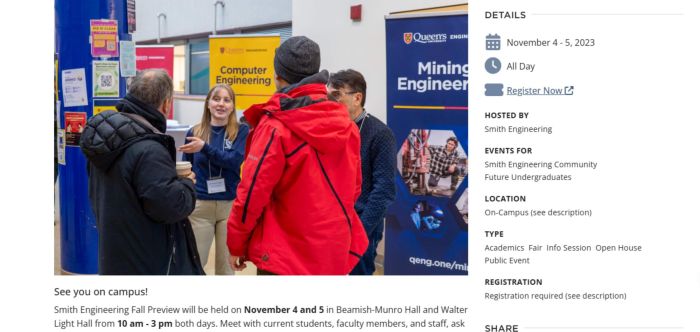
Example: Queen’s University (Canada) demonstrated advanced planning by creating a dedicated “Fall Preview” Open House webpage months ahead. The page provided key details (date, schedule, location) and prominently featured a call-to-action for prospective students to register, ensuring maximum visibility and early sign-ups.
Then, plan your outreach. Don’t wait until the last minute. Get your date on the calendar months in advance, and begin promoting it strategically across various online channels:
A dedicated landing page on your school’s website (with RSVP).
A short email series to build awareness and excitement.
Countdown posts, teaser videos, and stories on social media.
Text reminders or personal phone calls to those most likely to attend.
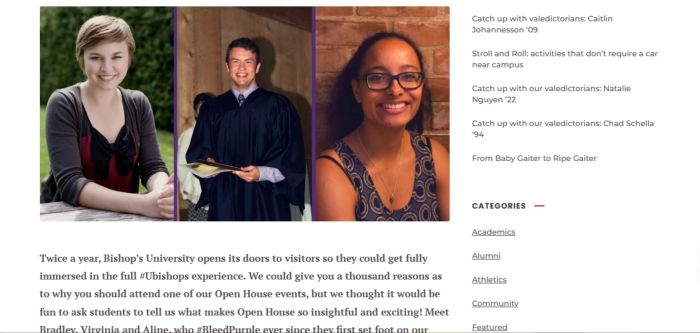
Example: Bishop’s University (Canada) boosted promotion by publishing a blog post prior to their Open House that walked readers through what to expect at the event. This preview-style post generated excitement and informed prospective students and parents about the Open House experience in detail.
Still want more attendees? Consider offering a virtual option. Whether it’s a livestream, a digital campus tour, or a short webinar, giving families more than one way to experience your school expands your reach.
2. Make Arrival Smooth and the Welcome Unforgettable
Let’s face it, no one enjoys showing up somewhere and feeling lost.
That’s why the moment guests arrive at your open house, the experience should feel seamless and friendly.
Start with signage. Make sure every guest knows exactly where to park and where to go. Have greeters ready: staff, student leaders, or enthusiastic parent volunteers. A welcome table with a map, a friendly smile, and a short overview of what’s ahead can work wonders.
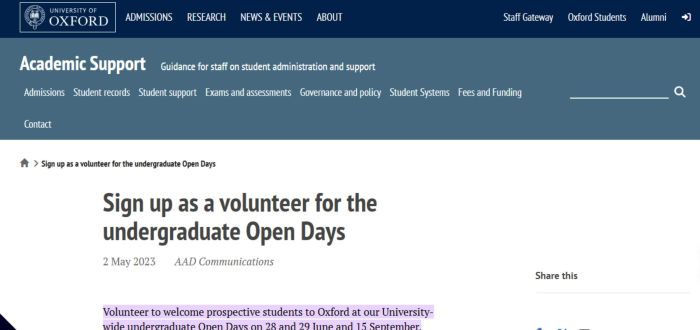
Example: University of Oxford (UK): For its 2023 undergraduate Open Days, Oxford enlisted staff volunteers as greeters and guides. These volunteers welcomed visitors, helped with directions around campus, and served as friendly points of contact at entrances and info tables, ensuring guests felt comfortable and never lost.
Don’t stop there. Decorate with banners, student art, or a slideshow of school activities. Create a warm and exciting vibe the moment families step inside. You’re not just showing them the campus, you’re showing them the community they could be a part of.
Example: UC Santa Cruz (USA): At its “Banana Slug Day” admitted-students open house in 2025, UC Santa Cruz set up check-in tables at key parking areas and deployed student guides (the “S.L.U.G.” ambassadors) throughout campus. Visitors were greeted at these welcome points and guided by the student ambassadors, making navigation easy and the arrival experience warm and organized.
3. Spotlight the People Who Make Your School Special
The facilities are nice. Programs are great. But what really wins hearts?
Your people.
That’s why teachers, support staff, coaches, and counselors need to be front and center during the open house. Make sure they’re not just present but prepared. Equip them with key talking points and FAQs so they feel confident answering questions and reinforcing your school’s values.
What should teachers do for open house? Teachers should prepare a welcoming classroom with student work on display, provide a brief overview of their curriculum, and have handouts with contact information and expectations. During the event, they should greet families warmly, answer general questions, and encourage follow-up meetings for individual concerns.
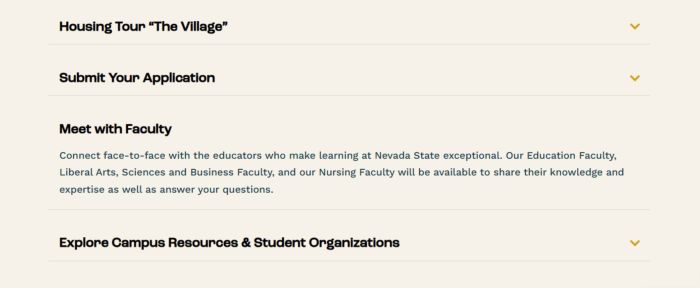
Example: During Nevada State’s Open House, faculty participation was a centerpiece. The event agenda included “Meet with Faculty” sessions where professors from various departments (Education, Liberal Arts & Sciences, Nursing, etc.) were on hand to chat and answer questions. This gave visitors a chance to connect face-to-face with the educators and get a feel for the academic community.
Encourage classroom displays that show what day-to-day learning looks like. And while teachers should be warm and approachable, remind them this isn’t the time for parent-teacher conferences. Keep it general, upbeat, and informative.
Want to go the extra mile? Kick off the event with a welcome from your school leader, followed by a quick intro to the key staff attendees. Let families know who’s who, and who they can talk to about specific interests like arts, athletics, or academics.
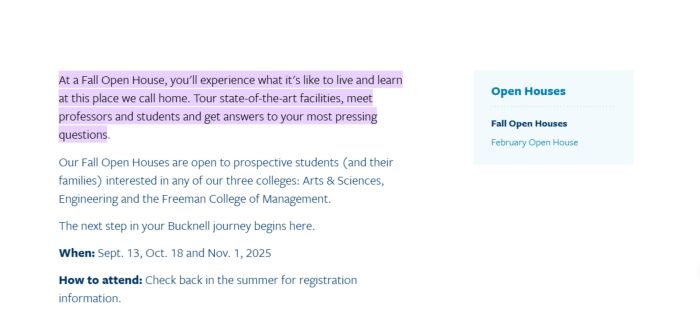
Example: Bucknell’s Fall Open House actively involved faculty and staff in mingling with prospects. Visitors could tour facilities and meet professors and current students to ask questions about programs and campus life, rather than only hearing formal presentations. This personal professor-student engagement at Open House helped put a human face on the university’s academics.
Your current students and parents are your school’s best spokespeople. Hearing about the school’s strengths from an administrator or teacher is valuable, but hearing it from a peer can be even more persuasive. In marketing terms, it’s social proof, and it carries a lot of weight. In fact, one study found that 93% of people trust recommendations from friends and family, while only 38% trust advertising.
Applying this to an open house, a prospective student is likely to trust the words of a current student, and parents will trust the perspectives of other parents, more than any brochure or formal presentation.
That’s why student ambassadors and parent advocates are some of your most valuable open house lead generation assets.
Hand-pick current students who represent the best of your school; friendly, positive, and articulate. Let them lead tours, greet visitors, or share their experience during a short panel. Their enthusiasm is contagious. As one education marketing expert put it, hearing directly from current students and parents can be one of the most powerful ways to engage prospective families.
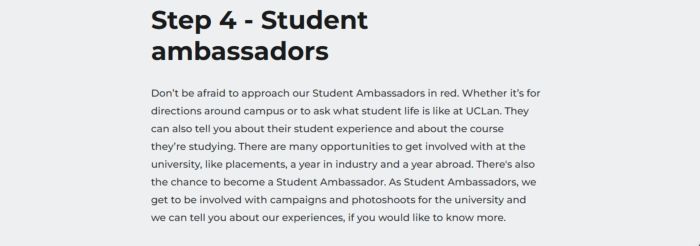
Example: University of Central Lancashire (UK) : At UCLan’s Open Days, current students act as official ambassadors (identifiable in special red attire). These student ambassadors welcome visitors at entrances, give campus directions, and share honest insights about student life and their courses. Attendees are encouraged to approach them with any questions, making the experience peer-guided and relatable.
Similarly, invite a few involved parents to chat with prospective families. Their personal stories, why they chose the school, how their child has grown, carry a weight that even the best marketing can’t match.
You’re not just saying, “We’re great.” You’re showing it.
5. Make the Event Fun, Interactive, and Memorable
Let’s be honest: No one wants to sit through a two-hour lecture.
So here’s your mission: Turn your open house into an experience.
How do you make an open house at school fun? Incorporate interactive elements like hands-on activities, themed scavenger hunts, live demonstrations, or student performances. Offer refreshments, set up a photo booth, and keep presentations short and engaging. The goal is to create an energetic, memorable experience that showcases school spirit.
Instead of a long presentation, create a rotating itinerary. Let families move through classrooms, labs, and activity spaces at their own pace. Throw in a scavenger hunt or “passport” that gets stamped at each stop. Offer a prize at the end for completing the journey.
Example: New Mexico State (USA): The College of ACES Open House 2025 at NMSU was designed as a family-friendly, interactive event. Visitors could roam through animal exhibits, science labs and museums with hands-on demonstrations and learning games at each stop. From petting zoo stations to chemistry experiments, attendees of all ages were invited to actively engage, making the Open House both educational and fun.
What else works? Hands-on demos. Let students try a science experiment, play with robots, sample the art room, or participate in a music warm-up. The more your visitors can do, not just see, the more they’ll remember.
Don’t forget the snacks. Coffee, cookies, or treats from the culinary class add comfort and create natural mingling moments. Bonus points if they’re decorated with school colors or logos.
And yes, music, performances, or even a visit from your mascot can energize the space and give families that “wow” moment.
Example: UC Santa Cruz (USA): The Banana Slug Day Open House combined campus exploration with fun activities. Prospective students and families joined student-led tours, watched student performances, visited a resource fair, and even sat in on mock mini-lectures by faculty. These interactive elements (plus chances to snag some UC Santa Cruz swag at the bookstore) turned the day into an immersive campus experience rather than a passive info session.
You’ve got a lot to say, but that doesn’t mean you should say it all at once.
Keep any formal presentations concise and dynamic. Ten to fifteen minutes max is ideal. Focus on the core message: What makes your school stand out? What are the values driving your mission?
Break up speeches with visuals; videos, photos, and student voices make everything more relatable. If you can, include a current student or alum to co-present. Their stories add authenticity and emotion.
Whatever you do, rehearse in advance. A confident, polished delivery makes all the difference.
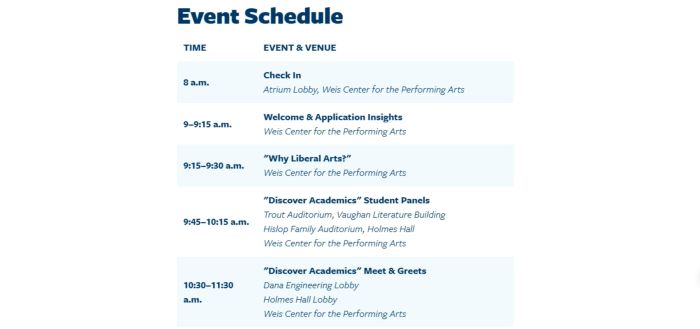
Example: Bucknell keeps Open House presentations brief and purposeful. Its Fall Open House schedule is broken into short sessions: for example, a 15-minute welcome and admissions overview followed by a 15-minute “Why Liberal Arts?” talk. Instead of long lectures, Bucknell offers multiple bite-sized talks and student panels, which keep visitors engaged and allow them to sample various topics without fatigue.
Before the event, ask registrants about their interests: academics, sports, arts, etc. Use this intel to tailor their visit. Match them with the right teacher, program head, or club coordinator. Let them know you were expecting them.
Even on the fly, personalization is powerful. Train ambassadors and staff to ask questions and respond accordingly: “You’re interested in robotics? You’ve got to meet Mr. Jackson. Let me introduce you.”
Name tags, interest-specific packets, or a simple, “Hi Sarah, we’re so glad you’re here,” can go a long way in helping families feel seen.
And yes, be mindful of accessibility needs, language support, and dietary restrictions. Every thoughtful detail adds up.
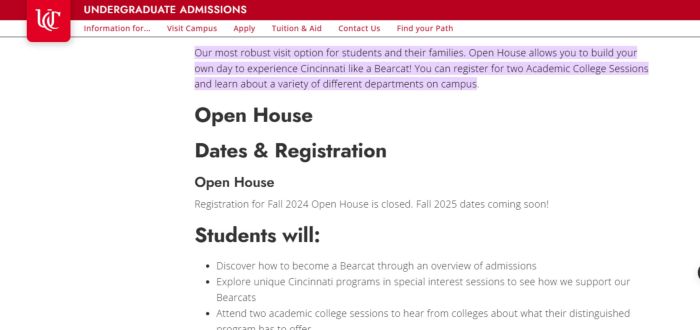
Example: University of Cincinnati (USA): Cincinnati’s Open House model allows each guest to “build your own day.” Attendees register for the specific academic sessions and special topics that interest them most. For example, a student could choose two different college info sessions (say, Engineering and Business) and several niche interest workshops. The itinerary is flexible – with options like honors program talks, campus tours, residence hall tours, etc. – so each visitor crafts a personalized schedule aligned with their goals.
Before families leave, hand them something to take home, whether that’s a branded folder with your materials, a printed photo from a photo booth, or even just a small keepsake like a sticker or magnet.
More importantly, give them the info they need to take the next step. Include your admissions contact, an FAQ sheet, key dates, and a personalized thank-you letter from the principal.
A friendly goodbye, a handshake, and a “We hope to see you again soon” can seal the deal emotionally. People remember how you made them feel. Make it good.
Example: Temple College (USA): This community college makes sure guests leave with smiles (and photos). At its Open House, Temple College set up a fun photo booth with their mascot, “TC Leopard.” Students and families could snap pictures with the mascot – a keepsake to post on social media – and even win prizes. This lighthearted closing activity gave attendees a lasting memory and positive vibe to associate with the school.
Send a thank-you email the next day. Personalize it if you can. Include links to the application page, upcoming deadlines, and photos from the event. Invite further questions and make it easy to get in touch.
If a family asks about something specific, say, learning support or scholarship details, make sure someone follows up with a personalized message.
Want to keep the momentum going? Enroll attendees in a short email series spotlighting your programs, alumni, or events. Nurturing that relationship can turn a visitor into an applicant.
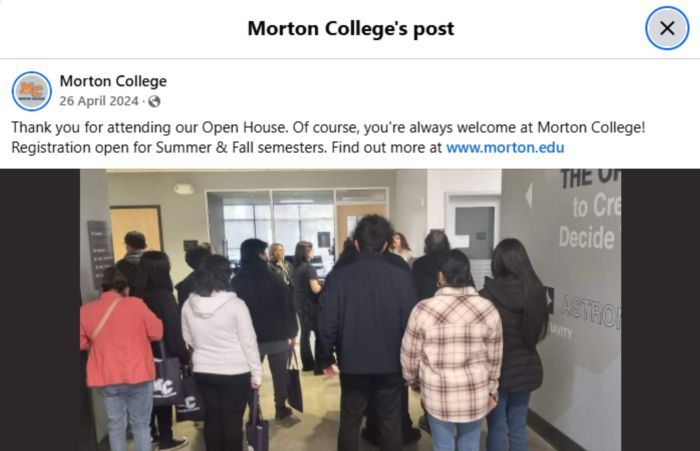
Example: Morton College (USA): After the Open House, Morton College immediately followed up with attendees and the broader community on social media. They posted a thank-you message to everyone who came, reinforcing that visitors are always welcome on campus. Importantly, the message included a next-step call-to-action, a reminder that registration was open for upcoming semesters, nudging interested students to take the next practical step toward enrollment.
10. Debrief, Reflect, and Get Ready to Do It Even Better Next Time
One last tip, and it’s a game changer.
After the event, take time to evaluate. Meet with your team and ask: What worked? What didn’t? What feedback did families share?
Review your numbers: RSVPs, attendance, applications started. Be sure to look for patterns. Did most families come from a certain neighborhood? Were particular sessions packed while others lagged?
Use this insight to adjust your strategy for next time. Update your checklists. Refine your flow. Keep evolving.
Oh, and don’t forget to celebrate your wins. Share event highlights in a post or newsletter. Thank your team. Show appreciation.
Final Thoughts
An open house is more than just an event, it’s an invitation.It’s your chance to say, “Here’s who we are. Here’s why we care. Here’s how your family fits in.”
When you plan with intention, create moments of connection, and follow through with heart, your open house becomes more than a tour. It becomes a story families want to be part of.
So get planning, and get ready to make your next open house your best one yet.
Would you like to receive tailored open house school ideas for your institution?
Contact Higher Education Marketing for more information.
Struggling to stand out in a crowded market?
Boost enrollment with tailored open house strategies!
Frequently Asked Questions
Question: How do you prepare for an open house at school?
Answer: Start by setting clear goals and selecting a date that works for your audience. Plan the schedule, secure staff and student volunteers, and prepare promotional materials. Promote the event across multiple channels (website, email, social media), tidy up the campus, and organize signage, welcome tables, and printed resources to ensure a smooth, welcoming experience.
Question: What should teachers do for open house?
Answer: Teachers should prepare a welcoming classroom with student work on display, provide a brief overview of their curriculum, and have handouts with contact information and expectations. During the event, they should greet families warmly, answer general questions, and encourage follow-up meetings for individual concerns.
Question: How do you make an open house at school fun?
Answer: Incorporate interactive elements like hands-on activities, themed scavenger hunts, live demonstrations, or student performances. Offer refreshments, set up a photo booth, and keep presentations short and engaging. The goal is to create an energetic, memorable experience that showcases school spirit.
June 8, 2025, by Dean Hoke: Intercollegiate athletics occupy a powerful and unique place in American higher education—something unmatched in any other country. From the massive media contracts of Division I football to the community pride surrounding NAIA and NJCAA basketball, college sports are a defining feature of the American academic landscape. Unlike most nations, where elite athletic development happens in clubs or academies, the U.S. integrates competitive sports directly into its college campuses.
This model is more than tradition; it’s an engine of opportunity. For many high school students—especially those from underserved backgrounds—the chance to play college sports shapes where they apply, enroll, and succeed. According to the NCAA, 35% of high school athletes say the ability to participate in athletics is a key factor in their college decision [1]. It’s not just about scholarships; it’s about identity, community, and believing their talents matter.
At smaller colleges and two-year institutions, athletics often serves as a key enrollment driver and differentiator in a crowded marketplace. International students, too, are drawn to the American system for its academic-athletic fusion, contributing tuition revenue and global prestige. Undermining this model through sweeping changes to federal financial aid, without considering the downstream effects, risks more than athletic participation. It threatens a distinctively American approach to education, access, and aspiration.
A New Threshold with Big Impacts
Currently, students taking 12 credit hours per semester are considered full-time and eligible for the maximum Pell Grant, which stands at $7,395 for 2024-25 [2]. The proposed House budget raises this threshold to 15 credit hours per semester. For student-athletes, whose schedules are already packed with training, competition, and travel, this shift could be devastating.
NCAA academic standards require student-athletes to maintain full-time enrollment (typically 12 hours) and make satisfactory academic progress [3]. Adding another three credit hours per term may force many to choose between academic integrity, athletic eligibility, and physical well-being. In sports like basketball, where teams frequently travel for games, or in demanding STEM majors, completing 15 credit hours consistently can be a formidable challenge.
Financial Impact on Student-Athletes
Key Proposed Changes Affecting Student-Athletes:
Pell Grant Reductions: The proposed budget aims to cut the maximum Pell Grant by $1,685, reducing it to $5,710 for the 2026–27 academic year. Additionally, eligibility criteria would become more stringent, requiring students to enroll in at least 15 credit hours per semester to qualify for full-time awards. These changes could result in approximately 700,000 students losing Pell Grant eligibility [4].
Elimination of Subsidized Loans: The budget proposes eliminating subsidized federal student loans, which currently do not accrue interest while a student is in school. This change would force students to rely more on unsubsidized loans or private lending options, potentially increasing their debt burden [5].
Cuts to Work-Study and SEOG Programs: The Federal Work-Study program and Supplemental Educational Opportunity Grants (SEOG) are slated for significant reductions or elimination. These programs provide essential financial support to low-income students, and their removal could affect over 1.6 million students [6].
Institutional Risk-Sharing: A new provision would require colleges to repay a portion of defaulted student loans, introducing a financial penalty for institutions with high default rates. This could strain budgets, especially at smaller colleges with limited resources [7].
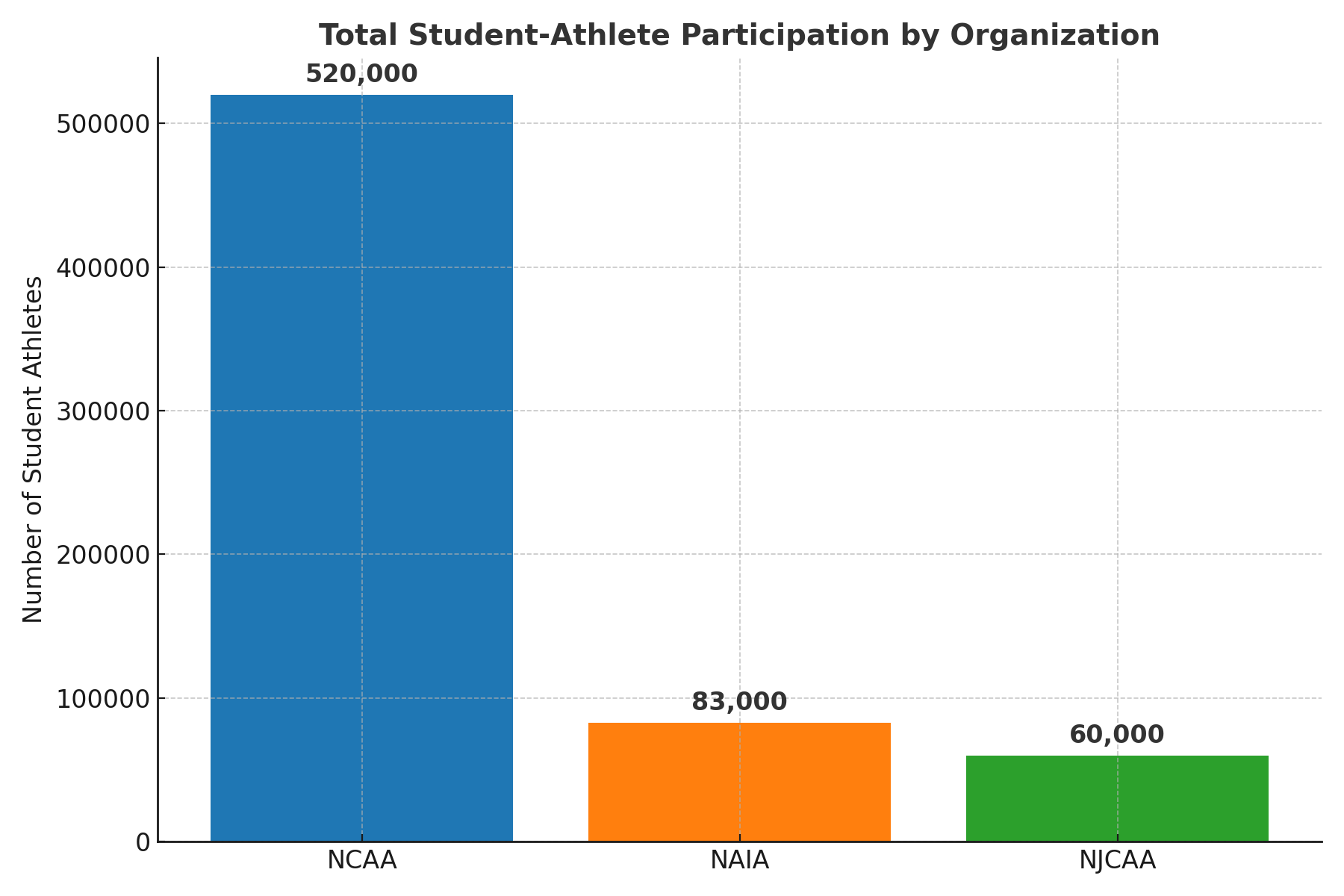
Figure 1: Total student-athletes by national athletic organization (NCAA, NAIA, NJCAA).
While Figure 1 highlights the total number of student-athletes in each organization, Figure 2 illustrates how deeply athletics is embedded in different types of institutions. NAIA colleges have the highest ratio, with student-athletes comprising 39% of undergraduate enrollment. Division III institutions follow at approximately 8.42%, and the NJCAA—serving mostly commuter and low-income students—relies on athletics for 8.58% of its total student base [8].
Even Division I, with its large student populations, includes a meaningful share (2.49%) of student-athletes. These proportions underscore how vital athletics are to institutional identity, especially in small colleges and two-year schools where athletes often make up a significant portion of campus life, retention strategy, and tuition revenue.
Figure 2: Percentage of student-athletes among total undergraduate enrollment by organization (NCAA Divisions I–III, NAIA, NJCAA).
The Pell Grant Profile: Who’s Affected
Pell Grants support students with the greatest financial need. According to a 2018 report, approximately 31.3% of Division I scholarship athletes receive Pell Grants. At individual institutions like Ohio State, the share is even higher: 47% of football players and over 50% of women’s basketball players. In the broader NCAA system, over 48% of athletes received some form of federal need-based aid in recent years [9].
There are approximately 665,000 student-athletes attending college. The NCAA reports that more than 520,000 student-athletes currently participate in championship-level intercollegiate athletics across Divisions I, II, and III [10]. The National Association of Intercollegiate Athletics (NAIA) oversees approximately 83,000 student-athletes [11], while the National Junior College Athletic Association (NJCAA) supports around 60,000 student-athletes at two-year colleges [12].
The NAIA and NJCAA systems, which serve many first-generation, low-income, and minority students, also have a high reliance on Pell Grant support. However, exact figures are less widely published.
The proposed redefinition of “full-time” means many of these students could lose up to $1,479 per year in aid, based on projections from policy experts [13]. For low-income students, this gap often determines whether they can afford to continue their education.
Fewer Credits, Fewer Dollars: Academic and Athletic Risks
Another major concern is how aid calculations based on “completed” credit hours will penalize students who drop a class mid-semester or fail a course. Even if a student-athlete enrolls in 15 credits, failing or withdrawing from a single 3-credit course could drop their award amount [14]. This adds pressure to persist in academically unsuitable courses, potentially hurting long-term academic outcomes.
Athletic departments, already burdened by compliance and recruitment pressures, may face added strain. Advisors will need to help students navigate increasingly complex eligibility and aid requirements, shifting focus from performance and development to credit-hour management.
Disproportionate Effects on Small Colleges and Non-Revenue Sports
The brunt of these changes will fall hardest on small, tuition-dependent institutions in the NCAA Division II, Division III, NAIA, and NJCAA. These colleges often use intercollegiate athletics as a strategic enrollment tool. At some NAIA schools, student-athletes comprise 40% to 60% of the undergraduate population [8].
Unlike large Division I schools that benefit from lucrative media contracts and booster networks, these institutions rely on a patchwork of tuition, modest athletic scholarships, and federal aid to keep programs running. A reduction in Pell eligibility could drive enrollment declines, lead to cuts in athletic offerings, and even force some colleges to close sports programs or entire campuses.
Already, schools like San Francisco State University, Cleveland State, and Mississippi College have recently announced program eliminations, citing budgetary constraints [15]. NJCAA institutions—the two-year colleges serving over 85,000 student-athletes—also face a precarious future under this proposed budget.
Economic Importance by Division
Division I: Athletics departments generated nearly $17.5 billion in total revenue in 2022, with $11.2 billion self-generated and $6.3 billion subsidized by institutional/government support or student fees [16]. Many Power Five schools are financially resilient, with revenue from TV contracts, merchandise, and ticket sales.
Division II: Median revenue for schools with football was around $6.9 million, but generated athletic revenue averaged only $528,000, leading to significant deficits subsidized by institutional funds [17].
Division III: Division III schools operate on leaner budgets, with no athletic scholarships and total athletics budgets often under $3 million per school. These programs are typically funded like other academic departments [18].
NAIA and NJCAA: These schools rely heavily on student-athlete enrollment to sustain their institutions. Athletics are not profit centers but recruitment and retention tools. Without Pell Grants, many of these athletes cannot afford to enroll [11][12].
Figure 3: Estimated number of NAIA, Division III, and NJCAA programs by state.
Unintended Tradeoffs: Equity and Resource Redistribution
Attempting to offset lost federal aid by reallocating institutional grants could result in aid being shifted away from non-athletes. This risks eroding equity goals, as well as provoking internal tension on campuses where athletes are perceived to receive preferential treatment.
Without new revenue sources, institutions may also raise tuition or increase tuition discounting, potentially compromising their financial stability. In essence, colleges may be forced to choose who gets to stay in school.
The High-Stakes Gamble for Student-Athletes
Figure 4: Estimated impact of Pell Grant changes on student-athletes, including projected dropouts and loan default rates.
For many student-athletes, especially those from low-income backgrounds, the Pell Grant is not just helpful—it’s essential. It makes the dream of attending college, competing in athletics, and earning a degree financially feasible. If the proposed changes to Pell eligibility become law, an estimated 50,000 student-athletes could be forced to drop out, unable to meet the new credit-hour requirements or fill the funding gap [19]. Those who remain may have no choice but to take on additional loans, risking long-term debt for a degree they may never complete. The reality is sobering: Pell recipients already face long-term student loan default rates as high as 27%, and for those who drop out, that figure climbs above 40% [20]. Stripping away vital support will almost certainly drive those numbers higher. The consequences won’t stop with individual students. Colleges—particularly smaller, tuition-dependent institutions where athletes make up a significant share of enrollment—stand to lose not just revenue, but the very programs and communities that give purpose to their campuses.
Colleges, athletic associations, policymakers, and communities must work together to safeguard opportunity. Student-athletes should never be forced to choose between academic success and financial survival. Preserving access to both education and athletics isn’t just about individual futures—it’s about upholding a uniquely American pathway to achievement and equity.
Dean Hoke is Managing Partner of Edu Alliance Group, a higher education consultancy. He formerly served as President/CEO of the American Association of University Administrators (AAUA). With decades of experience in higher education leadership, consulting, and institutional strategy, he brings a wealth of knowledge on small colleges’ challenges and opportunities. Dean is the Executive Producer and co-host for the podcast series Small College America.
Congressional Budget Office. (2025). Reconciliation Recommendations of the House Committee on Education and the Workforce. Retrieved from https://www.cbo.gov/publication/61412
NJCAA, NAIA, and NCAA. (2023). Student-Athlete Participation Reports.
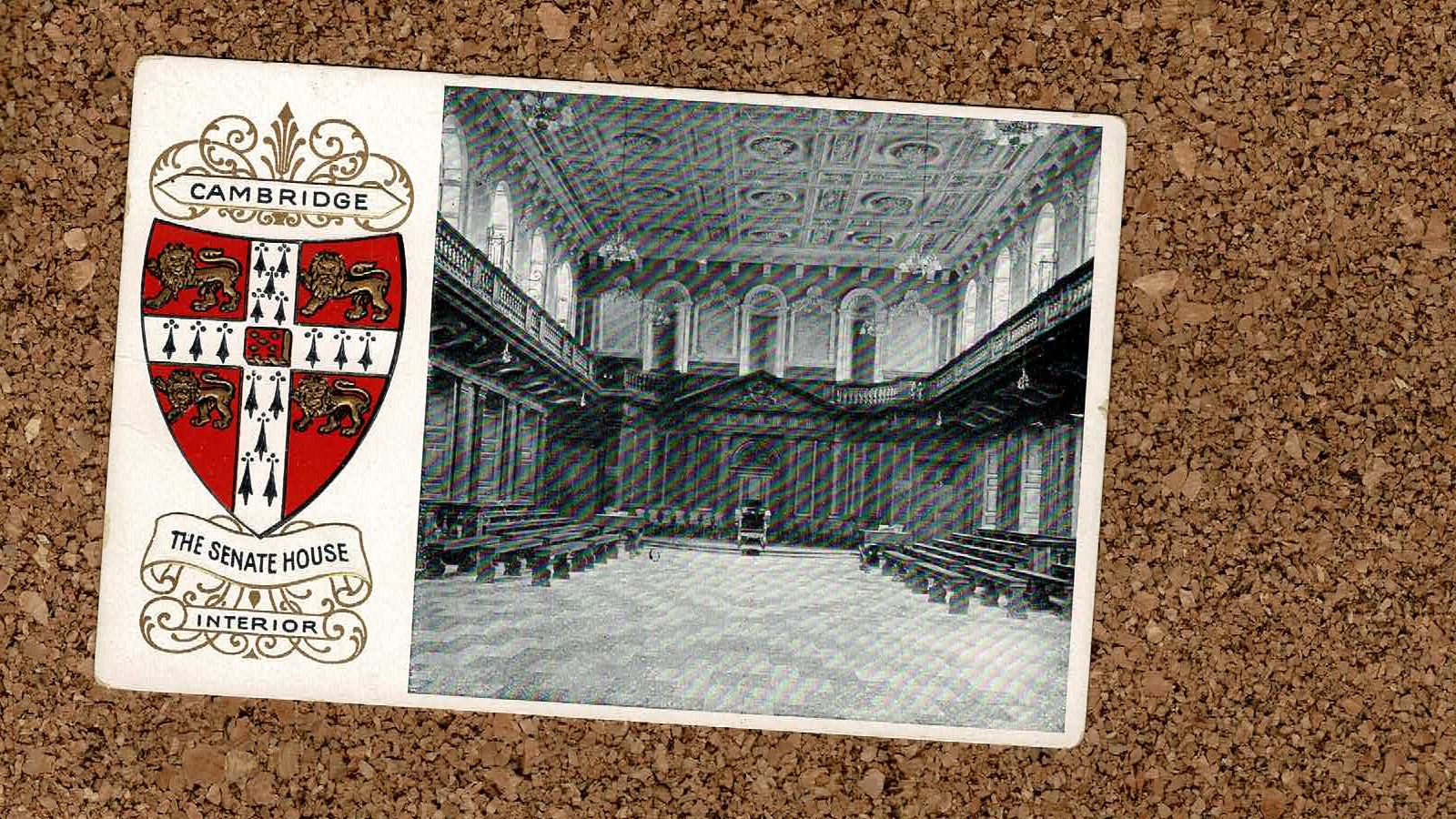
Today’s card shows the Senate House at the University of Cambridge. Building started in 1722, the Senate House opened in 1730, and it was completed in 1768 (yes, that is the right order of events). It was designed by the Jameses Gibbs and Burroughs (the latter being master of Gonville and Caius); woodwork by James Essex the Elder; and ceiling plaster by Artari and Bagutti.
As the name suggests, it was built as a meeting place for the university’s senate. And until 1926, the senate was a very big deal at Cambridge, being the governing body, in charge of everything. And since its members comprised everybody who held a Cambridge MA, it was a quite a thing to get a decision made. (I’ve blogged previously on the Microcosmographia academica, which is concerned with the politics of getting things agreed within the University of Cambridge senate).
In 1926 things took a turn for the senate – its governance functions were given to the Regent House. Senate is now mostly responsible for electing the university’s chancellor and for electing the High Steward, who oversees senate procedure.
There’s currently an election on for the University of Cambridge chancellor, which is all very exciting. For certain values of exciting. There’s ten candidates, including a big ticket HE name (Lord John Browne, he of the Browne review); big political names (former MP and cabinet minister Lord Chris Smith; Brexit campaigner Gina Miller); and the ubiquitous Sandi Toksvig. Voting takes place in person at the Senate House for two days in July; or online for about a week in July.
When it’s not being used for cancellarial (it’s a real word, honest) elections – which is most of the time, in fact – Senate House is also used for graduation ceremonies at Cambridge. I’ve written before about one aspect of these; safe to say that there’s lots of other local peculiarities. At Cambridge, for example, each graduation is a separate decision of the governing body, so a special meeting of the Regent House (and before then, of the senate) is held for each ceremony. I suspect this may be where be get the notion of the degree congregation, which language I’ve heard used at other universities.
There’s also an order of precedence for the colleges at graduation, established in the Statues and Ordinances. It is: King’s College, Trinity College, St John’s College, Peterhouse, Clare College, Pembroke College, Gonville and Caius College, Trinity Hall, Corpus Christi College, Queens’ College, St Catharine’s College, Jesus College, Christ’s College, Magdalene College, Emmanuel College, Sidney Sussex College, Downing College, Girton College, Newnham College, Selwyn College, Fitzwilliam College, Churchill College, Murray Edwards College, Darwin College, Wolfson College, Clare Hall, Robinson College, Lucy Cavendish College, St Edmund’s College, Hughes Hall, and Homerton College. And this isn’t strictly the order in which the colleges were established or admitted as colleges. If anyone knows why, please let me know!
Senate House has seen its share of high jinks. Most notable, perhaps, is the 1958 incident where students contrived to place an Austin Seven on its roof. Here’s the Liverpool Daily Post, reporting with an admirable straight face on plans for its retrieval.
After much back-and-forth and late-night dealing, House Republicans have passed a sweeping budget plan to cut spending and taxes that is moving on to the Senate—a significant milestone for legislation that seemed dead in the water a week ago amid concerns that the bill didn’t include deeper cuts.
The plan, called the One Big Beautiful Bill Act, narrowly advanced Thursday morning by a one-vote margin. All Democrats opposed the legislation, arguing that the spending cuts would hurt the working class and vulnerable populations while raising the deficit and giving tax breaks to wealthy individuals.
Among other changes, the legislation would levy new taxes on colleges, require institutions to pay millions to the federal government, change how students pay for college and limit eligibility for the Pell Grant. In the lead-up to Thursday’s vote, higher education leaders warned that the proposal would make trying to attend and pay for college much more complicated and raise costs for those who do enroll. The bill does include some wins for colleges, institutional lobbyists say, but those don’t outweigh the negatives.
Republicans, who say the cuts are necessary, are using a legislative procedure known as reconciliation to advance the bill. That process allows lawmakers to fast-track the legislation and pass it with a simple majority of votes in both chambers. (Typically, the Senate requires 60 votes to cut off debate for a bill.)
“It’s time we stopped asking a factory worker in Michigan or a rancher in Texas to subsidize the student debt of a lawyer in Manhattan so colleges can continue to spike their tuition to whatever they want,” said Rep. Tim Walberg, a Michigan Republican and chair of the House Committee on Education and the Workforce, in a statement. “By capping loan amounts and giving some financial responsibility to schools, this legislation addresses the root cause of high college costs and provides schools an incentive to deliver real value for students and taxpayers.”
With the measure now in the Senate’s hands and lawmakers eyeing a July 4 deadline, here’s what else you should know about the legislation that could reshape American higher education.
1. Students Set to Lose Pell Money
Many House committees had a hand in the legislation, but the proposals that will have the biggest impact on colleges are from the Committee on Education and the Workforce. The 103-page Student Success and Taxpayer Savings Plan, which is part of the broader reconciliation bill, would reduce spending by nearly $350 billion over the next 10 years.
Most of those savings stem from rolling back a Biden-era student loan repayment plan that never fully took effect and from capping how much students can borrow. But lawmakers are also planning to increase spending on Pell Grants by $2.8 billion as they aim to address a looming shortfall and open up the program to short-term workforce-training classes.
To make the math work, Republicans are changing who qualifies for a Pell Grant, proposing that students would have to take at least 15 credits a semester in order to receive the full award. They’ll also have to take at least 7.5 credits to get any money. Currently, the Pell Grant is prorated based on how many credits students take, and there’s no floor.
Changing the full-time-award definition would save $7.1 billion, according to the Congressional Budget Office, which estimated that more than half of students currently enrolled would see their Pell Grant reduced.
The CBO also estimated that cutting off Pell for part-time students would save about $687 million over the next 10 years. Currently, about 10 percent of Pell Grant recipients enroll less than half-time. Of those students, the CBO predicts that one-third of students who stand to lose their grant under this change would enroll in more classes. Presumably, the other two-thirds would either stop out or pay for their education with loans or their own money. (The CBO report was based on a minimum of six credits, but that threshold has since increased to 7.5, so the number of students affected could be higher.)
Over all, about 700,000 students would no longer be eligible for the Pell Grant after all the changes take effect. The changes are currently set to take effect in summer 2026.
2. Colleges on the Hook for Unpaid Student Loans
In addition to the Pell Grant cuts, college leaders are particularly worried about a provision known as risk-sharing, which would require institutions to pay a financial penalty based on students’ unpaid loans. How much colleges would have to pay is unclear, but the CBO estimates that by 2034, payments would total $1.3 billion and then continue to increase each year. Risk-sharing is expected to save the government $5.3 billion over the next 10 years.
Because of risk-sharing and other changes in the bill aimed at limiting student borrowing, the CBO predicts that the volume of student loans would drop by about 20 percent.
College leaders and lobbyists argue that the formula that would determine institutions’ payments is untested, and without more information, they can’t accurately gauge the ramifications. One lobbyist said the proposal represented “an astonishing level of federal overreach.” Critics of the plan also worry that underresourced and minority-serving institutions would be hit the hardest.
“The risk is not equal among colleges,” Tuskegee University president Mark Brown told senators this week.
Risk-sharing is just one of several proposed changes that would upend the student loan system. House Republicans also want to end Grad PLUS loans along with subsidized loans, restrict Parent PLUS loans and tie how much students can borrow to the median cost of a program. Some consumer protection advocates argued that these changes would drive students to private lenders, which often charge higher interest rates.
3. More Taxes and Medicaid Cuts Threaten Colleges’ Bottom Lines
Other proposals in the bill from the Ways and Means Committee would levy a host of new or expanded taxes against universities.
First, the committee created new brackets to tax wealthy universities’ endowments. Currently, private universities with endowments that are worth more than $500,000 per student pay a 1.4 percent tax. But under the plan, some could see their endowments taxed at 21 percent.
Institutions with endowments valued at $750,000 to $1.25 million per student would be hit with a 7 percent tax. That rate would climb to 14 percent for colleges with endowments worth $1.25 million to $2 million per student, while colleges with endowments of $2 million or more per student would pay 21 percent. Colleges also can’t include international students in their tally of students, which could subject more institutions to the tax.
In addition to the endowment tax, the proposal also taxes a college’s intellectual property by stating that the endowment tax should include all forms of investment income. This means that any royalties from a private university’s intellectual property, including patents and copyrights, would be taxable. Additionally, the legislation removes colleges’ exemption from the unrelated business income tax so that all institutions, public and private, would be taxed for royalties from licensing their name and logo.
House Republicans in other committees also proposed cuts to the Medicaid and Supplemental Nutrition Assistance programs, which critics say would hurt students and states’ budgets. And if states do take a hit financially, public colleges might see their budgets cut.
“If federal Medicaid funding is reduced in a new federal tax law, no public college or university will be immune from future state budget reductions and the austerity that will result. Public higher education must be prepared,” two professors wrote in an Inside Higher Ed op-ed earlier this year.
4. Warnings From Higher Ed Pile Up
Higher education groups warned before and after the vote of damaging consequences if the legislation becomes law.
American Federation of Teachers president Randi Weingarten called it a “big, ugly betrayal,” while Kara D. Freeman, president and CEO of the National Association of College and University Business Officers, said in a statement that “the implications for student access, research, and innovation could be far-reaching.”
Freeman said the endowment tax is especially concerning and cited NACUBO data that shows colleges and universities spent $30 billion from their endowments in fiscal year 2024—nearly half of which funded student financial aid.
“This scholarship tax takes funds away from students and makes it less possible for colleges to support them,” she said.
Meanwhile, the American Council on Education took issue with the use of the reconciliation process to advance sweeping changes, along with the provisions in the bill.
“The totality of the funding cuts, policy changes, and tax increases included in this reconciliation package will have a historic and negative impact on the ability of current and future students to access postsecondary education, as well as on colleges and universities striving to carry out their vital educational and research missions,” ACE wrote in a letter to the House.
So far, senators have said little about the higher ed provisions in the bill, so it’s not yet clear whether they’ll agree with the House plan. Generally, while the House prefers risk-sharing, the Senate is expected to back a measure that judges programs by their students’ employment rates and income levels after graduation.
But, with President Donald Trump backing the legislation and a fragile majority in the House, senators have few options if they want to change the legislation.
“This is arguably the most significant piece of Legislation that will ever be signed in the History of our Country!” Trump wrote on Truth Social. “Now, it’s time for our friends in the United States Senate to get to work, and send this Bill to my desk AS SOON AS POSSIBLE! There is no time to waste.”
This audio is auto-generated. Please let us know if you have feedback.
House Republicans on Thursday narrowly passed a massive tax and spending bill that, if signed into law, would add new financial pressures on U.S. colleges and students while extending the tax cuts instituted in 2017.
Backed by President Donald Trump and dubbed the “One Big Beautiful Bill Act,” the proposal includes provisions for dramatically increasing the endowment tax, a risk-sharing policy that would put colleges on the hook for unpaid student loans, and changes to the federal student aid program that critics say would reduce access to higher education.
The bill is headed to the Senate after it passed the House by one vote, with every Democrat and two Republicans voting against it. Three other Republicans either abstained or did not participate in the vote.
The Senate, held by Republicans with a 53-person majority, is widely expected to add changes to the bill.
Since lawmakers passed the legislation as part of the reconciliation process — a rule allowing the Senate to approve spending-related policies with a simple majority — Republicans can avoid a filibuster that would take 60 votes to break.
In a Wednesday letter to House leaders, American Council on Education President Ted Mitchell wrote that the higher ed policy changes would have “a historic and negative impact on the ability of current and future students to access postsecondary education, as well as on colleges and universities striving to carry out their vital educational and research missions.”
Here is a look at some of the major higher ed provisions:
Endowment tax
Today, the richest private colleges — the few dozen with at least 500 students and at least $500,000 endowment assets per student — pay an endowment excise tax set at 1.4%.
Wednesday’s bill would implement a graduated rate structure, with levels starting at 1.4%, and rising to 7%, 14% and 21% depending on endowment assets per student. Under that tiered system, the wealthiest college would be taxed the same as the current corporate income rate.
When House Republicans advanced the endowment tax proposal earlier this month, they decried “woke, elite universities that operate more like major corporations.”
The lowest tax bracket targets colleges whose endowments are valued between $500,000 and $749,999 per student.
Endowment taxes would rise to 21% for the nation’s wealthiest private colleges
Excise tax tiers for private colleges based on endowment funds per student
Industry experts and insiders worry the tax could hurt colleges’ long-term missions and diminish the resources they rely on to recruit lower-income students.
In a statement Thursday, Kara Freeman, president and CEO of the National Association of College and University Business Officers, pointed to research by her organization and Commonfund finding that nearly half of endowment spending went toward student aid in fiscal 2024.
“This scholarship tax takes funds away from students and makes it less possible for colleges to support them,” Freeman said.
Colleges spend the largest share of endowment funds on student financial aid
Endowment spending distribution by function in fiscal 2024
Financial aid changes
The bill eliminates federal subsidized loans for undergraduates and Direct Plus loans for graduate students beginning on July 1, 2026.
It also limits Parent Plus Loans, capping how much parents can borrow and only allowing them to take out loans if their dependent student has already taken out the maximum in unsubsidized loans.
The bill sets an overall lifetime student loan limit of $200,000 for any single borrower across all federal loan types.
Additionally, it raises the course hours for the full-time student designation needed to receive the maximum Pell Grant from 24 to 30 per academic year, and it changes the formula for Pell eligibility.
ACE’s Mitchell called the proposed changes to Pell Grants “crippling,” saying some 700,000 students could lose eligibility under the bill.
Regarding changes to federal student funding writ large, Mitchell described them as “deep cuts and damaging changes to important federal student aid programs” that would limit access to education.
The bill also cuts several student loan repayment programs, consolidating a “litany” of repayment plans into two, according to the House Committee on Education and Workforce.
The Republican-led committee last month described the higher education policy proposals as “strengthening accountability for students and taxpayers, streamlining student loan options, and simplifying student loan repayment.”
Risk-sharing
Along with tax hikes on some college endowments, the vast majority of colleges would make payments to the federal government based on a formula centered on the unpaid student loan balances of former students.
The risk-sharing policy is intended to increase college accountability on student costs and outcomes.
“Institutions that continue to saddle their students with debt eventually face increasing penalties and risk loss of access to federal student aid,” the House education committee said about the proposal previously.
But higher education experts and insiders worry a risk-sharing system could disincentivize colleges from accepting lower-income and historically marginalized students, who face more systemic challenges both in education and in the workforce.
While a portion of those payments might be offset by the bill’s new Promise grants for colleges that provide access to low- and middle-income students, analysis has found that many institutions will lose money overall.
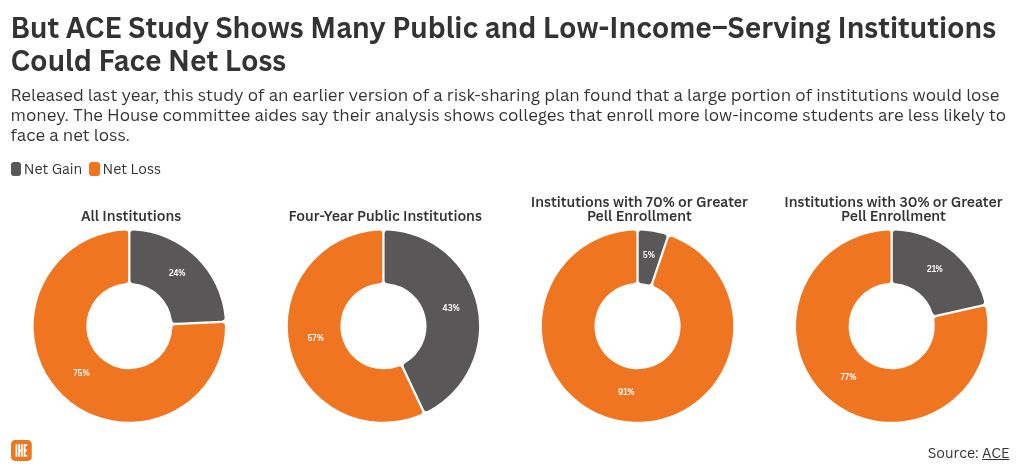
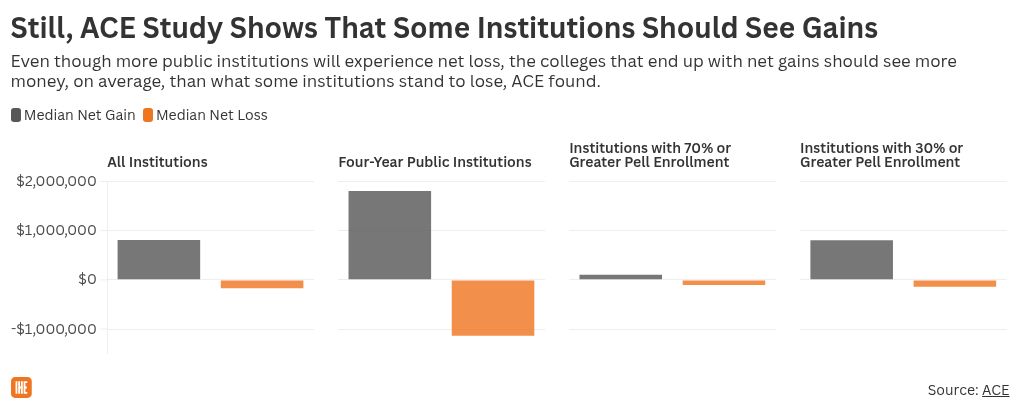
ACE found that 91% of colleges serving primarily lower-income students would make significant payments to the government even after Promise grants are factored in, with a median net loss of $107,000.
“In terms of its implementation, it would be disastrous for institutions that are doing the job of bringing on students that come from communities that are already underrepresented,” Jordan Nellums, senior policy associate with The Century Foundation, a left-leaning think tank, said of the proposal in an interview this spring.
Under a new accountability measure recently proposed as part of a larger House budget bill, colleges would have to pay millions of dollars each year to reimburse the government for their students’ unpaid loans.
The plan builds on an idea—known as risk-sharing—that lawmakers and policy analysts have been toying with since at least 2015. As the federal student loan portfolio grew, the goal was to require colleges to have some skin in the game and incentivize them to improve student outcomes.
And while the concept has gained some bipartisan support in theory, higher education institutions have repeatedly argued that it is difficult to create a fair accountability system when many of the variables involved are out of an institution’s control and depend on the decisions of individual students and borrowers.
So far, the higher ed lobby has successfully defeated proposed risk-sharing plans such as the one included in a Republican bill from the last Congress, known as the College Cost Reduction Act. But now, an almost identical proposal is back and at the heart of House Republicans’ plan to cut at least $330 billion from higher education programs over the next 10 years. The overall legislation, which aims to cut $1.5 trillion from the budget, could receive a vote on the House floor this week, though some lawmakers have threatened to block the measure amid concerns that it doesn’t include deeper cuts. Even if the bill fails, it serves as a marker of what House Republicans hope to accomplish moving forward.
Many higher education policy experts warn that practically speaking, the latest risk-sharing plan relies on a complicated formula that’s essentially a black box. Released in late April, the proposal has not been tested enough to know its ramifications, they say, and the limited data available is inconclusive. Some analyses released by conservative groups say the program will be a financial boost for efficient public institutions and penalize bloated private ones. But one study conducted by a lobbying group suggests that public regional and minority-serving institutions that serve high populations of low-income students will get hit the hardest.
“Fundamentally it’s an astonishing level of federal overreach to essentially lump in all institutions of higher education together—public, private, for-profit—and run a convoluted formula to determine winners and losers at the federal level and then redistribute funding,” said Craig Lindwarm, senior vice president of government affairs for the Association of Public and Land-grant Universities.
Democratic politicians also argue that the purpose of the legislation is not truly to hold colleges accountable for student outcomes like graduation rates and income levels, but to crack down on what the government considers overly liberal institutions and fund President Donald Trump’s priorities.
Even some conservative supporters acknowledge that it’s difficult to know the full scope of the bill’s potential impact this early. But they say risk-sharing is a necessary tool to penalize colleges that provide a poor return on investment and ensure the production of a well-prepared, financially stable workforce. They also suggest that the incentives such as additional grant funding to institutions that keep costs low and graduation rates high will offset the penalty for most public institutions.
“With any policy change, we’re not going to be able to predict in advance 100 percent of how this is going to affect everyone, everywhere, all the time. But I don’t think that should be an excuse to not make policy changes,” said Preston Cooper, a senior fellow at the conservative think tank the American Enterprise Institute. “I still think the data we have gives us a general idea of which sorts of institutions would be affected and the magnitudes of the penalties involved.”
So How Does It Work?
The proposed risk-sharing plan would kick in for new loans starting in July 2027, said an aide for Republicans on the House Education and the Workforce Committee. That means colleges wouldn’t be penalized for disruptions to the student loan system that occurred during the pandemic or efforts during the Biden and Trump administrations to overhaul repayment.
If we don’t even understand how this works, why the heck are we passing it? I mean, it’s a concept, but I don’t think it’s the concept that people think it is.”
Jason Delisle, nonresident senior fellow at the Urban Institute
And because borrowers don’t have to start paying back their loans until six months after they graduate or stop out, institutions likely won’t have to pay a penalty until 2029 or 2030 at the earliest, the aide added.
But from then on, institutional payments would be calculated annually—major by major—for each new cohort of borrowers and would continue until they’ve paid off their loans. The amount per cohort could change from year to year, depending on factors such as borrower behavior, postgraduation earnings and college costs. But it’s expected to grow as more and more cohorts are added to the lump sum.
Under the bill, the amount per cohort would be calculated using a three-part formula, which is largely unchanged from what Republicans proposed last Congress in the CCRA.
The first step is to determine a college’s risk-sharing liability, which is how much each institution owes the government. To do that, the formula looks at the difference between how much students were supposed to repay during a given year and how much they actually did. The calculation takes into account the value of any missed or partial payments as well as any interest that the government waived or principal contributions it matched, the committee aide said. It does not, however, include debt waived through programs like Public Service Loan Forgiveness, which was a concern for institutions.
This is the part of the formula that raises the most questions for institutions, as the mechanics of exactly how the risk-sharing liability is calculated are not clearly outlined in the legislation or in a CCRA database published by the education committee Republicans in 2024. And even if it were, much of the data needed to run the formula is not publicly accessible.
“How the formula works is the million-dollar question, and something that we’ve been trying to work on for a year and a half,” one policy expert said. “It’s very complicated and relies on metrics that aren’t publicly available.”
House committee aides counter that colleges have access to student borrower data via the National Student Loan Data System, which can be used to predict future risk-sharing payments. They also point to a recent Dear Colleague letter reminding colleges of their responsibility to monitor borrower payments.
But even then, higher ed lobbyists say, it’s not clear who will be responsible for calculating the liability. If any part of that responsibility falls to campus financial aid administrators, higher ed groups say the plan will increase the administrative burden on colleges.
“If I were a lobbyist, I would just say to all of my members, go to your congressman and say, ‘We don’t know what this does,’” said Jason Delisle, a policy analyst who has worked at think tanks across the political spectrum but is now based at Urban Institute where he’s a nonresident senior fellow. “If we don’t even understand how this works, why the heck are we passing it? I mean, it’s a concept, but I don’t think it’s the concept that people think it is.”
Incentives to Lower Costs
Once that risk-sharing liability is known, the next step in the formula is to figure out how much of that liability fee a college will have to pay. That’s done using what the legislation calls an earning-price ratio, which compares students’ earnings to the federal poverty line and college cost. A higher EPR means a lower final payment. For example, if an institution’s EPR is 0.3, or 30 percent, then it has to pay 70 percent of the original liability.
To further offset the risk-sharing penalty, colleges can also qualify for a new pot of funding proposed in the bill called the PROMISE Grant, which is the third step of the formula. How much a college would get in PROMISE funding depends on the total value of Pell Grants received and the graduation rate of Pell-eligible students. This grant is funded by other colleges’ risk-sharing payments.
Rep. Tim Walberg, a Michigan Republican and chair of the House Education and Workforce Committee, is leading the effort to cut billions from higher education programs.
Bill Clark/CQ-Roll Call Inc. via Getty Images
So, according to data from the House committee, the State Technical College of Missouri should get $3,230,130.50 in PROMISE grants. But the community college would have to pay $9,688, bringing its net gain down to $3,220,442.50. Washington University in St. Louis, however, would receive no PROMISE Grant funding and lose about $3.5 million. (The House Committee data only lists the final risk-sharing payment—not original liability values or EPRs.)
In theory, this data demonstrates how the EPR and the PROMISE Grant are supposed to support colleges that serve low-income students, but many higher ed lobbyists are worried the program will actually do the opposite. That’s largely because colleges can only receive a PROMISE Grant if they agree to lock in tuition rates for each new freshman class. If they can keep tuition costs low, then their EPR scores will only be strong. Some lobbyists say that neither is a feasible option for public colleges and minority-serving institutions, which rely heavily on funding from the state.
“It’s not a coincidence that some of our schools that would get hit the hardest are in states that invest very little in public higher education. Some of our schools in Pennsylvania and Arizona, for example, would fare extremely poorly, and it’s by and large because tuition levels are such a determinative component as it relates to the penalty assessment,” said MacGregor Obergfell, director of governmental affairs at APLU. “To think of what traditional conservative orthodoxy is, it seems pretty unusual that a conservative position is using the federal government to punish state institutions for decisions made by their states.”
Reward or Penalty?
Some higher ed groups also noted that much of the formula either depends on or fails to acknowledge factors outside of a college’s control. Much of this has to do with unpredictable borrower behavior, but there are other factors at play, too; for example, when calculating discounts with the EPR, the formula doesn’t account for differences in the cost of living from college to college.
“Institutions in higher-cost areas are at more of a disadvantage than other institutions,” said Karen McCarthy, vice president of public policy and federal relations for the National Association of Student Financial Aid Administrators. “They have to charge higher prices to reflect higher costs of labor, maintaining facilities and all those types of things.”
The burden of risk-sharing payments may be so high that colleges elect to opt out of the federal student loans program entirely, she added: “Ultimately it would have an impact on lower-income students who have a need both for a Pell Grant and a direct loan to help them meet their cost of attendance.”
Of colleges that enrolled 70 percent or more low-income, Pell-eligible students, 96 percent would have to pay a risk-sharing penalty and 91 percent would lose money over all when PROMISE Grant is factored in, according to the American Council on Education’s analysis of the House data.
The committee countered that finding with its own analysis of the data, sent to Inside Higher Ed, showing how colleges that enroll the highest share of low-income students should see about $99 more per student, while those that enroll the lowest share would lose about $66 per student.
The ACE analysis as well as the committee’s data are among the few studies that show the estimated impact of the previously proposed risk-sharing plan. None have been updated yet to reflect the latest iteration.
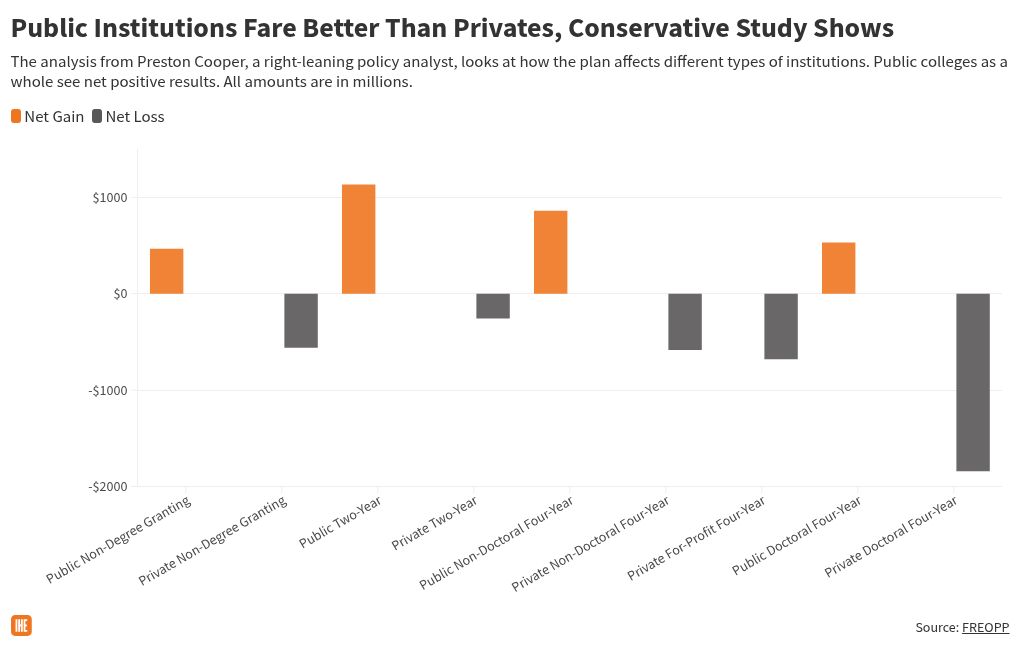
Another analysis from Cooper, the AEI fellow, estimated that public institutions as a whole should get more money under the plan, but private nonprofits are expected to face a substantial penalty.
Although critics point to how the plan would affect individual institutions, particularly small, underresourced schools, proponents argue that the focus should be on the impact to higher education over all, and that colleges can lower their costs to see a payoff.
“Because the net gains are significantly larger, the sector as a whole sees a net gain even though more institutions have net losses,” Cooper said. “So, the upside for institutions here is that there are significant rewards available to those which can improve their outcomes.”
At the end of the day, it’s all about how you choose to look at the data.
“I would just like to see [the formula of risk-sharing] play out for a couple of hypothetical colleges based on data that has some bearing on reality,” said Delisle from Urban Institute. “And that’s a hard thing to come by right now.”