Tag: House

  • White House Partners With Hillsdale for Lecture Series

    White House Partners With Hillsdale for Lecture Series

    President Donald Trump is tapping a familiar institution, Hillsdale College, to produce a video lecture series for the U.S. sestercentennial, the administration announced on social media.

    “On July 4, 2026, we will celebrate 250 years of American Independence. The White House has partnered with @Hillsdale to tell our story of a rag-tag army defeating the world’s mightiest empire and establishing the greatest republic ever to exist,” the administration posted Tuesday.

    The first installment in the series, according to the post, was a seven-and-a-half-minute video featuring patriotic imagery and comments from Hillsdale president Larry Arnn, who emphasized the importance of knowing American history in order to commemorate the 250th anniversary. 

    In introducing the video series, Arnn cast Trump in the mold of Abraham Lincoln. 

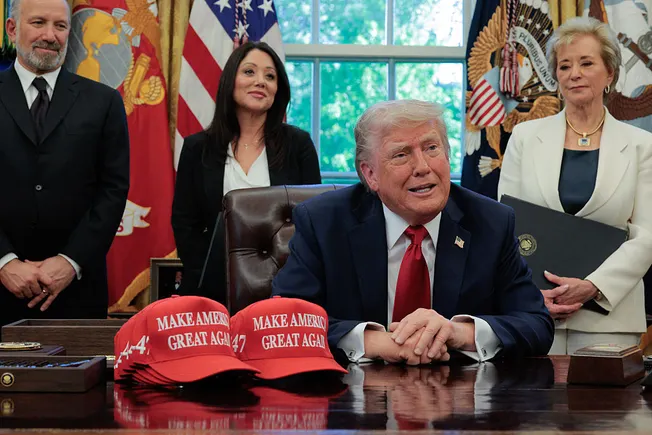
    “Part of the purpose of this series of lectures is to remember. President Trump does this in part I think—I don’t speak for him—but the word ‘again’ is important to him. He has a famous slogan that I will not repeat here, but everybody knows what it is,” Arnn said. “He wants to do something again. Something [that’s] already been done, he wants to see it happen again.”

    Arnn argued that Trump’s campaign slogan, Make America Great Again, “places him somewhere near the politics of Abraham Lincoln,” who sought to build on the foundation laid by George Washington.

    The video focused on the Declaration of Independence and start of the Revolutionary War. The second installment in the series is about the Battles of Lexington and Concord.

    A Hillsdale spokesperson told Politico the college did not take “a dime of federal money” for the video lecture series, which it is providing in partnership with the White House and the Department of Education. (Hillsdale, a private, Christian institution in Michigan, does not accept federal financial aid.)

    The Trump administration also worked with Hillsdale at the end of the president’s first term. In early 2017, Hillsdale officials were part of a commission, chaired by Arnn, that produced the 1776 Report, a widely ridiculed document that academics dismissed as unserious scholarship. Critics argued the 1776 Report provided a whitewashed view of American history, omitted Native Americans entirely and had multiple citation issues.

    Source link

  • House Education and Workforce Committee Holds Hearing on NLRB and Student Athletes

    House Education and Workforce Committee Holds Hearing on NLRB and Student Athletes

    by CUPA-HR | April 10, 2025

    On April 8, the House Education and Workforce Committee held a hearing titled, “Game Changer: The NLRB, Student-Athletes, and the Future of College Sports.” The hearing focused on the employment classification status of student athletes at institutions of higher education.

    The witnesses at the hearing included Daniel L. Nash, shareholder at Littler; Morgyn Wynne, former softball student athlete at Oklahoma State University; Ramogi Huma, executive director at the National College Players Association; and Jacqie McWilliams Parker, commissioner at the Central Intercollegiate Athletic Association.

    Majority Concerns with Employee Classification

    Republican committee members argued that the classification of student athletes as employees could alter college athletics to the detriment of institutions and student athletes alike. Confirmed by witness testimony, the majority discussed that employee classification for and unionization by student athletes could trigger unintended consequences for the athletes, such as fewer benefits, losing scholarships based on poor performance, having scholarships taxed as taxable income, and losing training support, mental health services, and media and career support. Further, they highlighted that employee classification could strain athletic department resources; McWilliams Parker stated that athletic departments would need to consider whether they could continue to sustain certain sports and provide scholarships to students.

    The majority also discussed the legislative and regulatory landscape surrounding this issue. In his opening statement, Chair Rick Allen (R-GA) discussed the memo from former General Counsel of the National Labor Relations Board (NLRB) Jennifer Abruzzo regarding the Biden-era NLRB’s position that student athletes are employees and are afforded statutory protections under the National Labor Relations Act (NLRA). Notably, the memo has since been revoked by the Trump administration’s acting general counsel at the NLRB. Further, in response to questioning from the chair of the full committee, Tim Walberg (R-MI), Nash clarified that existing labor laws are clear that revenue received by an organization is not a factor in determining employee status.

    Representative Lisa McClain (R-MI) also discussed her bill, the Protecting Student Athletes Economic Freedom Act, which would codify into law that student athletes are not employees of institutions, athletic conferences or athletic associations, as a solution to the majority’s concerns.

    Minority Argue for Greater Protections for Student Athletes

    Committee Democrats argued that student athletes require greater protection from exploitation. They argued that student athletes generate revenue for their institutions of higher education, conferences and the National Collegiate Athletic Association (NCAA), but fail to be compensated for their work and the amount of time they commit to their team. The members claimed that classifying student athletes as employees and allowing those athletes to collectively bargain would end the exploitation. Huma’s testimony supported committee Democrats advocating that student athletes should be equally able to benefit financially from the revenue they generate.

    CUPA-HR will monitor for future developments on the status of student athletes as discussed during this hearing and keep members apprised of significant policy updates.


    Source link

  • House Education and Workforce Committee Holds Hearing on FLSA Modernization

    House Education and Workforce Committee Holds Hearing on FLSA Modernization

    by CUPA-HR | March 27, 2025

    On March 25, the House Education and Workforce Subcommittee on Workforce Protections held a hearing titled “The Future of Wage Laws: Assessing the FLSA’s Effectiveness, Challenges, and Opportunities.” The hearing focused on several bills aimed at modernizing the Fair Labor Standards Act (FLSA), including legislation to amend overtime pay requirements on compensatory time and regular rate of pay and to provide clarity on independent contractor status under the FLSA.

    The witnesses at the hearing included Tammy McCutchen, senior affiliate at Resolution Economics; Paige Boughan, senior vice president and director of human resources at Farmers and Merchants Banks (on behalf of the Society for Human Resource Management); Andrew Stettner, director of economy and jobs at the Century Foundation; and Jonathan Wolfson, chief legal officer and policy director at Cicero Institute.

    Compensatory Time

    Committee members and witnesses discussed the Working Families Flexibility Act, which would allow private sector employers, including private institutions, to offer employees the choice of compensatory time or cash wages for overtime hours worked. Currently, the FLSA only allows for employees working for the public sector, including public institutions, to choose compensatory time or cash compensation for overtime hours worked.

    Chair of the Education and Workforce Committee Tim Walburg (R-MI) expressed his support for a bill like the Working Families Flexibility Act, as it would allow employees to choose which form of compensation best suits their needs. On the other side of the aisle, Rep. Mark Takano (D-CA) argued that offering compensatory time is an attempt to force workers to work more hours for free.

    CUPA-HR submitted a letter for the record prior to the hearing in support of the Working Families Flexibility Act. The letter highlights our past support for the legislation as introduced in previous Congresses. It also draws from CUPA-HR President and CEO Andy Brantley’s testimony for a 2013 Workforce Protections Subcommittee hearing in support of compensatory time. In his testimony, he provided examples of instances where employees benefited from the option of such overtime compensation, which he witnessed while working as an HR leader at a large public university.

    Regular Rate

    The hearing also discussed the Empowering Employer Child and Elder Care Solutions Act, which would exclude the value of employer-funded child or dependent care benefits from the regular rate calculation. The FLSA requires that overtime hours are paid at one-and-one-half times the employee’s regular rate of pay, which is an average hourly rate that includes certain types of compensation.

    During the hearing, Rep. Mark Messmer (R-IN) argued that the regular rate calculation that is currently used to determine overtime pay discourages employers from offering certain benefits. McCutcheon stated that legislation like the Empowering Employer Child and Elder Care Solutions Act would encourage employers to offer more benefits as they would no longer face burdensome overtime pay calculations.

    Independent Contractor Status

    During the hearing, committee members and witnesses also discussed the Modern Worker Empowerment Act (H.R. 1319), which would establish a new standard for defining an employee and an independent contractor under the FLSA. Specifically, the legislation would implement language that states workers are employees if the employer controls what work will be done and how it will be done, and workers are independent contractors if the entity under which the worker works does not exercise significant control over how the work is performed, among other things.

    Rep. Kevin Kiley (R-CA), who introduced the bill in early February, stated that the Modern Worker Empowerment Act was needed to ensure protections for independent contractors in the FLSA. Wolfson pointed to a 2019 California law, AB 5, which implemented an “ABC” test for worker classification and stated that businesses stopped working with freelancers as a result of the law. McCutcheon explained that the Modern Worker Empowerment Act provides clarity when determining worker classification status by focusing on who controls the work being done, unlike California’s ABC test which she claimed was too complicated.

    Ranking Member of the Education and Workforce Committee Bobby Scott (D-VA) opposed the Modern Worker Empowerment Act, claiming that workers do not want to be independent contractors and that employers force workers to accept independent contractor status, thus saving employers money.

    The House Education and Workforce Committee will continue to consider these bills as they are reintroduced and marked up during the 119th Congress. CUPA-HR will monitor for future developments on the bills discussed during this hearing and keep members apprised of significant updates.


    Source link

  • House Democrats push for Education Department closure transparency

    House Democrats push for Education Department closure transparency

    This audio is auto-generated. Please let us know if you have feedback.

    Dive Brief:

    • Democrats on the House Education and Workforce Committee introduced a resolution on Friday calling for transparency and information from the Trump administration and U.S. Secretary of Education Linda McMahon on their efforts to shutter the U.S. Department of Education.
    • Specifically, the resolution requests unredacted copies of all documents from the administration that refer to the Education Department’s closure, including decisions around workforce reductions and those that could affect the agency’s ability to carry out education laws like the Individuals with Disabilities Education Act and the Elementary and Secondary Education Act.
    • The resolution will be taken to the House floor for a vote if the Education and Workforce Committee, led by Chair Tim Walberg, R-Mich., does not adopt it within 14 legislative days.

    Dive Insight:

    The resolution’s introduction comes one day after President Donald Trump signed an executive order directing McMahon to close the Education Department to the “maximum extent appropriate and permitted by law.”

    “Abolishing a federal agency requires an Act of Congress,” said Rep. Bobby Scott, D-Va., ranking member of the House Education and Workforce Committee, in a Friday statement. “President Trump’s executive order has little regard for the irreparable harm it will cause to students, educators, our future workforce, and parents, who are already struggling.”

    After the Trump administration announced massive layoffs that cut the Education Department’s workforce in half earlier this month, the agency has denied that its key functions would be impacted.

    “Closing the Department does not mean cutting off funds from those who depend on them — we will continue to support K-12 students, students with special needs, college student borrowers, and others who rely on essential programs,” said McMahon in a Thursday statement praising the executive order.

    Additionally, Trump said before signing Thursday’s executive order that he plans to redistribute the department’s primary responsibilities to other parts of the government. That includes Pell Grants, Title I funding and resources for students with disabilities, he said. 

    The resolution introduced Friday appears to be part of a broader effort by Democrats in the House and Senate to challenge and seek more information over the slew of changes being made to the Education Department. 

    On March 17, leading Democrats on the congressional appropriations committees demanded details on the Education Department’s mass layoffs in a letter to the agency. The requested information included details on the number of staff terminated in each office and the expected savings from the staffing cuts.

    Source link

  • IEl Salvador’s notorious CECOT Mega-Prison That Could House US Deportees and Possibly US Citizens (CBS News)

    IEl Salvador’s notorious CECOT Mega-Prison That Could House US Deportees and Possibly US Citizens (CBS News)

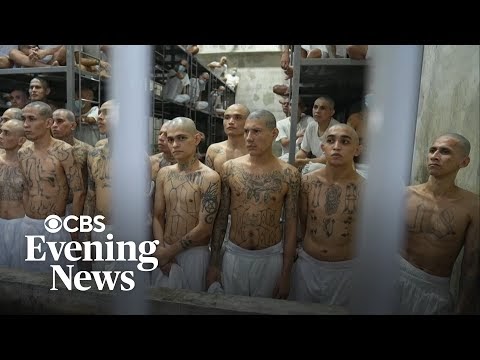
    CBS News this week got a first-hand look at El Salvador’s notorious Center for the Confinement of Terrorism, a prison that could soon house deportees (and possibly US citizens) from the U.S.  The Trump Administration is working on a deal even if it violates human rights. The images are disturbing. 

    Esta semana, CBS News pudo ver de primera mano el notorio Centro para el Confinamiento del Terrorismo de El Salvador, una prisión que pronto podría albergar a deportados (y posiblemente ciudadanos estadounidenses) de los EE. UU. La Administración Trump está trabajando en un acuerdo, incluso si viola los derechos humanos. Las imágenes son inquietantes.


    Source link

  • White House barring AP from press events violates the First Amendment

    White House barring AP from press events violates the First Amendment

    A widening gulf has opened between the Trump administration and the Associated Press. 

    Which gulf?

    Precisely.

    On Tuesday, the AP said the White House blocked one of its reporters from attending an event in the Oval Office because the outlet continues to use the name Gulf of Mexico in its reporting. This, despite President Donald Trump’s recent executive order renaming it the Gulf of America.

    After Trump signed that order, the AP announced it would continue referring to the gulf by its original name “while acknowledging the new name Trump has chosen.” It did so in part because the gulf borders other countries that don’t recognize the name change. (The AP did update its Stylebook to reflect Trump’s separate decision to revert the name of North America’s highest mountain, which President Obama changed to the native moniker Denali, to Mount McKinley because that “area lies solely in the United States.”)

    In a Wednesday briefing, Press Secretary Karoline Leavitt confirmed the AP’s allegations:

    I was very up front in my briefing on day one that if we feel that there are lies being pushed by outlets in this room, we are going to hold those lies accountable. And it is a fact that the body of water off the coast of Louisiana is called the Gulf of America.

    The standoff continues — and has escalated beyond Oval Office events. Last night, the White House blocked the AP from an open press conference featuring Trump and Indian Prime Minister Narendra Modi. 

    FIRE issued a statement condemning the administration’s actions, which have drawn criticism from press freedom groupspundits, and politicians across the political spectrum.

    In a letter to White House Chief of Staff Susie Wiles, AP Executive Editor Julie Pace called the administration’s actions “viewpoint discrimination based on a news organization’s editorial choices and a clear violation of the First Amendment.” 

    She’s right.

    To be sure, the First Amendment does not require the White House to open its doors to the media or hold press conferences. Nor does the president have to do a one-on-one interview with CNN just because he did one with Fox News. But court decisions spanning decades make clear that once the government grants media access, it has to play by constitutional rules. 

    That doesn’t mean the White House has to allow every reporter in the world into the Oval Office or briefing room. Space constraints obviously make that impossible, and not every journalist will manage to secure a press pass. But the reason for denying access matters. When the government shuts out journalists explicitly because it dislikes their reporting or political views, that violates the First Amendment.

    As one federal court proclaimed, “Neither the courts nor any other branch of the government can be allowed to affect the content or tenor of the news by choreographing which news organizations have access to relevant information.”

    And because denying press access involves the potential deprivation of First Amendment rights, any decision about who’s in or out must also satisfy due process. That means the government must establish clear, impartial criteria and procedures, and reporters must receive notice of why they were denied access and have a fair opportunity to challenge that decision.

    The AP — a major news agency that produces and distributes reports to thousands of newspapers, radio stations, and TV broadcasters around the world — has had long-standing access to the White House. It is now losing that access because its exercise of editorial discretion doesn’t align with the administration’s preferred messaging. 

    That’s viewpoint discrimination, and it’s unconstitutional.

    This isn’t the first time the White House has sent a journalist packing for reporting critically, asking tough questions, or failing to toe the government line. During Trump’s first term, the White House suspended CNN reporter Jim Acosta’s press pass after he interrogated the president about his views on immigration. After the network sued, a federal court ordered the administration to restore Acosta’s pass.

    But court decisions spanning decades make clear that once the government grants media access, it has to play by constitutional rules.

    Democratic administrations have also unacceptably targeted disfavored outlets for exclusion. The Obama administration tried to exclude Fox News from a press pool because of displeasure with its coverage. Obama’s deputy press secretary Josh Earnest said at the time, “We’ve demonstrated our willingness and ability to exclude Fox News from significant interviews.”

    Similar attacks on press freedom happen at all levels of government. In 2022, FIRE filed an amicus curiae — “friend of the court” — brief in a First Amendment lawsuit challenging vague and arbitrary press pass rules that Arizona elections officials used to block a Gateway Pundit journalist from press conferences. The officials didn’t like the conservative journalist’s political views or negative coverage, including his “inflammatory and/or accusatory language.” After the U.S. Court of Appeals for the Ninth Circuit initially ruled in favor of The Gateway Pundit, the outlet received a $175,000 settlement.

    The current spat over naming conventions for a body of water may seem trivial. But it sends a chilling message to all journalists that White House access hinges on whether the president approves of their reporting. Left unchecked, such a precedent opens the door to broader efforts to manipulate public discourse and undermine press freedom. What other “lies” might the Trump administration hold media outlets “accountable” for? Could scrutiny of its immigration policies, economic performance, or claims about election integrity be next?

    The characterization of the AP’s editorial style choice as a “lie” shows the danger of empowering the state to police mis- or disinformation. The Chinese government might say the same about anyone who calls a certain territory “Taiwan” instead of the “Republic of China” or “Chinese Taipei.” To a government official with a misinformation hammer, every deviation from official messaging looks like a nail. We saw enough misguided attempts to police “misinformation” during the Biden administration. Let’s leave that behind. 

    In an executive order signed the same day as the one renaming the gulf, Trump promised to “ensure that no Federal Government officer, employee, or agent engages in or facilitates any conduct that would unconstitutionally abridge the free speech of any American citizen.” That’s a good policy, and the administration should stick to it — the First Amendment requires no less.

    Any government attempt to control the flow of information strikes a blow at the First Amendment. A free press performs a vital democratic function — gathering, curating, and delivering information, which we can then evaluate for ourselves. Without the Fourth Estate acting as a crucial check on government power, we’ll know less about what our elected officials are up to, and face greater difficulty holding them accountable.

    The beauty of this country’s ideologically diverse media landscape is that if you distrust a particular source, countless others are available offering different information and perspectives. Preserving this rich information ecosystem demands constant vigilance against any threats to free speech and a free press, regardless of who the target is. The alternative — no matter what name you give it — is censorship.

    Source link

  • $50K threshold for college foreign gift reporting passes House panel

    $50K threshold for college foreign gift reporting passes House panel

    This audio is auto-generated. Please let us know if you have feedback.

    Dive Brief: 

    • The House Committee on Education and Workforce voted Wednesday to advance a bill that would require colleges to report gifts and contracts valued at $50,000 or more from most foreign countries. 
    • That would lower the requirement from the current threshold of $250,000. Republicans argued that the bill, called the Deterrent Act, is needed to prevent foreign influence in higher education. 
    • The bill would also lower the reporting threshold to $0 for the “countries of concern” as determined by the U.S. Code or the secretary of education, which include China, Russia, Iran and North Korea. The proposal would bar colleges from entering into contracts with those countries unless the secretary of education issues them a waiver and renews it each year. 

    Dive Insight: 

    The Deterrent Act would amend Section 117 of the Higher Education Act, which oversees foreign gift and contract reporting requirements for colleges. Republicans on the education committee argued the measure is needed to provide more transparency. 

    A fact sheet on the bill included concerns about foreign adversaries stealing secrets from American universities and influencing student behavior. 

    The fact sheet also referenced a 2024 congressional report that accused two high-profile research institutions — University of California, Berkeley and Georgia Institute of Technology — of failing to meet the current reporting requirements through their partnerships with Chinese universities. 

    “Higher education is one of the jewels of American society,” said Rep. Michael Baumgartner, a Washington Republican who co-sponsored the bill, on Wednesday. “Unfortunately, it’s also an area that is often under attack and used by malign influences to subvert American interests.”

    Under the bill, colleges would face fines and the loss of their Title IV federal student aid funding if they didn’t comply with the reporting requirements. 

    Democrats largely voiced opposition to the measure. 

    However, they focused many of their complaints Wednesday on the Trump administration’s recent moves that have sparked outcry in the higher education sector, including cuts to the National Institutes of Health’s funding for indirect research costs. A judge temporarily blocked the cuts earlier this week. 

    “I understand and I do appreciate the intent behind the Deterrent Act, but if House Republicans and the president truly want to lead in America, and they want America to lead, they must permanently reverse the cuts to the National Institutes of Health,” said Rep. Lucy McBath, a Democrat from Georgia. “It’s not enough for us just to wait outside for the lawsuits to protect folks back home from damaging and possibly illegal orders like these.”

    Virginia Rep. Bobby Scott, the top-ranking Democrat on the committee, struck a similar tone, referencing the Trump administration’s goal of eliminating the U.S. Department of Education. 

    He noted that the authors of Project 2025 — a wide-ranging conservative policy blueprint for the Republican administration — aim to dismantle the Education Department with the stated goal of having the federal government be less involved in schools. 

    “The argument rests on the perception that the federal government is too involved in our schools, and here we are marking up bills that would give the Department of Education more responsibility to impose unfunded mandates and interfere with local schools,” Scott said. 

    The House committee advanced several other bills Wednesday, including those that would allow schools to serve whole milk and aim to end Chinese influence in K-12 education. 

    House lawmakers previously passed the Deterrent Act in 2023, though it was never put to a vote in the Senate. At the time, the American Council on Education and other higher ed groups opposed the bill, objecting in part to the large fines colleges could face for noncompliance. 

    The Republican-backed bill may face better odds in this congressional session, now that the GOP also controls the Senate and the White House.

    Source link

  • FIRE statement on White House denying AP Oval Office access

    FIRE statement on White House denying AP Oval Office access

    Punishing journalists for not adopting state-mandated terminology is an alarming attack on press freedom.

    Source link

  • Education Department’s doors blocked to House Democrats

    Education Department’s doors blocked to House Democrats

    This audio is auto-generated. Please let us know if you have feedback.

    WASHINGTON — Democratic members of the House were blocked from entering the U.S. Department of Education’s headquarters in Washington, D.C., Friday after requesting a meeting with Acting Education Secretary Denise Carter to discuss their opposition to the Trump administration’s efforts to limit department programming.

    About 18 members of Congress walked up to the visitor’s entrance asking to enter after holding a press conference about their concerns. A person who was not wearing a security uniform came outside and told the group they were not allowed to enter. For the next 30 minutes, lawmakers pleaded to be let in the building, with some holding up their congressional business cards and arguing they had a right to enter the federal building as legislators who oversee federal agencies.

    U.S. Department of Homeland Security uniformed officers could be seen inside the glass doors. 

    “Each and everyone one of us have been through these doors,” said Rep. Greg Casar, D-Texas, standing near a sign reading “All Access Entrance.” “But, of course, as soon as we get word that Elon Musk and Donald Trump want to shut down the Department of Education, suddenly, they don’t want to let members of Congress in that ask questions.”

    On Wednesday, 96 Democratic members of Congress sent a letter to Carter requesting an “urgent” meeting to discuss the Trump administration’s plans for what they say is to “illegally dismantle or drastically reduce” the Education Department. The department has received the letter, but no meeting has been scheduled as of Friday afternoon, according to the office of Rep. Mark Takano, D-Calif. 

    An Education Department spokesperson said in an email after the lawmakers’ visit that “The protest was organized by members of Congress who were exercising their First Amendment rights, which they are at liberty to do. They did not have any scheduled appointments, and the protest has since ended.”

    A group of people are standing in front of glass doors entering a building.

    Democratic members of the U.S. House are denied entry to the U.S. Department of Education’s headquarters in Washington, D.C. on Feb. 7, 2025. They were there to voice concerns about attempts to reduce or eliminate department programs.

    Kara Arundel/K-12 Dive


    Carter, who is an Education Department senior official overseeing federal student aid, is in the acting role as education secretary pending Senate approval of Trump’s choice for education secretary — Linda McMahon. McMahon’s confirmation hearing is scheduled for Feb. 13.

    Trump is expected to issue an executive order limiting the Education Department’s activities, although the timing of that order is unknown. Since being inaugurated Jan. 20, Trump has issued a series of executive orders geared toward education. They include restrictions on diversity, equity and inclusion programs, an expansion of school choice, and halting federal support for “​​gender ideology and discriminatory equity ideology.”

    Most recently, he ordered K-12 schools and colleges to prevent transgender girls and women from participating on sports teams that align with their gender identity. Those that don’t comply could lose their federal funding.

    Trump has said his goal is to close the Education Department. However, that would require approval from at least 60 members of the Senate. Supporters of shrinking or eliminating the Education Department say there is too much federal bureaucracy. They also say states and districts should have more control over how to spend federal funds for schools. 

    During the Friday press conference in front of the Education Department, Rep. Jahana Hayes, D-Conn., a former national teacher of the year, asked what would happen to the civil rights of 49 million students, including 7 million students with disabilities, if the Education Department shuts down. She also asked about the $1.6 trillion in student financial aid the department manages.

    “If you want to have some true oversight of the department, I’m here for it, but what you will not do is shut down this department and deny access to all of those children who need it while we’re in Congress,” Hayes said. 

    Another former educator turned lawmaker, Rep. John Mannion, D-N.Y., said, “When we’re talking about dismantling the Department of Education, what we’re talking about is larger class sizes, those kids not getting those individualized services, the removal of athletics, art, science, music.” 

    “These people and I will not stand here silently as they steal taxpayer dollars from special education students,” Mannion said.

    Source link

  • Education Department’s doors blocked to House Democrats

    Education Department’s doors blocked to House Democrats

    This audio is auto-generated. Please let us know if you have feedback.

    WASHINGTON — Democratic members of the House were blocked from entering the U.S. Department of Education’s headquarters in Washington, D.C., Friday after requesting a meeting with Acting Education Secretary Denise Carter to discuss their opposition to the Trump administration’s efforts to limit department programming.

    About 18 members of Congress walked up to the visitor’s entrance asking to enter after holding a press conference about their concerns. A person who was not wearing a security uniform came outside and told the group they were not allowed to enter. For the next 30 minutes, lawmakers pleaded to be let in the building, with some holding up their congressional business cards and arguing they had a right to enter the federal building as legislators who oversee federal agencies.

    U.S. Department of Homeland Security uniformed officers could be seen inside the glass doors. 

    “Each and everyone one of us have been through these doors,” said Rep. Greg Casar, D-Texas, standing near a sign reading “All Access Entrance.” “But, of course, as soon as we get word that Elon Musk and Donald Trump want to shut down the Department of Education, suddenly, they don’t want to let members of Congress in that ask questions.”

    On Wednesday, 96 Democratic members of Congress sent a letter to Carter requesting an “urgent” meeting to discuss the Trump administration’s plans for what they say is to “illegally dismantle or drastically reduce” the Education Department. The department has received the letter, but no meeting has been scheduled as of Friday afternoon, according to the office of Rep. Mark Takano, D-Calif. 

    An Education Department spokesperson said in an email after the lawmakers’ visit that “The protest was organized by members of Congress who were exercising their First Amendment rights, which they are at liberty to do. They did not have any scheduled appointments, and the protest has since ended.”

    A group of people are standing in front of glass doors entering a building.

    Democratic members of the U.S. House are denied entry to the Education Department’s headquarters in Washington, D.C., on Feb. 7, 2025. They were there to voice concerns about attempts to reduce or eliminate department programs.

    Kara Arundel/K-12 Dive


    Carter, who is an Education Department senior official overseeing federal student aid, is in the acting role as education secretary pending Senate approval of Trump’s choice for education secretary — Linda McMahon. McMahon’s confirmation hearing is scheduled for Feb. 13.

    Trump is expected to issue an executive order limiting the Education Department’s activities, although the timing of that order is unknown. Since being inaugurated Jan. 20, Trump has issued a series of executive orders geared toward education. They include restrictions on diversity, equity and inclusion programs, an expansion of school choice, and halting federal support for “​​gender ideology and discriminatory equity ideology.”

    Most recently, he ordered K-12 schools and colleges to prevent transgender girls and women from participating on sports teams that align with their gender identity. Those that don’t comply could lose their federal funding.

    Trump has said his goal is to close the Education Department. However, that would require approval from at least 60 members of the Senate. Supporters of shrinking or eliminating the Education Department say there is too much federal bureaucracy. They also say states and districts should have more control over how to spend federal funds for schools. 

    During the Friday press conference in front of the Education Department, Rep. Jahana Hayes, D-Conn., a former national teacher of the year, asked what would happen to the civil rights of 49 million students, including 7 million students with disabilities, if the Education Department shuts down. She also asked about the $1.6 trillion in student financial aid the department manages.

    “If you want to have some true oversight of the department, I’m here for it, but what you will not do is shut down this department and deny access to all of those children who need it while we’re in Congress,” Hayes said. 

    Another former educator turned lawmaker, Rep. John Mannion, D-N.Y., said, “When we’re talking about dismantling the Department of Education, what we’re talking about is larger class sizes, those kids not getting those individualized services, the removal of athletics, art, science, music.” 

    “These people and I will not stand here silently as they steal taxpayer dollars from special education students,” Mannion said.

    Source link