Tag: ICE

  • Undocumented Immigrant Students Protected by Plyler v. Doe Ruling – The 74

    Undocumented Immigrant Students Protected by Plyler v. Doe Ruling – The 74


    Get stories like this delivered straight to your inbox. Sign up for The 74 Newsletter

    Students began asking questions soon after President Donald Trump took office.

    “How old do I have to be to adopt my siblings?” an area student asked a teacher, worried that their parents could be deported.

    “Can I attend school virtually?” asked another student, reasoning that they would be safer from being targeted by immigration agents if they studied online at home.

    A straight-A student from a South American country stunned and saddened her teacher by saying, “So when are they going to send me back?”

    “Can I borrow a laminator?”  asked another, who wanted to make a stack of “Know Your Rights” flyers sturdier. High schoolers have been passing the guides out, informing people what to do if stopped and questioned about immigration status.

    Trump campaigned on a vow to deport millions of undocumented immigrants, boasting of mass deportations.

    What that might mean for the children of targeted immigrants, or whether they would be rounded up, has been the subject of speculation, rumor and fear.

    In early March, the Trump administration began detaining families at a Texas center, with the intention of deporting the children and adults together.

    Kansas City area school districts are responding, training teachers and staff on protocols in case immigration agents try to enter a school and sending notices to parents.

    “Not every school district, not every charter school, not every private school, has addressed the issue,” said Christy J. Moreno with Revolución Educativa, a Kansas City nonprofit advocating for Latinos’ educational success.

    Parents in some local schools have had their fears calmed through district communication.

    “There have been some districts that have been a little bit more public about their stance on this, but in general terms, they’re not being very public,” said Moreno, an advocacy and impact officer. “It’s because of all the executive orders and the fear that federal funding will be taken away.”

    Indeed, when asked to comment, most area districts declined or pointed to district policy posted online.

    Immigrant children’s right to attend public school, K-12, is constitutionally protected.

    A 1982 U.S. Supreme Court decision, Plyler v. Doe, guarantees it regardless of immigration status.

    The Plyler ruling also ensures that schools do not ask the immigration status of children as they enroll, something that area districts have emphasized in communication to parents.

    The Shawnee Mission School District relies on policies that are the responsibility of building administrators if any external agency, such as law enforcement, requests access to or information about a student.

    “We strongly believe that every child deserves free and unfettered access to a quality public education, regardless of immigration status,” said David A. Smith, chief communications officer, in a statement. “While we cannot control the actions of others, we can control how we respond.”

    Schools were once understood to be off limits for U.S. Immigration and Customs Enforcement (ICE). Schools were considered to be “sensitive places,” along with hospitals and places of worship.

    Trump rescinded that nearly 14-year-old policy by executive order immediately upon taking office in January.

    In February, the Denver Public Schools sued the U.S. Department of Homeland Security, arguing that the schools’ duty to educate students was hindered by the change.

    Students were missing school out of fear, the Colorado educators said. And administrators and teachers were forced to redirect resources to train staff on how to react in case immigration agents entered school grounds.

    On March 7, a federal judge sided with Homeland Security in denying the injunction.

    The ruling gleaned some clarity for schools, with the government noting that the current policy requires “some level of approval on when to conduct an action” in a school.

    But that guardrail doesn’t negate anxieties, the judge acknowledged.

    In the Kansas City area, one mother, with two children in public school, indicated that her district’s support was too hesitant.

    “I know that the districts at this time have not come out in support of immigrant families in these difficult times,” she said. “They are just being very diplomatic, saying that education comes first.”

    Plyler v. Doe: Constitutionally protected, but still threatened

    Plyler v. Doe isn’t as universally understood as Brown v. Board of Education.

    The U.S. Supreme Court case guaranteeing immigrant children’s right to a public K-12 education is a landmark decision, said Rebeca Shackleford, director of federal government relations for All4Ed, a national nonprofit advocating for educational equity.

    “Kids are losing out already, even though they still have their right to this education,” Shackleford said. “There are kids who are not in school today because their parents are holding them back.”

    The class-action case originated in Texas.

    In 1975, the state legislature said school districts could deny enrollment to children who weren’t “legally admitted” into the U.S., withholding state funds for those children’s education.

    Two years later, the Tyler district decided to charge $1,000 tuition to Mexican students who couldn’t meet the legally admitted requirement. James Plyler was the superintendent of the Tyler Independent School District.

    The case was brought by the Mexican American Legal Defense and Educational Fund.

    Lower courts ruled for the children and their parents, noting that the societal costs of not educating the children outweighed the state’s harm. The lower courts also ruled the state could not preempt federal immigration law.

    Eventually the case was taken up by the U.S. Supreme Court, which in 1982 upheld the rights of the students to receive a K-12 education, 5-4, citing the 14th Amendment’s equal-protection clause.

    “By denying these children a basic education,” the court said, “we deny them the ability to live within the structure of our civic institutions, and foreclose any realistic possibility that they will contribute in even the smallest way to the progress of our Nation.”

    The court also said that holding children accountable for their parents’ actions “does not comport with fundamental conceptions of justice.”

    There have been efforts by state legislatures to challenge the ruling.

    In 2011, Alabama saw a dramatic drop in Latino student attendance, even among U.S.-born children, when the state ordered districts to determine the immigration status of students as they enrolled.

    The law was later permanently blocked by a federal court.

    Tennessee is currently debating passage of a law similar to the Texas law that led to the Plyler ruling.

    The proposed law would allow districts to charge undocumented students tuition, and would require districts to check the legal status of students as they enrolled.

    The bill recently passed out of an education committee.

    The chilling effect of such proposals, like current calls for mass deportations, can be widespread for children, advocates said.

    “How can you learn if you’re worried about whether or not your parents are going to be home when you get home from school?” Shackleford said.

    Teachers nationwide are seeing the impact as students worry for themselves, their parents and friends.

    “I think sometimes we forget that the words that we use as adults and the messages that we send are affecting our kids,” Shackleford, a former teacher, said. “And no one feels that more than teachers and classroom educators, because they’re right there in the rooms and hearing this and seeing the pain of their students.”

    Information vacuums contribute to rumors

    Voids in information leave room for misinformation, which is quickly spread by social media.

    Local advocates for immigrant rights have been tamping down rumors about raids, especially in regard to schools.

    There have not been any reported incidents involving ICE agents inside or on local K-12 school grounds.

    But in February, a man was detained near a Kansas City school, presumably as he was getting ready to drop a child off for the day’s lessons.

    Homeland Security officials arrested a man they said had previously been deported. Staff of the Guadalupe Centers Elementary & Pre-K School acted quickly, escorting the child into the building.

    For districts, managing communications can be a balance.

    North Kansas City Schools began getting questions from parents about ICE and Customs and Border Protection early this year.

    On Jan. 24, the district sent a notice to parents emphasizing policies that had been in place for several years.

    “In general, law enforcement has the same limited level of access to student records as members of the public with no special permissions,” according to the notice. “Law enforcement agents are not permitted to speak with nor interact with students without a valid subpoena, court order or explicit parent permission unless it’s an emergency situation.”

    Kansas City Public Schools Superintendent Jennifer Collier addressed immigration in a late January board meeting.

    Collier said that work had begun “behind the scenes” after Trump rescinded the sensitive-places policy.

    “What we didn’t want to do was to get out front and begin to alarm everybody, to create anxiety,” Collier said, noting the “feelings of heaviness and in some cases feelings of hopelessness.”

    All staff would be trained, including legal and security teams, in identifying valid court orders or warrants.

    She emphasized the emotional well-being of students. And the district has posted guidance online.

    “We’re going to make it to the other side of this,” Collier told her board. “So hold on. Don’t lose hope.”

    This article first appeared on Beacon: Kansas City and is republished here under a Creative Commons Attribution-NoDerivatives 4.0 International License.


    Get stories like these delivered straight to your inbox. Sign up for The 74 Newsletter
    Source link

  • At Least 10 Florida Universities Have Signed ICE Agreements

    At Least 10 Florida Universities Have Signed ICE Agreements

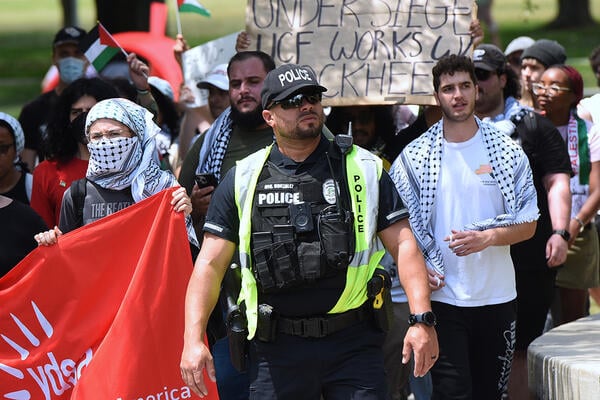
    At least 10 Florida public universities have struck agreements with the federal government authorizing campus police to question and detain undocumented immigrants.

    Inside Higher Ed requested public records from all 12 State University System of Florida institutions related to their agreements with U.S. Immigration and Customs Enforcement. Based on the results, it is clear that at least 10 have signed deals with ICE: Florida A&M University, Florida Atlantic University, Florida Gulf Coast University, Florida International University, New College of Florida, the University of Central Florida, the University of Florida, the University of North Florida, the University of South Florida and the University of West Florida.

    Florida State University and Florida Polytechnic University are in the process of signing the paperwork, according to spokespersons at each institution.

    It is unclear whether any of the 28 members of the Florida College System, which don’t all have sworn police forces, have made similar arrangements with ICE. An FCS system spokesperson did not respond to a request for comment on whether its colleges have also entered such agreements.

    Universities across the state signed memorandums of agreement at the direction of Republican governor Ron DeSantis, who ordered law enforcement agencies to partner with ICE “to execute functions of immigration enforcement,” according to a Feb. 19 news release.

    Legal experts and Florida faculty members note that such agreements are rare and mark a shift away from the typical duties of campus police, which don’t usually include immigration enforcement. They also raised concerns about how such arrangements could create a climate of fear on campuses.

    Enforcers Seeking Partners

    The DeSantis directive came shortly after the governor tapped Larry Keefe, a former U.S. attorney for the Northern District of Florida, to serve as executive director of the nascent State Board of Immigration Enforcement, created by Florida’s Legislature. Keefe is known for helping DeSantis orchestrate flights of migrants from Texas to Massachusetts in 2022.

    Keefe was named to the role on Feb. 17. Eight days later, Jennifer Pritt, executive director of the Florida Police Chiefs Association, sent an email to multiple universities that included a template for a memorandum of agreement with ICE. “Director Keefe is seeking participation from as many municipalities as possible, as soon as possible,” Pritt wrote.

    Most universities, however, offered limited statements about their agreements with ICE. A Florida Board of Governors spokesperson also provided few details.

    “Several police departments at universities within the State University System of Florida are partnering with U.S. Immigration and Customs Enforcement,” Cassandra Edwards, director of public affairs for FLBOG, wrote by email. “We do not maintain these records and recommend contacting individual universities for specific information about the partnerships.”

    Public records show that Florida Poly was hesitant to sign on, apparently due to guidance by Polk County sheriff Grady Judd, who is also on the State Board of Immigration Enforcement.

    “He wants us to hold off and not sign because he’s going to be handling all from Polk and not wants [sic] us to be involved as of now,” Florida Poly police chief Rick Holland wrote in a March 25 email response to questions from administrators at other universities about the agreements.

    Though Florida Poly noted it is still in the consideration process, emails obtained by Inside Higher Ed show another message from Holland indicating that Florida Poly appears willing to sign.

    “Can you send me a signed copy of your MOU as a template to where I need to sign?” Holland wrote in an April 3 email sent to Jennifer Coley, the chief of police at New College of Florida.

    (Florida Poly confirmed after publication that it planned to sign the paperwork Wednesday.)

    The Agreements

    Memorandums of agreement reviewed by Inside Higher Ed show that universities that entered arrangements with ICE will grant their police the authority to perform tasks typically reserved for government officials, such as questioning, arresting and preparing charges for individuals on campus suspected of immigration violations.

    Campus police will be required to undergo mandatory training “on relevant administrative, legal, and operational issues tailored to the immigration enforcement functions to be performed,” according to copies of agreements between universities and ICE reviewed by Inside Higher Ed.

    Universities that signed agreements did not provide a timeline for when the training might begin.

    Michael Kagan, a law professor and director of the University of Nevada, Las Vegas, Immigration Clinic, said such agreements are uncommon at universities, noting that he is unaware of any others. He said they are essentially “force multipliers for ICE that deputize local police agencies to do the work that ICE would normally do itself.”

    Jennifer Chacón, a professor at Stanford Law School, also said that she had not heard of prior agreements between campus police and ICE. Chacón noted that 287(g) agreements, introduced in 1996 to delegate immigration enforcement powers to other law enforcement agencies, have ebbed and flowed over the years, rising under Republican presidents and falling under their Democratic counterparts. Under President Donald Trump, who has made a crackdown on immigration a central part of his policy agenda, such agreements are proliferating.

    “Over the last three months, we’ve seen an explosion in 287(g) agreements under Trump,” Chacón said.

    ‘Designed to Increase Fear’

    Faculty and legal scholars are skeptical and concerned about campus agreements with ICE.

    In a statement to Inside Higher Ed, the Florida International chapter of United Faculty of Florida called for the university to immediately withdraw from the program, which it condemned.

    “We affirm that every member of our university community has a basic right to feel safe on campus—free from profiling, surveillance, and fear of deportation,” members wrote. “FIU’s latest act of anticipatory obedience undermines the rights of our community and jeopardizes the opportunity for all students and faculty to learn from and engage with their non-citizen peers. FIU’s haste to comply with ICE is in direct conflict with its stated vision. These actions distract from our educational mission and erode the inclusive environment FIU claims to foster.”

    The statement added the student body is “majority Hispanic, heavily immigrant, and home to nearly 600 students protected by the Deferred Action for Childhood Arrivals (DACA) program,” calling the agreement a betrayal of FIU’s legacy as a prominent Hispanic-serving institution.

    Faculty at FIU also wrote that they were “equally alarmed to hear about the termination of the F-1 visa status of 18 FIU students.” (As of Tuesday evening, at least 1,234 students at 209 colleges have had their visas revoked, in some cases for participating in campus protests but often for unclear reasons.)

    Legal scholars shared faculty members’ concerns about the fallout of such agreements.

    “It seems like this is designed to increase fear. And whether that’s by design or not, it is likely to increase racial profiling on campus, and it is not at all an effective way to police immigration,” Chacón said.

    Kagan said he would be unsurprised to see similar agreements at universities in other red states.

    “I think that it will accentuate the extremes in terms of how different university systems react to the reality that immigrants are part of their campus life,” he said. “You have one extreme, where Florida is saying, ‘Let’s hunt them down with our own police,’ while you have other university systems that have started programs to be more welcoming to undocumented students.”

    Editor’s note: This article has been updated to reflect that Florida Poly plans to sign an agreement with ICE on Wednesday.

    Source link

  • University of Florida Signs Agreement With ICE

    University of Florida Signs Agreement With ICE

    The University of Florida has signed an agreement to partner with U.S. Immigration and Customs Enforcement to help crack down on undocumented students, according to The Independent Florida Alligator, a student publication.

    The Florida Phoenix confirmed the report with a UF spokesperson, who said the university had agreed to deputize campus police as immigration officers but did not provide more details.

    The news broke the day after UF students held a rally on campus to protest the arrest and self-deportation of a Colombian student whom ICE agents stopped in late March for driving with an expired registration.

    UF is not the first institution in the state to commit to working with ICE; Florida Atlantic University signed a similar agreement earlier this month.

    Source link

  • ICE Detains U of Alabama Doctoral Student, Iran Native

    ICE Detains U of Alabama Doctoral Student, Iran Native

    Immigration and Customs Enforcement has detained a University of Alabama doctoral student and Iranian native. A spokesperson told Inside Higher Ed in an email that the student “posed significant national security concerns” but didn’t clarify what those concerns were.

    The Crimson White student newspaper and other media previously identified the student as Alireza Doroudi. As of Thursday evening, the ICE website listed Doroudi as in ICE custody but didn’t note where he was.

    “ICE HSI [Homeland Security Investigations] made this arrest in accordance with the State Department’s revocation of Doroudi’s student visa,” a Department of Homeland Security spokesperson said in an email to Inside Higher Ed Thursday. The department, which includes ICE, didn’t provide an interview.

    It’s unclear whether the detention is part of the Trump administration’s targeting of international students for alleged participation in pro-Palestinian protests, with immigration officers raiding their dorm rooms and revoking their visas.

    The Crimson White said Doroudi was “reportedly arrested by ICE officers” at his home around 5 a.m. Tuesday. A statement from the university said the student, whom the university didn’t name, was detained off campus. The Crimson White also reported that—according to a message in a group chat including Iranian students—Doroudi’s visa was revoked six months after he came to the U.S., but the university’s International Student and Scholar Services arm said he could stay in the country as long as he maintained his student status.

    The university didn’t provide Inside Higher Ed an interview Thursday or answer multiple written questions. Its emailed statement said, “Federal privacy laws limit what can be shared about an individual student.”

    “International students studying at the University are valued members of the campus community, and International Student and Scholar Services is available to assist international students who have questions,” the statement said. “UA has and will continue to follow all immigration laws and cooperate with federal authorities.”

    Source link

  • Lawyer for Columbia University student detained by ICE for pro-Palestine protests speaks out (ABC News)

    Lawyer for Columbia University student detained by ICE for pro-Palestine protests speaks out (ABC News)

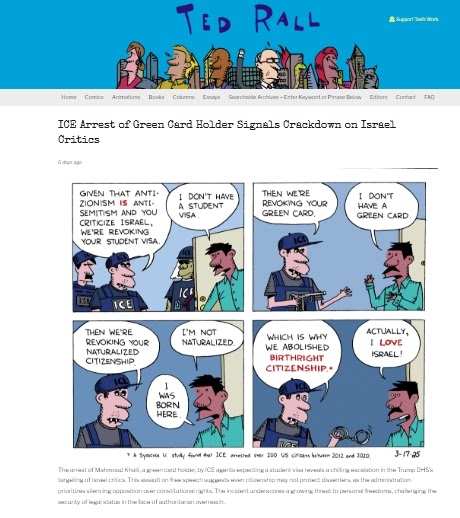
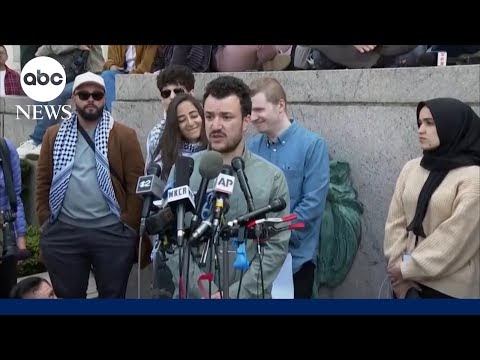
    ABC News’ Linsey Davis speaks with Baher Azmy, the lawyer for Columbia University student Mahmoud Khalil, who was arrested by Immigration and Customs Enforcement (ICE) despite having a green card. Khalil is currently detained in a Department of Homeland Security (DHS) facility in Jena, Louisiana.  A judge has temporarily blocked Khalil’s deportation. President Trump says that this action is just the beginning of such actions by the government.  

    A petition to release Mahmoud Khalil from DHS detention is here

    Source link

  • Denver Public Schools sues over Trump policy allowing on-campus ICE raids

    Denver Public Schools sues over Trump policy allowing on-campus ICE raids

    This audio is auto-generated. Please let us know if you have feedback.

    Dive Brief:

    • Denver Public Schools has issued the latest salvo in the battle over the Trump administration’s controversial new policy allowing immigration raids on school grounds with a lawsuit filed Wednesday in federal court. 
    • In Denver Public Schools v. Noem — believed to be the first lawsuit against the policy from a school system — the district seeks to undo the Trump administration’s Jan. 21 decision to allow immigration enforcement actions at “sensitive” locations such as schools, places where children gather, medical facilities and places of worship.
    • In the interim, Denver Public Schools is asking for a temporary restraining order to prohibit U.S. Immigration and Customs Enforcement and Customs and Border Protection enforcement of the policy.

    Dive Insight:

    The new Trump policy lifted the practice of avoiding immigration enforcement activities at places where students gather. Versions of the protected areas guidance have been in place for more than 30 years, according to the Denver system’s 25-page lawsuit, which was filed in the U.S. District Court for the District of Colorado.

    According to the lawsuit, school attendance has dropped “noticeably” across all schools in the Denver district — and particularly in schools with “new-to-country families and where ICE raids have already occurred” — since announcement of the new policy.

    The suit alleges that the policy is hurting the district’s ability to provide education and life services to children who aren’t attending school out of fear of immigration enforcement action. Colorado’s largest district, Denver Public Schools enrolls more than 90,000 students across 207 schools.

    In rescinding 2021 Biden administration language on the topic, the U.S. Department of Homeland Security said in a press release that the reversal would empower Customs and Border Patrol and Immigration and Customs Enforcement agents to enforce immigration laws and catch criminals who are in the country illegally.

    “Criminals will no longer be able to hide in America’s schools and churches to avoid arrest,” the statement read. “The Trump Administration will not tie the hands of our brave law enforcement, and instead trusts them to use common sense.”

    In its lawsuit, however, Denver Public Schools alleges that the new policy “gives federal agents virtually unchecked authority to enforce immigration laws in formerly protected areas, including schools. As reported to the public, the sole restraint on agents is that they use their own subjective ‘common sense’ to determine whether to carry out enforcement activities at formally safeguarded locations such as schools.”

    The lawsuit further claims that the DHS directive has not been backed up with formal written guidance and seeks for such a policy to be made “available for public inspection.”

    In a Thursday statement to CBS News Colorado, Tricia McLaughlin, assistant secretary of public affairs at DHS, said officers “would need secondary supervisor approval before any action can be taken in locations such as a church or a school. We expect these to be extremely rare.”

    The Denver Public Schools lawsuit comes the same week as a challenge filed by 27 religious groups — including the Mennonite Church, Episcopal Church and Central Conference of American Rabbis — that accuses the new immigration policy of infringing upon their congregations’ religious freedoms. Another lawsuit filed in January and led by the Philadelphia Yearly Meeting of the Religious Society of Friends, a Quaker organization, also alleges the policy infringes upon religious freedoms.

    Source link

  • ICE Gives Employers Until August 30 for In-Person Form I-9 Verification After COVID Flexibilities Expire – CUPA-HR

    ICE Gives Employers Until August 30 for In-Person Form I-9 Verification After COVID Flexibilities Expire – CUPA-HR

    by CUPA-HR | May 10, 2023

    On May 4, 2023, U.S. Immigration and Customs Enforcement (ICE) announced it will provide employers with 30 days to reach compliance with Form I-9 requirements after the COVID-19 flexibilities sunset on July 31, 2023. Employers will now have until August 30, 2023, to complete all required physical inspections of identity and employment-eligibility documents. This extension aims to ease the transition for employers who have been using the temporary flexibilities throughout the pandemic.

    Background 

    In March 2020, ICE introduced the temporary flexibilities in response to the COVID-19 pandemic, allowing employers to review employees’ identity and employment authorization documents remotely, rather than in person. This virtual inspection was to be followed by a physical examination within three business days after normal operations resumed. The flexibilities were extended several times, with the most recent extension set to expire on July 31, 2023.

    During the pandemic, employers with employees taking physical-proximity precautions were allowed to temporarily defer physical examination of employees’ identity and employment authorization documents. Remote examination methods, such as video link, fax or email, were permitted, with “COVID-19” entered as the reason for the physical-examination delay in the Section 2 Additional Information field on the Form I-9. Once the employees’ documents were physically examined, employers would add “documents physically examined” with the date of examination to Section 2 or Section 3 of the Form I-9, as appropriate.

    The recent announcement clarifies that employers have until August 30, 2023, to perform all required physical examinations of identity and employment-eligibility documents for individuals hired on or after March 20, 2020, who have received only a virtual or remote examination under the flexibilities.

    What’s Next 

    On August 18, 2022, ICE issued a proposed rule to allow alternative procedures for examining identity and employment-eligibility documents. CUPA-HR submitted comments to ICE encouraging it to move forward expediently and ensure that a remote review process remains available for all employers. The public comment period closed on October 17, 2022, and DHS is currently reviewing the comments. While the Fall 2022 Regulatory Agenda had forecast a final rule to be issued in May 2023, ICE’s announcement indicates a final rule will be issued later this year.


    Source link