I’ve been very lucky to have been part of many different EdTech Communities over the years. From my time spent with amazing educators at Adobe, Google, Raspberry Pi, Sphero, TED-Ed, and my first EdTech Community, Evernote, I’ve loved how you get what you put into a community. It can be what you need it to be when you want it to be. I’ve taken all of these experiences I use them to help me craft the community experience for educators in the SchoolAI Community.
One of the things I have loved from the different communities was the effort to give the community members a platform to share their story. There is so much we can all learn from each other, but educators are not always given the chance to share or they do not have the ability to attend a conference and share their story. Sometimes the keynote circuit is the same few names and it can be tough to break into those conversations. That’s why I have started the SchoolAI Lightning Talks.
Open to any educator who has an idea worth sharing, I want to give as many educators as possible a chance to share something that matters to them. You can find all of the details here and the submission page here. Do not let “I’m sure everyone already knows this.” or “It probably doesn’t make that big of a difference.” stop you from sharing. Do not let the imposter syndrome take over and prevent you from sharing your idea. If you have any questions, feel free to send me an email at [email protected] or find me on my socials. @TheNerdyTeacher
This is part one of a two-part series on the 50th anniversary of the Individuals with Disabilities Education Act. For part two, click here.
When Antoinette Banks’ daughter, Nevaeh, was diagnosed with intellectual disabilities in 2011, Banks was told her 5-year-old daughter would have a 0% chance of living independently as an adult.
“What I’m hearing is that my kid doesn’t have a future,” Banks says. “It broke me for a little bit.”
To fill in all the unanswered questions she had about her daughter’s future, Banks began trying to better understand the special education system she and her daughter were now a part of.
Just understanding all the processes and paperwork — individualized education programs, evaluations, assessments, procedural notices and more — got “super confusing sometimes,” says Banks, who lives in Sacramento, California.
Even after she filed all the special education documents in a three-ring binder, Banks still struggled to organize documents critical for monitoring the interventions provided by multiple teachers and therapists, as well as for tracking information from doctors and diagnosticians.
She created what she called an online “spreadsheet on steroids” to share with her daughter’s support teams. As she improved her homemade tool, she began sharing the template with other families in similar situations.
Antoinette Banks (right) stands with her daughter Nevaeh in northern California in spring 2025.
Permission granted by Lana Andruh
That prototype evolved into Expert IEP, a platform that’s now powered by artificial intelligence to help families, school districts, therapists and doctors collaborate on services for children with disabilities, Banks says.
“I thought that if I could get everyone to just communicate with one another and not be so siloed and not telling me what they think, but what does the data say about my daughter, then maybe we can get focused on what she actually needs in her learning environment,” Banks says.
Fast forward to today: Banks’ daughter is 19 years old and graduated in June from a public California high school with a general education diploma. Nevaeh is now studying biological systems engineering at a northern California college and wants to become a nanotechnologist, according to her mother.
“I feel so very, very blessed to have been able to be on this wild roller coaster ride with my daughter and continue to advocate and refine, because anything is possible,” Banks says.
The tool Banks created — which she said was born out of both frustration and necessity — is but one example of the many tools and techniques developed over the past five decades to support students with disabilities and their families and teachers.
On Nov. 29, the landmark Individuals with Disabilities Education Act turns 50. President Gerald Ford signed the legislation, originally known as the Education for All Handicapped Children Act, guaranteeing students with disabilities the right to a free and appropriate public education. Before then, no federal requirement existed that schools must educate students with disabilities.
In addition to opening public schools to a whole population of children, the law became the catalyst for legions of innovative practices and tools cultivated from both public and private sources. The transformations, special education experts say, were spurred by an ongoing need to individualize student supports while helping children with disabilities progress in general education classrooms.
IDEA eligibility grows over 5 decades
Since the Individuals with Disabilities Education Act was enacted, the portion of all public school students qualifying for special education services almost doubled.
Many of these practices and technologies — such as universal design for learning, assistive technology, and positive behavioral interventions and supports — would not only be proven to help students with disabilities, but also to benefit their peers without disabilities.
Innovative and proven practices that are effective for a student with disabilities are “going to work with a student without disabilities,” says Lindsay Kubatzky, director of policy and advocacy for the National Center for Learning Disabilities.
To mark IDEA’s 50th anniversary, K-12 Dive spoke with special education experts about approaches, practices and technologies that have revolutionized how students with disabilities are supported — and how these innovations keep evolving.
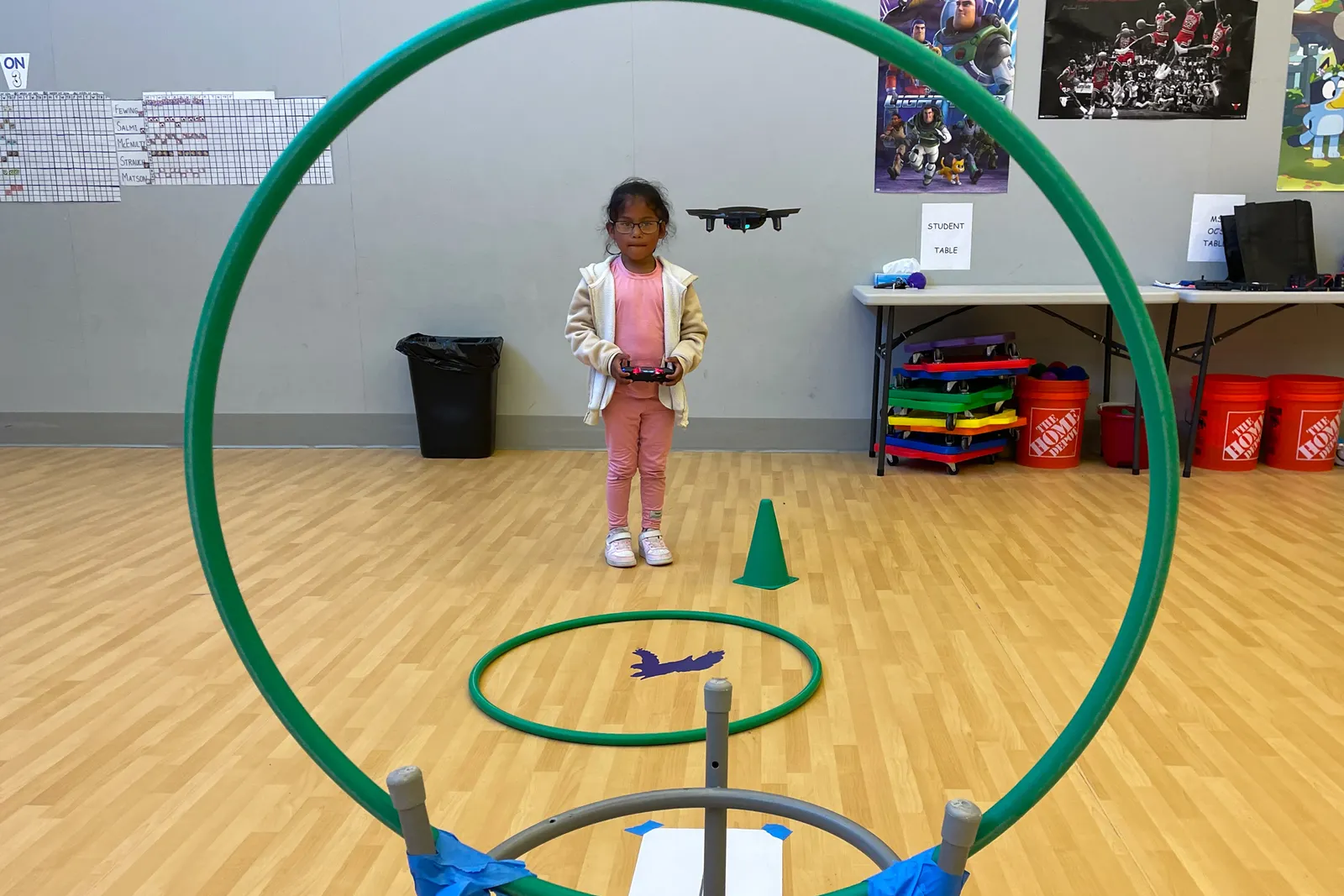
In rural Oregon, K-2 students at Warrenton Grade School take part in the CAST Take Flight drone curriculum in October 2025, showcasing how universal design for learning principles enable meaningful STEM learning for even the youngest learners.
Permission granted by Carolyn Peterson
Eliminating learning barriers with UDL
Delana Robles spends her day problem solving. As the universal design for learning resource teacher in New Mexico’s Albuquerque Public Schools, Robles helps teachers make learning accessible for students who have dyslexia, hearing or vision impairments, learning disabilities or other conditions.
“UDL is a way to include every student in the classroom by looking at who they are as a learner and as a person, versus seeing them as someone with a deficit,” Robles says. If educators understand each student’s strengths and needs and how to support them, “education will improve across the board,” she says.
The UDL framework can be applied across all ages and learning environments to reduce instructional barriers through classroom design, assistive technology and engaging teaching and learning practices. These could include using text-to-speech features or large fonts, or allowing students to choose how they demonstrate their knowledge by writing a report, creating a slideshow or performing a skit, for example.
UDL got its start in 1984 when neuroscience researchers were looking for ways computers — which were just becoming more widely used for personal and professional use — could improve learning for students with disabilities. A group of five clinicians from North Shore Children’s Hospital in Salem, Massachusetts, formed the nonprofit Center for Applied Special Technology.
Lindsay Jones is the CEO of CAST.
Permission granted by Lindsay Jones
Lindsay Jones, CEO of CAST and former president and CEO of the National Center for Learning Disabilities, says one of the biggest developments in special education over the past 50 years has been the acceptance of learner variability — the idea that each student processes and demonstrates learning differently. UDL, Jones says, helps schools use technology, classroom designs and instructional practices to make learning more effective and inclusive for each student.
Jones calls UDL “future proof,” meaning demand will only grow to customize learning so as to propel student understanding, engagement and agency. “I think it’s exciting that special education has driven a lot of the research that’s impacted all of education,” she says.
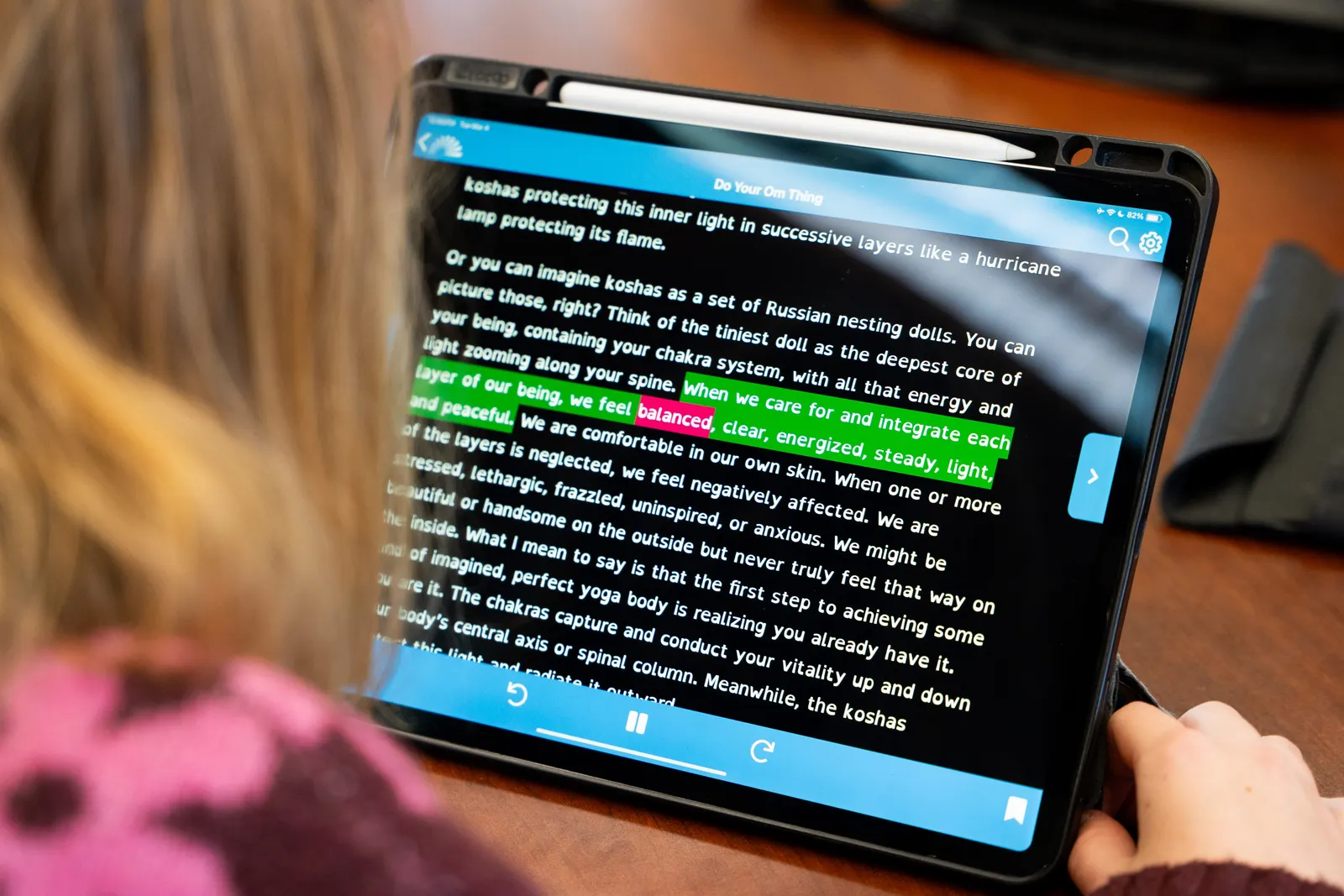
A student from the California School for the Blind in Fremont, Calif., reads a book using Bookshare’s accessibility features on March 4, 2025.
Permission granted by Erick Salazar
Making reading accessible through Bookshare
Obtaining books in accessible formats for students who have low vision or are blind used to be a slow and laborious process. Schools typically had to manually request large-print or Braille editions that could take weeks or months to arrive.
In some cases, schools could track down the limited number of large-print or Braille copies that existed. Schools in rural areas faced even greater barriers to obtaining accessible books, according to historical accounts. And when obtained, these books were big and heavy for students to carry around.
Schools also relied on staff or volunteers to make audio recordings of entire books — another time-consuming process.
All this meant that students rarely got the accessible content in time to participate in learning along with their peers, and that delay impacted their learning outcomes.
But as technology evolved, and as the 1997 reauthorization of IDEA required schools to consider assistive technology for every student with disabilities, schools became more equipped to serve students who had difficulty processing or comprehending printed words.
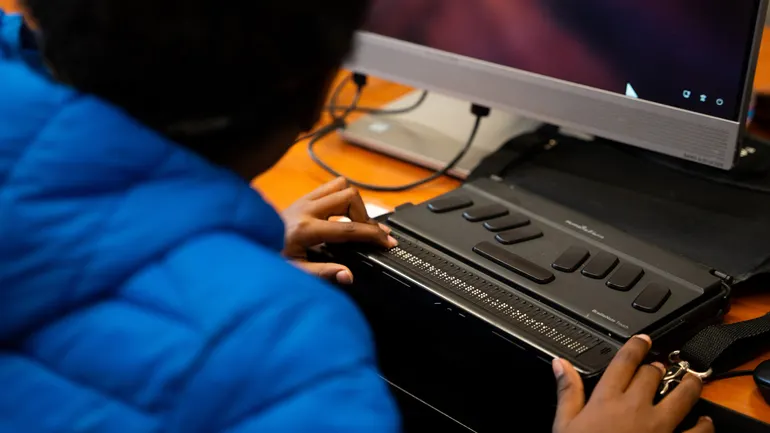
One tool that opened access to learning for students with disabilities is Bookshare. The free repository of titles allows students to customize how they see or hear text on a screen and to physically manage how to flip pages on reading devices.
It’s the world’s largest library of audio and ebooks — with 1.4 million titles, according to the organization. And access is free for qualifying U.S. students in public, private and home schooling because it is supported through grants from the U.S. Department of Education’s Office of Special Education Programs. In fiscal year 2025, OSEP awarded $9 million to Bookshare.
Part of Benetech, a nonprofit software organization focused on improving accessibility, Bookshare is the largest distributor of accessible textbooks in America. It operates through the National Instructional Materials Access Center, a federally funded, searchable online repository of source files for K-12 instructional materials that was created through the 2004 reauthorization of IDEA.
For schools, this means educators can request an accessible book for anyone from an early elementary school student who is struggling with decoding, to a high schooler who is blind and studying for Advanced Placement exams. Bookshare is also free for qualifying students in postsecondary, graduate, vocational and continuing education classes.
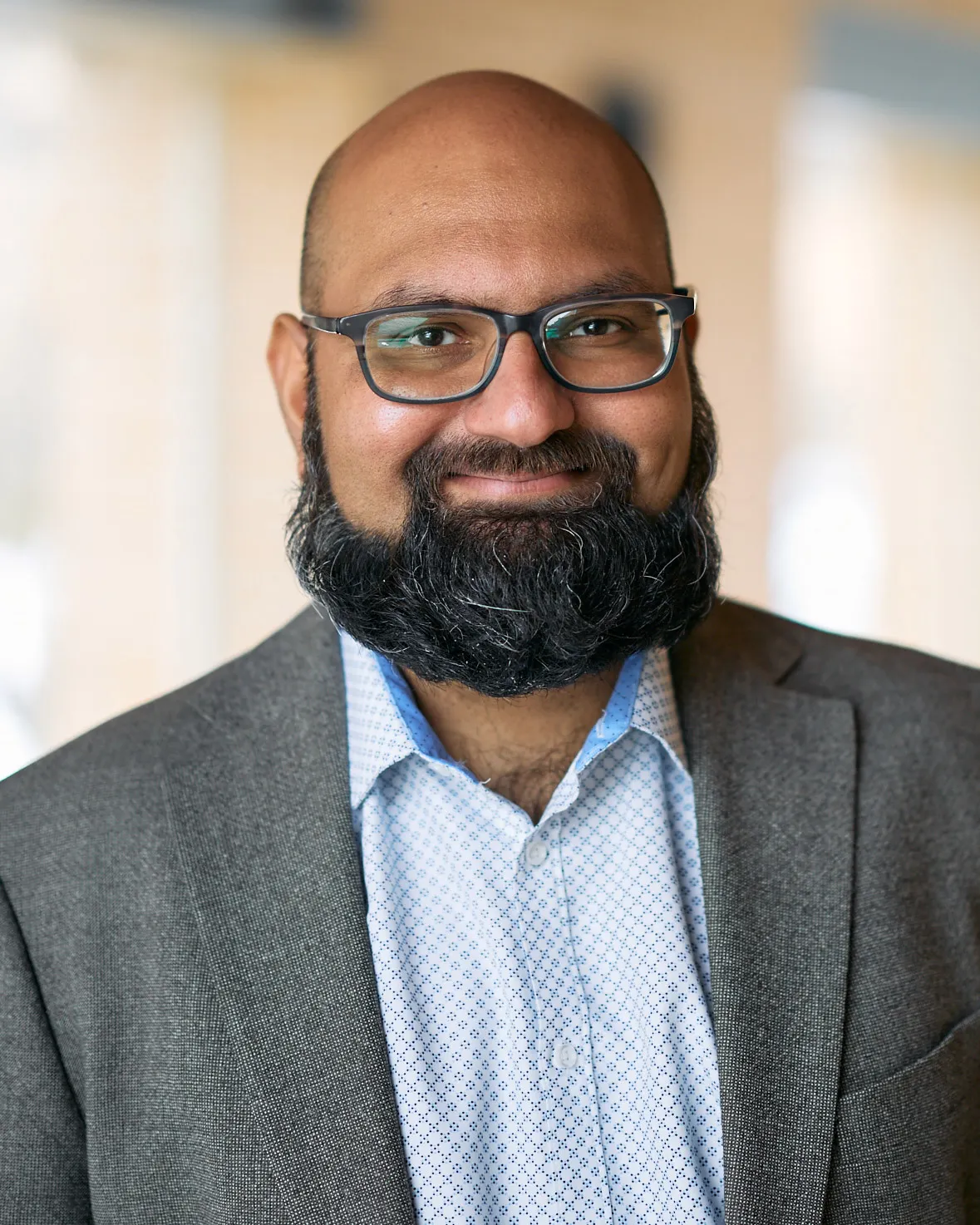
Ayan Kishore, Benetech CEO, says giving pre-K-12 students access to Bookshare materials helps put them on a pathway for postsecondary success and beyond.
Ayan Kishore is CEO of Benetech.
Permission granted by Benetech
“Bookshare started because we zoomed into a huge challenge. There are many challenges, but one challenge is accessibility,” he says. “The books that are used in a classroom are just simply not accessible for someone who is blind or dyslexic or has other sorts of disabilities.”
Guidance issued by the Education Department in January 2024 urges schools to consider an array of assistive technologies for students with disabilities. These include text-to-speech software, word prediction devices to help with writing and communication, augmentative and alternative communication devices, and visual schedules and timers. Low tech tools, such as pencil grips and modified scissors are also encouraged to remove barriers to learning.
I think it’s exciting that special education has driven a lot of the research that’s impacted all of education.
Lindsay Jones
CEO of CAST
Rebecca Thomas, a coach at New Mexico UDL, a state-funded grant program, helps teachers remove barriers to learning. Bookshare, assistive technology and UDL approaches are helping drive student engagement and close learning gaps through accessible tools, she says.
Supporting teachers in their jobs is also core to New Mexico UDL’s mission. “We love finding new tools that will help take things off teachers’ plates,” Thomas says.
Kishore says Bookshare keeps evolving. Several years ago that meant adding accessible STEM content. Now in development is Bookshare Plus, which aims to use AI to make any educational content — such as classroom handouts and worksheets — accessible.
Nonetheless, the future of Bookshare, which is celebrating its 25th anniversary this year, is tenuous. President Donald Trump’s FY 2026 request would cut all funding for the Education Department’s Education Technology, Media, and Materials for Individuals with Disabilities program under IDEA, which provides accessibility technology and services for students with disabilities. Rather, the proposed budget recommends states use Part B grants to set their own priorities for special education spending.
Earlier this month, after a prolonged federal government budget impasse and shutdown, Congress agreed to a continuing resolution to fund the Education Department through Jan. 30, 2026, at fiscal year 2025 funding levels.
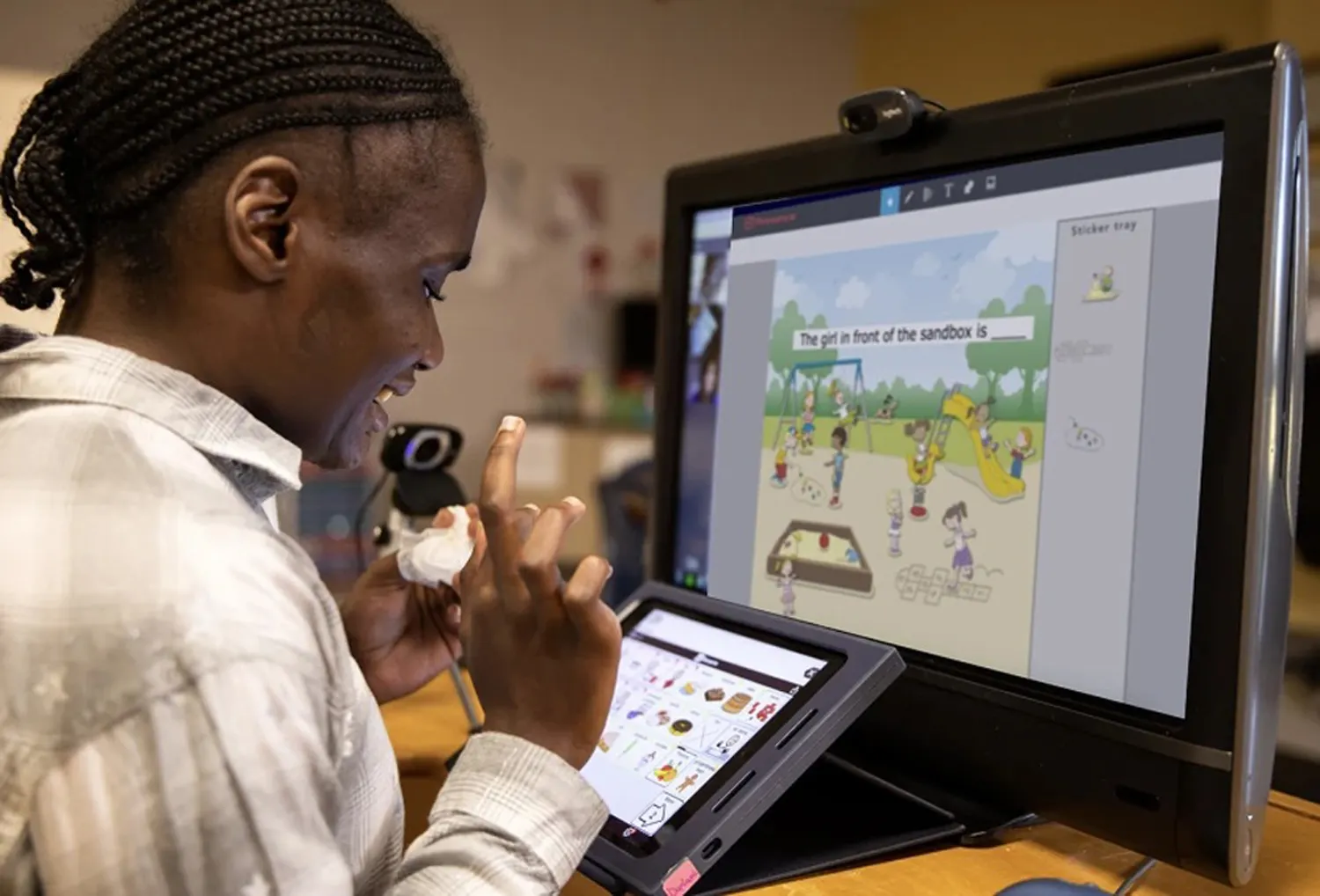
A student at Kershaw County School in South Carolina uses an augmentative and alternative communication device during teletherapy speech and language intervention in 2020.
Permission granted by Kathryn Boyd-Batstone
Addressing student needs through teletherapy
When Missouri’s Carthage Intermediate Center’s only speech-language pathologist moved away in 2023, the grade 4-5 school in the Carthage R-9 School District struggled to find a replacement who could support students whose IEPs required speech and language interventions.
Then, the next year, the center’s two feeder elementary schools lost their speech-language pathologists, too. The void — which couldn’t easily be filled because of a shortage of these specialists in the area — led the three schools to use teletherapy to supplement their services, says Susan Hatcher, assistant principal of Carthage Intermediate Center.
During online asynchronous sessions, a remote speech-language pathologist works 1-to-1 or with small groups of students on their communication skills while an in-person paraprofessional keeps them on task.
“We’ve got lots of examples of where kids have just really done well with this particular service and have really made some great growth,” says Hatcher.
Teletherapy, which began in the medical field, has allowed school districts, particularly in rural areas, to provide student services in the face of significant shortages of special education and related service providers.
Exact numbers are difficult to pin down on how many schools or students are taking this route. But several teletherapy platforms, including Presence, eLuma and Parallel Learning are working directly with school districts.
Presence alone has delivered more than 7 million teletherapy sessions to partner schools since its founding in 2009, according to the company. The company works with about 10,000 public, charter, private and virtual schools.
Bonnie Contreras, senior director of clinical solution engineering at Presence and a former school counselor, says that while the vast majority of students do well with the virtual interaction, it is not a replacement for special education teachers and other in-person experts.
“At the end of the day, the goal is for the student to really thrive with the resources that they need to do their best,” she says.
Hatcher says the district “would have been holding out hope” to attract and hire a qualified speech-language expert. The schools might have been able to partner with neighboring districts to share a provider, she says. But in the worst case scenario, a lack of available services would have required the schools to provide compensatory services or additional interventions, which can be costly, she adds.
While more in-person speech-language pathologists would be ideal, teletherapy allows the flexibility and customization to provide services to students when and how they need them, Hatcher says. In the end, these services are “very individualized, which, of course, is very much the spirit of IDEA.”
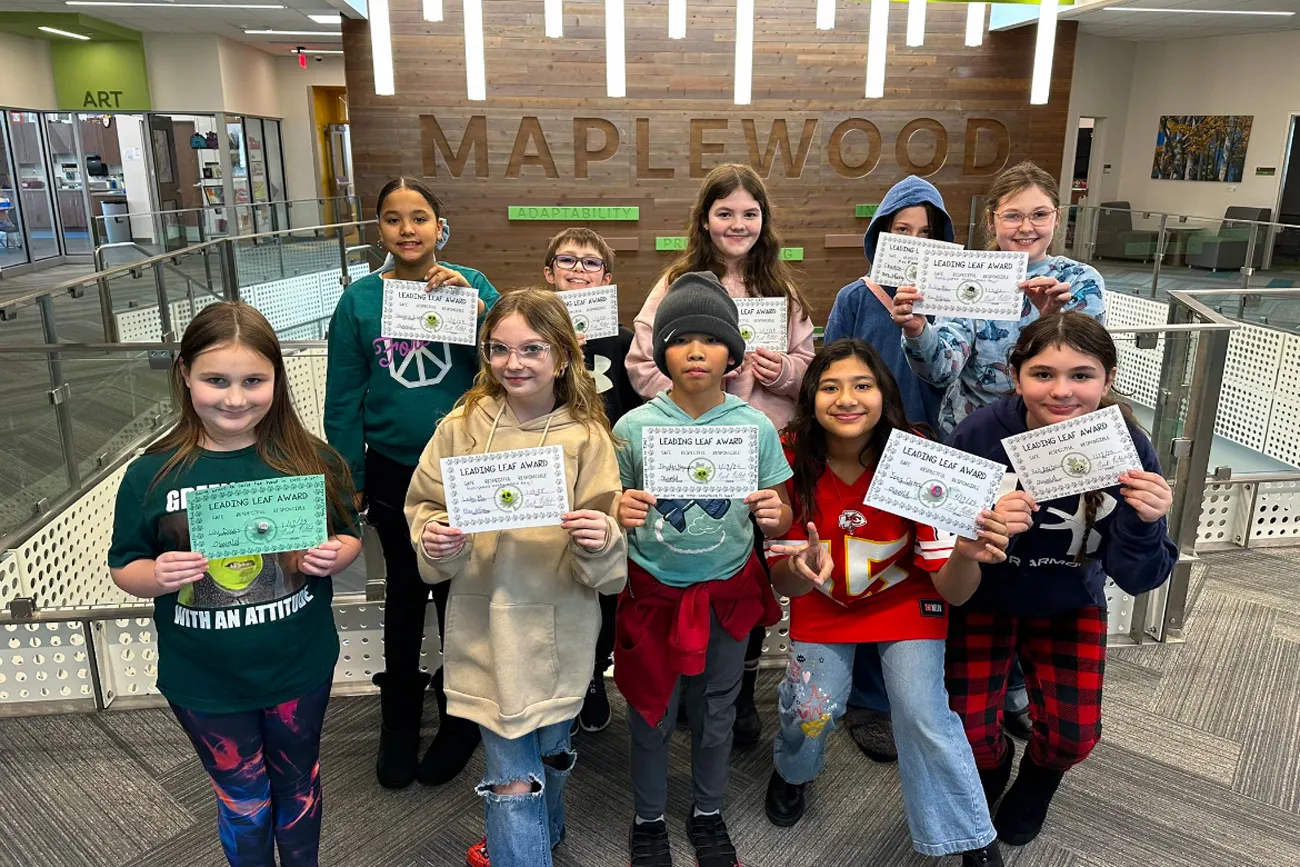
Students from Maplewood Elementary, in Maplewood, Mo., are being recognized in April 2025, for meeting school expectations — Safe, Respectful, and Responsible — that school staff have taught and practiced with the students through their school-wide PBIS program.
Permission granted by Maplewood Elementary School
Supporting learning through PBIS
Would you punish a student for failing a math test?
That’s the question Timothy Lewis asks people when he explains how positive behavioral interventions and supports in a school can be just as vital as academic interventions and supports.
If a student failed a math test, educators might review the material, organize learning supports and monitor the student’s progress, Lewis says. But when he began working with students and young adults with challenging behaviors as a special educator in the 1980s, the common approach was to discipline students for disruptive behaviors.
Lewis, director of the University of Missouri Center for School-wide Positive Behavior Support and a professor of special education, wanted to find a way to avoid punitive approaches and increase students’ academic performances by teaching appropriate and expected behaviors.
“Here’s the key about behavior,” Lewis says. “Behavior is functionally related to the teaching environment, meaning kids do behaviors because they can predict outcomes. And if you’re a really good teacher, you set up your environment to increase the likelihood kids learn.”
Timothy Lewis is the director of the University of Missouri Center for School-wide Positive Behavior Support.
Positive behavioral interventions and supports got their origins in the late 1980s from researchers like Lewis, along with George Sugai, Robert Horner and others at the University of Oregon. Their work on PBIS evolved from research on improving student behavior supports not just for individual students, but for entire classrooms and schools.
PBIS is built on a multi-tiered system of supports where all students gain an understanding of classroom and school expectations and appropriate social, emotional, and behavioral skills. Interventions intensify for the students who need more individualized supports.
Nearly 27,800 schools in the U.S. used PBIS in 2024, according to the Center on PBIS, a technical assistance center that began in 1998 and is funded through federal grants from OSEP and the Office of Elementary and Secondary Education.
PBIS practices contributed to improved attendance, teacher retention, and English and math achievement, along with reduced substance abuse and bullying, according to various research.
For instance, students with and without disabilities attending Missouri schools with universal PBIS showed better attendance, and students with disabilities spent more time in a general education classroom, than students at schools without PBIS, according to a report from the 2022-23 school year published by the Missouri Schoolwide Positive Behavior Support team. Moreover, schools with high levels of PBIS implementation over time showed more positive outcomes for both students with and without disabilities.
PBIS can also lead to cost savings. For every dollar spent on implementing PBIS schoolwide, about $105 is saved through decreased suspensions that also reduce dropout rates, according to a 2017 report published by the federal PBIS technical assistance center.
“PBIS is probably the most researched and has probably some of the best gold standard research to show its effectiveness of anything out there, and OSEP supported that,” says Larry Wexler, a longtime former director of research to practice at OSEP.
Lewis says the PBIS work, through the national center and statewide programs, keeps evolving. The PBIS framework in schools has been used to address school crisis situations, opioid addiction, mental well-being and other challenges. In terms of scope, it has been implemented in everything from a one-room K-12 school to large urban schools, he says.
“No one in education can make kids behave, nor can we make them learn. It’s all about building an environment to increase the likelihood” of learning for students with and without disabilities, Lewis says.
Visuals Editor Shaun Lucas contributed photo support to this story.
Just before the excitement of conference season, your local Facebook group lost its collective mind. And it shows no sign of calming down.
Given everything else that is going on, you’d think that reinforcing the joins between key government data sources and giving more visibility to the subjects of public data would be the kind of nerdy thing that the likes of me write about.
But no. Somebody used the secret code word. ID Cards.
Who is she and what is she to you?
I’ve written before about the problems our government faces in reliably identifying people. Any entitlement– or permission– based system needs a clear and unambiguous way of assuring the state that a person is indeed who they claim they are, and have the attributes or documentation they claim to.
As a nation, we are astonishingly bad at this. Any moderately serious interaction with the state requires a parade of paperwork – your passport, driving license, birth certificate, bank statement, bank card, degree certificate, and two recent utility bills showing your name and address. Just witness the furore over voter ID – to be clear a pointless idea aimed at solving a problem that the UK has never faced – and the wild collection of things that you might be allowed to pull out of your voting day pocket that do not include a student ID.
We are not immune from this problem in higher education. I’ve been asking for years why you need to apply to a university via UCAS, and apply for funding via the Student Loans Company, via two different systems. It’s then never been clear to me why you then need to submit largely similar information to your university when you enroll.
Sun sign
Given that organs of the state have this amount of your personal information, it is then alarming that the only way it can work out what you earn after graduating is by either asking you directly (Graduate Outcomes) or by seeing if anyone with your name, domicile, and date of birth turns up in the Inland Revenue database.
That latter one – administrative matching – is illustrative of the government’s current approach to identity. If it can find enough likely matches of personal information in multiple government databases it can decide (with a high degree of confidence) that records refer to the same person.
That’s how they make LEO data. They look for National Insurance Number (NINO), forename, surname, date of birth, postcode, and sex in both HESA student records and the Department for Work and Pension’s Customer Information System (which itself links to the tax database). Keen Wonkhe readers will have spotted that NINO isn’t returned to HESA – to get this they use “fuzzy matching” with personal data from the Student Loans Company, which does. The surname thing is even wilder – they use a sound-based algorithm (SOUNDEX) to allow for flexibility on spellings.
This kind of nonsense actually has a match rate of more than 90 per cent (though this is lower for ethnically Chinese graduates because sometimes forenames and surnames can switch depending on the cultural knowledge of whoever prepared the data).
It’s impressive as a piece of data engineering. But given that all of this information was collected and stored by arms of the same government it is really quite poor.
The tale of the student ID
Another higher education example. If you were ever a student you had a student ID. It was printed on your student card, and may have turned up on various official documents too. Perhaps you imagined that every student in the UK had a student number, and that there was some kind of logic to the way that they were created, and that there was a canonical national list. You would be wrong.
Back in the day, this would have been a HESA ID, itself created from your UCAS number and your year of entry (or your year of entry, HESA provider ID, and an internal reference number if you applied directly). Until just a few years ago, the non-UCAS alternative was in use for all students – even including the use of the old HESA provider ID rather than the more commonly used UKPRN. Why the move away from UCAS – well, UCAS had changed how they did identifiers and HESA’s systems couldn’t cope.
You’re expecting me to say that things are far more sensible now, but no. They are not. HESA has finally fixed the UKPRN issue within a new student ID field (SID). This otherwise replicates the old system but with one important difference: it is not persistent.
Under the old approach, the idea was you had one student number for life – if you did an undergraduate degree at Liverpool, a masters at Manchester Met, and a PhD at Royal Holloway these were all mapped to the same ID. There was even a lookup service for new providers if the student didn’t have their old number. I probably don’t even need to tell you why this is a good idea if you are interested – in policy terms – in the paths that students within their career in higher education. These days we just administratively match if we need to. Or – as in LEO – assume that the last thing a student studied was the key to or cause of their glittering or otherwise career.
The case of the LLE
Now I hear what you might be thinking. These are pretty terrible examples, but they are just bodges – workarounds for bad decisions made in the distant past. But we have the chance to get it right in the next couple of years.
The design of the Lifelong Learning Entitlement means that the government needs tight and reliable information about who does what bit of learning in order that funds can be appropriately allocated. So you’d think that there would be a rock-solid, portable, unique learner number underpinning everything.
There is not. Instead, we appear to be standardising on the Student Loans Company customer reference number. This is supposed to be portable for life, but it doesn’t appear in any other sector datasets (the “student support number” is in HESA, but that is somehow different – you get two identifiers from SLC, lucky you). SLC also holds your NINO (you need one to get funding!), and has capacity to hold another additional number of an institution’s choice, but not (routinely) your HESA student ID or your UCAS identifier.
There’s also space to add a Unique Learner Number (ULN) but at this stage I’m too depressed to go into what a missed opportunity that is.
Why is standardising on a customer reference number not a good idea? Well, think of all the data SLC doesn’t hold but HESA does. Think about being able to refer easily back to a school career and forward into working life on various government data. Think about how it is HESA data and not SLC data that underpins LEO. Think about the palaver I have described above and ask yourself why you wouldn’t fix it when you had the opportunity.
Learning to love Big Brother
I’ll be frank, I’m not crazy about how much the government knows about me – but honestly compared to people like Google, Meta, or – yikes – X (formerly twitter) it doesn’t hugely worry me.
I’ve been a No2ID zealot in my past (any employee of those three companies could tell you that) but these days I am resigned to the fact that people need to know who I am, and I’d rather be more than 95 per cent confident that they could get it right.
I’m no fan of filling in forms, but I am a fan of streamlined and intelligent administration.
So why do we need ID cards? Simply because in proper countries we don’t need to go through stuff like this every time we want to know if a person that pays tax and a person that went to university are the same person. Because the current state of the art is a mess.
If you have already eaten a lot of cake another piece will make you sick. Maybe you are trying to stay healthy and sugary foods aren’t healthy. But maybe you have eaten healthy all week and deserve a treat. Or it is a new cake recipe your friend came up with. Or it’s your birthday. All those are great reasons to have that piece of cake now.
Identify a “news angle”
The achievement of your healthy diet, or the new recipe or your birthday are like news angles. They are the reason you will eat cake now. They also answer the question: What’s so special about this piece of cake?
If you think of a story topic like this cake, the angle will define which direction the topic will take.
You could tell your editor that your angle is that the carbon tax is new and experts think it might not be as effective in cutting emissions as politicians promise. Or the carbon tax is the latest in a series of taxes imposed by the government and people are so sick of taxes, they might vote in an anti-tax political party in the next election. Or maybe next week is a big anniversary for the environmental group that pushed for the tax in the first place — it’s kind of like their birthday.
If your pitch was basically, “I think the carbon tax would make a great story,” your editors would likely pass on it. But maybe these pitches would catch their attention:
A carbon tax just passed in Denmark marks a new way of lowering carbon emissions and other governments and political parties are watching to see if it works. If it doesn’t, it could set back the push for clean energy not only in Denmark, but across Europe.
The carbon tax in Denmark is a gamble on the part of the country’s environmental advocates. Increasing numbers of voters believe they are already overtaxed. If it isn’t as effective as promised it could push people to vote for conservative, anti-tax politicians.
Next month is the twentieth anniversary of Denmark’s Green Party. But amid the celebrations is some real concern. The environmental movement has placed a big bet on the new carbon tax — which has garnered significant opposition.
If it’s difficult to find an angle for your topic, start telling people around you about your topic and about what you’ve discovered through your research. What kinds of questions do they ask about it? What do they seem to be interested in? Do they ask you something that makes you think, hmm, that’s a good question! If so, then you’ve found your angle.
Narrow your focus
There might be so many angles you end up all over the place. Editors won’t okay a story that they think will come in as a confusing mess. So it is also important to narrow your focus. In telling stories we are often tempted to tell people everything, but listeners and readers have short attention spans and limited appetites. How much cake can you eat in one sitting?
So think about what you want the focus of your story to be. It’s about a carbon tax. But is your focus on the effectiveness of it in lowering emissions? In that case you want to interview climate scientists. Is the focus about the politics of the tax? Then you want to talk to political experts. Maybe the story is about the cost of the tax on the economy. Then you will want to talk to economists and everyday taxpayers.
Before pitching the story, consider the one thing the story will be about, how you will focus on it and why that is important or interesting or relevant to the audience of the publication or show.
Don’t worry that your focus is too narrow. You can use something small happening in a small place to tell a big story.
What happens in Denmark could be emblematic of what is happening elsewhere or will likely happen elsewhere. The effects of one tax in one place could help explain the challenges of funding climate solutions in general.
Identify the problem and who it affects.
The smaller the story, the easier it is for people to consume it and understand it and that is what your editors will look for in a pitch.
It is important to identify what is at stake and who will be affected by the problem at the heart of your story – the “stakeholders”. In a story about a carbon tax, are the people most affect the companies who pollute? Is it the taxpayers? Is it the environmentalists frustrated by the lack of action on climate change? Is it the politicians who risk losing the next election or the opposition candidates who might win office?
Finally, do some initial research so you can present to the editors some information that shows the importance of the story and come up with a plan for how you will report it. Before an editor okays a story they want to be confident you can actually do it.
Here is how to construct a strong pitch:
State what the problem is and why this is an important story now.: Remember to narrow your focus. Editors won’t likely okay pitches that are too vague or broad.
State how you plan to find a possible solution
State the main data and the important context – What it is that makes this story important or particularly interesting or relevant to the audience.
Who the problem affects.
The news angle: Why is it relevant now
How you plan to go about reporting the story– the data or reports you will seek the people you plan to interview.
The big question your story will answer.
Be concise
Here is the real challenge: You have to keep it all short. Your pitch needs to show your editor that you don’t waste words and that you won’t turn in a story that’s a long, tedious, confusing read. Try to keep it to less than 300 words.
Be clear. Say only what you need to say. Don’t make your pitch flowery or use exclamation points. Keep to facts and keep out assumptions or biases. Don’t try too hard to convince. If the story idea is a good one it should convince on its own.
Finally, let’s give you an example. Imagine you are my editor and I am pitching a story about how to pitch a story. Here is my pitch. It is 194 words.
Young people around the world are itching to tell stories about the problems they see around them. But they find the pitching process intimidating. They’ve got big ideas but don’t know how to come up with an idea out of those big ideas that would grab the attention of an editor. Their story pitches end up too broad, vague and with too many angles.
The result is that important stories don’t get told. I plan to talk to editors about the pitching process and identify the elements that make a strong pitch and the common problems they see in weak pitches. I will also rely on information put together by News Decoder’s Engaging Youth in Environmental Storytelling (EYES) project.
The story is timely because 19 October is World Mental Health Day and reporting and telling non-fiction stories is a great way for young people to think through the big problems they face and that they see in the world around them and to talk to experts who can help them put it all into context.
Ultimately, my story will answer this question: Why do some stories get published but other, equally important stories don’t?
You have expert insights—plenty of them. You give impromptu lectures in office hours, debate podcast guests midrun and readily join boisterous debates over dinner. Maybe you’re even drafting a book that builds a careful case from your expert point of view. But when it comes time to write your own op-ed? That sharp idea can start to feel too complex, too niche or—let’s be honest—too wordy for 800 words aimed at a general audience.
That’s not a failing; it’s a feature of your training. Academics are trained to distill ideas for their peers, not for nonspecialists. You argue carefully, if not compactly. You cite meticulously, not conversationally. But public writing demands something different—skills to illuminate complex concepts in a way that an intelligent lay reader can follow, feel and act on.
Before you spend an afternoon translating your expert insight into an 800-word article you pitch to a newspaper or magazine, run your idea through this op-ed readiness test. It won’t replace compelling writing, but it may help determine whether your idea is ready to leave the seminar room and live, persuasively, on the opinion page.
Who cares? It’s a tough question, but not a cynical one. Just because something fascinates you doesn’t mean that it matters to the broader public. That’s not a judgment of your topic. It’s a reminder to find the resonance. What’s at stake beyond your personal experience or corner of the discipline? You don’t have to write about what’s already dominating headlines. In fact, if your idea surfaces something overlooked or offers a fresh lens, it may be exactly what public discourse needs. Urgency is not always about volume; it’s often about insight.
So ask yourself: Who, beyond academia, might find your idea clarifying, challenging or useful? Who might see their own experience differently—or see someone else’s for the first time? Who, if they read what you have to say, might think differently about something that affects their life, work, vote or values? If your answer is, “Well, maybe more people should care,” you might be onto something. But part of your task is to show them why.
Why now—or why always? Editors love a good news hook. If your idea connects to a breaking story, an upcoming decision or a public debate gaining steam, then run with it. But run fast. In journalism, “timely” means submitting within hours or a day or two, not weeks. If something is happening right now and you have a fresh angle, start writing.
Of course, not every op-ed needs a news peg. If your idea speaks to an enduring question or a slow-burning issue—and does so with clarity, urgency or surprising insight—it still has a shot. Just know that in an editor’s crowded inbox, a time peg can help your piece stand out. An “evergreen” op-ed may need to work harder and land stronger to compete.
Can you make your case by paragraph two? You don’t have to dumb down your argument, but you do have to speed it up. Public readers and their editors have strong opinions about long, slow windups. Spoiler: They don’t like them.
Try writing a working headline for your piece that’s under 60 characters. Then distill your argument in one or two crisp, compelling sentences—no acronyms, no jargon and no “hence” or “thus.” (Also, no “as Foucault reminds us.”) These sentences should appear early, ideally by the end of paragraph two. At first, this mandate can feel reductive. But being concise isn’t a betrayal of complexity. It’s a tool for focus. You’re not flattening your idea; you’re making it easy to find. If your piece needs detailed footnotes or a literature review, it’s probably not (yet) an op-ed.
What’s the aha? Your op-ed should offer insight that readers haven’t already heard several times this week. If your takeaway is “what you’ve heard, but with citations,” then it may still need sharpening. Some of the best pieces offer a twist such as an unexpected data point, an odd-but-illuminating comparison or a perspective that flips conventional wisdom on its head. You’re trying to make an intelligent reader think, “I hadn’t thought of that.”
Are you writing to connect—or to impress? You’re not writing to prove you’ve done the reading; you’re writing to help someone else think differently. Your op-ed should feel like an intelligent conversation over coffee, not a cautious explanation in a lecture hall. You don’t have to be breezy or punchy (unless that’s your style), but you should sound like a real person with a distinct voice. This isn’t about being casual for its own sake. It’s about being readable.
If your draft feels like it could be suitable for peer review, try loosening the syntax. Ask yourself: How would I say this to a smart friend who doesn’t share my training? Readers want active verbs, not hedges. When you write like someone who wants to be understood—not just cited—you don’t dilute your thinking; you make it land.
Will a reader remember it tomorrow? A good op-ed doesn’t just inform, it lingers. It leaves a mark, even a small one, on a reader’s thinking. That might come from a vivid image, a well-turned phrase or a question that unsettles something they thought they knew. If your argument is technically sound but leaves no lasting impression, it’s worth asking: What do I know that will stay with the reader? What might echo later, in a moment of uncertainty, over a dinner-table debate or in a voting booth?
If your idea for an op-ed makes it through these six questions, chances are it’s ready to leave the seminar room. From there, it’s all about shaping the piece—tightening the structure, sharpening the language and leading with your point. An op-ed doesn’t need to say everything you know on your topic. It just needs to make one point well, in a way that readers will remember.
Not every idea belongs on the op-ed page—but yours might. Ask the questions, trust your instincts and, when you’re ready, write it, shape it and send it.
And if you’d like more help along the way, sign up for my monthly newsletter. You’ll get notice of each new article in “The Public Scholar,” plus practical writing tips, behind-the-scenes insights from my work and inspiration from other academics finding their voice in public spaces. Your expertise is hard-won. What might happen if you shared what you know more broadly?
Susan D’Agostino is a mathematician whose stories have published in The Atlantic, BBC, Scientific American, The Washington Post, Wired, The Financial Times, Quanta and other leading publications. Her next book, How Math Will Save Your Life, will be published by W. W. Norton. Sign up for Susan’s free monthly newsletter here.
Passing out copies of a book on a college campus should not prompt a formal investigation. But that’s exactly what happened to freshman Eliyahu Itkowitz at West Virginia University. His experience illustrates how easily students and staff can weaponize a university’s investigative process to silence views they dislike.
In December 2024, Itkowitz was handing out copies on campus of Alan Dershowitz’s book, “The Ten Big Anti-Israel Lies: And How to Refute Them with Truth.” But after he gave one to a Muslim dining hall employee, she reported him to campus police and the university’s Division of Diversity, Equity, and Inclusion. His crime? Giving her an “anti-Muslim book.” The employee also requested that Itkowitz be banned from the dining hall. (The employee’s request to ban Itkowitz was not granted, probably because handing out books is not misconduct.)
The employee said she recognized Itkowitz from the Muslim Student Association’s social media posts in October, warning students to stay away from Itkowitz after he expressed disagreement with the anti-Israel slogans MSA members had painted on protest signs.
The next time Itkowitz visited the dining hall, that employee falsely claimed to her manager that Itkowitz had been banned for anti-Muslim speech. The employee then called campus police while her manager told Itkowitz he had to leave. Itkowitz objected and started recording the encounter, before eventually sitting down to eat with his friends.
In her reports to police and DDEI, the employee claimed that Itkowitz engaged in “racially inappropriate” speech, calling her “anti-Jewish” and telling her to “do [her] fucking job.” Itkowitz denies making any of these comments, none of the witnesses present heard any of the alleged comments or saw Itkowitz interact with the employee at all, and the video footage of the encounter does not support the employee’s claims.
The employee added that he had also called her a “terrorist” months earlier. He denies this too.
Nevertheless, WVU issued a no-contact order prohibiting any interaction between the two and launched an investigation into Itkowitz for religious discrimination and harassment. After completing that investigation, WVU eventually dropped the case against Itkowitz last month.
But the investigation never should have happened in the first place.
Even if the university found that every single one of the dining hall employee’s allegations were 100% true — and there are good reasons to doubt her account of events — the alleged conduct falls well short of the legal standard for discriminatory harassment. Quite simply, even if the allegations are true, the conduct would nevertheless be protected by the First Amendment.
As we explained in a letter to WVU sent today, even if a school changes course later, launching an investigation and slapping students with a no-contact order based on protected expression is guaranteed to chill speech by making students think twice before speaking up in the future. Instead, universities that receive such complaints should first conduct internal reviews, and if they confirm the allegations concern wholly protected expression, close the matter without notifying the speaker — thereby avoiding a chilling effect — while offering support to the complainant.
Otherwise, WVU is allowing students and staff with ideological disagreements to use its complaint process as a cudgel to silence opponents. Itkowitz’s case was not the first. In fall 2023, WVU launched a 10-month investigation into a student for counterprotesting at pro-Palestinian demonstrations based on a complaint from the Muslim Students Association that similarly alleged wholly protected speech.
Universities must not allow weaponization of DEI investigations to inhibit the free exchange of ideas.
A university campus that investigates students every time someone is offended cannot function as a home for rational dialogue and debate. Administrators must accept that students will sometimes be offended when confronted with views different from their own. At the very least, handing out books on a university campus should never be cause for investigation.
Why do so many students struggle to understand what they read, even after they learn how to read?
That’s a topic of hot debate among reading researchers. One camp has been arguing that schools have been going about it all wrong. These critics say that instead of drilling students on the main idea (similar to questions students will see on annual state exams), teachers should spend more time building students’ background knowledge of the world.
The theory is that the more familiar students are with science, history, geography and even art, the easier it will be for students to grasp new ideas when reading. Many educators are embracing this theory, and knowledge building lessons have been spreading rapidly across the country, from Baltimore to Mississippi to Colorado.
Related: Our free weekly newsletter alerts you to what research says about schools and classrooms.
But the evidence for this approach is still emerging, and some reading researchers urge caution. They worry that sometimes, too much time is being spent on background knowledge rather than actually reading and discussing texts. These skeptics argue students aren’t going to magically understand what they are reading just from knowing more about the world, and they need to be explicitly taught how to identify the main idea and how to summarize.
Debates like this are common in education as new research addresses unresolved issues, such as exactly how to teach reading once students have learned phonics and how to decode the words on the page.
“Early research showed that background knowledge plays a part,” said Kausalai Wijekumar, a professor of education at Texas A&M University, who has been studying reading instruction and recently produced a study that sheds more light on the debate. “People with good background knowledge seem to be able to read faster and understand quicker.”
For some children, particularly children from affluent families, she said, background knowledge is “enough” to unlock reading comprehension, but not for all. “If we want all the children to read, we have proven that they can be taught with the right strategies,” said Wijekumar. She has a body of research to back her position.
Wijekumar agrees that drilling students on the main point or the author’s purpose isn’t helpful because a struggling reader cannot come up with a point or a purpose from thin air. (She’s also not a fan of highlighting key words or graphic organizers, both common strategies for reading comprehension in schools.) Instead, Wijekumar advocates for a step-by-step process, conceived in the 1970s by her mentor and research partner, Bonnie J.F. Meyer, a professor emeritus at Penn State.
The first step is to guide students through a series of questions as they read, such as “Is there a problem?” “What caused it?” and “Is there a solution?” Based on their answers, students can then decide which structure the passage follows: cause and effect, problem and solution, comparisons or a sequence. Next, students fill in blanks — like in a Mad Libs worksheet — to help create a main idea statement. And finally, they practice expanding on that idea with relevant details to form a summary.
Wijekumar analyzed the story of Cinderella for me, using her approach. The problem? Cinderella is bullied by her stepmother and stepsisters. We learn this because she’s forced to do extra chores and isn’t allowed to attend the ball. The cause of the problem? They’re jealous of her. That’s why they take away her pretty clothes. Finally, the solution: A fairy godmother helps Cinderella go to the ball and meet Prince Charming. Students can then put all these elements together to come up with the main idea: Cinderella is bullied by her stepmother and stepsisters because they are jealous of her, but a fairy godmother saves her.
It’s a formulaic approach and there are certainly other ways of seeing or expressing the main idea. I wouldn’t have analyzed Cinderella that way. I would have guessed it’s a story about never giving up on your dreams even if your life is wretched now. But Wijekumar says it’s a helpful start for students who struggle the most.
“It’s very structured and systematic, and that provides a strong foundation,” Wijekumar said. “This is just the starting point. You can take it and layer on more things, but 99 percent of the children are having difficulty just starting.”
Wijekumar transformed Meyer’s strategy into a computerized tutor called ITSS, which stands for Intelligent Tutoring using the Structure Strategy. About 200,000 students around the world use ITSS. Wijekumar’s nonprofit, Literacy.IO, charges schools $40 a student plus teacher training, which can run $800 per teacher, depending on school size.
The tutor allows students to practice reading comprehension at their own pace. ITSS was one of only three online learning technologies that demonstrated clear evidence for improving student achievement, according to a February 2021 report by the Institute of Education Sciences, the research and development arm of the U.S. Department of Education.
Since then, Wijekumar has continued to refine her reading program and test it with more students. Her most recent study, a large-scale replication in high poverty schools, was highly successful according to one yardstick, but not so successful, according to another measure. It was published last year in the Journal of Educational Psychology.
A team of six researchers led by Wijekumar randomly assigned 17 of 33 schools in the Northeast and along the Texas border to teach reading with ITSS, while the remaining 16 schools taught reading as usual. More than 1,200 fifth graders practiced their reading comprehension using ITSS for 45 minutes a week over six months. Their teachers received 16 hours of training in how to teach reading comprehension this way and also delivered traditional analog reading lessons to their students.
After six months, students who received this reading instruction posted significantly higher scores on a researcher-designed assessment, which measured students’ ability to write main ideas, recall key information and understand text structures. However, there was no statistically significant difference between the two groups on a standardized test, the Gray Silent Reading Test (GSRT), which measured students’ general reading comprehension. The researchers did not report state test scores.
Earlier studies with wealthier students showed improvements on the standardized reading comprehension test. It’s hard to make sense of why this study showed giant benefits using one measure, but none using another.
Substantial changes in the instruction were needed for these high-poverty students. Some were such weak readers that Wijekumar’s team had to draft easier texts so that students could practice the method. But the biggest change was 14 hours of additional teacher training and the creation of instructional guides for the teachers. Wijekumar’s strategies directly contradicted what their schools’ textbooks told them to do. At first, the students were confused with the teachers teaching them one way and ITSS another. So Wijekumar worked with the teachers to scrap their textbook instructions and teach her way.
I consulted with Marissa Filderman,a respected reading expert who has reviewed the literature on comprehension instruction for children who struggle with reading and is an assistant professor at the University of Alabama. She said despite the imperfect evidence from this study, she sees Wijekumar’s body of research as evidence that explicit strategy instruction is important along with building background knowledge and vocabulary. But it’s still an evolving science, and the research isn’t yet clear enough to guide teachers on how much time to spend on each aspect.
Improving reading comprehension is critical, and I’ll be watching for new research to help answer these questions for teachers.
The Hechinger Report provides in-depth, fact-based, unbiased reporting on education that is free to all readers. But that doesn’t mean it’s free to produce. Our work keeps educators and the public informed about pressing issues at schools and on campuses throughout the country. We tell the whole story, even when the details are inconvenient. Help us keep doing that.
“Ideas of the university in the public domain are hopelessly impoverished. ‘Impoverished’ because they are unduly confined to a small range of possible conceptions of the university; and ‘hopelessly’ because they are too often without hope, taking the form of either a hand-wringing over the current state of the university or merely offering a defence of the emerging nature of ‘the entrepreneurial university’.”
Fifty years on from the Robbins Report, that was how Ron Barnett began Imagining the University in 2013, and it seems that nothing much has changed since then. Stefan Collini had written a much-cited book, What are universities for?, in 2012, which as the Guardian review said (Conrad, 2012) was “heavy on hand-wringing and light on real answers”. Tom Sperlinger, Josie McLellan and Richard Pettigrew wrote Who are universities for? Remaking higher education in 2018, which despite its respectable intentions was more akin to what Barnett called a ‘defence of the emerging nature of the entrepreneurial university’, aiming in the authors’ words to “make UK universities more accessible and responsive to a changing economy.”
“… what should a ‘good university’ look like? … Raewyn Connell asks us to consider just that, challenging us to rethink the fundamentals of what universities do. Drawing on the examples offered by pioneering universities and educational reformers around the world, Connell outlines a practical vision for how our universities can become both more engaging and more productive places, driven by social good rather than profit, helping to build fairer societies.”
Simon Marginson and his colleagues in the Centre for Global Higher Education have pursued a broad programme to conceptualise and promote the idea of the public good of higher education, but in his interviews with English university leaders:
“Nearly all advocated a broad public good role … and provided examples of public outcomes in higher education. However, these concepts lacked clarity, while at the same time the shaping effects of the market were sharply understood.”
His sad conclusion was that:
“English policy on the public good outcomes of higher education has been hi-jacked, reworked, and emptied out in Treasury’s long successful drive to implement a fee-based market.”
This means that everyday pressures too often drive us back to either handwringing or apologetic entrepreneurialism, or some mixture of the two. Even Colin Riordan, one of the most thoughtful of VCs during his tenure at Cardiff, could not break the mould:
“What are universities for? Everybody knows that universities exist to educate students and help to create a highly educated workforce. Most people know they’re also the place where research is done that ends up in technologies like smartphones, fuel-efficient cars and advanced medical care. That means universities are a critical part of the innovation process.”
These ideas sell the university short, and leave their leaders and managers ill-equipped to live the values they need to protect.
We are entering an era when Donald Trump and Elon Musk seem determined to ‘move fast and break things’, as the Facebook motto once had it. Mark Zuckerberg tried to move on ten years ago to “Move fast with stable infrastructure”, but it seems that Elon Musk didn’t get the memo, as the ‘Department of Government Efficiency’ cuts huge swathes through and – as it presumably hopes – out of US government. Whether or not DOGE succeeds we will soon discover, but the disregard for stable infrastructure may well prove fatal to its own efforts.
People would not normally accuse a university of moving fast, but what some might see as an excessive concern for stable infrastructure perhaps conceals the speed at which universities move to break existing ideas and understandings. The pursuit of truth may be an imperfect way to describe the aim of the university, but as an academic motivation it suffices to explain how one way of understanding will sometimes rapidly give way to another. Yes, we know that some paradigms hang on doggedly, often supported long past their sell-by date by academics with too much invested in them. But usually and eventually, often more suddenly, the truth will out.
How can universities best protect their distinctive quality, of encouraging open-minded teaching and research which will create the most favourable conditions for learning, individually and collectively? Strategies and academic values have their place, they might even constitute the stable infrastructure that is needed for a university to flourish. But the infrastructure needs to be built on a simple idea which everyone can comprehend. And that simple idea has to be infinitely flexible while staying perpetually relevant – here is one I prepared earlier:
“Many people can’t shake off the idea that management in higher education is or at least it should be about having clear objectives, and working out what to do through systematic analysis and ‘cascading’ objectives down through the organisation. They want to see the university as a rational machine, and the manager as a production controller, because Western scientistic culture has encouraged them to think that way.
The best way to deal with that way of thinking is to agree with it. You say: yes, we must focus on our key objective. In teaching our key objective is personal learning, development and growth for students, a process which cannot be well specified in advance. In research our key objective is the generation of new knowledge. So in higher education the key objective in each of our two main activities is the generation of unpredictable outcomes. Now please tell me what your key performance indicators will be.”[1]
The fundamental test of performance for a university is that it generates unpredictable outcomes. An infinitely flexible, endlessly relevant idea that everyone can understand – and always disruptive. That is why higher education matters – not just training students for the economy, not just innovation in research for economic growth. Universities need to keep generating unpredictable outcomes because that is their unique function as open public institutions, and that is what their wider society needs and deserves.
Rob Cuthbert is editor of SRHE News and the SRHE Blog, Emeritus Professor of Higher Education Management, University of the West of England and Joint Managing Partner, Practical Academics. Email [email protected]. Twitter/X @RobCuthbert.
[1] Text taken from inaugural professorial lecture; Rob Cuthbert, 7 November 2007
U.S. President Donald Trump views Israel’s war on Gaza through the eyes of the real estate developer he was before he entered politics.
“We have an opportunity to do something that could be phenomenal,” he said at a joint news conference with Israeli Prime Minister Benjamin Netanyahu on 4 February. “And I don’t want to be cute. I don’t want to be a wise guy. But the Riviera of the Middle East.”
He was talking about the possibility of forcing 2.2 million Palestinians from Gaza to make place for “the Riviera of the Middle East.”
Elaborating the idea in social media posts and interviews, the U.S. president left no doubt that he saw one of the world’s most complex problems — the Israeli-Palestinian conflict — as a real estate deal.
Trump explained that the United States could take over Gaza, a place where tens of thousands of people have been killed by Israeli air strikes and ground troops over the past 16 months.
Taking ownership of the conflict
Israel has pummelled Gaza ever since 7 October 2024 when gunmen from the militant Hamas group stormed across the border, killed 1,200 Israelis and took more than 250 people hostage.
“I do see a long-term ownership position and I see it bringing great stability to that part of the Middle East and maybe the entire Middle East,” Trump said. “We’re going to take over that piece and we’re going to develop it, create thousands and thousands of jobs. And it will be something that the entire Middle East can be very proud of.”
To make that possible, the people now living in the future Riviera must leave, possibly to neighbouring Jordan or Egypt, he said.
Leaders of both countries have rejected that idea, as has the Arab League, the Secretary General of the United Nations, Antonio Guterres and a host of human rights groups.
Conspicuously absent from statements by Trump and officials of his administration was the matter of international law.
The thorny issue of international law
The forced deportation of civilians is prohibited by an array of provisions of the Geneva Conventions which the United States has ratified.
Forced deportation has been considered a war crime ever since the Nuremberg Trial of Nazi officials.
The International Criminal Court lists the kind of forcible population transfer visualized by Trump’s Riviera of the Middle East plan as both a war crime and a crime against humanity. (The United States is not a member of the court because it never ratified the Rome Statute on the court’s establishment).
The legal and geo-political arguments triggered by Trump’s controversial proposal often leave out the collective trauma that shapes the Palestinians’ national identity and political aspirations.
That trauma dates back to the violence preceding the establishment of the state of Israel in 1948, more than 50 years after an Austrian Jew, Theodor Herzl, published a book (Der Judenstaat) that inspired the Zionist movement.
A history of forced expulsion
An estimated 700,000 Palestinians fled or were expelled from what is now Israel during the war between Zionist paramilitary fighters of the Haganah, the forerunners of today’s Israeli Defence Force, and regular soldiers of six Arab countries.
Palestinians call that forced exodus the Naqba (the catastrophe). At the time, many expected to return to their homes once the fighting was over.
A resolution by the U.N. General Assembly seven months after the formal establishment of Israel provided for a right of return for those who fled. A General Assembly resolution in 1974 declared the right to return an “inalienable right.”
Like all General Assembly resolutions, the 1948 vote was not binding, but it was explicit: “Refugees wishing to return to their homes and live at peace with their neighbours should be permitted to do so at the earliest possible date and that compensation should be paid for the property of those choosing not to return…”
Neither happened but the concept that those who left had a right to return has lived on for four generations, with hopes fading gradually but not entirely. There are still families who keep as heirlooms keys to the houses they fled in the turmoil of the Naqba.
How history plays out today
This history helps explain why today’s Palestinians in Gaza take seriously Trump’s proposal to resettle them all and their fear that any resettlement would result in permanent exile.
Trump’s “Riviera” proposal came as a surprise, apparently even to Netanyahu who stood next to him at the press conference. But it appears to have been a subject of discussion inside the Trump family for some time.
At an event at Harvard university in February 2024, Trump’s son-in-law, Jared Kushner, mused about the untapped value of the Gaza strip and its beautiful beaches. “Gaza’s waterfront property, it could be very valuable, if people would focus on building up livelihoods,” Kushner said.
He did not specify which people would do the building but his father-in-law appears to be determined that it would not be the people now living there.
Who, then? It’s one of many questions yet to be answered in the era of Trump 2.0.
Questions to consider:
• What is one problem Trump will have if he wants the United States to take over Gaza?
• Why do many Palestinians take Trump’s threat of relocation seriously?
• What makes the idea that people have the right to return to homes their ancestors were force out of complicated?