Tag: Ideology

  • Trump’s ‘domestic terrorism’ memo chillingly targets people by ideology

    Trump’s ‘domestic terrorism’ memo chillingly targets people by ideology

    On Thursday, the White House published a presidential memo — technically, a national security presidential memorandum — outlining its upcoming efforts to combat political violence.

    In the wake of Charlie Kirk’s assassination, a heightened attention to political violence makes sense. But this memo doesn’t focus on actual violence. It includes frequent references to constitutionally protected speech and ideas. 

    While there are quite a few pieces of this order that set off alarm bells, a few of the phrases struck me as especially troubling. Here they are. 

    ‘anti-Americanism, anti-capitalism, and anti-Christianity’

    The memo says: 

    There are common recurrent motivations and indicia uniting this pattern of violent and terroristic activities under the umbrella of self-described “anti-fascism.” [ . . . ] Common threads animating this violent conduct include anti-Americanism, anti-capitalism, and anti-Christianity; support for the overthrow of the United States Government; extremism on migration, race, and gender; and hostility towards those who hold traditional American views on family, religion, and morality.

    This is the most troubling passage in the memo, and there’s stiff competition for that title. This is the White House directly identifying beliefs, pointing the finger at them, and saying, “These are the suspicious people we need to watch.” In America, we shouldn’t target people for their ideologies. We should target them for their actions, full stop. 

    Recent Democratic administrations have engaged in the same guilt-by-association tactics. During the Obama administration, the IRS targeted nonprofit groups with the words “Tea Party” or “Patriots” in their names, identifying groups by ideology and punishing them by subjecting them to extra processes. And its explanation was that this was just a “shortcut” — other organizations with similar profiles had violated IRS rules, so they jumped to targeting groups that used similar words.

    In 2023, the FBI distributed an internal memo linking “ethnically motivated violent extremists” to traditional Catholic ideology, a call for viewpoint-based targeting that was only exposed by a whistleblower and oversight from Congress. In 2022, an internal FBI memo linked the Gadsden flag and other patriotic symbols to violent extremism. And while such links do exist, and it makes sense for law enforcement to identify them, it also risks sweeping up ordinary Americans.

    A man carries a Gadsden flag at a Proud Boys rally in Portland, Oregon, 2019.

    It may well be that some people who engage in politically motivated violence have anti-American beliefs, oppose the traditional family, or dislike organized religion. They should be prosecuted. And if there’s evidence of conspiracy or concrete steps toward violence, that may warrant an investigation. But we cannot start investigating other people simply because they happen to share those beliefs. Doing so would open the door to investigations of any political movement or ideology if any one of its adherents happened to engage in violence. 

    ‘…designation as a ‘domestic terrorist organization’’

    The memo also says:

    [T]he Attorney General may recommend that any group or entity whose members are engaged in activities meeting the definition of “domestic terrorism” in 18 U.S.C. 2331(5) merits designation as a “domestic terrorist organization.”

    Designating something a domestic terrorist organization sounds like a parallel to the process we use for identifying foreign terrorist organizations (FTO). That process was created by Congress in a statute. Being designated as an FTO triggers a number of legal effects, enabling the government to seize assets, revoke visas, bar entry of non-citizens, and prosecute people who provide any direct help to the organization. Congress has the ability to block or revoke FTO designation, and organizations themselves are entitled to judicial review of the decision to include them on a list.

    There is no such process for designating a domestic terrorist organization. In fact, the “domestic terrorist organization” definition proposed here has no legal safeguards and no clear significance. It’s completely made up. It seems an organization so designated will receive extra scrutiny from the federal government until it pleases the attorney general to remove them from the list. Donors, speakers, employees, and members of these organizations will all have their speech chilled for as long as the executive branch sees fit. 

    It’s hard not to compare this to the Hollywood blacklist during McCarthyism. There were, in fact, real Russian spies elsewhere in America, many of them motivated by their ideological commitment to communism. Some of them were passing nuclear secrets to our rival in the middle of a nuclear arms race, the stakes of which were, potentially, catastrophic beyond all human imagination. Many people on the blacklist did have ties to communism or communist sympathies, as well. But putting people on a list because the government didn’t like their politics violated the freedoms we claimed to be protecting. 

    ‘…politically motivated terrorist acts such as organized doxing…’

    “Organized doxing” is a strange phrase. 

    Doxing (or doxxing) is generally defined as publishing private information that makes someone online personally identifiable. It’s also legal in most places, as long as the information was lawfully obtained and isn’t otherwise part of harassment or incitement efforts. Whether you think that’s bad or not, I don’t know that organizing the effort makes it worse. If someone posts your personal information online, your first question isn’t likely to be, “How many people were involved and what was their political purpose?”

    However distasteful it might be in context, doxing is protected speech unless it violates some other existing law. After all, doxing describes much of the basic activity of news media, where otherwise unknown information is found and published, and frequently, that information is personally identifiable. That’s especially true when the “doxing” the government is upset about is information related to public employees in the course of their duties, such as the location of ICE agents.

    A missive from the most powerful man in the world carries so much force that it is, inevitably, a blunt instrument. When the president uses his pen to take aim at anything, it will cause a chilling effect.

    The administration itself has arguably been encouraging coordinated doxing efforts to identify people who said cruel things in the wake of Charlie Kirk’s assassination. When the vice president calls on the public to contact the employers of people who made unkind statements, and there have been groups soliciting submissions of those statements to catalog them, it would take exceptional care on the part of any future participants to avoid their efforts turning into doxing. 

    If organized doxing is a politically motivated terrorist act when an NGO encourages it, but it’s legal when the White House encourages it, the current administration should remember that it will be leaving that loaded gun on the desk of the next president — who may define “permissible doxing” much differently. 

    ‘Investigate institutional and individual funders, and officers and employees of organizations…’

    The memo directs that the National Joint Terrorism Task Force and its local offices shall investigate “institutional and individual funders, and officers and employees of organizations, that are responsible for, sponsor, or otherwise aid and abet the principal actors engaging in” political violence, intimidation, or obstruction of the rule of law. 

    To aid or abet criminal conduct requires knowledge of the conduct. To the extent officers and employees of organizations are knowingly breaking the law, I’d like to think that law enforcement is investigating them anyway. It’s been a few decades since I took criminal law, but I’m pretty sure “investigate people who know they’re breaking the law” was on the first page of the outline. Same with people who are “responsible for” it. 

    So what this memo is adding, then, is to investigate “institutional and individual funders” who “sponsor” the organizations that aid the principal actors engaged in political violence. That reading is also reflected in a call for the use of financial surveillance tools. It’s also consistent with a Justice Department push to investigate a group tied to billionaire investor and Democratic megadonor George Soros.

    If there is evidence that a donor was knowingly funding violence, they should be investigated, but the administration hasn’t actually shown such evidence. They simply assert there is a vast conspiracy on the left — going all the way up to its highest echelons — to fund and foment political violence, and so a sprawling investigation of the president’s ideological and political opponents is justified. 

    We have already seen orders like this get misused

    A missive from the most powerful man in the world carries so much force that it is, inevitably, a blunt instrument. When the president uses his pen to take aim at anything, it will cause a chilling effect.

    For example, when President Trump issued an executive order on gender ideology that prohibited federal funding to programs that suggest gender is a spectrum, Texas A&M cancelled an annual drag show and the National Endowment for the Arts reviewed applications for their consistency with the order. Neither of these outcomes were obvious on the face of the order. 

    What will the overreactions to this new memo look like? Donors ending their support because they don’t want to risk an investigation? Groups being denied bank loans or leases because they’re on a government list with no way to appeal that determination? Activists going underground because they want to challenge an orthodoxy, hiding their opinions from the places where they would otherwise be challenged in the marketplace of ideas? 

    If this is the plan to save American values, what’s the plan to destroy them look like?

    Source link

  • Scholarship, Not Ideology, Guides Civics Curricula

    Scholarship, Not Ideology, Guides Civics Curricula

    To the editor,

    I write in response to Ryan Quinn’s recent article (“The Battle for ‘Viewpoint Diversity’” Sept. 2, 2025) on the new civic center at Utah State University, which mandates general education courses on Western civilization. In his words: “Utah’s Legislature created a civic center at Utah State University committed to ‘viewpoint diversity and civil discourse’ … Those courses must include three that engage with ‘primary texts predominantly from Western civilization,’ such as ancient Israel, Greece or early Christianity. There’s no mention of Islam.”

    Well, there’s no mention of Shintoism, Confucianism or Buddhism, either, but I fail to see what’s puzzling about excluding Islam from a “Western civilization” curriculum. Islam’s primary texts played no part in the political construction of the West. Quinn’s implied request is analogous to demanding that a curriculum devoted to Aztec or Inca civilization include the Bible simply because Spain invaded, conquered, subjugated and colonized those societies. 

    As a matter of civics, the distinction between the Islamic world and the West is foundational and elementary. It is recognized historically and intellectually by all who have studied the West’s construction.

    Most Americans—and by extension, our education systems—naturally focus on their own historical and cultural heritage. We’re in the United States; courses here typically reflect what shaped this nation: Greco-Roman republicanism, state Christianity and Enlightenment ideals. People are curious how and why our country got to where it is. If we taught in Iran, China or elsewhere, the focus would reflect their heritage—not ours.

    This isn’t a value judgment. It’s just a fact. As odd as it sounds, the United States was conceived as a reactivation of the Roman Republic 1,800 years after it came to an abrupt halt. The Founders live action role played as ancient Romans in their writings. It’s strange, but that’s precisely why it fascinates students. So these texts are not political baggage; they’re intriguing questions of origin and identity.

     The question here isn’t moral judgment or wishful thinking. It’s scholarly clarity. Let’s demand substance, not ideology.

    Mike Fontaine is a professor of classics at Cornell University.

    Source link

  • Ideology, Outcomes, and a Shift in Higher Ed Oversight

    Ideology, Outcomes, and a Shift in Higher Ed Oversight

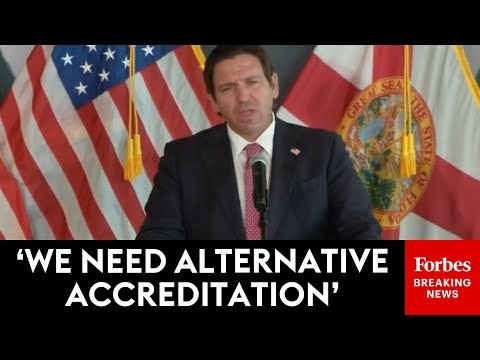
    In a bold move that could upend the structure of higher education oversight in the United States, Florida Governor Ron DeSantis announced the creation of the Commission for Public Higher Education (CPHE)—a multi-state effort to challenge what he and his allies call the “activist-controlled accreditation monopoly.” The CPHE includes six Republican-led states: Florida, Georgia, North Carolina, South Carolina, Tennessee, and Texas.

    Positioned as a new accrediting entity with a focus on “student outcomes, transparency, and ideological independence,” the CPHE represents a growing backlash against traditional regional accreditors like the Southern Association of Colleges and Schools Commission on Colleges (SACSCOC). According to DeSantis and CPHE proponents, these longstanding organizations have prioritized diversity, equity, and inclusion (DEI) and other perceived progressive mandates over academic quality, workforce readiness, and measurable outcomes.

    The Political Context

    Governor DeSantis has made higher education a central battleground in his broader cultural agenda, particularly since his administration launched efforts to eliminate DEI offices, weaken tenure protections, and reshape public university boards. The CPHE fits neatly into that larger campaign—what DeSantis calls “reclaiming higher education.”

    “We’re breaking the stranglehold of the accreditation cartel,” DeSantis said in Boca Raton. “Florida is leading the way in building an education system based on results, not ideology.”

    The effort is being coordinated with support from public university systems across the South, including the University of South Carolina and the University Systems of Georgia and Texas. University of South Carolina Board Chair Thad Westbrook praised the new accreditor’s “outcomes-based” framework, stating it will “benefit students while making accreditation more efficient.”

    A Threat to the Federal Gatekeeping System?

    Accreditation in the U.S. plays a crucial gatekeeping role: it determines whether institutions are eligible to receive federal student aid, including Pell Grants and federally backed student loans. For CPHE to have any real impact, it must eventually be recognized by the U.S. Department of Education.

    That recognition is far from guaranteed. The process requires years of documentation, reviews, and approvals—and federal education officials may view CPHE’s openly political roots as problematic. Critics argue the consortium is more about ideological conformity than educational quality.

    Risks and Ramifications

    While the CPHE claims to offer a “rigorous” and “transparent” alternative to traditional accreditation, skeptics—including some education policy analysts and faculty advocates—warn that the real motive is political control over higher education institutions. By tying accreditation to a specific ideological framework, opponents fear that academic freedom, faculty governance, and research independence could be undermined.

    There are also practical concerns. Should CPHE institutions lose recognition by federal agencies or face lawsuits over inconsistent standards, students could suffer the consequences—especially those relying on financial aid or seeking degrees with recognized accreditation.

    Moreover, CPHE’s narrow focus on “student outcomes” often means post-graduate earnings or job placement, metrics that oversimplify complex educational goals and ignore broader social and civic benefits of higher education.

    A Test of Federalism in Higher Ed

    This development marks an escalation in the state-federal tug-of-war over higher education. With the U.S. Supreme Court increasingly supportive of state autonomy, and with Congress gridlocked, states like Florida are testing how far they can go in reshaping public education under a conservative vision.

    The CPHE may become a flashpoint in the national debate over what public universities are for—and who gets to decide. Whether this initiative results in meaningful improvement or becomes another chapter in the politicization of higher education remains to be seen.

    Source link

  • Academics should forcefully reject the claim they are “promoting ideology”

    Academics should forcefully reject the claim they are “promoting ideology”

    To the editor:

    Jonathan Eburne calls the National Endowment for the Humanities’ posting of the executive orders regarding the promotion of gender, equity and environmental justice ideology an act of “capitulation” equivalent to “the ideological extension of a political party” (“An Open Letter to the NEH,” Feb. 28, 2025). I share his critical stance toward the executive orders and the spirit driving them. But his accusation against the NEH is unfair and normalizes a dangerous misreading of the scope of the orders that higher education must avoid.

    The NEH chair and staffers are federal employees, bound to obey government directives. To refuse compliance would invite immediate termination of the agency’s talented, experienced staff and call the future of the agency into question. With them would go vital funding and stewardship for the humanities that sustains faculty, students, state humanities councils and members of the public.

    To be clear, these orders apply across the federal government, and nothing in them is specific to the NEH. They do not apply to research and teaching; one (EO 14173) includes a carve-out for institutions of higher education.

    By treating NEH projects as falling under the scope of the orders, Eburne implicitly assents to the notion that research and teaching are equivalent to promoting ideology. This is indeed the guiding belief in Florida, and it is shared by the current administration.

    In fact, “promoting ideology” is not an accurate definition of scholarly or scientific inquiry, including the important work of teaching and doing research on gender, equity and the environment.

    It is crucial that we stand up against attempts to define academics as promoters of ideology and thus as untrustworthy stewards of knowledge, or, as the vice president has put it, dedicated to “deceit and lies, not to the truth.” It’s malicious abuse of language designed to undermine people’s confidence in academia and in expertise in general. The right strategy is not to accept a bad definition—it’s to call out the definition as wrong and reject the labeling while these orders are litigated in the courts.

    Joy Connolly is the president of the American Council of Learned Societies.

    Source link

  • Education Department to end internal “gender ideology” programs

    Education Department to end internal “gender ideology” programs

    The Department of Education is ordering an end to all spending and programs that “promote gender ideology,” according to an internal email sent to all department employees and obtained by Inside Higher Ed

    The email lays out steps the department will take to uphold President Trump’s executive order “Defending Women from Gender Ideology Extremism and Restoring Biological Truth to the Federal Government.” Those steps include a “thorough review and subsequent termination of Departmental programs, contracts, policies, outward-facing media, regulations and internal practices that fail to affirm the reality of biological sex.”

    The email also prohibits employee resource groups that “promote gender ideology” from meeting on government property or during work hours. 

    The email appears to be targeted primarily at internal department activities and spending, as opposed to schools and universities that receive federal funding. But the Trump administration has in recent days launched investigations into colleges over the participation of trans athletes in women’s sports, and Trump’s executive order attacking diversity, equity and inclusion could have wide-reaching effects on college programs and curricula.  

    A spokesperson for the department did not respond to Inside Higher Ed’s request for clarification or comment in time for publication.

    Source link

  • Trump Issues Executive Order to Restrict Gender Ideology in the Federal Government

    Trump Issues Executive Order to Restrict Gender Ideology in the Federal Government

    by CUPA-HR | January 22, 2025

    On January 20, the Trump administration issued an executive order (EO) titled, “Defending Women from Gender Ideology Extremism and Restoring Biological Truth to the Federal Government.” The EO was one of several executive orders and actions published by the Trump administration on its first day in office.

    The EO states that the United States government will recognize only two sexes — male and female — and defines sex as “an individual’s immutable biological classification as either male or female.” The definition continues to say that sex is “not a synonym for and does not include the concept of ‘gender identity.’” The executive order also defines “woman” and “girl” and “man” and “boy” to be adult and juvenile human females and males, respectively.

    The EO orders the secretary of health and human services to provide guidance expanding on the definitions established in the EO. It also directs all federal agencies to use the definitions set forth in the order “when interpreting or applying statutes, regulations, or guidance and in all other official agency business, documents, and communications.” All federal agencies will also be directed to use the term “sex” and not “gender” when administering or enforcing sex-based distinctions in applicable federal policies and documents.

    It also appears that the Trump administration hopes to codify these definitions into law through Congressional action. Specifically, the EO directs the assistant to the president for legislative affairs to provide the president proposed bill text to codify the definitions set in the order within 30 days.

    The EO also discusses the Supreme Court’s decision in Bostock v. Clayton County, which held that Title VII of the Civil Rights Act of 1964 protects employees from discrimination on the basis of sexual orientation or gender identity. The EO states that the Biden administration argued that the Bostock decision “requires gender identity-based access to single-sex spaces under, for example, Title IX of the Educational Amendments Act,” which the Trump administration states is “legally untenable.” As such, the EO directs the U.S. attorney general to issue guidance to federal agencies to “correct the misapplication” of Bostock to “sex-based distinctions in agency activities.” The EO also directs the attorney general to issue guidance and assist federal agencies in protecting sex-based distinctions.

    The EO directs all federal agencies to submit an update to the Trump administration on implementation of this order within 120 days. The update is required to include information on changes to agency documents and agency-imposed requirements on federally funded entities, including federal contractors, that were implemented to comply with the order. The head of each federal agency is also directed to rescind all guidance documents inconsistent with the requirements of the order, and the EO includes a partial list of documents that the administration deems as inconsistent, including several Department of Education guidance documents on Title IX and the Equal Employment Opportunity Commission’s 2024 Enforcement Guidance on Harassment in the Workplace.

    Finally, the EO directs agencies to take “all necessary steps, as permitted by law, to end the federal funding of gender ideology” and to “assess grant conditions and grantee preferences” to “ensure grant funds do not promote gender ideology.”

    Federal agencies will soon begin to take action and announce guidance to comply with the EO requirements. Institutions should therefore be aware of forthcoming guidance from the Department of Education on Title IX as a result of this EO. There could also be future ramifications for institutions that receive federal funds, including grants and contracts. CUPA-HR will continue to monitor for agency actions as well as any additional updates from the Trump administration as it relates to sex and gender-related policy.


    Source link