The India–United Kingdom Comprehensive Economic and Trade Agreement (CETA), negotiations for which began in January 2022, was finalised on July 24, with UK Prime Minister Keir Starmer and Indian Prime Minister Narendra Modi calling it a ‘step-change’ in bilateral relations.
While the trade deal covers a wide range of areas, including tariff reductions, market access, mobility, and investment protection, aimed at delivering a £4.8bn annual boost to the UK economy and an estimated USD $9-10bn in export growth, the two Prime Ministers also endorsed the India-UK Vision 2035, “reaffirming their shared commitment to unlocking the full potential of a revitalised partnership”.
Although technology, innovation, defence, and climate action are key pillars of India-UK cooperation under the Vision 2035 framework, education remains central to the shared goal of developing a skilled, future-ready talent pool to tackle global challenges and drive a sustainable future, according to a policy statement released alongside the FTA signing.
In a first, both countries are launching an annual ministerial India-UK Education Dialogue, which will include reviews of mutually recognised qualifications and knowledge-sharing through joint participation in platforms such as the UK’s Education World Forum and India’s National Education Policy initiatives.
The launch of the ministerial dialogue also comes as UK universities increasingly recognise the potential of establishing academic and research-focused branch campuses in India.
Just this Tuesday, the University of Bristol joined a growing list of UK institutions that have received approval to open campuses in India under the University Grants Commission’s Foreign Higher Educational Institutions (FHEI) regulations.
Bristol’s Mumbai campus, slated to launch in Summer 2026, will offer undergraduate and postgraduate programs in data science, economics, finance and investment, immersive arts, and financial technology.
Once operational, Bristol, ranked 51st globally, will become the highest-ranked British university to establish a campus in India, surpassing the University of Southampton, which launched its Gurugram campus earlier this month with classes beginning this August.
Though Modi has welcomed the establishment of British campuses in India, calling it a “new chapter in the education sector of both countries”, some UK universities are facing flak at home “for seeking fortunes in India” amid ongoing financial woes and domestic job cuts.
However, with universities like Bristol positioning their India campus as a hub for students, researchers, and industry to shape a better future, the Vision 2035 framework also underscores the India-UK Green Skills Partnership, an initiative focused on equipping young people in both countries with future-ready skills.
The partnership aims to bridge skill gaps and enable joint initiatives, such as centres of excellence, climate-focused ventures, and courses and certifications in areas such as sustainability.
Moreover, the Vision 2035 framework also “encourages exchange and understanding among youth and students” to strengthen the success of existing initiatives like the Young Professionals Scheme (YPS) and the Study India Programme.
While the YPS, launched in February 2023, is designed as a reciprocal visa scheme enabling British and Indian citizens aged 18-30 to live, work, travel, and study in each other’s country for up to two years, it has so far been largely one-sided.
Over 2,100 visas were issued to Indian nationals in 2023, while no such data is available for UK nationals going to India – suggesting participation has been minimal.
But on the educational front, with UK universities setting up campuses in India and more exchange opportunities emerging, British students may also be encouraged to study in the South Asian country, Alison Barrett, country director India at the British Council, said in a recent interview with Financial Express.
Once the FTA is ratified, the responsibility will shift to business organisations, institutions, and industry leaders to bring it to life Amarjit Singh, India Business Group
Furthermore, a recent article by Bhawna Kumar, Acumen’s director of TNE and institutional partnerships, and Nikunj Agarwal, the company’s consultant in research and TNE, highlighted the pivotal role of India’s National Education Policy in shaping the FTA and the Vision 2035.
“Chapter 8B of the FTA (UK Schedule of Commitments) places no restriction on UK providers offering higher education services (CPC 923) in India. This opens doors for UK universities to expand through various TNE models such as joint degrees, dual degrees, and campus partnerships,” they noted, citing the example of University of Birmingham’s joint master’s programs with IIT Madras in Data Science and Artificial Intelligence, and Sustainable Energy Systems, as a key example.
“Chapter 14 of the FTA aligns closely, promoting joint R&D, researcher exchanges, and institutional partnerships in areas like digital innovation, clean energy, agriculture, and healthcare mirroring NEP’s multidisciplinary agenda,” they added.
While the Vision 2035 framework appears robust on paper, the authors point out several implementation challenges that remain pressing, chief among them being regulatory alignment, visa bottlenecks, and the slow pace of progress on mutual recognition agreements.
“Establishing a Joint Education and Skills Council, co-chaired by senior officials from both countries, would institutionalise cooperation, monitor delivery, and resolve bottlenecks in real time,” they suggested.
While the trade deal does not explicitly mention international students, CETA is expected to broaden “high-quality employment pathways” for young Indians by easing access to the services market and facilitating short-term mobility for skilled talent across sectors such as IT, healthcare, finance, and the creative industries.
Each year, up to 1,800 Indian chefs, yoga instructors, and classical musicians would be able to work in the UK temporarily under CETA.
Additionally, Indian workers will benefit from the Double Contribution Convention (DCC), which will exempt them and their employers from UK National Insurance contributions for up to three years.
Will CETA stand the test of time in delivering benefits to students and professionals? Amarjit Singh, CEO, India Business Group, believes it can but only with a collaborative approach to ensure its long-term success.
“The UK-India partnership is respected across party lines. While the 2030 Roadmap was negotiated last year, the framework has been in the making for nearly a decade. There is broad consensus not to jeopardize this progress,” Singh told The PIE News.
Though CETA has been signed by both countries, it still requires ratification by their respective parliaments, a process expected to take another six to 12 months.
“Once the FTA is ratified, the responsibility will shift to business organisations, institutions, and industry leaders to bring it to life. That’s where we need more awareness, active engagement, and a bit of hand-holding to realise its full potential.”
International students are not responsible for sky-high rental price hikes, according to the latest analysis produced by Australia’s central bank, the Reserve Bank of Australia.
In its latest bulletin assessing the role international students play in Australia’s economy, it estimated a AUS$50bn net gain from students and underlined their value as employees too.
Spending by international students was also an important contributor to growth in consumer demand in Australia following the pandemic, it declared.
“In periods of strong inflows of students, such as just after borders reopened after the pandemic, this likely had an important effect on aggregate demand in the economy.”
And the report pointed out that international students constitute the second largest group of temporary visa holders with work rights in Australia after New Zealand citizens.
“A greater share of international students work in accommodation and food, as well as retail, compared with the share of the total labour force,” detailed report authors.
“Further, an increasing share of students are now working in health care, consistent with strong labour demand in this sector.”
The report noted this contribution was important in helping businesses in these sectors facing labour shortages in the tight labour market that emerged post-pandemic.
The timing of the report is useful, as new ESOS legislation is considered and the government is facing calls from the sector to stop stifling international student demand – with the latest calls relating to the new visa application fee which is killing demand from short-term students.
When it comes to the political hot potato of international student populations squeezing out domestic renters or contributing to accommodation price surges, RBA was dismissive of that thesis.
The rise in international student numbers is likely to have accounted for only a small share of the rise in rents since the onset of the pandemic Reserve Bank of Australia
Models of the housing market used by the RBA suggest that a 50,000 increase in population would raise private rents by around 0.5 per cent compared with a baseline projection. The marginal effect of an additional renter may be greater in periods where the rental market is tight and vacancy rates are low, such as occurred post-pandemic.
“Nonetheless, the rise in international student numbers is likely to have accounted for only a small share of the rise in rents since the onset of the pandemic, with much of the rise in advertised rents occurring before borders were reopened.”
One area where higher international student numbers have generated a supply response has been in purpose-built student accommodation, noted the report, with rapid growth in building approvals for such projects in recent years.
Note the gov plan to expand cap for insttutions investing in PBSA.
Another interesting fact shared was that International students make up around one-third of Australia’s permanent resident intake – around 30 per cent of international students went on to apply for temporary graduate visas in the five years to 2022, said the report citing 2022 data.
There is less expected flow into temporaray labour market now – “this is because the recent tightening in visa policy has targeted groups of students who were more likely to be seeking to work” explained RBA.
“That is, those international students who do receive visas going forward are less likely to be focused on employment opportunities in Australia on average,” said the report, citing Andrew Norton.
In sum, “rapid growth in the international student stock post-pandemic likely contributed to some of the upward pressure on inflation from 2022 to early 2023, especially as arriving students frontloaded their spending as they set up in Australia and took time to join the labour market. However, the increase in international students was just one of many other forces at play in this time that drove demand above supply in the economy, and hence higher inflation. For instance, supply-side factors were the biggest driver of the increase in inflation in 2022 and 2023 (RBA 2023; Beckers, Hambur and Williams 2023) while strong domestic demand arising from supportive fiscal and monetary policy also played an important role.”
An estimated one in five college students has dependents, and research shows that parenting students are more likely to experience basic needs insecurity in their pursuit of a degree. A 2024 survey by Trellis Strategies found that 6 percent of student parents self-identified as unhoused and 17 percent indicated some level of housing insecurity since they started college or during the 12 months leading up to the survey.
A recent brief from New America and Princeton Eviction Lab tied the threat of eviction to negative student outcomes; student parents who face eviction are 23 percent less likely to complete a bachelor’s degree compared to their housing secure peers, and more likely to have lower quality of life, including higher mortality rates and lower earnings years later.
In the most recent episode of Voices of Student Success, host Ashley Mowreader speaks with Edward Conroy, senior policy manager on higher education policy at New America, and Nick Graetz, assistant professor at the University of Minnesota in the department of sociology and the Institute for Social Research and Data Innovation, about how threats of eviction uniquely impact parents and the implications for generational education goals.
An edited version of the podcast appears below.
Inside Higher Ed: Just to get us started, can we get the 30,000-foot view? What is this brief? What were some of your findings? What did you all learn?
Eddy Conroy, New America’s senior policy manager in the education policy program.
Conroy: The overall goal here was to be able to look at parenting students—of which we know there are about 3 million in the country; it’s one in five undergrad students and another million grad students—if they’re threatened with an eviction, we thought it was pretty likely that’s going to have harmful effects on their chances of completing college. So wanted to see, what does that look like? How does that impact whether they graduate, whether they stay in college? What does it do to their income afterwards? What does it do to a bunch of different things that are pretty important when it comes to success in higher education? We’ll get more into detail, but we learned it was worse than perhaps either Nick or I thought the findings were going to be—and we didn’t think they were going to be great: The threat of eviction has just devastating consequences for parenting students’ chance of success in higher ed.
Nick Graetz, assistant professor at the University of Minnesota in the department of sociology and the Institute for Social Research and Data Innovation.
Graetz: Just a little background on how we got here from the data perspective. This is part of a larger collaboration that began with the U.S. Census Bureau maybe four years ago, with the goal of linking eviction records to other census administrative data to really understand who’s affected by eviction, because the records themselves only include names and addresses, not even things like age, race, sex, in terms of the actual data collected in court.
One of our first big findings from that linkage was just the extent to which households with kids are at higher risk of eviction. Across the board, we find [eviction] filing rates are twice as high for groups that have kids. This work with Eddy and New America was a partnership to try to dig into different groups that have children—so, specifically, parenting students—and see what’s going on there.
Inside Higher Ed: Something that I thought was interesting about this research—and I know this has to do with how evictions are filed, and the actual application of the eviction as well—but even the threat of an eviction had such a detrimental effect on completion rates.
We talk a lot in higher ed about housing insecurity and students’ basic needs, and how, if they don’t have $500, they might not be able to persist, or they are at higher risk of stopping out. I wonder if we can talk about that dynamic of, maybe the student isn’t experiencing literal homelessness, but even the threat of eviction can totally jeopardize or derail their educational pursuit.
Graetz: Part of it is a data consideration; we’re able to assess with a really high degree of accuracy the point at which we see someone in housing court across the country. It really varies how well we think we can capture the actual judgment rendered in housing court, but we use the threat of eviction, because that itself, based on prior work, has all these huge impacts, even if you’re ultimately able to stay in your home.
Starting at the highest level, the constant stress of making rent or facing eviction is traumatic, especially for parents. There’s this expression, “the rent eats first,” and we know that tenants tend to sacrifice on issues like food and health care when they see budgets tighten. We know that rent-burdened households with children spend 57 percent less on health care, 17 percent less on food, and that’s driven by the threat of eviction; if you fall behind on rent, you need to prioritize that above everything else. It’s really easy to snowball into an eviction filing.
The threat of eviction also compounds all sorts of other problems, especially material financial problems in lots of ways. Landlords file against the same tenants over and over again as a means of coercive rent collection, and we know that those fines and fees associated with just the filings can increase monthly housing costs up to 20 percent, and then also just having the mark of an eviction filing on your record, landlords use all sorts of tools to screen for those. It makes it harder to access new stable housing if you move—which can all have downstream impacts on things like finding a new job, finding new childcare, and so these things all kind of compound and accumulate over time.
Inside Higher Ed: I think navigating that system must also be especially challenging for college students because of that time constraint, and again, student parents, even more so, because we know that there’s such a time poverty when it comes to raising children and having dependents.
But we talk a lot about the hidden curriculum in higher education, and how it’s so hard to navigate even your institution and find everything you need. I can only imagine when you’re dealing with your landlord or housing court or all these other bureaucratic systems that are not always designed to be easy and user-friendly, that definitely compounds the stress and puts added pressure on this population.
Conroy: About 90 percent of people who get taken to eviction court end up losing their case. Regardless of whether you can navigate [the system], your chances of winning are pretty low and there’s all kinds of stuff underlying that. Very few people in eviction court end up with representation. You’re generally talking about folks who are lower income, have less social and cultural capital … if you’re in that situation in the first place, the chances that you have a friend or family member you can call up and say, “Hey, who knows a good lawyer?” or even have the money to pay that person, are really low.
Exactly to your point about time poverty, these things are a challenge for all students. But we know from lots of different pieces of research that parenting students’ pressures on their time are enormous. A vast majority are working full-time. They then have childcare and parenting responsibilities on top of that.
That is a lot—as somebody who is a stepparent—that’s a lot to do, to have a full-time job and take care of your kids and occasionally have a little bit of a life yourself. Then, add in going to college at the same time. Everything that we see from other pieces of research on parenting students’ time constraints, they don’t have enough hours in the day when everything’s going reasonably well. You add in the stress of eviction or housing insecurity, and it is really easy to see how that is incredibly destabilizing immediately and very difficult to fight that kind of thing, because it takes a lot of time to deal with all those things. And you have to show up in court; there are all of these knock-on effects too. You’re showing up for court, that means that you have to take the day off work. You’re in a job that you don’t get days off, so you’ve lost a day of income. Like Nick was saying, these things snowball really quickly.
Graetz: On the point about legal counsel and how tenants aren’t guaranteed representation in housing court. I think that’s one really important intervention at the university level: There are a lot of folks doing really incredible work offering free legal services to students. Those programs were one reason I was thinking, when I was trying to think of how big are these disparities we’re going to find, I was thinking of those programs as a place where tenants with kids in the general rental market don’t have access to that kind of thing, and virtually all of them are unrepresented. That’s another interesting intervention point that we could dig into more. It seems like it’s not a protective enough effect to really stop us from seeing such huge disparities here. But if universities could think about funding and investing in those programs more as a parenting student policy, as a retention policy, I think it could possibly have some really big impacts.
Inside Higher Ed: Absolutely. As we’ve been talking about time poverty, one thing that came to mind is just the things that a student has to do during the 9 a.m. to 5 p.m. time period. Housing court isn’t open until 10 p.m., very rarely are institutions providing legal services after hours. And so, I think one intervention that would be interesting to see is just how expanded resources could also benefit student parents who don’t always have that 9-to-5 hour available when they have to take class and get the kids to child care and deal with their eviction notice, and go to the grocery store, whatever else it might be.
I wonder if we can talk about some of the ways that institutions can have a role in supporting them with housing insecurity.
Conroy: This was the first piece that New America had really done, at this intersection of housing issues and higher education. So, we were deliberately a little careful about what the policy solutions discussion looked like, because there are enough people in the world who will wade into new issue areas that they don’t know and make a bunch of suggestions without really understanding whether they’ve been tried before. So, we wanted to be deliberately careful.
But I think one of the things that is really clear is these are not problems that institutions can solve on their own. So there was a big study that just came out, led by Rashida Crutchfield and a few other people in California, about work on California’s rapid rehousing investments.
California at the state level, had invested, I think, over $30 million in that effort, and it showed really good outcomes. But it helped students at a small handful of universities in California. And when you’re talking about over 2 million students just in the California Community College system alone, $31 million seems like a lot of money. But when you start dividing that by, you know, tens of thousands or potentially hundreds of thousands of students, it’s not very much, very quickly.
One of the really good quotes that came out of that was some senior administrator saying, “We simply can’t solve this at an institutional level by ourselves.” And I think it’s very clear from this data that parenting students have some unique vulnerabilities around housing insecurity and eviction—they’re having to pay more for housing, they need more housing than the average single student without kids, all of these things. Our financial aid system wasn’t designed to really support people with children. And so a big piece of this—and we’re starting to think about that now—is going to be institutions partnering and thinking through, how do we come to the table with our local housing authority? How do we come to the table with our city planning department and advocates for housing?
Because everybody in America, unless you’re pretty well off, is experiencing challenges with housing. This is not an issue that’s unique to students. But in this case, parenting students are uniquely vulnerable to some of the challenges created there, so a lot of the solutions are going to be partnerships. There’s a role to play for emergency aid, for using it strategically to avoid students getting to the point of eviction. There’s a role for improved financial aid and doing a better job of communicating with students that they have these resources. I think, like Nick said, legal services, particularly if you’re an institution with a law school, is a great way to help, if you have a Student Legal Clinic. I think that’s actually a really great piece, but it’s going to be, almost certainly, a lot of partnership work with institutions. You run a food pantry, you can connect students to SNAP, you can do those kinds of things. Housing is a much bigger challenge, and it’s going to require working across different areas, for colleges and universities.
Graetz: Ultimately, the universities investing in some of the emergency assistance stuff and legal services is, I think you can get a really big bang for your buck there, but it’s ultimately a band-aid solution to the broader housing crisis we’re all dealing with. And I think universities can be really powerful, important political actors in those conversations that have to be happening with state government and federal government to ease some of the major housing strain that families are facing.
Conroy: One thing that actually just came to mind is the current administration has said it wants to explore the idea of limiting access to public housing, and especially housing choice vouchers —what’s previously been known as Section Eight housing vouchers—to two years. This isn’t official policy yet, but it’s been floated as an idea.
One of the things we know is that, and as we see in this data, for a parenting student who was threatened with eviction five years post-enrollment, their family income was more than cut in half. If they were not threatened with eviction five years post-enrollment, [they had a] family income of $126,000 a year. That’s really good. That’s solidly middle class, like you’re doing pretty well.
If you were threatened with eviction five years later, your family income was $59,000. That is an enormous difference. But it shows that if we help protect students at this really crucial point where they’re trying to get to a place that they no longer need to rely on any kind of public support, they’re probably going to do pretty well.
Those kinds of policy proposals would make this so much worse, when we know that if you help that student get to the finish line, the chances that they ever have to rely on public housing or other public benefits again, become so much lower.
There are these really sort of backward policies that are penny-pinching to save a few cents now, but in the long run harm people and cost more money, or are just really ill-thought out approaches to public policy and housing policy.
Citing Sources
One study by the Lumina Foundation using 2012 data found that college graduates are 3.5 times less likely to be impoverished and five times less likely to be imprisoned or be in jail compared to non–college graduates. Lifetime government expenditures are 39 percent lower—$82,000 less—for college graduates than for Americans with only a high school degree.
The study also found that the average bachelor’s degree recipient contributes $381,000 more in taxes than they use in government services and programs over their lifetime.
Inside Higher Ed: We could definitely spend some time talking about the administration’s push for more children and encouraging family growth and things like that
We see that student parents are so motivated to complete a degree, and we know adult learners are intrinsically motivated. They are much more likely to have strong goals [and] positive academic outcomes compared to their younger peers, but there are all these external factors that continue to hinder their degree progress. We’ve talked about time poverty, housing insecurity, lack of finances, the need to work, caregiving responsibilities for those who are caught in the [Sandwich] Generation between older parents and younger children or siblings as well. It’s such a complex issue , I wonder if we can just talk a little bit about why it’s so essential to do more than just provide academic support and to surround student parents with basic needs, with legal aid, with some of these other essential elements of being a student parent.
Conroy: Like you said, academic outcomes for parenting students are actually pretty good. They, on average, have similar or even slightly better GPAs than their non-parent peers. But even under the best case scenario, taking eviction and everything else out of it, their chances of completing a bachelor’s degree in six years or an associate’s degree in three years are far lower than their non-parent peers.
It is because of all of these other things that we’re talking about. Everything else being equal, if you take a parenting student and a non-parenting student and drop them in the same environment, the chances that the parenting student is going to get to the finish line are already diminished, unless you figure out other ways to support them.
Priority registration is an enormous thing. I actually was just this week having dinner with a friend whose spouse just finished law school, but was at the same time working full-time. They have a young child, and he said the only way we were able to make this work is because Texas passed requirements that parenting students got priority registration, and his wife had first pick of classes, and that’s a family that has good financial resources.
There are simple things like that; even priority registration for parenting students means they can figure out their work schedule. They can figure out childcare. That can be a big deal by itself, but if colleges figure out how to properly support the groups with the largest challenges, then that all trickles down.
Universal design tells you that that will have good impacts for everybody else, but if colleges don’t do that, given demographic change … I’m not like somebody who thinks the world is going to collapse due to changes in the number of high school graduates, but it is going to have an impact. And we have this enormous pool of people in America who have some college but no degree or want to go back to college. New America just released our Varying Degrees report that we’ve done for years, and it shows, and it has shown again and again, Americans really value higher education. Folks who don’t have higher education are thinking about wanting to come back into it. The way that colleges will be able to smooth out some of those demographic change challenges is really thinking through carefully, how do we support groups like parenting students, where there’s also huge potential upside; if you move the needle 10 percent on your graduation rates for parenting students—because there the rates are so low right now—it has a really massive positive impact on your outcomes as an institution. And that’s important for funding, it’s important for recruitment, all of these things.
Graetz: One point you brought up, Ashley, that I just wanted to build on a little bit, is the potential for really multi-generational impacts of investing in student parents.
One thing we did in this work is think about how that goes both up and down the family tree. With the data linkage we’ve done, we’ve also connected the incomes of the parents of parenting students, so we could think of those as the grandparents of the children these folks are having while they’re enrolled.
And we find that lower grandparent income at the time of parenting students enrolling is associated with much higher risk of eviction. I think the threat of eviction in college while you’re caring for your grandchild, you know that grandparent is going to be affected by that too. Because of some of the statistics you mentioned earlier, about how many parenting students can afford a $500 bill, a big part of that depends on familial wealth and where can you go to draw on that kind of emergency assistance?
We know, of course, there are massive racial disparities in family wealth. So at the point of something like an eviction, that’s going to affect both up and down the family tree. It’s going to affect everybody who might be providing emergency support to that family member, potentially their child or who’s caring for their grandchild. But then it’s also going to affect the child; evictions, especially experienced early in life, have really traumatic long-term effects for children.
Inside Higher Ed: That’s something that I wanted to talk about as well—the value of supporting student parents for the dependents’ sake. In higher education, we want all students to succeed and thrive, but we also know that being a continuing generation student, or having a parent who has a college degree or certificate, boosts your chances of completing a degree. And there’s, like you mentioned Nick, wellbeing and personal life experiences too, that are really tied to having basic needs and being supported as a young child. I wonder if we can talk a little bit about why this is important, not only for the student, but also for future generations and their education.
Graetz: It’s hard to overstate the impacts that something like an eviction can have. In our previous work, looking at who’s affected by eviction the most, the rates are extremely high when you’re zero to five. So that’s because evictions target households with kids. Some of the most likely time of your life to be affected by an eviction is when you’re an infant, basically. And there’s a lot of literature on how this affects school outcomes, how this affects sort of regular developmental milestones. And I think it’s for tons of reasons; there’s the acute, traumatic effect of that eviction and this instability it causes, but then there’s just the downstream material consequences of that experience by the family for years and years later that are going to affect that child.
Conroy: One thing to add on there is, we know that wealth and poverty in America are very sticky. Your chances of moving up in terms of income quintiles and things like that are not great, but higher education is one of the things that really makes it more likely that, if you came from a relatively low-income family, that you’re able to move into a higher income bracket and be more economically secure, all of those things and all of that for lots of reasons.
We don’t have to get into every detail of it, but it has really good consequences for kids. It means that they’re more likely to go to a better-resourced school, they’re more likely to have good food on the table every day, all of these things.
Also, Georgetown Center on Education and the Workforce estimates that 70 percent of jobs being created will require some kind of post–high school education moving forward. [It] doesn’t have to be a four-year degree, but there is an ever-decreasing number of jobs that don’t require training of some kind beyond high school. We help parenting students complete college, we know that once you get into a second-generation, third-generation college-going group, you’re not first-gen anymore, your chances of going to and succeeding in college go up because you have a parent to turn to to say, “Hey, you navigated this. How do I do that?”
I see this with people in my family who are one of the only people in their community who went to college and they’re the community resource. It’s mom, dad, uncle, aunt, cousin. “Hey, talk to that person. They went to college; they succeeded. They’ll tell you what to do.” Those are very hard to measure, but the community network effects that happen over time and happen for kids in those families can be enormous.
Inside Higher Ed: We talked a little bit about the lack of policy or practice implications directly named in the research brief that you both wrote. But I wonder if we can talk about the future of this work, or where you hope that the conversation continues to go as we think about supporting student parents in higher education who may be facing eviction or dealing with housing insecurity?
Conroy: A couple of things that we’re working on that I can talk about. Nick and I have also, just in the past two weeks, been sort of figuring out, what can we do now to expand on this?
One is we’re in the middle of trying to develop some work in conjunction with Nick and Eviction Lab, and then New America’s future of Land and Housing Program, to work in a small number of cities, to do some of the things I was talking about earlier in terms of partnerships and what could we do to think really carefully of bringing higher ed experts, institutions, housing advocates, the local public housing authority all together to the table to say, “Housing affordability is a general problem. It’s also a very specific problem for these groups of students. How could we work in collaboration to change some of those things?”
That requires funding and all of those things. But we’re hoping to be able to do that as the “on the ground” piece at the same time as we build greater research evidence. We had seven states in this study, and, I can, Nick can talk better about, what were some of the ideas that we’re now starting to think about for what next stages, in terms of the evidence base, could look like?
Graetz: We’re hoping to expand the coverage across the country of this linkage between all the census administrative records, this and the student records. I think that could give us more scope and general ability to generalize across student parents living in very different housing contexts.
Then there’s just a bunch of other questions opened up by this initial work. Something I’m personally really interested in is the shifting ownership structure of student housing. A lot of times, we focus on trying to learn things by studying tenants, but it’s a lot harder to study landlords and owners and how those shifts can affect those risks being passed on to tenants in terms of things like eviction risk. I think that’s really interesting, especially in the student housing space and just the parts of a city’s housing stock that are primarily serving student populations. And then, we’re also really interested in doing more linkage to understand the relationship between various federal assistance programs and eviction risk among students and parenting students. That’s all, hopefully, stuff we can look forward to over the next year or two.
Conroy: So, if anybody’s listening and have spare million dollars or two …
Inside Higher Ed: I’ll write you a check later this afternoon.
Conroy: I need to look at Inside Higher Ed jobs. I didn’t realize they paid that well.
Inside Higher Ed: Well, you know …
Get more content like this directly to your inbox. Subscribe here.
New elementary teachers who promote equity in science are proving highly effective at engaging students, no matter their background, a new University of Michigan study shows.
U-M researchers found that new educators are pioneering paths in science education by offering opportunities for scientific conversations, innovative learning strategies and encouraging children to become active participants in scientific exploration.
“When teachers are equipped to foster a more equitable and just learning environment in science, it not only enhances children’s understanding of scientific concepts but also empowers them to see themselves as scientists and to use science to address real-world issues that matter in their communities,” said Elizabeth Davis, a professor at U-M’s Marsal Family School of Education.
“Beginning teachers use a range of effective strategies to work toward more equitable science teaching. They vary in their emphasis on opportunity and access, representation and identification, expanding what counts as science and engaging children as change-makers using science to support a better world. This variation highlights the multiplicity of entry points into this challenging work and shows these teachers’ many strengths.”
The study, published in the General Proceedings of the 5th Annual Meeting of the International Society for the Learning Sciences 2025, also identified areas for growth: These teachers were less consistently likely to work to broaden what counts as science and to link science to social justice.
Davis and co-authors Jessica Bautista and Victoria Pérez Nifoussi said the study helps understand how different approaches to equity in science education can work together, potentially influencing future teacher training for improved K-12 science learning.
They emphasized the clear need for teacher educators and curriculum developers to provide more concrete examples and resources to help future teachers navigate complex, justice-oriented approaches to science.
“All children deserve to experience the joy and wonder of the natural world, yet science is taught far less often than language arts or math in elementary schools,” Davis said. “Furthermore, many students are marginalized in science, including girls, students of color, children with learning differences and queer or gender nonconforming children.”
Funding challenges impact long-term research
The study is part of the U-M ASSETS research, a four-year longitudinal project that began in September 2023. Although it was intended to run for four years, the project, funded by the National Science Foundation, was terminated in its 20th month, just shy of two years from its start.
“The termination of these NSF projects–focused on STEM education, and in particular equity in STEM education–is going to adversely affect science education and science for generations to come,” Davis said.
“We are seeking additional funds for this work. Regardless, we will continue to support the teachers who participate in this project and we’ll continue to collect and analyze data to the extent we’re able to do so.”
The team is now working on characterizing the participants’ first year of teaching to assess how their approaches to equitable and just elementary science teaching align with and differ from their approaches during teacher education.
Fernanda Pires, a Brazilian native, is a Lead Public Relations Representative at Michigan News, who covers the School of Education, student learning, coordinates media training and works with international communication. She holds a Master degree in Journalism/Broadcasting from Michigan State University and has more than 20 years of experience in communications. In Brazil, she worked for about 10 years as a broadcast reporter at Brazil’s national TV Globo and as a writer for the daily newspaper Correio Popular, in one of the largest cities in São Paulo State. She also worked as a public relations/corporate communications specialist for Brahma Brewing and Tilibra, the country’s leading manufacturer of school, office and time management stationery products.ᐧ
Latest posts by eSchool Media Contributors (see all)
A bipartisan House bill introduced last Thursday aims to reshape college athletics by limiting how universities can fund sports programs while offering the NCAA limited antitrust protections—changes that could significantly affect institutional priorities and student access.
The SCORE Act, backed by seven Republicans and two Democrats, faces uncertain prospects despite bipartisan support. While the House appears receptive, the bill would require at least seven Democratic votes in the Senate, where passage remains unlikely.
The legislation addresses three key NCAA priorities: antitrust protections, federal preemption of state name-image-likeness (NIL) laws, and provisions preventing student-athletes from becoming university employees. These changes come as colleges navigate the fallout from a $2.78 billion settlement requiring institutions to compensate athletes directly.
The bill’s prohibition on using student fees to support athletics could force difficult budget decisions at universities nationwide. This restriction strikes at proposed funding mechanisms as schools scramble to find up to $20.5 million annually for athlete compensation.
Several institutions have already announced fee increases that would be affected. Clemson University implemented a $150 per-semester “athletic fee” this fall, while Fresno State approved $495 in additional yearly fees, with half designated for athletics. Such fees disproportionately impact students from lower-income backgrounds who already face rising educational costs.
The financial pressures extend beyond student fees. Tennessee has introduced “talent fees” for season-ticket holders, Arkansas has raised concession prices, and numerous schools are seeking increased booster contributions—all reflecting the growing financial demands of competitive athletics.
The legislation includes provisions aimed at protecting Olympic sports programs, which some fear could be eliminated as resources shift toward revenue-generating football and basketball. Schools with coaches earning over $250,000 would be required to offer at least 16 sports programs, mirroring existing NCAA Division I FBS requirements.
This mandate could help preserve opportunities for student-athletes in traditionally underrepresented sports, many of which provide crucial scholarship pathways for diverse student populations. However, critics question whether this protection is sufficient given the magnitude of financial pressures facing athletic departments.
The bill’s broader implications for Title IX compliance and gender equity in athletics remain unclear, as institutions balance new athlete compensation requirements with existing obligations to provide equal opportunities for male and female student-athletes.
Studying philosophy can be life changing. It gives students the opportunity to think critically and ask questions about life, beauty, truth, who they are and what they believe in. The skills and knowledge-sets students develop in philosophy courses are not only useful in a variety of careers but can also prepare them to live meaningful lives.
Developing critical career skills
Philosophy students learn how to make good arguments and criticize bad ones. They develop problem-solving, critical reading and reasoning skills. This is why philosophy students generally do very well on standardized tests such as the GRE, GMAT and LSAT. And it’s also why they typically succeed in fields like law, business, education and other areas that require writing, argumentation and analytical ability. They can go on to train as pastors and priests, building upon what they learned in philosophy of religion or ethics courses. They may become teachers or journalists, putting their broad knowledge and linguistic skills to work. A few philosophy students might go on to obtain graduate degrees in philosophy, which can lead to jobs teaching at the college level.
Pre-law applications
Many universities have pre-law programs connected to their philosophy education programs — either as a track within the philosophy major, or through recommended or required philosophy courses in an interdisciplinary pre-law program. Among useful courses for a career in law are those in logic and argumentation, along with ethics and social or political philosophy.
Cognitive science applications
Philosophy is also a useful major for students interested in cognitive science. Classes in epistemology and the philosophy of mind introduce students to questions and theories about what it means to think, and what is unique, if anything, about human consciousness. These studies are useful in a world where artificial intelligence (AI) has become commonplace. While engineers and computer scientists work on hardware and software, philosophers ask questions about the meaning and purpose of consciousness itself.
The link between ethics and philosophy
Philosophers are also trained to ask ethical questions about these and other technologies. Ethics and value theory are substantial areas of concern within a philosophy major. This includes applied ethics courses, where students critically evaluate difficult issues. This kind of content is what you can find in my textbook, “Ethics: Theory and Contemporary Issues.” Almost every profession has an ethics component: nurses, doctors, lawyers and engineers all need ethics training. A focus on ethics and philosophy makes sense as a double-major or a minor for students pursuing those professional degrees. There are also ethics professionals at work in the world outside of academia. For example, in hospitals and research facilities, there are ethics committees and advisory boards which work as case consultants and as policy advisors.
Philosophy as a “way of life”
Perhaps the most important reason for students to study philosophy is because they’re interested in life’s biggest questions. Maybe they’re concerned about justice and motivated by the search for wisdom. We live in a world that has become incredibly complex. It is increasingly difficult to distinguish the good and true from the mere appearance of these things. Without wisdom, it’s difficult to achieve happiness. The study of philosophy will acquaint them with the deepest and most profound thinking on wisdom, happiness and the good life. This is what we attempt to do in our textbook “Archetypes of Wisdom: Introduction to Philosophy.” It may also help students resolve some of their own questions about who they are, what they believe and how to live well. In the text, we explain that philosophy can be understood as a “way of life.” The philosophical life is open to all people. It is an open-minded and curious approach to living.
Studying philosophy: the full impact
The philosophical life is one that encourages active engagement with history, culture and politics. It is a way of thinking that helps you wrestle with difficult questions in pursuit of wisdom. Studying philosophy can help students with career development. It can help them become better citizens, friends and colleagues. And more importantly, it will help them discover the joy of thinking and the wonder of being human.
Written by Andrew Fiala, Ph.D., Professor of Philosophy and Founding Director of the Ethics Center at California State University, Fresno.
An estimated 57 percent of college students cannot complete their degree on time because their institution does not offer required courses during days and times—or in a format, such as online—that meet their needs, according to data from Ad Astra.
A recently published study from the National Bureau of Economic Research found that female students are more likely than their male peers to be shut out of a college course, which can have long-term implications for their success and outcomes.
The findings point to the role course shutouts can play in students’ major and career choices, with those unable to enroll in science, engineering, math or technology courses in their first term less likely to attempt a STEM course at any point during college.
The background: A common way for colleges to navigate budget cuts is to reduce course offerings or academic majors. But that can increase the number of students who are unable to enroll in, or find themselves shut out of, courses they want to take. Students at community colleges in particular are less likely to remain enrolled if they face a shutout, choosing instead to take zero credits that term or to transfer.
Federal funding cuts by the Trump administration have ramped up some institutions’ existing budget woes, requiring them to reduce program offerings. Some groups have advocated for minimizing costs via course sharing, which allows students to meet requirements and earn credits for their home institution while enrolling in a shared online course.
Methodology: The research, authored by faculty from Purdue and Brigham Young Universities, analyzed registration processes at Purdue in fall 2018, when first-year students were enrolled using a batch algorithm. Researchers considered a student shut out of a course in their first year if their primary request was not met or the student enrolled in a different, secondary course instead.
The data: Among the 7,646 first-year students studied, only 49 percent received their preferred schedule, meaning 51 percent were shut out from at least one of their top six requested courses. Eight percent of shutouts made it into their course eventually, according to the report.
Of the 241 courses that were oversubscribed, required English and communications courses were most likely to shut students out; the other overbooked courses represented a variety of subject areas.
The effects of a student not taking a preferred course in the first term were seen throughout their academic career. First-year students who were initially shut out from a course were 35 percentage points less likely to complete the course while enrolled and 25 percentage points less likely to ever enroll in a course in the same subject.
While a student’s first-term GPA was not impacted by the shutout, by senior year, students had a GPA two hundredths of a point lower compared to their peers who enrolled in their preferred classes. The study also found that each course shutout led to a 3 percent decrease in the probability of a student graduating within four years, which is economically meaningful but statistically insignificant.
Registration barriers also made it less likely that students would choose STEM majors, which researchers theorize could be due to a lack of substitution options to meet major prerequisites. Each shutout a student faced in a STEM course decreased the probability that a student majored in STEM by 20 percent.
The impact was especially striking for female students. For each course a female student was unable to enroll in during her first year, her first-semester credits dropped by 0.4, cumulative GPA by 0.05 and the probability of her majoring in a STEM field by 2.9 percentage points. The long-term effects extended into life after college: A shutout female student’s probability of graduating within four years dropped 7.5 percent and had an expected cost of approximately $1,500 in forgone wages and $800 in tuition and housing costs.
“In contrast, for male students, shutouts do not have a significant effect on credits earned, cumulative GPA, choosing a STEM major or on-time graduation,” researchers wrote.
Male students who didn’t get into their top-choice courses first semester were more likely to switch to a major in the business school and have a higher starting salary as well. “At this university, men are 19 percent more likely than women to major in business and this entire gender gap can be explained by course shutouts,” researchers wrote.
Researchers therefore believe finding ways to reduce course shutouts, particularly in STEM courses, can improve outcomes for women and others to widen the path to high-return majors.
Do you have an academic intervention that might help others improve student success? Tell us about it.
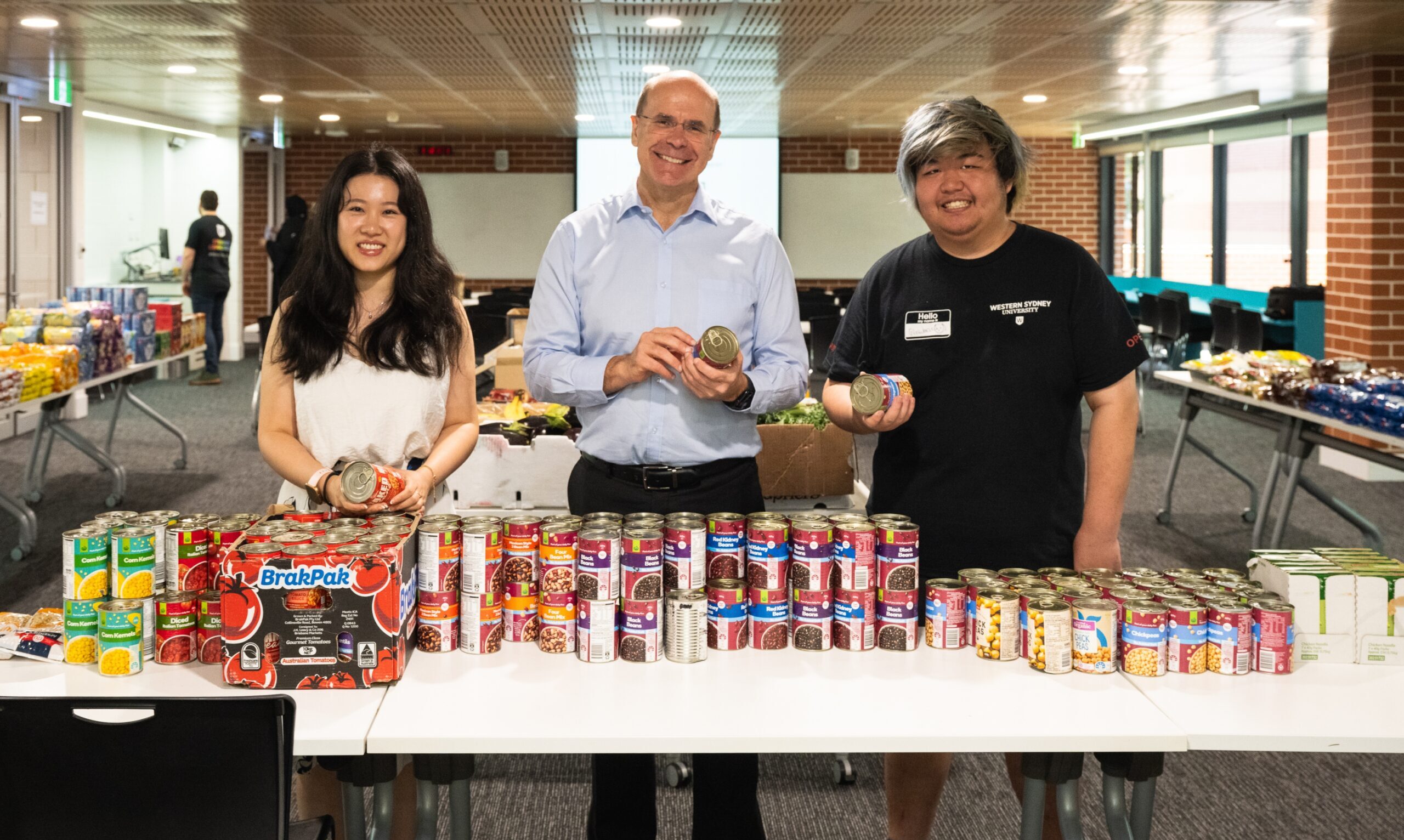
WSU provides a food pantry on campus for students struggling to afford food. Professor Williams (centre) is pictured with Student Community Program Coordinator Ms Miranda Zhang (left) and student Richard Xu. Picture: Wendy Chung
Western Sydney University (WSU) has ranked first in the measure of delivering community impact out of over 2000 universities globally in the Times Higher Education Impact Rankings released Wednesday.
Please login below to view content or subscribe now.
In a recent Wonkhe blog, Joe Mintz discussed the challenges of policy impact in social sciences and humanities research.
He highlighted the growing importance of research impact for government (and therefore institutions) but noted significant barriers. These included a disconnect where academics prioritise research quality over early policy engagement and a mutual mistrust that limits research influence on decision-making.
We have recently published a book on research impact that endeavours to explore the challenges of research impact, and these views chime greatly with us. Our motivation for starting the book project were personal. We have carried out a great deal of impactful research and provided support and training for others wishing to engage in impact. However, we wondered why impact seems to be so poorly understood across the sector, and, we had observed, there was a clear fracture between those who wanted to do impactful research, and institutions who wanted to control the process while not really understanding it.
Agenda opposition
There continues to be understandable opposition by some to what has been referred to as “the impact agenda”. One criticism is that impact is something being imposed by government and management that is at odds with the ideology of research. This argument follows that research impact is a market-driven mechanism that pressures academics to demonstrate immediate societal benefits from their research, often at the expense of intellectual freedom and critical inquiry. And a metric driven measurement of research impact may not fully capture the complexity or long-term value of research.
We can certainly empathise with this perspective, but might suggest that this is, in a large part, due to how impact has manifested in a sector that does not really understand what it can be. In our own experiences we have experienced management “advice” that firstly says do not waste your time doing impact, then, once performance-based research funding becomes attached to it, being told it is very important and your impact needs to be “four star”. And then indifference is replaced with interference and attempts to control, to make sure we’re doing it “properly” and making sure it can be monitored.
In trying to develop our understanding, we spoke to 25 “impactful” academics, who had objectively demonstrated that their research has high value impact, and a range of research professionals across the sector. It soon became very clear that our own observations were not outliers for those doing impactful research.
Impact success for those we spoke to came from a personal belief that saw it ingrained in their own research practice – this was something they did because they felt it was important, not because they had been told to. The stakeholders and networks they had, and often spent considerable time building, were their own not their institution’s, and many protected these contacts and networks from institutional interference.
In most cases, interview subjects said that there was little support from their institutions, they just did the work because they felt it was an important part of their research, and this symbiotic work with stakeholders provided further research opportunities. They could see the value of doing impactful research and felt personally rewarded as a result.
And many talked of institutional interference, where there was opposition to what they were doing (“you’re not doing impact properly”) and advised from positions of seniority although perhaps not knowledge or, in some cases integrity. They were instructed to do things more in line with university systems, regardless of how poor they might be. There was a clear dissonance between academic identity and management culture, often informed by an “impact industry” where PowerPoints from webinars are disseminated across institutions with little opportunity for deep knowledge becoming embedded.
Secret sauce
And many spoke of the research management machine, insisting that they engage with central systems so their work could be “monitored” and having many people around them telling them what to do, but offering no support. This support was often as basic as “do more impact” and “give us the evidence now”. In some cases, threats were made to not submit their case studies should they not follow the “correct process”, even when their work was clearly highly impactful. An odd flex for a senior leader, given QR funding goes to the institution, not the academic.
While the research that went into this book probably threw up as many questions as answers, one thing was very clear for this work. If it is to be successful, impact cannot be imposed upon academics or centrally controlled, it must originate from the academic’s community and own identity as a researcher. Telling someone to “do some impact because we need another case study” with a year before a REF submission is not good practice; management needs to take time to understand the research academics are doing and explore together how best to support it.
We are reminded of a comment from one interviewee, who does incredibly interesting and impactful research, and has done for many years. When asked why they do it, they simply said “because I enjoy it and I’m good at it”.
High quality impact case studies come from high quality research and high-quality impact. This is not something that can be gamed or systematised. Academics need to own impact for it to be successful, and institutions need to respect this.
There’s not many in the higher education sector that would have welcomed any part of the recent immigration white paper.
The reduction in the graduate route time limit would have been difficult enough. The BCA changes to duties on providers in order to sponsor international students will cause many problems. The possibility of financial penalties linked to asylum claims for those on student visas was as unexpected as it is problematic.
But it is the levy that has really attracted the ire of UK higher education.
The best form of defence
On one level it is simply a tax – on the income from international student fees, which is one of a vanishingly few places from which universities can cross-subsidise loss-making activity like research and teaching UK-domiciled students.
Yes, the funds raised are promised variously to “skills and higher education” or just “skills”, and the suggestion seems to be that the costs will be passed on entirely to international students via rises in tuition fees. There’s not any real information on the assumptions underpinning this position, or credible calculations by which the proportion of students that may be deterred by these rises and other measures has been estimated.
But details are still scant – the government has, after all, only promised to “explore” the introduction of a levy – and used the idea of a six per cent levy on international tuition fees as an “illustrative example”. We have to look forward to the Autumn statement (not even the skills white paper – remember joined-up, mission-led, government?) for more – and do recall that the white paper is a consultation and responses need to be made in order to finesse the policy.
Thinking about impact
There’s no reliable way to assess the impact of this policy with so little information, but we do know a lot about the exposure of each university to the international market.
For starters here’s a summary of provider income from overseas fees since 2016–17 – both for individual providers and (via the filters) for the sector as a whole.
The story has been one of growth pretty much anywhere you care to look – with only limited evidence of a cooling off in the most recent year of data. Some institutions have trebled their income from this source over the eight years of available data, with particular growth in postgraduate taught provision.
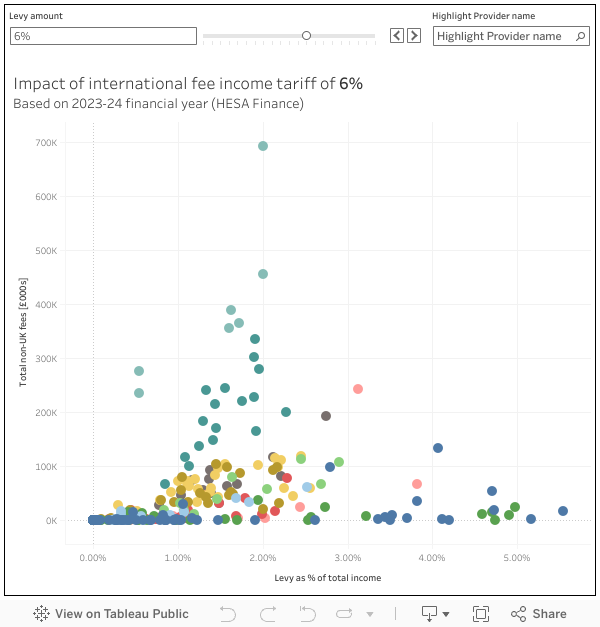
In considering the financial impact of a potential levy I have used the most recent (2023–24) year of financial data – showing the total non-UK fee income on the vertical axis and the proportion of total income represented by the value of the levy on the horizontal. By default I have modelled a levy of six per cent (you can use the filter to consider other levels).
In the majority of large universities the cost of levy is equivalent to around two per cent of total income. In the main it is the Russell Group that sees substantial income from international fees – the small number of exceptions (most notably the University of Hertfordshire and the University of the Arts London) would see a levy impact of closer to three per cent of total income.
What we can’t realistically model is university pricing behavior and the impact on recruitment. Universities generally charge what the market will stand for international courses – and this value is generally higher for providers that are better known from popular league tables.
Subject areas and qualifications also have an impact (the cost of an MBA, for example, may be higher than a taught creative arts masters – a year of postgraduate study may cost more than a year of an undergraduate course), as does the country from which students are arriving (China may be charged more than India, for example).
Some better off universities in the middle of the market may choose to swallow more of the cost of the levy in order to increase their competitiveness for applicants making decisions on price – this would put pressure on the currently cheaper end of the market to follow suit as well as direct competitors, and may lower the overall floor price for particular providers (though, to be fair, private providers are still better positioned to undercut should they have access to funds from investment or other parts of the business).
There is an obvious impact on the quality of the provision if providers do cut the amount of fee income – and this as well could have an impact on the attractiveness of the whole sector. For more hands-on courses in technical or creative subjects, provision may become unviable overall – surrendering the soft power of influence in these fields.
A starting point
It’s not often that we see a policy proposal on university funding launched with so little information. Generations of politicians have learned that university funding policy changes are the equivalent of poking a wasps nest with a sharp stick – it may be something that needs doing but the short term pain and noise is massive.
It could be that it is a deliberate policy to let the sector (and associated commentariat) go crazy for a month or so while a plan is developed to avoid the less desirable (for ministers) consequences. But the idea that international students will gladly pay more to support an underfunded sector is one that has been at the heart of university activity for decades – the only real change here is that the government feels it can put some of the profits to better use than some of our larger and better-known providers.
In all of this there appears to have been little consideration of the fairness of putting extra costs onto the fees of international students – particularly where they personally don’t see any value from their additional spend. But this has been an issue for a good few years, and it seems to have taken the possibility of a tariff (which could be considered unfair to cash-strapped universities too) to drive this problem further up the sector’s agenda.