As a PR professional, you can equip students on your campus with the skills and confidence to excel in interviews. Here are four reasons why you should invest the time and resources in media training your students.
It makes your life easier. When a reporter contacts you and asks for a student to weigh in on the news of the day or your institution’s latest initiative, you will have a pool of students to pick from at the ready rather than reaching out to deans or faculty to find a student and vet them that day.
While it will make your life easier in the long run, it does require you to put in the time up front. Meet students on their timelines. Most student group meetings are outside of class time, so it might mean you are attending a student government association meeting at 8 p.m. or doing a Zoom training with the College Democrats or Republicans on your lunch break.
It helps students and the community navigate crisis situations. With protests becoming regular occurrences on our campuses and in our communities, media training students will help them remain calm under pressure. When a reporter is looking for a comment, students won’t just say the first thing that pops into their mind. They will know how to get their key messages across to the audiences they are trying to reach.
It’s not just national and local media students need to respond to; student reporters are often the first to approach peers for quotes. All student newspapers are online, can be accessed by anyone and are an extension of your institution and its values. Engaging with student media isn’t just a learning opportunity—it shows how students will represent themselves, which in turn has a direct impact on the reputation of your institution.
Many students don’t know they can choose to not talk to the media or say no to interview requests. We’ve all seen the videos of reporters knocking on students’ doors and the students saying something unfavorable rather than just not opening the door in the first place, or of students having a microphone put in their face as they are walking to class to weigh in on a subject they don’t know about instead of saying, “I don’t know.” Media training can help students realize they have the option to respectfully decline interviews and interactions, which can help alleviate the pressure they might feel to respond in the moment.
Students build career-ready competencies. Whether it’s an internship or job interview, being able to succinctly articulate their points will help students for the rest of their lives. From public speaking to leadership roles to internships, media training gives students skills for their future.
We want our students to be able to weigh in on important issues, and media outlets are always looking for a student perspective. For example, my team was recently on campus for faculty and staff media and op-ed training when a professor asked if his students could sit in. Afterward, one student drafted an op-ed that she successfully placed. I’ve also provided op-ed writing training to seminar classes in which students learn the nuts and bolts of writing an op-ed and how to get published as an undergrad.
Name, image and likeness (NIL) has changed the game for student athletes. It takes students out of the arena and into the public eye where their reputation will be on the line. If you are at a larger school, some of your student athletes may have their own publicist, but if you are not at school where the NIL money is flowing, media training helps prepare student athletes for local commercials, being the face of the pizza shop down the street or even a postgame interview.
When a scandal occurs—a coach is fired, or student athletes are gambling or being hazed—you want students to know they can come to you for advice and guidance when reporters descend on campus.
Students are the most prominent ambassadors of your institution. Media training isn’t about making them a professional correspondent; it’s about making them feel prepared when they are in the spotlight. Whether they are engaging in a protest, talking with a peer reporter at the school newspaper or navigating a postgame interview, media training can serve them in the moment and long term. It’s worth your time to engage with your best spokespeople.
Cristal Steuer is associate vice president at TVP Communications, a national public relations and crisis communications agency solely focused on higher education.
Back when I worked in higher education policy, I worked with a misanthrope who refused to say good morning. Hard to believe, I know.
To remedy my angst, alongside the fuller spectrum of psychic bruises one garners in the sector, I left and enrolled on a MA Philosophy of Education course in late 2022.
At this time, the academy was contending with significant questions about gender, the legacy of colonialism, and the IHRA definition of antisemitism. These controversies did not meaningfully affect my area of policy – I focused mainly on nursing and medical education – but they resonated with my experience of off-the-record comments that lacked moral regard for students and fellow colleagues.
During the first of what was to be two in-person conversations about my dissertation, I proposed a focus on decency, a norm that protects individuals from humiliation. My programme leader at the time, a gender-critical and Jewish scholar, advised that the literature on decency was fairly scant. She suggested that I instead turn my attention to civility – so I did, shortly before she left academia for good.
Another stomach turns
One programme leader later, in early 2024, I submitted my dissertation: The Importance of Civility in Contemporary English Higher Education: In Dialogue with Michael Oakeshott. Outside of our departmental tumult, I saw the resurgence of global violence against civilians, the passage of the controversial Higher Education (Freedom of Speech) Act 2023, and the concerning rise of far-right political power.
Despite these shifts, my dissertation topic elicited little attention and the occasional frosty eye roll.
Anchoring my arguments to conservative philosophical thought was admittedly bold, but was I coming across as archaic? As sanctimonious?
Another can of worms
If you would like a summary of my 20k word tome, it is this: civility in higher education is important. To elaborate, it is important is for three reasons: incivility in the academy is courting heavy-handed governmental intervention; uncivil acts run counter to the civilising and civic remit of the university; and acts of incivility harm important communicative relationships.
I should perhaps start with an attempt to define civility.
For this, I turn to Aristotle, who positions civility as a weak form of friendship for those engaged in public forms of communicative exchange. Civility, as a virtue in citizenship, mandates a regard for rights, as rights are a moral concern, including individual dignity and freedom of expression. Civility, as a civilising virtue, also necessitates a regard for the moral “language” of social norms, including tolerance and sincerity (and good mornings), as well as the laws that codify adjudicated and legitimised social norms.
One conception of how this blend functions is “robust civility.” Coined by Timothy Garton Ash, and referenced in the Office for Students’ regulatory framework (no less), this form of civility significantly emphasises the right of free speech alongside a thick-skinned approach to debate. Other conceptions, such as Teresa Bejan’s “mere civility” and those advanced by civilitarians, temper the right of free speech with a greater regard for social norms and other human rights; how much your feelings should matter in your non-intimate friendships, however, cannot be settled here.
We’re banging pots and pans to make you understand
Despite the varying emphases on legal rights and social norms, what links these varying conceptions is the importance of civility in cohering plural societies that are granted the right of free speech. This brings us to the first of our three issues: in order to advance viewpoint plurality, governments are acting to protect this right.
Back in the 1980s, a time when – as my husband reminds me – our world also featured plenty of actual fascists, the Government signed the Education (No. 2) Act 1986 into law. This was partially in response to “no-platforming”, and of course, was reflective of Thatcher’s position on curtailing civic disorder.
The 2023 Higher Education (Freedom of Speech) Act follows much the same pattern, and we now have fines too (if not the tort).
It is a stark reminder that the autonomy of the university is contingent upon political will, and incivility in the academy emboldens popular support for governmental discipline, warranted or not.
I killed the teacher’s pet
This brings us to the second reason civility matters: that the university does and should hold an important civic and civilising remit, with civility as an important virtue cutting across both.
Although Oakeshott has little to say on higher education and died before the reforms to English universities in 1992, he proposes that the university in ideal form should repair, reshape and reconsider knowledge. The university is just one of many adjudicative associations that Oakeshott describes, but the university, in his conception, sits somewhat apart by considering academic claims.
By “academic”, he refers to the collective intellectual inheritance of a civilisation. This inheritance, when attended to with moral concern and care, cultivates and civilizes public discourse; incivility, in contrast, only serves to delegitimise two of the university’s most important functions and distance the public.
We gotta bury you, man
We truly need a coherent academic response to our current political and ethical dilemmas; what we cannot afford is for the academy to splinter or dissipate. When we lose students and academics to infighting, unfair treatment, open hostility and humiliation, we lose our solidarity with those who approach the world with intelligence, reserve and a concern for truth.
Civility coheres, accommodates plurality and presents us with good forms of communicative exchange; it is important, and we would be wise to give it the attention it deserves.
As educators, we must stay current. What could be more current than Artificial Intelligence? Our students are using this tool at an unprecedented rate, and every technological tool we have is guided by it. We are taking classes to learn how to use it in the classroom and how to teach our students to use it. Grammarly is editing this very article! You are not alone if you feel a bit reticent to jump on the bandwagon. Will it ultimately replace us as educators? As people?
“Artificial Intelligence”. The issue is embedded right in the name: Artificial means not real. Is it here to stay, and can we even fight it? One of our generation’s premier philosophers, Dr. Yuval Harari, said that if we hope to survive, we better fight it (2015). Technology has been hypothesized to be an evolutionary mismatch (Li & Colarelli, 2017). This term implies that behaviors that once supported a species have become injurious. An example of a mismatch is sugary foods. Our nomadic ancestors struggled to procure enough daily calories to sustain life. When they found sugary food, they filled up on it and stored it. In our modern day, too much sugar leads to issues related to early mortality.
Technology can be used as a tool to keep us connected. Unfortunately, it has also slowly evolved into a system that answers every question, educates, and can now act as a companion, moving us slowly away from one another, like the frog in the hot water who realizes too late it is boiling.
The Hidden Costs of Disconnection
What is the cost of this instant ‘answerer of all questions’ and constant companion? It is hard to quantify, but the loss of human interaction is vast and far-reaching. Humans, with their higher cognitive functioning, can live on their own and survive thanks to technology. But should they? The longest social science studies suggest that healthy aging is directly related to meaningful and supportive relationships (Bosworth, & Schaie, 1997; Waldinger, & Schulz, 2023).
Additionally, humans are creatures who are, to simplify, guided by neural stimulation. When we are stressed, or trying to manage life alone, the stress hormone cortisol increases (Doane, L. & Adam E. 2009). High cortisol levels are directly related to inflammation, aging, and many other ailments, and we know that loneliness leads to early mortality (Holt-Lunstead & Layton, 2010). The most efficient home-grown remedy to combat an increase in cortisol is face-to-face meaningful engagement, which will release oxytocin, called the ‘love drug’. Our bodies, meant to be social, will release oxytocin when we engage, which will help to mitigate the system that manages cortisol. Unfortunately, artificial intelligence does not release meaningful amounts of oxytocin, and no pills exist to take because they do not cross the blood-brain barrier (Young-Kuchenbecker, Pressman, Celniker, Grewen, Sumida, Jonathan, Everett, & Slavich, 2021). We are left with the innate and evolutionary need for connection.
If we are to believe Darwin, then the fittest will make it, and most of us know what fitness entails. Fitness is about the mind, the body, and the demands (either placed on you or by you) of your environment. Recent MIT findings suggest that AI has a deleterious impact on our memory and has a high cognitive cost. Participants in the study could not even quote their own work (Kosmyna, Hauptmann, Yuan, Situ, Liao, Beresnitzky, Braunstein, & Maes, 2025).). As we are living longer than any previous generation, our sophisticated society necessitates that we maintain our cognitive fitness for as long as possible. AI certainly appears to be a mismatch in healthy long-term aging.
Educators as Builders of Connection
As educators, our job is to teach the topic at hand along with the soft skills of connection, engagement, community, teamwork, and the power that can be harnessed by more than one mind. Our college-age students suffer the most from loneliness and all the physical and psychological challenges inherent in that experience (Caccioppo & Caccioppo, 2018). In a classroom study, my students investigated loneliness on our campus and found that out of 100 students, 99 of them reported feeling lonely, and it influenced their use of technology (2024).
Artificial Intelligence brings information to our fingertips that might otherwise be unobtainable. It can teach, educate, partner, and save us a lot of time, but we need to learn to use it as a tool and not have it use us. We used to ask questions of experts, older or wiser, which invited connection. Now we ask our device questions, which invites disconnection in that how we phrase our questions to AI will determine the breadth and depth of the answer. In our digital age, the user curates their information (Kjerstin & Wells, 2016). Without another person to offer insight and possible opposing views, the user will often be left with tremendous confirmation bias.
Evolution has taught us that an organism has the best chance of survival if it is connected to others. The Pando in Utah is an ideal example. In Fish Lake National Forest’s 106-acre area, almost 50,000 aspen trees are interconnected with one root system. What infects one tree infects them all. So, how can we help our students connect and use AI effectively while keeping the detrimental effects of AI at bay?
This educator has gone back to a bit of paper and pencil. In the classroom, the students work in small groups that vary weekly on a homework assignment. They can partner for a test and have several out-of-class projects that require a little time to have a conversation. One of the assignments is to record a video of their group talking over a sensitive topic, one that they might not have been comfortable discussing in class. Yes, it takes a bit more time to plan and to grade. However, most of us are teaching a topic that does not lead to a qualifying test or credential so we can afford to cut a bit of material in lieu of helping our lonely students. If the results of the MIT study are to be believed (Kosmyna, 2025), if we don’t do something different, those same students will leave without the knowledge we hoped they would gain or the comfort of connection a classroom can provide. We can do better and need to if we, as educators, are to stay relevant.
Jennifer Smith, PhD, CFLE, is an Assistant Teaching Professor at Kansas State University in the Department of Psychological Sciences. Jennifer received her bachelor’s degree in both psychology and human development from the University of Wisconsin and her master’s degree in counseling from Lakeland University. Additionally, she obtained her PhD in Lifespan Human Development from Kansas State University, with her dissertation focusing on the intersection of technology and relationships. Jennifer is also a CFLE (Certified Family Life Educator) from the National Council on Family Relations. She describes her perspective on all things as “contextual” and approaches her teaching through this lens. Jennifer loves teaching above all else. Her teaching philosophy is “empathic teaching engenders curious learners.”! When not with students, she enjoys traveling with her husband of 30 years, time with her two daughters, serving in her community and naps with her cats!
References
Bosworth, H. & Schaie, K. (1997). The Relationship of Social Environment, Social Networks, and Health Outcomes in The Seattle Longitudinal Study: Two Analytical Approaches. The journals of gerontology. Series B, Psychological sciences and social sciences. 52. P197-205. 10.1093/geronb/52B.5.P197.
Cacioppo, J. T., & Cacioppo, S. (2018). The growing problem of loneliness. The Lancet; the Lancet, 391(10119), 426. doi:10.1016/S0140-6736(18)30142-9
Doane, L. & Adam E.( 2009) Loneliness and cortisol: momentary, day-to-day, and trait associations. Psychoneuroendocrinology. 2010 Apr;35(3):430-41. doi: 10.1016/j. PMID: 19744794; PMCID: PMC2841363.
Harari, Y. N. (2015). Sapiens: A brief history of humankind. HarperCollins Publishers.
Holt-Lunstad, J., Smith, T., & Layton, J. (2010). Social relationships and mortality risk: A meta-analytic review (social relationships and mortality). PLoS Medicine, 7(7), e1000316. doi:10.1371/journal.pmed.1000316
Kosmyna, N., Hauptmann, E., Yuan, Y. T., Situ, J., Liao, X., Beresnitzky, A. V., Braunstein, I., & Maes, P. (2025). Your Brain on ChatGPT: Accumulation of Cognitive Debt when Using an AI Assistant for Essay Writing Task. ArXiv. https://arxiv.org/abs/2506.08872
Li, N., van Vugt, M. & Colarelli, S. (2017) The evolutionary mismatch hypothesis: Implications for psychological science. Current Directions in Psychological Science, 27, 38-44. doi:10.1177/0963721417731378.
Kjerstin, T., Wells, C. (2016) Curated Flows: A Framework for Mapping Media Exposure in the Digital Age, Communication Theory, Vol. 26, (3), p. 309–328. https://doi.org/10.1111/comt.12087
Waldinger, R., & Schulz, M. (2023). The Good Life: Lessons from the World’s Longest Scientific Study of Happiness. Simon & Schuster.
Young Kuchenbecker, S., Pressman, S. D., Celniker, J., Grewen, K. M., Sumida, K. D., Jonathan, N., Everett, B., & Slavich, G. M. (2021). Oxytocin, cortisol, and cognitive control during acute and naturalistic stress. Stress (Amsterdam, Netherlands), 24(4), 370–383. https://doi.org/10.1080/10253890.2021.1876658
As educators, we must stay current. What could be more current than Artificial Intelligence? Our students are using this tool at an unprecedented rate, and every technological tool we have is guided by it. We are taking classes to learn how to use it in the classroom and how to teach our students to use it. Grammarly is editing this very article! You are not alone if you feel a bit reticent to jump on the bandwagon. Will it ultimately replace us as educators? As people?
“Artificial Intelligence”. The issue is embedded right in the name: Artificial means not real. Is it here to stay, and can we even fight it? One of our generation’s premier philosophers, Dr. Yuval Harari, said that if we hope to survive, we better fight it (2015). Technology has been hypothesized to be an evolutionary mismatch (Li & Colarelli, 2017). This term implies that behaviors that once supported a species have become injurious. An example of a mismatch is sugary foods. Our nomadic ancestors struggled to procure enough daily calories to sustain life. When they found sugary food, they filled up on it and stored it. In our modern day, too much sugar leads to issues related to early mortality.
Technology can be used as a tool to keep us connected. Unfortunately, it has also slowly evolved into a system that answers every question, educates, and can now act as a companion, moving us slowly away from one another, like the frog in the hot water who realizes too late it is boiling.
The Hidden Costs of Disconnection
What is the cost of this instant ‘answerer of all questions’ and constant companion? It is hard to quantify, but the loss of human interaction is vast and far-reaching. Humans, with their higher cognitive functioning, can live on their own and survive thanks to technology. But should they? The longest social science studies suggest that healthy aging is directly related to meaningful and supportive relationships (Bosworth, & Schaie, 1997; Waldinger, & Schulz, 2023).
Additionally, humans are creatures who are, to simplify, guided by neural stimulation. When we are stressed, or trying to manage life alone, the stress hormone cortisol increases (Doane, L. & Adam E. 2009). High cortisol levels are directly related to inflammation, aging, and many other ailments, and we know that loneliness leads to early mortality (Holt-Lunstead & Layton, 2010). The most efficient home-grown remedy to combat an increase in cortisol is face-to-face meaningful engagement, which will release oxytocin, called the ‘love drug’. Our bodies, meant to be social, will release oxytocin when we engage, which will help to mitigate the system that manages cortisol. Unfortunately, artificial intelligence does not release meaningful amounts of oxytocin, and no pills exist to take because they do not cross the blood-brain barrier (Young-Kuchenbecker, Pressman, Celniker, Grewen, Sumida, Jonathan, Everett, & Slavich, 2021). We are left with the innate and evolutionary need for connection.
If we are to believe Darwin, then the fittest will make it, and most of us know what fitness entails. Fitness is about the mind, the body, and the demands (either placed on you or by you) of your environment. Recent MIT findings suggest that AI has a deleterious impact on our memory and has a high cognitive cost. Participants in the study could not even quote their own work (Kosmyna, Hauptmann, Yuan, Situ, Liao, Beresnitzky, Braunstein, & Maes, 2025).). As we are living longer than any previous generation, our sophisticated society necessitates that we maintain our cognitive fitness for as long as possible. AI certainly appears to be a mismatch in healthy long-term aging.
Educators as Builders of Connection
As educators, our job is to teach the topic at hand along with the soft skills of connection, engagement, community, teamwork, and the power that can be harnessed by more than one mind. Our college-age students suffer the most from loneliness and all the physical and psychological challenges inherent in that experience (Caccioppo & Caccioppo, 2018). In a classroom study, my students investigated loneliness on our campus and found that out of 100 students, 99 of them reported feeling lonely, and it influenced their use of technology (2024).
Artificial Intelligence brings information to our fingertips that might otherwise be unobtainable. It can teach, educate, partner, and save us a lot of time, but we need to learn to use it as a tool and not have it use us. We used to ask questions of experts, older or wiser, which invited connection. Now we ask our device questions, which invites disconnection in that how we phrase our questions to AI will determine the breadth and depth of the answer. In our digital age, the user curates their information (Kjerstin & Wells, 2016). Without another person to offer insight and possible opposing views, the user will often be left with tremendous confirmation bias.
Evolution has taught us that an organism has the best chance of survival if it is connected to others. The Pando in Utah is an ideal example. In Fish Lake National Forest’s 106-acre area, almost 50,000 aspen trees are interconnected with one root system. What infects one tree infects them all. So, how can we help our students connect and use AI effectively while keeping the detrimental effects of AI at bay?
This educator has gone back to a bit of paper and pencil. In the classroom, the students work in small groups that vary weekly on a homework assignment. They can partner for a test and have several out-of-class projects that require a little time to have a conversation. One of the assignments is to record a video of their group talking over a sensitive topic, one that they might not have been comfortable discussing in class. Yes, it takes a bit more time to plan and to grade. However, most of us are teaching a topic that does not lead to a qualifying test or credential so we can afford to cut a bit of material in lieu of helping our lonely students. If the results of the MIT study are to be believed (Kosmyna, 2025), if we don’t do something different, those same students will leave without the knowledge we hoped they would gain or the comfort of connection a classroom can provide. We can do better and need to if we, as educators, are to stay relevant.
Jennifer Smith, PhD, CFLE, is an Assistant Teaching Professor at Kansas State University in the Department of Psychological Sciences. Jennifer received her bachelor’s degree in both psychology and human development from the University of Wisconsin and her master’s degree in counseling from Lakeland University. Additionally, she obtained her PhD in Lifespan Human Development from Kansas State University, with her dissertation focusing on the intersection of technology and relationships. Jennifer is also a CFLE (Certified Family Life Educator) from the National Council on Family Relations. She describes her perspective on all things as “contextual” and approaches her teaching through this lens. Jennifer loves teaching above all else. Her teaching philosophy is “empathic teaching engenders curious learners.”! When not with students, she enjoys traveling with her husband of 30 years, time with her two daughters, serving in her community and naps with her cats!
References
Bosworth, H. & Schaie, K. (1997). The Relationship of Social Environment, Social Networks, and Health Outcomes in The Seattle Longitudinal Study: Two Analytical Approaches. The journals of gerontology. Series B, Psychological sciences and social sciences. 52. P197-205. 10.1093/geronb/52B.5.P197.
Cacioppo, J. T., & Cacioppo, S. (2018). The growing problem of loneliness. The Lancet; the Lancet, 391(10119), 426. doi:10.1016/S0140-6736(18)30142-9
Doane, L. & Adam E.( 2009) Loneliness and cortisol: momentary, day-to-day, and trait associations. Psychoneuroendocrinology. 2010 Apr;35(3):430-41. doi: 10.1016/j. PMID: 19744794; PMCID: PMC2841363.
Harari, Y. N. (2015). Sapiens: A brief history of humankind. HarperCollins Publishers.
Holt-Lunstad, J., Smith, T., & Layton, J. (2010). Social relationships and mortality risk: A meta-analytic review (social relationships and mortality). PLoS Medicine, 7(7), e1000316. doi:10.1371/journal.pmed.1000316
Kosmyna, N., Hauptmann, E., Yuan, Y. T., Situ, J., Liao, X., Beresnitzky, A. V., Braunstein, I., & Maes, P. (2025). Your Brain on ChatGPT: Accumulation of Cognitive Debt when Using an AI Assistant for Essay Writing Task. ArXiv. https://arxiv.org/abs/2506.08872
Li, N., van Vugt, M. & Colarelli, S. (2017) The evolutionary mismatch hypothesis: Implications for psychological science. Current Directions in Psychological Science, 27, 38-44. doi:10.1177/0963721417731378.
Kjerstin, T., Wells, C. (2016) Curated Flows: A Framework for Mapping Media Exposure in the Digital Age, Communication Theory, Vol. 26, (3), p. 309–328. https://doi.org/10.1111/comt.12087
Waldinger, R., & Schulz, M. (2023). The Good Life: Lessons from the World’s Longest Scientific Study of Happiness. Simon & Schuster.
Young Kuchenbecker, S., Pressman, S. D., Celniker, J., Grewen, K. M., Sumida, K. D., Jonathan, N., Everett, B., & Slavich, G. M. (2021). Oxytocin, cortisol, and cognitive control during acute and naturalistic stress. Stress (Amsterdam, Netherlands), 24(4), 370–383. https://doi.org/10.1080/10253890.2021.1876658
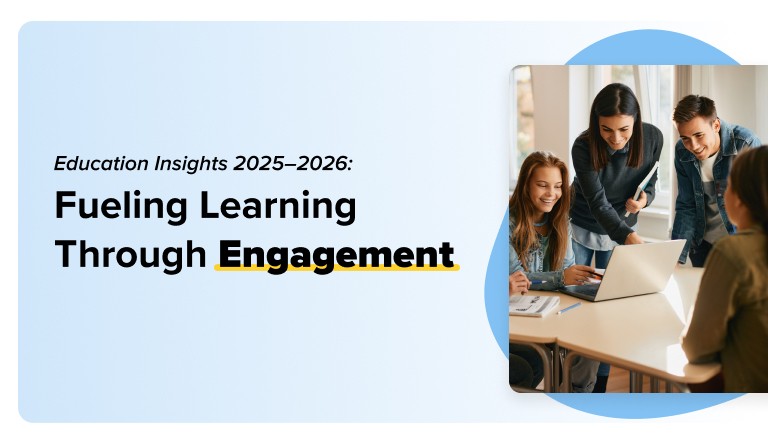
While there is wide agreement that student engagement plays a vital role in learning, educators continue to face uncertainty about what engagement looks like, how best to measure it, and how to sustain it, according to a new study from Discovery Education.
“Discovery Education conducted the EducationInsights report to gain a deeper understanding of how engagement is defined, observed, and nurtured in K-12 classrooms nationwide, and we are thankful to the participants who shared their perspectives and insights with us,” said Brian Shaw, Discovery Education’s Chief Executive Officer. “One of the most important findings of this report is that engagement is seen as essential to learning, but is inconsistently defined, observed, and supported in K-12 classrooms. I believe this highlights the need for a more standardized approach to measuring student engagement and connecting it to academic achievement. Discovery Education has embarked on an effort to address those challenges, and we look forward to sharing more as our work progresses.”
Key findings of the Education Insights 2025–2026: Fueling Learning Through Engagementreport include:
Engagement is broadly recognized as a key driver of learning and success. Ninety-three percent of educators surveyed agreed that student engagement is a critical metric for understanding overall achievement, and 99 percent of superintendents polled believe student engagement is one of the top predictors of success at school. Finally, 92 percent of students said that engaging lessons make school more enjoyable.
But educators disagree on the top indicators of engagement. Seventy-two percent of teachers rated asking thoughtful questions as the strongest indicator of student engagement. However, 54 percent of superintendents identified performing well on assessments as a top engagement indicator. This is nearly twice as high as teachers, who rank assessments among the lowest indicators of engagement.
School leaders and teachers disagree on if their schools have systems for measuring engagement. While 99 percent of superintendents and 88 percent of principals said their district has an intentional approach for measuring engagement, only 60 percent of teachers agreed. Further, nearly one-third of teachers said that a lack of clear, shared definitions of student engagement is a top challenge to measuring engagement effectively.
Educators and students differ on their perceptions of engagement levels. While 63 percent of students agreed with the statement “Students are highly engaged in school,” only 45 percent of teachers and 51 percent of principals surveyed agreed with the same statement.
Students rate their own engagement much higher than their peers. Seventy percent of elementary students perceived themselves as engaged, but only 42 percent perceived their peers as engaged. Fifty-nine percent of middle school students perceived themselves engaged in learning, but only 36 percent perceived their peers as engaged. Finally, 61 percent of high school students perceived themselves as engaged, but only 39 percent described their peers as engaged.
Proximity to learning changes impressions of AI. Two-thirds of students believe AI could help them learn faster, yet fewer than half of teachers report using AI themselves to complete tasks. Only 57 percent of teachers agreed with the statement “I frequently learn about positive ways students are using AI,” while 87 percent of principals and 98 percent of superintendents agree. Likewise, only 53 percent of teachers agreed with the statement “I am excited about the potential for AI to support teaching and learning,” while 83 percent of principals and 94 percent of superintendents agreed.
A new study reveals that while there is wide agreement that student engagement plays a vital role in learning, educators continue to face uncertainty about what engagement looks like, how best to measure it, and how to sustain it. Education Insights 2025–2026: Fueling Learning Through Engagementcaptures prevailing attitudes and beliefs on the topic of engagement from 1,398 superintendents, teachers, parents, and students from across the United States. Survey data was collected in May 2025 by Hanover Research on behalf of Discovery Education, the creators of essential PreK-12 learning solutions used in classrooms around the world.
“Discovery Education conducted the EducationInsights report to gain a deeper understanding of how engagement is defined, observed, and nurtured in K-12 classrooms nationwide, and we are thankful to the participants who shared their perspectives and insights with us,” said Brian Shaw, Discovery Education’s Chief Executive Officer. “One of the most important findings of this report is that engagement is seen as essential to learning, but is inconsistently defined, observed, and supported in K-12 classrooms. I believe this highlights the need for a more standardized approach to measuring student engagement and connecting it to academic achievement. Discovery Education has embarked on an effort to address those challenges, and we look forward to sharing more as our work progresses.”
Key findings of the Education Insights 2025–2026: Fueling Learning Through Engagementreport include:
Engagement is broadly recognized as a key driver of learning and success. 93% of educators surveyed agreed that student engagement is a critical metric for understanding overall achievement, and 99% of superintendents polled believe student engagement is one of the top predictors of success at school. Finally, 92% of students said that engaging lessons make school more enjoyable.
But educators disagree on the top indicators of engagement. 72% of teachers rated asking thoughtful questions as the strongest indicator of student engagement. However, 54% of superintendents identified performing well on assessments as a top engagement indicator. This is nearly twice as high as teachers, who rank assessments among the lowest indicators of engagement.
School leaders and teachers disagree on if their schools have systems for measuring engagement. While 99% of superintendents and 88% of principals said their district has an intentional approach for measuring engagement, only 60% of teachers agreed. Further, nearly 1/3 of teachers said that a lack of clear, shared definitions of student engagement is a top challenge to measuring engagement effectively.
Educators and students differ on their perceptions of engagement levels. While 63% of students agreed with the statement “Students are highly engaged in school,” only 45% of teachers and 51% of principals surveyed agreed with the same statement.
Students rate their own engagement much higher than their peers. 70% of elementary students perceived themselves as engaged, but only 42% perceived their peers as engaged. 59% of middle school students perceived themselves engaged in learning, but only 36% perceived their peers as engaged. Finally, 61% of high school students perceived themselves as engaged, but only 39% described their peers as engaged.
Proximity to learning changes impressions of AI. Two-thirds of students believe AI could help them learn faster, yet fewer than half of teachers report using AI themselves to complete tasks. Only 57% of teachers agreed with the statement “I frequently learn about positive ways students are using AI,” while 87% of principals and 98% of superintendents agree. Likewise, only 53% of teachers agreed with the statement “I am excited about the potential for AI to support teaching and learning,” while 83% of principals and 94% of superintendents agreed.
A complete copy of Education Insights 2025–2026: Fueling Learning Through Engagementcan be downloaded here.
On Wednesday, October 8 at 2:00 PM ET, Discovery Education is hosting a special, town hall-style webinar during which education leaders from across the nation will share their thoughts and insights on this report and its findings. Find more details and register for this event here.
About Discovery Education Discovery Education is the worldwide edtech leader whose state-of-the-art, PreK-12, digital solutions help educators engage all students and support higher academic achievement. Through award-winning multimedia content, instructional supports, and innovative classroom tools that are effective, engaging, and easy to use, Discovery Education helps educators deliver powerful learning experiences. Discovery Education serves approximately 4.5 million educators and 45 million students worldwide, and its resources are accessed in over 100 countries and territories. Through partnerships with districts, states, and trusted organizations, Discovery Education empowers teachers with essential edtech solutions that inspire curiosity, build confidence, and accelerate learning. Learn more at www.discoveryeducation.com.
On 18 July, U.S. legislators voted to rescind more than one billion dollars in funding previously allotted to the Public Broadcasting Service (PBS), a nonprofit network of television and radio stations partly funded by the U.S. government.
The cuts put at risk educational and training programs geared to young people across the country.
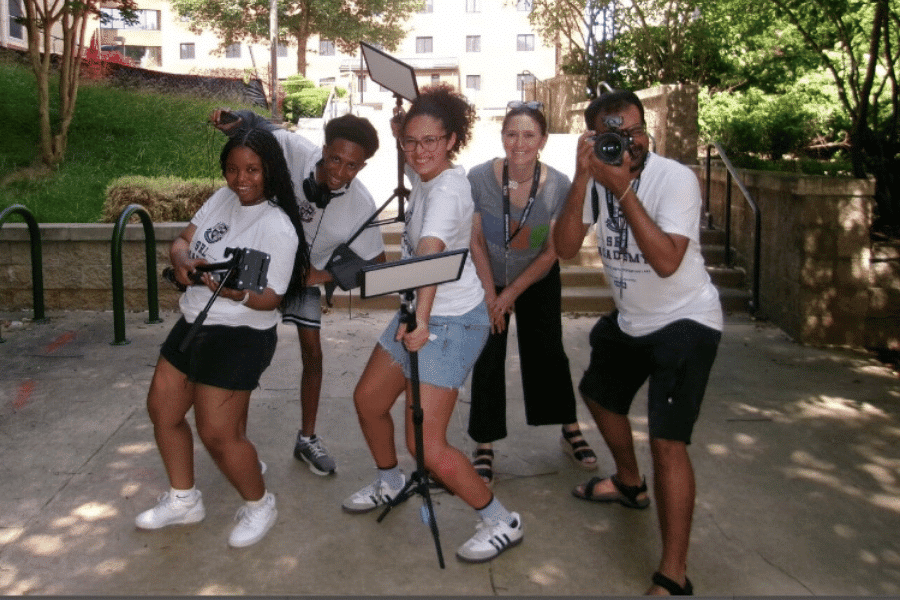
Student Reporting Labs (SRL) is a U.S.-based journalism training program for young people and their educators. On 23 July, Global Youth & News Media, a France-based nonprofit dedicated to encouraging and honoring news media engagement with the young, awarded SRL its Prize for Outstanding Achievement in Journalism.
“This award is in recognition of the program’s impactful history and determination to continue its unmatched work to introduce young people throughout the United States to local broadcast journalism,” said Aralynn McMane, executive director of Global Youth & News Media. “In voting to bestow this award, our board was unanimous and adamant about the need to shine a spotlight on Student Reporting Labs to remind the world of what short-sighted politics risks destroying in the wake of defunding public broadcasting.”
The importance of youth journalism
This is only the second time the Global Youth & News Media board has bestowed such an honorary award. The first was in 2018 for joint live coverage of the March For Our Lives anti-gun demonstration by The Guardian US with Eagle Eye News student reporters from Marjory Stoneman Douglas High School in Florida, which had seen the killing of 18 people at the school just three weeks prior.
Founded in 2009 by Leah Clapman, then the managing editor of education at PBS NewsHour, Student Reporting Labs has helped build broadcast and journalism programs in thousands of secondary schools across all 50 states.
The program connects them with over 40 public television stations and local news organizations to bring their story to local audiences. SRL empowers the next generation of storytellers by providing free training fellowships and workshops to students and educators across the country and around the world. In all, more than 125,000 students have participated in the program.
SRL also reaches more than 10,000 educatorsvia a free learning platform StoryMaker. StoryMaker provides teachers with instruction materials and lessons to help students think critically, explore their curiosity about the world and engage in their communities.
The SRL program was established “on the premise that some stories are best told by young people,” Clapman, now full-time executive director of SRL, wrote in a briefing last week. ”This is especially true in this moment of rapid change and disruption. In this challenging time, we’re leaning in to perseverance and service rather than despair.”
Mentoring teens to tell important stories
Clapman wrote that newsrooms can benefit from the important perspectives, experiences and insights that teens have and that these perspectives can help news organizations tell more nuanced and complete stories about issues that affect students.
One such teenager that the Student Reporting Labs trained was award-winning alumna Mary Williams, who joined the program in 2015 and interned at her local PBS station in Ohio.
“Now when I see the news, it’s personal,” she said. “The economy, education system and the Earth’s current state aren’t just my parents’ problems to worry about. They’re mine, too.”
The Global Youth & News Media Prize for journalism this year focused on youth collaborations that help local news media survive. The rest of the laureates were chosen by an international expert jury and will be announced in the coming weeks. News Decoder, which trains and encourages young people to develop global perspectives in storytelling, is a partner in the award and helped judge the entries.
News Decoder Educational News Director Marcy Burstiner said that it is more important than ever to recognize the important work young journalists are doing.
“It seems that in the United States and elsewhere there is a war on journalism and truth telling,” Burstiner said. “I used to tell my students that it was a myth that you needed a thick skin to be a journalist. But these days, you do.”
But every year, News Decoder finds more and more young people stepping up to the challenge, Burstiner said.
“They aren’t afraid to tell the important stories that need to be told,” she said. “But people need to support the organizations like PBS News Student Reporting Labs that help and encourage young people to be truth tellers.”
It’s never too early, but it can be too late. This simple phrase has transformed our advising sessions with graduate students and postdocs, resonating deeply with those navigating the uncertain waters of career transitions. As career advising experts who have guided countless individuals through this journey, we have seen firsthand the power of early career planning and the pitfalls of procrastination.
Today’s graduate students and postdocs are navigating more than just personal uncertainty. They are facing a rapidly shifting professional landscape influenced by political and societal forces beyond their control. The value of advanced degrees is being questioned in public discourse; funding cuts, hiring freezes and massive layoffs are affecting job prospects; and visa restrictions continue to impact international scholars. These trends are unsettling, but they underscore the same truth: Proactive, flexible career planning is necessary.
The path from graduate school or a postdoctoral position to a fulfilling career is rarely a straight line. We understand; we both hold Ph.D.s and were postdocs ourselves. Yet, many students and early-career researchers delay thinking about their next steps, often until the pressure of impending graduation or the end of an appointment looms large. This delay can turn the exciting question of “What’s next?” into the anxiety-inducing “What now?”
One common fear we encounter in our advising sessions is the fear of the unknown, and now more than ever, our best advice remains the same: Start sooner rather than later. When harnessed properly, this fear can become a powerful motivator for early career planning. If you build in time to explore your options, test possibilities and develop a flexible plan, you will be far better equipped to navigate unforeseen changes.
Crucially, starting early does not mean locking yourself into one path. It means giving yourself enough time to adapt, explore and build a more informed and confident future, even if that future changes along the way.
Your Hidden Advantage
As graduate students or postdocs, you are in a unique position: You are essentially being paid to learn and become experts in your field. Beyond your specific area of study, you also have access to a wealth of resources at your research institutions designed to support your professional development. These resources include:
Career services: Do not wait until your final year to visit the career office. Start early and make regular appointments to discuss your evolving career goals and strategies. Career service professionals can help you save precious time and effort and remain advocates for you in your career-exploration journey. Many of us know exactly how you are feeling because we have been there, too!
Workshops and seminars: Attend professional and career-development workshops offered by your institution. These often cover crucial topics like résumé writing, interview preparation or networking strategies.
Alumni networks: Leverage your institution’s alumni network. Alumni can provide valuable insights into various career paths, and many are eager to help current graduate students and postdocs navigate the job search process.
Professional associations: Join relevant professional associations in your field. Many offer graduate students and postdocs memberships at reduced rates and provide access to job boards, conferences, networking events and leadership opportunities.
International student and scholar services: If you are on a visa, connect early with your institution’s international center. These offices can offer critical guidance on work authorization options, strategies for transitioning from an academic-sponsored visa to another type of professional visa (such as the H-1B visa) and long-term planning toward permanent residency. They can also connect you with immigration attorneys and employer resources to help you advocate for yourself throughout the process.
Now is the time to take action. This month, schedule an appointment with your institution’s career services office (trust us, we are excited to meet and help you) and/or attend a networking event or workshop outside your immediate field of study.
If your plan involves stepping beyond the academic landscape, do not underestimate the power of building your professional network, as referrals and recommendations play a growing role in hiring decisions. The relationships you build now, through informational interviews, mentorship and community engagement, can become invaluable sources of insight, opportunity and support throughout your career.
The Perils of Procrastination
Waiting until the final months of your program or position to begin your job search is a recipe for stress and missed opportunities. Early preparation not only reduces anxiety but also allows you to explore multiple career paths, build necessary skills and make meaningful connections.
As career professionals, we see the impact of procrastination all the time: rushed applications, unclear goals, missed deadlines and tremendous stress. In our own career-exploration journey, we have been fortunate to experience the opposite. Our approach to prepare early opened doors to valuable opportunities and reduced the pressure to find just any job at the end of our postdoc. That contrast is a big reason why we now advocate so strongly for starting career planning before urgency sets in, even if you are still figuring out where you want to go.
So what does early preparation look like?
If you already have a strong idea of your next career step, whether it is to become faculty at a R-1 institution or secure an R&D position in industry, you should begin preparing at least a year before your intended transition. This gives you time to identify target roles, network meaningfully, develop your application materials and be ready when opportunities arise.
If you are still unsure about what your next career step is, start your exploration journey as soon as possible. Identifying careers of interest, scheduling informational interviews, developing your professional network in the areas of interest and learning or building new skills take time. Remember that the earlier you begin, the more options you will be able to explore. Career planning is not just for people with a clear path—it is also how you find your path.
Another critical reason to start early? Networking. Building professional relationships is one of the most powerful tools in your career exploration and job search tool kit, but it takes time. The best networking conversations happen when you are genuinely curious and not urgently seeking a job. If you wait until you are in crisis mode, panicked, pressed for time and desperate for a position, that energy can unintentionally seep into your conversations and make them less effective. By starting to connect with people well before you are actively applying for jobs, you can ask better questions, get clearer insights and build authentic relationships that may open doors later on.
The International Perspective
International graduate students and postdocs are navigating career planning under especially difficult circumstances. The experience of working and building a life in another country already comes with challenges, what with being far from home, managing complex visa systems and building support networks from scratch. With the current increasing political scrutiny, shifting immigration policies and rising uncertainty around international education, the pressure has only grown.
We want to acknowledge that this is not just a logistical issue—it is also an emotional one. For many international scholars, the stress of career planning is compounded by fears about stability, belonging and being able to stay in the country to which you have contributed so much. These are not easy conversations, and they should not be faced alone.
That is why early, informed and strategic planning is especially important. With the right tools, guidance and support system, you can better navigate the uncertainty and advocate for your future.
Use your resources. Connect early and often with your university’s international student or scholar office. They can clarify visa timelines, regulations and documentation requirements.
Get legal support. Consult with a qualified immigration attorney who can help you understand your options and advocate for you.
Network with intention. Seek out events, professional associations and communities that are welcoming to international scholars. These relationships can lead to valuable advice, referrals or even job opportunities.
While visa policies and political rhetoric may be out of your control, the way you prepare and position yourself is not. Planning ahead can help you reduce uncertainty, take advantage of time-sensitive opportunities and build a support system to help you succeed wherever your career takes you.
Know Your Path to Success
Many students and postdocs have a clear vision of their desired career but lack understanding of how to get there. For example, many aspiring faculty underestimate how important it is to gain teaching experience or to have early conversations with their supervisor about which projects they can pursue independently for their future research statements. Similarly, those aiming for roles in industry or policy may overlook essential skills such as project management, stakeholder communication or regulatory knowledge until they begin applying and realize the gap.
Career paths are often shaped by more than just qualifications. They are influenced by relationships, timing, self-awareness and luck, but especially by the ability to recognize and act on opportunities when they arise. That is why we often reference “planned happenstance,” a career-development theory by John Krumboltz, which encourages people to remain open-minded, take action and position themselves to benefit from unexpected opportunities. It is not about having a rigid plan, but about preparing enough that you can pivot with purpose.
Here are three practical strategies to help you do just that:
Conduct informational interviews: Speak with professionals in your target roles for invaluable insights into their day-to-day realities and career paths. Ask about those hidden requirements—the transferable skills and experiences crucial for success, but not necessarily listed in job descriptions. Use this knowledge to identify and address skill gaps early in your academic journey.
Perform skill audits: Regularly assess your skills against job descriptions in your desired field and identify gaps you need to address through coursework, volunteer experiences or side projects.
Seek mentorship: A good mentor can provide guidance, open doors and help you avoid common pitfalls in your career journey. Consider building a network of mentors rather than relying on a single person; different mentors can support different aspects of your professional growth. Your career services office is a great place to start!
Early planning gives you the ability to shape your own narrative, develop key experiences intentionally and take advantage of unexpected opportunities. Do not wait to be ready to start; start now, and readiness will come.
Start Here: A Career Planning Checklist
Career planning does not have to be overwhelming. Small steps, taken consistently, can lead to powerful outcomes, whether you are in year one of a Ph.D. program or year four of a postdoc. Use this checklist to begin or re-energize your professional development journey.
This month, try to:
Schedule a career advising appointment—even if you’re “just exploring.”
Attend one workshop or seminar outside of your research area.
Reach out to someone for an informational interview (a colleague, alum or speaker whose path interests you).
Identify one skill you want to build in the coming months and one way to begin (e.g., take a course, volunteer, shadow someone).
Join or re-engage with a professional association or community.
By starting your career planning early, you are not just preparing for a job: You are laying the foundation for a fulfilling career. Small, consistent efforts can lead to significant results over time. The resources available to you as graduate students and postdocs are invaluable, but only effective if you use them. Do not wait for your future to happen; start building it today!
Ellen Dobson, G.C.D.F., is the postdoctoral and graduate program manager at the Morgridge Institute for Research, where she leads professional and career-development programming for early-career researchers. Drawing on her experience as a Ph.D., postdoc and staff scientist, she is dedicated to helping graduate students and postdocs explore fulfilling career paths through supportive, practical guidance.
Anne-Sophie Bohrer is the program manager for career and professional development in the Office of Postdoctoral Affairs at the University of Michigan. In this role, she leads the development of programs to support postdoctoral fellows from all disciplines.
The Equality and Human Rights Commission is the regulator for equality and human rights issues. We intervened in the case of The University of Bristol v Dr Robert Abrahart to provide guidance to the court about the Equality Act 2010. The Act has been in force for over 10 years, so the legal duties contained within it are not new. However, we were concerned that there was confusion about how those duties are interpreted in the higher education sector.
Natasha Abrahart was 20 years old when she took her own life in April 2018. Her lecturers were aware that she was not well, noting that she did seem to have ‘a genuine case of some form of social anxiety’. However, no reasonable adjustments were made to how she was assessed, and she was still expected to attend oral interviews and participate in a group presentation. The University argued that oral communication was a ‘competence standard’, which is specifically excluded from the reasonable adjustments duty under the Equality Act.
The definition of disability is broad. Under Section 7 and Schedule 1 of the Equality Act, disability is defined as a physical or mental impairment that has a substantial and long-term adverse effect on a person’s ability to complete daily activities. ‘Long-term’ includes likely to last for more than 12 months. Although Natasha Abrahart suffered from a mental illness, physical conditions are also covered by the Act.
The court found that the University had indirectly discriminated against Natasha, discriminated against her as a consequence of her disability, and failed to make reasonable adjustments for her. The court also gave guidance to the sector, which we have distilled into our Advice Note.
The duties on universities are set out in law, which has been in force for approaching 15 years. Further, the duties apply to all students (and staff members) whether they attend university for a single term or for the rest of their student career.
Three of the key takeaways from the judgment relate to knowledge, evidence and competence standards.
In relation to knowledge, if one member of staff at a university knows about a student’s disability, then the whole university knows, and the duties not to discriminate take effect. So, if a student only tells the most junior administrator about their disability, and that staff member doesn’t pass the information on, the university is nonetheless bound by the Equality Act.
With regard to evidence, the judge in the Abrahart case said:
‘…what a disabled person says and does is evidence. There may be circumstances, such as urgency or the severity of their condition, in which a court will be prepared to conclude that it is sufficient evidence for an educational institution to be required to take action.’
This makes clear that it is not appropriate for a university to insist that a disabled student provide a doctor’s letter when the student is clearly severely ill. The duty on the university is to act, even where there is no formal medical diagnosis or evidence. There is no reciprocal duty on the student.
Competence standards are academic, medical or other standards applied for the purpose of determining whether or not a student has reached a particular level of competence or ability. A student has to reach the standard to show that they have attained the necessary level to pass or proceed on their course of studies. However, the way in which a competence standard is measured is still subject to the reasonable adjustments duty, so adjustments must be made to the method of assessment. The court found that the way in which a student’s level of knowledge or understanding, or the way their ability to actually complete the task is measured, is the method of assessment. It said this is rarely, if ever, a competence standard.
Our Advice Note provides some guidance on steps universities can take to ensure that they are complying with the Equality Act.
In addition to complying with the law, there are other potential benefits for institutions in taking those steps. These include providing a better student experience by prioritising student welfare, and reducing pressures on staff. It also allows students to gain valuable experience which will benefit them in working alongside disabled colleagues when they enter the workforce.
However, alongside the benefits to staff and student wellbeing, there are consequences for failing to comply with Equality Act duties.
Higher education students may complain to the Office of the Independent Adjudicator for Higher Education (OIAHE) in England and Wales, or to the Ombudsman in Scotland and Northern Ireland. Complaints can result in financial redress and recommendations for improvement. The OIA also publishes annual statements setting out each institution’s performance.
Students may also bring litigation in the County Court under the Equality Act. This is what Dr and Mrs Abrahart did, and it resulted in the payment of considerable damages to them by the University of Bristol, not to mention the additional costs to the University of defending complex litigation. We anticipate that the spotlight currently shining on this issue may well see an increase in these cases. Litigation can also be reputationally damaging.
There may be issues about breaches of contract where universities fail to make reasonable adjustments when these have been recommended by the Disability Service. From our perspective, the outcome of any such dispute does not detract from a separate and distinct obligation to comply with the Equality Act 2010, which is a distinct cause of action.
Of interest to the higher education sector, the Equality and Human Rights Commission may take regulatory action if institutions fail to comply with the Equality Act. We have a range of legal powers, including investigating organisations where we suspect a breach of the Act. As an alternative to an investigation, the Commission can enter into agreements and action plans with organisations to achieve compliance with the law.
We know that there is a great deal of excellent work taking place across the sector. For example, Oxford University is working on incorporating inclusivity into its teaching practices, with the joint benefits of making the environment more welcoming for disabled students and allowing its Disability Service to act as consultants on the most complex cases. The University of Bristol recently updated its regulations, is undertaking staff training, and continues with its programme of improvement to its wellbeing services. And the Open University has completed a mapping exercise to identify the key ‘crunch points’ faced by disabled students in their education journey and is working to embed robust escalation processes to ensure that adjustments are made when needed.
Reasonable adjustments could help hundreds of thousands of disabled students across the country reach their potential, and we have to make sure those students can access them. We know that the higher education sector is working hard, with limited resources, to address the issue. As Britain’s equality regulator, we will continue to support the sector as universities adapt to meet their legal duties to disabled students.
With your experience in the education field, you likely understand the benefits of cultivating strong relationships with current members of your school community. What many school administrators and marketers forget is that alumni, though they no longer attend a school, are invaluable to educational marketing strategy and an institution’s overall growth. If you haven’t already, it’s time to examine how your school can build a strong alumni network as part of your marketing efforts and general institutional development.
An alumni network is one of the most valuable assets a school can cultivate. Your graduates are living proof of your programs’ effectiveness. Their journeys from classroom to career serve as compelling testimonials that not only strengthen institutional reputation but also attract prospective students who seek assurance that your school can set them up for success. Join us as we discuss what an effective alumni network should look like, the benefits you can expect, and how to get started.
Struggling with enrollment?
Our expert digital marketing services can help you attract and enroll more students!
What’s an Alumni Network?
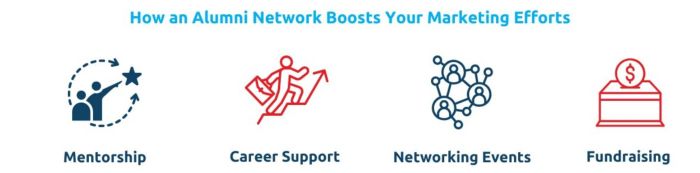
At its core, an alumni network is a community of former students who remain engaged with their alma mater. This engagement can take many forms, from mentorship opportunities and career support to networking events and fundraising initiatives. A well-developed alumni network fosters lifelong connections, enabling graduates to support each other while strengthening the institution that provided their foundation.
Enriching Education: The Power of an Alumni Network
When alumni feel connected to their school, they become brand ambassadors, willingly sharing their success stories and contributing to a culture of loyalty and pride. These graduates are more likely to participate in career panels, donate to scholarship funds, and advocate for your institution within their professional circles. Most importantly, their success becomes a tangible example of your school’s impact, which is a powerful marketing tool in itself.
Alumni relationships create a dynamic ecosystem of support, mentorship, and career growth. So in summary, why is alumni networking important? It plays a crucial role in helping graduates navigate their professional journeys, opening doors to job opportunities, industry insights, and collaborative ventures. An engaged alumni network ensures students are stepping into a lifelong professional community that enhances their career trajectory. For schools, this network fosters goodwill and credibility, proving that your programs produce graduates who thrive in competitive industries.
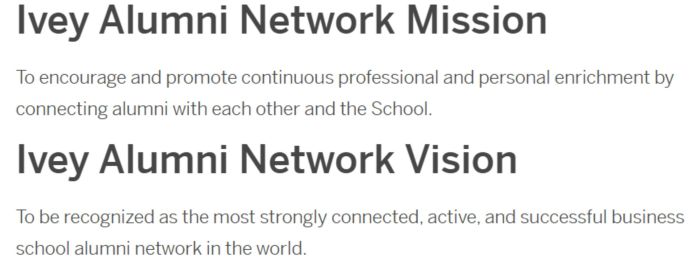
Example:On a dedicated alumni network page on their website, Ivey Business School plainly states the objective of their program” To encourage and promote continuous professional and personal enrichment by connecting alumni with each other and the school”. The alumni network is positioned as a resource for career development and support for graduates.
Source: Ivey Business School
The Unique Marketing Benefits of Alumni Networks
Now that higher education is increasingly competitive, the ability to showcase real-world success is crucial. What is the value of alumni networks when it comes to your marketing strategy? Alumni networks are excellent social proof, providing great opportunities for organic traffic, and showcasing how your school facilitates career development. Here’s how:
Your Alumni Network Offers Valuable Social Proof
In an education marketing context, social proof refers to the credibility and trust institutions build by showcasing the success and satisfaction of their alumni, current students, and faculty. When prospective students see tangible examples of graduates thriving in their careers, testimonials from successful alumni, or high employer satisfaction rates, they gain confidence that choosing your school is a worthwhile investment.
Social proof can take many forms, including video testimonials, alumni spotlights, employer endorsements, rankings, and word-of-mouth referrals. A strong alumni network serves as a powerful form of social proof, demonstrating that your institution provides quality education and equips graduates with the skills, knowledge, and professional connections necessary for long-term success.
Alumni success stories create a compelling narrative that validates the effectiveness of your curriculum, the strength of your career support services, and the credibility of your institution as a whole. Whether through personal testimonials, LinkedIn endorsements, or employer recommendations, alumni reinforce the value of your educational offerings in a way that no traditional marketing message can replicate.
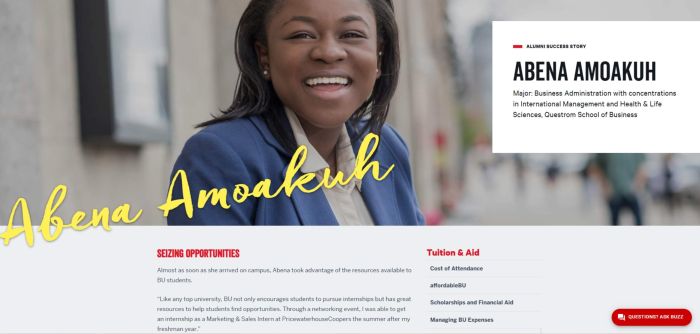
Example:On their website, Boston University showcases alumni success stories that highlight educational and career development opportunities like internships and networking events. The success of graduates provides valuable social proof for prospective students, who can identify with and look up to these role models.
Source: Boston University
Driving Organic Traffic
An engaged alumni network plays a crucial role in generating organic traffic through word-of-mouth marketing. When alumni have a positive experience with your institution, they naturally become enthusiastic advocates, sharing their journey with peers, family members, and colleagues. This organic promotion is highly credible because it comes from real-life experiences rather than institutional messaging.
Beyond personal referrals, alumni contribute to organic traffic through their online presence. When they mention your school on LinkedIn, post about their achievements on social media, or participate in professional discussions related to their field, they create a ripple effect that drives interest in your institution. Schools can amplify this impact by encouraging alumni to tag their alma mater in their career updates, engage in school-sponsored events, and contribute to online discussions within alumni groups.
Additionally, search engines favor authentic, frequently updated content. When alumni success stories are featured on your website, blog, or social media channels, they provide valuable, keyword-rich content that enhances search visibility. Prospective students searching for insights on career outcomes in their chosen field may stumble upon these stories, further reinforcing your school’s credibility and increasing inquiries and applications.
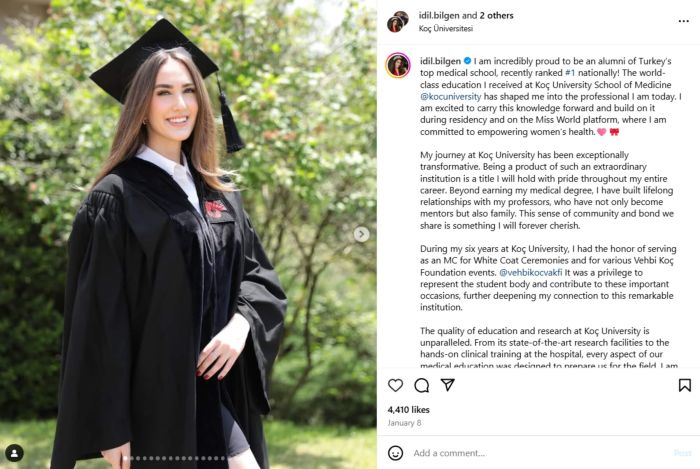
Example: Here an alumni from Koç University in Turkey posts a very valuable testimonial, even tagging her alma mater and citing it as the #1 medical school in the country. In addition to an official alumni network, encouraging UGC from graduates is an effective strategy that comes across as authentic and therefore, trustworthy. Ask alumni to tag your school in graduation posts or list you in the education section of their LinkedIn profiles for organic traffic.
Source: Instagram
Mentorship and Career Services as a Unique Selling Point
An active alumni network can significantly enhance a school’s career services by establishing mentorship opportunities and creating a direct pathway for graduates to secure employment. When alumni hold influential positions in various industries, they become a valuable resource for current students and recent graduates looking to break into their fields. Schools that foster strong alumni engagement can tap into this network to offer students real-world insights, industry-specific guidance, and professional connections that go beyond what traditional career services can provide.
By collaborating with alumni who have become hiring managers, entrepreneurs, or industry leaders, schools can develop a reliable talent pipeline that benefits both graduates and employers. Alumni who feel a deep connection to their alma mater are more likely to offer internship programs, job placements, and networking opportunities tailored specifically to students from their former institution. These partnerships not only enhance job placement rates but also reinforce the credibility of your programs, proving to prospective students that your institution delivers real career outcomes.
Moreover, alumni mentors can serve as role models, helping students navigate their career paths through professional guidance and hands-on training. Schools can structure formal mentorship programs where alumni are paired with students based on career interests, fostering long-term professional relationships that extend well beyond graduation. These interactions boost student confidence, provide practical career advice, and offer an inside look at industry trends and expectations.
When alumni return to recruit from their alma mater, it strengthens the institution’s reputation as a trusted source of skilled professionals. This cyclical relationship, where alumni continuously contribute to the success of new graduates, creates a sustainable ecosystem of career support and growth.
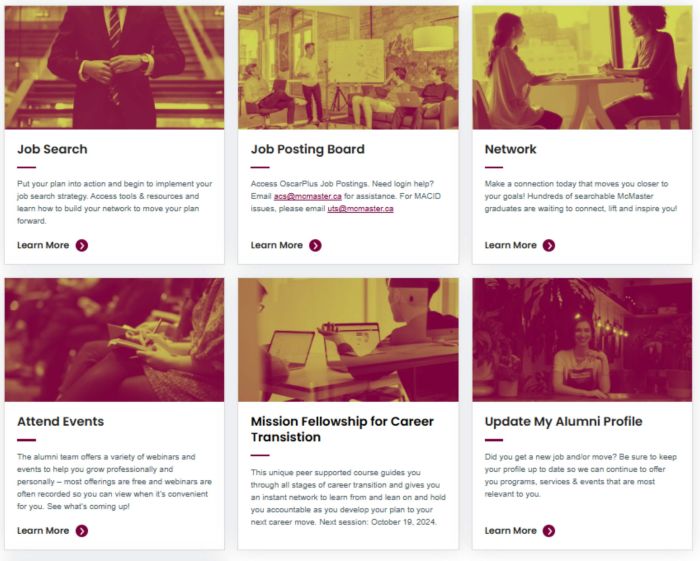
Example: McMaster University has an Alumni Services page that highlights all of the career advantages that come with being part of their alumni network. Be sure to put all of the career benefits that your alumni network offers on full display so that you can leverage them as part of the FAB marketing strategy (features, advantages, and benefits), an effective form of brand storytelling that encourages prospective students to vividly imagine their success at your institution.
Source: McMaster University
Building a Strong Alumni Network
If you want to harness the power of alumni networks, it starts with cultivating meaningful relationships from the moment students enroll. Establishing a culture of connection early on makes it easier to keep graduates engaged long after they receive their diplomas.
One of the most effective ways to build a thriving alumni network is through dedicated alumni associations. These groups should not merely exist on paper but should be actively nurtured with opportunities for engagement, such as career workshops, networking events, and mentorship programs. Leveraging digital platforms, such as LinkedIn and exclusive alumni portals, helps create spaces where former students can stay in touch, share job openings, and collaborate on projects.
Personalized outreach is key to maintaining long-term engagement. Schools that take the time to check in with alumni (through newsletters, exclusive events, or professional development opportunities) demonstrate continued investment in their graduates’ success. This encourages reciprocity, as alumni become more willing to give back, whether through donations, guest lectures, or referrals.
Video testimonials featuring alumni discussing how your programs shaped their careers are incredibly effective. Highlighting their professional achievements, career transitions, and personal growth builds trust with prospective students who are weighing their options. Success stories can be embedded into your website, showcased on social media, and included in email campaigns.
Featuring alumni in live webinars or Q&A sessions allows prospective students to ask direct questions about career outcomes. This real-time engagement adds credibility to your institution’s claims, reinforcing the message that your graduates excel in their fields. Schools that leverage alumni networks in these ways transform passive viewers into engaged applicants.
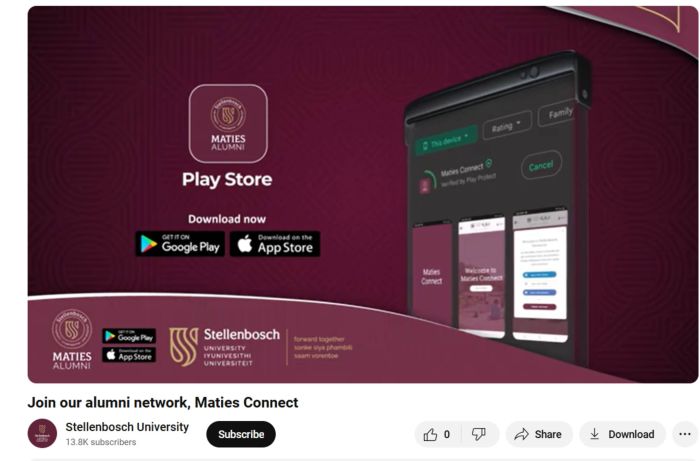
Example: Get creative with your alumni recruitment strategy! Here, Stellenbosch University promotes its alumni network app, Maties Alumni, on YouTube – an exclusive, all-in-one platform for nurturing alumni relationships, career opportunities, mentorship, and personal connections.
Source: Stellenbosch University | YouTube
Elevating Your School’s Reputation Through Alumni Success
Ultimately, the strength of your alumni network is a reflection of the strength of your institution. Schools that prioritize alumni engagement are not only fostering lifelong relationships but are also investing in an authentic, powerful marketing strategy. By celebrating alumni achievements, maintaining strong communication channels, and integrating success stories into recruitment efforts, you can build lasting credibility and attract the next generation of students eager to follow in their graduates’ footsteps.
If your institution is looking for ways to enhance engagement and incorporate alumni networks into your marketing strategy, Higher Education Marketing can help you develop targeted campaigns that amplify your alumni success stories and drive enrollment growth. Your graduates are your greatest success. Make sure their voices are heard!
Struggling with enrollment?
Our expert digital marketing services can help you attract and enroll more students!
Frequently Asked Questions
Question: Why is alumni networking important?
Answer: It plays a crucial role in helping graduates navigate their professional journeys, opening doors to job opportunities, industry insights, and collaborative ventures.
Question: What is the value of alumni networks?
Answer: Alumni networks are excellent social proof, provide great opportunities for organic traffic, and showcase how your school facilitates career development.