Tag: Improve

  • How colleges can improve financial efficiency with accounting software

    How colleges can improve financial efficiency with accounting software

    Today’s higher education requires financial efficiency. Outdated accounting processes cause financial inefficiencies in 73% of higher education institutions, according to a 2024 EDUCAUSE analysis. Right software can fix that. Here are 7 benefits of utilizing the best college accounting software, backed by numbers, automation, and improved decision-making.


    Why College Accounting Systems Need Improvement

    College economics are more complicated than ever due to shifting enrollments, diversified revenue streams, and escalating operational expenditures. Reports confirm that up to 30% of administrative time is wasted on manual accounting, resulting in errors, lost income, and lost productivity. Automation for college accounting is no longer optional—it’s game-changing.


    How Colleges Can Improve Financial Efficiency with Accounting Software. 7 Advantages


    1. Usability—simplify complex financial processes

    Do you know 43% of institutions prioritize user-friendliness when purchasing accounting software? The finest solutions enable non-financial workers to manage accounts using intuitive dashboards, drag-and-drop features, and automated reporting.


    2. Flexibility and scalability—grow without financial limits

    Many institutions have 12% yearly enrollment fluctuations, making scalability important. The ideal software expands with your organization as you add programs and revenue streams. Cloud-based upgrades minimize downtime, ensuring operations.


    3. Custom reporting – faster data-driven decision making

    Real-time reporting, according to 67% of officials in higher education, greatly enhances financial decision-making. Imagine being able to instantly have thorough knowledge on grant distributions, operating expenses, and tuition rates, therefore enabling leadership to act on facts rather than speculation.


    4. Reliability – Bid farewell to mistakes and lost data.

    Errors in manual accounting can cost organizations up to 5% of their yearly budget, an intolerable loss. Reliable accounting systems guarantee accurate, real-time tracking of payments, debts, and financial projections. For better processes, it also easily interacts with other campus administration systems.


    5. Automate and synchronize data to reduce administrative tasks

    Accounting automation reduced administrative tasks by 40%. Colleges can distribute resources faster, speed up approvals, and eliminate human error-related income leakage with synchronized data across admissions and payroll systems.


    6. Security – Guard private financial information

    Given 63% of higher education institutions having attacked recently, financial security is not negotiable. Modern accounting systems guarantee that your financial documents are untouchable by illegal hands by means of role-based access, encrypted data storage, and automatic backups.


    7. Efficiency — Save time, cut costs, increase revenue

    Saving time makes money. Academic institutions with accounting automation collect fees 25% faster and spend 18% less. Monitoring finances on the go using mobile and cloud capabilities reduces overhead and improves transparency and cash flow.


    The Bottom Line

    Choice of college accounting software is about developing a smarter, faster, and more robust financial ecosystem, not just convenience. The appropriate software helps universities maximize financial efficiency and future-proof operations through automation, real-time analytics, and cost reductions.

    Has your college been trapped in outmoded accounting? We must embrace intelligent automation-powered financial efficiency. Contact team Creatrix Campus today! 

    Source link

  • 10 Key Strategies to Improve Student Retention

    10 Key Strategies to Improve Student Retention

    Reading Time: 11 minutes

    Student retention is one of the most critical challenges faced by colleges and universities. While recruitment is essential to maintaining a thriving institution, keeping students engaged and enrolled until they complete their programs is just as vital. Why is that? 

    High dropout rates can impact institutional reputation, funding, and overall student satisfaction. As an education marketer, ask yourself: how can you create an experience that ensures students feel supported and motivated to stay the course? You’re in luck because today, we’re discussing the answer to this question at length. 

    Understanding the factors contributing to student retention in higher education is the first step toward building effective marketing strategies that help students persist through their academic journey. From engagement initiatives to personalized support systems, there are various approaches you can take to increase student retention and position your institution as one that truly cares about student success. Let’s explore ten of them together!

    Struggling with enrollment?

    Our expert digital marketing services can help you attract and enroll more students!

    Understanding Retention Marketing

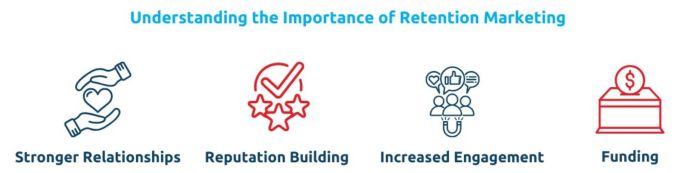
    What is retention marketing? Retention marketing is the strategic use of targeted campaigns, communication, and engagement initiatives that keep current students enrolled and actively involved in their educational journey. Unlike traditional marketing, which focuses on acquiring new students, retention marketing is about maintaining student satisfaction and addressing concerns before they result in attrition. 

    Investing in retention marketing helps schools build stronger student relationships, providing the necessary support to ensure academic persistence. Now let us explore key college student retention strategies to incorporate into your marketing plan.

    HEM Image 2HEM Image 2

    Source: HEM

    1. Personalizing Communication to Address Individual Student Needs

    One of the most effective ways to retain students is through personalized communication. Today’s students expect tailored messaging that speaks directly to their needs, challenges, and aspirations. 

    Automated email campaigns, segmented messaging, and personalized advising can go a long way in making students feel seen and heard. Implementing AI-driven chatbots and predictive analytics can help anticipate student concerns before they escalate, allowing your institution to intervene at critical moments.

    2. Creating a Strong Sense of Community and Belonging

    Feeling connected to a campus community is a key driver of student success. Institutions that foster a sense of belonging through student organizations, mentorship programs, and social events tend to see higher levels of college student retention

    Marketing teams can contribute by showcasing stories of engaged students and alumni, creating social media groups, and facilitating virtual and in-person networking opportunities that keep students feeling involved.

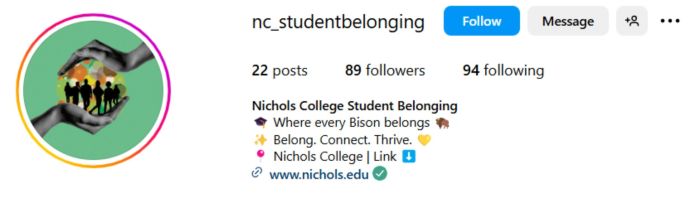
    Example: Here, Nichol’s College demonstrates its commitment to student belonging with a dedicated Instagram for making its current students feel at home. In addition to fostering belonging in your classrooms, clubs, and offices, to improve retention through your digital marketing efforts, it’s essential to champion each student’s role as a valued member of your community in posts and site content.

    HEM Image 3HEM Image 3

    Source: Nichols College | Instagram

    3. Offering Robust Academic Support Services

    Academic challenges are one of the leading reasons students drop out. By promoting tutoring centers, academic coaching, and faculty office hours, your institution can reinforce its commitment to student success. Marketing these services effectively ensures students know where to get help when needed. Outreach campaigns can highlight real student success stories, demonstrating the impact of these resources.

    Beyond traditional support, schools can integrate technology-driven solutions such as virtual tutoring and on-demand academic workshops. Proactively reaching out to students who show signs of struggling, such as declining grades or low attendance, can also prevent academic disengagement. 

    Additionally, faculty can offer structured study groups or mentoring programs to ensure students receive guidance outside of class hours. By fostering a strong academic support network, institutions can significantly improve student persistence and overall satisfaction.

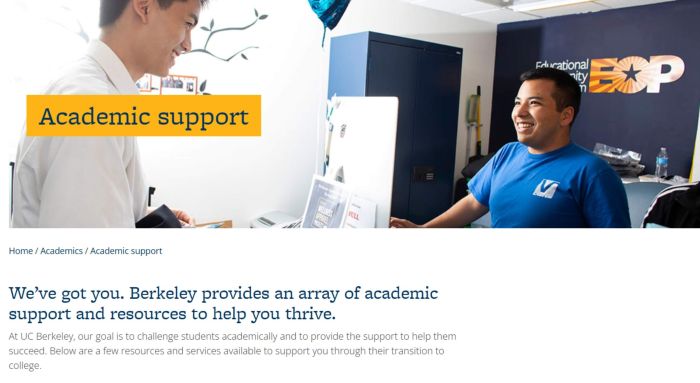
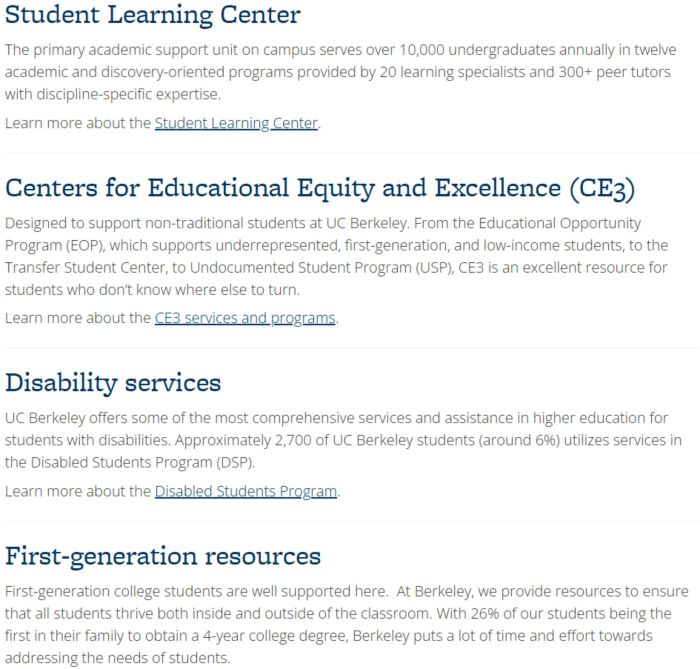
    Example: Discover the robust academic support system available to students at UC Berkeley. On their website, they make it clear that they are committed to meeting the learning needs of every student. Below, you’ll see an array of academic resources tailored to different subgroups of the Berkeley student body. Low-income, underrepresented, first-generation, and students with disabilities are acknowledged and supported to reach their full potential.

    HEM Image 4HEM Image 4

    HEM Image 5HEM Image 5

    HEM Image 6HEM Image 6

    Source: UC Berkeley

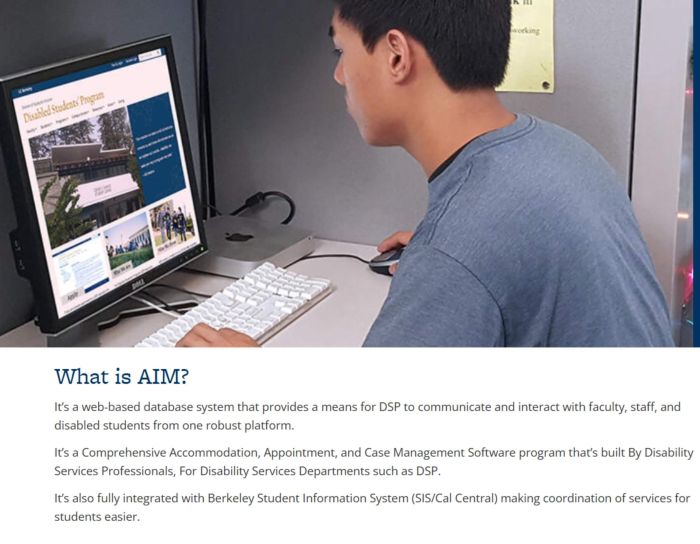
    In addition, UC Berkeley leverages technology to serve its students through the AIM platform, specifically tailored to learners with disabilities. AIM, pictured at the bottom, is an accessible Student Information System designed to facilitate communication between students and faculty, streamline the process of requesting accommodations, and centralize the management of their information.  

    To boost retention, make sure students know how you support their learning. Make it as convenient and inclusive as possible for students to access your resources. 

    4. Providing Career Development Opportunities Early On

    Students often enroll in college with long-term career aspirations in mind, yet many feel uncertain about how to achieve their goals. By integrating career services from day one, schools can help students see a clear pathway from education to employment. Internship programs, networking events, and job placement support should be at the forefront of marketing efforts. When students perceive that their investment in education will lead to tangible career outcomes, they are more likely to persist.

    To enhance engagement, institutions should provide hands-on career workshops, alumni networking events, and mentorship opportunities that connect students with professionals in their fields of interest. Career counselors can conduct personalized career assessments to help students identify potential career paths that align with their strengths and interests. 

    Additionally, integrating career-focused coursework, such as resume-building sessions and mock interviews, can help students feel more confident about their job prospects post-graduation. Schools that establish strong employer partnerships can also facilitate job placement programs, internships, and co-op opportunities that give students real-world experience while still in school, reinforcing their motivation to stay enrolled and complete their studies.

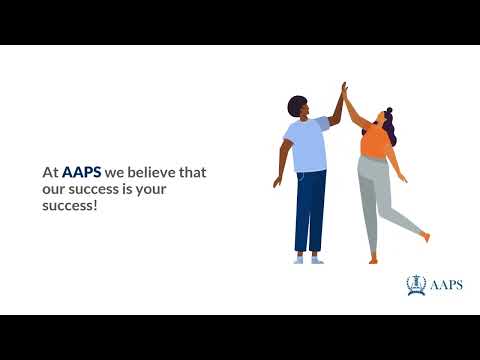
    Example: In this video, AAPS, an institution that mainly appeals to graduate students who are focused on starting or developing their careers, markets its career services which include: access to career and employment experts, resume writing support, and interview workshops.

    YouTube videoYouTube video

    Source: Academy of Applied Pharmaceutical Sciences | YouTube

    Their marketing shows how effective the career services at AAPS are, citing their 100% employer satisfaction rate and a solid 88% graduation rate. As you promote your career services, be sure to provide tangible results because that’s what your prospects and current students are looking for. 

    5. Focus on Student Engagement Initiatives 

    Student engagement plays a crucial role in student retention, as engaged students are more likely to complete their programs and feel a strong connection to their institution. Schools must take proactive steps to foster engagement through meaningful initiatives that encourage academic, social, and extracurricular involvement.

    One way to drive engagement is by creating dynamic student events, such as leadership workshops, cultural festivals, and career networking opportunities. These events provide students with valuable connections, skills, and a greater sense of belonging, reducing feelings of isolation and disengagement.

    Another highly effective strategy is gamification, where game design elements, such as rewards, leaderboards, and challenges, are integrated into academic and extracurricular activities. For instance, you could introduce a points-based system that rewards students for attending classes, participating in discussions, or completing extra-curricular workshops.

    Social media engagement is another powerful tool. Schools can create dedicated student communities on platforms like Discord, LinkedIn, or Instagram where students can connect, share experiences, and support one another. Institutions that regularly post interactive content, student highlights, and live Q&A sessions see stronger student participation.

    Additionally, peer mentorship programs help students build support networks that enhance their academic and personal experiences. New students, especially freshmen, often struggle with the transition to college life. Pairing them with experienced peers who can guide them through academic and social challenges creates a sense of stability and reassurance, leading to increased persistence.

    Finally, experiential learning opportunities, such as service-learning projects, research collaborations, and internships, allow students to see the real-world value of their education. When students feel that their coursework directly impacts their future career prospects, they are more likely to remain engaged and committed to completing their studies.

    Example: As part of their Student Life Program, the University of Toronto offers Mentorship and Peer Programs to increase student engagement, keeping them invested in both their studies and social lives at  U of T, in turn, supporting student retention. In this video, they make the voices of their student body heard, allowing them to express just how the Mentorship and Peer Support programs at U of T have impacted their education. When promoting your student engagement initiatives, try to leverage student testimonials for better relatability and credibility.

    YouTube videoYouTube video

    Source: U of T Student Life | YouTube

    6. Utilizing Data-Driven Insights to Address Student Challenges

    Predictive analytics and student data tracking allow institutions to identify at-risk students and intervene early. By analyzing factors such as attendance, engagement levels, and academic performance, schools can proactively reach out to students who may be struggling. Automated alerts and personalized advising sessions ensure students receive timely support tailored to their individual needs.

    In addition to tracking academic performance, you can use data insights to improve curriculum design and support services. For example, if a large number of students are struggling with a specific course, faculty can adjust the syllabus, provide supplemental learning materials, or offer additional tutoring sessions. 

    Schools can also analyze patterns of student engagement in extracurricular activities and campus events to determine what initiatives are most effective in fostering a sense of community. By using data to refine support systems continuously, institutions can create a proactive, student-centric approach that minimizes dropouts and maximizes success.

    7. Enhancing Financial Aid Awareness and Support

    Financial difficulties are one of the biggest reasons students leave college before completing their programs. Many students are unaware of the full range of financial aid options available. Your school’s marketing team can provide students access to vital scholarships, grants, and payment plans. Institutions should regularly communicate financial aid opportunities through social media, email campaigns, and student portals to alleviate financial stress and keep students enrolled.

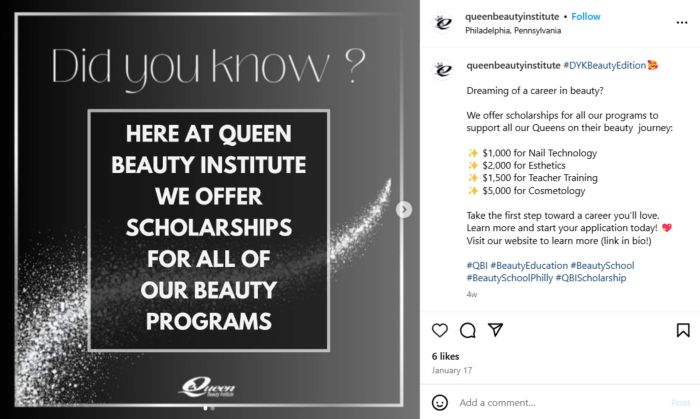
    Example: Unfortunately, many students leave their education behind due to their financial situations. Surely, some of these students are unaware of the financial assistance options available to them. To boost student retention, let your community know you can help them invest in their futures. Here, Queen Beauty Institute promotes its financial aid programs on social media, letting students know that support is available should they need it.

    HEM Image 7HEM Image 7

    Source: Queen Beauty Institute Instagram

    8. Promoting a Flexible and Inclusive Learning Environment

    Flexibility is key to student retention in higher education, particularly for non-traditional students balancing work, family, and school. Online learning options, hybrid models, and asynchronous coursework can make higher education more accessible. Schools should highlight these flexible learning opportunities in their marketing materials, emphasizing how they accommodate diverse student needs and lifestyles.

    In addition to offering different learning formats, you can provide adaptive scheduling options that allow students to select courses that fit their personal and professional commitments. Some colleges have introduced weekend or evening classes to serve students with full-time jobs or family obligations. Additionally, having a robust support system for online students, such as virtual study groups, 24/7 tech support, and faculty office hours, ensures they receive the same level of engagement as in-person learners.

    Another important aspect of fostering inclusivity is providing accessible resources for students with disabilities. Ensuring that digital learning platforms are compatible with screen readers, offering captioned lecture videos, and creating inclusive classroom environments can greatly enhance the learning experience. You can also implement specialized advising services to assist students in navigating academic and personal challenges, further reinforcing your commitment to diversity and inclusion.

    Example: Here, the Academy of Learning Career College introduces students to its Integrated Learning System, an educational resource designed to put students “in the driver’s seat of their learning experience”. It fosters flexibility and was created with many learning styles and neurodiversity in mind. Make it known how your school aims to meet students where they are.

    YouTube videoYouTube video

    Source: The Academy of Learning Career College | YouTube

    9. Encouraging Faculty-Student Engagement

    Professors play a crucial role in retaining students. Meaningful connections between students and faculty members can significantly impact a student’s decision to persist in their studies. Your marketing team can facilitate this by spotlighting faculty members in newsletters, creating video content featuring faculty mentorship stories, and promoting faculty office hours as a key resource.

    Institutions can also encourage faculty to take an active role in student success by implementing early intervention programs. If a professor notices a student struggling, they can reach out with personalized support or recommend tutoring services. Additionally, fostering a culture of open communication through regular check-ins, discussion forums, and one-on-one mentorship opportunities helps build trust and rapport between faculty and students.

    Another approach is incorporating faculty-led engagement opportunities such as research projects, community outreach programs, and interdisciplinary collaborations. When students work closely with faculty on meaningful academic projects, they feel more invested in their studies and are less likely to disengage. Schools that promote faculty involvement as a cornerstone of student support will see stronger connections, higher levels of academic motivation, and improved retention rates.

    10. Establishing Clear Pathways for Student Success

    Students are more likely to stay enrolled when they clearly understand their academic roadmap. Schools should provide structured academic pathways, regular progress check-ins, and advising support to help students navigate their journey efficiently. Marketing teams can assist by crafting student success stories highlighting how structured pathways have helped past students graduate on time and achieve their goals.

    In addition to offering clear course sequences, institutions can provide academic planning workshops that help students map out their degree completion plan. Schools should also ensure that students have easy access to academic advisors who can guide them in selecting courses aligned with their career goals. By integrating digital tools such as degree audit software, students can track their progress and receive real-time updates on their academic standing. 

    Offering flexible course options, such as summer sessions or online alternatives, can further help students stay on track and avoid delays in graduation. When students feel they are making steady progress, they are more likely to stay motivated and complete their degrees successfully.

    How to Improve Student Retention With a Comprehensive Marketing Strategy

    How to improve student retention? A comprehensive marketing strategy should involve consistent engagement with students through multiple touchpoints, addressing common concerns before they lead to dropout. By implementing strategic communication, financial aid awareness, community-building initiatives, and academic support, you can foster an environment where students feel valued and encouraged to complete their education.

    At Higher Education Marketing, we specialize in crafting tailored marketing strategies that attract students and keep them engaged throughout their academic journey. HEM specializes in student retention strategies that drive measurable success. Let’s craft a marketing plan that keeps students engaged from enrolment to graduation. that fosters long-term student success.

    Struggling with enrollment?

    Our expert digital marketing services can help you attract and enroll more students!

    Frequently Asked Questions

    Question: What is retention marketing?

    Answer: Retention marketing is the strategic use of targeted campaigns, communication, and engagement initiatives that keep current students enrolled and actively involved in their educational journey.

    Question: How to improve student retention?

    Answer: A comprehensive marketing strategy should involve consistent engagement with students through multiple touchpoints, addressing common concerns before they lead to dropout. By implementing strategic communication, financial aid awareness, community-building initiatives, and academic support, you can foster an environment where students feel valued and encouraged to complete their education.

    Source link

  • HVAC improvements shown to improve student outcomes

    HVAC improvements shown to improve student outcomes

    This audio is auto-generated. Please let us know if you have feedback.

    Facility managers that lead an effort to upgrade their school’s HVAC system can help students miss less school, get into less trouble and perform better on standardized math tests, researchers at the State University of New York at Albany suggest. 

    Attendance improved by 2% and suspension rates dropped by 7% in K-12 schools after they improved their heating and ventilation systems, researchers say in a paper, “The Effects of School Building HVAC System Conditions on Student Academic and Behavioral Outcomes.” 

    Math outcomes improved, too — by 4% after the heating system was replaced and by 3% after the cooling system was replaced. There was a similar improvement in math scores when the heating system was improved.    

    “We conclude that investments made now to improve school HVAC systems can benefit not only student comfort and well-being, but also enhance educational opportunity,” say the researchers, Lucy Sorensen, Moontae Hwang and Marzuka Ahmad Radia of the State University of New York at Albany. 

    The researchers say the improvement in absentee levels likely stems from cleaner air flowing through the system. “Improvements in school ventilation system conditions could reduce the spread of infectious diseases … thereby decreasing missed days of school due to sickness,” they said.  

    The improvement in math performance likely stems from more comfortable room temperatures, which helps aid focus, but it also likely plays a role in fewer suspensions. The authors cite other research beyond K-12 that finds criminal behavior goes down as temperatures improve. 

    “More comfortable temperatures could help to prevent student misbehavior, given the well-known link between, for instance, heat and criminal behavior,” they said. 

    For their findings, the researchers looked at data over multiple years from a building condition survey conducted by the New York State Education Department. The percentage changes in performance are to a standard deviation. The findings were published in November and are available from Brown University’s Annenberg Institute. 

    Source link

  • U.S. can improve data collection on AI/AN college students

    U.S. can improve data collection on AI/AN college students

    Native American student enrollment has been on the decline for the past decade, dropping 40 percent between 2010 and 2021, a loss of tens of thousands of students. Of the 15.4 million undergraduate students enrolled in fall 2021, only 107,000 were American Indian or Alaska Native, according to the National Center for Education Statistics.

    Researchers argue that the small population is not as small as it seems, however, due in part to federal practices of collecting data on Native populations, according to a new report from the Brookings Institute, the Institute for Higher Education Policy and the Urban Institute.

    Federal measures of race and ethnicity in postsecondary education data undercount the total population of Native American students, in part due to insufficient sampling, lack of data on tribal affiliation and aggregation practices that erase Native identities, researchers wrote.

    “For too long, Native American students have been severely undercounted in federal higher education data, with estimates suggesting that up to 80 percent are classified as a different race or ethnicity,” Kim Dancy, director of research and policy at IHEP, told Inside Higher Ed. “This chronic data collection failure renders Native students invisible in federal data systems and prevents clear assessments of the resources necessary to support student success.”

    In May 2024, the federal government announced new standards for collecting data on American Indian and Alaska Native (AI/AN) populations, which would improve the inclusivity and accuracy of data for students from these groups.

    The Obama administration introduced similar changes in 2016, but they were never implemented under the first Trump administration in 2017. Researchers worry a similar pattern may follow under the second Trump administration.

    “The second Trump Administration has demonstrated reluctance to prioritize data transparency, which could further jeopardize these efforts and stall progress,” Dancy said. “Without strong implementation of these standards, Native students will continue to be overlooked in federal policy decisions.”

    “It is critical that the Trump administration allow the revised SPD 15 standards to remain in effect, and for officials at ED and elsewhere throughout government to implement the standards in a way that provides Native American students and communities with the same high-quality data that all Americans should be able to access,” report authors wrote.

    Data Analysis at Risk

    The Education Department has canceled dozens of contracts in recent weeks, tied to the Trump administration’s Department of Government Efficiency. Many of these contracts related to student data analysis in both K-12 and postsecondary education.

    State of play: Degree attainment for Native Americans is bleak, according to data presently available. Twenty-six percent of Native American adults in the U.S. hold an associate degree or higher, and only 16 percent hold a bachelor’s degree or higher, according to 2024 data from the U.S. Census Bureau. In comparison, bachelor’s degree attainment by all other races is higher: 20 percent for Latino, 25 percent for Black, 38 percent for multiracial, 40 percent for white and 61 percent for Asian American students.

    Of the 58 percent of American Indian/Alaska Native students who enrolled in higher education beginning in 2009, over half (55 percent) didn’t earn a credential. In 2023, the National Student Clearinghouse Research Center reported six-year completion rates had fallen two percentage points among Native Americans, to 47.5 percent—21 percentage points lower than their white peers and 27 percentage points lower than Asian students in the 2016 cohort.

    Data collection is not the only barrier to Native student representation and completion in higher education, researchers wrote, “but until data on Native American students are more accurate, accessible, and meaningful, it will prove difficult to address these issues,” which include affordability, disparities in access and retention, and a lack of culturally informed wraparound services.

    Digging into data: Data collection at the U.S. Department of Education has several problems that disadvantage Native students more than other groups, according to the report. Native student data is often “topcoded” as Hispanic or Latino, essentially erasing Native student identities, filed under “more than one race” without further detail, or coded without tribal affiliation or citizenship.

    While topcoding students as Latino or Hispanic or categorizing learners as more than one race applies to all racial categories, Native American individuals are categorized this way at a higher rate than any other major group, which diminishes their representation.

    Additionally, ED independently makes decisions to not disaggregate or provide detailed data on racial and ethnic subgroups, such as topcoding Latino or Hispanic students, that is not modeled at other federal agencies, such as the Census Bureau and the Bureau of Labor Statistics.

    The last time the Office of Management and Budget revised data-reporting processes for colleges and universities, which allowed individuals to identify as more than one racial group, final implementation took place in the 2010–11 academic year.

    In the decade and a half since, Native American student enrollment has declined, and researchers say, “The limitations of ED’s student data made it challenging to discern whether this decline represented an actual change in enrollment trends or was due to the new reporting practices’ undercounting of Native college students.”

    A lack of data impacts institutions, tribes and others tracking student outcomes, reducing opportunities to support learners, and the challenges may perpetuate continued misperceptions of Native students’ journeys through higher education.

    New policies: In 2024, OMB created new federal standards around collecting data on race and ethnicity that would enhance data collection when it comes to Native populations. Federal agencies are required to create plans for implementation by September 2025 and be in full compliance by March 2029, leaving the Trump administration responsible for implementation of the revised standards.

    OMB outlined three approaches for agencies on how they might consider presentation of aggregated data on multiracial populations:

    • Alone or in combination, which includes students who identify with more than one racial or ethnic group in all reporting categories.
    • Most frequent multiple responses, reporting on as many combinations of race and ethnicity as possible that meet population thresholds.
    • Combined multiracial or multiethnic respondents into a single category.

    This third option would be most harmful to Native students, because it would perpetuate undercounts, researchers caution, and therefore policymakers should avoid it.

    Moving forward, report authors recommend ED and Congress collect and publish disaggregated data on Native American students, partner with tribal governments to increase data transparency and provide guidance and resources to institutions to improve their quality of data.

    “We encourage the Education Department to continue seeking input from Native communities, including voices that have been historically excluded from policy-development efforts,” Dancy said. “Accurate data alone won’t eliminate the structural inequities Native students face. But without the data, we cannot begin to dismantle the inequities.”

    Get more content like this directly to your inbox every weekday morning. Subscribe here.

    Source link

  • A virtual reality, AI-boosted system helps students with autism improve social skills

    A virtual reality, AI-boosted system helps students with autism improve social skills

    Key points:

    This article and the accompanying image originally appeared on the KU News site and are reposted here with permission.

    For more than a decade, University of Kansas researchers have been developing a virtual reality system to help students with disabilities, especially those with autism spectrum disorder, to learn, practice and improve social skills they need in a typical school day. Now, the KU research team has secured funding to add artificial intelligence components to the system to give those students an extended reality, or XR, experience to sharpen social interactions in a more natural setting.

    The U.S. Office of Special Education Programs has awarded a five-year, $2.5 million grant to researchers within KU’s School of Education & Human Sciences to develop Increasing Knowledge and Natural Opportunities With Social Emotional Competence, or iKNOW. The system will build on previous work and provide students and teachers with an immersive, authentic experience blending extended reality and real-world elements of artificial intelligence.

    iKNOW will expand the capabilities of VOISS, Virtual reality Opportunity to Integrate Social Skills, a KU-developed VR system that has proven successful and statistically valid in helping students with disabilities improve social skills. That system contains 140 unique learning scenarios meant to teach knowledge and understanding of 183 social skills in virtual school environments such as a classroom, hallway, cafeteria or bus that students and teachers can use via multiple platforms such as iPad, Chromebooks or Oculus VR headsets. The system also helps students use social skills such as receptive or expressive communication across multiple environments, not simply in the isolation of a classroom.

    IKNOW will combine the VR aspects of VOISS with AI features such as large language models to enhance the systems’ capabilities and allow more natural interactions than listening to prerecorded narratives and responding by pushing buttons. The new system will allow user-initiated speaking responses that can accurately transcribe spoken language in real-time. AI technology of iKNOW will also be able to generate appropriate video responses to avatars students interact with, audio analysis of user responses, integration of in-time images and graphics with instruction to boost students’ contextual understanding.

    “Avatars in iKNOW can have certain reactions and behaviors based on what we want them to do. They can model the practices we want students to see,” said Amber Rowland, assistant research professor in the Center for Research on Learning, part of KU’s Life Span Institute and one of the grant’s co principal investigators. “The system will harness AI to make sure students have more natural interactions and put them in the role of the ‘human in the loop’ by allowing them to speak, and it will respond like a normal conversation.”

    The spoken responses will not only be more natural and relatable to everyday situations, but the contextual understanding cues will help students better know why a certain response is preferred. Rowland said when students were presented with multiple choices in previous versions, they often would know which answer was correct but indicated that’s not how they would have responded in real life.

    IKNOW will also provide a real-time student progress monitoring system, telling them, educators and families how long students spoke, how frequently they spoke, number of keywords used, where students may have struggled in the system and other data to help enhance understanding.

    All avatar voices that iKNOW users encounter are provided by real middle school students, educators and administrators. This helps enhance the natural environment of the system without the shortcomings of students practicing social skills with classmates in supervised sessions. For example, users do not have to worry what the people they are practicing with are thinking about them while they are learning. They can practice the social skills that they need until they are comfortable moving from the XR environment to real life.

    “It will leverage our ability to take something off of teachers’ plates and provide tools for students to learn these skills in multiple environments. Right now, the closest we can come to that is training peers. But that puts students with disabilities in a different box by saying, ‘You don’t know how to do this,’” said Maggie Mosher, assistant research professor in KU’s Achievement & Assessment Institute, a co-principal investigator for the grant.

    Mosher, a KU graduate who completed her doctoral dissertation comparing VOISS to other social skills interventions, found the system was statistically significant and valid in improving social skills and knowledge across multiple domains. Her study, which also found the system to be acceptable, appropriate and feasible, was published in high-impact journals Computers & Education and Issues and Trends in Learning Technologies.

    The grant supporting iKNOW is one of four OSEP Innovation and Development grants intended to spur innovation in educational technology. The research team, including principal investigator Sean Smith, professor of special education; Amber Rowland, associate research professor in the Center for Research on Learning and the Achievement & Assessment Institute; Maggie Mosher, assistant research professor in AAI; and Bruce Frey, professor in educational psychology, will present their work on the project at the annual I/ITSEC conference, the world’s largest modeling, simulation and training event. It is sponsored by the National Training & Simulation Association, which promotes international and interdisciplinary cooperation within the fields of modeling and simulation, training, education and analysis and is affiliated with the National Defense Industrial Association.

    The research team has implemented VOISS, available on the Apple Store and Google Play, at schools across the country. Anyone interested in learning more can find information, demonstrations and videos at the iKNOW site and can contact developers to use the system at the site’s “work with us” page.

    IKNOW will add resources for teachers and families who want to implement the system at a website called iKNOW TOOLS (Teaching Occasions and Opportunities for Learning Supports) to support generalization of social skills across real-world settings.

    “By combining our research-based social emotional virtual reality work (VOISS) with the increasing power and flexibility of AI, iKNOW will further personalize the learning experience for individuals with disabilities along with the struggling classmates,” Smith said. “Our hope and expectation is that iKNOW will further engage students to develop the essential social emotional skills to then apply in the real world to improve their overall learning outcomes.”

    Latest posts by eSchool Media Contributors (see all)

    Source link

  • Why Data Alone Won’t Improve Retention – Faculty Focus

    Why Data Alone Won’t Improve Retention – Faculty Focus

    Source link

  • How Technology Can Improve the Classroom for All

    How Technology Can Improve the Classroom for All

    Since going viral with her “Gen Z history” TikTok series, teacher Lauren Cella is using her platform to advocate for strategically utilizing — not restricting — technology in the classroom.


    How did you get started in your career in teaching, and what led you to start sharing your journey on social media?

    I didn’t initially plan on teaching. I studied journalism at San Diego State, inspired by movies featuring magazine editors. I later chose history as a minor just for fun. After college, I pursued journalism, but I eventually tried substitute teaching, loved it, and got my credential in history. 

    During COVID, my students encouraged me to post lessons on TikTok, where I shared content in a humorous, easy-to-understand way. My Russian Revolution video went viral, which led me to keep creating these quick, story-like history lessons. I love reaching people worldwide and making history engaging. My videos are only about a minute long, which helps with attention spans, although I know they simplify complex topics. My hope is these videos spark curiosity, encouraging viewers to explore history further. 

    What are some emerging trends in technology that you think are shaping the future of education or that you have used in your classroom to engage students? 

    AI is a major topic in education now, especially around how its used and the ethics of it. Initially, my school blocked ChatGPT but then allowed it when teachers started using it to adapt lessons for different reading levels or languages. In my journalism class, we discussed the ethics of AI. My students agreed it wasn’t ethical to let AI write an article for them, but they saw value in using it to generate interview questions. These discussions highlight that we can’t avoid new technologies — we need input from students, teachers, and administrators to navigate them responsibly. 

    Companies like Adobe are creating student-friendly versions of AI tools, helping ease the burden on teachers. I also use AI to caption videos, which saves time. Students heading into creative fields need to learn these tools, as AI proficiency is essential. Just as learning to type or use email became necessary, so will understanding AI. 

    Do you have any advice for balancing the benefits of technology with the need for face-to-face interaction in the classroom?

    Teaching during the pandemic proved technology can’t replace teachers. Students need human connection. While tech has its place, it should be used to build specific skills, not just replace traditional methods. For example, students should still use a pen and paper daily, as it activates different brain functions and builds motor skills. Using technology in class should go beyond digitizing worksheets; it should add real value, like using AI in art to analyze creative elements. Ultimately, tech should support, not replace, essential hands-on learning for students’ overall development. 

    Do you have any tips for teachers looking to stay organized and efficient so they can focus on engaging their students in the classroom? 

    My biggest advice: Don’t grade everything. It’s okay to assign work as practice without grading it. Focus on priority standards — what students truly need to know — and build multiple assignments into one when possible. Trying to do it all leads to burnout without improving student outcomes. Start small, establish routines, and add more gradually to avoid overwhelming yourself and your students. 

    Is there any technology that you recommend that helps with the behind-the-scenes side of teaching, like lesson planning and grading? 

    I recommend using tools like Illuminate and Google Classroom extensions like Brisk and Magic School to manage data effectively. For one-to-one schools, Google offers many helpful extensions, and programs like IXL provide valuable insights. The key is to focus on areas where students struggle most, using data to streamline your lesson planning. With large classes, pulling reports helps make sense of data and can guide your approach without being overwhelming. 

    Are there any key digital safety practices that teachers should be implementing to protect students online? 

    It’s challenging when schools block tools like ChatGPT or YouTube, as they can also be valuable educational resources. We’re at a crossroads and need more digital citizenship education to teach students about online risks and the lasting consequences of their actions. Many students don’t realize that certain online behaviors, like sharing inappropriate images, can have serious legal consequences. They’re also vulnerable to scams, online blackmail, and bullying, particularly on group chats and gaming platforms. Parents should be aware that even if kids aren’t on social media, they’re still interacting with others online. We must educate young people on these dangers, as laws haven’t fully caught up to technology. Parents, teachers, and students need to support each other, staying vigilant and reporting harmful situations online just as they would in real life. 

    Do you have any advice for teachers who are facing burnout or mental health struggles right now?

    It’s not you; it’s the system. You’re not doing anything wrong, and you can’t change everything on your own. If you burn out, they’ll replace you, but students benefit from experienced teachers. High turnover isn’t good for schools or students. 

    Social media can distort reality, making it seem like everyone is angry and divided. In reality, most people are not like that. Social media algorithms promote outrage, which skews our perception of others. Many teachers online appear to have perfect classrooms, but that’s often not the case — they face the same challenges as everyone else. I try to share positive experiences to stay motivated, but I’ve encountered many difficulties that I don’t discuss publicly. 

    It’s also easy for students to idolize influencers, but most of what they see online is curated and not real. They should focus on real-life skills instead of just consuming online content. Encourage students to engage in offline activities like sports, arts, or social groups to foster real interactions. For example, in my classroom, I limit phone use during free time to promote conversations and social skills. 

    To support students academically, tools like Canva and Google Classroom can help organize assignments and instructions in one place. This is important because students juggle multiple classes and responsibilities. They need resources to manage their workload effectively, like accessible rubrics and checklists. Technology allows students to take ownership of their learning, especially during emergencies. Teaching them to use project management tools can build important skills. At my school, we even grade time management alongside project quality. Overall, digital organization and project management are valuable skills for students and teachers alike.


    Source link

  • Pay Increases for Higher Ed Employees Sharply Improve, But Still Fall Short of Inflation Rate – CUPA-HR

    Pay Increases for Higher Ed Employees Sharply Improve, But Still Fall Short of Inflation Rate – CUPA-HR

    by CUPA-HR | April 3, 2023

    New research from CUPA-HR has found that although employees across the higher education workforce saw the most substantial pay raises in 2022-23 than in the past several years, they are still being paid less than they were in 2019-20 in inflation-adjusted dollars.

    Some of the key findings from an analysis of CUPA-HR’s higher ed workforce salary survey data from 2016 to 2023:

    • This academic year, raises for higher ed employees were the largest seen in the past seven years, and all position types (administrators, professionals, staff and faculty) received an increase of at least 1.11 percentage points compared to the previous year.
    • Tenure-track and non-tenure-track teaching faculty continue to receive the smallest pay increases of any higher ed employee category. In 2022-23, tenure-track faculty saw a median pay increase of 2.9 percent and non-tenure-track faculty saw an increase of 3.2 percent. Tenure-track faculty salary increases have not kept pace with inflation since at least 2015, and non-tenure-track salary increases last met or exceeded inflation in 2016-17, meaning full-time faculty in general continue to be paid less every year in inflation-adjusted dollars.
    • Staff, which is typically the lowest-paid category of higher ed employees, saw the biggest raises this academic year at 5.3 percent (up from 2.9 percent in 2021-22).

    Explore this data and more in CUPA-HR’s newest interactive graphic.

    CUPA-HR Research

    CUPA-HR is the recognized authority on compensation surveys for higher education, with its workforce surveys designed by higher ed HR professionals for higher ed HR professionals and other campus leaders. CUPA-HR has been collecting data on the higher ed workforce for more than 50 years, and we maintain one of the largest workforce databases in existence. CUPA-HR also publishes numerous research publications and interactive graphics highlighting trends and issues around higher ed workforce planning, pay equity, representation of women and racial/ethnic minorities and more. Learn more about CUPA-HR research.


    Source link