Tag: including

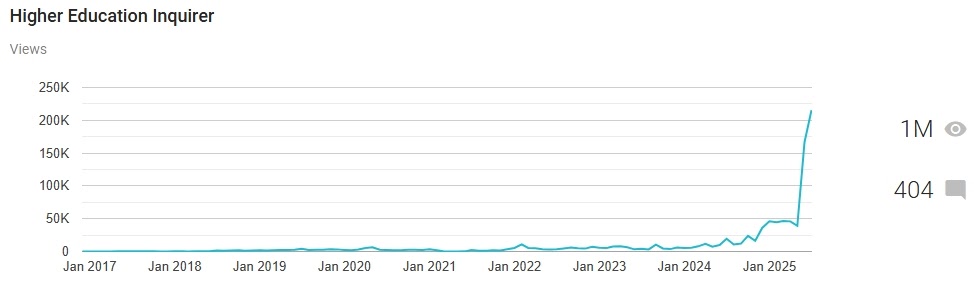
  • Higher Education Inquirer Surpasses 1 Million Views, Including More Than 200,000 in July 2025

    Higher Education Inquirer Surpasses 1 Million Views, Including More Than 200,000 in July 2025

    The Higher Education Inquirer has reached a major milestone: more than 1 million total views since its founding, with over 200,000 views in July 2025 alone—a record-breaking month for the independent investigative site. This surge in readership reflects growing public concern with the state of U.S. higher education, especially at a time of increasing economic precarity, political unrest, and institutional dysfunction.

    As corporate media outlets continue to downsize or ignore coverage of student debt, credential inflation, predatory schools, and the exploitation of academic labor, readers are seeking more critical, independent voices. HEI, which has long focused on underreported stories within the higher education-industrial complex, is becoming a go-to resource for policymakers, whistleblowers, journalists, and everyday people trying to make sense of the education economy.

    Most Viewed Stories in July 2025

    A few standout articles reveal key themes that are resonating with readers:


    1. “Camp Mystic: A Century of Privilege, Exclusion, and Resilience Along the Guadalupe”

    Views: 8,730

    This deeply researched piece on the elite girls’ camp in Texas struck a nerve with readers interested in the intersection of inherited wealth, segregation, and performative philanthropy. Camp Mystic serves as a metaphor for the parallel institutions that shape American leadership in quiet, exclusive ways—far from public scrutiny.

    Trend: Growing interest in how generational wealth and private networks perpetuate elite power and influence, especially through educational institutions.


    2. “The Big Beautiful Bill”: A Catastrophic Blow to College Affordability

    Views: 1,290

    This analysis of new legislation affecting federal student aid programs explores how a bill dressed in populist language has real consequences for working-class and middle-income families. Readers responded to its dissection of policy doublespeak and the structural defunding of public education.

    Trend: Rising awareness of how both major political parties contribute to the erosion of affordable education—often under misleading rhetoric.


    3. “Santa Ono: Take the Money and Run”

    Views: 956

    A pointed critique of University of Michigan President Santa Ono’s high salary and revolving-door administrative career drew in readers frustrated by bloated leadership pay and lack of institutional accountability.

    Trend: Increased public scrutiny of university presidents and boards of trustees, especially at elite institutions.


    4. “List of Schools with Strong Indicators of Misconduct, Evidence for Borrower Defense Claims”

    Views: 943

    This database-style article provided a valuable resource for former students, journalists, and attorneys. By documenting schools with troubling records, it supported those filing Borrower Defense to Repayment claims and highlighted the ongoing fallout from the for-profit college boom.

    Trend: Continued demand for actionable consumer information amid the Biden Administration’s limited and politically fraught debt relief efforts.


    5. “Degrees of Discontent: Credentialism, Inflation, and the Global Education Crisis”

    Views: 900

    This global take on the failures of credential-driven economies resonated with a wide audience—from jobseekers with degrees they can’t use to educators struggling to make sense of shifting academic value.

    Trend: A philosophical and economic reckoning with credentialism, especially as degrees lose value while tuition and debt skyrocket.


    6. “Layoffs at Southern New Hampshire University”

    Views: 826

    Coverage of SNHU, a major player in online education, shed light on the darker side of “innovation”: layoffs, overwork, and instability for faculty and staff.

    Trend: Growing doubts about the long-term sustainability and labor ethics of the online education model.


    7. “Universities Brace for Endowment Tax Hike, Rethink Investment Strategies”

    Views: 687

    A timely piece on elite university endowments caught the eye of readers interested in how wealth hoarding and financial engineering are baked into modern academia.

    Trend: Rising critiques of nonprofit tax loopholes and the financialization of higher ed.


    8. “Liberty University in Black and White”

    Views: 684

    This critical examination of Liberty University’s public image, internal contradictions, and links to right-wing political power explored how Christian nationalist ideology operates through higher education.

    Trend: High interest in the political roles of conservative religious institutions and their ties to the culture wars.


    9. “Corruption, Fraud and Scandal at Los Angeles Community College District (LACCD Whistleblower)”

    Views: 615

    A whistleblower-centered article on LACCD corruption revealed widespread misuse of funds and institutional cover-ups, especially in facilities projects.

    Trend: Rising demand for investigative journalism focused on local corruption in publicly funded institutions.


    10. “Agency Information Collection Activities…Borrower Defense to Loan Repayment Universal Forms”

    Views: Not Yet Indexed

    While bureaucratic in title, this article was shared among policy experts and debt activists for its breakdown of how regulations—and public comment periods—impact real people trying to discharge fraudulent debt.

    Trend: Readers are becoming more engaged in regulatory policy and more skeptical of federal agencies’ ability or willingness to protect consumers.


    What Readers Want 

    What these stories show is a distinct pattern: readers want more accountability, more transparency, and less propaganda from the education system that has long promised prosperity and delivered precarity. They’re fed up with bloated administrative salaries, empty credentials, elite hypocrisy, and legislative betrayal.

    Thanks to grassroots support and collaborations with students, whistleblowers, and journalists, the Higher Education Inquirer continues to grow in both reach and relevance.

    As we pass 1 million views, we’re not just marking clicks—we’re tracking the pulse of a system in crisis. And we’re not done yet.
    Source link

  • Two Killed and Seven, Including Suspect, Injured in FSU Shooting

    Two Killed and Seven, Including Suspect, Injured in FSU Shooting

    One suspect has been taken into custody after a shooting that left two victims dead and six injured at Florida State University’s student union on Thursday, law enforcement officials said in a press briefing.

    The suspect, who was identified as Phoenix Ikner, a 20-year-old FSU student and the son of a school resource deputy with the Leon County Sheriff’s Department, has also been hospitalized. He was shot by police after he “did not comply with commands,” according to Tallahassee Police Department chief Lawrence E. Revell.

    The two deceased victims were not students, Revell said, but he couldn’t share any other information about the victims’ identities.

    FSU president Richard McCullough called this a “tragic day for Florida State University” at the briefing.

    “We’re working to support the victims, the families and everyone affected,” he said.

    FSU students and employees received an emergency notification at 12:02 p.m. to shelter in place due to an active shooter near the campus’s student union. According to Revell, FSU campus police arrived on the scene “almost immediately” after the shooting began just before noon. Other local law enforcement agencies, including the Federal Bureau of Investigation’s Jacksonville field office and its Tallahassee suboffice, were involved in the response to the shooting. The Tallahassee police will lead the investigation.

    Over three hours later, police notified the campus that they had “neutralized the threat” but asked the public to continue avoiding the student union and the surrounding area. Students were advised to remain indoors except to walk to their dorms or the designated reunification point.

    Revell said the handgun Ikner used was his mother’s former service weapon. The suspect also had a shotgun with him, Revell said, but it was unclear if he had used it. Revell said the police did not yet know of any motive for the shooting and that Ikner had invoked his right not to speak with police.

    At the press briefing, McCullough said he had just returned from visiting the victims in the hospital.

    “Right now our top priority is safety and well-being for all the people on our campus,” he said.

    One FSU junior, McKenzie Heeter, told NBC that the assailant shot at her with what she thought was a rifle as she was exiting the student union with her lunch just before noon, but he missed. He then returned to his car and retrieved a handgun and shot another individual, at which point Heeter began running away from the student union and back to her apartment.

    “It was just me and like three other people that noticed at first, but we were walking in the opposite direction away from the union, so we started running. I just told everybody that I could see, stay away from campus,” she told NBC.

    Another group of about 40 individuals avoided the shooter by locking themselves in a bowling alley in the student union’s basement, The Tallahassee Democrat reported.

    Classes at FSU are canceled through Friday, and athletic events are canceled through the end of the weekend.

    Source link

  • Trump Signs Executive Order Ending DEI Programs Including Affirmative Action

    Trump Signs Executive Order Ending DEI Programs Including Affirmative Action

    by CUPA-HR | January 22, 2025

    On January 22, President Trump signed an executive order (EO) titled “Ending Illegal Discrimination and Restoring Merit-Based Opportunity.” The EO directs all federal agencies to “terminate all discriminatory and illegal preferences, mandates, policies, programs, activities, guidance, regulations, enforcement actions, consent orders, and requirements,” to enforce “longstanding civil rights laws,” and to “combat illegal private-sector DEI preferences, mandates, policies, programs, and activities.” The White House also published a fact sheet to supplement the order.

    The EO lists several other executive orders that the Trump administration is revoking. Notably, the Trump EO revokes executive order 11246, titled “Equal Employment Opportunity,” which has required federal contractors to have affirmative action plans since 1965. Additionally, the EO orders the Office of Federal Contract Compliance Programs (OFCCP) at the Department of Labor (DOL) to immediately cease “promoting diversity,” “holding federal contractors and subcontractors responsible for taking ‘affirmative action,’” and “allowing or encouraging federal contractors or subcontractors to engage in workforce balancing based on race, color, sex, sexual preference, religion, or national origin.” Both of these actions are explained by the EO to streamline the federal contracting process “to enhance speed and efficiency, reduce costs, and require federal contractors and subcontractors to comply with our civil rights laws.”

    The EO also directs each federal agency to include in every federal contract or grant award a term requiring a contractual counterparty or grant recipient to agree that it is in compliance with all applicable federal anti-discrimination laws and a term requiring the counterparty or recipient to certify that it does not operate “any programs promoting DEI that violate any applicable federal antidiscrimination laws.”

    The EO also includes orders to encourage the private sector to cease DEI programs and initiatives. Specifically, the EO directs the attorney general, in consultation with other relevant agencies, to promulgate a report with recommendations to enforce civil rights laws and encourage the private sector to end DEI practices. The report is required to identify “the most egregious and discriminatory DEI practitioners in each sector of concern.” It also requires each agency to identify up to nine potential civil compliance investigations as a way to deter DEI programs or principles. The EO lists institutions of higher education with endowments over $1 billion as potential targets for the civil compliance investigations.

    Finally, the EO directs the attorney general and secretary of education to issue guidance to state and local educational agencies and institutions of higher education that receive federal dollars or participate in the Title IV federal student loan assistance program regarding “the measures and practices required to comply with Students for Fair Admissions, Inc. v. President and Fellows of Harvard College.”

    The EO will have widespread implications for federal contractors in the higher education community. CUPA-HR will share further developments on this EO as they are released.


    Source link

  • Trump Signs Executive Order Ending DEI Programs Including Affirmative Action

    Trump Signs Executive Order Ending DEI Programs Including Affirmative Action

    by CUPA-HR | January 22, 2025

    On January 22, President Trump signed an executive order (EO) titled “Ending Illegal Discrimination and Restoring Merit-Based Opportunity.” The EO directs all federal agencies to “terminate all discriminatory and illegal preferences, mandates, policies, programs, activities, guidance, regulations, enforcement actions, consent orders, and requirements,” to enforce “longstanding civil rights laws,” and to “combat illegal private-sector DEI preferences, mandates, policies, programs, and activities.” The White House also published a fact sheet to supplement the order.

    The EO lists several other executive orders that the Trump administration is revoking. Notably, the Trump EO revokes executive order 11246, titled “Equal Employment Opportunity,” which has required federal contractors to have affirmative action plans since 1965. Additionally, the EO orders the Office of Federal Contract Compliance Programs (OFCCP) at the Department of Labor (DOL) to immediately cease “promoting diversity,” “holding federal contractors and subcontractors responsible for taking ‘affirmative action,’” and “allowing or encouraging federal contractors or subcontractors to engage in workforce balancing based on race, color, sex, sexual preference, religion, or national origin.” Both of these actions are explained by the EO to streamline the federal contracting process “to enhance speed and efficiency, reduce costs, and require federal contractors and subcontractors to comply with our civil rights laws.”

    The EO also directs each federal agency to include in every federal contract or grant award a term requiring a contractual counterparty or grant recipient to agree that it is in compliance with all applicable federal anti-discrimination laws and a term requiring the counterparty or recipient to certify that it does not operate “any programs promoting DEI that violate any applicable federal antidiscrimination laws.”

    The EO also includes orders to encourage the private sector to cease DEI programs and initiatives. Specifically, the EO directs the attorney general, in consultation with other relevant agencies, to promulgate a report with recommendations to enforce civil rights laws and encourage the private sector to end DEI practices. The report is required to identify “the most egregious and discriminatory DEI practitioners in each sector of concern.” It also requires each agency to identify up to nine potential civil compliance investigations as a way to deter DEI programs or principles. The EO lists institutions of higher education with endowments over $1 billion as potential targets for the civil compliance investigations.

    Finally, the EO directs the attorney general and secretary of education to issue guidance to state and local educational agencies and institutions of higher education that receive federal dollars or participate in the Title IV federal student loan assistance program regarding “the measures and practices required to comply with Students for Fair Admissions, Inc. v. President and Fellows of Harvard College.”

    The EO will have widespread implications for federal contractors in the higher education community. CUPA-HR will share further developments on this EO as they are released.


    Source link

  • Looking back at HEPI’s most controversial reports – including an unexpected one from 2024

    Looking back at HEPI’s most controversial reports – including an unexpected one from 2024

    HEPI Director, Nick Hillman, starts 2025 by looking back at some HEPI controversies from the last decade.

    New Year’s Day marked the first day of my twelfth year at HEPI. Over that time, I’ve had a hand in publishing (and writing) over 200 reports. None has stoked controversy for the sake of it, but neither have we shied away from publishing things that people feel need to be said even if they might be deemed by some to be controversial.

    Fortunately, just four (that’s under 2%) of these pieces have flared into major rows. That’s about one report every three years or so on average, which doesn’t feel too bad a record for think-tank land. If we were in the business of stoking controversy for the sake of it, then it would be fair to say we are not very good at it.

    Most people understand the role of think tanks is to make people think, whether they agree with them or not. Indeed, HEPI was founded as an offshoot of HEFCE in the early 2000s because it was felt there were things that should be said but which an official arms-length body could not easily say, with the overarching goal of speeding up the policymaking process

    Some reports we were initially a little nervous about putting out have been accepted at face value without getting anyone too hot under the collar. (A recent one of this ilk looked at the experience of trans and non-binary students.) But more intriguingly, those HEPI reports that have been deemed controversial have not generally been the ones I thought in advance would be.

    And each one is now seared on my mind.

    A UKIP Licence

    The first of these, published back in 2015, proposed a National Licence to give everyone with a UK Internet Protocol address access at no upfront charge to past and present academic research. The associated backend costs were designed to be covered by government payments to publishers.

    FE lecturers and some health professionals welcomed the idea wholeheartedly, as they tended to think better access to the latest and past research would help them do their jobs. However, the more headbanger-ish element of the open-access world thought it outrageous that free access might be limited, at least initially, only to those in the UK. They also disliked the fact that publishers would continue to receive material payments.

    As you would have needed a UK IP address to benefit from the National Licence and as the UK Independence Party was then riding high, the critics amusingly caricatured the paper as a ‘UKIP’ idea. Less amusingly, one academic called for it to be withdrawn, only to rescind this when it was suggested that this might be illiberal – before changing his mind once more and calling again for a ban.

    The paper is still available but the National Licence idea has not made any progress and the major challenge of poor access to academic output for those without institutional log-ins (including policymakers, not to mention think-tank staff…) remains. 

    Boys to Men

    The second controversial piece – produced in 2016 – was on the education of boys, who fall far behind girls in our education system. This, sadly, also remains a big problem that no government has gripped (though it’s not too late for the current Government to do so). Our paper was condemned, for example by the then leadership of the National Union of Students (NUS), for emphasising sex rather than class.

    At the time, I said the report seemed to have been treated like an embarrassing relative who sits in the corner at family gatherings spouting politically incorrect nonsense.

    In response to such condemnation, we pointed out that it is possible to be worried about more than one issue at a time and that, as disadvantaged girls tend to do a little better than disadvantaged boys, sex seems one important factor to consider alongside all the others when assessing outcomes.

    The challenges in this area are perhaps a little better understood these days than they were a few years ago – thanks to excellent work from people like Richard Reeves, a Brit who is now the President of the American Institute for Boys and Men and who has written an whole book on the topic and who recently spoke at a really good Bright Blue event on the issue). So when we return to the topic, as we would like to do early in 2025, perhaps it will be less fraught.

    Grammar schools for all

    The third row was predictable. It occurred six years ago, on the back of a HEPI piece by the right-of-centre policy wonk Iain Mansfield. He defended grammar schools and their impressive record in getting BAME (Black, Asian and Minority Ethnic) pupils into the most selective universities, such as the University of Cambridge.

    This paper (like the one on the National Licence) appeared in HEPI’s Debate Paper series, which is more polemical in its approach than HEPI’s other papers, for we knew it might stoke a row. Yet after publication of Iain’s paper, which had gone through our regular peer-review process as with all full-length HEPI papers, one well-respected expert in the sociology of education working at a Russell Group university declared HEPI should ‘disband’.

    However, most of the opposition to Iain’s paper was classier. Unlike other – more ideological – think tanks, we invariably encourage people who disagree with something we have published to write for us too. So we encouraged the critics to gather together under two Oxford academics to produce a strong HEPI paper of their own that responded to Iain’s work in the form of a series of essays. 

    In their respective pieces, Iain and his critics were largely focusing on different issues – Iain looked mainly at access to selective higher education on leaving grammar school and the collection of essays concentrated mainly on how grammar school systems tend to work against the interests of those who are shut out from them. While the debate was angry in parts, it was properly evidence based and therefore very illuminating.

    As someone who lives in part of the country where nearly all children still take the 11+, I found the discussion usefully educational and took something from both sides. Iain as the initial protagonist and someone who thrives on intellectual debate certainly welcomed it.

    Helping postgraduate parents

    The row in 2024, in contrast, came as a complete surprise. It was prompted by a HEPI Policy Note on the lack of childcare support for parents who are early career researchers.

    The paper, written for HEPI by the GW4 group of universities in England and Wales, was based on the personal testimonies of postgraduate parents. It argued that postgraduate parents should become entitled to the same support that is available to undergraduate parents:

    the current approach does not provide the right incentives to support social mobility through education. Extending the current undergraduate Childcare Grant to postgraduate students would seem a logical first step to support the most economically disadvantaged.

    The paper also explained that the authors knew their proposals would not solve all the problems faced by postgraduate parents:

    While GW4 acknowledges that this would not be a panacea for all postgraduates, extending the support to those with the greatest need would be a welcome first step to ensure parity of policy.

    So the authors also floated going further:

    A future step such as expanding the 30 free hours, so that childcare does not continue to be a barrier to the reskilling and career progression opportunities that postgraduate studies can provide, is worthy of consideration if the ambitions of the R&D People and Culture Strategy are to be delivered.

    This seemed a relatively uncontroversial conclusion, not least because it was in tune with HEPI’s earlier uncontested work pointing out how postgraduate researchers often fall through the gap between student support and employee benefits. Moreover, all our other work on improving the lives of early career researchers had been widely welcomed; in 2024 alone, this included a collection of essays with the British Academy and a study of the career progression of Black early-career academics with the Society of Black Academics and GatenbySanderson.

    So we assumed that, if only we could secure engagement with its contents, then the HEPI / GW4 Policy Note calling for modest improvements in the support for postgraduate parents in England would also land on fertile soil. Yet the outcry from a small number of those who read it and who thought it did not go far enough was extraordinary.

    Playing the ball not the person

    The process for putting a paper of this sort together takes months and, during this time, we had lots of fascinating conversations about whether the proposals should be bolder, whether or not we should argue that England should simply and immediately copy the generous arrangements in Wales (even though Wales is better funded thanks to the Barnett formula) and which arm of the state should have responsibility for childcare support for postgraduates. The wording about better short-term arrangements only being a ‘first step’ reflected these discussions.

    Although the Policy Note was not my work, I used my social media channels to help publicise it and so drew much of the ire from academics on X / Twitter. Initially, I was asked why we wanted to block people from ‘feeding our families’. Later, and after I had pointed out this criticism seemed not to be based on a close reading of the actual paper, I was called ‘unhinged’ and accused of ‘misogyny’ and ‘everyday sexism’. One message about the report was tagged with ‘VAWG’, which I learnt stands for ‘violence against women and girls’. Remember, our paper proposed introducing – not restricting or abolishing – childcare support for postgraduate parents, and with a focus (initially) on the poorest ones most in need.

    Anyone serious about helping postgraduates should surely avoid the sort of attack that only serves to deter people from becoming involved in policymaking in the first place. At HEPI, we will always have the back of anyone who writes for us (irrespective of whether individual members of HEPI staff personally agree with them or not), but people are still bound to be put off if they find their peers prefer to play the person not the ball the minute they arrive on the pitch.

    Put simply, not everyone is able to respond to attacks in the wonderful way that the Cambridge academic Dr Ally Louks has been doing so effectively in recent weeks. Perhaps we could all learn something useful from her.

    Policymaking is hard…

    Successful policymaking is hard. It relies on lots of people putting their heads above the parapet to light a better way. HEPI wants to encourage debate across the whole range of higher education policy issues, but that needs a conducive environment in which to flourish. If we really are serious about producing a better environment for postgraduate students – and as our work consistently shows, HEPI certainly is – then we need a constant stream of new ideas, persuasive papers and open debate.

    At HEPI, we remain committed to encouraging a positive environment and, as a think tank publishing 35+ reports a year plus a daily blog, we rely on sourcing lots of good content, ideally from those at the coalface – and irrespective of whether they have written for policymakers before.

    So just as we have encouraged those who want to go further than we proposed in the GW4 / HEPI report on postgraduate parents to write an alternative piece for us (currently without success), we also encourage others to make it their New Year’s Resolution to write for HEPI. If you are even mildly tempted, our Instructions for Bloggers can be found here and our Instructions for Authors are here.

    Source link