Tag: increases

  • Confidence in higher education increases for the first time in a decade

    Confidence in higher education increases for the first time in a decade

    This audio is auto-generated. Please let us know if you have feedback.

    Dive Brief:

    • Americans’ confidence in higher education has increased for the first time in a decade, according to research released Wednesday by Gallup and the Lumina Foundation.
    • Among those surveyed, 42% of adults expressed “a great deal” or “quite a lot” of confidence in the sector, compared with 36% in 2023 and 2024. The percentage of respondents with little to no confidence declined from 32% last year to 23% in 2025.
    • However, the share of adults with high confidence in higher education is still well below 57%, the share who held those views when Gallup first posed the question in 2015.

    Dive Insight:

    Along with breaking a decadelong trend, Wednesday’s findings are noteworthy because they come amid increasing conservative attacks on the sector and continued questioning of the value of college.

    Researchers polled just over 1,400 adults via phone from June 2 to 26.

    When asked to explain their responses, 30% of participants confident in higher education pointed to the value of being educated. And 24% said colleges provide good training, with some respondents citing learning to think for oneself and others citing the ability to appreciate different viewpoints.

    Other reasons were named more frequently than they were in previous years. Last year, 5% of surveyed adults cited the innovations higher education fosters as inspiring confidence. This year, that share jumped to 15%. And 14% said U.S. colleges are some of the best in the world, up from 7% last year.

    In contrast, the share of respondents who pointed to the strength of college instructors and administrators declined from 7% last year to 4% in 2025. And just 1% of adults said college is available to anyone who wants to further their education, down from 2% the previous year.

    More than a third of respondents who said they lacked confidence in higher ed, 38%, cited concerns about political agendas, up from 28% in 2024. Those who had little confidence in the sector also expressed concerns about the cost of college and institutions not focusing on and teaching the “right things,” though mentions of both reasons declined from 2024 to 2025.

    When researchers asked all participants what would increase their confidence in higher education, they said colleges could focus more on practical job skills, lower their costs, and remove politics from the classroom.

    Confidence increased among respondents across the political spectrum, researchers found. But Republicans — who drove much of the decline in confidence in the sector over the past decade — continue to hold more negative views of higher education.

    Among Democrats, 61% expressed confidence in higher ed, up from 56% last year. By comparison, 26% of Republicans said the same, an increase from 20% in 2024. 

    About 2 in 5 respondents who identified as politically independent, 41%, expressed confidence in higher ed. That’s up from 35% last year. 

    Republicans are more likely to express confidence in two-year colleges than four-year colleges, the research found. Almost half of surveyed adults in the party, 48%, expressed confidence in two-year institutions, while just over a quarter, 26%, said the same of four-year colleges.

    A majority of surveyed Democrats had high confidence in both institutional types.

    Source link

  • Housing Program Increases Student Success in Calif.

    Housing Program Increases Student Success in Calif.

    An estimated 20 percent of college students experience housing insecurity and 14 percent experience homelessness, according to fall 2024 data from Trellis Strategies. Yet many colleges are ill-equipped to address student housing concerns, particularly institutions with nonresidential campuses or those that serve adult learners.

    The state of California created an initiative in 2020 to provide housing and short-term support to students who were experiencing housing insecurity while enrolled at one of the three public systems—the California State Universities, California Community Colleges or the University of California.

    A recently published analysis of the state’s College Focused Rapid Rehousing (CFRR) program identified promising practices and lessons learned from the pilot. The study—authored by the Center for Equitable Higher Education (CEHE) at California State University, Long Beach—found that students who participated were more likely to remain enrolled and graduate compared to their peers, and a majority had established stable housing one year later.

    The background: Passed in July 2019, Assembly Bill 74 allocated funding for college-focused rapid rehousing programs, which give students rental subsidies, moving assistance, wraparound supports, case management and emergency grants. The community college system received $9 million, CSU $6.5 million and UC institutions $3.5 million to invest in long- and short-term initiatives, depending on each system’s unique student needs.

    According to 2023 data included in the report, over half of CSU students and 65 percent of CCC’s who receive financial aid experience housing insecurity. One-quarter of CCC students and 11 percent of CSU students experienced homelessness during the 2022–23 academic year.

    The CEHE study evaluated the program over three years at eight CSU campuses and two community colleges. In total, 639 students participated in CFRR across the 10 institutions, and 3,949 received short-term assistance—often in the form of an emergency grant—from spring 2020 to spring 2024. Approximately 540 students fell into both categories, receiving short-term support before enrolling in CFRR.

    Some historically underserved populations were more likely to participate in CFRR: Black students and former foster youth were heavily overrepresented relative to the general population, and first-generation, transfer and returning students were also overrepresented to a smaller degree.

    Addressing housing insecurity: The program was successful in its goal of mitigating homelessness for enrolled students. After engaging with CFRR, participants experienced substantial housing stability, with an average of nine consecutive months of housing.

    In addition, a majority of students who left the program graduated (27 percent) or reached permanent housing (27 percent), while 15 percent failed to meet academic requirements, which is a common barrier to sustaining housing assistance.

    The greatest share of students (37 percent) were placed in stable housing in less than six months, though one-third took over 12 months to get housing from a community partner. The breakdown highlights the challenges in placing students in viable housing options, according to the report. However, two-thirds of surveyed students (n=181) said they believe they had been housed relatively quickly.

    One year after exiting the program, a majority of participants indicated that they were residing in an apartment or home that they directly leased or owned. Eighteen percent lived with a family member.

    Students credited the program with supporting their long-term success; 71 percent of survey respondents agreed or strongly agreed that their current housing situation was better because of the assistance they received.

    However, many still struggled with financial insecurity. Sixty-two percent said it was difficult to pay increased rent in the first year after exiting the program, and 25 percent underpaid or missed at least one rent payment during this period. Three in 10 said they had to move more than twice due to financial difficulties, and one-quarter of program graduates reported at least one episode of homelessness.

    Impacting student success: In addition to meeting students’ basic needs, the program had a demonstrated effect on persistence and attainment rates.

    Participants were more likely to remain enrolled or graduate (56 percent) compared to students receiving short-term housing assistance (47 percent). At CSU, CFRR students graduated within four years at higher rates than the broader CSU population (43 percent versus 35.5 percent), as well.

    Data also pointed to the impact housing crises can have on students’ academic performance, with housing-insecure students reporting their lowest GPA the semester they engaged in support interventions and the semester following.

    A graph showing the average GPA of CFRR participants compared to their peers who received short-term assistance from their institution.

    Twelve months after receiving assistance, CFRR students were significantly less likely to stop out of school compared to their peers who received just a short-term housing subsidy. Survey data showed students were more likely to engage in school activities, but a majority (70 percent) still held jobs to pay for college, working an average of 25 hours per week. Eighty percent of CFRR participants said they had difficulty balancing school and life responsibilities.

    Program participants were also more likely to be employed six months after entering housing (70 percent) versus three months before entering the program (56 percent).

    Housing insecurity can damage students’ mental health and in turn affect their persistence in higher education. At intake into CFRR, 76 percent of participants said they felt lonely, but that number dropped to 63 percent in follow-up surveys. Just under half of housing-insecure students experienced serious psychological distress at intake, while closer to one-third indicated distress at follow-up. These numbers remain elevated compared to the total student population at CSU, where 20 percent experienced serious psychological distress.

    The program also increased students’ emotional and mental resilience. Students rated their ability to handle personal problems higher after securing housing as well, from 33 percent to 52 percent during follow-up.

    If your student success program has a unique feature or twist, we’d like to know about it. Click here to submit.

    Source link

  • List of Schools Where Student Visas Have Been Revoked Increases to 46. Arizona State Tops List.

    List of Schools Where Student Visas Have Been Revoked Increases to 46. Arizona State Tops List.

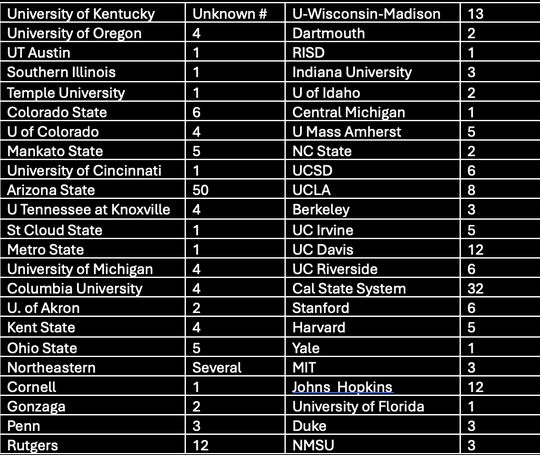
    According to WeAreHigherEd.org, there are now 46 schools where student visas have been revoked.  Arizona State tops the list at 50, followed by the University of Wisconsin-Madision (13), UC Davis (12), Rutgers (12), and Johns Hopkins (12) . The website includes profiles of a number of those students who have been detained. If you know of someone who has been abducted, you can report it here.

    Source link

  • New legislation in Scotland increases the SFC’s powers, but only up to a point

    New legislation in Scotland increases the SFC’s powers, but only up to a point

    Post-school reform in Scotland continues to chug along, following last month’s announcement of the preferred future shape of the funding body landscape.

    Today sees the legislation that will enact the changes introduced in Holyrood: the Tertiary Education and Training (Funding and Governance) (Scotland) Bill.

    We’ve been over how responsibilities for further education student support and apprenticeships and skills funding will shift around, and the bill also contains expected changes to the governance arrangements of the Scottish Funding Council (SFC), as well as some technical changes relating to fees and private provision.

    But what’s emerged as perhaps the more pressing question for the higher education sector is how the legislation will change SFC responsibilities and powers, as these apply to its work with universities. The legislation sets out the route the Scottish government will take here, and it’s a fairly balanced one – we are still a long way from an England-style “boots on the ground” regulatory environment, likely to the relief of many.

    Tell us about your finances

    Much of what the bill will do legislatively is through modifications to the Further and Higher Education (Scotland) Act 2005. Section 22(4) of this gives the SFC various powers to “pull” information from universities – or strictly, from their governing bodies – but only where the funder knows that the information exists, or may exist.

    The new legislation aims to create a landscape in which post-16 education bodies must “proactively notify SFC of certain developments of which the SFC might otherwise be unaware” in what the bill’s policy memorandum characterises as a “push” of information – a responsibility to notify the funding council of things it would not have known otherwise. Those who are more used to other UK systems will probably be thinking of “reportable events”.

    It’s suggested that notifications would likely be sought in the following kinds of situation:

    • Where a university is planning voluntary or compulsory severance (so no daily refreshing of the QMUL UCU cuts tracker for the SFC)
    • Where a university has reached a certain threshold in a rapidly worsening financial viability situation
    • A major data breach, such as resulting from a cyberattack.

    But exactly how this will work is not specified on the face of the legislation – it would be determined by ministers via the laying of regulations, with consultation and an affirmative procedure in the Scottish Parliament, “given that they could potentially place significant obligations on post-16 education bodies.” But this does mean that there is a lack of clarity on exactly what the bill is going to mandate.

    Part of the rationale for beefing up the legislation from what was previously anticipated (and let’s be honest, what was in the consultation) seems to be that ministers have not received enough clarity about the financial challenges being faced by certain universities and colleges. When the policy memorandum notes that “there can be challenges for SFC in getting information from post-16 education bodies about their financial sustainability,” you feel that really the issue is about ministerial oversight and the sense of having active levers to pull. This is given an explicit tweak elsewhere in the bill (again, quoting the policy memorandum):

    New section 15A(2) allows the Scottish Ministers to seek information and advice from the SFC relating to post-16 education bodies, this could be an individual body or the bodies as a whole. Section 15A(3) requires the SFC to respond to any such request from the Scottish Ministers and the SFC may also offer information proactively when it considers it appropriate to do so. This is necessary because unforeseen circumstances may arise of which the Scottish Ministers might otherwise be unaware (and so would not know to enquire).

    So what are you going to do about it?

    Also in the 2005 Act is provision for the SFC to “secure the promotion or carrying out of studies designed to improve economy, efficiency and effectiveness in the management or operations of any fundable body” – but no such power exists where the matters are not related to financial support.

    The new legislation would amend this, with the intention of making the SFC able to “address a broader range of matters to assist with performance improvement.” So in scope for an efficiency study would now be the needs and interests of learners:

    The policy intention is that the SFC could, particularly where notified of certain adverse circumstances (such as course closures), instigate studies or reviews of the impact on students and learners so that assistance could be provided to ensure they are not negatively impacted. For example, if a college was heading towards needing to close courses before students could complete them, the SFC could help to make arrangements for the students to continue their education at different colleges.

    Bringing the student interest in scope sounds sensible in theory, but there remains the question of what changes on the ground, beyond the production of a study. The 2005 Act allows the SFC to attend and speak to an institution’s governing body – the new section 15(4) of this bill will extend this to the issuing of a set of written recommendations.

    So the SFC will be able to recommend setting specific improvement targets, or requiring the development of an improvement plan. And it will now even be able to publish these, “where there is wider interest amongst institutions, or the public, in the recommendations and they are not sensitive.” But it won’t be obliged to.

    And what if its recommendations are ignored?

    As with the SFC’s right to address meetings, already provided for in section 16 of the 2005 Act, there is no corresponding duty on the fundable body to do anything in response to the recommendations. However, as a matter of good governance and practice, the Scottish Government would expect the fundable body to consider them appropriately.

    But beyond these recommendations, in the legislation as it stands there would be proper statutory powers for the SFC to influence educational institutions’ behaviour, through the issuing of guidance, which currently is “purely administrative” (though presumably always very welcome). The Tertiary Education and Training Bill will change this, so that institutions must have regard to the guidance, in the carrying out of their funded activities (note that “have regard to” is quite woolly language – something that the Office for Students has exploited frequently within the way HERA was drafted). But the SFC will have to consult both ministers and institutions in issuing guidance.

    It could have been otherwise

    Various alternative approaches were considered and rejected. The use of codes of conduct (“for example to address concerns around breaches of fair work conditions”) was felt to potentially lead to complex interactions with other requirements, and diminish autonomy. Plus there would have been a need for “appropriate enforcement mechanisms,” which is a whole other question.

    More powers of audit and investigation were also considered and not taken forward, which would have been a move towards a “more interventionist SFC.” Likewise for stronger enforcement and intervention action, including serving enforcement notices or the removing, suspending, or appointing of officers or governing body members.

    But this would have been “a fundamental change to SFC’s role which requires more careful consideration” – and would have gone way beyond what was originally consulted on.

    There’s still a long way to go here – Universities Scotland is already noting the “new, very broadly defined provisions regarding the monitoring of the financial sustainability of institutions,” and raising concerns that too much change in the relationship between the SFC and universities (or universities and the Scottish government) could jeopardise the classification of universities in the Office for National Statistics classification.

    The Scottish government seems to be aware of this particular risk – but there are certainly MSPs keen for the SFC to become more “interventionist”, and the legislation now faces a complicated passage through a Parliament in which the SNP does not hold a majority. The ministerial statement to Holyrood launching the bill saw Ross Greer of the Scottish Greens concerned about whether the SFC would have the ability to intervene in matters relating to fair work – higher education minister Graeme Dey said he would be happy to discuss the issue further.

    For now the legislation aims at a delicate balancing act between juicing up the SFC’s role and preserving universities’ autonomy. The next question is whether this persists in the face of deeper scrutiny and parliamentary compromises.


    Source link

  • UKRI increases PhD stipend by 8 per cent

    UKRI increases PhD stipend by 8 per cent

    Let’s get the headlines out of the way first.

    UKRI is increasing its PhD stipend by eight per cent to £20,780 from 1 October 2025. Wonkhe understands that this will not be funded by a reduction in the overall number of grants but instead forms part of UKRI’s funding settlement for 2025–26.

    Pay

    This means that UKRI will provide a take home income that is equivalent to the take home National Living Wage. This is not the same as the Real Living Wage but it is nonetheless a significant and welcome increase.

    This is the single largest real terms increase of the stipend for funded students since 2003. Given that UKRI supports 20 per cent of doctoral students, and many universities choose to mirror the terms of UKRI, this will undoubtedly have a significant impact on improving the conditions of PGR students.

    There is a sort of unwritten expectation that providers will generally peg their own grants to the levels of UKRI’s. Albeit, as we learn from the accompanying financial analysis that goes with the main report about around one in five students receive an amount above the minimum stipend. However, while half of respondents to a survey on the UKRI stipend indicated that at least 90 per cent of their non-UKRI funded doctoral students received a stipend equivalent to that of UKRI’s minimum level, around one in ten indicated that all of their non-UKRI funded doctoral students receive a stipend lower than UKRI’s minimum.

    The potential implications of this are that some providers will further stretch their already stretched resources in maintaining UKRI’s funding levels, or that some providers will fall behind the UKRI minimum rate for students they fund directly. Prior to today’s announcement providers were generally positive about mooted increases. However, while 72 per cent of respondents say they would increase their own stipends to match the National Living Wage this is lower than the 89 per cent who said they would be very or somewhat likely to increase their own stipends by inflation (and a little higher than the 66 per cent said who said they would be very or somewhat likely to increase their stipend if it was anchored to the Real Living Wage).

    Providers, for their part, stated in interviews that

    Institutions would endorse in principle an increase in line with price inflation (at a minimum) or National Living Wage (which institutions feel, morally, would be preferable) and thought they would be able to match this for university funded stipends. However, for UKRI training grants, were such a raise not accompanied by additional grant funding from UKRI, ROs might need to reduce student numbers in the future to ensure they can continue paying the minimum stipend.

    Providers may see some good news in the increase in the minimum fee for a UKRI student increasing by 4.6 per cent to £5,006.This should mean that providers can recoup a slightly greater amount of funding for their students and like with grants many providers will align their home PGR fees to the UKRI minimum. This is an entirely different question as to whether providers are anywhere close to recouping the actual cost of teaching PGR students.

    Terms

    The funding increase will grab the headlines but the revisions to UKRI’s Standard Terms and Conditions of Training Grant (TGCs) are likely to be as impactful.

    In February 2023 UKRI commissioned Advance HE to carry out a review of its TGCs from an EDI perspective which has been considered alongside UKRI’s own new deal for postgraduate research. There is also a new companion document to the update to the TGCs by the UKRI commissioned Equality, Diversity and Inclusion Caucus (EDICa). In their report EDICa highlighted the impacts of child support on the continuation of studies, the wide variability in disabled students getting the support they need, the inflexibility in moving between full and part-time study, and the considerable time it takes in getting medical evidence for securing adjustments. As the authors state

    However, for many current doctoral training students, the system of support in its current form is entrenching wider inequalities, particularly relating to caring responsibilities, disability and the benefits that may be achieved through change of mode of study.

    This seems to be a message that UKRI has taken seriously.

    The first thing to point out is that UKRI is not a regulator and it is at pains to point this out

    UKRI is not a regulator and while we for the first time are explicit that we expect compliance with consumer law, employment law, Office for Students and Medr regulation (all where applicable), providers remain responsible for their own compliance and regulators for enforcement.

    It feels self evident but the revised terms make it explicit that the role of UKRI is to steer the organisations it funds, and by extension the sector, toward better conditions for PGR students. UKRI will impose conditions on its own grants but it has a wider set of expectations for the sector on improving the conditions for PGRs.

    The reason it is steering not shoving the sector are numerous. Primarily, it has limited powers within HERA but it also acknowledges that it is providers that are best placed to make decisions on their own students. The revision to the terms is the moment where some of the ambitions of the Tickell review have come to life in loosening the conditions and reducing the bureaucracy on student grant funding.

    This new flexibility comes in a number of forms. UKRI has extended the time a student can draw their stipend while on sick leave from 13 to 28 weeks. UKRI is also removing the requirement for students to provide medical evidence when taking medical leave, instead this process will be more closely managed by a students’ provider. This is because obtaining a diagnosis was a barrier to students taking the leave they needed.

    It is in their approach to supporting disabled students where the dynamic of UKRi improving its own conditions while encouraging universities to do likewise comes to light. They note

    We will require that disabled students are offered reasonable adjustments at the earliest opportunity and that the research organisation or provider has a policy to support this. For our part, we will update UKRI’s Disabled Students’ Allowance (DSA) Framework in April 2025.

    Again, the expectation is that providers will not just act reasonably but they will only ask students for evidence of a disability where it is necessary to do so. This is a reflection of EHRC guidance, recommendations of the OfS Disabled Students’ Commission and the Bristol v Abrahart judgement.

    Finally, UKRI is removing restrictions on students moving between full or part-time modes of study. Their view is that providers are better placed to advise on student modes of study, and they may offer additional funding if they wish.

    There are other important measures within here which deserve consideration. Grant funding will include an individual risk assessment when a student is pregnant, breastfeeding or has given birth in the last six months. There is not strong evidence that PGR students are disadvantaged when joining a trade union. And there are still a whole range of challenges in getting support for international students due to the interplay between visa regulations and PGR study.

    In total this feels like the kind of policy change that the sector has been calling for. It is not the kind of public argument, back and forth debate, that has been seen on other culture measures like updating the REF. Instead, it is a considered series of changes to the actual conditions of PGR students that will put more money in their pockets while allowing greater flexibility around: leave, illness, support for disabled students, and mode of study. It is not perfect and the wider pressures PGR students will feel are still acute, but it is a big step forward.

    UKRI has taken an approach which the sector may recognise as reasonable. They have updated their own conditions based on the evidence presented to them, explained where they have chosen not to, and given greater flexibility to providers to do the things they believe are important.

    Source link

  • DOL Increases Overtime Minimum Salary Threshold to $58,656 in Final Rule, Implements Automatic Updates – CUPA-HR

    DOL Increases Overtime Minimum Salary Threshold to $58,656 in Final Rule, Implements Automatic Updates – CUPA-HR

    by CUPA-HR | April 23, 2024

    On April 23, the Department of Labor (DOL) issued the highly anticipated final rule to alter the overtime pay regulations under the Fair Labor Standards Act (FLSA). The rule increases the minimum salary threshold to $43,888 on July 1, 2024, and then to $58,656 on January 1, 2025. The rule also implements automatic updates to the threshold that will occur every three years. Institutions will need to make all necessary adjustments by July 1, 2024, in order to be in compliance with the final rule.

    The department clarified that the first increase updates the minimum salary threshold using the department’s current methodology, which was used in the 2019 Trump-era overtime rulemaking to set the current standard of $35,568. The second increase then implements the department’s new preferred methodology, which sets the minimum salary threshold to the 35th percentile of weekly earnings of full-time salaried workers in the lowest wage census region. This phased-in implementation will likely impact how litigation challenging the rule is both pursued and decided over the next six months.

    In September 2023, DOL issued its proposed rule to update the minimum salary threshold, which sought to increase the threshold from its current level of $35,568 annually to $60,209 — a nearly 70% increase. The proposed rule also sought to implement triennial automatic updates based on the 35th percentile.

    CUPA-HR submitted comments in response to the proposed rule and participated in a meeting with DOL and officials from the White House Office of Information and Regulatory Affairs (OIRA) to express our concerns with the proposal. In both the comments and OIRA meeting, CUPA-HR made the four following recommendations for DOL to consider before issuing their final rule:

    1. DOL should not update the salary threshold at this time.
    2. DOL should lower the proposed minimum salary threshold and account for room and board.
    3. DOL should not implement automatic updates to the salary threshold.
    4. DOL should extend the effective date of any final rule implementing a higher salary threshold.

    Lawsuits challenging the final rule are forthcoming. In the meantime, CUPA-HR will be hosting a webinar on May 8 covering the provisions of the final rule and its impact on higher education. Registration is open and free to all.


    Source link

  • Higher Education Pay Increases in 2023 Exceeded Inflation for the First Time Since the Pandemic – CUPA-HR

    Higher Education Pay Increases in 2023 Exceeded Inflation for the First Time Since the Pandemic – CUPA-HR

    by CUPA-HR | March 27, 2024

    New research from CUPA-HR has found that median pay increases for most higher education employees in 2023-24 continued the upward trend seen last year (and exceeded the inflation rate for the first time since 2019-20). However, the findings also show that most higher ed employees are still being paid less than they were in 2019-20 in inflation-adjusted dollars.

    The largest gap between pre-pandemic inflation-adjusted salaries and current salaries is for tenure-track faculty (earning 9.7% less), followed by non-tenure-track teaching faculty (earning 8.2% less). The smallest gap is for staff (earning only 0.3% less).

    Other key findings from an analysis of CUPA-HR’s higher ed workforce salary survey data from 2016-17 to 2023-24 include:

    • Non-tenure-track teaching faculty received their highest raise in the past eight years.
    • Staff (generally non-exempt employees) received the highest increase in pay in comparison to other employee types. This was true last year as well.
    • Tenure-track faculty continued to receive the lowest pay increases (and were the only group of employees whose raise did not surpass inflation).

    Across higher ed, employees are still being paid less than they were in 2019-20 (pre-pandemic) in inflation-adjusted dollars. Tenure-track faculty are the group with the largest gap between median salaries in 2019-20 adjusted to 2023-24 dollars and actual median salaries in 2023-24, earning 9.7% less. This is followed by non-tenure-track teaching faculty (earning 8.2% less). The smallest gap is for staff (earning only 0.3% less).

    High inflation has only exacerbated the gaps in pay increases faculty (particularly tenure-track faculty) experience in relation to other higher ed employees. Further, even though most higher ed employee groups received raises that beat inflation in 2023-24, these raises did not reverse the erosion of higher ed employee purchasing power that has been occurring since 2019-20.

    Explore this data and more in CUPA-HR’s newest interactive graphic.

    CUPA-HR Research

    CUPA-HR is the recognized authority on compensation surveys for higher education, with its workforce surveys designed by higher ed HR professionals for higher ed HR professionals and other campus leaders.


    Source link

  • Pay Increases for Higher Ed Employees Sharply Improve, But Still Fall Short of Inflation Rate – CUPA-HR

    Pay Increases for Higher Ed Employees Sharply Improve, But Still Fall Short of Inflation Rate – CUPA-HR

    by CUPA-HR | April 3, 2023

    New research from CUPA-HR has found that although employees across the higher education workforce saw the most substantial pay raises in 2022-23 than in the past several years, they are still being paid less than they were in 2019-20 in inflation-adjusted dollars.

    Some of the key findings from an analysis of CUPA-HR’s higher ed workforce salary survey data from 2016 to 2023:

    • This academic year, raises for higher ed employees were the largest seen in the past seven years, and all position types (administrators, professionals, staff and faculty) received an increase of at least 1.11 percentage points compared to the previous year.
    • Tenure-track and non-tenure-track teaching faculty continue to receive the smallest pay increases of any higher ed employee category. In 2022-23, tenure-track faculty saw a median pay increase of 2.9 percent and non-tenure-track faculty saw an increase of 3.2 percent. Tenure-track faculty salary increases have not kept pace with inflation since at least 2015, and non-tenure-track salary increases last met or exceeded inflation in 2016-17, meaning full-time faculty in general continue to be paid less every year in inflation-adjusted dollars.
    • Staff, which is typically the lowest-paid category of higher ed employees, saw the biggest raises this academic year at 5.3 percent (up from 2.9 percent in 2021-22).

    Explore this data and more in CUPA-HR’s newest interactive graphic.

    CUPA-HR Research

    CUPA-HR is the recognized authority on compensation surveys for higher education, with its workforce surveys designed by higher ed HR professionals for higher ed HR professionals and other campus leaders. CUPA-HR has been collecting data on the higher ed workforce for more than 50 years, and we maintain one of the largest workforce databases in existence. CUPA-HR also publishes numerous research publications and interactive graphics highlighting trends and issues around higher ed workforce planning, pay equity, representation of women and racial/ethnic minorities and more. Learn more about CUPA-HR research.


    Source link

  • USCIS Proposes Fee Rule With Significant Increases for Employers – CUPA-HR

    USCIS Proposes Fee Rule With Significant Increases for Employers – CUPA-HR

    by CUPA-HR | January 19, 2023

    On January 4, 2023, U.S. Citizenship and Immigration Services (USCIS) issued a proposed rule to adjust certain immigration and naturalization benefit request fees, which would result in significantly higher fees for employment-based petitioners. USCIS last adjusted fees in 2016, but the most recent fee review conducted by the agency determined that the 2016 fees are insufficient to cover the agency’s operating costs. Unlike other government agencies that receive the majority of their funding through congressional appropriations, USCIS receives approximately 96 percent of its funding from filing fees. USCIS claims that the increased fees will “allow USCIS to more fully recover its operating costs, reestablish and maintain timely case processing, and prevent the accumulation of future case backlogs.”

    While the proposal is nearly 500 pages long and has significant implications for both employment-based and family-based filings, this blog post focuses on the most significant implications for higher ed employers. Of significance for higher ed employers is a new proposal to fund the Asylum Program with employer petitions fees. Specifically, USCIS “proposes a new Asylum Program Fee of $600 be paid by any employers who file either a Form I-129, Petition for a Non-immigrant Worker, or Form I-140, Immigrant Petition for Alien Worker.”

    In addition to the new Asylum Program Fee, USCIS is proposing to increase almost all employment-based and employment-based “adjacent” filing fees. A full fee schedule can be found in Table 1 of the preamble to the proposal and includes the following highlights:

    • Fees for I-129 Petitions for H-1B workers rose 70 percent, from $460 to $780;
    • Fees for I-129 Petitions for L-1 workers rose 201 percent, from $460 to $1,385;
    • Fees for I-129 Petitions for O-1 workers rose 129 percent, from $460 to $1,055;
    • I-765 Employment Authorization (EAD) application fees were structured in a way to encourage online applications by providing a discount for online filings. Online applications will be priced at $555, regardless of whether the individual needs their biometrics, whereas paper-based filings will be $650.
    • Changes made to the I-539 fees for applications to extend/change non-immigrant status were similarly structured to the I-765 changes. Online applications will be priced at $525, whereas paper-based applications are rising to $620.
    • I-485 Adjustment of Status applications uniformly rose to $1,540. For those interested in applying for adjustment of status and a travel document (I-131), those fees will be $2,170 for electronic applications and $2,190 for paper-based applications. Lastly, for those looking to concurrently file for a status adjustment, a travel document and an EAD (I-765), that will cost $2,820.

    In addition to the aforementioned changes, USCIS is also proposing to revise the premium processing timeframe interpretation from calendar days to business days. Currently, premium processing allows petitioners to receive an adjudicative action on their case within 15 calendar days. Changing the interpretation to business days would add nearly a week to the existing adjudication time.

    As mentioned earlier, the fee proposal is nearly 500 pages long and as such includes numerous changes not covered in this blog post. CUPA-HR will continue to evaluate the proposal, which is open for public feedback through March 6, 2023, and plans to join with other higher education associations to submit comments identifying the proposals impact to the higher education community.


    Source link